Top tips on managing professional
boundaries in social work
How to understand and act within key boundaries and maintain a professional
relationship with clients
by Ruth Hardy on June 19, 2017 in Inform Adults, Inform Children
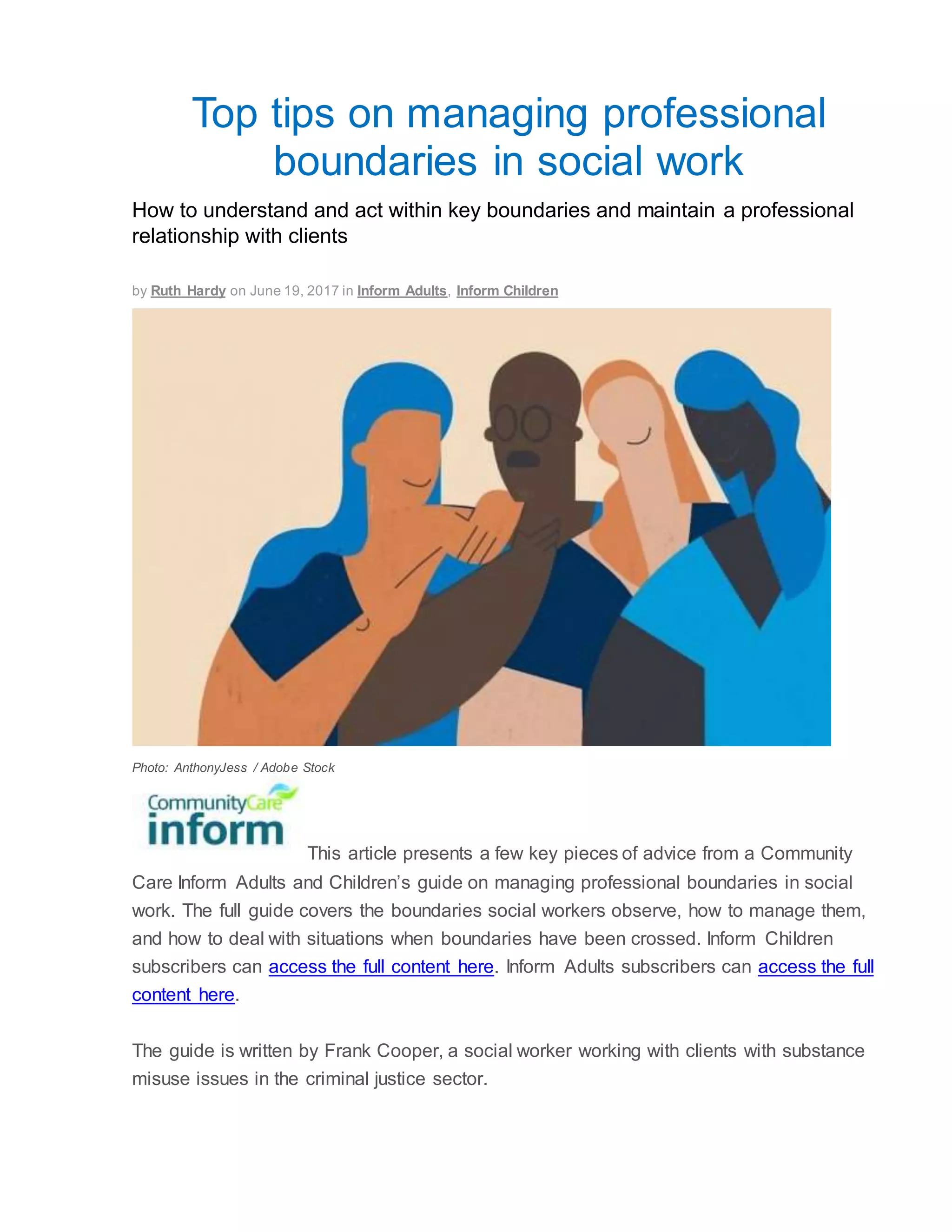
Photo: AnthonyJess / Adobe Stock
This article presents a few key pieces of advice from a Community
Care Inform Adults and Children’s guide on managing professional boundaries in social
work. The full guide covers the boundaries social workers observe, how to manage them,
and how to deal with situations when boundaries have been crossed. Inform Children
subscribers can access the full content here. Inform Adults subscribers can access the full
content here.
The guide is written by Frank Cooper, a social worker working with clients with substance
misuse issues in the criminal justice sector.
As with all professions, social workers are expected to uphold key boundaries to protect
themselves, their clients and the organisation they work for. These boundaries are meant
to ensure that relationships between social workers and clients remain professional, even
when working on very personal and difficult issues.
What are the boundaries?
These are a few of the major boundaries that may have implications for your practice and
behaviour:
1. Client focus. You are expected to place the needs of service users on your caseload at
the centre of any decisions that you make about them and their lives.
2. Self-disclosure. Information about yourself and your personal life should not be disclosed
to clients.
3. Dual relationships. You should not hold more than one type of relationship with a client,
for example, they cannot work for you, be a family member or receive extra private support
from you, as well as be one of your clients.
4. Working within your competence. It is important that you understand the limitations of
your role and of your personal capabilities, and when to refer to other professionals or to
seek further support and advice for yourself and your clients.
5. Looking after self. It is your responsibility to ensure that you are in a fit state to do the job
that you are required to do. This covers not only your behaviour outside work but also how
you manage your stress and emotions within work and caused by your work.
Crossing or breaking boundaries
The reality of work in the social care sector is that boundaries will get crossed at various
points for a variety of reasons, whether it is simple human error, tiredness, stress,
manipulation by clients, difficult situations, bad luck or just a bad day at the office. It is your
job to spot potential and actual boundary crossings and to take appropriate action.
A boundary crossing is usually part of a pattern or a build-up of behaviour between you and
your client. Much of the build-up may be internal for one, or both, of you. It is not practical
for us to challenge everything that a client says or does that might be a crossed boundary
and so we have to work in a world where we are essentially doing an ongoing dynamic risk
assessment of the situation, intervening where necessary.
Personal versus professional
The key to managing many of these boundaries is understanding the difference between a
professional and a personal relationship and ensuring that your behaviour always remains
on the right side of the line. Professional relationships are time bound; have a distinct role
and purpose; have some structure; one participant holds the power and is specifically
trained and supported for the role; there is a power imbalance in favour of the professional;
the professional has a responsibility for the welfare of the non-professional and there are
rules and boundaries that guide the relationship.
Once you have allowed a relationship to stray into some personal areas, it is much harder
for you to maintain other professional boundaries. You will also find that when you do
behave in a professional manner, clients will be surprised, unhappy and resentful as they
may have been expecting a personal response. You will also find that it may be much
harder for you to make the decisions that your role or your service requires you to make if
they are detrimental to the client.
You and your client need to be clear that you are not literally, potentially or figuratively their
friend, parent, partner or child, and it is your responsibility to ensure that this is not the
case.

Top tips on managing professional boundaries in Social Work

  • 1.
    Top tips onmanaging professional boundaries in social work How to understand and act within key boundaries and maintain a professional relationship with clients by Ruth Hardy on June 19, 2017 in Inform Adults, Inform Children Photo: AnthonyJess / Adobe Stock This article presents a few key pieces of advice from a Community Care Inform Adults and Children’s guide on managing professional boundaries in social work. The full guide covers the boundaries social workers observe, how to manage them, and how to deal with situations when boundaries have been crossed. Inform Children subscribers can access the full content here. Inform Adults subscribers can access the full content here. The guide is written by Frank Cooper, a social worker working with clients with substance misuse issues in the criminal justice sector.
  • 2.
    As with allprofessions, social workers are expected to uphold key boundaries to protect themselves, their clients and the organisation they work for. These boundaries are meant to ensure that relationships between social workers and clients remain professional, even when working on very personal and difficult issues. What are the boundaries? These are a few of the major boundaries that may have implications for your practice and behaviour: 1. Client focus. You are expected to place the needs of service users on your caseload at the centre of any decisions that you make about them and their lives. 2. Self-disclosure. Information about yourself and your personal life should not be disclosed to clients. 3. Dual relationships. You should not hold more than one type of relationship with a client, for example, they cannot work for you, be a family member or receive extra private support from you, as well as be one of your clients. 4. Working within your competence. It is important that you understand the limitations of your role and of your personal capabilities, and when to refer to other professionals or to seek further support and advice for yourself and your clients. 5. Looking after self. It is your responsibility to ensure that you are in a fit state to do the job that you are required to do. This covers not only your behaviour outside work but also how you manage your stress and emotions within work and caused by your work. Crossing or breaking boundaries The reality of work in the social care sector is that boundaries will get crossed at various points for a variety of reasons, whether it is simple human error, tiredness, stress, manipulation by clients, difficult situations, bad luck or just a bad day at the office. It is your job to spot potential and actual boundary crossings and to take appropriate action. A boundary crossing is usually part of a pattern or a build-up of behaviour between you and your client. Much of the build-up may be internal for one, or both, of you. It is not practical for us to challenge everything that a client says or does that might be a crossed boundary and so we have to work in a world where we are essentially doing an ongoing dynamic risk assessment of the situation, intervening where necessary. Personal versus professional The key to managing many of these boundaries is understanding the difference between a professional and a personal relationship and ensuring that your behaviour always remains on the right side of the line. Professional relationships are time bound; have a distinct role
  • 3.
    and purpose; havesome structure; one participant holds the power and is specifically trained and supported for the role; there is a power imbalance in favour of the professional; the professional has a responsibility for the welfare of the non-professional and there are rules and boundaries that guide the relationship. Once you have allowed a relationship to stray into some personal areas, it is much harder for you to maintain other professional boundaries. You will also find that when you do behave in a professional manner, clients will be surprised, unhappy and resentful as they may have been expecting a personal response. You will also find that it may be much harder for you to make the decisions that your role or your service requires you to make if they are detrimental to the client. You and your client need to be clear that you are not literally, potentially or figuratively their friend, parent, partner or child, and it is your responsibility to ensure that this is not the case.