Top School in Delhi NCR 
BY: 
SCHOOL.EDHOLE.COM
Binary Arithmetic 
MATH FOR COMPUTERS 
School.edhole.com
Huh? 
• Binary numbers are NUMBERS 
• That means you can add, subtract, multiply, and 
divide 
• 2 + 2 = 4 
• In Binary: 10 + 10 = 100 
• So you COULD just convert all numbers to decimal, 
do the math, and then convert the answer back… 
• But I don’t care about the math 
• I want you to understand how a computer does it! 
School.edhole.com
Addition 
Similar to addition of large decimal numbers 
You need to “carry” when a number gets too large for 
a single digit 
In binary, that’s 1 + 1 = 10 
carried bits 
(or 0, carry a 1) 
If you have 1 + 1 + 1 = 11 
11_ 
(or 1, carry a 1) 
11 0011 
+ 1011 
11 1110 
School.edhole.com
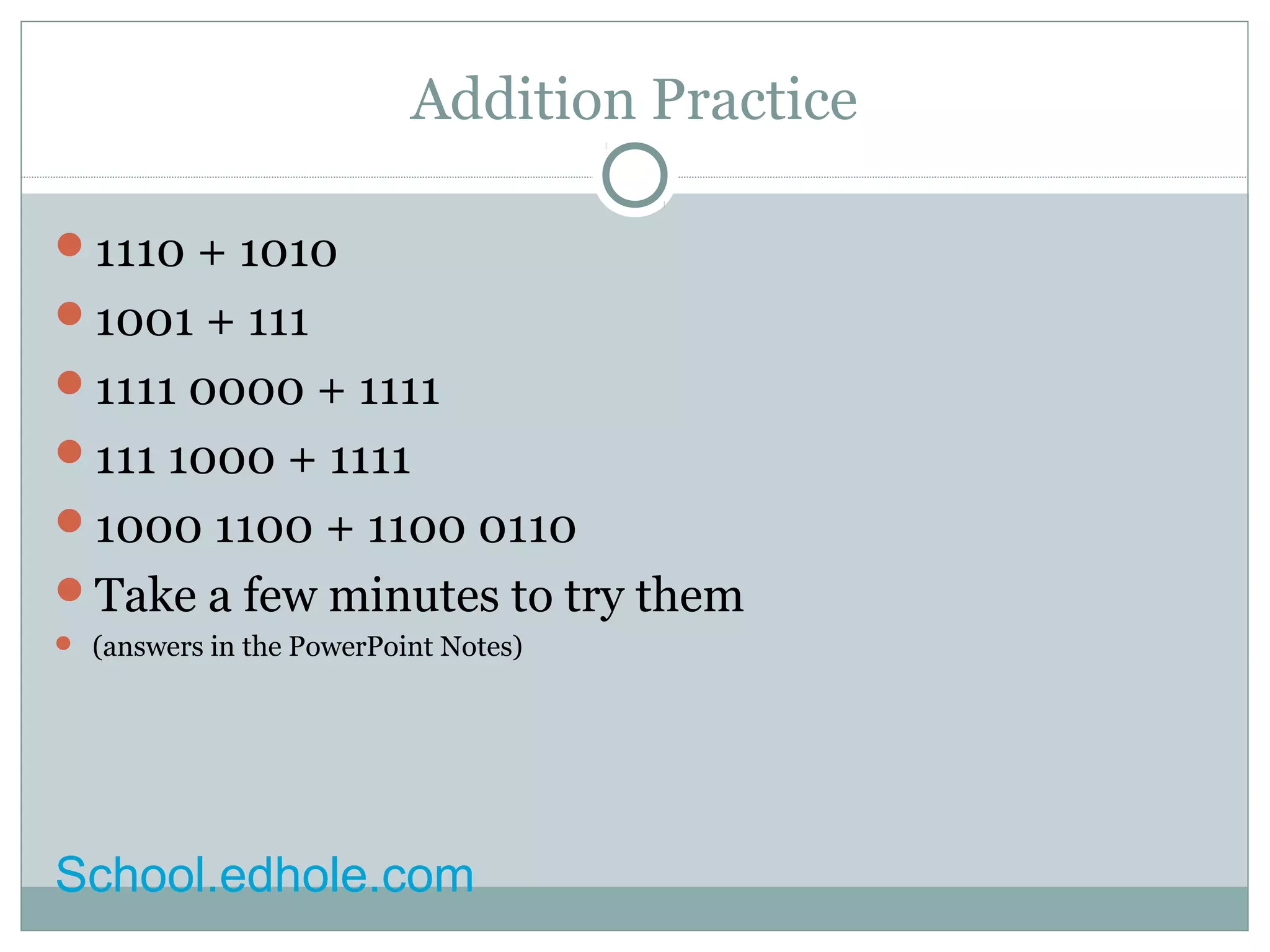
Addition Practice 
1110 + 1010 
1001 + 111 
1111 0000 + 1111 
111 1000 + 1111 
1000 1100 + 1100 0110 
Take a few minutes to try them 
 (answers in the PowerPoint Notes) 
School.edhole.com
Overflow 
1111 1111 + 100 = 1 0000 0011 
The answer is more than 1 byte large 
A computer typically will make it DROP THE 
EXTRA BIT ON THE LEFT 
The computer’s answer: 11 (binary) or 3 
(decimal) 
This is called an overflow error 
Sometimes overflow behavior is undefined 
(unpredictable) 
School.edhole.com
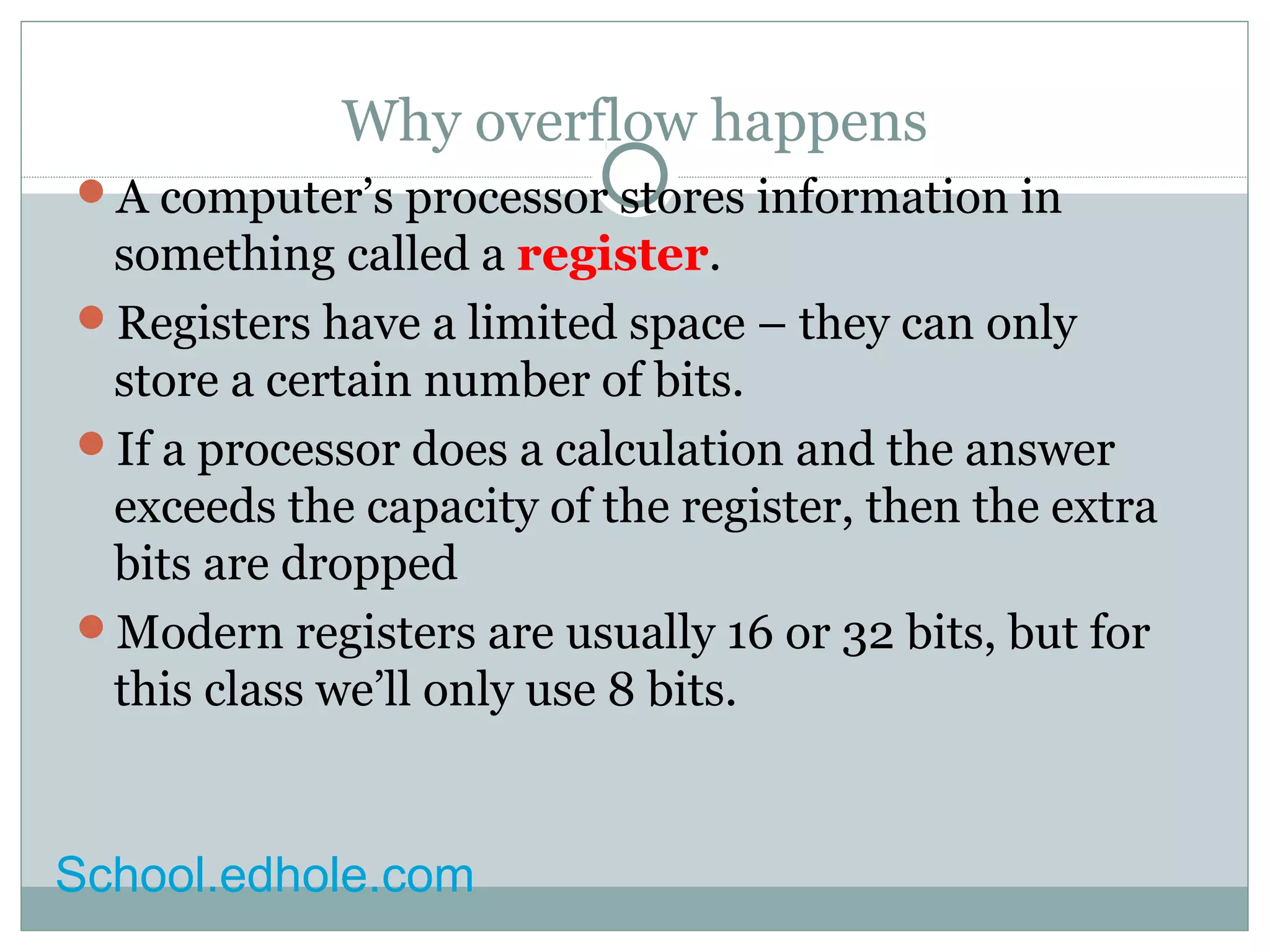
Why overflow happens 
A computer’s processor stores information in 
something called a register. 
Registers have a limited space – they can only 
store a certain number of bits. 
If a processor does a calculation and the answer 
exceeds the capacity of the register, then the extra 
bits are dropped 
Modern registers are usually 16 or 32 bits, but for 
this class we’ll only use 8 bits. 
School.edhole.com
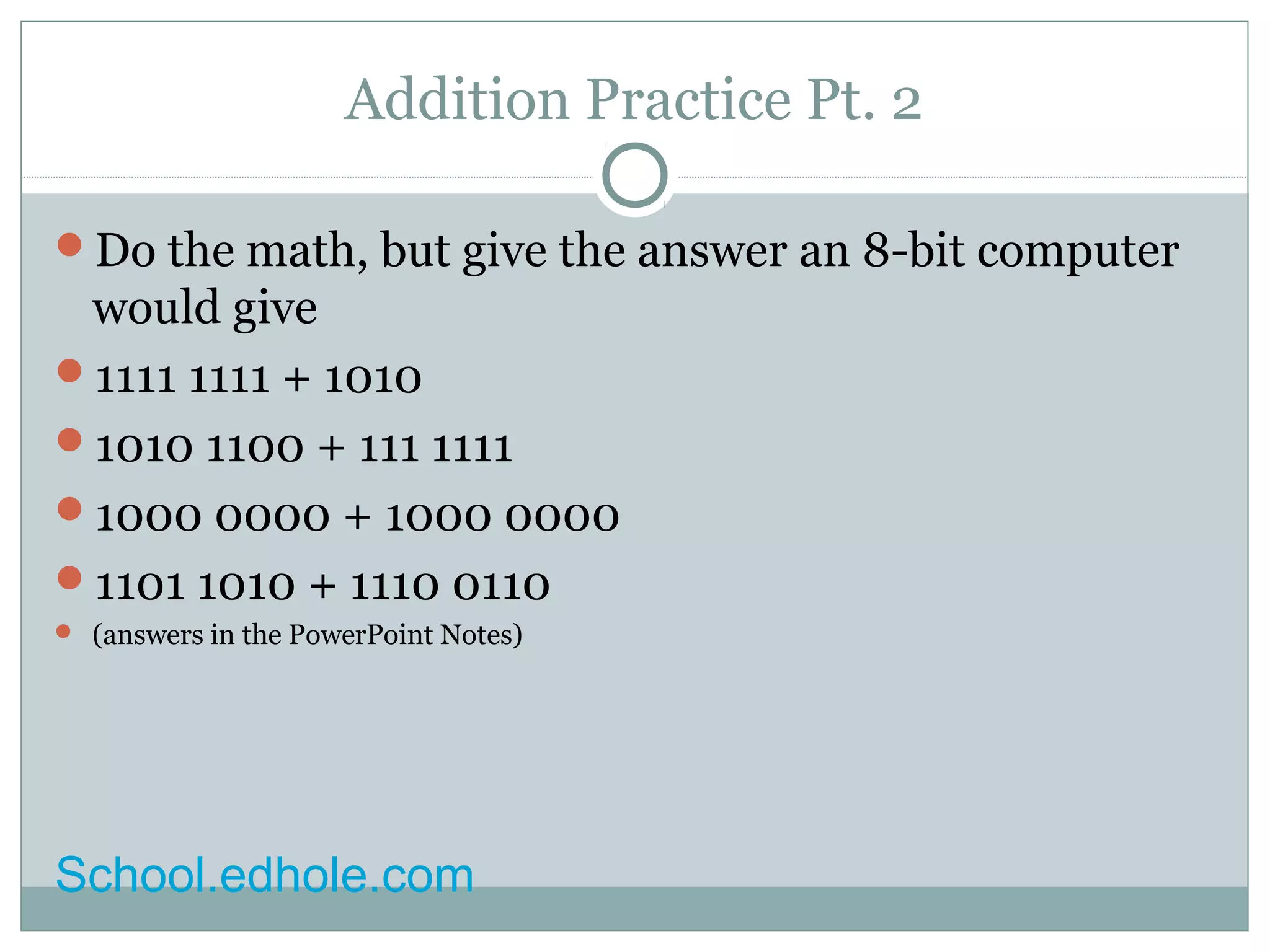
Addition Practice Pt. 2 
Do the math, but give the answer an 8-bit computer 
would give 
1111 1111 + 1010 
1010 1100 + 111 1111 
1000 0000 + 1000 0000 
1101 1010 + 1110 0110 
 (answers in the PowerPoint Notes) 
School.edhole.com
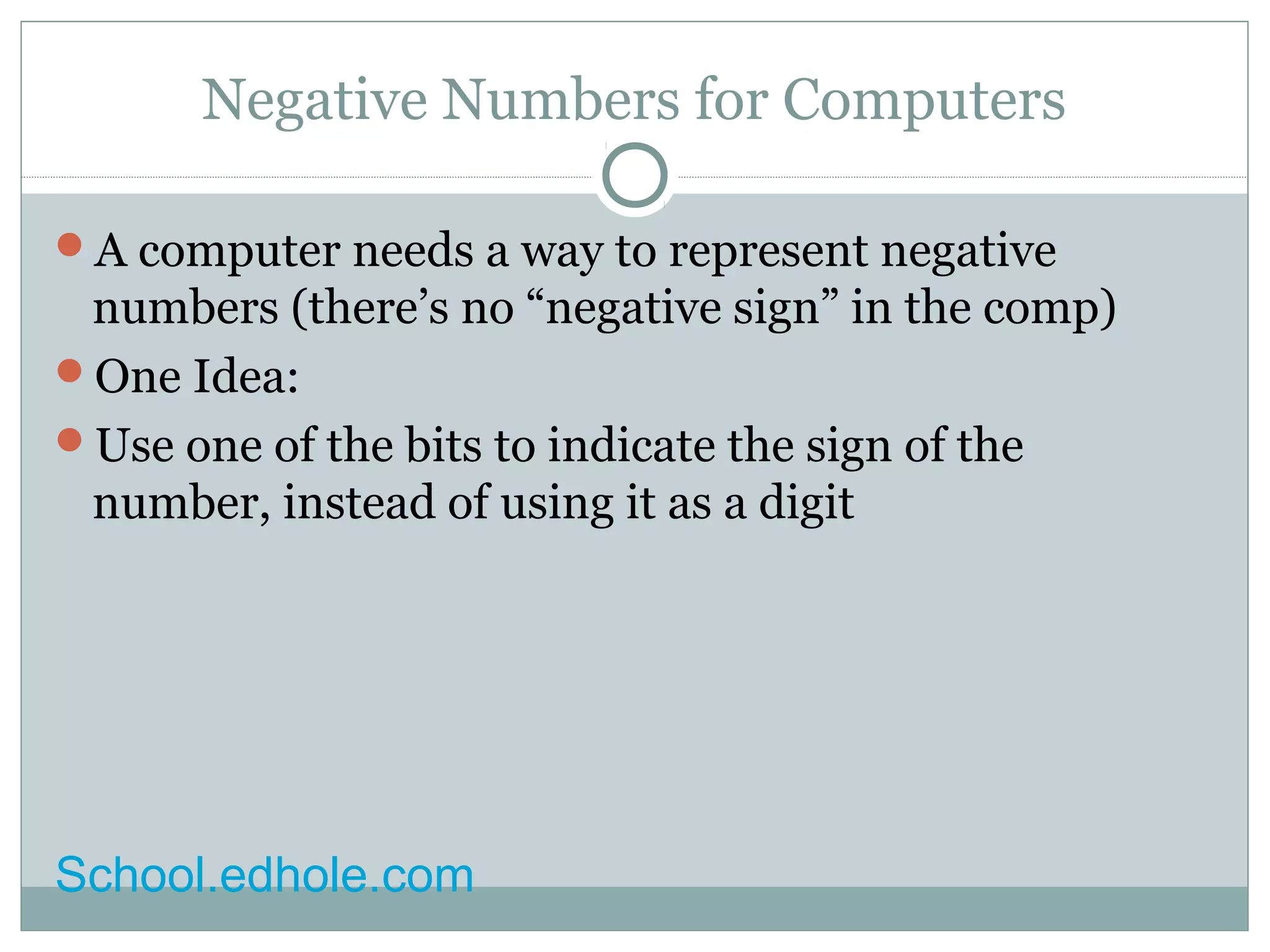
Negative Numbers for Computers 
A computer needs a way to represent negative 
numbers (there’s no “negative sign” in the comp) 
One Idea: 
Use one of the bits to indicate the sign of the 
number, instead of using it as a digit 
School.edhole.com
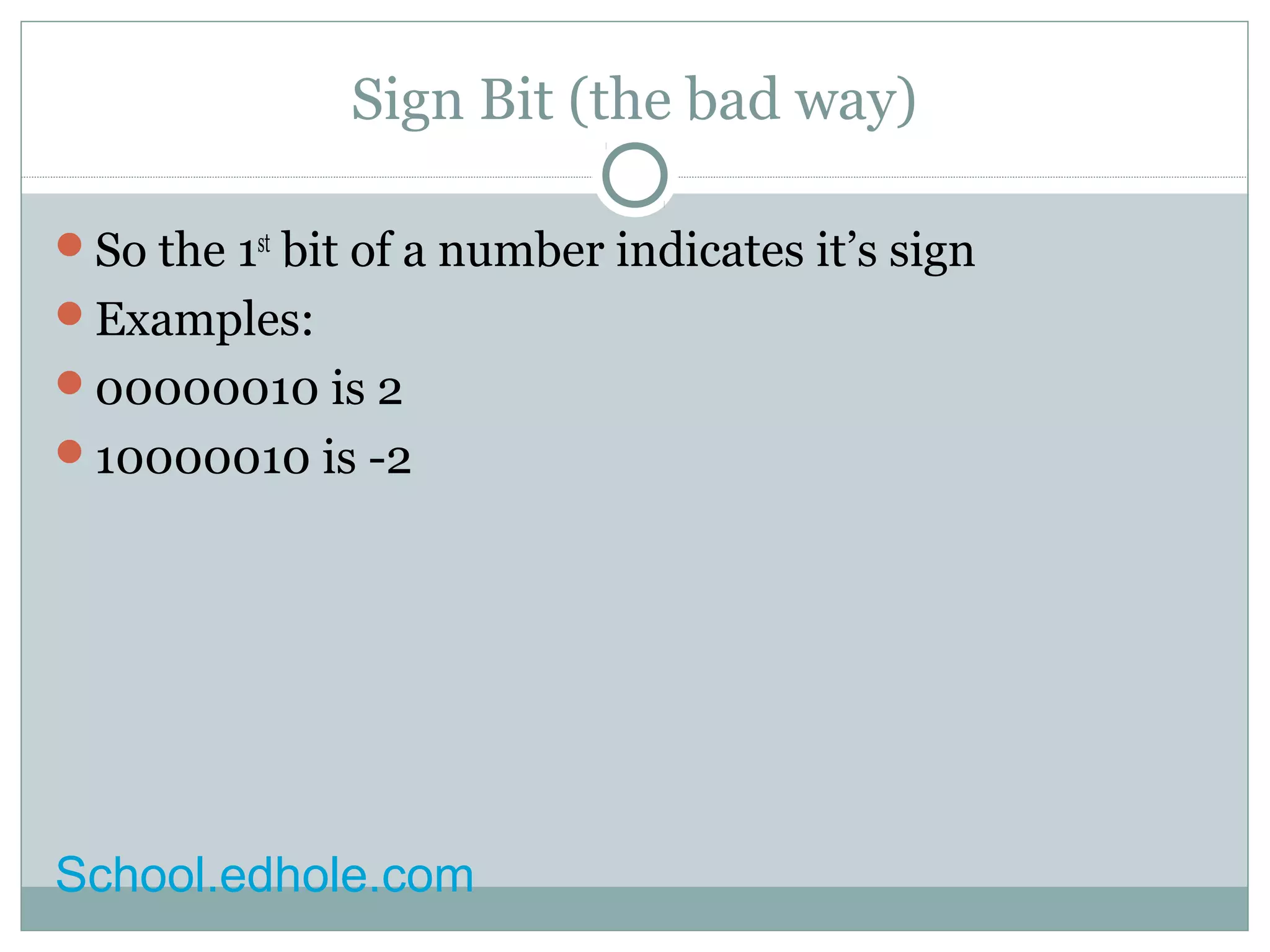
Sign Bit (the bad way) 
So the 1st bit of a number indicates it’s sign 
Examples: 
00000010 is 2 
10000010 is -2 
School.edhole.com
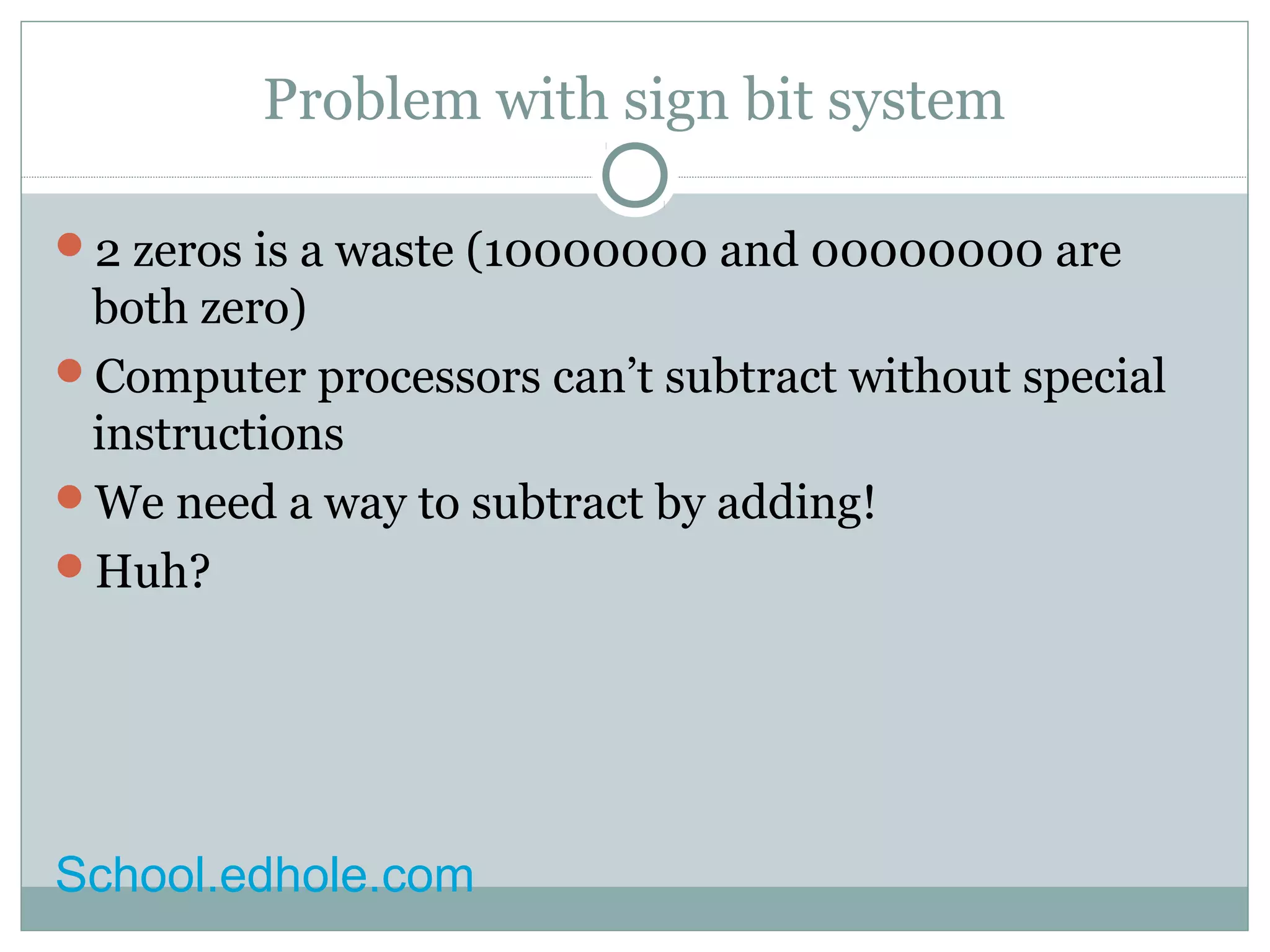
Problem with sign bit system 
2 zeros is a waste (10000000 and 00000000 are 
both zero) 
Computer processors can’t subtract without special 
instructions 
We need a way to subtract by adding! 
Huh? 
School.edhole.com
Twos Complement 
• Consider this idea: a binary digit “place value” 
could be negative! 
negative 
eights 
fours twos ones 
1 0 1 1 
• So the above number is actually 3 (the positive 
bits) minus 8 = -5 
• 1000 in the above system actually represents the 
decimal number -8 
• The example above is 4 bits. Most problems for this 
class will assume 8 bits. 
School.edhole.com
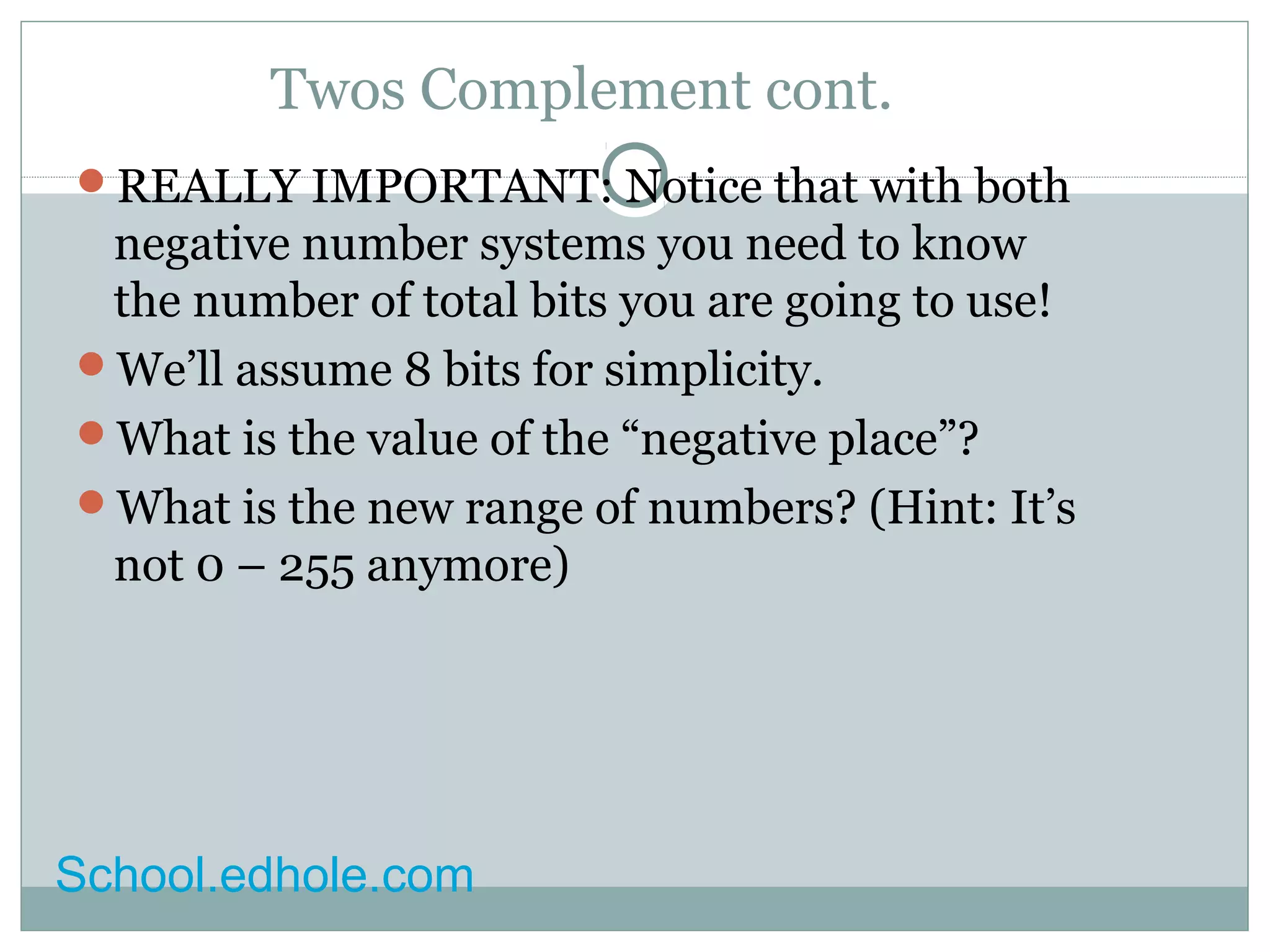
Twos Complement cont. 
REALLY IMPORTANT: Notice that with both 
negative number systems you need to know 
the number of total bits you are going to use! 
We’ll assume 8 bits for simplicity. 
What is the value of the “negative place”? 
What is the new range of numbers? (Hint: It’s 
not 0 – 255 anymore) 
School.edhole.com
Calculating Twos Complement 
• Example: -1 in (8-bit) twos complement is 
1111 1111 
• Still confused? 
• Remember, everything is the same except for 
a negative place value! 
-128 64 32 16 8 4 2 1 
1 1 1 1 1 1 1 1 
• -128 + 64 + 32 + 16 + 8 + 4 + 2 + 1 = -1 
• Btw, a “normal” binary number (where 1111 
1111 = 255) is called “unsigned” 
School.edhole.com
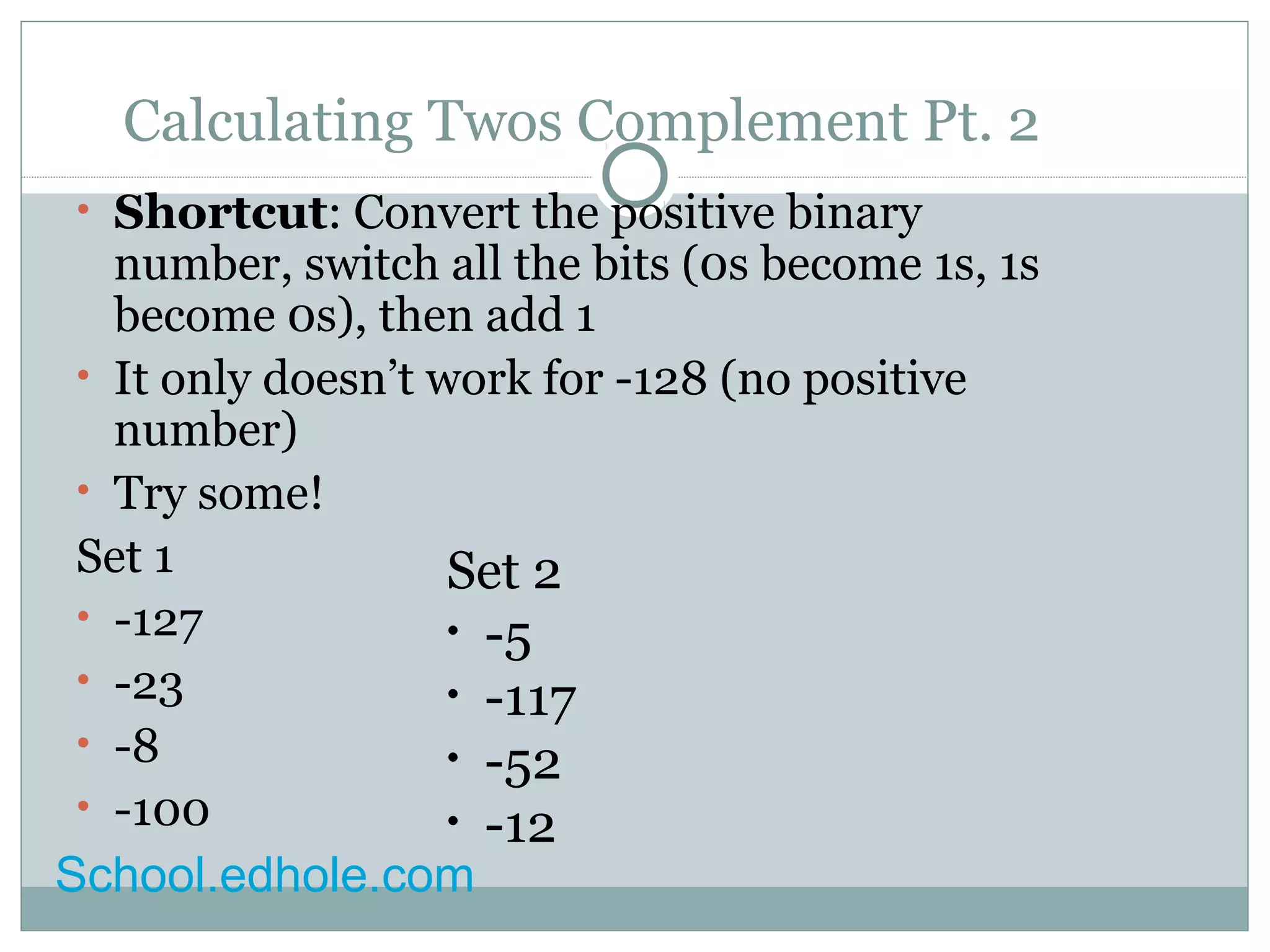
Calculating Twos Complement Pt. 2 
• Shortcut: Convert the positive binary 
number, switch all the bits (0s become 1s, 1s 
become 0s), then add 1 
• It only doesn’t work for -128 (no positive 
number) 
• Try some! 
Set 1 
• -127 
• -23 
• -8 
• -100 
Set 2 
• -5 
• -117 
• -52 
• -12 
School.edhole.com
Actually Subtracting, finally 
• Once you’ve got Twos Complement figured out, 
subtracting is IDENTICAL TO ADDING (but now 
using our twos complement numbers) 
• Example: Decimal 100 - 20 
• Binary: 0110 0100 - 0001 0100 
• 2s complement of 20: 1110 1100 
0110 0100 
+1110 1100 
1 0101 0000 
• Overflow bit is dropped, as usual 
• 0101 0000 is… 80 
• So this 2s complement system USES overflow 
School.edhole.com
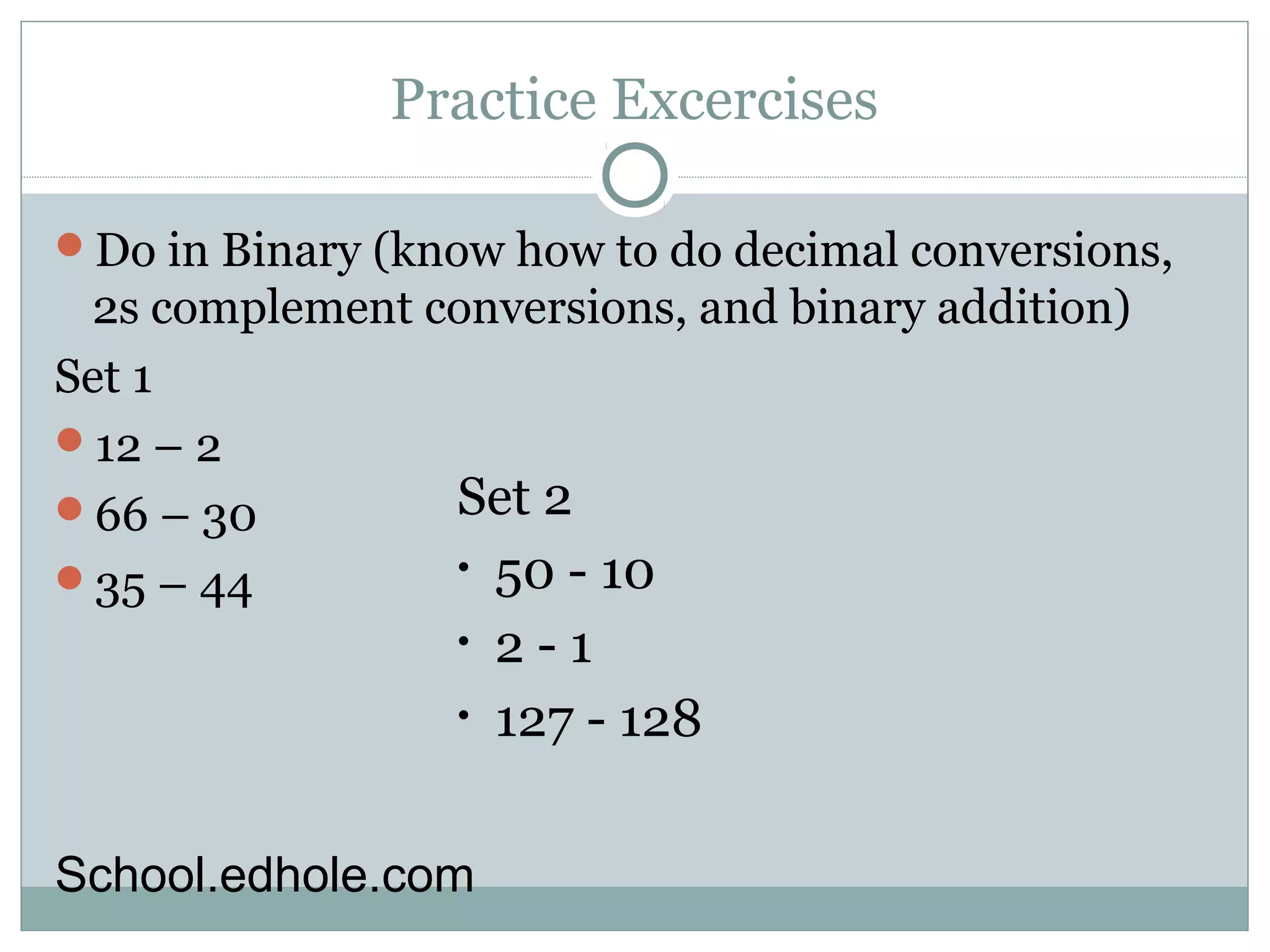
Practice Excercises 
Do in Binary (know how to do decimal conversions, 
2s complement conversions, and binary addition) 
Set 1 
12 – 2 
66 – 30 
35 – 44 
Set 2 
• 50 - 10 
• 2 - 1 
• 127 - 128 
School.edhole.com
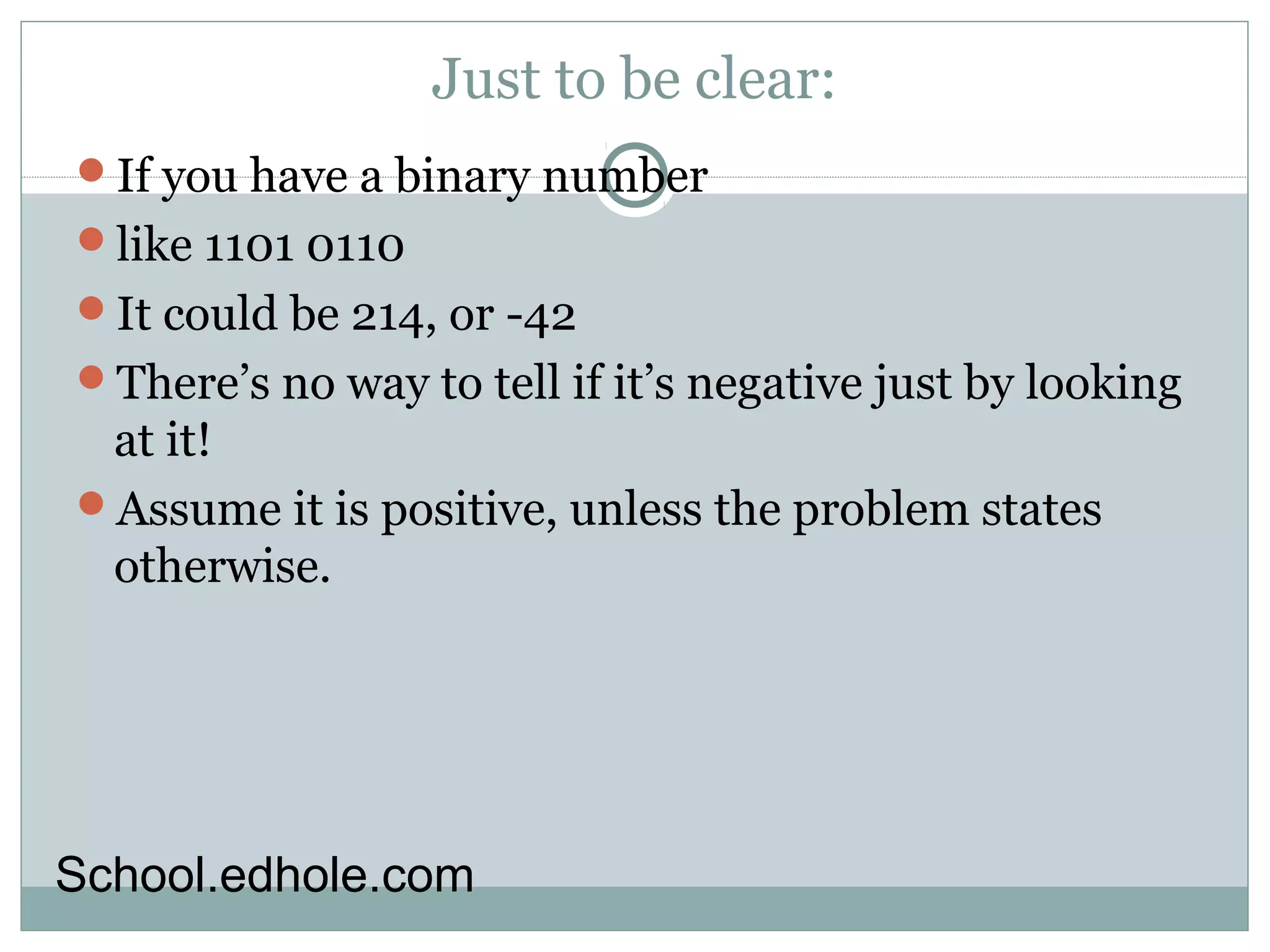
Just to be clear: 
If you have a binary number 
like 1101 0110 
It could be 214, or -42 
There’s no way to tell if it’s negative just by looking 
at it! 
Assume it is positive, unless the problem states 
otherwise. 
School.edhole.com
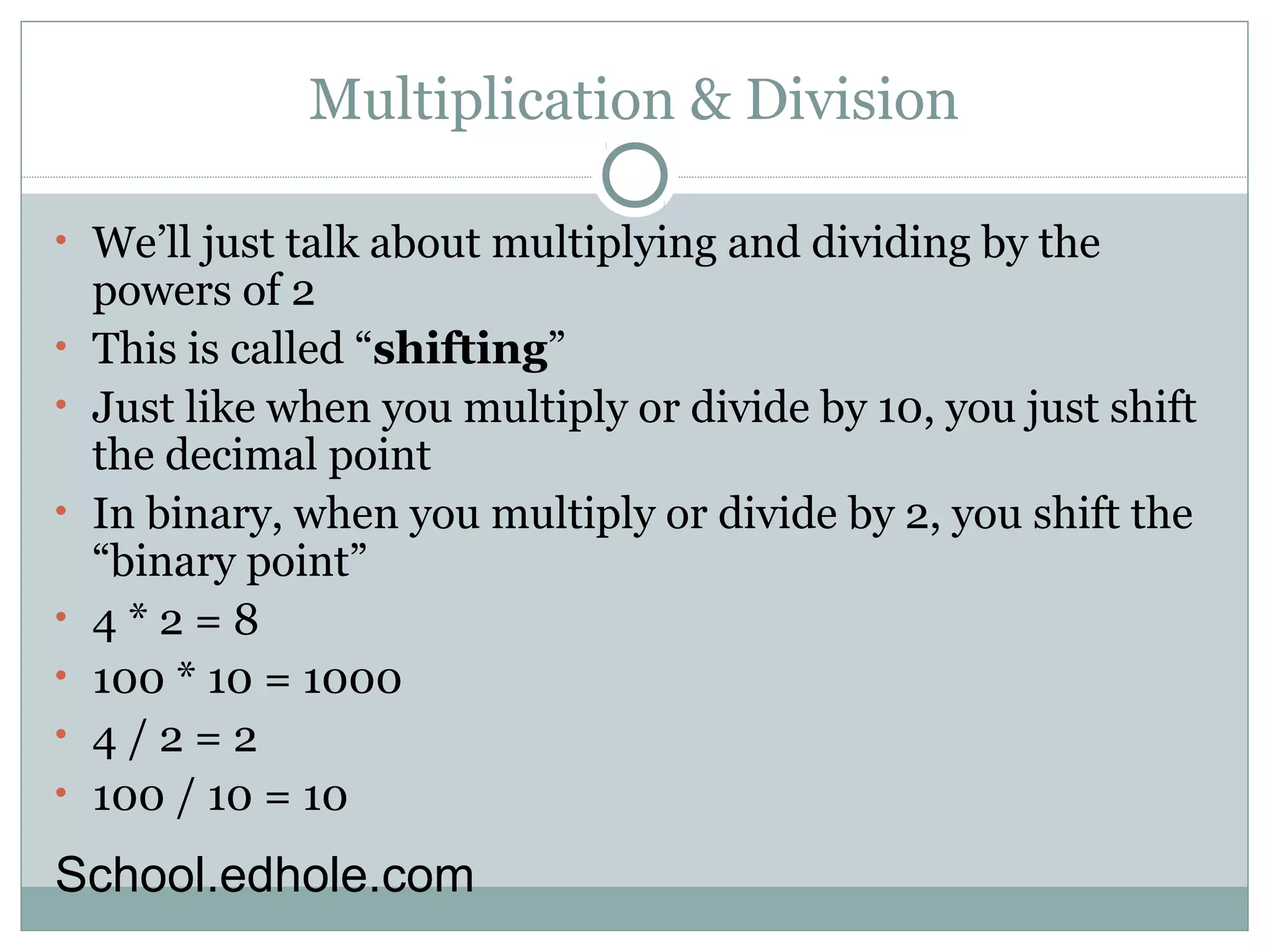
Multiplication & Division 
• We’ll just talk about multiplying and dividing by the 
powers of 2 
• This is called “shifting” 
• Just like when you multiply or divide by 10, you just shift 
the decimal point 
• In binary, when you multiply or divide by 2, you shift the 
“binary point” 
• 4 * 2 = 8 
• 100 * 10 = 1000 
• 4 / 2 = 2 
• 100 / 10 = 10 
School.edhole.com
Shifting Details 
• Multiplying can also be called left-shifting 
• Dividing: right-shifting 
• Left-Shifting can give you the overflow error 
• 1000 0000 * 10 = 1 0000 0000 
• For 2s complement negative numbers, 
overflow will give really weird results 
• Again, the leftmost bit is dropped 
• Right-shift is DIFFERENT FOR TWOS 
COMPLEMENT vs. unsigned binary numbers 
• Unsigned: shift in a 0 for the leftmost bit 
• 2s comp: shift School.edhole.co imn a COPY of the leftmost bit
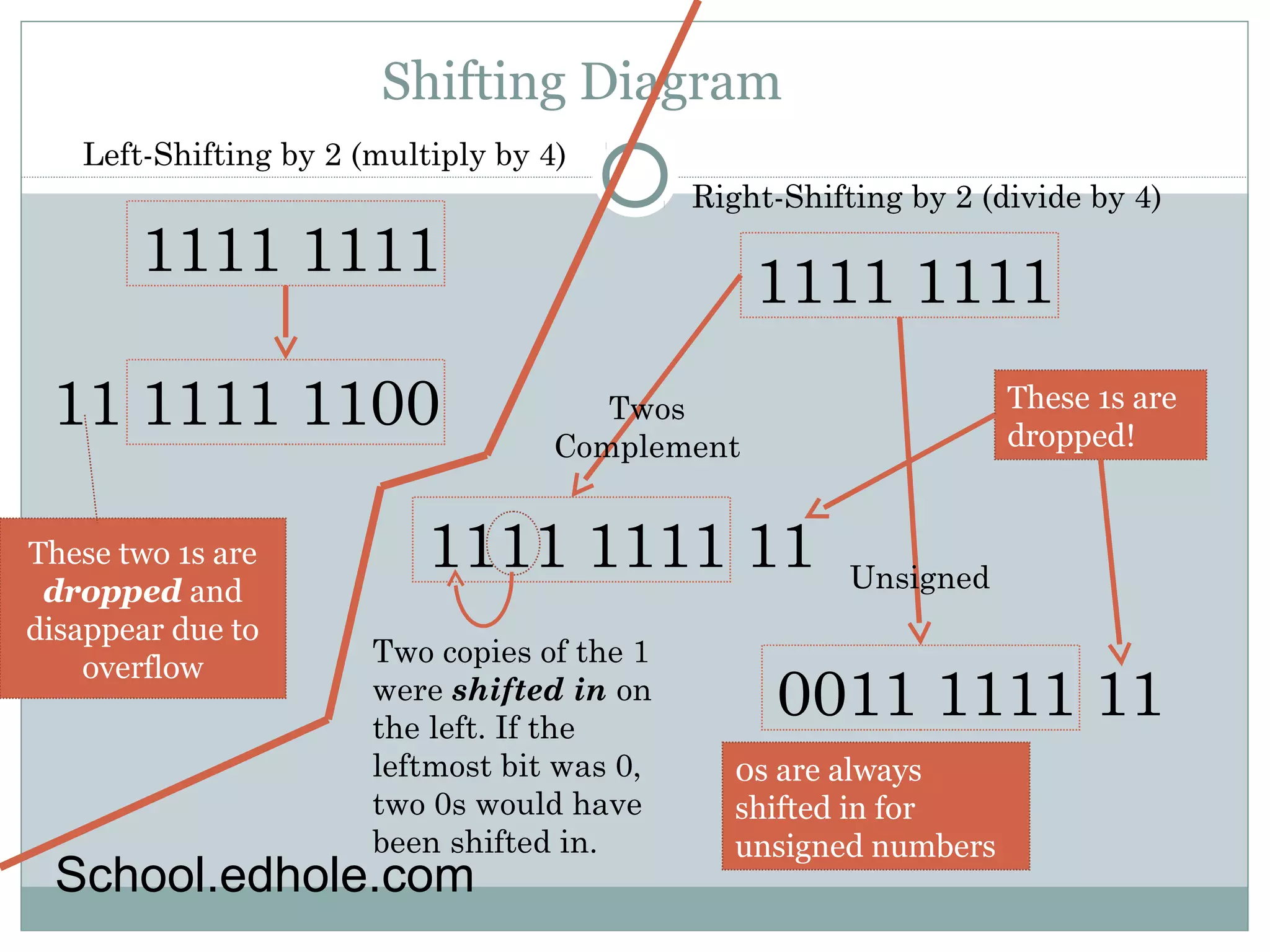
Shifting Diagram 
Left-Shifting by 2 (multiply by 4) 
1111 1111 
11 1111 1100 
These two 1s are 
dropped and 
disappear due to 
overflow 
Right-Shifting by 2 (divide by 4) 
1111 1111 
1111 1111 11 
0011 1111 11 
Twos 
Complement 
Unsigned 
Two copies of the 1 
were shifted in on 
the left. If the 
leftmost bit was 0, 
two 0s would have 
been shifted in. 
0s are always 
shifted in for 
unsigned numbers 
These 1s are 
dropped! 
School.edhole.com
More Shifting Examples 
Unsigned numbers 
1011 0111 * 10 = 0110 1110 (overflow) 
1111 1111 * 100 = 1111 1100 (overflow) 
0001 1111 * 1000 = 1111 1000 
1000 0000 / 1 0000 = 0000 1000 
0011 0010 / 10 = 0001 1001 
0001 0011 / 100 = 0000 0100 (?????) 
19 / 4 = 4 
So when you divide, you lose precision 
(the computer will drop bits that go off 
the right side – this means the answer 
is always rounded down towards -∞) 
Twos Complement 
1111 1111 * 10 = 1111 1110 
1000 0001 * 10 = 0000 0010 (overflow!) 
-127 * 2 = 2…? 
1001 1100 / 100 = 1110 0111 
Instead of 0s, 1s 
were shifted in on 
the left because 
that was the 
leftmost bit of the 
original byte 
School.edhole.com
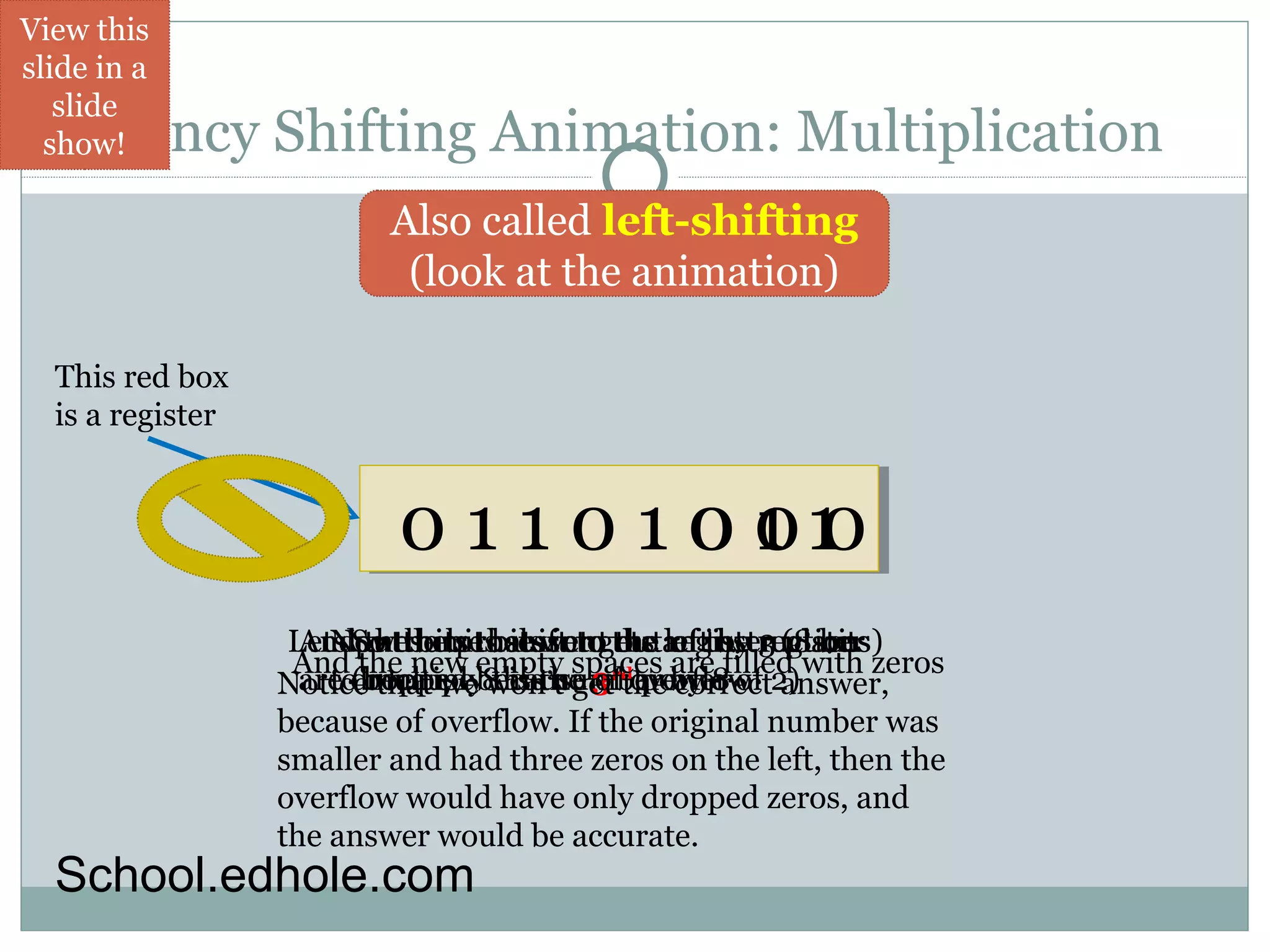
Fancy Shifting Animation: Multiplication 
Also called left-shifting 
(look at the animation) 
This red box 
is a register 
0 1 1 0 1 0 1 1 
0 0 
Lets And Now So put the the the some bits bits processor that bits shift went into to gets the out an left register of instruction 
the by register 
3 (places 
8 bits) 
And are to der (the because multiply tohpapt new ewde empty b 8 wecoanu’ts this is the number spaces eg eotf 3rd ohvee power by are croflrorwect 8 
filled of 2) 
with zeros 
Notic t answer, 
because of overflow. If the original number was 
smaller and had three zeros on the left, then the 
overflow would have only dropped zeros, and 
the answer would be accurate. 
View this 
slide in a 
slide 
show! 
School.edhole.com
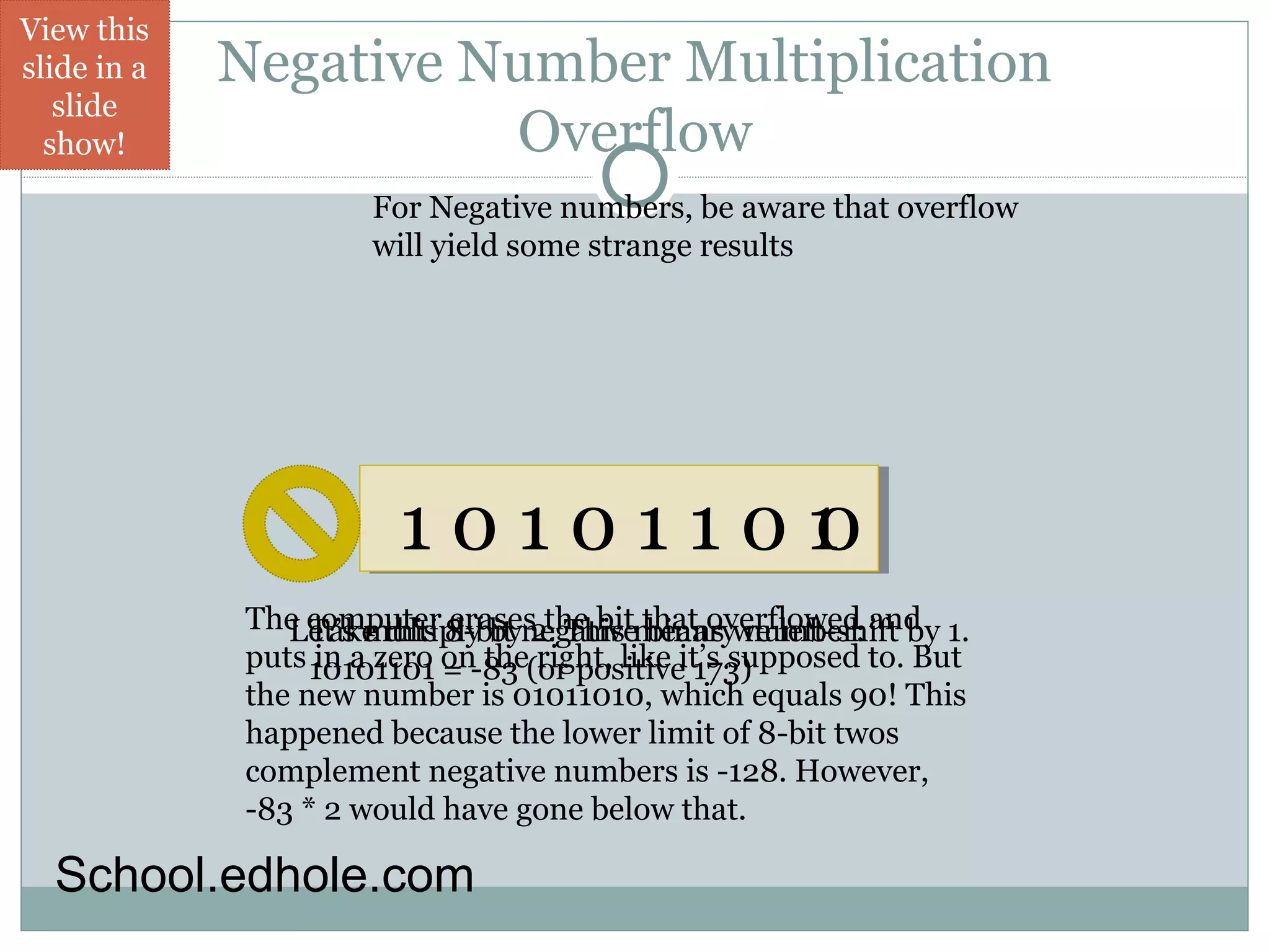
Negative Number Multiplication 
Overflow 
For Negative numbers, be aware that overflow 
will yield some strange results 
1 0 1 0 1 1 0 1 
0 
The computer erases the bit that overflowed and 
puts in a zero on the right, like it’s supposed to. But 
the new number is 01011010, which equals 90! This 
happened because the lower limit of 8-bit twos 
complement negative numbers is -128. However, 
-83 * 2 would have gone below that. 
Let’s multiply by 2. This means we left-shift by 1. 
Take this 8-bit negative binary number: 
10101101 = -83 (or positive 173) 
View this 
slide in a 
slide 
show! 
School.edhole.com
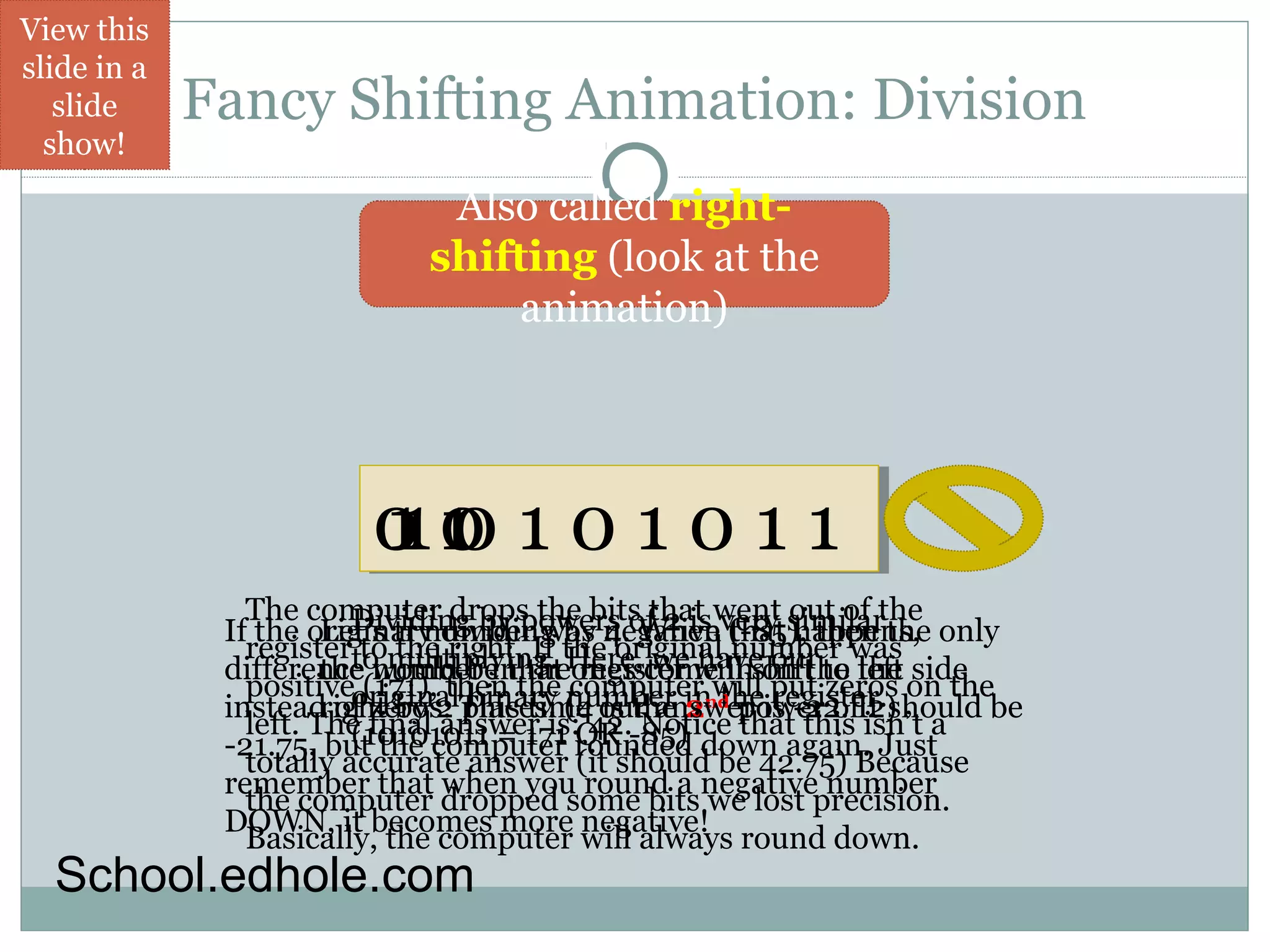
Fancy Shifting Animation: Division 
Also called right-shifting 
(look at the 
animation) 
0 1 1 
0 
1 0 1 0 1 0 1 1 
The computer Dividing drops by powers the bits of that 2 is went very similar 
out of the 
register to to multiplying. the right. If the Here, original we have number our 
was 
positive original (171), then binary the number computer in will the put register. 
zeros on the 
left. The (10101011 final answer = 171 is: OR 42. -Notice 85) 
that this isn’t a 
totally accurate answer (it should be 42.75) Because 
the computer dropped some bits we lost precision. 
Basically, the computer will always round down. 
View this 
slide in a 
slide 
show! 
If the original Let’s try number dividing was by negative 4. When (-that 85), happens, 
then the only 
difference the number would be in that the ones register come will in shift on the to the 
left side 
instead right of zeros. by 2 This places. time (4 our is the answer 2nd power is -22. of It 2) 
should be 
-21.75, but the computer rounded down again. Just 
remember that when you round a negative number 
DOWN, it becomes more negative! 
School.edhole.com
Microsoft Calculator 
It’s actually useful for this binary stuff 
Use it to double-check and test yourself 
Put it into Scientific mode (under view) and you’ll see 
buttons for decimal, binary, hex, and octal 
School.edhole.com
Calculator Cont. 
• If you click on the decimal (Dec) button and 
then enter a negative decimal number, then 
click the Binary (Bin) button, you’ll see that 
negative number in Twos Complement form 
• If you do any arithmetic in Binary, and the 
Byte button is activated, you’ll see the 
“computer’s answer” (overflow) 
• You can then click over to Decimal to see what 
that number would be 
School.edhole.com
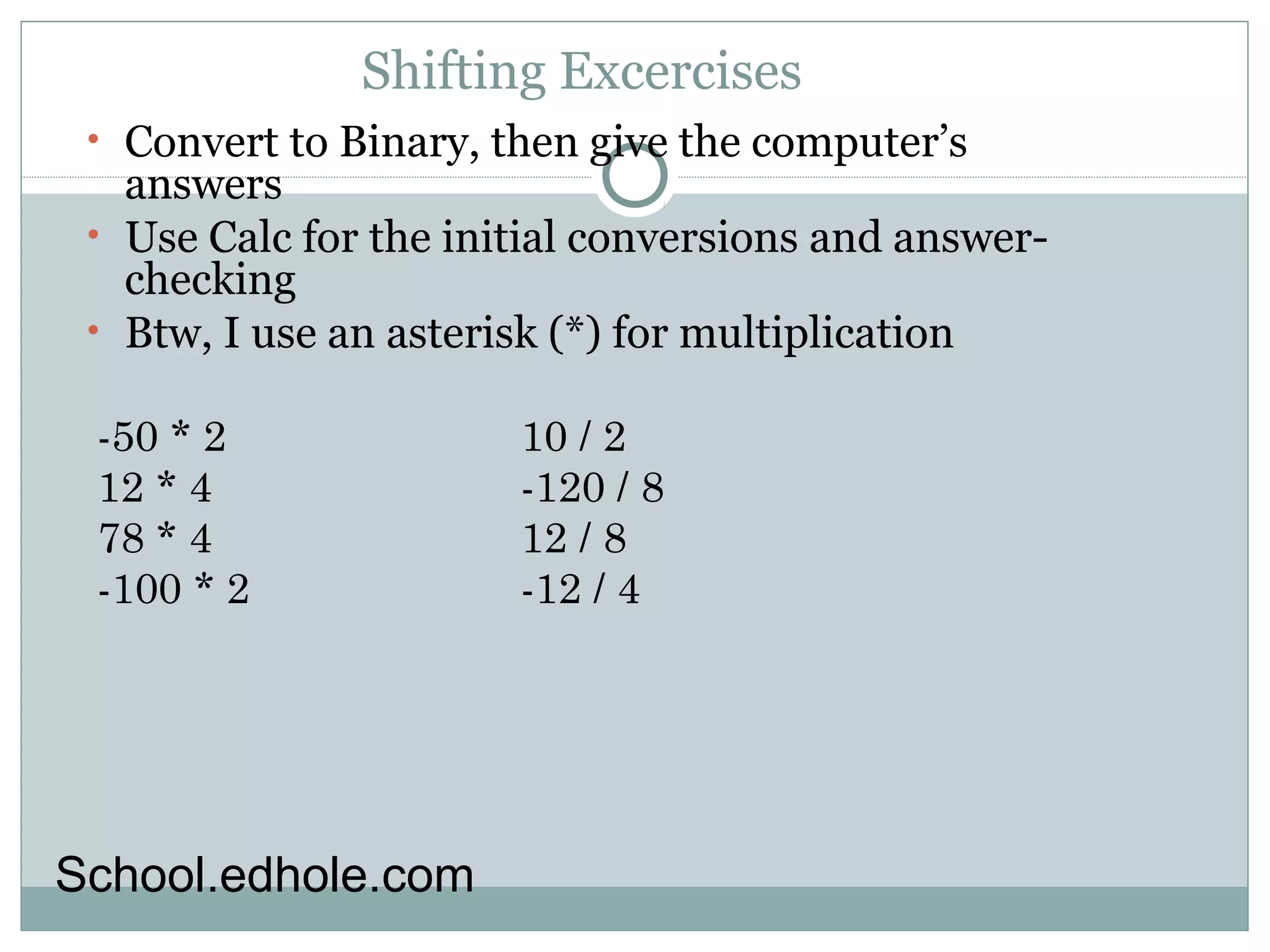
Shifting Excercises 
• Convert to Binary, then give the computer’s 
answers 
• Use Calc for the initial conversions and answer-checking 
• Btw, I use an asterisk (*) for multiplication 
-50 * 2 
10 / 2 
12 * 4 
-120 / 8 
78 * 4 
12 / 8 
-100 * 2 
-12 / 4 
School.edhole.com
Restating the Obvious 
The MATH ISN’T IMPORTANT. I can get the 
answers from a calculator. 
Understanding these processes gives you an idea of 
how the computer works. 
If the only thing you understand is that computers 
are actually pretty simple machines that need lots 
of instructions to work properly, then you’re doing 
pretty good (ok, you won’t so well on the test if you 
can’t do the calculations, but at least you have the 
general idea) 
School.edhole.com

Top schools in delhi ncr

  • 1.
    Top School inDelhi NCR BY: SCHOOL.EDHOLE.COM
  • 2.
    Binary Arithmetic MATHFOR COMPUTERS School.edhole.com
  • 3.
    Huh? • Binarynumbers are NUMBERS • That means you can add, subtract, multiply, and divide • 2 + 2 = 4 • In Binary: 10 + 10 = 100 • So you COULD just convert all numbers to decimal, do the math, and then convert the answer back… • But I don’t care about the math • I want you to understand how a computer does it! School.edhole.com
  • 4.
    Addition Similar toaddition of large decimal numbers You need to “carry” when a number gets too large for a single digit In binary, that’s 1 + 1 = 10 carried bits (or 0, carry a 1) If you have 1 + 1 + 1 = 11 11_ (or 1, carry a 1) 11 0011 + 1011 11 1110 School.edhole.com
  • 5.
    Addition Practice 1110+ 1010 1001 + 111 1111 0000 + 1111 111 1000 + 1111 1000 1100 + 1100 0110 Take a few minutes to try them  (answers in the PowerPoint Notes) School.edhole.com
  • 6.
    Overflow 1111 1111+ 100 = 1 0000 0011 The answer is more than 1 byte large A computer typically will make it DROP THE EXTRA BIT ON THE LEFT The computer’s answer: 11 (binary) or 3 (decimal) This is called an overflow error Sometimes overflow behavior is undefined (unpredictable) School.edhole.com
  • 7.
    Why overflow happens A computer’s processor stores information in something called a register. Registers have a limited space – they can only store a certain number of bits. If a processor does a calculation and the answer exceeds the capacity of the register, then the extra bits are dropped Modern registers are usually 16 or 32 bits, but for this class we’ll only use 8 bits. School.edhole.com
  • 8.
    Addition Practice Pt.2 Do the math, but give the answer an 8-bit computer would give 1111 1111 + 1010 1010 1100 + 111 1111 1000 0000 + 1000 0000 1101 1010 + 1110 0110  (answers in the PowerPoint Notes) School.edhole.com
  • 9.
    Negative Numbers forComputers A computer needs a way to represent negative numbers (there’s no “negative sign” in the comp) One Idea: Use one of the bits to indicate the sign of the number, instead of using it as a digit School.edhole.com
  • 10.
    Sign Bit (thebad way) So the 1st bit of a number indicates it’s sign Examples: 00000010 is 2 10000010 is -2 School.edhole.com
  • 11.
    Problem with signbit system 2 zeros is a waste (10000000 and 00000000 are both zero) Computer processors can’t subtract without special instructions We need a way to subtract by adding! Huh? School.edhole.com
  • 12.
    Twos Complement •Consider this idea: a binary digit “place value” could be negative! negative eights fours twos ones 1 0 1 1 • So the above number is actually 3 (the positive bits) minus 8 = -5 • 1000 in the above system actually represents the decimal number -8 • The example above is 4 bits. Most problems for this class will assume 8 bits. School.edhole.com
  • 13.
    Twos Complement cont. REALLY IMPORTANT: Notice that with both negative number systems you need to know the number of total bits you are going to use! We’ll assume 8 bits for simplicity. What is the value of the “negative place”? What is the new range of numbers? (Hint: It’s not 0 – 255 anymore) School.edhole.com
  • 14.
    Calculating Twos Complement • Example: -1 in (8-bit) twos complement is 1111 1111 • Still confused? • Remember, everything is the same except for a negative place value! -128 64 32 16 8 4 2 1 1 1 1 1 1 1 1 1 • -128 + 64 + 32 + 16 + 8 + 4 + 2 + 1 = -1 • Btw, a “normal” binary number (where 1111 1111 = 255) is called “unsigned” School.edhole.com
  • 15.
    Calculating Twos ComplementPt. 2 • Shortcut: Convert the positive binary number, switch all the bits (0s become 1s, 1s become 0s), then add 1 • It only doesn’t work for -128 (no positive number) • Try some! Set 1 • -127 • -23 • -8 • -100 Set 2 • -5 • -117 • -52 • -12 School.edhole.com
  • 16.
    Actually Subtracting, finally • Once you’ve got Twos Complement figured out, subtracting is IDENTICAL TO ADDING (but now using our twos complement numbers) • Example: Decimal 100 - 20 • Binary: 0110 0100 - 0001 0100 • 2s complement of 20: 1110 1100 0110 0100 +1110 1100 1 0101 0000 • Overflow bit is dropped, as usual • 0101 0000 is… 80 • So this 2s complement system USES overflow School.edhole.com
  • 17.
    Practice Excercises Doin Binary (know how to do decimal conversions, 2s complement conversions, and binary addition) Set 1 12 – 2 66 – 30 35 – 44 Set 2 • 50 - 10 • 2 - 1 • 127 - 128 School.edhole.com
  • 18.
    Just to beclear: If you have a binary number like 1101 0110 It could be 214, or -42 There’s no way to tell if it’s negative just by looking at it! Assume it is positive, unless the problem states otherwise. School.edhole.com
  • 19.
    Multiplication & Division • We’ll just talk about multiplying and dividing by the powers of 2 • This is called “shifting” • Just like when you multiply or divide by 10, you just shift the decimal point • In binary, when you multiply or divide by 2, you shift the “binary point” • 4 * 2 = 8 • 100 * 10 = 1000 • 4 / 2 = 2 • 100 / 10 = 10 School.edhole.com
  • 20.
    Shifting Details •Multiplying can also be called left-shifting • Dividing: right-shifting • Left-Shifting can give you the overflow error • 1000 0000 * 10 = 1 0000 0000 • For 2s complement negative numbers, overflow will give really weird results • Again, the leftmost bit is dropped • Right-shift is DIFFERENT FOR TWOS COMPLEMENT vs. unsigned binary numbers • Unsigned: shift in a 0 for the leftmost bit • 2s comp: shift School.edhole.co imn a COPY of the leftmost bit
  • 21.
    Shifting Diagram Left-Shiftingby 2 (multiply by 4) 1111 1111 11 1111 1100 These two 1s are dropped and disappear due to overflow Right-Shifting by 2 (divide by 4) 1111 1111 1111 1111 11 0011 1111 11 Twos Complement Unsigned Two copies of the 1 were shifted in on the left. If the leftmost bit was 0, two 0s would have been shifted in. 0s are always shifted in for unsigned numbers These 1s are dropped! School.edhole.com
  • 22.
    More Shifting Examples Unsigned numbers 1011 0111 * 10 = 0110 1110 (overflow) 1111 1111 * 100 = 1111 1100 (overflow) 0001 1111 * 1000 = 1111 1000 1000 0000 / 1 0000 = 0000 1000 0011 0010 / 10 = 0001 1001 0001 0011 / 100 = 0000 0100 (?????) 19 / 4 = 4 So when you divide, you lose precision (the computer will drop bits that go off the right side – this means the answer is always rounded down towards -∞) Twos Complement 1111 1111 * 10 = 1111 1110 1000 0001 * 10 = 0000 0010 (overflow!) -127 * 2 = 2…? 1001 1100 / 100 = 1110 0111 Instead of 0s, 1s were shifted in on the left because that was the leftmost bit of the original byte School.edhole.com
  • 23.
    Fancy Shifting Animation:Multiplication Also called left-shifting (look at the animation) This red box is a register 0 1 1 0 1 0 1 1 0 0 Lets And Now So put the the the some bits bits processor that bits shift went into to gets the out an left register of instruction the by register 3 (places 8 bits) And are to der (the because multiply tohpapt new ewde empty b 8 wecoanu’ts this is the number spaces eg eotf 3rd ohvee power by are croflrorwect 8 filled of 2) with zeros Notic t answer, because of overflow. If the original number was smaller and had three zeros on the left, then the overflow would have only dropped zeros, and the answer would be accurate. View this slide in a slide show! School.edhole.com
  • 24.
    Negative Number Multiplication Overflow For Negative numbers, be aware that overflow will yield some strange results 1 0 1 0 1 1 0 1 0 The computer erases the bit that overflowed and puts in a zero on the right, like it’s supposed to. But the new number is 01011010, which equals 90! This happened because the lower limit of 8-bit twos complement negative numbers is -128. However, -83 * 2 would have gone below that. Let’s multiply by 2. This means we left-shift by 1. Take this 8-bit negative binary number: 10101101 = -83 (or positive 173) View this slide in a slide show! School.edhole.com
  • 25.
    Fancy Shifting Animation:Division Also called right-shifting (look at the animation) 0 1 1 0 1 0 1 0 1 0 1 1 The computer Dividing drops by powers the bits of that 2 is went very similar out of the register to to multiplying. the right. If the Here, original we have number our was positive original (171), then binary the number computer in will the put register. zeros on the left. The (10101011 final answer = 171 is: OR 42. -Notice 85) that this isn’t a totally accurate answer (it should be 42.75) Because the computer dropped some bits we lost precision. Basically, the computer will always round down. View this slide in a slide show! If the original Let’s try number dividing was by negative 4. When (-that 85), happens, then the only difference the number would be in that the ones register come will in shift on the to the left side instead right of zeros. by 2 This places. time (4 our is the answer 2nd power is -22. of It 2) should be -21.75, but the computer rounded down again. Just remember that when you round a negative number DOWN, it becomes more negative! School.edhole.com
  • 26.
    Microsoft Calculator It’sactually useful for this binary stuff Use it to double-check and test yourself Put it into Scientific mode (under view) and you’ll see buttons for decimal, binary, hex, and octal School.edhole.com
  • 27.
    Calculator Cont. •If you click on the decimal (Dec) button and then enter a negative decimal number, then click the Binary (Bin) button, you’ll see that negative number in Twos Complement form • If you do any arithmetic in Binary, and the Byte button is activated, you’ll see the “computer’s answer” (overflow) • You can then click over to Decimal to see what that number would be School.edhole.com
  • 28.
    Shifting Excercises •Convert to Binary, then give the computer’s answers • Use Calc for the initial conversions and answer-checking • Btw, I use an asterisk (*) for multiplication -50 * 2 10 / 2 12 * 4 -120 / 8 78 * 4 12 / 8 -100 * 2 -12 / 4 School.edhole.com
  • 29.
    Restating the Obvious The MATH ISN’T IMPORTANT. I can get the answers from a calculator. Understanding these processes gives you an idea of how the computer works. If the only thing you understand is that computers are actually pretty simple machines that need lots of instructions to work properly, then you’re doing pretty good (ok, you won’t so well on the test if you can’t do the calculations, but at least you have the general idea) School.edhole.com

Editor's Notes

  • #6 1110 + 1010 = 1 1000, 1001 + 111 = 1 0000, 1111 0000 + 1111 = 1111 1111, 111 1000 + 1111 = 10000111, 1000 1100 + 1100 0110 = 101010010
  • #9 1001, 10 1011, 0 , 11000000
  • #14 Value of negative place is -128, range of numbers is now -128 to 127
  • #16 Set 1: 1000 0001, 1110 1001, 1111 1000, 1001 1100 Set 2: 1111 1011, 1000 1011, 1100 1100, 1111 0100
  • #18 12 – 2 = 1100 + 11111110, 66 – 30 = 1000010 + 11100010, 35 – 44 = 100011 + 11010100 50 – 10 = 110010 + 11110110, 2 – 1 = 10 + 11111111, 127 – 128 = 1111111 + 10000000