@fincooper
Top Azure security fails and
how to avoid them
@fincooper
Karl Ots
Managing Consultant
karl.ots@zure.com
• Cloud & cybersecurity expert
• User group and conference organizer, podcast hosts
• Patented inventor
• Working on Azure since 2011
• Helped to secure 100+ Azure applications, from startups to
Fortune 500 enterprises
• linkedin.com/in/karlots
@fincooper
What to expect in this session
• Azure security landscape
• Top Azure security fails I have wondered upon in my adventures
• Why are they bad?
• How to fix them?
• Resources to help you secure your Azure environment, regardless of your
current status
@fincooper
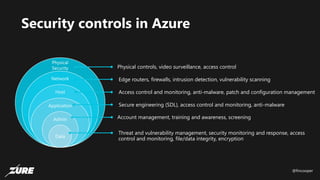
Security controls in Azure
Physical
Security
Network
Host
Application
Admin
Data
Physical controls, video surveillance, access control
Edge routers, firewalls, intrusion detection, vulnerability scanning
Access control and monitoring, anti-malware, patch and configuration management
Secure engineering (SDL), access control and monitoring, anti-malware
Account management, training and awareness, screening
Threat and vulnerability management, security monitoring and response, access
control and monitoring, file/data integrity, encryption
@fincooper
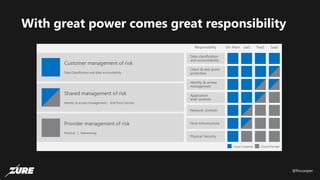
With great power comes great responsibility
@fincooper
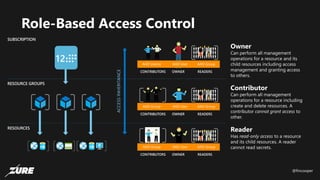
Role-Based Access Control
Subscription
Resource Groups
Resources
Owner
Can perform all management
operations for a resource and its
child resources including access
management and granting access
to others.
Contributor
Can perform all management
operations for a resource including
create and delete resources. A
contributor cannot grant access to
other.
Reader
Has read-only access to a resource
and its child resources. A reader
cannot read secrets.
@fincooper
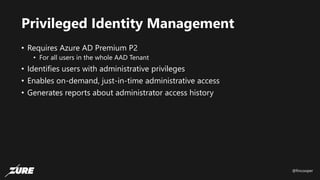
Privileged Identity Management
• Requires Azure AD Premium P2
• For all users in the whole AAD Tenant
• Identifies users with administrative privileges
• Enables on-demand, just-in-time administrative access
• Generates reports about administrator access history
@fincooper
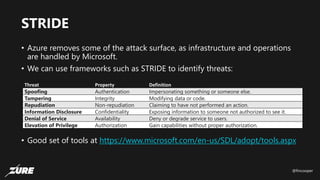
STRIDE
• Azure removes some of the attack surface, as infrastructure and operations
are handled by Microsoft.
• We can use frameworks such as STRIDE to identify threats:
• Good set of tools at https://www.microsoft.com/en-us/SDL/adopt/tools.aspx
Threat Property Definition
Spoofing Authentication Impersonating something or someone else.
Tampering Integrity Modifying data or code.
Repudiation Non-repudiation Claiming to have not performed an action.
Information Disclosure Confidentiality Exposing information to someone not authorized to see it.
Denial of Service Availability Deny or degrade service to users.
Elevation of Privilege Authorization Gain capabilities without proper authorization.
@fincooper
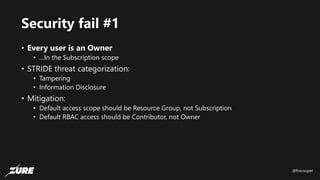
Security fail #1
• Every user is an Owner
• …In the Subscription scope
• STRIDE threat categorization:
• Tampering
• Information Disclosure
• Mitigation:
• Default access scope should be Resource Group, not Subscription
• Default RBAC access should be Contributor, not Owner
@fincooper
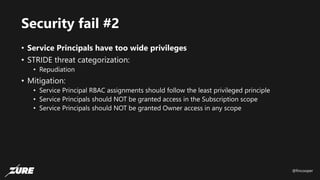
Security fail #2
• Service Principals have too wide privileges
• STRIDE threat categorization:
• Repudiation
• Mitigation:
• Service Principal RBAC assignments should follow the least privileged principle
• Service Principals should NOT be granted access in the Subscription scope
• Service Principals should NOT be granted Owner access in any scope
@fincooper
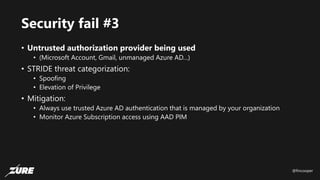
Security fail #3
• Untrusted authorization provider being used
• (Microsoft Account, Gmail, unmanaged Azure AD…)
• STRIDE threat categorization:
• Spoofing
• Elevation of Privilege
• Mitigation:
• Always use trusted Azure AD authentication that is managed by your organization
• Monitor Azure Subscription access using AAD PIM
@fincooper
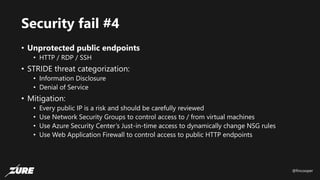
Security fail #4
• Unprotected public endpoints
• HTTP / RDP / SSH
• STRIDE threat categorization:
• Information Disclosure
• Denial of Service
• Mitigation:
• Every public IP is a risk and should be carefully reviewed
• Use Network Security Groups to control access to / from virtual machines
• Use Azure Security Center’s Just-in-time access to dynamically change NSG rules
• Use Web Application Firewall to control access to public HTTP endpoints
@fincooper
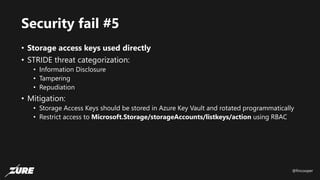
Security fail #5
• Storage access keys used directly
• STRIDE threat categorization:
• Information Disclosure
• Tampering
• Repudiation
• Mitigation:
• Storage Access Keys should be stored in Azure Key Vault and rotated programmatically
• Restrict access to Microsoft.Storage/storageAccounts/listkeys/action using RBAC
@fincooper
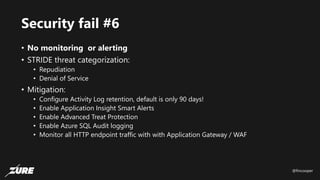
Security fail #6
• No monitoring or alerting
• STRIDE threat categorization:
• Repudiation
• Denial of Service
• Mitigation:
• Configure Activity Log retention, default is only 90 days!
• Enable Application Insight Smart Alerts
• Enable Advanced Treat Protection
• Enable Azure SQL Audit logging
• Monitor all HTTP endpoint traffic with with Application Gateway / WAF
@fincooper
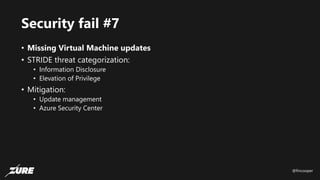
Security fail #7
• Missing Virtual Machine updates
• STRIDE threat categorization:
• Information Disclosure
• Elevation of Privilege
• Mitigation:
• Update management
• Azure Security Center
@fincooper
DEMO
“How to avoid them”
@fincooper
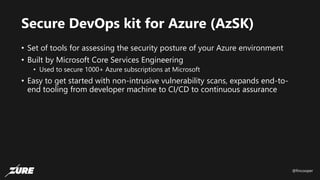
Secure DevOps kit for Azure (AzSK)
• Set of tools for assessing the security posture of your Azure environment
• Built by Microsoft Core Services Engineering
• Used to secure 1000+ Azure subscriptions at Microsoft
• Easy to get started with non-intrusive vulnerability scans, expands end-to-
end tooling from developer machine to CI/CD to continuous assurance
@fincooper
Materials
• My slides: slideshare.net/karlots
• Secure DevOps Kit for Azure:
• azsk.azurewebsites.net
• STRIDE Threat Modeling Lessons from Star Wars:
• youtube.com/watch?v=Y3VQpg04vXo
• Azure Security and Compliance Blueprint (not Azure Blueprint):
• docs.microsoft.com/en-us/azure/security/blueprints/gdpr-paaswa-overview
• Azure Virtual Datacenter:
• docs.microsoft.com/en-us/azure/architecture/vdc/
Top Azure security fails and how to avoid them

Top Azure security fails and how to avoid them

  • 1.
    @fincooper Top Azure securityfails and how to avoid them
  • 2.
    @fincooper Karl Ots Managing Consultant karl.ots@zure.com •Cloud & cybersecurity expert • User group and conference organizer, podcast hosts • Patented inventor • Working on Azure since 2011 • Helped to secure 100+ Azure applications, from startups to Fortune 500 enterprises • linkedin.com/in/karlots
  • 3.
    @fincooper What to expectin this session • Azure security landscape • Top Azure security fails I have wondered upon in my adventures • Why are they bad? • How to fix them? • Resources to help you secure your Azure environment, regardless of your current status
  • 4.
    @fincooper Security controls inAzure Physical Security Network Host Application Admin Data Physical controls, video surveillance, access control Edge routers, firewalls, intrusion detection, vulnerability scanning Access control and monitoring, anti-malware, patch and configuration management Secure engineering (SDL), access control and monitoring, anti-malware Account management, training and awareness, screening Threat and vulnerability management, security monitoring and response, access control and monitoring, file/data integrity, encryption
  • 5.
    @fincooper With great powercomes great responsibility
  • 6.
    @fincooper Role-Based Access Control Subscription ResourceGroups Resources Owner Can perform all management operations for a resource and its child resources including access management and granting access to others. Contributor Can perform all management operations for a resource including create and delete resources. A contributor cannot grant access to other. Reader Has read-only access to a resource and its child resources. A reader cannot read secrets.
  • 7.
    @fincooper Privileged Identity Management •Requires Azure AD Premium P2 • For all users in the whole AAD Tenant • Identifies users with administrative privileges • Enables on-demand, just-in-time administrative access • Generates reports about administrator access history
  • 8.
    @fincooper STRIDE • Azure removessome of the attack surface, as infrastructure and operations are handled by Microsoft. • We can use frameworks such as STRIDE to identify threats: • Good set of tools at https://www.microsoft.com/en-us/SDL/adopt/tools.aspx Threat Property Definition Spoofing Authentication Impersonating something or someone else. Tampering Integrity Modifying data or code. Repudiation Non-repudiation Claiming to have not performed an action. Information Disclosure Confidentiality Exposing information to someone not authorized to see it. Denial of Service Availability Deny or degrade service to users. Elevation of Privilege Authorization Gain capabilities without proper authorization.
  • 9.
    @fincooper Security fail #1 •Every user is an Owner • …In the Subscription scope • STRIDE threat categorization: • Tampering • Information Disclosure • Mitigation: • Default access scope should be Resource Group, not Subscription • Default RBAC access should be Contributor, not Owner
  • 10.
    @fincooper Security fail #2 •Service Principals have too wide privileges • STRIDE threat categorization: • Repudiation • Mitigation: • Service Principal RBAC assignments should follow the least privileged principle • Service Principals should NOT be granted access in the Subscription scope • Service Principals should NOT be granted Owner access in any scope
  • 11.
    @fincooper Security fail #3 •Untrusted authorization provider being used • (Microsoft Account, Gmail, unmanaged Azure AD…) • STRIDE threat categorization: • Spoofing • Elevation of Privilege • Mitigation: • Always use trusted Azure AD authentication that is managed by your organization • Monitor Azure Subscription access using AAD PIM
  • 12.
    @fincooper Security fail #4 •Unprotected public endpoints • HTTP / RDP / SSH • STRIDE threat categorization: • Information Disclosure • Denial of Service • Mitigation: • Every public IP is a risk and should be carefully reviewed • Use Network Security Groups to control access to / from virtual machines • Use Azure Security Center’s Just-in-time access to dynamically change NSG rules • Use Web Application Firewall to control access to public HTTP endpoints
  • 13.
    @fincooper Security fail #5 •Storage access keys used directly • STRIDE threat categorization: • Information Disclosure • Tampering • Repudiation • Mitigation: • Storage Access Keys should be stored in Azure Key Vault and rotated programmatically • Restrict access to Microsoft.Storage/storageAccounts/listkeys/action using RBAC
  • 14.
    @fincooper Security fail #6 •No monitoring or alerting • STRIDE threat categorization: • Repudiation • Denial of Service • Mitigation: • Configure Activity Log retention, default is only 90 days! • Enable Application Insight Smart Alerts • Enable Advanced Treat Protection • Enable Azure SQL Audit logging • Monitor all HTTP endpoint traffic with with Application Gateway / WAF
  • 15.
    @fincooper Security fail #7 •Missing Virtual Machine updates • STRIDE threat categorization: • Information Disclosure • Elevation of Privilege • Mitigation: • Update management • Azure Security Center
  • 16.
  • 17.
    @fincooper Secure DevOps kitfor Azure (AzSK) • Set of tools for assessing the security posture of your Azure environment • Built by Microsoft Core Services Engineering • Used to secure 1000+ Azure subscriptions at Microsoft • Easy to get started with non-intrusive vulnerability scans, expands end-to- end tooling from developer machine to CI/CD to continuous assurance
  • 18.
    @fincooper Materials • My slides:slideshare.net/karlots • Secure DevOps Kit for Azure: • azsk.azurewebsites.net • STRIDE Threat Modeling Lessons from Star Wars: • youtube.com/watch?v=Y3VQpg04vXo • Azure Security and Compliance Blueprint (not Azure Blueprint): • docs.microsoft.com/en-us/azure/security/blueprints/gdpr-paaswa-overview • Azure Virtual Datacenter: • docs.microsoft.com/en-us/azure/architecture/vdc/