After over a century of revolution, struggle and
bloodshed; India achieved Independence from the
British rule on August 15th, 1947. During the struggle
of independence each and every Indian played its
role in some way or other. Most of them even
sacrificed their life in the fight for freedom for our
beloved country and are known as freedom fighters
of India. With the true spirit and courage they faced
various tortures and hardships to earn us freedom.
Among the various pioneers of the revolution the
most famous freedom fighters are mentioned below.
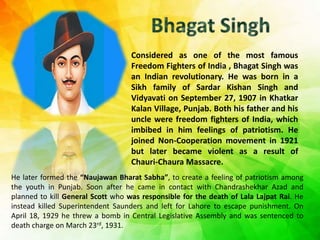
Considered as one of the most famous
Freedom Fighters of India , Bhagat Singh was
an Indian revolutionary. He was born in a
Sikh family of Sardar Kishan Singh and
Vidyavati on September 27, 1907 in Khatkar
Kalan Village, Punjab. Both his father and his
uncle were freedom fighters of India, which
imbibed in him feelings of patriotism. He
joined Non-Cooperation movement in 1921
but later became violent as a result of
Chauri-Chaura Massacre.
He later formed the “Naujawan Bharat Sabha”, to create a feeling of patriotism among
the youth in Punjab. Soon after he came in contact with Chandrashekhar Azad and
planned to kill General Scott who was responsible for the death of Lala Lajpat Rai. He
instead killed Superintendent Saunders and left for Lahore to escape punishment. On
April 18, 1929 he threw a bomb in Central Legislative Assembly and was sentenced to
death charge on March 23rd, 1931.
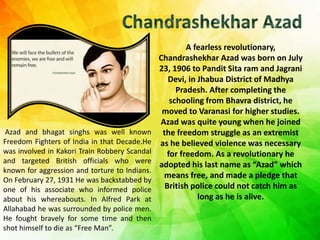
A fearless revolutionary,
Chandrashekhar Azad was born on July
23, 1906 to Pandit Sita ram and Jagrani
Devi, in Jhabua District of Madhya
Pradesh. After completing the
schooling from Bhavra district, he
moved to Varanasi for higher studies.
Azad was quite young when he joined
the freedom struggle as an extremist
as he believed violence was necessary
for freedom. As a revolutionary he
adopted his last name as “Azad” which
means free, and made a pledge that
British police could not catch him as
long as he is alive.
Azad and bhagat singhs was well known
Freedom Fighters of India in that Decade.He
was involved in Kakori Train Robbery Scandal
and targeted British officials who were
known for aggression and torture to Indians.
On February 27, 1931 He was backstabbed by
one of his associate who informed police
about his whereabouts. In Alfred Park at
Allahabad he was surrounded by police men.
He fought bravely for some time and then
shot himself to die as “Free Man”.
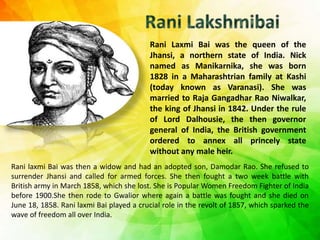
Rani Laxmi Bai was the queen of the
Jhansi, a northern state of India. Nick
named as Manikarnika, she was born
1828 in a Maharashtrian family at Kashi
(today known as Varanasi). She was
married to Raja Gangadhar Rao Niwalkar,
the king of Jhansi in 1842. Under the rule
of Lord Dalhousie, the then governor
general of India, the British government
ordered to annex all princely state
without any male heir.
Rani laxmi Bai was then a widow and had an adopted son, Damodar Rao. She refused to
surrender Jhansi and called for armed forces. She then fought a two week battle with
British army in March 1858, which she lost. She is Popular Women Freedom Fighter of India
before 1900.She then rode to Gwalior where again a battle was fought and she died on
June 18, 1858. Rani laxmi Bai played a crucial role in the revolt of 1857, which sparked the
wave of freedom all over India.
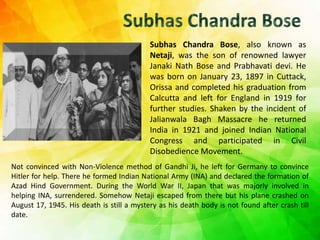
Subhas Chandra Bose, also known as
Netaji, was the son of renowned lawyer
Janaki Nath Bose and Prabhavati devi. He
was born on January 23, 1897 in Cuttack,
Orissa and completed his graduation from
Calcutta and left for England in 1919 for
further studies. Shaken by the incident of
Jalianwala Bagh Massacre he returned
India in 1921 and joined Indian National
Congress and participated in Civil
Disobedience Movement.
Not convinced with Non-Violence method of Gandhi Ji, he left for Germany to convince
Hitler for help. There he formed Indian National Army (INA) and declared the formation of
Azad Hind Government. During the World War II, Japan that was majorly involved in
helping INA, surrendered. Somehow Netaji escaped from there but his plane crashed on
August 17, 1945. His death is still a mystery as his death body is not found after crash till
date.
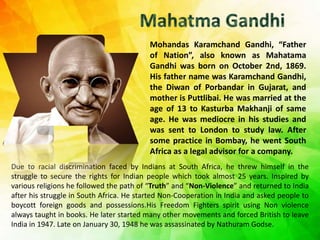
Mohandas Karamchand Gandhi, “Father
of Nation”, also known as Mahatama
Gandhi was born on October 2nd, 1869.
His father name was Karamchand Gandhi,
the Diwan of Porbandar in Gujarat, and
mother is Puttlibai. He was married at the
age of 13 to Kasturba Makhanji of same
age. He was mediocre in his studies and
was sent to London to study law. After
some practice in Bombay, he went South
Africa as a legal advisor for a company.
Due to racial discrimination faced by Indians at South Africa, he threw himself in the
struggle to secure the rights for Indian people which took almost 25 years. Inspired by
various religions he followed the path of “Truth” and “Non-Violence” and returned to India
after his struggle in South Africa. He started Non-Cooperation in India and asked people to
boycott foreign goods and possessions.His Freedom Fighters spirit using Non violence
always taught in books. He later started many other movements and forced British to leave
India in 1947. Late on January 30, 1948 he was assassinated by Nathuram Godse.
Click below
Subscribe button for more updates

Top 5 Indian Freedom Fighters

  • 2.
    After over acentury of revolution, struggle and bloodshed; India achieved Independence from the British rule on August 15th, 1947. During the struggle of independence each and every Indian played its role in some way or other. Most of them even sacrificed their life in the fight for freedom for our beloved country and are known as freedom fighters of India. With the true spirit and courage they faced various tortures and hardships to earn us freedom. Among the various pioneers of the revolution the most famous freedom fighters are mentioned below.
  • 3.
    Considered as oneof the most famous Freedom Fighters of India , Bhagat Singh was an Indian revolutionary. He was born in a Sikh family of Sardar Kishan Singh and Vidyavati on September 27, 1907 in Khatkar Kalan Village, Punjab. Both his father and his uncle were freedom fighters of India, which imbibed in him feelings of patriotism. He joined Non-Cooperation movement in 1921 but later became violent as a result of Chauri-Chaura Massacre. He later formed the “Naujawan Bharat Sabha”, to create a feeling of patriotism among the youth in Punjab. Soon after he came in contact with Chandrashekhar Azad and planned to kill General Scott who was responsible for the death of Lala Lajpat Rai. He instead killed Superintendent Saunders and left for Lahore to escape punishment. On April 18, 1929 he threw a bomb in Central Legislative Assembly and was sentenced to death charge on March 23rd, 1931.
  • 4.
    A fearless revolutionary, ChandrashekharAzad was born on July 23, 1906 to Pandit Sita ram and Jagrani Devi, in Jhabua District of Madhya Pradesh. After completing the schooling from Bhavra district, he moved to Varanasi for higher studies. Azad was quite young when he joined the freedom struggle as an extremist as he believed violence was necessary for freedom. As a revolutionary he adopted his last name as “Azad” which means free, and made a pledge that British police could not catch him as long as he is alive. Azad and bhagat singhs was well known Freedom Fighters of India in that Decade.He was involved in Kakori Train Robbery Scandal and targeted British officials who were known for aggression and torture to Indians. On February 27, 1931 He was backstabbed by one of his associate who informed police about his whereabouts. In Alfred Park at Allahabad he was surrounded by police men. He fought bravely for some time and then shot himself to die as “Free Man”.
  • 5.
    Rani Laxmi Baiwas the queen of the Jhansi, a northern state of India. Nick named as Manikarnika, she was born 1828 in a Maharashtrian family at Kashi (today known as Varanasi). She was married to Raja Gangadhar Rao Niwalkar, the king of Jhansi in 1842. Under the rule of Lord Dalhousie, the then governor general of India, the British government ordered to annex all princely state without any male heir. Rani laxmi Bai was then a widow and had an adopted son, Damodar Rao. She refused to surrender Jhansi and called for armed forces. She then fought a two week battle with British army in March 1858, which she lost. She is Popular Women Freedom Fighter of India before 1900.She then rode to Gwalior where again a battle was fought and she died on June 18, 1858. Rani laxmi Bai played a crucial role in the revolt of 1857, which sparked the wave of freedom all over India.
  • 6.
    Subhas Chandra Bose,also known as Netaji, was the son of renowned lawyer Janaki Nath Bose and Prabhavati devi. He was born on January 23, 1897 in Cuttack, Orissa and completed his graduation from Calcutta and left for England in 1919 for further studies. Shaken by the incident of Jalianwala Bagh Massacre he returned India in 1921 and joined Indian National Congress and participated in Civil Disobedience Movement. Not convinced with Non-Violence method of Gandhi Ji, he left for Germany to convince Hitler for help. There he formed Indian National Army (INA) and declared the formation of Azad Hind Government. During the World War II, Japan that was majorly involved in helping INA, surrendered. Somehow Netaji escaped from there but his plane crashed on August 17, 1945. His death is still a mystery as his death body is not found after crash till date.
  • 7.
    Mohandas Karamchand Gandhi,“Father of Nation”, also known as Mahatama Gandhi was born on October 2nd, 1869. His father name was Karamchand Gandhi, the Diwan of Porbandar in Gujarat, and mother is Puttlibai. He was married at the age of 13 to Kasturba Makhanji of same age. He was mediocre in his studies and was sent to London to study law. After some practice in Bombay, he went South Africa as a legal advisor for a company. Due to racial discrimination faced by Indians at South Africa, he threw himself in the struggle to secure the rights for Indian people which took almost 25 years. Inspired by various religions he followed the path of “Truth” and “Non-Violence” and returned to India after his struggle in South Africa. He started Non-Cooperation in India and asked people to boycott foreign goods and possessions.His Freedom Fighters spirit using Non violence always taught in books. He later started many other movements and forced British to leave India in 1947. Late on January 30, 1948 he was assassinated by Nathuram Godse.
  • 8.