 The Indian War of Independence from the
British Colonial Powers lasted for numerous
decades and finally after a long struggle
freedom was achieved. It was a war that
abolished British supremacy in the world.
Hundreds and thousands of men, women and
children fought for it till their last breath and
some like Shaheed Bhagat Singh even in
their death. I might not be able to pay my
respects to all of those great souls. But that
doesn’t mean that their contribution wasn’t
worthwhile. The free air that we breath, and
every walk that we take is all because of
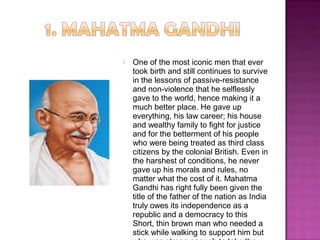
 One of the most iconic men that ever
took birth and still continues to survive
in the lessons of passive-resistance
and non-violence that he selflessly
gave to the world, hence making it a
much better place. He gave up
everything, his law career; his house
and wealthy family to fight for justice
and for the betterment of his people
who were being treated as third class
citizens by the colonial British. Even in
the harshest of conditions, he never
gave up his morals and rules, no
matter what the cost of it. Mahatma
Gandhi has right fully been given the
title of the father of the nation as India
truly owes its independence as a
republic and a democracy to this
Short, thin brown man who needed a
stick while walking to support him but
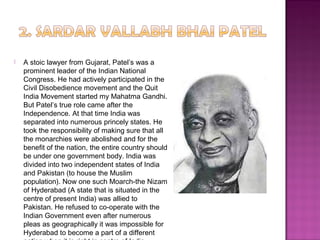
 A stoic lawyer from Gujarat, Patel’s was a
prominent leader of the Indian National
Congress. He had actively participated in the
Civil Disobedience movement and the Quit
India Movement started my Mahatma Gandhi.
But Patel’s true role came after the
Independence. At that time India was
separated into numerous princely states. He
took the responsibility of making sure that all
the monarchies were abolished and for the
benefit of the nation, the entire country should
be under one government body. India was
divided into two independent states of India
and Pakistan (to house the Muslim
population). Now one such Moarch-the Nizam
of Hyderabad (A state that is situated in the
centre of present India) was allied to
Pakistan. He refused to co-operate with the
Indian Government even after numerous
pleas as geographically it was impossible for
Hyderabad to become a part of a different
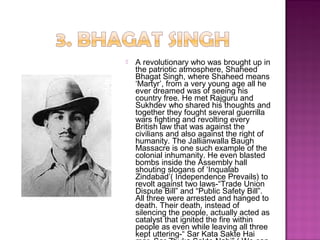
 A revolutionary who was brought up in
the patriotic atmosphere, Shaheed
Bhagat Singh, where Shaheed means
‘Martyr’, from a very young age all he
ever dreamed was of seeing his
country free. He met Rajguru and
Sukhdev who shared his thoughts and
together they fought several guerrilla
wars fighting and revolting every
British law that was against the
civilians and also against the right of
humanity. The Jallianwalla Baugh
Massacre is one such example of the
colonial inhumanity. He even blasted
bombs inside the Assembly hall
shouting slogans of ‘Inqualab
Zindabad’( Independence Prevails) to
revolt against two laws-“Trade Union
Dispute Bill” and “Public Safety Bill”.
All three were arrested and hanged to
death. Their death, instead of
silencing the people, actually acted as
catalyst that ignited the fire within
people as even while leaving all three
kept uttering-“ Sar Kata Sakte Hai
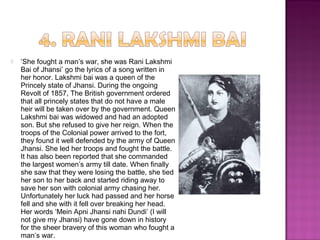
 ‘She fought a man’s war, she was Rani Lakshmi
Bai of Jhansi’ go the lyrics of a song written in
her honor. Lakshmi bai was a queen of the
Princely state of Jhansi. During the ongoing
Revolt of 1857, The British government ordered
that all princely states that do not have a male
heir will be taken over by the government. Queen
Lakshmi bai was widowed and had an adopted
son. But she refused to give her reign. When the
troops of the Colonial power arrived to the fort,
they found it well defended by the army of Queen
Jhansi. She led her troops and fought the battle.
It has also been reported that she commanded
the largest women’s army till date. When finally
she saw that they were losing the battle, she tied
her son to her back and started riding away to
save her son with colonial army chasing her.
Unfortunately her luck had passed and her horse
fell and she with it fell over breaking her head.
Her words ‘Mein Apni Jhansi nahi Dundi’ (I will
not give my Jhansi) have gone down in history
for the sheer bravery of this woman who fought a
man’s war.
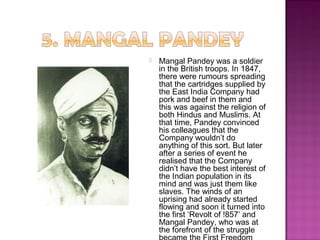
 Mangal Pandey was a soldier
in the British troops. In 1847,
there were rumours spreading
that the cartridges supplied by
the East India Company had
pork and beef in them and
this was against the religion of
both Hindus and Muslims. At
that time, Pandey convinced
his colleagues that the
Company wouldn’t do
anything of this sort. But later
after a series of event he
realised that the Company
didn’t have the best interest of
the Indian population in its
mind and was just them like
slaves. The winds of an
uprising had already started
flowing and soon it turned into
the first ‘Revolt of !857’ and
Mangal Pandey, who was at
the forefront of the struggle
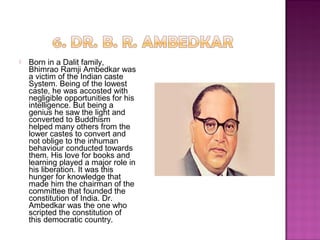
 Born in a Dalit family,
Bhimrao Ramji Ambedkar was
a victim of the Indian caste
System. Being of the lowest
caste, he was accosted with
negligible opportunities for his
intelligence. But being a
genius he saw the light and
converted to Buddhism
helped many others from the
lower castes to convert and
not oblige to the inhuman
behaviour conducted towards
them. His love for books and
learning played a major role in
his liberation. It was this
hunger for knowledge that
made him the chairman of the
committee that founded the
constitution of India. Dr.
Ambedkar was the one who
scripted the constitution of
this democratic country.
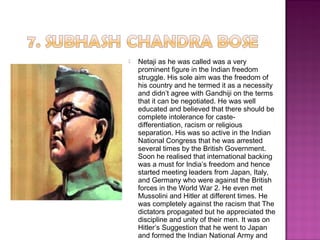
 Netaji as he was called was a very
prominent figure in the Indian freedom
struggle. His sole aim was the freedom of
his country and he termed it as a necessity
and didn’t agree with Gandhiji on the terms
that it can be negotiated. He was well
educated and believed that there should be
complete intolerance for caste-
differentiation, racism or religious
separation. His was so active in the Indian
National Congress that he was arrested
several times by the British Government.
Soon he realised that international backing
was a must for India’s freedom and hence
started meeting leaders from Japan, Italy,
and Germany who were against the British
forces in the World War 2. He even met
Mussolini and Hitler at different times. He
was completely against the racism that The
dictators propagated but he appreciated the
discipline and unity of their men. It was on
Hitler’s Suggestion that he went to Japan
and formed the Indian National Army and
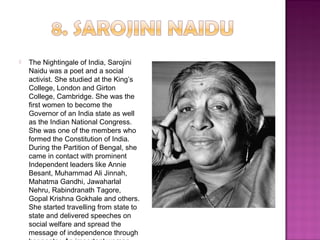
 The Nightingale of India, Sarojini
Naidu was a poet and a social
activist. She studied at the King’s
College, London and Girton
College, Cambridge. She was the
first women to become the
Governor of an India state as well
as the Indian National Congress.
She was one of the members who
formed the Constitution of India.
During the Partition of Bengal, she
came in contact with prominent
Independent leaders like Annie
Besant, Muhammad Ali Jinnah,
Mahatma Gandhi, Jawaharlal
Nehru, Rabindranath Tagore,
Gopal Krishna Gokhale and others.
She started travelling from state to
state and delivered speeches on
social welfare and spread the
message of independence through
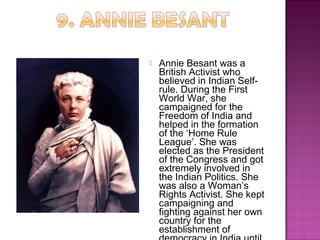
 Annie Besant was a
British Activist who
believed in Indian Self-
rule. During the First
World War, she
campaigned for the
Freedom of India and
helped in the formation
of the ‘Home Rule
League’. She was
elected as the President
of the Congress and got
extremely involved in
the Indian Politics. She
was also a Woman’s
Rights Activist. She kept
campaigning and
fighting against her own
country for the
establishment of
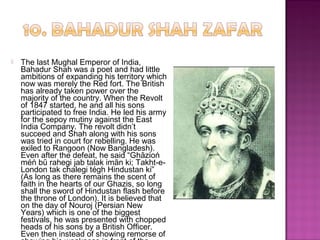
 The last Mughal Emperor of India,
Bahadur Shah was a poet and had little
ambitions of expanding his territory which
now was merely the Red fort. The British
has already taken power over the
majority of the country. When the Revolt
of 1847 started, he and all his sons
participated to free India. He led his army
for the sepoy mutiny against the East
India Company. The revolt didn’t
succeed and Shah along with his sons
was tried in court for rebelling. He was
exiled to Rangoon (Now Bangladesh).
Even after the defeat, he said “Ghāzioń
méń bū rahegi jab talak imān ki; Takht-e-
London tak chalegi tégh Hindustan ki”
(As long as there remains the scent of
faith in the hearts of our Ghazis, so long
shall the sword of Hindustan flash before
the throne of London). It is believed that
on the day of Nouroj (Persian New
Years) which is one of the biggest
festivals, he was presented with chopped
heads of his sons by a British Officer.
Even then instead of showing remorse of

Freedom fighters

  • 2.
     The IndianWar of Independence from the British Colonial Powers lasted for numerous decades and finally after a long struggle freedom was achieved. It was a war that abolished British supremacy in the world. Hundreds and thousands of men, women and children fought for it till their last breath and some like Shaheed Bhagat Singh even in their death. I might not be able to pay my respects to all of those great souls. But that doesn’t mean that their contribution wasn’t worthwhile. The free air that we breath, and every walk that we take is all because of
  • 3.
     One ofthe most iconic men that ever took birth and still continues to survive in the lessons of passive-resistance and non-violence that he selflessly gave to the world, hence making it a much better place. He gave up everything, his law career; his house and wealthy family to fight for justice and for the betterment of his people who were being treated as third class citizens by the colonial British. Even in the harshest of conditions, he never gave up his morals and rules, no matter what the cost of it. Mahatma Gandhi has right fully been given the title of the father of the nation as India truly owes its independence as a republic and a democracy to this Short, thin brown man who needed a stick while walking to support him but
  • 4.
     A stoiclawyer from Gujarat, Patel’s was a prominent leader of the Indian National Congress. He had actively participated in the Civil Disobedience movement and the Quit India Movement started my Mahatma Gandhi. But Patel’s true role came after the Independence. At that time India was separated into numerous princely states. He took the responsibility of making sure that all the monarchies were abolished and for the benefit of the nation, the entire country should be under one government body. India was divided into two independent states of India and Pakistan (to house the Muslim population). Now one such Moarch-the Nizam of Hyderabad (A state that is situated in the centre of present India) was allied to Pakistan. He refused to co-operate with the Indian Government even after numerous pleas as geographically it was impossible for Hyderabad to become a part of a different
  • 5.
     A revolutionarywho was brought up in the patriotic atmosphere, Shaheed Bhagat Singh, where Shaheed means ‘Martyr’, from a very young age all he ever dreamed was of seeing his country free. He met Rajguru and Sukhdev who shared his thoughts and together they fought several guerrilla wars fighting and revolting every British law that was against the civilians and also against the right of humanity. The Jallianwalla Baugh Massacre is one such example of the colonial inhumanity. He even blasted bombs inside the Assembly hall shouting slogans of ‘Inqualab Zindabad’( Independence Prevails) to revolt against two laws-“Trade Union Dispute Bill” and “Public Safety Bill”. All three were arrested and hanged to death. Their death, instead of silencing the people, actually acted as catalyst that ignited the fire within people as even while leaving all three kept uttering-“ Sar Kata Sakte Hai
  • 6.
     ‘She foughta man’s war, she was Rani Lakshmi Bai of Jhansi’ go the lyrics of a song written in her honor. Lakshmi bai was a queen of the Princely state of Jhansi. During the ongoing Revolt of 1857, The British government ordered that all princely states that do not have a male heir will be taken over by the government. Queen Lakshmi bai was widowed and had an adopted son. But she refused to give her reign. When the troops of the Colonial power arrived to the fort, they found it well defended by the army of Queen Jhansi. She led her troops and fought the battle. It has also been reported that she commanded the largest women’s army till date. When finally she saw that they were losing the battle, she tied her son to her back and started riding away to save her son with colonial army chasing her. Unfortunately her luck had passed and her horse fell and she with it fell over breaking her head. Her words ‘Mein Apni Jhansi nahi Dundi’ (I will not give my Jhansi) have gone down in history for the sheer bravery of this woman who fought a man’s war.
  • 7.
     Mangal Pandeywas a soldier in the British troops. In 1847, there were rumours spreading that the cartridges supplied by the East India Company had pork and beef in them and this was against the religion of both Hindus and Muslims. At that time, Pandey convinced his colleagues that the Company wouldn’t do anything of this sort. But later after a series of event he realised that the Company didn’t have the best interest of the Indian population in its mind and was just them like slaves. The winds of an uprising had already started flowing and soon it turned into the first ‘Revolt of !857’ and Mangal Pandey, who was at the forefront of the struggle
  • 8.
     Born ina Dalit family, Bhimrao Ramji Ambedkar was a victim of the Indian caste System. Being of the lowest caste, he was accosted with negligible opportunities for his intelligence. But being a genius he saw the light and converted to Buddhism helped many others from the lower castes to convert and not oblige to the inhuman behaviour conducted towards them. His love for books and learning played a major role in his liberation. It was this hunger for knowledge that made him the chairman of the committee that founded the constitution of India. Dr. Ambedkar was the one who scripted the constitution of this democratic country.
  • 9.
     Netaji ashe was called was a very prominent figure in the Indian freedom struggle. His sole aim was the freedom of his country and he termed it as a necessity and didn’t agree with Gandhiji on the terms that it can be negotiated. He was well educated and believed that there should be complete intolerance for caste- differentiation, racism or religious separation. His was so active in the Indian National Congress that he was arrested several times by the British Government. Soon he realised that international backing was a must for India’s freedom and hence started meeting leaders from Japan, Italy, and Germany who were against the British forces in the World War 2. He even met Mussolini and Hitler at different times. He was completely against the racism that The dictators propagated but he appreciated the discipline and unity of their men. It was on Hitler’s Suggestion that he went to Japan and formed the Indian National Army and
  • 10.
     The Nightingaleof India, Sarojini Naidu was a poet and a social activist. She studied at the King’s College, London and Girton College, Cambridge. She was the first women to become the Governor of an India state as well as the Indian National Congress. She was one of the members who formed the Constitution of India. During the Partition of Bengal, she came in contact with prominent Independent leaders like Annie Besant, Muhammad Ali Jinnah, Mahatma Gandhi, Jawaharlal Nehru, Rabindranath Tagore, Gopal Krishna Gokhale and others. She started travelling from state to state and delivered speeches on social welfare and spread the message of independence through
  • 11.
     Annie Besantwas a British Activist who believed in Indian Self- rule. During the First World War, she campaigned for the Freedom of India and helped in the formation of the ‘Home Rule League’. She was elected as the President of the Congress and got extremely involved in the Indian Politics. She was also a Woman’s Rights Activist. She kept campaigning and fighting against her own country for the establishment of
  • 12.
     The lastMughal Emperor of India, Bahadur Shah was a poet and had little ambitions of expanding his territory which now was merely the Red fort. The British has already taken power over the majority of the country. When the Revolt of 1847 started, he and all his sons participated to free India. He led his army for the sepoy mutiny against the East India Company. The revolt didn’t succeed and Shah along with his sons was tried in court for rebelling. He was exiled to Rangoon (Now Bangladesh). Even after the defeat, he said “Ghāzioń méń bū rahegi jab talak imān ki; Takht-e- London tak chalegi tégh Hindustan ki” (As long as there remains the scent of faith in the hearts of our Ghazis, so long shall the sword of Hindustan flash before the throne of London). It is believed that on the day of Nouroj (Persian New Years) which is one of the biggest festivals, he was presented with chopped heads of his sons by a British Officer. Even then instead of showing remorse of