

Tools to Expedite your Proposal,
IRB, and Results Chapter
Anxiety is pain in the
future.
Today’s Webinar
•
•
•
•
•
•

Start with the methodology chapter
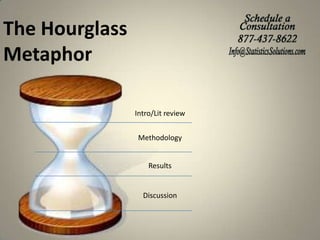
The Hourglass Metaphor
Methodology Basics
Results Chapter
Discussion Chapter
Graduate Student Toolkit
Please feel free to ask questions throughout the webinar in the chat
pane to your right
Start with the
Methodology
Chapter
st
1

st
1

Things (even when they’re
named “Chapter 3”)
The Hourglass
Metaphor
Intro/Lit review
Methodology

Results

Discussion
Methodology
Basics
1.
2.
3.
4.
5.
6.

Clear research questions
Participants
Instruments/materials
Procedure
Data analysis plan
Sample size
Clear Research
Questions
•
•
•
•
•

Statistical language
Differences, influence, or relationships
Know your IV’s and DV’s
Keep your terms consistent
Match the number of research questions and
hypotheses
• Make it understandable to lay readers (or waste a
month of your life)
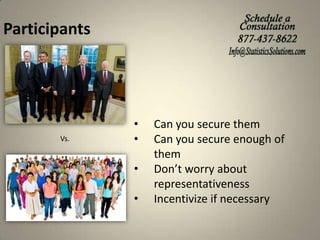
Participants

Vs.

•
•
•
•

Can you secure them
Can you secure enough of
them
Don’t worry about
representativeness
Incentivize if necessary
Instruments/Materials
•
•
•

Use valid and reliable instruments
Don’t make your own survey
Use secondary data if possible
Procedure
• How are you going to administer those
instruments to those participants?
• Paper and pencil, web-based, or interview?
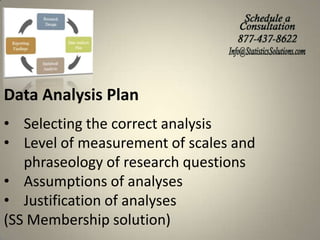
Data Analysis Plan
• Selecting the correct analysis
• Level of measurement of scales and
phraseology of research questions
• Assumptions of analyses
• Justification of analyses
(SS Membership solution)
Sample Size
• The 2 types of sample sizes in the world
• Power analysis
(SS Membership solution)
Results Chapter

•
•
•
•

Descriptive statistics
Statistical analyses
Assumptions of analyses
Write-up results
Descriptive Statistics
• Reliability of scales
• Frequencies and percentages for
nominal and ordinal level variables
• Means, standard deviations, and
range for continuous level variables
Statistical Analyses
Relationship questions
• Correlation
• Chi-square
Prediction questions
• Regression
• Logistic regression

Difference questions
• ANOVA
• ANCOVA
• Repeated-measure ANOVA
• T-tests
• Wilcoxon
• Mann-Whitney
Assumptions of Analyses
• Correlation—scatterplot
• ANOVA/t-test—
homogeneity of variance and normality
• Regression—outliers, mulitcollinearity and
homoscadacity, homogeneity of regression
• AnCova-DV and covariate are related
• Chi-square—expected value of 5 within each cell
Discussion Chapter
•
•
•
•

Clear support or non-support for hypotheses
Practical and theoretical implications of findings
Generalizability and limitations
Future research
The prescription for
anxiety
is

Preparation
Membership Resources
•
•
•
•
•
•

Dissertation Template
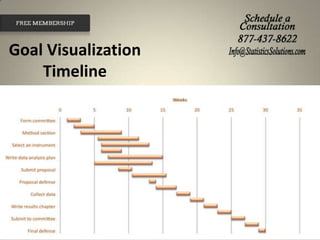
Goal Visualization Timeline
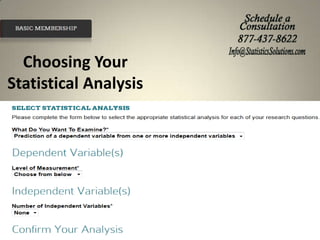
Choosing your statistical analyses
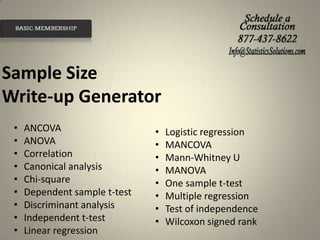
Sample size/Power analysis generator
Data analysis plan templates
Statistical Analysis: A Manual on Dissertation Statistics in
SPSS
• Video Tutorials
Dissertation
Template
•
•
•
•
•
•
•

Chapters 1-5 guidelines (what each paragraph contains)
Table of contents with hyperlinks to particular chapters
Page numbering (including roman numeral front matter)
Reference examples
Average word count per section
APA 6th Edition formatting
Automatic Bookmarks (clickable to section)
Goal Visualization
Timeline
Choosing Your
Statistical Analysis
Sample Size
Write-up Generator
•
•
•
•
•
•
•
•
•

ANCOVA
ANOVA
Correlation
Canonical analysis
Chi-square
Dependent sample t-test
Discriminant analysis
Independent t-test
Linear regression

•
•
•
•
•
•
•
•

Logistic regression
MANCOVA
Mann-Whitney U
MANOVA
One sample t-test
Multiple regression
Test of independence
Wilcoxon signed rank
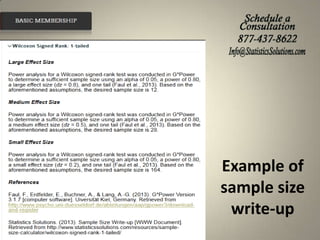
Example of
sample size
write-up
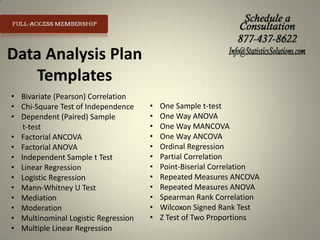
Data Analysis Plan
Templates
• Bivariate (Pearson) Correlation
• Chi-Square Test of Independence
• Dependent (Paired) Sample
t-test
• Factorial ANCOVA
• Factorial ANOVA
• Independent Sample t Test
• Linear Regression
• Logistic Regression
• Mann-Whitney U Test
• Mediation
• Moderation
• Multinominal Logistic Regression
• Multiple Linear Regression

•
•
•
•
•
•
•
•
•
•
•
•

One Sample t-test
One Way ANOVA
One Way MANCOVA
One Way ANCOVA
Ordinal Regression
Partial Correlation
Point-Biserial Correlation
Repeated Measures ANCOVA
Repeated Measures ANOVA
Spearman Rank Correlation
Wilcoxon Signed Rank Test
Z Test of Two Proportions
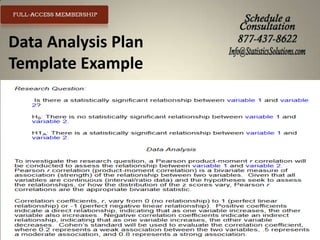
Data Analysis Plan
Template Example
Results Chapter
• Video Tutorials
• SPSS Manual
Statistics Solutions Pro

www.StatisticsSolutionsPro.com
• Easy—no software to learn or nuances of the
analysis assumptions to examine
• Convenient—no download necessary
Feedback and What
You Need
I’d like your feedback on the Webcast

I’d like to know what else you’d like in upcoming webinars
Send comments to: James@StatisticsSolutions.com
Have the courage to move forward
Believe in yourself
Get the help you need
Thank you!
Join us for our next webinar:

Navigating Graduate School
Thursday, September 19th, 2013
9:00 PM- 10:00 PM ET, 6:00 PM-7:00PM PT

Tools to Expedite Your Proposal, IRB, and Results Chapter

Editor's Notes

  • #3 I am after all, a Ph.D. in Clinical Psychology
  • #5 Its taking much longer than we expectedTell my story about comps over the summer, internship an additional year, confrontation with department about this business, and the dissertation topic with Bill.
  • #6 Finding people that careTalk about Kari letting me dictate my thesis (could not write any more), Bill—just get out of there.
  • #7 Identified needs: librarian for lit review, methodologist for methods, statistician for results chapter, Suicide and homicide were in the mix.
  • #8 Bill moving the paragraphs back and forth
  • #21 The Dissertation Template is a comprehensive, 24-page outline that you can use for your dissertation.   Whether your university has a template or you’ve begun the dissertation without one, this guide will be helpful to you as it includes a detailed descriptions of chapters 1-5 and subsections that help you, the doctoral student, flesh-out each chapter.  The template is written to comply with most university requirementsThe Dissertation Template includes:Table of contents with hyperlinks to particular chaptersPage numbering (including roman numeral front matter)Reference examplesAverage word count per sectionChapters 1-5 guidelinesAPA 6th Edition formattingAutomatic Bookmarks (clickable to section)
  • #24 The Sample Size/Power Analysis Calculator with Write-up is a tool for anyone struggling with power analysis. Simply identify the test to be conducted and the degrees of freedom where applicable (explained in the document), and the sample size/power analysis calculator will calculate your sample size for a power of .80 of an alpha of .05 for small, medium and large effect sizes.  The sample size/power analysis calculator then presents the write-up with references which can easily be integrated in your dissertation document.
  • #26 Statistics Solutions provides a data analysis plan template based on your selected analysis. You can use this template to develop the data analysis section of your dissertation or research proposal. If you do not know your analysis, you can figure it out using our select statistical analysis tool.The template includes research questions stated in statistical language, analysis justification and assumptions of the analysis. Simply edit the blue text to reflect your research information and you will have the data analysis plan for your dissertation or research proposal. For an example, see the data analysis template for One Way MANCOVA.
  • #28 SPSS Video TutorialsIn these exciting SPSS video tutorials, Dr. James Lani and colleagues will provide step-by-step instruction on describing the statistical analyses, how to assess assumptions and how to interpret those analyses. The video is a great opportunity to pause and run your own analyses in tandem with the presenter.Statistical Analysis: A Guide on Dissertation and Thesis Statistics in SPSSDownloadable manual that outlines the most common statistical tests used for dissertation statistics. In the manual, students are given each analyses described using real-world examples and shown how to conduct each analysis in a step-by-step manner. Also includes examples of the test, example data set used in instruction, syntax to assist with conducting the analysis, interpretation and sample write-up of the results