q3 w5 l5
DATAANALYSISUSING
STATISTICSAND
HYPOTHESISTESTINGIN
QUANTITATIVESTUDIES
Cognitive Competency:
Understand and explain the importance of statistical data analysis and
hypothesis testing in quantitative research.
Psychomotor Competency:
Apply statistical methods (e.g., t-tests, ANOVA) using basic tools (e.g.,
calculators or software like Excel) to analyze research data.
Affective Competency:
Appreciate the role of data analysis and hypothesis testing in drawing
meaningful conclusions in various fields (e.g., Humanities, Electrical,
Culinary, Beauty Care, STEM).
LESSONOBJECTIVES
SHAREEXPERIENCESOR
ASSUMPTIONSABOUTTHEUSEOF
STATISTICSINDAILYLIFE,
SUCHASMAKINGDECISIONS,
COOKINGRECIPES,BEAUTY
TRENDS,ETC.
Scenario:
A researcher is conducting a
study on the impact of social
media on student mental health.
They distribute surveys to
students asking about their
social media usage, mental
health status, and academic
performance.
Humanities and Social Sciences (HUMSS)
What Data
Analysis
can be
used?
Data Analysis Use:
The researcher analyzes the survey data using
statistical methods like correlation analysis to
determine if there is a significant relationship
between social media usage and mental health
indicators. They may perform hypothesis
testing to validate if increased social media use
significantly impacts students' anxiety levels.
Scenario:
An electrical company wants to
evaluate the effectiveness of its
training programs for new
electricians. After completing
the training, trainees take an
assessment that measures their
knowledge and practical skills.
Technical-Vocational Livelihood - Electrical
Installation and Maintenance (TVL-EIM)
What Data
Analysis
can be
used?
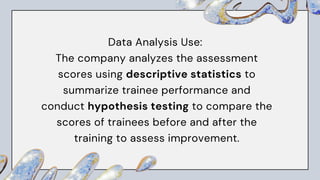
Data Analysis Use:
The company analyzes the assessment
scores using descriptive statistics to
summarize trainee performance and
conduct hypothesis testing to compare the
scores of trainees before and after the
training to assess improvement.
Scenario:
A culinary school conducts
a taste test competition
among students to
determine which dish
garners the highest
satisfaction rating from
judges.
Technical-Vocational Livelihood -
Cookery (TVL-Cookery)
What Data
Analysis
can be
used?
Data Analysis Use:
The school collects ratings from judges on
various dishes and analyzes the data using
ANOVA to compare the mean satisfaction
scores across different dishes. This helps
identify which cooking techniques or ingredients
yield the best results.
Scenario:
A beauty salon wants to
know which services are
most popular among its
clients to optimize its
offerings. They collect data
on the number of services
booked over a month.
Technical-Vocational Livelihood -
Beauty Care (TVL-Beauty Care)
What Data
Analysis
can be
used?
Data Analysis Use:
The salon analyzes the booking data using
frequency counts and percentages to
determine the most popular services. They might
conduct a chi-square test to see if there’s a
significant difference in the popularity of
services based on different customer
demographics (e.g., age or gender).
Scenario:
A high school science project
involves testing the
effectiveness of different
fertilizers on plant growth.
Students set up an experiment
with several groups of plants,
each receiving a different
fertilizer.
Science, Technology, Engineering, and
Mathematics (STEM)
What Data
Analysis
can be
used?
Data Analysis Use:
After a month, students measure the growth of the
plants and use descriptive statistics (mean
height, standard deviation) to summarize the
results. They might perform a t-test to analyze
whether the average growth of plants with one
fertilizer is significantly different from those with
another, thus validating their hypothesis about
fertilizer effectiveness.
STATISTICALTESTS
01 02
Descriptive
Statistics
03 04
T-Tests Chi-Square
Test
ANOVA
(Analysis of
Variance)
DESCRIPTIVESTATISTICS
Summarize and
describe the main
features of a
dataset.
Measures of central
tendency (mean,
median, mode) and
measures of variability
(range, variance,
standard deviation).
Purpose Examples
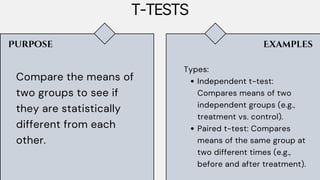
T-TESTS
Compare the means of
two groups to see if
they are statistically
different from each
other.
Types:
Independent t-test:
Compares means of two
independent groups (e.g.,
treatment vs. control).
Paired t-test: Compares
means of the same group at
two different times (e.g.,
before and after treatment).
Purpose Examples
CHI-SQUARETEST
Assess the
relationship between
two categorical
variables.
Tests whether
distributions of
categorical variables
differ from expected
distributions.
Purpose Examples
ANOVA(ANALYSISOFVARIANCE)
Compare means among
three or more groups to
see if at least one group
mean is significantly
different.
Types:
One-way ANOVA: Tests
one independent
variable.
Two-way ANOVA: Tests
two independent
variables.
Purpose Examples
Null Hypothesis (H₀): A statement that there is no effect or no
difference. It serves as the default position that indicates no
association or effect.
1.
Example: "There is no difference in average plant height
between the different fertilizer groups."
Alternative Hypothesis (H₁): A statement that contradicts the
null hypothesis, indicating there is an effect or a difference.
2.
Example: "There is a difference in average plant height
between the different fertilizer groups."
HYPOTHESISTESTINGPROCESS
Significance Level (α): The threshold for determining whether to
reject the null hypothesis, commonly set at 0.05 (5%). This means
that there is a 5% risk of concluding that a difference exists when
there is none (Type I error).
P-Value: The probability of obtaining the observed data, or
something more extreme, assuming the null hypothesis is true. A
small p-value (typically ≤ 0.05) indicates strong evidence against
the null hypothesis.
Example: A p-value of 0.03 suggests there is only a 3% chance of
observing the data if the null hypothesis is true, leading to its
rejection.
HYPOTHESISTESTINGPROCESS
STEPSINHYPOTHESISTESTING
01 02
State the
Hypotheses
03 04
Select the
Appropriate
Statistical
Test
Determine
the
Significance
Level (α)
Collect
and
Analyze
the Data
05
Make a
Decision
06
Report the
Results
THE
PROCESS
Descriptive Statistics
Summarize and describe the characteristics of a dataset. Common
measures include the mean, median, mode, and standard deviation.
Inferential Statistics
Inferential statistics allow you to make predictions or inferences about a
population based on a sample of data.
Steps:
Calculate the mean for each group
1.
Data:
Group 1 (New Program Scores): 85, 90, 88, 92, 87
roup2 (Standard Program Scores): 78, 80, 77, 75, 79
Data:
Before Treatment Scores: 6, 7, 8, 6, 7
After Treatment Scores: 8, 9, 9, 7, 8
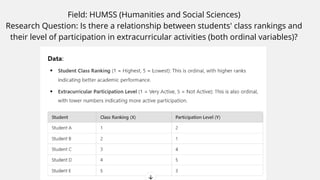
Field: HUMSS (Humanities and Social Sciences)
Research Question: Is there a relationship between students' class rankings and
their level of participation in extracurricular activities (both ordinal variables)?
choose the correct statistical test for your
research problems and analyze data through
group discussion.
COMPUTE
References
Hypothesis Testing and p-Values –
"What is Hypothesis Testing in Statistics?" by Investopedia. Retrieved from: https://www.investopedia.com/terms/h/hypothesis-testing.asp
Statistical Tests Overview –
"Introduction to Hypothesis Testing" by Laerd Statistics. Retrieved from: https://statistics.laerd.com/statistical-guides/hypothesis-testing.php
Using Excel for Statistical Analysis –
"How to Perform a Hypothesis Test in Excel" by Statology. Retrieved from: https://www.statology.org/hypothesis-test-in-excel/
Descriptive and Inferential Statistics –
"What are Descriptive and Inferential Statistics?" by Simply Psychology. Retrieved from: https://www.simplypsychology.org/descriptive-
inferential-statistics.html
THANKYOU
very much

Data Analysis using Statistics and Hypothesis Testing in Quantitative Studies.pdf

  • 1.
  • 2.
    Cognitive Competency: Understand andexplain the importance of statistical data analysis and hypothesis testing in quantitative research. Psychomotor Competency: Apply statistical methods (e.g., t-tests, ANOVA) using basic tools (e.g., calculators or software like Excel) to analyze research data. Affective Competency: Appreciate the role of data analysis and hypothesis testing in drawing meaningful conclusions in various fields (e.g., Humanities, Electrical, Culinary, Beauty Care, STEM). LESSONOBJECTIVES
  • 3.
  • 4.
    Scenario: A researcher isconducting a study on the impact of social media on student mental health. They distribute surveys to students asking about their social media usage, mental health status, and academic performance. Humanities and Social Sciences (HUMSS) What Data Analysis can be used?
  • 5.
    Data Analysis Use: Theresearcher analyzes the survey data using statistical methods like correlation analysis to determine if there is a significant relationship between social media usage and mental health indicators. They may perform hypothesis testing to validate if increased social media use significantly impacts students' anxiety levels.
  • 6.
    Scenario: An electrical companywants to evaluate the effectiveness of its training programs for new electricians. After completing the training, trainees take an assessment that measures their knowledge and practical skills. Technical-Vocational Livelihood - Electrical Installation and Maintenance (TVL-EIM) What Data Analysis can be used?
  • 7.
    Data Analysis Use: Thecompany analyzes the assessment scores using descriptive statistics to summarize trainee performance and conduct hypothesis testing to compare the scores of trainees before and after the training to assess improvement.
  • 8.
    Scenario: A culinary schoolconducts a taste test competition among students to determine which dish garners the highest satisfaction rating from judges. Technical-Vocational Livelihood - Cookery (TVL-Cookery) What Data Analysis can be used?
  • 9.
    Data Analysis Use: Theschool collects ratings from judges on various dishes and analyzes the data using ANOVA to compare the mean satisfaction scores across different dishes. This helps identify which cooking techniques or ingredients yield the best results.
  • 10.
    Scenario: A beauty salonwants to know which services are most popular among its clients to optimize its offerings. They collect data on the number of services booked over a month. Technical-Vocational Livelihood - Beauty Care (TVL-Beauty Care) What Data Analysis can be used?
  • 11.
    Data Analysis Use: Thesalon analyzes the booking data using frequency counts and percentages to determine the most popular services. They might conduct a chi-square test to see if there’s a significant difference in the popularity of services based on different customer demographics (e.g., age or gender).
  • 12.
    Scenario: A high schoolscience project involves testing the effectiveness of different fertilizers on plant growth. Students set up an experiment with several groups of plants, each receiving a different fertilizer. Science, Technology, Engineering, and Mathematics (STEM) What Data Analysis can be used?
  • 13.
    Data Analysis Use: Aftera month, students measure the growth of the plants and use descriptive statistics (mean height, standard deviation) to summarize the results. They might perform a t-test to analyze whether the average growth of plants with one fertilizer is significantly different from those with another, thus validating their hypothesis about fertilizer effectiveness.
  • 14.
    STATISTICALTESTS 01 02 Descriptive Statistics 03 04 T-TestsChi-Square Test ANOVA (Analysis of Variance)
  • 15.
    DESCRIPTIVESTATISTICS Summarize and describe themain features of a dataset. Measures of central tendency (mean, median, mode) and measures of variability (range, variance, standard deviation). Purpose Examples
  • 16.
    T-TESTS Compare the meansof two groups to see if they are statistically different from each other. Types: Independent t-test: Compares means of two independent groups (e.g., treatment vs. control). Paired t-test: Compares means of the same group at two different times (e.g., before and after treatment). Purpose Examples
  • 17.
    CHI-SQUARETEST Assess the relationship between twocategorical variables. Tests whether distributions of categorical variables differ from expected distributions. Purpose Examples
  • 18.
    ANOVA(ANALYSISOFVARIANCE) Compare means among threeor more groups to see if at least one group mean is significantly different. Types: One-way ANOVA: Tests one independent variable. Two-way ANOVA: Tests two independent variables. Purpose Examples
  • 19.
    Null Hypothesis (H₀):A statement that there is no effect or no difference. It serves as the default position that indicates no association or effect. 1. Example: "There is no difference in average plant height between the different fertilizer groups." Alternative Hypothesis (H₁): A statement that contradicts the null hypothesis, indicating there is an effect or a difference. 2. Example: "There is a difference in average plant height between the different fertilizer groups." HYPOTHESISTESTINGPROCESS
  • 20.
    Significance Level (α):The threshold for determining whether to reject the null hypothesis, commonly set at 0.05 (5%). This means that there is a 5% risk of concluding that a difference exists when there is none (Type I error). P-Value: The probability of obtaining the observed data, or something more extreme, assuming the null hypothesis is true. A small p-value (typically ≤ 0.05) indicates strong evidence against the null hypothesis. Example: A p-value of 0.03 suggests there is only a 3% chance of observing the data if the null hypothesis is true, leading to its rejection. HYPOTHESISTESTINGPROCESS
  • 21.
    STEPSINHYPOTHESISTESTING 01 02 State the Hypotheses 0304 Select the Appropriate Statistical Test Determine the Significance Level (α) Collect and Analyze the Data 05 Make a Decision 06 Report the Results
  • 22.
  • 23.
    Descriptive Statistics Summarize anddescribe the characteristics of a dataset. Common measures include the mean, median, mode, and standard deviation.
  • 28.
    Inferential Statistics Inferential statisticsallow you to make predictions or inferences about a population based on a sample of data.
  • 36.
    Steps: Calculate the meanfor each group 1. Data: Group 1 (New Program Scores): 85, 90, 88, 92, 87 roup2 (Standard Program Scores): 78, 80, 77, 75, 79
  • 41.
    Data: Before Treatment Scores:6, 7, 8, 6, 7 After Treatment Scores: 8, 9, 9, 7, 8
  • 70.
    Field: HUMSS (Humanitiesand Social Sciences) Research Question: Is there a relationship between students' class rankings and their level of participation in extracurricular activities (both ordinal variables)?
  • 74.
    choose the correctstatistical test for your research problems and analyze data through group discussion. COMPUTE References Hypothesis Testing and p-Values – "What is Hypothesis Testing in Statistics?" by Investopedia. Retrieved from: https://www.investopedia.com/terms/h/hypothesis-testing.asp Statistical Tests Overview – "Introduction to Hypothesis Testing" by Laerd Statistics. Retrieved from: https://statistics.laerd.com/statistical-guides/hypothesis-testing.php Using Excel for Statistical Analysis – "How to Perform a Hypothesis Test in Excel" by Statology. Retrieved from: https://www.statology.org/hypothesis-test-in-excel/ Descriptive and Inferential Statistics – "What are Descriptive and Inferential Statistics?" by Simply Psychology. Retrieved from: https://www.simplypsychology.org/descriptive- inferential-statistics.html
  • 75.