CLA East Woodfuel Event
30th October 2013

The Renewable Heat
Incentive for Biomass
Heating
Tom Beeley,
CLA Renewable Energy Adviser
What is the RHI?
• Introduced in November 2011
• Supports use of heat from renewable energy sources -

biomass, GSHP, solar thermal
• Designed to overcome barriers to renewable heating
• Aims to provide a 12% return on investment

• Allocated budget of £860 million
• Quarterly, index linked payments over 20 years based
on metered heat
• Administered by Ofgem
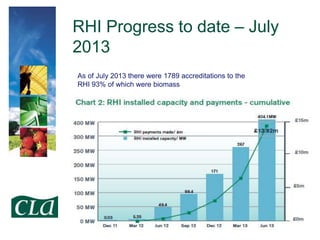
RHI Progress to date – July
2013
As of July 2013 there were 1789 accreditations to the
RHI 93% of which were biomass
Who is eligible?
• Any eligible system installed since 15th July 2009
• All non domestic buildings can qualify

• Systems heating multiple buildings
• Includes system heating multiple domestic buildings
• Must use liquid or steam as heat delivery medium

• Must not have received a grant
• Applicants must be the owner of the installation
• Installations under 45kWth need to be MCS certified
Eligibility in more detail
“Installations serving a single private residential premises
are currently not eligible for the RHI”
Are premises considered “separate and self-contained
premises for Council Tax banding purposes.”? Farm

Offices?
• Renewable Heat Incentive Guidance Volume One:
Eligibility and how to apply http://www.ofgem.gov.uk/eserve/RHI/howtoapply/Documents1/RHI_Guidance_Doc
ument_Vol_One.pdf
Eligible uses of heat
Space Heating
Hot Water

in a building

Carrying out a process (not electricity)
Definition Of Building:

“Permanent or long-lasting building or structure of
whatever kind and whether fixed or moveable which,
except for doors and windows is wholly enclosed on all
sides with a roof or ceiling and walls”
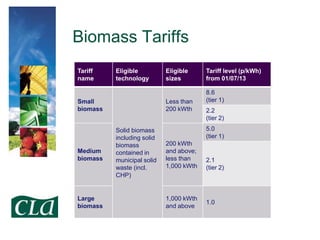
Biomass Tariffs
Tariff
name

Eligible
technology

Small
biomass

Medium
biomass

Large
biomass

Eligible
sizes

Less than
200 kWth

Solid biomass
including solid
biomass
contained in
municipal solid
waste (incl.
CHP)

Tariff level (p/kWh)
from 01/07/13
8.6
(tier 1)
2.2
(tier 2)
5.0
(tier 1)

200 kWth
and above;
less than
1,000 kWth

1,000 kWth
and above

2.1
(tier 2)

1.0
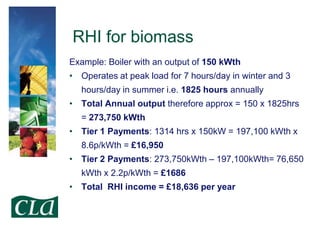
RHI for biomass
Example: Boiler with an output of 150 kWth
• Operates at peak load for 7 hours/day in winter and 3
hours/day in summer i.e. 1825 hours annually
• Total Annual output therefore approx = 150 x 1825hrs
= 273,750 kWth

• Tier 1 Payments: 1314 hrs x 150kW = 197,100 kWth x
8.6p/kWth = £16,950
• Tier 2 Payments: 273,750kWth – 197,100kWth= 76,650

kWth x 2.2p/kWth = £1686
• Total RHI income = £18,636 per year
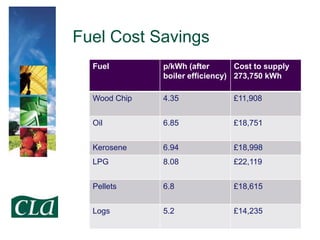
Fuel Cost Savings
Fuel

p/kWh (after
Cost to supply
boiler efficiency) 273,750 kWh

Wood Chip

4.35

£11,908

Oil

6.85

£18,751

Kerosene

6.94

£18,998

LPG

8.08

£22,119

Pellets

6.8

£18,615

Logs

5.2

£14,235
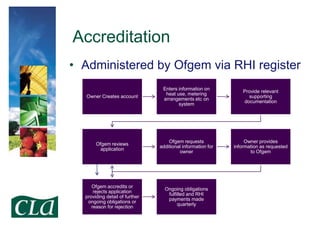
Accreditation
• Administered by Ofgem via RHI register
Owner Creates account

Enters information on
heat use, metering
arrangements etc on
system

Provide relevant
supporting
documentation

Ofgem reviews
application

Ofgem requests
additional information for
owner

Owner provides
information as requested
to Ofgem

Ofgem accredits or
rejects application
providing detail of further
ongoing obligations or
reason for rejection

Ongoing obligations
fulfilled and RHI
payments made
quarterly
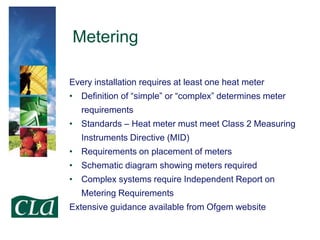
Metering
Every installation requires at least one heat meter
• Definition of “simple” or “complex” determines meter

requirements
• Standards – Heat meter must meet Class 2 Measuring
Instruments Directive (MID)

• Requirements on placement of meters
• Schematic diagram showing meters required
• Complex systems require Independent Report on
Metering Requirements
Extensive guidance available from Ofgem website
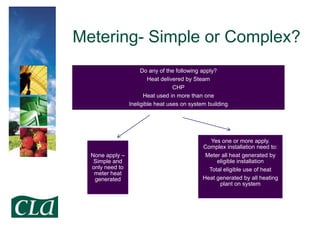
Metering- Simple or Complex?
Do any of the following apply?
Heat delivered by Steam
CHP
Heat used in more than one
Ineligible heat uses on system building

None apply –
Simple and
only need to
meter heat
generated

Yes one or more apply.
Complex installation need to:
Meter all heat generated by
eligible installation
Total eligible use of heat
Heat generated by all heating
plant on system
Ongoing Obligations
• Submission of periodic data
• Maintenance of equipment

• Calibration of meters
• Notification of any major changes to installation or
heating system – including ownership

• Keeping of records
• Annual declaration
• Compliance with any document audit / site inspection
request
Changes to the Scheme
• Tariff degression introduced June 2013
• Sustainability criteria for non-waste biomass from April

2014 for new and existing installations
• Air quality standards from 24th September
Proposed changes

• Introducing new technologies
• Minimum Energy Efficiency standards
• Review of tariffs for large scale biomass (and other
technologies) – Tariff to be doubled
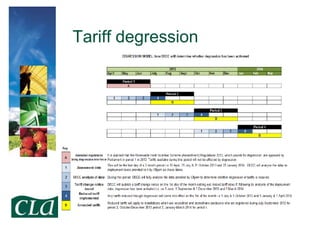
Tariff degression
Tariff Degression calculation
• Tariff degression based on level of deployment
• Looks at overall deployment, technology deployment &

change in rate of deployment
• If triggers points exceeded then tariff reduction will take
place

• Can be applied across the scheme as a whole or to
individual technologies
• So far degression of medium scale biomass only in July
Sustainability Criteria
• Sustainability been an area of discussion
• New requirements introduced from April 2014

• Apply to existing and new accreditations
• Fuel will need to be supplied from an accredited
member of Biomass supplier list

• Includes self supply although process will be simplified
• Accreditation process not yet set up so little detail
available
Domestic RHI – Key points
• Open for applications in spring 2014 –early application

for existing systems
• Owner-occupiers, Private landlords, Registered
Providers of Social Housing, Self-builders, Third-party

owners of a heating system and owners of systems
installed since 15th July 2009 (legacy applicants) all
included

• MCS certified biomass boilers up to 45kWth
• Minimum energy efficiency requirements will apply
• Payments will be made quarterly in arrears for 7 years,
based on deemed heat usage
Domestic RHI -Tariffs
• Biomass tariff has been set at 12.2 p/kWh
• RHI income based on deemed heat demand of your

property from an EPC
• By way of an example, a home with a heat demand of
15,000 kWh per year would receive £1,830 p.a. in

payments if heated with a biomass boiler or £12,810
over the 7 years.
• Renewable Heating Premium Payment (RHPP)
currently available
RHI an opportunity for CLA
members
• Best opportunity for those off gas grid
• Index linked income for 20 years

• Reduced fuel costs
• Carbon savings
• Opportunity for landlords with tenanted properties,

businesses and farms
• Opportunity for woodland owners as wood fuel suppliers
• Get in under the non domestic scheme if you can
• Domestic customers to benefit in future

The Renewable Heat Incentive for Woodfuelled Heating

  • 1.
    CLA East WoodfuelEvent 30th October 2013 The Renewable Heat Incentive for Biomass Heating Tom Beeley, CLA Renewable Energy Adviser
  • 2.
    What is theRHI? • Introduced in November 2011 • Supports use of heat from renewable energy sources - biomass, GSHP, solar thermal • Designed to overcome barriers to renewable heating • Aims to provide a 12% return on investment • Allocated budget of £860 million • Quarterly, index linked payments over 20 years based on metered heat • Administered by Ofgem
  • 3.
    RHI Progress todate – July 2013 As of July 2013 there were 1789 accreditations to the RHI 93% of which were biomass
  • 4.
    Who is eligible? •Any eligible system installed since 15th July 2009 • All non domestic buildings can qualify • Systems heating multiple buildings • Includes system heating multiple domestic buildings • Must use liquid or steam as heat delivery medium • Must not have received a grant • Applicants must be the owner of the installation • Installations under 45kWth need to be MCS certified
  • 5.
    Eligibility in moredetail “Installations serving a single private residential premises are currently not eligible for the RHI” Are premises considered “separate and self-contained premises for Council Tax banding purposes.”? Farm Offices? • Renewable Heat Incentive Guidance Volume One: Eligibility and how to apply http://www.ofgem.gov.uk/eserve/RHI/howtoapply/Documents1/RHI_Guidance_Doc ument_Vol_One.pdf
  • 6.
    Eligible uses ofheat Space Heating Hot Water in a building Carrying out a process (not electricity) Definition Of Building: “Permanent or long-lasting building or structure of whatever kind and whether fixed or moveable which, except for doors and windows is wholly enclosed on all sides with a roof or ceiling and walls”
  • 7.
    Biomass Tariffs Tariff name Eligible technology Small biomass Medium biomass Large biomass Eligible sizes Less than 200kWth Solid biomass including solid biomass contained in municipal solid waste (incl. CHP) Tariff level (p/kWh) from 01/07/13 8.6 (tier 1) 2.2 (tier 2) 5.0 (tier 1) 200 kWth and above; less than 1,000 kWth 1,000 kWth and above 2.1 (tier 2) 1.0
  • 8.
    RHI for biomass Example:Boiler with an output of 150 kWth • Operates at peak load for 7 hours/day in winter and 3 hours/day in summer i.e. 1825 hours annually • Total Annual output therefore approx = 150 x 1825hrs = 273,750 kWth • Tier 1 Payments: 1314 hrs x 150kW = 197,100 kWth x 8.6p/kWth = £16,950 • Tier 2 Payments: 273,750kWth – 197,100kWth= 76,650 kWth x 2.2p/kWth = £1686 • Total RHI income = £18,636 per year
  • 9.
    Fuel Cost Savings Fuel p/kWh(after Cost to supply boiler efficiency) 273,750 kWh Wood Chip 4.35 £11,908 Oil 6.85 £18,751 Kerosene 6.94 £18,998 LPG 8.08 £22,119 Pellets 6.8 £18,615 Logs 5.2 £14,235
  • 10.
    Accreditation • Administered byOfgem via RHI register Owner Creates account Enters information on heat use, metering arrangements etc on system Provide relevant supporting documentation Ofgem reviews application Ofgem requests additional information for owner Owner provides information as requested to Ofgem Ofgem accredits or rejects application providing detail of further ongoing obligations or reason for rejection Ongoing obligations fulfilled and RHI payments made quarterly
  • 11.
    Metering Every installation requiresat least one heat meter • Definition of “simple” or “complex” determines meter requirements • Standards – Heat meter must meet Class 2 Measuring Instruments Directive (MID) • Requirements on placement of meters • Schematic diagram showing meters required • Complex systems require Independent Report on Metering Requirements Extensive guidance available from Ofgem website
  • 12.
    Metering- Simple orComplex? Do any of the following apply? Heat delivered by Steam CHP Heat used in more than one Ineligible heat uses on system building None apply – Simple and only need to meter heat generated Yes one or more apply. Complex installation need to: Meter all heat generated by eligible installation Total eligible use of heat Heat generated by all heating plant on system
  • 13.
    Ongoing Obligations • Submissionof periodic data • Maintenance of equipment • Calibration of meters • Notification of any major changes to installation or heating system – including ownership • Keeping of records • Annual declaration • Compliance with any document audit / site inspection request
  • 14.
    Changes to theScheme • Tariff degression introduced June 2013 • Sustainability criteria for non-waste biomass from April 2014 for new and existing installations • Air quality standards from 24th September Proposed changes • Introducing new technologies • Minimum Energy Efficiency standards • Review of tariffs for large scale biomass (and other technologies) – Tariff to be doubled
  • 15.
  • 16.
    Tariff Degression calculation •Tariff degression based on level of deployment • Looks at overall deployment, technology deployment & change in rate of deployment • If triggers points exceeded then tariff reduction will take place • Can be applied across the scheme as a whole or to individual technologies • So far degression of medium scale biomass only in July
  • 17.
    Sustainability Criteria • Sustainabilitybeen an area of discussion • New requirements introduced from April 2014 • Apply to existing and new accreditations • Fuel will need to be supplied from an accredited member of Biomass supplier list • Includes self supply although process will be simplified • Accreditation process not yet set up so little detail available
  • 18.
    Domestic RHI –Key points • Open for applications in spring 2014 –early application for existing systems • Owner-occupiers, Private landlords, Registered Providers of Social Housing, Self-builders, Third-party owners of a heating system and owners of systems installed since 15th July 2009 (legacy applicants) all included • MCS certified biomass boilers up to 45kWth • Minimum energy efficiency requirements will apply • Payments will be made quarterly in arrears for 7 years, based on deemed heat usage
  • 19.
    Domestic RHI -Tariffs •Biomass tariff has been set at 12.2 p/kWh • RHI income based on deemed heat demand of your property from an EPC • By way of an example, a home with a heat demand of 15,000 kWh per year would receive £1,830 p.a. in payments if heated with a biomass boiler or £12,810 over the 7 years. • Renewable Heating Premium Payment (RHPP) currently available
  • 20.
    RHI an opportunityfor CLA members • Best opportunity for those off gas grid • Index linked income for 20 years • Reduced fuel costs • Carbon savings • Opportunity for landlords with tenanted properties, businesses and farms • Opportunity for woodland owners as wood fuel suppliers • Get in under the non domestic scheme if you can • Domestic customers to benefit in future