Economic Impacts of Large-Scale
Utilization of Excess Heat -
Assessment through Regional
Modeling
Akram Sandvall, Erik Ahlgren, Tomas Ekvall
Energy Technology, Energy and Environment Department,
Chalmers University of Technology
Swedish Environmental Research Institutes (IVL)
IEA ETSAP Workshop, Nov.17-19, 2014, Copenhagen
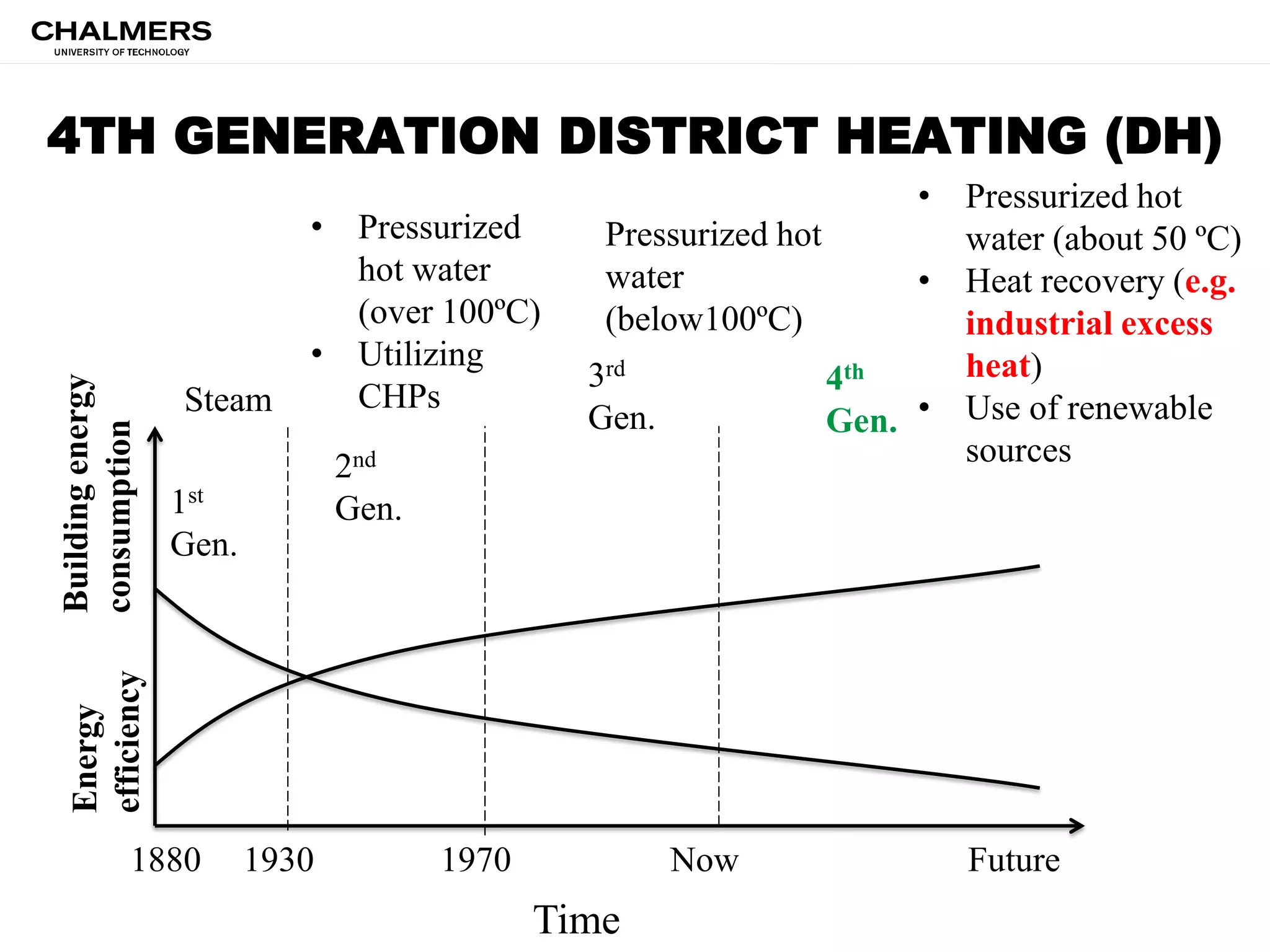
4TH GENERATION DISTRICT HEATING (DH)
Time
Energy
efficiency
Buildingenergy
consumption
1st
Gen.
19301880 1970 Now Future
2nd
Gen.
3rd
Gen.
4th
Gen.
Steam
• Pressurized
hot water
(over 100ºC)
• Utilizing
CHPs
Pressurized hot
water
(below100ºC)
• Pressurized hot
water (about 50 ºC)
• Heat recovery (e.g.
industrial excess
heat)
• Use of renewable
sources
Swedish DH systems
Source: Statistics Sweden & Swedish Energy Agency
0
10
20
30
40
50
60
70
1970
1975
1980
1985
1990
1995
2000
2005
2010
Fueluse[TWh]
Excess heat
Heat pumps
Electric boilers
Biofuels, Municipal solid
waste, peat
Energy coal including coke
oven and blast furnace gas
Natural gas including LPG
Oil
0
10
20
30
40
50
1980 1985 1990 1995 2000 2005 2010
Fuelsupply[TWh]
Peat
Tall oil pitch
Forest residues
Municipal solid waste
(MSW)
0
10
20
30
40
50
60
70
1970
1975
1980
1985
1990
1995
2000
2005
2010
Fueluse[TWh]
Industrial EH
Heat pumps
Electric boilers
Biofuels, Municipal solid
waste, peat
Energy coal including coke
oven and blast furnace gas
Natural gas including LPG
Oil
Biomass (forest residues &
energy crops)
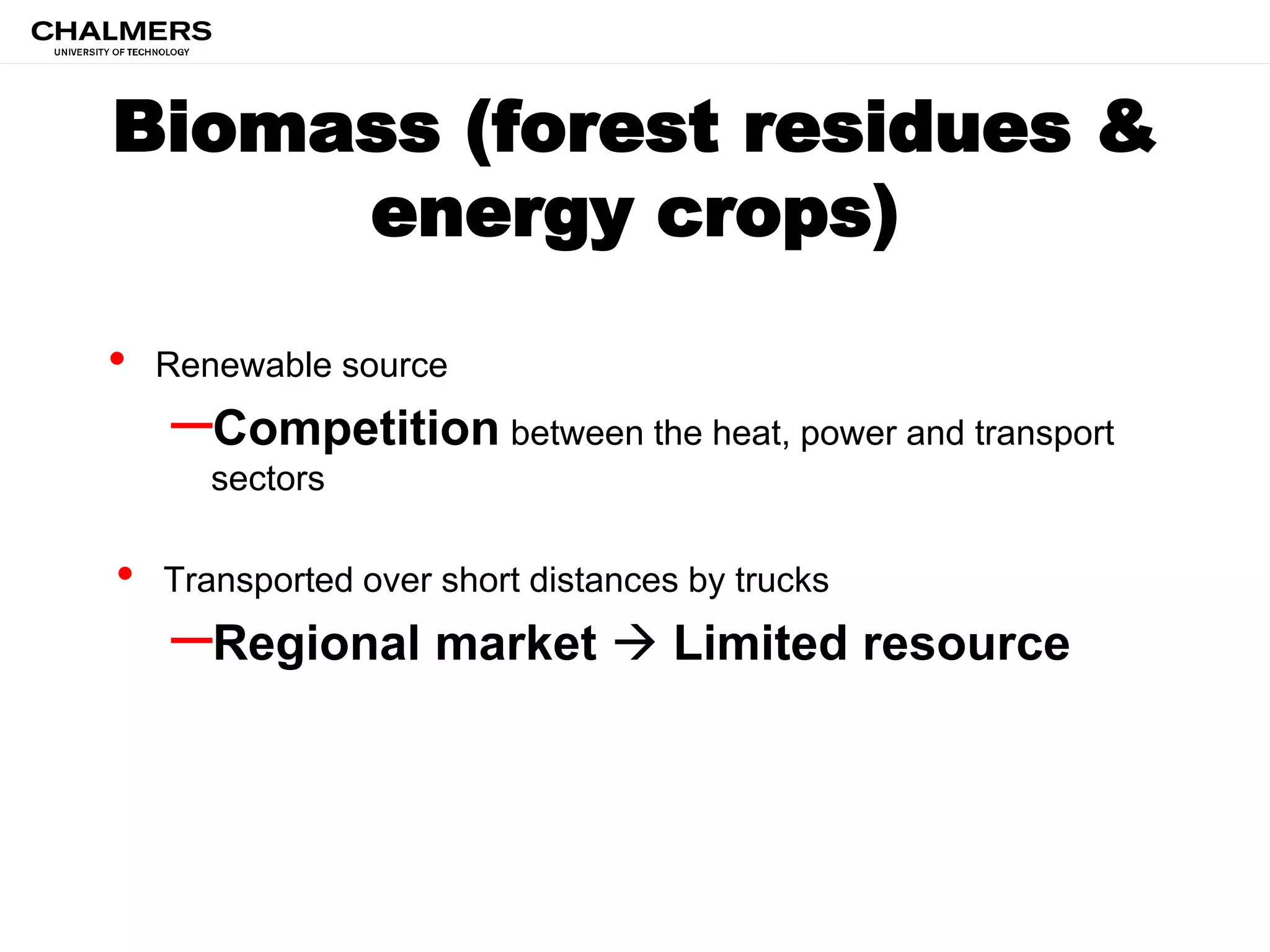
• Renewable source
–Competition between the heat, power and transport
sectors
• Transported over short distances by trucks
–Regional market  Limited resource
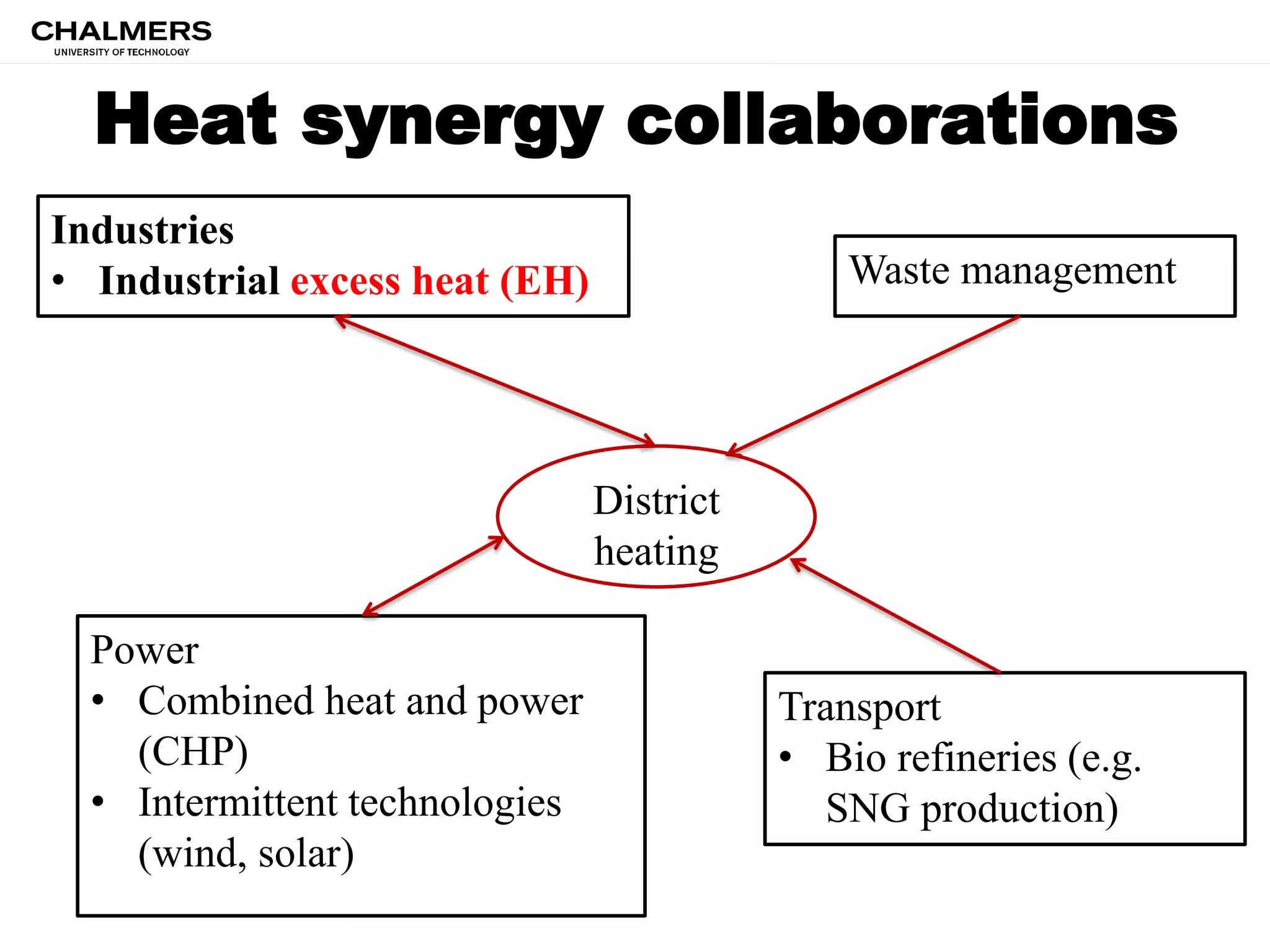
Heat synergy collaborations
Power
• Combined heat and power
(CHP)
• Intermittent technologies
(wind, solar)
Transport
• Bio refineries (e.g.
SNG production)
Waste management
Industries
• Industrial excess heat (EH)
District
heating
Industrial EH
• Challenges
– High investment cost of building heat networks
– Possible lock-in effects
Could construction of large heat networks, shared
between several industries and DH systems be a
solution?
Research Questions
• How would the system cost of DH supply be affected at a
regional level by the construction of a large heat network
allowing for long-distance transmission of EH?
• How is the marginal cost of DH supply affected by such a large
heat network?
Methodology
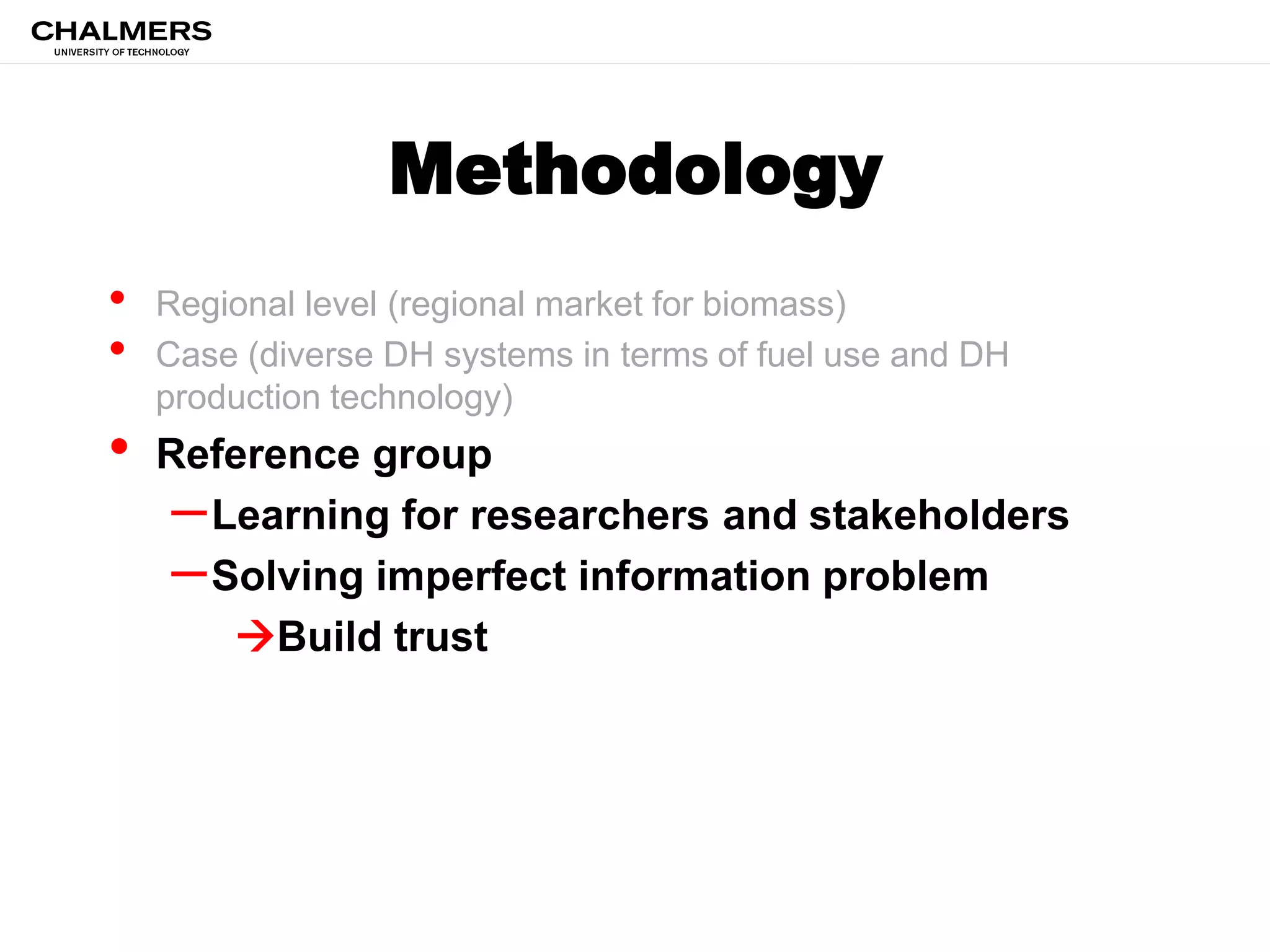
• Regional level (regional market for biomass)
• Case (diverse DH systems in terms of fuel use
and DH production technology)
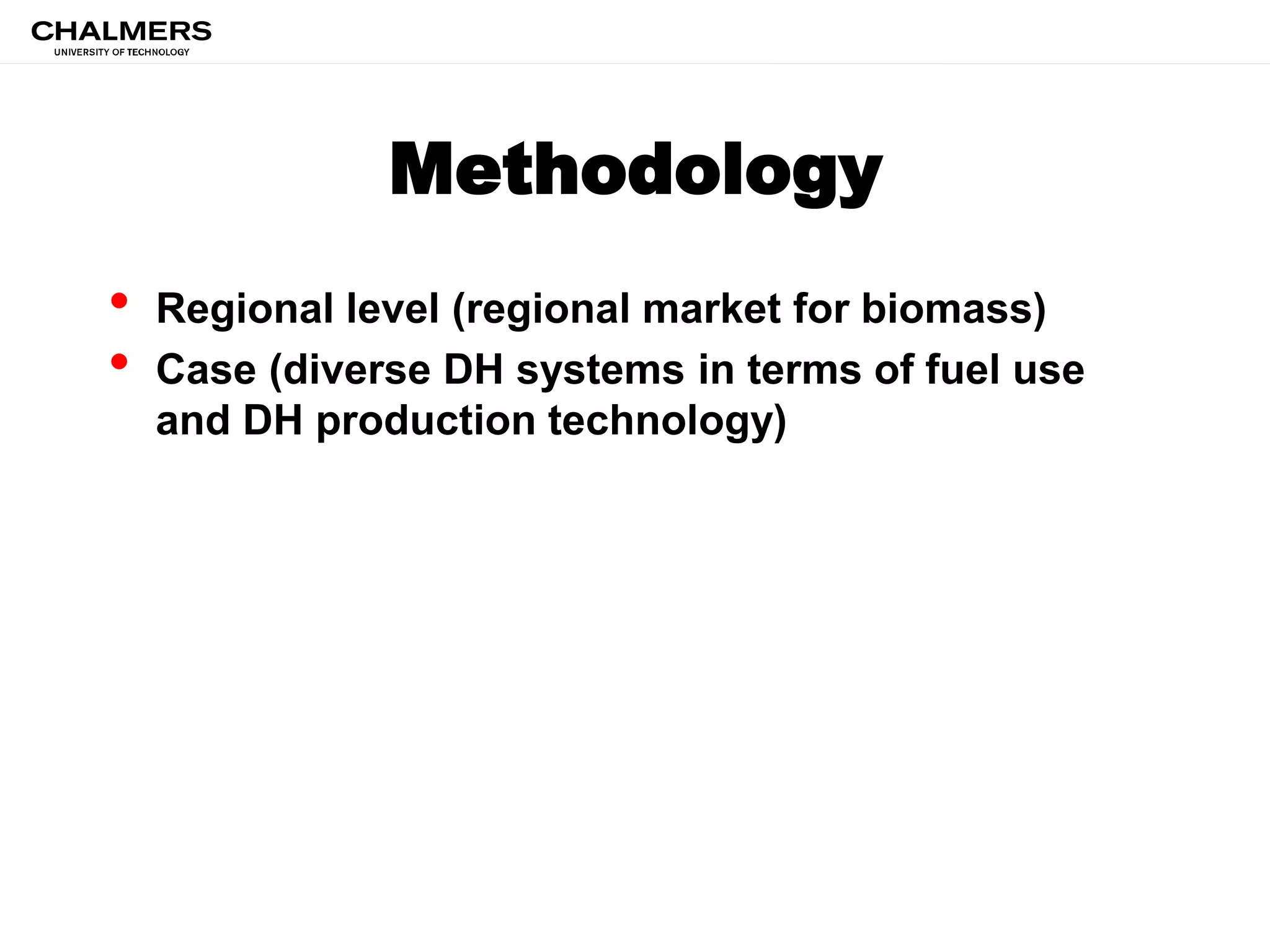
Västra Götaland
CASE
Methodology
• Regional level (regional market for biomass)
• Case (diverse DH systems in terms of fuel use and DH
production technology)
• Reference group
–Learning for researchers and stakeholders
–Solving imperfect information problem
Build trust
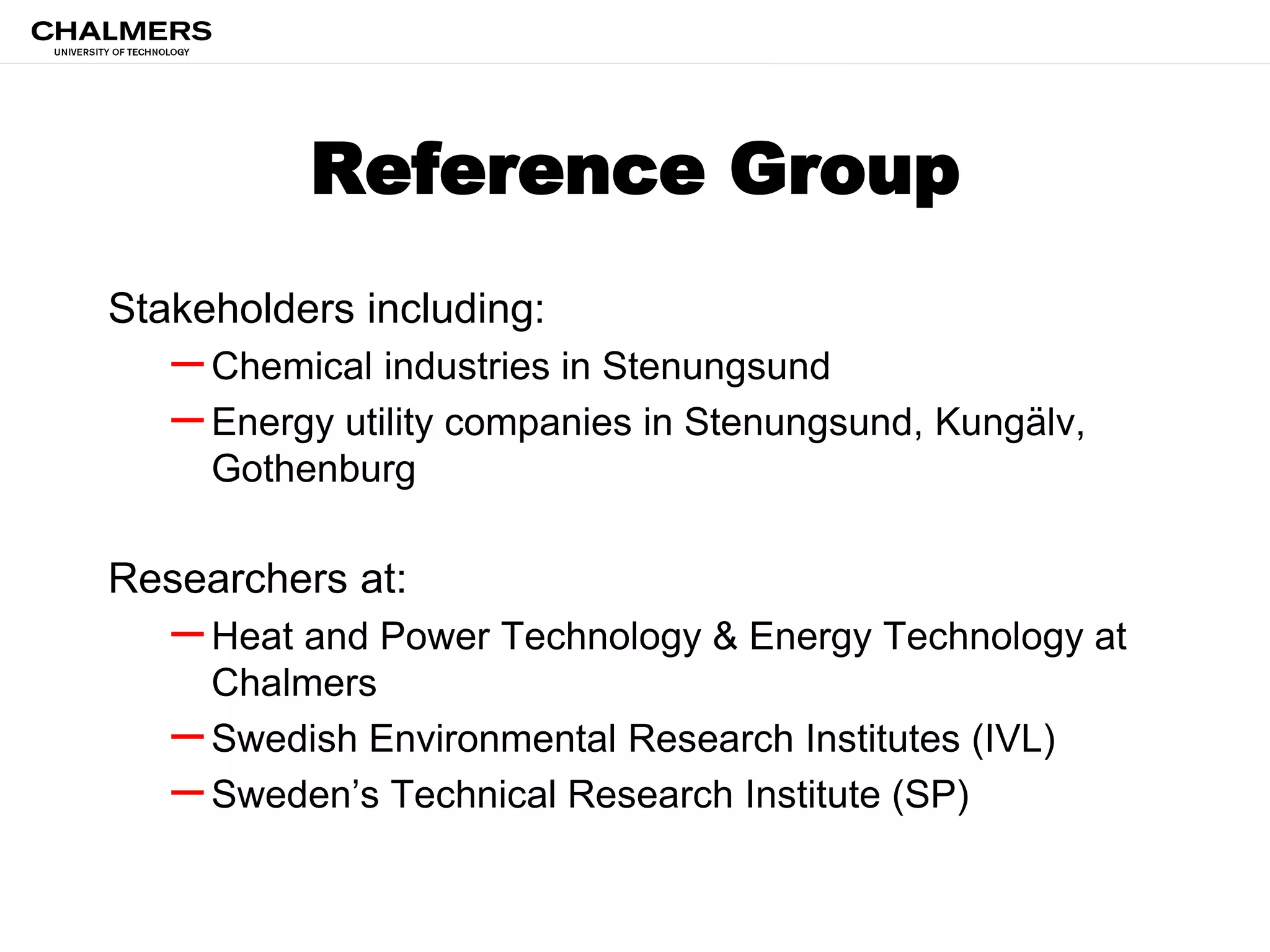
Reference Group
Stakeholders including:
–Chemical industries in Stenungsund
–Energy utility companies in Stenungsund, Kungälv,
Gothenburg
Researchers at:
–Heat and Power Technology & Energy Technology at
Chalmers
–Swedish Environmental Research Institutes (IVL)
–Sweden’s Technical Research Institute (SP)
Methodology
• Regional level (regional market for biomass)
• Case (diverse DH systems in terms of fuel use and DH
production technology)
• Reference group
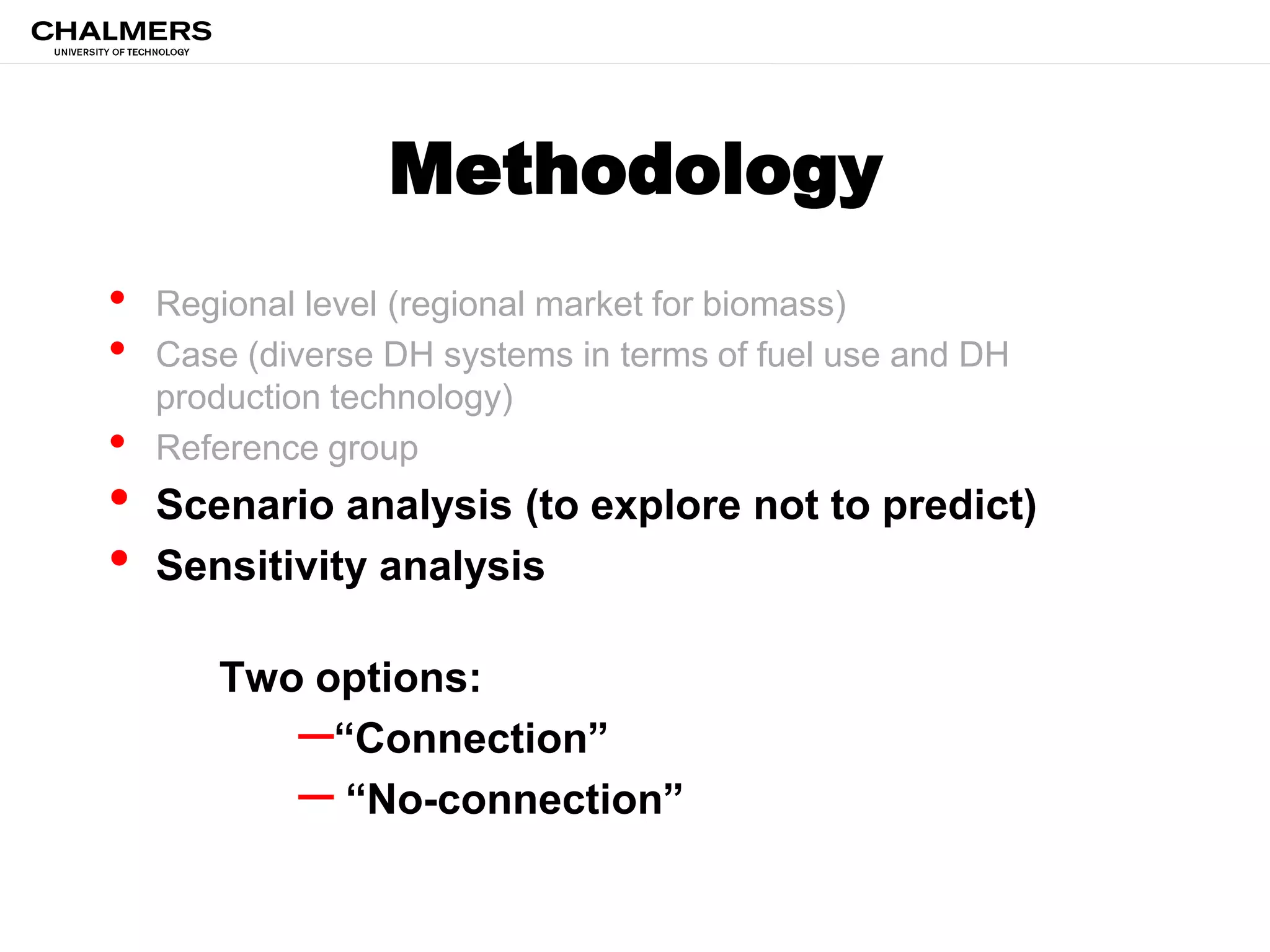
• Scenario analysis (to explore not to predict)
• Sensitivity analysis
Two options:
–“Connection”
– “No-connection”
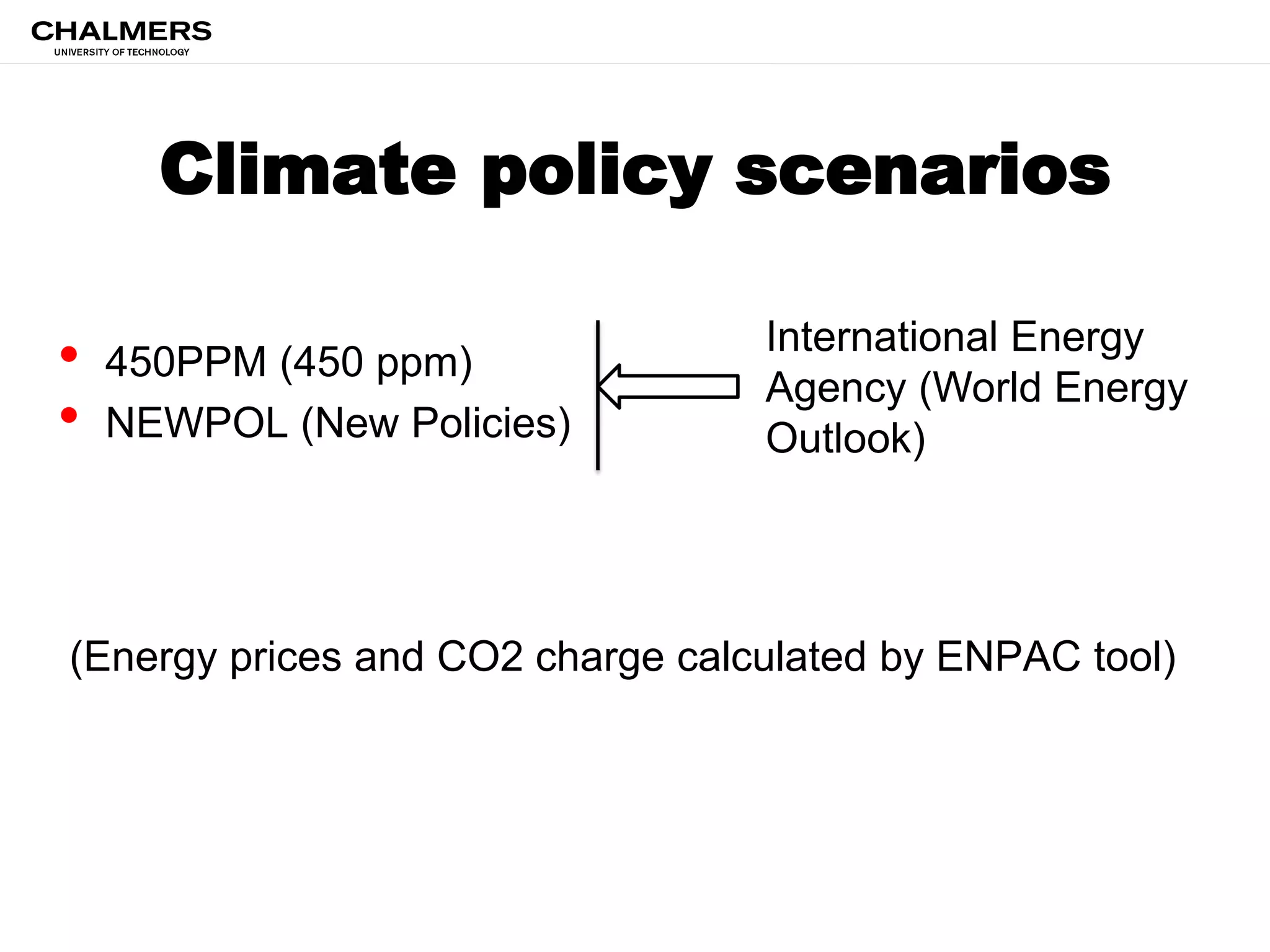
Climate policy scenarios
• 450PPM (450 ppm)
• NEWPOL (New Policies)
(Energy prices and CO2 charge calculated by ENPAC tool)
International Energy
Agency (World Energy
Outlook)
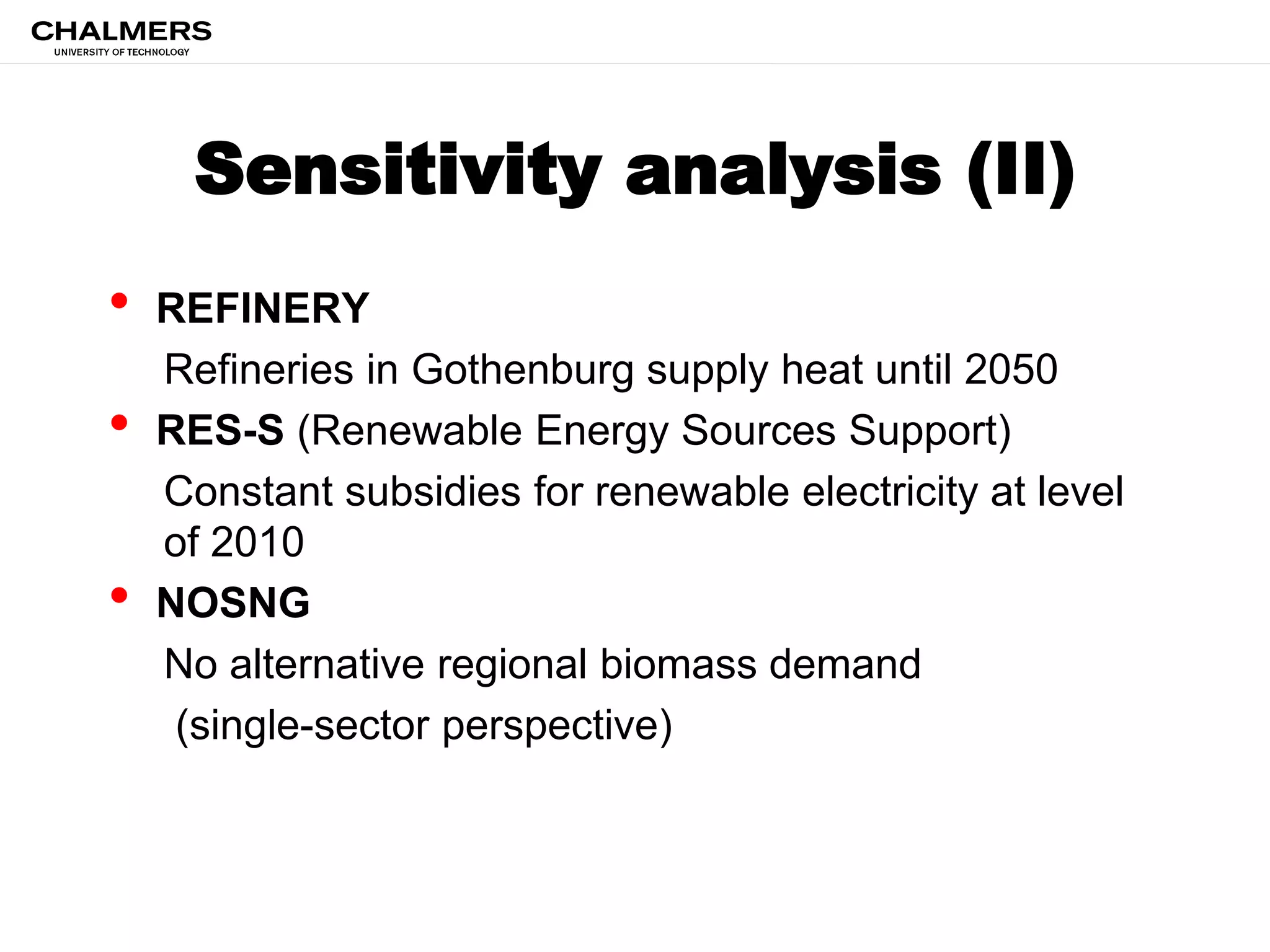
Sensitivity analysis (I)
• NONG
NG use is not allowed after 2030
• REHD (Reduced Heat Demand)
2010-2030 10% linear reduction
2030-2050 10% linear reduction
• LIC (Low Investment Cost)
About 50% lower pipeline cost
• INTRATE (INTerest RATE)
(2.5% and 30 yrs for pipelines &
11% and 15 yrs for heat exchangers)
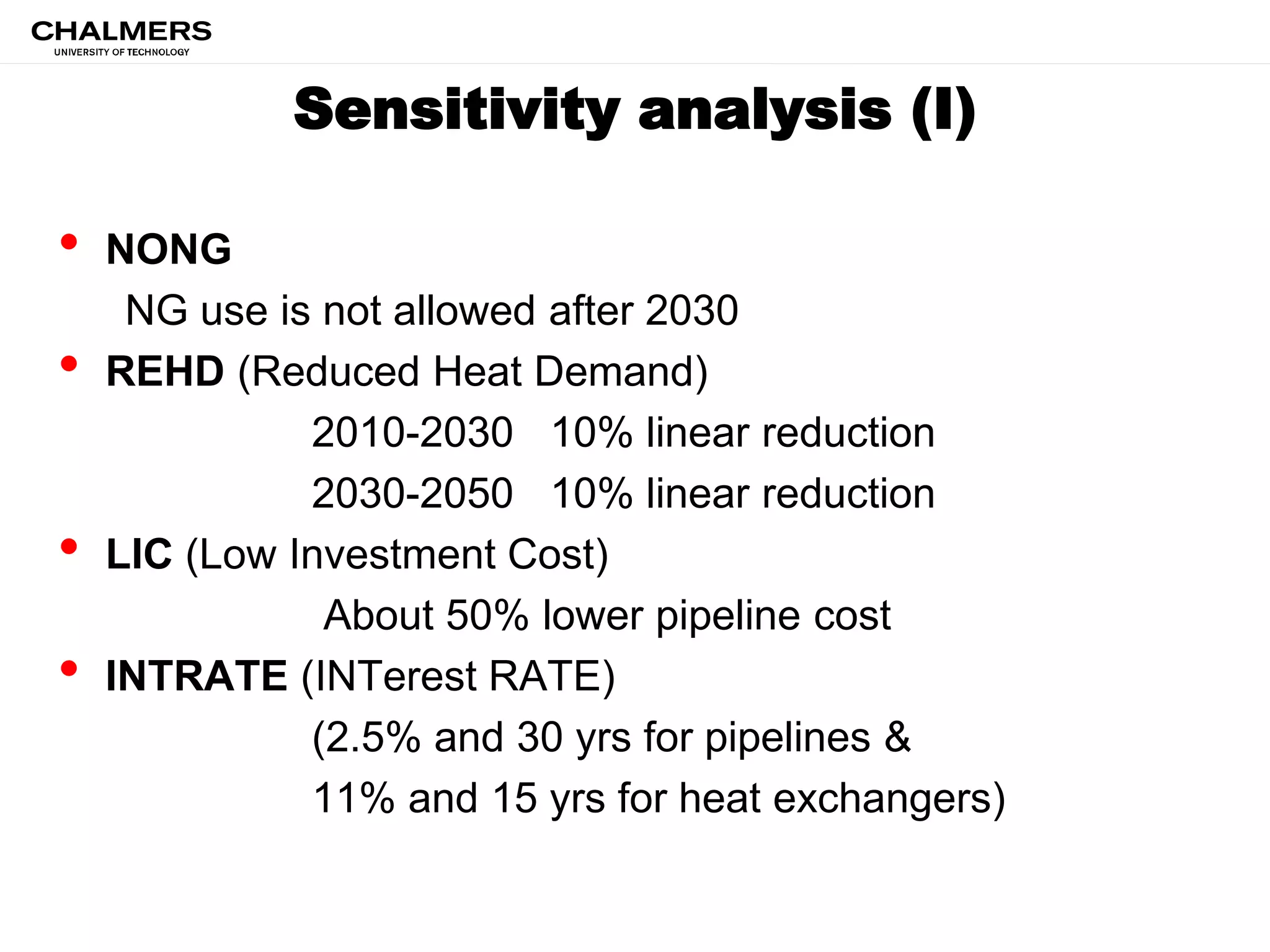
Sensitivity analysis (II)
• REFINERY
Refineries in Gothenburg supply heat until 2050
• RES-S (Renewable Energy Sources Support)
Constant subsidies for renewable electricity at level
of 2010
• NOSNG
No alternative regional biomass demand
(single-sector perspective)
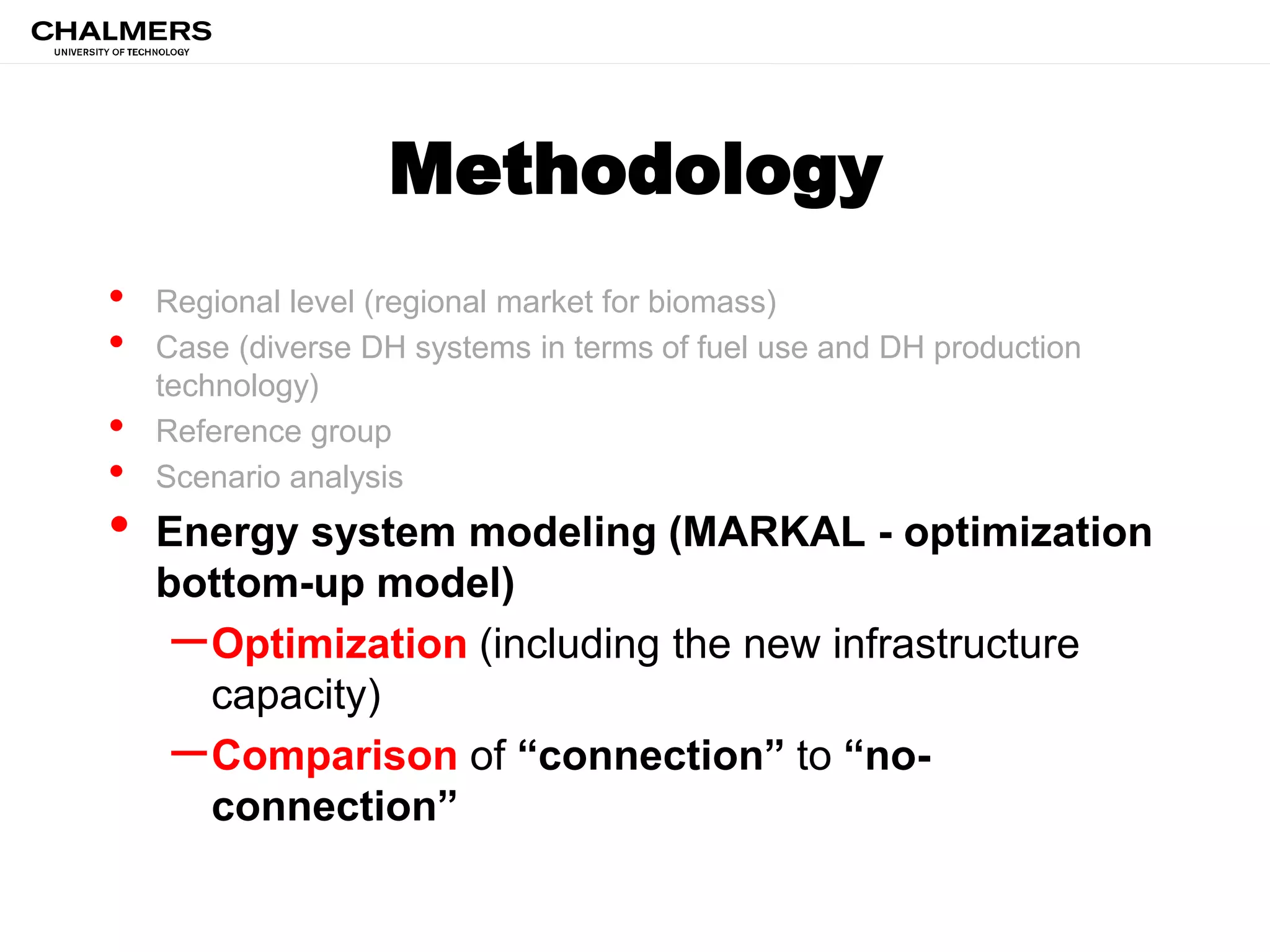
Methodology
• Regional level (regional market for biomass)
• Case (diverse DH systems in terms of fuel use and DH production
technology)
• Reference group
• Scenario analysis
• Energy system modeling (MARKAL - optimization
bottom-up model)
–Optimization (including the new infrastructure
capacity)
–Comparison of “connection” to “no-
connection”
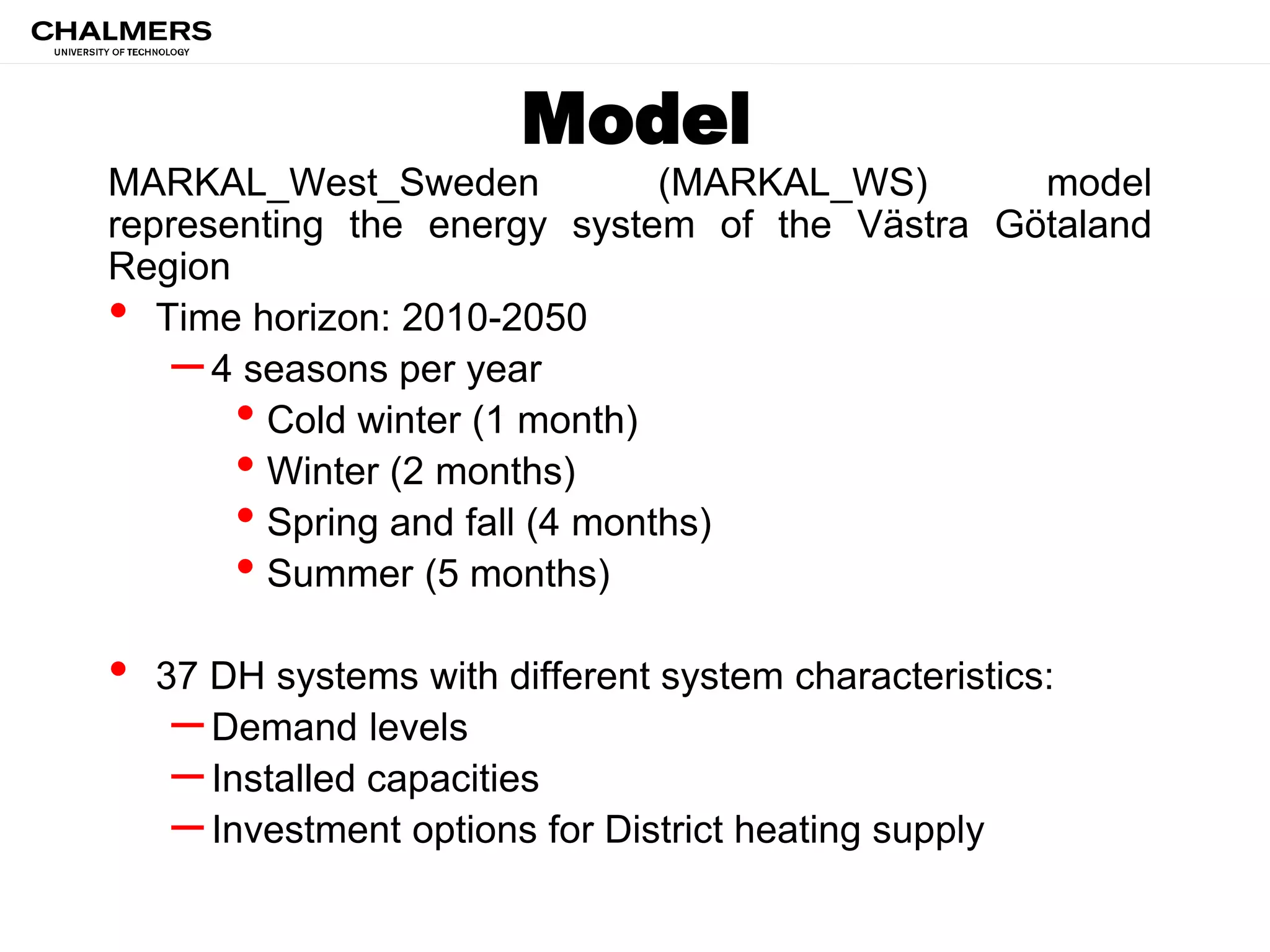
Model
MARKAL_West_Sweden (MARKAL_WS) model
representing the energy system of the Västra Götaland
Region
• Time horizon: 2010-2050
–4 seasons per year
• Cold winter (1 month)
• Winter (2 months)
• Spring and fall (4 months)
• Summer (5 months)
• 37 DH systems with different system characteristics:
–Demand levels
–Installed capacities
–Investment options for District heating supply
Model
• Investment options for the heat network between the cluster of
chemical industries in Stenungsund and the Gothenburg/
Kungälv DH systems.
• Bio-refinery, GoBiGas 1& 2, for SNG (synthetic natural gas)
production (biomass competitor)
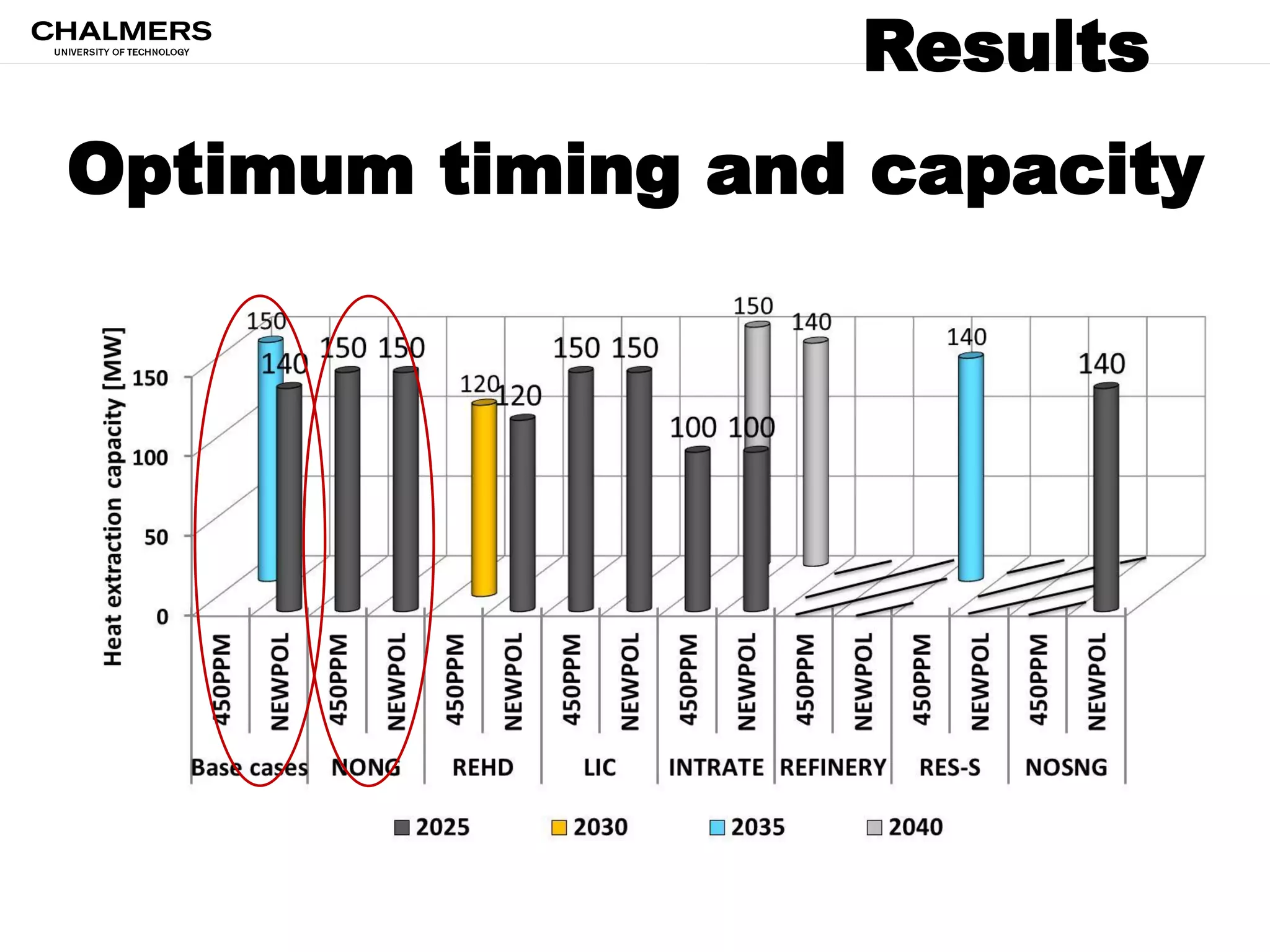
Optimum timing and capacity
Results
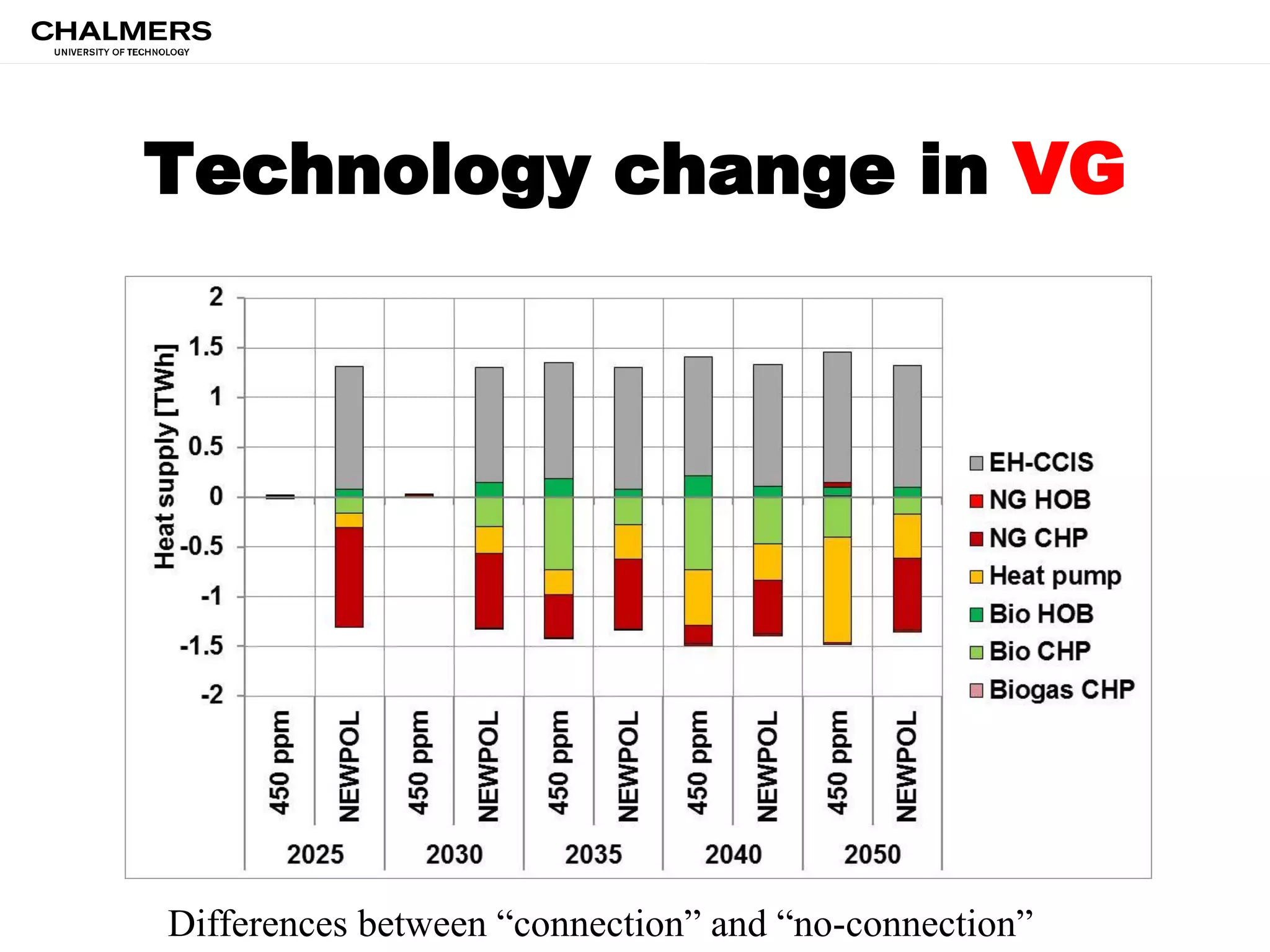
Technology change in VG
Differences between “connection” and “no-connection”
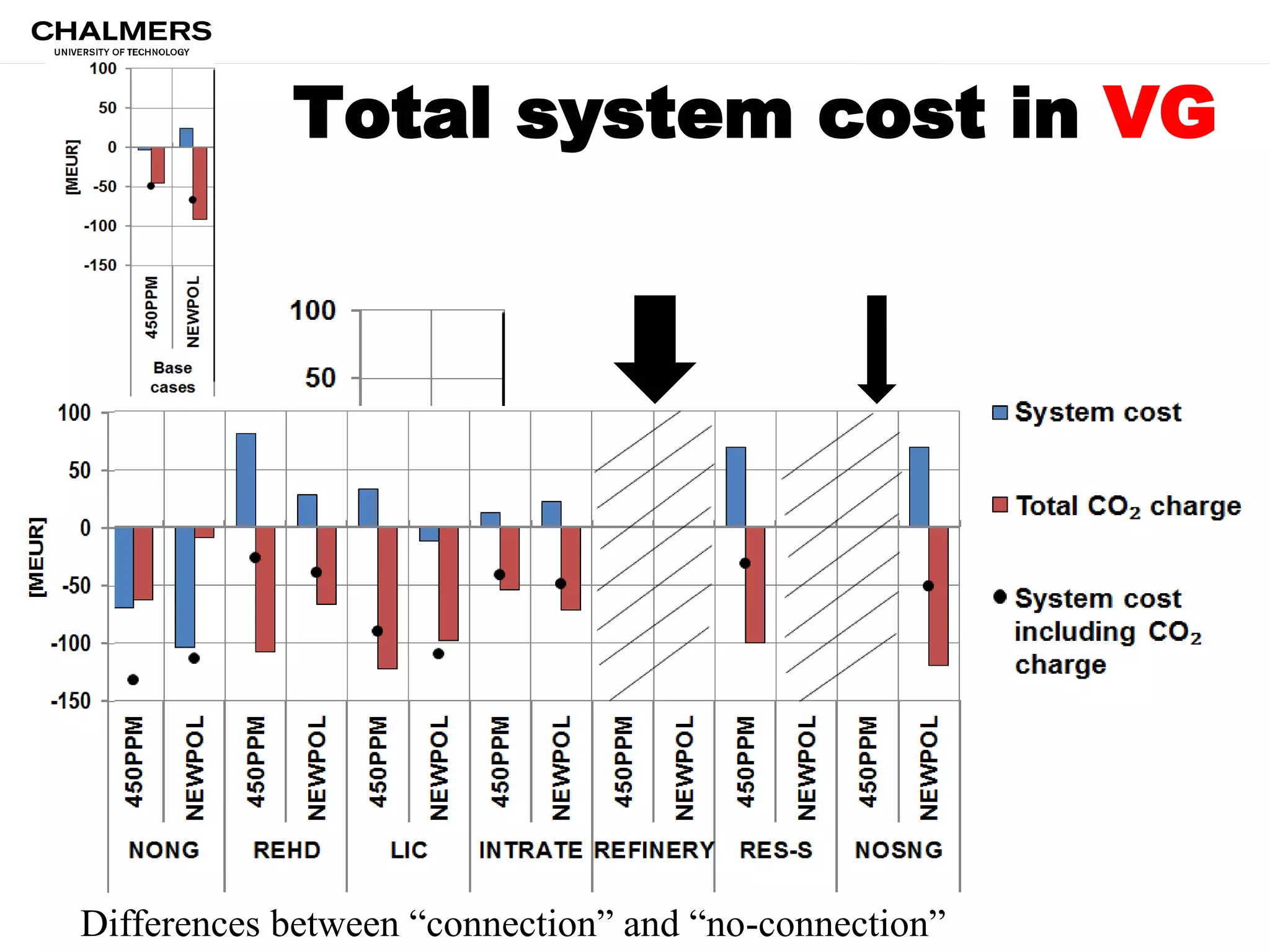
Total system cost in VG
Differences between “connection” and “no-connection”
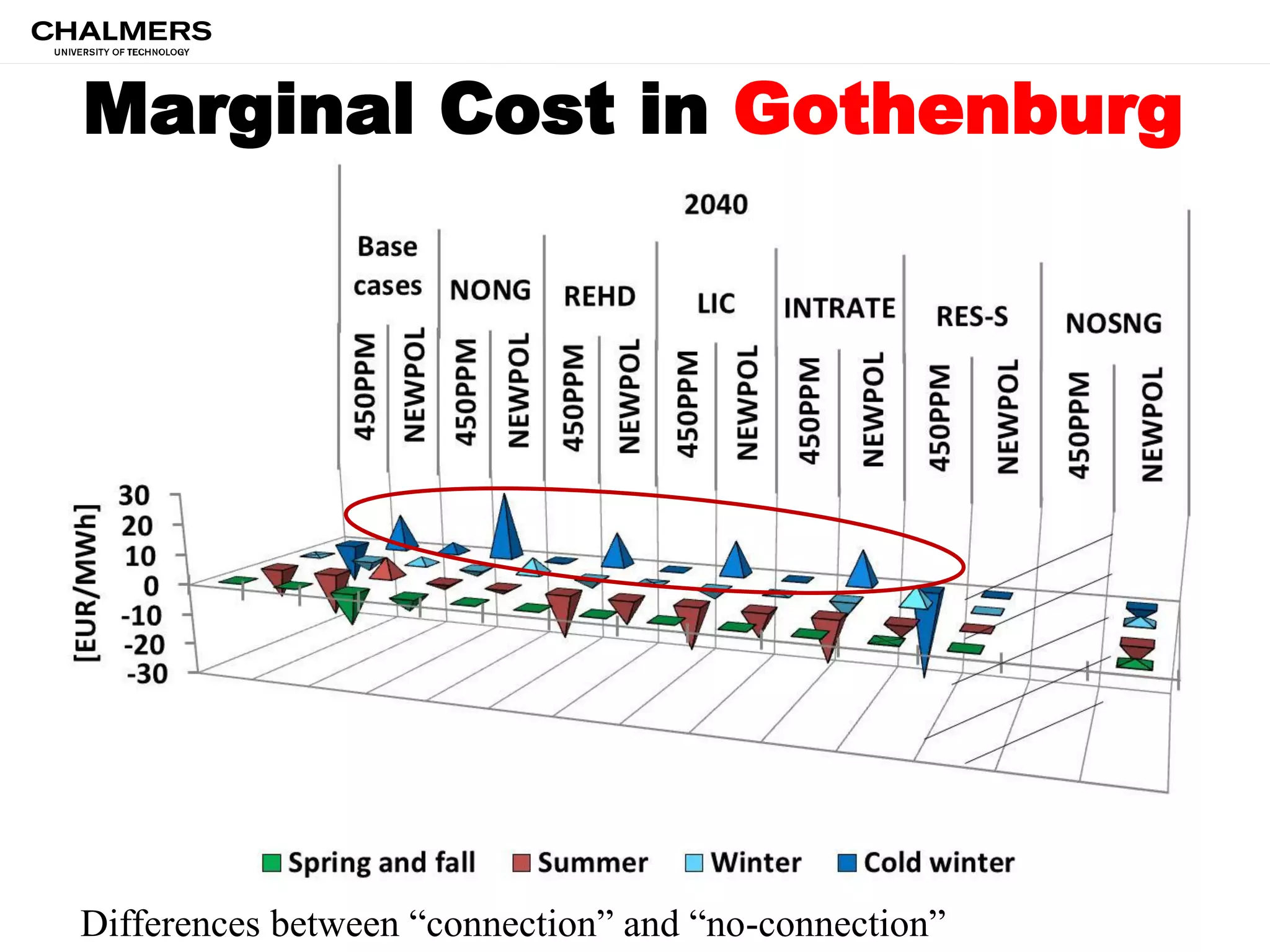
Marginal Cost in Gothenburg
Differences between “connection” and “no-connection”
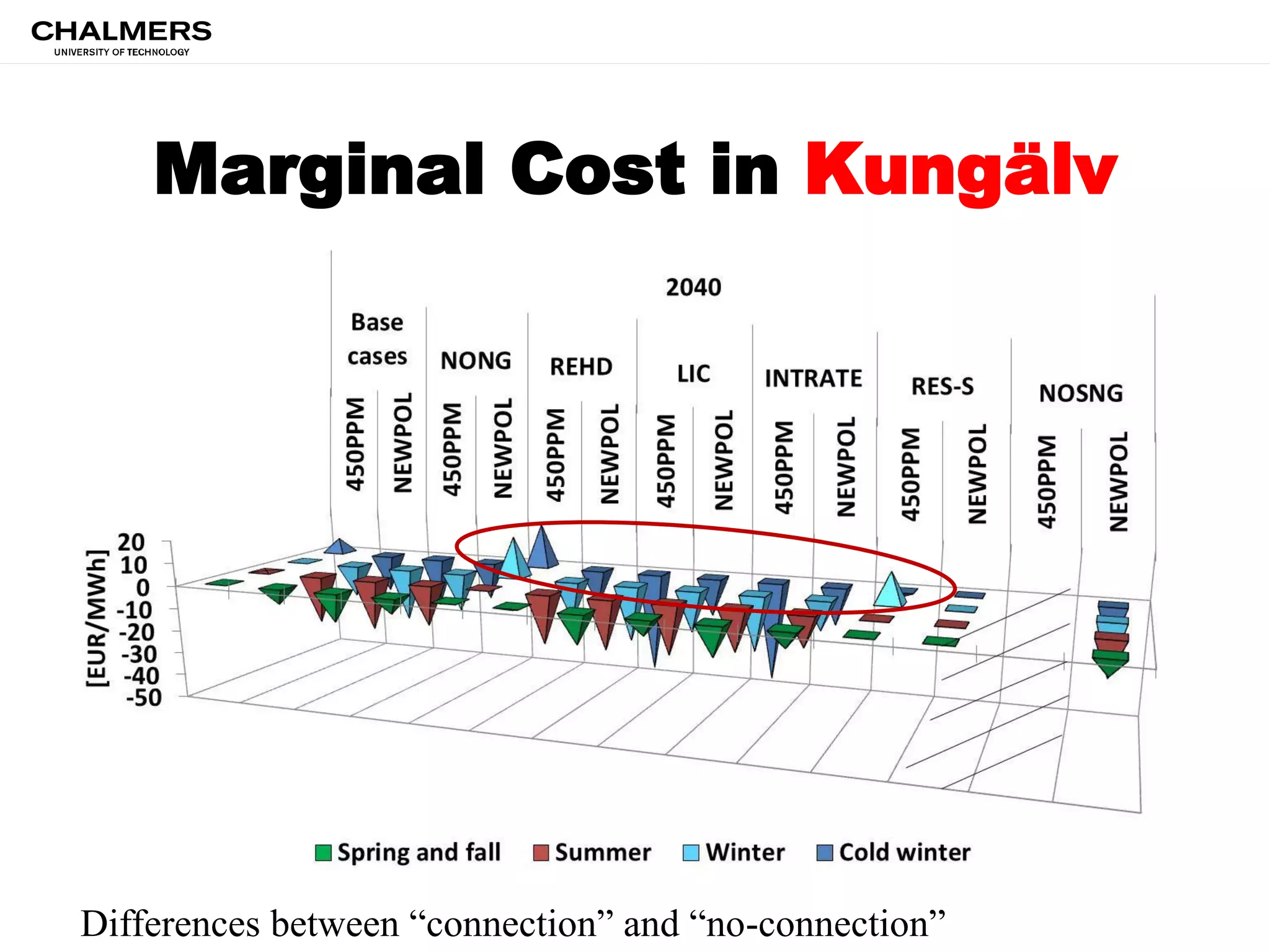
Marginal Cost in Kungälv
Differences between “connection” and “no-connection”
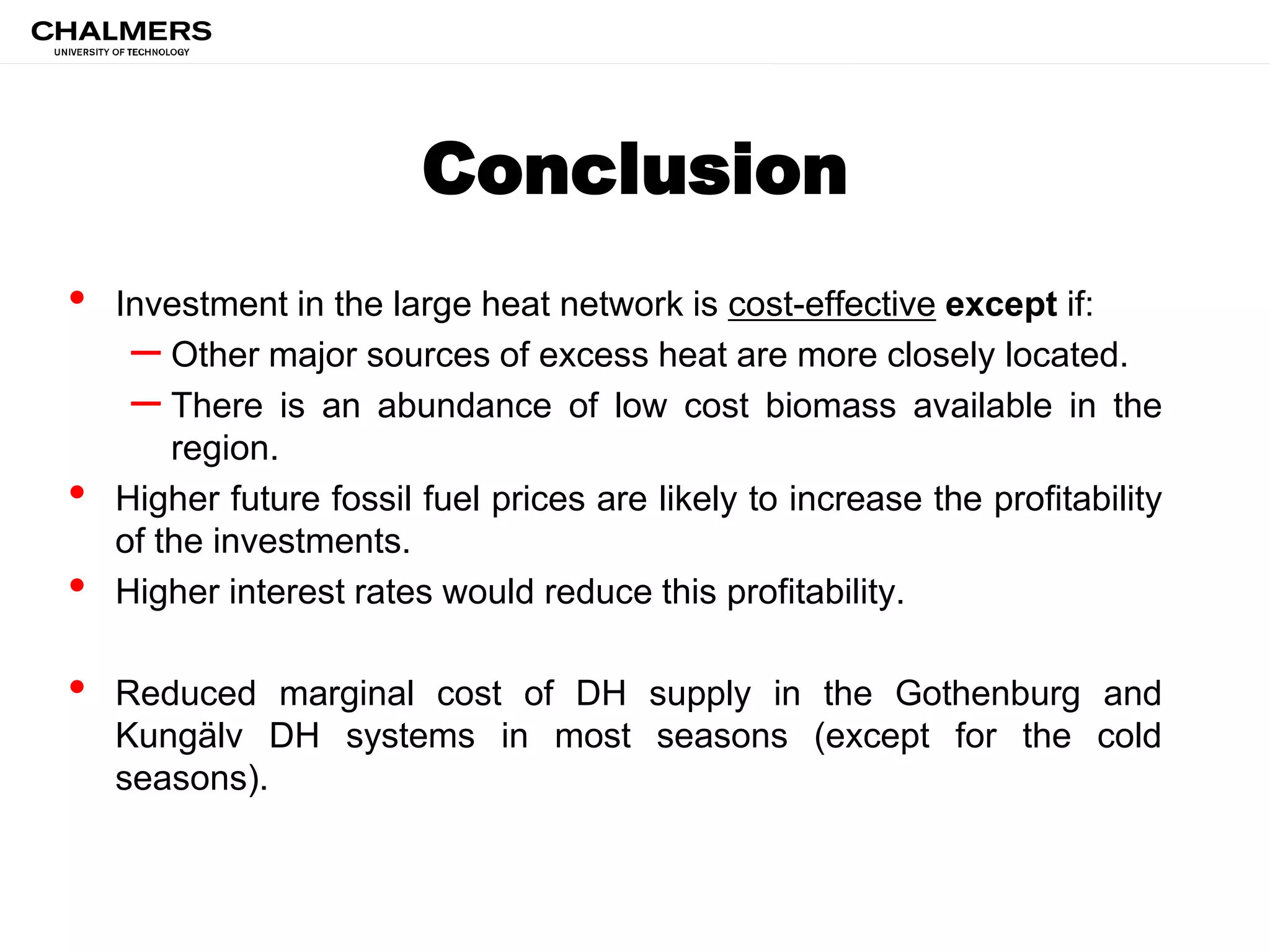
Conclusion
• Investment in the large heat network is cost-effective except if:
– Other major sources of excess heat are more closely located.
– There is an abundance of low cost biomass available in the
region.
• Higher future fossil fuel prices are likely to increase the profitability
of the investments.
• Higher interest rates would reduce this profitability.
• Reduced marginal cost of DH supply in the Gothenburg and
Kungälv DH systems in most seasons (except for the cold
seasons).
Thank you!
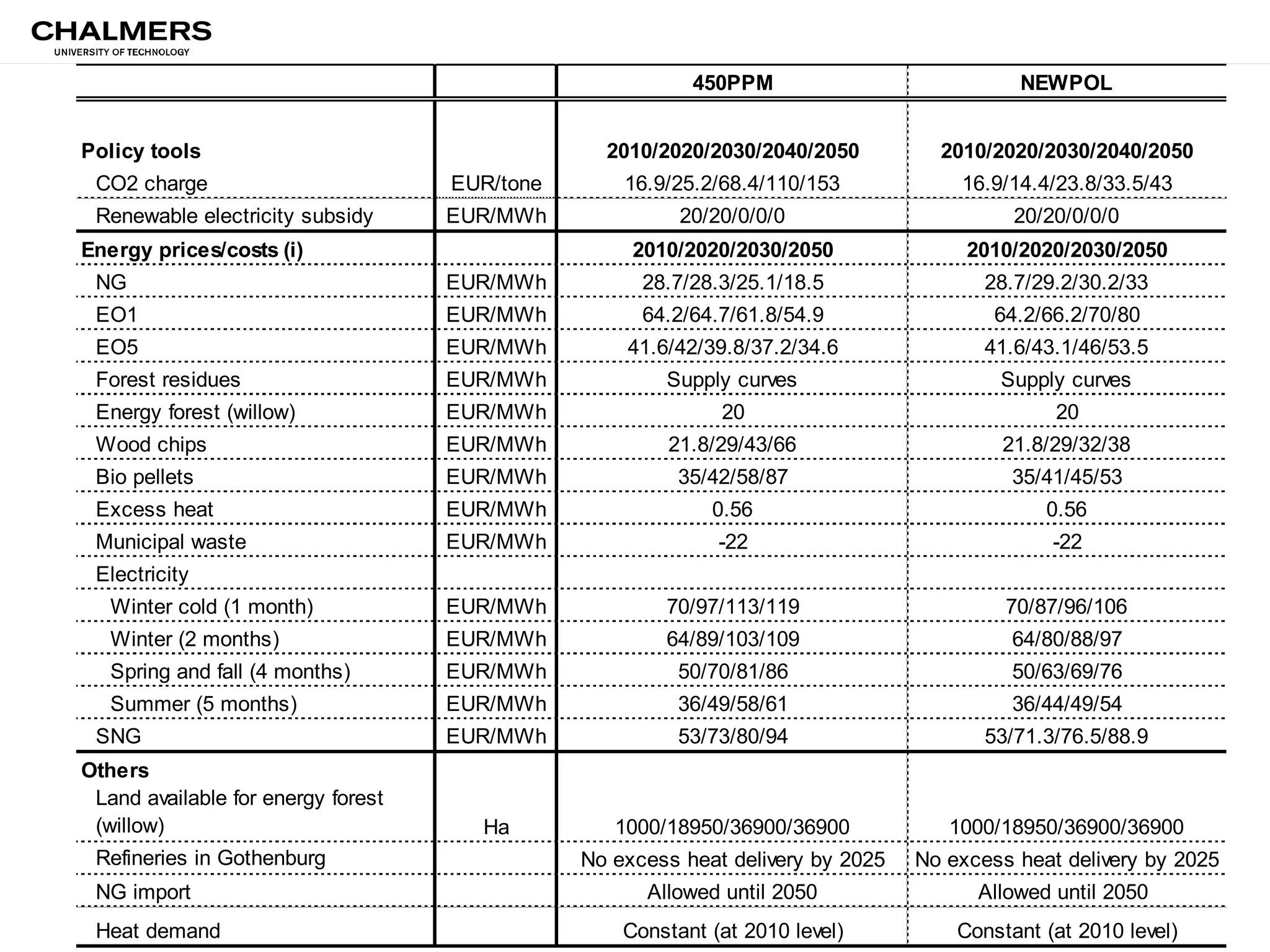
NEWPOL
Policy tools 2010/2020/2030/2040/2050
CO2 charge EUR/tone 16.9/14.4/23.8/33.5/43
Renewable electricity subsidy EUR/MWh 20/20/0/0/0
Energy prices/costs (i) 2010/2020/2030/2050
NG EUR/MWh 28.7/29.2/30.2/33
EO1 EUR/MWh 64.2/66.2/70/80
EO5 EUR/MWh 41.6/43.1/46/53.5
Forest residues EUR/MWh Supply curves
Energy forest (willow) EUR/MWh 20
Wood chips EUR/MWh 21.8/29/32/38
Bio pellets EUR/MWh 35/41/45/53
Excess heat EUR/MWh 0.56
Municipal waste EUR/MWh -22
Electricity
Winter cold (1 month) EUR/MWh 70/87/96/106
Winter (2 months) EUR/MWh 64/80/88/97
Spring and fall (4 months) EUR/MWh 50/63/69/76
Summer (5 months) EUR/MWh 36/44/49/54
SNG EUR/MWh 53/71.3/76.5/88.9
Others
Land available for energy forest
(willow) Ha 1000/18950/36900/36900
Refineries in Gothenburg No excess heat delivery by 2025
NG import Allowed until 2050
Heat demand Constant (at 2010 level)
2010/2020/2030/2040/2050
16.9/25.2/68.4/110/153
450PPM
20/20/0/0/0
2010/2020/2030/2050
28.7/28.3/25.1/18.5
64.2/64.7/61.8/54.9
41.6/42/39.8/37.2/34.6
53/73/80/94
Supply curves
20
21.8/29/43/66
35/42/58/87
0.56
50/70/81/86
-22
70/97/113/119
64/89/103/109
36/49/58/61
1000/18950/36900/36900
Allowed until 2050
Constant (at 2010 level)
No excess heat delivery by 2025
SKG pipeline
Cap≤ 50 MW 1800/ 0.25 Cap≤ 50 MW 1100/ 0.25
50˂Cap≤ 100 MW 2200/ 0.12 50˂Cap≤ 100 MW 1200/0.12
100˂Cap≤ 150 MW 2600/ 0.08 100˂Cap≤ 150 MW 1300/ 0.08
Length km
SK pipeline
Investment/ Variable
O&M Cost
[EUR/m]/
[EUR/MWh
heat]
Cap≤ 50 MW 1800/ 0.16 Cap≤ 50 MW 1100/ 0.16
Length km
EH-CCIS extraction
Cap ≤ 20 MW 4.4 Cap ≤ 20 MW 4.4
20˂Cap ≤ 40 MW 6.7 20˂Cap ≤ 40 MW 6.7
40˂Cap ≤ 60 MW 12.8 40˂Cap ≤ 60 MW 12.8
60˂Cap ≤ 80 MW 20.6 60˂Cap ≤ 80 MW 20.6
80˂Cap ≤ 100 MW 26.7 80˂Cap ≤ 100 MW 26.7
100˂Cap ≤ 120 MW 37.8 100˂Cap ≤ 120 MW 37.8
120˂Cap ≤ 140 MW 51.1 120˂Cap ≤ 140 MW 51.1
140˂Cap ≤ 150 MW 61.1 140˂Cap ≤ 150 MW 61.1
450PPM and NEWPOL LIC
55
Investment/ Variable
O&M Cost
[EUR/m]/
[EUR/MWh
heat]
55
Investment cost
(80/50 hot water)
MEUR
35 35
DH technologies
Gas CC CHP 45-49 90 0.8-1.2 1 2.5
Gas Engine CHP 38 86 0.75 4.3
Biomass ST CHP 25-34 110 2.3-7.2 1.5 2.7
Waste ST CHP 22 91 5.9-8.2 3 -12
Gas HOB 0.05-1.0 2.5 0.7
Biomass HOB 0.34-0.56 1.5 2.0
Oil HOB 0.09-0.17 2.5 0.7
Waste HOB 1.0-1.1 3 -16
Heat pump 0.70 0.5 0.7
[MEUR/year] [EUR/MWh fuel]
Bio-refinery plants
SNG (iii) 2 3
[EUR/MWh fuel]
Heat plants
Fixed O&M cost Variable O&M cost
Electricity [%] Total [%] [kEUR/kW electricity] [% of inv. cost/year] [EUR/MWh fuel]
Heat [%] [kEUR/kW heat]
Specific investment
cost (ii)
Combined heat and power plants
91
SNG [%]
70
300 (COP)
[% of inv. cost/year]
90
Technology Conversion efficiency (i)
110
90
Economic impact of large-scale utilisation of excess heat - assessment through regional modelling

Economic impact of large-scale utilisation of excess heat - assessment through regional modelling

  • 1.
    Economic Impacts ofLarge-Scale Utilization of Excess Heat - Assessment through Regional Modeling Akram Sandvall, Erik Ahlgren, Tomas Ekvall Energy Technology, Energy and Environment Department, Chalmers University of Technology Swedish Environmental Research Institutes (IVL) IEA ETSAP Workshop, Nov.17-19, 2014, Copenhagen
  • 2.
    4TH GENERATION DISTRICTHEATING (DH) Time Energy efficiency Buildingenergy consumption 1st Gen. 19301880 1970 Now Future 2nd Gen. 3rd Gen. 4th Gen. Steam • Pressurized hot water (over 100ºC) • Utilizing CHPs Pressurized hot water (below100ºC) • Pressurized hot water (about 50 ºC) • Heat recovery (e.g. industrial excess heat) • Use of renewable sources
  • 3.
    Swedish DH systems Source:Statistics Sweden & Swedish Energy Agency 0 10 20 30 40 50 60 70 1970 1975 1980 1985 1990 1995 2000 2005 2010 Fueluse[TWh] Excess heat Heat pumps Electric boilers Biofuels, Municipal solid waste, peat Energy coal including coke oven and blast furnace gas Natural gas including LPG Oil 0 10 20 30 40 50 1980 1985 1990 1995 2000 2005 2010 Fuelsupply[TWh] Peat Tall oil pitch Forest residues Municipal solid waste (MSW) 0 10 20 30 40 50 60 70 1970 1975 1980 1985 1990 1995 2000 2005 2010 Fueluse[TWh] Industrial EH Heat pumps Electric boilers Biofuels, Municipal solid waste, peat Energy coal including coke oven and blast furnace gas Natural gas including LPG Oil
  • 4.
    Biomass (forest residues& energy crops) • Renewable source –Competition between the heat, power and transport sectors • Transported over short distances by trucks –Regional market  Limited resource
  • 5.
    Heat synergy collaborations Power •Combined heat and power (CHP) • Intermittent technologies (wind, solar) Transport • Bio refineries (e.g. SNG production) Waste management Industries • Industrial excess heat (EH) District heating
  • 6.
    Industrial EH • Challenges –High investment cost of building heat networks – Possible lock-in effects Could construction of large heat networks, shared between several industries and DH systems be a solution?
  • 7.
    Research Questions • Howwould the system cost of DH supply be affected at a regional level by the construction of a large heat network allowing for long-distance transmission of EH? • How is the marginal cost of DH supply affected by such a large heat network?
  • 8.
    Methodology • Regional level(regional market for biomass) • Case (diverse DH systems in terms of fuel use and DH production technology)
  • 9.
  • 10.
    Methodology • Regional level(regional market for biomass) • Case (diverse DH systems in terms of fuel use and DH production technology) • Reference group –Learning for researchers and stakeholders –Solving imperfect information problem Build trust
  • 11.
    Reference Group Stakeholders including: –Chemicalindustries in Stenungsund –Energy utility companies in Stenungsund, Kungälv, Gothenburg Researchers at: –Heat and Power Technology & Energy Technology at Chalmers –Swedish Environmental Research Institutes (IVL) –Sweden’s Technical Research Institute (SP)
  • 12.
    Methodology • Regional level(regional market for biomass) • Case (diverse DH systems in terms of fuel use and DH production technology) • Reference group • Scenario analysis (to explore not to predict) • Sensitivity analysis Two options: –“Connection” – “No-connection”
  • 13.
    Climate policy scenarios •450PPM (450 ppm) • NEWPOL (New Policies) (Energy prices and CO2 charge calculated by ENPAC tool) International Energy Agency (World Energy Outlook)
  • 14.
    Sensitivity analysis (I) •NONG NG use is not allowed after 2030 • REHD (Reduced Heat Demand) 2010-2030 10% linear reduction 2030-2050 10% linear reduction • LIC (Low Investment Cost) About 50% lower pipeline cost • INTRATE (INTerest RATE) (2.5% and 30 yrs for pipelines & 11% and 15 yrs for heat exchangers)
  • 15.
    Sensitivity analysis (II) •REFINERY Refineries in Gothenburg supply heat until 2050 • RES-S (Renewable Energy Sources Support) Constant subsidies for renewable electricity at level of 2010 • NOSNG No alternative regional biomass demand (single-sector perspective)
  • 16.
    Methodology • Regional level(regional market for biomass) • Case (diverse DH systems in terms of fuel use and DH production technology) • Reference group • Scenario analysis • Energy system modeling (MARKAL - optimization bottom-up model) –Optimization (including the new infrastructure capacity) –Comparison of “connection” to “no- connection”
  • 17.
    Model MARKAL_West_Sweden (MARKAL_WS) model representingthe energy system of the Västra Götaland Region • Time horizon: 2010-2050 –4 seasons per year • Cold winter (1 month) • Winter (2 months) • Spring and fall (4 months) • Summer (5 months) • 37 DH systems with different system characteristics: –Demand levels –Installed capacities –Investment options for District heating supply
  • 18.
    Model • Investment optionsfor the heat network between the cluster of chemical industries in Stenungsund and the Gothenburg/ Kungälv DH systems. • Bio-refinery, GoBiGas 1& 2, for SNG (synthetic natural gas) production (biomass competitor)
  • 19.
    Optimum timing andcapacity Results
  • 20.
    Technology change inVG Differences between “connection” and “no-connection”
  • 21.
    Total system costin VG Differences between “connection” and “no-connection”
  • 22.
    Marginal Cost inGothenburg Differences between “connection” and “no-connection”
  • 23.
    Marginal Cost inKungälv Differences between “connection” and “no-connection”
  • 24.
    Conclusion • Investment inthe large heat network is cost-effective except if: – Other major sources of excess heat are more closely located. – There is an abundance of low cost biomass available in the region. • Higher future fossil fuel prices are likely to increase the profitability of the investments. • Higher interest rates would reduce this profitability. • Reduced marginal cost of DH supply in the Gothenburg and Kungälv DH systems in most seasons (except for the cold seasons).
  • 25.
  • 26.
    NEWPOL Policy tools 2010/2020/2030/2040/2050 CO2charge EUR/tone 16.9/14.4/23.8/33.5/43 Renewable electricity subsidy EUR/MWh 20/20/0/0/0 Energy prices/costs (i) 2010/2020/2030/2050 NG EUR/MWh 28.7/29.2/30.2/33 EO1 EUR/MWh 64.2/66.2/70/80 EO5 EUR/MWh 41.6/43.1/46/53.5 Forest residues EUR/MWh Supply curves Energy forest (willow) EUR/MWh 20 Wood chips EUR/MWh 21.8/29/32/38 Bio pellets EUR/MWh 35/41/45/53 Excess heat EUR/MWh 0.56 Municipal waste EUR/MWh -22 Electricity Winter cold (1 month) EUR/MWh 70/87/96/106 Winter (2 months) EUR/MWh 64/80/88/97 Spring and fall (4 months) EUR/MWh 50/63/69/76 Summer (5 months) EUR/MWh 36/44/49/54 SNG EUR/MWh 53/71.3/76.5/88.9 Others Land available for energy forest (willow) Ha 1000/18950/36900/36900 Refineries in Gothenburg No excess heat delivery by 2025 NG import Allowed until 2050 Heat demand Constant (at 2010 level) 2010/2020/2030/2040/2050 16.9/25.2/68.4/110/153 450PPM 20/20/0/0/0 2010/2020/2030/2050 28.7/28.3/25.1/18.5 64.2/64.7/61.8/54.9 41.6/42/39.8/37.2/34.6 53/73/80/94 Supply curves 20 21.8/29/43/66 35/42/58/87 0.56 50/70/81/86 -22 70/97/113/119 64/89/103/109 36/49/58/61 1000/18950/36900/36900 Allowed until 2050 Constant (at 2010 level) No excess heat delivery by 2025
  • 27.
    SKG pipeline Cap≤ 50MW 1800/ 0.25 Cap≤ 50 MW 1100/ 0.25 50˂Cap≤ 100 MW 2200/ 0.12 50˂Cap≤ 100 MW 1200/0.12 100˂Cap≤ 150 MW 2600/ 0.08 100˂Cap≤ 150 MW 1300/ 0.08 Length km SK pipeline Investment/ Variable O&M Cost [EUR/m]/ [EUR/MWh heat] Cap≤ 50 MW 1800/ 0.16 Cap≤ 50 MW 1100/ 0.16 Length km EH-CCIS extraction Cap ≤ 20 MW 4.4 Cap ≤ 20 MW 4.4 20˂Cap ≤ 40 MW 6.7 20˂Cap ≤ 40 MW 6.7 40˂Cap ≤ 60 MW 12.8 40˂Cap ≤ 60 MW 12.8 60˂Cap ≤ 80 MW 20.6 60˂Cap ≤ 80 MW 20.6 80˂Cap ≤ 100 MW 26.7 80˂Cap ≤ 100 MW 26.7 100˂Cap ≤ 120 MW 37.8 100˂Cap ≤ 120 MW 37.8 120˂Cap ≤ 140 MW 51.1 120˂Cap ≤ 140 MW 51.1 140˂Cap ≤ 150 MW 61.1 140˂Cap ≤ 150 MW 61.1 450PPM and NEWPOL LIC 55 Investment/ Variable O&M Cost [EUR/m]/ [EUR/MWh heat] 55 Investment cost (80/50 hot water) MEUR 35 35
  • 28.
    DH technologies Gas CCCHP 45-49 90 0.8-1.2 1 2.5 Gas Engine CHP 38 86 0.75 4.3 Biomass ST CHP 25-34 110 2.3-7.2 1.5 2.7 Waste ST CHP 22 91 5.9-8.2 3 -12 Gas HOB 0.05-1.0 2.5 0.7 Biomass HOB 0.34-0.56 1.5 2.0 Oil HOB 0.09-0.17 2.5 0.7 Waste HOB 1.0-1.1 3 -16 Heat pump 0.70 0.5 0.7 [MEUR/year] [EUR/MWh fuel] Bio-refinery plants SNG (iii) 2 3 [EUR/MWh fuel] Heat plants Fixed O&M cost Variable O&M cost Electricity [%] Total [%] [kEUR/kW electricity] [% of inv. cost/year] [EUR/MWh fuel] Heat [%] [kEUR/kW heat] Specific investment cost (ii) Combined heat and power plants 91 SNG [%] 70 300 (COP) [% of inv. cost/year] 90 Technology Conversion efficiency (i) 110 90