1
Properties of Context-free
Languages
Chapter 7
2
Topics
1) Simplifying CFGs, Normal forms
2) Pumping lemma for CFLs
3) Closure and decision properties of
CFLs
3
How to “simplify” CFGs?
4
Three ways to simplify/clean a CFG
(clean)
1. Eliminate useless symbols
(simplify)
2. Eliminate ε-productions
3. Eliminate unit productions
A => ε
A => B
5
Eliminating useless symbols
Grammar cleanup
6
Eliminating useless symbols
A symbol X is reachable if there exists:
 S *
α X β
A symbol X is generating if there exists:
 X *
w,

for some w ∈ T*
For a symbol X to be “useful”, it has to be both
reachable and generating

S *
α X β *
w’, for some w’ ∈ T*
reachable generating
7
Algorithm to detect useless
symbols
1. First, eliminate all symbols that are not
generating
2. Next, eliminate all symbols that are
not reachable
Is the order of these steps important,
or can we switch?
8
Example: Useless symbols
 SAB | a
 A b
1. A, S are generating
2. B is not generating (and therefore B is useless)
3. ==> Eliminating B… (i.e., remove all productions that involve B)
1. S a
2. A  b
4. Now, A is not reachable and therefore is useless
5. Simplified G:
1. S  a
What would happen if you reverse the order:
i.e., test reachability before generating?
Will fail to remove:
A  b
9
Eliminating ε-productions
A => ε
10
Eliminating ε-productions
It is not possible to eliminate ε-productions for
languages which include ε in their word set
Theorem: If G=(V,T,P,S) is a CFG for a language L,
then L {ε} has a CFG without ε-productions
Definition: A is “nullable” if A* ε
 If A is nullable, then any production of the form
“B CAD” can be simulated by:

B  CD | CAD
 This can allow us to remove ε transitions for A
A  ε
So we will target the grammar for the rest of the language
What’s the point of removing ε-productions?
11
Algorithm to detect all nullable
variables
 Basis:
 If A ε is a production in G, then A is
nullable
(note: A can still have other productions)
 Induction:
 If there is a production B C1C2…Ck, where
every Ci is nullable, then B is also nullable
12
Example: Eliminating ε-
productions
 Let L be the language represented by the following CFG G:
i. SAB
ii. AaAA | ε
iii. BbBB | ε
Goal: To construct G1, which is the grammar for L-{ε}
 Nullable symbols: {A, B}
 G1 can be constructed from G as follows:
 B  b | bB | bB | bBB
 ==> B  b | bB | bBB
 Similarly, A  a | aA | aAA
 Similarly, S  A | B | AB
 Note: L(G) = L(G1) U {ε}
G1:
• S  A | B | AB
• A  a | aA | aAA
• B  b | bB | bBB
Simplified
grammar
13
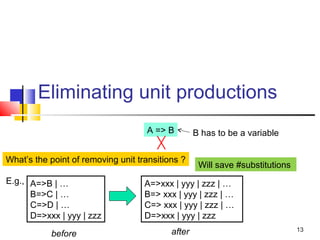
Eliminating unit productions
A => B B has to be a variable
What’s the point of removing unit transitions ?
A=>B | …
B=>C | …
C=>D | …
D=>xxx | yyy | zzz
A=>xxx | yyy | zzz | …
B=> xxx | yyy | zzz | …
C=> xxx | yyy | zzz | …
D=>xxx | yyy | zzz
Will save #substitutions
E.g.,
before after
14
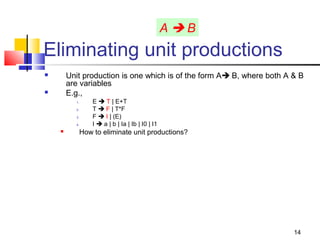
Eliminating unit productions
 Unit production is one which is of the form A B, where both A & B
are variables
 E.g.,
1. E  T | E+T
2. T  F | T*F
3. F  I | (E)
4. I  a | b | Ia | Ib | I0 | I1
 How to eliminate unit productions?
A  B
15
The Unit Pair Algorithm:
to remove unit productions
 Suppose AB1 B2  …  Bn  α
 Action: Replace all intermediate productions to produce α
directly
 i.e., A α; B1 α; … Bn  α;
Definition: (A,B) to be a “unit pair” if A*
B
 We can find all unit pairs inductively:
 Basis: Every pair (A,A) is a unit pair (by definition). Similarly, if AB
is a production, then (A,B) is a unit pair.
 Induction: If (A,B) and (B,C) are unit pairs, and AC is also a unit
pair.
16
Example: eliminating unit
productions
G:
1. E  T | E+T
2. T  F | T*F
3. F  I | (E)
4. I  a | b | Ia | Ib | I0 | I1
Unit pairs Only non-unit
productions to be
added to P1
(E,E) E  E+T
(E,T) E  T*F
(E,F) E  (E)
(E,I) E  a|b|Ia | Ib | I0 | I1
(T,T) T  T*F
(T,F) T  (E)
(T,I) T  a|b| Ia | Ib | I0 | I1
(F,F) F  (E)
(F,I) F  a| b| Ia | Ib | I0 |
I1
(I,I) I  a| b | Ia | Ib | I0 |
I1
G1:
1. E  E+T | T*F | (E) | a| b | Ia | Ib | I0 | I1
2. T  T*F | (E) | a| b | Ia | Ib | I0 | I1
3. F  (E) | a| b | Ia | Ib | I0 | I1
4. I  a | b | Ia | Ib | I0 | I1
17
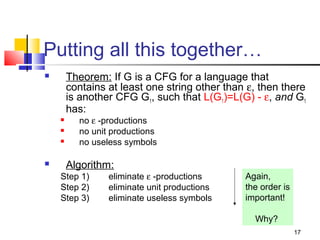
Putting all this together…
 Theorem: If G is a CFG for a language that
contains at least one string other than ε, then there
is another CFG G1, such that L(G1)=L(G) - ε, and G1
has:
 no ε -productions
 no unit productions
 no useless symbols
 Algorithm:
Step 1) eliminate ε -productions
Step 2) eliminate unit productions
Step 3) eliminate useless symbols
Again,
the order is
important!
Why?
18
Normal Forms
19
Why normal forms?
 If all productions of the grammar could be
expressed in the same form(s), then:
a. It becomes easy to design algorithms that use
the grammar
b. It becomes easy to show proofs and properties
20
Chomsky Normal Form (CNF)
Let G be a CFG for some L-{ε}
Definition:
G is said to be in Chomsky Normal Form if all
its productions are in one of the following
two forms:
i. A  BC where A,B,C are variables, or
ii. A  a where a is a terminal
 G has no useless symbols
 G has no unit productions
 G has no ε-productions
21
CNF checklist
G1:
1. E  E+T | T*F | (E) | Ia | Ib | I0 | I1
2. T  T*F | (E) | Ia | Ib | I0 | I1
3. F  (E) | Ia | Ib | I0 | I1
4. I  a | b | Ia | Ib | I0 | I1
Checklist:
• G has no ε-productions
• G has no unit productions
• G has no useless symbols
• But…
• the normal form for productions is violated
Is this grammar in CNF?
So, the grammar is not in CNF
22
How to convert a G into CNF?
 Assumption: G has no ε-productions, unit productions or useless
symbols
1) For every terminal a that appears in the body of a production:
i. create a unique variable, say Xa, with a production Xa  a, and
ii. replace all other instances of a in G by Xa
2) Now, all productions will be in one of the following
two forms:
 A  B1B2… Bk (k≥3) or Aa
1) Replace each production of the form A  B1B2B3… Bk by:
 AB1C1 C1B2C2 … Ck-3Bk-2Ck-2 Ck-2Bk-1Bk
B1 C1
B2 C2
and so on…
Example #1
23
G:
S => AS | BABC
A => A1 | 0A1 | 01
B => 0B | 0
C => 1C | 1
X0 => 0
X1 => 1
S => AS | BY1
Y1 => AY2
Y2 => BC
A => AX1 | X0Y3 | X0X1
Y3 => AX1
B => X0B | 0
C => X1C | 1
G in CNF:
All productions are of the form: A=>BC or A=>a
24
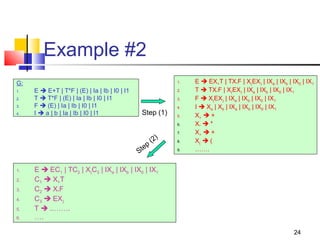
Example #2
G:
1. E  E+T | T*F | (E) | Ia | Ib | I0 | I1
2. T  T*F | (E) | Ia | Ib | I0 | I1
3. F  (E) | Ia | Ib | I0 | I1
4. I  a | b | Ia | Ib | I0 | I1
1. E  EX+T | TX*F | X(EX) | IXa | IXb | IX0 | IX1
2. T  TX*F | X(EX) | IXa | IXb | IX0 | IX1
3. F  X(EX) | IXa | IXb | IX0 | IX1
4. I  Xa | Xb | IXa | IXb | IX0 | IX1
5. X+  +
6. X*  *
7. X+  +
8. X(  (
9. …….
Step (1)
1. E  EC1 | TC2 | X(C3 | IXa | IXb | IX0 | IX1
2. C1  X+T
3. C2  X*F
4. C3  EX)
5. T  ..…….
6. ….
Step
(2)
25
CFL Closure Properties
26
Closure Property Results
 CFLs are closed under:
 Union
 Concatenation
 Substitution
 Homomorphism, inverse homomorphism
 reversal
 CFLs are not closed under:
 Intersection
 Difference
 Complementation
Note: Reg languages
are closed
under
these
operators

Toc CFG cfl properties

  • 1.
  • 2.
    2 Topics 1) Simplifying CFGs,Normal forms 2) Pumping lemma for CFLs 3) Closure and decision properties of CFLs
  • 3.
  • 4.
    4 Three ways tosimplify/clean a CFG (clean) 1. Eliminate useless symbols (simplify) 2. Eliminate ε-productions 3. Eliminate unit productions A => ε A => B
  • 5.
  • 6.
    6 Eliminating useless symbols Asymbol X is reachable if there exists:  S * α X β A symbol X is generating if there exists:  X * w,  for some w ∈ T* For a symbol X to be “useful”, it has to be both reachable and generating  S * α X β * w’, for some w’ ∈ T* reachable generating
  • 7.
    7 Algorithm to detectuseless symbols 1. First, eliminate all symbols that are not generating 2. Next, eliminate all symbols that are not reachable Is the order of these steps important, or can we switch?
  • 8.
    8 Example: Useless symbols SAB | a  A b 1. A, S are generating 2. B is not generating (and therefore B is useless) 3. ==> Eliminating B… (i.e., remove all productions that involve B) 1. S a 2. A  b 4. Now, A is not reachable and therefore is useless 5. Simplified G: 1. S  a What would happen if you reverse the order: i.e., test reachability before generating? Will fail to remove: A  b
  • 9.
  • 10.
    10 Eliminating ε-productions It isnot possible to eliminate ε-productions for languages which include ε in their word set Theorem: If G=(V,T,P,S) is a CFG for a language L, then L {ε} has a CFG without ε-productions Definition: A is “nullable” if A* ε  If A is nullable, then any production of the form “B CAD” can be simulated by:  B  CD | CAD  This can allow us to remove ε transitions for A A  ε So we will target the grammar for the rest of the language What’s the point of removing ε-productions?
  • 11.
    11 Algorithm to detectall nullable variables  Basis:  If A ε is a production in G, then A is nullable (note: A can still have other productions)  Induction:  If there is a production B C1C2…Ck, where every Ci is nullable, then B is also nullable
  • 12.
    12 Example: Eliminating ε- productions Let L be the language represented by the following CFG G: i. SAB ii. AaAA | ε iii. BbBB | ε Goal: To construct G1, which is the grammar for L-{ε}  Nullable symbols: {A, B}  G1 can be constructed from G as follows:  B  b | bB | bB | bBB  ==> B  b | bB | bBB  Similarly, A  a | aA | aAA  Similarly, S  A | B | AB  Note: L(G) = L(G1) U {ε} G1: • S  A | B | AB • A  a | aA | aAA • B  b | bB | bBB Simplified grammar
  • 13.
    13 Eliminating unit productions A=> B B has to be a variable What’s the point of removing unit transitions ? A=>B | … B=>C | … C=>D | … D=>xxx | yyy | zzz A=>xxx | yyy | zzz | … B=> xxx | yyy | zzz | … C=> xxx | yyy | zzz | … D=>xxx | yyy | zzz Will save #substitutions E.g., before after
  • 14.
    14 Eliminating unit productions Unit production is one which is of the form A B, where both A & B are variables  E.g., 1. E  T | E+T 2. T  F | T*F 3. F  I | (E) 4. I  a | b | Ia | Ib | I0 | I1  How to eliminate unit productions? A  B
  • 15.
    15 The Unit PairAlgorithm: to remove unit productions  Suppose AB1 B2  …  Bn  α  Action: Replace all intermediate productions to produce α directly  i.e., A α; B1 α; … Bn  α; Definition: (A,B) to be a “unit pair” if A* B  We can find all unit pairs inductively:  Basis: Every pair (A,A) is a unit pair (by definition). Similarly, if AB is a production, then (A,B) is a unit pair.  Induction: If (A,B) and (B,C) are unit pairs, and AC is also a unit pair.
  • 16.
    16 Example: eliminating unit productions G: 1.E  T | E+T 2. T  F | T*F 3. F  I | (E) 4. I  a | b | Ia | Ib | I0 | I1 Unit pairs Only non-unit productions to be added to P1 (E,E) E  E+T (E,T) E  T*F (E,F) E  (E) (E,I) E  a|b|Ia | Ib | I0 | I1 (T,T) T  T*F (T,F) T  (E) (T,I) T  a|b| Ia | Ib | I0 | I1 (F,F) F  (E) (F,I) F  a| b| Ia | Ib | I0 | I1 (I,I) I  a| b | Ia | Ib | I0 | I1 G1: 1. E  E+T | T*F | (E) | a| b | Ia | Ib | I0 | I1 2. T  T*F | (E) | a| b | Ia | Ib | I0 | I1 3. F  (E) | a| b | Ia | Ib | I0 | I1 4. I  a | b | Ia | Ib | I0 | I1
  • 17.
    17 Putting all thistogether…  Theorem: If G is a CFG for a language that contains at least one string other than ε, then there is another CFG G1, such that L(G1)=L(G) - ε, and G1 has:  no ε -productions  no unit productions  no useless symbols  Algorithm: Step 1) eliminate ε -productions Step 2) eliminate unit productions Step 3) eliminate useless symbols Again, the order is important! Why?
  • 18.
  • 19.
    19 Why normal forms? If all productions of the grammar could be expressed in the same form(s), then: a. It becomes easy to design algorithms that use the grammar b. It becomes easy to show proofs and properties
  • 20.
    20 Chomsky Normal Form(CNF) Let G be a CFG for some L-{ε} Definition: G is said to be in Chomsky Normal Form if all its productions are in one of the following two forms: i. A  BC where A,B,C are variables, or ii. A  a where a is a terminal  G has no useless symbols  G has no unit productions  G has no ε-productions
  • 21.
    21 CNF checklist G1: 1. E E+T | T*F | (E) | Ia | Ib | I0 | I1 2. T  T*F | (E) | Ia | Ib | I0 | I1 3. F  (E) | Ia | Ib | I0 | I1 4. I  a | b | Ia | Ib | I0 | I1 Checklist: • G has no ε-productions • G has no unit productions • G has no useless symbols • But… • the normal form for productions is violated Is this grammar in CNF? So, the grammar is not in CNF
  • 22.
    22 How to converta G into CNF?  Assumption: G has no ε-productions, unit productions or useless symbols 1) For every terminal a that appears in the body of a production: i. create a unique variable, say Xa, with a production Xa  a, and ii. replace all other instances of a in G by Xa 2) Now, all productions will be in one of the following two forms:  A  B1B2… Bk (k≥3) or Aa 1) Replace each production of the form A  B1B2B3… Bk by:  AB1C1 C1B2C2 … Ck-3Bk-2Ck-2 Ck-2Bk-1Bk B1 C1 B2 C2 and so on…
  • 23.
    Example #1 23 G: S =>AS | BABC A => A1 | 0A1 | 01 B => 0B | 0 C => 1C | 1 X0 => 0 X1 => 1 S => AS | BY1 Y1 => AY2 Y2 => BC A => AX1 | X0Y3 | X0X1 Y3 => AX1 B => X0B | 0 C => X1C | 1 G in CNF: All productions are of the form: A=>BC or A=>a
  • 24.
    24 Example #2 G: 1. E E+T | T*F | (E) | Ia | Ib | I0 | I1 2. T  T*F | (E) | Ia | Ib | I0 | I1 3. F  (E) | Ia | Ib | I0 | I1 4. I  a | b | Ia | Ib | I0 | I1 1. E  EX+T | TX*F | X(EX) | IXa | IXb | IX0 | IX1 2. T  TX*F | X(EX) | IXa | IXb | IX0 | IX1 3. F  X(EX) | IXa | IXb | IX0 | IX1 4. I  Xa | Xb | IXa | IXb | IX0 | IX1 5. X+  + 6. X*  * 7. X+  + 8. X(  ( 9. ……. Step (1) 1. E  EC1 | TC2 | X(C3 | IXa | IXb | IX0 | IX1 2. C1  X+T 3. C2  X*F 4. C3  EX) 5. T  ..……. 6. …. Step (2)
  • 25.
  • 26.
    26 Closure Property Results CFLs are closed under:  Union  Concatenation  Substitution  Homomorphism, inverse homomorphism  reversal  CFLs are not closed under:  Intersection  Difference  Complementation Note: Reg languages are closed under these operators