
Closure Properties of DFAs
CSE 2233
Mohammad Imam Hossain | Lecturer, Dept. of CSE | UIU
Regular Language
2
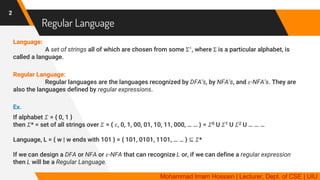
Language:
A set of strings all of which are chosen from some Σ∗
, where Σ is a particular alphabet, is
called a language.
Regular Language:
Regular languages are the languages recognized by DFA’s, by NFA’s, and 𝜀-NFA’s. They are
also the languages defined by regular expressions.
Ex.
If alphabet 𝛴 = { 0, 1 }
then 𝛴* = set of all strings over 𝛴 = { 𝜀, 0, 1, 00, 01, 10, 11, 000, … … } = 𝛴0 U 𝛴1 U 𝛴2 U … … …
Language, L = { w | w ends with 101 } = { 101, 0101, 1101, … … } ⊆ 𝛴*
If we can design a DFA or NFA or 𝜀-NFA that can recognize L or, if we can define a regular expression
then L will be a Regular Language.
Mohammad Imam Hossain | Lecturer, Dept. of CSE | UIU
Regular Operations
3
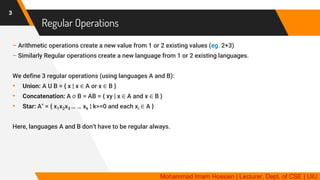
– Arithmetic operations create a new value from 1 or 2 existing values (eg. 2+3)
– Similarly Regular operations create a new language from 1 or 2 existing languages.
We define 3 regular operations (using languages A and B):
• Union: A U B = { x | x ∈ A or x ∈ B }
• Concatenation: A o B = AB = { xy | x ∈ A and x ∈ B }
• Star: A* = { x1x2x3 … … xk | k>=0 and each xi ∈ A }
Here, languages A and B don’t have to be regular always.
Mohammad Imam Hossain | Lecturer, Dept. of CSE | UIU
Regular Operations - Example
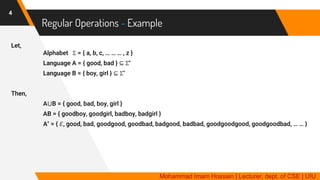
Let,
Alphabet Σ = { a, b, c, … … … , z }
Language A = { good, bad } ⊆ Σ*
Language B = { boy, girl } ⊆ Σ*
Then,
A⋃B = { good, bad, boy, girl }
AB = { goodboy, goodgirl, badboy, badgirl }
A* = { ℰ, good, bad, goodgood, goodbad, badgood, badbad, goodgoodgood, goodgoodbad, … … }
4
Mohammad Imam Hossain | Lecturer, dept. of CSE | UIU
Other Operations
5
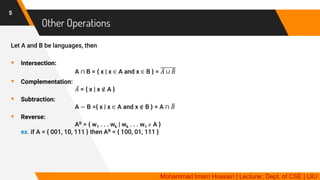
Let A and B be languages, then
 Intersection:
A ∩ B = { x | x ∈ A and x ∈ B } = ҧ𝐴 ∪ ത𝐵
 Complementation:
ҧ𝐴 = { x | x ∉ A }
 Subtraction:
A − B ={ x | x ∈ A and x ∉ B } = A ∩ ത𝐵
 Reverse:
AR = { w1 . . . wk | wk . . . w1 𝜖 A }
ex. if A = { 001, 10, 111 } then AR = { 100, 01, 111 }
Mohammad Imam Hossain | Lecturer, Dept. of CSE | UIU
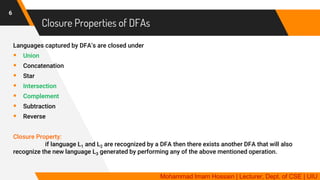
Closure Properties of DFAs
6
Languages captured by DFA’s are closed under
 Union
 Concatenation
 Star
 Intersection
 Complement
 Subtraction
 Reverse
Closure Property:
if language L1 and L2 are recognized by a DFA then there exists another DFA that will also
recognize the new language L3 generated by performing any of the above mentioned operation.
Mohammad Imam Hossain | Lecturer, Dept. of CSE | UIU
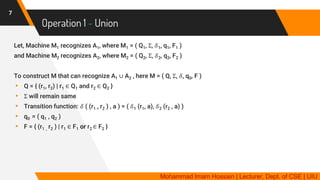
Operation 1 - Union
7
Let, Machine M1 recognizes A1, where M1 = ( Q1, Σ, 𝛿1, q1, F1 )
and Machine M2 recognizes A2, where M2 = ( Q2, Σ, 𝛿2, q2, F2 )
To construct M that can recognize A1 ∪ A2 , here M = ( Q, Σ, 𝛿, q0, F )
▸ Q = { (r1, r2) | r1 ∈ Q1 and r2 ∈ Q2 }
▸ Σ will remain same
▸ Transition function: 𝛿 ( (r1 , r2 ) , a ) = ( 𝛿1 (r1, a), 𝛿2 (r2 , a) )
▸ q0 = ( q1 , q2 )
▸ F = { (r1 , r2 ) | r1 ∈ F1 or r2 ∈ F2 }
Mohammad Imam Hossain | Lecturer, Dept. of CSE | UIU
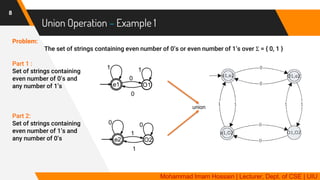
Union Operation – Example 1
8
Problem:
The set of strings containing even number of 0’s or even number of 1’s over Σ = { 0, 1 }
Part 1 :
Set of strings containing
even number of 0’s and
any number of 1’s
Part 2:
Set of strings containing
even number of 1’s and
any number of 0’s
Mohammad Imam Hossain | Lecturer, Dept. of CSE | UIU
union
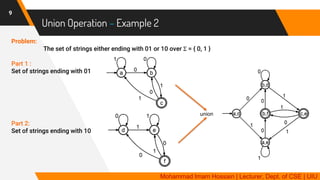
Union Operation – Example 2
9
Problem:
The set of strings either ending with 01 or 10 over Σ = { 0, 1 }
Part 1 :
Set of strings ending with 01
Part 2:
Set of strings ending with 10
Mohammad Imam Hossain | Lecturer, Dept. of CSE | UIU
union
Union Operation – Practices
10
1) The set of strings either begin or end with 01
2) The set of strings with 01 or 10 as substring
3) The set of strings starts and ends with the same symbol over Σ = { 0 ,1 }
Mohammad Imam Hossain | Lecturer, Dept. of CSE | UIU
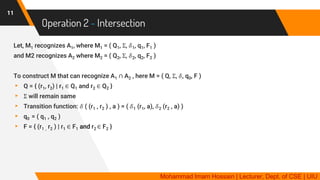
Operation 2 - Intersection
11
Let, M1 recognizes A1, where M1 = ( Q1, Σ, 𝛿1, q1, F1 )
and M2 recognizes A2 where M2 = ( Q2, Σ, 𝛿2, q2, F2 )
To construct M that can recognize A1 ∩ A2 , here M = ( Q, Σ, 𝛿, q0, F )
▸ Q = { (r1, r2) | r1 ∈ Q1 and r2 ∈ Q2 }
▸ Σ will remain same
▸ Transition function: 𝛿 ( (r1 , r2 ) , a ) = ( 𝛿1 (r1, a), 𝛿2 (r2 , a) )
▸ q0 = ( q1 , q2 )
▸ F = { (r1 , r2 ) | r1 ∈ F1 and r2 ∈ F2 }
Mohammad Imam Hossain | Lecturer, Dept. of CSE | UIU
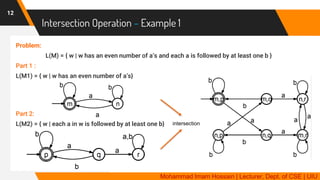
Problem:
L(M) = { w | w has an even number of a’s and each a is followed by at least one b }
Part 1 :
L(M1) = { w | w has an even number of a’s}
Part 2:
L(M2) = { w | each a in w is followed by at least one b}
Intersection Operation – Example 1
12
Mohammad Imam Hossain | Lecturer, Dept. of CSE | UIU
intersection
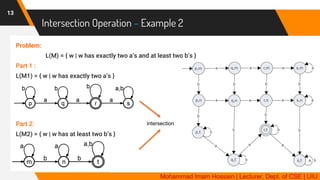
Problem:
L(M) = { w | w has exactly two a’s and at least two b’s }
Part 1 :
L(M1) = { w | w has exactly two a’s }
Part 2:
L(M2) = { w | w has at least two b’s }
Intersection Operation – Example 2
13
Mohammad Imam Hossain | Lecturer, Dept. of CSE | UIU
intersection
Intersection Operation – Practices
14
1) { w | w has at least three a’s and at least two b’s }
2) { w | w has exactly two a’s and at least two b’s }
3) { w | w has an even number of a’s and at most two b’s }
4) { w | w has an even number of a’s and each a is followed by at least one b }
5) { w | w starts with an a and has at most one b }
6) { w | w has an odd number of a’s and ends with a b }
7) { w | w has even length and an odd number of a’s }
Mohammad Imam Hossain | Lecturer, Dept. of CSE | UIU
Operation 3 - Complement
15
Technique:
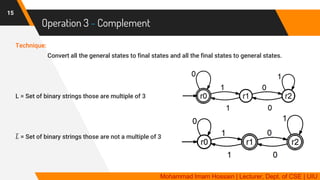
Convert all the general states to final states and all the final states to general states.
L = Set of binary strings those are multiple of 3
ത𝐿 = Set of binary strings those are not a multiple of 3
Mohammad Imam Hossain | Lecturer, Dept. of CSE | UIU
Complement Operation – Practices
16
1) L(M) = { w | w does not contain the substring ab}
2) L(M) = { w | w does not contain the substring baba }
3) L(M) = { w | w contains neither the substrings ab nor ba }
4) L(M) = { w | w is any string that doesn’t contain exactly two a’s }
Mohammad Imam Hossain | Lecturer, Dept. of CSE | UIU
17
THANKS!
Any questions?
You can find me at imam@cse.uiu.ac.bd
References:
Chapter 1(section 1.1), Introduction to the Theory of Computation, 3rd Edition by Michael Sipser

TOC 3 | Different Operations on DFA

  • 1.
    Closure Properties ofDFAs CSE 2233 Mohammad Imam Hossain | Lecturer, Dept. of CSE | UIU
  • 2.
    Regular Language 2 Language: A setof strings all of which are chosen from some Σ∗ , where Σ is a particular alphabet, is called a language. Regular Language: Regular languages are the languages recognized by DFA’s, by NFA’s, and 𝜀-NFA’s. They are also the languages defined by regular expressions. Ex. If alphabet 𝛴 = { 0, 1 } then 𝛴* = set of all strings over 𝛴 = { 𝜀, 0, 1, 00, 01, 10, 11, 000, … … } = 𝛴0 U 𝛴1 U 𝛴2 U … … … Language, L = { w | w ends with 101 } = { 101, 0101, 1101, … … } ⊆ 𝛴* If we can design a DFA or NFA or 𝜀-NFA that can recognize L or, if we can define a regular expression then L will be a Regular Language. Mohammad Imam Hossain | Lecturer, Dept. of CSE | UIU
  • 3.
    Regular Operations 3 – Arithmeticoperations create a new value from 1 or 2 existing values (eg. 2+3) – Similarly Regular operations create a new language from 1 or 2 existing languages. We define 3 regular operations (using languages A and B): • Union: A U B = { x | x ∈ A or x ∈ B } • Concatenation: A o B = AB = { xy | x ∈ A and x ∈ B } • Star: A* = { x1x2x3 … … xk | k>=0 and each xi ∈ A } Here, languages A and B don’t have to be regular always. Mohammad Imam Hossain | Lecturer, Dept. of CSE | UIU
  • 4.
    Regular Operations -Example Let, Alphabet Σ = { a, b, c, … … … , z } Language A = { good, bad } ⊆ Σ* Language B = { boy, girl } ⊆ Σ* Then, A⋃B = { good, bad, boy, girl } AB = { goodboy, goodgirl, badboy, badgirl } A* = { ℰ, good, bad, goodgood, goodbad, badgood, badbad, goodgoodgood, goodgoodbad, … … } 4 Mohammad Imam Hossain | Lecturer, dept. of CSE | UIU
  • 5.
    Other Operations 5 Let Aand B be languages, then  Intersection: A ∩ B = { x | x ∈ A and x ∈ B } = ҧ𝐴 ∪ ത𝐵  Complementation: ҧ𝐴 = { x | x ∉ A }  Subtraction: A − B ={ x | x ∈ A and x ∉ B } = A ∩ ത𝐵  Reverse: AR = { w1 . . . wk | wk . . . w1 𝜖 A } ex. if A = { 001, 10, 111 } then AR = { 100, 01, 111 } Mohammad Imam Hossain | Lecturer, Dept. of CSE | UIU
  • 6.
    Closure Properties ofDFAs 6 Languages captured by DFA’s are closed under  Union  Concatenation  Star  Intersection  Complement  Subtraction  Reverse Closure Property: if language L1 and L2 are recognized by a DFA then there exists another DFA that will also recognize the new language L3 generated by performing any of the above mentioned operation. Mohammad Imam Hossain | Lecturer, Dept. of CSE | UIU
  • 7.
    Operation 1 -Union 7 Let, Machine M1 recognizes A1, where M1 = ( Q1, Σ, 𝛿1, q1, F1 ) and Machine M2 recognizes A2, where M2 = ( Q2, Σ, 𝛿2, q2, F2 ) To construct M that can recognize A1 ∪ A2 , here M = ( Q, Σ, 𝛿, q0, F ) ▸ Q = { (r1, r2) | r1 ∈ Q1 and r2 ∈ Q2 } ▸ Σ will remain same ▸ Transition function: 𝛿 ( (r1 , r2 ) , a ) = ( 𝛿1 (r1, a), 𝛿2 (r2 , a) ) ▸ q0 = ( q1 , q2 ) ▸ F = { (r1 , r2 ) | r1 ∈ F1 or r2 ∈ F2 } Mohammad Imam Hossain | Lecturer, Dept. of CSE | UIU
  • 8.
    Union Operation –Example 1 8 Problem: The set of strings containing even number of 0’s or even number of 1’s over Σ = { 0, 1 } Part 1 : Set of strings containing even number of 0’s and any number of 1’s Part 2: Set of strings containing even number of 1’s and any number of 0’s Mohammad Imam Hossain | Lecturer, Dept. of CSE | UIU union
  • 9.
    Union Operation –Example 2 9 Problem: The set of strings either ending with 01 or 10 over Σ = { 0, 1 } Part 1 : Set of strings ending with 01 Part 2: Set of strings ending with 10 Mohammad Imam Hossain | Lecturer, Dept. of CSE | UIU union
  • 10.
    Union Operation –Practices 10 1) The set of strings either begin or end with 01 2) The set of strings with 01 or 10 as substring 3) The set of strings starts and ends with the same symbol over Σ = { 0 ,1 } Mohammad Imam Hossain | Lecturer, Dept. of CSE | UIU
  • 11.
    Operation 2 -Intersection 11 Let, M1 recognizes A1, where M1 = ( Q1, Σ, 𝛿1, q1, F1 ) and M2 recognizes A2 where M2 = ( Q2, Σ, 𝛿2, q2, F2 ) To construct M that can recognize A1 ∩ A2 , here M = ( Q, Σ, 𝛿, q0, F ) ▸ Q = { (r1, r2) | r1 ∈ Q1 and r2 ∈ Q2 } ▸ Σ will remain same ▸ Transition function: 𝛿 ( (r1 , r2 ) , a ) = ( 𝛿1 (r1, a), 𝛿2 (r2 , a) ) ▸ q0 = ( q1 , q2 ) ▸ F = { (r1 , r2 ) | r1 ∈ F1 and r2 ∈ F2 } Mohammad Imam Hossain | Lecturer, Dept. of CSE | UIU
  • 12.
    Problem: L(M) = {w | w has an even number of a’s and each a is followed by at least one b } Part 1 : L(M1) = { w | w has an even number of a’s} Part 2: L(M2) = { w | each a in w is followed by at least one b} Intersection Operation – Example 1 12 Mohammad Imam Hossain | Lecturer, Dept. of CSE | UIU intersection
  • 13.
    Problem: L(M) = {w | w has exactly two a’s and at least two b’s } Part 1 : L(M1) = { w | w has exactly two a’s } Part 2: L(M2) = { w | w has at least two b’s } Intersection Operation – Example 2 13 Mohammad Imam Hossain | Lecturer, Dept. of CSE | UIU intersection
  • 14.
    Intersection Operation –Practices 14 1) { w | w has at least three a’s and at least two b’s } 2) { w | w has exactly two a’s and at least two b’s } 3) { w | w has an even number of a’s and at most two b’s } 4) { w | w has an even number of a’s and each a is followed by at least one b } 5) { w | w starts with an a and has at most one b } 6) { w | w has an odd number of a’s and ends with a b } 7) { w | w has even length and an odd number of a’s } Mohammad Imam Hossain | Lecturer, Dept. of CSE | UIU
  • 15.
    Operation 3 -Complement 15 Technique: Convert all the general states to final states and all the final states to general states. L = Set of binary strings those are multiple of 3 ത𝐿 = Set of binary strings those are not a multiple of 3 Mohammad Imam Hossain | Lecturer, Dept. of CSE | UIU
  • 16.
    Complement Operation –Practices 16 1) L(M) = { w | w does not contain the substring ab} 2) L(M) = { w | w does not contain the substring baba } 3) L(M) = { w | w contains neither the substrings ab nor ba } 4) L(M) = { w | w is any string that doesn’t contain exactly two a’s } Mohammad Imam Hossain | Lecturer, Dept. of CSE | UIU
  • 17.
    17 THANKS! Any questions? You canfind me at imam@cse.uiu.ac.bd References: Chapter 1(section 1.1), Introduction to the Theory of Computation, 3rd Edition by Michael Sipser