
Dr. Ritam Kundu
Department of Periodontics, Dr. R. Ahmed Dental College & Hospital
Kolkata
s
Smoking Cessation Interventions - Guidelines And
Goals
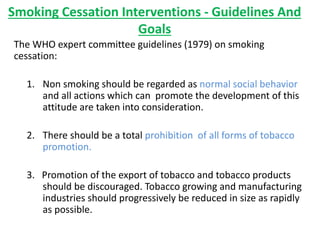
The WHO expert committee guidelines (1979) on smoking
cessation:
1. Non smoking should be regarded as normal social behavior
and all actions which can promote the development of this
attitude are taken into consideration.
2. There should be a total prohibition of all forms of tobacco
promotion.
3. Promotion of the export of tobacco and tobacco products
should be discouraged. Tobacco growing and manufacturing
industries should progressively be reduced in size as rapidly
as possible.
As per the US Public Health Service report, the aims of the
smoking cessation treatment should be as follows:-
1. The achievement of long term or permanent abstinence.
2. Effective treatment should be offered to all tobacco
users.
3. There should be consistent identification ,documentation
and treatment of every tobacco user at each visit to the
hospital.
4. Brief tobacco dependence treatment is also effective and
thus should be offered.
• 5. A strong relationship exists between the intensity of
tobacco dependence, counseling and its effectiveness.
• 6. Practical counseling and social support, outside of
treatment are helpful.
• 7. Of all the effective pharmacotherapies ,at least one of
these medications should be prescribed in the absence
of contraindications.
• 8. Tobacco dependence treatments are cost effective
and should be covered by health insurance plans.
1. Dental surgeons as one of the key health care providers can educate
the patient regarding the deleterious effect of tobacco use both in
clinical practice and community level.
2. Dental surgeons frequently encounters smokers, visiting the dental clinic
for scaling of the stained dentition due to smoking or changes of oral
mucous membrane due to the use of tobacco.
3. Dental practitioners can point to gingival recession, bone loss and
tobacco stains on teeth to demonstrate visually the detrimental effects of
smoking on the dentition. Particularly for patients concerned about their
general esthetic appearance, such a demonstration might stimulate
further efforts by the patient to quit tobacco use.
4. Dental surgeons, having the knowledge of tobacco intervention can
display posters or other visual aids in the clinic to promote awareness
towards enrolment of patient and/or accompanying person in the Tobacco
intervention program.
5. Dental surgeons can assess the effectiveness of the tobacco
intervention in the patients, who are under periodic recall as a part of their
routine dental treatment and can reinforce the intervention, if needed.
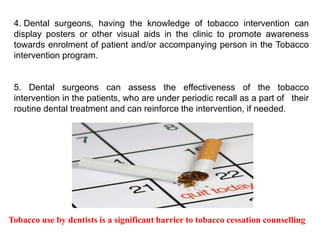
Tobacco use by dentists is a significant barrier to tobacco cessation counselling
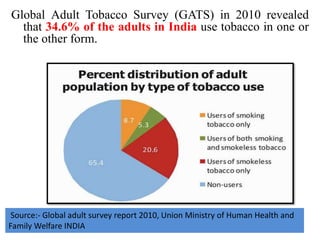
Global Adult Tobacco Survey (GATS) in 2010 revealed
that 34.6% of the adults in India use tobacco in one or
the other form.
Source:- Global adult survey report 2010, Union Ministry of Human Health and
Family Welfare INDIA
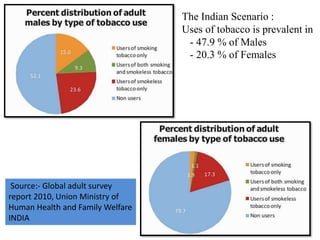
The Indian Scenario :
Uses of tobacco is prevalent in
- 47.9 % of Males
- 20.3 % of Females
Source:- Global adult survey
report 2010, Union Ministry of
Human Health and Family Welfare
INDIA
11
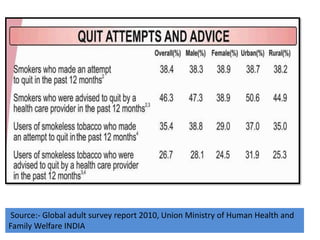
Source:- Global adult survey report 2010, Union Ministry of Human Health and
Family Welfare INDIA
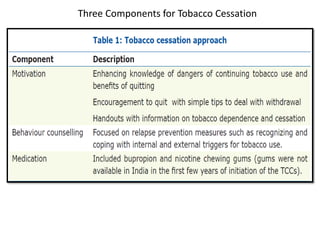
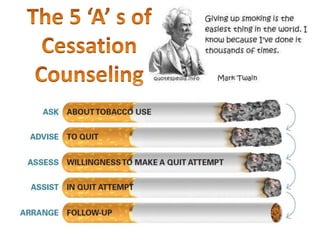
Three Components for Tobacco Cessation
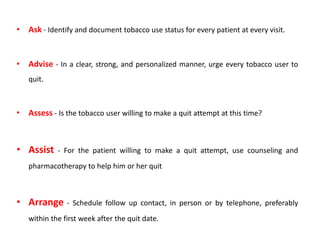
• Ask - Identify and document tobacco use status for every patient at every visit.
• Advise - In a clear, strong, and personalized manner, urge every tobacco user to
quit.
• Assess - Is the tobacco user willing to make a quit attempt at this time?
• Assist - For the patient willing to make a quit attempt, use counseling and
pharmacotherapy to help him or her quit
• Arrange - Schedule follow up contact, in person or by telephone, preferably
within the first week after the quit date.
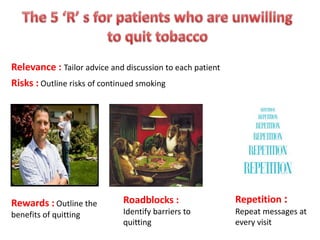
Relevance : Tailor advice and discussion to each patient
Risks : Outline risks of continued smoking
Rewards : Outline the
benefits of quitting
Roadblocks :
Identify barriers to
quitting
Repetition :
Repeat messages at
every visit
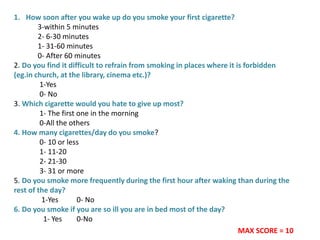
Fagerstrom test for Nicotine
Dependence(FTND) and Heaviness of
Smoking(HIS)
MAX SCORE = 10
1. How soon after you wake up do you smoke your first cigarette?
3-within 5 minutes
2- 6-30 minutes
1- 31-60 minutes
0- After 60 minutes
2. Do you find it difficult to refrain from smoking in places where it is forbidden
(eg.in church, at the library, cinema etc.)?
1-Yes
0- No
3. Which cigarette would you hate to give up most?
1- The first one in the morning
0-All the others
4. How many cigarettes/day do you smoke?
0- 10 or less
1- 11-20
2- 21-30
3- 31 or more
5. Do you smoke more frequently during the first hour after waking than during the
rest of the day?
1-Yes 0- No
6. Do you smoke if you are so ill you are in bed most of the day?
1- Yes 0-No
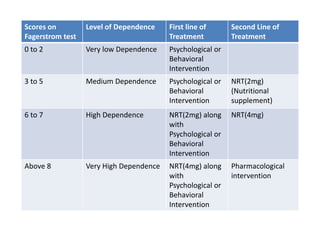
Scores on
Fagerstrom test
Level of Dependence First line of
Treatment
Second Line of
Treatment
0 to 2 Very low Dependence Psychological or
Behavioral
Intervention
3 to 5 Medium Dependence Psychological or
Behavioral
Intervention
NRT(2mg)
(Nutritional
supplement)
6 to 7 High Dependence NRT(2mg) along
with
Psychological or
Behavioral
Intervention
NRT(4mg)
Above 8 Very High Dependence NRT(4mg) along
with
Psychological or
Behavioral
Intervention
Pharmacological
intervention
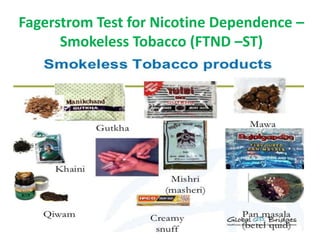
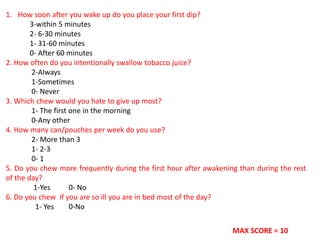
Fagerstrom Test for Nicotine Dependence –
Smokeless Tobacco (FTND –ST)
MAX SCORE = 10
1. How soon after you wake up do you place your first dip?
3-within 5 minutes
2- 6-30 minutes
1- 31-60 minutes
0- After 60 minutes
2. How often do you intentionally swallow tobacco juice?
2-Always
1-Sometimes
0- Never
3. Which chew would you hate to give up most?
1- The first one in the morning
0-Any other
4. How many can/pouches per week do you use?
2- More than 3
1- 2-3
0- 1
5. Do you chew more frequently during the first hour after awakening than during the rest
of the day?
1-Yes 0- No
6. Do you chew if you are so ill you are in bed most of the day?
1- Yes 0-No
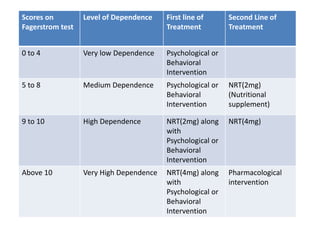
Scores on
Fagerstrom test
Level of Dependence First line of
Treatment
Second Line of
Treatment
0 to 4 Very low Dependence Psychological or
Behavioral
Intervention
5 to 8 Medium Dependence Psychological or
Behavioral
Intervention
NRT(2mg)
(Nutritional
supplement)
9 to 10 High Dependence NRT(2mg) along
with
Psychological or
Behavioral
Intervention
NRT(4mg)
Above 10 Very High Dependence NRT(4mg) along
with
Psychological or
Behavioral
Intervention
Pharmacological
intervention
23
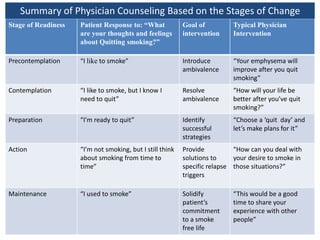
Stage of Readiness Patient Response to: “What
are your thoughts and feelings
about Quitting smoking?”
Goal of
intervention
Typical Physician
Intervention
Precontemplation “I like to smoke” Introduce
ambivalence
“Your emphysema will
improve after you quit
smoking”
Contemplation “I like to smoke, but I know I
need to quit”
Resolve
ambivalence
“How will your life be
better after you’ve quit
smoking?”
Preparation “I’m ready to quit” Identify
successful
strategies
“Choose a ‘quit day’ and
let’s make plans for it”
Action “I’m not smoking, but I still think
about smoking from time to
time”
Provide
solutions to
specific relapse
triggers
“How can you deal with
your desire to smoke in
those situations?”
Maintenance “I used to smoke” Solidify
patient’s
commitment
to a smoke
free life
“This would be a good
time to share your
experience with other
people”
Summary of Physician Counseling Based on the Stages of Change
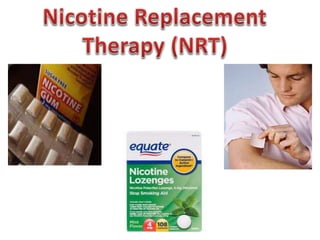
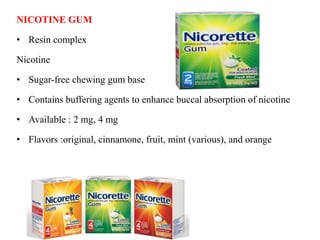
NICOTINE GUM
• Resin complex
Nicotine
• Sugar-free chewing gum base
• Contains buffering agents to enhance buccal absorption of nicotine
• Available : 2 mg, 4 mg
• Flavors :original, cinnamone, fruit, mint (various), and orange
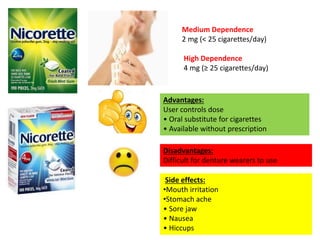
Medium Dependence
2 mg (< 25 cigarettes/day)
High Dependence
4 mg (≥ 25 cigarettes/day)
Advantages:
User controls dose
• Oral substitute for cigarettes
• Available without prescription
Disadvantages:
Difficult for denture wearers to use
Side effects:
•Mouth irritation
•Stomach ache
• Sore jaw
• Nausea
• Hiccups
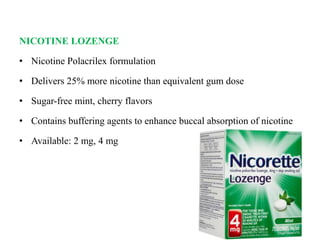
NICOTINE LOZENGE
• Nicotine Polacrilex formulation
• Delivers 25% more nicotine than equivalent gum dose
• Sugar-free mint, cherry flavors
• Contains buffering agents to enhance buccal absorption of nicotine
• Available: 2 mg, 4 mg
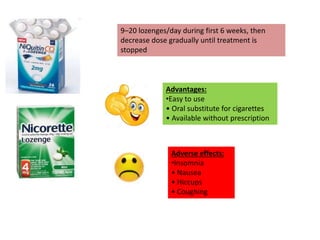
9–20 lozenges/day during first 6 weeks, then
decrease dose gradually until treatment is
stopped
Advantages:
•Easy to use
• Oral substitute for cigarettes
• Available without prescription
Adverse effects:
•Insomnia
• Nausea
• Hiccups
• Coughing
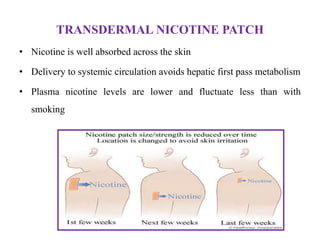
TRANSDERMAL NICOTINE PATCH
• Nicotine is well absorbed across the skin
• Delivery to systemic circulation avoids hepatic first pass metabolism
• Plasma nicotine levels are lower and fluctuate less than with
smoking
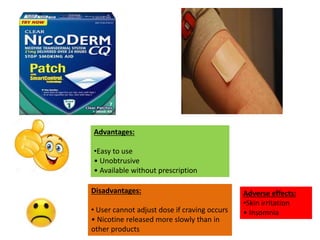
Advantages:
•Easy to use
• Unobtrusive
• Available without prescription
Disadvantages:
• User cannot adjust dose if craving occurs
• Nicotine released more slowly than in
other products
Adverse effects:
•Skin irritation
• Insomnia
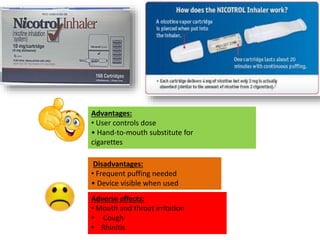
Advantages:
• User controls dose
• Hand-to-mouth substitute for
cigarettes
Disadvantages:
• Frequent puffing needed
• Device visible when used
Adverse effects:
• Mouth and throat irritation
• Cough
• Rhinitis
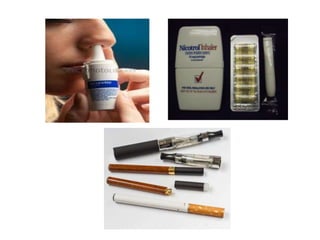
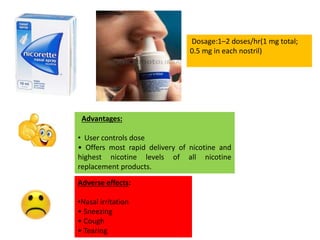
Dosage:1–2 doses/hr(1 mg total;
0.5 mg in each nostril)
Advantages:
• User controls dose
• Offers most rapid delivery of nicotine and
highest nicotine levels of all nicotine
replacement products.
Adverse effects:
•Nasal irritation
• Sneezing
• Cough
• Tearing
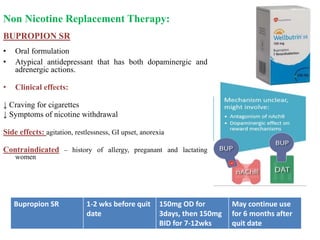
Bupropion SR 1-2 wks before quit
date
150mg OD for
3days, then 150mg
BID for 7-12wks
May continue use
for 6 months after
quit date
Non Nicotine Replacement Therapy:
BUPROPION SR
• Oral formulation
• Atypical antidepressant that has both dopaminergic and
adrenergic actions.
• Clinical effects:
↓ Craving for cigarettes
↓ Symptoms of nicotine withdrawal
Side effects: agitation, restlessness, GI upset, anorexia
Contraindicated – history of allergy, preganant and lactating
women
VARENICLINE:
• Partial nicotinic receptor agonist that binds to α and β nicotinic
acetylcholine receptors in brain
• Oral formulation 0.5 mg OD for first 3 days, increased to 0.5 mg
twice daily for next 4 days, 1 mg twice daily for 12 weeks.
• Clinical effects:
↓ symptoms of nicotine withdrawal
• Tobacco use can be stopped one week after initiating treatment.
• Side effects: agitation, depression
• Contraindicated in pregnant and lactating women.
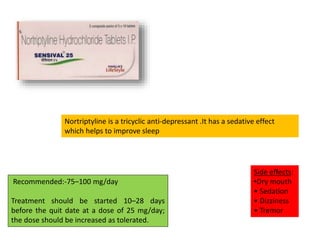
Recommended:-75–100 mg/day
Treatment should be started 10–28 days
before the quit date at a dose of 25 mg/day;
the dose should be increased as tolerated.
Side effects:
•Dry mouth
• Sedation
• Dizziness
• Tremor
Nortriptyline is a tricyclic anti‐depressant .It has a sedative effect
which helps to improve sleep
Combination Therapy
• Combined behavioural and pharmacological therapies appear to be the best
approach for treating tobacco dependence.
• Because these therapies operate by different mechanisms, complementary
and potentially additive effects may be expected
• Nicotine Replacement Therapies (NRT) combined with supportive
counselling are the most widely used and intensively reached treatment
method
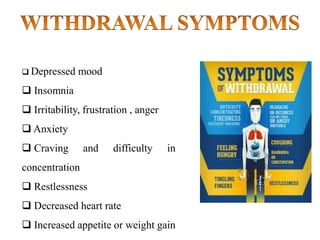
 Depressed mood
 Insomnia
 Irritability, frustration , anger
 Anxiety
 Craving and difficulty in
concentration
 Restlessness
 Decreased heart rate
 Increased appetite or weight gain
References
1. Daly & bachelor,Richard Watt – Essential Dental Public Health.
2. Esther v Wilkins – clinical practice for dental hygienist.
3. Prochaska JO, DiClemente CC. Toward a comprehensive model of change.
In: Miller WR, Heather N, eds. Treating addictive behaviors: processes of
change. New York: Plenum, 1986:3–27.
4. Clinical practice. Treatment of tobacco use and dependence. N Engl J Med
2002;346:506-512.
5. Murthy P, Saddichha S; Tobacco cessation services in India: Recent
developments and the need for expansion;Indian Journal of Cancer,
2010;Volume 47 ;Suppl 1
6. WHO – GLOBAL ADULT TOBACCO SURVEY (GATS)-2007.

Tobacco ceassation

  • 1.
    Dr. Ritam Kundu Departmentof Periodontics, Dr. R. Ahmed Dental College & Hospital Kolkata
  • 3.
  • 4.
    Smoking Cessation Interventions- Guidelines And Goals The WHO expert committee guidelines (1979) on smoking cessation: 1. Non smoking should be regarded as normal social behavior and all actions which can promote the development of this attitude are taken into consideration. 2. There should be a total prohibition of all forms of tobacco promotion. 3. Promotion of the export of tobacco and tobacco products should be discouraged. Tobacco growing and manufacturing industries should progressively be reduced in size as rapidly as possible.
  • 5.
    As per theUS Public Health Service report, the aims of the smoking cessation treatment should be as follows:- 1. The achievement of long term or permanent abstinence. 2. Effective treatment should be offered to all tobacco users. 3. There should be consistent identification ,documentation and treatment of every tobacco user at each visit to the hospital. 4. Brief tobacco dependence treatment is also effective and thus should be offered.
  • 6.
    • 5. Astrong relationship exists between the intensity of tobacco dependence, counseling and its effectiveness. • 6. Practical counseling and social support, outside of treatment are helpful. • 7. Of all the effective pharmacotherapies ,at least one of these medications should be prescribed in the absence of contraindications. • 8. Tobacco dependence treatments are cost effective and should be covered by health insurance plans.
  • 7.
    1. Dental surgeonsas one of the key health care providers can educate the patient regarding the deleterious effect of tobacco use both in clinical practice and community level. 2. Dental surgeons frequently encounters smokers, visiting the dental clinic for scaling of the stained dentition due to smoking or changes of oral mucous membrane due to the use of tobacco. 3. Dental practitioners can point to gingival recession, bone loss and tobacco stains on teeth to demonstrate visually the detrimental effects of smoking on the dentition. Particularly for patients concerned about their general esthetic appearance, such a demonstration might stimulate further efforts by the patient to quit tobacco use.
  • 8.
    4. Dental surgeons,having the knowledge of tobacco intervention can display posters or other visual aids in the clinic to promote awareness towards enrolment of patient and/or accompanying person in the Tobacco intervention program. 5. Dental surgeons can assess the effectiveness of the tobacco intervention in the patients, who are under periodic recall as a part of their routine dental treatment and can reinforce the intervention, if needed. Tobacco use by dentists is a significant barrier to tobacco cessation counselling
  • 9.
    Global Adult TobaccoSurvey (GATS) in 2010 revealed that 34.6% of the adults in India use tobacco in one or the other form. Source:- Global adult survey report 2010, Union Ministry of Human Health and Family Welfare INDIA
  • 10.
    The Indian Scenario: Uses of tobacco is prevalent in - 47.9 % of Males - 20.3 % of Females Source:- Global adult survey report 2010, Union Ministry of Human Health and Family Welfare INDIA
  • 11.
    11 Source:- Global adultsurvey report 2010, Union Ministry of Human Health and Family Welfare INDIA
  • 12.
    Three Components forTobacco Cessation
  • 14.
    • Ask -Identify and document tobacco use status for every patient at every visit. • Advise - In a clear, strong, and personalized manner, urge every tobacco user to quit. • Assess - Is the tobacco user willing to make a quit attempt at this time? • Assist - For the patient willing to make a quit attempt, use counseling and pharmacotherapy to help him or her quit • Arrange - Schedule follow up contact, in person or by telephone, preferably within the first week after the quit date.
  • 15.
    Relevance : Tailoradvice and discussion to each patient Risks : Outline risks of continued smoking Rewards : Outline the benefits of quitting Roadblocks : Identify barriers to quitting Repetition : Repeat messages at every visit
  • 16.
    Fagerstrom test forNicotine Dependence(FTND) and Heaviness of Smoking(HIS)
  • 17.
    MAX SCORE =10 1. How soon after you wake up do you smoke your first cigarette? 3-within 5 minutes 2- 6-30 minutes 1- 31-60 minutes 0- After 60 minutes 2. Do you find it difficult to refrain from smoking in places where it is forbidden (eg.in church, at the library, cinema etc.)? 1-Yes 0- No 3. Which cigarette would you hate to give up most? 1- The first one in the morning 0-All the others 4. How many cigarettes/day do you smoke? 0- 10 or less 1- 11-20 2- 21-30 3- 31 or more 5. Do you smoke more frequently during the first hour after waking than during the rest of the day? 1-Yes 0- No 6. Do you smoke if you are so ill you are in bed most of the day? 1- Yes 0-No
  • 18.
    Scores on Fagerstrom test Levelof Dependence First line of Treatment Second Line of Treatment 0 to 2 Very low Dependence Psychological or Behavioral Intervention 3 to 5 Medium Dependence Psychological or Behavioral Intervention NRT(2mg) (Nutritional supplement) 6 to 7 High Dependence NRT(2mg) along with Psychological or Behavioral Intervention NRT(4mg) Above 8 Very High Dependence NRT(4mg) along with Psychological or Behavioral Intervention Pharmacological intervention
  • 19.
    Fagerstrom Test forNicotine Dependence – Smokeless Tobacco (FTND –ST)
  • 20.
    MAX SCORE =10 1. How soon after you wake up do you place your first dip? 3-within 5 minutes 2- 6-30 minutes 1- 31-60 minutes 0- After 60 minutes 2. How often do you intentionally swallow tobacco juice? 2-Always 1-Sometimes 0- Never 3. Which chew would you hate to give up most? 1- The first one in the morning 0-Any other 4. How many can/pouches per week do you use? 2- More than 3 1- 2-3 0- 1 5. Do you chew more frequently during the first hour after awakening than during the rest of the day? 1-Yes 0- No 6. Do you chew if you are so ill you are in bed most of the day? 1- Yes 0-No
  • 21.
    Scores on Fagerstrom test Levelof Dependence First line of Treatment Second Line of Treatment 0 to 4 Very low Dependence Psychological or Behavioral Intervention 5 to 8 Medium Dependence Psychological or Behavioral Intervention NRT(2mg) (Nutritional supplement) 9 to 10 High Dependence NRT(2mg) along with Psychological or Behavioral Intervention NRT(4mg) Above 10 Very High Dependence NRT(4mg) along with Psychological or Behavioral Intervention Pharmacological intervention
  • 23.
    23 Stage of ReadinessPatient Response to: “What are your thoughts and feelings about Quitting smoking?” Goal of intervention Typical Physician Intervention Precontemplation “I like to smoke” Introduce ambivalence “Your emphysema will improve after you quit smoking” Contemplation “I like to smoke, but I know I need to quit” Resolve ambivalence “How will your life be better after you’ve quit smoking?” Preparation “I’m ready to quit” Identify successful strategies “Choose a ‘quit day’ and let’s make plans for it” Action “I’m not smoking, but I still think about smoking from time to time” Provide solutions to specific relapse triggers “How can you deal with your desire to smoke in those situations?” Maintenance “I used to smoke” Solidify patient’s commitment to a smoke free life “This would be a good time to share your experience with other people” Summary of Physician Counseling Based on the Stages of Change
  • 26.
    NICOTINE GUM • Resincomplex Nicotine • Sugar-free chewing gum base • Contains buffering agents to enhance buccal absorption of nicotine • Available : 2 mg, 4 mg • Flavors :original, cinnamone, fruit, mint (various), and orange
  • 27.
    Medium Dependence 2 mg(< 25 cigarettes/day) High Dependence 4 mg (≥ 25 cigarettes/day) Advantages: User controls dose • Oral substitute for cigarettes • Available without prescription Disadvantages: Difficult for denture wearers to use Side effects: •Mouth irritation •Stomach ache • Sore jaw • Nausea • Hiccups
  • 28.
    NICOTINE LOZENGE • NicotinePolacrilex formulation • Delivers 25% more nicotine than equivalent gum dose • Sugar-free mint, cherry flavors • Contains buffering agents to enhance buccal absorption of nicotine • Available: 2 mg, 4 mg
  • 29.
    9–20 lozenges/day duringfirst 6 weeks, then decrease dose gradually until treatment is stopped Advantages: •Easy to use • Oral substitute for cigarettes • Available without prescription Adverse effects: •Insomnia • Nausea • Hiccups • Coughing
  • 30.
    TRANSDERMAL NICOTINE PATCH •Nicotine is well absorbed across the skin • Delivery to systemic circulation avoids hepatic first pass metabolism • Plasma nicotine levels are lower and fluctuate less than with smoking
  • 31.
    Advantages: •Easy to use •Unobtrusive • Available without prescription Disadvantages: • User cannot adjust dose if craving occurs • Nicotine released more slowly than in other products Adverse effects: •Skin irritation • Insomnia
  • 32.
    Advantages: • User controlsdose • Hand-to-mouth substitute for cigarettes Disadvantages: • Frequent puffing needed • Device visible when used Adverse effects: • Mouth and throat irritation • Cough • Rhinitis
  • 33.
    Dosage:1–2 doses/hr(1 mgtotal; 0.5 mg in each nostril) Advantages: • User controls dose • Offers most rapid delivery of nicotine and highest nicotine levels of all nicotine replacement products. Adverse effects: •Nasal irritation • Sneezing • Cough • Tearing
  • 35.
    Bupropion SR 1-2wks before quit date 150mg OD for 3days, then 150mg BID for 7-12wks May continue use for 6 months after quit date Non Nicotine Replacement Therapy: BUPROPION SR • Oral formulation • Atypical antidepressant that has both dopaminergic and adrenergic actions. • Clinical effects: ↓ Craving for cigarettes ↓ Symptoms of nicotine withdrawal Side effects: agitation, restlessness, GI upset, anorexia Contraindicated – history of allergy, preganant and lactating women
  • 36.
    VARENICLINE: • Partial nicotinicreceptor agonist that binds to α and β nicotinic acetylcholine receptors in brain • Oral formulation 0.5 mg OD for first 3 days, increased to 0.5 mg twice daily for next 4 days, 1 mg twice daily for 12 weeks. • Clinical effects: ↓ symptoms of nicotine withdrawal • Tobacco use can be stopped one week after initiating treatment. • Side effects: agitation, depression • Contraindicated in pregnant and lactating women.
  • 37.
    Recommended:-75–100 mg/day Treatment shouldbe started 10–28 days before the quit date at a dose of 25 mg/day; the dose should be increased as tolerated. Side effects: •Dry mouth • Sedation • Dizziness • Tremor Nortriptyline is a tricyclic anti‐depressant .It has a sedative effect which helps to improve sleep
  • 38.
    Combination Therapy • Combinedbehavioural and pharmacological therapies appear to be the best approach for treating tobacco dependence. • Because these therapies operate by different mechanisms, complementary and potentially additive effects may be expected • Nicotine Replacement Therapies (NRT) combined with supportive counselling are the most widely used and intensively reached treatment method
  • 39.
     Depressed mood Insomnia  Irritability, frustration , anger  Anxiety  Craving and difficulty in concentration  Restlessness  Decreased heart rate  Increased appetite or weight gain
  • 42.
    References 1. Daly &bachelor,Richard Watt – Essential Dental Public Health. 2. Esther v Wilkins – clinical practice for dental hygienist. 3. Prochaska JO, DiClemente CC. Toward a comprehensive model of change. In: Miller WR, Heather N, eds. Treating addictive behaviors: processes of change. New York: Plenum, 1986:3–27. 4. Clinical practice. Treatment of tobacco use and dependence. N Engl J Med 2002;346:506-512. 5. Murthy P, Saddichha S; Tobacco cessation services in India: Recent developments and the need for expansion;Indian Journal of Cancer, 2010;Volume 47 ;Suppl 1 6. WHO – GLOBAL ADULT TOBACCO SURVEY (GATS)-2007.