Presentation on Tobacco
May 12, 2014
Smoking remains one of the leading causes of
preventable illness, disability and premature death in
Canada.
4 people die every day in Saskatchewan from tobacco
related diseases.
Secondhand and third hand smoke affects others who are
exposed to tobacco smoke including children and pets.
Two thirds of people who smoke are thinking of quitting.
www.makeapact.ca
About 77% of people in Saskatchewan
do not smoke.
• Saskatchewan has one of the highest cigarette
smoking prevalence rates in Canada.
• Consistent with national trends, smoking
prevalence is highest among 20-24 year olds.
• Prevalence of smoking among 15-19 year olds
is higher in Saskatchewan than the national
average.
Government of Saskatchewan 2012
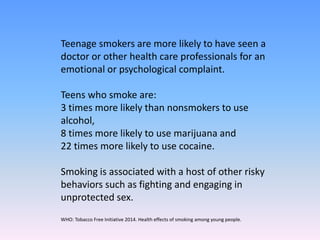
Teenage smokers are more likely to have seen a
doctor or other health care professionals for an
emotional or psychological complaint.
Teens who smoke are:
3 times more likely than nonsmokers to use
alcohol,
8 times more likely to use marijuana and
22 times more likely to use cocaine.
Smoking is associated with a host of other risky
behaviors such as fighting and engaging in
unprotected sex.
WHO: Tobacco Free Initiative 2014. Health effects of smoking among young people.
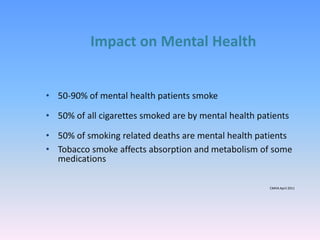
Impact on Mental Health
• 50-90% of mental health patients smoke
• 50% of all cigarettes smoked are by mental health patients
• 50% of smoking related deaths are mental health patients
• Tobacco smoke affects absorption and metabolism of some
medications
CMHA April 2011
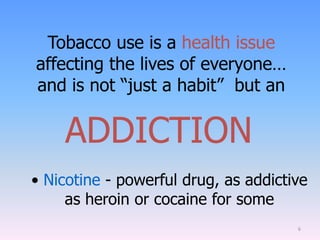
6
Tobacco use is a health issue
affecting the lives of everyone…
and is not “just a habit” but an
• Nicotine - powerful drug, as addictive
as heroin or cocaine for some
ADDICTION
Quitting Tobacco
There are many reasons for quitting:
• Health is usually the primary reason
• CO$T can be a factor
Other motivators can play a role, such as the arrival of a new baby or the
purchase of a new home or vehicle….
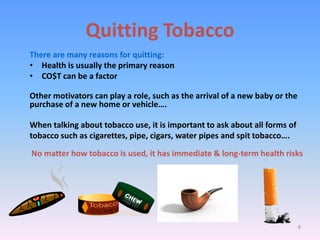
When talking about tobacco use, it is important to ask about all forms of
tobacco such as cigarettes, pipe, cigars, water pipes and spit tobacco….
No matter how tobacco is used, it has immediate & long-term health risks
8
9
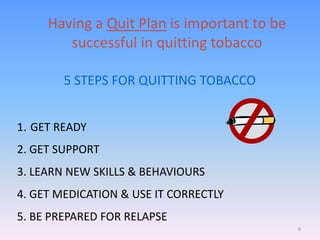
5 STEPS FOR QUITTING TOBACCO
1. GET READY
2. GET SUPPORT
3. LEARN NEW SKILLS & BEHAVIOURS
4. GET MEDICATION & USE IT CORRECTLY
5. BE PREPARED FOR RELAPSE
Having a Quit Plan is important to be
successful in quitting tobacco
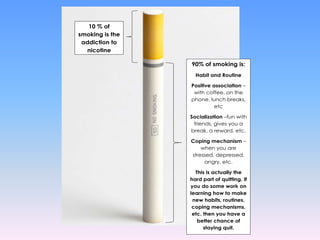
10 % of
smoking is the
addiction to
nicotine
90% of smoking is:
Habit and Routine
Positive association –
with coffee, on the
phone, lunch breaks,
etc
Socialization –fun with
friends, gives you a
break, a reward, etc.
Coping mechanism –
when you are
stressed, depressed,
angry, etc.
This is actually the
hard part of quitting. If
you do some work on
learning how to make
new habits, routines,
coping mechanisms,
etc. then you have a
better chance of
staying quit.
Nicotine Withdrawal
• Fear of withdrawal can be a major barrier to
quitting
• Not all experience withdrawal
• Worst symptoms subside in just 72 hours &
cease in 7-10 days
• Psychological symptoms:
strong cravings mood swings
anxiety crankiness
depression insomnia
11
Source: Ferguson.T. New York:Ballantine Books: Women and Tobacco
What about Nicotine Replacement
Therapy (NRT) ?
• Patch, gum, inhaler, lozenge and mist spray are available for
purchase over the counter at supermarkets and
pharmacies.
• Delivers clean nicotine at gradual doses
• Doubles quit rate
• With counseling, quit rate doubles again
• Products have precautions
12
Patient concerns:
• 69% smokers believe NRT products as harmful as cigarettes
• Individuals need to receive accurate advice and clear
reassurance on safety of products
•British Thoracic Society 2004
NRT Precautions
• Cardiovascular Disease - caution in patients who have had a heart attack;
physician to review if even recent or disease unstable *
• Diabetes - nicotine affects blood sugar levels so need to monitor *
• Pregnancy - behavioral support first; if not successful in quitting need to
weight risk benefit of NRT. Risks to unborn baby less than from continued
smoking *
• Breastfeeding - NRT reduces infants exposure to nicotine; use gum for
example 2-3 hours prior to bf; if patch, remove at night *
• Adolescent - consider if highly nicotine dependent or history of failed
previous attempt without NRT; combination of counseling, peer and family
support and for some, NRT, is best approach *
Use of NRT should be discussed with physician and closely
monitored with these groups
* literature & research reviews
13
Pharmacotherapy available by prescription:
• Champix® (varenicline)
• Zyban® (buproprion)
• Start 7-14 days before quit date: to achieve
steady state of blood levels of the drug
14
Refer to: www.rxfiles.ca
For current information on Tobacco/Smoking Cessation
Pharmacotherapy
“ If I quit smoking, I’ll gain weight..”
• 2/3 of people do gain weight: less than 10 lbs
• True Cause of weight gain:
– high fat, high calorie foods
– enhanced taste & smell
– lack of exercise
EAT RIGHT by following “Canada’s Food Guide to Healthy Eating” and stay
active
“ Weight can be lost, lungs cannot”
… Average smoker would have to gain 125 lbs above their
recommended weight to have the same health risk as smoking one
pack of cigarettes per day
15
Tobacco Intervention is the single
most effective step to lengthen &
improve patients’ lives
With intervention there will be:
- a significant reduction in number of tobacco users &
reduced exposure to secondhand and third hand
tobacco smoke
- a decrease in tobacco related disease
- a lowering of healthcare costs
16
Brief ( 3 – 5 minutes or less) tobacco
intervention encourages smokers to:
• think about their smoking
• consider disadvantages of smoking
• consider benefits of quitting
• Even those not ready to quit benefit from
intervention & self-help materials to increase their
awareness & motivation to quit
17
18
Research shows that just by asking an individual “Do you
smoke?” is not enough to motivate them to quit.
All health professionals need to advise and assist patients
in their attempt to quit.
This is accomplished with the implementation of the 5 A‟s
of Tobacco Cessation Intervention.
5 A‟s
19
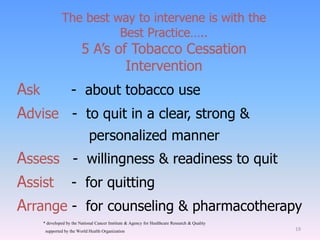
Ask - about tobacco use
Advise - to quit in a clear, strong &
personalized manner
Assess - willingness & readiness to quit
Assist - for quitting
Arrange - for counseling & pharmacotherapy
The best way to intervene is with the
Best Practice…..
5 A‟s of Tobacco Cessation
Intervention
* developed by the National Cancer Institute & Agency for Healthcare Research & Quality
supported by the World Health Organization
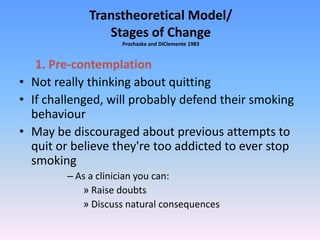
Transtheoretical Model/
Stages of Change
Prochaska and DiClemente 1983
1. Pre-contemplation
• Not really thinking about quitting
• If challenged, will probably defend their smoking
behaviour
• May be discouraged about previous attempts to
quit or believe they're too addicted to ever stop
smoking
– As a clinician you can:
» Raise doubts
» Discuss natural consequences
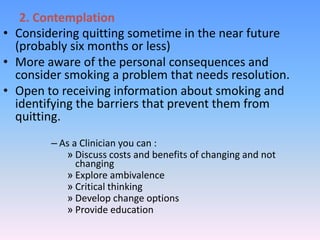
2. Contemplation
• Considering quitting sometime in the near future
(probably six months or less)
• More aware of the personal consequences and
consider smoking a problem that needs resolution.
• Open to receiving information about smoking and
identifying the barriers that prevent them from
quitting.
– As a Clinician you can :
» Discuss costs and benefits of changing and not
changing
» Explore ambivalence
» Critical thinking
» Develop change options
» Provide education
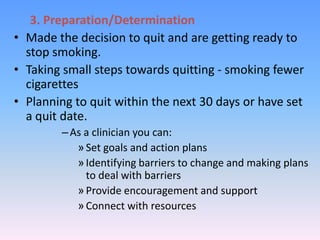
3. Preparation/Determination
• Made the decision to quit and are getting ready to
stop smoking.
• Taking small steps towards quitting - smoking fewer
cigarettes
• Planning to quit within the next 30 days or have set
a quit date.
–As a clinician you can:
»Set goals and action plans
»Identifying barriers to change and making plans
to deal with barriers
»Provide encouragement and support
»Connect with resources
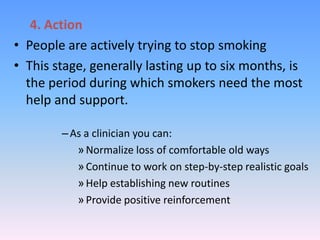
4. Action
• People are actively trying to stop smoking
• This stage, generally lasting up to six months, is
the period during which smokers need the most
help and support.
–As a clinician you can:
»Normalize loss of comfortable old ways
»Continue to work on step-by-step realistic goals
»Help establishing new routines
»Provide positive reinforcement
5. Maintenance
• Person has learned to anticipate and handle
temptations to smoke and is able to use new ways of
coping with stress, boredom and social pressures
• May slip and have a cigarette, they try to learn from
the slip so it doesn't happen again. This helps to give
them a stronger sense of control and the ability to
stay smokefree.
– As a clinician you can:
» Continue goal planning
» Relapse prevention planning
» Provide support and encouragement for alternative
social and recreational activities
» Reinforce commitment
Adapted from 5 Stages to Quitting Health Canada 2009.
6. Relapse
When the person falls back to an earlier stages of change.
–As a clinician you can:
»Focus on elements of past progress, not present
“failures”
»Recognition of warning signs
»Encourage recovery based activities
»Re-engaging support system
»Back to basics
5Rs of Motivational Interviewing
RELEVANCE
• “Do you feel quitting smoking is an important
thing to do for yourself and others around
you?”
RISKS
• “What effect do you think your continued
smoking will have on you and others around
you?”
ROADBLOCKS
• “What is stopping you from quitting?”
REWARDS
• “Can you identify the benefits of quitting for
yourself and not smoking around others?”
REPETITION
• Repeat interventions until smoker expresses
interest in quitting.
28
Some healthcare professionals are
concerned about whether they can
issue credible advice …
•“What if I smoke ?”
•“I’ve never smoked !“
•Ex-smokers
But..“ I‟ve Never Smoked…”
May feel uneasy providing advice, but:
• remember overwhelming evidence linked to tobacco
use
• become familiar with resources & tools in your
community to assist your patients to quit successfully
Just as healthcare professionals who
have never been a parent, can support
new mothers.
29
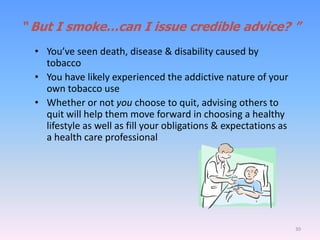
“ But I smoke…can I issue credible advice? ”
• You’ve seen death, disease & disability caused by
tobacco
• You have likely experienced the addictive nature of your
own tobacco use
• Whether or not you choose to quit, advising others to
quit will help them move forward in choosing a healthy
lifestyle as well as fill your obligations & expectations as
a health care professional
30
Whether or not a healthcare provider
smokes, their professional advice is
essential.
If the subject of addressing tobacco
cessation is not mentioned, the individual
may mistakenly perceive that quitting
tobacco is not important.
Saskatoon Health Region
Community Addictions Services
-Tobacco Cessation Services-
• accepts self referrals & referrals from professionals/agencies
• “Free” services by telephone, individual counseling, single session workshops
Main floor @ Sturdy Stone Building - 122 3rd Avenue North Saskatoon SK S7K 2H6
306 - 655 - 4100
Thinking of Quitting Smoking or
Other Tobacco Products?*
Saskatoon Health Region Mental Health &
Addiction Services is offering a free education
session to help adults who are considering
cutting down or quitting tobacco use.
Session Date: Tuesday May 27, 2014
Time: 5:00 – 6:30 pm
Location: Sturdy Stone Building – Main Floor, Suite
156 – 122 – 3rd
Avenue North
(Please use the back door entrance located facing 4th
Avenue North)
For more information call Lynn Isaak 306-655-4125.
*Refers to tobacco in all forms: smoking cigarettes, pipe, cigars and using spit tobacco like snuff and chewing tobacco.
Addiction Services 306-655-4100
Tobaccofree Helpline 306-655-4685
Smokers‟ Helpline 1-877-513-5333
Website: saskatoonhealthregion.ca
E-mail: tobaccofree@saskatoonhealthregion.ca
34
SUPPORT
www.makeapact.ca
Partnership to Assist with Cessation of Tobacco
www.mn-s.ca
The Green Light Program – Métis Nation – Sask. Health Department
www.rnao.org/smokingCessation/index.asp
“Helping People Quit Smoking: Nursing Best Practice Guidelines”
35
OPPORTUNITIES
for
ENHANCED LEARNING
36
Everyone can make a difference
When a consistent, short „quitting tobacco‟ message is given
by many – nurses, physicians, dentists, pharmacists, other
health professionals , there is a significant increase in the
numbers quitting tobacco.
Thank You
Lynn Isaak
Addiction Counsellor
Mental Health and Addiction Services
Tobacco Cessation Program
Sturdy Stone Building
122 – 3rd Ave. N.
Saskatoon, SK S7K 2H6
Phone: (306) 655-4125
Email: marylynn.isaak@saskatoonhealthregion.ca

Presentation on tobacco

  • 1.
  • 2.
    Smoking remains oneof the leading causes of preventable illness, disability and premature death in Canada. 4 people die every day in Saskatchewan from tobacco related diseases. Secondhand and third hand smoke affects others who are exposed to tobacco smoke including children and pets. Two thirds of people who smoke are thinking of quitting. www.makeapact.ca
  • 3.
    About 77% ofpeople in Saskatchewan do not smoke. • Saskatchewan has one of the highest cigarette smoking prevalence rates in Canada. • Consistent with national trends, smoking prevalence is highest among 20-24 year olds. • Prevalence of smoking among 15-19 year olds is higher in Saskatchewan than the national average. Government of Saskatchewan 2012
  • 4.
    Teenage smokers aremore likely to have seen a doctor or other health care professionals for an emotional or psychological complaint. Teens who smoke are: 3 times more likely than nonsmokers to use alcohol, 8 times more likely to use marijuana and 22 times more likely to use cocaine. Smoking is associated with a host of other risky behaviors such as fighting and engaging in unprotected sex. WHO: Tobacco Free Initiative 2014. Health effects of smoking among young people.
  • 5.
    Impact on MentalHealth • 50-90% of mental health patients smoke • 50% of all cigarettes smoked are by mental health patients • 50% of smoking related deaths are mental health patients • Tobacco smoke affects absorption and metabolism of some medications CMHA April 2011
  • 6.
    6 Tobacco use isa health issue affecting the lives of everyone… and is not “just a habit” but an • Nicotine - powerful drug, as addictive as heroin or cocaine for some ADDICTION
  • 8.
    Quitting Tobacco There aremany reasons for quitting: • Health is usually the primary reason • CO$T can be a factor Other motivators can play a role, such as the arrival of a new baby or the purchase of a new home or vehicle…. When talking about tobacco use, it is important to ask about all forms of tobacco such as cigarettes, pipe, cigars, water pipes and spit tobacco…. No matter how tobacco is used, it has immediate & long-term health risks 8
  • 9.
    9 5 STEPS FORQUITTING TOBACCO 1. GET READY 2. GET SUPPORT 3. LEARN NEW SKILLS & BEHAVIOURS 4. GET MEDICATION & USE IT CORRECTLY 5. BE PREPARED FOR RELAPSE Having a Quit Plan is important to be successful in quitting tobacco
  • 10.
    10 % of smokingis the addiction to nicotine 90% of smoking is: Habit and Routine Positive association – with coffee, on the phone, lunch breaks, etc Socialization –fun with friends, gives you a break, a reward, etc. Coping mechanism – when you are stressed, depressed, angry, etc. This is actually the hard part of quitting. If you do some work on learning how to make new habits, routines, coping mechanisms, etc. then you have a better chance of staying quit.
  • 11.
    Nicotine Withdrawal • Fearof withdrawal can be a major barrier to quitting • Not all experience withdrawal • Worst symptoms subside in just 72 hours & cease in 7-10 days • Psychological symptoms: strong cravings mood swings anxiety crankiness depression insomnia 11 Source: Ferguson.T. New York:Ballantine Books: Women and Tobacco
  • 12.
    What about NicotineReplacement Therapy (NRT) ? • Patch, gum, inhaler, lozenge and mist spray are available for purchase over the counter at supermarkets and pharmacies. • Delivers clean nicotine at gradual doses • Doubles quit rate • With counseling, quit rate doubles again • Products have precautions 12 Patient concerns: • 69% smokers believe NRT products as harmful as cigarettes • Individuals need to receive accurate advice and clear reassurance on safety of products •British Thoracic Society 2004
  • 13.
    NRT Precautions • CardiovascularDisease - caution in patients who have had a heart attack; physician to review if even recent or disease unstable * • Diabetes - nicotine affects blood sugar levels so need to monitor * • Pregnancy - behavioral support first; if not successful in quitting need to weight risk benefit of NRT. Risks to unborn baby less than from continued smoking * • Breastfeeding - NRT reduces infants exposure to nicotine; use gum for example 2-3 hours prior to bf; if patch, remove at night * • Adolescent - consider if highly nicotine dependent or history of failed previous attempt without NRT; combination of counseling, peer and family support and for some, NRT, is best approach * Use of NRT should be discussed with physician and closely monitored with these groups * literature & research reviews 13
  • 14.
    Pharmacotherapy available byprescription: • Champix® (varenicline) • Zyban® (buproprion) • Start 7-14 days before quit date: to achieve steady state of blood levels of the drug 14 Refer to: www.rxfiles.ca For current information on Tobacco/Smoking Cessation Pharmacotherapy
  • 15.
    “ If Iquit smoking, I’ll gain weight..” • 2/3 of people do gain weight: less than 10 lbs • True Cause of weight gain: – high fat, high calorie foods – enhanced taste & smell – lack of exercise EAT RIGHT by following “Canada’s Food Guide to Healthy Eating” and stay active “ Weight can be lost, lungs cannot” … Average smoker would have to gain 125 lbs above their recommended weight to have the same health risk as smoking one pack of cigarettes per day 15
  • 16.
    Tobacco Intervention isthe single most effective step to lengthen & improve patients’ lives With intervention there will be: - a significant reduction in number of tobacco users & reduced exposure to secondhand and third hand tobacco smoke - a decrease in tobacco related disease - a lowering of healthcare costs 16
  • 17.
    Brief ( 3– 5 minutes or less) tobacco intervention encourages smokers to: • think about their smoking • consider disadvantages of smoking • consider benefits of quitting • Even those not ready to quit benefit from intervention & self-help materials to increase their awareness & motivation to quit 17
  • 18.
    18 Research shows thatjust by asking an individual “Do you smoke?” is not enough to motivate them to quit. All health professionals need to advise and assist patients in their attempt to quit. This is accomplished with the implementation of the 5 A‟s of Tobacco Cessation Intervention. 5 A‟s
  • 19.
    19 Ask - abouttobacco use Advise - to quit in a clear, strong & personalized manner Assess - willingness & readiness to quit Assist - for quitting Arrange - for counseling & pharmacotherapy The best way to intervene is with the Best Practice….. 5 A‟s of Tobacco Cessation Intervention * developed by the National Cancer Institute & Agency for Healthcare Research & Quality supported by the World Health Organization
  • 20.
    Transtheoretical Model/ Stages ofChange Prochaska and DiClemente 1983 1. Pre-contemplation • Not really thinking about quitting • If challenged, will probably defend their smoking behaviour • May be discouraged about previous attempts to quit or believe they're too addicted to ever stop smoking – As a clinician you can: » Raise doubts » Discuss natural consequences
  • 21.
    2. Contemplation • Consideringquitting sometime in the near future (probably six months or less) • More aware of the personal consequences and consider smoking a problem that needs resolution. • Open to receiving information about smoking and identifying the barriers that prevent them from quitting. – As a Clinician you can : » Discuss costs and benefits of changing and not changing » Explore ambivalence » Critical thinking » Develop change options » Provide education
  • 22.
    3. Preparation/Determination • Madethe decision to quit and are getting ready to stop smoking. • Taking small steps towards quitting - smoking fewer cigarettes • Planning to quit within the next 30 days or have set a quit date. –As a clinician you can: »Set goals and action plans »Identifying barriers to change and making plans to deal with barriers »Provide encouragement and support »Connect with resources
  • 23.
    4. Action • Peopleare actively trying to stop smoking • This stage, generally lasting up to six months, is the period during which smokers need the most help and support. –As a clinician you can: »Normalize loss of comfortable old ways »Continue to work on step-by-step realistic goals »Help establishing new routines »Provide positive reinforcement
  • 24.
    5. Maintenance • Personhas learned to anticipate and handle temptations to smoke and is able to use new ways of coping with stress, boredom and social pressures • May slip and have a cigarette, they try to learn from the slip so it doesn't happen again. This helps to give them a stronger sense of control and the ability to stay smokefree. – As a clinician you can: » Continue goal planning » Relapse prevention planning » Provide support and encouragement for alternative social and recreational activities » Reinforce commitment Adapted from 5 Stages to Quitting Health Canada 2009.
  • 25.
    6. Relapse When theperson falls back to an earlier stages of change. –As a clinician you can: »Focus on elements of past progress, not present “failures” »Recognition of warning signs »Encourage recovery based activities »Re-engaging support system »Back to basics
  • 26.
    5Rs of MotivationalInterviewing RELEVANCE • “Do you feel quitting smoking is an important thing to do for yourself and others around you?” RISKS • “What effect do you think your continued smoking will have on you and others around you?”
  • 27.
    ROADBLOCKS • “What isstopping you from quitting?” REWARDS • “Can you identify the benefits of quitting for yourself and not smoking around others?” REPETITION • Repeat interventions until smoker expresses interest in quitting.
  • 28.
    28 Some healthcare professionalsare concerned about whether they can issue credible advice … •“What if I smoke ?” •“I’ve never smoked !“ •Ex-smokers
  • 29.
    But..“ I‟ve NeverSmoked…” May feel uneasy providing advice, but: • remember overwhelming evidence linked to tobacco use • become familiar with resources & tools in your community to assist your patients to quit successfully Just as healthcare professionals who have never been a parent, can support new mothers. 29
  • 30.
    “ But Ismoke…can I issue credible advice? ” • You’ve seen death, disease & disability caused by tobacco • You have likely experienced the addictive nature of your own tobacco use • Whether or not you choose to quit, advising others to quit will help them move forward in choosing a healthy lifestyle as well as fill your obligations & expectations as a health care professional 30
  • 31.
    Whether or nota healthcare provider smokes, their professional advice is essential. If the subject of addressing tobacco cessation is not mentioned, the individual may mistakenly perceive that quitting tobacco is not important.
  • 32.
    Saskatoon Health Region CommunityAddictions Services -Tobacco Cessation Services- • accepts self referrals & referrals from professionals/agencies • “Free” services by telephone, individual counseling, single session workshops Main floor @ Sturdy Stone Building - 122 3rd Avenue North Saskatoon SK S7K 2H6 306 - 655 - 4100
  • 33.
    Thinking of QuittingSmoking or Other Tobacco Products?* Saskatoon Health Region Mental Health & Addiction Services is offering a free education session to help adults who are considering cutting down or quitting tobacco use. Session Date: Tuesday May 27, 2014 Time: 5:00 – 6:30 pm Location: Sturdy Stone Building – Main Floor, Suite 156 – 122 – 3rd Avenue North (Please use the back door entrance located facing 4th Avenue North) For more information call Lynn Isaak 306-655-4125. *Refers to tobacco in all forms: smoking cigarettes, pipe, cigars and using spit tobacco like snuff and chewing tobacco.
  • 34.
    Addiction Services 306-655-4100 TobaccofreeHelpline 306-655-4685 Smokers‟ Helpline 1-877-513-5333 Website: saskatoonhealthregion.ca E-mail: tobaccofree@saskatoonhealthregion.ca 34 SUPPORT
  • 35.
    www.makeapact.ca Partnership to Assistwith Cessation of Tobacco www.mn-s.ca The Green Light Program – Métis Nation – Sask. Health Department www.rnao.org/smokingCessation/index.asp “Helping People Quit Smoking: Nursing Best Practice Guidelines” 35 OPPORTUNITIES for ENHANCED LEARNING
  • 36.
    36 Everyone can makea difference When a consistent, short „quitting tobacco‟ message is given by many – nurses, physicians, dentists, pharmacists, other health professionals , there is a significant increase in the numbers quitting tobacco.
  • 37.
    Thank You Lynn Isaak AddictionCounsellor Mental Health and Addiction Services Tobacco Cessation Program Sturdy Stone Building 122 – 3rd Ave. N. Saskatoon, SK S7K 2H6 Phone: (306) 655-4125 Email: marylynn.isaak@saskatoonhealthregion.ca