Tobacco Cessation
Based on presentations by
Melissa Cade and Hector Vasquez
and material by
The National Association of State Mental Health Program
Directors
1
How smoking harms smokers
• Cigarette smoke contains over 7,000 chemicals, 69 of which are known to cause cancer.
• Smoking is directly responsible for approximately 80-90% of lung cancer deaths and
approximately 80-90% of COPD deaths.
• Among adults who have ever smoked, 70% started smoking regularly at age 18 or younger, and
86% at age 21 or younger.
• Among current smokers, chronic lung disease accounts for 73% of smoking-related conditions.
Even among smokers who have quit, chronic lung cancer disease accounts for 50% of smoking-
related conditions.
• Smoking harms nearly every organ in the body and is a main cause of lung cancer and chronic
obstructive pulmonary disease (COPD, including chronic bronchitis and emphysema). It is also a
cause of coronary heart disease, stroke, and a host of other cancers and diseases.
2
Tobacco is identified as a cause of …
• Bladder cancer
• Cervical cancer
• Esophageal cancer
• Kidney cancer
• Laryngeal cancer
• Leukemia
• Lung cancer
• Oral cancer
• Pancreatic cancer
• Stomach cancer
• Abdominal aortic aneurysm
• Atherosclerosis
• Cerebrovascular disease
• Coronary heart disease
• COPD
• Pneumonia
• Reduced lung function among infants
• Respiratory disease in childhood and
adolescence
• Fetal death and stillbirth
• Reduced fertility
• Low birth weight
• Pregnancy complications
• Cataracts
• Hip fractures
• Low bone density
• Peptic ulcer disease
3
How smoking harms the rest of us
• The 2006 Surgeon General’s Report on smoking concluded that there is no risk-free level of exposure to secondhand
smoke. Short-term exposure can potentially increase the risk of heart attacks.
• Secondhand smoke exposure causes disease and premature death in children and adults who do not smoke. Secondhand
smoke contains hundreds of chemicals known to be toxic or carcinogenic, including formaldehyde, benzene, vinyl
chloride, arsenic ammonia, and hydrogen cyanide.
• Secondhand smoke causes approximately 3,400 deaths from lung cancer and 22,700 to 69,600 deaths from disease each
year. In 2009, the Institute of Medicine reported that relatively brief exposure to secondhand smoke could trigger a heart
attack.
• Sidestream smoke – smoke from the lighted end of a cigarette, pipe, or cigar. Even though most people think of
secondhand smoke and sidestream smoke are the same, they aren’t. Sidestream smoke has higher concentrations of
cancer-causing (carcinogens) and is more toxic than mainstream smoke. And, it has smaller particles than mainstream
smoke – these smaller particles make their way into the lungs and the body’s cells more easily.
• Nonsmokers exposed to secondhand smoke at work are at increased risk for adverse health effects. Levels of secondhand
smoke in restaurants and bars were found to be 2 to 5 times higher than in residences with smokers and 2 to 6 times
higher than in office workplaces.
• Workplace productivity was increased and absenteeism was decreased among former smokers compared with current
smokers.
• The National Cancer Institute found that being employed in a workplace where smoking is prohibited is associated with a
reduction in the number of cigarettes smoked per day and an increase in the success rate of smokers who are attempting
to quit.
4
The costs of smoking
• In 1964, the first Surgeon General’s report on the effects of smoking on health was
released. In the more than 50 years since, extensive data from thousands of studies have
consistently substantiated the devastating effects of smoking on the lives of millions of
Americans. Yet today in the United States, tobacco use remains the single largest
preventable cause of death and disease for both men and women. Cigarette smoking costs
society over $193 billion annually in medical care and health-related productivity.
• In Texas, smoking is responsible for 24,500 annual deaths and $12.2 billion in excess
medical care expenditures and lost productivity. Annual medical care costs related to
smoking are more than $5.8 billion. An estimated $6.4 billion in annual productivity losses
are associated with death-related forgone lifetime earnings. Tobacco use remains the
leading cause of premature and preventable death in our nation, and is responsible for
443,000 deaths each year because of cigarette smoking and exposure to secondhand smoke.
• Tobacco addiction kills more than 1,200 people a day in the United States. Each year in
Texas, tobacco claims more lives than AIDS, heroin, cocaine, alcohol, car accidents, fire
and murder – combined (as reported on the Department of State Health Services website).
5
Is nicotine addictive?
Yes. Any honest and thorough appraisal of the scientific and medical literature on nicotine must conclude
that this is a drug that causes physical dependence and addiction. At least 3 related lines of evidence lead to
this conclusion:
• Reinforcement: A reinforcer is something that motivates an individual to work toward getting more.
Nicotine is known to promote the release of dopamine in brain regions that mediate reinforcement.
• Tolerance: Studies have demonstrated the rapid development of tolerance to the effects of nicotine.
When people begin to smoke they experience a range of rather unpleasant effects, such as dizziness or
nausea, but these disappear over days or weeks as the smoker continues to smoke. Tolerance to other
effects of nicotine develops even more rapidly. For example, when a group of smokers was given 2
equal doses of nicotine 60 minutes apart, they experienced more pronounced elevations of their heart
rates and reported greater subjective effects from the first dose compared to the second.
• Withdrawal: Studies have shown that people who have quit using nicotine often report powerful
cravings and irritability during the first two to three weeks after their last cigarette. As with tolerance,
withdrawal from nicotine has both short- and long-term aspects. For example, most smokers report that
their first cigarette of the day is the one that makes them feel the best. This effect can be seen as the
termination of a mini-withdrawal after the overnight abstinence.
6
Why we use tobacco
• Learned behaviors: Smoking is learned behavior and is not a natural
act. Everyone had to learn how to smoke. You worked at it and had a
strong desire to practice to learn. Through your perseverance you
conditioned your body to expect the cigarette’s nicotine and the assault of
harmful chemicals in the smoke.
• Triggered behaviors: Smoking is a triggered behavior and as your
smoking became perfected you began carrying cigarettes into other
situations. Each time you smoked in a situation you reinforced the
behavior and began to connect the act of smoking with these activities
and emotions. This triggered behavior is an automatic behavior as well.
Smoking has become an automatic way to deal with difficult life
situations.
• Social behavior: Smoking is a social behavior because tobacco use
becomes a part of daily activities and rituals.
7
Smoking: The perfect drug?
• 2 cents per hit
• Smoking a pack per day equals 20 cigarettes at ten puffs per
cigarette.
• Easily absorbed
• Reaches the brain in 8 to 10 seconds
• Faster than intravenous
• Legal
• Easily obtained
• Fashionable
• In the past, though times have changed
8
The three-link chain of addiction
• Physical: Smoking causes true drug dependence. Nicotine is the addictive
ingredient in tobacco. It makes smoking patterns stronger and very resistant to
change. Nicotine is rated by most experts as a more difficult drug to quit than
heroin, cocaine, alcohol, caffeine, and marijuana.
• Mental: Tobacco products are often used as a result of environmental cues or
triggers. Lighting up or dipping becomes an automatic behavior – people may not
even realize when they are using the product. Additionally, tobacco is used as a
coping mechanism. People may use tobacco to handle stress or when they feel
lonely, bored, or angry. Nicotine may be used to self-medicate underlying
problems such as depression, anxiety, and stress.
• Social: Some feel smoking makes it easier to identify with a group. Smoking
typically starts during the adolescent or teen years and is more prevalent among
those with low income and poor academic performance.
9
Addiction and smoking
Evidence suggests that smoking actually harms recovery from the addiction
to other drugs because it can trigger the use of those substances.
• Approximately 71% of all illicit drug users smoke.
• 74 to 100% of patients in drug treatment smoke.
• 85 to 98% of patients in methadone maintenance treatment smoke.
• 70 % of HIV+ patients smoke.
10
Alcohol Amblyopia
Alcohol Amblyopia or Nutritional Optic Neuropathy results when a person is
alcohol- and tobacco-dependent. It is a rare disease that causes decreased visual
acuity – so that the “E” and the “1” look like orange boxes.
11
Cigarette smoking exacerbates
alcohol-induced brain damage
• Chronic alcohol use damages the brains of alcoholics, particularly the
frontal lobes, which are critical for high-order cognitive functioning
(problem-solving, reasoning, abstraction, planning, foresight).
• Chronic cigarette use increases the severity of this brain damage.
• Measurements made on smokers, light smokers, abstinent alcoholics
and light drinkers using functional MRIs (Durazzo et. al.,
Alcoholism: Clinical and Experimental Research, December 2004).
12
Mental illness and smoking
• People with serious mental illness die 25 years younger than the general
population due largely to conditions caused or worsened by smoking.

• Smokers with schizophrenia spend more than one-quarter of their total income on
cigarettes.
• Tobacco use interferes with psychiatric medications.
• Although more than two-thirds of smokers want to quit, only 3 percent are able
to quit without help.
• Even highly addicted smokers with mental illness can quit and are more likely to
succeed with a combination of medications and behavioral therapy.
13
Smoking prevalence
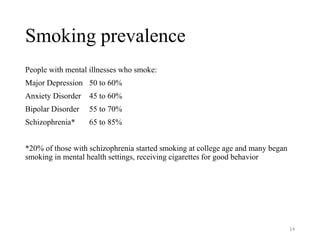
People with mental illnesses who smoke:
Major Depression 50 to 60%
Anxiety Disorder 45 to 60%
Bipolar Disorder 55 to 70%
Schizophrenia* 65 to 85%
*20% of those with schizophrenia started smoking at college age and many began
smoking in mental health settings, receiving cigarettes for good behavior
14
Smokers with schizophrenia
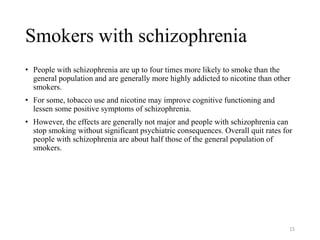
• People with schizophrenia are up to four times more likely to smoke than the
general population and are generally more highly addicted to nicotine than other
smokers.
• For some, tobacco use and nicotine may improve cognitive functioning and
lessen some positive symptoms of schizophrenia.
• However, the effects are generally not major and people with schizophrenia can
stop smoking without significant psychiatric consequences. Overall quit rates for
people with schizophrenia are about half those of the general population of
smokers.
15
Drinking and smoking
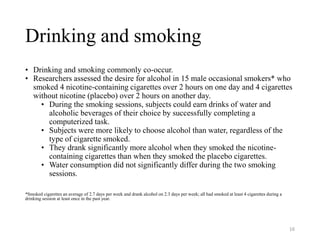
• Drinking and smoking commonly co-occur.
• Researchers assessed the desire for alcohol in 15 male occasional smokers* who
smoked 4 nicotine-containing cigarettes over 2 hours on one day and 4 cigarettes
without nicotine (placebo) over 2 hours on another day.
• During the smoking sessions, subjects could earn drinks of water and
alcoholic beverages of their choice by successfully completing a
computerized task.
• Subjects were more likely to choose alcohol than water, regardless of the
type of cigarette smoked.
• They drank significantly more alcohol when they smoked the nicotine-
containing cigarettes than when they smoked the placebo cigarettes.
• Water consumption did not significantly differ during the two smoking
sessions.
*Smoked cigarettes an average of 2.7 days per week and drank alcohol on 2.3 days per week; all had smoked at least 4 cigarettes during a
drinking session at least once in the past year.
16
Smoking may hinder recovery
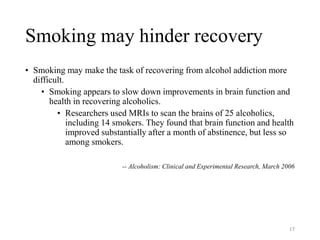
• Smoking may make the task of recovering from alcohol addiction more
difficult.
• Smoking appears to slow down improvements in brain function and
health in recovering alcoholics.
• Researchers used MRIs to scan the brains of 25 alcoholics,
including 14 smokers. They found that brain function and health
improved substantially after a month of abstinence, but less so
among smokers.
-- Alcoholism: Clinical and Experimental Research, March 2006
17
It’s good for you if clients quit
Staff who work in psychiatric hospitals smoke at higher rates than the general
population (30 percent to 40 percent, compared with 22 percent) and are regularly
exposed to toxins through second-hand smoke.
18
Quitting
• Every year in the U.S. over 392,000 people die from tobacco-caused disease,
making it the leading cause of preventable death. Another 50,000 people die from
exposure to secondhand smoke. Tragically, each day thousands of kids still pick
up a cigarette for the first time. The cycle of addiction, illness, and death
continues.
• Quitting smoking is the single most important step a smoker can take to improve
the length and quality of his or her life. Stopping smoking can be tough, but
smokers don’t have to quit alone.
19
Quitting: A track record
• 90% would like to quit.
• 60% have tried to quit.
• 66% have health concerns.
• Of the 17 million American adults who attempt to quit each year, only 1.3 million
are successful.
• High motivation but limited success
20
Why quit?
• For your health! As soon as you quit, your body begins to repair the
damage caused by smoking. Of course it’s best to quit early in life, but even

people who quit later in life will improve their health.
• To save money! It’s getting more expensive to smoke cigarettes. State and
federal cigarette taxes continue to go up and in some places, a pack of
cigarettes can cost $10. Even if a pack costs “only” $5 where you live,
smoking one pack per day adds up to $1,825 per year.
• To save aggravation! It’s getting less convenient to smoke. More and more
states and cities are passing clean indoor air laws that make it illegal to
smoke in bars, restaurants, and other public places.
• It’s good for the people around you! Cigarette smoke is harmful to
everyone who inhales it, not just the smoker. Whether you are young or old
and in good health or bad, secondhand smoke is dangerous and can make
you sick. Children who live with smokers get more chest colds and ear
infections while babies born to mothers who smoke have increase risk of
premature delivery, low birth weight, and sudden death syndrome.
21
Health benefits of quitting
• 20 minutes after quitting: Your heart rate drops to a normal level.
• 12 hours after quitting: The carbon monoxide level in your blood drops to
normal.
• 2 weeks to 3 months after quitting: Your risk of having a heart attack begins to
drop; your lung function begins to improve.
• 1 to 9 months after quitting: Your coughing and shortness of breath decrease.
• 1 year after quitting: Your added risk of coronary heart disease is half that of a
smoker’s.
• 5 to 15 years after quitting: Your risk of having a stroke is reduced to that of a
nonsmoker’s; your risk of getting cancer of the mouth, throat, and esophagus is
half that of a smoker’s.
• 10 years after quitting: Your risk of dying from lung cancer is about half that of a
smoker’s; your risk of getting bladder cancer is half that of a smoker’s; your risk
of getting cervical cancer or cancer of the larynx, kidney, or pancreas decreases.
• 15 years after quitting: Your risk of coronary heart disease is the same as that of a
nonsmoker.
22
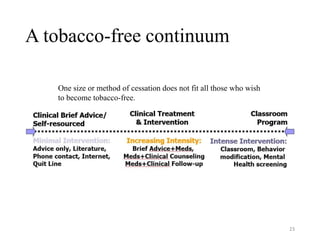
A tobacco-free continuum
23
One size or method of cessation does not fit all those who wish
to become tobacco-free.
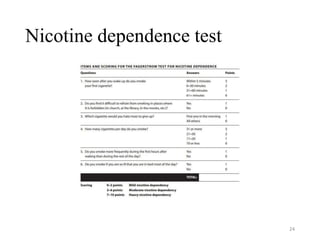
Nicotine dependence test
24
Remember the four Ds
• Delay: Allow some time. Don’t reach for a cigarette right away. Count to 200.
Smoke urges pass in about 3 to 5 minutes.
• Deep Breath: Take ten slow, deep breaths – in through the nose and slowly
through the mouth
• Do Something Else: Focus on being busy. Do something you like besides
smoking. Keep your thinking away from cigarettes.
• Drink Water: Slowly sip water – up to eight glasses a day. Water helps to flush
nicotine out of your body.
25
Common concerns
“I’ve tried to quit many times – and failed. Why should it be different now?”
Most people who have quit for good have tried many times before – just like you. They learn
from their experiences and apply this to their new attempts.
“I know I’ll gain weight, and I don’t want those extra pounds.”
People differ widely when it comes to gaining weight after they stop smoking. If you use
food, especially food high in calories, as your primary way to cope with smoking urges, then
your chances of gaining weight are much higher. Try using the non-food coping techniques
and increase your daily exercise.
“Isn’t it bad to put nicotine-replacement drugs in my body?”
It’s not the nicotine that is so bad for you; it’s all the other chemicals you inhale when you
smoke. Nicotine replacement therapy delivers just enough nicotine to ease your withdrawal
symptoms, so you can focus on quitting for good.
26
Medications
• Patches
• Gum
• Lozenge
• Spray
• Inhaler
• Tablets
With e-cigarettes there are many unknowns, including the unknown health effects
of long-term use. Currently, there are no e-cigarettes approved by the FDA for
therapeutic uses, so they cannot be recommended as a cessation aid.
27
Pharmacotherapy
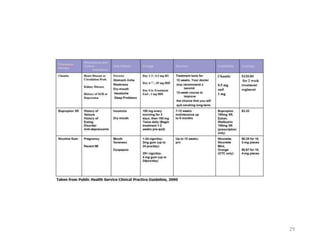
• Three first-line types of pharmacotherapy (FDA approved) are Chantix, nicotine
replacement therapy and Bupropion.
• Whether medications are prescribed via formal TUC programs or via clinical
care visits, providers should be aware of the medications and the need to follow
those patients who are using the medications.
• Patients receiving TUC medications along with behavioral support have the best
chance of quitting.
• Natural/herbal/hypnosis/acupuncture are not proved in evidenced-based studies
28
29
30
31
Implementation of tobacco
cessation
• Group education monthly for all units: This will provide clients with
knowledge of the consequences of smoking, as well as options for quitting.
• Individual counseling/coaching: This provides a client with one-on-one care in
regards to exploring their current situation with smoking. There are several
handouts that can be completed by clients who are willing to quit smoking, as
well as clients unwilling to quit smoking.
• Referral: There are several referral sources that provide help with quitting
smoking, as well as provide educational tools for clients. Links will be provided
at the end of the course.
32
Benefits
• Clients/patients
• Recovering person will be able to have complete recovery.
• Improved treatment outcomes
• Increased client self-esteem
• Program administration
• Fewer smoke breaks – more program time
• Improved work productivity
• Less cigarette litter
• Less indoor air pollution
• Less risk of fire
• Less secondhand smoke
• Lower maintenance costs (carpets, furniture, walls, painting, etc.)
• Reduce cigarette bartering
• Improve staff health and attendance
• Lower insurance costs
• Integrate substance abuse and medical staff
33
Your role
As clinicians, you are in a frontline position to help your patients by asking two key
questions: ‘Do you smoke?’ and ‘Do you want to quit?’ ”
-- David Satcher, M.D., Ph.D., former U.S. surgeon general
34
Helpful links
• www.yesquit.com
• www.quittobacco.org (includes a tobacco savings calculator and a
discussion group for support)
• www.cdc.gov/tobacco/quit_smoking
• www.quitsmoking.com
• www.cms.hhs.gov (Centers for Medicare & Medicaid Services; information
for patients)
35

Tobacco Cessation

  • 1.
    Tobacco Cessation Based onpresentations by Melissa Cade and Hector Vasquez and material by The National Association of State Mental Health Program Directors 1
  • 2.
    How smoking harmssmokers • Cigarette smoke contains over 7,000 chemicals, 69 of which are known to cause cancer. • Smoking is directly responsible for approximately 80-90% of lung cancer deaths and approximately 80-90% of COPD deaths. • Among adults who have ever smoked, 70% started smoking regularly at age 18 or younger, and 86% at age 21 or younger. • Among current smokers, chronic lung disease accounts for 73% of smoking-related conditions. Even among smokers who have quit, chronic lung cancer disease accounts for 50% of smoking- related conditions. • Smoking harms nearly every organ in the body and is a main cause of lung cancer and chronic obstructive pulmonary disease (COPD, including chronic bronchitis and emphysema). It is also a cause of coronary heart disease, stroke, and a host of other cancers and diseases. 2
  • 3.
    Tobacco is identifiedas a cause of … • Bladder cancer • Cervical cancer • Esophageal cancer • Kidney cancer • Laryngeal cancer • Leukemia • Lung cancer • Oral cancer • Pancreatic cancer • Stomach cancer • Abdominal aortic aneurysm • Atherosclerosis • Cerebrovascular disease • Coronary heart disease • COPD • Pneumonia • Reduced lung function among infants • Respiratory disease in childhood and adolescence • Fetal death and stillbirth • Reduced fertility • Low birth weight • Pregnancy complications • Cataracts • Hip fractures • Low bone density • Peptic ulcer disease 3
  • 4.
    How smoking harmsthe rest of us • The 2006 Surgeon General’s Report on smoking concluded that there is no risk-free level of exposure to secondhand smoke. Short-term exposure can potentially increase the risk of heart attacks. • Secondhand smoke exposure causes disease and premature death in children and adults who do not smoke. Secondhand smoke contains hundreds of chemicals known to be toxic or carcinogenic, including formaldehyde, benzene, vinyl chloride, arsenic ammonia, and hydrogen cyanide. • Secondhand smoke causes approximately 3,400 deaths from lung cancer and 22,700 to 69,600 deaths from disease each year. In 2009, the Institute of Medicine reported that relatively brief exposure to secondhand smoke could trigger a heart attack. • Sidestream smoke – smoke from the lighted end of a cigarette, pipe, or cigar. Even though most people think of secondhand smoke and sidestream smoke are the same, they aren’t. Sidestream smoke has higher concentrations of cancer-causing (carcinogens) and is more toxic than mainstream smoke. And, it has smaller particles than mainstream smoke – these smaller particles make their way into the lungs and the body’s cells more easily. • Nonsmokers exposed to secondhand smoke at work are at increased risk for adverse health effects. Levels of secondhand smoke in restaurants and bars were found to be 2 to 5 times higher than in residences with smokers and 2 to 6 times higher than in office workplaces. • Workplace productivity was increased and absenteeism was decreased among former smokers compared with current smokers. • The National Cancer Institute found that being employed in a workplace where smoking is prohibited is associated with a reduction in the number of cigarettes smoked per day and an increase in the success rate of smokers who are attempting to quit. 4
  • 5.
    The costs ofsmoking • In 1964, the first Surgeon General’s report on the effects of smoking on health was released. In the more than 50 years since, extensive data from thousands of studies have consistently substantiated the devastating effects of smoking on the lives of millions of Americans. Yet today in the United States, tobacco use remains the single largest preventable cause of death and disease for both men and women. Cigarette smoking costs society over $193 billion annually in medical care and health-related productivity. • In Texas, smoking is responsible for 24,500 annual deaths and $12.2 billion in excess medical care expenditures and lost productivity. Annual medical care costs related to smoking are more than $5.8 billion. An estimated $6.4 billion in annual productivity losses are associated with death-related forgone lifetime earnings. Tobacco use remains the leading cause of premature and preventable death in our nation, and is responsible for 443,000 deaths each year because of cigarette smoking and exposure to secondhand smoke. • Tobacco addiction kills more than 1,200 people a day in the United States. Each year in Texas, tobacco claims more lives than AIDS, heroin, cocaine, alcohol, car accidents, fire and murder – combined (as reported on the Department of State Health Services website). 5
  • 6.
    Is nicotine addictive? Yes.Any honest and thorough appraisal of the scientific and medical literature on nicotine must conclude that this is a drug that causes physical dependence and addiction. At least 3 related lines of evidence lead to this conclusion: • Reinforcement: A reinforcer is something that motivates an individual to work toward getting more. Nicotine is known to promote the release of dopamine in brain regions that mediate reinforcement. • Tolerance: Studies have demonstrated the rapid development of tolerance to the effects of nicotine. When people begin to smoke they experience a range of rather unpleasant effects, such as dizziness or nausea, but these disappear over days or weeks as the smoker continues to smoke. Tolerance to other effects of nicotine develops even more rapidly. For example, when a group of smokers was given 2 equal doses of nicotine 60 minutes apart, they experienced more pronounced elevations of their heart rates and reported greater subjective effects from the first dose compared to the second. • Withdrawal: Studies have shown that people who have quit using nicotine often report powerful cravings and irritability during the first two to three weeks after their last cigarette. As with tolerance, withdrawal from nicotine has both short- and long-term aspects. For example, most smokers report that their first cigarette of the day is the one that makes them feel the best. This effect can be seen as the termination of a mini-withdrawal after the overnight abstinence. 6
  • 7.
    Why we usetobacco • Learned behaviors: Smoking is learned behavior and is not a natural act. Everyone had to learn how to smoke. You worked at it and had a strong desire to practice to learn. Through your perseverance you conditioned your body to expect the cigarette’s nicotine and the assault of harmful chemicals in the smoke. • Triggered behaviors: Smoking is a triggered behavior and as your smoking became perfected you began carrying cigarettes into other situations. Each time you smoked in a situation you reinforced the behavior and began to connect the act of smoking with these activities and emotions. This triggered behavior is an automatic behavior as well. Smoking has become an automatic way to deal with difficult life situations. • Social behavior: Smoking is a social behavior because tobacco use becomes a part of daily activities and rituals. 7
  • 8.
    Smoking: The perfectdrug? • 2 cents per hit • Smoking a pack per day equals 20 cigarettes at ten puffs per cigarette. • Easily absorbed • Reaches the brain in 8 to 10 seconds • Faster than intravenous • Legal • Easily obtained • Fashionable • In the past, though times have changed 8
  • 9.
    The three-link chainof addiction • Physical: Smoking causes true drug dependence. Nicotine is the addictive ingredient in tobacco. It makes smoking patterns stronger and very resistant to change. Nicotine is rated by most experts as a more difficult drug to quit than heroin, cocaine, alcohol, caffeine, and marijuana. • Mental: Tobacco products are often used as a result of environmental cues or triggers. Lighting up or dipping becomes an automatic behavior – people may not even realize when they are using the product. Additionally, tobacco is used as a coping mechanism. People may use tobacco to handle stress or when they feel lonely, bored, or angry. Nicotine may be used to self-medicate underlying problems such as depression, anxiety, and stress. • Social: Some feel smoking makes it easier to identify with a group. Smoking typically starts during the adolescent or teen years and is more prevalent among those with low income and poor academic performance. 9
  • 10.
    Addiction and smoking Evidencesuggests that smoking actually harms recovery from the addiction to other drugs because it can trigger the use of those substances. • Approximately 71% of all illicit drug users smoke. • 74 to 100% of patients in drug treatment smoke. • 85 to 98% of patients in methadone maintenance treatment smoke. • 70 % of HIV+ patients smoke. 10
  • 11.
    Alcohol Amblyopia Alcohol Amblyopiaor Nutritional Optic Neuropathy results when a person is alcohol- and tobacco-dependent. It is a rare disease that causes decreased visual acuity – so that the “E” and the “1” look like orange boxes. 11
  • 12.
    Cigarette smoking exacerbates alcohol-inducedbrain damage • Chronic alcohol use damages the brains of alcoholics, particularly the frontal lobes, which are critical for high-order cognitive functioning (problem-solving, reasoning, abstraction, planning, foresight). • Chronic cigarette use increases the severity of this brain damage. • Measurements made on smokers, light smokers, abstinent alcoholics and light drinkers using functional MRIs (Durazzo et. al., Alcoholism: Clinical and Experimental Research, December 2004). 12
  • 13.
    Mental illness andsmoking • People with serious mental illness die 25 years younger than the general population due largely to conditions caused or worsened by smoking. • Smokers with schizophrenia spend more than one-quarter of their total income on cigarettes. • Tobacco use interferes with psychiatric medications. • Although more than two-thirds of smokers want to quit, only 3 percent are able to quit without help. • Even highly addicted smokers with mental illness can quit and are more likely to succeed with a combination of medications and behavioral therapy. 13
  • 14.
    Smoking prevalence People withmental illnesses who smoke: Major Depression 50 to 60% Anxiety Disorder 45 to 60% Bipolar Disorder 55 to 70% Schizophrenia* 65 to 85% *20% of those with schizophrenia started smoking at college age and many began smoking in mental health settings, receiving cigarettes for good behavior 14
  • 15.
    Smokers with schizophrenia •People with schizophrenia are up to four times more likely to smoke than the general population and are generally more highly addicted to nicotine than other smokers. • For some, tobacco use and nicotine may improve cognitive functioning and lessen some positive symptoms of schizophrenia. • However, the effects are generally not major and people with schizophrenia can stop smoking without significant psychiatric consequences. Overall quit rates for people with schizophrenia are about half those of the general population of smokers. 15
  • 16.
    Drinking and smoking •Drinking and smoking commonly co-occur. • Researchers assessed the desire for alcohol in 15 male occasional smokers* who smoked 4 nicotine-containing cigarettes over 2 hours on one day and 4 cigarettes without nicotine (placebo) over 2 hours on another day. • During the smoking sessions, subjects could earn drinks of water and alcoholic beverages of their choice by successfully completing a computerized task. • Subjects were more likely to choose alcohol than water, regardless of the type of cigarette smoked. • They drank significantly more alcohol when they smoked the nicotine- containing cigarettes than when they smoked the placebo cigarettes. • Water consumption did not significantly differ during the two smoking sessions. *Smoked cigarettes an average of 2.7 days per week and drank alcohol on 2.3 days per week; all had smoked at least 4 cigarettes during a drinking session at least once in the past year. 16
  • 17.
    Smoking may hinderrecovery • Smoking may make the task of recovering from alcohol addiction more difficult. • Smoking appears to slow down improvements in brain function and health in recovering alcoholics. • Researchers used MRIs to scan the brains of 25 alcoholics, including 14 smokers. They found that brain function and health improved substantially after a month of abstinence, but less so among smokers. -- Alcoholism: Clinical and Experimental Research, March 2006 17
  • 18.
    It’s good foryou if clients quit Staff who work in psychiatric hospitals smoke at higher rates than the general population (30 percent to 40 percent, compared with 22 percent) and are regularly exposed to toxins through second-hand smoke. 18
  • 19.
    Quitting • Every yearin the U.S. over 392,000 people die from tobacco-caused disease, making it the leading cause of preventable death. Another 50,000 people die from exposure to secondhand smoke. Tragically, each day thousands of kids still pick up a cigarette for the first time. The cycle of addiction, illness, and death continues. • Quitting smoking is the single most important step a smoker can take to improve the length and quality of his or her life. Stopping smoking can be tough, but smokers don’t have to quit alone. 19
  • 20.
    Quitting: A trackrecord • 90% would like to quit. • 60% have tried to quit. • 66% have health concerns. • Of the 17 million American adults who attempt to quit each year, only 1.3 million are successful. • High motivation but limited success 20
  • 21.
    Why quit? • Foryour health! As soon as you quit, your body begins to repair the damage caused by smoking. Of course it’s best to quit early in life, but even people who quit later in life will improve their health. • To save money! It’s getting more expensive to smoke cigarettes. State and federal cigarette taxes continue to go up and in some places, a pack of cigarettes can cost $10. Even if a pack costs “only” $5 where you live, smoking one pack per day adds up to $1,825 per year. • To save aggravation! It’s getting less convenient to smoke. More and more states and cities are passing clean indoor air laws that make it illegal to smoke in bars, restaurants, and other public places. • It’s good for the people around you! Cigarette smoke is harmful to everyone who inhales it, not just the smoker. Whether you are young or old and in good health or bad, secondhand smoke is dangerous and can make you sick. Children who live with smokers get more chest colds and ear infections while babies born to mothers who smoke have increase risk of premature delivery, low birth weight, and sudden death syndrome. 21
  • 22.
    Health benefits ofquitting • 20 minutes after quitting: Your heart rate drops to a normal level. • 12 hours after quitting: The carbon monoxide level in your blood drops to normal. • 2 weeks to 3 months after quitting: Your risk of having a heart attack begins to drop; your lung function begins to improve. • 1 to 9 months after quitting: Your coughing and shortness of breath decrease. • 1 year after quitting: Your added risk of coronary heart disease is half that of a smoker’s. • 5 to 15 years after quitting: Your risk of having a stroke is reduced to that of a nonsmoker’s; your risk of getting cancer of the mouth, throat, and esophagus is half that of a smoker’s. • 10 years after quitting: Your risk of dying from lung cancer is about half that of a smoker’s; your risk of getting bladder cancer is half that of a smoker’s; your risk of getting cervical cancer or cancer of the larynx, kidney, or pancreas decreases. • 15 years after quitting: Your risk of coronary heart disease is the same as that of a nonsmoker. 22
  • 23.
    A tobacco-free continuum 23 Onesize or method of cessation does not fit all those who wish to become tobacco-free.
  • 24.
  • 25.
    Remember the fourDs • Delay: Allow some time. Don’t reach for a cigarette right away. Count to 200. Smoke urges pass in about 3 to 5 minutes. • Deep Breath: Take ten slow, deep breaths – in through the nose and slowly through the mouth • Do Something Else: Focus on being busy. Do something you like besides smoking. Keep your thinking away from cigarettes. • Drink Water: Slowly sip water – up to eight glasses a day. Water helps to flush nicotine out of your body. 25
  • 26.
    Common concerns “I’ve triedto quit many times – and failed. Why should it be different now?” Most people who have quit for good have tried many times before – just like you. They learn from their experiences and apply this to their new attempts. “I know I’ll gain weight, and I don’t want those extra pounds.” People differ widely when it comes to gaining weight after they stop smoking. If you use food, especially food high in calories, as your primary way to cope with smoking urges, then your chances of gaining weight are much higher. Try using the non-food coping techniques and increase your daily exercise. “Isn’t it bad to put nicotine-replacement drugs in my body?” It’s not the nicotine that is so bad for you; it’s all the other chemicals you inhale when you smoke. Nicotine replacement therapy delivers just enough nicotine to ease your withdrawal symptoms, so you can focus on quitting for good. 26
  • 27.
    Medications • Patches • Gum •Lozenge • Spray • Inhaler • Tablets With e-cigarettes there are many unknowns, including the unknown health effects of long-term use. Currently, there are no e-cigarettes approved by the FDA for therapeutic uses, so they cannot be recommended as a cessation aid. 27
  • 28.
    Pharmacotherapy • Three first-linetypes of pharmacotherapy (FDA approved) are Chantix, nicotine replacement therapy and Bupropion. • Whether medications are prescribed via formal TUC programs or via clinical care visits, providers should be aware of the medications and the need to follow those patients who are using the medications. • Patients receiving TUC medications along with behavioral support have the best chance of quitting. • Natural/herbal/hypnosis/acupuncture are not proved in evidenced-based studies 28
  • 29.
  • 30.
  • 31.
  • 32.
    Implementation of tobacco cessation •Group education monthly for all units: This will provide clients with knowledge of the consequences of smoking, as well as options for quitting. • Individual counseling/coaching: This provides a client with one-on-one care in regards to exploring their current situation with smoking. There are several handouts that can be completed by clients who are willing to quit smoking, as well as clients unwilling to quit smoking. • Referral: There are several referral sources that provide help with quitting smoking, as well as provide educational tools for clients. Links will be provided at the end of the course. 32
  • 33.
    Benefits • Clients/patients • Recoveringperson will be able to have complete recovery. • Improved treatment outcomes • Increased client self-esteem • Program administration • Fewer smoke breaks – more program time • Improved work productivity • Less cigarette litter • Less indoor air pollution • Less risk of fire • Less secondhand smoke • Lower maintenance costs (carpets, furniture, walls, painting, etc.) • Reduce cigarette bartering • Improve staff health and attendance • Lower insurance costs • Integrate substance abuse and medical staff 33
  • 34.
    Your role As clinicians,you are in a frontline position to help your patients by asking two key questions: ‘Do you smoke?’ and ‘Do you want to quit?’ ” -- David Satcher, M.D., Ph.D., former U.S. surgeon general 34
  • 35.
    Helpful links • www.yesquit.com •www.quittobacco.org (includes a tobacco savings calculator and a discussion group for support) • www.cdc.gov/tobacco/quit_smoking • www.quitsmoking.com • www.cms.hhs.gov (Centers for Medicare & Medicaid Services; information for patients) 35