LAWS OF ALGEBRA OF PREPOSITIONS
Mayengo,
M.
M
1
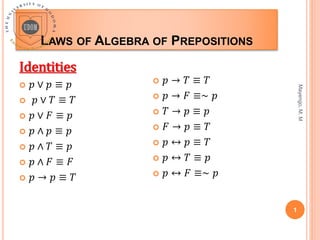
Identities
 𝑝 ∨ 𝑝 ≡ 𝑝
 𝑝 ∨ 𝑇 ≡ 𝑇
 𝑝 ∨ 𝐹 ≡ 𝑝
 𝑝 ∧ 𝑝 ≡ 𝑝
 𝑝 ∧ 𝑇 ≡ 𝑝
 𝑝 ∧ 𝐹 ≡ 𝐹
 𝑝 → 𝑝 ≡ 𝑇
 𝑝 → 𝑇 ≡ 𝑇
 𝑝 → 𝐹 ≡∼ 𝑝
 𝑇 → 𝑝 ≡ 𝑝
 𝐹 → 𝑝 ≡ 𝑇
 𝑝 ↔ 𝑝 ≡ 𝑇
 𝑝 ↔ 𝑇 ≡ 𝑝
 𝑝 ↔ 𝐹 ≡∼ 𝑝
LAWS OF ALGEBRA OF PREPOSITIONS
Mayengo,
M.
M
2
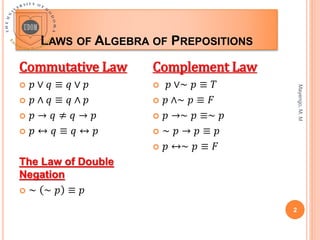
Commutative Law
 𝑝 ∨ 𝑞 ≡ 𝑞 ∨ 𝑝
 𝑝 ∧ 𝑞 ≡ 𝑞 ∧ 𝑝
 𝑝 → 𝑞 ≠ 𝑞 → 𝑝
 𝑝 ↔ 𝑞 ≡ 𝑞 ↔ 𝑝
The Law of Double
Negation
 ∼ ∼ 𝑝 ≡ 𝑝
Complement Law
 𝑝 ∨∼ 𝑝 ≡ 𝑇
 𝑝 ∧∼ 𝑝 ≡ 𝐹
 𝑝 →∼ 𝑝 ≡∼ 𝑝
 ∼ 𝑝 → 𝑝 ≡ 𝑝
 𝑝 ↔∼ 𝑝 ≡ 𝐹
LAWS OF ALGEBRA OF PREPOSITIONS
Mayengo,
M.
M
3
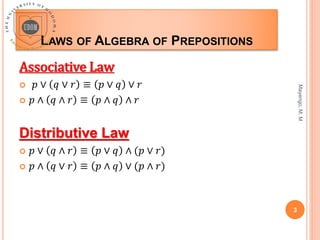
Associative Law
 𝑝 ∨ 𝑞 ∨ 𝑟 ≡ 𝑝 ∨ 𝑞 ∨ 𝑟
 𝑝 ∧ 𝑞 ∧ 𝑟 ≡ 𝑝 ∧ 𝑞 ∧ 𝑟
Distributive Law
 𝑝 ∨ 𝑞 ∧ 𝑟 ≡ 𝑝 ∨ 𝑞 ∧ (𝑝 ∨ 𝑟)
 𝑝 ∧ 𝑞 ∨ 𝑟 ≡ 𝑝 ∧ 𝑞 ∨ (𝑝 ∧ 𝑟)
LAWS OF ALGEBRA OF PREPOSITIONS
Mayengo,
M.
M
4
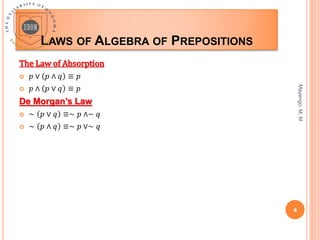
The Law of Absorption
 𝑝 ∨ 𝑝 ∧ 𝑞 ≡ 𝑝
 𝑝 ∧ 𝑝 ∨ 𝑞 ≡ 𝑝
De Morgan’s Law
 ∼ 𝑝 ∨ 𝑞 ≡∼ 𝑝 ∧∼ 𝑞
 ∼ 𝑝 ∧ 𝑞 ≡∼ 𝑝 ∨∼ 𝑞
LAWS OF ALGEBRA OF PREPOSITIONS
Mayengo,
M.
M
5
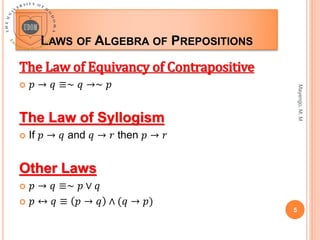
The Law of Equivancy of Contrapositive
 𝑝 → 𝑞 ≡∼ 𝑞 →∼ 𝑝
The Law of Syllogism
 If 𝑝 → 𝑞 and 𝑞 → 𝑟 then 𝑝 → 𝑟
Other Laws
 𝑝 → 𝑞 ≡∼ 𝑝 ∨ 𝑞
 𝑝 ↔ 𝑞 ≡ 𝑝 → 𝑞 ∧ (𝑞 → 𝑝)
TAUTOLOGIES AND CONTRADICTIONS
Mayengo,
M.
M
6
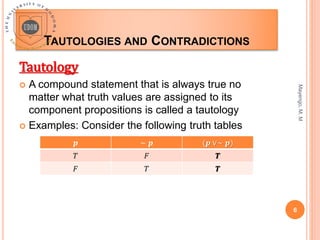
Tautology
 A compound statement that is always true no
matter what truth values are assigned to its
component propositions is called a tautology
 Examples: Consider the following truth tables
𝒑 ∼ 𝒑 (𝒑 ∨∼ 𝒑)
𝑇 𝐹 𝑻
𝐹 𝑇 𝑻
TAUTOLOGIES AND CONTRADICTIONS
Mayengo,
M.
M
7
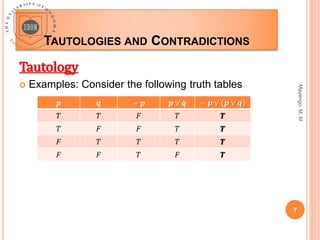
Tautology
 Examples: Consider the following truth tables
𝒑 𝒒 ∼ 𝒑 𝒑 ∨ 𝒒 ∼ 𝒑 ∨ (𝒑 ∨ 𝒒)
𝑇 𝑇 𝐹 𝑇 𝑻
𝑇 𝐹 𝐹 𝑇 𝑻
𝐹 𝑇 𝑇 𝑇 𝑻
𝐹 𝐹 𝑇 𝐹 𝑻
TAUTOLOGIES AND CONTRADICTIONS
Mayengo,
M.
M
8
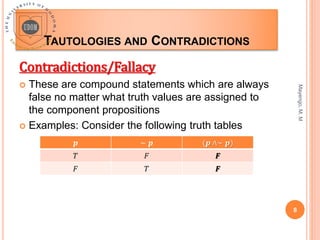
Contradictions/Fallacy
 These are compound statements which are always
false no matter what truth values are assigned to
the component propositions
 Examples: Consider the following truth tables
𝒑 ∼ 𝒑 (𝒑 ∧∼ 𝒑)
𝑇 𝐹 𝑭
𝐹 𝑇 𝑭
TAUTOLOGIES AND CONTRADICTIONS
Mayengo,
M.
M
9
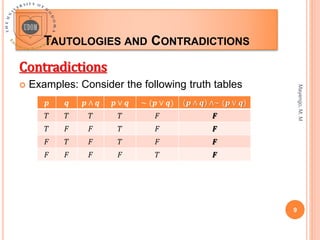
Contradictions
 Examples: Consider the following truth tables
𝒑 𝒒 𝒑 ∧ 𝒒 𝒑 ∨ 𝒒 ∼ (𝒑 ∨ 𝒒) 𝒑 ∧ 𝒒 ∧∼ (𝒑 ∨ 𝒒)
𝑇 𝑇 𝑇 𝑇 𝐹 𝑭
𝑇 𝐹 𝐹 𝑇 𝐹 𝑭
𝐹 𝑇 𝐹 𝑇 𝐹 𝑭
𝐹 𝐹 𝐹 𝐹 𝑇 𝑭
TAUTOLOGIES AND CONTRADICTIONS
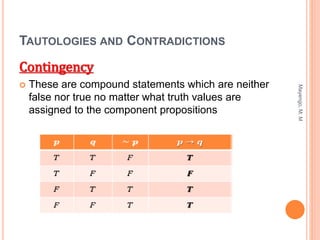
Contingency
 These are compound statements which are neither
false nor true no matter what truth values are
assigned to the component propositions
Mayengo,
M.
M
TAUTOLOGIES AND CONTRADICTIONS
Mayengo,
M.
M
11
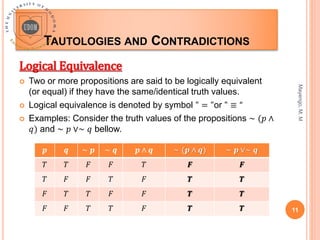
Logical Equivalence
 Two or more propositions are said to be logically equivalent
(or equal) if they have the same/identical truth values.
 Logical equivalence is denoted by symbol " = "or " ≡ “
 Examples: Consider the truth values of the propositions ∼ (𝑝 ∧
𝑞) and ∼ 𝑝 ∨∼ 𝑞 bellow.
𝒑 𝒒 ∼ 𝒑 ∼ 𝒒 𝒑 ∧ 𝒒 ∼ (𝒑 ∧ 𝒒) ∼ 𝒑 ∨∼ 𝒒
𝑇 𝑇 𝐹 𝐹 𝑇 𝑭 𝑭
𝑇 𝐹 𝐹 𝑇 𝐹 𝑻 𝑻
𝐹 𝑇 𝑇 𝐹 𝐹 𝑻 𝑻
𝐹 𝐹 𝑇 𝑇 𝐹 𝑻 𝑻
TAUTOLOGIES AND CONTRADICTIONS
Mayengo,
M.
M
12
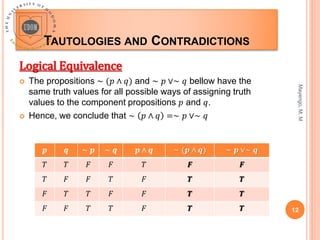
Logical Equivalence
 The propositions ∼ (𝑝 ∧ 𝑞) and ∼ 𝑝 ∨∼ 𝑞 bellow have the
same truth values for all possible ways of assigning truth
values to the component propositions 𝑝 and 𝑞.
 Hence, we conclude that ∼ 𝑝 ∧ 𝑞 =∼ 𝑝 ∨∼ 𝑞
𝒑 𝒒 ∼ 𝒑 ∼ 𝒒 𝒑 ∧ 𝒒 ∼ (𝒑 ∧ 𝒒) ∼ 𝒑 ∨∼ 𝒒
𝑇 𝑇 𝐹 𝐹 𝑇 𝑭 𝑭
𝑇 𝐹 𝐹 𝑇 𝐹 𝑻 𝑻
𝐹 𝑇 𝑇 𝐹 𝐹 𝑻 𝑻
𝐹 𝐹 𝑇 𝑇 𝐹 𝑻 𝑻
TAUTOLOGIES AND CONTRADICTIONS
Mayengo,
M.
M
13
Logical Equivalence
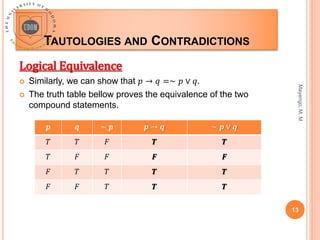
 Similarly, we can show that 𝑝 → 𝑞 =∼ 𝑝 ∨ 𝑞.
 The truth table bellow proves the equivalence of the two
compound statements.
𝒑 𝒒 ∼ 𝒑 𝒑 → 𝒒 ∼ 𝒑 ∨ 𝒒
𝑇 𝑇 𝐹 𝑻 𝑻
𝑇 𝐹 𝐹 𝑭 𝑭
𝐹 𝑇 𝑇 𝑻 𝑻
𝐹 𝐹 𝑇 𝑻 𝑻
QUESTIONS
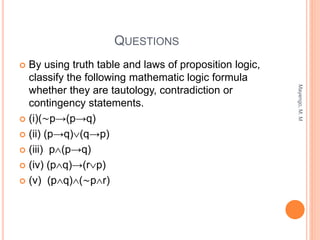
 By using truth table and laws of proposition logic,
classify the following mathematic logic formula
whether they are tautology, contradiction or
contingency statements.
 (i)(∼p→(p→q)
 (ii) (p→q)(q→p)
 (iii) p(p→q)
 (iv) (pq)→(rp)
 (v) (pq)(∼pr)
Mayengo,
M.
M

Tn 110 lecture 2 logic

  • 1.
    LAWS OF ALGEBRAOF PREPOSITIONS Mayengo, M. M 1 Identities  𝑝 ∨ 𝑝 ≡ 𝑝  𝑝 ∨ 𝑇 ≡ 𝑇  𝑝 ∨ 𝐹 ≡ 𝑝  𝑝 ∧ 𝑝 ≡ 𝑝  𝑝 ∧ 𝑇 ≡ 𝑝  𝑝 ∧ 𝐹 ≡ 𝐹  𝑝 → 𝑝 ≡ 𝑇  𝑝 → 𝑇 ≡ 𝑇  𝑝 → 𝐹 ≡∼ 𝑝  𝑇 → 𝑝 ≡ 𝑝  𝐹 → 𝑝 ≡ 𝑇  𝑝 ↔ 𝑝 ≡ 𝑇  𝑝 ↔ 𝑇 ≡ 𝑝  𝑝 ↔ 𝐹 ≡∼ 𝑝
  • 2.
    LAWS OF ALGEBRAOF PREPOSITIONS Mayengo, M. M 2 Commutative Law  𝑝 ∨ 𝑞 ≡ 𝑞 ∨ 𝑝  𝑝 ∧ 𝑞 ≡ 𝑞 ∧ 𝑝  𝑝 → 𝑞 ≠ 𝑞 → 𝑝  𝑝 ↔ 𝑞 ≡ 𝑞 ↔ 𝑝 The Law of Double Negation  ∼ ∼ 𝑝 ≡ 𝑝 Complement Law  𝑝 ∨∼ 𝑝 ≡ 𝑇  𝑝 ∧∼ 𝑝 ≡ 𝐹  𝑝 →∼ 𝑝 ≡∼ 𝑝  ∼ 𝑝 → 𝑝 ≡ 𝑝  𝑝 ↔∼ 𝑝 ≡ 𝐹
  • 3.
    LAWS OF ALGEBRAOF PREPOSITIONS Mayengo, M. M 3 Associative Law  𝑝 ∨ 𝑞 ∨ 𝑟 ≡ 𝑝 ∨ 𝑞 ∨ 𝑟  𝑝 ∧ 𝑞 ∧ 𝑟 ≡ 𝑝 ∧ 𝑞 ∧ 𝑟 Distributive Law  𝑝 ∨ 𝑞 ∧ 𝑟 ≡ 𝑝 ∨ 𝑞 ∧ (𝑝 ∨ 𝑟)  𝑝 ∧ 𝑞 ∨ 𝑟 ≡ 𝑝 ∧ 𝑞 ∨ (𝑝 ∧ 𝑟)
  • 4.
    LAWS OF ALGEBRAOF PREPOSITIONS Mayengo, M. M 4 The Law of Absorption  𝑝 ∨ 𝑝 ∧ 𝑞 ≡ 𝑝  𝑝 ∧ 𝑝 ∨ 𝑞 ≡ 𝑝 De Morgan’s Law  ∼ 𝑝 ∨ 𝑞 ≡∼ 𝑝 ∧∼ 𝑞  ∼ 𝑝 ∧ 𝑞 ≡∼ 𝑝 ∨∼ 𝑞
  • 5.
    LAWS OF ALGEBRAOF PREPOSITIONS Mayengo, M. M 5 The Law of Equivancy of Contrapositive  𝑝 → 𝑞 ≡∼ 𝑞 →∼ 𝑝 The Law of Syllogism  If 𝑝 → 𝑞 and 𝑞 → 𝑟 then 𝑝 → 𝑟 Other Laws  𝑝 → 𝑞 ≡∼ 𝑝 ∨ 𝑞  𝑝 ↔ 𝑞 ≡ 𝑝 → 𝑞 ∧ (𝑞 → 𝑝)
  • 6.
    TAUTOLOGIES AND CONTRADICTIONS Mayengo, M. M 6 Tautology A compound statement that is always true no matter what truth values are assigned to its component propositions is called a tautology  Examples: Consider the following truth tables 𝒑 ∼ 𝒑 (𝒑 ∨∼ 𝒑) 𝑇 𝐹 𝑻 𝐹 𝑇 𝑻
  • 7.
    TAUTOLOGIES AND CONTRADICTIONS Mayengo, M. M 7 Tautology Examples: Consider the following truth tables 𝒑 𝒒 ∼ 𝒑 𝒑 ∨ 𝒒 ∼ 𝒑 ∨ (𝒑 ∨ 𝒒) 𝑇 𝑇 𝐹 𝑇 𝑻 𝑇 𝐹 𝐹 𝑇 𝑻 𝐹 𝑇 𝑇 𝑇 𝑻 𝐹 𝐹 𝑇 𝐹 𝑻
  • 8.
    TAUTOLOGIES AND CONTRADICTIONS Mayengo, M. M 8 Contradictions/Fallacy These are compound statements which are always false no matter what truth values are assigned to the component propositions  Examples: Consider the following truth tables 𝒑 ∼ 𝒑 (𝒑 ∧∼ 𝒑) 𝑇 𝐹 𝑭 𝐹 𝑇 𝑭
  • 9.
    TAUTOLOGIES AND CONTRADICTIONS Mayengo, M. M 9 Contradictions Examples: Consider the following truth tables 𝒑 𝒒 𝒑 ∧ 𝒒 𝒑 ∨ 𝒒 ∼ (𝒑 ∨ 𝒒) 𝒑 ∧ 𝒒 ∧∼ (𝒑 ∨ 𝒒) 𝑇 𝑇 𝑇 𝑇 𝐹 𝑭 𝑇 𝐹 𝐹 𝑇 𝐹 𝑭 𝐹 𝑇 𝐹 𝑇 𝐹 𝑭 𝐹 𝐹 𝐹 𝐹 𝑇 𝑭
  • 10.
    TAUTOLOGIES AND CONTRADICTIONS Contingency These are compound statements which are neither false nor true no matter what truth values are assigned to the component propositions Mayengo, M. M
  • 11.
    TAUTOLOGIES AND CONTRADICTIONS Mayengo, M. M 11 LogicalEquivalence  Two or more propositions are said to be logically equivalent (or equal) if they have the same/identical truth values.  Logical equivalence is denoted by symbol " = "or " ≡ “  Examples: Consider the truth values of the propositions ∼ (𝑝 ∧ 𝑞) and ∼ 𝑝 ∨∼ 𝑞 bellow. 𝒑 𝒒 ∼ 𝒑 ∼ 𝒒 𝒑 ∧ 𝒒 ∼ (𝒑 ∧ 𝒒) ∼ 𝒑 ∨∼ 𝒒 𝑇 𝑇 𝐹 𝐹 𝑇 𝑭 𝑭 𝑇 𝐹 𝐹 𝑇 𝐹 𝑻 𝑻 𝐹 𝑇 𝑇 𝐹 𝐹 𝑻 𝑻 𝐹 𝐹 𝑇 𝑇 𝐹 𝑻 𝑻
  • 12.
    TAUTOLOGIES AND CONTRADICTIONS Mayengo, M. M 12 LogicalEquivalence  The propositions ∼ (𝑝 ∧ 𝑞) and ∼ 𝑝 ∨∼ 𝑞 bellow have the same truth values for all possible ways of assigning truth values to the component propositions 𝑝 and 𝑞.  Hence, we conclude that ∼ 𝑝 ∧ 𝑞 =∼ 𝑝 ∨∼ 𝑞 𝒑 𝒒 ∼ 𝒑 ∼ 𝒒 𝒑 ∧ 𝒒 ∼ (𝒑 ∧ 𝒒) ∼ 𝒑 ∨∼ 𝒒 𝑇 𝑇 𝐹 𝐹 𝑇 𝑭 𝑭 𝑇 𝐹 𝐹 𝑇 𝐹 𝑻 𝑻 𝐹 𝑇 𝑇 𝐹 𝐹 𝑻 𝑻 𝐹 𝐹 𝑇 𝑇 𝐹 𝑻 𝑻
  • 13.
    TAUTOLOGIES AND CONTRADICTIONS Mayengo, M. M 13 LogicalEquivalence  Similarly, we can show that 𝑝 → 𝑞 =∼ 𝑝 ∨ 𝑞.  The truth table bellow proves the equivalence of the two compound statements. 𝒑 𝒒 ∼ 𝒑 𝒑 → 𝒒 ∼ 𝒑 ∨ 𝒒 𝑇 𝑇 𝐹 𝑻 𝑻 𝑇 𝐹 𝐹 𝑭 𝑭 𝐹 𝑇 𝑇 𝑻 𝑻 𝐹 𝐹 𝑇 𝑻 𝑻
  • 14.
    QUESTIONS  By usingtruth table and laws of proposition logic, classify the following mathematic logic formula whether they are tautology, contradiction or contingency statements.  (i)(∼p→(p→q)  (ii) (p→q)(q→p)  (iii) p(p→q)  (iv) (pq)→(rp)  (v) (pq)(∼pr) Mayengo, M. M