A Need To Specify and Verify
Standard Functions
Nikolay Shilov
A.P. Ershov Institute of Informatics
Systems (Novosibirsk, Russia)
=4 BACAUSE OF RAND()
Part 1
11/13/2015 2N.Shilov -TMPA-2015 talk
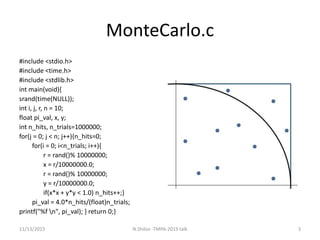
MonteCarlo.c
#include <stdio.h>
#include <time.h>
#include <stdlib.h>
int main(void){
srand(time(NULL));
int i, j, r, n = 10;
float pi_val, x, y;
int n_hits, n_trials=1000000;
for(j = 0; j < n; j++){n_hits=0;
for(i = 0; i<n_trials; i++){
r = rand()% 10000000;
x = r/10000000.0;
r = rand()% 10000000;
y = r/10000000.0;
if(x*x + y*y < 1.0) n_hits++;}
pi_val = 4.0*n_hits/(float)n_trials;
printf("%f n", pi_val); } return 0;}
11/13/2015 3N.Shilov -TMPA-2015 talk
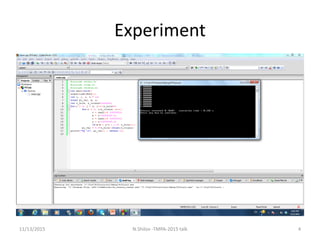
Experiment
11/13/2015 4N.Shilov -TMPA-2015 talk
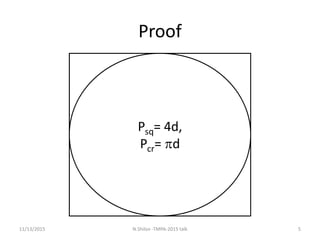
Proof
Psq= 4d,
Pcr= d
11/13/2015 5N.Shilov -TMPA-2015 talk
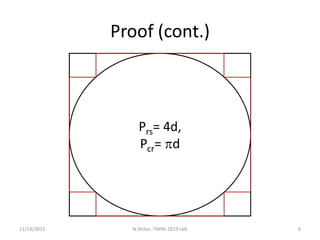
Proof (cont.)
Prs= 4d,
Pcr= d
11/13/2015 6N.Shilov -TMPA-2015 talk
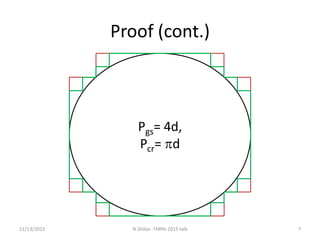
Proof (cont.)
Pgs= 4d,
Pcr= d
11/13/2015 7N.Shilov -TMPA-2015 talk
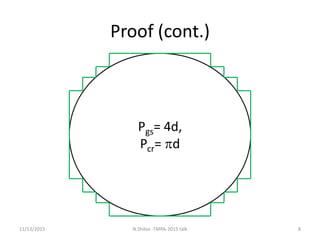
Proof (cont.)
Pgs= 4d,
Pcr= d
11/13/2015 8N.Shilov -TMPA-2015 talk
Proof (cont.)
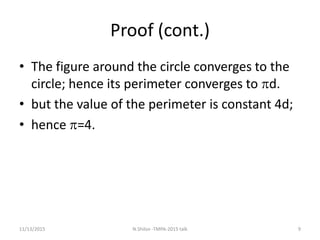
• The figure around the circle converges to the
circle; hence its perimeter converges to d.
• but the value of the perimeter is constant 4d;
• hence =4.
11/13/2015 9N.Shilov -TMPA-2015 talk
Formal Methods as a Rescue
• Let us specify the program in Hoare style by
pre- and post-conditions. The pre-condition
may be TRUE since the program has no input.
• The post-condition may be pi_val==4.0, but
since the real program works with floating
point values, it makes sense relax the post-
condition a little bit.
• Due to the exercise we may hope that
╞[TRUE] PiMC [3.9<=pi_val<=4.1].
11/13/2015 10N.Shilov -TMPA-2015 talk
Formal Methods as a Rescue
• But if we try to apply Floyd-Hoare methodic to
generate verification conditions and prove the
assertion then we encounter a problem of
formal semantics of the function rand() in
the assignment
r = rand()% 10000000;
that has 2 instances in the program.
11/13/2015 11N.Shilov -TMPA-2015 talk
Formal Methods as a Rescue
• The standard rule to generate verification
condition for assignment reads
(x)(t)
;
[(x)] x=t [(x)]
• for function rand()it leads to
(x)(rand())
.
[(x)] x=rand() [(x)]
11/13/2015 12N.Shilov -TMPA-2015 talk
What is rand()?!
(C reference. Rand. http://en.cppreference.com/w/c/numeric/random/rand.)
Parameters
(none)
Return value
Pseudo-random integral value between ​0​ and RAND_MAX,
inclusive.
Notes
There are no guarantees as to the quality of the random
sequence produced. …
POSIX requires that the period of the pseudo-random number
generator used by rand is at least 232
POSIX offered a thread-safe version of rand called rand_r, which
is obsolete in favor of the drand48 family of functions.
11/13/2015 13N.Shilov -TMPA-2015 talk
WHAT IS SQRT?
Part II
11/13/2015 14N.Shilov -TMPA-2015 talk
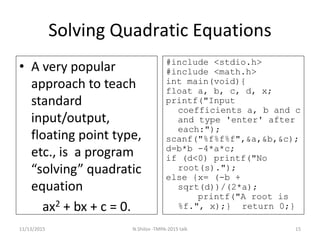
Solving Quadratic Equations
• A very popular
approach to teach
standard
input/output,
floating point type,
etc., is a program
“solving” quadratic
equation
ax2 + bx + c = 0.
#include <stdio.h>
#include <math.h>
int main(void){
float a, b, c, d, x;
printf("Input
coefficients a, b and c
and type 'enter' after
each:");
scanf("%f%f%f",&a,&b,&c);
d=b*b -4*a*c;
if (d<0) printf("No
root(s).");
else {x= (-b +
sqrt(d))/(2*a);
printf("A root is
%f.", x);} return 0;}
11/13/2015 15N.Shilov -TMPA-2015 talk
Solving Quadratic Equations
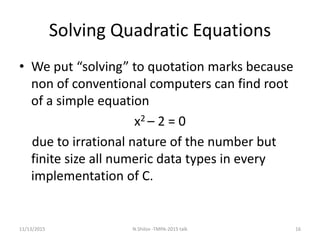
• We put “solving” to quotation marks because
non of conventional computers can find root
of a simple equation
x2 – 2 = 0
due to irrational nature of the number but
finite size all numeric data types in every
implementation of C.
11/13/2015 16N.Shilov -TMPA-2015 talk
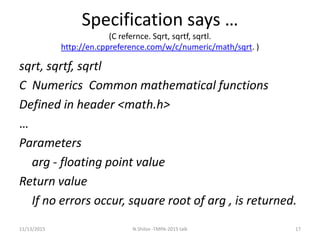
Specification says …
(C refernce. Sqrt, sqrtf, sqrtl.
http://en.cppreference.com/w/c/numeric/math/sqrt. )
sqrt, sqrtf, sqrtl
C Numerics Common mathematical functions
Defined in header <math.h>
…
Parameters
arg - floating point value
Return value
If no errors occur, square root of arg , is returned.
11/13/2015 17N.Shilov -TMPA-2015 talk
Alternatives for sqrt
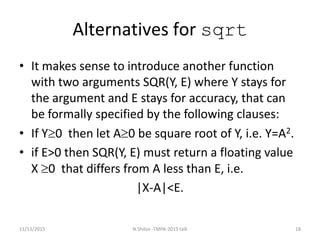
• It makes sense to introduce another function
with two arguments SQR(Y, E) where Y stays for
the argument and E stays for accuracy, that can
be formally specified by the following clauses:
• If Y0 then let A0 be square root of Y, i.e. Y=A2.
• if E>0 then SQR(Y, E) must return a floating value
X 0 that differs from A less than E, i.e.
|X-A|<E.
11/13/2015 18N.Shilov -TMPA-2015 talk
(NOT YET A ) CONCLUSION
Part III
11/13/2015 N.Shilov -TMPA-2015 talk 19
(Not yet a ) Conclusion
• A need of better specification and validation
of standard functions is well-recognized by
industrial and academic professional
community as well as the problem of
conformance of their implementation with the
specification
11/13/2015 20N.Shilov -TMPA-2015 talk
(Not yet a ) Conclusion
• J. Harrison, Formal Verification of Square Root Algorithms. Formal
Methods in System Design, 2003, Vol.22(2), p.143-153.
• V. Kuliamin, Standardization and Testing of Mathematical Functions
Programming and Computer Software, 2007, Vol. 33 (3), p.154-173.
• V.V. Kuliamin, Standardization and Testing of Mathematical
Functions in floating point numbers. Proceedings of Int. Conf.
Perspectives of Systems Informatics PSI-2009. Lecture Notes in
Computer Science, 2010, Vol. 5947, p. 257-268.
• A.V. Promsky, C Program Verification: Verification Condition
Explanation and Standard Library. Automatic Control and Computer
Sciences, 2012, Vol. 46, No. 7, p. 394–401.
• A.V. Promsky, Experiments on self-applicability in the C-light
verification system. Bull. Nov.Comp. Center, Comp. Science, Vol.35,
2013, p.85-99.
11/13/2015 21N.Shilov -TMPA-2015 talk
(Not yet a ) Conclusion
• A very serious obstacle for formal verification
of standard mathematical functions is a need
of axiomatization of floating point arithmetic.
• Maybe interval analysis approach and
formalization of interval arithmetic may help
to tackle the problem for functions like sqrt
(but not for functions like rand).
11/13/2015 22N.Shilov -TMPA-2015 talk

TMPA-2015: A Need To Specify and Verify Standard Functions

  • 1.
    A Need ToSpecify and Verify Standard Functions Nikolay Shilov A.P. Ershov Institute of Informatics Systems (Novosibirsk, Russia)
  • 2.
    =4 BACAUSE OFRAND() Part 1 11/13/2015 2N.Shilov -TMPA-2015 talk
  • 3.
    MonteCarlo.c #include <stdio.h> #include <time.h> #include<stdlib.h> int main(void){ srand(time(NULL)); int i, j, r, n = 10; float pi_val, x, y; int n_hits, n_trials=1000000; for(j = 0; j < n; j++){n_hits=0; for(i = 0; i<n_trials; i++){ r = rand()% 10000000; x = r/10000000.0; r = rand()% 10000000; y = r/10000000.0; if(x*x + y*y < 1.0) n_hits++;} pi_val = 4.0*n_hits/(float)n_trials; printf("%f n", pi_val); } return 0;} 11/13/2015 3N.Shilov -TMPA-2015 talk
  • 4.
  • 5.
    Proof Psq= 4d, Pcr= d 11/13/20155N.Shilov -TMPA-2015 talk
  • 6.
    Proof (cont.) Prs= 4d, Pcr=d 11/13/2015 6N.Shilov -TMPA-2015 talk
  • 7.
    Proof (cont.) Pgs= 4d, Pcr=d 11/13/2015 7N.Shilov -TMPA-2015 talk
  • 8.
    Proof (cont.) Pgs= 4d, Pcr=d 11/13/2015 8N.Shilov -TMPA-2015 talk
  • 9.
    Proof (cont.) • Thefigure around the circle converges to the circle; hence its perimeter converges to d. • but the value of the perimeter is constant 4d; • hence =4. 11/13/2015 9N.Shilov -TMPA-2015 talk
  • 10.
    Formal Methods asa Rescue • Let us specify the program in Hoare style by pre- and post-conditions. The pre-condition may be TRUE since the program has no input. • The post-condition may be pi_val==4.0, but since the real program works with floating point values, it makes sense relax the post- condition a little bit. • Due to the exercise we may hope that ╞[TRUE] PiMC [3.9<=pi_val<=4.1]. 11/13/2015 10N.Shilov -TMPA-2015 talk
  • 11.
    Formal Methods asa Rescue • But if we try to apply Floyd-Hoare methodic to generate verification conditions and prove the assertion then we encounter a problem of formal semantics of the function rand() in the assignment r = rand()% 10000000; that has 2 instances in the program. 11/13/2015 11N.Shilov -TMPA-2015 talk
  • 12.
    Formal Methods asa Rescue • The standard rule to generate verification condition for assignment reads (x)(t) ; [(x)] x=t [(x)] • for function rand()it leads to (x)(rand()) . [(x)] x=rand() [(x)] 11/13/2015 12N.Shilov -TMPA-2015 talk
  • 13.
    What is rand()?! (Creference. Rand. http://en.cppreference.com/w/c/numeric/random/rand.) Parameters (none) Return value Pseudo-random integral value between ​0​ and RAND_MAX, inclusive. Notes There are no guarantees as to the quality of the random sequence produced. … POSIX requires that the period of the pseudo-random number generator used by rand is at least 232 POSIX offered a thread-safe version of rand called rand_r, which is obsolete in favor of the drand48 family of functions. 11/13/2015 13N.Shilov -TMPA-2015 talk
  • 14.
    WHAT IS SQRT? PartII 11/13/2015 14N.Shilov -TMPA-2015 talk
  • 15.
    Solving Quadratic Equations •A very popular approach to teach standard input/output, floating point type, etc., is a program “solving” quadratic equation ax2 + bx + c = 0. #include <stdio.h> #include <math.h> int main(void){ float a, b, c, d, x; printf("Input coefficients a, b and c and type 'enter' after each:"); scanf("%f%f%f",&a,&b,&c); d=b*b -4*a*c; if (d<0) printf("No root(s)."); else {x= (-b + sqrt(d))/(2*a); printf("A root is %f.", x);} return 0;} 11/13/2015 15N.Shilov -TMPA-2015 talk
  • 16.
    Solving Quadratic Equations •We put “solving” to quotation marks because non of conventional computers can find root of a simple equation x2 – 2 = 0 due to irrational nature of the number but finite size all numeric data types in every implementation of C. 11/13/2015 16N.Shilov -TMPA-2015 talk
  • 17.
    Specification says … (Crefernce. Sqrt, sqrtf, sqrtl. http://en.cppreference.com/w/c/numeric/math/sqrt. ) sqrt, sqrtf, sqrtl C Numerics Common mathematical functions Defined in header <math.h> … Parameters arg - floating point value Return value If no errors occur, square root of arg , is returned. 11/13/2015 17N.Shilov -TMPA-2015 talk
  • 18.
    Alternatives for sqrt •It makes sense to introduce another function with two arguments SQR(Y, E) where Y stays for the argument and E stays for accuracy, that can be formally specified by the following clauses: • If Y0 then let A0 be square root of Y, i.e. Y=A2. • if E>0 then SQR(Y, E) must return a floating value X 0 that differs from A less than E, i.e. |X-A|<E. 11/13/2015 18N.Shilov -TMPA-2015 talk
  • 19.
    (NOT YET A) CONCLUSION Part III 11/13/2015 N.Shilov -TMPA-2015 talk 19
  • 20.
    (Not yet a) Conclusion • A need of better specification and validation of standard functions is well-recognized by industrial and academic professional community as well as the problem of conformance of their implementation with the specification 11/13/2015 20N.Shilov -TMPA-2015 talk
  • 21.
    (Not yet a) Conclusion • J. Harrison, Formal Verification of Square Root Algorithms. Formal Methods in System Design, 2003, Vol.22(2), p.143-153. • V. Kuliamin, Standardization and Testing of Mathematical Functions Programming and Computer Software, 2007, Vol. 33 (3), p.154-173. • V.V. Kuliamin, Standardization and Testing of Mathematical Functions in floating point numbers. Proceedings of Int. Conf. Perspectives of Systems Informatics PSI-2009. Lecture Notes in Computer Science, 2010, Vol. 5947, p. 257-268. • A.V. Promsky, C Program Verification: Verification Condition Explanation and Standard Library. Automatic Control and Computer Sciences, 2012, Vol. 46, No. 7, p. 394–401. • A.V. Promsky, Experiments on self-applicability in the C-light verification system. Bull. Nov.Comp. Center, Comp. Science, Vol.35, 2013, p.85-99. 11/13/2015 21N.Shilov -TMPA-2015 talk
  • 22.
    (Not yet a) Conclusion • A very serious obstacle for formal verification of standard mathematical functions is a need of axiomatization of floating point arithmetic. • Maybe interval analysis approach and formalization of interval arithmetic may help to tackle the problem for functions like sqrt (but not for functions like rand). 11/13/2015 22N.Shilov -TMPA-2015 talk