TMPA-2015-Keynote - Part:
1 / 157
Prove it !
This is not an
Antonov !
Nicolas Guelfi- Wednesday 11th November, 2015 (23:06) - University of Luxembourg, LU
TMPA-2015-Keynote - Part:
2 / 157
My Name is
Guelfi !
Nicolas Guelfi
Software Engineering Education
The MessirApproach
TMPA-2015
(Invited Talk)
Nicolas Guelfi- Wednesday 11th November, 2015 (23:06) - University of Luxembourg, LU
TMPA-2015-Keynote - Part:
Presentation Parts
3 / 157
1: Warning ! (slide 4)
2: Software Engineering Education (slide 10)
3: An Experimental Remedy (slide 52)
4: Illustration: The iCrash Messep Variant (slide 64)
5: Conclusion (slide 139)
Nicolas Guelfi- Wednesday 11th November, 2015 (23:06) - University of Luxembourg, LU
TMPA-2015-Keynote - Part: Warning !
Part I
Warning !
4 / 157
Nicolas Guelfi- Wednesday 11th November, 2015 (23:06) - University of Luxembourg, LU
TMPA-2015-Keynote - Part: Warning !
5 / 157
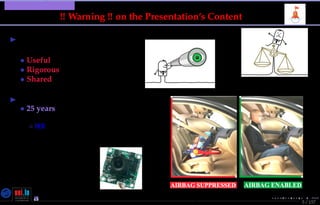
!! Warning !! on the Presentation’s Content
Pragmatism & Objectivism
• Useful, scalable but not universal
• Rigorous but mostly empirical
• Shared by some but not all
Based on Experience ...including:
• 25 years in education and knowledge
transfer (bachelor, master, doctorate,
post-doctorate)
• 8 years as Software Engineering expert
at Court of Justice for conformance
questions
• 400 trainees in the SE industry
managed at bachelor and master levels
Nicolas Guelfi- Wednesday 11th November, 2015 (23:06) - University of Luxembourg, LU
TMPA-2015-Keynote - Part: Warning !
5 / 157
!! Warning !! on the Presentation’s Content
Pragmatism & Objectivism
• Useful, scalable but not universal
• Rigorous but mostly empirical
• Shared by some but not all
Based on Experience ...including:
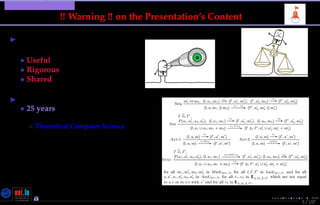
• 25 years in theoretical and applied
research
◦ IEE
Efficient Verification of Occupants
Classification System
Nicolas Guelfi- Wednesday 11th November, 2015 (23:06) - University of Luxembourg, LU
TMPA-2015-Keynote - Part: Warning !
5 / 157
!! Warning !! on the Presentation’s Content
Pragmatism & Objectivism
• Useful, scalable but not universal
• Rigorous but mostly empirical
• Shared by some but not all
Based on Experience ...including:
• 25 years in theoretical and applied
research
◦ Dassault Aviation - (Rafale)
Fault Tolerant Embedded System for
Outside Temperature Monitoring
Nicolas Guelfi- Wednesday 11th November, 2015 (23:06) - University of Luxembourg, LU
TMPA-2015-Keynote - Part: Warning !
5 / 157
!! Warning !! on the Presentation’s Content
Pragmatism & Objectivism
• Useful, scalable but not universal
• Rigorous but mostly empirical
• Shared by some but not all
Based on Experience ...including:
• 25 years in theoretical and applied
research
◦ Theoretical Computer Science
Algebraic theories applied to the
mathematical modeling of concurrent
processes with advanced data structures
Nicolas Guelfi- Wednesday 11th November, 2015 (23:06) - University of Luxembourg, LU
TMPA-2015-Keynote - Part: Warning !
5 / 157
!! Warning !! on the Presentation’s Content
Pragmatism & Objectivism
• Useful, scalable but not universal
• Rigorous but mostly empirical
• Shared by some but not all
Based on Experience ...including:
• 25 years in theoretical and applied
research
◦ Software Engineering & Dependable
Systems
European & National Research Projects,
Excellence networks
SERENE
(http://www.ercim.eu/activity/workgroup)
Nicolas Guelfi- Wednesday 11th November, 2015 (23:06) - University of Luxembourg, LU
TMPA-2015-Keynote - Part: Software Engineering Education
Part II
Software Engineering Education
6 / 157
Nicolas Guelfi- Wednesday 11th November, 2015 (23:06) - University of Luxembourg, LU
TMPA-2015-Keynote - Part: Software Engineering Education
Introductory Quotes
7 / 157
Software Engineering Definition
The application of a systematic, disciplined,
quantifiable approach to the development,
operation, and maintenance of software.
(IEEE in [IEEE(1990)])
Nicolas Guelfi- Wednesday 11th November, 2015 (23:06) - University of Luxembourg, LU
TMPA-2015-Keynote - Part: Software Engineering Education
Introductory Quotes
8 / 157
Software Engineering Definition
Software engineering is the part of computer
science which is too difficult for the computer
scientist.
(Friedrich Bauer [Bauer(1971), 71])
Nicolas Guelfi- Wednesday 11th November, 2015 (23:06) - University of Luxembourg, LU
TMPA-2015-Keynote - Part: Software Engineering Education
Introductory Quotes
9 / 157
Software Engineering Education
Today, the majority of Engineers understand very little of the “science of programming”. On
the other side, the scientists who study programming understand very little about what it
means to be an Engineer ...the two fields have much to learn from each other and that the
marriage of software and Engineering should be consummated.
(David Lorge Parnas in [Parnas(1997)])
Prove it !This is not an
Antonov !
Nicolas Guelfi- Wednesday 11th November, 2015 (23:06) - University of Luxembourg, LU
TMPA-2015-Keynote - Part: Software Engineering Education
Introductory Quotes
10 / 157
Software Engineering Education
Is it possible to have software engineers in the numbers in
which we need them, without formal software engineering
education ?
(A.J. Perlis in [Naur and Randell(1969), 68])
Nicolas Guelfi- Wednesday 11th November, 2015 (23:06) - University of Luxembourg, LU
TMPA-2015-Keynote - Part: Software Engineering Education
Do We Need SE Education ?
11 / 157
Do We (Really) Need
Software Engineering
Education ?
Nicolas Guelfi- Wednesday 11th November, 2015 (23:06) - University of Luxembourg, LU
TMPA-2015-Keynote - Part: Software Engineering Education
Do We Need SE Education ?
12 / 157
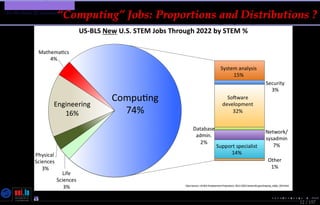
“Computing” Jobs: Proportions and Distributions ?
(Science, Technology, Engineering and Mathematics)
Nicolas Guelfi- Wednesday 11th November, 2015 (23:06) - University of Luxembourg, LU
TMPA-2015-Keynote - Part: Software Engineering Education
Do We Need SE Education ?
13 / 157
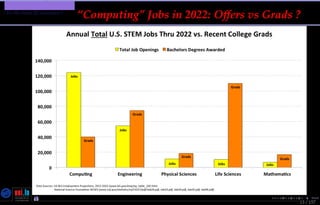
“Computing” Jobs in 2022: Offers vs Grads ?
Nicolas Guelfi- Wednesday 11th November, 2015 (23:06) - University of Luxembourg, LU
TMPA-2015-Keynote - Part: Software Engineering Education
What About SE in Industry ?
14 / 157
What about
SE in Industry ?
(conjectures only !!)
Nicolas Guelfi- Wednesday 11th November, 2015 (23:06) - University of Luxembourg, LU
TMPA-2015-Keynote - Part: Software Engineering Education
What About SE in Industry ?
15 / 157
Capability Maturity Model
CMM [Paulk(1993)] and CMMI-DEV [SEI(2010)]
• can be used as an observation tool
• provides a subjective and relative evaluation of the
Software Engineering practice in industry.
Nicolas Guelfi- Wednesday 11th November, 2015 (23:06) - University of Luxembourg, LU
TMPA-2015-Keynote - Part: Software Engineering Education
What About SE in Industry ?
16 / 157
CCMI-DEV - Capability Maturity Model Integration for
Development
State of practice in industry [Bollinger and McGowan(2009)]
Level 1 - Initial
Level 2 - Repeatable
Level 3 - Defined
Level 4 - Managed
Level 5 - Optimizing
0 10 20 30 40 50 60 70 80 90 100
Level 1
Level 2
Level 3
Level 4
Level 5
51.2
24.8
17.4
5.4
1.2
Percentage (%)
Nicolas Guelfi- Wednesday 11th November, 2015 (23:06) - University of Luxembourg, LU
TMPA-2015-Keynote - Part: Software Engineering Education
What About SE in Industry ?
17 / 157
Agile Software Development - [Beck and al.(2001)]
Represents a “Software Engineering success story”
for the mass
• realistic w.r.t. SE maturity (theories, methods and tools)
• realistic w.r.t. ICT project’s budgets
Mainly focused on project management and
development life cycle
• iterative and incremental design and development
Promotes directly some SE areas
1. Software Construction
2. Software Testing
3. Software Engineering Management
4. Software Engineering Process
5. Software Quality
6. Software Engineering Professional Practice
Nicolas Guelfi- Wednesday 11th November, 2015 (23:06) - University of Luxembourg, LU
TMPA-2015-Keynote - Part: Software Engineering Education
What About SE in Industry ?
18 / 157
Agile in Industry - [Stavru(2014)]
[Rodríguez and al.(2012)]
[VersionOne(2012)]
0 20 40 60 80 100
VersionOne
Rodriguez and al.
20
44.8
80
55.2
Rate of Agile in
Method Prone Projects (%)
No Agile
Agile
Nicolas Guelfi- Wednesday 11th November, 2015 (23:06) - University of Luxembourg, LU
TMPA-2015-Keynote - Part: Software Engineering Education
What About SE in Industry ?
19 / 157
Agile Methodologies Used - [VersionOne(2015)]
0 20 40 60 80 100
Scrum
Scrum & XP hybrid
Custom Hybrid
Scrumban
Kanban
Iterative Dev.
Agile Modeling
Feature Driven Dev.
AgileUP
XP
56
10
8
6
6
4
1
1
0.5
0.5
Percentage (%)
Nicolas Guelfi- Wednesday 11th November, 2015 (23:06) - University of Luxembourg, LU
TMPA-2015-Keynote - Part: Software Engineering Education
What About SE in Industry ?
20 / 157
Agile Project Management Tools Used
[VersionOne(2015)]
Nicolas Guelfi- Wednesday 11th November, 2015 (23:06) - University of Luxembourg, LU
TMPA-2015-Keynote - Part: Software Engineering Education
What About SE in Industry ?
21 / 157
Model Driven Engineering Practice in industry
[Hutchinson et al.(2011)Hutchinson, Whittle, Rouncefield, and Kristoffersen]
250 questionnaire answers from MDE practitioners
22 in-depth interviews of MDE professionals from 17
different companies
on-site observational studies with companies
practicing MDE
Nicolas Guelfi- Wednesday 11th November, 2015 (23:06) - University of Luxembourg, LU
TMPA-2015-Keynote - Part: Software Engineering Education
What About SE in Industry ?
0 10 20 30 40 50 60 70 80 90 100
make use of UML
use a DSL of their own design
use a DSL provided by a tool
use BPMN
use SysML and MATLAB/Simulink
85
40
25
25
10
Percentage (%)
22 / 157
Model Driven Engineering Practice in industry
[Hutchinson et al.(2011)Hutchinson, Whittle, Rouncefield, and Kristoffersen]
Nicolas Guelfi- Wednesday 11th November, 2015 (23:06) - University of Luxembourg, LU
TMPA-2015-Keynote - Part: Software Engineering Education
What About SE in Industry ?
23 / 157
Model Driven Engineering Practice in industry
[Hutchinson et al.(2011)Hutchinson, Whittle, Rouncefield, and Kristoffersen]
0 20 40 60 80 100
Class Diagram
Activity Diagram
Use Case Diagram
Sequence Diagram
State Machine Diagram
DSL Diagram
Component Diagram
Flow Diagram
Entity Relationship Diagram
Deployment Diagram
Object Diagram
Composite Structure Diagram
87
56
38
33
23
8
8
5
3
3
2
2
Percentage (%)
35 diagram types cited
inclusion min threshold of 2
diagrams below the threshold:
Abstract Syntax Graphs, Arrow
Diagrams, UsiXML Stylistics and
ICONIX Robustness Diagrams,...
Nicolas Guelfi- Wednesday 11th November, 2015 (23:06) - University of Luxembourg, LU
TMPA-2015-Keynote - Part: Software Engineering Education
What About SE in Industry ?
0 20 40 60 80 100
Use of models for team communication
Use of models for understanding a problem at an abstract level
Code generation
Use of models to capture and document designs
Use of model-to-model transformations
Use of domain-specific languages (DSLs)
Model simulation - Executable models
Use of models in testing
Percentage (%)
Productivity Impact
Maintainability Impact
24 / 157
Model Driven Engineering Practice in industry
[Hutchinson et al.(2011)Hutchinson, Whittle, Rouncefield, and Kristoffersen]
Nicolas Guelfi- Wednesday 11th November, 2015 (23:06) - University of Luxembourg, LU
TMPA-2015-Keynote - Part: Software Engineering Education
Status of SE Education ?
25 / 157
What is the status of
Software Engineering
Education ?
Nicolas Guelfi- Wednesday 11th November, 2015 (23:06) - University of Luxembourg, LU
TMPA-2015-Keynote - Part: Software Engineering Education
Status of SE Education ?
26 / 157
Software Engineering Education Main Dates
1968 · · · · · ·• NATO conference [Naur and Randell(1969)]
1976 · · · · · ·• Workshop on Software Engineering Education
1978 · · · · · ·• Subcommittee on Model Curricula in SE (SMCSE)
1989 · · · · · ·• SEI Graduate Curriculum report
1990 · · · · · ·• N. Guelfi first SE lecture !
1993 · · · · · ·• IEEE CS/ACM Joint Steering Committee
1998 · · · · · ·• SE Coordinating Committee (SWECC)
1999 · · · · · ·• SE Code of Ethics & Professional Practice
2004 · · · · · ·• SE2004 Undergraduate Curriculum Report
2005 · · · · · ·• SWEBOK Certified [ISO/IEC(2005)]
2009 · · · · · ·• Graduate Software Engineering 2009 (GSwE2009 published)
2013 · · · · · ·• CS2013 Undergraduate Curriculum - submitted [Sahami and Roach(2014)]
2014 · · · · · ·• SE2014 Undergraduate Curriculum - submitted [ACM/IEEE(2015)]
2014 · · · · · ·• SWEBOK submitted for recognition [ISO/IEC(2014)]
Nicolas Guelfi- Wednesday 11th November, 2015 (23:06) - University of Luxembourg, LU
TMPA-2015-Keynote - Part: Software Engineering Education
SE Body of Knowledge ?
27 / 157
What is the
Software Engineering
Body of Knowledge ?
Nicolas Guelfi- Wednesday 11th November, 2015 (23:06) - University of Luxembourg, LU
TMPA-2015-Keynote - Part: Software Engineering Education
SE Body of Knowledge ?
28 / 157
SWEBOK IEEE/ISO Standard
[ISO/IEC(2005)],[ISO/IEC(2014)]
SE knowledge decomposed in:
• 15 Knowledge Areas
• 99 Topics
• 394 Sub-topics
Nicolas Guelfi- Wednesday 11th November, 2015 (23:06) - University of Luxembourg, LU
TMPA-2015-Keynote - Part: Software Engineering Education
SE Body of Knowledge ?
29 / 157
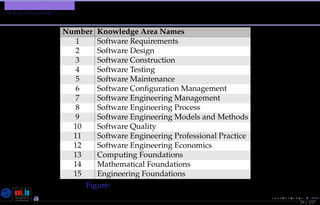
Number Knowledge Area Names
1 Software Requirements
2 Software Design
3 Software Construction
4 Software Testing
5 Software Maintenance
6 Software Configuration Management
7 Software Engineering Management
8 Software Engineering Process
9 Software Engineering Models and Methods
10 Software Quality
11 Software Engineering Professional Practice
12 Software Engineering Economics
13 Computing Foundations
14 Mathematical Foundations
15 Engineering Foundations
Figure: SWEBOK Knowledge Areas
Nicolas Guelfi- Wednesday 11th November, 2015 (23:06) - University of Luxembourg, LU
TMPA-2015-Keynote - Part: Software Engineering Education
SE Body of Knowledge ?
30 / 157
Number Topic Names
1 Modeling
2 Types of Models
3 Analysis of Models
4 Software Engineering Methods
Figure: SWEBOK topics for (9) Software
Engineering Models and Methods
Number SubTopic Names
1 Modeling Principles
2 Properties and Expression of Models
3 Syntax, Semantics, and Pragmatics
4 Preconditions, Postconditions, and Invariants
Figure: SWEBOK topics for (9.1) Modeling
Number SubTopic Names
1 Heuristic Methods
2 Formal Methods
3 Prototyping Methods
4 Agile Methods
Figure: SWEBOK topics for (9.4) Software
Engineering Methods
Nicolas Guelfi- Wednesday 11th November, 2015 (23:06) - University of Luxembourg, LU
TMPA-2015-Keynote - Part: Software Engineering Education
SWEBOK Coverage ?
31 / 157
What is the SWEBOK
Intentional CoverageNG
Over the World ?
Nicolas Guelfi- Wednesday 11th November, 2015 (23:06) - University of Luxembourg, LU
TMPA-2015-Keynote - Part: Software Engineering Education
SWEBOK Coverage ?
32 / 157
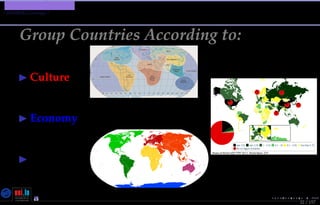
Group Countries According to:
Culture
Economy
Location
Nicolas Guelfi- Wednesday 11th November, 2015 (23:06) - University of Luxembourg, LU
TMPA-2015-Keynote - Part: Software Engineering Education
SWEBOK Coverage ?
33 / 157
MessirEducation Regions
10 Regions - 48 Institutions
N° Region Name Qty
1 North America 7
2 Western Europe 11
3 Japan 3
4 Oceania and South Africa 4
5 Eastern Europe 4
6 Latin America 3
7 North Africa and the Middle East 5
8 Main Africa 2
9 South and Southeast Asia 7
10 Centrally Planned Asia 2
Figure: Messir Education Regions
3 samples
• Schangai Ranking - 48
• ABET/SE - 27
• Network - 14
Nicolas Guelfi- Wednesday 11th November, 2015 (23:06) - University of Luxembourg, LU
TMPA-2015-Keynote - Part: Software Engineering Education
SWEBOK Coverage ?
34 / 157
International Standard Classification
of Education [UNE(2012)]
Level
• 6: Bachelor
• 7: Master
• 8: Doctorate
Category
• 4: Academic
• 5: Professional
• 6: Orientation unspecified
SubCategory
• 5: First degree
• 6: Long first degree
• 7: Second or further degree
Exitfromeducationsystem/labourmarketentry
Tertiaryeducation
Post-
secondary
non-
tertiary
education
Secondary
education
Primary
education
Earlychildhood
education
First-timeschoolentry
01
02
1
2
3
4
8
667
766
767
5
666
665
768
Figure: International Standard Classification
of Education Pathways DiagramNicolas Guelfi- Wednesday 11th November, 2015 (23:06) - University of Luxembourg, LU
TMPA-2015-Keynote - Part: Software Engineering Education
SWEBOK Coverage ?
35 / 157
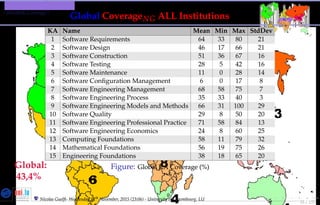
Global CoverageNG ALL Institutions
Global:
43,4%
KA Name Mean Min Max StdDev
1 Software Requirements 64 33 80 21
2 Software Design 46 17 66 21
3 Software Construction 51 36 67 16
4 Software Testing 28 5 42 16
5 Software Maintenance 11 0 28 14
6 Software Configuration Management 6 0 17 8
7 Software Engineering Management 68 58 75 7
8 Software Engineering Process 35 33 40 3
9 Software Engineering Models and Methods 66 31 100 29
10 Software Quality 29 8 50 20
11 Software Engineering Professional Practice 71 58 84 13
12 Software Engineering Economics 24 8 60 25
13 Computing Foundations 58 11 79 32
14 Mathematical Foundations 56 19 75 26
15 Engineering Foundations 38 18 65 20
Figure: Global KA Coverage (%)
Nicolas Guelfi- Wednesday 11th November, 2015 (23:06) - University of Luxembourg, LU
TMPA-2015-Keynote - Part: Software Engineering Education
SWEBOK Coverage ?
36 / 157
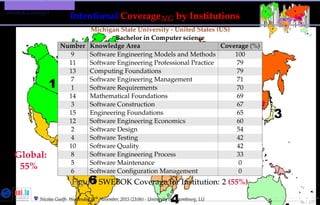
Intentional CoverageNG by Institutions
Global:
55%
Michigan State University - United States (US)
Bachelor in Computer science
Number Knowledge Area Coverage (%)
9 Software Engineering Models and Methods 100
11 Software Engineering Professional Practice 79
13 Computing Foundations 79
7 Software Engineering Management 71
1 Software Requirements 70
14 Mathematical Foundations 69
3 Software Construction 67
15 Engineering Foundations 65
12 Software Engineering Economics 60
2 Software Design 54
4 Software Testing 42
10 Software Quality 42
8 Software Engineering Process 33
5 Software Maintenance 0
6 Software Configuration Management 0
Figure: SWEBOK Coverage for Institution: 2 (55%)
Nicolas Guelfi- Wednesday 11th November, 2015 (23:06) - University of Luxembourg, LU
TMPA-2015-Keynote - Part: Software Engineering Education
SWEBOK Coverage ?
37 / 157
Intentional CoverageNG by Institutions
Global:
35%
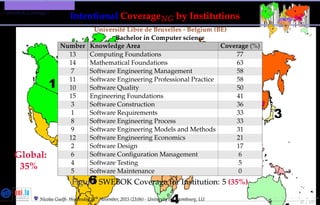
Université Libre de Bruxelles - Belgium (BE)
Bachelor in Computer science
Number Knowledge Area Coverage (%)
13 Computing Foundations 77
14 Mathematical Foundations 63
7 Software Engineering Management 58
11 Software Engineering Professional Practice 58
10 Software Quality 50
15 Engineering Foundations 41
3 Software Construction 36
1 Software Requirements 33
8 Software Engineering Process 33
9 Software Engineering Models and Methods 31
12 Software Engineering Economics 21
2 Software Design 17
6 Software Configuration Management 6
4 Software Testing 5
5 Software Maintenance 0
Figure: SWEBOK Coverage for Institution: 5 (35%)
Nicolas Guelfi- Wednesday 11th November, 2015 (23:06) - University of Luxembourg, LU
TMPA-2015-Keynote - Part: Software Engineering Education
Lessons Learned ?
38 / 157
What are the
Lessons Learned ?
Nicolas Guelfi- Wednesday 11th November, 2015 (23:06) - University of Luxembourg, LU
TMPA-2015-Keynote - Part: Software Engineering Education
Lessons Learned ?
39 / 157
Software Engineering - Lessons Learned
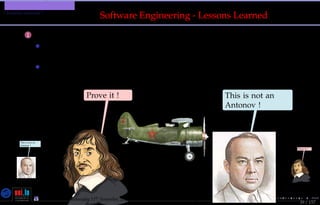
1 Extremism Syndrome
• Professional Oriented Curriculums (largely) exclude
science and theory
• Academic Oriented Curriculums (largely) exclude
technology and industry
Prove it !
This is not an
Antonov !
This is not an
Antonov !
Prove it !
Nicolas Guelfi- Wednesday 11th November, 2015 (23:06) - University of Luxembourg, LU
TMPA-2015-Keynote - Part: Software Engineering Education
Lessons Learned ?
40 / 157
Software Engineering - Lessons Learned
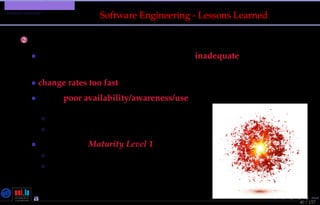
2 Shared 68 Crisis Syndrome
• theories/methods/tools taught (mainly) inadequate
w.r.t. industry needs
• change rates too fast for SE education (& research)
• (very) poor availability/awareness/use of standards
in SE Education
◦ SWEBOK weakly covered
◦ GSwE2009/SE2014 weakly implemented
• SE Education Maturity Level 1 - Initial
◦ Process is ad hoc, even chaotic
◦ Success depends on individual effort and heroics
Nicolas Guelfi- Wednesday 11th November, 2015 (23:06) - University of Luxembourg, LU
TMPA-2015-Keynote - Part: Software Engineering Education
Lessons Learned ?
41 / 157
Software Engineering - Lessons Learned
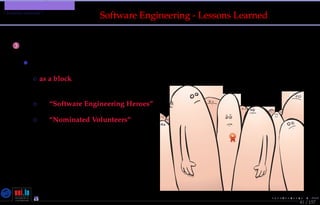
“Unfortunately, it’s just me.
It is my passion.”
(Dr. Kristen Walcott-Justice
University of Colorado)
3 Ugly Duckling Syndrome
• SE is explicitly taught mostly:
◦ as a block in “Software Engineering”
courses and rarely in a full curriculum
◦ by “Software Engineering Heroes”
◦ by “Nominated Volunteers”
Nicolas Guelfi- Wednesday 11th November, 2015 (23:06) - University of Luxembourg, LU
TMPA-2015-Keynote - Part: Software Engineering Education
Lessons Learned ?
42 / 157
Software Engineering - Lessons Learned
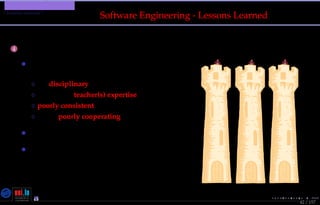
4 Ivory Towers City Syndrome
• The majority of curriculums is made of
courses which:
◦ are disciplinary (verticality)
◦ focused on teacher(s) expertise topics
◦ poorly consistent with each others
◦ (very) poorly cooperating
• Cooperation with industry is (very) rare
• Cooperation with SE tools industry is
(very) poor
Nicolas Guelfi- Wednesday 11th November, 2015 (23:06) - University of Luxembourg, LU
TMPA-2015-Keynote - Part: Software Engineering Education
Lessons Learned ?
43 / 157
Software Engineering - Lessons Learned
5 “HyperTheoryTrophy” Syndrome
• Most academic teachers have:
◦ a scientific education oriented towards
(fundamental) research
◦ (very) poor industrial experience as engineer
• Hyper presence of theoretical computer
science and formal methods
This is not an
Antonov !
Prove it !
Nicolas Guelfi- Wednesday 11th November, 2015 (23:06) - University of Luxembourg, LU
TMPA-2015-Keynote - Part: Software Engineering Education
Lessons Learned ?
44 / 157
Software Engineering - Lessons Learned
6 Conservatism Syndrome
• courses contain “old fashioned” content even for
technology oriented courses
Nicolas Guelfi- Wednesday 11th November, 2015 (23:06) - University of Luxembourg, LU
TMPA-2015-Keynote - Part: Software Engineering Education
Lessons Learned ?
45 / 157
Software Engineering - Lessons Learned
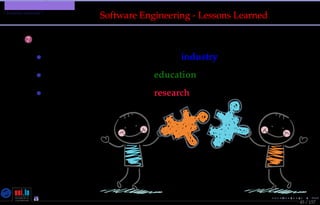
7 Forgotten Pragmatics Syndrome
• SE Problems encountered by the industry
• SE Problems addressed in education
• SE Problems addressed in research
Nicolas Guelfi- Wednesday 11th November, 2015 (23:06) - University of Luxembourg, LU
TMPA-2015-Keynote - Part: Software Engineering Education
Lessons Learned ?
46 / 157
Software Engineering - Lessons Learned
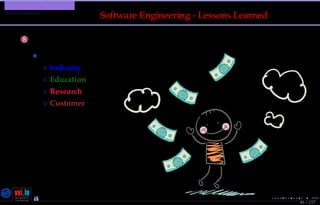
8 Infinity Fantasm Syndrom
• Viewpoints on the costs of the solutions:
◦ Industry
◦ Education
◦ Research
◦ Customer
Nicolas Guelfi- Wednesday 11th November, 2015 (23:06) - University of Luxembourg, LU
TMPA-2015-Keynote - Part: Software Engineering Education
So What ?
47 / 157
So ...
What Can We Do ?
Nicolas Guelfi- Wednesday 11th November, 2015 (23:06) - University of Luxembourg, LU
TMPA-2015-Keynote - Part: An Experimental Remedy
Part III
An Experimental Remedy
48 / 157
Nicolas Guelfi- Wednesday 11th November, 2015 (23:06) - University of Luxembourg, LU
TMPA-2015-Keynote - Part: An Experimental Remedy
Proposal Main Idea ?
49 / 157
A Product Line of Software Engineering Project Courses
Nicolas Guelfi- Wednesday 11th November, 2015 (23:06) - University of Luxembourg, LU
TMPA-2015-Keynote - Part: An Experimental Remedy
Proposal Main Idea ?
50 / 157
Messep learning tool
Software Engineering Project Courses Product Line
Variation points include:
• SWEBOK
◦ Knowledge areas (KA)
◦ Topics (TP)
◦ Sub-topics (STP)
• Application Domains ([Heiman(2010)])
◦ Market (MK)
◦ Categories (CT)
◦ Sub-Categories (SCT)
• Technologies
not a one for all approach
Flexibility: an as complete as consistent as wished
approach for the targeted SE learning objectives
Nicolas Guelfi- Wednesday 11th November, 2015 (23:06) - University of Luxembourg, LU
TMPA-2015-Keynote - Part: An Experimental Remedy
Proposal Main Idea ?
50 / 157
Messep learning tool
Software Engineering Project Courses Product Line
Variation points include:
• SWEBOK
◦ Knowledge areas (KA)
◦ Topics (TP)
◦ Sub-topics (STP)
• Application Domains ([Heiman(2010)])
◦ Market (MK)
◦ Categories (CT)
◦ Sub-Categories (SCT)
• Technologies
not a one for all approach
Flexibility: an as complete as consistent as wished
approach for the targeted SE learning objectives
Nicolas Guelfi- Wednesday 11th November, 2015 (23:06) - University of Luxembourg, LU
TMPA-2015-Keynote - Part: An Experimental Remedy
Proposal Main Idea ?
50 / 157
Messep learning tool
Software Engineering Project Courses Product Line
Variation points include:
• SWEBOK
◦ Knowledge areas (KA)
◦ Topics (TP)
◦ Sub-topics (STP)
• Application Domains ([Heiman(2010)])
◦ Market (MK)
◦ Categories (CT)
◦ Sub-Categories (SCT)
• Technologies
not a one for all approach
Flexibility: an as complete as consistent as wished
approach for the targeted SE learning objectives
Nicolas Guelfi- Wednesday 11th November, 2015 (23:06) - University of Luxembourg, LU
TMPA-2015-Keynote - Part: An Experimental Remedy
Proposal Main Idea ?
50 / 157
Messep learning tool
Software Engineering Project Courses Product Line
Variation points include:
• SWEBOK
◦ Knowledge areas (KA)
◦ Topics (TP)
◦ Sub-topics (STP)
• Application Domains ([Heiman(2010)])
◦ Market (MK)
◦ Categories (CT)
◦ Sub-Categories (SCT)
• Technologies
not a one for all approach
Flexibility: an as complete as consistent as wished
approach for the targeted SE learning objectives
Nicolas Guelfi- Wednesday 11th November, 2015 (23:06) - University of Luxembourg, LU
TMPA-2015-Keynote - Part: An Experimental Remedy
Proposal Main Idea ?
51 / 157
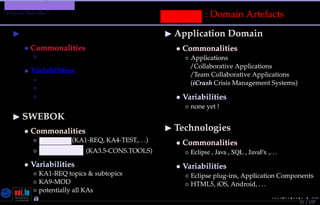
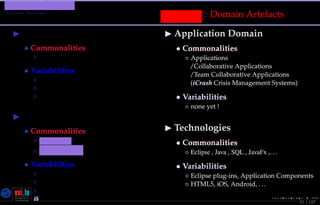
Messep : Domain Artefacts
SE Project Course Definition
• Commonalities
◦ none !
• Variabilities
◦ process, schedule
◦ activities, workload
◦ evaluation
SWEBOK
• Commonalities
◦ Messir(KA1-REQ, KA4-TEST,...)
◦ Excalibur (KA3.5-CONS.TOOLS)
• Variabilities
◦ KA1-REQ topics & subtopics
◦ KA9-MOD
◦ potentially all KAs
Application Domain
• Commonalities
◦ Applications
/Collaborative Applications
/Team Collaborative Applications
(iCrash Crisis Management Systems)
• Variabilities
◦ none yet !
Technologies
• Commonalities
◦ Eclipse , Java , SQL , JavaFx ,...
• Variabilities
◦ Eclipse plug-ins, Application Components
◦ HTML5, iOS, Android, ...
Nicolas Guelfi- Wednesday 11th November, 2015 (23:06) - University of Luxembourg, LU
TMPA-2015-Keynote - Part: An Experimental Remedy
Proposal Main Idea ?
51 / 157
Messep : Domain Artefacts
SE Project Course Definition
• Commonalities
◦ none !
• Variabilities
◦ process, schedule
◦ activities, workload
◦ evaluation
SWEBOK
• Commonalities
◦ Messir(KA1-REQ, KA4-TEST,...)
◦ Excalibur (KA3.5-CONS.TOOLS)
• Variabilities
◦ KA1-REQ topics & subtopics
◦ KA9-MOD
◦ potentially all KAs
Application Domain
• Commonalities
◦ Applications
/Collaborative Applications
/Team Collaborative Applications
(iCrash Crisis Management Systems)
• Variabilities
◦ none yet !
Technologies
• Commonalities
◦ Eclipse , Java , SQL , JavaFx ,...
• Variabilities
◦ Eclipse plug-ins, Application Components
◦ HTML5, iOS, Android, ...
Nicolas Guelfi- Wednesday 11th November, 2015 (23:06) - University of Luxembourg, LU
TMPA-2015-Keynote - Part: An Experimental Remedy
Proposal Main Idea ?
51 / 157
Messep : Domain Artefacts
SE Project Course Definition
• Commonalities
◦ none !
• Variabilities
◦ process, schedule
◦ activities, workload
◦ evaluation
SWEBOK
• Commonalities
◦ Messir(KA1-REQ, KA4-TEST,...)
◦ Excalibur (KA3.5-CONS.TOOLS)
• Variabilities
◦ KA1-REQ topics & subtopics
◦ KA9-MOD
◦ potentially all KAs
Application Domain
• Commonalities
◦ Applications
/Collaborative Applications
/Team Collaborative Applications
(iCrash Crisis Management Systems)
• Variabilities
◦ none yet !
Technologies
• Commonalities
◦ Eclipse , Java , SQL , JavaFx ,...
• Variabilities
◦ Eclipse plug-ins, Application Components
◦ HTML5, iOS, Android, ...
Nicolas Guelfi- Wednesday 11th November, 2015 (23:06) - University of Luxembourg, LU
TMPA-2015-Keynote - Part: An Experimental Remedy
Proposal Main Idea ?
51 / 157
Messep : Domain Artefacts
SE Project Course Definition
• Commonalities
◦ none !
• Variabilities
◦ process, schedule
◦ activities, workload
◦ evaluation
SWEBOK
• Commonalities
◦ Messir(KA1-REQ, KA4-TEST,...)
◦ Excalibur (KA3.5-CONS.TOOLS)
• Variabilities
◦ KA1-REQ topics & subtopics
◦ KA9-MOD
◦ potentially all KAs
Application Domain
• Commonalities
◦ Applications
/Collaborative Applications
/Team Collaborative Applications
(iCrash Crisis Management Systems)
• Variabilities
◦ none yet !
Technologies
• Commonalities
◦ Eclipse , Java , SQL , JavaFx ,...
• Variabilities
◦ Eclipse plug-ins, Application Components
◦ HTML5, iOS, Android, ...
Nicolas Guelfi- Wednesday 11th November, 2015 (23:06) - University of Luxembourg, LU
TMPA-2015-Keynote - Part: An Experimental Remedy
Proposal Main Idea ?
52 / 157
Messep : Derivation Processes
Forward
• Bind the variabilities
• Define Deltas
◦ add/modify variation point, variant,
constraint
• Derive SE Project Variant
◦ SE Project Definition documents
◦ Realization artefacts (i.e. models, code, SE
tools,...)
Back & Forth (if necessary)
• Select a SE Project Variant from the
Product Line
• Define Deltas (Optional)
◦ add/modify variation points, variants,
constraints
• Derive Refined SE Project Variant
(Optional)
◦ SE Project Definition documents
◦ Realization artefacts
(i.e. models, code, SE tools,...)
Nicolas Guelfi- Wednesday 11th November, 2015 (23:06) - University of Luxembourg, LU
TMPA-2015-Keynote - Part: An Experimental Remedy
Proposal Main Idea ?
52 / 157
Messep : Derivation Processes
Forward
• Bind the variabilities
• Define Deltas
◦ add/modify variation point, variant,
constraint
• Derive SE Project Variant
◦ SE Project Definition documents
◦ Realization artefacts (i.e. models, code, SE
tools,...)
Back & Forth (if necessary)
• Select a SE Project Variant from the
Product Line
• Define Deltas (Optional)
◦ add/modify variation points, variants,
constraints
• Derive Refined SE Project Variant
(Optional)
◦ SE Project Definition documents
◦ Realization artefacts
(i.e. models, code, SE tools,...)
Nicolas Guelfi- Wednesday 11th November, 2015 (23:06) - University of Luxembourg, LU
TMPA-2015-Keynote - Part: Illustration: The iCrash MessepVariant
Part IV
Illustration: The
iCrash MessepVariant
53 / 157
Nicolas Guelfi- Wednesday 11th November, 2015 (23:06) - University of Luxembourg, LU
TMPA-2015-Keynote - Part: Illustration: The iCrash MessepVariant
iCrash SEP Variant - Process
54 / 157
iCrash 4ME Variant - Process
Back & Forth
• Select a SE Project Variant from the Product Line
◦ iCrash v1.0
• Define Deltas
◦ add/modify variation points, variants, constraints
• Derive Refined SE Project Variant
◦ SE Project Definition documents
◦ Realization artefacts (i.e. models, code, SE tools,...)
Nicolas Guelfi- Wednesday 11th November, 2015 (23:06) - University of Luxembourg, LU
TMPA-2015-Keynote - Part: Illustration: The iCrash MessepVariant
iCrash Variant Overview
55 / 157
Messep SE Project iCrash v1.0 Card
Features
Details
Project Name iCrash v 1.0
ICSED Level BA 655 (Bachelor/Professional/First degree)
Schedule 10 hours * 14 weeks * 2 periods
Group Size 4 [2-4]
Phases Per.1 [Pha.1/6w + Pha.2/8w]
Per.2 [Pha.1/8w + Pha.2/7w]
Main SWEBOK KAs KA1/REQ + KA9/MOD + KA3/CONS
Main Market Applications/Collaborative Applications/Team Collaborative Applications
Main Technologies
VirtualBox
Nicolas Guelfi- Wednesday 11th November, 2015 (23:06) - University of Luxembourg, LU
TMPA-2015-Keynote - Part: Illustration: The iCrash MessepVariant
iCrash Variant Overview
56 / 157
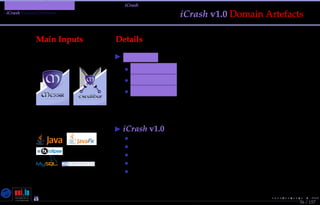
iCrash v1.0 Domain Artefacts
Main Inputs Details
Requirements Messir Standardized Requirements Artefacts
• Excalibur Requirements Specification Project
• Excalibur Requirements Documentation Project
• Excalibur Requirements Simulation Project
Construction iCrash v1.0 Code
• Functionalities - Java
• GUI - JavaFx
• Data persistency - MySQL
• Distributed processing - Java RMI
• Versioning - SubVersioN
Nicolas Guelfi- Wednesday 11th November, 2015 (23:06) - University of Luxembourg, LU
TMPA-2015-Keynote - Part: Illustration: The iCrash MessepVariant
iCrash Variant Overview
57 / 157
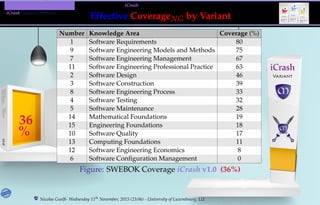
Effective CoverageNG by Variant
36
%
Number Knowledge Area Coverage (%)
1 Software Requirements 80
9 Software Engineering Models and Methods 75
7 Software Engineering Management 67
11 Software Engineering Professional Practice 63
2 Software Design 46
3 Software Construction 39
8 Software Engineering Process 33
4 Software Testing 32
5 Software Maintenance 28
14 Mathematical Foundations 19
15 Engineering Foundations 18
10 Software Quality 17
13 Computing Foundations 11
12 Software Engineering Economics 8
6 Software Configuration Management 0
Figure: SWEBOK Coverage iCrash v1.0 (36%)
Nicolas Guelfi- Wednesday 11th November, 2015 (23:06) - University of Luxembourg, LU
TMPA-2015-Keynote - Part: Illustration: The iCrash MessepVariant
iCrash SEP Commonalities - Requirement Analysis
58 / 157
What is the MessirInternal Standard ?
Nicolas Guelfi- Wednesday 11th November, 2015 (23:06) - University of Luxembourg, LU
TMPA-2015-Keynote - Part: Illustration: The iCrash MessepVariant
iCrash SEP Commonalities - Requirement Analysis
The MessirRequirements
Engineering process (MevoP )
is iterative and incremental.
59 / 157
Requirements Analyst
[Correct&Complete]
[Incorrect or Incomplete]
Use Cases
Concepts
Environment
Operations
Tests
Iteration
Closure
Nicolas Guelfi- Wednesday 11th November, 2015 (23:06) - University of Luxembourg, LU
TMPA-2015-Keynote - Part: Illustration: The iCrash MessepVariant
iCrash SEP Commonalities - Requirement Analysis
60 / 157
Definition Specification Simulation
Use Case
Environment
Concept
Operation
Test
Figure: MevoP Process - Model focus by Analysis Level
Nicolas Guelfi- Wednesday 11th November, 2015 (23:06) - University of Luxembourg, LU
TMPA-2015-Keynote - Part: Illustration: The iCrash MessepVariant
iCrash SEP Commonalities - Requirement Analysis
61 / 157
Categories of Messirlanguages by Analysis levels.
Level msrd msr pl
Definition +++ + -
Specification ++ +++ -
Simulation + + +++
Agile ( msrd)
• Messirdocumentation language
• template based natural language
Rigorous ( msr)
• Messirspecification language
• structured object-oriented and constraint
oriented specification language
Scientific ( pl)
• Messirsimulation language
• Prologmsr programming language
Nicolas Guelfi- Wednesday 11th November, 2015 (23:06) - University of Luxembourg, LU
TMPA-2015-Keynote - Part: Illustration: The iCrash MessepVariant
iCrash SEP Commonalities - Requirement Analysis
iCrash - Stakeholders
The iCrash system is intended to support the ABC company for the
management of crisis situations.
the iCrash stakeholders are:
1. Communication Company
2. Humans
3. Coordinators
4. Administrator
5. Creator
6. Activator
62 / 157
iCrash v1.0 Stakeholders
Nicolas Guelfi- Wednesday 11th November, 2015 (23:06) - University of Luxembourg, LU
TMPA-2015-Keynote - Part: Illustration: The iCrash MessepVariant
iCrash SEP Commonalities - Requirement Analysis
iCrash - Use Case Model
63 / 157
iCrash
Use Case Diagram View
Illustration
Nicolas Guelfi- Wednesday 11th November, 2015 (23:06) - University of Luxembourg, LU
TMPA-2015-Keynote - Part: Illustration: The iCrash MessepVariant
iCrash SEP Commonalities - Requirement Analysis
iCrash - Use Case Model
64 / 157
iCrash
Use Case Specification
Illustration
1 use case system summary suDeployAndRun() {
2 actor actAdministrator[primary,active]
3 actor actMsrCreator[secondary,active]
4 actor actCoordinator[secondary,active,multiple]
5 actor actActivator[secondary,proactive]
6 actor actComCompany[secondary,active]
7
8 reuse oeCreateSystemAndEnvironment[1..1]
9 reuse ugAdministrateTheSystem[1..*]
10 reuse suGlobalCrisisHandling[1..*]
11 reuse oeSetClock[1..*]
12 reuse oeSollicitateCrisisHandling[0..*]
13 reuse oeAlert[1..*]
14
15 step a: actMsrCreator executes
oeCreateSystemAndEnvironment
16 step b: actAdministrator executes
ugAdministrateTheSystem
17 step c: actComCompany executes oeAlert
18 step d: actActivator executes oeSetClock
19 step ^e: actActivator executes
oeSollicitateCrisisHandling
20 step f: actCoordinator executes
suGlobalCrisisHandling
21
22 ordering constraint
23 "step (a) must be always the first step."
24 ordering constraint
25 "step (f) can be executed by different
actCoordinator actors."
26 ordering constraint
27 "if (e) then previously (d)."Nicolas Guelfi- Wednesday 11th November, 2015 (23:06) - University of Luxembourg, LU
TMPA-2015-Keynote - Part: Illustration: The iCrash MessepVariant
iCrash SEP Commonalities - Requirement Analysis
iCrash - Use Case Model
65 / 157
iCrash
Use Case Documentation
Illustration
The goal is to install the iCrash system on its infrastructure and to exploit its capacities related to the secure
administration and efficient handling of car crash situations depending on alerts received.
Use-Case Description
Name suDeployAndRun
Scope system
Level summary
Primary Actor
1 actAdministrator[active]
Secondary actor(s)
1 actMsrCreator[active]
2 actCoordinator[active, multiple]
3 actActivator[proactive]
4 actComCompany[active]
Goal(s) description
The goal is to install the iCrash system on its infrastructure and to exploit its capacities related to the secure
administration and efficient handling of car crash situations depending on alerts received.
Reuse
1 oeCreateSystemAndEnvironment
2 ugAdministrateTheSystem [1..*]
3 suGlobalCrisisHandling [1..*]
4 oeSetClock [1..*]
5 oeSollicitateCrisisHandling [*]
6 oeAlert [1..*]
Protocol condition(s)
1 the iCrash system has never been deployed and used
Pre-condition(s)
1 none
Main post-condition(s)
1 the iCrash system has been created and has handled the crisis situations for which it received alerts
through the communication company.
Main Steps
a the actor actMsrCreator executes the oeCreateSystemAndEnvironment use case
b the actor actAdministrator executes the ugAdministrateTheSystem use case
c the actor actComCompany executes the oeAlert use case
d the actor actActivator executes the oeSetClock use case
e the actor actActivator executes the oeSollicitateCrisisHandling use case
f the actor actCoordinator executes the suGlobalCrisisHandling use case
Steps Ordering Constraints
1 step (a) must be always the first step.
2 step (f) can be executed by different actCoordinator actors.
3 if (e) than previously (d).
Nicolas Guelfi- Wednesday 11th November, 2015 (23:06) - University of Luxembourg, LU
TMPA-2015-Keynote - Part: Illustration: The iCrash MessepVariant
iCrash SEP Commonalities - Requirement Analysis
iCrash - Use Case Model
66 / 157
iCrash
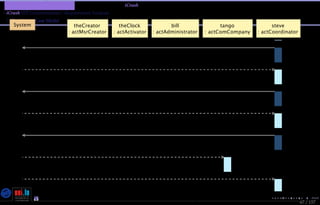
Use Case Instance
Diagram View
Illustration
Nicolas Guelfi- Wednesday 11th November, 2015 (23:06) - University of Luxembourg, LU
TMPA-2015-Keynote - Part: Illustration: The iCrash MessepVariant
iCrash SEP Commonalities - Requirement Analysis
iCrash - Use Case Model
67 / 157
Nicolas Guelfi- Wednesday 11th November, 2015 (23:06) - University of Luxembourg, LU
TMPA-2015-Keynote - Part: Illustration: The iCrash MessepVariant
iCrash SEP Commonalities - Requirement Analysis
iCrash - Use Case Model
68 / 157
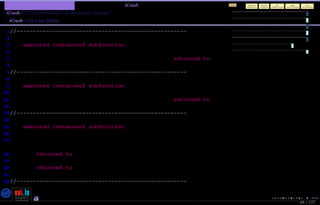
1 //----------------------------------------------------
2 steve
3 executed instanceof subfunction
4 oeLogin("steve","pwdMessirExcalibur2017"){
5 ieMessage('You are logged ! Welcome ...') returned to steve
6 }
7 //----------------------------------------------------
8 steve
9 executed instanceof subfunction
10 oeGetCrisisSet("pending"){
11 ieSendACrisis("crisis with ID 1 details") returned to steve
12 }
13 //----------------------------------------------------
14 steve
15 executed instanceof subfunction
16 oeSetCrisisHandler("1"){
17 ieSmsSend("+3524666445252","The handling of your alert by our services is in
progress !")
18 returned to tango
19 ieMessage("You are now considered as handling the crisis !")
20 returned to steve
21 }
22 //----------------------------------------------------
Nicolas Guelfi- Wednesday 11th November, 2015 (23:06) - University of Luxembourg, LU
TMPA-2015-Keynote - Part: Illustration: The iCrash MessepVariant
iCrash SEP Commonalities - Requirement Analysis
iCrash - Environment Model
69 / 157
Nicolas Guelfi- Wednesday 11th November, 2015 (23:06) - University of Luxembourg, LU
TMPA-2015-Keynote - Part: Illustration: The iCrash MessepVariant
iCrash SEP Commonalities - Requirement Analysis
iCrash - Environment Model
70 / 157
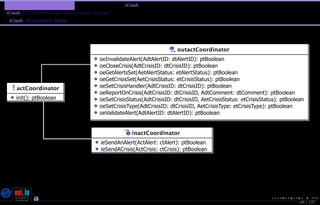
1 actor actCoordinator
2 role rnactCoordinator
3 cardinality [0..*]
4 extends actAuthenticated{
5
6 operation init():ptBoolean
7
8 output interface outactCoordinator{
9 operation oeInvalidateAlert(AdtAlertID:dtAlertID ):ptBoolean
10 operation oeCloseCrisis(AdtCrisisID:dtCrisisID ):ptBoolean
11 operation oeGetAlertsSet(AetAlertStatus:etAlertStatus ):ptBoolean
12 operation oeGetCrisisSet(AetCrisisStatus:etCrisisStatus ):ptBoolean
13 operation oeSetCrisisHandler(AdtCrisisID:dtCrisisID ):ptBoolean
...1 input interface inactCoordinator{
2 operation ieSendAnAlert(ActAlert:ctAlert ):ptBoolean
3 operation ieSendACrisis(ActCrisis:ctCrisis ):ptBoolean
4 }
5 }
Nicolas Guelfi- Wednesday 11th November, 2015 (23:06) - University of Luxembourg, LU
TMPA-2015-Keynote - Part: Illustration: The iCrash MessepVariant
iCrash SEP Commonalities - Requirement Analysis
iCrash - Concept Model
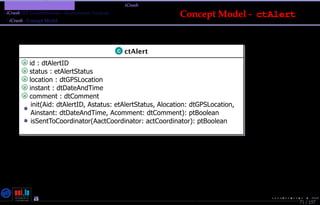
71 / 157
Concept Model - ctAlert
Nicolas Guelfi- Wednesday 11th November, 2015 (23:06) - University of Luxembourg, LU
TMPA-2015-Keynote - Part: Illustration: The iCrash MessepVariant
iCrash SEP Commonalities - Requirement Analysis
iCrash - Concept Model
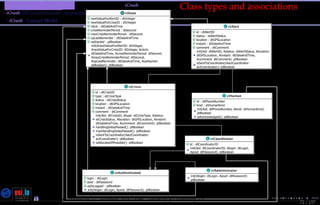
72 / 157
Class types and associations
Nicolas Guelfi- Wednesday 11th November, 2015 (23:06) - University of Luxembourg, LU
TMPA-2015-Keynote - Part: Illustration: The iCrash MessepVariant
iCrash SEP Commonalities - Requirement Analysis
iCrash - Concept Model
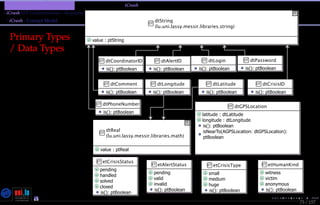
73 / 157
Primary Types
/ Data Types
Nicolas Guelfi- Wednesday 11th November, 2015 (23:06) - University of Luxembourg, LU
TMPA-2015-Keynote - Part: Illustration: The iCrash MessepVariant
iCrash SEP Commonalities - Requirement Analysis
iCrash - Concept Model
74 / 157
1 Concept Model {
2
3 Primary Types{
...1 class ctAlert role rnctAlert cardinality [0..*]{
2 attribute id:dtAlertID
3 attribute status: etAlertStatus
4 attribute location:dtGPSLocation
5 attribute instant:dtDateAndTime
6 attribute comment:dtComment
7
8 operation init( Aid:dtAlertID ,
9 Astatus:etAlertStatus ,
10 Alocation:dtGPSLocation ,
11 Ainstant:dtDateAndTime ,
12 Acomment:dtComment ):ptBoolean
13 operation isSentToCoordinator(AactCoordinator:actCoordinator ):ptBoolean
14
15 }
Nicolas Guelfi- Wednesday 11th November, 2015 (23:06) - University of Luxembourg, LU
TMPA-2015-Keynote - Part: Illustration: The iCrash MessepVariant
iCrash SEP Commonalities - Requirement Analysis
iCrash - Operation Model
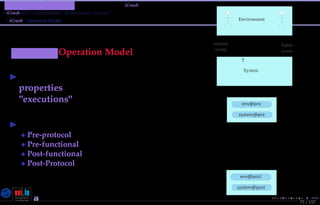
MessirOperation Model
The objective is to provide the
properties that "characterize" all valid
"executions" for each system operation.
Categories of semantic properties
• Pre-protocol
• Pre-functional
• Post-functional
• Post-Protocol
75 / 157
System
Environment
?
output
event
input
event
global_statei
Output event
+
Input event 1
Input event 2
.....
env@pre
system@pre
env@post
system@post
global_statei+1
Nicolas Guelfi- Wednesday 11th November, 2015 (23:06) - University of Luxembourg, LU
TMPA-2015-Keynote - Part: Illustration: The iCrash MessepVariant
iCrash SEP Commonalities - Requirement Analysis
iCrash - Operation Model
76 / 157
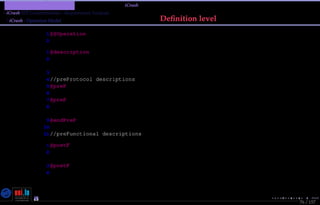
Operation Model at
Definition level (msrd file)
1 @@Operation
2 icrash.environment.actAdministrator.outactAdministrator.oeAddCoordinator
1 @description
2 "sent to add a new coordinator in the system's post state and environment
's post state."
3
4 //preProtocol descriptions
5 @preP
6 "the system is started"
7 @preP
8 "the actor logged previously and did not log out ! (i.e. the associated
ctAdministrator instance is considered logged)"
9 @endPreP
10
11 //preFunctional descriptions
1 @postF
2 "the system's state has a new instance of ctCoordinator initialized with
the given values."
3 @postF
4 "the new actor instance and ctCoordinator instance are related."
Nicolas Guelfi- Wednesday 11th November, 2015 (23:06) - University of Luxembourg, LU
TMPA-2015-Keynote - Part: Illustration: The iCrash MessepVariant
iCrash SEP Commonalities - Requirement Analysis
iCrash - Operation Model
77 / 157
Operation Model at
Specification level (mcl)
1 operation: icrash.environment.actAdministrator.outactAdministrator.
oeAddCoordinator(AdtCoordinatorID:dtCoordinatorID, AdtLogin:dtLogin,
AdtPassword:dtPassword):ptBoolean
1 postF:
2 let TheSystem: ctState in
3 self.rnActor.rnSystem = TheSystem
4 self.rnActor.rnSystem = TheSystem
5 and self.rnActor = TheActor
6 /* PostF01 */
7 TheactCoordinator.init()
8
9 /* PostF02 */
10 and ThectCoordinator.init(AdtCoordinatorID,AdtLogin,AdtPassword)
11
12 /* PostF03 */
13 and TheactCoordinator@post.rnctCoordinator = ThectCoordinator
14
15 /* PostF04 */
16 and ThectCoordinator@post.rnactAuthenticated = TheactCoordinator
17
18 /* PostF05 */
19 and TheActor.rnInterfaceIN^ieCoordinatorAdded()
Nicolas Guelfi- Wednesday 11th November, 2015 (23:06) - University of Luxembourg, LU
TMPA-2015-Keynote - Part: Illustration: The iCrash MessepVariant
iCrash SEP Commonalities - Requirement Analysis
iCrash - Operation Model
78 / 157
Operation Model at Simulation level
(Prologmsr code)
1msrop(outactAdministrator,
2 oeAddCoordinator,
3 [preProtocol,Self,
4 AdtCoordinatorID,
5 AdtLogin,
6 AdtPassword
7 ],
8 []):-
...1/* PostF03 */
2 msrNav([TheactCoordinator],
3 [msmAtPost,rnctCoordinator],
4 [ThectCoordinator]),
5/* PostF05 */
6 msrNav([TheActor],
7 [rnInterfaceIN,
8 ieCoordinatorAdded,[]],
9 [[ptBoolean,true]]),
Nicolas Guelfi- Wednesday 11th November, 2015 (23:06) - University of Luxembourg, LU
TMPA-2015-Keynote - Part: Illustration: The iCrash MessepVariant
iCrash - Test Model
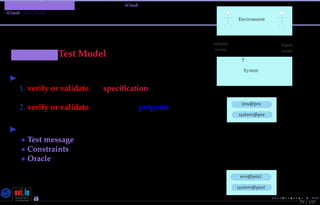
MessirTest Model
Defines test cases to:
1. verify or validate the specification by inspection or
simulation
2. verify or validate the delivered program
A test case is a sequence of test steps
• Test message - system operation triggered
• Constraints - domain for the parameter values
• Oracle - defines acceptance conditions
79 / 157
System
Environment
?
output
event
input
event
global_statei
Output event
+
Input event 1
Input event 2
.....
env@pre
system@pre
env@post
system@post
global_statei+1
Nicolas Guelfi- Wednesday 11th November, 2015 (23:06) - University of Luxembourg, LU
TMPA-2015-Keynote - Part: Illustration: The iCrash MessepVariant
iCrash - Test Model
80 / 157
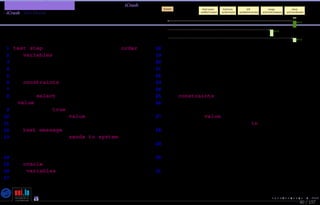
1 test step ts12oeSetCrisisHandler order 12{
2 variables{
3 TheActor : actCoordinator
4 AdtCrisisID : dtCrisisID
5 }
6 constraints{
7 TheActor=TheSystem.rnactCoordinator
8 ->select(a | a.rnctCoordinator.login.
value.eq('steve'))
9 ->any2(true)
10 AdtCrisisID.value= '1'
11 }
12 test message{
13 out:TheActor sends to system
actCoordinator.outactCoordinator.
oeSetCrisisHandler(AdtCrisisID)
14 }
15 oracle{
16 variables{
17 AMessage:ptString
18 AdtPhoneNumber:dtPhoneNumber
19 AdtSMS:dtSMS
20 ActAlert:ctAlert
21
22 TheComCompany: actComCompany
23 TheCoordinator:actCoordinator
24 }
25 constraints{
26 AMessage = 'You are now considered as
handling the crisis !'
27 AdtSMS.value = 'The handling of your
alert by our services is in progress !'
28 TheComCompany.inactComCompany.ieSmsSend
(AdtPhoneNumber,AdtSMS)
29 TheCoordinator.inactCoordinator.
ieSendAnAlert(ActAlert)
30 TheActor.inactAuthenticated.ieMessage(
AMessage)
31 }
Nicolas Guelfi- Wednesday 11th November, 2015 (23:06) - University of Luxembourg, LU
TMPA-2015-Keynote - Part: Illustration: The iCrash MessepVariant
iCrash - Construction
81 / 157
What is the iCrash v1.0
Implementation Artefact ?
Nicolas Guelfi- Wednesday 11th November, 2015 (23:06) - University of Luxembourg, LU
TMPA-2015-Keynote - Part: Illustration: The iCrash MessepVariant
iCrash - Construction
82 / 157
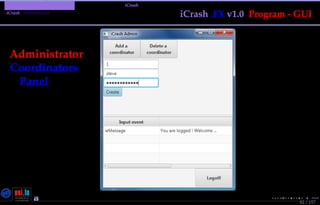
iCrash .FX v1.0 Program - GUI
Administrator
Coordinators
Panel
Nicolas Guelfi- Wednesday 11th November, 2015 (23:06) - University of Luxembourg, LU
TMPA-2015-Keynote - Part: Illustration: The iCrash MessepVariant
iCrash - Construction
83 / 157
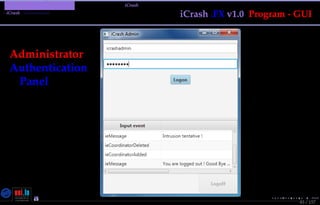
iCrash .FX v1.0 Program - GUI
Administrator
Authentication
Panel
Nicolas Guelfi- Wednesday 11th November, 2015 (23:06) - University of Luxembourg, LU
TMPA-2015-Keynote - Part: Illustration: The iCrash MessepVariant
iCrash - Construction
84 / 157
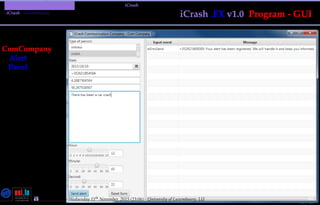
iCrash .FX v1.0 Program - GUI
ComCompany
Alert
Panel
Nicolas Guelfi- Wednesday 11th November, 2015 (23:06) - University of Luxembourg, LU
TMPA-2015-Keynote - Part: Illustration: The iCrash MessepVariant
iCrash - Construction
85 / 157
iCrash .FX v1.0 Program - GUI
Coordinator
Alerts
Panel
Nicolas Guelfi- Wednesday 11th November, 2015 (23:06) - University of Luxembourg, LU
TMPA-2015-Keynote - Part: Illustration: The iCrash MessepVariant
iCrash - Construction
86 / 157
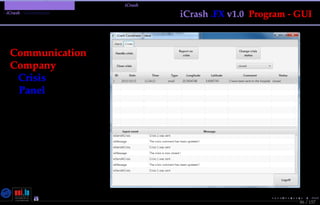
iCrash .FX v1.0 Program - GUI
Communication
Company
Crisis
Panel
Nicolas Guelfi- Wednesday 11th November, 2015 (23:06) - University of Luxembourg, LU
TMPA-2015-Keynote - Part: Illustration: The iCrash MessepVariant
iCrash - Construction
87 / 157
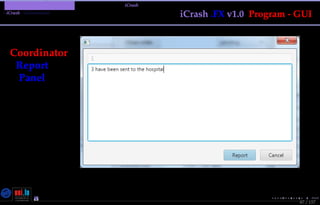
iCrash .FX v1.0 Program - GUI
Coordinator
Report
Panel
Nicolas Guelfi- Wednesday 11th November, 2015 (23:06) - University of Luxembourg, LU
TMPA-2015-Keynote - Part: Illustration: The iCrash MessepVariant
iCrash - Construction
88 / 157
iCrash .FX v1.0 Program - GUI
Coordinator
Status
Panel
Nicolas Guelfi- Wednesday 11th November, 2015 (23:06) - University of Luxembourg, LU
TMPA-2015-Keynote - Part: Illustration: The iCrash MessepVariant
iCrash - Construction
89 / 157
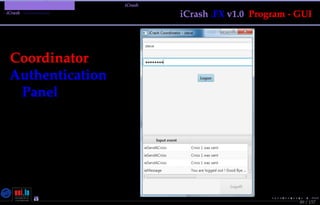
iCrash .FX v1.0 Program - GUI
Coordinator
Authentication
Panel
Nicolas Guelfi- Wednesday 11th November, 2015 (23:06) - University of Luxembourg, LU
TMPA-2015-Keynote - Part: Illustration: The iCrash MessepVariant
iCrash - Construction
90 / 157
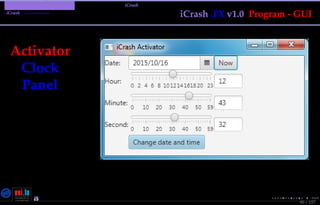
iCrash .FX v1.0 Program - GUI
Activator
Clock
Panel
Nicolas Guelfi- Wednesday 11th November, 2015 (23:06) - University of Luxembourg, LU
TMPA-2015-Keynote - Part: Illustration: The iCrash MessepVariant
iCrash - Construction
91 / 157
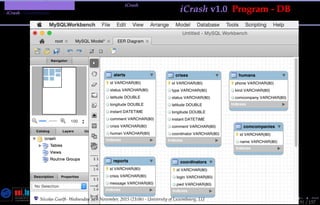
iCrash v1.0 Program - DB
Nicolas Guelfi- Wednesday 11th November, 2015 (23:06) - University of Luxembourg, LU
TMPA-2015-Keynote - Part: Illustration: The iCrash MessepVariant
iCrash - Construction
92 / 157
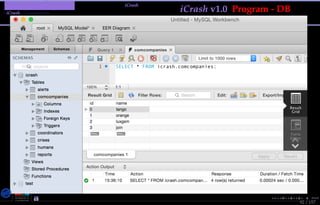
iCrash v1.0 Program - DB
Nicolas Guelfi- Wednesday 11th November, 2015 (23:06) - University of Luxembourg, LU
TMPA-2015-Keynote - Part: Illustration: The iCrash MessepVariant
iCrash SEP Variant - Tools
93 / 157
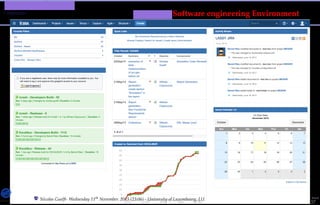
What is the MessirSoftware Engineering Environment ?
Nicolas Guelfi- Wednesday 11th November, 2015 (23:06) - University of Luxembourg, LU
TMPA-2015-Keynote - Part: Illustration: The iCrash MessepVariant
iCrash SEP Variant - Tools
94 / 157
Software Engineering Tools.
1 Requirements
2 Design
3 Construction
4 Management
5 Quality
6 Maintenance
Figure: Tools Focus
Type/Scope
• Tool: supports an individual Task
Unit belonging to the development
life cycle.
• Workbench: combines in an
integrated way two or more tools to
cover a sub-part of the software life
cycle.
• Environment: combines tools and
workbenches in order to target the
maximum coverage of the life
cycle.
Nicolas Guelfi- Wednesday 11th November, 2015 (23:06) - University of Luxembourg, LU
TMPA-2015-Keynote - Part: Illustration: The iCrash MessepVariant
iCrash SEP Variant - Tools
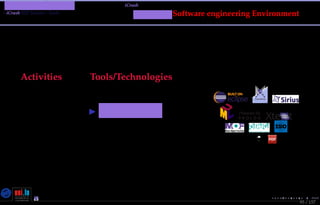
Activities Tools/Technologies
Requirements
Excalibur Eclipse SE
workbench
95 / 157
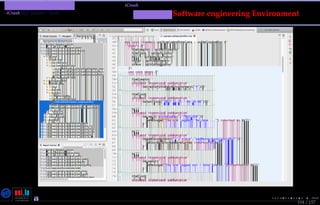
MessirSoftware engineering Environment
Nicolas Guelfi- Wednesday 11th November, 2015 (23:06) - University of Luxembourg, LU
TMPA-2015-Keynote - Part: Illustration: The iCrash MessepVariant
iCrash SEP Variant - Tools
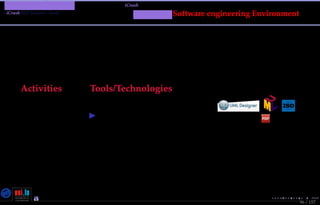
Activities Tools/Technologies
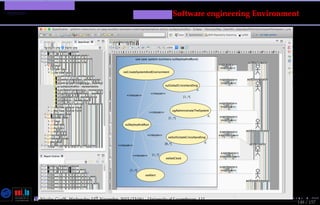
Design
Eclipse UML Designer
96 / 157
MessirSoftware engineering Environment
Nicolas Guelfi- Wednesday 11th November, 2015 (23:06) - University of Luxembourg, LU
TMPA-2015-Keynote - Part: Illustration: The iCrash MessepVariant
iCrash SEP Variant - Tools
Activities Tools/Technologies
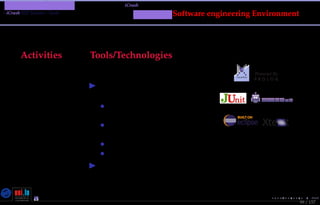
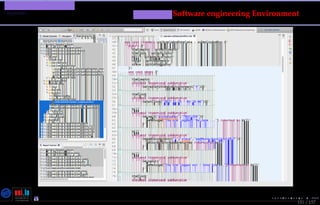
Construction
Functionalities - Java
GUI - JavaFx
Data persistency - MySQL
Distributed processing -
Java RMI
... Tomcat
97 / 157
MessirSoftware engineering Environment
Nicolas Guelfi- Wednesday 11th November, 2015 (23:06) - University of Luxembourg, LU
TMPA-2015-Keynote - Part: Illustration: The iCrash MessepVariant
iCrash SEP Variant - Tools
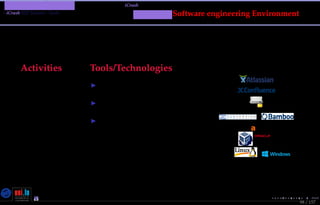
Activities Tools/Technologies
Management
Atlassian Confluence knowledge base
collaboration tool.
SubVersioN versioning and revision
control tool.
Atlassian Bamboo and
Apache Maven continuous integration
server for project builds.
maven
VirtualBox
98 / 157
MessirSoftware engineering Environment
Nicolas Guelfi- Wednesday 11th November, 2015 (23:06) - University of Luxembourg, LU
TMPA-2015-Keynote - Part: Illustration: The iCrash MessepVariant
iCrash SEP Variant - Tools
Activities Tools/Technologies
Quality
Test based Verification &
Validation
• Messir Excalibur
simulator
• SWTbot testing tool for
graphical user interface.
• JUnit unit testing framework
• EclEmma Java code coverage.
Syntax validation tools
99 / 157
MessirSoftware engineering Environment
Nicolas Guelfi- Wednesday 11th November, 2015 (23:06) - University of Luxembourg, LU
TMPA-2015-Keynote - Part: Illustration: The iCrash MessepVariant
iCrash SEP Variant - Tools
Activities Tools/Technologies
Maintenance
Atlassian JIRA issue tracking tool.
SubVersioN versioning and revision
control tool.
Atlassian Bamboo and
Apache Maven continuous integration
server for project builds.
maven
100 / 157
MessirSoftware engineering Environment
Nicolas Guelfi- Wednesday 11th November, 2015 (23:06) - University of Luxembourg, LU
TMPA-2015-Keynote - Part: Illustration: The iCrash MessepVariant
iCrash SEP Variant - Tools
101 / 157
MessirSoftware engineering Environment
Nicolas Guelfi- Wednesday 11th November, 2015 (23:06) - University of Luxembourg, LU
TMPA-2015-Keynote - Part: Illustration: The iCrash MessepVariant
iCrash SEP Variant - Tools
102 / 157
MessirSoftware engineering Environment
Nicolas Guelfi- Wednesday 11th November, 2015 (23:06) - University of Luxembourg, LU
TMPA-2015-Keynote - Part: Illustration: The iCrash MessepVariant
iCrash SEP Variant - Tools
103 / 157
MessirSoftware engineering Environment
Nicolas Guelfi- Wednesday 11th November, 2015 (23:06) - University of Luxembourg, LU
TMPA-2015-Keynote - Part: Illustration: The iCrash MessepVariant
iCrash SEP Variant - Tools
104 / 157
MessirSoftware engineering Environment
Nicolas Guelfi- Wednesday 11th November, 2015 (23:06) - University of Luxembourg, LU
TMPA-2015-Keynote - Part: Illustration: The iCrash MessepVariant
iCrash SEP Variant - Tools
105 / 157
MessirSoftware engineering Environment
Nicolas Guelfi- Wednesday 11th November, 2015 (23:06) - University of Luxembourg, LU
TMPA-2015-Keynote - Part: Illustration: The iCrash MessepVariant
iCrash SEP Variant - Tools
106 / 157
MessirSoftware engineering Environment
Nicolas Guelfi- Wednesday 11th November, 2015 (23:06) - University of Luxembourg, LU
TMPA-2015-Keynote - Part: Illustration: The iCrash MessepVariant
iCrash SEP Variant - Tools
107 / 157
MessirSoftware engineering Environment
Nicolas Guelfi- Wednesday 11th November, 2015 (23:06) - University of Luxembourg, LU
TMPA-2015-Keynote - Part: Illustration: The iCrash MessepVariant
iCrash SEP Variant - Tools
108 / 157
MessirSoftware engineering Environment
Nicolas Guelfi- Wednesday 11th November, 2015 (23:06) - University of Luxembourg, LU
TMPA-2015-Keynote - Part: Illustration: The iCrash MessepVariant
iCrash SEP Variant - Tools
109 / 157
iCrash v1.0 Requirements Documentation
iCrash :
A Crisis Management Case Study
Å ×× ÖAnalysis Document
- v 1.4 -
(Report type: Simulation)
Laboratory for Advanced Software Systems
University of Luxembourg
Thursday 5th
November, 2015 - 08:12
Nicolas Guelfi- Wednesday 11th November, 2015 (23:06) - University of Luxembourg, LU
iCrash :
A Crisis Management Case Study
Å ×× ÖAnalysis Document
- v 1.4 -
(Report type: Simulation)
Laboratory for Advanced Software Systems
University of Luxembourg
Thursday 5th
November, 2015 - 08:12
TMPA-2015-Keynote - Part: Illustration: The iCrash MessepVariant
iCrash SEP Variant - Tools
110 / 157
MessirSoftware engineering Environment
Nicolas Guelfi- Wednesday 11th November, 2015 (23:06) - University of Luxembourg, LU
TMPA-2015-Keynote - Part: Illustration: The iCrash MessepVariant
iCrash SEP Variant - Tools
111 / 157
MessirSoftware engineering Environment
Nicolas Guelfi- Wednesday 11th November, 2015 (23:06) - University of Luxembourg, LU
TMPA-2015-Keynote - Part: Illustration: The iCrash MessepVariant
iCrash SEP Variant - iCrash v1.ME
112 / 157
How to define my own
Project Variant ?
Nicolas Guelfi- Wednesday 11th November, 2015 (23:06) - University of Luxembourg, LU
TMPA-2015-Keynote - Part: Illustration: The iCrash MessepVariant
iCrash SEP Variant - iCrash v1.ME
113 / 157
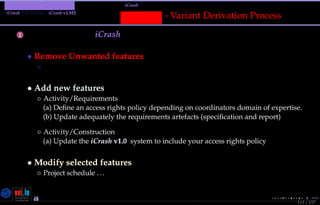
Messep - Variant Derivation Process
1 Define Deltas for iCrash 4ME
• Remove Unwanted features
◦ Requirements simulation level (Prolog)
• Add new features
◦ Activity/Requirements
(a) Define an access rights policy depending on coordinators domain of expertise.
(b) Update adequately the requirements artefacts (specification and report)
◦ Activity/Construction
(a) Update the iCrash v1.0 system to include your access rights policy
• Modify selected features
◦ Project schedule . ..
Nicolas Guelfi- Wednesday 11th November, 2015 (23:06) - University of Luxembourg, LU
TMPA-2015-Keynote - Part: Illustration: The iCrash MessepVariant
iCrash SEP Variant - iCrash v1.ME
113 / 157
Messep - Variant Derivation Process
1 Define Deltas for iCrash 4ME
• Remove Unwanted features
◦ Requirements simulation level (Prolog)
• Add new features
◦ Activity/Requirements
(a) Define an access rights policy depending on coordinators domain of expertise.
(b) Update adequately the requirements artefacts (specification and report)
◦ Activity/Construction
(a) Update the iCrash v1.0 system to include your access rights policy
• Modify selected features
◦ Project schedule . ..
Nicolas Guelfi- Wednesday 11th November, 2015 (23:06) - University of Luxembourg, LU
TMPA-2015-Keynote - Part: Illustration: The iCrash MessepVariant
iCrash SEP Variant - iCrash v1.ME
113 / 157
Messep - Variant Derivation Process
1 Define Deltas for iCrash 4ME
• Remove Unwanted features
◦ Requirements simulation level (Prolog)
• Add new features
◦ Activity/Requirements
(a) Define an access rights policy depending on coordinators domain of expertise.
(b) Update adequately the requirements artefacts (specification and report)
◦ Activity/Construction
(a) Update the iCrash v1.0 system to include your access rights policy
• Modify selected features
◦ Project schedule . ..
Nicolas Guelfi- Wednesday 11th November, 2015 (23:06) - University of Luxembourg, LU
TMPA-2015-Keynote - Part: Illustration: The iCrash MessepVariant
iCrash SEP Variant - iCrash v1.ME
114 / 157
Messep - Variant Derivation Process
2 Define Deltas for iCrash v1. TCS
• Remove Unwanted features
◦ Requirements simulation level (Prolog)
• Add new features
◦ Activity/Requirements
(a) Use Algebraic Petri Nets to model the
iCrash system
(b) Verify using model checking with the AlPiNA[a]
tools if an alert can stay unhandled infinitely
• Modify selected features
◦ Project schedule .. .
Nicolas Guelfi- Wednesday 11th November, 2015 (23:06) - University of Luxembourg, LU
TMPA-2015-Keynote - Part: Illustration: The iCrash MessepVariant
iCrash SEP Variant - iCrash v1.ME
114 / 157
Messep - Variant Derivation Process
sendcrisis
[$cd]
Recording Crisis Data
[]
[system($cd)]
System
sendcrisisfor
validation
[system(getcrisistype($vcs),
true)]
assigncrisis
isvalidcrisis($sy=true)&
invalidsobs($sob,
getcrisistype($sy)=true)
[$sy]
[assigncrisis($sob,$sy)]
Superobserver Ready
[$sob]
ExecutingCrisis
[$sy]
sendreport
blkrep($ec=true)
[$ec]
[]
ExecutedCrisisReport
[rp($ec)]
[sobs(YK,Fire)
sobs(NG,Blockage)]
[]
[system(getcrisistype($sy),
false)]
ValdidatingCrisis
validatecrisis
[$vcs]
[Fire, Fire,
Blockage,Blockage]
3 Define Deltas for iCrash v1. TCS
• Remove Unwanted features
◦ Requirements simulation level (Prolog)
• Add new features
◦ Activity/Requirements
(a) Use Algebraic Petri Nets to model the
iCrash system
(b) Verify using model checking with the AlPiNA[a]
tools if an alert can stay unhandled infinitely
• Modify selected features
◦ Project schedule .. . [a] [Hostettler et al.(2011)Hostettler, Marechal, Linard, Risoldi, and Buchs]
[b] [Buchs and Guelfi(1991)]
[c] [Buchs and Guelfi(2000)]
Nicolas Guelfi- Wednesday 11th November, 2015 (23:06) - University of Luxembourg, LU
TMPA-2015-Keynote - Part: Illustration: The iCrash MessepVariant
iCrash SEP Variant - iCrash v1.ME
114 / 157
Messep - Variant Derivation Process
sendcrisis
[$cd]
Recording Crisis Data
[]
[system($cd)]
System
sendcrisisfor
validation
[system(getcrisistype($vcs),
true)]
assigncrisis
isvalidcrisis($sy=true)&
invalidsobs($sob,
getcrisistype($sy)=true)
[$sy]
[assigncrisis($sob,$sy)]
Superobserver Ready
[$sob]
ExecutingCrisis
[$sy]
sendreport
blkrep($ec=true)
[$ec]
[]
ExecutedCrisisReport
[rp($ec)]
[sobs(YK,Fire)
sobs(NG,Blockage)]
[]
[system(getcrisistype($sy),
false)]
ValdidatingCrisis
validatecrisis
[$vcs]
[Fire, Fire,
Blockage,Blockage]
4 Define Deltas for iCrash v1. TCS
• Remove Unwanted features
◦ Requirements simulation level (Prolog)
• Add new features
◦ Activity/Requirements
(a) Use Algebraic Petri Nets to model the
iCrash system
(b) Verify using model checking with the AlPiNA[a]
tools if an alert can stay unhandled infinitely
• Modify selected features
◦ Project schedule .. . [a] [Hostettler et al.(2011)Hostettler, Marechal, Linard, Risoldi, and Buchs]
[b] [Buchs and Guelfi(1991)]
[c] [Buchs and Guelfi(2000)]
Nicolas Guelfi- Wednesday 11th November, 2015 (23:06) - University of Luxembourg, LU
TMPA-2015-Keynote - Part: Illustration: The iCrash MessepVariant
iCrash SEP Variant - iCrash v1.ME
115 / 157
Messep - Variant Derivation Process
1 Define Deltas for iCrash Eiffel [Meyer(2009)]
• Remove Unwanted features
◦ iCrash Java Implementation
• Add new features
◦ Activity/Construction
(a) Write an Eiffel implementation that
conforms to the iCrash program.
◦ Activity/Code Generation
(b) Use the Xtend and Xtext MDE tools to
generate Eiffel implementation from
Messir specification
• Modify selected features
◦ Project schedule ...
Nicolas Guelfi- Wednesday 11th November, 2015 (23:06) - University of Luxembourg, LU
TMPA-2015-Keynote - Part: Illustration: The iCrash MessepVariant
iCrash SEP Variant - iCrash v1.ME
115 / 157
Messep - Variant Derivation Process
1 Define Deltas for iCrash Eiffel [Meyer(2009)]
• Remove Unwanted features
◦ iCrash Java Implementation
• Add new features
◦ Activity/Construction
(a) Write an Eiffel implementation that
conforms to the iCrash program.
◦ Activity/Code Generation
(b) Use the Xtend and Xtext MDE tools to
generate Eiffel implementation from
Messir specification
• Modify selected features
◦ Project schedule ...
Nicolas Guelfi- Wednesday 11th November, 2015 (23:06) - University of Luxembourg, LU
TMPA-2015-Keynote - Part: Illustration: The iCrash MessepVariant
iCrash SEP Variant - iCrash v1.ME
115 / 157
Messep - Variant Derivation Process
1 Define Deltas for iCrash Eiffel [Meyer(2009)]
• Remove Unwanted features
◦ iCrash Java Implementation
• Add new features
◦ Activity/Construction
(a) Write an Eiffel implementation that
conforms to the iCrash program.
◦ Activity/Code Generation
(b) Use the Xtend and Xtext MDE tools to
generate Eiffel implementation from
Messir specification
• Modify selected features
◦ Project schedule ...
Nicolas Guelfi- Wednesday 11th November, 2015 (23:06) - University of Luxembourg, LU
TMPA-2015-Keynote - Part: Illustration: The iCrash MessepVariant
MessepWhat do I concretely get ?
116 / 157
What do I
Concretely Get ?
Nicolas Guelfi- Wednesday 11th November, 2015 (23:06) - University of Luxembourg, LU
TMPA-2015-Keynote - Part: Illustration: The iCrash MessepVariant
MessepWhat do I concretely get ?
Actor Deliverables
Instructor
Main Work Products
• Project Course Syllabus (source,pdf)
• Project Course Evaluation forms (source, pdf,
xls)
Main Benefits
• Efficiency - rapid engineering of SE project
course
• Quality - reuse of quality components
• Maintenability - standardized, generic,
modular & tool supported
• Stability in time in front of changing
instructors
• Flexibility - SE Coverage adapted to degree
or course objectives
117 / 157
Main Concrete Usable Messep Deliverables
Nicolas Guelfi- Wednesday 11th November, 2015 (23:06) - University of Luxembourg, LU
TMPA-2015-Keynote - Part: Illustration: The iCrash MessepVariant
MessepWhat do I concretely get ?
Actor Deliverables
Students
Main Work Products
• Specialized Project Definition
• Reusable projects inputs (documentation,
models, source, executables, ...)
• Software Engineering Environment
Main Benefits
• Learnability - teaching material
• Accessibility - tools
• Maturity - soundness of reused components
• Adequacy - work vs resource
• Motivation - more results / more experience
/ less failures / less deadlocks
118 / 157
Main Concrete Usable Messep Deliverables
Nicolas Guelfi- Wednesday 11th November, 2015 (23:06) - University of Luxembourg, LU
TMPA-2015-Keynote - Part: Illustration: The iCrash MessepVariant
MessepFlexibility
119 / 157
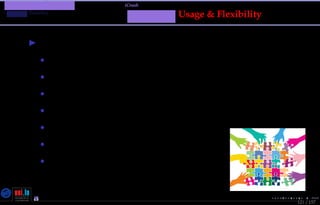
Messep Usage & Flexibility
Bachelor Level
• UML modeling with class diagrams, use case diagrams and
sequence diagrams
• Requirements engineering with use cases
• Practical development projects of with Java , JavaFx , MySQL .
• Introduction to software engineering concepts
• Introduction to development methods concepts
• Introduction to product quality
• Verification and Validation
• ...
Nicolas Guelfi- Wednesday 11th November, 2015 (23:06) - University of Luxembourg, LU
TMPA-2015-Keynote - Part: Illustration: The iCrash MessepVariant
MessepFlexibility
120 / 157
Messep Usage & Flexibility
Master Level
• Advanced Requirements Engineering
• Model Driven Engineering
• Domain Specific Languages: concepts and tools
• Software Engineering Environments: use and development
• Formal Methods
• Operational and Axiomatic Semantics
• Testing and Model checking
• Constraint logic programming
• ...
Nicolas Guelfi- Wednesday 11th November, 2015 (23:06) - University of Luxembourg, LU
TMPA-2015-Keynote - Part: Illustration: The iCrash MessepVariant
MessepFlexibility
121 / 157
Messep Usage & Flexibility
Doctorate Level
• Theories, Methods and tools in the software engineering domain
• Domain Specific Languages
• Model Driven Engineering
• Specification based testing
• Dependability requirements
• Simulation and verification of modeling languages
• ...
Nicolas Guelfi- Wednesday 11th November, 2015 (23:06) - University of Luxembourg, LU
TMPA-2015-Keynote - Part: Conclusion
Part V
Conclusion
122 / 157
Nicolas Guelfi- Wednesday 11th November, 2015 (23:06) - University of Luxembourg, LU
TMPA-2015-Keynote - Part: Conclusion
MessirWho ?
123 / 157
There is a (HUGE) need to improve SE Education !
Messep SE Project Courses Product Line
• Allows for Rapid SE Course Definition & Evolution
• Reconciliates Science & Engineering
• Ensure Quality by Reuse
• Eases Educators Collaboration
• Improves SWEBOK Coverage
Nicolas Guelfi- Wednesday 11th November, 2015 (23:06) - University of Luxembourg, LU
TMPA-2015-Keynote - Part: Conclusion
MessirWho ?
124 / 157
Messir& Excalibur Producers
University of Luxembourg
• Nicolas Guelfi
• Alfredo Capozucca
• Benoit Ries
Nicolas Guelfi- Wednesday 11th November, 2015 (23:06) - University of Luxembourg, LU
TMPA-2015-Keynote - Part: Conclusion
MessirWho ?
125 / 157
MessirProspective Network
Cat. Reg. RC CC Institution Contact(s)
edu 01 NA CA McGill University Joerg Kienzle
edu 01 NA US Carnegie Mellon University - Silicon Valley Cécile Péraire
edu 01 NA US Michigan State University Betty Cheng
edu 01 NA US University of Southern California George Edwards
Nenad Medvidovic
edu 02 WE CH University of Geneva Didier Buchs
edu 02 WE DE University of Hamburg Daniel Moldt
edu 02 WE IT University of Turin Susanna Donatelli
edu 02 WE IT University of Milan Lucia Pomello
edu 02 WE LU University of Luxembourg Nicolas Guelfi
edu 02 WE UK University of Newcastle Maciej Koutny
edu 05 EE RU Saint Petersburg State Technical University Vladimir Itsykson
Evgeny Pyshkin
ind 02 WE LU iTrust Consulting Carlo Harpes
Figure: Messir Prospective Network
Nicolas Guelfi- Wednesday 11th November, 2015 (23:06) - University of Luxembourg, LU
TMPA-2015-Keynote - Part: Conclusion
MessirWho ?
126 / 157
Know a
Software Engineering
Hero ?
Nicolas Guelfi- Wednesday 11th November, 2015 (23:06) - University of Luxembourg, LU
TMPA-2015-Keynote - Part: Conclusion
MessirWho ?
126 / 157
Being him ...
Nicolas Guelfi- Wednesday 11th November, 2015 (23:06) - University of Luxembourg, LU
TMPA-2015-Keynote - Part: Conclusion
MessirWho ?
126 / 157
Or him ...
Nicolas Guelfi- Wednesday 11th November, 2015 (23:06) - University of Luxembourg, LU
TMPA-2015-Keynote - Part: Conclusion
MessirWho ?
126 / 157
Know a Victim ?
Nicolas Guelfi- Wednesday 11th November, 2015 (23:06) - University of Luxembourg, LU
TMPA-2015-Keynote - Part: Conclusion
MessirWho ?
126 / 157
Tell him
to join our
daily scrum !
Nicolas Guelfi- Wednesday 11th November, 2015 (23:06) - University of Luxembourg, LU
TMPA-2015-Keynote - Part: Conclusion
MessirWho ?
127 / 157
Contact us !
messir@uni.lu
Nicolas Guelfi- Wednesday 11th November, 2015 (23:06) - University of Luxembourg, LU
TMPA-2015-Keynote - Part: Conclusion
Discussion
Questions, Ideas, Remarks
128 / 157
Nicolas Guelfi- Wednesday 11th November, 2015 (23:06) - University of Luxembourg, LU
TMPA-2015-Keynote - Part: Conclusion
Discussion
References
[UNE(2012)] International Standard Classification of Education (ISCED) 2011.
UNESCO Institute for Statistics, 2012.
doi: 10.15220/978-92-9189-123-8-en.
URL http://dx.doi.org/10.15220/978-92-9189-123-8-en.
[ACM/IEEE(2015)] ACM/IEEE.
Software engineering 2014 - curriculum guidelines for undergraduate degree programs in software engineering.
2015.
URL https://www.acm.org/education/SE2014-20150223_draft.pdf,https:
//www.acm.org/education/curricula-recommendations.
[Anderson et al.(2001)Anderson, Krathwohl, and Bloom] Lorin W Anderson, David R Krathwohl, and Benjamin Samuel Bloom.
A taxonomy for learning, teaching, and assessing: A revision of Bloom’s taxonomy of educational objectives.
Allyn & Bacon, 2001.
[Bauer(1971)] Friedrich L. Bauer.
Software engineering.
In 1. Foundations and systems., International Federation for Information Processing: IFIP congress series, pages 530–538, August 1971.
[Beck and al.(2001)] Kent Beck and al.
The agile manifesto, 2001.
[Bloom and Krathwohl(1956)] Benjamin Samuel Bloom and David R Krathwohl.
Taxonomy of educational objectives: The classification of educational goals. handbook i: Cognitive domain.
1956.
[Bollinger and McGowan(2009)] Terry Bollinger and Clement McGowan.
A critical look at software capability evaluations: An update.
Software, IEEE, 26(5):80–83, 2009.
129 / 157
Nicolas Guelfi- Wednesday 11th November, 2015 (23:06) - University of Luxembourg, LU
TMPA-2015-Keynote - Part: Conclusion
Discussion
Title
[Buchs and Guelfi(1991)] Didier Buchs and Nicolas Guelfi.
Co-opn: A concurrent object oriented petri net approach. in application and theory of petri nets.
In 12th International Conference, Gjern, Denmark, pages 432–454, 1991.
[Buchs and Guelfi(2000)] Didier Buchs and Nicolas Guelfi.
A formal specification framework for object-oriented distributed systems.
Software Engineering, IEEE Transactions on, 26(7):635–652, 2000.
[Heer(2012)] Rex Heer.
A model of learning objectives—based on a taxonomy for learning, teaching, and assessing: a revision of bloom’s taxonomy of educational
objectives.
Center for Excellence in Learning and Teaching, Iowa State University. http://www. celt. iastate. edu/teaching/RevisedBlooms1. html, 2012.
[Heiman(2010)] R Heiman.
Idc’s software taxonomy 2010.
International Data Corporation, Framingham, 2010.
[Hostettler et al.(2011)Hostettler, Marechal, Linard, Risoldi, and Buchs] Steve Hostettler, Alexis Marechal, Alban Linard, Matteo Risoldi, and Didier
Buchs.
High-level petri net model checking with alpina.
Fundamenta Informaticae, 113(3-4):229–264, August 2011.
ISSN 0169-2968.
[Hutchinson et al.(2011)Hutchinson, Whittle, Rouncefield, and Kristoffersen] John Hutchinson, Jon Whittle, Mark Rouncefield, and Steinar
Kristoffersen.
Empirical assessment of mde in industry.
In Proceedings of the 33rd International Conference on Software Engineering, pages 471–480. ACM, 2011.
130 / 157
Nicolas Guelfi- Wednesday 11th November, 2015 (23:06) - University of Luxembourg, LU
TMPA-2015-Keynote - Part: Conclusion
Discussion
Title
[IEEE(1990)] IEEE.
Ieee standard glossary of software engineering terminology.
Technical report, 1990.
URL http://ieeexplore.ieee.org/xpls/abs_all.jsp?arnumber=159342.
[ISO/IEC(2005)] ISO/IEC.
Software Engineering – Guide to the Software Engineering Body of Knowledge (SWEBOK).
International Organization for Standardization, 2005.
ISO-IEC TR 19759-2005.
[ISO/IEC(2014)] ISO/IEC.
Software Engineering – Guide to the Software Engineering Body of Knowledge (SWEBOK).
International Organization for Standardization, 2014.
ISO-IEC TR 19759-2014.
[Meyer(2009)] Bertrand Meyer.
Touch of Class: Learning to Program Well with Objects and Contracts.
Springer Publishing Company, Incorporated, 1 edition, 2009.
ISBN 3540921443, 9783540921448.
[Naur and Randell(1969)] P. Naur and B. Randell.
Software engineering report of a conference sponsored by the nato science committee garmisch germany 7th-11th october 1968.
1969.
URL http://homepages.cs.ncl.ac.uk/brian.randell/NATO/nato1968.PDF.
131 / 157
Nicolas Guelfi- Wednesday 11th November, 2015 (23:06) - University of Luxembourg, LU
TMPA-2015-Keynote - Part: Conclusion
Discussion
Title
[Parnas(1997)] David Lorge Parnas.
Software engineering: An unconsummated marriage (extended abstract).
In Mehdi Jazayeri and Helmut Schauer, editors, Software Engineering - ESEC/FSE ’97, 6th European Software Engineering Conference Held Jointly
with the 5th ACM SIGSOFT Symposium on Foundations of Software Engineering, Zurich, Switzerland, September 22-25, 1997, Proceedings, volume 1301
of Lecture Notes in Computer Science, pages 1–3. Springer, 1997.
ISBN 3-540-63531-9.
doi: 10.1145/267895.267897.
URL http://doi.acm.org/10.1145/267895.267897.
[Paulk(1993)] Mark Paulk.
Capability maturity model for software.
Wiley Online Library, 1993.
[Rodríguez and al.(2012)] Pilar Rodríguez and al.
Survey on agile and lean usage in finnish software industry.
In Proceedings of the ACM-IEEE international symposium on Empirical software engineering and measurement, pages 139–148. ACM, 2012.
[Sahami and Roach(2014)] Mehran Sahami and Steve Roach.
Computer science curricula 2013 released.
Commun. ACM, 57(6):5–5, June 2014.
ISSN 0001-0782.
doi: 10.1145/2610445.
URL http://doi.acm.org.proxy.bnl.lu/10.1145/2610445.
[SEI(2010)] CMMI Product SEI.
Cmmi for development (cmmi-dev).
Technical report, CMU/SEI-2010-TR-033, Software Engineering Institute, Carnegie Mellon University, 2010.
132 / 157
Nicolas Guelfi- Wednesday 11th November, 2015 (23:06) - University of Luxembourg, LU
TMPA-2015-Keynote - Part: Conclusion
Discussion
Title
[Stavru(2014)] Stavros Stavru.
A critical examination of recent industrial surveys on agile method usage.
Journal of Systems and Software, 94:87–97, 2014.
[VersionOne(2012)] Inc VersionOne.
6th annual state of agile survey.
Technical report, 2012.
[VersionOne(2015)] Inc VersionOne.
9th annual state of agile survey.
Technical report, 2015.
133 / 157
Nicolas Guelfi- Wednesday 11th November, 2015 (23:06) - University of Luxembourg, LU
TMPA-2015-Keynote - Part: Conclusion
Glossary
engineering the practical application of scientific ideas and principles.. 13
science a systematically organized body of knowledge on any subject.. 13
134 / 157
Nicolas Guelfi- Wednesday 11th November, 2015 (23:06) - University of Luxembourg, LU
TMPA-2015-Keynote - Part: Conclusion
Appendix
135 / 157
Effective CoverageNG by Variant
36
%
Number Knowledge Area Coverage (%)
1 Software Requirements 80
9 Software Engineering Models and Methods 75
7 Software Engineering Management 67
11 Software Engineering Professional Practice 63
2 Software Design 46
3 Software Construction 39
8 Software Engineering Process 33
4 Software Testing 32
5 Software Maintenance 28
14 Mathematical Foundations 19
15 Engineering Foundations 18
10 Software Quality 17
13 Computing Foundations 11
12 Software Engineering Economics 8
6 Software Configuration Management 0
Figure: SWEBOK Coverage iCrash v1.0 (36%)
Nicolas Guelfi- Wednesday 11th November, 2015 (23:06) - University of Luxembourg, LU
TMPA-2015-Keynote - Part: Conclusion
Appendix
136 / 157
Problem: How to determine “more precisely” the
SWEBOK topic cognitive acquisition provided by a
lecture ?
Solution:
1. associate a Focus Level (1,2 or 3) representing the
importance of the subject w.r.t. to the lecture’s main
concern.
2. associate a Bloom Cognitive Level (1 to 6): representing
the output cognitive level supposed to be reached after
successful completion of the lecture
([Bloom and Krathwohl(1956)]).
3. compute an weighted average using quantified Bloom
Cognitive Level and focus level
Nicolas Guelfi- Wednesday 11th November, 2015 (23:06) - University of Luxembourg, LU
TMPA-2015-Keynote - Part: Conclusion
Appendix
137 / 157
Bloom Education Levels
[Bloom and Krathwohl(1956)],
[Anderson et al.(2001)Anderson, Krathwohl, and Bloom],
(3D model from [Heer(2012)])
Nicolas Guelfi- Wednesday 11th November, 2015 (23:06) - University of Luxembourg, LU
TMPA-2015-Keynote - Part: Conclusion
Appendix
1 Remembering
2 Understanding
3 Applying
4 Analyzing
5 Evaluating
6 Creating
Figure: Bloom 2001 Levels
138 / 157
Bloom 2001 Education Levels
[Anderson et al.(2001)Anderson, Krathwohl, and Bloom]
Nicolas Guelfi- Wednesday 11th November, 2015 (23:06) - University of Luxembourg, LU
TMPA-2015-Keynote - Part: Conclusion
Appendix
Focus Levels
Bloom Levels 1 2 3
Creating 6 80 90 100
Evaluating 5 60 70 80
Analyzing 4 50 55 60
Applying 3 35 40 45
Understanding 2 20 25 30
Remembering 1 5 10 15
Table: Acquisition Levels Scale (%)
by Cognitive and Focus levels
139 / 157
MessirSWEBOK Acquisition Scale
Nicolas Guelfi- Wednesday 11th November, 2015 (23:06) - University of Luxembourg, LU
TMPA-2015-Keynote - Part: Conclusion
Appendix
1 Remembering
1 Retrieving, recognizing, and recalling
relevant knowledge from long-term memory.
2 Understanding
1 Constructing meaning from oral, written,
and graphic messages through interpreting,
exemplifying, classifying, summarizing,
inferring, comparing, and explaining.
3 Applying
1 Carrying out or using a procedure through
executing, or implementing.
Figure: Bloom 2001 Levels 1,2,3
4 Analyzing
1 Breaking material into constituent parts,
determining how the parts relate to one
another and to an overall structure or
purpose through differentiating, organizing,
and attributing.
5 Evaluating
1 Making judgments based on criteria and
standards through checking and critiquing.
6 Creating
1 Putting elements together to form a coherent
or functional whole; reorganizing elements
into a new pattern or structure through
generating, planning, or producing.
Figure: Bloom 2001 Levels 4,5,6
140 / 157
Bloom Education Levels
[Anderson et al.(2001)Anderson, Krathwohl, and Bloom]
Nicolas Guelfi- Wednesday 11th November, 2015 (23:06) - University of Luxembourg, LU
TMPA-2015-Keynote - Part: Conclusion
Appendix
141 / 157
Agile Techniques Used - [VersionOne(2015)]
0 20 40 60 80 100
Daily Standup
Prioritized backlogs
Short Iterations
Iteration Planning
Retrospectives
Release Planning
Unit Testing
Team-based estimation
Taskboard
Iteration reviews
80
79
79
71
69
65
65
56
53
53
Percentage (%)
0 20 40 60 80 100
Dedicated Product Owner
Single integrated team
Coding Standards
Open Work area
Refactoring
Test-driven development
Kanban
Story Mapping
Collective Code Ownership
Automated Acceptance Testing
Continuous Deployment
Pair Programming
Agile Games
Behaviour Driven Development
48
46
43
38
36
34
31
29
27
24
24
21
13
9
Percentage (%)
Nicolas Guelfi- Wednesday 11th November, 2015 (23:06) - University of Luxembourg, LU
TMPA-2015-Keynote - Part: Conclusion
Appendix
142 / 157
Semiotics and the forgotten Pragmatics
semiotics
steve:Adminitrator
(pa,[1])
steve: Administrator
steve : Administrator
1
pa
syntactics semantics pragmatics
Nicolas Guelfi- Wednesday 11th November, 2015 (23:06) - University of Luxembourg, LU
TMPA-2015-Keynote - Part: Conclusion
Appendix
143 / 157
MessirBook
Nicolas Guelfi
Laboratory for Advanced Software Systems
University of Luxembourg
Å ×× ÖA Scientific Method for
the Software Engineering Master
- v 0.63 -
Thursday 14th
May, 2015 - 16:26
Contents
Part I - Specification, Simulation and Documentation 1
I.1 Introduction . . . . . . . . . . . . . . . . . . . . . . . . . . . . . . . . . . . . . . . . . . . . . . . . . . . 3
I.2 Process . . . . . . . . . . . . . . . . . . . . . . . . . . . . . . . . . . . . . . . . . . . . . . . 5
I.3 Definition . . . . . . . . . . . . . . . . . . . . . . . . . . . . . . . . . . . . . . . . . . . . . . 7
I.3.1 Introduction . . . . . . . . . . . . . . . . . . . . . . . . . . . . . . . . . . . . . . . . . . . . . . . . . 7
I.3.2 Environment Model . . . . . . . . . . . . . . . . . . . . . . . . . . . . . . . . . . . . . . . . . . . . . 7
I.3.3 Concept Model . . . . . . . . . . . . . . . . . . . . . . . . . . . . . . . . . . . . . . . . . . . . . . . 7
I.3.3.1 Class Type . . . . . . . . . . . . . . . . . . . . . . . . . . . . . . . . . . . . . . . . . . . . . 8
I.3.3.2 Datatype Type . . . . . . . . . . . . . . . . . . . . . . . . . . . . . . . . . . . . . . . . . . . 8
I.3.3.3 Associations . . . . . . . . . . . . . . . . . . . . . . . . . . . . . . . . . . . . . . . . . . . . . 8
I.3.3.4 Type Operations . . . . . . . . . . . . . . . . . . . . . . . . . . . . . . . . . . . . . . . . . . 8
I.3.3.5 Textual Syntax Rules . . . . . . . . . . . . . . . . . . . . . . . . . . . . . . . . . . . . . . . 9
I.3.3.6 Graphical Syntax Rules . . . . . . . . . . . . . . . . . . . . . . . . . . . . . . . . . . . . . . 9
I.3.3.7 Naming Conventions . . . . . . . . . . . . . . . . . . . . . . . . . . . . . . . . . . . . . . . 9
I.3.4 Operation Model . . . . . . . . . . . . . . . . . . . . . . . . . . . . . . . . . . . . . . . . . . . . . . 9
I.3.4.1 Overview . . . . . . . . . . . . . . . . . . . . . . . . . . . . . . . . . . . . . . . . . . . . . . 9
I.3.4.2 Constraints Specification . . . . . . . . . . . . . . . . . . . . . . . . . . . . . . . . . . . . . 11
I.3.4.3 Guiding Principles . . . . . . . . . . . . . . . . . . . . . . . . . . . . . . . . . . . . . . . . . 11
I.3.4.4 Evolutions . . . . . . . . . . . . . . . . . . . . . . . . . . . . . . . . . . . . . . . . . . . . . . 11
I.3.5 Tests Model . . . . . . . . . . . . . . . . . . . . . . . . . . . . . . . . . . . . . . . . . . . . . . . . . 12
I.3.5.1 Overview . . . . . . . . . . . . . . . . . . . . . . . . . . . . . . . . . . . . . . . . . . . . . . 12
I.3.5.2 Guiding Principles . . . . . . . . . . . . . . . . . . . . . . . . . . . . . . . . . . . . . . . . . 12
I.3.5.3 Evolutions . . . . . . . . . . . . . . . . . . . . . . . . . . . . . . . . . . . . . . . . . . . . . . 12
I.3.6 Additional Constraints . . . . . . . . . . . . . . . . . . . . . . . . . . . . . . . . . . . . . . . . . . . 12
I.3.6.1 Dependability Constraints . . . . . . . . . . . . . . . . . . . . . . . . . . . . . . . . . . . . 12
I.3.6.2 Performance Specification . . . . . . . . . . . . . . . . . . . . . . . . . . . . . . . . . . . . 12
I.3.6.3 Interfaces . . . . . . . . . . . . . . . . . . . . . . . . . . . . . . . . . . . . . . . . . . . . . . 12
I.3.6.4 Other constraints . . . . . . . . . . . . . . . . . . . . . . . . . . . . . . . . . . . . . . . . . 12
I.3.7 Conventions . . . . . . . . . . . . . . . . . . . . . . . . . . . . . . . . . . . . . . . . . . 12
I.3.7.1 General Textual Conventions . . . . . . . . . . . . . . . . . . . . . . . . . . . . . . . . . . 12
I.3.7.2 General Graphical Conventions . . . . . . . . . . . . . . . . . . . . . . . . . . . . . . . . . 12
I.3.7.3 Environment Model . . . . . . . . . . . . . . . . . . . . . . . . . . . . . . . . . . . . . . . . 12
I.3.7.4 Concept Model . . . . . . . . . . . . . . . . . . . . . . . . . . . . . . . . . . . . . . . . . . . 12
I.3.7.5 Operation Model . . . . . . . . . . . . . . . . . . . . . . . . . . . . . . . . . . . . . . . . . . 13
I.3.7.6 Test Model . . . . . . . . . . . . . . . . . . . . . . . . . . . . . . . . . . . . . . . . . . . . . 13
I.4 Simulation . . . . . . . . . . . . . . . . . . . . . . . . . . . . . . . . . . . . . . . . . . . . . . 15
I.4.1 Introduction . . . . . . . . . . . . . . . . . . . . . . . . . . . . . . . . . . . . . . . . . . . . . . . . . 15
I.4.2 Translating to Prolog . . . . . . . . . . . . . . . . . . . . . . . . . . . . . . . . . . . . . 15
I.4.2.1 The Underlying Logical Structure . . . . . . . . . . . . . . . . . . . . . . . . . . . . . . . . 15
I.4.2.2 The Simulation Predicates . . . . . . . . . . . . . . . . . . . . . . . . . . . . . . . . . . . . 15
I.4.2.3 Logical Structure . . . . . . . . . . . . . . . . . . . . . . . . . . . . . . . . . . . . . . . . . . 15
I.4.3 Tests Simulation . . . . . . . . . . . . . . . . . . . . . . . . . . . . . . . . . . . . . . . . . . . . . . 16
I.4.4 conclusion . . . . . . . . . . . . . . . . . . . . . . . . . . . . . . . . . . . . . . . . . . . . . . . . . . 16
vNicolas Guelfi- Wednesday 11th November, 2015 (23:06) - University of Luxembourg, LU
TMPA-2015-Keynote - Part: Conclusion
Appendix
144 / 157
Excalibur Book
Alfredo Capozucca, Benoît Ries
Laboratory for Advanced Software Systems
University of Luxembourg
Ü
 Ð ÙÖ
Model-Driven Tools
for Domain-Specific
Languages and Methods
- v 0.47 -
Thursday 14th
May, 2015 - 16:21
Contents
Part I Prelude
I.1 Ü
 Ð ÙÖ Book . . . . . . . . . . . . . . . . . . . . . . . . . . . . . . . . . . . . . . . . . . . . . .
Part II Ü
 Ð ÙÖ User Guide (70-100 pages)
II.1 Main features . . . . . . . . . . . . . . . . . . . . . . . . . . . . . . . . . . . . . . . . . . . . . . . . . .
II.2 Introduction (10 pages) . . . . . . . . . . . . . . . . . . . . . . . . . . . . . . . . . . . . . . . . . . . .
II.3 Analysis Models (15 pages) . . . . . . . . . . . . . . . . . . . . . . . . . . . . . . . . . . . . . . . . .
II.4 Views (15 pages) . . . . . . . . . . . . . . . . . . . . . . . . . . . . . . . . . . . . . . . . . . . . . . . .
II.5 Documentation (15 pages) . . . . . . . . . . . . . . . . . . . . . . . . . . . . . . . . . . . . . . . . . .
II.6 Simulation (15 pages) . . . . . . . . . . . . . . . . . . . . . . . . . . . . . . . . . . . . . . . . . . . . .
II.7 F.A.Q. . . . . . . . . . . . . . . . . . . . . . . . . . . . . . . . . . . . . . . . . . . . . . . . . . . . . . . .
Part III Model-Driven Engineering of a DSL Environment (200-220 pages)
III.1 Software Engineering Environments (30 pages) . . . . . . . . . . . . . . . . . . . . . . . . . . .
III.2 Specifying textually (50 pages) . . . . . . . . . . . . . . . . . . . . . . . . . . . . . . . . . . . . . .
III.3 Representing graphically (50 pages) . . . . . . . . . . . . . . . . . . . . . . . . . . . . . . . . . . .
III.4 Documenting (50 pages) . . . . . . . . . . . . . . . . . . . . . . . . . . . . . . . . . . . . . . . . . . .
III.5 Formally simulating (20 pages) . . . . . . . . . . . . . . . . . . . . . . . . . . . . . . . . . . . . . .
III.6 Limitations (5 pages) . . . . . . . . . . . . . . . . . . . . . . . . . . . . . . . . . . . . . . . . . . . . .
III.7 Development roadmap (5 pages) . . . . . . . . . . . . . . . . . . . . . . . . . . . . . . . . . . . . .
Nicolas Guelfi- Wednesday 11th November, 2015 (23:06) - University of Luxembourg, LU
TMPA-2015-Keynote - Part: Conclusion
Appendix
145 / 157
Messir
Tutorial Slides
- Part:
1 / 252
Who are
you ?
My Name is
Guelfi !
Nicolas Guelfi
A Scientific Method for
the Software Engineering Master
-
Tutorial
Nicolas Guelfi - February 5, 2015 (17:03) - University of Luxembourg
- Part: Operation Model - Theory
Operation Specification in Process
Categories of semantic properties
Pre-functional properties
I Conditions under which the system
operation is considered defined .
I Expressed using:
• the system’s state @pre
• the environment state @pre
• the operation parameters
11 / 252
System
Environment
?
output
event
input
event
global_statei
Output event
+
Input event 1
Input event 2
.....
env@pre
system@pre
env@post
system@post
unde f ined de f ined
global_statei+1
Nicolas Guelfi - February 5, 2015 (17:03) - University of Luxembourg
- Part: Process - Illustration
Phase: Iteration 1 - Requirements Definition
Step 3 - Refine Use Case Model - Application
PROCESS STEP
Phase: Requirement Elicitation - Iteration: 1 - Step: 3
Name: Refine Use Case Model
Goal
to reach a fixed point for the first version of the use case model
Process
1. refine existing use cases - select all use cases that contain steps that would
need to be decomposed differently:
1.1 Refine using use case levels adequately (subfunction<usergoal<summary)
1.2 Refine actor definition by using inheritance for interface sharing and by modifying the
interfaces to be consistent with the update version of the use cases.
2. refine use cases instances - for each use case instance impacted by the use
case refinement, redefine the use cases instances including consistent
refinement of information exchange descriptions.
3. enrich use case instances - provide additional use case instances to improve
the coverage of interactions scenarios between system and environment.
- Part: Process - Illustration
Phase: Iteration 1 - Requirements Definition
Step 3 - Refine Use Case Model - Application
1 Use Case Model {
2
3 use case system usergoal
4 ugAdministrateTheSystem() {
5 primary actor actAdministrator[active]
6
7 reuse ugSecurelyUseSystem[1..*]
8 reuse oeAddCoordinator[1..*]
9 reuse oeDeleteCoordinator[1..*]
10
11 step a: actAdministrator
12 executes ugSecurelyUseSystem
13 step b: actAdministrator
14 executes oeAddCoordinator
15 step c: actAdministrator
16 executes oeDeleteCoordinator
17 }
18 }
19}
Nicolas Guelfi- Wednesday 11th November, 2015 (23:06) - University of Luxembourg, LU
TMPA-2015-Keynote - Part: Conclusion
Appendix
146 / 157
MessirSoftware engineering Environment
Nicolas Guelfi- Wednesday 11th November, 2015 (23:06) - University of Luxembourg, LU
TMPA-2015-Keynote - Part: Conclusion
Appendix
147 / 157
MessirSoftware engineering Environment
Nicolas Guelfi- Wednesday 11th November, 2015 (23:06) - University of Luxembourg, LU
TMPA-2015-Keynote - Part: Conclusion
Appendix
148 / 157
MessirSoftware engineering Environment
Nicolas Guelfi- Wednesday 11th November, 2015 (23:06) - University of Luxembourg, LU
TMPA-2015-Keynote - Part: Conclusion
Appendix
149 / 157
MessirSoftware engineering Environment
Nicolas Guelfi- Wednesday 11th November, 2015 (23:06) - University of Luxembourg, LU
TMPA-2015-Keynote - Part: Conclusion
Appendix
150 / 157
MessirSoftware engineering Environment
Nicolas Guelfi- Wednesday 11th November, 2015 (23:06) - University of Luxembourg, LU
TMPA-2015-Keynote - Part: Conclusion
Appendix
151 / 157
MessirSoftware engineering Environment
Nicolas Guelfi- Wednesday 11th November, 2015 (23:06) - University of Luxembourg, LU
TMPA-2015-Keynote - Part: Conclusion
Appendix
152 / 157
MessirSoftware engineering Environment
Nicolas Guelfi- Wednesday 11th November, 2015 (23:06) - University of Luxembourg, LU
TMPA-2015-Keynote - Part: Conclusion
Appendix
153 / 157
MessirSoftware engineering Environment
Nicolas Guelfi- Wednesday 11th November, 2015 (23:06) - University of Luxembourg, LU
TMPA-2015-Keynote - Part: Conclusion
Appendix
154 / 157
MessirSoftware engineering Environment
Nicolas Guelfi- Wednesday 11th November, 2015 (23:06) - University of Luxembourg, LU
TMPA-2015-Keynote - Part: Conclusion
Appendix
155 / 157
MessirSoftware engineering Environment
Nicolas Guelfi- Wednesday 11th November, 2015 (23:06) - University of Luxembourg, LU
TMPA-2015-Keynote - Part: Conclusion
Appendix
156 / 157
MessirSoftware engineering Environment
Laboratory for Advanced Software Systems
University of Luxembourg
6, rue R. Coudenhove-Kalergi, Luxembourg
iCrash :
A Crisis Management Case Study
Analysis Document
- v 1.3 -
Monday 15th June, 2015 - 18:17
Contents
1 Introduction . . . . . . . . . . . . . . . . . . . . . . . . . . . . . . . . . . . . . . . . . . . . . . . . . . . . 11
1.1 Overview . . . . . . . . . . . . . . . . . . . . . . . . . . . . . . . . . . . . . . . . . . . . . . . . . . . 11
1.2 Purpose and recipients of the document . . . . . . . . . . . . . . . . . . . . . . . . . . . . . . . . 11
1.3 Application Domain . . . . . . . . . . . . . . . . . . . . . . . . . . . . . . . . . . . . . . . . . . . . 11
1.4 Definitions, acronyms and abbreviations . . . . . . . . . . . . . . . . . . . . . . . . . . . . . . . . 11
1.5 Document structure . . . . . . . . . . . . . . . . . . . . . . . . . . . . . . . . . . . . . . . . . . . . 12
2 General Description . . . . . . . . . . . . . . . . . . . . . . . . . . . . . . . . . . . . . . . . . . . . . . 13
2.1 Domain Stakeholders . . . . . . . . . . . . . . . . . . . . . . . . . . . . . . . . . . . . . . . . . . . . 13
2.1.1 Communication Company . . . . . . . . . . . . . . . . . . . . . . . . . . . . . . . . . . . . 13
2.1.2 Humans . . . . . . . . . . . . . . . . . . . . . . . . . . . . . . . . . . . . . . . . . . . . . . . 13
2.1.3 Coordinators . . . . . . . . . . . . . . . . . . . . . . . . . . . . . . . . . . . . . . . . . . . . 14
2.1.4 Administrator . . . . . . . . . . . . . . . . . . . . . . . . . . . . . . . . . . . . . . . . . . . 14
2.1.5 Creator . . . . . . . . . . . . . . . . . . . . . . . . . . . . . . . . . . . . . . . . . . . . . . . 14
2.1.6 Activator . . . . . . . . . . . . . . . . . . . . . . . . . . . . . . . . . . . . . . . . . . . . . . 15
2.2 System’s Actors . . . . . . . . . . . . . . . . . . . . . . . . . . . . . . . . . . . . . . . . . . . . . . . 16
2.3 Use Cases Model . . . . . . . . . . . . . . . . . . . . . . . . . . . . . . . . . . . . . . . . . . . . . . 17
2.3.1 Use Cases . . . . . . . . . . . . . . . . . . . . . . . . . . . . . . . . . . . . . . . . . . . . . . 17
2.3.2 Use Case Instance(s) . . . . . . . . . . . . . . . . . . . . . . . . . . . . . . . . . . . . . . . 26
3 Environment Model . . . . . . . . . . . . . . . . . . . . . . . . . . . . . . . . . . . . . . . . . . . . . . . 31
3.1 Local view 01 . . . . . . . . . . . . . . . . . . . . . . . . . . . . . . . . . . . . . . . . . . . . . . . . 31
3.2 Local view 02 . . . . . . . . . . . . . . . . . . . . . . . . . . . . . . . . . . . . . . . . . . . . . . . . 31
3.3 Local view 03 . . . . . . . . . . . . . . . . . . . . . . . . . . . . . . . . . . . . . . . . . . . . . . . . 31
3.4 Local view 04 . . . . . . . . . . . . . . . . . . . . . . . . . . . . . . . . . . . . . . . . . . . . . . . . 31
3.5 Local view 05 . . . . . . . . . . . . . . . . . . . . . . . . . . . . . . . . . . . . . . . . . . . . . . . . 31
3.6 Global view 01 . . . . . . . . . . . . . . . . . . . . . . . . . . . . . . . . . . . . . . . . . . . . . . . . 32
3.7 Actors and Interfaces Descriptions . . . . . . . . . . . . . . . . . . . . . . . . . . . . . . . . . . . . 35
3.7.1 actActivator Actor . . . . . . . . . . . . . . . . . . . . . . . . . . . . . . . . . . . . . . 35
3.7.2 actAdministrator Actor . . . . . . . . . . . . . . . . . . . . . . . . . . . . . . . . . . 36
3.7.3 actAuthenticated Actor . . . . . . . . . . . . . . . . . . . . . . . . . . . . . . . . . . 36
3.7.4 actComCompany Actor . . . . . . . . . . . . . . . . . . . . . . . . . . . . . . . . . . . . . 36
3.7.5 actCoordinator Actor . . . . . . . . . . . . . . . . . . . . . . . . . . . . . . . . . . . . 37
3.7.6 actMsrCreator Actor . . . . . . . . . . . . . . . . . . . . . . . . . . . . . . . . . . . . . 37
4 Concept Model . . . . . . . . . . . . . . . . . . . . . . . . . . . . . . . . . . . . . . . . . . . . . . . . . 39
4.1 PrimaryTypes-Classes . . . . . . . . . . . . . . . . . . . . . . . . . . . . . . . . . . . . . . . . . . . 39
4.1.1 Local view 01 . . . . . . . . . . . . . . . . . . . . . . . . . . . . . . . . . . . . . . . . . . . . 39
4.1.2 Local view 02 . . . . . . . . . . . . . . . . . . . . . . . . . . . . . . . . . . . . . . . . . . . . 39
4.1.3 Local view 03 . . . . . . . . . . . . . . . . . . . . . . . . . . . . . . . . . . . . . . . . . . . . 39
4.1.4 Local view 04 . . . . . . . . . . . . . . . . . . . . . . . . . . . . . . . . . . . . . . . . . . . . 39
4.1.5 Global view 01 . . . . . . . . . . . . . . . . . . . . . . . . . . . . . . . . . . . . . . . . . . . 39
4.2 PrimaryTypes-Datatypes . . . . . . . . . . . . . . . . . . . . . . . . . . . . . . . . . . . . . . . . . 42
4.2.1 Global view 01 . . . . . . . . . . . . . . . . . . . . . . . . . . . . . . . . . . . . . . . . . . . 42
4.3 SecondaryTypes-Datatypes . . . . . . . . . . . . . . . . . . . . . . . . . . . . . . . . . . . . . . . . 42
4.3.1 Local view 01 . . . . . . . . . . . . . . . . . . . . . . . . . . . . . . . . . . . . . . . . . . . . 42
2
Nicolas Guelfi- Wednesday 11th November, 2015 (23:06) - University of Luxembourg, LU
TMPA-2015-Keynote - Part: Conclusion
Appendix
157 / 157
MessirSoftware engineering Environment
38 4 Concept Model
Fig. 4.5 Concept Model - PrimaryTypes-Classes global view 01. Primary types class types global view - cm-pt-ct-gv-01 .
4.3 SecondaryTypes-Datatypes
4.3.1 Local view 01
Figure 4.7 shows the local view of the secondary types datatype types.
4.4 Concept Model Types Descriptions
This section provides the textual descriptions of all the types defined in the concept model and that can be part
of the graphical views provided.
4.4.1 Primary types - Class types descriptions
The table below is providing comments on the graphical views given for the class types of the primary types.
Type logical operations are precisely specified in the operation model.
Classes
ctAdministrator
used to caracterize internally the entity that is responsible of administrating the iCrash system.
extends icrash.concepts.primarytypes.classes.ctAuthenticated
operation init: used to initialize the current object as a new instance of the ctAdministrator type.
ctAlert
Used to model crisis alerts sent by any human having communication capability using communication companies
belonging to the system’s environment
4.4 Concept Model Types Descriptions 39
. . . Classes table continuation
attribute id: dtAlertID: the alert unique identification information.
attribute status: etAlertStatus: the alert validation status
attribute location: dtGPSLocation: the position of the alert provided by the space-based satellite
navigation system used by the human using the communication company to inform the
iCrash system of a crisis.
attribute instant: dtDateAndTime: the date and time at which the alert notification has been sent.
attribute comment: dtComment: a textual description providing unstructured information on the
alert.
operation init: used to initialize the current object as a new instance of the ctAlert type.
operation isSentToCoordinator: used to provide a given coordinator with current alert information.
ctAuthenticated
used to model system’s representation about actors that need to authenticate to access some specific
functionalities.
attribute login: dtLogin: an identifier for authentication.
attribute pwd: dtPassword: a key for authentication.
attribute vpIsLogged: ptBoolean: used to determine the access status.
operation init: used to initialize the current object as a new instance of the ctAuthenticated type.
ctCoordinator
used to model system’s representation about the actors that have the responsibility to handle alerts and crisis.
extends icrash.concepts.primarytypes.classes.ctAuthenticated
attribute id: dtCoordinatorID: a unique identification information.
operation init: used to initialize the current object as a new instance of the ctCoordinator type.
ctCrisis
Used to model crisis that are infered from the reception of at least one alert message. Crisis aer entities that
are handled by the iCrash system.
attribute id: dtCrisisID: the crisis unique identification information.
attribute type: etCrisisType: an indication of the gravity of the crisis.
attribute status: etCrisisStatus: the crisis handling status.
attribute location: dtGPSLocation: the position of the crisis equal by the one of the first alert
received and associated to the crisis.
attribute instant: dtDateAndTime: the date and time at which the first related alert notification
has been sent.
attribute comment: dtComment: a textual description providing unstructured information on the
crisis handling.
operation init: used to initialize the current object as a new instance of the ctAlert type.
operation handlingDelayPassed: used to determine if the crisis stood too longly in a pending status
since last reminder.
operation maxHandlingDelayPassed: used to determine if the crisis stood too longly in a pending
status since its creation.
operation isSentToCoordinator: used to provide a given coordinator with current crisis information.
operation isAllocatedIfPossible: used to allocate a crisis to a coordinator if any or to alert the
administrator of crisis waiting to be handled.
ctHuman
used to model system’s representation about the indirect actors that has alerted of potential crisis.
attribute id: dtPhoneNumber: the number of the communication device used to send an alert to
iCrash system.
attribute kind: etHumanKind: role with respect to the alert notified.
operation init: used to initialize the current object as a new instance of the ctHuman type.
ctState
used to model the system. Each system specified using must include a ctState class for which there
is only one instance at any state of the abstract machine after creation.
attribute nextValueForAlertID: dtInteger: used to associate each alert declared with a unique
idenitification value.
continues in next page . . .
Nicolas Guelfi- Wednesday 11th November, 2015 (23:06) - University of Luxembourg, LU

TMPA-2015: Software Engineering Education: The Messir Approach

  • 1.
    TMPA-2015-Keynote - Part: 1/ 157 Prove it ! This is not an Antonov ! Nicolas Guelfi- Wednesday 11th November, 2015 (23:06) - University of Luxembourg, LU
  • 2.
    TMPA-2015-Keynote - Part: 2/ 157 My Name is Guelfi ! Nicolas Guelfi Software Engineering Education The MessirApproach TMPA-2015 (Invited Talk) Nicolas Guelfi- Wednesday 11th November, 2015 (23:06) - University of Luxembourg, LU
  • 3.
    TMPA-2015-Keynote - Part: PresentationParts 3 / 157 1: Warning ! (slide 4) 2: Software Engineering Education (slide 10) 3: An Experimental Remedy (slide 52) 4: Illustration: The iCrash Messep Variant (slide 64) 5: Conclusion (slide 139) Nicolas Guelfi- Wednesday 11th November, 2015 (23:06) - University of Luxembourg, LU
  • 4.
    TMPA-2015-Keynote - Part:Warning ! Part I Warning ! 4 / 157 Nicolas Guelfi- Wednesday 11th November, 2015 (23:06) - University of Luxembourg, LU
  • 5.
    TMPA-2015-Keynote - Part:Warning ! 5 / 157 !! Warning !! on the Presentation’s Content Pragmatism & Objectivism • Useful, scalable but not universal • Rigorous but mostly empirical • Shared by some but not all Based on Experience ...including: • 25 years in education and knowledge transfer (bachelor, master, doctorate, post-doctorate) • 8 years as Software Engineering expert at Court of Justice for conformance questions • 400 trainees in the SE industry managed at bachelor and master levels Nicolas Guelfi- Wednesday 11th November, 2015 (23:06) - University of Luxembourg, LU
  • 6.
    TMPA-2015-Keynote - Part:Warning ! 5 / 157 !! Warning !! on the Presentation’s Content Pragmatism & Objectivism • Useful, scalable but not universal • Rigorous but mostly empirical • Shared by some but not all Based on Experience ...including: • 25 years in theoretical and applied research ◦ IEE Efficient Verification of Occupants Classification System Nicolas Guelfi- Wednesday 11th November, 2015 (23:06) - University of Luxembourg, LU
  • 7.
    TMPA-2015-Keynote - Part:Warning ! 5 / 157 !! Warning !! on the Presentation’s Content Pragmatism & Objectivism • Useful, scalable but not universal • Rigorous but mostly empirical • Shared by some but not all Based on Experience ...including: • 25 years in theoretical and applied research ◦ Dassault Aviation - (Rafale) Fault Tolerant Embedded System for Outside Temperature Monitoring Nicolas Guelfi- Wednesday 11th November, 2015 (23:06) - University of Luxembourg, LU
  • 8.
    TMPA-2015-Keynote - Part:Warning ! 5 / 157 !! Warning !! on the Presentation’s Content Pragmatism & Objectivism • Useful, scalable but not universal • Rigorous but mostly empirical • Shared by some but not all Based on Experience ...including: • 25 years in theoretical and applied research ◦ Theoretical Computer Science Algebraic theories applied to the mathematical modeling of concurrent processes with advanced data structures Nicolas Guelfi- Wednesday 11th November, 2015 (23:06) - University of Luxembourg, LU
  • 9.
    TMPA-2015-Keynote - Part:Warning ! 5 / 157 !! Warning !! on the Presentation’s Content Pragmatism & Objectivism • Useful, scalable but not universal • Rigorous but mostly empirical • Shared by some but not all Based on Experience ...including: • 25 years in theoretical and applied research ◦ Software Engineering & Dependable Systems European & National Research Projects, Excellence networks SERENE (http://www.ercim.eu/activity/workgroup) Nicolas Guelfi- Wednesday 11th November, 2015 (23:06) - University of Luxembourg, LU
  • 10.
    TMPA-2015-Keynote - Part:Software Engineering Education Part II Software Engineering Education 6 / 157 Nicolas Guelfi- Wednesday 11th November, 2015 (23:06) - University of Luxembourg, LU
  • 11.
    TMPA-2015-Keynote - Part:Software Engineering Education Introductory Quotes 7 / 157 Software Engineering Definition The application of a systematic, disciplined, quantifiable approach to the development, operation, and maintenance of software. (IEEE in [IEEE(1990)]) Nicolas Guelfi- Wednesday 11th November, 2015 (23:06) - University of Luxembourg, LU
  • 12.
    TMPA-2015-Keynote - Part:Software Engineering Education Introductory Quotes 8 / 157 Software Engineering Definition Software engineering is the part of computer science which is too difficult for the computer scientist. (Friedrich Bauer [Bauer(1971), 71]) Nicolas Guelfi- Wednesday 11th November, 2015 (23:06) - University of Luxembourg, LU
  • 13.
    TMPA-2015-Keynote - Part:Software Engineering Education Introductory Quotes 9 / 157 Software Engineering Education Today, the majority of Engineers understand very little of the “science of programming”. On the other side, the scientists who study programming understand very little about what it means to be an Engineer ...the two fields have much to learn from each other and that the marriage of software and Engineering should be consummated. (David Lorge Parnas in [Parnas(1997)]) Prove it !This is not an Antonov ! Nicolas Guelfi- Wednesday 11th November, 2015 (23:06) - University of Luxembourg, LU
  • 14.
    TMPA-2015-Keynote - Part:Software Engineering Education Introductory Quotes 10 / 157 Software Engineering Education Is it possible to have software engineers in the numbers in which we need them, without formal software engineering education ? (A.J. Perlis in [Naur and Randell(1969), 68]) Nicolas Guelfi- Wednesday 11th November, 2015 (23:06) - University of Luxembourg, LU
  • 15.
    TMPA-2015-Keynote - Part:Software Engineering Education Do We Need SE Education ? 11 / 157 Do We (Really) Need Software Engineering Education ? Nicolas Guelfi- Wednesday 11th November, 2015 (23:06) - University of Luxembourg, LU
  • 16.
    TMPA-2015-Keynote - Part:Software Engineering Education Do We Need SE Education ? 12 / 157 “Computing” Jobs: Proportions and Distributions ? (Science, Technology, Engineering and Mathematics) (Science, Technology, Engineering and Mathematics) Nicolas Guelfi- Wednesday 11th November, 2015 (23:06) - University of Luxembourg, LU
  • 17.
    TMPA-2015-Keynote - Part:Software Engineering Education Do We Need SE Education ? 13 / 157 “Computing” Jobs in 2022: Offers vs Grads ? Nicolas Guelfi- Wednesday 11th November, 2015 (23:06) - University of Luxembourg, LU
  • 18.
    TMPA-2015-Keynote - Part:Software Engineering Education What About SE in Industry ? 14 / 157 What about SE in Industry ? (conjectures only !!) Nicolas Guelfi- Wednesday 11th November, 2015 (23:06) - University of Luxembourg, LU
  • 19.
    TMPA-2015-Keynote - Part:Software Engineering Education What About SE in Industry ? 15 / 157 Capability Maturity Model CMM [Paulk(1993)] and CMMI-DEV [SEI(2010)] • can be used as an observation tool • provides a subjective and relative evaluation of the Software Engineering practice in industry. Nicolas Guelfi- Wednesday 11th November, 2015 (23:06) - University of Luxembourg, LU
  • 20.
    TMPA-2015-Keynote - Part:Software Engineering Education What About SE in Industry ? 16 / 157 CCMI-DEV - Capability Maturity Model Integration for Development State of practice in industry [Bollinger and McGowan(2009)] Level 1 - Initial Level 2 - Repeatable Level 3 - Defined Level 4 - Managed Level 5 - Optimizing 0 10 20 30 40 50 60 70 80 90 100 Level 1 Level 2 Level 3 Level 4 Level 5 51.2 24.8 17.4 5.4 1.2 Percentage (%) Nicolas Guelfi- Wednesday 11th November, 2015 (23:06) - University of Luxembourg, LU
  • 21.
    TMPA-2015-Keynote - Part:Software Engineering Education What About SE in Industry ? 17 / 157 Agile Software Development - [Beck and al.(2001)] Represents a “Software Engineering success story” for the mass • realistic w.r.t. SE maturity (theories, methods and tools) • realistic w.r.t. ICT project’s budgets Mainly focused on project management and development life cycle • iterative and incremental design and development Promotes directly some SE areas 1. Software Construction 2. Software Testing 3. Software Engineering Management 4. Software Engineering Process 5. Software Quality 6. Software Engineering Professional Practice Nicolas Guelfi- Wednesday 11th November, 2015 (23:06) - University of Luxembourg, LU
  • 22.
    TMPA-2015-Keynote - Part:Software Engineering Education What About SE in Industry ? 18 / 157 Agile in Industry - [Stavru(2014)] [Rodríguez and al.(2012)] [VersionOne(2012)] 0 20 40 60 80 100 VersionOne Rodriguez and al. 20 44.8 80 55.2 Rate of Agile in Method Prone Projects (%) No Agile Agile Nicolas Guelfi- Wednesday 11th November, 2015 (23:06) - University of Luxembourg, LU
  • 23.
    TMPA-2015-Keynote - Part:Software Engineering Education What About SE in Industry ? 19 / 157 Agile Methodologies Used - [VersionOne(2015)] 0 20 40 60 80 100 Scrum Scrum & XP hybrid Custom Hybrid Scrumban Kanban Iterative Dev. Agile Modeling Feature Driven Dev. AgileUP XP 56 10 8 6 6 4 1 1 0.5 0.5 Percentage (%) Nicolas Guelfi- Wednesday 11th November, 2015 (23:06) - University of Luxembourg, LU
  • 24.
    TMPA-2015-Keynote - Part:Software Engineering Education What About SE in Industry ? 20 / 157 Agile Project Management Tools Used [VersionOne(2015)] Nicolas Guelfi- Wednesday 11th November, 2015 (23:06) - University of Luxembourg, LU
  • 25.
    TMPA-2015-Keynote - Part:Software Engineering Education What About SE in Industry ? 21 / 157 Model Driven Engineering Practice in industry [Hutchinson et al.(2011)Hutchinson, Whittle, Rouncefield, and Kristoffersen] 250 questionnaire answers from MDE practitioners 22 in-depth interviews of MDE professionals from 17 different companies on-site observational studies with companies practicing MDE Nicolas Guelfi- Wednesday 11th November, 2015 (23:06) - University of Luxembourg, LU
  • 26.
    TMPA-2015-Keynote - Part:Software Engineering Education What About SE in Industry ? 0 10 20 30 40 50 60 70 80 90 100 make use of UML use a DSL of their own design use a DSL provided by a tool use BPMN use SysML and MATLAB/Simulink 85 40 25 25 10 Percentage (%) 22 / 157 Model Driven Engineering Practice in industry [Hutchinson et al.(2011)Hutchinson, Whittle, Rouncefield, and Kristoffersen] Nicolas Guelfi- Wednesday 11th November, 2015 (23:06) - University of Luxembourg, LU
  • 27.
    TMPA-2015-Keynote - Part:Software Engineering Education What About SE in Industry ? 23 / 157 Model Driven Engineering Practice in industry [Hutchinson et al.(2011)Hutchinson, Whittle, Rouncefield, and Kristoffersen] 0 20 40 60 80 100 Class Diagram Activity Diagram Use Case Diagram Sequence Diagram State Machine Diagram DSL Diagram Component Diagram Flow Diagram Entity Relationship Diagram Deployment Diagram Object Diagram Composite Structure Diagram 87 56 38 33 23 8 8 5 3 3 2 2 Percentage (%) 35 diagram types cited inclusion min threshold of 2 diagrams below the threshold: Abstract Syntax Graphs, Arrow Diagrams, UsiXML Stylistics and ICONIX Robustness Diagrams,... Nicolas Guelfi- Wednesday 11th November, 2015 (23:06) - University of Luxembourg, LU
  • 28.
    TMPA-2015-Keynote - Part:Software Engineering Education What About SE in Industry ? 0 20 40 60 80 100 Use of models for team communication Use of models for understanding a problem at an abstract level Code generation Use of models to capture and document designs Use of model-to-model transformations Use of domain-specific languages (DSLs) Model simulation - Executable models Use of models in testing Percentage (%) Productivity Impact Maintainability Impact 24 / 157 Model Driven Engineering Practice in industry [Hutchinson et al.(2011)Hutchinson, Whittle, Rouncefield, and Kristoffersen] Nicolas Guelfi- Wednesday 11th November, 2015 (23:06) - University of Luxembourg, LU
  • 29.
    TMPA-2015-Keynote - Part:Software Engineering Education Status of SE Education ? 25 / 157 What is the status of Software Engineering Education ? Nicolas Guelfi- Wednesday 11th November, 2015 (23:06) - University of Luxembourg, LU
  • 30.
    TMPA-2015-Keynote - Part:Software Engineering Education Status of SE Education ? 26 / 157 Software Engineering Education Main Dates 1968 · · · · · ·• NATO conference [Naur and Randell(1969)] 1976 · · · · · ·• Workshop on Software Engineering Education 1978 · · · · · ·• Subcommittee on Model Curricula in SE (SMCSE) 1989 · · · · · ·• SEI Graduate Curriculum report 1990 · · · · · ·• N. Guelfi first SE lecture ! 1993 · · · · · ·• IEEE CS/ACM Joint Steering Committee 1998 · · · · · ·• SE Coordinating Committee (SWECC) 1999 · · · · · ·• SE Code of Ethics & Professional Practice 2004 · · · · · ·• SE2004 Undergraduate Curriculum Report 2005 · · · · · ·• SWEBOK Certified [ISO/IEC(2005)] 2009 · · · · · ·• Graduate Software Engineering 2009 (GSwE2009 published) 2013 · · · · · ·• CS2013 Undergraduate Curriculum - submitted [Sahami and Roach(2014)] 2014 · · · · · ·• SE2014 Undergraduate Curriculum - submitted [ACM/IEEE(2015)] 2014 · · · · · ·• SWEBOK submitted for recognition [ISO/IEC(2014)] Nicolas Guelfi- Wednesday 11th November, 2015 (23:06) - University of Luxembourg, LU
  • 31.
    TMPA-2015-Keynote - Part:Software Engineering Education SE Body of Knowledge ? 27 / 157 What is the Software Engineering Body of Knowledge ? Nicolas Guelfi- Wednesday 11th November, 2015 (23:06) - University of Luxembourg, LU
  • 32.
    TMPA-2015-Keynote - Part:Software Engineering Education SE Body of Knowledge ? 28 / 157 SWEBOK IEEE/ISO Standard [ISO/IEC(2005)],[ISO/IEC(2014)] SE knowledge decomposed in: • 15 Knowledge Areas • 99 Topics • 394 Sub-topics Nicolas Guelfi- Wednesday 11th November, 2015 (23:06) - University of Luxembourg, LU
  • 33.
    TMPA-2015-Keynote - Part:Software Engineering Education SE Body of Knowledge ? 29 / 157 Number Knowledge Area Names 1 Software Requirements 2 Software Design 3 Software Construction 4 Software Testing 5 Software Maintenance 6 Software Configuration Management 7 Software Engineering Management 8 Software Engineering Process 9 Software Engineering Models and Methods 10 Software Quality 11 Software Engineering Professional Practice 12 Software Engineering Economics 13 Computing Foundations 14 Mathematical Foundations 15 Engineering Foundations Figure: SWEBOK Knowledge Areas Nicolas Guelfi- Wednesday 11th November, 2015 (23:06) - University of Luxembourg, LU
  • 34.
    TMPA-2015-Keynote - Part:Software Engineering Education SE Body of Knowledge ? 30 / 157 Number Topic Names 1 Modeling 2 Types of Models 3 Analysis of Models 4 Software Engineering Methods Figure: SWEBOK topics for (9) Software Engineering Models and Methods Number SubTopic Names 1 Modeling Principles 2 Properties and Expression of Models 3 Syntax, Semantics, and Pragmatics 4 Preconditions, Postconditions, and Invariants Figure: SWEBOK topics for (9.1) Modeling Number SubTopic Names 1 Heuristic Methods 2 Formal Methods 3 Prototyping Methods 4 Agile Methods Figure: SWEBOK topics for (9.4) Software Engineering Methods Nicolas Guelfi- Wednesday 11th November, 2015 (23:06) - University of Luxembourg, LU
  • 35.
    TMPA-2015-Keynote - Part:Software Engineering Education SWEBOK Coverage ? 31 / 157 What is the SWEBOK Intentional CoverageNG Over the World ? Nicolas Guelfi- Wednesday 11th November, 2015 (23:06) - University of Luxembourg, LU
  • 36.
    TMPA-2015-Keynote - Part:Software Engineering Education SWEBOK Coverage ? 32 / 157 Group Countries According to: Culture Economy Location Nicolas Guelfi- Wednesday 11th November, 2015 (23:06) - University of Luxembourg, LU
  • 37.
    TMPA-2015-Keynote - Part:Software Engineering Education SWEBOK Coverage ? 33 / 157 MessirEducation Regions 10 Regions - 48 Institutions N° Region Name Qty 1 North America 7 2 Western Europe 11 3 Japan 3 4 Oceania and South Africa 4 5 Eastern Europe 4 6 Latin America 3 7 North Africa and the Middle East 5 8 Main Africa 2 9 South and Southeast Asia 7 10 Centrally Planned Asia 2 Figure: Messir Education Regions 3 samples • Schangai Ranking - 48 • ABET/SE - 27 • Network - 14 Nicolas Guelfi- Wednesday 11th November, 2015 (23:06) - University of Luxembourg, LU
  • 38.
    TMPA-2015-Keynote - Part:Software Engineering Education SWEBOK Coverage ? 34 / 157 International Standard Classification of Education [UNE(2012)] Level • 6: Bachelor • 7: Master • 8: Doctorate Category • 4: Academic • 5: Professional • 6: Orientation unspecified SubCategory • 5: First degree • 6: Long first degree • 7: Second or further degree Exitfromeducationsystem/labourmarketentry Tertiaryeducation Post- secondary non- tertiary education Secondary education Primary education Earlychildhood education First-timeschoolentry 01 02 1 2 3 4 8 667 766 767 5 666 665 768 Figure: International Standard Classification of Education Pathways DiagramNicolas Guelfi- Wednesday 11th November, 2015 (23:06) - University of Luxembourg, LU
  • 39.
    TMPA-2015-Keynote - Part:Software Engineering Education SWEBOK Coverage ? 35 / 157 Global CoverageNG ALL Institutions Global: 43,4% KA Name Mean Min Max StdDev 1 Software Requirements 64 33 80 21 2 Software Design 46 17 66 21 3 Software Construction 51 36 67 16 4 Software Testing 28 5 42 16 5 Software Maintenance 11 0 28 14 6 Software Configuration Management 6 0 17 8 7 Software Engineering Management 68 58 75 7 8 Software Engineering Process 35 33 40 3 9 Software Engineering Models and Methods 66 31 100 29 10 Software Quality 29 8 50 20 11 Software Engineering Professional Practice 71 58 84 13 12 Software Engineering Economics 24 8 60 25 13 Computing Foundations 58 11 79 32 14 Mathematical Foundations 56 19 75 26 15 Engineering Foundations 38 18 65 20 Figure: Global KA Coverage (%) Nicolas Guelfi- Wednesday 11th November, 2015 (23:06) - University of Luxembourg, LU
  • 40.
    TMPA-2015-Keynote - Part:Software Engineering Education SWEBOK Coverage ? 36 / 157 Intentional CoverageNG by Institutions Global: 55% Michigan State University - United States (US) Bachelor in Computer science Number Knowledge Area Coverage (%) 9 Software Engineering Models and Methods 100 11 Software Engineering Professional Practice 79 13 Computing Foundations 79 7 Software Engineering Management 71 1 Software Requirements 70 14 Mathematical Foundations 69 3 Software Construction 67 15 Engineering Foundations 65 12 Software Engineering Economics 60 2 Software Design 54 4 Software Testing 42 10 Software Quality 42 8 Software Engineering Process 33 5 Software Maintenance 0 6 Software Configuration Management 0 Figure: SWEBOK Coverage for Institution: 2 (55%) Nicolas Guelfi- Wednesday 11th November, 2015 (23:06) - University of Luxembourg, LU
  • 41.
    TMPA-2015-Keynote - Part:Software Engineering Education SWEBOK Coverage ? 37 / 157 Intentional CoverageNG by Institutions Global: 35% Université Libre de Bruxelles - Belgium (BE) Bachelor in Computer science Number Knowledge Area Coverage (%) 13 Computing Foundations 77 14 Mathematical Foundations 63 7 Software Engineering Management 58 11 Software Engineering Professional Practice 58 10 Software Quality 50 15 Engineering Foundations 41 3 Software Construction 36 1 Software Requirements 33 8 Software Engineering Process 33 9 Software Engineering Models and Methods 31 12 Software Engineering Economics 21 2 Software Design 17 6 Software Configuration Management 6 4 Software Testing 5 5 Software Maintenance 0 Figure: SWEBOK Coverage for Institution: 5 (35%) Nicolas Guelfi- Wednesday 11th November, 2015 (23:06) - University of Luxembourg, LU
  • 42.
    TMPA-2015-Keynote - Part:Software Engineering Education Lessons Learned ? 38 / 157 What are the Lessons Learned ? Nicolas Guelfi- Wednesday 11th November, 2015 (23:06) - University of Luxembourg, LU
  • 43.
    TMPA-2015-Keynote - Part:Software Engineering Education Lessons Learned ? 39 / 157 Software Engineering - Lessons Learned 1 Extremism Syndrome • Professional Oriented Curriculums (largely) exclude science and theory • Academic Oriented Curriculums (largely) exclude technology and industry Prove it ! This is not an Antonov ! This is not an Antonov ! Prove it ! Nicolas Guelfi- Wednesday 11th November, 2015 (23:06) - University of Luxembourg, LU
  • 44.
    TMPA-2015-Keynote - Part:Software Engineering Education Lessons Learned ? 40 / 157 Software Engineering - Lessons Learned 2 Shared 68 Crisis Syndrome • theories/methods/tools taught (mainly) inadequate w.r.t. industry needs • change rates too fast for SE education (& research) • (very) poor availability/awareness/use of standards in SE Education ◦ SWEBOK weakly covered ◦ GSwE2009/SE2014 weakly implemented • SE Education Maturity Level 1 - Initial ◦ Process is ad hoc, even chaotic ◦ Success depends on individual effort and heroics Nicolas Guelfi- Wednesday 11th November, 2015 (23:06) - University of Luxembourg, LU
  • 45.
    TMPA-2015-Keynote - Part:Software Engineering Education Lessons Learned ? 41 / 157 Software Engineering - Lessons Learned “Unfortunately, it’s just me. It is my passion.” (Dr. Kristen Walcott-Justice University of Colorado) 3 Ugly Duckling Syndrome • SE is explicitly taught mostly: ◦ as a block in “Software Engineering” courses and rarely in a full curriculum ◦ by “Software Engineering Heroes” ◦ by “Nominated Volunteers” Nicolas Guelfi- Wednesday 11th November, 2015 (23:06) - University of Luxembourg, LU
  • 46.
    TMPA-2015-Keynote - Part:Software Engineering Education Lessons Learned ? 42 / 157 Software Engineering - Lessons Learned 4 Ivory Towers City Syndrome • The majority of curriculums is made of courses which: ◦ are disciplinary (verticality) ◦ focused on teacher(s) expertise topics ◦ poorly consistent with each others ◦ (very) poorly cooperating • Cooperation with industry is (very) rare • Cooperation with SE tools industry is (very) poor Nicolas Guelfi- Wednesday 11th November, 2015 (23:06) - University of Luxembourg, LU
  • 47.
    TMPA-2015-Keynote - Part:Software Engineering Education Lessons Learned ? 43 / 157 Software Engineering - Lessons Learned 5 “HyperTheoryTrophy” Syndrome • Most academic teachers have: ◦ a scientific education oriented towards (fundamental) research ◦ (very) poor industrial experience as engineer • Hyper presence of theoretical computer science and formal methods This is not an Antonov ! Prove it ! Nicolas Guelfi- Wednesday 11th November, 2015 (23:06) - University of Luxembourg, LU
  • 48.
    TMPA-2015-Keynote - Part:Software Engineering Education Lessons Learned ? 44 / 157 Software Engineering - Lessons Learned 6 Conservatism Syndrome • courses contain “old fashioned” content even for technology oriented courses Nicolas Guelfi- Wednesday 11th November, 2015 (23:06) - University of Luxembourg, LU
  • 49.
    TMPA-2015-Keynote - Part:Software Engineering Education Lessons Learned ? 45 / 157 Software Engineering - Lessons Learned 7 Forgotten Pragmatics Syndrome • SE Problems encountered by the industry • SE Problems addressed in education • SE Problems addressed in research Nicolas Guelfi- Wednesday 11th November, 2015 (23:06) - University of Luxembourg, LU
  • 50.
    TMPA-2015-Keynote - Part:Software Engineering Education Lessons Learned ? 46 / 157 Software Engineering - Lessons Learned 8 Infinity Fantasm Syndrom • Viewpoints on the costs of the solutions: ◦ Industry ◦ Education ◦ Research ◦ Customer Nicolas Guelfi- Wednesday 11th November, 2015 (23:06) - University of Luxembourg, LU
  • 51.
    TMPA-2015-Keynote - Part:Software Engineering Education So What ? 47 / 157 So ... What Can We Do ? Nicolas Guelfi- Wednesday 11th November, 2015 (23:06) - University of Luxembourg, LU
  • 52.
    TMPA-2015-Keynote - Part:An Experimental Remedy Part III An Experimental Remedy 48 / 157 Nicolas Guelfi- Wednesday 11th November, 2015 (23:06) - University of Luxembourg, LU
  • 53.
    TMPA-2015-Keynote - Part:An Experimental Remedy Proposal Main Idea ? 49 / 157 A Product Line of Software Engineering Project Courses Nicolas Guelfi- Wednesday 11th November, 2015 (23:06) - University of Luxembourg, LU
  • 54.
    TMPA-2015-Keynote - Part:An Experimental Remedy Proposal Main Idea ? 50 / 157 Messep learning tool Software Engineering Project Courses Product Line Variation points include: • SWEBOK ◦ Knowledge areas (KA) ◦ Topics (TP) ◦ Sub-topics (STP) • Application Domains ([Heiman(2010)]) ◦ Market (MK) ◦ Categories (CT) ◦ Sub-Categories (SCT) • Technologies not a one for all approach Flexibility: an as complete as consistent as wished approach for the targeted SE learning objectives Nicolas Guelfi- Wednesday 11th November, 2015 (23:06) - University of Luxembourg, LU
  • 55.
    TMPA-2015-Keynote - Part:An Experimental Remedy Proposal Main Idea ? 50 / 157 Messep learning tool Software Engineering Project Courses Product Line Variation points include: • SWEBOK ◦ Knowledge areas (KA) ◦ Topics (TP) ◦ Sub-topics (STP) • Application Domains ([Heiman(2010)]) ◦ Market (MK) ◦ Categories (CT) ◦ Sub-Categories (SCT) • Technologies not a one for all approach Flexibility: an as complete as consistent as wished approach for the targeted SE learning objectives Nicolas Guelfi- Wednesday 11th November, 2015 (23:06) - University of Luxembourg, LU
  • 56.
    TMPA-2015-Keynote - Part:An Experimental Remedy Proposal Main Idea ? 50 / 157 Messep learning tool Software Engineering Project Courses Product Line Variation points include: • SWEBOK ◦ Knowledge areas (KA) ◦ Topics (TP) ◦ Sub-topics (STP) • Application Domains ([Heiman(2010)]) ◦ Market (MK) ◦ Categories (CT) ◦ Sub-Categories (SCT) • Technologies not a one for all approach Flexibility: an as complete as consistent as wished approach for the targeted SE learning objectives Nicolas Guelfi- Wednesday 11th November, 2015 (23:06) - University of Luxembourg, LU
  • 57.
    TMPA-2015-Keynote - Part:An Experimental Remedy Proposal Main Idea ? 50 / 157 Messep learning tool Software Engineering Project Courses Product Line Variation points include: • SWEBOK ◦ Knowledge areas (KA) ◦ Topics (TP) ◦ Sub-topics (STP) • Application Domains ([Heiman(2010)]) ◦ Market (MK) ◦ Categories (CT) ◦ Sub-Categories (SCT) • Technologies not a one for all approach Flexibility: an as complete as consistent as wished approach for the targeted SE learning objectives Nicolas Guelfi- Wednesday 11th November, 2015 (23:06) - University of Luxembourg, LU
  • 58.
    TMPA-2015-Keynote - Part:An Experimental Remedy Proposal Main Idea ? 51 / 157 Messep : Domain Artefacts SE Project Course Definition • Commonalities ◦ none ! • Variabilities ◦ process, schedule ◦ activities, workload ◦ evaluation SWEBOK • Commonalities ◦ Messir(KA1-REQ, KA4-TEST,...) ◦ Excalibur (KA3.5-CONS.TOOLS) • Variabilities ◦ KA1-REQ topics & subtopics ◦ KA9-MOD ◦ potentially all KAs Application Domain • Commonalities ◦ Applications /Collaborative Applications /Team Collaborative Applications (iCrash Crisis Management Systems) • Variabilities ◦ none yet ! Technologies • Commonalities ◦ Eclipse , Java , SQL , JavaFx ,... • Variabilities ◦ Eclipse plug-ins, Application Components ◦ HTML5, iOS, Android, ... Nicolas Guelfi- Wednesday 11th November, 2015 (23:06) - University of Luxembourg, LU
  • 59.
    TMPA-2015-Keynote - Part:An Experimental Remedy Proposal Main Idea ? 51 / 157 Messep : Domain Artefacts SE Project Course Definition • Commonalities ◦ none ! • Variabilities ◦ process, schedule ◦ activities, workload ◦ evaluation SWEBOK • Commonalities ◦ Messir(KA1-REQ, KA4-TEST,...) ◦ Excalibur (KA3.5-CONS.TOOLS) • Variabilities ◦ KA1-REQ topics & subtopics ◦ KA9-MOD ◦ potentially all KAs Application Domain • Commonalities ◦ Applications /Collaborative Applications /Team Collaborative Applications (iCrash Crisis Management Systems) • Variabilities ◦ none yet ! Technologies • Commonalities ◦ Eclipse , Java , SQL , JavaFx ,... • Variabilities ◦ Eclipse plug-ins, Application Components ◦ HTML5, iOS, Android, ... Nicolas Guelfi- Wednesday 11th November, 2015 (23:06) - University of Luxembourg, LU
  • 60.
    TMPA-2015-Keynote - Part:An Experimental Remedy Proposal Main Idea ? 51 / 157 Messep : Domain Artefacts SE Project Course Definition • Commonalities ◦ none ! • Variabilities ◦ process, schedule ◦ activities, workload ◦ evaluation SWEBOK • Commonalities ◦ Messir(KA1-REQ, KA4-TEST,...) ◦ Excalibur (KA3.5-CONS.TOOLS) • Variabilities ◦ KA1-REQ topics & subtopics ◦ KA9-MOD ◦ potentially all KAs Application Domain • Commonalities ◦ Applications /Collaborative Applications /Team Collaborative Applications (iCrash Crisis Management Systems) • Variabilities ◦ none yet ! Technologies • Commonalities ◦ Eclipse , Java , SQL , JavaFx ,... • Variabilities ◦ Eclipse plug-ins, Application Components ◦ HTML5, iOS, Android, ... Nicolas Guelfi- Wednesday 11th November, 2015 (23:06) - University of Luxembourg, LU
  • 61.
    TMPA-2015-Keynote - Part:An Experimental Remedy Proposal Main Idea ? 51 / 157 Messep : Domain Artefacts SE Project Course Definition • Commonalities ◦ none ! • Variabilities ◦ process, schedule ◦ activities, workload ◦ evaluation SWEBOK • Commonalities ◦ Messir(KA1-REQ, KA4-TEST,...) ◦ Excalibur (KA3.5-CONS.TOOLS) • Variabilities ◦ KA1-REQ topics & subtopics ◦ KA9-MOD ◦ potentially all KAs Application Domain • Commonalities ◦ Applications /Collaborative Applications /Team Collaborative Applications (iCrash Crisis Management Systems) • Variabilities ◦ none yet ! Technologies • Commonalities ◦ Eclipse , Java , SQL , JavaFx ,... • Variabilities ◦ Eclipse plug-ins, Application Components ◦ HTML5, iOS, Android, ... Nicolas Guelfi- Wednesday 11th November, 2015 (23:06) - University of Luxembourg, LU
  • 62.
    TMPA-2015-Keynote - Part:An Experimental Remedy Proposal Main Idea ? 52 / 157 Messep : Derivation Processes Forward • Bind the variabilities • Define Deltas ◦ add/modify variation point, variant, constraint • Derive SE Project Variant ◦ SE Project Definition documents ◦ Realization artefacts (i.e. models, code, SE tools,...) Back & Forth (if necessary) • Select a SE Project Variant from the Product Line • Define Deltas (Optional) ◦ add/modify variation points, variants, constraints • Derive Refined SE Project Variant (Optional) ◦ SE Project Definition documents ◦ Realization artefacts (i.e. models, code, SE tools,...) Nicolas Guelfi- Wednesday 11th November, 2015 (23:06) - University of Luxembourg, LU
  • 63.
    TMPA-2015-Keynote - Part:An Experimental Remedy Proposal Main Idea ? 52 / 157 Messep : Derivation Processes Forward • Bind the variabilities • Define Deltas ◦ add/modify variation point, variant, constraint • Derive SE Project Variant ◦ SE Project Definition documents ◦ Realization artefacts (i.e. models, code, SE tools,...) Back & Forth (if necessary) • Select a SE Project Variant from the Product Line • Define Deltas (Optional) ◦ add/modify variation points, variants, constraints • Derive Refined SE Project Variant (Optional) ◦ SE Project Definition documents ◦ Realization artefacts (i.e. models, code, SE tools,...) Nicolas Guelfi- Wednesday 11th November, 2015 (23:06) - University of Luxembourg, LU
  • 64.
    TMPA-2015-Keynote - Part:Illustration: The iCrash MessepVariant Part IV Illustration: The iCrash MessepVariant 53 / 157 Nicolas Guelfi- Wednesday 11th November, 2015 (23:06) - University of Luxembourg, LU
  • 65.
    TMPA-2015-Keynote - Part:Illustration: The iCrash MessepVariant iCrash SEP Variant - Process 54 / 157 iCrash 4ME Variant - Process Back & Forth • Select a SE Project Variant from the Product Line ◦ iCrash v1.0 • Define Deltas ◦ add/modify variation points, variants, constraints • Derive Refined SE Project Variant ◦ SE Project Definition documents ◦ Realization artefacts (i.e. models, code, SE tools,...) Nicolas Guelfi- Wednesday 11th November, 2015 (23:06) - University of Luxembourg, LU
  • 66.
    TMPA-2015-Keynote - Part:Illustration: The iCrash MessepVariant iCrash Variant Overview 55 / 157 Messep SE Project iCrash v1.0 Card Features Details Project Name iCrash v 1.0 ICSED Level BA 655 (Bachelor/Professional/First degree) Schedule 10 hours * 14 weeks * 2 periods Group Size 4 [2-4] Phases Per.1 [Pha.1/6w + Pha.2/8w] Per.2 [Pha.1/8w + Pha.2/7w] Main SWEBOK KAs KA1/REQ + KA9/MOD + KA3/CONS Main Market Applications/Collaborative Applications/Team Collaborative Applications Main Technologies VirtualBox Nicolas Guelfi- Wednesday 11th November, 2015 (23:06) - University of Luxembourg, LU
  • 67.
    TMPA-2015-Keynote - Part:Illustration: The iCrash MessepVariant iCrash Variant Overview 56 / 157 iCrash v1.0 Domain Artefacts Main Inputs Details Requirements Messir Standardized Requirements Artefacts • Excalibur Requirements Specification Project • Excalibur Requirements Documentation Project • Excalibur Requirements Simulation Project Construction iCrash v1.0 Code • Functionalities - Java • GUI - JavaFx • Data persistency - MySQL • Distributed processing - Java RMI • Versioning - SubVersioN Nicolas Guelfi- Wednesday 11th November, 2015 (23:06) - University of Luxembourg, LU
  • 68.
    TMPA-2015-Keynote - Part:Illustration: The iCrash MessepVariant iCrash Variant Overview 57 / 157 Effective CoverageNG by Variant 36 % Number Knowledge Area Coverage (%) 1 Software Requirements 80 9 Software Engineering Models and Methods 75 7 Software Engineering Management 67 11 Software Engineering Professional Practice 63 2 Software Design 46 3 Software Construction 39 8 Software Engineering Process 33 4 Software Testing 32 5 Software Maintenance 28 14 Mathematical Foundations 19 15 Engineering Foundations 18 10 Software Quality 17 13 Computing Foundations 11 12 Software Engineering Economics 8 6 Software Configuration Management 0 Figure: SWEBOK Coverage iCrash v1.0 (36%) Nicolas Guelfi- Wednesday 11th November, 2015 (23:06) - University of Luxembourg, LU
  • 69.
    TMPA-2015-Keynote - Part:Illustration: The iCrash MessepVariant iCrash SEP Commonalities - Requirement Analysis 58 / 157 What is the MessirInternal Standard ? Nicolas Guelfi- Wednesday 11th November, 2015 (23:06) - University of Luxembourg, LU
  • 70.
    TMPA-2015-Keynote - Part:Illustration: The iCrash MessepVariant iCrash SEP Commonalities - Requirement Analysis The MessirRequirements Engineering process (MevoP ) is iterative and incremental. 59 / 157 Requirements Analyst [Correct&Complete] [Incorrect or Incomplete] Use Cases Concepts Environment Operations Tests Iteration Closure Nicolas Guelfi- Wednesday 11th November, 2015 (23:06) - University of Luxembourg, LU
  • 71.
    TMPA-2015-Keynote - Part:Illustration: The iCrash MessepVariant iCrash SEP Commonalities - Requirement Analysis 60 / 157 Definition Specification Simulation Use Case Environment Concept Operation Test Figure: MevoP Process - Model focus by Analysis Level Nicolas Guelfi- Wednesday 11th November, 2015 (23:06) - University of Luxembourg, LU
  • 72.
    TMPA-2015-Keynote - Part:Illustration: The iCrash MessepVariant iCrash SEP Commonalities - Requirement Analysis 61 / 157 Categories of Messirlanguages by Analysis levels. Level msrd msr pl Definition +++ + - Specification ++ +++ - Simulation + + +++ Agile ( msrd) • Messirdocumentation language • template based natural language Rigorous ( msr) • Messirspecification language • structured object-oriented and constraint oriented specification language Scientific ( pl) • Messirsimulation language • Prologmsr programming language Nicolas Guelfi- Wednesday 11th November, 2015 (23:06) - University of Luxembourg, LU
  • 73.
    TMPA-2015-Keynote - Part:Illustration: The iCrash MessepVariant iCrash SEP Commonalities - Requirement Analysis iCrash - Stakeholders The iCrash system is intended to support the ABC company for the management of crisis situations. the iCrash stakeholders are: 1. Communication Company 2. Humans 3. Coordinators 4. Administrator 5. Creator 6. Activator 62 / 157 iCrash v1.0 Stakeholders Nicolas Guelfi- Wednesday 11th November, 2015 (23:06) - University of Luxembourg, LU
  • 74.
    TMPA-2015-Keynote - Part:Illustration: The iCrash MessepVariant iCrash SEP Commonalities - Requirement Analysis iCrash - Use Case Model 63 / 157 iCrash Use Case Diagram View Illustration Nicolas Guelfi- Wednesday 11th November, 2015 (23:06) - University of Luxembourg, LU
  • 75.
    TMPA-2015-Keynote - Part:Illustration: The iCrash MessepVariant iCrash SEP Commonalities - Requirement Analysis iCrash - Use Case Model 64 / 157 iCrash Use Case Specification Illustration 1 use case system summary suDeployAndRun() { 2 actor actAdministrator[primary,active] 3 actor actMsrCreator[secondary,active] 4 actor actCoordinator[secondary,active,multiple] 5 actor actActivator[secondary,proactive] 6 actor actComCompany[secondary,active] 7 8 reuse oeCreateSystemAndEnvironment[1..1] 9 reuse ugAdministrateTheSystem[1..*] 10 reuse suGlobalCrisisHandling[1..*] 11 reuse oeSetClock[1..*] 12 reuse oeSollicitateCrisisHandling[0..*] 13 reuse oeAlert[1..*] 14 15 step a: actMsrCreator executes oeCreateSystemAndEnvironment 16 step b: actAdministrator executes ugAdministrateTheSystem 17 step c: actComCompany executes oeAlert 18 step d: actActivator executes oeSetClock 19 step ^e: actActivator executes oeSollicitateCrisisHandling 20 step f: actCoordinator executes suGlobalCrisisHandling 21 22 ordering constraint 23 "step (a) must be always the first step." 24 ordering constraint 25 "step (f) can be executed by different actCoordinator actors." 26 ordering constraint 27 "if (e) then previously (d)."Nicolas Guelfi- Wednesday 11th November, 2015 (23:06) - University of Luxembourg, LU
  • 76.
    TMPA-2015-Keynote - Part:Illustration: The iCrash MessepVariant iCrash SEP Commonalities - Requirement Analysis iCrash - Use Case Model 65 / 157 iCrash Use Case Documentation Illustration The goal is to install the iCrash system on its infrastructure and to exploit its capacities related to the secure administration and efficient handling of car crash situations depending on alerts received. Use-Case Description Name suDeployAndRun Scope system Level summary Primary Actor 1 actAdministrator[active] Secondary actor(s) 1 actMsrCreator[active] 2 actCoordinator[active, multiple] 3 actActivator[proactive] 4 actComCompany[active] Goal(s) description The goal is to install the iCrash system on its infrastructure and to exploit its capacities related to the secure administration and efficient handling of car crash situations depending on alerts received. Reuse 1 oeCreateSystemAndEnvironment 2 ugAdministrateTheSystem [1..*] 3 suGlobalCrisisHandling [1..*] 4 oeSetClock [1..*] 5 oeSollicitateCrisisHandling [*] 6 oeAlert [1..*] Protocol condition(s) 1 the iCrash system has never been deployed and used Pre-condition(s) 1 none Main post-condition(s) 1 the iCrash system has been created and has handled the crisis situations for which it received alerts through the communication company. Main Steps a the actor actMsrCreator executes the oeCreateSystemAndEnvironment use case b the actor actAdministrator executes the ugAdministrateTheSystem use case c the actor actComCompany executes the oeAlert use case d the actor actActivator executes the oeSetClock use case e the actor actActivator executes the oeSollicitateCrisisHandling use case f the actor actCoordinator executes the suGlobalCrisisHandling use case Steps Ordering Constraints 1 step (a) must be always the first step. 2 step (f) can be executed by different actCoordinator actors. 3 if (e) than previously (d). Nicolas Guelfi- Wednesday 11th November, 2015 (23:06) - University of Luxembourg, LU
  • 77.
    TMPA-2015-Keynote - Part:Illustration: The iCrash MessepVariant iCrash SEP Commonalities - Requirement Analysis iCrash - Use Case Model 66 / 157 iCrash Use Case Instance Diagram View Illustration Nicolas Guelfi- Wednesday 11th November, 2015 (23:06) - University of Luxembourg, LU
  • 78.
    TMPA-2015-Keynote - Part:Illustration: The iCrash MessepVariant iCrash SEP Commonalities - Requirement Analysis iCrash - Use Case Model 67 / 157 Nicolas Guelfi- Wednesday 11th November, 2015 (23:06) - University of Luxembourg, LU
  • 79.
    TMPA-2015-Keynote - Part:Illustration: The iCrash MessepVariant iCrash SEP Commonalities - Requirement Analysis iCrash - Use Case Model 68 / 157 1 //---------------------------------------------------- 2 steve 3 executed instanceof subfunction 4 oeLogin("steve","pwdMessirExcalibur2017"){ 5 ieMessage('You are logged ! Welcome ...') returned to steve 6 } 7 //---------------------------------------------------- 8 steve 9 executed instanceof subfunction 10 oeGetCrisisSet("pending"){ 11 ieSendACrisis("crisis with ID 1 details") returned to steve 12 } 13 //---------------------------------------------------- 14 steve 15 executed instanceof subfunction 16 oeSetCrisisHandler("1"){ 17 ieSmsSend("+3524666445252","The handling of your alert by our services is in progress !") 18 returned to tango 19 ieMessage("You are now considered as handling the crisis !") 20 returned to steve 21 } 22 //---------------------------------------------------- Nicolas Guelfi- Wednesday 11th November, 2015 (23:06) - University of Luxembourg, LU
  • 80.
    TMPA-2015-Keynote - Part:Illustration: The iCrash MessepVariant iCrash SEP Commonalities - Requirement Analysis iCrash - Environment Model 69 / 157 Nicolas Guelfi- Wednesday 11th November, 2015 (23:06) - University of Luxembourg, LU
  • 81.
    TMPA-2015-Keynote - Part:Illustration: The iCrash MessepVariant iCrash SEP Commonalities - Requirement Analysis iCrash - Environment Model 70 / 157 1 actor actCoordinator 2 role rnactCoordinator 3 cardinality [0..*] 4 extends actAuthenticated{ 5 6 operation init():ptBoolean 7 8 output interface outactCoordinator{ 9 operation oeInvalidateAlert(AdtAlertID:dtAlertID ):ptBoolean 10 operation oeCloseCrisis(AdtCrisisID:dtCrisisID ):ptBoolean 11 operation oeGetAlertsSet(AetAlertStatus:etAlertStatus ):ptBoolean 12 operation oeGetCrisisSet(AetCrisisStatus:etCrisisStatus ):ptBoolean 13 operation oeSetCrisisHandler(AdtCrisisID:dtCrisisID ):ptBoolean ...1 input interface inactCoordinator{ 2 operation ieSendAnAlert(ActAlert:ctAlert ):ptBoolean 3 operation ieSendACrisis(ActCrisis:ctCrisis ):ptBoolean 4 } 5 } Nicolas Guelfi- Wednesday 11th November, 2015 (23:06) - University of Luxembourg, LU
  • 82.
    TMPA-2015-Keynote - Part:Illustration: The iCrash MessepVariant iCrash SEP Commonalities - Requirement Analysis iCrash - Concept Model 71 / 157 Concept Model - ctAlert Nicolas Guelfi- Wednesday 11th November, 2015 (23:06) - University of Luxembourg, LU
  • 83.
    TMPA-2015-Keynote - Part:Illustration: The iCrash MessepVariant iCrash SEP Commonalities - Requirement Analysis iCrash - Concept Model 72 / 157 Class types and associations Nicolas Guelfi- Wednesday 11th November, 2015 (23:06) - University of Luxembourg, LU
  • 84.
    TMPA-2015-Keynote - Part:Illustration: The iCrash MessepVariant iCrash SEP Commonalities - Requirement Analysis iCrash - Concept Model 73 / 157 Primary Types / Data Types Nicolas Guelfi- Wednesday 11th November, 2015 (23:06) - University of Luxembourg, LU
  • 85.
    TMPA-2015-Keynote - Part:Illustration: The iCrash MessepVariant iCrash SEP Commonalities - Requirement Analysis iCrash - Concept Model 74 / 157 1 Concept Model { 2 3 Primary Types{ ...1 class ctAlert role rnctAlert cardinality [0..*]{ 2 attribute id:dtAlertID 3 attribute status: etAlertStatus 4 attribute location:dtGPSLocation 5 attribute instant:dtDateAndTime 6 attribute comment:dtComment 7 8 operation init( Aid:dtAlertID , 9 Astatus:etAlertStatus , 10 Alocation:dtGPSLocation , 11 Ainstant:dtDateAndTime , 12 Acomment:dtComment ):ptBoolean 13 operation isSentToCoordinator(AactCoordinator:actCoordinator ):ptBoolean 14 15 } Nicolas Guelfi- Wednesday 11th November, 2015 (23:06) - University of Luxembourg, LU
  • 86.
    TMPA-2015-Keynote - Part:Illustration: The iCrash MessepVariant iCrash SEP Commonalities - Requirement Analysis iCrash - Operation Model MessirOperation Model The objective is to provide the properties that "characterize" all valid "executions" for each system operation. Categories of semantic properties • Pre-protocol • Pre-functional • Post-functional • Post-Protocol 75 / 157 System Environment ? output event input event global_statei Output event + Input event 1 Input event 2 ..... env@pre system@pre env@post system@post global_statei+1 Nicolas Guelfi- Wednesday 11th November, 2015 (23:06) - University of Luxembourg, LU
  • 87.
    TMPA-2015-Keynote - Part:Illustration: The iCrash MessepVariant iCrash SEP Commonalities - Requirement Analysis iCrash - Operation Model 76 / 157 Operation Model at Definition level (msrd file) 1 @@Operation 2 icrash.environment.actAdministrator.outactAdministrator.oeAddCoordinator 1 @description 2 "sent to add a new coordinator in the system's post state and environment 's post state." 3 4 //preProtocol descriptions 5 @preP 6 "the system is started" 7 @preP 8 "the actor logged previously and did not log out ! (i.e. the associated ctAdministrator instance is considered logged)" 9 @endPreP 10 11 //preFunctional descriptions 1 @postF 2 "the system's state has a new instance of ctCoordinator initialized with the given values." 3 @postF 4 "the new actor instance and ctCoordinator instance are related." Nicolas Guelfi- Wednesday 11th November, 2015 (23:06) - University of Luxembourg, LU
  • 88.
    TMPA-2015-Keynote - Part:Illustration: The iCrash MessepVariant iCrash SEP Commonalities - Requirement Analysis iCrash - Operation Model 77 / 157 Operation Model at Specification level (mcl) 1 operation: icrash.environment.actAdministrator.outactAdministrator. oeAddCoordinator(AdtCoordinatorID:dtCoordinatorID, AdtLogin:dtLogin, AdtPassword:dtPassword):ptBoolean 1 postF: 2 let TheSystem: ctState in 3 self.rnActor.rnSystem = TheSystem 4 self.rnActor.rnSystem = TheSystem 5 and self.rnActor = TheActor 6 /* PostF01 */ 7 TheactCoordinator.init() 8 9 /* PostF02 */ 10 and ThectCoordinator.init(AdtCoordinatorID,AdtLogin,AdtPassword) 11 12 /* PostF03 */ 13 and TheactCoordinator@post.rnctCoordinator = ThectCoordinator 14 15 /* PostF04 */ 16 and ThectCoordinator@post.rnactAuthenticated = TheactCoordinator 17 18 /* PostF05 */ 19 and TheActor.rnInterfaceIN^ieCoordinatorAdded() Nicolas Guelfi- Wednesday 11th November, 2015 (23:06) - University of Luxembourg, LU
  • 89.
    TMPA-2015-Keynote - Part:Illustration: The iCrash MessepVariant iCrash SEP Commonalities - Requirement Analysis iCrash - Operation Model 78 / 157 Operation Model at Simulation level (Prologmsr code) 1msrop(outactAdministrator, 2 oeAddCoordinator, 3 [preProtocol,Self, 4 AdtCoordinatorID, 5 AdtLogin, 6 AdtPassword 7 ], 8 []):- ...1/* PostF03 */ 2 msrNav([TheactCoordinator], 3 [msmAtPost,rnctCoordinator], 4 [ThectCoordinator]), 5/* PostF05 */ 6 msrNav([TheActor], 7 [rnInterfaceIN, 8 ieCoordinatorAdded,[]], 9 [[ptBoolean,true]]), Nicolas Guelfi- Wednesday 11th November, 2015 (23:06) - University of Luxembourg, LU
  • 90.
    TMPA-2015-Keynote - Part:Illustration: The iCrash MessepVariant iCrash - Test Model MessirTest Model Defines test cases to: 1. verify or validate the specification by inspection or simulation 2. verify or validate the delivered program A test case is a sequence of test steps • Test message - system operation triggered • Constraints - domain for the parameter values • Oracle - defines acceptance conditions 79 / 157 System Environment ? output event input event global_statei Output event + Input event 1 Input event 2 ..... env@pre system@pre env@post system@post global_statei+1 Nicolas Guelfi- Wednesday 11th November, 2015 (23:06) - University of Luxembourg, LU
  • 91.
    TMPA-2015-Keynote - Part:Illustration: The iCrash MessepVariant iCrash - Test Model 80 / 157 1 test step ts12oeSetCrisisHandler order 12{ 2 variables{ 3 TheActor : actCoordinator 4 AdtCrisisID : dtCrisisID 5 } 6 constraints{ 7 TheActor=TheSystem.rnactCoordinator 8 ->select(a | a.rnctCoordinator.login. value.eq('steve')) 9 ->any2(true) 10 AdtCrisisID.value= '1' 11 } 12 test message{ 13 out:TheActor sends to system actCoordinator.outactCoordinator. oeSetCrisisHandler(AdtCrisisID) 14 } 15 oracle{ 16 variables{ 17 AMessage:ptString 18 AdtPhoneNumber:dtPhoneNumber 19 AdtSMS:dtSMS 20 ActAlert:ctAlert 21 22 TheComCompany: actComCompany 23 TheCoordinator:actCoordinator 24 } 25 constraints{ 26 AMessage = 'You are now considered as handling the crisis !' 27 AdtSMS.value = 'The handling of your alert by our services is in progress !' 28 TheComCompany.inactComCompany.ieSmsSend (AdtPhoneNumber,AdtSMS) 29 TheCoordinator.inactCoordinator. ieSendAnAlert(ActAlert) 30 TheActor.inactAuthenticated.ieMessage( AMessage) 31 } Nicolas Guelfi- Wednesday 11th November, 2015 (23:06) - University of Luxembourg, LU
  • 92.
    TMPA-2015-Keynote - Part:Illustration: The iCrash MessepVariant iCrash - Construction 81 / 157 What is the iCrash v1.0 Implementation Artefact ? Nicolas Guelfi- Wednesday 11th November, 2015 (23:06) - University of Luxembourg, LU
  • 93.
    TMPA-2015-Keynote - Part:Illustration: The iCrash MessepVariant iCrash - Construction 82 / 157 iCrash .FX v1.0 Program - GUI Administrator Coordinators Panel Nicolas Guelfi- Wednesday 11th November, 2015 (23:06) - University of Luxembourg, LU
  • 94.
    TMPA-2015-Keynote - Part:Illustration: The iCrash MessepVariant iCrash - Construction 83 / 157 iCrash .FX v1.0 Program - GUI Administrator Authentication Panel Nicolas Guelfi- Wednesday 11th November, 2015 (23:06) - University of Luxembourg, LU
  • 95.
    TMPA-2015-Keynote - Part:Illustration: The iCrash MessepVariant iCrash - Construction 84 / 157 iCrash .FX v1.0 Program - GUI ComCompany Alert Panel Nicolas Guelfi- Wednesday 11th November, 2015 (23:06) - University of Luxembourg, LU
  • 96.
    TMPA-2015-Keynote - Part:Illustration: The iCrash MessepVariant iCrash - Construction 85 / 157 iCrash .FX v1.0 Program - GUI Coordinator Alerts Panel Nicolas Guelfi- Wednesday 11th November, 2015 (23:06) - University of Luxembourg, LU
  • 97.
    TMPA-2015-Keynote - Part:Illustration: The iCrash MessepVariant iCrash - Construction 86 / 157 iCrash .FX v1.0 Program - GUI Communication Company Crisis Panel Nicolas Guelfi- Wednesday 11th November, 2015 (23:06) - University of Luxembourg, LU
  • 98.
    TMPA-2015-Keynote - Part:Illustration: The iCrash MessepVariant iCrash - Construction 87 / 157 iCrash .FX v1.0 Program - GUI Coordinator Report Panel Nicolas Guelfi- Wednesday 11th November, 2015 (23:06) - University of Luxembourg, LU
  • 99.
    TMPA-2015-Keynote - Part:Illustration: The iCrash MessepVariant iCrash - Construction 88 / 157 iCrash .FX v1.0 Program - GUI Coordinator Status Panel Nicolas Guelfi- Wednesday 11th November, 2015 (23:06) - University of Luxembourg, LU
  • 100.
    TMPA-2015-Keynote - Part:Illustration: The iCrash MessepVariant iCrash - Construction 89 / 157 iCrash .FX v1.0 Program - GUI Coordinator Authentication Panel Nicolas Guelfi- Wednesday 11th November, 2015 (23:06) - University of Luxembourg, LU
  • 101.
    TMPA-2015-Keynote - Part:Illustration: The iCrash MessepVariant iCrash - Construction 90 / 157 iCrash .FX v1.0 Program - GUI Activator Clock Panel Nicolas Guelfi- Wednesday 11th November, 2015 (23:06) - University of Luxembourg, LU
  • 102.
    TMPA-2015-Keynote - Part:Illustration: The iCrash MessepVariant iCrash - Construction 91 / 157 iCrash v1.0 Program - DB Nicolas Guelfi- Wednesday 11th November, 2015 (23:06) - University of Luxembourg, LU
  • 103.
    TMPA-2015-Keynote - Part:Illustration: The iCrash MessepVariant iCrash - Construction 92 / 157 iCrash v1.0 Program - DB Nicolas Guelfi- Wednesday 11th November, 2015 (23:06) - University of Luxembourg, LU
  • 104.
    TMPA-2015-Keynote - Part:Illustration: The iCrash MessepVariant iCrash SEP Variant - Tools 93 / 157 What is the MessirSoftware Engineering Environment ? Nicolas Guelfi- Wednesday 11th November, 2015 (23:06) - University of Luxembourg, LU
  • 105.
    TMPA-2015-Keynote - Part:Illustration: The iCrash MessepVariant iCrash SEP Variant - Tools 94 / 157 Software Engineering Tools. 1 Requirements 2 Design 3 Construction 4 Management 5 Quality 6 Maintenance Figure: Tools Focus Type/Scope • Tool: supports an individual Task Unit belonging to the development life cycle. • Workbench: combines in an integrated way two or more tools to cover a sub-part of the software life cycle. • Environment: combines tools and workbenches in order to target the maximum coverage of the life cycle. Nicolas Guelfi- Wednesday 11th November, 2015 (23:06) - University of Luxembourg, LU
  • 106.
    TMPA-2015-Keynote - Part:Illustration: The iCrash MessepVariant iCrash SEP Variant - Tools Activities Tools/Technologies Requirements Excalibur Eclipse SE workbench 95 / 157 MessirSoftware engineering Environment Nicolas Guelfi- Wednesday 11th November, 2015 (23:06) - University of Luxembourg, LU
  • 107.
    TMPA-2015-Keynote - Part:Illustration: The iCrash MessepVariant iCrash SEP Variant - Tools Activities Tools/Technologies Design Eclipse UML Designer 96 / 157 MessirSoftware engineering Environment Nicolas Guelfi- Wednesday 11th November, 2015 (23:06) - University of Luxembourg, LU
  • 108.
    TMPA-2015-Keynote - Part:Illustration: The iCrash MessepVariant iCrash SEP Variant - Tools Activities Tools/Technologies Construction Functionalities - Java GUI - JavaFx Data persistency - MySQL Distributed processing - Java RMI ... Tomcat 97 / 157 MessirSoftware engineering Environment Nicolas Guelfi- Wednesday 11th November, 2015 (23:06) - University of Luxembourg, LU
  • 109.
    TMPA-2015-Keynote - Part:Illustration: The iCrash MessepVariant iCrash SEP Variant - Tools Activities Tools/Technologies Management Atlassian Confluence knowledge base collaboration tool. SubVersioN versioning and revision control tool. Atlassian Bamboo and Apache Maven continuous integration server for project builds. maven VirtualBox 98 / 157 MessirSoftware engineering Environment Nicolas Guelfi- Wednesday 11th November, 2015 (23:06) - University of Luxembourg, LU
  • 110.
    TMPA-2015-Keynote - Part:Illustration: The iCrash MessepVariant iCrash SEP Variant - Tools Activities Tools/Technologies Quality Test based Verification & Validation • Messir Excalibur simulator • SWTbot testing tool for graphical user interface. • JUnit unit testing framework • EclEmma Java code coverage. Syntax validation tools 99 / 157 MessirSoftware engineering Environment Nicolas Guelfi- Wednesday 11th November, 2015 (23:06) - University of Luxembourg, LU
  • 111.
    TMPA-2015-Keynote - Part:Illustration: The iCrash MessepVariant iCrash SEP Variant - Tools Activities Tools/Technologies Maintenance Atlassian JIRA issue tracking tool. SubVersioN versioning and revision control tool. Atlassian Bamboo and Apache Maven continuous integration server for project builds. maven 100 / 157 MessirSoftware engineering Environment Nicolas Guelfi- Wednesday 11th November, 2015 (23:06) - University of Luxembourg, LU
  • 112.
    TMPA-2015-Keynote - Part:Illustration: The iCrash MessepVariant iCrash SEP Variant - Tools 101 / 157 MessirSoftware engineering Environment Nicolas Guelfi- Wednesday 11th November, 2015 (23:06) - University of Luxembourg, LU
  • 113.
    TMPA-2015-Keynote - Part:Illustration: The iCrash MessepVariant iCrash SEP Variant - Tools 102 / 157 MessirSoftware engineering Environment Nicolas Guelfi- Wednesday 11th November, 2015 (23:06) - University of Luxembourg, LU
  • 114.
    TMPA-2015-Keynote - Part:Illustration: The iCrash MessepVariant iCrash SEP Variant - Tools 103 / 157 MessirSoftware engineering Environment Nicolas Guelfi- Wednesday 11th November, 2015 (23:06) - University of Luxembourg, LU
  • 115.
    TMPA-2015-Keynote - Part:Illustration: The iCrash MessepVariant iCrash SEP Variant - Tools 104 / 157 MessirSoftware engineering Environment Nicolas Guelfi- Wednesday 11th November, 2015 (23:06) - University of Luxembourg, LU
  • 116.
    TMPA-2015-Keynote - Part:Illustration: The iCrash MessepVariant iCrash SEP Variant - Tools 105 / 157 MessirSoftware engineering Environment Nicolas Guelfi- Wednesday 11th November, 2015 (23:06) - University of Luxembourg, LU
  • 117.
    TMPA-2015-Keynote - Part:Illustration: The iCrash MessepVariant iCrash SEP Variant - Tools 106 / 157 MessirSoftware engineering Environment Nicolas Guelfi- Wednesday 11th November, 2015 (23:06) - University of Luxembourg, LU
  • 118.
    TMPA-2015-Keynote - Part:Illustration: The iCrash MessepVariant iCrash SEP Variant - Tools 107 / 157 MessirSoftware engineering Environment Nicolas Guelfi- Wednesday 11th November, 2015 (23:06) - University of Luxembourg, LU
  • 119.
    TMPA-2015-Keynote - Part:Illustration: The iCrash MessepVariant iCrash SEP Variant - Tools 108 / 157 MessirSoftware engineering Environment Nicolas Guelfi- Wednesday 11th November, 2015 (23:06) - University of Luxembourg, LU
  • 120.
    TMPA-2015-Keynote - Part:Illustration: The iCrash MessepVariant iCrash SEP Variant - Tools 109 / 157 iCrash v1.0 Requirements Documentation iCrash : A Crisis Management Case Study Å ×× ÖAnalysis Document - v 1.4 - (Report type: Simulation) Laboratory for Advanced Software Systems University of Luxembourg Thursday 5th November, 2015 - 08:12 Nicolas Guelfi- Wednesday 11th November, 2015 (23:06) - University of Luxembourg, LU iCrash : A Crisis Management Case Study Å ×× ÖAnalysis Document - v 1.4 - (Report type: Simulation) Laboratory for Advanced Software Systems University of Luxembourg Thursday 5th November, 2015 - 08:12
  • 121.
    TMPA-2015-Keynote - Part:Illustration: The iCrash MessepVariant iCrash SEP Variant - Tools 110 / 157 MessirSoftware engineering Environment Nicolas Guelfi- Wednesday 11th November, 2015 (23:06) - University of Luxembourg, LU
  • 122.
    TMPA-2015-Keynote - Part:Illustration: The iCrash MessepVariant iCrash SEP Variant - Tools 111 / 157 MessirSoftware engineering Environment Nicolas Guelfi- Wednesday 11th November, 2015 (23:06) - University of Luxembourg, LU
  • 123.
    TMPA-2015-Keynote - Part:Illustration: The iCrash MessepVariant iCrash SEP Variant - iCrash v1.ME 112 / 157 How to define my own Project Variant ? Nicolas Guelfi- Wednesday 11th November, 2015 (23:06) - University of Luxembourg, LU
  • 124.
    TMPA-2015-Keynote - Part:Illustration: The iCrash MessepVariant iCrash SEP Variant - iCrash v1.ME 113 / 157 Messep - Variant Derivation Process 1 Define Deltas for iCrash 4ME • Remove Unwanted features ◦ Requirements simulation level (Prolog) • Add new features ◦ Activity/Requirements (a) Define an access rights policy depending on coordinators domain of expertise. (b) Update adequately the requirements artefacts (specification and report) ◦ Activity/Construction (a) Update the iCrash v1.0 system to include your access rights policy • Modify selected features ◦ Project schedule . .. Nicolas Guelfi- Wednesday 11th November, 2015 (23:06) - University of Luxembourg, LU
  • 125.
    TMPA-2015-Keynote - Part:Illustration: The iCrash MessepVariant iCrash SEP Variant - iCrash v1.ME 113 / 157 Messep - Variant Derivation Process 1 Define Deltas for iCrash 4ME • Remove Unwanted features ◦ Requirements simulation level (Prolog) • Add new features ◦ Activity/Requirements (a) Define an access rights policy depending on coordinators domain of expertise. (b) Update adequately the requirements artefacts (specification and report) ◦ Activity/Construction (a) Update the iCrash v1.0 system to include your access rights policy • Modify selected features ◦ Project schedule . .. Nicolas Guelfi- Wednesday 11th November, 2015 (23:06) - University of Luxembourg, LU
  • 126.
    TMPA-2015-Keynote - Part:Illustration: The iCrash MessepVariant iCrash SEP Variant - iCrash v1.ME 113 / 157 Messep - Variant Derivation Process 1 Define Deltas for iCrash 4ME • Remove Unwanted features ◦ Requirements simulation level (Prolog) • Add new features ◦ Activity/Requirements (a) Define an access rights policy depending on coordinators domain of expertise. (b) Update adequately the requirements artefacts (specification and report) ◦ Activity/Construction (a) Update the iCrash v1.0 system to include your access rights policy • Modify selected features ◦ Project schedule . .. Nicolas Guelfi- Wednesday 11th November, 2015 (23:06) - University of Luxembourg, LU
  • 127.
    TMPA-2015-Keynote - Part:Illustration: The iCrash MessepVariant iCrash SEP Variant - iCrash v1.ME 114 / 157 Messep - Variant Derivation Process 2 Define Deltas for iCrash v1. TCS • Remove Unwanted features ◦ Requirements simulation level (Prolog) • Add new features ◦ Activity/Requirements (a) Use Algebraic Petri Nets to model the iCrash system (b) Verify using model checking with the AlPiNA[a] tools if an alert can stay unhandled infinitely • Modify selected features ◦ Project schedule .. . Nicolas Guelfi- Wednesday 11th November, 2015 (23:06) - University of Luxembourg, LU
  • 128.
    TMPA-2015-Keynote - Part:Illustration: The iCrash MessepVariant iCrash SEP Variant - iCrash v1.ME 114 / 157 Messep - Variant Derivation Process sendcrisis [$cd] Recording Crisis Data [] [system($cd)] System sendcrisisfor validation [system(getcrisistype($vcs), true)] assigncrisis isvalidcrisis($sy=true)& invalidsobs($sob, getcrisistype($sy)=true) [$sy] [assigncrisis($sob,$sy)] Superobserver Ready [$sob] ExecutingCrisis [$sy] sendreport blkrep($ec=true) [$ec] [] ExecutedCrisisReport [rp($ec)] [sobs(YK,Fire) sobs(NG,Blockage)] [] [system(getcrisistype($sy), false)] ValdidatingCrisis validatecrisis [$vcs] [Fire, Fire, Blockage,Blockage] 3 Define Deltas for iCrash v1. TCS • Remove Unwanted features ◦ Requirements simulation level (Prolog) • Add new features ◦ Activity/Requirements (a) Use Algebraic Petri Nets to model the iCrash system (b) Verify using model checking with the AlPiNA[a] tools if an alert can stay unhandled infinitely • Modify selected features ◦ Project schedule .. . [a] [Hostettler et al.(2011)Hostettler, Marechal, Linard, Risoldi, and Buchs] [b] [Buchs and Guelfi(1991)] [c] [Buchs and Guelfi(2000)] Nicolas Guelfi- Wednesday 11th November, 2015 (23:06) - University of Luxembourg, LU
  • 129.
    TMPA-2015-Keynote - Part:Illustration: The iCrash MessepVariant iCrash SEP Variant - iCrash v1.ME 114 / 157 Messep - Variant Derivation Process sendcrisis [$cd] Recording Crisis Data [] [system($cd)] System sendcrisisfor validation [system(getcrisistype($vcs), true)] assigncrisis isvalidcrisis($sy=true)& invalidsobs($sob, getcrisistype($sy)=true) [$sy] [assigncrisis($sob,$sy)] Superobserver Ready [$sob] ExecutingCrisis [$sy] sendreport blkrep($ec=true) [$ec] [] ExecutedCrisisReport [rp($ec)] [sobs(YK,Fire) sobs(NG,Blockage)] [] [system(getcrisistype($sy), false)] ValdidatingCrisis validatecrisis [$vcs] [Fire, Fire, Blockage,Blockage] 4 Define Deltas for iCrash v1. TCS • Remove Unwanted features ◦ Requirements simulation level (Prolog) • Add new features ◦ Activity/Requirements (a) Use Algebraic Petri Nets to model the iCrash system (b) Verify using model checking with the AlPiNA[a] tools if an alert can stay unhandled infinitely • Modify selected features ◦ Project schedule .. . [a] [Hostettler et al.(2011)Hostettler, Marechal, Linard, Risoldi, and Buchs] [b] [Buchs and Guelfi(1991)] [c] [Buchs and Guelfi(2000)] Nicolas Guelfi- Wednesday 11th November, 2015 (23:06) - University of Luxembourg, LU
  • 130.
    TMPA-2015-Keynote - Part:Illustration: The iCrash MessepVariant iCrash SEP Variant - iCrash v1.ME 115 / 157 Messep - Variant Derivation Process 1 Define Deltas for iCrash Eiffel [Meyer(2009)] • Remove Unwanted features ◦ iCrash Java Implementation • Add new features ◦ Activity/Construction (a) Write an Eiffel implementation that conforms to the iCrash program. ◦ Activity/Code Generation (b) Use the Xtend and Xtext MDE tools to generate Eiffel implementation from Messir specification • Modify selected features ◦ Project schedule ... Nicolas Guelfi- Wednesday 11th November, 2015 (23:06) - University of Luxembourg, LU
  • 131.
    TMPA-2015-Keynote - Part:Illustration: The iCrash MessepVariant iCrash SEP Variant - iCrash v1.ME 115 / 157 Messep - Variant Derivation Process 1 Define Deltas for iCrash Eiffel [Meyer(2009)] • Remove Unwanted features ◦ iCrash Java Implementation • Add new features ◦ Activity/Construction (a) Write an Eiffel implementation that conforms to the iCrash program. ◦ Activity/Code Generation (b) Use the Xtend and Xtext MDE tools to generate Eiffel implementation from Messir specification • Modify selected features ◦ Project schedule ... Nicolas Guelfi- Wednesday 11th November, 2015 (23:06) - University of Luxembourg, LU
  • 132.
    TMPA-2015-Keynote - Part:Illustration: The iCrash MessepVariant iCrash SEP Variant - iCrash v1.ME 115 / 157 Messep - Variant Derivation Process 1 Define Deltas for iCrash Eiffel [Meyer(2009)] • Remove Unwanted features ◦ iCrash Java Implementation • Add new features ◦ Activity/Construction (a) Write an Eiffel implementation that conforms to the iCrash program. ◦ Activity/Code Generation (b) Use the Xtend and Xtext MDE tools to generate Eiffel implementation from Messir specification • Modify selected features ◦ Project schedule ... Nicolas Guelfi- Wednesday 11th November, 2015 (23:06) - University of Luxembourg, LU
  • 133.
    TMPA-2015-Keynote - Part:Illustration: The iCrash MessepVariant MessepWhat do I concretely get ? 116 / 157 What do I Concretely Get ? Nicolas Guelfi- Wednesday 11th November, 2015 (23:06) - University of Luxembourg, LU
  • 134.
    TMPA-2015-Keynote - Part:Illustration: The iCrash MessepVariant MessepWhat do I concretely get ? Actor Deliverables Instructor Main Work Products • Project Course Syllabus (source,pdf) • Project Course Evaluation forms (source, pdf, xls) Main Benefits • Efficiency - rapid engineering of SE project course • Quality - reuse of quality components • Maintenability - standardized, generic, modular & tool supported • Stability in time in front of changing instructors • Flexibility - SE Coverage adapted to degree or course objectives 117 / 157 Main Concrete Usable Messep Deliverables Nicolas Guelfi- Wednesday 11th November, 2015 (23:06) - University of Luxembourg, LU
  • 135.
    TMPA-2015-Keynote - Part:Illustration: The iCrash MessepVariant MessepWhat do I concretely get ? Actor Deliverables Students Main Work Products • Specialized Project Definition • Reusable projects inputs (documentation, models, source, executables, ...) • Software Engineering Environment Main Benefits • Learnability - teaching material • Accessibility - tools • Maturity - soundness of reused components • Adequacy - work vs resource • Motivation - more results / more experience / less failures / less deadlocks 118 / 157 Main Concrete Usable Messep Deliverables Nicolas Guelfi- Wednesday 11th November, 2015 (23:06) - University of Luxembourg, LU
  • 136.
    TMPA-2015-Keynote - Part:Illustration: The iCrash MessepVariant MessepFlexibility 119 / 157 Messep Usage & Flexibility Bachelor Level • UML modeling with class diagrams, use case diagrams and sequence diagrams • Requirements engineering with use cases • Practical development projects of with Java , JavaFx , MySQL . • Introduction to software engineering concepts • Introduction to development methods concepts • Introduction to product quality • Verification and Validation • ... Nicolas Guelfi- Wednesday 11th November, 2015 (23:06) - University of Luxembourg, LU
  • 137.
    TMPA-2015-Keynote - Part:Illustration: The iCrash MessepVariant MessepFlexibility 120 / 157 Messep Usage & Flexibility Master Level • Advanced Requirements Engineering • Model Driven Engineering • Domain Specific Languages: concepts and tools • Software Engineering Environments: use and development • Formal Methods • Operational and Axiomatic Semantics • Testing and Model checking • Constraint logic programming • ... Nicolas Guelfi- Wednesday 11th November, 2015 (23:06) - University of Luxembourg, LU
  • 138.
    TMPA-2015-Keynote - Part:Illustration: The iCrash MessepVariant MessepFlexibility 121 / 157 Messep Usage & Flexibility Doctorate Level • Theories, Methods and tools in the software engineering domain • Domain Specific Languages • Model Driven Engineering • Specification based testing • Dependability requirements • Simulation and verification of modeling languages • ... Nicolas Guelfi- Wednesday 11th November, 2015 (23:06) - University of Luxembourg, LU
  • 139.
    TMPA-2015-Keynote - Part:Conclusion Part V Conclusion 122 / 157 Nicolas Guelfi- Wednesday 11th November, 2015 (23:06) - University of Luxembourg, LU
  • 140.
    TMPA-2015-Keynote - Part:Conclusion MessirWho ? 123 / 157 There is a (HUGE) need to improve SE Education ! Messep SE Project Courses Product Line • Allows for Rapid SE Course Definition & Evolution • Reconciliates Science & Engineering • Ensure Quality by Reuse • Eases Educators Collaboration • Improves SWEBOK Coverage Nicolas Guelfi- Wednesday 11th November, 2015 (23:06) - University of Luxembourg, LU
  • 141.
    TMPA-2015-Keynote - Part:Conclusion MessirWho ? 124 / 157 Messir& Excalibur Producers University of Luxembourg • Nicolas Guelfi • Alfredo Capozucca • Benoit Ries Nicolas Guelfi- Wednesday 11th November, 2015 (23:06) - University of Luxembourg, LU
  • 142.
    TMPA-2015-Keynote - Part:Conclusion MessirWho ? 125 / 157 MessirProspective Network Cat. Reg. RC CC Institution Contact(s) edu 01 NA CA McGill University Joerg Kienzle edu 01 NA US Carnegie Mellon University - Silicon Valley Cécile Péraire edu 01 NA US Michigan State University Betty Cheng edu 01 NA US University of Southern California George Edwards Nenad Medvidovic edu 02 WE CH University of Geneva Didier Buchs edu 02 WE DE University of Hamburg Daniel Moldt edu 02 WE IT University of Turin Susanna Donatelli edu 02 WE IT University of Milan Lucia Pomello edu 02 WE LU University of Luxembourg Nicolas Guelfi edu 02 WE UK University of Newcastle Maciej Koutny edu 05 EE RU Saint Petersburg State Technical University Vladimir Itsykson Evgeny Pyshkin ind 02 WE LU iTrust Consulting Carlo Harpes Figure: Messir Prospective Network Nicolas Guelfi- Wednesday 11th November, 2015 (23:06) - University of Luxembourg, LU
  • 143.
    TMPA-2015-Keynote - Part:Conclusion MessirWho ? 126 / 157 Know a Software Engineering Hero ? Nicolas Guelfi- Wednesday 11th November, 2015 (23:06) - University of Luxembourg, LU
  • 144.
    TMPA-2015-Keynote - Part:Conclusion MessirWho ? 126 / 157 Being him ... Nicolas Guelfi- Wednesday 11th November, 2015 (23:06) - University of Luxembourg, LU
  • 145.
    TMPA-2015-Keynote - Part:Conclusion MessirWho ? 126 / 157 Or him ... Nicolas Guelfi- Wednesday 11th November, 2015 (23:06) - University of Luxembourg, LU
  • 146.
    TMPA-2015-Keynote - Part:Conclusion MessirWho ? 126 / 157 Know a Victim ? Nicolas Guelfi- Wednesday 11th November, 2015 (23:06) - University of Luxembourg, LU
  • 147.
    TMPA-2015-Keynote - Part:Conclusion MessirWho ? 126 / 157 Tell him to join our daily scrum ! Nicolas Guelfi- Wednesday 11th November, 2015 (23:06) - University of Luxembourg, LU
  • 148.
    TMPA-2015-Keynote - Part:Conclusion MessirWho ? 127 / 157 Contact us ! messir@uni.lu Nicolas Guelfi- Wednesday 11th November, 2015 (23:06) - University of Luxembourg, LU
  • 149.
    TMPA-2015-Keynote - Part:Conclusion Discussion Questions, Ideas, Remarks 128 / 157 Nicolas Guelfi- Wednesday 11th November, 2015 (23:06) - University of Luxembourg, LU
  • 150.
    TMPA-2015-Keynote - Part:Conclusion Discussion References [UNE(2012)] International Standard Classification of Education (ISCED) 2011. UNESCO Institute for Statistics, 2012. doi: 10.15220/978-92-9189-123-8-en. URL http://dx.doi.org/10.15220/978-92-9189-123-8-en. [ACM/IEEE(2015)] ACM/IEEE. Software engineering 2014 - curriculum guidelines for undergraduate degree programs in software engineering. 2015. URL https://www.acm.org/education/SE2014-20150223_draft.pdf,https: //www.acm.org/education/curricula-recommendations. [Anderson et al.(2001)Anderson, Krathwohl, and Bloom] Lorin W Anderson, David R Krathwohl, and Benjamin Samuel Bloom. A taxonomy for learning, teaching, and assessing: A revision of Bloom’s taxonomy of educational objectives. Allyn & Bacon, 2001. [Bauer(1971)] Friedrich L. Bauer. Software engineering. In 1. Foundations and systems., International Federation for Information Processing: IFIP congress series, pages 530–538, August 1971. [Beck and al.(2001)] Kent Beck and al. The agile manifesto, 2001. [Bloom and Krathwohl(1956)] Benjamin Samuel Bloom and David R Krathwohl. Taxonomy of educational objectives: The classification of educational goals. handbook i: Cognitive domain. 1956. [Bollinger and McGowan(2009)] Terry Bollinger and Clement McGowan. A critical look at software capability evaluations: An update. Software, IEEE, 26(5):80–83, 2009. 129 / 157 Nicolas Guelfi- Wednesday 11th November, 2015 (23:06) - University of Luxembourg, LU
  • 151.
    TMPA-2015-Keynote - Part:Conclusion Discussion Title [Buchs and Guelfi(1991)] Didier Buchs and Nicolas Guelfi. Co-opn: A concurrent object oriented petri net approach. in application and theory of petri nets. In 12th International Conference, Gjern, Denmark, pages 432–454, 1991. [Buchs and Guelfi(2000)] Didier Buchs and Nicolas Guelfi. A formal specification framework for object-oriented distributed systems. Software Engineering, IEEE Transactions on, 26(7):635–652, 2000. [Heer(2012)] Rex Heer. A model of learning objectives—based on a taxonomy for learning, teaching, and assessing: a revision of bloom’s taxonomy of educational objectives. Center for Excellence in Learning and Teaching, Iowa State University. http://www. celt. iastate. edu/teaching/RevisedBlooms1. html, 2012. [Heiman(2010)] R Heiman. Idc’s software taxonomy 2010. International Data Corporation, Framingham, 2010. [Hostettler et al.(2011)Hostettler, Marechal, Linard, Risoldi, and Buchs] Steve Hostettler, Alexis Marechal, Alban Linard, Matteo Risoldi, and Didier Buchs. High-level petri net model checking with alpina. Fundamenta Informaticae, 113(3-4):229–264, August 2011. ISSN 0169-2968. [Hutchinson et al.(2011)Hutchinson, Whittle, Rouncefield, and Kristoffersen] John Hutchinson, Jon Whittle, Mark Rouncefield, and Steinar Kristoffersen. Empirical assessment of mde in industry. In Proceedings of the 33rd International Conference on Software Engineering, pages 471–480. ACM, 2011. 130 / 157 Nicolas Guelfi- Wednesday 11th November, 2015 (23:06) - University of Luxembourg, LU
  • 152.
    TMPA-2015-Keynote - Part:Conclusion Discussion Title [IEEE(1990)] IEEE. Ieee standard glossary of software engineering terminology. Technical report, 1990. URL http://ieeexplore.ieee.org/xpls/abs_all.jsp?arnumber=159342. [ISO/IEC(2005)] ISO/IEC. Software Engineering – Guide to the Software Engineering Body of Knowledge (SWEBOK). International Organization for Standardization, 2005. ISO-IEC TR 19759-2005. [ISO/IEC(2014)] ISO/IEC. Software Engineering – Guide to the Software Engineering Body of Knowledge (SWEBOK). International Organization for Standardization, 2014. ISO-IEC TR 19759-2014. [Meyer(2009)] Bertrand Meyer. Touch of Class: Learning to Program Well with Objects and Contracts. Springer Publishing Company, Incorporated, 1 edition, 2009. ISBN 3540921443, 9783540921448. [Naur and Randell(1969)] P. Naur and B. Randell. Software engineering report of a conference sponsored by the nato science committee garmisch germany 7th-11th october 1968. 1969. URL http://homepages.cs.ncl.ac.uk/brian.randell/NATO/nato1968.PDF. 131 / 157 Nicolas Guelfi- Wednesday 11th November, 2015 (23:06) - University of Luxembourg, LU
  • 153.
    TMPA-2015-Keynote - Part:Conclusion Discussion Title [Parnas(1997)] David Lorge Parnas. Software engineering: An unconsummated marriage (extended abstract). In Mehdi Jazayeri and Helmut Schauer, editors, Software Engineering - ESEC/FSE ’97, 6th European Software Engineering Conference Held Jointly with the 5th ACM SIGSOFT Symposium on Foundations of Software Engineering, Zurich, Switzerland, September 22-25, 1997, Proceedings, volume 1301 of Lecture Notes in Computer Science, pages 1–3. Springer, 1997. ISBN 3-540-63531-9. doi: 10.1145/267895.267897. URL http://doi.acm.org/10.1145/267895.267897. [Paulk(1993)] Mark Paulk. Capability maturity model for software. Wiley Online Library, 1993. [Rodríguez and al.(2012)] Pilar Rodríguez and al. Survey on agile and lean usage in finnish software industry. In Proceedings of the ACM-IEEE international symposium on Empirical software engineering and measurement, pages 139–148. ACM, 2012. [Sahami and Roach(2014)] Mehran Sahami and Steve Roach. Computer science curricula 2013 released. Commun. ACM, 57(6):5–5, June 2014. ISSN 0001-0782. doi: 10.1145/2610445. URL http://doi.acm.org.proxy.bnl.lu/10.1145/2610445. [SEI(2010)] CMMI Product SEI. Cmmi for development (cmmi-dev). Technical report, CMU/SEI-2010-TR-033, Software Engineering Institute, Carnegie Mellon University, 2010. 132 / 157 Nicolas Guelfi- Wednesday 11th November, 2015 (23:06) - University of Luxembourg, LU
  • 154.
    TMPA-2015-Keynote - Part:Conclusion Discussion Title [Stavru(2014)] Stavros Stavru. A critical examination of recent industrial surveys on agile method usage. Journal of Systems and Software, 94:87–97, 2014. [VersionOne(2012)] Inc VersionOne. 6th annual state of agile survey. Technical report, 2012. [VersionOne(2015)] Inc VersionOne. 9th annual state of agile survey. Technical report, 2015. 133 / 157 Nicolas Guelfi- Wednesday 11th November, 2015 (23:06) - University of Luxembourg, LU
  • 155.
    TMPA-2015-Keynote - Part:Conclusion Glossary engineering the practical application of scientific ideas and principles.. 13 science a systematically organized body of knowledge on any subject.. 13 134 / 157 Nicolas Guelfi- Wednesday 11th November, 2015 (23:06) - University of Luxembourg, LU
  • 156.
    TMPA-2015-Keynote - Part:Conclusion Appendix 135 / 157 Effective CoverageNG by Variant 36 % Number Knowledge Area Coverage (%) 1 Software Requirements 80 9 Software Engineering Models and Methods 75 7 Software Engineering Management 67 11 Software Engineering Professional Practice 63 2 Software Design 46 3 Software Construction 39 8 Software Engineering Process 33 4 Software Testing 32 5 Software Maintenance 28 14 Mathematical Foundations 19 15 Engineering Foundations 18 10 Software Quality 17 13 Computing Foundations 11 12 Software Engineering Economics 8 6 Software Configuration Management 0 Figure: SWEBOK Coverage iCrash v1.0 (36%) Nicolas Guelfi- Wednesday 11th November, 2015 (23:06) - University of Luxembourg, LU
  • 157.
    TMPA-2015-Keynote - Part:Conclusion Appendix 136 / 157 Problem: How to determine “more precisely” the SWEBOK topic cognitive acquisition provided by a lecture ? Solution: 1. associate a Focus Level (1,2 or 3) representing the importance of the subject w.r.t. to the lecture’s main concern. 2. associate a Bloom Cognitive Level (1 to 6): representing the output cognitive level supposed to be reached after successful completion of the lecture ([Bloom and Krathwohl(1956)]). 3. compute an weighted average using quantified Bloom Cognitive Level and focus level Nicolas Guelfi- Wednesday 11th November, 2015 (23:06) - University of Luxembourg, LU
  • 158.
    TMPA-2015-Keynote - Part:Conclusion Appendix 137 / 157 Bloom Education Levels [Bloom and Krathwohl(1956)], [Anderson et al.(2001)Anderson, Krathwohl, and Bloom], (3D model from [Heer(2012)]) Nicolas Guelfi- Wednesday 11th November, 2015 (23:06) - University of Luxembourg, LU
  • 159.
    TMPA-2015-Keynote - Part:Conclusion Appendix 1 Remembering 2 Understanding 3 Applying 4 Analyzing 5 Evaluating 6 Creating Figure: Bloom 2001 Levels 138 / 157 Bloom 2001 Education Levels [Anderson et al.(2001)Anderson, Krathwohl, and Bloom] Nicolas Guelfi- Wednesday 11th November, 2015 (23:06) - University of Luxembourg, LU
  • 160.
    TMPA-2015-Keynote - Part:Conclusion Appendix Focus Levels Bloom Levels 1 2 3 Creating 6 80 90 100 Evaluating 5 60 70 80 Analyzing 4 50 55 60 Applying 3 35 40 45 Understanding 2 20 25 30 Remembering 1 5 10 15 Table: Acquisition Levels Scale (%) by Cognitive and Focus levels 139 / 157 MessirSWEBOK Acquisition Scale Nicolas Guelfi- Wednesday 11th November, 2015 (23:06) - University of Luxembourg, LU
  • 161.
    TMPA-2015-Keynote - Part:Conclusion Appendix 1 Remembering 1 Retrieving, recognizing, and recalling relevant knowledge from long-term memory. 2 Understanding 1 Constructing meaning from oral, written, and graphic messages through interpreting, exemplifying, classifying, summarizing, inferring, comparing, and explaining. 3 Applying 1 Carrying out or using a procedure through executing, or implementing. Figure: Bloom 2001 Levels 1,2,3 4 Analyzing 1 Breaking material into constituent parts, determining how the parts relate to one another and to an overall structure or purpose through differentiating, organizing, and attributing. 5 Evaluating 1 Making judgments based on criteria and standards through checking and critiquing. 6 Creating 1 Putting elements together to form a coherent or functional whole; reorganizing elements into a new pattern or structure through generating, planning, or producing. Figure: Bloom 2001 Levels 4,5,6 140 / 157 Bloom Education Levels [Anderson et al.(2001)Anderson, Krathwohl, and Bloom] Nicolas Guelfi- Wednesday 11th November, 2015 (23:06) - University of Luxembourg, LU
  • 162.
    TMPA-2015-Keynote - Part:Conclusion Appendix 141 / 157 Agile Techniques Used - [VersionOne(2015)] 0 20 40 60 80 100 Daily Standup Prioritized backlogs Short Iterations Iteration Planning Retrospectives Release Planning Unit Testing Team-based estimation Taskboard Iteration reviews 80 79 79 71 69 65 65 56 53 53 Percentage (%) 0 20 40 60 80 100 Dedicated Product Owner Single integrated team Coding Standards Open Work area Refactoring Test-driven development Kanban Story Mapping Collective Code Ownership Automated Acceptance Testing Continuous Deployment Pair Programming Agile Games Behaviour Driven Development 48 46 43 38 36 34 31 29 27 24 24 21 13 9 Percentage (%) Nicolas Guelfi- Wednesday 11th November, 2015 (23:06) - University of Luxembourg, LU
  • 163.
    TMPA-2015-Keynote - Part:Conclusion Appendix 142 / 157 Semiotics and the forgotten Pragmatics semiotics steve:Adminitrator (pa,[1]) steve: Administrator steve : Administrator 1 pa syntactics semantics pragmatics Nicolas Guelfi- Wednesday 11th November, 2015 (23:06) - University of Luxembourg, LU
  • 164.
    TMPA-2015-Keynote - Part:Conclusion Appendix 143 / 157 MessirBook Nicolas Guelfi Laboratory for Advanced Software Systems University of Luxembourg Å ×× ÖA Scientific Method for the Software Engineering Master - v 0.63 - Thursday 14th May, 2015 - 16:26 Contents Part I - Specification, Simulation and Documentation 1 I.1 Introduction . . . . . . . . . . . . . . . . . . . . . . . . . . . . . . . . . . . . . . . . . . . . . . . . . . . 3 I.2 Process . . . . . . . . . . . . . . . . . . . . . . . . . . . . . . . . . . . . . . . . . . . . . . . 5 I.3 Definition . . . . . . . . . . . . . . . . . . . . . . . . . . . . . . . . . . . . . . . . . . . . . . 7 I.3.1 Introduction . . . . . . . . . . . . . . . . . . . . . . . . . . . . . . . . . . . . . . . . . . . . . . . . . 7 I.3.2 Environment Model . . . . . . . . . . . . . . . . . . . . . . . . . . . . . . . . . . . . . . . . . . . . . 7 I.3.3 Concept Model . . . . . . . . . . . . . . . . . . . . . . . . . . . . . . . . . . . . . . . . . . . . . . . 7 I.3.3.1 Class Type . . . . . . . . . . . . . . . . . . . . . . . . . . . . . . . . . . . . . . . . . . . . . 8 I.3.3.2 Datatype Type . . . . . . . . . . . . . . . . . . . . . . . . . . . . . . . . . . . . . . . . . . . 8 I.3.3.3 Associations . . . . . . . . . . . . . . . . . . . . . . . . . . . . . . . . . . . . . . . . . . . . . 8 I.3.3.4 Type Operations . . . . . . . . . . . . . . . . . . . . . . . . . . . . . . . . . . . . . . . . . . 8 I.3.3.5 Textual Syntax Rules . . . . . . . . . . . . . . . . . . . . . . . . . . . . . . . . . . . . . . . 9 I.3.3.6 Graphical Syntax Rules . . . . . . . . . . . . . . . . . . . . . . . . . . . . . . . . . . . . . . 9 I.3.3.7 Naming Conventions . . . . . . . . . . . . . . . . . . . . . . . . . . . . . . . . . . . . . . . 9 I.3.4 Operation Model . . . . . . . . . . . . . . . . . . . . . . . . . . . . . . . . . . . . . . . . . . . . . . 9 I.3.4.1 Overview . . . . . . . . . . . . . . . . . . . . . . . . . . . . . . . . . . . . . . . . . . . . . . 9 I.3.4.2 Constraints Specification . . . . . . . . . . . . . . . . . . . . . . . . . . . . . . . . . . . . . 11 I.3.4.3 Guiding Principles . . . . . . . . . . . . . . . . . . . . . . . . . . . . . . . . . . . . . . . . . 11 I.3.4.4 Evolutions . . . . . . . . . . . . . . . . . . . . . . . . . . . . . . . . . . . . . . . . . . . . . . 11 I.3.5 Tests Model . . . . . . . . . . . . . . . . . . . . . . . . . . . . . . . . . . . . . . . . . . . . . . . . . 12 I.3.5.1 Overview . . . . . . . . . . . . . . . . . . . . . . . . . . . . . . . . . . . . . . . . . . . . . . 12 I.3.5.2 Guiding Principles . . . . . . . . . . . . . . . . . . . . . . . . . . . . . . . . . . . . . . . . . 12 I.3.5.3 Evolutions . . . . . . . . . . . . . . . . . . . . . . . . . . . . . . . . . . . . . . . . . . . . . . 12 I.3.6 Additional Constraints . . . . . . . . . . . . . . . . . . . . . . . . . . . . . . . . . . . . . . . . . . . 12 I.3.6.1 Dependability Constraints . . . . . . . . . . . . . . . . . . . . . . . . . . . . . . . . . . . . 12 I.3.6.2 Performance Specification . . . . . . . . . . . . . . . . . . . . . . . . . . . . . . . . . . . . 12 I.3.6.3 Interfaces . . . . . . . . . . . . . . . . . . . . . . . . . . . . . . . . . . . . . . . . . . . . . . 12 I.3.6.4 Other constraints . . . . . . . . . . . . . . . . . . . . . . . . . . . . . . . . . . . . . . . . . 12 I.3.7 Conventions . . . . . . . . . . . . . . . . . . . . . . . . . . . . . . . . . . . . . . . . . . 12 I.3.7.1 General Textual Conventions . . . . . . . . . . . . . . . . . . . . . . . . . . . . . . . . . . 12 I.3.7.2 General Graphical Conventions . . . . . . . . . . . . . . . . . . . . . . . . . . . . . . . . . 12 I.3.7.3 Environment Model . . . . . . . . . . . . . . . . . . . . . . . . . . . . . . . . . . . . . . . . 12 I.3.7.4 Concept Model . . . . . . . . . . . . . . . . . . . . . . . . . . . . . . . . . . . . . . . . . . . 12 I.3.7.5 Operation Model . . . . . . . . . . . . . . . . . . . . . . . . . . . . . . . . . . . . . . . . . . 13 I.3.7.6 Test Model . . . . . . . . . . . . . . . . . . . . . . . . . . . . . . . . . . . . . . . . . . . . . 13 I.4 Simulation . . . . . . . . . . . . . . . . . . . . . . . . . . . . . . . . . . . . . . . . . . . . . . 15 I.4.1 Introduction . . . . . . . . . . . . . . . . . . . . . . . . . . . . . . . . . . . . . . . . . . . . . . . . . 15 I.4.2 Translating to Prolog . . . . . . . . . . . . . . . . . . . . . . . . . . . . . . . . . . . . . 15 I.4.2.1 The Underlying Logical Structure . . . . . . . . . . . . . . . . . . . . . . . . . . . . . . . . 15 I.4.2.2 The Simulation Predicates . . . . . . . . . . . . . . . . . . . . . . . . . . . . . . . . . . . . 15 I.4.2.3 Logical Structure . . . . . . . . . . . . . . . . . . . . . . . . . . . . . . . . . . . . . . . . . . 15 I.4.3 Tests Simulation . . . . . . . . . . . . . . . . . . . . . . . . . . . . . . . . . . . . . . . . . . . . . . 16 I.4.4 conclusion . . . . . . . . . . . . . . . . . . . . . . . . . . . . . . . . . . . . . . . . . . . . . . . . . . 16 vNicolas Guelfi- Wednesday 11th November, 2015 (23:06) - University of Luxembourg, LU
  • 165.
    TMPA-2015-Keynote - Part:Conclusion Appendix 144 / 157 Excalibur Book Alfredo Capozucca, Benoît Ries Laboratory for Advanced Software Systems University of Luxembourg Ü Ð ÙÖ Model-Driven Tools for Domain-Specific Languages and Methods - v 0.47 - Thursday 14th May, 2015 - 16:21 Contents Part I Prelude I.1 Ü Ð ÙÖ Book . . . . . . . . . . . . . . . . . . . . . . . . . . . . . . . . . . . . . . . . . . . . . . Part II Ü Ð ÙÖ User Guide (70-100 pages) II.1 Main features . . . . . . . . . . . . . . . . . . . . . . . . . . . . . . . . . . . . . . . . . . . . . . . . . . II.2 Introduction (10 pages) . . . . . . . . . . . . . . . . . . . . . . . . . . . . . . . . . . . . . . . . . . . . II.3 Analysis Models (15 pages) . . . . . . . . . . . . . . . . . . . . . . . . . . . . . . . . . . . . . . . . . II.4 Views (15 pages) . . . . . . . . . . . . . . . . . . . . . . . . . . . . . . . . . . . . . . . . . . . . . . . . II.5 Documentation (15 pages) . . . . . . . . . . . . . . . . . . . . . . . . . . . . . . . . . . . . . . . . . . II.6 Simulation (15 pages) . . . . . . . . . . . . . . . . . . . . . . . . . . . . . . . . . . . . . . . . . . . . . II.7 F.A.Q. . . . . . . . . . . . . . . . . . . . . . . . . . . . . . . . . . . . . . . . . . . . . . . . . . . . . . . . Part III Model-Driven Engineering of a DSL Environment (200-220 pages) III.1 Software Engineering Environments (30 pages) . . . . . . . . . . . . . . . . . . . . . . . . . . . III.2 Specifying textually (50 pages) . . . . . . . . . . . . . . . . . . . . . . . . . . . . . . . . . . . . . . III.3 Representing graphically (50 pages) . . . . . . . . . . . . . . . . . . . . . . . . . . . . . . . . . . . III.4 Documenting (50 pages) . . . . . . . . . . . . . . . . . . . . . . . . . . . . . . . . . . . . . . . . . . . III.5 Formally simulating (20 pages) . . . . . . . . . . . . . . . . . . . . . . . . . . . . . . . . . . . . . . III.6 Limitations (5 pages) . . . . . . . . . . . . . . . . . . . . . . . . . . . . . . . . . . . . . . . . . . . . . III.7 Development roadmap (5 pages) . . . . . . . . . . . . . . . . . . . . . . . . . . . . . . . . . . . . . Nicolas Guelfi- Wednesday 11th November, 2015 (23:06) - University of Luxembourg, LU
  • 166.
    TMPA-2015-Keynote - Part:Conclusion Appendix 145 / 157 Messir Tutorial Slides - Part: 1 / 252 Who are you ? My Name is Guelfi ! Nicolas Guelfi A Scientific Method for the Software Engineering Master - Tutorial Nicolas Guelfi - February 5, 2015 (17:03) - University of Luxembourg - Part: Operation Model - Theory Operation Specification in Process Categories of semantic properties Pre-functional properties I Conditions under which the system operation is considered defined . I Expressed using: • the system’s state @pre • the environment state @pre • the operation parameters 11 / 252 System Environment ? output event input event global_statei Output event + Input event 1 Input event 2 ..... env@pre system@pre env@post system@post unde f ined de f ined global_statei+1 Nicolas Guelfi - February 5, 2015 (17:03) - University of Luxembourg - Part: Process - Illustration Phase: Iteration 1 - Requirements Definition Step 3 - Refine Use Case Model - Application PROCESS STEP Phase: Requirement Elicitation - Iteration: 1 - Step: 3 Name: Refine Use Case Model Goal to reach a fixed point for the first version of the use case model Process 1. refine existing use cases - select all use cases that contain steps that would need to be decomposed differently: 1.1 Refine using use case levels adequately (subfunction<usergoal<summary) 1.2 Refine actor definition by using inheritance for interface sharing and by modifying the interfaces to be consistent with the update version of the use cases. 2. refine use cases instances - for each use case instance impacted by the use case refinement, redefine the use cases instances including consistent refinement of information exchange descriptions. 3. enrich use case instances - provide additional use case instances to improve the coverage of interactions scenarios between system and environment. - Part: Process - Illustration Phase: Iteration 1 - Requirements Definition Step 3 - Refine Use Case Model - Application 1 Use Case Model { 2 3 use case system usergoal 4 ugAdministrateTheSystem() { 5 primary actor actAdministrator[active] 6 7 reuse ugSecurelyUseSystem[1..*] 8 reuse oeAddCoordinator[1..*] 9 reuse oeDeleteCoordinator[1..*] 10 11 step a: actAdministrator 12 executes ugSecurelyUseSystem 13 step b: actAdministrator 14 executes oeAddCoordinator 15 step c: actAdministrator 16 executes oeDeleteCoordinator 17 } 18 } 19} Nicolas Guelfi- Wednesday 11th November, 2015 (23:06) - University of Luxembourg, LU
  • 167.
    TMPA-2015-Keynote - Part:Conclusion Appendix 146 / 157 MessirSoftware engineering Environment Nicolas Guelfi- Wednesday 11th November, 2015 (23:06) - University of Luxembourg, LU
  • 168.
    TMPA-2015-Keynote - Part:Conclusion Appendix 147 / 157 MessirSoftware engineering Environment Nicolas Guelfi- Wednesday 11th November, 2015 (23:06) - University of Luxembourg, LU
  • 169.
    TMPA-2015-Keynote - Part:Conclusion Appendix 148 / 157 MessirSoftware engineering Environment Nicolas Guelfi- Wednesday 11th November, 2015 (23:06) - University of Luxembourg, LU
  • 170.
    TMPA-2015-Keynote - Part:Conclusion Appendix 149 / 157 MessirSoftware engineering Environment Nicolas Guelfi- Wednesday 11th November, 2015 (23:06) - University of Luxembourg, LU
  • 171.
    TMPA-2015-Keynote - Part:Conclusion Appendix 150 / 157 MessirSoftware engineering Environment Nicolas Guelfi- Wednesday 11th November, 2015 (23:06) - University of Luxembourg, LU
  • 172.
    TMPA-2015-Keynote - Part:Conclusion Appendix 151 / 157 MessirSoftware engineering Environment Nicolas Guelfi- Wednesday 11th November, 2015 (23:06) - University of Luxembourg, LU
  • 173.
    TMPA-2015-Keynote - Part:Conclusion Appendix 152 / 157 MessirSoftware engineering Environment Nicolas Guelfi- Wednesday 11th November, 2015 (23:06) - University of Luxembourg, LU
  • 174.
    TMPA-2015-Keynote - Part:Conclusion Appendix 153 / 157 MessirSoftware engineering Environment Nicolas Guelfi- Wednesday 11th November, 2015 (23:06) - University of Luxembourg, LU
  • 175.
    TMPA-2015-Keynote - Part:Conclusion Appendix 154 / 157 MessirSoftware engineering Environment Nicolas Guelfi- Wednesday 11th November, 2015 (23:06) - University of Luxembourg, LU
  • 176.
    TMPA-2015-Keynote - Part:Conclusion Appendix 155 / 157 MessirSoftware engineering Environment Nicolas Guelfi- Wednesday 11th November, 2015 (23:06) - University of Luxembourg, LU
  • 177.
    TMPA-2015-Keynote - Part:Conclusion Appendix 156 / 157 MessirSoftware engineering Environment Laboratory for Advanced Software Systems University of Luxembourg 6, rue R. Coudenhove-Kalergi, Luxembourg iCrash : A Crisis Management Case Study Analysis Document - v 1.3 - Monday 15th June, 2015 - 18:17 Contents 1 Introduction . . . . . . . . . . . . . . . . . . . . . . . . . . . . . . . . . . . . . . . . . . . . . . . . . . . . 11 1.1 Overview . . . . . . . . . . . . . . . . . . . . . . . . . . . . . . . . . . . . . . . . . . . . . . . . . . . 11 1.2 Purpose and recipients of the document . . . . . . . . . . . . . . . . . . . . . . . . . . . . . . . . 11 1.3 Application Domain . . . . . . . . . . . . . . . . . . . . . . . . . . . . . . . . . . . . . . . . . . . . 11 1.4 Definitions, acronyms and abbreviations . . . . . . . . . . . . . . . . . . . . . . . . . . . . . . . . 11 1.5 Document structure . . . . . . . . . . . . . . . . . . . . . . . . . . . . . . . . . . . . . . . . . . . . 12 2 General Description . . . . . . . . . . . . . . . . . . . . . . . . . . . . . . . . . . . . . . . . . . . . . . 13 2.1 Domain Stakeholders . . . . . . . . . . . . . . . . . . . . . . . . . . . . . . . . . . . . . . . . . . . . 13 2.1.1 Communication Company . . . . . . . . . . . . . . . . . . . . . . . . . . . . . . . . . . . . 13 2.1.2 Humans . . . . . . . . . . . . . . . . . . . . . . . . . . . . . . . . . . . . . . . . . . . . . . . 13 2.1.3 Coordinators . . . . . . . . . . . . . . . . . . . . . . . . . . . . . . . . . . . . . . . . . . . . 14 2.1.4 Administrator . . . . . . . . . . . . . . . . . . . . . . . . . . . . . . . . . . . . . . . . . . . 14 2.1.5 Creator . . . . . . . . . . . . . . . . . . . . . . . . . . . . . . . . . . . . . . . . . . . . . . . 14 2.1.6 Activator . . . . . . . . . . . . . . . . . . . . . . . . . . . . . . . . . . . . . . . . . . . . . . 15 2.2 System’s Actors . . . . . . . . . . . . . . . . . . . . . . . . . . . . . . . . . . . . . . . . . . . . . . . 16 2.3 Use Cases Model . . . . . . . . . . . . . . . . . . . . . . . . . . . . . . . . . . . . . . . . . . . . . . 17 2.3.1 Use Cases . . . . . . . . . . . . . . . . . . . . . . . . . . . . . . . . . . . . . . . . . . . . . . 17 2.3.2 Use Case Instance(s) . . . . . . . . . . . . . . . . . . . . . . . . . . . . . . . . . . . . . . . 26 3 Environment Model . . . . . . . . . . . . . . . . . . . . . . . . . . . . . . . . . . . . . . . . . . . . . . . 31 3.1 Local view 01 . . . . . . . . . . . . . . . . . . . . . . . . . . . . . . . . . . . . . . . . . . . . . . . . 31 3.2 Local view 02 . . . . . . . . . . . . . . . . . . . . . . . . . . . . . . . . . . . . . . . . . . . . . . . . 31 3.3 Local view 03 . . . . . . . . . . . . . . . . . . . . . . . . . . . . . . . . . . . . . . . . . . . . . . . . 31 3.4 Local view 04 . . . . . . . . . . . . . . . . . . . . . . . . . . . . . . . . . . . . . . . . . . . . . . . . 31 3.5 Local view 05 . . . . . . . . . . . . . . . . . . . . . . . . . . . . . . . . . . . . . . . . . . . . . . . . 31 3.6 Global view 01 . . . . . . . . . . . . . . . . . . . . . . . . . . . . . . . . . . . . . . . . . . . . . . . . 32 3.7 Actors and Interfaces Descriptions . . . . . . . . . . . . . . . . . . . . . . . . . . . . . . . . . . . . 35 3.7.1 actActivator Actor . . . . . . . . . . . . . . . . . . . . . . . . . . . . . . . . . . . . . . 35 3.7.2 actAdministrator Actor . . . . . . . . . . . . . . . . . . . . . . . . . . . . . . . . . . 36 3.7.3 actAuthenticated Actor . . . . . . . . . . . . . . . . . . . . . . . . . . . . . . . . . . 36 3.7.4 actComCompany Actor . . . . . . . . . . . . . . . . . . . . . . . . . . . . . . . . . . . . . 36 3.7.5 actCoordinator Actor . . . . . . . . . . . . . . . . . . . . . . . . . . . . . . . . . . . . 37 3.7.6 actMsrCreator Actor . . . . . . . . . . . . . . . . . . . . . . . . . . . . . . . . . . . . . 37 4 Concept Model . . . . . . . . . . . . . . . . . . . . . . . . . . . . . . . . . . . . . . . . . . . . . . . . . 39 4.1 PrimaryTypes-Classes . . . . . . . . . . . . . . . . . . . . . . . . . . . . . . . . . . . . . . . . . . . 39 4.1.1 Local view 01 . . . . . . . . . . . . . . . . . . . . . . . . . . . . . . . . . . . . . . . . . . . . 39 4.1.2 Local view 02 . . . . . . . . . . . . . . . . . . . . . . . . . . . . . . . . . . . . . . . . . . . . 39 4.1.3 Local view 03 . . . . . . . . . . . . . . . . . . . . . . . . . . . . . . . . . . . . . . . . . . . . 39 4.1.4 Local view 04 . . . . . . . . . . . . . . . . . . . . . . . . . . . . . . . . . . . . . . . . . . . . 39 4.1.5 Global view 01 . . . . . . . . . . . . . . . . . . . . . . . . . . . . . . . . . . . . . . . . . . . 39 4.2 PrimaryTypes-Datatypes . . . . . . . . . . . . . . . . . . . . . . . . . . . . . . . . . . . . . . . . . 42 4.2.1 Global view 01 . . . . . . . . . . . . . . . . . . . . . . . . . . . . . . . . . . . . . . . . . . . 42 4.3 SecondaryTypes-Datatypes . . . . . . . . . . . . . . . . . . . . . . . . . . . . . . . . . . . . . . . . 42 4.3.1 Local view 01 . . . . . . . . . . . . . . . . . . . . . . . . . . . . . . . . . . . . . . . . . . . . 42 2 Nicolas Guelfi- Wednesday 11th November, 2015 (23:06) - University of Luxembourg, LU
  • 178.
    TMPA-2015-Keynote - Part:Conclusion Appendix 157 / 157 MessirSoftware engineering Environment 38 4 Concept Model Fig. 4.5 Concept Model - PrimaryTypes-Classes global view 01. Primary types class types global view - cm-pt-ct-gv-01 . 4.3 SecondaryTypes-Datatypes 4.3.1 Local view 01 Figure 4.7 shows the local view of the secondary types datatype types. 4.4 Concept Model Types Descriptions This section provides the textual descriptions of all the types defined in the concept model and that can be part of the graphical views provided. 4.4.1 Primary types - Class types descriptions The table below is providing comments on the graphical views given for the class types of the primary types. Type logical operations are precisely specified in the operation model. Classes ctAdministrator used to caracterize internally the entity that is responsible of administrating the iCrash system. extends icrash.concepts.primarytypes.classes.ctAuthenticated operation init: used to initialize the current object as a new instance of the ctAdministrator type. ctAlert Used to model crisis alerts sent by any human having communication capability using communication companies belonging to the system’s environment 4.4 Concept Model Types Descriptions 39 . . . Classes table continuation attribute id: dtAlertID: the alert unique identification information. attribute status: etAlertStatus: the alert validation status attribute location: dtGPSLocation: the position of the alert provided by the space-based satellite navigation system used by the human using the communication company to inform the iCrash system of a crisis. attribute instant: dtDateAndTime: the date and time at which the alert notification has been sent. attribute comment: dtComment: a textual description providing unstructured information on the alert. operation init: used to initialize the current object as a new instance of the ctAlert type. operation isSentToCoordinator: used to provide a given coordinator with current alert information. ctAuthenticated used to model system’s representation about actors that need to authenticate to access some specific functionalities. attribute login: dtLogin: an identifier for authentication. attribute pwd: dtPassword: a key for authentication. attribute vpIsLogged: ptBoolean: used to determine the access status. operation init: used to initialize the current object as a new instance of the ctAuthenticated type. ctCoordinator used to model system’s representation about the actors that have the responsibility to handle alerts and crisis. extends icrash.concepts.primarytypes.classes.ctAuthenticated attribute id: dtCoordinatorID: a unique identification information. operation init: used to initialize the current object as a new instance of the ctCoordinator type. ctCrisis Used to model crisis that are infered from the reception of at least one alert message. Crisis aer entities that are handled by the iCrash system. attribute id: dtCrisisID: the crisis unique identification information. attribute type: etCrisisType: an indication of the gravity of the crisis. attribute status: etCrisisStatus: the crisis handling status. attribute location: dtGPSLocation: the position of the crisis equal by the one of the first alert received and associated to the crisis. attribute instant: dtDateAndTime: the date and time at which the first related alert notification has been sent. attribute comment: dtComment: a textual description providing unstructured information on the crisis handling. operation init: used to initialize the current object as a new instance of the ctAlert type. operation handlingDelayPassed: used to determine if the crisis stood too longly in a pending status since last reminder. operation maxHandlingDelayPassed: used to determine if the crisis stood too longly in a pending status since its creation. operation isSentToCoordinator: used to provide a given coordinator with current crisis information. operation isAllocatedIfPossible: used to allocate a crisis to a coordinator if any or to alert the administrator of crisis waiting to be handled. ctHuman used to model system’s representation about the indirect actors that has alerted of potential crisis. attribute id: dtPhoneNumber: the number of the communication device used to send an alert to iCrash system. attribute kind: etHumanKind: role with respect to the alert notified. operation init: used to initialize the current object as a new instance of the ctHuman type. ctState used to model the system. Each system specified using must include a ctState class for which there is only one instance at any state of the abstract machine after creation. attribute nextValueForAlertID: dtInteger: used to associate each alert declared with a unique idenitification value. continues in next page . . . Nicolas Guelfi- Wednesday 11th November, 2015 (23:06) - University of Luxembourg, LU