Tissue engineering
Applications in Urology
Dr. Roshan V Shetty
Senior Resident In Urology
AJIMS &RC
 Organ transplantation
 Tissue for reconstructive procedures
 Novel therapies for chronic illness
 Normal wound healing has been studied extensively and is
helpful in maximizing success for the engineering of tissues
 At the time of tissue injury, cell ingrowth is initiated from the
wound edges to cover the tissue defect
 Cells are able to traverse short distances without any
detrimental effects
 wound is large, more than a few millimeters in distance or
depth, increased collagen deposition, fibrosis, and scar
formation ensue
 Matrices implanted in wound beds are able to lengthen the
distances that cells can traverse
 Tissue defects greater than 1 cm that are treated with a matrix
alone, without cells, usually have increased collagen deposition
 Cell-seeded matrices implanted in wound beds are able to
further lengthen the distance for normal tissue formation without
initiating an adverse fibrotic response
Urethra
 Naturally derived collagen-based materials such as
 Woven meshes of PGA without cells and with cells
 bladder-derived acellular submucosa
 acellular urethral submucosa
 collagen gels
 bladder submucosa matrix proved to be a suitable graft for
repair of urethral defects
 Nonseeded acellular matrices, were applied in a successful
manner for onlay urethral repairs
Urethra
Atala et al, 1999
 Neourethras were created by anastomosing the matrix in an on-
lay fashion to the urethral plate
 size of the created neourethra ranged from 5 to 15 cm
 After a 3-year follow-up,
 3 or 4 patients had a successful outcome with regard to
cosmetic appearance and function
 One patient who had a 15-cm neourethra created developed a
sub-glanular fistula
Urethra
 Acellular collagen-based matrix
 Eliminated the necessity of additional surgical procedures for
graft harvesting,
 Potential morbidity from the harvest procedure were
decreased
 Reduced operative time
 But when tubularized urethral repairs were attempted
experimentally, adequate urethral tissue regeneration was
not achieved and complications ensued(contracture &
Stricture).
Urethra
 To overcome this bladder epithelial and smooth muscle cells
were grown and seeded onto preconfigured tubular matrices
 Entire urethra segments were resected and
urethroplasties were performed with tubularized collagen
matrices seeded with cells
Urethra
Raya-Rivera et al, 2011
 5 patients with urethral injuries
 had a small tissue biopsy specimen retrieved
 cells were expanded in vitro and seeded in two layers on
tubularized scaffolds that were implanted surgically
 engineered urethras were able to show adequate anatomy,
both by urethroscopy and with urethrography and function
long term
Bladder
 Currently, gastrointestinal segments are commonly used as
tissues for bladder replacement or repair
 GI tissues are designed to absorb specific solutes
 whereas bladder tissue is designed for the excretion of solutes
 Thus, multiple complications may ensue, such as infection,
metabolic disturbances, urolithiasis, perforation, increased
mucus production, and malignancy
Bladder
Matrices
 Synthetic materials that have been tried include polyvinyl
sponge, Teflon, collagen matrices, Vicryl (PGA) matrices, and
silicone
 Permanent synthetic materials used for bladder reconstruction
succumb to mechanical failure and urinary stone formation
 use of degradable materials leads to fibroblast deposition,
scarring, graft contracture, and a reduced reservoir volume over
time
Bladder
 Non-seeded allogeneic acellular bladder matrices have
served as scaffolds for the ingrowth of host bladder wall
components serve as vehicles for partial bladder regeneration
 Acellular collagen matrices can be enhanced with growth
factors to improve bladder regeneration
 Cell-seeded allogeneic acellular bladder matrices showed
better tissue regeneration
Bladder
 SIS, a biodegradable, acellular, xenogeneic collagen-based
tissue matrix graft, was first described in early 1960s
 derived from pig small intestine in which mucosa is
mechanically removed from inner surface and serosa and
muscular layer are removed from outer surface
 Non seeded SIS matrix used for bladder augmentation is able
to regenerate in vivo
 transitional layer was the same as that of the native bladder
tissue but muscle layer was not fully developed
Bladder
 Regenerative medicine with selective cell transplantation in SIS
may provide a means to create functional new bladder
segments.
 Native cells are currently preferable because they can be used
without rejection
 Amniotic fluid– and bone marrow–derived stem cells have the
potential to differentiate into bladder tissue and urothelium.
 Embryonic stem cells also have the potential to differentiate into
bladder tissue.
Bladder
 A study using engineered bladder tissue for cystoplasty
reconstruction was conducted starting in 1998
 pilot study of seven patients was reported , Atala et al, 2006
 Patients underwent reconstruction with the engineered bladder
tissue created with the PGA-collagen cell-seeded scaffolds
with omental coverage
 showed increased compliance, decreased end-filling pressures,
increased capacities, and longer dry periods over time
Bladder
Bladder cell therapies
 Injectable therapy within the bladder may be useful for SUI and
VUR
 Injection of chondrocytes for the correction of VUR in children
 At 1-year follow-up, reflux correction was maintained in 70%
 SUI in adults have been attempted
 After 1 year, 1/8 women achieved total continence and 5 reported
improvement
Bladder cell therapies
 autologous smooth muscle cells was explored for urinary
incontinence, SUI and VUR applications
 myoblasts isolated from the abdominal wall vasculature were
injected in a series of bladder exstrophy patients with urinary
incontinence.
 88% of patients were socially dry
 The patients were also on a pelvic floor electrical stimulation and
pelvic floor exercise program
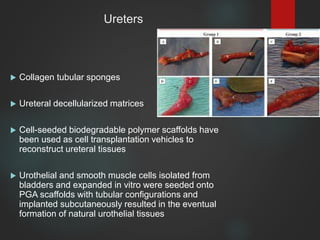
Ureters
 Collagen tubular sponges
 Ureteral decellularized matrices
 Cell-seeded biodegradable polymer scaffolds have
been used as cell transplantation vehicles to
reconstruct ureteral tissues
 Urothelial and smooth muscle cells isolated from
bladders and expanded in vitro were seeded onto
PGA scaffolds with tubular configurations and
implanted subcutaneously resulted in the eventual
formation of natural urothelial tissues
Male Genital And Reproductive Tissue
 One of the major limitations of genital reconstructive surgery is
the availability of sufficient autologous tissue
 Phallic reconstruction was initially attempted in the late 1930s,
with rib cartilage but discouraged because of the unsatisfactory
functional and cosmetic results
 Silicone rigid prostheses were popularized in the 1970s and
have been used widely but biocompatibility issues have been a
problem
Male Genital And Reproductive Tissue
Reconstruction of Penile Corpora
 Cultured human corporeal smooth muscle cells may be used in
conjunction with biodegradable polymers to create corpus
cavernosum tissue de novo
Falke et al, 2003
 Human corpus cavernosal muscle and ECs were derived from
donor penile tissue, and the cells were expanded in vitro and
seeded on the acellular matrices.
 The matrices were covered with the appropriate cell architecture
4 weeks after implantation
Male Genital And Reproductive Tissue
Reconstruction of Penile Corpora
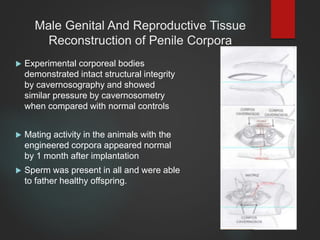
 Experimental corporeal bodies
demonstrated intact structural integrity
by cavernosography and showed
similar pressure by cavernosometry
when compared with normal controls
 Mating activity in the animals with the
engineered corpora appeared normal
by 1 month after implantation
 Sperm was present in all and were able
to father healthy offspring.
Male Genital And Reproductive Tissue
Penile Cell Therapy
 Various cell lines have been used in animal models in an
attempt to reverse erectile dysfunction in animal models
 Endothelial cells
 Mesenchymal stem cells either alone or with matrices
 human bone marrow–derived stem cells
 Muscle-derived stem cells
 Long-term studies are needed to gauge the full impact of
these therapies
Penile transplant
 Such a scaffold could represent a new solution in cases of total penile loss after
cancer or trauma or in transgender surgeries, cases where the incidence is
increasing rapidly.
Male Genital And Reproductive Tissue
Testis – Leydig cells
 Patients with testicular dysfunction require androgen
replacement for somatic development in form of
 periodic intramuscular injections
 Skin patch applications
 Long-term non-pulsatile testosterone therapy is not
optimal and can cause multiple problems
Male Genital And Reproductive Tissue
Testis – Leydig cells
 Leydig cells were microencapsulated in an alginate-poly-L-
lysine solution for controlled testosterone replacement
 Provides a barrier between the transplanted cells and
the host’s immune system, as well as allowing for the
long-term physiologic release of testosterone
 On similar principles, testicular prostheses have been
created with chondrocytes and loaded with testosterone
Male Genital And Reproductive Tissue
Testis – Spermatogenesis
 Spermatogenesis for infertility purposes has been a major area of
interest
 First successful isolation of human spermatogonial stem cells in
2002 showed that the cells were able to colonize and survive for 6
months in mice recipient testes
 Successful autologous and allogeneic spermatogonial stem cell
transplantation has been demonstrated
 In vitro propagation of human spermatogonial stem cells from both
adult and pubertal testes has been established
Female Genital And Reproductive Tissue
Uterus
 Congenital malformations of the uterus may have profound
implications clinically
 possibility of engineering functional uterine tissue using
autologous cells was investigated
 Autologous uterine smooth muscle and epithelial cells were
harvested, grown, and expanded in culture.
 These cells were seeded onto preconfigured uterine-shaped
biodegradable polymer scaffolds, which were then used for
subtotal uterine tissue replacement
Female Genital And Reproductive Tissue
Vagina
 Many techniques and materials can be used successfully for
vaginal reconstruction
 most common, creating a canal by dissecting the potential
neovaginal space and subsequently lining the pelvic canal with a
graft
 Vaginal epithelial and smooth muscle cells were harvested,
expanded, and seeded on biodegradable polymer scaffolds
Female Genital And Reproductive Tissue
Ovary
 Ovarian tissue is essential for fertility.
 Recent studies have shown that ovarian cells can be derived
from stem cell populations. The cells can lead to the
production of oocytes and embryos
 Cell therapies have also been used to enhance the
functionality of the ovary
 Adipose-, amniotic fluid–, umbilical cord–, and bone
marrow–derived stem cells have all resulted in a return of
experimentally damaged ovarian function in animal models
Renal Structures
 Isolation of particular cell types that produce specific factors
may be a good approach for selective cell therapies
 Cells that produce erythropoietin have been isolated in culture,
and these cells could eventually be used to treat anemia that
results from ESRD
 More ambitious approaches involve working toward the goal of
total renal function replacement
Renal Structures
 Nuclear material from bovine dermal fibroblasts was transferred into
unfertilized enucleated eggs.
 Renal cells from the cloned embryos were harvested, expanded in
vitro, and seeded onto three-dimensional renal devices.
 The devices were implanted into the back into the steer and were
retrieved 12 weeks later.
 This process produced functioning renal units
 Cells derived from nuclear transfer can be successfully harvested,
expanded in culture, and transplanted in vivo with the use of
biodegradable scaffolds on which the single suspended cells can
organize into tissue
Renal Structures
 These studies were the first demonstration of the use of
therapeutic cloning for regeneration of tissues in vivo
 Renal cells seeded on the matrix adhered to the inner surface
and proliferated to confluency by 7 days after seeding. Renal
tubular and glomerulus-like structures were observed 8 weeks
after implantation
 More recent data has confirmed that the creation of larger
kidney structures using decellularized kidney matrices and
repopulated with cells is possible
Thank You

tissueengineeringapplicationsinurology-200716071252.pdf

  • 1.
    Tissue engineering Applications inUrology Dr. Roshan V Shetty Senior Resident In Urology AJIMS &RC
  • 2.
     Organ transplantation Tissue for reconstructive procedures  Novel therapies for chronic illness
  • 3.
     Normal woundhealing has been studied extensively and is helpful in maximizing success for the engineering of tissues  At the time of tissue injury, cell ingrowth is initiated from the wound edges to cover the tissue defect  Cells are able to traverse short distances without any detrimental effects  wound is large, more than a few millimeters in distance or depth, increased collagen deposition, fibrosis, and scar formation ensue
  • 4.
     Matrices implantedin wound beds are able to lengthen the distances that cells can traverse  Tissue defects greater than 1 cm that are treated with a matrix alone, without cells, usually have increased collagen deposition  Cell-seeded matrices implanted in wound beds are able to further lengthen the distance for normal tissue formation without initiating an adverse fibrotic response
  • 5.
    Urethra  Naturally derivedcollagen-based materials such as  Woven meshes of PGA without cells and with cells  bladder-derived acellular submucosa  acellular urethral submucosa  collagen gels  bladder submucosa matrix proved to be a suitable graft for repair of urethral defects  Nonseeded acellular matrices, were applied in a successful manner for onlay urethral repairs
  • 6.
    Urethra Atala et al,1999  Neourethras were created by anastomosing the matrix in an on- lay fashion to the urethral plate  size of the created neourethra ranged from 5 to 15 cm  After a 3-year follow-up,  3 or 4 patients had a successful outcome with regard to cosmetic appearance and function  One patient who had a 15-cm neourethra created developed a sub-glanular fistula
  • 7.
    Urethra  Acellular collagen-basedmatrix  Eliminated the necessity of additional surgical procedures for graft harvesting,  Potential morbidity from the harvest procedure were decreased  Reduced operative time  But when tubularized urethral repairs were attempted experimentally, adequate urethral tissue regeneration was not achieved and complications ensued(contracture & Stricture).
  • 8.
    Urethra  To overcomethis bladder epithelial and smooth muscle cells were grown and seeded onto preconfigured tubular matrices  Entire urethra segments were resected and urethroplasties were performed with tubularized collagen matrices seeded with cells
  • 9.
    Urethra Raya-Rivera et al,2011  5 patients with urethral injuries  had a small tissue biopsy specimen retrieved  cells were expanded in vitro and seeded in two layers on tubularized scaffolds that were implanted surgically  engineered urethras were able to show adequate anatomy, both by urethroscopy and with urethrography and function long term
  • 11.
    Bladder  Currently, gastrointestinalsegments are commonly used as tissues for bladder replacement or repair  GI tissues are designed to absorb specific solutes  whereas bladder tissue is designed for the excretion of solutes  Thus, multiple complications may ensue, such as infection, metabolic disturbances, urolithiasis, perforation, increased mucus production, and malignancy
  • 12.
    Bladder Matrices  Synthetic materialsthat have been tried include polyvinyl sponge, Teflon, collagen matrices, Vicryl (PGA) matrices, and silicone  Permanent synthetic materials used for bladder reconstruction succumb to mechanical failure and urinary stone formation  use of degradable materials leads to fibroblast deposition, scarring, graft contracture, and a reduced reservoir volume over time
  • 13.
    Bladder  Non-seeded allogeneicacellular bladder matrices have served as scaffolds for the ingrowth of host bladder wall components serve as vehicles for partial bladder regeneration  Acellular collagen matrices can be enhanced with growth factors to improve bladder regeneration  Cell-seeded allogeneic acellular bladder matrices showed better tissue regeneration
  • 14.
    Bladder  SIS, abiodegradable, acellular, xenogeneic collagen-based tissue matrix graft, was first described in early 1960s  derived from pig small intestine in which mucosa is mechanically removed from inner surface and serosa and muscular layer are removed from outer surface  Non seeded SIS matrix used for bladder augmentation is able to regenerate in vivo  transitional layer was the same as that of the native bladder tissue but muscle layer was not fully developed
  • 15.
    Bladder  Regenerative medicinewith selective cell transplantation in SIS may provide a means to create functional new bladder segments.  Native cells are currently preferable because they can be used without rejection  Amniotic fluid– and bone marrow–derived stem cells have the potential to differentiate into bladder tissue and urothelium.  Embryonic stem cells also have the potential to differentiate into bladder tissue.
  • 16.
    Bladder  A studyusing engineered bladder tissue for cystoplasty reconstruction was conducted starting in 1998  pilot study of seven patients was reported , Atala et al, 2006  Patients underwent reconstruction with the engineered bladder tissue created with the PGA-collagen cell-seeded scaffolds with omental coverage  showed increased compliance, decreased end-filling pressures, increased capacities, and longer dry periods over time
  • 17.
  • 18.
    Bladder cell therapies Injectable therapy within the bladder may be useful for SUI and VUR  Injection of chondrocytes for the correction of VUR in children  At 1-year follow-up, reflux correction was maintained in 70%  SUI in adults have been attempted  After 1 year, 1/8 women achieved total continence and 5 reported improvement
  • 19.
    Bladder cell therapies autologous smooth muscle cells was explored for urinary incontinence, SUI and VUR applications  myoblasts isolated from the abdominal wall vasculature were injected in a series of bladder exstrophy patients with urinary incontinence.  88% of patients were socially dry  The patients were also on a pelvic floor electrical stimulation and pelvic floor exercise program
  • 20.
    Ureters  Collagen tubularsponges  Ureteral decellularized matrices  Cell-seeded biodegradable polymer scaffolds have been used as cell transplantation vehicles to reconstruct ureteral tissues  Urothelial and smooth muscle cells isolated from bladders and expanded in vitro were seeded onto PGA scaffolds with tubular configurations and implanted subcutaneously resulted in the eventual formation of natural urothelial tissues
  • 21.
    Male Genital AndReproductive Tissue  One of the major limitations of genital reconstructive surgery is the availability of sufficient autologous tissue  Phallic reconstruction was initially attempted in the late 1930s, with rib cartilage but discouraged because of the unsatisfactory functional and cosmetic results  Silicone rigid prostheses were popularized in the 1970s and have been used widely but biocompatibility issues have been a problem
  • 22.
    Male Genital AndReproductive Tissue Reconstruction of Penile Corpora  Cultured human corporeal smooth muscle cells may be used in conjunction with biodegradable polymers to create corpus cavernosum tissue de novo Falke et al, 2003  Human corpus cavernosal muscle and ECs were derived from donor penile tissue, and the cells were expanded in vitro and seeded on the acellular matrices.  The matrices were covered with the appropriate cell architecture 4 weeks after implantation
  • 23.
    Male Genital AndReproductive Tissue Reconstruction of Penile Corpora  Experimental corporeal bodies demonstrated intact structural integrity by cavernosography and showed similar pressure by cavernosometry when compared with normal controls  Mating activity in the animals with the engineered corpora appeared normal by 1 month after implantation  Sperm was present in all and were able to father healthy offspring.
  • 24.
    Male Genital AndReproductive Tissue Penile Cell Therapy  Various cell lines have been used in animal models in an attempt to reverse erectile dysfunction in animal models  Endothelial cells  Mesenchymal stem cells either alone or with matrices  human bone marrow–derived stem cells  Muscle-derived stem cells  Long-term studies are needed to gauge the full impact of these therapies
  • 25.
    Penile transplant  Sucha scaffold could represent a new solution in cases of total penile loss after cancer or trauma or in transgender surgeries, cases where the incidence is increasing rapidly.
  • 26.
    Male Genital AndReproductive Tissue Testis – Leydig cells  Patients with testicular dysfunction require androgen replacement for somatic development in form of  periodic intramuscular injections  Skin patch applications  Long-term non-pulsatile testosterone therapy is not optimal and can cause multiple problems
  • 27.
    Male Genital AndReproductive Tissue Testis – Leydig cells  Leydig cells were microencapsulated in an alginate-poly-L- lysine solution for controlled testosterone replacement  Provides a barrier between the transplanted cells and the host’s immune system, as well as allowing for the long-term physiologic release of testosterone  On similar principles, testicular prostheses have been created with chondrocytes and loaded with testosterone
  • 28.
    Male Genital AndReproductive Tissue Testis – Spermatogenesis  Spermatogenesis for infertility purposes has been a major area of interest  First successful isolation of human spermatogonial stem cells in 2002 showed that the cells were able to colonize and survive for 6 months in mice recipient testes  Successful autologous and allogeneic spermatogonial stem cell transplantation has been demonstrated  In vitro propagation of human spermatogonial stem cells from both adult and pubertal testes has been established
  • 29.
    Female Genital AndReproductive Tissue Uterus  Congenital malformations of the uterus may have profound implications clinically  possibility of engineering functional uterine tissue using autologous cells was investigated  Autologous uterine smooth muscle and epithelial cells were harvested, grown, and expanded in culture.  These cells were seeded onto preconfigured uterine-shaped biodegradable polymer scaffolds, which were then used for subtotal uterine tissue replacement
  • 30.
    Female Genital AndReproductive Tissue Vagina  Many techniques and materials can be used successfully for vaginal reconstruction  most common, creating a canal by dissecting the potential neovaginal space and subsequently lining the pelvic canal with a graft  Vaginal epithelial and smooth muscle cells were harvested, expanded, and seeded on biodegradable polymer scaffolds
  • 32.
    Female Genital AndReproductive Tissue Ovary  Ovarian tissue is essential for fertility.  Recent studies have shown that ovarian cells can be derived from stem cell populations. The cells can lead to the production of oocytes and embryos  Cell therapies have also been used to enhance the functionality of the ovary  Adipose-, amniotic fluid–, umbilical cord–, and bone marrow–derived stem cells have all resulted in a return of experimentally damaged ovarian function in animal models
  • 33.
    Renal Structures  Isolationof particular cell types that produce specific factors may be a good approach for selective cell therapies  Cells that produce erythropoietin have been isolated in culture, and these cells could eventually be used to treat anemia that results from ESRD  More ambitious approaches involve working toward the goal of total renal function replacement
  • 34.
    Renal Structures  Nuclearmaterial from bovine dermal fibroblasts was transferred into unfertilized enucleated eggs.  Renal cells from the cloned embryos were harvested, expanded in vitro, and seeded onto three-dimensional renal devices.  The devices were implanted into the back into the steer and were retrieved 12 weeks later.  This process produced functioning renal units  Cells derived from nuclear transfer can be successfully harvested, expanded in culture, and transplanted in vivo with the use of biodegradable scaffolds on which the single suspended cells can organize into tissue
  • 36.
    Renal Structures  Thesestudies were the first demonstration of the use of therapeutic cloning for regeneration of tissues in vivo  Renal cells seeded on the matrix adhered to the inner surface and proliferated to confluency by 7 days after seeding. Renal tubular and glomerulus-like structures were observed 8 weeks after implantation  More recent data has confirmed that the creation of larger kidney structures using decellularized kidney matrices and repopulated with cells is possible
  • 37.