Serial Dilution: Principle,
Method, and Applications
A Practical Approach in Microbiology
Dr. Sweta Naik
Department of Applied Microbiology
Fakir Mohan University
Introduction
• • Definition of serial dilution
• • Importance in microbiology (e.g., estimating
bacterial concentration)
Principle of Serial Dilution
• • Stepwise dilution of a substance in solution
• • Constant dilution factor (e.g., 10-fold)
• • Reduces dense culture to countable
concentration
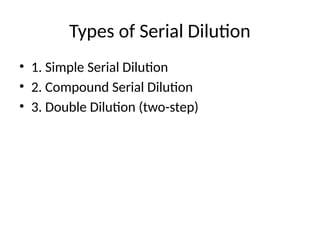
Types of Serial Dilution
• 1. Simple Serial Dilution
• 2. Compound Serial Dilution
• 3. Double Dilution (two-step)
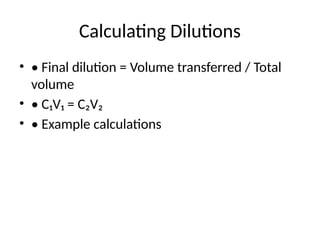
Calculating Dilutions
• • Final dilution = Volume transferred / Total
volume
• • C₁V₁ = C₂V₂
• • Example calculations
Serial Dilution Procedure
• 1. Label dilution tubes
• 2. Add equal volumes of diluent
• 3. Transfer a measured volume to next tube
• 4. Mix thoroughly
• 5. Plate appropriate dilutions
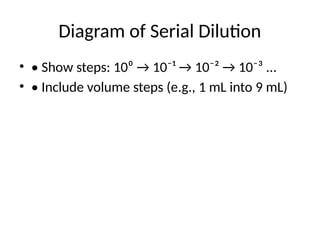
Diagram of Serial Dilution
• • Show steps: 10⁰ → 10⁻¹ → 10⁻² → 10⁻³ ...
• • Include volume steps (e.g., 1 mL into 9 mL)
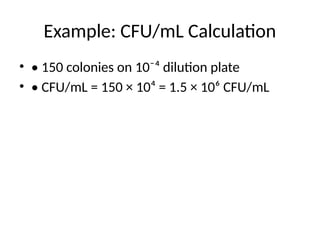
Example: CFU/mL Calculation
• • 150 colonies on 10⁻⁴ dilution plate
• • CFU/mL = 150 × 10⁴ = 1.5 × 10⁶ CFU/mL
Applications of Serial Dilution
• • Microbial count (CFU/mL)
• • Antibiotic sensitivity testing
• • Phage titration
• • Biochemical assays
• • Environmental sample testing
Common Mistakes & Precautions
• • Not mixing well between dilutions
• • Incorrect pipetting volumes
• • Skipping tubes or cross-contamination
Summary
• • Essential for quantifying microbes
• • Accurate technique ensures reliable results
• • Used in clinical, food, and research labs
Quiz/Activity
• • What is the dilution factor if you transfer 1
mL into 9 mL?
• • How many CFU/mL if 80 colonies on 10⁻³
plate?
References
• • Cappuccino & Sherman: Microbiology: A
Laboratory Manual
• • Atlas: Handbook of Microbiological Media
• • ASM online learning portal

Serial_Dilution_Presentation.pptx.......

  • 1.
    Serial Dilution: Principle, Method,and Applications A Practical Approach in Microbiology Dr. Sweta Naik Department of Applied Microbiology Fakir Mohan University
  • 2.
    Introduction • • Definitionof serial dilution • • Importance in microbiology (e.g., estimating bacterial concentration)
  • 3.
    Principle of SerialDilution • • Stepwise dilution of a substance in solution • • Constant dilution factor (e.g., 10-fold) • • Reduces dense culture to countable concentration
  • 4.
    Types of SerialDilution • 1. Simple Serial Dilution • 2. Compound Serial Dilution • 3. Double Dilution (two-step)
  • 5.
    Calculating Dilutions • •Final dilution = Volume transferred / Total volume • • C₁V₁ = C₂V₂ • • Example calculations
  • 6.
    Serial Dilution Procedure •1. Label dilution tubes • 2. Add equal volumes of diluent • 3. Transfer a measured volume to next tube • 4. Mix thoroughly • 5. Plate appropriate dilutions
  • 7.
    Diagram of SerialDilution • • Show steps: 10⁰ → 10⁻¹ → 10⁻² → 10⁻³ ... • • Include volume steps (e.g., 1 mL into 9 mL)
  • 8.
    Example: CFU/mL Calculation •• 150 colonies on 10⁻⁴ dilution plate • • CFU/mL = 150 × 10⁴ = 1.5 × 10⁶ CFU/mL
  • 9.
    Applications of SerialDilution • • Microbial count (CFU/mL) • • Antibiotic sensitivity testing • • Phage titration • • Biochemical assays • • Environmental sample testing
  • 10.
    Common Mistakes &Precautions • • Not mixing well between dilutions • • Incorrect pipetting volumes • • Skipping tubes or cross-contamination
  • 11.
    Summary • • Essentialfor quantifying microbes • • Accurate technique ensures reliable results • • Used in clinical, food, and research labs
  • 12.
    Quiz/Activity • • Whatis the dilution factor if you transfer 1 mL into 9 mL? • • How many CFU/mL if 80 colonies on 10⁻³ plate?
  • 13.
    References • • Cappuccino& Sherman: Microbiology: A Laboratory Manual • • Atlas: Handbook of Microbiological Media • • ASM online learning portal