Tip Clearance Flow
in
Turbomachines
1
Appalla Aditya Shiva
1005 – 17 – 745302
M.E. Turbomachinery
2
Contents:
Basis of tip – clearance flows in turbomachines.
Effects of tip – clearance flow.
Determinants of tip – clearance effect.
Estimation using determinants of tip – clearance flows.
Optimisation of tip – clearance flows.
3
Basis of tip – clearance
flows in turbomachines:
• Tip clearance – radial
distance between rotor and
casing of a turbomachine.
• Tip clearance flow is the flow
across the vane from
pressure to suction side,
deviating from vane –
congruent flow.
• Accounts for nearly 1/3rd of
total accrued losses in axial
turbomachines
4
Basis of tip – clearance
flows in turbomachines:
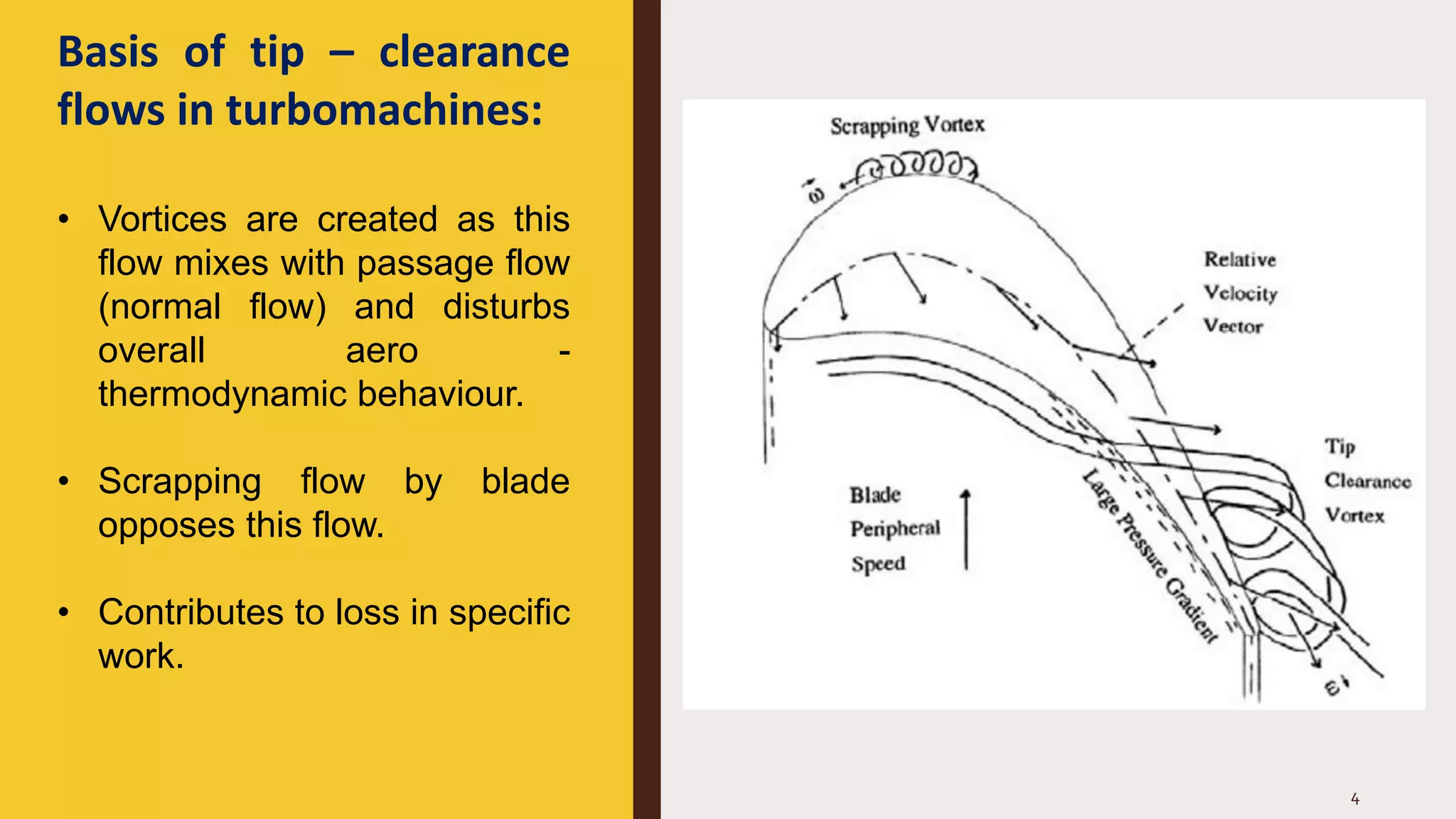
• Vortices are created as this
flow mixes with passage flow
(normal flow) and disturbs
overall aero -
thermodynamic behaviour.
• Scrapping flow by blade
opposes this flow.
• Contributes to loss in specific
work.
■ Effects of tip – clearance
flow:
• Flow separation across the blade.
• Heat generation and abrasive
thermal loading
• Loss in fluid work.
• Blockage of fluid – surge in
compressors.
• Noise production.
• Cavitation in hydro – turbomachines.
■ Determinants of tip – clearance
flow:
• Blade – tip clearances.
• Blade loading.
• Relative motion effect.
• Thermal effects.
• End wall and blade boundary layer
5
6
Analysis of Determinants:
1. Blade curvature
• Vortices lie in the upper half of
most blade profiles, generating
great energy losses.
• Positive or forward curved
vanes experience less vortex
losses.
• Negative or backward curving –
increases wall vortex flows,
sometimes.
7
Analysis of Determinants:
2. Blade – tip clearances
• Pressure loss increases with tip
clearance height, in almost all
cases of subsonic and
transonic flow.
• However, the best results have
been seen at 1% - 3% of blade
height in subsonic flows.
• Such effect is negligible in
turbines generally in transonic
regimes.
8
Analysis of Determinants:
3. Blade contouring:
(a) Squealer Blade:
• Guided grooves on the
suction side streamlines the
flow and decreases tip
leakage flow.
• However, recessed pressure
side faces blade loading.
9
10
Analysis of Determinants:
3. Blade contouring:
(b) Axisymmetric Blade and casing:
• Provides smoother tip flow, thus
lower chances of adverse
pressure gradients.
• Reduces tip leakage flow, thus
increasing efficiency and
maintaining nearly 100% mass
flow rate.
11
Analysis of Determinants:
3. Blade contouring:
(c) Blade tip winglet:
• Eliminates flow separation
completely, gives 100% mass
flow across the stage.
• Pressure side winglet increases
stall performance by nearly 34%,
without any loss in efficiency.
12
Conclusion:
1. Lower blade angles, preferably close to 16° near the outlet.
2. Clearance height as narrow as possible – 0.5% to 1% of blade height.
3. Operate within transonic regime.
4. Use better blade contours – axisymmetric is optimum.
5. Use winglets to fully streamline the flow.

Tip clearance flow

  • 1.
    Tip Clearance Flow in Turbomachines 1 AppallaAditya Shiva 1005 – 17 – 745302 M.E. Turbomachinery
  • 2.
    2 Contents: Basis of tip– clearance flows in turbomachines. Effects of tip – clearance flow. Determinants of tip – clearance effect. Estimation using determinants of tip – clearance flows. Optimisation of tip – clearance flows.
  • 3.
    3 Basis of tip– clearance flows in turbomachines: • Tip clearance – radial distance between rotor and casing of a turbomachine. • Tip clearance flow is the flow across the vane from pressure to suction side, deviating from vane – congruent flow. • Accounts for nearly 1/3rd of total accrued losses in axial turbomachines
  • 4.
    4 Basis of tip– clearance flows in turbomachines: • Vortices are created as this flow mixes with passage flow (normal flow) and disturbs overall aero - thermodynamic behaviour. • Scrapping flow by blade opposes this flow. • Contributes to loss in specific work.
  • 5.
    ■ Effects oftip – clearance flow: • Flow separation across the blade. • Heat generation and abrasive thermal loading • Loss in fluid work. • Blockage of fluid – surge in compressors. • Noise production. • Cavitation in hydro – turbomachines. ■ Determinants of tip – clearance flow: • Blade – tip clearances. • Blade loading. • Relative motion effect. • Thermal effects. • End wall and blade boundary layer 5
  • 6.
    6 Analysis of Determinants: 1.Blade curvature • Vortices lie in the upper half of most blade profiles, generating great energy losses. • Positive or forward curved vanes experience less vortex losses. • Negative or backward curving – increases wall vortex flows, sometimes.
  • 7.
    7 Analysis of Determinants: 2.Blade – tip clearances • Pressure loss increases with tip clearance height, in almost all cases of subsonic and transonic flow. • However, the best results have been seen at 1% - 3% of blade height in subsonic flows. • Such effect is negligible in turbines generally in transonic regimes.
  • 8.
    8 Analysis of Determinants: 3.Blade contouring: (a) Squealer Blade: • Guided grooves on the suction side streamlines the flow and decreases tip leakage flow. • However, recessed pressure side faces blade loading.
  • 9.
  • 10.
    10 Analysis of Determinants: 3.Blade contouring: (b) Axisymmetric Blade and casing: • Provides smoother tip flow, thus lower chances of adverse pressure gradients. • Reduces tip leakage flow, thus increasing efficiency and maintaining nearly 100% mass flow rate.
  • 11.
    11 Analysis of Determinants: 3.Blade contouring: (c) Blade tip winglet: • Eliminates flow separation completely, gives 100% mass flow across the stage. • Pressure side winglet increases stall performance by nearly 34%, without any loss in efficiency.
  • 12.
    12 Conclusion: 1. Lower bladeangles, preferably close to 16° near the outlet. 2. Clearance height as narrow as possible – 0.5% to 1% of blade height. 3. Operate within transonic regime. 4. Use better blade contours – axisymmetric is optimum. 5. Use winglets to fully streamline the flow.