Case Study: Tinker v. Des Moines It can hardly be argued that either students or teachers shed their constitutional rights to freedom of speech or expression at the schoolhouse gate.   - Supreme Court majority opinion, February 24, 1969 Presented by Joan Cansdale March 20, 2010
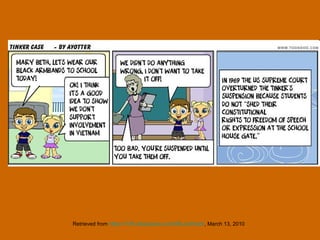
Retrieved from  https://105.wikispaces.com/09Landmark , March 13, 2010
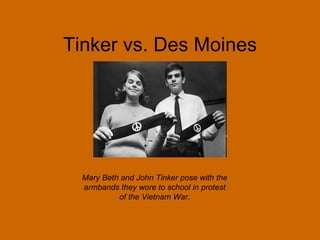
Tinker vs. Des Moines Mary Beth and John Tinker pose with the armbands they wore to school in protest of the Vietnam War .
Tinker v. Des Moines December 16, 1965 : Several students including Christopher  Eckhardt, John Tinker and Mary Beth Tinker arrive at school  wearing black armbands to protest the Vietnam War.  They are  suspended. January 3, 1966 :  The Des Moines school board votes to support the  armband ban and the students’ suspensions. March 14, 1966 :  Iowa Civil Liberties Union files complaint in U. S. District  Court. A tie vote by the U. S. Court of Appeals affirmed the district court’s decision. November 12, 1968 :  case heard by the U. S. Supreme Court February 24, 1969 : Supreme Court reverses District Court’s decision
Tinker   Decision Students have the right to freedom of expression. May not create substantial disruption May not infringe on the rights of others Armband = symbolic act of “pure speech”
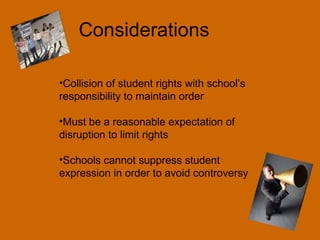
Considerations Collision of student rights with school’s responsibility to maintain order Must be a reasonable expectation of disruption to limit rights Schools cannot suppress student expression in order to avoid controversy
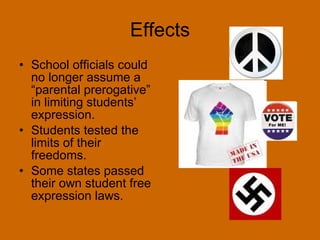
Effects School officials could no longer assume a “parental prerogative” in limiting students’ expression. Students tested the limits of their freedoms. Some states passed their own student free expression laws.
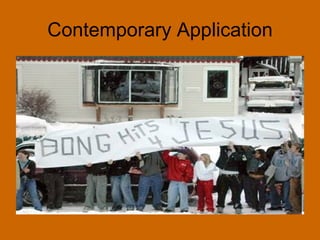
Implications for School Administrators When is an armband more than an armband? Why is it “pure speech”? What qualifies as a “substantial disruption”? Under what conditions might it be appropriate to limit a student’s right to freedom of expression?
Contemporary Application

Tinker vs. DesMoines - Student Free Speech

  • 1.
    Case Study: Tinkerv. Des Moines It can hardly be argued that either students or teachers shed their constitutional rights to freedom of speech or expression at the schoolhouse gate. - Supreme Court majority opinion, February 24, 1969 Presented by Joan Cansdale March 20, 2010
  • 2.
    Retrieved from https://105.wikispaces.com/09Landmark , March 13, 2010
  • 3.
    Tinker vs. DesMoines Mary Beth and John Tinker pose with the armbands they wore to school in protest of the Vietnam War .
  • 4.
    Tinker v. DesMoines December 16, 1965 : Several students including Christopher Eckhardt, John Tinker and Mary Beth Tinker arrive at school wearing black armbands to protest the Vietnam War. They are suspended. January 3, 1966 : The Des Moines school board votes to support the armband ban and the students’ suspensions. March 14, 1966 : Iowa Civil Liberties Union files complaint in U. S. District Court. A tie vote by the U. S. Court of Appeals affirmed the district court’s decision. November 12, 1968 : case heard by the U. S. Supreme Court February 24, 1969 : Supreme Court reverses District Court’s decision
  • 5.
    Tinker Decision Students have the right to freedom of expression. May not create substantial disruption May not infringe on the rights of others Armband = symbolic act of “pure speech”
  • 6.
    Considerations Collision ofstudent rights with school’s responsibility to maintain order Must be a reasonable expectation of disruption to limit rights Schools cannot suppress student expression in order to avoid controversy
  • 7.
    Effects School officialscould no longer assume a “parental prerogative” in limiting students’ expression. Students tested the limits of their freedoms. Some states passed their own student free expression laws.
  • 8.
    Implications for SchoolAdministrators When is an armband more than an armband? Why is it “pure speech”? What qualifies as a “substantial disruption”? Under what conditions might it be appropriate to limit a student’s right to freedom of expression?
  • 9.