© Copyright 2006 Student Press Law Center
Press Freedom for  High School Student Journalists A legal guide to protecting the free press rights of high school student journalists  This presentation was made possible by a generous grant from: © Copyright 2006 Student Press Law Center
Student Press Law Center Web site: www.splc.org Phone: (703) 807-1904 Monday - Friday  9 a.m. - 6 p.m. Eastern Time Provides free legal help and information on media law issues to student journalists and their advisers Between Memorial Day and Labor Day the SPLC closes at 4:30 p.m. on Fridays
Censorship and  the First Amendment What authority do school officials have to control the content of high school student media?
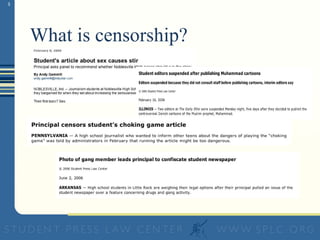
What is censorship?
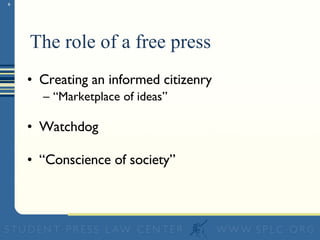
The role of a free press Creating an informed citizenry “Marketplace of ideas” Watchdog “Conscience of society”
“ [W]ere it left to me to decide whether we should have a government without newspapers or newspapers without a government, I should not hesitate a moment to prefer the latter.” —  Thomas Jefferson Letter to Colonel Edward Carrington (January 16, 1787)
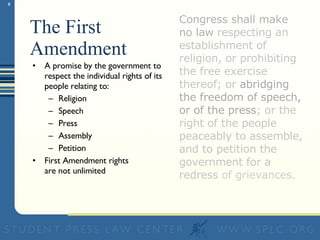
The First Amendment A promise by the government to respect the individual rights of its people relating to: Religion Speech Press Assembly Petition First Amendment rights  are not unlimited Congress shall make no law  respecting an establishment of religion, or prohibiting the free exercise thereof; or  abridging the freedom of speech, or of the press ; or the right of the people peaceably to assemble, and to petition the government for a redress  of grievances.
Public vs. Private Schools Because they are government agencies, public schools are limited by the First Amendment in their ability to censor The First Amendment does not regulate the behavior of private schools.  However, state law or school policy could provide legal protections for press freedom
Legal protections for private school student media State Constitutional Protection
Legal protections for private school student media State Constitutional Protection Contract Law
Legal protections for private school student media State Constitutional Protection Contract Law Public Pressure
Press Freedom at  Public High Schools  Public school officials do not have unlimited authority to censor student media
The “Publisher” Myth Private Publishers Legally own the publication Private money used to fund the publication Private publisher is not a state actor limited by the First Amendment Can freely dictate publication’s content Public School Officials Do not own the publication Taxpayer dollars used to support publication Public School Principal = Government Official First Amendment clearly limits ability of school officials to control publication’s content
Tinker v. Des Moines Independent Community School District  (1969) The U.S. Supreme Court recognizes that the First Amendment protects on-campus student speech
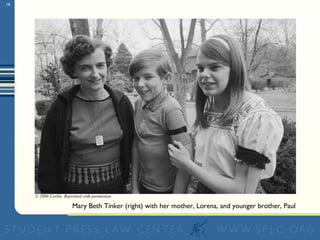
Mary Beth Tinker (right) with her mother, Lorena, and younger brother, Paul © 2006 Corbis. Reprinted with permission.
Neither students nor teachers “shed their constitutional rights to freedom of expression or speech at the schoolhouse gate.” —  Supreme Court majority opinion Tinker v. Des Moines Independent Community School District (1969)
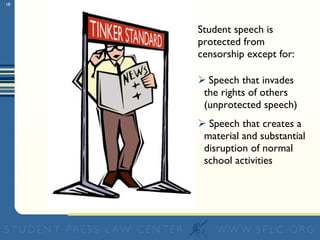
Speech that invades the rights of others (unprotected speech) Speech that creates a material and substantial disruption of normal school activities Student speech is protected from censorship except for:
Unprotected Speech Libel Invasion of Privacy Copyright Infringement “ Fighting Words” Speech that creates a clear and present danger Speech that presents a clear and immediate threat to national security Obscenity* Etc.
“ Material and Substantial Disruption” Serious, physical disruption generally required
“ Material and Substantial Disruption” Serious, physical disruption generally required Reasonable forecast of disruption required
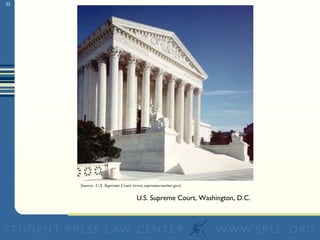
Source: U.S. Supreme Court (www.supremecourtus.gov) U.S. Supreme Court, Washington, D.C.
Hazelwood School District v. Kuhlmeier  (1988) The U.S. Supreme Court significantly reduces the level of First Amendment protection provided to  most  school-sponsored student media at public high schools
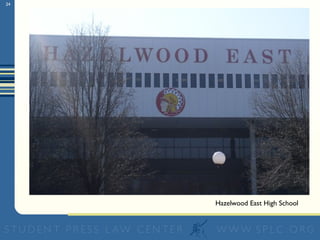
Hazelwood East High School
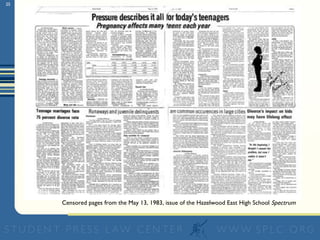
Censored pages from the May 13, 1983, issue of the Hazelwood East High School  Spectrum
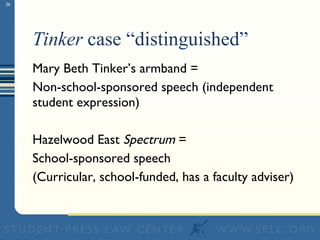
Tinker  case “distinguished” Mary Beth Tinker’s armband =  Non-school-sponsored speech (independent student expression) Hazelwood East  Spectrum  = School-sponsored speech (Curricular, school-funded, has a faculty adviser)
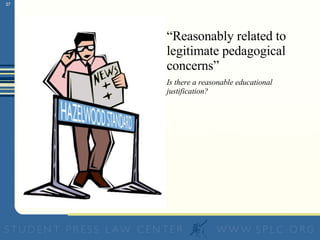
“ Reasonably related to legitimate pedagogical concerns”  Is there a reasonable educational justification?
 
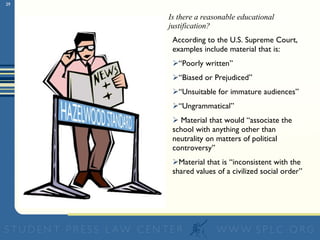
Is there a reasonable educational justification? According to the U.S. Supreme Court, examples include material that is: “ Poorly written” “ Biased or Prejudiced” “ Unsuitable for immature audiences” “ Ungrammatical” Material that would “associate the school with anything other than neutrality on matters of political controversy” Material that is “inconsistent with the shared values of a civilized social order”
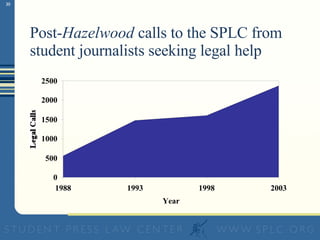
Post- Hazelwood  calls to the SPLC from student journalists seeking legal help
Hazelwood  does not create  an unlimited license to censor! Applies only to school-sponsored speech
Hazelwood  does not create  an unlimited license to censor! Applies only to school-sponsored speech Does not apply to “public forum”  student media
Hazelwood  does not create  an unlimited license to censor! Applies only to school-sponsored speech Does not apply to “public forum”  student media Hazelwood  standard has  some  teeth
Dean v. Utica Community Schools  (2004) The post- Hazelwood  case public high school student media have been awaiting
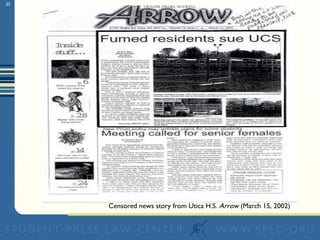
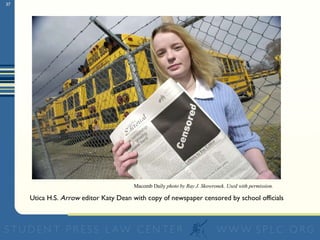
Censored news story from Utica H.S.  Arrow  (March 15, 2002)
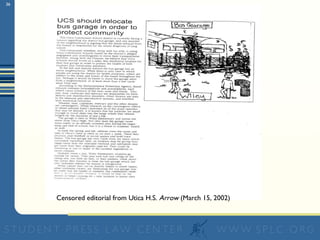
Censored editorial from Utica H.S.  Arrow  (March 15, 2002)
Utica H.S.  Arrow  editor Katy Dean with copy of newspaper censored by school officials Macomb Daily  photo by Ray J. Skowronek. Used with permission.
Censorship “Indefensible” Utica H.S.  Arrow  = Limited Public Forum Even if not a limited public forum , censorship was “unreasonable” under  Hazelwood —  U.S. District Court Judge Arthur Tarnow    Dean v. Utica  bench ruling
Arrow = “Limited Public Forum”  Degree/type of administrative/faculty control   Written policy statements The school’s practice with respect to the forum Curricular/extracurricular nature of student media  The nature of the property at issue and its compatibility with expressive activity
Censorship “Unreasonable” under  Hazelwood Fairness, Balance and Opportunity to Respond  Grammar Writing Quality ("well-written and adhered to established journalistic standards") Suitability for Potential Audience Research quality No Bias or Prejudice Accuracy Discipline, Courtesy and Respect for Authority Timing (could problems with story be reasonably "fixed") Continuity/Experience of Journalism Instructor
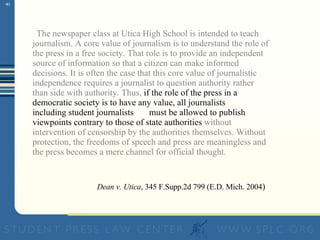
“ The newspaper class at Utica High School is intended to teach journalism. A core value of journalism is to understand the role of the press in a free society. That role is to provide an independent source of information so that a citizen can make informed decisions. It is often the case that this core value of journalistic independence requires a journalist to question authority rather than side with authority. Thus,  if the role of the press in a democratic society is to have any value, all journalists — including student journalists — must be allowed to publish viewpoints contrary to those of state authorities  without intervention of censorship by the authorities themselves. Without protection, the freedoms of speech and press are meaningless and the press becomes a mere channel for official thought.” —  Dean v. Utica , 345 F.Supp.2d 799 (E.D. Mich. 2004 )
State and Local  Anti- Hazelwood  Protection  Hazelwood  does not trump free speech protection provided by state law or local policies
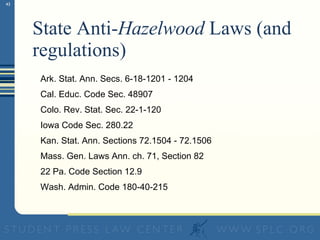
State Anti- Hazelwood  Laws (and regulations)  Ark. Stat. Ann. Secs. 6-18-1201 - 1204 Cal. Educ. Code Sec. 48907 Colo. Rev. Stat. Sec. 22-1-120 Iowa Code Sec. 280.22 Kan. Stat. Ann. Sections 72.1504 - 72.1506 Mass. Gen. Laws Ann. ch. 71, Section 82 22 Pa. Code Section 12.9 Wash. Admin. Code 180-40-215
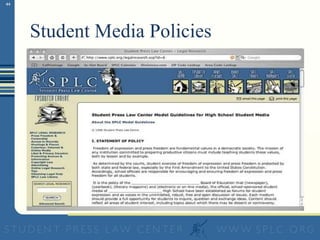
Student Media Policies
Fighting Censorship:  A Checklist What to do if it happens to you
Fighting Censorship:  A Checklist Practice sound journalism
Fighting Censorship:  A Checklist Practice sound journalism Pick your battles wisely
Fighting Censorship:  A Checklist Practice sound journalism Pick your battles wisely Do your homework
Fighting Censorship:  A Checklist Practice sound journalism Pick your battles wisely Do your homework Meet with the censors
Fighting Censorship:  A Checklist Practice sound journalism Pick your battles wisely Do your homework Meet with the censors Use the court of public opinion
Fighting Censorship:  A Checklist Practice sound journalism Pick your battles wisely Do your homework Meet with the censors Use the court of public opinion Consider alternative media
Fighting Censorship:  A Checklist Practice sound journalism Pick your battles wisely Do your homework Meet with the censors Use the court of public opinion Consider alternative media Consider your legal options
Need more help? Additional resources for high school student media
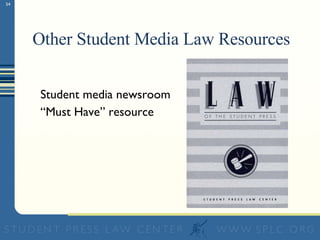
Other Student Media Law Resources Student media newsroom “ Must Have” resource
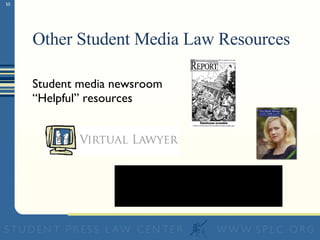
Other Student Media Law Resources Student media newsroom “Helpful” resources
Seek help when you need it! Student Press Law Center www.splc.org (703) 807-1904 Monday - Friday, 9 a.m. to 6 p.m. Eastern Time Between Memorial Day and Labor Day the SPLC closes at 4:30 p.m. on Fridays
Press Freedom for High School Student Journalists  was written and produced by the Student Press Law Center with the support of a generous grant from the Newspaper Association of America Foundation.  You can help the Student Press Law Center create new generations of Americans who will understand and defend the First Amendment to the U.S. Constitution and the values it embodies through your tax-deductible contribution.  Go to  www.splc.org/give  for details.  Permission to use and display this classroom presentation for noncommercial, educational purposes is hereby granted. Any commercial use, reproduction or editing of this presentation is prohibited without the express written permission of the Student Press Law Center. While every effort is made to ensure the accuracy of the information contained in  Press Law Primer for High School Student Journalists  it provides  general guidance and information only . It is neither intended nor represented as a substitute for obtaining case-specific advice from a licensed and experienced media law attorney in your state. © 2006 Student Press Law Center. All rights reserved.

Pppressfreedom

  • 1.
    © Copyright 2006Student Press Law Center
  • 2.
    Press Freedom for High School Student Journalists A legal guide to protecting the free press rights of high school student journalists This presentation was made possible by a generous grant from: © Copyright 2006 Student Press Law Center
  • 3.
    Student Press LawCenter Web site: www.splc.org Phone: (703) 807-1904 Monday - Friday 9 a.m. - 6 p.m. Eastern Time Provides free legal help and information on media law issues to student journalists and their advisers Between Memorial Day and Labor Day the SPLC closes at 4:30 p.m. on Fridays
  • 4.
    Censorship and the First Amendment What authority do school officials have to control the content of high school student media?
  • 5.
  • 6.
    The role ofa free press Creating an informed citizenry “Marketplace of ideas” Watchdog “Conscience of society”
  • 7.
    “ [W]ere itleft to me to decide whether we should have a government without newspapers or newspapers without a government, I should not hesitate a moment to prefer the latter.” — Thomas Jefferson Letter to Colonel Edward Carrington (January 16, 1787)
  • 8.
    The First AmendmentA promise by the government to respect the individual rights of its people relating to: Religion Speech Press Assembly Petition First Amendment rights are not unlimited Congress shall make no law respecting an establishment of religion, or prohibiting the free exercise thereof; or abridging the freedom of speech, or of the press ; or the right of the people peaceably to assemble, and to petition the government for a redress of grievances.
  • 9.
    Public vs. PrivateSchools Because they are government agencies, public schools are limited by the First Amendment in their ability to censor The First Amendment does not regulate the behavior of private schools. However, state law or school policy could provide legal protections for press freedom
  • 10.
    Legal protections forprivate school student media State Constitutional Protection
  • 11.
    Legal protections forprivate school student media State Constitutional Protection Contract Law
  • 12.
    Legal protections forprivate school student media State Constitutional Protection Contract Law Public Pressure
  • 13.
    Press Freedom at Public High Schools Public school officials do not have unlimited authority to censor student media
  • 14.
    The “Publisher” MythPrivate Publishers Legally own the publication Private money used to fund the publication Private publisher is not a state actor limited by the First Amendment Can freely dictate publication’s content Public School Officials Do not own the publication Taxpayer dollars used to support publication Public School Principal = Government Official First Amendment clearly limits ability of school officials to control publication’s content
  • 15.
    Tinker v. DesMoines Independent Community School District (1969) The U.S. Supreme Court recognizes that the First Amendment protects on-campus student speech
  • 16.
    Mary Beth Tinker(right) with her mother, Lorena, and younger brother, Paul © 2006 Corbis. Reprinted with permission.
  • 17.
    Neither students norteachers “shed their constitutional rights to freedom of expression or speech at the schoolhouse gate.” — Supreme Court majority opinion Tinker v. Des Moines Independent Community School District (1969)
  • 18.
    Speech that invadesthe rights of others (unprotected speech) Speech that creates a material and substantial disruption of normal school activities Student speech is protected from censorship except for:
  • 19.
    Unprotected Speech LibelInvasion of Privacy Copyright Infringement “ Fighting Words” Speech that creates a clear and present danger Speech that presents a clear and immediate threat to national security Obscenity* Etc.
  • 20.
    “ Material andSubstantial Disruption” Serious, physical disruption generally required
  • 21.
    “ Material andSubstantial Disruption” Serious, physical disruption generally required Reasonable forecast of disruption required
  • 22.
    Source: U.S. SupremeCourt (www.supremecourtus.gov) U.S. Supreme Court, Washington, D.C.
  • 23.
    Hazelwood School Districtv. Kuhlmeier (1988) The U.S. Supreme Court significantly reduces the level of First Amendment protection provided to most school-sponsored student media at public high schools
  • 24.
  • 25.
    Censored pages fromthe May 13, 1983, issue of the Hazelwood East High School Spectrum
  • 26.
    Tinker case“distinguished” Mary Beth Tinker’s armband = Non-school-sponsored speech (independent student expression) Hazelwood East Spectrum = School-sponsored speech (Curricular, school-funded, has a faculty adviser)
  • 27.
    “ Reasonably relatedto legitimate pedagogical concerns” Is there a reasonable educational justification?
  • 28.
  • 29.
    Is there areasonable educational justification? According to the U.S. Supreme Court, examples include material that is: “ Poorly written” “ Biased or Prejudiced” “ Unsuitable for immature audiences” “ Ungrammatical” Material that would “associate the school with anything other than neutrality on matters of political controversy” Material that is “inconsistent with the shared values of a civilized social order”
  • 30.
    Post- Hazelwood calls to the SPLC from student journalists seeking legal help
  • 31.
    Hazelwood doesnot create an unlimited license to censor! Applies only to school-sponsored speech
  • 32.
    Hazelwood doesnot create an unlimited license to censor! Applies only to school-sponsored speech Does not apply to “public forum” student media
  • 33.
    Hazelwood doesnot create an unlimited license to censor! Applies only to school-sponsored speech Does not apply to “public forum” student media Hazelwood standard has some teeth
  • 34.
    Dean v. UticaCommunity Schools (2004) The post- Hazelwood case public high school student media have been awaiting
  • 35.
    Censored news storyfrom Utica H.S. Arrow (March 15, 2002)
  • 36.
    Censored editorial fromUtica H.S. Arrow (March 15, 2002)
  • 37.
    Utica H.S. Arrow editor Katy Dean with copy of newspaper censored by school officials Macomb Daily photo by Ray J. Skowronek. Used with permission.
  • 38.
    Censorship “Indefensible” UticaH.S. Arrow = Limited Public Forum Even if not a limited public forum , censorship was “unreasonable” under Hazelwood — U.S. District Court Judge Arthur Tarnow Dean v. Utica bench ruling
  • 39.
    Arrow = “LimitedPublic Forum” Degree/type of administrative/faculty control Written policy statements The school’s practice with respect to the forum Curricular/extracurricular nature of student media The nature of the property at issue and its compatibility with expressive activity
  • 40.
    Censorship “Unreasonable” under Hazelwood Fairness, Balance and Opportunity to Respond Grammar Writing Quality ("well-written and adhered to established journalistic standards") Suitability for Potential Audience Research quality No Bias or Prejudice Accuracy Discipline, Courtesy and Respect for Authority Timing (could problems with story be reasonably "fixed") Continuity/Experience of Journalism Instructor
  • 41.
    “ The newspaperclass at Utica High School is intended to teach journalism. A core value of journalism is to understand the role of the press in a free society. That role is to provide an independent source of information so that a citizen can make informed decisions. It is often the case that this core value of journalistic independence requires a journalist to question authority rather than side with authority. Thus, if the role of the press in a democratic society is to have any value, all journalists — including student journalists — must be allowed to publish viewpoints contrary to those of state authorities without intervention of censorship by the authorities themselves. Without protection, the freedoms of speech and press are meaningless and the press becomes a mere channel for official thought.” — Dean v. Utica , 345 F.Supp.2d 799 (E.D. Mich. 2004 )
  • 42.
    State and Local Anti- Hazelwood Protection Hazelwood does not trump free speech protection provided by state law or local policies
  • 43.
    State Anti- Hazelwood Laws (and regulations) Ark. Stat. Ann. Secs. 6-18-1201 - 1204 Cal. Educ. Code Sec. 48907 Colo. Rev. Stat. Sec. 22-1-120 Iowa Code Sec. 280.22 Kan. Stat. Ann. Sections 72.1504 - 72.1506 Mass. Gen. Laws Ann. ch. 71, Section 82 22 Pa. Code Section 12.9 Wash. Admin. Code 180-40-215
  • 44.
  • 45.
    Fighting Censorship: A Checklist What to do if it happens to you
  • 46.
    Fighting Censorship: A Checklist Practice sound journalism
  • 47.
    Fighting Censorship: A Checklist Practice sound journalism Pick your battles wisely
  • 48.
    Fighting Censorship: A Checklist Practice sound journalism Pick your battles wisely Do your homework
  • 49.
    Fighting Censorship: A Checklist Practice sound journalism Pick your battles wisely Do your homework Meet with the censors
  • 50.
    Fighting Censorship: A Checklist Practice sound journalism Pick your battles wisely Do your homework Meet with the censors Use the court of public opinion
  • 51.
    Fighting Censorship: A Checklist Practice sound journalism Pick your battles wisely Do your homework Meet with the censors Use the court of public opinion Consider alternative media
  • 52.
    Fighting Censorship: A Checklist Practice sound journalism Pick your battles wisely Do your homework Meet with the censors Use the court of public opinion Consider alternative media Consider your legal options
  • 53.
    Need more help?Additional resources for high school student media
  • 54.
    Other Student MediaLaw Resources Student media newsroom “ Must Have” resource
  • 55.
    Other Student MediaLaw Resources Student media newsroom “Helpful” resources
  • 56.
    Seek help whenyou need it! Student Press Law Center www.splc.org (703) 807-1904 Monday - Friday, 9 a.m. to 6 p.m. Eastern Time Between Memorial Day and Labor Day the SPLC closes at 4:30 p.m. on Fridays
  • 57.
    Press Freedom forHigh School Student Journalists was written and produced by the Student Press Law Center with the support of a generous grant from the Newspaper Association of America Foundation. You can help the Student Press Law Center create new generations of Americans who will understand and defend the First Amendment to the U.S. Constitution and the values it embodies through your tax-deductible contribution. Go to www.splc.org/give for details. Permission to use and display this classroom presentation for noncommercial, educational purposes is hereby granted. Any commercial use, reproduction or editing of this presentation is prohibited without the express written permission of the Student Press Law Center. While every effort is made to ensure the accuracy of the information contained in Press Law Primer for High School Student Journalists it provides general guidance and information only . It is neither intended nor represented as a substitute for obtaining case-specific advice from a licensed and experienced media law attorney in your state. © 2006 Student Press Law Center. All rights reserved.

Editor's Notes

  • #2 [Note to Presenter: The notes that follow work as either a presentation script or as preparatory material for the presenter. If you’re reading the notes as a script and allow for moderate discussion, the full presentation should last approximately 45-60 minutes.]