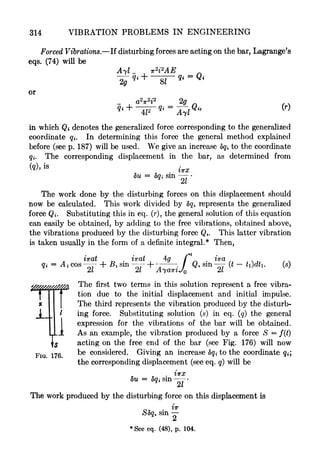
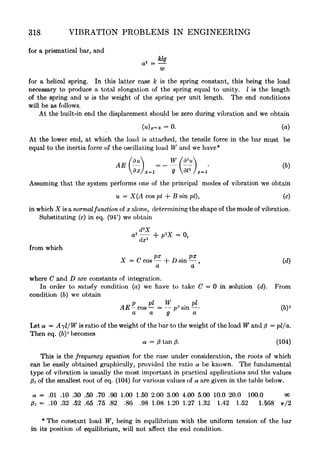
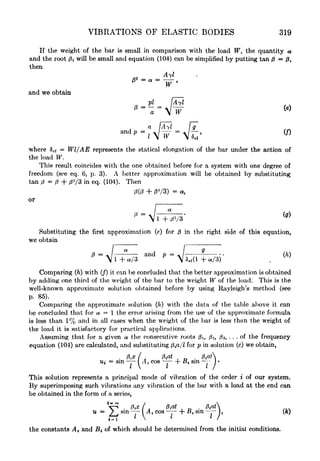
Part-2
CHAPTER V
TORSIONAL AND LATERAL VIBRATION OF SHAFTS
42. Free Torsional Vibrations of Shafts. In the previous discussion of
torsional vibrations (see Art. 2) a simple problem of a shaft with two
rotating masses at the ends was considered. In the following the general
case of vibration of a shaft with several rotating masses will be discussed,
Fig. 147. Many problems on torsional vibrations in electric machinery,
Diesel engines and propeller shafts can be reduced to such a system.*
Let /i, /2, /s, be moments of inertia of the rotating masses about
the axis of the shaft, <pi, ^2, <P3, angles of rotation of these masses
during vibration, and k 9 k%, 3,
spring constants of the shaft for the
length db, 6c, and cd, respectively. Then
ki(<?i (2), &2(<P2 ^3)*
*
represent
torsional moments for the above lengths.
If we proceed as in Art. 2 and observe
that on the first disc a torque fci(<pi
(pz) acts during vibration, while on the second disc the torque is k(<p
92) &2(<p2
~~
^s) and so on>
tne differential equations of motion for con-
secutive discs become
Fia. 147.
w) =
=
=
-l <f>n)
= 0. (a)
*
The bibliography of this subject can be found in the very complete investigation
of torsional vibration in the Diesel engine made by F. M. Lewis; see Trans. Soc. of
Naval Architects and Marine Engineers, Vol. 33, 1925, p. 109, New York. A number of
practical examples are calculated in the books: W. K. Wilson, "Practical Solution of
Torsional Vibration Problems," New York, 1935. W. A. Tuplin, "Torsional Vibration,"
New York, 1934.
253
254 VIBRATION PROBLEMS IN ENGINEERING
Adding these equations together we get
n<f>n
= 0, (tt
which means that the moment of momentum of the system about the
axis of the shaft remains constant during the free vibration. In the fol-
lowing this moiftent of momentum will be taken equal to zero. In this
manner any rotation of the shaft as a rigid body will be excluded and only
vibratory motion due to twist of the shaft will be considered. To find the
frequencies of the natural vibrations of this system we proceed as before
and take the solutions of equations (a) in the form
<?1
= Xi COS pt, <P2
= X2 COS ptj
Substituting in equations (a) we obtain
= Xa cos
- X2 )
=
- X2 )
- A; 2 (X2
- X3 )
=
fcn_l(X n -l ~ X w)
= 0. (c)
Eliminating Xi, X2 ,
from
these equations, we obtain an equation
of the nth degree in p
2
called the fre-
quency equation. The n roots of this
equation give us the n frequencies cor-
VM4
^mjj]j| j
x3 responding to the n principal modes of
vibration of the system.
The System of Three Discs. Let
us apply the above given general dis-
cussion to the problem of three discs,
Fig. 148. The system of equations (c)
in this case becomes:
- fci(Xi
- X2)
=
+ fci(Xi
- X2)
- /b 2 (X2
- X3 )
=
/3X3 p
2
+ fc 2 (X2
- Xs)
= 0.
From the. first and the third of these equations we find that :
FIG. 148.
X3
=-
TORSIONAL AND LATERAL VIBRATION OF SHAFTS 255
Substituting these expressions into equation
(/iXi + 72X2 + /3X3)p
2 = 0,
which is obtained by adding together equations (d), we find
=0.
This is a cubic equation in p
2
of which one of the roots is p
2 = 0. This
root corresponds to the possibility of having the shaft rotate as a rigid
body without any torsion (see Art. 35). The two other roots can be readily
found from the quadratic equation
=0. (84)
Let pi
2
and p>2
2
be these two roots. Substituting pi
2
instead of p
2
in equa-
tions (e) we find that:
i ki 3 k<2
X2 hpi
2
ki
'
2 /spi
2
fe
If pi
2
is the smaller root we shall find that one of these two ratios is posi-
tive while the other is negative; this means that during vibrations two
adjacent discs will rotate in one direction while the third disc rotates in an
opposite direction giving the mode of vibration shown in Fig. I486.*
For the larger root p2
2
both ratios become negative and the mode of vibra-
tion, corresponding to the higher frequency is shown in Fig. 148c. During
this vibration the middle disc rotates in the direction opposite to the rota-
tion of the two other discs.
The Case of Many Discs. In the case of four discs we shall have four
equations in the system (c), and proceeding as in the previous case we get
a frequency equation of fourth degree in p
2
. One of the roots is again
zero so that for calculating the remaining three roots we obtain a cubic
equation. To simplify the writing of this equation, let us introduce the
notations
fci fci 2 ^2 fc* fo
7-
= l,
= CX2,
= 3, 7-
= 4, y = 6, 7-
= 6
/I 12 /2^ /3 h ^4
Then the frequency equation is
2 + ai3 + 0203 ~ a2a3 ~
= 0. (85)
*
It is assumed that Is/k* > I/ki.
256 VIBRATION PROBLEMS IN ENGINEERING
In solving this equation one of the approximate methods for calcu-
lating the roots of algebraic equations of higher degree must be used.*
When the number of discs is larger than four the derivation of the
frequency equation and its solution become too complicated and the calcu-
lation of frequencies is usually made by one of the approximate methods.
Geared Systems. Sometimes we have to deal with geared systems as
shown in Fig. 149a, instead of with a single shaft. The general equations
k'
I,
fr
FIG. 149tt. FIG. 1496.
of vibration of such systems can be readily derived. Considering the
system in Fig. 149a, let
lit ^3 be moments of inertia of rotating masses.
V?i, <p3 are the corresponding angles of rotation.
^2', iz" are moments of inertia of gears.
n is gear ratio.
^2, n<p2 are angles of rotation of gears.
kit &2 are spring constants of shafts.
Then the kinetic energy of the system will be
79, _ _ji_1 ~ ~
12
The potential energy of the system is
V =
Letting
(a)
(K)
*
Such methods are discussed in v. Sanden's book, "Practical Analysis."
TORSIONAL AND LATERAL VIBRATION OF SHAFTS 257
The equations (/) and (g) become
v =
These expressions have the same form as the expressions for T and V
which can be written for a single shaft. It can be concluded from this
that the differential equations of vibration of the geared system shown in
Fig. 149 will be the same as those of a single shaft with discs provided the
notations shown in eqs. (h) are used. This conclusion can be expanded
also to the case of a geared system with more than two shafts.*
Another arrangement of a geared system is shown in Fig. 1496, in
which /o, /i, /2, are the moments of inertia of the rotating masses;
fci, A?2, torsional rigidities of the shafts. Let, n be gear ratio, ^>o, <f>i,
<P2,
- -
angles of rotation of discs /o, /i, /2 If /o is very large
in comparison with the other moments of inertia we can take <po
= 0, then
the kinetic and the potential energy of the system will be
+ W+ W+ W),2
+ k'2(<p2
- <pi)
2
= 0,
= 0,
<>)
= 0,
= 0,
and Lagrange's differential equations of motion become
from which the frequency equation .can be obtained in the same manner
as before and the frequencies will then be represented by the roots of
this equation.
PROBLEMS
Determine the natural frequencies of a steel shaft with three discs, Fig. 148, if the
weights of the discs are 3000 11)., 2000 Ib. and 1000 lb., the diameters of the discs are 40
in., the distances between the discs are l h = 30 in., the diameter of the shaft is 5 in.
and the modulus of elasticity in shear is G = 11.5-106
lb. per sq. in. Determine the
ratios between the angular deflections Xi :
2, X2 : Xa for the two principal modes of
vibration.
*
Such systems are considered in the paper by T. H. Smith, "Nodal Arrangements
of Geared Drives," Engineering, 1922, pp. 438 and 467.
253 VIBRATION PROBLEMS IN ENGINEERING
Solution. Making our calculations in inches and in pounds, we find that:
11
= 1553, 7 2 = 1035, 78
= 517.7, fci
= kz
= 23.5 -108
.
Eq. (84) becomes
p
4 - 106000 p
2
+ 2060. 10 = 0,
from which
Pi
2 = 25600, p2
2 = 80400.
The corresponding frequencies are:
PI PI
/i
= - =v 25.5 per sec. /a
= = 45.2 per sec.
2w 2ir
The ratios of amplitudes for the fundamental mode of vibration are:
X!/X, = _ 1.44, X3 /X2
= 2.29.
For the higher mode of vibration
Xi/X2
= -0.232, X3 /X2
= - 1.30.
43. Approximate Methods of Calculating Frequencies of Natural
Vibrations. In practical applications it is usually the lowest frequency or
the two lowest frequencies of vibration of a shaft with several discs that
are important and in many cases these can be approximately calculated by
using the results obtained in the case of two and three discs. Take
as a first example a shaft with four discs of which the moments of
inertia are /i = 302 Ib. in. sec.
2
,
72 = 87,500 Ib. in. sec.
2
, h = 1200
Ib. in. sec.
2
, /4 = 0.373 Ib. in. sec.
2
. The spring constants of the three
portions of the shaft are k = 316 -106
Ib. in. per radian, 2 = 114.5-106
Ib. in. per radian, k% = 1.09 -106
Ib. in. per radian. Since I and /4 are
very small we can neglect them entirely in calculating the lowest fre-
quency and consider only the two discs 12 and 13. Applying equation
(17) for this system, we obtain
1
/(
^r ^
_49- 6 P61
"
sec-
In dealing with the vibration of the disc /i we can consider the disc 12 as
being infinitely large and assume that it does not vibrate, then the fre-
quency of the disc /i, from eq. (14), is
163 per sec.
TORSIONAL AND LATERAL VIBRATION OF SHAFTS 259
Noting again that the disc /4 is very small in comparison with Is and
neglecting the motion of the latter disc we find
T*
14
272 Per sec-
A more elaborate calculation for this case by using the cubic equation (84)
gives /i
= 49.5, /2
= 163, /s
= 272, so that for the given proportions of the
discs it is not necessary to go into a refined calculation.
As a second example let us consider the system shown in Fig. 150,
where the moments of inertia of the generator, flywheel, of six cylinders
and two air purnps, and also the distances between these masses are given.*
3000
2200
FIG. 150.
The shaft is replaced by an equivalent shaft of uniform section (see p. 271)
with a torsional rigidity C = 10 H)
kg. X cm.2
Due to the fact that the
masses of the generator and of the flywheel are much larger than the remain-
ing masses a good approximation for the frequency of the lowest type of
vibration can be obtained by replacing all the small masses by one mass
having a moment of inertia, /a = 93 X 6 + 7 + 6.5 572 and located
at the distance 57.5 + 2.5 X 48.5 179 centimeters from the flywheel.
Reducing in this manner the given system to three masses only the fre-
quencies can be easily calculated from eq. (84) and we obtain pi
2 = 49,000
and p2
2 = 123,000. The exact solution for the same problem gives pi
2 =
*
This example is discussed in the book by Holzer mentioned below (see p. 263).
Kilogram and centimeter are taken as units.
260 VIBRATION PROBLEMS IN ENGINEERING
49,840 and p2
2 = 141,000. It is seen that a good approximation is obtained
for the fundamental type of vibration. In order to get a still better
approximation Rayleigh's method can be used (see Art. 16).
Rayleigh's Method. Let a and b denote the distances of the flywheel from the ends
of the shaft and assume that the shapes of the two principal modes of vibrations are
such as shown in Fig. 150 (6) and (c) and that the part 6 of the deflection curve can
be replaced by a parabola so that the angle of twist <? for any section distant x from the
flywheel is given by the equation
,
(vio v>2)(26 x)x
v = v>2 H (a)
It is easy to see that for x = and x = 6 the angle <p in the above equation assumes
the values <f>% and <f> i0 respectively. By eq. (a) and the first of eqs. (c) Art. 42 we have:
<f>2
The angles of rotation of all other, masses can be represented as functions of <f>i and v'lo
and these latter two angles can be considered as the generalized coordinates of the
given system.
Then the potential energy of the system is
(yi
- 2)'C ,
1
/-VM2
.
C
V =
2a
+ 2
C
Jo(TX)
dX=
2
in which
V ,
and C is torsional rigidity of the shaft. (d)
The kinetic energy of the system will be
T - V^ *
-~-
2 2
'
or by using the eqs. (a) and (6) and letting Xk = the distance from the flywheel to any
rotating mass k and ak =
T = 7
*
2
Substituting (e) and (c) in Lagrange's equations (73) and putting, as before,
<f>i
= Xj cos (pt -f- /3); <f>o Xio cos (pt -f- /3),
TORSIONAL AND LATERAL VIBRATION OF SHAFTS 261
the following two equations will be obtained:
7d - 7) ^4f 4a
1
T - 5 7 (1
-
LOO
u S
By equating the determinant of these equations to zero the frequency equation will
be obtained, the two roots of which will give us the frequencies of the two modes of
vibration shown in Fig. 150. All necessary calculations are given in the table on p. 262.
Then from the frequency equation the smaller root will be
7 = 1.563,
and from (d) we obtain
p
2 = 50000.
The error of this approximate solution as compared with the exact solution given above
is only K%-
The second root of the frequency equation gives the frequency of the second mode
of vibration with an accuracy of 4.5%. It should be noted that in using this approxi-
mate method the effect of the mass of the shaft on the frequency of the system can
easily be calculated.*
As soon as we have an approximate value of a frequency, we can improve
the accuracy of the solution by the method of successive approximations.
For this purpose the equations (c) (p. 254), must be written in the form:
X3 = X2
- (/ lXl + J2X2), (0
K2
X4 = X3
-
f
:
(/iXi + 72X2 + /sXs), (h)
Making now a rough estimate of the value p
2
and taking an arbitrary
value for Xi, the angular deflection of the first disc, the corresponding
value of X2 will be found from eq. (/). Then, from eq. (g) Xs will be
*
See writer's paper in the Bulletin of the Polytechnical Institute in S. Petersburg
(1905).
262 VIBRATION PROBLEMS IN ENGINEERING
TORSIONAL AND LATERAL VIBRATION OF SHAFTS 263
found; 4 from eq. (h) and so on. If the magnitude of p
2
had been
chosen correctly, the equation
/iXlp
2
+ 72X2P
2
+ /nXn??
2 = 0,
representing the sum of the eqs. (c) (p. 254), would be satisfied. Other-
wise the angles 2, Xs, would have to be calculated again with a new
estimate for p-.* It is convenient to put the results of these calculations
in tabular form. As an example, the calculations for a Diesel installation,
shown in Fig. 151, are given in the tables on p. 264. f
FIG. 151.
Column 1 of the tables gives the moments of inertia of the masses, inch,
pound and second being taken as units. Column 3 begins with an arbi-
trary value of the angle of rotation of the first mass. This angle is taken
equal to 1. Column 4 gives the moments of the inertia forces of the
consecutive masses and column 5 the total torque of the inertia forces of
all masses to the left of the cross section considered. Dividing the torque
by the spring constants given in column 6, we obtain the angles of twist
for consecutive portions of the shaft. These are given in column 7. The
last number in column 5 represents the sum of the moments of the inertia
forces of all the masses. This sum must be equal to zero in the case of
free vibration. By taking p = 96.2 in the first table, the last value in
column 5 becomes positive. For p = 96.8, taken in the second table,
the corresponding value is negative. This shows that the exact value of
*
Several examples of this calculation may he found in the book by H. Holzer,
"Die Berechnung der Drehsehwingungen," 1921, Berlin, J. Springer. See also F. M.,
Lewis, loc. cit., and Max Tolle, "Regelung der Kraftmaschinen," 3d Ed., 1921.
| These calculations were taken from the paper of F. M. Lewis, mentioned above.
264 VIBRATION PROBLEMS IN ENGINEERING
Table for p = 96,S; p
2 = 9250
Table for p = 96,8; p-
= 9380
p lies between the above two values and the correct values in columns 3
and 5 will be obtained by interpolation. By using the values in column 3,
the elastic curve representingthe mode of vibration can be constructed as
shown in Fig. 151. Column 5 gives the corresponding torque for each
portion of the shaft when the amplitude of the first mass is 1 radian.
If this amplitude has any other value Xi, the amplitudes and the torque
of the other masses may be obtained by multiplying the values in columns
3 and 5 by Xi.
TORSIONAL AND LATERAL VIBRATION OF SHAFTS 265
44. Forced Torsional Vibration of a Shaft with Several Discs. If a
torque Mt sin ut is applied to one of the discs forced vibrations of the
period r = 2?r/co will be produced; moreover the vibration of each disc
will be of the form X sin w. The procedure of calculating the amplitudes
of forced vibration will now be illustrated by an example.
Let us take a shaft (Fig. 152) with four discs of which the moments of
inertia are I = 777, /2 = 518, 7s = h = 130, and the spring constants
are k = 24.6 -106
, &2 = 3
= 36.8-10, inches, pounds and seconds being
(*)
FIG. 152.
taken as units. Assume that a pulsating torque Mt sin ut is acting on the
first disc and that it is required to find the amplitudes of the forced vibra-
tion of all the discs for the given frequency co = V 31,150. The equations
of motion in this case are
II<PI 4~ ki(<pi <p<2)
==
Mt sin cot
-
^3)
=
-
<*4)
= (a)
= 0.
Substituting in these equations
<pi
= i sin co
we obtain
2 sn
74X4co
2
*i(Xi
- X2)
=- Mt
fci(Xi
- X2 )
- fc 2 (X 2
- X3)
=
A; 2 (X2
- Xs)
- fc 3 (X3
- X4)
=
fc3 (X3
- X4)
= 0. <W
266 VIBRATION PROBLEMS IN ENGINEERING
By adding these equations we find that
or(7iXi + 7^X2 + 73X3 + 74X4)
= Mf. (c)
If Xi is the amplitude of the first disc the amplitude of the second disc is
found from the first of equations (6).
JiXi , Af,
= Xl
-
CO (d)
Substituting this expression into the second of equations (6) we find Xa and
from the third of equations (6) we find X4. Thus all the amplitudes will
be expressed by XL Substituting them in equation (c), we obtain a
linear equation in XL
It is advantageous to make all the calculations in tabular form as shown
in the table below :
We begin with the first row of the table. By using the given numerical
values of 7i, o>
2
and fci we calculate /iw
2
and /ico
2
/fci. Starting with the
second row we calculate X2 by using eq. (d) and the figures from the first
row. In this way the expression in the second column and the second row
is obtained. Multiplying it with o>
2
/2 the expression in the third column
and the second row is obtained. Adding it to the expression in the fourth
column of the first row and dividing afterwards by 2 the last two terms
of the second row are obtained. Having these quantities, we start with the
third row by using the second of equations (6) for calculating Xa and then
continue our calculations as before. Finally we obtain the expression in
the fourth row and the fourth column which represents the left side of
equation (c). Substituting this expression into equation (c), we find the
equation for calculating Xi
16.9-10% - 1.077Mt
=- Mt .
TORSIONAL AND LATERAL VIBRATION OF SHAFTS 267
This gives
=1
""
16.9-10
If this value of Xi be substituted into the expressions of the second column,
the amplitudes of the forced vibration of all the discs may be calculated.
Having these amplitudes we may calculate the angles of twist of the shaft
between the consecutive discs since they are equal to i 2, X2 Xs
and 3 X4. With these values of the angles of twist and with the known
dimensions of the shaft the shearing stresses produced by the forced vibra-
tion may be found by applying the known formula of strength of material.
Effect of Damping on Torsional Vibrations at Resonance. If the period
of the external harmonic torque coincides with the period of one of the
natural modes of vibration of the system, a condition of resonance takes
place. This mode of vibration becomes very pronounced and the damping
forces must be taken into consideration in order to obtain the actual value
of the amplitude of vibration.* Assuming that the damping force is pro-
portional to the velocity and neglecting the effect of this force on the mode
of vibration, i.e., assuming that the ratios between the amplitudes of the
steady forced vibration of the rotating masses are the same as for the cor-
responding type of free vibration, the approximate values of the amplitudes
of forced vibration may be calculated as follows: Let <p m = X m sin pt be
the angle of rotation of the mth
disc during vibration on which damping
is acting. Then the resisting moment of the damping forces will be
d<?m .
c
-- - = cX mp cos pt,
at
where c is a constant depending upon the damping condition. The phase
difference between the torque which produces the forced vibration and the
displacement must be 90 degrees for resonance. Hence we take this mo-
ment in the form Mt cos pt. Assuming </?
= Xn sin pt for the angle of
rotation of the n
th
mass on which the torque is acting, the amplitude of the
forced vibration will be found from the condition that in the steady state
of forced vibration the work done by the harmonic torque during one
*
The approximate method of calculating forced vibration with damping has been
developed by H. Wydler in the book:
"
Drehschwingungen in Kolbenmaschinenanlagen."
Berlin, 1922. See also F. M. Lewis, loc. cit., p. 253; John F. Fox, Some Experiences
with Torsional Vibration Problems in Diesel Engine Installations, Journal Amer. Soc.
of Naval Engineers 1926, and G. G. Eichelbcrg, "Torsionsschwingungauschlag,"
Stodola Festschrift, Zurich, 1929, p. 122.
268 VIBRATION PROBLEMS IN ENGINEERING
oscillation must be equal to the energy absorbed at the damping point.
In this manner we obtain
2* 2r
/P
d<f> m d<p m f
'
,*,.C
~~^T ~^7 * = / Mt cos pt~dt,
at at J$ at
or substituting
<Pm
= X m Sin pt] <p n
= Xn SU1 pt,
we obtain
M Xn
Xm = , (e)
cp X m
and the amplitude of vibration for the first mass will be
Knowing the damping constant c and taking the ratios Xn/X m and Xi/X m
from the normal elastic curve (see Fig. 151) the amplitudes of forced vibra-
tion may be calculated for the case of a simple harmonic torque with damp-
ing applied at a certain section of the shaft.
Consider again the example of the four discs shown in Fig. 152. By
using the method of successive approximation we shall find with sufficient
accuracy that the circular frequency of the lowest mode of vibration is
approximately p = 235 radians per second, and that the ratios of the
amplitudes for this mode of vibration are X2/Xi
= 0.752, Xs/Xi = 1.33,
X4/Xi = 1.66. The corresponding normal elastic curve is shown in
Fig. 1526. Assume now that the periodic torque M cos pt is applied at
the first disc and that the damping is applied at the fourth disc.* Then
from equation (/)
x = ^
Cp X4 X4
Substituting the value from the normal elastic curve for the ratio
Xi/X4 we find
Xi-0.38
'
cp
From this equation the amplitude Xi can be calculated for any given torque
Mt and any given value of damping factor c.
* The same reasoning holds if damping is applied to any other disc.
TORSIONAL AND LATERAL VIBRATION OF SHAFTS 269
If several simple harmonic torques are acting on the shaft, the resul-
tant amplitude Xi, of the first mass, may be obtained from the equation (/)
above by the principle of superposition. It will be equal to
where the summation sign indicates the vector sum, each torque being
taken with the corresponding phase.
In actual cases the external torque is usually of a more complicated
nature. In the case of a Diesel engine, for instance, the turning effort
produced by a single cylinder depends on the position of the crank, on the
gas pressure and on inertia forces. The turning effort curve of each cylinder
may be constructed from the corresponding gas pressure diagram, taking
into account the inertia forces of the reciprocating masses. In analyzing
forced vibrations this curve must be represented by a trigonometrical
series
*
f(<p)
= OQ + fli cos <p + 02 cos 2<p +
+ 61 sin <p + 62 sin 2<p + , (d)
in which <p
= 2?r represents the period of the curve. This period is equal
to one revolution of the crankshaft in a two-cycle engine and to two revo-
lutions in a four-cycle engine. The condition of resonance occurs and a
critical speed will be obtained each time when the frequency of one of the
terms of the series (d) coincides with the frequency of one of the natural
modes of vibration of the shaft. For a single cylinder in a two-cycle engine
there will be obtained in this manner critical speeds of the order 1, 2, 3, . .
.,
where the index indicates the number of vibration cycles per revolution of
the crankshaft. In the case of a four-cycle engine, we may have critical
speeds of the order J^, 1, 1J^, . .
.; i.e., of every integral order and half
order. There will be a succession of such critical speeds for each mode
of natural vibration. The amplitude of a forced vibration of a given type
produced by a single cylinder may be calculated as has been explained
before. In order to obtain the summarized effect of all cylinders, it will be
necessary to use the principle of superposition, taking the turning effort of
each cylinder at the corresponding phase. In particular cases, when the
number of vibrations per revolution is equal to, or a multiple of the number
of firing impulses (a major critical speed) the phase difference is zero and
*
Examples of such an analysis may be found in the papers by H. Wydler, loc. cit.,
p. 152, and F. M. Lewis, loc. cit., p. 253.
270 VIBRATION PROBLEMS IN ENGINEERING
the vibrations produced by the separate cylinders will be simply added
together. Several examples of the calculation of amplitudes of forced
vibration are to be found in the papers by H. Wydler and F. M. Lewis
mentioned above. They contain also data on the amount of damping in
such parts as the marine propeller, the generator, and the cylinders as well
as data on the losses due to internal friction.
*
The application in particular
cases of the described approximate method gives satisfactory accuracy in
qomputing the amplitude of forced vibration and the corresponding maxi-
mum stress.
45. Torsional Vibration of Diesel Engine Crankshafts. We have been
dealing so far with a uniform shaft having rigid discs mounted on it.
There are, however, cases in which the problem of torsional vibration is
more complicated. An example of such a problem we have in the torsional
vibrations of Diesel-Engine crankshafts. Instead of a cylindrical shaft
we have here a crankshaft of a complicated form and instead of rotating
circular dies we have rotating cranks connected to reciprocating masses of
the engine. If the crankshaft be replaced by an equivalent cylindrical shaft
the torsional rigidity of one crank (Fig. 153) must be considered first. This
rigidity depends on the conditions of constraint at the bearings. Assuming
that the clearances in the bearings are such that free displacements of the
cross sections m-n and m-n during twist are possible, the angle of twist
produced by a torque Mt can be easily obtained. This angle consists of
three parts: (a) twist of the journals, (6) twist of the crankpin and (c)
bending of the web.
*
Bibliography on this subject and some new data on internal friction may be
found in the book by E. Lehr, "Die Abkurzungsverfahren zur Ermittelung der Schwing-
ungsfestigkeit," Stuttgart, dissertation, 1925. See also E. Jaquet, "Stodola's Fest-
schrift/' p. 308; S. F. Dorey, Proc. I. Mech. E. v. 123, p. 479, 1932; O. Foppl, The Iron
and Steel Institute, October, 1936.
TORSIONAL AND LATERAL VIBRATION OF SHAFTS 271
Let Ci = --- be the torsional rigidity of the journal,
32
2
= ----- be the torsional rigidity of the crankpin,
B = E be the flexural rigidity of the web.
2t
In order to take into account local deformations of the web in the
regions shaded in the figure, due to twist, the lengths of the journal and
of the pin are taken equal to 2&i = 26 + .9/1 and a a -- .9A, respec-
tively.* The angle of twist 6 of the crank produced by a torque M will
then be
2biMt aiMt 2rMt
In calculating the torsional vibrations of a crankshaft every crank must be
replaced by an equivalent shaft of uniform cross section of a torsional
rigidity C. The length of the equivalent shaft will be found from
in which 6 is the angle of twist calculated above.
Then the length of equivalent shaft will be,
Another extreme case will be obtained on the assumption that the con-
straint at the bearings is complete, corresponding to no clearances. In
this case the length I of the equivalent shaft will be found from the equation,!
*
Such an assumption is in good agreement with experiments made; see a paper
by Dr. Seelmann, V.D.I. Vol. 69 (1925), p. 601, and F. Sass, Maschinenbau, Vol. 4,
1925, p. 1223. See also F. M. Lewis, loc. cit., p. 253.
t A detailed consideration of the twist of a crankshaft is given by the writer in
Trans. Am. Soc. Mech. Eng., Vol. 44 (1922), p. 653. See also "Applied Elasticity,"
p. 188. Further discussion of this subject and also the bibliography can be found in the
paper by R. Grammel, Ingenieur-Archiv, v. 4, p. 287, 1933, and in the doctor thesis
by A. Kimmel, Stuttgart, 1935. There are also empirical formulae for the calculation of
the equivalent length. See the paper by B. C. Carter, Engineering, v. 126, p. 36, 1928,
and the paper by C. A. Norman and K. W. Stinson, S.A.E. journal, v. 23, p. 83, 1928.
272 VIBRATION PROBLEMS IN ENGINEERING
I =
in which
4C3 2C2
-
B 2k V
l l^fjL +
C3
(87)
(88)
is the torsional rigidity of the web as a bar of rectangular
ar r-
3.6(c
2
+ h2
)
cross section with sides h and c,
_xJ_4Z?
is the flexural rigidity of the crankpin,
64
F, FI are the cross sectional areas of the pin and of the web, respectively.
By taking a = 26 1 and Ci = 2 the complete
,^__^ constraint as it is seen from eqs. (86) and (87)
| I reduces the equivalent length of shaft in the ratio
1 :
{
1 (r/2fc) }
. In actual conditions the length of
the equivalent shaft will have an intermediate value
between the two extreme cases considered above.
Another question to be decided in considering
torsional vibration of crankshafts is the calculation
of the inertia of the moving masses. Let us assume
that the mass m of the connecting rod is replaced in
the usual way
*
by two masses mi = (I /I
2
) at the
crankpin and wo = m (I/I
2
) at the cross head,
where / denotes the moment of inertia of the
,
_ x connecting rod about the center of cross head. All
I
'
''^V? j
other moving masses also can be replaced by masses
v / concentrated in the same two points so that finally

x / only two masses M and M must be taken into
x ^ -"' consideration (Fig. 154). Let co be constant angular
FIG. 154. velocity, cot be the angle of the crank measured from
the dead position as shown in Fig. 154. Then the
velocity of the mass Mi is equal to o>r and the velocity of the mass M,
as shown in Art. 15 (see p. 78), is equal to
r2
co
tor sin ut + sin 2to.
21
*
See, for instance, "Regelung der Kraftmaschinen," by Max Tolle, 3d Ed. (1921)
p. 116.
TORSIONAL AND LATERAL VIBRATION OF SHAFTS 273
The kinetic energy of the moving masses of one crank will be
T = HMico
2
r
2
+ Y2Mu2
r
2
( sin ut + -- sin 2coH
The average value of T during one revolution is
By using this average value, the inertia of the moving parts connected with
one crank can be replaced by the inertia of an equivalent disc having a
moment of inertia
/ =
By replacing all cranks by equivalent lengths of shaft and all moving masses
by equivalent discs the problem on the vibration of crankshafts will be
reduced to that of the torsional vibration of a cylindrical shaft and the
critical speeds can be calculated as has been shown before.* It should be
noted that such a method of investigating the vibration must be considered
only as a rough approximation. The actual problem is much more compli-
cated and in the simplest case of only one crank with a flywheel it reduces
to a problem in torsional vibrations of a shaft with two discs, one of which
has a variable moment of inertia. More detailed investigations show f that
in such a system
"
forced vibrations
"
do not arise only from the pres-
sure of the expanding gases on the piston. They are also produced by the
incomplete balance of the reciprocating parts. Practically all the phe-
nomena associated with dangerous critical speeds would appear if the fuel
were cut off and the engine made to run without resistance at the requisite
speed.
The positions of the critical speeds in such systems are approximately
those found by the usual method, i.e., by replacing the moving masses by
equivalent discs. J
*
Very often we obtain in this way a shaft with a comparatively large number of
equal and equally spaced discs that replace the masses corresponding to individual
cylinders, together with one or two larger discs replacing flywheels, generators, etc. For
calculating critical speeds of such systems there exist numerical tables which simplify
the work immensely. See R. Grammel, Ingenieur-Archiv, v. 2, p. 228, 1931 and v. 5,
p. 83, 1934.
f See paper by G. R. Goldsbrough,
"
Torsional Vibration in Reciprocating Engine
Shafts/' Proc. of the Royal Society, Vol. 109 (1925), p. 99 and Vol. 113, 1927, p. 259.
J The bibliography on torsional vibration of discs of a variable moment of inertia
is given on p. 160.
274 VIBRATION PROBLEMS IN ENGINEERING
46. Damper with Solid Friction. In order to reduce the amplitudes of torsional
vibrations of crankshafts a damper with solid friction,* commonly known as the Lan-
chester damper, is very often used in gas and Diesel engines. The damper, Fig. 155,
consists of two flywheels a free to rotate on bushings 6, and driven by the crankshaft
through friction rings c. . The flywheels are pressed against these
rings by means of loading springs and adjustable nuts d. If, due
to resonance, large vibrations of the shaftend e and of the damper
hub occur, the inertia of the flywheel prevents it from following
the motion; the resultant relative motion between the hub and
the flywheel gives rise to rubbing on the friction surfaces and a
certain amount of energy will be dissipated.
It was shown in the discussion of Art. 44 (see p. 268) that the
amplitude of torsional vibration at resonance can be readily calcu-
FIG. 155. lated if the amount of energy dissipated in the damper per cycle
is known. To calculate this energy in the case of Lanchcster
damper, the motion of the damper flywheels must be considered. Under steady condi-
tions the flywheels are rotating with an average angular velocity equal to the average
angular velocity of the crankshaft. On this motion a motion relative to the oscillating
FIG. 156.
hub will be superimposed. It will be periodic motion and its frequency will be the
same as that of the oscillating shaft. The three possible types of the superimposed
motion are illustrated by the velocity diagrams in Fig. 156. The sinusoidal curves rep-
*
The theory of this damper has been developed by J. P. Den Hartog and J. Ormon-
droyd, Trans. Amer. Soc. Mech. Engrs. v. 52, No. 22, p. 133, 1930.
TORSIONAL AND LATERAL VIBRATION OF SHAFTS 275
resent the angular velocity co& of the oscillating hub. During slipping, the flywheel is
acted upon by a constant friction torque Mf, therefore its angular velocity is a linear
function of time, which is represented in the diagrams by straight lines. If the flywheel
is slipping continuously we have the condition shown in Fig. 156a. The velocity co/* of
the flywheel is represented by the broken line which shows that the flywheel has a
periodically symmetrical motion. The velocity of this motion increases when the hub
velocity co^ is greater and decreases when the hub velocity is less than the flywheel
velocity co/. The slopes of the straight lines are equal to the angular accelerations of
the flywheel, i.e., equal to M//I where 7 is the total moment of inertia of the damper
flywheels. As the damper loading springs are tightened up, the friction torque increases
and the straight lines of the flywheel velocity diagram become steeper. Finally we
arrive at the limiting condition shown in Fig. 1566 when the straight line becomes
tangent to the sine curve. This represents the limit of the friction torque below which
slipping of the flywheel is continuous. If the friction is increased further, the flywheel
clings to the hub until the acceleration of the hub is large enough to overcome the
friction and we obtain the condition shown in Fig. 156c.
In our further discussion we assume that the damper flywheel is always sliding and we
use the diagram in Fig. 156a. Noting that the relative angular velocity of the flywheel
with respect to the hub is co/ co^, we see that the energy dissipated during an interval
of time dt will be M/(co^ <o/)(ft
so that the energy dissipated per cycle may be obtained
by an integration:
i
- <f)dt, (a)
= f*A)
where r 2ir/co is the period of the torsional vibration of the shaft. In Fig. 156a this
integral is represented to certain scale by the shaded area. In order to simplify the cal-
culation of this area we take the time as being zero at the instant the superimposed
velocity co/
of the flywheel is zero and about to become positive, and we denote by tQ
the time corresponding to the maximum of the superimposed velocity co& of the hub. In
this case the oscillatory motion of the hub is
X sin u(t Jo),
and by differentiation we obtain
cofc
= X co COS co( to). (b)
The velocity of the flywheel for the interval of time r/4 < t < r/4 will be
/
= MS/I. (c)
The time t Q may be found from the condition that when t = r/4 (see Fig. 156a)
(l)
j
= uh> Then by using (b) and (c) we obtain
1 = Xco cos ( co/o )
= Xco sin <
2co
and
*
co/ and wh denote the velocities of the flywheel and of the hub superimposed on the
uniform average velocity of rotation of the crankshaft.
276 VIBRATION PROBLEMS IN ENGINEERING
In calculating the amount of energy dissipated per cycle we note that the two shaded
areas in Fig. 156a are equal. Hence
^r
/
JQ
E = M/(wh
- <*f)dt
= 2
Q
or, substituting from (6) and (c),
# = 2M/
~+/2r jj/Y]
/ Xo> cos w(* *o)
--~ dt.
J-*/*<* L l J
Performing the integration we obtain
E = 4A//X cos wto,
or by using (d) we find the final expression for the amount of energy dissipated per cycle:
By a change in the adjustable nuts d the friction torque M/ can be properly chosen.
If the force exerted by the loading springs is very small the friction force is also small and
its damping effect on the torsional vibrations of the crankshaft will be negligible. By
tightening up the nuts we can get another extreme case when the friction torque is so
large that the flywheel does not slide at all and no dissipation of energy takes place.
The most effective damping action is obtained when the friction torque has the magni-
tude at which expression (e) becomes a maximum. Taking the derivative of this expres-
sion with respect to M/ and equating it to zero we find the most favorable value for the
torque
A/2
Mf = -* A 2
/. (/)
With this value substituted in (e) the energy dissipated per cycle becomes
Having this expression we may calculate the amplitude of the forced vibration at
resonance in the same manner as in the case of a viscous damping acting on one of the
vibrating discs (see p. 268). If a pulsating torque M cos a>(t to) is acting on a disc of
which the amplitude of torsional vibration is Xm,
the work done by this torque per
cycle is (see p. 45) MXm7r. Equating this work to the energy dissipated (g) we find
The ratio Xn/X can be taken from the normal elastic curve of the vibrating shaft so
that if M and I are given the amplitude X can be calculated from equation (h). Usually
equation (h) may be applied for determining the necessary moment of inertia / of the
damper. In such a case the amplitude X should be taken of such a magnitude as to have
the maximum torsional stress in the shaft below the allowable stress for the material of
the shaft. Then the corresponding value of / may be calculated from equation (h).
TORSIONAL AND LATERAL VIBRATION OF SHAFTS 277
47. Lateral Vibrations of Shafts on Many Supports. General In
our previous discussion (Art. 17) the simplest case of a shaft on two sup-
ports was considered and it was then shown that the critical speed of rota-
tion of a shaft is that speed at which the number of revolutions per second
is equal to the frequency of its natural lateral vibrations. In practice,
however, cases of shafts on many supports are encountered and considera-
tion will now be given to the various methods which may be employed for
calculating the frequencies of the natural modes of lateral vibration of such
shafts. *
Analytical Method. This method can be applied without difficulty
in the case of a shaft of uniform cross section carrying several discs.
FIG. 157.
Let us consider first the simple example of a shaft on three supports
carrying two discs (Fig. 157) the weights of which are W and WV The
statical deflections of the shaft under these loads can be represented by
the equations,
81
= anWi + ai 2 W<2 , (a)
62 = aziWi + a22 W7
2, (6)
the constants an, ai2, #21 and a2 2 of which can be calculated in the following
manner. Remove the intermediate support C and consider the deflections
produced by load M7
2 alone (Fig. 1576); then the equation of the deflection
curve for the left part of the shaft will be
y
QlEI
*
This subject is discussed in detail by A. Stodola, "Dampf- und Gasturbinen," 6th
Ed., Berlin, 1924.
278 VIBRATION PROBLEMS IN ENGINEERING
and the deflection at the point C becomes:
= TF2 c2
_yc
61EI
( r *
Now determine the reaction 7? 2 in such a manner as to reduce this deflection
to zero (Fig. 157c). Applying eq. (c) for calculating the deflection under
7?2 and putting this deflection equal to yc) obtained above, we have,
from which
W2c2 (l
2 - h2 - c2
2
)
R2 = _
In the same manner the reaction Ri produced by the load W can be
calculated and the complete reaction R = R + #2 at the middle support
will be obtained. Now, by using eq. (c) the deflection y produced by
the loads Wi , W% and the reaction R can be represented in the form (a) in
which
011 =
(d)
Interchanging Z2 and l and c2 and c in the above equations, the
constants a2 i and a22 of eq. (6) will be obtained and it will be seen that
012 ==
021, i.e., that a load put at the location D produces at F the
same deflection as a load of the same magnitude at F produces at D.
Such a result should be expected on the basis of the reciprocal theorem.
Consider now the vibration of the loads W and TF2 about their position
of equilibrium, found above, and in the plane of the figure. Let y and
y2 now denote the variable displacements of W and W<2 from their positions
of equilibrium during vibration. Then, neglecting the mass of the shaft,
the kinetic energy of the system will be
Wi W<>
T =
2,
^+
^ ("2)2'
(e)
In calculating the increase in potential energy of the system due to
displacement from the position of equilibrium equations (a) and (6) for
TORSIONAL AND LATERAL VIBRATION OF SHAFTS 279
static deflections will be used. Letting, for simplicity, aii,= a, ai2 = 0,21
= b, 0,22
= c,* we obtain from the above equations (a) and (6) the following
forces necessary to produce the deflections y and 7/2.
-r i
= cyi
- fo/2- "
i
= -TT" ;
r2
-rr- ;
ac b2
ac b2
and
Substituting (e) and (/) in Lagrange's equations (73) we obtain the
following differential equations for the free lateral vibration of the shaft
Wl " c b
n
yi H
--TT; y*
--r> y*
= >
g ac b" ac b~
W2 . t
b .
a . . .
---
2/2
---, 2/i + -^ 2/2
= 0. (gr)
g ac bz
ac o~
Assuming that the shaft performs one of the natural modes of vibration
and substituting in eqs. (g):
7/1
= Xi cosp; 7/2
= X2 cos pt,
we obtain
^ (
c Wl A b
^ nXi I
-~ -- p- 1
--rr,
X2 = 0,
Vac 62
g / ac b2
b fa W^ 
--77, Xi + X2 (
---- ---- p
2
)
= 0. (A)
ac b
2
Vac b
2
g /
By putting the determinant of these equations equal to zero the fol-
lowing frequcncy equation will be obtained
c Wl AC a W*
2 b*
n m
V -~g
P
') V^=T^
~ '
g
P
)
~
lac
-W= ' (fc)
from which
c ,
a V 4(ac
- 62
)1 /o x
p =
2(^^)fe
+
^ V^+-F-j --wFr^-r (89)
In this manner two positive roots for p
2
, corresponding to the two principal
modes of vibration of the shaft are obtained. Substituting these two roots
*
The constants a, b and c can be calculated for any particular case by using eqs. (d).
280 VIBRATION PROBLEMS IN ENGINEERING
in one of the eq. (h) two different values for the ratio Xi/2 will be obtained.
For the larger value of p
2
the ratio Xi/2 becomes positive, i.e., both discs
during the vibration move simultaneously in the same direction and the
mode of vibration is as shown in Fig. 158a. If the smaller root of p'
2
be
substituted in eq. (h) the ratio Xi/2 becomes negative and the correspond-
ing mode of vibration will be as shown in Fig. 1586. Take, for instance,
the particular case when (see Fig. 157) Wi
= W2', h = h = (Z/2) and
FIG. 158.
^ = 02 = (I/*). Substituting in eqs. (d) and using the conditions of
symmetry, we obtain:
23 P , r
9 Z
3
a = c = - ; and o =
48 X 256 El
Substituting in eq. (89), we have
P!
2 = 9
48X256 7
(a-V)W W(l/2Y
'
7W(l/2)
3
These two frequencies can also be easily derived by substituting in
eq. 5 (see p. 3) the statical deflections
*'.<-
W(l/2)
3
and tit
o <c
= 7W(l/2)
3
7Q8EI48EI
for the cases shown in Fig. 159.
Another method of solution of the problem on the lateral vibrations
of shafts consists in the application of D'Alembert's principle. In using
this principle the equations of vibration will be written in the same manner
TORSIONAL AND LATERAL VIBRATION OF SHAFTS 281
as the equations of statics. It is only necessary to add to the loads acting
on the shaft the inertia forces. Denoting as before, by y and t/2 the deflec-
tions of the shaft from the position of equilibrium under the loads W
and W2, respectively, the inertia forces will be (W/g)yi and (WVfiOife.
'These inertia forces must be in equilibrium with the elastic forces due to
the additional deflection and two equations equivalent to (a) and (6) can
be written down as follows.
Wi .. . W* ..
= - a
9
, Wi .. W2 ..
2/2
= ~ o -
?/i
- c 2/2-
9 Q
Assuming, as before,
2/i
= Xi cos pt] 7/2
= ^2 cos pty
and substituting in eqs. (I) we obtain,
9
(0
Wi
9
On)
Putting the determinant of these two equations equal to zero, the fre-
quency equation (A-), which we had before, will be obtained.
Hf
Fia. 160.
The methods developed above for calculating the frequencies of the
lateral vibrations can be used also in cases where the number of discs or
the number of spans is greater than two. Take, for instance, the case
shown in Fig. 160. By using a method analogous to the one employed
in the previous example, the statical deflections of the shaft under the
discs can be represented in the following form :
63 =
+ CL22W2 + 023TF3,
+ 032^2 +
282 VIBRATION PROBLEMS IN ENGINEERING
in which an, 012, . - are constants depending on the distances between
the supports, the distances of the discs from the supports and on the
flexural rigidity of the shaft. From the reciprocal theorem it can be
concluded at once that ai2 = 021, ais = asi and am = 032. Applying
now D'Alembert's principle and denoting by yi, y2 and ys the displace-
ments of the discs during vibration from the position of equilibrium, the
following equations of vibration will be derived from the statical equa-
tions (n).
Wi .. W2 .. W3 ..
2/1
= an 2/1 ai2 2/2 ais 2/3,
9 9 9
Wi .. W2 .. Wz ..
i/2
= a2 i i/i 022 2/2 #23 2/3,
999Wi .. W2 .. W3 ..
2/3
= #31 2/1 #32 2/2 33 2/3,
999from which the frequency equation, a cubic in p
2
,
can be gotten in the
usual manner. The three roots of this equation will give the frequencies
of the three principal modes of vibration of the system under considera-
tion.*
It should be noted that the frequency equations for the lateral vibra-
tions of shafts can be used also for calculating critical speeds of rotation.
A critical speed of rotation is a speed at which the centrifugal forces of the
rotating masses are sufficiently large to keep the shaft in a bent condition
(see Art. 17). Take again the case of two discs (Fig. 155a) and assume
that 2/1 and y2 are the deflections, produced by the centrifugal forces |
(Wi/g)<*>
2
yi and (W2 /g)u'
2
y2 of the rotating discs. Such deflections can
exist only if the centrifugal forces satisfy the following conditions of equi-
librium [see eqs. (a) and (6)],
Wi 2 ,
W2
2
2/i
= an CO^T/I + a !2 u2
y%,
9 9
Wi W2
^
2/2
= 2i w2
2/i + 022 a>
2
i/2.
9 9
These equations can give for y and 2/2 solutions different from zero only
in the case when their determinant vanishes. Observing that the equa-
*
A graphical method of solution of frequency equations has been developed by
C. R. Soderberg, Phil. Mag., Vol. 5, 1928, p. 47.
f The effect of the weight of the shaft on the critical speeds will be considered later.
TORSIONAL AND LATERAL VIBRATION OF SHAFTS 283
tions (o) are identical with the equations (m) above and equating their
determinant to zero, an equation identical with eq. (fc) will be obtained for
calculating the critical speeds of rotation.
Graphical Method. In the case of shafts of variable cross section or
those having many discs the analytical method of calculating the critical
speeds, described above, becomes very complicated and recourse should
be made to graphical methods. As a simple example, a shaft supported
at the ends will now be considered (Fig. 62). Assume some initial deflection
of the rotating shaft satisfying the end conditions where t/i, 3/2, . . . are
the deflections at the discs W, W2, ... If be the angular velocity then
the corresponding centrifugal forces will be (Wi/g)u
2
yi, (W2/g)u
2
y2, . .
Considering these forces as statically applied to the shaft, the corre-
sponding deflection curve can be obtained graphically as was explained in
Art. 17. If our assumption about the shape of the initial deflection curve
was correct, the deflections y ', 7/2', ., as obtained graphically, should be
proportional to the deflections 2/1, 2/2, ... initially assumed, and the critical
speed will be found from the equation
(90)
This can be explained in the following manner.
By taking ucr as given by (90) instead of w, in calculating the cen-
trifugal forces as above, all these forces will increase in the ratio y/yi]
the deflections graphically derived will now also increase in the same
proportion and the deflection curve, as obtained graphically, will 'now
coincide with the initially assumed deflection curve. This means that
at a speed given by eq. (90), the centrifugal forces are sufficient to keep the
rotating shaft in a deflected form. Such a speed is called a critical speed
(see p. 282).
It was assumed in the previous discussion that the deflection curve, as
obtained graphically, had deflections proportional to those of the curve
initially taken. If there is a considerable difference in the shape of these
two curves and a closer approximation for wcr is desired, the construction
described above should be repeated by taking the deflection curve, obtained
graphically, as the initial deflection curve.*
The case of a shaft on three supports and having one disc on each span
(Fig. 157) will now be considered. In the solution of this problem we may
*
It was pointed out in considering Rayleigh's method (see Art. 16), that a con-
siderable error in the shape of the assumed deflection curve produces only a small effect
on the magnitude of wcr provided the conditions at the ends are satisfied.
284 VIBRATION PROBLEMS IN ENGINEERING
proceed exactly in the same manner as before in the analytical solution and
establish first the equations,
+
62 = d2lWi + CL22W2,
(a)'
w,
B
between the acting forces and the resultant deflections.
In order to obtain the values of the constants an, 012, . . .
graphically
we assume first that the load Wi is acting alone and that the middle sup-
port is removed (Fig. 161a); then
the deflections yi ', 7/2' and ye
f
can
easily be obtained by using the graph-
( a) ical method, described before (see p.
95). Now, by using the same method,
the deflection curve produced by a
vertical force R' applied at C and
acting in an upward direction should
be constructed and the deflections
y ", y" and 2/2" measured. Taking
into consideration that the deflection at the support C should be equal to
zero the reaction R of this support will now be found from the equation,
y'
/?'
FIG. 161.
.
fb)
and the actual deflections at D and E, produced by load Wi, will be
2/ii
= yi'
- yi" ~, , (q)
2/21
= yj - yJ'r,-
y
Comparing these equations with the eqs. (a)' and (&)' we obtain
/ // MC
yi y ,
Absolute values of the deflections are taken in this equation;
TORSIONAL AND LATERAL VIBRATION OF SHAFTS 285
from which the constants an and 021 can be calculated. In the same
manner, considering the load Wz> the constants ai2 and a22 can be found.
All constants of eqs. (a)' and (by being determined, the two critical speeds
of the shaft can be calculated by using formula (89), in which a = an;
b = ai2 = 2i; c = a22.
In the previous calculations, the reaction R at the middle support has
been taken as the statically indeterminate quantity. In case there are
many supports, it is simpler to take as statically indeterminate quantities
the bending moments at the intermediate supports. To illustrate this
method of calculation, let us consider a motor generator set consisting
of an induction motor and a D.C. generator supported on three bearings.*
The dimensions of the shaft of variable cross section are given in figure
162 (a). We assume that the masses of the induction motor armature,
D.C. armature and also D.C. commutator are concentrated at their
centers of gravity (Fig. 162a). In order to take into account the mass
of the shaft, one-half of the mass of the left span of the shaft has been
added to the mass of the induction motor and one-half of the mass of the
right span of the shaft has been equally distributed between the D.C.
armature and D.C. commutator. In this manner the problem is reduced
to one of three degrees of freedom and the deflections y } 3/2, 2/3 of the
masses Wi, TF2, and Wz during vibration will be taken as coordinates.
The statical deflections under the action of loads Wi, Wz, Wz can be
represented by eqs. (n) and the constants an, ai2, ... of these eqs. will
now be determined by taking the bending moment at the intermediate
support as the statically indeterminate quantity. In order to obtain an,
let us assume that the shaft is cut into two parts at the intermediate
support and that the right span is loaded by a 1 Ib. load at the cross
section where T^i is applied (Fig. 1626). By using the graphical
method, explained in Art. 17, we obtain the deflection under the load
an = 2.45 X 10~ inch and the slope at the left support 71 = 5.95 X 10~8
radian. By applying now a bending moment of 1 inch pound at the
intermediate support and using the same graphical method, we obtain
the slopes 72 = 4.23 X 10~9
(Fig. 162c) and 73 = 3.5 X 10~9
(Fig.
162d). From the reciprocity theorem it follows that the deflection at
the point W for this case is numerically equal to the slope 71, in the case
shown in Fig. 1626. Combining these results it can now be concluded
that the bending moment at the intermediate support produced by a
* These numerical data represent an actual case calculated by J. P. DenHartog,
Research Engineer, Westinghouse Electric and Manufacturing Company, East Pitts-
burgh, Pennsylvania.
286 VIBRATION PROBLEMS IN ENGINEERING
load of 1 Ib. at the point Wi is
M = 71
72 + 73
and that the deflection under this load is
<v,2
Ibs. X inch,
FIG. 162.
Proceeding in the same manner with the other constants of eqs. (n) the
following numerical values have been obtained :
d22 = 19.6 X IO-7
; 033 = 7.6 X 10~7
; 012 = a2 i
= 18.1 X 10~7
;
a13
= fl31
= ~ 3.5 x 10~7
;
a23 = a32 = - 4.6 X 10~7
.
Now substituting in eqs. (n) the centrifugal forces Wiu2
y/g,
and Ww2
y3/g instead of the loads Wi, W2, Wz, the following equations
will be found.
1 - an-
1C
^j2/i
~
n /
-a 13
-2/3
= 0,
Q
TORSIONAL AND LATERAL VIBRATION OF SHAFTS 287
021 3/1+11 022
*
J 2/2 23 3/3
= U,
 / 9
31
^
2/1
- 32 2/2 +( 1 - 033 ) 2/3
= 0.
 flr
/ff
If the determinant of this system of equations be equated to zero, and
the quantities calculated above be used for the constants an, ai2, the
following frequency equation for calculating the critical speeds is arrived at :
(o>
2
10-7
)
3 - 3.76(o>
2
10-7
)
2
+ 1.93(
2
10-7
)
- .175 = 0,
from which the three critical speeds in R.P.M. are:
= 5620.
ZTT 2ir 2?r
In addition to the above method, the direct method of graphical solu-
tion previously described for a shaft with one span, can also be applied to
the present case of two spans. In this case an initial deflection curve
satisfying the conditions at the supports (Fig. 158, a, b) should be taken
and a certain angular velocity o> assumed. The centrifugal forces acting
on the shaft will then be
^1 2 A W*
2
ori/i and 0/2/2.
9 9
By using the graphical method the deflection curve produced by these
two forces can be constructed and if the initial curve was chosen correctly
the constructed deflection curve will be geometrically similar to the initial
curve and the critical speed will be obtained from an equation analogous
to eq. (90). If there is a considerable difference in the shape of these two
curves the construction should be repeated by considering the obtained
deflection curve as the initial curve.*
This method can be applied also to the case of many discs and to cases
where the mass of the shaft should be taken into consideration. We begin
again by taking an initial deflection curve (Fig. 163) and by assuming a
certain angular velocity co. Then the centrifugal forces Pi, P<i, acting
on the discs and on portions of the shaft can easily be calculated, and the
*
It can be shown that this process is convergent when calculating the slowest
critical speed and by repeating the construction described above we approach the
true critical speed. See the book by A. Stodola, "Dampf- und Gasturbinen," 6th Ed.
1924. Berlin.
288 VIBRATION PROBLEMS IN ENGINEERING
corresponding deflection curve can be constructed as follows: Consider
first the forces acting on the left span of the shaft and, removing the middle
support C, construct the deflection curve shown in Fig. 1636. In the
same manner the deflection curve produced by the vertical load Rr
applied
at C and acting in an upward direction can be obtained (Fig. 163c) and
reaction R at the middle support produced by the loading of the left span
of the shaft can be calculated by using eq. (p) above. The deflection
produced at any point by the loading of the left side of the shaft can then
be found by using equations, similar to equations (q).
(0
Taking, for instance, the cross sections in which the initial curve has
the largest deflections t/i and 2/2 (Fig. 163a) the deflections produced at
these cross sections by the loading acting on the left side of the shaft will be
ya
= yi
- yi"-~,
ye
In the same manner the deflections yn and 2/25 produced in these cross sec-
tions by the loading of the right side of the shaft can be obtained and the
complete deflections ya + yb and t/2a + 2/26 can be calculated.* If the
initial deflection curve was chosen correctly, the following equation should
be fulfilled:
2/ia + yu yi
y2a + 2/26 2/2
* Deflections in a downward direction are taken as positive.
(r)
TORSIONAL AND LATERAL VIBRATION OF SHAFTS 289
and the critical speed will be calculated from the equation
Jfl (91)
a + 2/16
If there is a considerable deviation from condition (r) the calculation
of a second approximation becomes necessary for which purpose the
following procedure can be adopted.* It is easy to see that the deflections
yia and 2/2a, found above, should be proportional to co
2
and to the initial
deflection 2/1, so that we can write the equations
yia
= ayu>
2
,
2/2a
= 022/1C0
2
,
from which the constants a and a<i can be calculated. In the same man-
ner from the equations
2/26
= &22/2^
2
,
the constants bi and 62 can be found.
Now, if the initial deflection curve had been chosen correctly and if
o; = cocr ,
the following equations should be satisfied
2/i
= yia + yib
= ait/ia>
2
+
2/2
= 2/2a + 2/26
= a22/ico
2
+ &22/2W
2
,
which can be written as follows:
(1
- aio)
2
)?/! bico
2
2/2
= 0,
(1
- 62u2
)2/2
= 0.
The equation for calculating the critical speed will now be obtained by
equating to zero the determinant of these equations, and we obtain,
(ai&2 2?>i)co
4
(ai + &2)w
2
+ 1 = 0.
The root of this equation which makes the ratio 2/1/2/2 of eqs. (s) negative,
corresponds to the assumed shape of the curve (Fig. 163a) and gives the
lowest critical speed. For obtaining a closer approximation the ratio 2/1/2/2,
as obtained from eqs. (s), should be used in tracing the new shape of the
*
This method was developed by Mr. Borowicz in his thesis "Beitrage zur Berech-
nung krit. Geschwindigkeiten zwei und mehrfach gelagerter Wellen," Miinchen, 1915.
See also E. Rausch, Ingenieur-Archiv, Vol. I, 1930, p. 203., and the book by K. Karas,
"Die Kritische Drehzahlen Wichtiger Rotorformen," 1935, Berlin.
290 VIBRATION PROBLEMS IN ENGINEERING
initial curve and with this new curve the graphical solution should be
repeated. In actual cases this further approximation is usually unnecessary.
48. Gyroscopic Effects on the Critical Speeds of Rotating Shafts.
General. In our previous discussion on the critical speeds of rotating
shafts only the centrifugal forces of the rotating masses were taken into
consideration. Under certain conditions not only these forces, but also
the moments of the inertia forces due to angular movements of the axes of
the rotating masses are of importance and should be taken into account
in calculating the critical speeds. In the following the simplest case of a
single circular disc on d shaft will be considered (Fig. 164).
FIG. 164 FIG. 165.
Assuming that the deflections y and z of the shaft during vibration are
very small and that the center of gravity of the disc coincides with the
axis of the shaft, the position of the disc will be completely determined
by the coordinates y and z of its center and by the angles /3 and y which
the axis 0-0 perpendicular to the plane of the disc and tangent to the
deflection curve of the shaft makes with the fixed planes xz and xy, per-
pendicular to each other and drawn through the x axis joining the centers
of the bearings. Letting W equal the weight of the disc and taking into
consideration the elastic reactions of the shaft *
only, the equations of
motion of the center of gravity of the disc will be
W w z = Z, (a)
*
The conditions assumed here correspond to the case of a vertical shaft when the
weight of the disc does not affect the deflections of the shaft. The effect of this weight
will be considered later (see p. 299).
TORSIONAL AND LATERAL VIBRATION OF SHAFTS 291
in which Y and Z are the components of the reaction of the shaft in the
y and z directions. These reactions are linear functions of the coordinates
y, z and of the angles 0, 7 which can be determined from the consideration
of the bending shaft.
Take, for instance, the bending of a shaft with simply supported ends,
in the xy plane (Fig. 165) under the action of a force P and of a couple M.
Considering in the usual way the deflection curve of the shaft we obtain
the deflection at equal to *
Pa2
b2
Mab(a - b)
and the slope at the same point equal to
where B is the flexural rigidity of the shaft.
From eqs. (b) and (c) we obtain
By using eq. (d) the eqs. (a) of motion of the center of gravity of the disc
become
W W
y + my + np = Q; z + mz + ny = 0, (92)
9
in which
In considering the relative motion of the disc about its center of gravity
it will be assumed that the moment of the external forces acting on the
disc with respect to the 0-0 axis is always equal to zero, then the angular
velocity co with respect to this axis remains constant. The moments Mv
and M ,
taken about the y and z axes parallel to the y and z axes (see
*
See "Applied Elasticity" p. 89.
292 VIBRATION PROBLEMS IN ENGINEERING
Fig. 164), and representing the action of the elastic forces of the shaft on
the disc can be written in the following form,
My = m'z + n'7,
Mt
= m'y rip, (g)
in which mr
and nf
are constants which can be obtained from the deflection
curve of the shaft.* The positive directions for the angles and 7 and
for the moments Mv and Mz are indicated in the figure.
In the case considered above (see eq. e), we have
b - a ,
3ZB
;
ri = -
(fc)
ab
The equations of relative motion of the disc with respect to its center of
gravity will now be obtained by using the principle of angular momentum
which states that the rate of increase of the total moment of momentum
of any moving system about any fixed axis is equal to the total moment of
the external forces about this axis. In calculating the rate of change of the
angular momentum about a fixed axis drawn through the instantaneous
position of center of gravity we may take into consideration only the
relative motion, f
In calculating the components of the angular momentum the principal
axis of inertia of the disc will be taken. The axis of rotation 00 is one of
these axes. The two other axes will be two perpendicular diameters of the
disc. One of these diameters Oa we taken in the plane 00z (see Fig.
164). It will make a small angle 7 with the axis Ozi. Another diameter
Ob will make the angle with the axis Oy.
Let I = moment of inertia of the disc about the 0-0 axis,
/i = 1/2 = moment of inertia of the disc about a diameter.
Then the component of angular momentum about the 00 axis will be /co,
and the components about the diameters Oa and 06 will be /i/3 and 7i7,
respectively.! Positive directions of these components of the angular
momentum are shown in Fig. 164. Projecting these components on the
fixed axes Oy and Oz through the instantaneous position of the center of
*
It is assumed that the flexibility of the shaft including the flexibility of its supports
is the same in both directions.
t See, for instance, H. Lamb, "Higher Mechanics," 1920, p. 94.
t It is assumed, as before, that and 7 are small. Then and y will be approxi-
mate values of the angular velocities about the diameters Oa and Ob.
TORSIONAL AND LATERAL VIBRATION OF SHAFTS 293
gravity we obtain lup /ry and Iwy + Itf, respectively. Then from
the principle of angular momentum we have
= My
or, by using eqs.
and ~
= mz
(93)
Four eqs. (92) and (93) describing the motion of the disc, will be satisfied
by substituting
y = A sin pt ;
z = cos pt; (i
= C sin pt; y = D cos (m)
In this manner four linear homogeneous equations in A, B, C, D will be
obtained. Putting the determinant of these equations equal to zero, the
equation for calculating the frequencies p of the natural vibrations will be
determined.* Several particular cases will now be considered.
As a first example consider the
case in which the principal axis 00
perpendicular to the plane of the disc
remains always in a plane containing
the x axis and rotating with the con-
stant angular velocity w, with which
the disc rotates. Putting r equal to
the deflection of the shaft and v? equal to the angle between 00 and x axes
(see Fig. 164) we obtain for this particular case,
FIG. 166.
y = r cos to; z = r sin = # cos y = <p sin wt. (n)
Considering r and <p as constants and considering the instantaneous posi-
tion when the plane of the deflected line of the shaft coincides with the
xy plane (Fig. 166) we obtain from eqs. (n)
*
See the paper by A. Stodola in Zeitschrift, f. d. gesamte Turbinenwesen, 1918, p.
253, and 1920, p. 1.
294 VIBRATION PROBLEMS IN ENGINEERING
Substituting in eqs. (92) and (93) we obtain,
W ..
y + my + up = 0,
g
(I
- 7i)/3co
2 = m'y - rift. (o)
It is seen that the shaft is bent not only by centrifugal force but also by
the moment M = (7 /i)/3co
2
which represents the gyroscopic effect of the
rotating disc in this case and makes the shaft stiffer. Substituting
y = r cos co, ft
= <p cos co,
in eqs. (p) we obtain,
m 6o
2
) r + nv = 0,
- ro'r + {n' + (/
- /i)co
2
j p = 0. (p)
The deflection of the shaft, assumed above, becomes possible if eqs. (p)
may have for r and <p roots other than zero, i.e., when the angular velocity
co is such that the determinant of these equations becomes equal to zero.
In this manner the following equation for calculating the critical speeds
will be found:
IOTIT
m-- J {n
1
+ (7-/i)co
2
} +nm' = 0, (r)(
or letting
mg
and noting that, from (h) and (fc),
u <
~ 6>
2
nm = emu t where c = ~r----- ,
a2
ab + b2
we obtain
(p
2 - to
2
)(g
2
+ co
2
)
- CpV =
or
- c)
= 0.
It is easy to see that (for c < 1) eq. (s) has only one positive root for
co
2
, namely, __- g
2
)
2
+ (i
- c)pV- (0
TORSIONAL AND LATERAL VIBRATION OF SHAFTS 295
When the gyroscopic effect can be neglected, I Ji = should be
substituted in (r) and we obtain,
co
2
TF _ mn' + nm' 31B
from which
where
represents the statical deflection of the shaft under the load W. This
result coincides completely with that found before (see Art. 17) consider-
ing the disc on the shaft as a system with one degree of freedom.
In the above discussion it was assumed that the angular velocity of the
plane of the deflected shaft is the same as that of the rotating disc. It is
possible also that these two velocities are different. Assuming, for instance,
that the angular velocity of the plane of the deflected shaft is coi ano!
substituting,
y = rcoso>i; z = rsncoiJ; 13
= ^coscoiJ; y =
in eqs. (/) and (I) we obtain,
W ..
y + my + n(3 = 0,
9 (o)i
(7wa>i 7io>i
2
)/3
= mf
y n'0,
instead of eqs. (o).
By putting on = co the previous result will be obtained. If coi
= o>
we obtain from the second of eqs. (o)
1
- (7 + 7i)a>
2
/3
= m'y - n'p. (u)
This shows that when the plane of the bent shaft rotates with the velocity
co in the direction opposite to that of the rotation of the disc, the gyro-
scopic effect will be represented by the moment
M = - (7 + 7i)o>
2
0.
The minus sign indicates that under such conditions the gyroscopic
moment is acting in the direction of increasing the deflection of the shaft
and hence lowers the critical speed of the shaft. If the shaft with the
296 VIBRATION PROBLEMS IN ENGINEERING
disc is brought up to the speed o> from the condition of rest, the condition
wi = o) usually takes place. But if there are disturbing forces of the
same frequency as the critical speed for the condition on = co, then
rotation of the bent shaft in a direction opposite to that of the rotating
disc may take place.*
Vibration of a Rigid Rotor with Flexible Bearings. Equations (92) and
(93) can be used also in the study of vibrations of a rigid rotor, having
bearings in flexible pedestals (Fig. 167). Let j/i, 21 and 2/2, 22 be small
displacements of the bearings during vibration. Taking these displace-
ments as coordinates of the oscillating rotor, the displacements of the
center of gravity and the angular displace-
ments of the axis of the rotor will be (see
Fig. 167).
,
+ 2/2 ,
h
y
zo =
RP =
FIG. 167.
7 =
12 ,
h
7
+ ft
y
*/2
- y
I
'
22 2i
I
Let ci, C2, di and d? be constants depending on the flexibility of the pedestals
in the horizontal and vertical directions, such that cy, c^yz are hori-
zontal and dizi, d2z2 are the vertical reactions of the bearings due to
the small displacements y, yz, z and 22 in the y and z directions. Then
the equations of motion of the center of gravity (92) become
W
~r (kyi + Iy2) + cy + 023/2
= 0,
w = 0.
The eqs. (93) representing the rotations of the rotor about the y and z
axis will be in this case
3/2
-
- - 21
I
22- .
T
h I
.
+j
I i
*
See A. Stodola, "Dampf- und Gasturbinen" (1924), p. 367.
TORSIONAL AND LATERAL VIBRATION OF SHAFTS 297
The four equations (v) and (w) completely describe the free vibrations
of a rigid rotor on flexible pedestals. Substituting in these equations
i/i
= A sin pt 1/2
= B sin pi; z = C cos pi] z<2
= D cos pt,
four homogeneous linear equations in A, B, C, and D will be obtained.
Equating the determinant of these equations to zero, we get the frequency
equation from which the frequencies of the four natural modes of vibra-
tion of the rotor can be calculated.
Consider now a forced vibration of the rotor produced by some eccen-
trically attached mass. The effect of such an unbalance will be equivalent
to the action of a disturbing force with the components
Y = A cos co; Z = B sin ut,
applied to the center of gravity and to a couple with the components,
My = C sin cot ;
Mz
= D cos w.
Instead of the eqs. (v) and (w) we obtain
W
ky + 1^2) + ciyi + c2?/2 =A cos at,
gi
w
~T ('221 + h'z2) + dizi + d<2Z2
= B sin wt,
gi
(a')
~~
21 , 7 j i t n j
zidih + C sin at,
I
1J2 yi 7 , i , rk j
h 11
-;
= yzczlz + yicih + D cos ut.
I i
The particular solution of these equations representing the forced
vibration of the rotor will be of the form
y
= A' cos ut; y<2
= B1
cos ut ; z = C' sin co; 22 = -D' sin ut.
Substituting in eqs. (a)', tiie amplitude of the forced vibration will be
found. During this vibration the axis of the rotor describes a surface
given by the equations
y = (a + bx) cos ut,
z = (c + dx) sin ut,
298 VIBRATION PROBLEMS IN ENGINEERING
in which a, b, c and d are constants. We see that every point of the axis
describes an ellipse given by the equation,
(a + bx)
2
c + dx)
2
For two points of the axis, namely, for
1.
a
b
and
the ellipses reduce to straight lines and the general shape of the surface
described by the axis of the rotor will be as shown in Fig. 168. It is seen
FIG. 168.
that the displacements of a point on the axis of the rotor depend not only
upon the magnitude of the disturbing force (amount of unbalance) but
also upon the position of the point along the axis and on the direction in
which the displacement is measured.
In the general case the unbalance can be represented by two eccen-
trically attached masses (see Art. 13) and the forced vibrations of the rotor
can be obtained by superimposing two vibrations of such kind as con-
sidered above and having a certain difference in phase.
*
From the linearity
of the equations (a') it can also be concluded that by putting correction
*
This question is discussed in detail in the paper by V. Blaess, "Uber den Mas-
senausgleich raschumlaufender Korper," Z. f. angewandte Mathematik und Mechanik,
Vol. 6 (1926), p. 429. See also paper by D, M. Smith, 1. c. page 213.
TORSIONAL AND LATERAL VIBRATION OF SHAFTS 299
weights in two planes the unbalance always can be removed; it is only
necessary to determine the correction weights in such a manner that the
corresponding centrifugal forces will be in equilibrium with the disturbing
forces due to unbalance. *
49. Effect of Weight of Shaft and Discs on the Critical Speed. In
our previous discussion the effect of the weight of the rotating discs was
excluded by assuming that the axis of the shaft is vertical. In the case of
horizontal shafts the weights of the discs must be considered as disturbing
forces which at a certain speed produce considerable vibration in the shaft.
This speed is usually called
"
critical speed of the second order, "f For
determining this speed a more detailed study of the motion of discs is
necessary. In the following the simplest case of a single disc will be
considered and it will be assumed that the disc is attached to the shaft at
the cross section in which the tangent to the
deflection curve of the shaft remains parallel to
the center line of the bearings. In this manner
the
"
gyroscopic effect/' discussed in the previous
article, will be excluded and only the motion of
the discs in its own plane needs to be considered.
Let us begin with the case when the shaft is
vertical. Then xy represents the horizontal plane
of the disc and the center of the vertical
shaft in its undeflected position (see Fig. 169). FIG. 169.
During the vibration let S be the instantaneous
position of the center of the shaft and C, the instantaneous position of
the center of gravity of the disc so that CS = e represents the eccentricity
with which the disc is attached to the shaft. Other notations will be as
follows :
m = the mass of the disc.
mi2 = moment of inertia of the disc about the axis through C and perpen-
dicular to the disc.
k = spring constant of the shaft equal to the force in the xy plane neces-
sary to produce unit deflection in this plane.
cocr
= V k/m = the critical speed of the first order (see article 17).
x, y = coordinates of the center of gravity C of the disc during motion.
*
The effect of flexibility of the shaft will be considered later (see Art. 50).
f A. Stodola was the first to discuss this problem. The literature on the subject
can be found in his book, 6th Ed., p. 929. See also the paper by T. Poschl in Zeitschr.
f. angew. Mathem. u. Mech., Vol. 3 (1923), p. 297.
300 VIBRATION PROBLEMS IN ENGINEERING
<p
= the angle of rotation of the disc equal to the angle between the radius
SC and x axis.
= the angle of rotation of the vertical plane OC.
l/
= the angle of rotation of the disc with respect to the plane OC.
Then <p
= ^ + 6. The coordinates x and y of the center of gravity C
and the angle of rotation <p will be taken as coordinates determining the
position of the disc in the plane xy.
The differential equations of motion of the center of gravity C can
easily be written in the usual way if we note that only one force, the
elastic reaction of the shaft, is acting on the disc in the xy plane. This
force is proportional to the deflection OS of the shaft and its components
in the x and y directions, proportional to the coordinates of the point S, will
be k(x e cos <p) and k(y e sin <p) respectively. Then the differ-
ential equations of motion of the center C will be
mx = k(x e cos <p) ; my = k(y e sin <p)
or
mx + kx = ke cos <p,
(a)
my + ky = ke sin <p.
The third equation will be obtained by using the principle of angular
momentum. The angular momentum of the disc about the axis con-
sists (1) of the angular momentum mi2
# of the disc rotating with the
angular velocity about its center of gravity and (2) of the angular
momentum m(xy yx) of the mass m of the disc concentrated at its
center of gravity. Then the principle of angular momentum gives the
equation
-
mi
2
v + m(xy y%) }
= M,
at
or
mi2
'<p + m(xy yx)
= M, (6)
in which M is the torque transmitted to the disc by the shaft.
The equations (a) and (6) completely describe the motion of the disc.
When M = a particular solution of the equations (a) and (6) will be
obtained by assuming that the center of gravity C of the disc remains in
the plane OS of the deflection curve of the shaft and describes while rotating
at constant angular velocity
= w, a circle of radius r. Then substituting
in equations (a) x = r cos ut] y = r sin ut and taking <p
= ut for the case
TORSIONAL AND LATERAL VIBRATION OF SHAFTS 301
represented in Fig. 170a, and <p
= ut + TT for the case represented in Fig.
1706, we obtain
ke 6o)cr
2
k raw2
cocr
2
w2
ke ewcr
2
for
2
for > cocr.
-X
FIG. 170.
These results coincide with those obtained before from elementary con-
siderations (see Art. 17).
Let us now consider the case when the torque M is different from zero
and such that *
M = m(xy - y'x). (c)
Then from eq. (6) we conclude that
^ = Q, = const.,
and by integrating we obtain
<p ut + <po, (d)
in which <po is an arbitrary constant determining the initial magnitude
of the angle <p.
Substituting (d) in eqs. (a) and using the notation cocr
2 = fc/m, we
obtain
x + cocr
2
x = cocr
2
e cos (o> + <po)>
y sn (e)
*
This case is discussed in detail in the dissertation "Die kritischen Zustande zweiter
Art rasch umlaufender Wellen," by P. Schroder, Stuttgart, 1924. This paper contains
very complete references to the new literature on the subject.
302 VIBRATION PROBLEMS IN ENGINEERING
It is easy to show by substitution that
MI ewC r
2
X = COS (Vert + 71 + <Po) H 2 2
C S ^ ~^~ '
MI e<*)cr
y __ .
gjjj (<j)CTt -j- 71 -{- (po) -f- sin (co -f- ^o)>
efc cocr
2
co
2
represent a solution of the eqs. (e).
Substituting (/) in eq. (c) we obtain
M = Mi sin { (cocr
- o>) + 71 }
.
(0)
It can be concluded that under the action of the pulsating moment (g) the
disc is rotating with a constant angular velocity and at the same time its
center of gravity performs a combined oscillatory motion represented by
the eqs. (/).
In the same manner it can be shown that under the action of a pulsating
torque
M = M2 sin { (ucr + co)< + 72 } ,
the disc also rotates with a constant speed co and its center performs
oscillatory motions given by the equations
_ _ f>
j/v/2 co rr
X = COS (cOcr^ 4~ 72 ^o) H ^ o COS (co -f- <po) y
ek UCT co
M eo,
2 (*>
y
= sin (<j) Crt ~}~ 72 <po) H ^ ^ sin (co -f- <po).
Ck Ucr
~ <J~
Combining the solutions (/) and (h) the complete solution of the eqs. (e),
containing four arbitrary constants M, M^ 71
and 72 will be obtained. This result can now
be used for explaining the vibrations produced by
the weight of the disc itself.
Assume that the shaft is in a horizontal posi-
r tion and the y axis is upwards, then by adding
j~
the weight of the disc we will obtain Fig. 171,
"~ig
x instead of Fig. 169. The equations (a) and (6)
FIG. 171. will be replaced in this case by the following
system of equations:
m'x + kx = ke cos <p,
my + ky = ke sin (? mg, (&)
mi2
'<p + m(xy yx)
= M mgx.
TORSIONAL AND LATERAL VIBRATION OF SHAFTS 303
Let us displace the origin of coordinates from to Oi as shown in the
figure; then by letting
,
mO
yi
= y
T '
eqs. (k) can be represented in the following form :
mx + kx = ke cos <p,
myi + kyi = ke sin <p, (J)
mi2
1}> + m(xy yx)
= M mge cos <p.
This system of equations coincides with the system of eqs. (a) and (6)
and the effect of the disc's weight is represented by the pulsating torque
mge cos <p. Imagine now that M = and that the shaft is rotating
with a constant angular velocity cu = J^wcr . Then the effect of the weight
of the disc can be represented in the following form
mge cos <p
= mge cos (cotf)
= mge sin (ut -rr/2)
= mge sin { (cocr co) ir/2}. (m)
This disturbing moment has exactly the same form as the pulsating
moment given by eq. (g) and it can be concluded that at the speed w = Hc*)cr,
the pulsating moment due to the weight of the disc will produce vibrations
of the shaft given by the equations (/). This is the so-called critical speed
Of the second order, which in many actual cases has been observed.* It
should be noted, however, that vibrations of the same frequency can be
produced also by variable flexibility of the shaft (see p. 154) and it is quite
possible that in some cases where a critical speed of the second order has
been observed the vibrations were produced by this latter cause.
50. Effect of Flexibility of Shafts on the Balancing of Machines. In
our previous discussion on the balancing of machines (see Art. 13) it was
assumed that the rotor was an absolutely rigid body. In such a case
complete balancing may be accomplished by putting correction weights
in two arbitrarily chosen planes. The assumption neglecting the flexibility
of the shaft is accurate enough at low speeds but for high speed machines
and especially in the cases of machines working above the critical speed the
deflection of the shaft may have a considerable effect and as a result of this,
the rotor can be balanced only for one definite speed or at certain con-
ditions cannot be balanced at all and will always give vibration troubles.
*
See, O. Foppl, V.D.I., Vol. 63 (1919), p. 867.
304 VIBRATION PROBLEMS IN ENGINEERING
The effect of the flexibility of the shaft will now be explained on a
simple example of a shaft supported at the
* 2
  ends and carrying two discs (see Fig. 172).
[
- .* y The deflection of the shaft y under a load W*
*
tity J^ j
will depend not only on the magnitude of this
-/ -| load, but also on the magnitude of the load
W2> The same conclusion holds also for the
FIG. 172. deflection y2 under the load W2 .
By using the
equations of the deflection curve of a shaft on
two supports, the following expressions for the deflections can be obtained:
y
=
2/2
= a2 iWi + a22 W2, (a)
in which an, ai 2,
a2 i and a22 remain constant for a given shaft and a given
position of loads. These equations can be used now in calculating the
deflections produced in the shaft by the centrifugal forces due to eccen-
tricities of the discs.
Let mij m2 = masses of discs I and II,
co = angular velocity,
2/i, 2/2
= deflections at the discs I and II, respectively,
ci, c2 = distances from the left support to the discs I and II,
Yij Y2 = centrifugal forces acting on the shaft.
Assuming that only disc / has a certain eccentricity e and taking the de-
flection in the plane of this eccentricity, the centrifugal forces acting on
the shaft will be
YI = (e + 7/i)mico
2
;
Y2 =
or, by using equations similiar to eqs. (a), we obtain
YI =
Y2
from which
__
(1
^y 2 =
(1
It is seen that instead of a centrifugal force eimico
2
,
which we have in the
TORSIONAL AND LATERAL VIBRATION OF SHAFTS 305
case of a rigid shaft, two forces YI and Y2 are acting on the flexible shaft.
The unbalance will be the same as in the case of a rigid shaft on which a
force RI = Yi + Y% is acting at the distance from the left support equal to
Y2c2
Jr i + r 2
It may be seen from eqs. (&) that h does not depend on the amount of
eccentricity e 9
but only on the elastic properties of the shaft, the position
and magnitude of the masses m and W2 and on the speed w of the machine.
In the same manner as above the effect of eccentricity in disc II can
be discussed and the result of eccentricities in both discs can be obtained
by the principle of superposition. From this it can be concluded that at
a given speed the unbalance in two discs on a flexible shaft is dynamically
equivalent to unbalances in two definite planes of a rigid shaft. The
position of these planes can be determined by using eq. (c) for one of the
planes and an analogous equation for the second plane.
Similar conclusions can be made for a flexible shaft with any number n
of discs
*
and it can be shown that the unbalance in these discs is equiva-
lent to the unbalance in n definite planes of a rigid shaft. These planes
remaining fixed at a given speed of the shaft, the balancing can be accom-
plished by putting correction weights in two planes arbitrarily chosen.
At any other speed the planes of unbalance in the equivalent rigid shaft
change their position and the rotor goes out of balance. This gives us an
explanation why a rotor perfectly balanced in a balancing machine at a
comparatively low speed may become out of balance at service speed. Thus
balancing in the field under actual conditions becomes necessary. The dis-
placements of the planes of unbalance with variation in speed is shown
below for two particular cases. In Fig. 173 a shaft carrying three discs is
represented. The changes with the speed in the distances Zi, k, h of the
planes of unbalance in the equivalent rigid shaft are shown in the figure by
the curves Zi, fa, k* It is seen that with an increase in speed these curves
first approach each other, then go through a common point of intersection
at the critical speed and above it diverge again. Excluding the region near
the critical speed, the rotor can be balanced at any other speed, by putting
correction weights in any two of the three discs. More difficult conditions
are shown in Fig. 174. It is seen that at a speed equal to about 2150 r.p.m.
* A general investigation of the effect of flexibility of the shaft on the balancing
can be found in the paper by V. Blaess, mentioned before (see p. 298). From this
paper the figures 173 and 174 have been taken.
306 VIBRATION PROBLEMS IN ENGINEERING
i
the curves h and 3 go through the same point A. The two planes of the
equivalent rigid shaft coincide and it becomes impossible to balance the
machine by putting correction weights in the discs 1 and 3. Practically
FIG. 173.
2000-
6
Q_
^3000-
FIG. 174.
in a considerable region near the point A the conditions will be such that
it will be difficult to obtain satisfactory balancing and heavy vibration
troubles should be expected.
CHAPTER VI
VIBRATIONS OF ELASTIC BODIES
In considering the vibrations of elastic bodies it will be assumed that
the material of the body is homogeneous, isotropic and that it follows
Hooke's law. The differential equations of motion established in the
previous chapter for a system of particles will also be used here.
In the case of elastic bodies, however, instead of several concentrated
masses, we have a system consisting of an infinitely large number of
particles between which elastic forces are acting. This system requires
an infinitely large number of coordinates for specifying its position and it
therefore has an infinite number of degrees of freedom because any small
displacement satisfying the condition of continuity, i.e., a displacement
which will not produce cracks in the body, can be taken as a possible or
virtual displacement. On this basis it is seen that any elastic body can
have an infinite number of natural modes of vibration.
In the case of thin bars and plates the problem of vibration can be
considerably simplified. These problems, which are of great importance
in many engineering applications, will be discussed in more detail
*
in
the following chapter.
51. Longitudinal Vibrations of Prismatical Bars. Differential Equa-
tion of Longitudinal Vibrations. The following consideration is based on
the assumption that during longitudinal vibration of a prismatical bar
the cross sections of the bar remain plane and the particles in these cross
sections perform only motion in an axial direction of the bar. The longi-
tudinal extensions and compressions which take place during such a
vibration of the bar will certainly be accompanied by some lateral deform-
ation, but in the following only those cases will be considered where the
length of the longitudinal waves is large in comparison with the cross sec-
*
The most complete discussion of the vibration problems of elastic systems can be
found in the famous book by Lord Rayleigh "Theory of Sound." See also H. Lamb,
"The Dynamical Theory of Sound." A. E. H. Love, "Mathematical Theory of Elas-
ticity," 4 ed. (1927), Handbuch der Physik, Vol. VI (1928), and Barr6 de Saint-Venant,
Theorie de I'61asticit6 des corps solides. Paris, 1883.
307
308 VIBRATION PROBLEMS IN ENGINEERING
tional dimensions of the bar. In these cases the lateral displacements dur-
ing longitudinal vibration can be neglected without substantial errors.*
Under these conditions the differential equation of motion of an element
of the bar between two adjacent cross sections mn and mn (see Fig. 175)
may be written in the same manner as for a particle.
Let u = the longitudinal displacement
of any cross section mn of
the bar during vibration,
e = unit elongation,
E = modulus of elasticity,
A = cross sectional area,
S = AEe = longitudinal tensile
force,
7 = weight of the material of the
bar per unit volume,
I = the length of the bar.
FIG. 175.
Then the unit elongation and the tensile force at any cross section mn of
the bar will be
&u A r?
du
dx
;
dx
For an adjacent cross section the tensile force will be
Taking into consideration that the inertia force of the element mnmn of
the bar is
Aydx d2
u
and using the D'Alembert's principle, the following differential equation
of motion of the element mnmn will be obtained
*
A complete solution of the problem on longitudinal vibrations of a cyclindrical
bar of circular cross section, in which the lateral displacements are also taken into
consideration, was given by L. Pochhammer, Jr. f. Mathem., Vol. 81 (1876), p. 324.
See also E. Giebe u. E. Blechschmidt, Annalen d. Phys. 5 Folge, Vol. 18, p. 457, 1933.
VIBRATIONS OF ELASTIC BODIES 309
Ay d2
u AT^-
+ AE ~ =
or
O
= a2
-, (94)
dx2 ' v }
in which *
a2 = (95)
7
Solution by Trigonometric Series. The displacement ut depending on
the coordinate x and on the time ,
should be such a function of x and t
as to satisfy the partial differential eq. (94). Particular solutions of this
equation can easily be found by taking into consideration 1, that in
the general case any vibration of a system can be resolved into the natural
modes of vibration and 2, when a system performs one of its natural
modes of vibration all points of the system execute a simple harmonic
vibration and keep step with one another so that they pass simultaneously
through their equilibrium positions. Assume now that the bar performs
a natural mode of vibration, the frequency of which is p/27r, then the solu-
tion of eq. (94) should be taken in the following form :
u = X(A cos pt + B sin pt), (a)
in which A and B are arbitrary constants and X a certain function of x
alone, determining the shape of the normal mode of vibration under
consideration, and called "normal function." This function should be
determined in every particular case so as to satisfy the conditions at the
ends of the bar. As an example consider now the longitudinal vibrations
of a bar with free ends. In this case the tensile force at the ends during
vibration should be equal to zero and we obtain the following end con-
ditions (see Fig. 175)
00
 ojc/ x - 1
Substituting (a) in eq. (94) we obtain
'
2
"dr2 '
from which
X = Coos + D sin (c)
a a
1
It can be shown that a is the velocity of propagation of waves along the bar.
310 VIBRATION PROBLEMS IN ENGINEERING
In order to satisfy the first of the conditions (6) it is necessary to put D = 0.
The second of the conditions (6) will be satisfied when
sin = 0. (96)
a
This is the "frequency equation" for the case under consideration from
which the frequencies of the natural modes of the longitudinal vibrations
of a bar with free ends, can be calculated. This equation will be satisfied
by putting
= IT, (d)
where i is an integer. Taking i = 1, 2, 3, ,
the frequencies of the
various modes of vibration will be obtained. The frequency of the funda-
mental type of vibration will be found by putting i = 1, then
air
=
-y
The corresponding period of vibration will be
The shape of this mode of vibration, obtained from eq. (c), is represented
in Fig. 1756, by the curve fcfc, the ordinates of which are equal to
v n nXi = Ci COS - = Ci COS
a I
In Fig. 175c, the second mode of vibration is represented in which
= 27r; and X?> = 2 cos
a I
The general form of a particular solution (a) of eq. (94) will be
iirx
( iwat . tVaA
u = cos I Ai cos -
(- Bi sin I
(e)
VIBRATIONS OF ELASTIC BODIES 311
By superimposing such particular solutions any longitudinal vibration
of the bar *
can be represented in the following form :
i= ~ / J-
'
A
Eiwxf iirdt nro,t
cos ~T 
A* cos ~T + fi sin ~7~ I
'
(99)
i=l,2,3,... t  ^ I /
The arbitrary constants A t , B, always can be chosen in such a manner as
to satisfy any initial conditions.
Take, for instance, that at the intial moment t
0, the displacements
u are given by the equation (?/)<= o
= f(x) and the initial velocities by the
equation (u)t =o = /i(z). Substituting t = in eq. (99), we obtain
By substituting t = in the derivative with respect to t of eq. (99), we
obtain
/i 0*0
= X) ~7~ ^i cos ~
7
~*
(0)
i^ i i l
The coefficients A^ and Bl in eqs. (/) and (g) can now be calculated, as
explained before (see Art. 18) by using the formulae:
'-?/I/ *S Q
f*s
(h)
Bi = -
/ /i(x) cos -
dx. (k)
lira JQ I
As an example, consider now the case when a prismatical bar com-
pressed by forces applied at the ends, is suddenly released of this com-
pression at the initial moment t = 0. By taking f
04.0 = f(x)
= - ~ ex; /i Or)
= 0,
where e denotes the unit compression at the moment t = 0, we obtain
from eqs. (h) and (k)
Ai =
-y^ for i = odd; Ai = for i = even; Bi = 0,
*
Displacement of the bar as a rigid body is not considered here. An example
where this displacement must be taken into consideration will be discussed on p. 316.
t It is assumed that the middle of the bar is stationary.
312 VIBRATION PROBLEMS IN ENGINEERING
and the general solution (99) becomes
iirx iirat
Id
cos
T cos
Only odd integers i = 1, 3, 5, enter in this solution and the vibration
is symmetrical about the middle cross section of the bar.
On the general solution 99 representing the vibration of the bar any
longitudinal displacement of the bar as a rigid body can be superimposed.
Solution by using Generalized Coordinates. Taking as generalized
coordinates in this case the expressions in the brackets in eq. (e) and
using the symbols # for these coordinates, we obtain
H^ iwx mu = LJ fficos (0
<=i *
The potential energy of the system consisting in this case of the
energy of tension and compression will be,
AE
x
=-w- i iqism
~i)
x=
AE^ 1
^ .
2-
2_j i
2
q*
2
.
(m)
4* i-1
In calculating the integral
J (
only the terms containing the squares of the coordinates g* give integrals
different from zero (see Art. 18).
The kinetic energy at the same time will be,
Substituting T and V in Lagrange's eqs. (73) we obtain for each coordi-
nate q> the following differential equation
from which
A , r -
i
= Ai cos h Bi sin
VIBRATIONS OF ELASTIC BODIES 313
This result coincides completely with what was obtained before (see eq. e).
We see that the equations (p) contain each only one coordinate #. The
chosen coordinates are independent of each other and the corresponding
vibrations are "principal" modes of vibration of the bar (see p. 197).
The application of generalized coordinates is especially useful in the dis-
cussion of forced vibrations. As an example, let us consider here the case of
a bar with one end built in and another end free. The solution for this
case can be obtained at once from expression (99). It is only necessary to
assume in the previous case that the bar with free ends performs vibrations
symmetrical about the middle of the bar. This condition will be satisfied
by taking i = 1, 3, 5 in solution (99). Then the middle section can
be considered as fixed and each half of the bar will be exactly in the same
condition as a bar with one end fixed and another free. Denoting by /
the length of such a bar and putting the origin of coordinates at the fixed
end, the solution for this case will be obtained by substituting 21 for I and
sin iirx/21 for cos iirx/l in eq. (99). In this manner we obtain
.
.
n . ,+ *^
u = 2^ sm l^cos + B,sin ] (100)
<- 1,3,5,.-.
Al  M Ll /
Now, if we consider the expressions in the brackets of the above solu-
tion as generalized coordinates and use the symbols <?
for them, we obtain,
*" / j f "*"
07 W/
4-1,3,5,... ^
Substituting this in the expressions for the potential and kinetic energy
we obtain :
AE
E it. (102)
1,3,5,..-
Lagrange's equation for free vibration corresponding to any coordinate
ji will be as follows:
from which
iwat ,
_ .
iirat
Aicos- -
+ Bism -
This coincides with what we had before (see eq. (100)).
314 VIBRATION PROBLEMS IN ENGINEERING
Farced Vibrations. If disturbing forces are acting on the bar, Lagrange's
eqs. (74) will be
Ayl .. w
or
in which Q denotes the generalized force corresponding to the generalized
coordinate g,-.
In determining this force the general method explained
before (see p. 187) will be used. We give an increase dq% to the coordinate
#i. The corresponding displacement in the bar, as determined from
<> is
5u = dqi sin
JLit
The work done by the disturbing forces on this displacement should
now be calculated. This work divided by 6gt represents the generalized
force Qi. Substituting this in eq. (r), the general solution of this equation
can easily be obtained, by adding to the free vibrations, obtained above,
the vibrations produced by the disturbing force Qt . This latter vibration
is taken usually in the form of a definite integral.* Then,
C lira
.
/ Q sin -
ijQ 21
iwat iirat 4g
i cos -
+ B% sin
-
+ - -.
/ Q sin -
(t ti)dti. (s)
21 21
The first ^wo terms in this solution represent a free vibra-
tion due to the initial displacement and initial impulse.
The third represents the vibration produced by the disturb-
ing force. Substituting solution (s) in eq. (q) the general
expression for the vibrations of the bar will be obtained.
As an example, the vibration produced by a force S = /()
acting on the free end of the bar (see Fig. 176) will now
be considered. Giving an increase dqi to the coordinate g<;
the corresponding displacement (see eq. q) will be
.
du = dqi sin -
2il
The work produced by the disturbing force on this displacement is
.
iv
% sin
&
Seeeq. (48), p. 104.
VIBRATIONS OF ELASTIC BODIES 315
and we obtain
i - 1
where i = 1, 3, 5, . . ..
Substituting in (s) and taking into consideration only that part of the
vibration, produced by the disturbing force, we obtain,
i - I
Ayairi JQ
Substituting in (q) and considering the motion of the lower end of the
bar (x
= /) we have
!!),_,
=
-p~ f S sin
Ayaw^ 1,375,... tc/o 2
(ii)
In any particular case it is only necessary to substitute S = f(h) in (u)
and perform the integration indicated. Let us take, for instance, the
particular case of the vibrations produced in the bar by a constant force
suddenly applied at the initial moment (t
= 0). Then, from (u) y
we
obtain
SglS ^ 1 / iirat
j-V^ Z -^ ( 1 - cos -~ )
-
Aya~ir-i ^ l ^...i
2
 21 I
(103)
It is seen that all modes of vibration will be produced in this manner, the
periods and frequencies of which are
4Z . 1 ai
T*
= ~^ J / = = TV
ai ri 4t
The maximum deflection will occur when cos (iwat/21)
= 1. Then
or by taking into consideration that
we obtain
=w-i -
AE
-
316 VIBRATION PROBLEMS IN ENGINEERING
We arrive in this manner at the well known conclusion that a suddenly
applied force produces twice as great a deflection as one gradually
applied.*
As another example let us consider the longitudinal vibration of a
bar with free ends (Fig. 175) produced by a longitudinal force S suddenly
applied at the end x = I. Superposing on the vibration of the bar given
by eq. (I) a displacement qo of the bar as a rigid body the displacement u
can be represented in the following form :
TTX 2irx
u = go + q cos + qz cos + #3 cos +. (v)
The expressions for potential and kinetic energy, from (ra) and (ri) will be
. Ayl .
and the equations of motion become
Ayl ..
- qo
= yo
9
(w)
Ayl .. AEw2
i
2
By using the same method as before (see p. 314) it can be shown that in
this case
Qo = S and Q> = (- 1)'S.
Then assuming that the initial velocities and the initial displacements are
equal to zero, we obtain, from eqs. (w) :
N _? Tc -
iwa ,< .wi (~ l)*2gtS^ iirat
y --.
/ S sin -
(t
- ti)dh = ( 1 - cos )
AirayiJ I Aw2
i
2
ya
2
 I /
* For a more detailed discussion of this subject see the next article, p. 323.
VIBRATIONS OF ELASTIC BODIES 317
Substituting in eq. (v), the following solution for the displacements pro-
duced by a suddenly applied force AS will be obtained
gSP ,
2glS V^(-l)
1
i*xf iwat
u = + ~r~--- V -
2
cos ( 1 - cos r- )
2Ayl ATT2
a2
ytt i
2
I  I /
The first term on the right side represents the displacement calculated
as for a rigid body. To this displacement, vibrations of a bar with free
ends are added. Using the notations 5 = (Sl/AE) for the elongation of the
bar uniformly stretched by the force S, and r = (2l/a) for the period of
the fundamental vibration, the displacement of the end x = I of the bar
will be
-
~ cos
< , 1 t  T
The maximum displacement, due to vibration, will be obtained when
t = (r/2). Then
An analogous problem is encountered in investigating the vibrations pro-
duced during the lifting of a long drill stem as used in deep oil wells.
62. Vibration of a Bar with a Load at the End. Natural Vibrations. The problem
of the vibration of a bar with a load at the end (Fig. 177) may have a
///////////
practical application not only in the case of prismatical bars but also
ray <vyryft
when the load is supported by a helical spring as in the case of an
indicator spring (see p. 28). If the mass of the bar or of the spring be i
small in comparison with the mass of the load at the end it can be m
neglected and the problem will be reduced to that of a system with one
degree of freedom (see Fig. 1). In the following the effect of the
mass of the bar will be considered in detail.* Denoting the longi-
tudinal displacements from the position of equilibrium by u and using
the differential equation (94) of the longitudinal vibrations developed
in the previous paragraph, we obtain
d2
w d*u
=** ;, (94')
dt~ dx
where
2
Eg
a2 =
7
*
See author's paper, Bull. Polyt. Inst. Kiev, 1910, and Zeitschr. f. Math. u. Phys.
V. 59, 1911. See also A. N. Kryloff, "Differential Eq. of Math. Phys.," p. 308, 1913,
S. Petersburg.
318 VIBRATION PROBLEMS IN ENGINEERING
for a prismatical bar, and
for a helical spring. In this latter case k is the spring constant, this being the load
necessary to produce a total elongation of the spring equal to unity. I is the length
of the spring and w is the weight of the spring per unit length. The end conditions
will be as follows.
At the built-in end the displacement should be zero during vibration and we obtain
(u) x - o
= 0. (a)
At the lower end, at which the load is attached, the tensile force in the bar must be
equal to the inertia force of the oscillating load W and we have*
/au
__W/** .
dxjx-i Q fl
2
/*-i
Assuming that the system performs one of the principal modes of vibration we obtain
u = X(A cos pt + B sin pt), (c)
in which X is a normal function of x alone, determining the shape of the mode of vibration.
Substituting (c) in eq. (94') we obtain
a2
-f- p
z
X 0,
from which
X = C cos + D sin , (d)
a a
where C and D are constants of integration.
In order to satisfy condition (a) we have to take C = in solution (d). From
condition (6) we obtain
p pi W pi
AE - cos - = p
2
sin - (6)
1
a a g a
Let a = Ayl/W is ratio of the weight of the bar to the weight of the load W and ft
= pi/a.
Then eq. (6)
1
becomes
a = ft tan 0. (104)
This is the frequency equation for the case under consideration, the roots of which
can be easily obtained graphically, provided the ratio a be known. The fundamental
type of vibration is usually the most important in practical applications and the values
0! of the smallest root of eq. (104) for various values of a are given in the table below.
= .01 .10 .30 .50 .70 .90 1.00 1.50 2.00 3.00 4.00 5.00 10.0 20.0 100.0 oo
0i = .10 .32 .52 .65 .75 .82 .86 .98 1.08 1.20 1.27 1.32 1.42 1.52 1.568 7r/2
*
The constant load W, being in equilibrium with the uniform tension of the bar
in its position of equilibrium, will not affect the end condition.
VIBRATIONS OF ELASTIC BODIES 319
If the weight of the bar is small in comparison with the load TF, the quantity ot
and the root 0i will be small and equation (104) can be simplified by putting tan 0=0,
then
^ " a "
~W '
and we obtain
P1
W ff~
!
/T W 5
where &st
= Wl/AE represents the statical elongation of the bar under the action of
the load W.
This result coincides with the one obtained before for a system with one degree of
freedom (see eq. 6, p. 3). A better approximation will be obtained by substituting
tan 0=0 + 3
/3 in eq. (104). Then
0(0 + 0V3) = a,
or
Substituting the first approximation (e) for in the right side of this equation,
we obtain
(*
" A/ and p% '
*.i( /o+ or/3
Comparing (ft) with (/) it can be concluded that the better approximation is obtained
by adding one third of the weight of the bar to the weight W of the load. This is the
well-known approximate solution obtained before by using Rayleigh's method (see
p. 85).
Comparing the approximate solution (h) with the data of the table above it can
be concluded that for a = 1 the error arising from the use of the approximate formula
is less than 1% and in all cases when the weight of the bar is less than the weight of
the load it is satisfactory for practical applications.
Assuming that for a given a the consecutive roots 0i, 2 , 03, ... of the frequency
equation (104) are calculated, and substituting ta/Z for p in solution (c) we obtain,
Ui = sin 1 A i
cos h ^i sin
This solution represents a principal mode of vibration of the order i of our system.
By superimposing such vibrations any vibration of the bar with a load at the end can
be obtained in the form of a series,
*V? . fa/ A ^at . toA
u / J
sin i At cos --h # sin -
J,
<=i
I
 I *
/
(Ac)
the constants At and Bt
-
of which should be determined from the initial conditions.
320 VIBRATION PROBLEMS IN ENGINEERING
Assume, for instance, that the bar is at rest under the action of a tensile force S
applied at the lower end and that at the initial moment t = this force is suddenly
removed. For this case all the coefficients Bl in eq. (k) should be taken equal to zero
because the initial velocities are zero. The coefficients Ai should be determined in
such a manner as to represent the initial configuration of the system. From the uni-
form extension of the bar at the initial moment we obtain
=
Equation (k), for t = 0, yields
The coefficients At should be determined in such a manner as to satisfy the equation
In determining these coefficients we proceed exactly as was explained in Art. 18. In
order to obtain any coefficient Al both sides of the above equation should be multiplied
with sin (ptx/l)dx and integrated from x = to x = I.
By simple calculations we obtain
rl fax I I sin 20A
I sin2
dx = - 1 1 ---- I
Jo I
2 2ft /
S rl fax SI2
I cos fa sin fa
and also, by taking into consideration eq. (104) for every integer m 7* i
rl
. fax . pn* W . .
I .
/ sin - sin - dx sin fa sin ftn
-- sin fa sin /3
JQ I I Ay a
Then, from eq. (I)
l
. fax'^-Z . fax S rl , fax
sin > Aj, sin - -
dx -
I x sin axt
o L
t~[ I AE JQ I
or
I / sin 2ft __ | .
"y-T .
_ SJ^
I cosft sin ft
Remembering that, from eq. (k),
*S A , ^ *
SI
/ j
Am sm ftn
= (u)z~i Ai sin ft
= -7^ Ai sm ft,
1 = 1,2,3,... (1-1), <
we obtain
If sin2& I .
/iSZ .
 ,Sf/
2
/ cos ft sin ft-
VIBRATIONS OF ELASTIC BODIES 321
from which, by taking into consideration that (from eq. 104)
I I cos Q{
- sin ft
= ,
ot ft
we obtain
4SZ sin ft
fa + sin 2ft)
'
the initial displacement will be
AE AE fci 0(2ft + sin 2ft)
and the vibration of the bar will be represented in this case by the following series:
. . PiX Pi*w
i = CNJ sm ft sin cos 7-
(106)
AE ~ ft (2/3, + sin 2/3,)
Forced Vibrations. In the following the forced vibrations of the system will be
considered by taking the expressions in the brackets of eq. (k) for generalized coordinates.
Then
The potential energy of the system will be,
AE
g cos
2
It can be shown by simple calculations that, in virtue of eq. (104),
/I
PnX PmX
cos cos -dx when m ?^ n,
*
I I
and
Substituting in the above expression for V we obtain,
ia-
The kinetic energy of the system will consist of two parts, the kinetic energy of
the vibrating rod and the kinetic energy of the load at the end of the rod, and we obtain
* The same can be concluded also from the fact that the coordinates #1, 92, ... are
principal coordinates, hence the potential and kinetic energies should contain only
squares of these coordinates.
322 VIBRATION PROBLEMS IN ENGINEERING
Substituting (m) for the displacement u and performing the integrations:
/'
pmX fi nX Wsin -
sin dx = sin /3m sin /3n, where m 7* n.
I I AyfQ I i Ay
We obtain
Now, from eq. (104), we have
.-^-Atanft,
or
A ^l
W =
t tan pi
Substituting in the above expression for the kinetic energy we obtain,
It is seen that the expressions (n) and (o) for the potential and kinetic energy contain
only squares of </ t and Qi. The products of these quantities disappear because the terms of
the series (k) and (I) are the principal or natural modes of vibration of the system under
consideration and the coordinates qi are the principal coordinates (see p. 197). Substi-
tuting (n) and (o) in Lagrange's equation (74) the following equation for any coordinate
qi will be obtained.
AE f sin
in which Qi denotes the generalized force corresponding to the generalized coordinate qt
.
Considering only vibrations produced by a disturbing force and neglecting the
free vibrations due to initial displacements and initial impulses, the solution of eq. (p)
will be *
2(7 I
_% rl
. afc
q
*=Ay~l
where, as before,
Substituting this into (m) the following general solution of the problem will be
o Jtained:
sin
t
'
*
See eq. 48, p. 104.
VIBRATIONS OF ELASTIC BODIES 323
In any particular case the corresponding value of Qt should be substituted in this
solution. By putting x = I the displacements of the load W during vibration will be
obtained.
Force Suddenly Applied. Consider, as an example, the vibration produced by a
constant force S suddenly applied at the lower end of the bar. The generalized force
Qi corresponding to any coordinate qt in this case (see p. 314) will be
Qi = S sin fa.
Substituting in eq. (107) we obtain for the displacements of the load W the following
expression:
*
*
/1AQ.
(108)
Consider now the particular case when the load W at the end of the bar diminishes
to zero and the conditions approach those considered in the previous article. In such a
case a in eq. (104) becomes infinitely large and the roots of that transcendental equation
will be
Substituting in eq. (108) the same result as in the previous article (see eq. 103,
p. 315) will be obtained.
A second extreme case is when the load W is very large in comparison with the
weight of the rod and a in eq. (104) approaches zero. The roots of this equation then
approach the values:
All terms in the series (108) except the first term, tend towards zero and the system
approaches the case of one degree of freedom. The displacement of the lower end of
the rod will be given in this case by the first term of (108) and will be
sin 2
,
,
1 cos
or by putting sin pi = Pi and sin 2pi = 2/3 1 we obtain
g$l I (*Pit
x = i
=
71 l ~ cos-- I-
Aa-y  I
/
W
This becomes a maximum when
then
This show that the maximum displacement produced by a suddenly applied force is
twice as great as the static elongation produced by the same force.
This conclusion also holds for the case when W = (see p. 316) but it will not
be true in the general case given by eq. 108. To prove this it is necessary to observe
324 VIBRATION PROBLEMS IN ENGINEERING
that in the two particular cases mentioned above, the system at the end of a half period
of the fundamental mode of vibration will be in a condition of instantaneous rest.
At this moment the kinetic energy becomes equal to zero and the work done by the
suddenly applied constant force is completely transformed into potential energy of
deformation and it can be concluded from a statical consideration that the displacement
of the point of application of the force should be twice as great as in the equilibrium
configuration.
In the general case represented by eq. (108) the roots of eq. (104) are incommensura-
ble and the system never passes into a configuration in which the energy is purely
potential. Part of the energy always remains in the form of kinetic energy and the
displacement of the point of application of the force will be less than twice that in the
equilibrium configuration.
Comparison with Static Deflection. The method of generalized coordinates, applied
above, is especially useful for comparing the displacements of a system during vibration
and the statical displacements which would be produced in the system if the disturbing
forces vary very slowly. Such comparisons are necessary, for instance, in the study
of steam and gas engine indicator diagrams, and of various devices used in recording
gas pressures during explosions. The case of an indicator is represented by the scheme
shown in Fig. 177. Assume that a pulsating force sin ut is applied to the load W,
representing the reduced mass of the piston (see p. 28). In order to find the generalized
force in this case, the expression (m) for the displacements will be used. Giving to a
coordinate g an increase 6g the corresponding displacement in the bar will be
dqi sin -7- ,
I
and the work done by the pulsating load S sin u>t during this displacement will be
S sin o>2 sin &$#t .
Hence the generalized force
Qi = S sin o}t sin ft.
Substituting this in solution (107) and performing the integration we obtain
(7sin ut sin
&
') (7-')'
It is seen that the vibration consists of two parts: (1) forced vibrations proportional
to sin ut having the same period as the disturbing force and (2) free vibrations pro-
portional to sin (aftt/I). When the frequency of the disturbing force approaches one of
the natural frequencies of vibration o> approaches the value aft/7 for this mode of
vibration and a condition of resonance takes place. The amplitude of vibration of the
corresponding term in the series (q) will then increase indefinitely, as was explained
before (see pp. 15 and 209). In order to approach the static condition the quantity w
should be considered as small in comparison with oft/J in the series (q). Neglecting
VIBRATIONS OF ELASTIC BODIES 325
then the terms having wl/afii as a factor, we obtain, for a very slow variation of the
pulsating load,
 sin 2
ft
Z -
AE 0,(2fl, + 8in2ft)
'
which represents the static elongation of the bar (see eq. 105). By comparing the
series (r) and (q) the difference between static and dynamic deflections can be estab-
lished.* It is seen that a satisfactory record of steam or gas pressure can be obtained
only if the frequency of the fundamental mode of vibration of the indicator is high
in comparison with the frequency of the pulsating force.
63. Torsional Vibration of Circular Shafts. Free Vibration. In our
previous discussions (see pp. 9 and 253) the mass of the shaft was either
neglected or considered small in comparison with the rotating masses
attached to the shaft. In the following a more complete theory of the
torsional vibrations of a circular shaft with two discs at the ends is given f
on the basis of which the accuracy of our previous solution is discussed.
It is assumed in the following discussion that the circular cross sections
of the shaft during torsional vibration remain plane and the radii of these
cross sections remain straight. J Let
GIP
= C be torsional rigidity of shaft,
7 be weight per unit of volume of shaft,
6 be angle of twist at any arbitrary cross section mn (see Fig. 175)
during torsional vibration,
/i, 12 are moments of inertia of the discs at the ends of the shaft about the
shaft axis.
Considering an element of the shaft between two adjacent cross sections
mn and /ftini the twisting moments at these cross sections will be
30
GIP and G
dx
The differential equation of rotatory motion of the elemental disc
(see Fig. 175) during torsional vibration will be
u* ^ P n 2
g dt2
dx2
*
"Oamping effect is neglected in this consideration.
t See writer's paper in the Bulletin of the Polytechnical Institute in S. Petersburg,
1005, and also his paper "Ueber die Erzwungenen Schwingungen von Prismatischen
Stiiben," Z. f. Math. u. Phys., Vol. 50 (1011).
J A more complete theory can be found in L. Pochhammer's paper, mentioned
before fr>. 308).
326 VIBRATION PROBLEMS IN ENGINEERING
or by using the notation
^ = a2
(109)
7
we obtain
S-'0' (UO)
This equation is identical with the eq. (94) obtained above for the
jt
longitudinal vibration and the previous results
can be used in various particular cases. For
LJ-x instance, in the case of a shaft with free ends the
/
>|J frequency equation will be identical with eq. (96)
FIG. 178. and the general solution will be (see eq. 99).
f
^-^ ITTX ( iirat iirat
6 = > J cos I A v cos -
, + B% sin -
)
(HI)
,tY Z  / I /
v 7
In the case of a shaft with discs at the ends the problem becomes more
complicated and the end conditions must be considered. From the con-
dition that the twisting of the shaft at the ends is produced by the inertia
forces of the discs we obtain (see Fig. 178).
A
(a)
(6)
Assume that the shaft performs one of the normal modes of vibration,
then it can be written :
6 = X(A cos pt + B sin pt), (c)
where X is a function of x alone, determining the shape of the mode of
vibration under consideration.
Substituting (c) in eq. (110) we obtain
dx2
from which
X = C cos + D sin
VIBRATIONS OF ELASTIC BODIES 327
The constants C and D should be determined in such a manner as to
satisfy the end conditions. Substituting (d) in eqs. (a) and (6) we obtain
p* (ccos
Pl
+ D sin ?l
] I2 = P
GIP (- Csin^ + Dcos^Y (e)
 a a / a  a a I
Eliminating the constants C and D the following frequency equation
will be obtained,
/ pi pali . pl p / pi pali pl ...
p
2
lcos - -sin- 1/2=-' G/p (sm-+ cos~J- (/)
 a GIP a/ a  a GIP a/
Letting
pl a Iig II /2 / - = 0;
-
= - = m; T = n> (d
a ytlp /o /o
where 7o = (yU r /g) is the moment of inertia of the shaft about its axis,
we obtain, from eq. (/) the frequency equation in the following form:
pn(l
- m/3 tan jS)
= (tan ft + m$)
or
tan^ =
^-^. (112)
mn@2
1
Let
01, 02, 03,
'
be the consecutive roots of this transcendental equation, then the corre-
sponding normal functions, from (d) and (e) will be
v n ( &x o ^A = C I cos -- mpi sin I
and we obtain for the general solution in this case
* ^f ^ a ^V^ ^^_LPo = 2_j 
cos
~7
m^ sm ~T / 1
cos
T" "^ * sm
If the moments of inertia /i and /2 of the discs are small in comparison
with the moment of inertia /o of the shaft, the quantities m and n in eq.
112 become small, the consecutive roots of this equation will approach
the values TT, 2?r, and the general solution (113) approaches the solution
(111) given above for a shaft with free ends.
328 VIBRATION PROBLEMS IN ENGINEERING
Consider now another extreme case, more interesting from a practical
standpoint, when I and 12 are large in comparison with Io; the quantities
m and n will then be large numbers. In this case unity can be neglected
in comparison with mnp2
in the denominator on the right side of eq. 112
and, instead of eq. (112), we obtain
tan = (1/ra + 1/n). (114)
This equation is of the same form as eq. (104) (see p. 318) for longitudinal
vibrations. The right side of this equation is a small quantity and an
approximate solution for the first root will be obtained by substituting
tan 0i = 0i. Then
0i = Vl/ro + 1/n. (h)
The period of the corresponding mode of vibration, from eq. 113, will be
0ia 2?rZ
T1 = 2?r :
-
=
/ 0ia
or, by using eqs. 109, (g) and (h), we obtain
T n^j,' (H5)
t
pUi T" J-2)
This result coincides with eq. 16 (see p. 12) obtained by considering the
system as having one degree of freedom and neglecting the mass of the
shaft.
The approximate values of the consecutive roots of eq. (114) will be,
02 = TT + l/7r(l/m + 1/n); 03 = 2ir + l/27r(l/m + 1/n);
It is seen that all these roots are large in comparison with 0i, and the
frequencies of the corresponding modes of vibration will be very high in
comparison with the frequency of fundamental type of vibration.
In order to get a closer approximation for the first root of eq. (112), we
substitute tan 0i = 0i + l/30i
3
,
then
or
m + n
(
VIBRATIONS OF ELASTIC BODIES 329
Substituting in the right side of this equation the value of 0i from eq. (h)
and neglecting small quantities of higher order, we obtain
n 3
and the corresponding frequency of the fundamental vibration will be
3
The same result will be obtained if in the first approximation for the
frequency
g),
1
/<?/(/, + 7,
/-5I irrZTT ^ ti 1 1 2
as obtained from eq. (115) we substitute
Ii+-Io 7 "7- and 1-2 + ~Io 7 TT~for ^1 and ^2-
O ll + 12 O 11 H- 12
This means that the second approximation (116) coincides with the
result which would have been obtained by the Rayleigh method (see
Art. 16, p. 88). According to this method one third of the moment
of inertia of the part of the shaft between the disc and the nodal cross
section should be added to the moment of inertia of each disc. This
approximation is always sufficient in practical applications for calculating
the frequency of the fundamental mode of vibration.*
Forced Vibration. In studying forced torsional vibrations generalized
coordinates again are very useful. Considering the brackets containing t
in the general solution (113) as such coordinates, we obtain
e = * (cos ^r
-
ii  l
in which pi are consecutive roots of eq. (112).
*
A. graphical method for determining the natural frequencies of toreional vibration
of shafts with discs has been developed by F. M. Lewis, see papers: "Torsional Vibra-
tions of Irregular Shafts," Journal Am. Soc. of Naval Engs. Nov. 1919, p. 857 and
"Critical Speeds of Torsional Vibration," Journal Soc, Automotive Engs., Nov. 1920,
p. 413.
sn
330 VIBRATION PROBLEMS IN ENGINEERING
The potential energy of the system will be
, GI, fl
,
a 008
(118)
o i = i
where
Ai = 2ft(l + m2
ft
2
)
- sin 2ft + m2
ft
2
sin 2ft + 2ftm(l
- cos 2ft). (A)
The terms containing products of the coordinates in expression (118)
disappear in the process of integration in virtue of eq. (112). Such a
result should be expected if we remember that our generalized coordinates
are principal or normal coordinates of the system.
The kinetic energy of the system consists of the energy of the vibrating
shaft and of the energies of the two oscillating discs:
T =
IT r ^+ 1***-* + 1
1*?*-'
zg J & &
or, substituting (117) for 6 we obtain
r = xUT? a
> (119)
O <-l Pt
in which Ai is given by eq. (fc).
By using eqs. (118) and (119) Lagrange's equations will become:
or
*^-a*
in which Q is the symbol for the generalized force corresponding to the
generalized coordinate g.
Considering only the vibration produced by the disturbing force, we
obtain from eq. (I)
/ Qi sin
^ (t
- ti)dti.
JQ I
VIBRATIONS OF ELASTIC BODIES 331
Substituting in eq. (117), the general expression for the vibrations pro-
duced by the disturbing forces, we will find:
^ j / Q, sin (t
- ti)dtL (120)
v
In every particular case it remains only to substitute for Qt the corre-
sponding expression and to perform the indicated integration in order to
obtain forced vibrations. These forced vibrations have the tendency to
increase indefinitely* when the period
of the disturbing force coincides with
the period of one of the natural vibra-
tions.
64. Lateral Vibration of Prismatical
Bars. Differential Equation of Lateral
Vibration. Assuming that vibration
occurs in one of the principal planes of
*
FlG 179
flexure of the bar and that cross sec-
tional dimensions are small in comparison with the length of the bar,
the well known differential equation of the deflection curve
m m,
M
TUU
w<&
I
EI-*= -
dx2 (121)
will now be used, in which
El is flexural rigidity and,
M is bending moment at any cross section. The direction of the axes
and the positive directions of bending moments and shearing forces
are as shown in Fig. 179.
Differentiating eq. (121) twice we obtain
dx
dM
El
dV _ dQ
dx2
/ dx
dQ- = w.
dx
(a)
This last equation representing the differential equation of a bar subjected
to a continuous load of intensity w can be used also for obtaining the
equation of lateral vibration. It is only necessary to apply D'Alembert's
1
Damping is neglected in our calculations.
332 VIBRATION PROBLEMS IN ENGINEERING
principle and to imagine that the vibrating bar is loaded by inertia forces,
the intensity of which varies along the length of the bar and is given by
where 7 is the weight of material of the bar per unit volume, and
A is cross-sectional area.
Substituting (b) for w in eq. (a) the general equation for the lateral
vibration of the bar becomes *
2d!. (122)
g dt*
(122)
In the particular case of a prismatical bar the flexural rigidity El
remains constant along the length of the bar and we obtain from eq. (122)
El ^ = - ~~ ^d^ g dt2
or
in which
a* =
E'9-
(124)
A-y
We begin with studying the normal modes of vibration. When a bar
performs a normal mode of vibration the deflection at any location varies
harmonically with the time and can be represented as follows:
y X(A cos pt + B sin p(), (c)
where X is a function of the coordinate x determining the shape of the
normal mode of vibration under consideration. Such functions are called
"normal functions." Substituting (c) in eq. (123), we obtain,
*
The differential equation in which damping is taken into consideration has been
discussed by H. Holzer, Zeitschr. f. angew. Math. u. Mech., V. 8, p. 272, 1928. See also
K. Sezawa, Zeitschr f. angew. Math. u. Mech., V. 12, p. 275, 1932.
VIBRATIONS OF ELASTIC BODIES 333
from which the normal functions for any particular case can be obtained.
By using the notation
p
2
p
2
Ay
I*
~
-Elg
" A (126)
it can be easily verified that sin kx, cos kx, sinh kx and cosh kx will be
particular solutions of eq. (125) and the general solution of this equation
will be obtained in the form,
X = Ci sin kx + Cz cos kx + 3 sinh kx + C cosh kx, (127)
in which Ci, C are constants which should be determined in every
particular case from the conditions at the ends of the bar. At an end
which is simply supported, i.e., where the deflection and bending moment
are equal to zero, we have
(PX
X = 0;
^ 2
= 0. (d)
At a built-in end, i.e., where the deflection and slope of the deflection
curve are equal to zero,
X = 0;
~ = 0. (e)
At a free end the bending moment and the shearing force both are equal to
zero and we obtain,
-* -*
For the two ends of a vibrating bar we always will have four end con-
ditions from which the ratios between the arbitrary constants of the
general solution (127) and the frequency equation can be obtained. In
this manner the modes of natural vibration and their frequencies will
be established. By superimposing all possible normal vibrations (c)
the general expression for the free lateral vibrations becomes:
i
J=
00
y = XI X^AiCos pl t + B, sin pj) .
(128)
<-i
Applications of this general theory to particular cases will be considered
later.
Forced Vibration. In considering forced lateral vibrations of bars
generalized coordinates are very useful and, in the following, the expressions
334 VIBRATION PROBLEMS IN ENGINEERING
in the brackets of eq. (128) will be taken as such coordinates. Denoting
them by the symbol, g we obtain
V = 2^ ffjr* (129)
In order to derive Lagrange's equations it is necessary to find expressions
for the potential and kinetic energy.
The potential energy of the system is the energy of bending and can
be calculated as follows :
2 JQ dx2
/ 2 t4"i
*
*/o V dx2
/
The kinetic energy of the vibrating bar will be
A rl
A <= ~ cl
T = J- / y*dx
= ~ Y q
2
/ X 2
dx. (131)
2gf /o 20 i = i /o
The terms containing products of the coordinates disappear from the
expressions (130) and (131) in virtue of the fundamental property of
normal functions (see p. 209). This can also be proven by direct inte-
gration.
Let Xm and Xn be two normal functions corresponding to normal
modes of vibration of the order ra and n, having frequencies p m/27r and
pn /2w. Substituting in eq. (125) we obtain
Xn.
dx* a*
Multiplying the first of these equations with Xn and the second with Xm,
subtracting one from another and integrating we have
P
2
n
- P
2
m f' v ,
__ /^/V d*
X V ^Aja2
4 XmX ndX-
J^
Xm-dxt
"An
4)**,
from which, by integration by parts, follows
Pn
2 ~ P.2
f"
a2
A Y ** ^ n
-y
** ^ m
"A- m ,o ^*-n ,o
Y l
(132)
XmXndx =
'o
tl,S ~ IM.~ S ~. I1.S 1 1.~ S _
+ dx dx2
dx dx'2
VIBRATIONS OF ELASTIC BODIES 335
From the end conditions (d), (e) and (/) it can be concluded that in all
cases the right side of the above equation is equal to zero, hence,
c
l
I
J
= when ra n
and the terms containing the products of the coordinates disappear from
eq. (131). By using an analogous method is can be shown also that the
products of the coordinates disappear from eq. (130).
Equation (132) can be used also for the calculation of integrals such as
r i
r i /fny 2
f XJdx and
f (
L
*:)dX (g)
JO JO  dx2
/
entering into the expressions (130) and (131) of the potential and the kinetic energy of
a vibrating bar.
It is easy to see that by directly substituting m = n into this equation, the necessary
results cannot be obtained because both sides of the equation become equal to zero.
Therefore the following procedure should be adopted for calculating the integrals (g).
Substitute for Xn in eq. (132) a function which is very near to the function Xm and
which will be obtained from eqs. (125) and (126) by giving to the quantity k an infinitely
small increase 6k, so that Xn approaches Xm when dk approaches zero. Then
? = (k -f 6/c)
4 = fc
4
+ Wdk,
a2
,
a2
Y - Y 4-
dXm MA n Am -f-
"- OK.
dk
Substituting in eq. (132) and neglecting small quantities of higher order we obtain
,
4/c
3
/ X m dx
dd*Xm dXm d*Xm ,
d fdXmd*Xm dXm d
- ~~~ ~ ~ ~ ~ ~~~ ~~"-
~r~~
~ ~r^ r
~ ~ ~~r~:> ~~", rr , ,
dk dx3
dk dx* dk  dx / dx- dx dkdx*
In the following we denote by X', X",- -consecutive derivatives of X with respect to
kxj then
-
m > 11
dx dk
With these notations eq. (125) becomes
X"" = X,
and eq. (h) will have the following form:
336 VIBRATION PROBLEMS IN ENGINEERING
'/"X'md*:
^0
4k* - k*xXm'Xm
'"
or
4k 3XmXm
r " - 2kxXm'Xm
'" -
,")
- kXm'(2kXm
"
+ k*xXm'")
I
"
+ kx(Xm")* (k)
From the end conditions (d), (e) and (/) it is easy to see that the terms in eq. (k) con-
taining the products XmXm
'"
and Xm'Xm
"
are equal to zero for any manner of fastening
the ends, hence
f X*
Jo
dx x{X*m - 2Xm'Xm
'"
= -
{X'm - 2Xm'Xm
'"
+ (*,"
4
(133)
From this equation the first of the integrals (g) easily can be calculated for any kind of
fastening of the ends of the bar. If the right end (x
= I) of the bar is free,
and we obtain, from (133)
If the same end is built in, we obtain
f X*mdx
JQ
For the hinged end we obtain
f X*mdx
^0
(134)
(135)
(136)
In calculating the second of the integrals (g) equation (125) should be used. Multi-
plying this equation by X and integrating along the length of the bar:
p2
rl
r l
d4
x
I X*dx = I Xdx.
a*J JQ dx*
Integrating the right side of this equation by parts we obtain,
(137)
This result together with eq. (133) gives us the second of the integrals (g) and now the
expressions (130) and (131) for V and T can be calculated. Eqs. (133) and (137) are
very useful in investigating forced vibrations of bars with other end conditions than
hinged ones.
VIBRATIONS OF ELASTIC BODIES 337
56. The Effect of Shearing Force and Rotatory Inertia. In the previous discus-
sion the cross sectional dimensions of the bar were considered to be very small in
comparison with the length and the simple equation (121) was used for the deflection
curve. Corrections will now be given, taking into account the effect of the cross sectional
dimensions on the frequency. These corrections may be of considerable importance in
studying the modes of vibration of higher frequencies when a vibrating bar is subdivided
by nodal cross sections into comparatively short portions.
Rotatory Inertia.* It is easy to see that during vibration the elements of the bar
such as mnmn (see Fig. 179) perform not only a translatory motion but also rotate.
The variable angle of rotation which is equal to the slope of the deflection curve will be
expressed by dy/dx and the corresponding angular velocity and angular acceleration
will be given by
d*y d*y
and
dxdt dxdt*
Therefore the moment of the inertia forces of the element mnmn about the axis through
its center of gravity and perpendicular to the xy plane will be t
Iy d*y
dx.
g dxdt2
This moment should be taken into account in considering the variation in bending
moment along the axis of the bar. Then, instead of the first of the equations (a) p. 331,
we will have,
dx g
Substituting this value of dM/dx in the equation for the deflection curve
and using (6) p. 332, we obtain
m^^^Jy^LL^L. (138)
dx4
g dP g dx*dt*
This is the differential equation for the lateral vibration of prismatical bars in which the
second term on the right side represents the effect of rotatory inertia.
Effect of Shearing Force. I A still more accurate differential equation is obtained
if not only the rotatory inertia, but also the deflection due to shear will be taken into
account. The slope of the deflection curve depends not only on the rotation of cross
sections of the bar but also on the shear. Let ^ denote the slope of the deflection curve
when the shearing force is neglected and /3 the angle of shear at the neutral axis in the
same cross section, then we find for the total slope
7-* + *
dx
*
See Lord Rayleigh, "Theory of Sound/' paragraph 186.
t The moment is taken positive when it is a clockwise direction.
t See writer's paper in Philosophical Magazine (Ser. 6) Vol. 41, p. 744 and Vol. 43,
p. 125.
338 VIBRATION PROBLEMS IN ENGINEERING
From the elementary theory of bending we have for bending moment and shearing force
the following equations,
M = - El ; Q = k'pAG = k' (
- * ) AG,
dx dx I
In which k
f
is a numerical factor depending on the shape of the cross section; A is the
cross sectional area and G is modulus of elasticity in shear. The differential equation
of rotation of an element mnmn (Fig. 179) will be
dM j ,
^ d * 7
dx + Qdx = dx.
dx g dt2
Substituting (6) we obtain
dx'2
dx I g dt'
2
The differential equation for the translatory motion of the same element in a vertical
direction will be
dQ yA Vy
dx = dx,
dx g dt'
2
or
.. .
- - }AG = 0. (d)
g dt* dx'
2
dx/
'
Eliminating fy from equations (c) and (d) the following more complete differential
equation for the lateral vibration of prismatical bars will be obtained
_ ..- .
dx* g dt'
2
g
^
gk'G] dx'W g gk'G dt*
The application of this equation in calculating the frequencies will be shown in the
following article.
66. Free Vibration of a Bar with Hinged Ends. General Solution.
In considering particular cases of vibration it is useful to present the
general solution (127) in the following form
X = Ci(cos kx + cosh kx) + 2 (cos kx cosh kx)
+ Ca(sin kx + sinh kx) + C^sin kx sinh kx)
-
.
(140)
In the case of hinged ends the end conditions are
(1) (X),. = 0; (2) (ff) =0;
rfx
2
/ z _
(3) (Z),.,-0; (4) =0. (a)
VIBRATIONS OF ELASTIC BODIES 339
From the first two conditions (a) it can be concluded that the constants
Ci and 2 in solution (140) should be taken equal to zero. From con-
ditions (3) and (4) we obtain 3
= 4 and
sin kl = 0, (141)
which is the frequency equation for the case under consideration. The
consecutive roots of this equation are
kl = 7T, 27T, 37T .
(142)
The circular frequencies of the consecutive modes of vibration will be
obtained from eq. (126) :
i o /t , ox
Pi = aki- = ---
; p2 =
~-p-
; pa =
--^ ; , (143)
and the frequency fn of any mode of vibration will be found from the
equation
p. _ n'or _ xn* /A7g
; "
27T 2P 2P>A7
U }
The corresponding period of vibration will be
(145)
It is seen that the period of vibration is proportional to the square of the
length and inversely proportional to the radius of gyration of the cross
section. For geometrically similar bars the periods of vibration increase
in the same proportion as the linear dimensions.
In the case of rotating circular shafts of uniform cross section the
frequencies calculated by eq. 144 represent the critical numbers of revo-
lutions per second. When the speed of rotation of the shaft approaches
one of the frequencies (144) a considerable lateral vibration of the shaft
should be expected.
The shape of the deflection curve for the various modes of vibration
is determined by the normal function (140). It was shown that in the
case we are considering, Ci = C2 = and Ca = C4, hence the normal
function has a form
X = D sin kx. (6)
Substituting for k its values, from eq. (142), we obtain
_ .
,r _. .
= D% sin ;
X3
= DS sin ;
l i
340 VIBRATION PROBLEMS IN ENGINEERING
It is seen that the deflection curve during vibration is a sine curve, the
number of half waves in the consecutive modes of vibration being equal
to 1, 2, 3 .
By superimposing such sinusoidal vibrations any kind of
free vibration due to any initial conditions can be represented. Substi-
tuting (6) in the general solution (128) we obtain
" fax
y = 2^i sin (d cos pd + D< sin pd). (146)
I i
The constants d, D, of this solution should be determined in every
particular case so as to satisfy the initial conditions. Assume, for instance,
that the initial deflections and initial velocities along the bar are given by
the equations
(y) t-o
= S(%) and (y) tmQ
= fi(x).
Substituting t = in expression (146) and in the derivative of this ex-
pression with respect to t, we obtain,
/  f/  r^ sv tiffi / 
(y) *-o
= f(x)
= 2*1 Ci sm ~7~ > w<-i ^
f f f  ^ n iirx
tA
(y) i-o
= /i w = 2^1 P*D* sm "T"
'
w<Ii *
Now the constants d and D; can be calculated in the usual way by multi-
plying (c) and (d) by sin (iirx/l)dx and by integrating both sides of these
equations from x = to x = I. In this manner we obtain
x."f **x
i f *.
dx, (e)
Assume, for instance, that in the initial moment the axis of the bar is
straight and that due to impact an initial velocity v is given to a short
portion 6 of the bar at the distance c from the left support. Then,
f(x) = and/i(rr) also is equal to zero in all points except the point x = c
for which /i (c)
= v. Substituting this in the eqs. (e) and (/) we obtain,
C, ==0; Di = v8 sin - -
Ipi I
Substituting in (146)
2vd^ 1 . lire iirx
y = r 2^ sm T" sin
~T~ sin P*- ( 147)
*
i-iP i *
VIBRATIONS OF ELASTIC BODIES 341
If c = (Z/2), i.e., the impact is produced at the middle of the span,
2vd/l . TTX 1 3wx 1 fax 
y = I sm sin pit
-- sin sin prf H-- sin sin p&t
---- )
I pi I
pz I
P5 I
/
2vdl/l
= s
T
sm T sn Plt
""
Q
sin
~T~
sin P3* + o^
sin
~T~ sin PS*
Q/7T L I j I o I
It is seen that in this case only modes of vibration symmetrical about the
middle of the span will be produced and the amplitudes of consecutive
modes of vibration entering in eq. (g) decrease as l/i
2
.
The Effect of Rotatory Inertia and of Shear. In order to find the values of the fre-
quencies more accurately equation (139) instead of equation (123) should be taken.
Dividing eq. (139) by Ay/g and using the notation,
'
A'
we obtain
This equation and the end conditions will be satisfied by taking
y = C sin -
cos pmt.
(k)
Substituting in eq. (148) we obtain the following equation for calculating the frequencies
E r2
7
I*
' m rm
I*
rm
/ k'G
Considering only the first two terms in this equation we have
W2
7T
2
<Z7T
2
in which
X = (l/m) is the length of the half waves in which the bar is subdivided during vibration.
This coincides with the result (143) obtained before. By taking the three first
terms in eq. (149) and considering 7r
2
r 2
/X
2
as a small quantity we obtain
Pm "
~X?
'
l ~ ~
V9 '
"
(w)
In this manner the effect of rotatory inertia is taken into account and we see that this
correction becomes more and more important with a decrease of X, i.e., with an increase
in the frequency of vibration.
In order to obtain the effect of shear all terms of eq. (149) should be taken into con-
sideration. Substituting the first approximation (1) for pm in the last term of this
342 VIBRATION PROBLEMS IN ENGINEERING
equation it can be shown that this term is a small quantity of the second order as com-
pared with the small quantity 7rV2
/X
2
.
Neglecting this term we obtain,
*
Assuming E = 8/3(7 and taking a bar of rectangular cross section for which k' 2/3,
we have
A. 4.
k'G
The correction due to shear is four times larger than the correction due to rotatory
inertia.
Assuming that the wave length X is ten times larger than the depth of the beam, we
obtain
1 TrV2
_ 1 7T
2
1
2* X2
~
2'l2*100
~ '
'
and the correction for rotatory inertia and shear together will be about 2 per cent.
57. Other End Fastenings. Bar with Free Ends. In this case we
have the following end conditions:
(!) -0; (2)-
() -0;
Va^/x-o
In order to satisfy the conditions (1) and (2) we have to take in the general
solution (140)
C2 = C4 =
so that
X = Ci(cos kx + cosh kx) + Ca(sin kx + sinh kx). (b)
From the conditions (3) and (4) we obtain
Ci( cos kl + cosh kl) + C3 (
- sin kl + sinh kl)
= 0,
Ci(sin kl + sinh kl) + C3 (
- cos kl + cosh kl)
= 0. (c)
A solution for the constants Ci and Ca, different from zero, can be obtained
only in the case when the determinant of equations (c) is equal to zero.
In this manner the following frequency equation is obtained :
(
- cos kl + cosh kl)
2 - (sinh
2
kl - sin2
kl)
=
*
This result is in a very satisfactory agreement with experiments. See paper by
E. Goens, Annalen dcr Physik 5 series, Vol. 11, p. 649, 1931.
VIBRATIONS OF ELASTIC BODIES 343
or, remembering that
cosh2
kl sinh2
kl = 1,
cos2
kl + sin
2
kl = 1,
we have
cos kl cosh kl = 1. (151)
The first six consecutive roots of this equation are given in the table
below :
kl k%l k$l kjl_k$l k&l
~0 4.730 7.853 10.996 14JL37 17.279
Now the frequencies can be calculated by using eq. (126)
Substituting the consecutive roots of eq. (151) in eq. (c) the ratios
for the corresponding modes of vibration can be calculated and the
shape of the deflection curve during ^__vibration will then be obtained from ^*^ ~~7 ^^
eq. (b). In the Fig. 180 below the first
W
three modes of natural vibration are
shown. On these vibrations a displace- s
ment of the bar as a rigid body can be
superposed. This displacement corre-
sponds to the frequency kl = 0. Then
the right side of eq. (125) becomes zero
and by taking into consideration the
end conditions (a), we obtain X = a + bx. The corresponding motion
can be investigated in the same manner as was shown in the case of
longitudinal vibration (see p. 316).
Bar with Built-in ??ids. The end conditions in this case are:
(1) (X).. -0; (2)
(3) (Z)..,-0; (4)
The first two conditions will be satisfied if in the general solution (140) we
take
d = C3
= 0.
344 VIBRATION PROBLEMS IN ENGINEERING
From the two other conditions the following equations will be obtained
C2(cos kl cosh kl) + 4 (sin kl sinh kl)
= 0,
C2(sin kl + sinh kl) + C( cos kl + cosh kl)
= 0,
from which the same frequency equation as above (see eq. (151)) can be
deduced. This means that the consecutive frequencies of vibration of a
bar with built-in ends are the same as for the same bar with free ends.*
Bar with One End Built in, Other End Free. Assuming that the left
end (x
= 0) is built in, the following end conditions will be obtained :
(1) OT.-.-O; (2)
(f),_-<>;
(3)
() .0; (4)
() ,0.
dx*/x=i dx6
/x=i
From the first two conditions we conclude that Ci = Cs = in the general
solution (140). The remaining two conditions give us the following
frequency equation:
cos kl cosh kl = 1.
The consecutive roots of this equation are given in the table below:
kl kj, k%l kl k&l kol
1.875 4.694 7.855 Io7996 14.137 17.279
It is seen that with increasing frequency these roots approach the roots
obtained above for a bar with free ends. The frequency of vibration of
any mode will be
- J^ _ ^ *
2
fi
~
2;
"
"aT
Taking, for instance, the fundamental mode of vibration, we obtain
a /1.875V
The corresponding period of vibration will be :
~/i
~
a 1.8752
~
3.515
*
From eq. (125), it can be concluded that in this case there is no motion corre-
sponding to kil = a
VIBRATIONS OF ELASTIC BODIES 345
This differs by less than 1.5 per cent from the approximate solution
obtained by using Rayleigh's method (see p. 86).
Bar with One End Built in, Other End Supported. In this case the
frequency equation will be
tan kl = tanh kl.
The consecutive roots of this equation are:
kl k2l k$l kl ksl
3.927 7.069 10.210 13.352 16.493
Beam on Many Supports.* Consider the case of a continuous beam
with n spans simply supported at the ends and at (n 1) intermediate
supports. Let l, fc, ,
ln the lengths of consecutive spans, the flexural
rigidity of the beam being the same for all spans. Taking the origin of
coordinates at the left end of each span, solution (127) p. 333 will be used
for the shape of the deflection curve of each span during vibration. Tak-
ing into consideration that the deflection at the left end (x
= 0) is equal
to zero the normal function for the span r will be
Xr
= ar (cos kx cosh kx) + cr sin kx + df sinh fcx, (e)
in which ar,
cr and dr are arbitrary constants. The consecutive deriva-
tives of (e) will be
Xr
f
= arfc(sin kx + sinh kx) + crk cos kx + drk cosh kx, (/)
Xr
" == ~~ ark2
(cos kx + cosh kx) crk2
sin kx + drk
2
sinh kx. (g)
Substituting x = in eqs. (/ ) and (g) we obtain
It is seen that cr + dr is proportional to the slope of the deflection curve,
and ar is proportional to the bending moment at the support r. From
the conditions of simply supported ends it can now be concluded that
11 = OH+I
= 0.
Considering the conditions at the right end of the span r we have,
r),.!,
= 0; (X'r)x _ lf
= (X'r +l),_ ; (Xr"),-!,
= (X"r+l),- 0>
*
See E. R. Darnley, Phil. Mag., Vol. 41 (1921), p. 81. See also D. M. Smith, Engi-
neering, Vol. 120 (1925), p. 808; K. Hohenemser and W. Prager, "Dynamik der Stab-
werke," p. 127. Berlin 1933; K. Federhofer, Bautechn., Vol. 11, p. 647, 1933; F. Stiissi,
Schweiz. Bauztg., Vol. 104, p. 189, 1934> and W. Mudrak, Ingenieur-Archiv, Vol. 7, p. 51,
1936.
346 VIBRATION PROBLEMS IN ENGINEERING
or by using (e), (/) and (g),
ar (cos klr cosh klr) + cr sin fcZr + dr sinh klr
= 0, (ft)
ar (sin Mr + sinh klr) + cr cos fcZr + dr cosh fcZr
= cr+i + dr +i, (k)
ar (cos klr + cosh klr) + cr sin fcZr dr sinh klr
= 2ar +i. (Z)
Adding and subtracting (h) and (I) we obtain
ar cos klr + cr sin fcZr
= ar ;
cosh &Zr dr sinh fcZr
= ar +i
from which, provided sin klr is not zero,
ar +i ar cos klr ,
ar +i + ar cosh fcZr , .
Cr
= - -,
-J
dr
= -TT-T^
- (m)
sin klr sinh /ar
and
cr + dr
= ar (coth klr cot fc r) ar +i(cosech klr cosec fcZr). (ri)
Using the notations:
coth klr cot Mr
= (pry (o)
cosech klr cosec klr
= i/v,
we obtain
Cr + dr = 0>r<Pr
~ ar+l^r.
In the same manner for the span r + 1
cr+ i + dr+i
= ar +i<pr +i
~ ar -h2^r-j-i. (p)
Substituting (m) and (p) in eq. (ft), we obtain
<^r+l) + ar+2^r + l
= 0. (#)
Writing an analogous equation for each intermediate support the
following system of (n 1) equations will be obtained:
= 0,
= y
.......... (r)
an _l^n _l an (<f>n-l + <Pn)
= 0.
Proceeding in the usual manner and putting equal to zero the de-
terminant of these equations the frequency equation for the vibration of
continuous beams will be obtained.
VIBRATIONS OF ELASTIC BODIES 347
Take, for instance, a bar on three supports, then only one equation of
the system (r) remains and the frequency equation will be
<P -f <P2
=
or
The frequencies of the consecutive modes of vibration will be obtained
from the condition,
In the solution of this transcen-
dental equation it is convenient to
draw a graph of the functions <p
and p. In Fig. 181 <p and y
are given as functions of the argu-
ment kl expressed in degrees. The
problem then reduces to finding
by trial and error a line parallel to
the x axis which cuts the graphs
of <p and <p in points whose
abscissae are in the ratio of the
lengths of the spans.
Taking, for instance, l : Z2 =
6 :
4.5, we obtain for the smallest
root
kli = 3.416,
from which the frequency of the
fundamental mode of vibration be-
comes
7
v i45 90 135 180
FIG. 181.
__
ki
2
a _ 3.4162
fi
~
27T~
"
27T/X
2  Ay
For the next higher frequency we obtain
kk - 4.787.
The third frequency is given approximately by kh = 6.690 so that the
consecutive frequencies are in the ratio 1 : 1.96 : 3.82. If the lengths of
the spans tend to become equal it is seen from Fig. 181 that the smallest
root tends to kli = kh = TT. In the case of the fundamental type of
348 VIBRATION PROBLEMS IN ENGINEERING
vibration each span will be in the condition of a bar with hinged ends.
Another type of vibration will be obtained by assuming the tangent at the
intermediate support to be horizontal, then each span will be in the con-
dition of a bar with one end built in and another simply supported.
In the case of three spans we obtain, from (r),
0,
#3(^2 + ^3)
= 0,
and the frequency equation becomes
2 = o. (0
Having tables of the functions v> and l/
*
the frequency of the funda-
mental mode can be found, from (0, by a process of trial and error.
58. Forced Vibration of a Beam with Supported Ends. General In
the case of a beam with supported ends the general expression for flexural
vibration is given by eq. (146). By using the symbols q% for the generalized
coordinates we obtain from the above equation
^ .
iirx
y = z^ sm ~r* (a)
1=1 *
The expressions for the potential and kinetic energy will now be found
from eqs. (130) and (131) by substituting sin iirx/l for X:
.
2 ., 2
T * T sin2 dx = *** (152)
ow(=1
If disturbing forces are acting on the beam, Lagrange's eq. (74) for any
coordinate g will be
Ayl..
~^
q
or
*
Such tables are given in the paper by E. R. Darnley; loc. cit, p. 345. Another
method by using nomographic solution is given in the paper by D. M. Smith, loc. cit.,
p. 345, in which the application of this problem to the vibration of condenser tubes is
shown.
VIBRATIONS OF ELASTIC BODIES 349
in which Qi denotes the generalized force corresponding to the coordinate
qi and a2
is given by eq. (124). The general solution of eq. (6) is
cos h i sn
/<
The first two terms in this solution represent the free vibration determined
by the initial conditions while the third j
term represents the vibration produced by j*"~
the disturbing forces.
Pulsating Force.
consider now the case of a pulsating force
Pulsating Force. As an example let us r
^
F
P = PO sin coJi applied at a distance c from
the left support (see Fig. 182). In order to obtain a generalized force Q
assume that a small increase 6g t is given to a coordinate qi. The corre-
sponding deflection of the beam, from eq. (a), will be
.
by
= dq, sin
I
and the work done by the external force P on this displacement is
Then,
r* llrc
Poq, sin
lirC ITTC
P sin = PO sin sin uti. (d)
(l V
Substituting in eq. (c) and considering only that part of the vibrations
produced by the pulsating force we obtain
/
P
""TVivsnr
20 .
O sin I
4 2 ^r sin
2 2j,,-
A(y
, u
^ y<Mo2 -*'
.o 2 .-.4 4 2 2M Sil1
T2 )' (g)
350 VIBRATION PROBLEMS IN ENGINEERING
Substituting in eq. (a), we have
i-rrc iirx
lire ITTX
T Sm
T . Wat
It is seen that the first series in this solution is proportional to sin cot.
It has the same period as the disturbing force and represents forced
vibrations of the beam. The second series represents free vibrations of the
beam produced by application of the force. These latter vibrations
due to various kinds of resistance will be gradually damped out and only
the forced vibrations, given by equation
.
lire iirx
are of practical importance.
If the pulsating force P is varying very slowly, co is a very small quan-
tity and w2
/
4
can be neglected in the denominator of the series (/), then
2gPP *^-? 1 inc iirx
^ =
Z^S^sin
T sin
T
or, by using eq. (124),
i
i inc . iirx
^n TSm
T.
(g)
This expression represents the statical deflection of the beam produced
by the load P.* In the particular case, when the force P is applied at
the middle, c = 1/2 and we obtain
2PP ( .
TTX 1 . 3-jrx 1 . 5<jrx
The series converges rapidly and a satisfactory approximation for the
*
See "Applied Elasticity," p. 131; "Strength of Materials," Vol. 2, p. 417.
VIBRATIONS OF ELASTIC BODIES 351
deflections will be obtained by taking the first term only. In this manner
we find for the deflection at the middle :
2P13
PP
v * /z
"2 El*** 48.7EI
The error of this approximation is about 1.5 per cent.
Denoting by a the ratio of the frequency of the disturbing force to the
frequency of the fundamental type of free vibration, we obtain
and the series (/), representing forced vibrations, becomes
lire .
iir
sm
T Sln
T
If the pulsating force is applied at the middle, we obtain
sm sm
_I
I -a2
For small a the first term of this series represents the deflection with good
accuracy and comparing (k) with (h) it can be concluded that the ratio
of the dynamical deflection to the statical deflection is approximately
equal to
y* I - a
If, for instance, the frequency of the disturbing force is four times as
small as the frequency of the fundamental mode of vibration, the dy-
namical deflection will be about 6 per cent greater than the statical deflec-
tion.
Due to the fact that the problems on vibration of bars are represented
by linear differential equations, the principle of superposition holds and
if there are several pulsating forces acting on the beam, the resulting
vibration will be obtained by superimposing the vibrations produced
by the individual forces. The case of continuously distributed pulsating
forces also can be solved in the same manner; the summation only has
352 VIBRATION PROBLEMS IN ENGINEERING
to be replaced by an integration along the length of the beam. Assume,
for instance, that the beam is loaded by a uniformly distributed load of
the intensity:
w = WQ sin ut.
Such a load condition exists, for instance, in a locomotive side rod under
the action of lateral inertia forces. In order to determine the vibrations
WQ dc should be substituted for P in eq. (/) and afterwards this equation
should be integrated with respect to c within the limits c = and c = I.
In this manner we obtain
sm
T
If the frequency of the load is very small in comparison with the fre-
quency of the fundamental mode of vibration of the bar the term co
2
Z
4
in the denominators of the series (m) can be neglected and we obtain,
/ TTX STTX STTX 
A IA I
s*n ~T sin ~T~ sin ~7~ 
4ti>Z
4
I .
I .
I .
This very rapidly converging series represents the statical deflection of the
beam produced by a uniformly distributed load w. By taking x = 1/2 we
obtain for the deflection at the middle
1 -
(P)
If only the first term of this series be taken, the error in the deflection
at the middle will be about 1/4 per cent. If the frequency of the pulsating
load is not small enough to warrant application of the statical equation,
the same method can be used as was shown in the case of a single force
and we will arrive at the same conclusion as represented by eq. (I).
Moving Constant Force. If a constant vertical force P is moving
along the length of a beam it produces vibrations which can be calculated
without any difficulty by using the general eq. (c). Let v denote the
constant *
velocity of the moving force and let the force be at the left
support at the initial moment (t
= 0), then at any other moment t = t
the distance of this force from this left support will be vti. In order to
*
The case when the velocity is not constant has been discussed by A. N. Lowan,
Phil. Mag. Ser. 7, Vol. 19, p. 708, 1935.
VIBRATIONS OF ELASTIC BODIES 353
determine the generalized force Q< for this case assume that the coordinate
QI in the general expression (a) of the deflection curve obtains an infinitely
small increase &?. The work done by the force P due to this displacement
will be
Hence the generalized force
Q* = P sin
I
Substituting this in the third term of equation (c) the following expression
will be found for the vibrations produced by the moving load.*
ITTX
2gPP *j
Sm
T .
irvt
sin. (155)
wx
AyIT* a fa i*(i
2
TT
2
d2 - v
2
l
2
) I
2
The first series in this solution represents forced vibrations and the second
series free vibrations of the beam.
If the velocity v of the moving force be very small, we can put v =
and vt = c in the solution above; then
2gPl
3
t^ 1 lire iwx
= ^ - sin sin -
i-i * I* <>
This is the statical deflection of the beam produced by the load P applied
at the distance c from the left support (see eq. (j)). By using the nota-
tion,
V
2
l
2
* This problem is of practical interest in connection with the study of bridge vibra-
tions. The first solution of this problem was given by A. N. Kryloff ; see Mathematische
Annalen, Vol. 61 (1905). See also writer's paper in the "Bulletin of the Polytechnical
Institute in Kiev" (1908). (German translation in Zeitschr. f. Math. u. Phys., Vol. 59
(1911)). Prof. C. E. Inglis in the Proc. of The Inst. of Civil Engineers, Vol. 218 (1924),
London, came to the same results. If instead of moving force a moving weight is acting
on the beam, the problem becomes more complicated. See H. H. Jeffcott, Phil. Mag.
7 ser., Vol. 8, p. 66, 1929, and H. Steuding, Ingenieur-Archiv, Vol. 5, p. 275, 1934.
354 VIBRATION PROBLEMS IN ENGINEERING
the forced vibrations in the general solution (155) can be presented in
the following form
iirx iirvt
i *
2
(t
2 - a2
)
It is interesting to note that this deflection completely coincides with the
statical deflection of a beam* on which in addition to the lateral load P
applied at a distance c = vt from the left support a longitudinal compressive
force S is acting, such that
S - Sl"
- 2 ^" ~ ~
Here Scr denotes the known critical or column load for the beam.
From the eqs. (s) and (q) we obtain
SI2
or
s,'^.
The effect of this force on the statical deflection of the beam loaded
by P is equivalent to the effect of the velocity of a moving force P on
the deflection (r) representing forced vibrations.
By increasing the velocity v, a condition can be reached where one
of the denominators in the series (155) becomes equal to zero and resonance
takes place. Assume, for instance, that
V = v2
l
2
.
(u)
In this case the period of the fundamental vibration of the beam, equal
to 2Z2
/W> becomes equal to 2l/v and is twice as great as the time required
for the force P to pass over the beam. The denominators in the first
terms of both series in eq. (155) become, under the condition (u), equal to
*
See "Applied Elasticity," p. 163. By using the known expression for the statical
deflection curve the finite form of the function, from which the series (r) has its origin,
can be obtained.
VIBRATIONS OF ELASTIC BODIES 355
jro and the sum of these two terms will be
TTVt IV TT
2
at
-- sin
I 7r
2
a2 - v
2
l
2
his has the form 0/0 and can be presented in the usual way as follows
iee p. 17) :
Pg wvt ,
TTX Pgl . wvt . TTX
--- t cos sm + -
sm sin- (v)
yAirv I I yAw2
v
2
II
This expression has its maximum value when
I
id is then equal to
Pgl ( TTVt TTVt lTVt TTX PP 7TX
--I sin -cos 1 sin = sin--- (w)
yAir
2
v2
 I I I /t-i/v I ElIT* I
Taking into consideration that the expression (v) represents a satis-
tctory approximation for the dynamical deflection given by equation
155) it can be concluded that the maximum dynamical deflection at the
jsonance condition (u) is about 50 per cent greater than the maximum
,atical deflection which is equal to
PZ3
It is interesting to note that the maximum dynamical deflection occurs
r
hen the force P is leaving the beam. At this moment the deflection under
le force P is equal to zero, hence the work
one by this force during the passing of the
earn is also equal to zero. In order to explain
le source of the energy accumulated in the
ibrating beam during the passing over of the
)rce P we should assume that there is no fric-
on and the beam produces a reaction R in the FIG. 183.
irection of the normal (Fig. 183). In this case,
om the condition of equilibrium it follows that there should exist a
orizontal force, equal to P(dy/dx). The work done by this force during
s passage along the beam will be
-
/ P(?)*/o dx/x~
vdt.
356 VIBRATION PROBLEMS IN ENGINEERING
Substituting expression (v) for y we obtain
P2
g C
V
f Kit TTVt TTVt TTVt ,
E = I I
sin cos - I cos vat =
yAirv
2
JQ  I I I / I
or, by taking into consideration eqs. (u) and (124) we obtain
"*
This amount of work is very close* to the amount of the potential energy
of bending in the beam at the moment i
l/v.
In the case of bridges, the time it takes to cross the bridge is usually
large in comparison with the period of the fundamental type of vibration
and the quantity a2
, given by eq. (<?), is small. Then by taking only
the first term in each series of eq. (155) and assuming that in the most
unfavorable case the amplitudes of the forced and free vibrations are
added to one another, we obtain for the maximum deflection,
,
* i
N
air TT V - V
2
l
2
/T^TT
2
7r
2
a2 - t;
2
P
2PP 1 + a
(156)
This is a somewhat exaggerated value of the maximum dynamical deflec-
tion, because damping was completely neglected in the above discussion.
By using the principle of superposition the solution of the problem
in the case of a system of concentrated moving forces and in the case of
moving distributed forces can be also solved without difficulty.!
Moving Pulsating Force. J Consider now the case when a pulsating force
is moving along the beam with a constant velocity v. Such a condition
may occur, for instance, when an imperfectly balanced locomotive passes
over a bridge (Fig. 184). The vertical component of the centrifugal force
*
The potential energy of the beam bent by the force P at the middle is
P2/3 E
This ratio is very close to the square of the ratio of the maximum deflections for the
dynamical and statical conditions which is equal to (48/x
3
)
2 = 2.38. The discrepancy
should be attributed to the higher harmonics in the deflection curve.
f See writer's paper mentioned above.
t See writer's paper in Phil. Mag., Vol. 43 (1922), p. 1018.
VIBRATIONS OF ELASTIC BODIES 357
P*, due to the unbalance, is P cos eoi, where o> is the angular velocity of the
driving wheel. By using the same
manner of reasoning as before, the p ^
-^.
following expression for the generalized !
_force, corresponding to the generalized T
^^ j
i
coordinate gt will be obtained. L "*1 ,
_'
Qi = P cos co^i sin - FIG. 184.
I
Substituting this in the third term of the general solution (c), we obtain
*V?; .  . . fiirv
y = W ^ m
'
>
,
sin
i
4 - (/3+ia)
2
z
4 - (/S
- ia)
2
sin~
12 '
(157)
where a = vl/ira is the ratio of the period r 2P/7ra of the fundamental
type of vibration of the beam to twice the time, TI = l/v,
it takes the force P to pass over the beam,
ft T/T2 is the ratio of the period of the fundamental type of
vibration of the beam to the period 72 = 2?r/co of the pulsat-
ing force.
When the period TL> of the pulsating force is equal to the period T of the
fundamental type of vibration of the beam (3
= 1 and we obtain the
condition of resonance. The amplitude of the vibration during motion
of the pulsating force will be gradually built up and attains its maximum
at the moment t = l/v when the first term (for i = 1) in the series on the
right of (157), which is the most important part of ?/, may be reduced
to the form
1 2PP .
TTX .
- -~-
i sin sin ut
a Eln* I
and the maximum deflection is given by the formula
1 2JPP 2n
^max
^ VT~I
* ~~~
a hlit* r
*
It is assumed that at the initial moment t {
= the centrifugal force is acting in
downwards direction.
358 VIBRATION PROBLEMS IN ENGINEERING
Due to the fact that in actual cases the time interval TI = l/v is large in
comparison with the period r of the natural vibration, the maximum
dynamical deflection produced by the pulsating force P will be many
times greater than the deflection 2Pl3
/EIir*, which would be produced
by the same force if applied statically at the middle of the beam. Some
applications of eq. (158) for calculating the impact effect on bridges will
be given in the next article.
59. Vibration of Bridges. It is well known that a rolling load produces
in a bridge or in a girder a greater deflection and greater stresses than the
same load acting statically. Such an "impact effect" of live loads on
bridges is of great practical importance and many engineers have worked
on the solution of this problem.* There are various causes producing
impact effect on bridges of which the following will be discussed: (1) Live-
load effect of a smoothly-running load; (2) Impact effect of the balance-
weights of the locomotive driving wheels and (3) Impact effect due to
irregularities of the track and flat spots on the wheels.
Live-load Effect of a Smoothly Running Mass. In discussing this
problem two extreme cases will be considered: (1) when the mass of the
moving load is large in comparison with
i~ i
x the mass of the beam, i.e., girder or rail
f^
*""""""
T bearer, and (2) when the mass of the
moving load is small in comparison with
the mass of the bridge. In the first case
FIG. 185. ^e mass f the beam can be neglected.
Then the deflection of the beam under
the load at any position of this load v/ill be proportional to the pressure
R, which the rolling load P produces on the beam (Fig. 185) and can be
calculated from the known equation of statical deflection :
_ Rx2
(l
- x)
2
y ~
31EI
"
(a)
In order to obtain the pressure R the inertia force (P/g) (d
2
y/dt
2
) should
be added to the rolling load P. Assuming that the load is moving along
the beam with a constant velocity v, we obtain
dy _ dy __
dt
~~ V
dx' dt*
~ V
~dx
2
*
The history of the subject is extensively discussed in the famous book by Clebsch'
Theorie der Elastizitat fester Korper, traduite p. S. Venant (Paris 1883), see Note du
par. 61, p. 597.
VIBRATIONS OF ELASTIC BODIES 359
and the pressure on the beam will be
)
Substituting in eq. (a) we obtain
gggyg-*)'. ftw)
gdx
2
) mi (159)
This equation determines the path of the point of contact of the rolling
load with the beam.* An approximation of the solution of eq. (159)
will be obtained by assuming that the path is the same as at zero speed
(v
= 0) and by substituting
Px2
(l
- a:)
2
31EI
for y in the right side of this equation. Then by simple calculations it
can be shown that y becomes maximum when the load is at the middle
of the span and the maximum pressure will be
The maximum deflection in the center of the beam increases in the same
rate as the pressure on it, so that :
(v
2
PI 
l + -
(160)
This approximate solution as compared with the result of an exact solution
of the eq. (159) f is accurate enough for practical applications. The
additional term in the brackets is usually very small and it can be con-
*
This equation was established by Willis: Appendix to the Report of the Com-
missioners ... to inquire into the Application of Iron to Railway Structures (1849),
London. This report was reprinted in the "Treatise on the Strength of Timber, Cast
and Malleable Iron," by P. Barlow, 1851, London.
t The exact solution of eq. (159) was obtained by G. G. Stokes, see Math, and
Phys. Papers, Vol. 2, p. 179. The same problem has been discussed also by H. Zim-
mermann, see "Die Schwingungen eines Traegers mit bewegter Last." Berlin, 1896.
It should be noted that the integration of eq. (159) can be made also numerically by
using the method explained before, see p. 126. In this manner solutions for a beam on
elastic supports and for continuous beams were obtained by Prof. N. P. Petroff, see, the
Memoirs of The Russian Imperial Technical Society (1903).
360 VIBRATION PROBLEMS IN ENGINEERING
eluded that the "live-load effect" in the case of small girders has no prac-
tical importance.
In the second case when the mass of the load is small in comparison
with the mass of the bridge the moving load -can be replaced, with sufficient
accuracy, by a moving force and then the results given in article 58 can be
used. Assuming, for instance, that for three single track railway bridges
with spans of 60 feet, 120 feet and 360 feet, the natural frequencies are as
shown in the table below,*
().-120ft.per.eo.
and taking the velocity v = 120 feet per sec., the quantity , repre-
senting the ratio of the period of the fundamental type of vibration
to twice the time l/v for the load to pass over the bridge will be as shown
in the third line of the table. Now on the basis of solution (156) it can
be concluded f that for a span of 60 feet and with a very high velocity,
the increase in deflection due to the live load effect is about 12 per cent and
this is still diminished with a decrease of velocity and with an increase of
span. If several moving loads are acting on the bridge the oscillations
associated with these should be superimposed. Only in the exceptional
case of synchronism of these vibrations the resultant live-load effect on the
system will be equal to the sum of the effects of the separate loads and the
increase in deflection due to this effect will be in the same proportion as
for a single load. From these examples it can be concluded that the live-
load effect of a smooth-running load is not an important factor and in the
most unfavorable cases it will hardly exceed 10 per cent. Much more
serious effects may be produced, as we will see, by pulsating forces due to
rotating balance weights of steam locomotives.
Impact Effect of Unbalanced Weights. The most unfavorable condition
*
Some experimental data on vibrations of bridges can be found in the following
papers: A. Buhler, Stosswirkungen bei eisernen Eisenbahnbrueken, Druckschrift zum
Intern. Kongress fur Briickenbau, Zurich, 1920; W. Hort, Stossbeanspruchungen
und Schwingungen . . . Die Bautechnik, 1928, Berlin, and in books N. Streletzky,
"Ergebnisse der experimentellen Bruckeminterj3uchungen" Berlin, 1928, and C. -K
Inglis,
"
A Mathematical Treatise on Vibrations in Railway Bridges," Cambridge, 1934.
t The bridge is considered here as a simple beam of a constant cross section. Vibra-
tion of trusses has been discussed by H. Reissner, Zeitschr. f. Bant., Vol. 53 (1903),
p. 135, E. Pohlhausen, Zeitschr. f. Angew. Math. u. Mech., Vol. 1 (1921), p. 28, and
K. Federhofer, "Der Stahlbau." 1934, Heft 1.
VIBRATIONS OF ELASTIC BODIES 361
occurs in the case of resonance when the number of revolutions per second
of the driving wheels is equal to the frequency of natural vibration of the
bridge. For a short span bridge the frequency of natural vibration is
usually so high that synchronism of the pulsating load and the natural
vibration is impossible at any practical velocity. By taking, for instance,
six revolutions per second of the driving wheels as the highest limit and
taking the frequencies of natural vibration from the table above it can
be concluded that the resonance condition is hardly possible for spans
less than 100 ft. For larger spans resonance conditions should be taken
into consideration and the impact effect should be calculated from eq.
(158).
Let PI bo the maximum resultant pressure on the rail due to the counter-
weights when the driving wheels are revolving once per second.
n is the total number of revolutions of the driving wheels during
passage along the bridge.
Then, from eq. (158), we obtain the following additional deflection due
to the impact effect,
(161)
We see that in calculating the impact effect due to unbalanced weights
we have to take consideration of: (1) the statical deflection produced by
the force Pi, (2) the period r of the natural vibration of the bridge and
(3) the number of revolutions n. All these quantities are usually disre-
garded in impact formulas as applied in bridge design.
In order to obtain some idea about the amount of this impact effect let
us apply eq. (161) to a numerical example* of a locomotive crossing a
bridge of 120 feet span. Assuming that the locomotive load is equivalent
to a uniform load of 14,700 Ibs. per linear foot distributed over a length of
15 feet, and that the train load following and preceding the locomotive is
equivalent to a uniformly distributed load of 5,500 Ibs. per linear foot, the
maximum central deflection of each girder is (2P/EIw
4
) (275,000) approxi-
mately. The same deflection when the locomotive approaches the sup-
port and the train completely covers the bridge is (2P/EI7T
4
) (206,000)
approximately. Taking the number of revolutions n 8 (the diameter
of the wheels equal to 4 feet and 9 inches) and the maximum pulsating
pressure on each girder at the resonance condition equal to Pi/r
2 = 18,750
* The figures below are taken from the paper by C. E. Inglis, previously mentioned
(see p. 353).
362 VIBRATION PROBLEMS IN ENGINEERING
Ibs., the additional deflection, calculated from eq. (161), will be
(2i
3
/EIir
4
) (300,000). Adding this to the statical deflection, calculated
above for the case of the locomotive approaching the end of the bridge, we
obtain for the complete deflection at the center (2P/EIw*) (506,000).
Comparing this with the maximum statical central deflection (ZP/EIir
4
)
X (275,000), given above, it can be concluded that the increase in deflec-
tion due to impact is in this case about 84 per cent. Assuming the number
of revolutions n equal to 6 (the diameter of driving wheels equal to 6J^
feet) and assuming again a condition of resonance, we will obtain for the
same numerical example an increase in deflection equal to 56 per cent.
In the case of bridges of shorter spans, when the frequency of natural
vibration is considerably larger than the number of revolutions per second
of the driving wheels, a satisfactory approximation can be obtained by
taking only the first term in the series (157) and assuming the most un-
favorable condition, namely, that sin ([irv/l] + co) and sin ([wv/l] o>)
become equal to 1 and sin ir'
2
at/l
2
equal to 1 at the moment t = l/2v
when the pulsating force arrives at the middle of the spun. Then the
additional deflection, from (157), will be
1
.
*
,
<*
,
l-(/3+a)
2
l-(/3-a)
2
(l-0)
2
-a2
"*
2PP 1 - a (162)
Consider, for instance, a 60-foot span bridge and assume the same
kind of loading as in the previous example, then the maximum statical
deflection is (2l
3
/EIw
4
) (173,000) approximately. If the driving wheels
have a circumference of 20 feet and make 6 revolutions per second, the
maximum downwards force on the girder will be 18,750(6/5)
2 = 27,000
Ibs. Assuming the natural frequency of the bridge equal to 9, we obtain
from eq. (153)
2/3 9Z3
5 = (27>
000 x 2' 5?)
Hence,
dynamical deflection 173 + 69.4 ^ ^--_. --- _..
i 4Qt
statical deflection 173
The impact effect of the balancing weights in this case amounts to 40
per cent.
VIBRATIONS OF ELASTIC BODIES 363
In general it will be seen from the theory developed above that the
most severe impact effects will be obtained in the shortest spans for which
a resonance condition may occur (about 100 feet spans for the assumption
made above) because in this case the resonance occurs when the pulsating
disturbing force has its greatest magnitude. With increase in the span
the critical speed decreases and also the magnitude of the pulsating load,
consequently the impact effect decreases. For very large spans, when
the frequency of the fundamental type of vibration is low, synchronism
of the pulsating force with the second mode of vibration having a node
at the middle of the span becomes theoretically possible and due to this
cause an increase in the impact effect may occur at a velocity of about
four times as great as the first critical speed.
It should be noted that all our calculations were based on the assump-
tion of a pulsating force moving along the bridge. In actual conditions
we have rolling masses, which will cause a variation in the natural frequency
of the bridge in accordance with the varying position of the loads. This
variability of the natural frequency which is especially pronounced in
short spans is very beneficial because the pulsating load will no longer
be in resonance all the time during passing over the bridge and its cumu-
lative effect will not be as pronounced as is given by the above theory.
From experiments made by the Indian Railway Bridge Committee,*
it is apparent that on the average the maximum deflection occurs when the
engine has traversed about two-thirds of the span and that the maximum
impact effect amounts to only about one-thrid of that given by eq. (161).
It should be noted also that the impact effect is proportional to the force
PI and depends therefore on the type of engine and on the manner of
balancing. While in a badly balanced two cylinder engine the force PI
may amount to more than 1000 lbs.,f in electric locomotives, perfect
balancing can be obtained without introducing a fluctuating rail pressure.
This absence of impact effect may compensate for the increase in axle
load in modern heavy electric locomotives.
In the case of short girders and rail bearers whose natural frequencies
are very high, the effect of counter-weights on the deflection and stresses
can be calculated with sufficient accuracy by neglecting vibrations and
using the statical formula in which the centrifugal forces of the counter-
*
See Bridge Sub-Committee Reports, 1925; Calcutta: Government of India
Central Publication Branch, Technical Paper No. 247 (1920). Similar conclusions were
obtained also by C. E. Inglis, see his book, "Vibrations in Bridges," 1934.
f Some data on the values of Pi for various types of engines are given in the Bridge
Sub-Committee Report, mentioned above.
364 VIBRATION PROBLEMS IN ENGINEERING
weights should be added to the statical rail pressures. The effect of
these centrifugal forces may be especially pronounced in the case of short
spans when only a small number of wheels can be on the girder si-
multaneously.
Impact Effects Due to Irregularities of Track and Flats on Wheels.
Irregularities like low spots on the rails, rail joints, flats on the wheels,
etc., may be responsible for considerable impact effect which may become
especially pronounced in the case of short spans. If the shape of the
low spots in the track or of the flats on the wheels is given by a smooth
curve, the methods used before in considering the effect of road unevenness
on the vibrations of vehicles (see p. 238) and the effect of low spots on
deflection of rails (see p. 107) can also bo applied here for calculating the
additional pressure of the wheel on the rail. This additional pressure
will be proportional to the unsprung mass of the wheel and to the square
of the velocity of the train. It may attain a considerable magnitude and
has practical importance in the case of short bridges and rail bearers.
This additional dynamical effect produced by irregularities in the track and
flats on the wheels justifies the high impact factor usually applied in the
design of short bridges. By removing rail joints from the bridges and by
using ballasted spans or those provided with heavy timber floors, the effect
of these irregularities can be dimin-
ished and the strength condition
considerably improved.
60. Effect of Axial Forces on
FIG. 186. Lateral Vibrations. Bar with Hinged
Ends. As a first example of this kind
of problems let us consider the case of a bar compressed by two forces S
(see Fig. 186). The general expression for the lateral vibration will be the
same as before (see eq. (146)).
i=i I
The difference will be only in the expression for the potential energy of
the system. It will be appreciated that during lateral deflection in this
case not only the energy of bending but also the change in the energy of
compression should be considered. Due to lateral deflection the initially
compressed center line of the bar expands somewhat* and the potential
energy of compression diminishes. The increase in length of the center
*
The hinges are assumed immovable during vibration.
VIBRATIONS OF ELASTIC BODIES 365
line will be (see Fig. 186),
The corresponding diminishing of the energy of compression is
*
S (
d
*j S
2 J wdx -
2 .
* T
cos
If the ends of the bar are free to slide in an axial direction eq. (6) will
represent the work of forces S. For the energy of bending the equation
(152) previously obtained will be used. Hence the complete potential
energy becomes
The kinetic energy of the bar, from eq. (153) is
and Lagrange's equation for any coordinate g* will be
. RP
By using the notations,
a2 =
^ ,
a2 =
^~ , (165)
we obtain
from which,
* - C
Substituting this in (a) the complete expression for free vibrations
will be obtained.
Comparing this solution (166) with (143) it can be concluded that,
*
Only those deflections are considered here which are sq small that any change in
longitudinal force can be neglected.
366 VIBRATION PROBLEMS IN ENGINEERING
due to the compressive force S, the frequencies of natural vibration are
diminished in the proportion
If a2
approaches 1, the frequency of the fundamental type of vibration
approaches zero, because at this value of a2
the compressive force S
attains its critical value EIir'2
/l
2
at which the straight form of equilibrium
becomes unstable and the bar buckles sidewise.
If instead of a compressive a tensile force S is acting on the bar the
frequency of vibration increases. In order to obtain the free vibrations
in this case it is only necessary to change the sign of a2
in eq. (166). Then
C COS
When a2
is a very large number (such conditions can be obtained with
thin wires or strings) 1 can be neglected in comparison with a'2
/i
2
and we
obtain from (167)
in I (jS . . _ . iir I gS
Substituting in (a)
^V "" I Q& T^ /llr
C cos /
~
t + D sin -
I *
Ay I
n
(168)
<C>
FIG. 187.
This is the general solution for the lateral
vibrations of a stretched string where the
rigidity of bending is neglected.
Cantilever Beam. In this case only an
approximate solution, by using the Ray-
leigh method, will be given. As a basis
of this calculation the deflection curve
3 12
of a cantilever under the action of its weight w per unit length will be
taken. The potential energy of bending in this case is
W2
l*
40J5/'
(d)
VIBRATIONS OF ELASTIC BODIES 367
If the deflection during vibration is given by y cos pt, the maximum
kinetic energy of vibration will be
urVP 13
Putting (d) equal to (e) the following expression for the frequency and
the period of vibration of a cantilever (Fig. 187a) will be obtained
T - -
"VwlTo Vjj^
=
3^30 Vista'
(1?0)
1 / 65 /Wf* 2rr wl*
-
= 27T' '
 -- -
=  -- -
f ^90X9>//(7 3.530 V Elg
The error of this approximate solution is less than }/% per cent (see p. 344).
In order to calculate the frequency when a tensile force S is acting
at the end of the cantilever, Fig. 1876, the quantity
8
r(d
^
2./o
i
which is equal and opposite in sign to the work done by the tensile force
8 during bending, should be added to the potential energy of bending,
calculated above (eq. (d)). Then
5 S12
Due to this increase in potential energy the frequency of vibration will
be found by multiplying the value (169) by
(171)
It is interesting to note that the term 5/14 SP/EI differs only about
10 per cent from the quantity or = 4Sl2
/EIir
2
, representing the ratio of
the longitudinal force <S to the critical column force for a cantilever.
If tensile forces s are uniformly distributed along the length of the
cantilever (Fig. 187c), the term to be added to the energy of bending
will be
rl
/J2 277 7SJ
=; ( 172>
368 VIBRATION PROBLEMS IN ENGINEERING
Comparing with eq. (/) it can be concluded that the effect on the
frequency of uniformly distributed tensile forces is the same as if 7/20
of the sum of these forces be applied at the end of the cantilever.
This result may be of some practical interest in discussing the effect
of the centrifugal force on the frequency of vibration of turbine blades
(see p. 382).
61. Vibration of Beams on Elastic Foundation. Assume that a beam
with hinged ends is supported along its length by a continuous elastic
foundation, the rigidity of which is given by the magnitude k of the modulus
of foundation, k is the load per unit length of the beam necessary to pro-
duce a compression in the foundation equal to unity. If the mass of the
foundation can be neglected the vibrations of such a beam can easily
be studied by using the same methods as before. It is only necessary in
calculating the potential energy of the system to add to the energy of
bending of the beam, the energy of deformation of the elastic foundation.
Taking, as before, for hinged ends,
lirX
2lSin
T'
we obtain
The first series in this expression represents the energy of bending of
the beam (see eq. 152) and the second series the energy of deformation of
the foundation.
The kinetic energy of vibration is, from eq. (153),
The differential equation of motion for any coordinate <?
is
or
gi + ~(i4
+ ft)qi
= -Qi .
(b)
VIBRATIONS OF ELASTIC BODIES 36S
in which Qt denotes the external disturbing force corresponding to the
coordinate >
Elg
yA'
(174)
By taking /3
= 0, the equation for a hinged bar unsupported by any elastic
foundation will be obtained (see p. 348). Denoting,
2 _ ^ -4
z
4
a general solution of equation (fe) will be
/iQt sin ,(
, . u
(d)
The two first terms of this solution represent free vibrations of the beam,
depending on the initial conditions. The third term represents vibrations
produced by the disturbing force Qt .
The frequencies of the natural vibrations depend, as seen from (c), not
only on the rigidity of the beam but also on the rigidity of the foundation.
As an example consider the case when a pulsating force P = PQ sin ut
is acting on the beam at a distance c from the left support (Fig. 182).
The generalized force corresponding to the coordinate g will be in this
case
Qt
= PO sin - sin
i
(e)
Substituting in cq. (d) and considering only vibrations produced by
the disturbing force we obtain
_ i,
<
- Po sm
-y
-
sin cot -sin
Substituting in (a)
tTTC iTTT
sin sin - -
sin
II .
?7TC .
tTTX .
co sin sin --- sin p>t
ll
The first term in this expression represents the forced vibration and the
370 VIBRATION PROBLEMS IN ENGINEERING
second, the free vibration of the beam. By taking co = and P = P sin co
the deflection of the beam by a constant force P will be obtained:
.
iwc . iirx
Sm
T Sm
T. (175)
*
Elir* ti i* + ft
By taking c = 1/2 the deflection by the force P at the middle will be
obtained as below :
Comparing this with eq. (h), p. 350, it can be concluded that the additional
term in the denominators represents the effect on the deflection of the
beam of the elastic foundation.
By comparing the forced vibrations
iirC iirx lire iirx
sin
y sin
T 2PP
Bin -
sin
with the statical deflection (175) it can be concluded that the dynamical
deflections can be obtained from the statical formula. It is only necessary
to replace by - (w
2
l
4
/w
4
a2
).
By using the notations (174), we obtain
This means that the dynamical deflection can be obtained from the
statical formula by replacing in it the actual modulus of foundation by a
diminished value k (y^A/g) of the same modulus. This conclusion
remains true also in the case of an infinitely long bar on an elastic founda-
tion. By using it the deflection of a rail produced by a pulsating load
can be calculated.*
62. Ritz Method.t It has already been shown in several cases in
previous chapters (see article 16) that in calculating the frequency of the
* See writer's paper, Statical and Dynamical Stresses in Rails, Intern. Congress for
Applied Mechanics, Proceedings, Zurich, 1926, p. 407.
t See Walther Ritz, Gesammelte Werke, p. 265 (1911), Paris.
VIBRATIONS OF ELASTIC BODIES 371
fundamental type of vibration of a complicated system the approximate
method of Rayleigh can be applied. In using this method it is necessary
to make some assumption as to the shape of the deflection curve of a vibrat-
ing beam or vibrating shaft. The corresponding frequency will then be
found from the consideration of the energy of the system. The choosing
of a definite shape for the deflection curve in this method is equivalent
to introducing some additional constraints which reduces the system to
one having a single degree of freedom. Such additional constraints can
only increase the rigidity of the system and make the frequency of vibra-
tion, as obtained by Rayleigh's method, usually somewhat higher than its
exact value. Better approximations in calculating the fundamental fre-
quency and also the frequencies of
higher modes of vibration can be
obtained by Ritz's method which is
a further development of Rayleigh's
method.* In using this method the
deflection curve representing the mode
of vibration is to be taken with
several parameters, the magnitudes
of which should be chosen in such a
manner as to reduce to a minimum
the frequency of vibration. The man-
ner of choosing the shape of the deflec-
tion curve and the procedure of cal-
culating consecutive frequencies will now be shown for the simple case of
the vibration of a uniform string (Fig. 188). Assume that
S is tensile force in the string,
w is the weight of the string per unit length,
21 is the length of the string.
If the string performs one of the normal modes of vibration, the deflection
can be represented as follows:
y = X cos pt, (a)
where X is a function of x determining the shape of the vibrating string,
and p determines the frequency of vibration. Assuming that the deflec-
*
Lord Rayleigh used the method only for an approximate calculation of frequency
of the gravest mode of vibration of complicated systems, and was doubtful (see his
papers in Phil. Mag;., Vol. 47, p. 566; 1899, and Vol. 22, p. 225; 1911) regarding its
application to the investigation of higher modes of vibration.
FIG. 188.
372 VIBRATION PROBLEMS IN ENGINEERING
tions are very small, the change in the tensile force S during vibration can
be neglected and the increase in potential energy of deformation due to
the deflection will be obtained by multiplying S with the increase in length
of the string. In this manner the following expression for the potential
energy is found, the energy in the position of equilibrium being taken as
zero,
JQ dx/
The maximum potential energy occurs when the vibrating string occupies
its extreme position. In this position cos pt
= 1 and
dx. (b)
The kinetic energy of the vibrating string is
w i
T = - / (y)
2
dx.
Its maximum occurs when the vibrating string is in its middle position,
i.e., when cos pt 0, then
Assuming that there are no losses in energy, we may equate (6) and
(c), thus obtaining
/ X*dx
Knowing the shapes of various modes of vibration and substituting in
(d) the corresponding expressions for X, the frequencies of these modes of
vibration can easily be calculated. In the case of a uniform string, the
deflection curves during vibration are sinusoidal curves and for the first
three modes of vibration, shown in Fig. 188, we have
v . _r
A i
= ai cos ;
A2 = a2 sin ; Zs = as cos
M I 2fc
VIBRATIONS OF ELASTIC BODIES 373
Substituting in (d) we obtain (See eq. 168)
P!
'
A jo ) P2 ==
"To j P3
= "7 To > ^v
4Z2
w J
2
w 4 Z
2
w
and the corresponding frequencies will be
Pi 1
Let us now apply Ritz's method in calculating from eq. (d) the
frequency /i of the fundamental type of vibration. The first step in the
application of this method is the choosing of a suitable expression for the
deflection curve. Let <pi(:r), ^2(2),
' '
^e a series of functions satisfying
the end conditions and suitable for representation of X. Then, by taking
X = ai<p(x) + 02^2(0;) + aa^sCr) H , (0)
we can obtain a suitable deflection curve of the vibrating string.
We know that by taking a finite number of terms in the expression (g)
we superimpose certain limitations on the possible shapes of the deflection
curve of the string and due to this fact the frequency, as calculated from
(d), will usually be higher than the exact value of this frequency. In
order to obtain the approximation as close as possible, Ritz proposed to
choose the coefficients ai, 02, #3, in the expression (g) so as to make the
expression (d) a minimum. In this manner a system of equations such
as
rl
A/YV
dx
- = (h)
X-dx
will be obtained.
Performing the differentiation indicated ve have,
r .
d r/rfxy r/^vv a
/ X2
dx- I (
1 dx / - lax-
o dan JQ dx / JQ dx/ da
or noting from (d), that
f(*
JQ (ix )'*
-e
/ gb
374 VIBRATION PROBLEMS IN ENGINEERING
we obtain, from (k)
dx ifw 
m)
--- --X 2
(dx = Q. (I)
dx/ gS J
In this way a system of equations homogeneous and linear in ai, 2,
as, will be obtained, the number of which will be equal to the number
of coefficients ai, a2, 03, in the expression (g). Such a system of equa-
tions can yield for ai, 02, as solutions different from zero only if the
determinant of these equations is equal to zero. This condition brings
us to the frequency equation from which the frequencies of the various
modes of vibrations can be calculated.
Let us consider the modes of vibration of a taut string symmetrical
with respect to the middle plane. It is easy to see that a function like
as I2
x2
, representing a symmetrical parabolic curve and satisfying end
conditions {(y) x =i = 0} is a suitable function in this case. By multi-
plying this function with x2
,
T4
,
a series of curves symmetrical and
satisfying the end conditions will be obtained. In this mariner we arrive
at the following expression for the deflection curve of the vibrating string
X = ai(l
2 - x2
} + a<2x2
(l
2 - x2
) + a^(l2 - x2
} + .
(m)
In order to show how quickly the accuracy of our calculations increases
with an increase in the number of terms of the expression (ra) we begin
with one term only and put
Ar
i
= ai(/
2 - x2
).
Then,
Substituting in eq. (d) we obtain
, 5 gS""'
Comparing this with the exact solution (e) it is seen that 5/2 instead of
7r
2
/4 is obtained, and the error in frequency is only .66%.
It should be noted that by taking only one term in the expression (m)
the shape of the curve is completely determined and the system is reduced
to one with a single degree of freedom, as is done in Rayleigh's approximate
method.
In order to get a further approximation let us take two terms in the
VIBRATIONS OF ELASTIC BODIES 375
expression (w). Then we will have two parameters a and a2 and by
changing the ratio of these two quantities we can change also, to a certain
extent, the shape of the curve. The best approximation will be obtained
when this ratio is such that the expression (d) becomes a minimum, which
is accomplished when the conditions (I) are satisfied.
By taking
X2 = ai(l
2 - x2
) + a2x2
(l
2 - x2
)
we obtain
^.i
8 ,_ 16 __ 8
,
44
H a2
2
l
7
.
Substituting in eq. (/) and taking the derivatives with respect to a
and a2 we obtain
ai(l
- 2/5k
2
l
2
) + a2Z
2
(l/5
- 2/35fc
2
J
2
)
= 0,
ai(l
- 2/7/c
2
/
2
) + a2 l
2
(ll/7
- 2/2lk
2
l
2
)
= 0, (n)
in which
fc2 =
^JT
)
The determinant of the equations (n) will vanish when
fc
4
/
4 - 2Sk2
l
2
+ 63 = 0.
The two roots of this equation are
ki
2
l
2 = 2.46744, k2
2
l
2 = 25.6.
Remembering that we are considering only modes of vibration sym-
metrical about the middle and using eq. (p) we obtain for the first and third
modes of vibration,
9
2.46744 gS 2
25.6 gS
I
2
w I
2
w
Comparing this with the exact solutions (e) :
2 = Z!^ = 2.467401^ 2 ^STT^ = 22.207 gS
Pi
""
4i2
w
"
I
2
w ; P3
"
4 P w I
2
w 9
it can be concluded that the accuracy with which the fundamental fre-
quency is obtained is very high (the error is less than .001%). The
376 VIBRATION PROBLEMS IN ENGINEERING
error in the frequency of the third mode of vibration is about 6.5%. By
taking three terms in the expression (ra) the frequency of the third mode of
vibration will be obtained with an error less than J^%.*
It is seen that by using the Ritz method not only the fundamental
frequency but also frequencies of higher modes of vibration can be
obtained with good accuracy by taking a sufficient number of terms in
the expression for the deflection curve. In the next article an application
of this method to the study of the vibrations of bars of variable cross section
will be shown.
63. Vibration of Bars of Variable Cross Section. General. In our
previous discussion various problems involving the vibration of prismat-
ical bars were considered. There exist, however, several important
engineering problems such as the vibration of turbine blades, of hulls
of ships, of beams of variable depth, etc., in which recourse has to be
taken to the theory of vibration of a bar of variable section. The differ-
ential equation of vibration of such a bar has been previously discussed
(see p. 332) and has the following form,
in which I and A are certain functions of x. Only in some special cases
which will be considered later, the exact forms of the normal functions
can be determined in terms of known functions and usually in the solution
of such problems approximate methods like the Rayleigh-Ritz method
are used for calculating the natural frequencies of vibration. By taking
the deflection of the rod, while vibrating, in the form
y = X cos ptj (a)
in which X determines the mode of vibration, we obtain the following
expressions for the maximum potential and the maximum kinetic energy,
dx, (&)
lLJt~ /
T = p?
f'A X2dx
^ 2g JQ
'
*
See W. Ritz, mentioned above, p. 370.
VIBRATIONS OF ELASTIC BODIES 377
from which
&
/'
AX*dx
The exact solution for the frequency of the fundamental mode of vibration
will be the one which makes the left side of (d) a minimum. In order to
obtain an approximate solution we proceed as in the previous article and
take the shape of the deflection curve in the form of a series,
X = anpi(x) + a2 <p2(x) + asps CO + -, (e)
in which every one of the functions <p satisfies the conditions at the ends
of the rod. Substituting (e) in eq. (d) the conditions of minimum will be
d2
X2
,
, T ) dx
(/)
or
From (g) and (d) we obtain
d C
l
 fd
2
X2
p
2
Ay 1
T" /
'
Ul -J V )
~
S X dx
= Q. (178)
dan J I dx2
/ Eg J
The problem reduces to finding such values for the constants
a>i> <*>2, 03,* -in eq. (e) as to make the integral
a minimum.
The equations (178) are homogeneous and linear in ai, 02, as, and
their number is equal to the number of terms in the expression (e).
Equating to zero the determinant of these equations, the frequency equation
378 VIBRATION PROBLEMS IN ENGINEERING
will be obtained from which the frequencies of the various modes can be
calculated.
Vibration of a Wedge. In the case of a wedge of constant unit thickness
with one end free, and the other one built in (Fig.
189) we have
_2bxA- ,
F,G. 189.
J-JL^Y12  I /
'
where I is the length of the cantilever,
26 is the depth of the cantilever at the built-in end.
The end conditions are :
x . dx
=0,
(3) (X),., - 0,
= 0.
In order to satisfy the conditions at the ends we take the deflection
curve in the form of the series
It is easy to see that each term as well as its derivative with respect to z,
becomes equal to zero when x = I.
Consequently the end conditions
(3) and (4) above will be satisfied. Conditions (1) and (2) are also satisfied
since I and dl/dx are zero for x = 0.
Taking as a first approximation
and substituting in (d) we obtain
~>2 = i n _J? __ .
In order to get a closer approximation we take two terms in (fc), then
VIBRATIONS OF ELASTIC BODIES 379
Substituting in (h)
2 b3
/ 24
82 =
3 P
Now from the conditions
we obtain
2Mp2 /V
% 30
20,02 _02
105 280
/Eg 6*
_ p2
(K -, Q/4 IAP:
t_| n^ ot AUc)
= 0|
60,2
p*
105 5 3 2
Equating to zero the determinant of these equations we get
?n*L- p?V2
^ - p
~ - (
2E b"
- p2
Y = o
7 3i4
307 5 7 3i4
280/ 5 7 3/4
1057
'
From this equation p
2
can be calculated. The smallest of the two roots
gives
, P _ 5.319 6 lEg
It is interesting to note that for the case under consideration an exact
solution exists in which the forms of the normal functions are determined
in terms of Bessel's functions.* From this exact solution we have
Comparing with (I) and (n) it can be concluded that the accuracy of
the first approximation is about 3%, while the error of the second ap-
proximation is less than .1% and a further increase in the number of terms
in expression (e) is necessary only if the frequencies of the higher modes of
vibration are also to be calculated.
For comparison it is important to note that in the case of a prismatical
*
See G. Kirchhoff, Berlin, Monatsberichte, p. 815 (1879), or Ges. Ahhandlungen,
p. 339. See also Todhunter and Pearson, A History of the Theory of Elasticity, Vol. 2,
part 2, p. 92.
380 VIBRATION PROBLEMS IN ENGINEERING
cantilever bar having the same section as the wedge at the thick end, the
following result was obtained (see p. 344)
p al.8752
3.5156 I
Eg"
27r~ 27ri
2
~"
2irl
2
The method developed above can be applied also in cases when A and
/ are not represented by continuous functions of x. These functions may
have several points of discontinuity or may be represented by different
mathematical expressions in different intervals along the length /. In
such cases the integrals (h) should be subdivided into intervals such that
/ and A may be represented by continuous functions in each of these
intervals. If the functions A and / are obtained either graphically or
from numerical tables this method can also be used, it being only neces-
sary to apply one of the approximate methods in calculating the integrals
(h). This makes Ritz's method especially suitable in studying the vibra-
tion of turbine blades and such structures as bridges and hulls of ships.
Vibration of a Conical Bar. The problem of the vibrations of a conical
bar which has its tip free and the base built in was first treated by Kirch-
hoff.
*
For the fundamental mode he obtained in this case
p _ 4.359 r Eg
where r is radius of the base,
I is the length of the bar.
For comparison it should be remembered here that a cylindrical bar
of the same length and area of base has the frequency (see above)
f _ P_ _ J^.1^752 _ L758 r
* ""
27T
~
27T Z
2
~ "
27T
Thus the frequencies of the fundamental modes of a conical and a cylin-
drical bars are in the ratio 4.359 : 1.758. The frequencies of the higher
modes of vibration of a conical bar can be calculated from the equation
p a r
in which a has the values given below, f
4.359 10.573 19.225 30.339 43.921 59.956
*Loc. cit., p. 379.
t See Dorothy Wrinch, Proc. Roy. Soc. London, Vol. 101 (1922), p. 493.
VIBRATIONS OF ELASTIC BODIES 381
Other Cases of Vibration of a Cantilever of Variable Cross Section. In
the general case the frequency of the lateral vibrations of a cantilever can
be represented by the equation
in which i is radius of gyration of the built-in section,
I is length of the cantilever,
a is constant depending on the shape of the bar and on the mode
of vibration.
In the following the values of this constant a for certain particular
cases of practical importance are given.
1. If the variations of the cross sectional area and of the moment of
inertia, along the axis a-, can be expressed in the form,
A = axm
]
I = bxm
, (183)
x being measured from the free end, i remains constant along the length
of the cantilever and the constant a, in eq. (182) can be represented for
the fundamental mode with sufficient accuracy by the equation
*
a = 3.47(1 + 1.05ra).
2. If the variation of the cross sectional area and of the moment of
inertia along the axis x can be expressed in the form
(184)
x being measured from the built-in end, then i remains constant along the
length of the rod and the quantity a, in eq. (182), will be as given in the
table below. f
c = .4 .6 .8 1.0
a =3. 515 4.098 4.585 5.398 7.16
Bar of Variable, Cross Section with Free Ends. Let us consider now the
case of a laterally vibrating free-free bar consisting of two equal halves
*
See Akimasa Ono, Journal of the Society of Mechanical Engineers, Tokyo, Vol.
27 (1924), p. 467.
t Akimasa Ono, Journal of the Society of Mechanical Engineers, Vol. 28 (1925), p.
429.
382 VIBRATION PROBLEMS IN ENGINEERING
joined together at their thick ends (Fig. 190), the left half being generated
by revolving the curve
y = axn
(o)
about the x axis. The exact solution in terms of Bessel functions has
been obtained in this case for certain values of n* and the frequency of
the fundamental mode can be represented in the form
(185)
in which r is radius of the thickest cross section,
2,1 is length of the bar,
a. is constant, depending on the shape of the curve (o), the values
of which are given in the table below :
n= _1/4 1/2 3/4
_1_
a = 5. 593 6.957 8.203 9.300 10.173
The application of integral equations in investigating lateral vibrations
of bars of variable cross section has been discussed by E. Schwerin.f
Fia. 191.
64. Vibration of Turbine Blades. General. It is well known that
under certain conditions dangerous vibrations in turbine blades may occur
and to this fact the majority of fractures in such blades may be attributed.
The disturbing force producing the vibrations in this case is the steam
pressure. This pressure always can be resolved into two components;
a tangential component P and an axial one Q (Fig. 191) which produce
bending of blades in the tangential and axial directions, respectively.
These components do not remain constant, but vary with the time because
they depend on the relative position of the moving blades with respect to
the fixed guide blades. Such pulsating forces, if in resonance with one
* See J. W. Nicholson; Proc. Roy. Soc. of London, Vol. 93 (1917), p. 506.
t E. Schwerin, tlber Transversalschwingungen von Staben veraenderlichen Quer-
schnitts. Zeitschr. f. techn. Physik, Vol. 8, 1927, p. 264.
VIBRATIONS OF ELASTIC BODIES 383
of the natural modes of vibration of the blades, may produce large forced
vibrations with consequent high stresses, which may result finally in the
production of progressive fatigue cracks at points of sharp variation in
cross section, where high stress concentration takes place. From this it
can be seen that the study of vibration of turbine blades and the determina-
tion of the various frequencies corresponding to the natural modes of
vibration may assist the designer in choosing such proportions for the
blades that the possibility of resonance will be eliminated. In making
such investigations, Rayleigh's method usually gives a satisfactory
approximation. It is therefore unnecessary to go further in the refine-
ment of the calculations, especially
if we take into consideration that in
actual cases variations in the condition
at the built-in end of the blade may
affect considerably the frequencies of
the natural modes of vibration.*
Due to the fact that the two prin- Fia 192.
cipal moments of inertia of a cross
section of a blade are different, natural modes of vibration in two principal
planes should be studied separately.
Application of Rayleigh's Method. Let xy be one of these two principal
planes (Fig. 192).
I is length of the blade.
a is the radius of the rotor at the built-in end of the blade.
c is constant defined by eq. (184).
A is cross sectional area of the blade varying along the x axis.
o) is angular velocity of the turbine rotor.
7 is weight of material per unit volume.
X is function of x representing the deflection curve of the blade under
the action of its weight.
Taking the curve represented by the function X as a basis for the
calculation of the fundamental mode of vibration, the deflection curve
of the blade during vibration will be,
y = X cos pt. (a)
The maximum potential energy will be obtained when the blade is in its
extreme position and the deflection curve is represented by the equation
y = x. (b)
* See W. Hort, V. D. I., Vol. 70 (1926), p. 1420.
384 VIBRATION PROBLEMS IN ENGINEERING
This energy consists of two parts: (1) the energy V due to lateral bending
and (2) the energy 2 due to the action of the centrifugal forces. The
energy V is equal to the work done by the lateral loading during the
deflection, given by eq. (6), and is represented by the equation:
<v r
l
Vl=
lJ
AXdX' (C)
in which X, the function of x representing the deflection curve of the
blade produced by its weight, can always be obtained by analytical or
graphical methods. In the latter case the integral (c) can be calculated
by one of the approximate methods.
In calculating V% it should be noted that the centrifugal force acting
on an element of the length dx of the blade (see Fig. 192) is
co
2
(a + x). (d)
9
The radial displacement of this element towards the center due to bending
of the blade is
J/(?r)V ()
Z i/o  /
and the work of the centrifugal force (d) will be
The potential energy F2 will now be obtained by the summation of
the elements of work (/), along the length of the blade and by changing
the sign of the sum. Then
<,,
The maximum kinetic energy will be obtained when the vibrating blade is
in its middle position and the velocities, calculated from equation (a) have
the values:
Then
* /' A <> rl
_ 1 / A*V _ 'VTT /
(*)
.
/*l .
I I Ay
2*/
VIBRATIONS OF ELASTIC BODIES 385
Now, from the equation
T = Fi + 72
we obtain
9
1 AXdx + a,*
I A (a + x)dx
AX*dx
This is the equation for calculating the frequency of the first natural mode
of vibration of a blade.
The second term in the numerator of the right-hand member represents
the effect of centrifugal force. Denoting by
/ AXdx 9
I A(a + x)dx f (
d
V J .
/2 _ w 2? J ^ a~'
n*m> /2
~
TnTVs ^i V 187)
AX2
dx I AX2
dx
we find, from eq. (186), that the frequency of vibration of the blade can be
represented in the following form :
/ = A//1 2+/2 2, (188)
in which /i denotes the frequency of the blade when the rotor is stationary,
and /2 represents the frequency of the blade when the elastic forces are
neglected and only the restitutive force due to centrifugal action is taken
into consideration.
Vibration in the Axial Direction. In calculating the frequency of
vibration in an axial direction a good approximation can be obtained by
assuming that the variation of the cross sectional area and of the moment
of inertia along the axis of the blade is given by the equations (184). In
this case the frequency f will be obtained by using the corresponding
table (see p. 381).
The frequency /2 for the same case, can be easily calculated from eq.
(187) and can be represented in the following form
h -
^ , (189)
in which ft is a number depending on the proportions of the blade. Several
386 VIBRATION PROBLEMS IN ENGINEERING
values of /J are given in the table below.* Knowing /i and/2 the frequency
/ will now be obtained from eq. (188).
in which
FIG. 193.
Vibration in the Tangential Direc-
tion. In the tangential direction the
blades have usually a variable ra-
dius of gyration. Consequently the
equations (184) cannot be directly
applied. In such a case an approxi-
mation can be obtained by assuming
that the variation of / and A along
the x axis (Fig. 193) can be represented
by the equations :f
(190)
r 7 (*
x / - vx/ = /o I 1 m- ra sin )
,
A A (^
X i -
WXA = Aoll nj n sin
J,
m = n =
/o
'
7m and Am are the values of I and A at the middle of a blade, and
n =
*
The table is taken from the paper by Akimasa Ono, mentioned before, p. 381.
t W. Hort: Proceedings of the First International Congress for Applied Mechanics,
Delft (1925), p. 282. The numerical results, given below, are obtained on the assump-
tion that the mode of vibration of a bar of variable cross section is the same as that of a
prismatical bar.
VIBRATIONS OF ELASTIC BODIES 387
The frequencies will then be calculated from the general eq. (182) in
which the constant a for the fundamental and higher modes of vibration
is given by the equation
*
/I
- m0j - m'Maoi ^1 .
* 1 ~ ny%
- n'7
(191)
Here, #o are values of the constant a for a cantilever of uniform section
(see table on p. 344). f The constants fr, 0/, 7, and 7,' for the various
modes of vibration are given in the table below.
If one end of the blade is built in while the other is simply supported,
the same equation (191) can be used in calculating . In this case ot
should be taken from the table on p. 345. The constants &, 0/, 7; and 7/
are given in the table below.
In this manner f in eq. (188) can be calculated. For calculating /2
for the fundamental mode, eq. (189) and the above table can be used and
the frequency / will then be obtained from eq. (188) as before.
*
If the values of w, m', n, and n' are not greater than .5, formula (191) according to
Hort, is correct to within 2%. To get an idea of the error made in case m and n were
unity, the exact solutions for the natural frequencies of a conical shaped blade and a
wedge shaped blade were compared with the values obtained by the above method.
It was found that in these extreme cases the error was 17% and 18.5%, respectively, for
the conical shaped blade and the wedge shaped blade.
t kfl* of this table is equal to ao in eq. (191).
388 VIBRATION PROBLEMS IN ENGINEERING
It should be noted that the blades are usually connected in groups by
means of shrouding wires. These wires do not always substantially
affect the frequencies of the axial vibrations but they may change the
frequencies of the tangential vibrations considerably.*
65. Vibration of Hulls of Ships. As another example of the application
of the theory of vibration of bars of variable section, the problem of the
vibration of the hull of a ship will now be considered. The disturbing
force in this case is usually due to unbalance in the engine or to the action
of propellersf and, if the frequency of the disturbing force coincides with
the frequency of one of the natural modes of vibration of the hull, large
forced vibrations may be produced. If the hull of the ship be taken as a
bar of variable section with free ends and Ritz's method (see Art. 62) be
applied, the frequencies of the various modes can always be calculated with
sufficient accuracy from the eqs. (178).
To simplify the problem let us assume that the bar is symmetrical
with respect to the middle cross section and that, by putting the origin of
coordinates in this section, the cross sectional area and moment of inertia
for any cross section can be represented, respectively, by the equations
A = Ao(l
- ex2
)] I = J (l
- 6z2
), (a)
in which AQ and 7o denote the cross sectional area and the moment of
inertia of the middle cross section, respectively. It is understood that x
may vary from x = I to x = +1,21 being the length of the ship.
We will further assume that the deflection during vibration may be
represented by
y = X cos pt,
in which X is taken in the form of the series,
X = ai<pi(x) + a<2,<p2(x) + d3<f>z(x) + .
(6)
We must choose for <pi, <p2 ,
suitable functions, satisfying the end
conditions. The ratios between the coefficients a 9 #2, 03 and the
frequencies will be then obtained from the equations (178).
*
See Stodola's book, loc. cit. p. 277. See also W. Hort, V. D. I. Vol. 70 (1926),
p. 1422, E. Schwerin, Uber die Eigenfrequenzen der Schaufelgruppen von Dampftur-
binen, Zeitschr. f. techn. Physik, Vol. 8, 1927, p. 312, and R. P. Kroon, Trans. Am. Soc.
Mech. Engrs., V. 56, p. 109, 1934.
f Propeller Vibration is discussed in the paper by F. M. Lewis presented before the
"
Society of Naval Architects and Marine Engineers," November, 1935, New York.
VIBRATIONS OF ELASTIC BODIES 389
A satisfactory approximation for the frequency of the fundamental
mode of vibration can be obtained *
by taking for the functions <p(x) the
normal functions for a prismatical bar with free ends. The general
solution (140) for symmetrical modes of vibration should be taken in the
form
X = Ci(cos kx + cosh kx) + 2 (cos kx cosh kx). (c)
Now from the conditions at the free ends we have
Substituting (c) in (d), we obtain
Ci( cos kl + cosh kl) 2 (cos kl + cosh kl)
= 0, (e)
Ci(sin kl + sinh kl) Cz( sin kl + sinh kl)
= 0.
Putting the determinant of these equations equal to zero the frequency
equation
tan kl + tanhfrZ = 0, (/)
will be obtained, the consecutive roots of which are
kj = 0; k2l = 2,3650 .
Substituting from (e) the ratio C/Ci into eq. (c) the normal functions
corresponding to the fundamental and higher modes of vibration will be
Xt
= C,(cos k& cosh kt l + cosh kvx cos kt l).
The arbitrary constant, for simplification, will be taken in the form
1
v cos2
kj, + cosh2
kj,
The normal function, corresponding to the first root, kl = 0, will be a
constant and the corresponding motion will be a displacement of the bar
as a rigid body in the y direction. This constant will be taken equal to
*Sec author's book, "Theory of Elasticity," Vol. 2 (1916), S. Petersburg. See
also N. Akimoff, Trans, of the Soc. of Naval Arch. (New York), Vol. 26 (1918). Further
discussion of the problem is given in the papers by J. Lockwood Taylor, Trans. North
East Coast Inst. of Eng. and Shipbuild., 1928 and Trans, of the Instit. of Naval Archi-
tects, 1930.
390 VIBRATION PROBLEMS IN ENGINEERING
Taking the normal functions, obtained in this manner, as suitable
functions <p(x) in the series (6) we obtain
~, 1 cos k%x cosh k%l + cosh k2X cos k%l , .
X = ai TT-- + a2 , 1
.
(0)
V 2 V cos2
fc 2Z + cosh2
k2l
Substituting the above in eq. (178), we obtain
a f f
+l
^ ^ , fJ
1
/o / (1 bx2
) / J / j
ala] (pi <f>j
ax
dan [ J-i 1=1.2.3^-1.2.3
!(i ,_J2) ^.^efai.o
<-l. 2. 3, ... >1. 2. 3. ... J
and denoting
/ /
J i
* *; '
</_ ^
* ; t;
we obtain, from (A),
I] a% (ain
- X^in)
= 0, (0
<-l,2,3,...
in which
x -
W' w
For determining the fundamental mode of vibration two terms of
the series (g) are practically sufficient. The equations (I) in this case
become
ftn) + &2(<*21 X/32 i)
= 0,
i(ai2 X/3i 2) + 02(0:22 Xfe) = 0. (n)
In our case,
.. _ cos k2X cosh kzl + cosh fc2x cos fc 2t
^>i
= 0; ^2
" = fc2
2
/
Vcos2
k%l + cosh2
k%l
Substituting this in (fc) and performing the integration, we obtain
<*ii
= 0; ai2 = 0; 2i = 0,
/
+l
^1 98
(1
- 6z2
)(v>2")
2
^ = ^(1
- .0876Z2
), (p)
*
^u = 1(1
- .333cZ2
); /3 12 = /321 = .297d3
; /322 = 1(1
- .481cZ2
). (g)
VIBRATIONS OF ELASTIC BODIES 391
Substituting in eqs. (n) and equating the determinant of these equations
to zero, the frequency equation becomes:
x2-0. (r)
022
The first root of this equation (X
= 0) corresponds to a displacement
of the bar as a rigid body. The second root

a22 *
f ^
X =
fl
--P22
1
determines the frequency of the fundamental type of vibration. This
frequency is
p V IEI^I
fi
= = -
v -T (0
2?r 2;r * ^.
Numerical Example. Let 21 = 100 meters; Jo 20 (meter)
4
;
= 7 X 9.81 ton per meter;* b = c = .0003 per meter square. Then
the weight of the ship
Q = 2^07 / (1
- cx2
)dx = 5150 ton.
*/o
From eqs. (p) and (g) we obtain
a22 = 23.40 X 10⁻⁵
; 0n = 37.50; J2 = 11.14; 22 = 31.95;
then, from eq. (s) we get
X = .817 X 10~5
.
Assuming E = 2.107
ton per meter square, we obtain
p = x 2 X 107
X .817 X 10-5 = 21.6.
The number of oscillations per minute
N = - 206.
27T
*
To take into account the pulsating current flow in the water due to vibration,
certain mass of water must be added to the mass of the hull. This question is discussed
in the papers by F. E. Lewis, Proc. Soc. Nav. Archit. and Marine Engrs., New York,
November, 1929; E. B. Moulin and A. D. Brown, Proc. Cambridge Phil. Soc., V. 24,
pp. 400 and 531, 1928; A. D. Brown, E. B. Moulin and A. J. Perkins, Proc. Cambridge
Phil. Soc., V. 26, p. 258, 1930, and J. J. Koch, Ingenieur-Archiv., V. 4, p. 103, 1933.
392 VIBRATION PROBLEMS IN ENGINEERING
The functions <f>(x), taken above, can be used also when the laws of
variation of / and A are different from those given by eqs. (a) and also
when / and A are given graphically. In each case it is only necessary
to calculate the integrals (fc) which calculation can always be carried
out by means of some approximate method.
66. Lateral Impact of Bars. Approximate Solution. The problem of
stresses and deflections produced in a beam by a falling body is of great
practical importance. The exact solution of this problem involves the
study of the lateral vibration of the beam. In cases where the mass of
the beam is negligible in comparison with the mass of the falling body an
approximate solution can easily be obtained by assuming that the de-
flection curve of the beam during impact has the same shape as the corre-
sponding statical deflection curve. Then the maximum deflection and the
maximum stress will be found from a consideration of the energy of the
system. Let us take, for example, a beam supported at the ends and
struck midway between the supports by a falling weight W. If 6 denotes
the deflection at the middle of the beam the following relation between the
deflection and the force P acting on the beam holds:
s = - 3
-
48A7
and the potential energy of deformation will be
If the weight W falls through a height h, the work done by this load during
falling will be
W(h + 5d) (b)
and the dynamical deflection dd will be found from the equation,
from which
id = . + V> + 2h8, t , (d)
where
WP
5" ~
A&EI
represents the statical deflection of the beam under the action of the load W.
VIBRATIONS OF ELASTIC BODIES 393
In the above discussion the mass of the beam was neglected and it was
assumed that the kinetic energy of the falling weight W was completely
transformed into potential energy of deformation of the beam. In actual
conditions a part of the kinetic energy will be lost during the impact.
Consequently calculations made as above will give an upper limit for the
dynamical deflection and the dynamical stresses. In order to obtain a
more accurate solution the mass of a beam subjected to impact must be
taken into consideration.
If a moving body, having a mass W/g and a velocity v() strikes centrally
a stationary body of mass Wi/g, and, if the deformation at the point of
contact is perfectly inelastic, the final velocity v, after the impact (equal for
both bodies), may be determined from the equation
W W + Wi
TO = ---v,
9 9
from which
w
It should be noted that for a beam at the instance of impact, it is only
at the point of contact that the velocity v of the body W and of the beam
will be the same. Other points of the beam may have velocities different
from v, and at the supports of the beam these velocities will be equal to zero.
Therefore, not the actual mass of the beam, but some reduced mass must be
used in eq. (e) for calculating the velocity v. The magnitude of this reduced
mass will depend on the shape of the deflection curve and can be approxi-
mately determined in the same manner as was done in Rayleigh's method
(see eq. 41, p. 85), i.e., by assuming that the deflection curve is the same
as the one obtained statically. Then
W
-+--,
in which 17/35JFi is the reduced weight of the beam. The kinetic energy of
the system will be
20 2 t ,i!!Kl"*"
35 W
394 VIBRATION PROBLEMS IN ENGINEERING
This quantity should be substituted for (Wvo
2
/2g) = Wh in the previous
equation (c) in order to take into account the effect of the mass of the
beam. The dynamical deflection then becomes
(192)
The same method can be used in all other cases of impact in which the
displacement of the structure at the point of impact is proportional to the
force.*
Impact and Vibrations. The method described above gives sufficiently
accurate results for the cases of thin rods and beams if the mass of the
falling weight is large in comparison to the mass of the beam. Otherwise
the consideration of vibrations of the beam and of local deformations at
the point of impact becomes necessary.
Lateral vibrations of a beam struck by a body moving with a given
velocity were considered by S. Venant.j Assuming that after impact
the striking body becomes attached to the beam, the vibrations can
be investigated by expressing the deflection as the sum of a series of
normal functions. The constant coefficients of this series should be
determined in such a manner as to satisfy the given initial conditions. In
this manner, S. Venant was able to show that the approximate solution
given above has an accuracy sufficient for practical applications.
The assumption that after impact the striking body becomes attached
to the beam is an aribitrary one and in order to get a more accurate picture
of the phenomena of impact, the local deformations of the beam and
of the striking body at the point of contact should be investigated. Some
results of such an investigation in which a ball strikes the flat surface of a
rectangular beam will now be given. J The local deformation will be
given in this case by the known solution of Herz. Let a denote the
displacement of the striking ball with respect to the axis of the beam due
to this deformation and P, the corresponding pressure of the ball on the
beam; then
*
This method was developed by H. Cox, Cambridge Phil. Soc. Trans., Vol. 9
(1850), p. 73. See also Todhunter and Pearson, History, Vol. 1, p. 895.
t Loc. cit, p. 307, note finale du paragraphe 61, p. 490.
t See author's paper, Zeitschr. f. Math. u. Phys., Vol. 62 (1913), p. 198.
H. Herz: J. f. Math. (Crelle), Vol. 92 (1881). A. E. H. Love, Math. Theory of
Elasticity (1927), p. 198.
VIBRATIONS OF ELASTIC BODIES 395
where k is a constant depending on the elastic properties of the bodies and
on the magnitude of the radius of the ball. The pressure P, during impact,
will vary with the time and will produce a deflection of the beam which
'
can be expressed by the general solution (c) of Art. 58. If the beam is
struck at the middle, the expression for the generalized forces will be
iw
Ql
= P sin
-
and the deflection at the middle produced by the pressure P becomes
v-> 1 I
2
20 i ^ i
2
Tr
2
a(t t)dt
y = 2^ -; -o--i, / Psin n to)
< = i, 3^5. ...i" Tr~a yA I JQ I
The complete displacement of the ball from the beginning of the impact
(t
= 0) will be equal to
d = a + y. (K)
The same displacement can be found now from a consideration of the
motion of the ball. If TO is the velocity of the ball at the beginning of
the impact (t
= 0) the velocity v at any moment t = t will be equal to*
Pdti, (k)
in which m is the mass of the ball and P is the reaction of the beam on
the ball varying with the time. The displacement of the ball in the
direction of impact will be,
rdt  rti
d = v t
- I I Pdti. (I)
Equating (h) and (I) the following equation is obtained,
VQ t- I I Pdti = kP2/
J rn JQ
+
f
g _IJ!_J^ rrsm
i2"2a(
(- 1, aTs, ... i'
2
?T
2
a yAl J
This equation can be solved numerically by sub-dividing the interval
of time from to t into small elements and calculating, step by step, the
*
It is assumed that no forces other than P are acting on the ball.
2/3
396 VIBRATION PROBLEMS IN ENGINEERING
displacements of the ball. In the following the results of such calculations
for two numerical examples are given.
Examples. In the first example a steel bar of a square cross section
1 X 1 cm. and of length = 15.35 cm. is taken. A steel ball of the radius
r = 1 cm. strikes the bar with a velocity v = 1 cm. per sec. Assuming
E = 2.2 X 10 kilograms per sq. cm. and 7 = 7.96 grams per cu. cm.
the period of the fundamental mode of vibration will be r = .001 sec.
In the numerical solution of eq. (m) this period was sub-divided into 180
equal parts so that 6r = (l/180)r. The pressure P calculated for each
step is given in Fig. 194 by the curve 7. For comparison in the same
figure the variation of pressure with time, for the case when the ball strikes
an infinitely large body having a plane boundary surface is shown by the
IO$T 10 30 40
FIG. 194.
SO 606t
dotted lines. It is seen that the ball remains in contact with the bar only
during an interval of time equal to 28 (6r), i.e., about 1/6 of r. The dis-
placements of the ball are represented by curve // and the deflection of the
bar at the middle by curve 777.
A more complicated case is represented in Fig. 195. In this case the
length of the bar and the radius of the ball are taken twice as great as in
the previous example. The period T of the fundamental mode of vibra-
tion of the bar is four times as large as in the previous case while the
variation of the pressure P is represented by a more complicated curve
/. It is seen that the ball remains in contact with the bar from t =
to t = 19.5(5r). Then it strikes the bar again at the moment t = 60(5r)
and remains in contact till t = 80(6r). The deflection of the bar is given
by curve 77.
VIBRATIONS OF ELASTIC BODIES 397
It will be noted from these examples that the phenomenon of elastic
impact is much more complicated than that of inelastic impact considered
by S. Venant.*
67. Longitudinal Impact of Prismatical Bars. General. For the
approximate calculation of the stresses and deflections produced in a
prismatical bar, struck longitudinally by a moving body, the approxi-
mate method developed in the previous article can be used, but for a
more accurate solution of the problem a consideration of the longitudinal
vibrations of the bar is necessary.
Young was the first f to point out the necessity of a more detailed
consideration of the effect of the mass of the bar on the
x
longitudinal impact. He showed also that any small per-
fectly rigid body will produce a permanent set in the bar
during impact, provided the ratio of the velocit}' v i of motion
of the striking body to the velocity v of the propagation of
sound waves in the bar is larger than the strain corresponding
to the elastic limit in compression of the material. In order
to prove this statement he assumed that at the moment of
impact (Fig. 196) a local compression will be produced J
at the surface of contact of the moving body and the bar
w
^//////7///^
FIG. 196.
*
For experimental verification of the above theory see in the paper by H. L. Mason,
Trans. Am. Soc. Mech. Engrs., Journal of Applied Mechanics, V. 3, p. 55, 1936.
t See his Lectures on Natural Philosophy, Vol. I, p. 144. The history of the longi-
tudinal impact problem is discussed in detail in the book of Clebsch, translated by
S. Venant, loc. cit. p. 307, see note finale du par. 60, p. 480, a.
t It is assumed that the surfaces of contact are two parallel smooth planes.
398 VIBRATION PROBLEMS IN ENGINEERING
which compression is propagated along the bar with the velocity of sound.
Let us take a very small interval of time equal to t, such that during this
interval the velocity of the striking body can be considered as unchanged.
Then the displacement of the body will be vt and the length of the com-
pressed portion of the bar will be vt. Consequently the unit compression
becomes equal to v/v. (Hence the statement mentioned above.)
The longitudinal vibrations of a prismatical bar during impact were
considered by Navier.* He based his analysis on the assumption that
after impact the moving body becomes attached to the bar at least during
a half period of the fundamental type of vibration. In this manner
the problem of impact becomes equivalent to that of the vibrations of
a load attached to a prismatical bar and having at the initial moment a
given velocity (see Art. 52). The solution of this problem, in the form
of an infinite series given before, is not suitable for the calculation of the
maximum stresses during impact and in the following a more compre-
hensive solution, developed by S. Venantf and J. Boussineq,J will be
discussed.
Bar Fixed at One End and Struck at the Other. Considering first the
bar fixed at one end and struck longitudinally at the other, Fig. 196,
recourse will be taken to the already known equation for longitudinal
vibrations (see p. 309). This equation is
d2
u .
2
u
in which u denotes the longitudinal displacements from the position of
equilibrium during vibration and
* - -*
(6)
The condition at the fixed end is
(w)x-o = 0. (c)
The condition at the free end, at which the force in the bar must be equal
to the inertia force of the striking body, will be
W
r- 7
*
Rapport et Memoire sur les Fonts Suspendus, Ed. (1823).
t Loc. cit, p. 307.
J Applications des Potentials, p. 508.
See Love, "Theory of Elasticity," 4th ed., p. 431 (1927).
VIBRATIONS OF ELASTIC BODIES 399
Denoting by m the ratio of the weight W of the striking body to the weight
Ayl of the bar, we obtain, from (d)
The conditions at the initial moment t = 0, when the body strikes the
bar, are
du
" = - = o (/)
for all values of x between x and x = I while at the end x = I, since
at the instant of impact the velocity of the struck end of the bar becomes
equal to that of the striking body, we have:
The problem consists now in rinding such a solution of the equation
(a) which satisfies the terminal conditions (c) and (c) and the initial
conditions (/) and (g).
The general solution of this equation can be taken in the form
u = f(ai - x) + fl (at + ?), (h)
in which / and f are arbitrary functions.
In order to satisfy the terminal condition (c) we must have,
/(0+/i(0 =0
or
/i(aO = -f(at) 0)
for any value of the argument at. Hence the solution (h) may be written
in the form
u = f(at
- x)
- f(at + x). (&)
If accents indicate differentiation with respect to the arguments
(a a*) or (at + x) and (i) holds we may put
from which it is seen that the expression (k) satisfies eq. (a).
400 VIBRATION PROBLEMS IN ENGINEERING
The solution (fc) has a very simple physical meaning which can be easily
explained in the following manner. Let us take the first term f(at x)
on the right side of eq. (k) and consider a certain instant t. The function/
can be represented for this instant by some curve nsr (Fig. 197), the shape of
which will depend on the kind of the function /. It is easy to see that after
the lapse of an element of time A the argument at x of the function / will
remain unchanged provided only that the
abscissae are increased during the same interval
of time by an element Ar equal to aAt. Geo-
metrically this means that during the interval
FIG. 107. of time A the curve nsr moves without distor-
tion to a new position shown in the figure by
the dotted line. It can be appreciated from this consideration that the
first term on the right side of eq. (k) represents a wave traveling along
the x axis with a constant velocity equal to
Eq
' ( 193)
which is also the velocity of propagation of sound waves along the bar.
In the same manner it can be shown that the second term on the right
side of eq. (k) represents a wave traveling with the velocity a in the
negative direction of the x axis. The general solution (k) is obtained
by the superposition of two such waves of the same shape traveling with
the same velocity in two opposite directions. The striking body produces
during impact a continuous series of such waves, which travel towards
the fixed end and are reflected there. The shape of these consecutive
waves can now be established by using the initial conditions and the
terminal condition at the end x = I.
For the initial moment (t
= 0) we have, from eq. (fc),
(")c-o =/(-*) -/(+*),
Now by using the initial conditions (/) we obtain,
-/' (-^r)
- f(+x) = for < x < I,
/'(-r) -/'(+*) = for 0<x<l. (I)
VIBRATIONS OF ELASTIC BODIES 401
Considering / as a function of an argument z, which can be put equal
to + x or x, it can be concluded, from (7), that when I < z < I, /' (z)
is equal to zero, since only under this condition both equations (I) can be
satisfied simultaneously and hence /(z) is a constant which can be taken
equal to zero and we get,
/(z)
= when - I < z < I (m)
Now the values of the function /(z) can be determined for the values of
z outside the interval I < z < I
by using the end condition (e).
Substituting (k) in eq. (c) we obtain
ml{f"(at -I) - f"(at + I) }
= + f'(at
- 1) + f'(at + I)
or by putting at + I = z,
/"CO + J'CO = /"(*
~ 20 - --, /'(*
~ 2;). (")
r/jt ml
By using this equation the function /(z) can be constructed step by
step as follows:
From (m) we know that in the interval I < z < 31 the right-hand
member of equation (n) is zero. By integrating this equation the function
/(z) in the interval I < z < 31 will be obtained. The right-hand member
of equation (/?) will then become known for the interval 31 < z < 51.
Consequently the integration of this equation will give the function /(z)
for the interval 31 < z < 5/. By proceeding in this way the function
/(z) can be determined for all values of z greater than 1.
Considering eq. (n) as an equation to determine / '(z) the general
solution of this linear equation of the first order will be
/'(z)
= Ce-'/Ml
+ c-'
"ll
fe*
" l
(f"(z
- 20 - ~f'(z -
20)
dz, (p)
in which C is a constant of integration.
For the interval I < z < 3/, the right-hand member of eq. (n) vanishes
and we obtain
/'(z)
= Ce-/ml
.
Now, by using the condition ((7), we have
or
-l/m V
a
402 VIBRATION PROBLEMS IN ENGINEERING
and we obtain for the interval I < z < 3Z
d
When 3J < z < 5Z, we have, from eq. (q)
and
f'(z-2t) =-e- (2
a
f"(z
- 21)
- -J'(z - 20 = - --e-"
ml ml a
Now the solution (p) can be represented in the following form,
- 2 - 3')/m
'.
(r)
The constant of integration C will be determined from the condition
of continuity of the velocity at the end x = I at the moment t = (21/a).
This condition is
(dv = (du
dt/t-2l/a-Q dt/* =
or by using eq. (fc)
f'(l
- 0)
- /'(3Z
- 0)
= /'(Z + 0)
- /'(3Z + 0).
Using now eqs. (m) (g) and (r) we obtain
from which
41
a
and we have for the interval 31 < z < 51
v _,.
/'(z)
CD d  TTlt-
Knowing /'(z) when 3Z < z < 51 and using eq. (n), the expression for
/'(z) when 5Z < z < 71 can be obtained and so on.
The function /(z) can be determined by integration if the function
/'(z) be known, the constant of integration being determined from the
VIBRATIONS OF ELASTIC BODIES 403
condition that there is no abrupt change in the displacement u at x = I.
In this manner the following results are obtained when I < z < 3Z.
f(z)
= mlv/a{l
-
when 3Z < z < 51
2.
(, -
30)mt /
Knowing /(z) the displacements and the stresses at any cross section
of the bar can be calculated by substituting in eq. (k) the corresponding
values for the functions f(at x) and f(at + x). When < t < (I/a)
the term f(at x) in eq. (A:) is equal to zero, by virtue of (ra) and hence
we have only the wave f(at + x) advancing in the negative direction of
the x axis. The shape of this wave will be obtained from (t) by substi-
tuting at + x for z. At t (I/a) this wave will be reflected from the
fixed end and in the interval (I/a) < t < (2l/a) we will have two waves,
the wave f(at x) traveling in the positive direction along the x axis and
the wave f(at + x) traveling in the negative direction. Both waves can
be obtained from (t) by substituting, for z, the arguments (at x) and
(at + x), respectively. Continuing in this way the complete picture of
the phenomenon of longitudinal impact can be secured.
The above solution represents the actual conditions only as long as
there exists a positive pressure between the striking body and the bar,
i.e., as long as the unit elongation
-) = -f(at-l)-f(at + T) (w)
remains negative. When < at < 21, the right-hand member of the eq.
(w) is represented by the function (q) with the negative sign and remains
negative. When 21 < at < 41 the right side of the eq. (it?) becomes
_ Va</mi
{i
a ( ml
This vanishes when
1 + ml
or
-2/m
2at/ml = 4/m + 2 + <T
2m.
(x)
404 VIBRATION PROBLEMS IN ENGINEERING
This equation can have a root in the interval, 21 < at < 4Z only if
2 + e~
2/m
< 4/m,
which happens for m = 1.73.
Hence, if the ratio of the weight of the striking body to the weight of
the bar is less than 1.73 the impact ceases at an instant in the interval
21 < at < 41 and this instant can be calculated from equation (x). For
larger values of the ratio w, an investigation of whether or not the impact
ceases at some instant in the interval 4Z < at < 6Z should be made, and
so on.
The maximum compressive stresses during impact occur at the fixed
end and for large values of m (m > 24) can be calculated with sufficient
accuracy from the following approximate formula:
+l). (194)
a
For comparison it is interesting to note that by using the approximate
method of the previous article and neglecting dtt in comparison with h in
eq. (d) (see p. 392) we arrive at the equation
cr^x = E- Vm. (195)
a
When 5 < m < 24 the equation
<rmax
= E
V
(Vm +1.1) (196)
a
should be used instead of eq. (194). When m < 5, S. Venant derived the
following formula,
<r* = 2E
V
(l + e- 2/m
). (197)
a
By using the above method the oase of a rod free at one end and struck
longitudinally at the other and the case of longitudinal impact of two
prismatical bars can be considered.* It should be noted that the investi-
gation of the longitudinal impact given above is based on the assumption
that the surfaces of contact between the striking body and the bar are two
ideal smooth parallel planes. In actual conditions, there will always be
some surface irregularities and a certain interval of time is required to
*
See A. E. H. Love, p. 435, loc. cit.
VIBRATIONS OF ELASTIC BODIES 405
flatten down the high spots. If this interval is of the same order as the time
taken for a sound wave to pass along the bar, a satisfactory agreement
between the theory and experiment cannot be expected.* Much better
results will be obtained if the arrangement is such that the time Ifa is com-
paratively long. For example, by replacing the solid bar by a helical
spring C. Ramsauer obtained f a very good agreement between theory and
experiment. For this reason we may also expect satisfactory results in
applying the theory to the investigation of the propagation of impact waves
in long uniformly loaded railway trains. Such a problem may be of prac-
tical importance in studying the forces acting in couplings between cars.J
Another method of obtaining better agreement between theory and
experiment is to make the contact conditions more definite. By taking,
for instance, a bar with a rounded end and combining the Ilerz theory
for the local deformation at the point of contact with S. Venant's theory
of the waves traveling along the bar, J. E. Sears secured a very good
coincidence between theoretical and experimental results.
68. Vibration of a Circular Ring. The problem of the vibration of a
circular ring is encountered in the investi-
gation of the frequencies of vibration of
various kinds of circular frames for rotating
electrical machinery as is necessary in a study
of the causes of noise produced by such ma-
chinery. In the following, several simple
problems on the vibration of a circular ring of
constant cross section aro considered, under
the assumptions that the cross sectional dimen- FKJ. IDS.
sions of the ring are small in comparison with
the radius of its center lino mid that one of the principal axes of the
cross section is situated in the plane of the ring.
Pure Radial Vibration. In this case the center line of the ring forms
a circle of periodically varying radius and all the cross sections move
radially without rotation.
*
Such experiments with solid steel bars were made by W. Voigt, Wied. Ann., Vol.
19, p. 43 (1883).
f Ann. d. Phys., Vol. 30 (1909).
J This question has been studied in the recent paper by O. R. Wikander, Trans. Am.
Soc, Mech. Engns., V. 57, p. 317, 1935.
Trans. Cambridge Phil. Soc., Vol. 21 (1908), p. 49. Further experiments are
described by J. K. P. Wagstaff, London, Royal Soo. Proc. (ser. A), Vol. 105, p. 5-14
(1924). See also W. A. Prowse, Phil. Mag., ser. 7, V. 22, p. 209, 1936.
406 VIBRATION PROBLEMS IN ENGINEERING
Assume that r is radius of the center line of the ring,
u is the radial displacement, the same for all cross sections.
A is the cross sectional area of the ring.
The unit elongation of the ring in the circumferential direction is then
u/r. The potential energy of deformation, consisting in this case of
the energy of simple tension will be given by the equation:
while the kinetic energy of vibration will be
T = U2
2TTT. (6)
From (a) and (6) we obtain
7 r2
from which
u = Ci cos pi + C2 sin pt,
where
fis
The frequency of pure radial vibration is therefore *
(198,
A circular ring possesses also modes of vibration analogous to the longi-
tudinal vibrations of prismatical bars. If i denotes the number of wave
lengths to the circumference, the frequencies of the higher modes of
extensional vibration of the ring will be determined from the equation, f
(199)
*
If there is any additional load, which can be considered as uniformly distributed
along the center line of the ring, it is only necessary in the above calculation (eq. b) to
replace Ay by Ay + w, where w denotes the additional weight per unit length of the
center line of the ring.
t See A. E. H. Love, p. 454, loc. cit.
VIBRATIONS OF ELASTIC BODIES 407
Torsional Vibration. Consideration will now be given to the simplest
mode of torsional vibration, i.e., that in which the center line of the ring
remains undeformed and all the cross sec-
tions of the ring rotate during vibration
through the same angle (Fig. 199). Due to
this rotation a point M, distant y from the
middle plane of the ring, will have a radial
displacement equal to T/V? and the correspond-
ing circumferential elongation can be taken FIG. 199.
approximately equal to y<p/r. The potent!
al energy of deformation of the ring can now be calculated as follows:
.
A 2  r / r
where Ix is moment of inertia of the cross section about the x axis.
The kinetic energy of vibration will be
T = 2*r
^?, (d)
where I p is the polar moment of inertia of the cross section.
From (c) and (d) we obtain
Eg L..i i7 *
n
9 + o Y 9 = 0,
7'~ IP
from which
<p
= Ci cos pt + C-2 sin pt,
where
Eghp =
j-'>
Tr- I p
The frequency of torsional vibration will then be given by
Comparing this result with formula (198) it can be concluded that the
frequencies of the torsional and pure radial vibrations are in the ratio
/Ix/fp . The frequencies of the higher modes of torsional vibration are
given,* in the case of a circular cross section of the ring, by the equation,
(201)
*
Sec A. E. II. Love, p. 453, loc. cit.
408 VIBRATION PROBLEMS IN ENGINEERING
Remembering that
Eg a
r
where a is the velocity of propagation of sound along the bar, it can be
concluded that the extensional and torsional vibrations considered above
have usually high frequencies. Much lower frequencies will be obtained
if flexural vibrations of the ring are considered.
Flexural Vibrations of a Circular Ring. Flexural vibrations of a
circular ring fall into two classes, i.e., flexural vibrations in the plane of
the ring and flexural vibrations involving both displacements at right
angles to the plane of the ring and twist.* In considering the flexural
vibrations in the plane of the ring (Fig. 198) assume that
6 is the angle determining the position of a point on the center line.
u is radial displacement, positive in the direction towards the center.
v is tangential displacement, positive in the direction of the increase in
the angle 6.
I is moment of inertia of the cross section with respect to a principal
axis at right angles to the plane of the ring.
The unit elongation of the center line at any point, due to the displace-
ments u and v is,
u dv
and the change in curvature can be represented by the equation f
r+Ar r r2
dd2
r*
In the most general case of flexural vibration the radial displacement u
can be represented in the form of a trigonometrical series t
u = a cos + a% cos 26 + - -
+ 61 sin 6 + 62 sin 20 + (ti)
in which the coefficients ai, 02, 61, 62, , varying with the time,
represent the generalized coordinates.
*
A. E. H. Love, loc. cit., p. 451.
t This equation was established by J. Boussinesq: Comptes Rendus., Vol. 97, p. 843
(1883).
J The constant term of the series, corresponding to pure radial vibration, is omitted.
VIBRATIONS OF ELASTIC BODIES 409
Considering flexural vibrations without extension,* we have, from (e),
dv
, ^
u = ~, 07)
from which, f
v = a sin 6 + Y^a^ sin 20 + bi cos 6 ^62 cos 20 .
(&)
The bending moment at any cross section of the ring will be
and hence we obtain for the potential energy of bending
El
or, by substituting the series (h) for u and by using the formulae,
r2*
r2'
I cos mQ cos n6dO = 0, / sin m6 sin nOdd = 0, when m 5^ n,
*^o *^o
/2r
/^2T
^27r
cos me sin m0d^ = 0, / cos2
mddd = / sin2
ra0d0 = TT,
*^0 *M)
we get
V-fTEd-t^a^ + b.
2
). (0
*r <-l
The kinetic energy of the vibrating ring is
A C2 *
T = ~t (# + p)rdem
2>9 */o
By substituting (h) and (Jfc) for w and t>,
this becomes
+ M). ()
It is seen that the expressions (I) and (m) contain only the squares of
*
Discussion of flexural vibrations by taking into account also extension see in the
papers by F. W. Waltking, Ingenieur-Archiv., V. 5, p. 429, 1934, and K. Federhofer,
Sitzungsberichten der Acad. der Wiss. Wien, Abteilung Ila, V. 145, p. 29, 1936.
t The constant of integration representing a rotation of the ring in its plane as a
rigid body, is omitted in the expression (&).
410 VIBRATION PROBLEMS IN ENGINEERING
the generalized coordinates and of the corresponding velocities; hence
these coordinates are the principal or normal coordinates and the corre-
sponding vibrations are the principal modes of flexural vibration of the
ring. The differential equation for any mode of vibration, from (I) and
(w), will be
g
or
Eg I i
2
(l
- i
2
)
2
ft
a .
_j
-- - -
a = 0.
7 Ar4
1 + t
2
Hence the frequency of any mode of vibration is determined by the
equation :
*(T^W2
- <202>
When i = 1, we obtain f
= 0. In this case u = a cos 0; v = a sin 6
and the ring moves as a rigid body, a being the displacement in the
negative direction of the x axis Fig. 198. When i = 2 the ring performs the
fundamental mode of flexural vibration. The extreme positions of the
ring during this vibration are shown in Fig. 198 by dotted lines.
In the case of flexural vibrations of a ring of circular cross section
involving both displacements at right angles to the plane of the ring and
twist the frequencies of the principal modes of vibration can be calculated
from the equation*
.
in which v denotes Poisson's ratio.
Comparing (203) and (202) it can be concluded that even in the lowest
mode (i
= 2) the frequencies of the two classes of flexural vibrations
differ but very slightly, f
Incomplete Ring. When the ring has the form of an incomplete
circular arc, the problem of the calculation of the natural frequencies of
vibration becomes very complicated. | The results so far obtained can
*
A. E. H. Love, Mathematical Theory of Elasticity, 4th Ed., Cambridge, 1927,
p. 453.
t An experimental investigation of ring vibrations in connection with study of gear
noise see in the paper by R. E. Peterson, Trans. Am. Soc. Mech. Engrs., V. 52, p. 1, 1930.
J This problem has been discussed by H. Lamb, London Math. Soc. Proc., Vol. 19,
p. 365 (1888). See also the paper by F. W. Waltking, loc. cit., p. 409.
VIBRATIONS OF ELASTIC BODIES 411
be interpreted only for the case where the length of the arc is small in
comparison to the radius of curvature. In such cases, these results
show that natural frequencies are slightly lower than those of a straight
bar of the same material, length, and cross section. Since, in the general
case, the exact solution of the problem is extremely complicated, at this
date only some approximate values for the lowest natural frequency are
available, the Rayleigh-Ritz method *
being used in their calculation.
69. Vibration of Membranes. General. In the following discussion
it is assumed that the membrane is a perfectly flexible and infinitely thin
lamina of uniform material and thickness. It is further assumed that it
is uniformly stretched in all directions by a tension so large that the
fluctuation in this tension due to the small deflections during vibration
can be neglected. Taking the plane of the membrane coinciding with
the xy plane, assume that
v is the displacement of any point of the membrane at right angles to
the xy plane during vibration.
S is uniform tension per unit length of the boundary.
w is weight of the membrane per unit area.
The increase in the potential energy of the membrane during deflection
will be found in the usual way by multiplying the uniform tension S byi
the increase in surface area of the membrane. The area of the surface
of the membrane in a deflected position will be
or, observing that the deflections during vibration are very small,
Then the increase in potential energy will be
*
See J. P. DenHartog, The Lowest Natural Frequency of Circular Arcs, Phil. Mag.,
Vol. 5 (1928), p. 400; also: Vibration of Frames of Electrical Machines, Trans. A.S.M.E.
Applied Mech. Div. 1928. Further discussion of the problem see in the papers by
K. Federhofer, Ingenieur-Archiv., V. 4, p. 110, and p. 276, 1933. See also the above
mentioned paper by F. W. Waltking.
412 VIBRATION PROBLEMS IN ENGINEERING
The kinetic energy of the membrane during vibration is
T = / / v
2
dxdy.
**Q / */
(6)
FIG. 200.
By using (a) and (6) the frequencies of the normal
x
modes of vibration can be calculated as will now be
shown for some particular cases.
Vibration of a Recta?igular Membrane. Let a and b
denote the lengths of the sides of the membrane and
let the axes be taken as shown in Fig. 200. Whatever
function of the coordinates v may be, it always can
be represented within the limits of the rectangle by
the double series
ZV-*
nnrx
2^ q mn sin sin ^
,
m=l n=l a b
(c)
the coefficients q mn of which are taken as the generalized coordinates for
this case. It is easy to see that each term of the series (c) satisfies the
boundary conditions, namely, v = 0, for x = 0; x = a and v = for
y = 0; y = b.
Substituting (c) in the expression (a) for the potential energy we
obtain
Sir
2
C=
T7
m mirx
-
n .
n
r sm
.6 a
cos ~i
b
Integrating this expression over the area of the membrane using the
formulae of Art. (18) (see p. 99) we find,
ct "L oTnftvn**/ o
v = SaJ^ T ^(rn? (d)
In the same way by substituting (c) in eq. (6) the following expression
for the kinetic energy will be obtained:
20 4
(e)
The expressions (d) and (e) do not contain the products of the coordinates
VIBRATIONS OF ELASTIC BODIES 413
and of the corresponding velocities, hence the coordinates chosen are prin-
cipal coordinates and the corresponding vibrations are normal modes of
vibration of the membrane.
The differential equation of a normal vibration, from (d) and (e), will be
w ab .. abw2
/m2
n2
g 4 4 a2
from which,
The lowest mode of vibration will be obtained by putting m = n = 1.
Then
The deflection surface of the membrane in this case is
TTX TT]j
v = C sin sin ~-
(g)
In the same manner the higher modes of vibration can be obtained.
Take, for instance, the case of a square membrane, when a = b. The
frequency of the lowest tone is
'
(205)
-
aV2
The frequency is directly proportional to the square root of the tension S
and inversely proportional to the length of sides of the membrane and to
the square root of the load per unit area.
The next two higher modes of vibration will be obtained by taking
one of the numbers ra, n equal to 2 and the other to 1. These two modes
have the same frequency, but show different shapes of deflection surface.
In Fig. 201, a and b the node lines of these two modes of vibration are
shown. Because of the fact that the frequencies are the same it is possible
to superimpose these two surfaces on each other in any ratio of their
maximum deflections. Such a combination is expressed by
/ . 2irx . try .
TTX .
2iry
v = I C sin -- sin --h D sin sin - I
,
 a a a a /
414 VIBRATION PROBLEMS IN ENGINEERING
where C and D are arbitrary quantities. Four particular cases of such
a combined vibration are shown in Fig. 201. Taking D = we obtain
the vibration mentioned above and shown in Fig. 201, a. The membrane,
while vibrating, is sub-divided into two equal parts by a vertical nodal
C=o C=D
y
FIG. 201.
line. When (7 = 0, the membrane is sub-divided by a horizontal nodal
line as in Fig. 201, b. When C = D, we obtain
/ .
ZTTX .iry .
TTX .
27rA
v = C I sin sin f- sin sin j
 a a a a /
~ .
TTX . iry/ TTX 7ry
= 26 sm sin l cos f- cos j
a a  a a /
This expression vanishes when
or again when
TTX
sm = 0, or
a
I Acos h cos = 0.
a a
The first two equations give us the sides of the boundary; from the
third equation we obtain
or
= _ my.
a a
x + y = a.
This represents one diagonal of the square shown in Fig. 201, d. Fig.
201, c represents the case when C D. Each half of the membrane
in the last two cases can be considered as an isosceles right-angled tri-
angular membrane. The fundamental frequency of this membrane,
from eq. (204), will be
2 w w
VIBRATIONS OF ELASTIC BODIES 415
In this manner also higher modes of vibration of a square or rectangular
membrane can be considered.*
In the case of forced vibration of the membrane the differential equa-
tion of motion (/) becomes
wab .. abw2
/m2
n2

7" Qmn + AS
-"- I + I
qmn = Q mri , (k)
in which Qmn is the generalized disturbing force corresponding to the co-
ordinate qmn .
Let us consider, as an example, the case of a harmonic force P =
Po cos utj acting at the center of the membrane. By giving an increase
6qmn to a coordinate qmn ,
in the expression (c), we find for the work done
by the force P:
_ rrnr nir
PO cos ut5q mn sin - sm ,
2i Lt
from which we see that when m and n are both odd, Qmn = db PO cos ut,
otherwise Qmn = 0. Substituting in eq. (A), and using eq. 48, (p. 104),
we obtain
A r> /"'
4g PO /
Qmn = ~
/ sin p mn (t ti) cos u>tdti
abwp mn JQ
4fl^ PO
= _j_ (CQS ^1 COS Pmn0> (k)
abwpmn
2
or
where
 >
"" i o
w  a- o-(
By substituting (k) in the expression (c) the vibrations produced by
the disturbing force PO cos ut will be obtained.
When a distributed disturbing force of an intensity Z is acting on the
membrane, the generalized force in eq. (h) becomes
/& xa
^ / / ~ .
m?r:r .
U7ry j j /TX
Qmn = I I Z sm sin dxdy. (I)
Jo JQ a b
*
A more detailed discussion of this problem can be found in Rayleigh's book, loc.
cit., p. 306. See also Lame's, Legons sur relasticit^. Paris, 1852.
416 VIBRATION PROBLEMS IN ENGINEERING
Assume, for instance, that a uniformly distributed pressure Z is suddenly
applied to the membrane at the initial moment (t
= 0), then from (i),
Qmn = Z---
(1 cosm7r)(l cosnTr).
When m and n both are odd, we have
Qmn =-^ 2 Zi ("0
mmr2
otherwise Qmn vanishes.
Substituting (m) in eq. (h) and assuming the initial condition that q mn
= at t = 0, we obtain
_ _ 160 Z(l
- cos p mnt)
~~ ~......
,,
pmn
2 VV
Hence the vibrations produced by the suddenly applied pressure Z are
V 1 COS p mnt . . n
(
.
"^-'
where m and n are both odd.
Rayleigh-Ritz Method. In calculating the frequencies of the natural
modes of vibration of a membrane the Rayleigh-Ritz method is very
useful. In applying this method we assume that the deflections of the
membrane, while vibrating, are given by
V = Vo COS pty (p)
where VQ is a suitable function of the coordinates x and y which determines
the shape of the deflected membrane, i.e., the mode of vibration. Sub-
stituting (p) in the expression (a) for the potential energy, we find
s
For the maximum kinetic energy we obtain from (6)
Traax
= ~ P
2
ffvo
2
dxdy. (r)
Putting (q) equal to (r) we get
2 8g
p
r
J J
T7/ / *vtfdxdy
VIBRATIONS OF ELASTIC BODIES 417
In applying the Rayleigh-Ritz method we take the expression VQ for
the deflection surface of the membrane in the form of a series:
, y) 2(x, y) , (0
each term of which satisfies the conditions at the boundary. (The
deflections at the boundary of the membrane must be equal to zero.)
The coefficients ai, 0,2
-
in this series should be chosen in such a manner
as to make (s) a minimum, i.e., so as to satisfy all equations of the following
form
f nJ J (
= 0,
or
ff
By using (s) this latter equation becomes
= 0. (u)
p*w
j-
*'
dy / gb
In this manner we obtain as many equations of the type (u) as there are
coefficients in the series (t). All these equations will be
linear in ai, ao, #3, ,
and by equating the determinant
of these equations to zero the frequency equation for the
membrane will be obtained.
Considering, for instance, the modes of vibration of a
square membrane symmetrical with respect to the x and y
axes, Fig. 202, the series (f) can be taken in the following
form,
y = (a
2 - *2
)(a
2 - 7/
2
) (ai + a2x2
+ a3*/
2
+ a4x2
7/
2
+)
It is easy to see that each term of this series becomes equal to zero, when
x = y = i a. Hence the conditions at the boundary are satisfied.
In the case of a convex polygon the boundary conditions will be satis-
fied by taking
y
FIG. 202.
VQ (anx + b ny
418 VIBRATION PROBLEMS IN ENGINEERING
where ax + by + c = 0, are the equations of the sides of the
polygon. By taking only the first term (m = 0, n = 0) of this series a
satisfactory approximation for the fundamental type of vibration usually
will be obtained. It is necessary to take more terms if the frequencies of
higher modes of vibration are required.
Circular Membrane. We will consider the simplest case of vibration,
where the deflected surface of the membrane is symmetrical with respect
to the center of the circle. In this case the deflections depend only on the
radial distance r and the boundary condition will be satisfied by taking
irr 3?rr
#o = i cos -
+ a<2 cos - --h i (v)
2a 2a
where a denotes the radius of the boundary.
Because we are using polar coordinates, eq. (q) has to be replaced in
this case by the following equation :
*
Instead of (r) we obtain
/av^lirrdr (r)'
,/
and eq. (u) assumes the form
d
By taking only the first term in the series (v) and substituting VQ
a cos 7rr/2a in eq. (u)
1
we obtain
-
2
wr j P2w r 9
^ j
/ sm2
rdr = / cos2
rdr,
4a2
JQ 2a gS J 2a
from which
or
P =
VIBRATIONS OF ELASTIC BODIES 419
The exact solution *
gives for this case,
2.404 IgS
P =
w (207)
The error of the first approximation is less than
In order to get a better approximation for the fundamental note and
also for the frequencies of the higher modes of vibration, a larger number
of terms in the series (v) should be taken. These higher modes of vibra-
tion will have one, two, three, nodal circles at which the displacements
v are zero during vibration.
In addition to the modes of vibration symmetrical with respect to the
center a circular membrane may have also modes in which one, two, three,
n=o 5-7 n- o
n-i
n=o 5=3
Fia. 203.
diameters of the circle are nodal lines, along which the deflections
during vibration are zero. Several modes of vibration of a circular mem-
brane are shown in Fig. 203 where the nodal circles and nodal diameters
are indicated by dotted lines.
In all cases the quantity p, determining the frequencies, can be ex-
pressed by the equation,
the constants an8 of which are given in the .table below, f In this table
n denotes the number of nodal diameters and s the number of nodal
circles. (The boundary circle is included in this number.)
*
The problem of the vibration of a circular membrane is discussed in detail by
Lord Rayleigh, loc. cit., p. 318.
t The table was calculated by Bourget, Ann. de. l'<5cole normale, Vol. 3 (1866).
420 VIBRATION PROBLEMS IN ENGINEERING
It is assumed in the previous discussion that the membrane has a
complete circular area and that it is fixed only on the circular boundary,
but it is easy to see that the results obtained include also the solution of
other problems such as membranes bounded by two concentric circles
and two radii or membranes in the form of a sector. Take, for instance,
membrane semi-circular in form. All possible modes of vibration of
this membrane will be included in the modes which the circular membrane
may perform. It is only necessary to consider one of the nodal diameters
of the circular membrane as a fixed boundary. When the boundary of a
membrane is approximately circular, the lowest tone of such a membrane
is nearly the same as that of circular membrane having the same area
and the same value of Sg/w. Taking the equation determining the fre-
quency of the fundamental mode of vibration of a membrane in the form,
P = a V~7
gs
wA' (209)
where A is the area of the membrane, the constant a of this equation will
be given by the table on page 421, which shows the effect of a greater
or less departure from the circular form.*
In cases where the boundary is different from those discussed above
the investigation of the vibrations presents mathematical difficulties and
only the case of an elliptical boundary has been completely solved by
Mathieu.f A complete discussion of the theory of vibration of mem-
branes from a mathematical point of view is given in a book by Pockels.J
*
The table is taken from Rayleigh's book, loc. cit., p. 345.
t Journal de Math. (Liouville), Vol. 13 (1868).
t Pockels: t)ber die partielle Differentialgleichung, Au + k*u = 0; Leipzig, 1891.
VIBRATIONS OF ELASTIC BODIES 421
Circle .................................... a = 2.404y^ = 4.261
Square ................................... a = ?r/2 4.443
Quadrant of a circle ....................... a = -X^ = 4,551
r*
Sector of a circle 60 ....................... a = 6 379/- = 4.616
* 6
/13
Rectangle 3X2 ........................... a = -v/ TT = 4.624
^ 6
Equilateral triangle ........................ a = 27rVtan 30 = 4.774
Semi-circle ................................ a = 3
-832^H
= 4.803
Rectangle 2X1 ........................... a = TT
^ = 4.967
Rectangle 3X1 ........................... a = TT
^ = 5.736
70. Vibration of Plates. General. In the following discussion it is
assumed that the plate consists of a perfectly elastic, homogeneous,
isotropic material and that it has a uniform thick-
ness h considered small in comparison with its
other dimensions. We take for the xy plane the
middle plane of the plate and assume that with
small deflections
*
the lateral sides of an element,
cut out from the plate by planes parallel to the
zx and zy planes (see Fig. 204) remain plane
and rotate so as to be normal to the deflected
middle surface of the plate. Then the strain in a
thin layer of this element, indicated by the
shaded area and distant z from the middle plane
can be obtained from a simple geometrical con-
sideration and will be represented by the following equations:!
z d'
2
v
*
The deflections are assumed to be small in comparison with the thickness of the
plate.
t It is assumed that there is no stretching of the middle plane.
422 VIBRATION PROBLEMS IN ENGINEERING
z d2
v
6*y
= - 22
in which
exx,
evy are unit elongations in the x and y directions,
exv is shear deformation in the xy plane,
v is deflection of the plate,
,
are curvatures in the xz and yz planes,
R ri2
h is thickness of the plate.
The corresponding stresses will then be obtained from the known
equations:
Ez d2
A
W'<TX
= -i
-
2 (txx + veyy)
= - -
[
-
+ v
E _ Ez_
Ez 32
v
exy
--
(1 + ^-^,
in which v denotes Poisson's ratio.
The potential energy accumulated in the shaded layer of the element
during the deformation will be
or by using the eqs. (a) and (6)
2(1
- ,2
d2
v d2
v
from which, by integration, we obtain the potential energy of bending of
the plate
VIBRATIONS OF ELASTIC BODIES 423
Eh3
where D = is the flexural rigidity of the plate.
1^(1 v )
The kinetic energy of a vibrating plate will be
(211)
where yh/g is the mass per unit area of the plate.
From these expressions for V and T, the differential equation of vibra-
tion of the plate can be obtained.
Vibration of a Rectangular Plate. In the case of a rectangular plate
Fig. (200) with simply supported edges we can proceed as in the case of a
rectangular mepabtane and take the deflection of the plate during vibra-
tion in the form of a double series
m= ~ n ^
Ev-^
v = 2_j Lj^n sin sin
- -
(d)
It is easy to see that each term of this scries satisfies the conditions at
the edges, which require that w, d'
2
w/dx
2
and d'
2
w/dy'
2
must be equal to
zero at the boundary.
Substituting (d) in eq. 210 the following expression for the potential
energy will be obtained
7r
4
a6 "^ n
^ ,
/ro2
n2
2
v = -
g-
D Z Z ?
2
^ +
^J (212)
The kinetic energy will be
yh a
T = -
2g <
It will be noted that the expressions (212) and (213) contain only the
squares of the quantities q mn and of the corresponding velocities, from
which it can be concluded that these quantities are normal coordinates
for the case under consideration. The differential equation of a normal
vibration will be
u2
g  a
from which
?mn = Ci cos pt + 2 sin pt,
where
(214)
424 VIBRATION PROBLEMS IN ENGINEERING
From this the frequencies of the lowest mode and of the higher modes of
vibration can be easily calculated. Taking, for instance, a square plate
we obtain for the lowest mode of vibration
rH
(215)
In considering higher modes of vibration and their nodal lines, the dis-
cussion previously given for the vibration of a rectangular membrane can
be used. Also the case of forced vibrations of a rectangular plate with
simply supported edges can be solved without any difficulty. It should
be noted that the cases of vibration of a rectangular plate, of which two
opposite edges are supported while the other two edges are free or clamped,
can also be solved without great mathematical difficulty.
*
The problems of the vibration of a rectangular plate, of which all the
edges are free or clamped, are, however, much more complicated. For
the solution of these problems, Ritz' method has been found to be very
useful, f In using this method we assume
v = VQ cos pty (e)
where VQ is a function of x and y which determines the mode of vibration.
Substituting (e) in the equations (210) and (211), the following expressions
for the maximum potential and kinetic energy of vibration will be obtained :
p
2
I I v
2
dxdy,
^lj- -
+ 2(1 v) 
-- ] dxdy
dx2
dy
2 ^ '
dxdy/
J
-r
J J ^
from which
Now we take the function VQ in the form of a series
vo = ai<t>i(x, y) + d2<p2(x, y) H----
, (f)
*
See Voigt, Gottinger Nachrichten, 1893, p. 225.
t See W. Ritz, Annalen der Physik, Vol. 28 (1909), p. 737. See also "Gesammelte
Werke" (1911), p. 265.
VIBRATIONS OF ELASTIC BODIES 425
where ^i, ^2, are suitable functions of x and yy satisfying the con-
ditions at the boundary of the plate. It is then only necessary to de-
termine the coefficients ai, 02, in such a manner as to make the right
member of (216) a minimum. In this way we arrive at a system of equa-
tions of the type:
da, dy*
(217)
which will be linear with respect to the constants ai, 2, and by
equating to zero the determinant of these equations the frequencies of the
various modes of vibration can be approximately calculated.
W. Ritz applied this method to the study of the vibration of a square
plate with free edges.* The series (/) was taken in this case in the form,
where um(x) and v n (y) are the normal functions of the vibration of a
prismatical bar with free ends (see p. 343). The frequencies of the lowest
and of the higher modes of vibration will be determined by the equation
(218)
in which a is a constant depending on the mode of vibration. For the
three lowest modes the values of this constant are
ai = 14.10, <*2
= 20.56, a3
= 23.91.
The corresponding modes of vibration are represented by their nodal
lines in Fig. 205 below.
<*
2
= 20.561410 23 91
FIG. 205.
An extensive study of the nodal lines for this case and a comparison with
experimental data are given in the paper by W. Ritz mentioned above.
*
Loc. cit, p. 424.
426 VIBRATION PROBLEMS IN ENGINEERING
From eq. (218) some general conclusions can be drawn which hold
also in other cases of vibration of plates, namely,
(a) The period of the vibration of any natural mode varies with
the square of the linear dimensions, provided the thickness remains the
same;
(6) If all the dimensions of a plate, including the thickness, be increased
in the same proportion, the period increases with the linear dimensions;
(c) The period varies inversely with the square root of the modulus
of elasticity and directly as the square root of the density of material.
Vibration of a Circular Plate. The problem of the vibration of a
circular plate has been solved by G. Kirchhoff *
who calculated also the
frequencies of several modes of vibration
for a plate with free boundary. The exact
solution of this problem involves the use
of Bessel functions. In the following an
approximate solution is developed by means
of the Rayleigh-Ritz method, which usually
gives for the lowest mode an accuracy suffi-
cient for practical applications. In apply-
FIG. 206. ing this method it will be useful to trans-
form the expressions (210) and (211) for
the potential and kinetic energy to polar coordinates. By taking the
coordinates as shown in Fig. 206, we see from the elemental triangle mns
that by giving to the coordinate x a small increase dx we obtain
dx sin
dr = ax cos 0; ad =
r
Then, considering the deflection v as a function of r and we obtain,
dv dv dr dv 30 dv dv sin 6
= -4- = COS u "~~~
dx drdx 36 dx dr 36 r
In the same manner we will find
dv dv d/;cos0
= sin 6 H
dy dr d6 r
*
See Journal f. Math. (Crelle), Vol. 40 (1850), or Gesammelte Abhandlpngen von
G. Kirchhoff, Leipzig 1882, p. 237, or Vorlesungen liber math. Physik, Mechanik
Vorlesung 30.
VIBRATIONS OF ELASTIC BODIES 427
Repeating the differentiation we obtain
d2
v
dx2
(d
d sin 0 /dv dv sin 0
cos 6 1 1 cos 6 1
dr d6 r / dr dB r J
d2
v d2
v sin 6 cos dv sin 2
6
= COS2
0-2 --------1
--------
dr2
dddr r dr r
dv sin cos d2
*; sin
2
6~~ ~ +
d2
v d2
v .
a2
^ sin cos dv cos2
9
dv sin cos a 2
i> cos2
a0 r
2
a02
r2 3
a2
^
__
d2
v .
a2
?; cos 20 dv cos 20
= gij COS "T" '
' ~~" " ~
dxdy dr2
drdO r d6 r
2
dv sin cos a'~V sin cos
ar r a02
r2 !
from which we find
a2
?^ d2
v i i a2
t> i a^ i a2
^
U *-*'i * *^
d*vd*v
_ /^a
2
?' 2
_d
2
v/i dv i aL
> _ fa A
ax2
a?/
2
~
axdy)
~
dr2
rdr r2
dff
2
) drr dS
Substituting in eq. (210) and taking the origin at the center of the plate
we obtain
where a denotes the radius of the plate.
When the deflection of the plate is symmetrical about the center, v
will be a function of r only and eq. (219) becomes
428 VIBRATION PROBLEMS IN ENGINEERING
In the case of a plate clamped at the edge, the integral
vanishes and we obtain from (219)
22
(221)^ '
x.2, r
- /
2 JQ J dr2
rdr r
2
dff
2
If the deflection of such a plate is symmetrical about the center, we have
(222)
o dr r
^
The expression for the kinetic energy in polar coordinates will be
and in symmetrical cases,
, /*2ir s>a
T = J. / / v*rdedr (223)
2gJo Jo
T = ^ / i^r.
^o
(224)
By using these expressions for the potential and kinetic energy the
frequencies of the natural modes of vibration of a circular plate for various
particular cases can be calculated.
Circular Plate Clamped at the Boundary. The problem of the circular
plate clamped at the edges is of practical interest in connection with
the application in telephone receivers and other devices. In using the
Rayleigh-Ritz method we assume
V = VQ COS pt, (I)
where VQ is a function of r and
In the case of the lowest mode of vibration the shape of the vibrating
plate is symmetrical about the center of the plate and VQ will be a function
of r only. By taking VQ in the form of a series like
f -
-, (m)
the condition of symmetry will be satisfied. The conditions at the bound-
ary also will be satisfied because each term of the series (m) together
with its first derivative vanishes when r = a.
VIBRATIONS OF ELASTIC BODIES 429
The differential equation (217) in the case under consideration becomes
d fa
/d2
vo 1 dvo
2
p
2
yh J ,
.
^ x
^~ I HTT + "T~J -^TT^o2
rdr = 0. (225)
da n */ (dr2
r dr / gD }
By taking only one term of the series (w) and substituting it in (225) we
obtain,
96_ p
2-
9a2
gD 10
from which
1033
In order to get a closer approximation we take the two first terms of the
series (m), then
J
96 / 3 9
10
Equations (225) become
/UA_x , _ /96
where
Equating to zero the determinant of eqs. (n) we obtain
x2 - 2 4
g
X48
x + 768X36X7 = 0,
5
from which
xi ==
104.3; x2 = 1854.
Substituting in (o) we obtain
10.21 GJD 43.04
Pi
= r- V~T ^2
= ^-a2 ^ 7/1 a2
430 VIBRATION PROBLEMS IN ENGINEERING
pi determines the second approximation to the frequency of the lowest
mode of vibration of the plate and p% gives a rough approximation to the
frequency of the second mode of vibration, in which the vibrating plate
has one nodal circle. By using the same method the modes of vibration
having nodal diameters can also be investigated.
In all cases the frequency of vibration will be determined by the
equation
nf L/^k
(228)
the constant a of which for a given number s of nodal circles and of a
given number n of nodal diameters is given in the table below.
In the case of thin plates the mass of the air or of the liquid in which the
plate vibrates may affect the frequency considerably. In order to take
this into account in the case of the lowest mode of vibration, equation
(228) above should be replaced by the following equation,*
10.21 IgD
(229)
in which
= .6689?
7 h
and (71/7) is the ratio of the density of the fluid to the density of the
material of the plate.
Taking, for instance, a steel plate of 7 inches diameter and 1/8 inch
thick vibrating in water, we obtain
= .6689 X X28 = 2.40;
7 .8
= .542.
*
This problem has been discussed by H. Lamb, Proc. Roy. Soc. London, Vol. 98
(1921), p. 205.
VIBRATIONS OF ELASTIC BODIES 431
The frequency of the lowest mode of vibration will be lowered to .542
of its original value.
Other Kinds of Boundary Conditions. In all cases the frequencies of a
vibrating circular plate can be calculated from eq. (228). The numerical
values of the factor a are given in the tables below.
For a free circular plate with n nodal diameters and s nodal circles a.
has the following values:*
For a circular plate with its center fixed and having s nodal circles
a has the following values f
The frequencies of vibration having nodal diameters will be the same as
in the case of a free plate.
The Effect of Stretching of the Middle Surface of the Plate. In the
previous theory it was assumed that the deflection of the plate is small
in comparison with its thickness. If a vibrating plate is under con-
siderable static pressure such that the deflection produced by this pressure
is not small in comparison with the thickness of the plate, the stretching
of the middle surface of the plate should be taken into account in calcu-
lating the frequency of vibration. Due to the resistance of the plate
to such a stretching the rigidity of the plate and the frequency of vibration
increase with the pressure acting on the plate. J In order to show how
the stretching of the middle surface may affect the frequency, let us
consider again the case of a circular plate clamped at the boundary and
*
Poisson's ratio is taken equal to Y$.
f See paper by R. V. Southwell, Proc. Roy. Soc., A, Vol. 101 (1922), p. 133; v = .3
is taken in these calculations.
t Such an increase in frequency was established experimentally. See paper by
J. H. Powell and Ji H. T. Roberts, Proc. Phys. Soc. London, Vol. 35 (1923), p. 170.
432 VIBRATION PROBLEMS IN ENGINEERING
assume that the deflection of the plate under a uniformly distributed pres-
sure is given by the equation
*
vo = ai
(
1 ~
$' (my
In addition to the displacements VQ at right angles to the plate the
points in the middle plane of the plate will perform radial displacements u
which vanish at the center and at the clamped boundary of the plate.
The unit elongation of the middle surface in a radial direction, due to
the displacements VQ and uy
is
du
er
= r
"
The elongation in a circumferential direction will be,
et
= "-
(r)
For an approximate solution of the problem we assume that the radial
displacements are represented by the following series:
u = r(a r) (ci + c2r + w2
+ ), (5)
each term of which satisfies the boundary conditions.
Taking only the first two terms in the series (s) and substituting (s)
and (m), in eqs. (p) and (r) the strain in the middle surface will be obtained
and the energy corresponding to the stretching of the middle surface can
now be calculated as follows:
Vl =
-^ f (e? + ef + 2^i)rdr =
^(.250c,1 ~ V
Z
JQ 1 V* 
O 2
+.1167c2
2
a4
+ .300clC2a3 - .00846cia
-a
j-
w2 - + .00477^-)cr cr /
*
This equation represents the deflections when the stretching of the middle sur-
face is neglected. It can be used also for approximate calculation of the effect of the
stretching.
VIBRATIONS OF ELASTIC BODIES 433
Determining the constants c and 02 so as to make Vi a minimum, we
get, from the equations
d = 1.185. ;
c2
=- 1.75^--
a6
a4
Substituting in eq. (t) :
Vi = 2.597rZ>
a
~
2
-
Adding this energy of stretching to the energy of bending (eq. 222) we
obtain,
The second term in the brackets represents the correction due to the
extension of the middle surface of the plate. It is easy to see that this
correction is small and can be neglected only when the deflection ai at
the center of the plate is small in comparison vith the thickness h. The
static deflection of the plate under the action of a uniformly distributed
pressure w can now be found from the equation of virtual displacements,
*T7 ra / O O O
3V I / r-V 7
Trwa2
Sai = 2irwdai I 11 -
J rdr = 5ai
dai J V a 2
/ 3
from which
The last factor on the right side represents the effect of the stretching of
the middle surface. Due to this effect the deflection a is no longer
proportional to w and the rigidity of the plate increases with the deflection.
Taking, for instance, ai = y?h, we obtain, from (230)
The deflection is 11% less than that obtained by neglecting the stretching
of the middle surface.
From the expression (u) of the potential energy, which contains not
only the square but also the fourth power of the deflection ai, it can be
434 VIBRATION PROBLEMS IN ENGINEERING
concluded at once that the vibration of the plate about its flat con-
figuration will not be isochronic and the frequency will increase with
the amplitude of vibration. Consider now small vibrations of the plate
about a bent position given by eq. (w)'. This bending is supposed to be
due to some constant uniformly distributed static pressure w. If A
denotes the amplitude of this vibration, the increase in the potential
energy of deformation due to additional deflection of the plate will be
obtained from eq. (u) and is equal to *
The work done by the constant pressure w during this increase in deflection
is
2 A 2 A
64ai Dirn*in/ irn^/
sw =
33 a4
The complete change in the potential energy of the system will be
Equating this to the maximum kinetic energy,
/"/, ^V A
Jo V
-
iM
rrfr = 2
o
p
we obtain
Comparing this result with eq. (226) it can be concluded that the last
factor on the right side of eq. (231) represents the correction due to the
stretching of the middle surface of the plate.
It should be noted that in the above theory equation (m)
f
for the
deflection of the plate was used and the effect of tension in the middle
surface of the plate on the form of the deflection surface was neglected.
This is the reason why eq. (231) will be accurate enough only if the deflec-
tions are not large, say a <> h. Otherwise the effect of tension in the
middle surface on the form of the deflection surface must be taken into
consideration.
*
Terms with A8
and A4
are neglected in this expression.
VIBRATIONS OF ELASTIC BODIES 435
71. Vibration of Turbine Discs. General. It is now fairly well
established that fractures which occur in turbine discs and which cannot
be explained by defects in the material or by excessive stresses due to
centrifugal forces may be attributed to flexural vibrations of these discs.
In this respect it may be noted that direct experiments have shown *
that such vibrations, at certain speeds of the turbine, become very
pronounced and produce considerable additional bending stresses which
may result in fatigue of the metal and in the gradual development of
cracks, which usually start at the boundaries of the steam balance holes
and other discontinuities in the web of the turbine disc, where stress
concentration is present.
There are various causes which may produce these flexural vibrations
in turbine discs but the most important is that due to non-uniform steam
pressure. A localized pressure acting on the rim of a rotating disc is
sufficient at certain speeds to maintain lateral vibrations in the disc and
experiments show that the application of a localized force of only a few
pounds, such as produced by a small direct current magnet to the side
of a rotating turbine disc makes it respond violently at a whole series of
critical speeds.
Assume now that there exists a certain irregularity in the nozzles
which results in a non-uniform steam pressure and imagine that a turbine
disc is rotating with a constant angular velocity o> in the field of such a
pressure. Then for a certain spot on the rim of the disc the pressure
will vary with the angle of the rotation of the wheel and this may be
represented by a periodic function, the period of which is equal to the
time of one revolution of the disc. In the most general case such a function
may be represented by a trigonometrical series
w = oo + ai sin co + 02 sin 2ut + 61 cos ut + &2 cos 2ut + .
By taking only one term of the series such as ai sin ut we obtain a periodic
disturbing force which may produce large lateral vibration of the disc if
the frequency w/27r of the force coincides with one of the natural fre-
quencies p/2ir of the disc. From this it can be appreciated that the
calculation of the natural frequencies of a disc may have a great practical
importance.
A rotating disc, like a circular plate, may have various modes of
vibration which can be sub-divided into two classes:
*
See paper by Wilfred Campbell, Trans. Am. Soc. Mech. Eng., Vol. 46 (1924), p. 31,
See also paper by Dr. J. von Freudenreich, Engineering, Vol. 119, p. 2 (1925),
436 VIBRATION PROBLEMS IN ENGINEERING
a. Vibrations symmetrical with respect to the center, having nodal lines
in the form of concentric circles, and
b. Unsymmetrical having diameters for nodal lines. The experiments
show that the symmetrical type of vibration very seldom occurs
and no disc failure can be attributed to this kind of vibration.
In discussing the unsymmetrical vibrations it can be assumed that the
deflection of the disc has the following form,
v = VQ sin nO cos pt, (a)
in which, as before, ^o is a function of the radial distance r only, 6 de-
termines the angular position of the point under consideration, and n
represents the number of nodal diameters.
The deflection can be taken also in the form
v = VQ cos ri0 sin pt. (a)'
Combining (a) and (a)' we obtain
v = VQ (sin nd cos pt =t cos nO sin pf)
= VQ sin (nO db pt),
which represents traveling waves. The angular speed of these waves
traveling around the disc will be found from the condition
nO pt const.
From
= -t + const.
n
we obtain two speeds p/n and + p/n which are the speeds of the back-
ward and forward traveling waves, respectively. The experiments of
Campbell
*
proved the existence of these two trains of waves in a rotating
disc and showed also that the amplitudes of the backward moving waves
are usually larger than those of the forward moving waves. Backward
moving waves become especially pronounced under conditions of reso-
nance when the backward speed of these waves in the disc coincides
exactly with the forward angular velocity of the rotating disc so that
the waves become stationary in space. The experiments show that this
type of vibration is responsible in a majority of cases for disc failures.
Calculation of the Frequencies of Disc Vibrations. In calculating the
frequencies of the various modes of vibration of turbine discs the Rayleigh-
*
Loc. cit., p. 435.
VIBRATIONS OF ELASTIC BODIES 437
Ritz method is very useful.* In applying this method we assume that
the deflection of the disc has a form
v = VQ sin nS cos pt. (a)"
In the particular case of vibration symmetrical with respect to the center
the deflection will be:
V = VQ COS pt. (6)
Considering in the following this particular case the maximum potential
energy of deformation will be, from eq. (220),
on d
2
vldv- 2(1
- v)
~~-
T rdr,
rdr/ drz
rdr
(c)
where a, b are outer and inner radii of the disc,
D
12(1
- is flexural ridigity of the disc, which in this case
will be variable due to variation in thickness h of the disc.
In considering the vibration of a rotating disc not only the energy of
deformation but also the energy corresponding to the work done during
deflection by the centrifugal forces
must be taken into consideration. It
is easy to see that the centrifugal
forces resist any deflection of the disc
and this results in an increase in the
frequency of its natural vibration.
In calculating the work done by the
centrifugal forces let us take an element
cut out from the disc by two cylin-
drical surfaces of the radii r and r + dr (Fig. 207). The radial displace-
ment of this element towards the center due to the deflection will be
FIG. 207.
dr
} dr.
The mass of the element is
9
dr
* The vibration of turbine discs by using this method was investigated by A. Stodola,
Schweiz. Bauz., Vol. 63, p. 112 (1914).
438 VIBRATION PROBLEMS IN ENGINEERING
and the work done during the deflection by the centrifugal forces acting
on this element will be
dr-- / (^)dr. (d)
g 2Jb dr/
v '
The energy corresponding to the work of the centrifugal forces will be
obtained by summation of such elements as (d) in the following form,
<v  f Tr2
<
2
hy .
f
T
(dv(
2
(Fi)max = / dr I ( )
dr. (e)
Jb g Jb dr J
w
The maximum kinetic energy is given by the equation
T =
Substituting expression (6) for v we obtain
Typ
2
hvQ
2
rdr.
9 /&
Now, from the equation
we deduce
In order to obtain the frequency the deflection curve ^o should be
chosen so as to make the expression (g) a minimum. This can be done
graphically by assuming for VQ a suitable curve from which v$, dvo/dr and
d2
vo/dr
2
can be taken for a series of equidistant points and then the
expressions (c), (e) and (/) can be calculated. By gradual changes in
the shape of the curve for #o a satisfactory approximation for the lowest
frequency can be obtained *
from eq. (g).
In order to take into account the effect of the blades on the frequency
of natural vibration the integration in the expression (e) and (/) for the
*
Such a graphical method has been developed by A. Stodola, loc. cit., p. 437. It
was applied also by E. Oehler, V. D. I., Vol. 69 (1925), p. 335, and gave good agreement
with experimental data.
VIBRATIONS OF ELASTIC BODIES 439
work done by the centrifugal forces and for the kinetic energy must be
extended from b to a + I where I denotes the length of the blade. In
this calculation the blades can be assumed to be straight during vibration
of the disc so that no addition to the expression for the potential energy
(c) will be necessary.
In an analytical calculation of the lowest frequency of a vibrating
disc we take VQ in the form of a series such as
VQ = ai(r
- b)
2
+ a2 (r
- 6)
3
+ a3 (r
- 6)* + -,
which satisfies the conditions at the built-in inner boundary of the disc,
where VQ and dvQ/dr become equal to zero. The coefficients ai, a^ #3
should now be chosen so as to make expression (g) a minimum. Pro-
ceeding as explained in the previous article (see p. 429) a system of
equations analogous to the equations (225) and linear in ai, #2, as can
be obtained. Equating to zero the determinant of these equations, the
frequency equation will be found.
In the case of a mode of vibration having diameters as nodal lines the
expression (a)" instead of (b) must be used for the deflections. The
potential energy will be found from eq. (219): it is only necessary to
take into consideration that in the case of turbine discs the thickness
and the flexural rigidity D are varying with the radial distance r so that
D must be retained under the sign of integration. Without any difficulty
also the expressions for V and T can be established for this case and
finally the frequency can be calculated from eq. (g) exactly in the same
manner as it was explained above for the case of a symmetrical mode of
vibration.*
When the disc is stationary V vanishes and we obtain from equation
(g)
' max , ^.
f
Pi
2 =
12L
/
9 J
hvjrdr
which determines the frequency of vibration due to elastic forces alone.
Another Extreme case is obtained when the disc is very flexible and
the restoring forces during vibration are due entirely to centrifugal forces.
Such conditions are encountered, for instance, when experimenting with
*
The formulae for this calculation are developed in detail by A. Stodola, loc. cit.
440 VIBRATION PROBLEMS IN ENGINEERING
flexible discs made of rubber. The frequency will be determined in
this case from eq.
?ry C"
9 J*
hvo
2
rdr
Now, from eq. (gr), we have
p'
2 = pi
2
+ P2
2
-
fo)"
(h)
If the frequencies pi and p>2 are determined in some way, the resulting
frequency of vibration of the disc will be found from eq. (h). In the
case of discs of constant thickness and fixed at the center an exact solution
for pi and p2 has been obtained by R. V. Southwell.* He gives for pi
2
the following equation,
2 = (*)
The values of the constant a for a given number n of nodal diameters and
a given number s of nodal circles are given in the table below, f
The equation for calculating p%
2
is
P2
2 = Xw2
, (0
in which w is the angular velocity and X is a constant given in the table
below,
*
Loc. cit., p. 431.
f All other notations are the same as for circular plates (see p. 428). Poisson's
ratio is taken equal to .3 in these calculations.
VIBRATIONS OF ELASTIC BODIES 441
Determining pi
2
and p2
2
from the equations (k) and (/) the frequency of
vibration of the rotating disc will then be found from eq. (h).*
In the above theory of the vibration of discs the effect of non-uniform
heating of the disc was not considered. In a turbine in service the rim of
the disc will be warmer than the web. Due to this factor compressive
stresses in the rim and tensile stresses in the web will be set up which
may affect the frequencies of the natural vibrations considerably. The
experiments and calculations f show that for vibrations with and 1
nodal diameters, the frequency is increased, whereas with a larger number
of nodal diameters, the frequency is lowered by such a non-uniform heating.
*
A discussion of the differential equation of vibration for the case of a disc of variable
thickness is given in the paper by Dr. Fr. Dubois, Schweiz. Bauz., Vol. 89, p. 149 (1927).
t Freudenreich, loc. cit., p. 435.
APPENDIX
VIBRATION MEASURING INSTRUMENTS
1. General. Until quite recently practical vibration problems in the
shops and in the field were usually left to the care of men who did not
have great knowledge of the theory of vibration and based their opinions
on data obtained from experience and gathered by the unaided senses of
touch, sight and hearing. With the increasing dimensions and velocities
of modern rotating machinery, the problem of eliminating vibrations
becomes more and more important and for a successful solution of this
problem the compilation of quantitative data on the vibrations of such
machines and their foundations becomes necessary. Such quantitative
results, however, can be got only by means of instruments. The funda-
mental data to be measured in investigating this problem are: (a) the
frequency of the vibration, (6) its amplitude, (c) the type of wave, simple
harmonic, or complex, and (d) the stresses produced by this vibration.
Modern industry developed many instruments for measuring the
above quantities and in the following some of the most important, which
have found wide application, will be described.*
2. Frequency Measuring Instruments. A knowledge of the frequency
of a vibration is very important and often gives a valuable clue to its
source. The description of a very simple frequency meter, Frahm's
tachometer, which has long been used in turbo generators, was given
before. (See page 27.) The Fullarton vibrometer is built on the same
principle. It is shown in Fig. 208. This instrument consists of a claw
A to be clamped under a bolt head, two joints B rotatable at right angles
to each other, a main frame bearing a reed C, a length scale D on the
side, an amplitude scale E across the top, and a long screw F. A clamp
carriage rides on the main frame, its position being adjusted by the screw.
*
See the paper by J. Ormondroyd, Journal A.I.E.E., Vol. 45 (1926), p. 330. See
also the paper by P. A. Borden, A.LE.P1 Trans., 1925, p. 238, and the paper by H.
Steuding, V.D.I., Vol. 71 (1927), p. 605, representing an abstract from a very complete
investigation on vibration recording instruments made for the Special Committee on
Vibration organized by the V.D.I. (Society of German Engineers).
443
444 VIBRATION PROBLEMS IN ENGINEERING
The reed is held tightly in a fixed clamp at the bottom of the frame and its
free length is varied by the position of the movable clamp on the carriage.
The instrument is bolted to the vibrating machine* and the free length
of the reed is adjusted until the largest amplitude of motion is obtained
at the end of the reed. This is read on the transverse scale. The instru-
ment then is in resonance with the impressed frequency. This frequency
can be determined by measuring the free length of the reed.
This device is so highly selective (damping forces extremely small)
that it can be used ..only on vibrations with almost absolutely constant
FIG. 208.
frequency. The least variation in frequency near the resonance point
will give a very large fluctuation in amplitude. This limits the instrument
to uses on turbo generators and other machinery in which the speed
varies only slightly.
3. The Measurement of Amplitudes. There are many instances
where it is important to measure only the amplitude of the vibration.
This is true in most cases of studying forced periodic vibrations of a
known frequency such as are found in structures or apparatus under the
action of rotating machinery. Probably the most frequent need for
measuring amplitudes occurs in power plants, where vibrations of the
*
The weight of the machine should be considerably larger than the weight of the
instrument to exclude the possibility of the instrument affecting the motion of the
machine.
APPENDIX 445
building, of the floor, of the foundation or of the frame are produced by
impulses given once, a revolution due to unbalance of the rotating parts.
The theory on which seismic instruments are based is given on page
19. An amplitude meter on this principle, built by the Vibration Specialty
Company of Philadelphia, is shown in Fig. 209. The photograph shows
the instrument with the side cover off. It is of the seismographic type.
A steel block (1) is suspended on springs (3) in a heavy frame (2), the
FIG. 209.
additional compression springs (4) centering the block horizontally.
The frequencies of the natural vibrations of the block both in vertical
and horizontal direction are about 200 per minute. The frame carries two
dial indicators (5), the plungers of which touch the block. The instrument
is to be bolted to the structure under investigation. The frequency of
vibration produced by high speed rotating machinery is usually several
times higher than the natural frequency of the vibrometer and the block
of the instrument can be considered as stationary in space. The indicators
446 VIBRATION PROBLEMS IN ENGINEERING
gluedon
register the vertical and horizontal components of the relative motion
between the block and the frame, their hands moving back and forth over
arcs giving the double amplitudes of these components.
This instrument proved to be very useful in power plants for studying
the vibration of turbo generators. It is a well known fact that at times
a unit, due probably to non-uniform temperature distribution in the rotor,
begins to vibrate badly when brought to full speed, the vibrations persisting
for a long period. This condition may be cured by slowing the machine
down and then raising the speed again. Sometimes vibrations may
be built up also at changes in the load or due to a drop in the vacuum, which
is accompanied by variations in temperature of the turbine parts. One
or two vibrometers mounted on the bearing pedestals of the turbine will
give complete information about such vibrations.
The instrument is also very useful
for balancing the rotors at high speed,
especially when a very fine balancing
is needed. The elimination of the
personal element during this opera-
tion is of great importance. The
balancing takes a long time when the
unit is in service, several days passing
sometimes between two consecutive
trials and a numerical record of the
amplitude of vibration gives a definite
method of comparing the condition
of the machine for the various loca-
tions of balancing weights. The pro-
cedure of balancing by using only the
amplitudes of the vibration was de-
scribed before (see page 70).
Another interesting application of
this instrument is shown in Fig. 210.
With the front cover off the instru-
ment, the actual path of a point on
the vibrating pedestal of a turbo
generator can be studied.* A piece of
emery cloth of a medium grade is glued to the steel block of the instrument.
A light is thrown onto the emery, giving very sharp point reflections on the
*
This method was devised by Mr. G. B. Karelitz, Research Engineer of the Westing-
house Electric & Manufacturing Company.
FIG. 210.
APPENDIX 447
crystals of carborundum. A microscope is rigidly attached to the pedestal
inder investigation and focused on the emery cloth. The block being
stationary in space, the relative motion of the microscope and the cloth
Medium Vibration ^
Rough > ^
Scale
o 5 10 15 * io~
3
in.
Go
600 800 100Q 1200 1400 1600
Rp.n%
FIG. 211.
"1800 Wpp WOO
3an be clearly seen, the points of light scribing bright figures, of the same
kind as the well known Lissajous' figures. Typical figures as obtained on
a,
pedestal of an 1800 r.p.rn. turbine are shown in Fig. 211.
FIG. 212;
448 VIBRATION PROBLEMS IN ENGINEERING
4. Seismic Vibrographs. Seismic vibrographs are used where a
complete analysis of the vibration is required. The chief application
these instruments find is in the measurement of floor vibrations in build-
ings, vibrations of foundations of machines and vibrations of bridges.
By analyzing a vibrograph record into simple harmonic vibrations, it is
possible sometimes to find out the source of the disturbing forces producing
these component vibrations.
The Vibrograph constructed by the Cambridge Instrument Company*
is shown in Figs. 212,and 213. This instrument records vertical vibrations.
Fia 213.
If required for violent oscillations, the instrument is fitted with a steel
yard attachment indicated by the dotted lines of the sectional diagram,
Fig. 213. The instrument consists of a weighted lever, pivoted on knife
edges on a stand which, when placed on the structure or foundation, par-
takes of its vibrations. The small lever movements caused by the vibra-
tions are recorded on a moving strip of celluloid by a fine point carried
at the extremity of an arm joined to the lever. The heavy mass M is
attached by a metal strip to a steel block which is pivoted to the stand
by means of the knife edges K. The steel block forms a short lever, the
*For a more detailed description of this instrument, see Engineering, Vol. 119
(1925), p. 271.
APPENDIX 449
effective length of which is equal to the horizontal distance between the
strip and the knife edges. The weight M is balanced by a helical spring Q
suspended from the upper portion of the stand. The lower end of this
spring is hooked into one of the four holes in the arm of the bell crank
lever L and by selecting one of these holes the natural frequency of the
moving system can be altered. An arm extending upward from the
pivoted steel block, previously referred to, has at its upper extremity a flat
spring S, carrying the recording point. This point bears upon the surface
of a celluloid film (actually a portion of clear moving picture film) wrapped
around the split drum D which is rotated by means of the clockwork
mechanism C. By means of an adjustable governor the speed of the film
can be varied between about 4 mm. and 20 mm. per second. In the
narrow gap between the two portions of the split drum D rests a second
point which can be shifted laterally by means of an electromagnet acting
through a small lever mechanism inside the drum. This electromagnet is
connected to a separate clock, making contact every tenth of a second,
or other time interval. Thus a zero line with time markings is recorded
on the back of the film simultaneously with the actual "vibrogram" on
the front. The records obtained can be read by a microscope accurately
to .01 mm. and as the initial magnification of the recording instrument is 10,
a vertical movement of the foundation of 10"4 cm. is clearly measurable.*
In Fig. 214, the "Geiger" Vibrograph is shown, t The whole instrument,
the dimensions of which are about 8" X 6" X 6", has to be attached to
the vibrating machine or structure. A heavy block on weak springs
supported inside the instrument will remain still in space. The relative
motion between this block and the frame of the instrument is transmitted
to a capillary pen which traces a record of it on a band of paper, 2J^"
wide. A clockwork, which can be set at various speeds, moves the band
of paper and rolls it up on a pulley. For time marking there is a canti-
lever spring attached to the frame with a steel knob and a pen on its end.
This cantilever has a natural frequency of 25 cycles per second. It can
be operated either by hand or electrically by means of two dry cells.
It must be deflected every second or so and traces a damped 25-cycle
wave on the record. The natural period of the seismographic mass
ftself is approximately 1J^ per second. The magnification of the lever
*
This method of recording was first adopted by W. G. Collins in the Cambridge
microindicator for high-speed engines, see Engineering, Vol. 13 (1922), p. 716. See
also Trans, of the Optical Society, Vol. 27 (1925-1926), p. 215.
t For a more detailed description of this instrument, see V.D.I., Vol. 60 (1916), p.
811.
450 VIBRATION PROBLEMS IN ENGINEERING
system connecting this mass with the pen is adjustable. Satisfactory
records can be obtained with a magnification of 12 times for frequencies
up to 130 per second. It will operate satisfactorily even to 200 cycles
FIG. 214.
per second, provided the magnification chosen is not more than three
times. It should be noted that by means of an adjustment at the seismo-
graphic mass it is possible to obtain a record of the vibration in any
direction.
APPENDIX 451
FIG. 215.
In cases where the vibrating body is so small that its vibration will
be affected by the comparatively large mass of the instrument, it is possible
to use it merely as a recorder ("universal recorder/' as it is called by the
inventor). The seismographic mass is then taken out of it and the instru-
452 VIBRATION PROBLEMS IN ENGINEERING
ment has to be supported immovable in space in some manner; for instance,
by suspending it from a crane. The lever system of the recording pen is
directly actuated by a tiny rod which touches the vibrating body. (Fig.
215.) With this arrangement, magnifications of 100 times at 60 cycles
and of 15 times at 150 cycles can be obtained. A record of this instrument
is shown in Fig. 216.
5. Torsiograph. Many instruments have been designed for recording
torsional vibrations in shafting. An instrument of this kind which has
found a large application is shown in Fig. 217. This instrument, designed
r
FIG. 217.
by A. Geiger, has the same recording and timing device as the vibrograph
described above, but differs from it in its seismographic part. It has a
light pulley of about 6" diameter, in which a heavy fly-wheel is mounted
concentrically and free to turn on the same axis. The connection
between pulley and mass is by means of a very flexible spiral spring.
The natural frequency of torsional oscillations of this mass, when the
APPENDIX 453
pulley is kept steady, is about y% per second. In operation the pulley
is driven by means of a short belt, 1" wide, from the shaft of which the
torsional oscillations are to be measured. The pulley moves with the
shaft, but the heavy mass inside will revolve at practically uniform angular
velocity provided that the frequency of torsional vibrations is above a
certain value, say four times larger than the natural frequency of the
instrument. The relative motion of the pulley and a point on the cir-
cumference of the fly-wheel is transmitted through a lever system to the
recording pen. This instrument operates up to 200 cycles per second for
low magnifications, and the magnification of the oscillatory motion on the
circumference of the shaft can be made as high as 24 to 1 for low frequency
motions. Small oscillations should be recorded from a portion of the shaft
with as large a diameter as possible. Large oscillations should be measured
on small diameter shafts to keep the record within the limits of the instru-
ment. The limit to the size of the driving pulley is established by the
effects of centrifugal forces on the spiral spring which is attached between
the fly-wheel and the pulley. At about 1500 r.p.m. the centrifugal forces
distort the spring enough to push the pen off the recording strip. This
instrument has been successfully applied in studying torsional vibrations
in Diesel engine installations such as in locomotives and submarines.
Recently a combined torsiograph vibrograph universal recorder has
been put on the market.
6. Torsion Meters. There are cases where not only the oscillations of
angular velocity as measured by Geiger's Torsiograph, but also the torque
in a shaft transmitting power, is of interest. Many instruments have been
designed for this purpose, especially in connection with measuring the
power transmitted through propeller shafts of ships.* The generally
accepted method is to measure the relative movement of two members
fixed in two sections at a certain distance from each other on the shaft.
The angle made by these members relative to each other is observed or
recorded by an oscillograph. Knowing the speed of rotation of the
shaft and its modulus of rigidity, the horse power transmitted can be
determined. Fig. 218 represents the torsion meter designed by E. B.
Moullin of the Engineering Laboratory, Cambridge, England, f "The
*
There are various methods of measuring and recording the angle of twist in shafts,
to be divided in four groups: (a) mechanical, (b) optical, (c) stroboscopic, and (d) elec-
trical methods. Descriptions of the instruments built on these various principles are
given in the paper by H. Steuding, mentioned above. (See page 443. See also the
paper by V. Vieweg in the periodical "Der Betrieb," 1921, p. 378.
f See the paper by Robert S. Whipple, Journal of the Optical Soc. of America, Vol.
10 (1925), p. 455.
454 VIBRATION PROBLEMS IN ENGINEERING
relative movement of the two members of the instrument is measured
electrically and continuously throughout the revolution, so that the
instrument can be fixed in the ship's tunnel on the shaft, and the observa-
tions made at a distance. The Moullin torsion meter has been used to
measure the torque transmitted on ships' shafts up to 10 inches in diameter,
and transmitting 1500 H.P. The instrument consists of an air-gap
choker, one-half carried by a ring fixed to a point on the shaft, and the
other half carried adjacent to the first but attached to a sleeve fixed to
Fig.Z
END LEVATION OF SLEtV FigA.
Fig 5.
FIG. 218.
the shaft about four feet away. Fig. 218 shows the arrangement of the
halves of the choker, of which the one a is fixed to the ring, and the other
b is attached to the sleeve. A small alternating current generator supplies
current to the windings c at a frequency of 60 cycles per second and about
100 volts. As the shaft twists, the gap opens for forward running (and
closes in running astern) and the current increases in direct proportion
to the gap so that the measurements on a record vary directly with the
torque. Two chokers are fitted, one at each end of a diameter, so that
they are in mechanical balance, and, being connected electrically in series,
are unaffected by bending movements. Current is led in and out of the
chokers by two slip rings d and e." By using a standard oscillograph a
continuous record can be obtained such as shown in Fig. 219.
In Fig. 220 is shown the torsion meter of Amsler, which is largely
used for measuring the efficiency of high speed engines.
APPENDIX 455
The connecting flanges D and L of the torsion meter are usually keyed
on to the ends 1 and 2 of the driving and the driven shafts. The elastic
bar which transmits the torsional effort is marked G. It is fitted at the
ends of the chucks F and //. The chuck F is always fastened to the
FIG. 219.
sleeve A on which the flange B is keyed. The flange B is bolted to the
flange D, and the flange J to the flange L; the ends of the bar G are thus
rigidly secured to the flanges D and L. In order to measure the angle of
twist the discs M,
N and are used. M is fastened to the chuck J, while
-f
FIG. 220.
the other two, N and 0, are fixed to the sleeve A. When the measuring
bar G is twisted under the action of a torque, the disc M turns with respect
to the other two discs N and O through a definite angle of twist. The
edge U of the disc M is made of a ring of transparent celluloid on which
a scale is engraved. Opposite this scale there is a small opening T in the
disc N, and a fine radial slot which serves is a pointer for making readings
456 VIBRATION PROBLEMS IN ENGINEERING
on the scale. The disc has no opening opposite T but only a radial slot
like the one in the disc Ny
and through this the observer looks when reading
the position of the indicator T on the scale U by means of the mirror S
placed at an angle of 45 degrees to the visual ray. The scale engraved on
the celluloid is well illuminated from behind by means of a lamp R. If
the apparatus has a considerable velocity, say not less than 250 revolutions
per minute, the number of luminous impressions per second will be sufficient
to give the impression of a steady image and the reading of the angle of
oflight
-soo
Fia. 221.
twist can be taken with a great accuracy, provided this angle remains
constant during rotation. Knowing the angle of twist and the torsional
rigidity of the bar G, the torque and the power transmitted can easily be
calculated.
V. Vieweg improved the instrument described above by attaching
the mirror S to the disc as shown in Fig. 221 and by taking the distance
of this mirror from the scale mn equal to the distance of the mirror from
the axis of the shaft. In this way a stationary image of the scale will be
obtained which can be observed by telescope.*
*
For the description of this instrument see the Journal
"
Maschinenbau" 1923-24,
p. 1028.
APPENDIX 457
7. Strain Recorders. In studying the stresses produced in engi-
neering structures or in machine parts during vibrations, the use of
special instruments, recording deformations of a very short duration, is
necessary. In Fig. 222 below an instrument of this kind, the "Stress
Recorder/' built by the Cambridge Instrument Company, is shown.*
The instrument is especially useful for the measurement of rapidly
changing stresses in girders of bridges and other structures under moving
or pulsating loads. To find the stress changes in a girder, the instrument
c.
FIG. 222.
is clamped to the girder under test. A clamp is placed upon the pro-
jecting part C of a spring plunger, which yields to the clamp so that the
instrument is held on to the member, the extension of which is to be
measured, by a pre-determined pressure. At one end of the instrument
are two fixed points A, while at the other end is a single point carried on
the part D, which is free to move in a direction parallel to the length of the
instrument. This movement can take place because the bars E and EI
are reduced at the points marked, the reduction in the size of the bars
allowing them to bend at these points, thus forming hinges. The part D
is connected to a pivoted lever M carrying the recording stylus S at its
upper extremity. Any displacements of the point B due to stress changes
in the structure under test are reproduced on a magnified scale by the
stylus, and recorded upon a strip of transparent celluloid, which is moved
past the stylus by means of a clockwork mechanism P at a rate from
about 3 to 20 mm. per second. The mechanical magnification of the
*
For the description of this instrument, see "Engineering" (1924), Vol. 118, p. 287.
458 VIBRATION PROBLEMS IN ENGINEERING
record in the instrument is ten. The records can be examined by means
of a suitable hand microscope, similar to that mentioned on page 449,
or direct enlargements from the actual diagrams can be obtained by
photographic methods. The record on the film can be read in this manner
with an accuracy of .01 mm. Taking the distance between the points A
and B equal to 15 inches, we find that the unit elongation can be measured
to an accuracy of ;
' 2- 66 x 10 --
For steel this corresponds to a stress of 80 Ibs. per square inch. The
recording part of the instrument is very rigid and is suitable for vibrations
of a very high frequency. For instance, vibrations of a frequency of 1400
per second in a girder have been clearly recorded but this is not necessarily
the limit of the instrument. It can be easily attached to almost any
part of a structure. The clockwork mechanism driving the celluloid
strip is started and stopped either by hand on the instrument itself or by
an electrical device controlled automatically or by hand from a distance.
The time-marking and position-recording mechanisms are also electrically
controlled from a distance. Synchronous readings can be obtained on a
number of recorders, as they can be operated from the same time and
position signals.
Fig. 223 below represents the diagram of connections of a Magnetic
Strain Gauge developed by Westinghouse engineers.* The instrument
is held on to the member or girder, the extension of which is to be measured,
by clamps such that the two laminated iron U-cores A and B forming a
rigid unit are attached to the member at the cross section mm and the
laminated iron yoke C through a bar D is attached at the cross section
pq so that the gauge length is equal to L Any changes in the length I
due to a change in stress of the member produces relative displacements
of C with respect to A and B causing a change in the air gaps. Coils
are wound around the two U-shaped iron cores. Through these coils
in series an a.c. current is sent of a frequency large with respect to the
frequency of the stress variations to be measured. Applying a constant
voltage on the two coils in series, the current taken is constant, not de-
pendent on changes in air gap. Unequal air gaps only divide the total
voltage in two unequal parts on the two coils. A record of the voltage
across one coil is taken by a standard oscillograph. The ordinates of
*
Hitter's Extensometer.
APPENDIX 459
the envelope of the diagrams such as that shown in Fig. 219 are pro-
portional to the strains in the member. This magnetic strain gauge was
used *
for measuring the stresses in rails, produced by a moving loco-
motive, and proved to be very useful. For a gauge length I = 8 in.
an accuracy in reading corresponding to a stress of 1000 Ibs. per sq. in.
can be obtained.
Electric Telemeter, f This instrument depends upon the well known
fact that if a stack of carbon discs is held under pressure a change of
FLUX PATH
HIGH FREQUENCY
GENERATOR, genera! mechanical scheme
FIG. 223.
pressure will be accompanied by a change in electrical resistance and also
a change of length of the stack. The simplest form of the instrument is
shown in Fig. 224 when clamped to the member E, the strain in which
is to be measured. Any change in distance between the points of support
*
See writer's paper presented before the International Congress of Applied Mathe-
matics and Mechanics. Zurich, 1926.
f A complete description of this instrument can be found in the technologic paper
of the Bureau of Standards, No. 247, Vol. 17 (1924), p. -737, by O. S. Peters and
B. McCollum. See also the paper by 0. S. Peters, presented before the Annual Meeting of
the American Society for Testing Materials (1927).
460 VIBRATION PROBLEMS IN ENGINEERING
A and B produces a change in the initial compression of the stack C of
carbon discs, hence a change in the electrical resistance which can be
recorded by an oscillograph. Fig. 225 shows in principle the electrical
scheme. The instrument 1 is placed in one arm of a Wheatstone bridge,
the other three arms of which are 2, 3, and 4. The bridging instrument 5,
B
7 6
1
Tjuyir | |
FIG. 224. FIG. 225.
which may be a milliammeter or an oscillograph, indicates any unbalance
in the bridge circuit. The resistances 2 and 3 are fixed, and 4 is so adjusted
that the bridge is balanced when the carbon pile of the instrument is
under its initial compression. Any change of this compression, due to
strain in test member, will produce unbalance of the bridge, the extent of
which will be indicated by the instrument 5, which may be calibrated to
read directly the strain in the test member.
'
B
FIG. 226.
An instrument of such a simple form as described above has a defect
which grows out of the fact that the resistance of the carbon pile is not a
linear function of the displacement. In order to remove this defect, two
carbon piles are used in actual instruments (Fig. 226). In this arrange-
ment any change in distance between the points A and B due to strain in
the test member will be transmitted by the bar C to the arm D. As a
APPENDIX 461
result of this an increase of compression in one of the two carbon piles E
and Ef
and a decrease in the other will be produced. Placing these two
carbon piles in the wheatstone bridge as shown in Fig. 227, the effects of
changes in the resistance of the two piles will be added and the resultant
rinj
V1Jl
f
m
FIG. 227. FIG. 228.
effect, which now becomes very nearly proportional to the strain, will be
recorded by the bridging instrument.
A great range of sensitivity is possible by varying the total bridge
current. Taking this current .6 amp. which is allowed for continuous
operation, we obtain full deflection of the bridging instrument with .002
FIG. 229 a. FIG. 2296.
inch displacement. Hence, assuming a gauge length AB (Fig. 226)
equal to 8 inches, the full deflection of the instrument for a steel member
will represent a stress of about 7500 Ibs. per square inch. The instrument
proved to be useful in recording the rapidly varying strain in a vibrating
member. Vibrations up to more than 800 cycles per second can be repro-
duced in true proportion.
462 VIBRATION PROBLEMS IN ENGINEERING
This instrument tfas been also successfully used for measuring accel-
erations.
A slight modification is necessary, consisting of attaching a small
mass m to the arm A (Fig. 228). The stacks act as springs, such that
the natural period of vibration of the mass m is quite high (of the order of
250 per second in the experiments described below). This instrument
was mounted on an oscillating table sliding in guides and operated by a
crank. The oscillation of such a table, due to the finite length of the
connecting rod is not sinusoidal, but contains also higher harmonics of
which the most important is the second. Fig. 229 a shows the acceler-
ation diagram of this table as calculated, and Fig. 229 6 gives the oscillo-
graph record obtained from the carbon pile accelerometer mounted on it.
The small saw teeth on this diagram have the period of natural vibration
of the mass m.
AUTHOR INDEX
Akimoff, M. J,, 121
Akimoff, N., 68, 389
d'Alcmbert, 182
Amslcr, E., 454
Andronov, A., 161
Anoshenko, B., 73
Appleton, E. V., 129
Baker, J. G., 67, 70, 110, 150, 222, 227
Becker, G., 222
Bickley, W. G., 88
Birnbaum, W., 222
Blaess, V., 213, 298, 305
Blechschmidt, E., 308
Bock, G., 245
Borden, P. A., 443
Borowicz, 289
Bourget, 419
Boussinesq, J., 408
Brauchisch, K. V., 66
Brown, A. D., 391
Blihler, A., 360
Burkhard, 136
Campbell, W., 435
Carter, B. C., 271
Chaikin, S., 161
Clebsch, 358, 397
Collins, W. G., 449
Coulomb, C. A., 31
Couwenhoven, A. C., 168
Cox, H., 394
Darnley, E. R., 345, 348
Den Hartog, J. P., 57, 110, 149, 241, 245,
274, 285, 411
Dorey, 32, 270
Dreyfus, L., 168
Dubois, F., 441
Duffing, G., 103, 121, 138, 149
Eck, B., 98
Eichelberg, G. G., 267
Federhofer, K., 345, 360, 409, 411
Fletcher, L. C., 68
Floquot, 161
Foppl, A., 223
Foppl, O., 32, 245, 252, 270, 303
Fox, J. F., 267
Frahm, H., 11, 252
Freudenreich, J. von, 435
Fromm, H., 31, 222
Geiger, J., 32, 449
Giebe, E., 308
Goens, E., 342
Goldsbrough, G. R., 273
Grammel, R., 160, 271, 273
Hahnkamm, E., 245, 249, 252
Hciles, R. M., 149
Herz, H., 394
Hoheriemser, K., 345
Holzer, H, 241, 259, 263, 332
Hort, W., 123, 128, 360, 383, 386, 388
Hovey, B. K., 109
Hurwitz, A., 215, 217
Inglis, C. E., 353, 360
Jacobsen, L. S., 57, 62, 146
Jaquet, E., 270
Jeffcott, H. H., 353
Jespersen, H. J., 146
Karas, K., 289
Karclitz, G. B., 71, 446
Kelvin, Lord, 124
Kimball, A. L., 57, 226, 227
Kimmell, A., 271
463
464 AUTHOR INDEX
Kirchhoff, G., 379, 426
Klotter, K., 121
Koch, J. J., 391
Kotschin, N., 160
Kroon, R. P. ,
388
Kryloff, A. N., 129, 317, 353
Lagrange, J. L., 189
Lamb, H., 198, 292, 307, 410, 430
Lam6, 415
Lehr, E., 66, 270
Lemaire, P., 237
Lewis, F. M., 253, 263, 267, 269, 271, 329,
388, 391
Liapounoff, A. M., 129
Linsted, A., 129
Lockwood, Taylor, J., 389
Loiziansky, L., 103
Love, A. E. H., 307, 394, 398, 403, 406,
408, 410
Lovell, D. E., 226
Lowan, A. N., 352
Lurje, A., 103
Lux, F., 27
Mandelstam, L., 161
Martienssen, O., 141
Maruhn, H., 222
Mason, H. L., 397
Mason, W., 226
Mathieu, 161, 420
McCollum, B., 459
Meissner E., 124, 168, 181
Melde, 152
Mikina, S. J., 149
Milne, W. E., 62, 136
Minorsky, N., 252
Mises, R. von, 31
Morin, A., 31
Moullin, E. B., 391
Mudrak, W., 345
Miiller, K. E., 168, 176, 181
Navier, 398
Newkirk, B. L., 229
Nicholson, J. W., 382
Norman, C. A., 271
Oehler, E., 438
Ono, A., 381
Ormondroyd, J., 241, 245, 274, 443
Ostrogradsky, M. V., 129
Papalexi, N., 161
Pearson, 379, 394
Perkins, A. J., 391
Peters, 0. S., 459
Peterson, R. E., 410
Petroff, N. P., 359
Pochhammer, L,, 308, 325
Pockels, 420
Pohlhausen, E., 360
Poschl, T., 299
Powell, J. H., 431
Prager, W., 345
Prowse W. A., 405
Ramsauer, C., 405
Rathbone, T. C., 73, 74
Rausch, E., 289
Rayleigh, Lord, 84, 103, 111, 129, 158, 165
214, 307, 337, 371, 419
Reissner, H., 360
Ritter, J. G., 458
Ritz, W., 370, 424
Roberts, J. II. T., 431
Robertson, D., 223
Routh, E. J,, 217
Rowell, H. S., 233
Runge, C., 48
Rushing, F. C., 67, 70
Sachs, G., 31
Sanden, H. von, 48, 99, 129
Sass, F., 271
Schlick, O., 80
Schroder, P ,
301
Schuler, M., 252
Schunk, T. E., 160
Schwerin, E., 161, 382
Sears, J. E., 405
Seefehlner, E. E., 168
Silverman, I. K., 149
Smith, D. M., 213, 345, 348
Smith, J. H., 257
AUTHOR INDEX 465
Soderberg, C. R., 52, 282 Van der Pol, B., 161, 164
Southwell, R. V., 431 Vieweg, V., 453
Spath, W., 26 Voigt, W., 405, 424
Steuding, H., 353, 443, 453
Stinson, K. W,, 271
Stodola, A., 32, 98, 277, 287, 293, 299, 388, Wagstaff, J. E. P., 405
437, 438, 439 Waltking, F. W., 409, 410
Stokes, G. G!, 359 Whipplc, R. 8., 453
Streletzky, N., 360 Wiechert, A, 118, 168, 171, 181
St. Vcnant, 307 Wikaridcr, 0. R., 405
Stiissi, F., 345 Willis 359
Witt, A., 161
Tait WC 185 Wrinch, Dorothy, 380
Temple,' G.',' 88 Wydler, H., 267, 269
Thearle, 70
Todhunter, 379, 394
Young 397
Tolle, M., 78, 263, 272
Trefftz, E., 141, 160
Trumpler, W. E., 69 Zimmermann, H., 359
SUBJECT INDEX
Accelerometer, 22, 462
d'Alembert's Principle, 182
Amplitude,
definition of, 5
frequency diagram, 41
measurement of, 76, 444
Automobile Vibration, 229
Axial Forces, effect on lat. vibr. of bars,
364
Bars Continued
Forced Vibrations (supported ends)
moving constant force, 352
moving pulsating force, 356
pulsating force, 349
Beats, 18, 236
Bridges, Vibration of
impact of unbalanced weights, 360
irregularities of track; flats, etc., 364
moving mass, 358
B
Balancing, 62
effect of shaft flexibility, 303
Karelitz method of, 71
Balancing Machines
Akimoff's, 68
Lawaczek-Heymann's, 64
Soderberg's, 69
Ears
Lateral Vibrations of
cantilever, 86, 344
clamped ends, 343
differential equation, 332
effect of axial forces, 364
effect of shear, etc., 337, 341
free ends, 342
hinged ends, 6, 85, 338, 348
many supports, 345
one end clamped, one supported,
345
on elastic foundation, 368
variable section, cantilever, 378
variable section, free ends, 381
with variable flexibility, 153, 376
Longitudinal Vibrations of
cantilever with loaded end, 317
differential equation, 309
force suddenly applied, 323
struck at the end, 397
trigonometric series solution, 309
Cantilever Beam, Vibration, 86, 344
Centrifugal Force, effect on frequency,
366
Circular Frequency, 4
Coefficient of Friction, 31
Collins Micro Indicator, 29
Conical Rod Vibration, 380
Constraint, Equations of, 183
Crank Drive, Inertia of, 272
Crank Shaft, Torsional Flexibility, 270
Critical Damping, 37
Critical Regions, 175
Critical Speeds of Shafts
analytical determination of, 277
effect of gravity, 299
example of three bearing set, 285
graphical determination of, 95, 283
gyroscopic effect, 290
rotating shaft, several discs, 94
rotating shaft, single disc, 92
variable flexibility, 153
Critical Speed of Automobile, 237
Damper with Solid Friction, 274
Damping
constant damping, 30
energy absorption due to, 45
467
468 SUBJECT INDEX
Damping Continued
proportional to velocity, 32
in torsional vibration, 271
Degree of Freedom, definition, 1
Diesel Engine, Torsional vibration, 270
Discs, Turbine, 435
Disturbing Force, 14
general case of, 98
Dynamic Vibration Absorber, 240
Geared Systems, torsional vibration, 256
Generalized Coordinate, 185
Generalized Force, 187
Governor, Vibration, 219
Graphical Integration, 121
Grooved Rotor, 98
Gyroscopic Effects, 290
Elastic Foundation, Vibration of bars on,
368
Energy
absorbed by damping, 49
method of calculation, 74
Equivalent Disc, 273
Equivalent Shaft Length, 10, 271
Harmonic Motion, definition, 3
Hysteresis loop, 32, 223
Impact
effect on bridges, 358
lateral on bars, 392
longitudinal on bars, 397
Indicator, steam engines, 28
Inertia of Crank Drive, 272
Flexible Bearings with rigid rotor, 296
Forced Vibrations
definition, 15
general theory, 208
non-linear, 137
torsional, 265
with damping, 37, 57
Foundation Vibration, 24, 51, 101
Frahm Tachometer, 27
Frame, Vibration of circular, 405, 410
rectangular, 90
Free Vibrations
definition, 1
general theory, 194
with Coulomb damping, 54
with viscous damping, 32
Frequency
circular, 4
definition, 3
equation, 197, 198
measurement of, 448
Fullarton Vibrometer, 28, 443
Fundamental Type of Vibration, 200
Lagrange's equations, 189
Lateral Vibration of bars, 332
Lissajous Figures, 447
Logarithmical decrement, 35
Longitudinal Vibration of bars, 307
M
Magnification Factor, 15, 40, 59
Membranes
circular, 418
general, 411
rectangular, 412
Modes of Vibration, 197
principal, 198
N
Natural Vibrations, 1
Nodal Section, 11
Non-Linear Restoring Force, 119
Non-Linear Systems, 114
Normal Coordinates, 124, 127
Normal Functions, 309
SUBJECT INDEX 469
Oscillator, 26
Pallograph, 80
Pendulum
double, 203
spherical, 192
variable length, 155
Period, definition, 3
Phase
definition, 6, 16
diagram, 42, 61
with damped vibration 42, 60
Phasometer, 74
Plates
circular, 426
clamped at boundary, 428
effect of stretch of middle surface, 431
free, 424
general, 421
rectangular, 422
Principal Coordinates, 197
Rail Deflection, 107
Rail Vibration, 256
Rayleigh Method, 83
in torsional vibration, 260
Regions of Critical Speed, 175
Resonance, definition, 15
Ring
Complete
flexural vibration, 408
radial vibration, 405
torsional vibration, 407
Incomplete, 410
Ritz Method, 370, 424
Seismic Instruments, 19
Self-Excited Vibrations, 110
Ships, Hull Vibration of, 388
Side Rod Drive, 167
Spring Characteristic Variable, 151
Spring Constant, 1
Spring Mounting, 24, 51
Stability of Motion, 216
Strain Recorder
Cambridge, 457
magnetic 458
telemeter, 459
Sub-Harmonic Resonance, 149
Tachometer, Frahm, 27
Telemeter, 459
Torsiograph, 452
Torsion Meter
Amsler, 454
Moullin, 453
Vieweg, 456
Torsional Vibrations
effect of mass of shaft, 325
many discs, 255
single disc, 9
two discs, 11
three discs, 254
Transient, 49
Transmissibility, 52 ~^
Transmission lines vibration, 112
Turbine Blades, 382
Turbine Discs, 435
Unbalance, definitions
dynamic, 63
static, 63
Universal Recorder, 335
Shafts
critical speed of, 282
lateral vibrations, 277
torsional vibrations, 253
Schlingertank, 252
Variable Cross Section
cantilever, 378
free ends, 381
Variable Flexibility, 151
470 SUBJECT INDEX
Vehicle Vibration, 229 Virtual Displacement, Principle of, 182
Vibration Absorber, 240 Viscosity, 31
Vibrograph Viscous Damping, 32, 213
Cambridge, 448
Geiger, 449
theory, 19 W
Vibrometer
Fullarton, 443 Wedge, 378
Vibration Specialty, 445 Whirling of Shafts, 222

Timoshenko: Vibration Problems in Engineering E-book Part-2

  • 1.
  • 2.
    CHAPTER V TORSIONAL ANDLATERAL VIBRATION OF SHAFTS 42. Free Torsional Vibrations of Shafts. In the previous discussion of torsional vibrations (see Art. 2) a simple problem of a shaft with two rotating masses at the ends was considered. In the following the general case of vibration of a shaft with several rotating masses will be discussed, Fig. 147. Many problems on torsional vibrations in electric machinery, Diesel engines and propeller shafts can be reduced to such a system.* Let /i, /2, /s, be moments of inertia of the rotating masses about the axis of the shaft, <pi, ^2, <P3, angles of rotation of these masses during vibration, and k 9 k%, 3, spring constants of the shaft for the length db, 6c, and cd, respectively. Then ki(<?i (2), &2(<P2 ^3)* * represent torsional moments for the above lengths. If we proceed as in Art. 2 and observe that on the first disc a torque fci(<pi (pz) acts during vibration, while on the second disc the torque is k(<p 92) &2(<p2 ~~ ^s) and so on> tne differential equations of motion for con- secutive discs become Fia. 147. w) = = = -l <f>n) = 0. (a) * The bibliography of this subject can be found in the very complete investigation of torsional vibration in the Diesel engine made by F. M. Lewis; see Trans. Soc. of Naval Architects and Marine Engineers, Vol. 33, 1925, p. 109, New York. A number of practical examples are calculated in the books: W. K. Wilson, "Practical Solution of Torsional Vibration Problems," New York, 1935. W. A. Tuplin, "Torsional Vibration," New York, 1934. 253
  • 3.
    254 VIBRATION PROBLEMSIN ENGINEERING Adding these equations together we get n<f>n = 0, (tt which means that the moment of momentum of the system about the axis of the shaft remains constant during the free vibration. In the fol- lowing this moiftent of momentum will be taken equal to zero. In this manner any rotation of the shaft as a rigid body will be excluded and only vibratory motion due to twist of the shaft will be considered. To find the frequencies of the natural vibrations of this system we proceed as before and take the solutions of equations (a) in the form <?1 = Xi COS pt, <P2 = X2 COS ptj Substituting in equations (a) we obtain = Xa cos - X2 ) = - X2 ) - A; 2 (X2 - X3 ) = fcn_l(X n -l ~ X w) = 0. (c) Eliminating Xi, X2 , from these equations, we obtain an equation of the nth degree in p 2 called the fre- quency equation. The n roots of this equation give us the n frequencies cor- VM4 ^mjj]j| j x3 responding to the n principal modes of vibration of the system. The System of Three Discs. Let us apply the above given general dis- cussion to the problem of three discs, Fig. 148. The system of equations (c) in this case becomes: - fci(Xi - X2) = + fci(Xi - X2) - /b 2 (X2 - X3 ) = /3X3 p 2 + fc 2 (X2 - Xs) = 0. From the. first and the third of these equations we find that : FIG. 148. X3 =-
  • 4.
    TORSIONAL AND LATERALVIBRATION OF SHAFTS 255 Substituting these expressions into equation (/iXi + 72X2 + /3X3)p 2 = 0, which is obtained by adding together equations (d), we find =0. This is a cubic equation in p 2 of which one of the roots is p 2 = 0. This root corresponds to the possibility of having the shaft rotate as a rigid body without any torsion (see Art. 35). The two other roots can be readily found from the quadratic equation =0. (84) Let pi 2 and p>2 2 be these two roots. Substituting pi 2 instead of p 2 in equa- tions (e) we find that: i ki 3 k<2 X2 hpi 2 ki ' 2 /spi 2 fe If pi 2 is the smaller root we shall find that one of these two ratios is posi- tive while the other is negative; this means that during vibrations two adjacent discs will rotate in one direction while the third disc rotates in an opposite direction giving the mode of vibration shown in Fig. I486.* For the larger root p2 2 both ratios become negative and the mode of vibra- tion, corresponding to the higher frequency is shown in Fig. 148c. During this vibration the middle disc rotates in the direction opposite to the rota- tion of the two other discs. The Case of Many Discs. In the case of four discs we shall have four equations in the system (c), and proceeding as in the previous case we get a frequency equation of fourth degree in p 2 . One of the roots is again zero so that for calculating the remaining three roots we obtain a cubic equation. To simplify the writing of this equation, let us introduce the notations fci fci 2 ^2 fc* fo 7- = l, = CX2, = 3, 7- = 4, y = 6, 7- = 6 /I 12 /2^ /3 h ^4 Then the frequency equation is 2 + ai3 + 0203 ~ a2a3 ~ = 0. (85) * It is assumed that Is/k* > I/ki.
  • 5.
    256 VIBRATION PROBLEMSIN ENGINEERING In solving this equation one of the approximate methods for calcu- lating the roots of algebraic equations of higher degree must be used.* When the number of discs is larger than four the derivation of the frequency equation and its solution become too complicated and the calcu- lation of frequencies is usually made by one of the approximate methods. Geared Systems. Sometimes we have to deal with geared systems as shown in Fig. 149a, instead of with a single shaft. The general equations k' I, fr FIG. 149tt. FIG. 1496. of vibration of such systems can be readily derived. Considering the system in Fig. 149a, let lit ^3 be moments of inertia of rotating masses. V?i, <p3 are the corresponding angles of rotation. ^2', iz" are moments of inertia of gears. n is gear ratio. ^2, n<p2 are angles of rotation of gears. kit &2 are spring constants of shafts. Then the kinetic energy of the system will be 79, _ _ji_1 ~ ~ 12 The potential energy of the system is V = Letting (a) (K) * Such methods are discussed in v. Sanden's book, "Practical Analysis."
  • 6.
    TORSIONAL AND LATERALVIBRATION OF SHAFTS 257 The equations (/) and (g) become v = These expressions have the same form as the expressions for T and V which can be written for a single shaft. It can be concluded from this that the differential equations of vibration of the geared system shown in Fig. 149 will be the same as those of a single shaft with discs provided the notations shown in eqs. (h) are used. This conclusion can be expanded also to the case of a geared system with more than two shafts.* Another arrangement of a geared system is shown in Fig. 1496, in which /o, /i, /2, are the moments of inertia of the rotating masses; fci, A?2, torsional rigidities of the shafts. Let, n be gear ratio, ^>o, <f>i, <P2, - - angles of rotation of discs /o, /i, /2 If /o is very large in comparison with the other moments of inertia we can take <po = 0, then the kinetic and the potential energy of the system will be + W+ W+ W),2 + k'2(<p2 - <pi) 2 = 0, = 0, <>) = 0, = 0, and Lagrange's differential equations of motion become from which the frequency equation .can be obtained in the same manner as before and the frequencies will then be represented by the roots of this equation. PROBLEMS Determine the natural frequencies of a steel shaft with three discs, Fig. 148, if the weights of the discs are 3000 11)., 2000 Ib. and 1000 lb., the diameters of the discs are 40 in., the distances between the discs are l h = 30 in., the diameter of the shaft is 5 in. and the modulus of elasticity in shear is G = 11.5-106 lb. per sq. in. Determine the ratios between the angular deflections Xi : 2, X2 : Xa for the two principal modes of vibration. * Such systems are considered in the paper by T. H. Smith, "Nodal Arrangements of Geared Drives," Engineering, 1922, pp. 438 and 467.
  • 7.
    253 VIBRATION PROBLEMSIN ENGINEERING Solution. Making our calculations in inches and in pounds, we find that: 11 = 1553, 7 2 = 1035, 78 = 517.7, fci = kz = 23.5 -108 . Eq. (84) becomes p 4 - 106000 p 2 + 2060. 10 = 0, from which Pi 2 = 25600, p2 2 = 80400. The corresponding frequencies are: PI PI /i = - =v 25.5 per sec. /a = = 45.2 per sec. 2w 2ir The ratios of amplitudes for the fundamental mode of vibration are: X!/X, = _ 1.44, X3 /X2 = 2.29. For the higher mode of vibration Xi/X2 = -0.232, X3 /X2 = - 1.30. 43. Approximate Methods of Calculating Frequencies of Natural Vibrations. In practical applications it is usually the lowest frequency or the two lowest frequencies of vibration of a shaft with several discs that are important and in many cases these can be approximately calculated by using the results obtained in the case of two and three discs. Take as a first example a shaft with four discs of which the moments of inertia are /i = 302 Ib. in. sec. 2 , 72 = 87,500 Ib. in. sec. 2 , h = 1200 Ib. in. sec. 2 , /4 = 0.373 Ib. in. sec. 2 . The spring constants of the three portions of the shaft are k = 316 -106 Ib. in. per radian, 2 = 114.5-106 Ib. in. per radian, k% = 1.09 -106 Ib. in. per radian. Since I and /4 are very small we can neglect them entirely in calculating the lowest fre- quency and consider only the two discs 12 and 13. Applying equation (17) for this system, we obtain 1 /( ^r ^ _49- 6 P61 " sec- In dealing with the vibration of the disc /i we can consider the disc 12 as being infinitely large and assume that it does not vibrate, then the fre- quency of the disc /i, from eq. (14), is 163 per sec.
  • 8.
    TORSIONAL AND LATERALVIBRATION OF SHAFTS 259 Noting again that the disc /4 is very small in comparison with Is and neglecting the motion of the latter disc we find T* 14 272 Per sec- A more elaborate calculation for this case by using the cubic equation (84) gives /i = 49.5, /2 = 163, /s = 272, so that for the given proportions of the discs it is not necessary to go into a refined calculation. As a second example let us consider the system shown in Fig. 150, where the moments of inertia of the generator, flywheel, of six cylinders and two air purnps, and also the distances between these masses are given.* 3000 2200 FIG. 150. The shaft is replaced by an equivalent shaft of uniform section (see p. 271) with a torsional rigidity C = 10 H) kg. X cm.2 Due to the fact that the masses of the generator and of the flywheel are much larger than the remain- ing masses a good approximation for the frequency of the lowest type of vibration can be obtained by replacing all the small masses by one mass having a moment of inertia, /a = 93 X 6 + 7 + 6.5 572 and located at the distance 57.5 + 2.5 X 48.5 179 centimeters from the flywheel. Reducing in this manner the given system to three masses only the fre- quencies can be easily calculated from eq. (84) and we obtain pi 2 = 49,000 and p2 2 = 123,000. The exact solution for the same problem gives pi 2 = * This example is discussed in the book by Holzer mentioned below (see p. 263). Kilogram and centimeter are taken as units.
  • 9.
    260 VIBRATION PROBLEMSIN ENGINEERING 49,840 and p2 2 = 141,000. It is seen that a good approximation is obtained for the fundamental type of vibration. In order to get a still better approximation Rayleigh's method can be used (see Art. 16). Rayleigh's Method. Let a and b denote the distances of the flywheel from the ends of the shaft and assume that the shapes of the two principal modes of vibrations are such as shown in Fig. 150 (6) and (c) and that the part 6 of the deflection curve can be replaced by a parabola so that the angle of twist <? for any section distant x from the flywheel is given by the equation , (vio v>2)(26 x)x v = v>2 H (a) It is easy to see that for x = and x = 6 the angle <p in the above equation assumes the values <f>% and <f> i0 respectively. By eq. (a) and the first of eqs. (c) Art. 42 we have: <f>2 The angles of rotation of all other, masses can be represented as functions of <f>i and v'lo and these latter two angles can be considered as the generalized coordinates of the given system. Then the potential energy of the system is (yi - 2)'C , 1 /-VM2 . C V = 2a + 2 C Jo(TX) dX= 2 in which V , and C is torsional rigidity of the shaft. (d) The kinetic energy of the system will be T - V^ * -~- 2 2 ' or by using the eqs. (a) and (6) and letting Xk = the distance from the flywheel to any rotating mass k and ak = T = 7 * 2 Substituting (e) and (c) in Lagrange's equations (73) and putting, as before, <f>i = Xj cos (pt -f- /3); <f>o Xio cos (pt -f- /3),
  • 10.
    TORSIONAL AND LATERALVIBRATION OF SHAFTS 261 the following two equations will be obtained: 7d - 7) ^4f 4a 1 T - 5 7 (1 - LOO u S By equating the determinant of these equations to zero the frequency equation will be obtained, the two roots of which will give us the frequencies of the two modes of vibration shown in Fig. 150. All necessary calculations are given in the table on p. 262. Then from the frequency equation the smaller root will be 7 = 1.563, and from (d) we obtain p 2 = 50000. The error of this approximate solution as compared with the exact solution given above is only K%- The second root of the frequency equation gives the frequency of the second mode of vibration with an accuracy of 4.5%. It should be noted that in using this approxi- mate method the effect of the mass of the shaft on the frequency of the system can easily be calculated.* As soon as we have an approximate value of a frequency, we can improve the accuracy of the solution by the method of successive approximations. For this purpose the equations (c) (p. 254), must be written in the form: X3 = X2 - (/ lXl + J2X2), (0 K2 X4 = X3 - f : (/iXi + 72X2 + /sXs), (h) Making now a rough estimate of the value p 2 and taking an arbitrary value for Xi, the angular deflection of the first disc, the corresponding value of X2 will be found from eq. (/). Then, from eq. (g) Xs will be * See writer's paper in the Bulletin of the Polytechnical Institute in S. Petersburg (1905).
  • 11.
    262 VIBRATION PROBLEMSIN ENGINEERING
  • 12.
    TORSIONAL AND LATERALVIBRATION OF SHAFTS 263 found; 4 from eq. (h) and so on. If the magnitude of p 2 had been chosen correctly, the equation /iXlp 2 + 72X2P 2 + /nXn?? 2 = 0, representing the sum of the eqs. (c) (p. 254), would be satisfied. Other- wise the angles 2, Xs, would have to be calculated again with a new estimate for p-.* It is convenient to put the results of these calculations in tabular form. As an example, the calculations for a Diesel installation, shown in Fig. 151, are given in the tables on p. 264. f FIG. 151. Column 1 of the tables gives the moments of inertia of the masses, inch, pound and second being taken as units. Column 3 begins with an arbi- trary value of the angle of rotation of the first mass. This angle is taken equal to 1. Column 4 gives the moments of the inertia forces of the consecutive masses and column 5 the total torque of the inertia forces of all masses to the left of the cross section considered. Dividing the torque by the spring constants given in column 6, we obtain the angles of twist for consecutive portions of the shaft. These are given in column 7. The last number in column 5 represents the sum of the moments of the inertia forces of all the masses. This sum must be equal to zero in the case of free vibration. By taking p = 96.2 in the first table, the last value in column 5 becomes positive. For p = 96.8, taken in the second table, the corresponding value is negative. This shows that the exact value of * Several examples of this calculation may he found in the book by H. Holzer, "Die Berechnung der Drehsehwingungen," 1921, Berlin, J. Springer. See also F. M., Lewis, loc. cit., and Max Tolle, "Regelung der Kraftmaschinen," 3d Ed., 1921. | These calculations were taken from the paper of F. M. Lewis, mentioned above.
  • 13.
    264 VIBRATION PROBLEMSIN ENGINEERING Table for p = 96,S; p 2 = 9250 Table for p = 96,8; p- = 9380 p lies between the above two values and the correct values in columns 3 and 5 will be obtained by interpolation. By using the values in column 3, the elastic curve representingthe mode of vibration can be constructed as shown in Fig. 151. Column 5 gives the corresponding torque for each portion of the shaft when the amplitude of the first mass is 1 radian. If this amplitude has any other value Xi, the amplitudes and the torque of the other masses may be obtained by multiplying the values in columns 3 and 5 by Xi.
  • 14.
    TORSIONAL AND LATERALVIBRATION OF SHAFTS 265 44. Forced Torsional Vibration of a Shaft with Several Discs. If a torque Mt sin ut is applied to one of the discs forced vibrations of the period r = 2?r/co will be produced; moreover the vibration of each disc will be of the form X sin w. The procedure of calculating the amplitudes of forced vibration will now be illustrated by an example. Let us take a shaft (Fig. 152) with four discs of which the moments of inertia are I = 777, /2 = 518, 7s = h = 130, and the spring constants are k = 24.6 -106 , &2 = 3 = 36.8-10, inches, pounds and seconds being (*) FIG. 152. taken as units. Assume that a pulsating torque Mt sin ut is acting on the first disc and that it is required to find the amplitudes of the forced vibra- tion of all the discs for the given frequency co = V 31,150. The equations of motion in this case are II<PI 4~ ki(<pi <p<2) == Mt sin cot - ^3) = - <*4) = (a) = 0. Substituting in these equations <pi = i sin co we obtain 2 sn 74X4co 2 *i(Xi - X2) =- Mt fci(Xi - X2 ) - fc 2 (X 2 - X3) = A; 2 (X2 - Xs) - fc 3 (X3 - X4) = fc3 (X3 - X4) = 0. <W
  • 15.
    266 VIBRATION PROBLEMSIN ENGINEERING By adding these equations we find that or(7iXi + 7^X2 + 73X3 + 74X4) = Mf. (c) If Xi is the amplitude of the first disc the amplitude of the second disc is found from the first of equations (6). JiXi , Af, = Xl - CO (d) Substituting this expression into the second of equations (6) we find Xa and from the third of equations (6) we find X4. Thus all the amplitudes will be expressed by XL Substituting them in equation (c), we obtain a linear equation in XL It is advantageous to make all the calculations in tabular form as shown in the table below : We begin with the first row of the table. By using the given numerical values of 7i, o> 2 and fci we calculate /iw 2 and /ico 2 /fci. Starting with the second row we calculate X2 by using eq. (d) and the figures from the first row. In this way the expression in the second column and the second row is obtained. Multiplying it with o> 2 /2 the expression in the third column and the second row is obtained. Adding it to the expression in the fourth column of the first row and dividing afterwards by 2 the last two terms of the second row are obtained. Having these quantities, we start with the third row by using the second of equations (6) for calculating Xa and then continue our calculations as before. Finally we obtain the expression in the fourth row and the fourth column which represents the left side of equation (c). Substituting this expression into equation (c), we find the equation for calculating Xi 16.9-10% - 1.077Mt =- Mt .
  • 16.
    TORSIONAL AND LATERALVIBRATION OF SHAFTS 267 This gives =1 "" 16.9-10 If this value of Xi be substituted into the expressions of the second column, the amplitudes of the forced vibration of all the discs may be calculated. Having these amplitudes we may calculate the angles of twist of the shaft between the consecutive discs since they are equal to i 2, X2 Xs and 3 X4. With these values of the angles of twist and with the known dimensions of the shaft the shearing stresses produced by the forced vibra- tion may be found by applying the known formula of strength of material. Effect of Damping on Torsional Vibrations at Resonance. If the period of the external harmonic torque coincides with the period of one of the natural modes of vibration of the system, a condition of resonance takes place. This mode of vibration becomes very pronounced and the damping forces must be taken into consideration in order to obtain the actual value of the amplitude of vibration.* Assuming that the damping force is pro- portional to the velocity and neglecting the effect of this force on the mode of vibration, i.e., assuming that the ratios between the amplitudes of the steady forced vibration of the rotating masses are the same as for the cor- responding type of free vibration, the approximate values of the amplitudes of forced vibration may be calculated as follows: Let <p m = X m sin pt be the angle of rotation of the mth disc during vibration on which damping is acting. Then the resisting moment of the damping forces will be d<?m . c -- - = cX mp cos pt, at where c is a constant depending upon the damping condition. The phase difference between the torque which produces the forced vibration and the displacement must be 90 degrees for resonance. Hence we take this mo- ment in the form Mt cos pt. Assuming </? = Xn sin pt for the angle of rotation of the n th mass on which the torque is acting, the amplitude of the forced vibration will be found from the condition that in the steady state of forced vibration the work done by the harmonic torque during one * The approximate method of calculating forced vibration with damping has been developed by H. Wydler in the book: " Drehschwingungen in Kolbenmaschinenanlagen." Berlin, 1922. See also F. M. Lewis, loc. cit., p. 253; John F. Fox, Some Experiences with Torsional Vibration Problems in Diesel Engine Installations, Journal Amer. Soc. of Naval Engineers 1926, and G. G. Eichelbcrg, "Torsionsschwingungauschlag," Stodola Festschrift, Zurich, 1929, p. 122.
  • 17.
    268 VIBRATION PROBLEMSIN ENGINEERING oscillation must be equal to the energy absorbed at the damping point. In this manner we obtain 2* 2r /P d<f> m d<p m f ' ,*,.C ~~^T ~^7 * = / Mt cos pt~dt, at at J$ at or substituting <Pm = X m Sin pt] <p n = Xn SU1 pt, we obtain M Xn Xm = , (e) cp X m and the amplitude of vibration for the first mass will be Knowing the damping constant c and taking the ratios Xn/X m and Xi/X m from the normal elastic curve (see Fig. 151) the amplitudes of forced vibra- tion may be calculated for the case of a simple harmonic torque with damp- ing applied at a certain section of the shaft. Consider again the example of the four discs shown in Fig. 152. By using the method of successive approximation we shall find with sufficient accuracy that the circular frequency of the lowest mode of vibration is approximately p = 235 radians per second, and that the ratios of the amplitudes for this mode of vibration are X2/Xi = 0.752, Xs/Xi = 1.33, X4/Xi = 1.66. The corresponding normal elastic curve is shown in Fig. 1526. Assume now that the periodic torque M cos pt is applied at the first disc and that the damping is applied at the fourth disc.* Then from equation (/) x = ^ Cp X4 X4 Substituting the value from the normal elastic curve for the ratio Xi/X4 we find Xi-0.38 ' cp From this equation the amplitude Xi can be calculated for any given torque Mt and any given value of damping factor c. * The same reasoning holds if damping is applied to any other disc.
  • 18.
    TORSIONAL AND LATERALVIBRATION OF SHAFTS 269 If several simple harmonic torques are acting on the shaft, the resul- tant amplitude Xi, of the first mass, may be obtained from the equation (/) above by the principle of superposition. It will be equal to where the summation sign indicates the vector sum, each torque being taken with the corresponding phase. In actual cases the external torque is usually of a more complicated nature. In the case of a Diesel engine, for instance, the turning effort produced by a single cylinder depends on the position of the crank, on the gas pressure and on inertia forces. The turning effort curve of each cylinder may be constructed from the corresponding gas pressure diagram, taking into account the inertia forces of the reciprocating masses. In analyzing forced vibrations this curve must be represented by a trigonometrical series * f(<p) = OQ + fli cos <p + 02 cos 2<p + + 61 sin <p + 62 sin 2<p + , (d) in which <p = 2?r represents the period of the curve. This period is equal to one revolution of the crankshaft in a two-cycle engine and to two revo- lutions in a four-cycle engine. The condition of resonance occurs and a critical speed will be obtained each time when the frequency of one of the terms of the series (d) coincides with the frequency of one of the natural modes of vibration of the shaft. For a single cylinder in a two-cycle engine there will be obtained in this manner critical speeds of the order 1, 2, 3, . . ., where the index indicates the number of vibration cycles per revolution of the crankshaft. In the case of a four-cycle engine, we may have critical speeds of the order J^, 1, 1J^, . . .; i.e., of every integral order and half order. There will be a succession of such critical speeds for each mode of natural vibration. The amplitude of a forced vibration of a given type produced by a single cylinder may be calculated as has been explained before. In order to obtain the summarized effect of all cylinders, it will be necessary to use the principle of superposition, taking the turning effort of each cylinder at the corresponding phase. In particular cases, when the number of vibrations per revolution is equal to, or a multiple of the number of firing impulses (a major critical speed) the phase difference is zero and * Examples of such an analysis may be found in the papers by H. Wydler, loc. cit., p. 152, and F. M. Lewis, loc. cit., p. 253.
  • 19.
    270 VIBRATION PROBLEMSIN ENGINEERING the vibrations produced by the separate cylinders will be simply added together. Several examples of the calculation of amplitudes of forced vibration are to be found in the papers by H. Wydler and F. M. Lewis mentioned above. They contain also data on the amount of damping in such parts as the marine propeller, the generator, and the cylinders as well as data on the losses due to internal friction. * The application in particular cases of the described approximate method gives satisfactory accuracy in qomputing the amplitude of forced vibration and the corresponding maxi- mum stress. 45. Torsional Vibration of Diesel Engine Crankshafts. We have been dealing so far with a uniform shaft having rigid discs mounted on it. There are, however, cases in which the problem of torsional vibration is more complicated. An example of such a problem we have in the torsional vibrations of Diesel-Engine crankshafts. Instead of a cylindrical shaft we have here a crankshaft of a complicated form and instead of rotating circular dies we have rotating cranks connected to reciprocating masses of the engine. If the crankshaft be replaced by an equivalent cylindrical shaft the torsional rigidity of one crank (Fig. 153) must be considered first. This rigidity depends on the conditions of constraint at the bearings. Assuming that the clearances in the bearings are such that free displacements of the cross sections m-n and m-n during twist are possible, the angle of twist produced by a torque Mt can be easily obtained. This angle consists of three parts: (a) twist of the journals, (6) twist of the crankpin and (c) bending of the web. * Bibliography on this subject and some new data on internal friction may be found in the book by E. Lehr, "Die Abkurzungsverfahren zur Ermittelung der Schwing- ungsfestigkeit," Stuttgart, dissertation, 1925. See also E. Jaquet, "Stodola's Fest- schrift/' p. 308; S. F. Dorey, Proc. I. Mech. E. v. 123, p. 479, 1932; O. Foppl, The Iron and Steel Institute, October, 1936.
  • 20.
    TORSIONAL AND LATERALVIBRATION OF SHAFTS 271 Let Ci = --- be the torsional rigidity of the journal, 32 2 = ----- be the torsional rigidity of the crankpin, B = E be the flexural rigidity of the web. 2t In order to take into account local deformations of the web in the regions shaded in the figure, due to twist, the lengths of the journal and of the pin are taken equal to 2&i = 26 + .9/1 and a a -- .9A, respec- tively.* The angle of twist 6 of the crank produced by a torque M will then be 2biMt aiMt 2rMt In calculating the torsional vibrations of a crankshaft every crank must be replaced by an equivalent shaft of uniform cross section of a torsional rigidity C. The length of the equivalent shaft will be found from in which 6 is the angle of twist calculated above. Then the length of equivalent shaft will be, Another extreme case will be obtained on the assumption that the con- straint at the bearings is complete, corresponding to no clearances. In this case the length I of the equivalent shaft will be found from the equation,! * Such an assumption is in good agreement with experiments made; see a paper by Dr. Seelmann, V.D.I. Vol. 69 (1925), p. 601, and F. Sass, Maschinenbau, Vol. 4, 1925, p. 1223. See also F. M. Lewis, loc. cit., p. 253. t A detailed consideration of the twist of a crankshaft is given by the writer in Trans. Am. Soc. Mech. Eng., Vol. 44 (1922), p. 653. See also "Applied Elasticity," p. 188. Further discussion of this subject and also the bibliography can be found in the paper by R. Grammel, Ingenieur-Archiv, v. 4, p. 287, 1933, and in the doctor thesis by A. Kimmel, Stuttgart, 1935. There are also empirical formulae for the calculation of the equivalent length. See the paper by B. C. Carter, Engineering, v. 126, p. 36, 1928, and the paper by C. A. Norman and K. W. Stinson, S.A.E. journal, v. 23, p. 83, 1928.
  • 21.
    272 VIBRATION PROBLEMSIN ENGINEERING I = in which 4C3 2C2 - B 2k V l l^fjL + C3 (87) (88) is the torsional rigidity of the web as a bar of rectangular ar r- 3.6(c 2 + h2 ) cross section with sides h and c, _xJ_4Z? is the flexural rigidity of the crankpin, 64 F, FI are the cross sectional areas of the pin and of the web, respectively. By taking a = 26 1 and Ci = 2 the complete ,^__^ constraint as it is seen from eqs. (86) and (87) | I reduces the equivalent length of shaft in the ratio 1 : { 1 (r/2fc) } . In actual conditions the length of the equivalent shaft will have an intermediate value between the two extreme cases considered above. Another question to be decided in considering torsional vibration of crankshafts is the calculation of the inertia of the moving masses. Let us assume that the mass m of the connecting rod is replaced in the usual way * by two masses mi = (I /I 2 ) at the crankpin and wo = m (I/I 2 ) at the cross head, where / denotes the moment of inertia of the , _ x connecting rod about the center of cross head. All I ' ''^V? j other moving masses also can be replaced by masses v / concentrated in the same two points so that finally x / only two masses M and M must be taken into x ^ -"' consideration (Fig. 154). Let co be constant angular FIG. 154. velocity, cot be the angle of the crank measured from the dead position as shown in Fig. 154. Then the velocity of the mass Mi is equal to o>r and the velocity of the mass M, as shown in Art. 15 (see p. 78), is equal to r2 co tor sin ut + sin 2to. 21 * See, for instance, "Regelung der Kraftmaschinen," by Max Tolle, 3d Ed. (1921) p. 116.
  • 22.
    TORSIONAL AND LATERALVIBRATION OF SHAFTS 273 The kinetic energy of the moving masses of one crank will be T = HMico 2 r 2 + Y2Mu2 r 2 ( sin ut + -- sin 2coH The average value of T during one revolution is By using this average value, the inertia of the moving parts connected with one crank can be replaced by the inertia of an equivalent disc having a moment of inertia / = By replacing all cranks by equivalent lengths of shaft and all moving masses by equivalent discs the problem on the vibration of crankshafts will be reduced to that of the torsional vibration of a cylindrical shaft and the critical speeds can be calculated as has been shown before.* It should be noted that such a method of investigating the vibration must be considered only as a rough approximation. The actual problem is much more compli- cated and in the simplest case of only one crank with a flywheel it reduces to a problem in torsional vibrations of a shaft with two discs, one of which has a variable moment of inertia. More detailed investigations show f that in such a system " forced vibrations " do not arise only from the pres- sure of the expanding gases on the piston. They are also produced by the incomplete balance of the reciprocating parts. Practically all the phe- nomena associated with dangerous critical speeds would appear if the fuel were cut off and the engine made to run without resistance at the requisite speed. The positions of the critical speeds in such systems are approximately those found by the usual method, i.e., by replacing the moving masses by equivalent discs. J * Very often we obtain in this way a shaft with a comparatively large number of equal and equally spaced discs that replace the masses corresponding to individual cylinders, together with one or two larger discs replacing flywheels, generators, etc. For calculating critical speeds of such systems there exist numerical tables which simplify the work immensely. See R. Grammel, Ingenieur-Archiv, v. 2, p. 228, 1931 and v. 5, p. 83, 1934. f See paper by G. R. Goldsbrough, " Torsional Vibration in Reciprocating Engine Shafts/' Proc. of the Royal Society, Vol. 109 (1925), p. 99 and Vol. 113, 1927, p. 259. J The bibliography on torsional vibration of discs of a variable moment of inertia is given on p. 160.
  • 23.
    274 VIBRATION PROBLEMSIN ENGINEERING 46. Damper with Solid Friction. In order to reduce the amplitudes of torsional vibrations of crankshafts a damper with solid friction,* commonly known as the Lan- chester damper, is very often used in gas and Diesel engines. The damper, Fig. 155, consists of two flywheels a free to rotate on bushings 6, and driven by the crankshaft through friction rings c. . The flywheels are pressed against these rings by means of loading springs and adjustable nuts d. If, due to resonance, large vibrations of the shaftend e and of the damper hub occur, the inertia of the flywheel prevents it from following the motion; the resultant relative motion between the hub and the flywheel gives rise to rubbing on the friction surfaces and a certain amount of energy will be dissipated. It was shown in the discussion of Art. 44 (see p. 268) that the amplitude of torsional vibration at resonance can be readily calcu- FIG. 155. lated if the amount of energy dissipated in the damper per cycle is known. To calculate this energy in the case of Lanchcster damper, the motion of the damper flywheels must be considered. Under steady condi- tions the flywheels are rotating with an average angular velocity equal to the average angular velocity of the crankshaft. On this motion a motion relative to the oscillating FIG. 156. hub will be superimposed. It will be periodic motion and its frequency will be the same as that of the oscillating shaft. The three possible types of the superimposed motion are illustrated by the velocity diagrams in Fig. 156. The sinusoidal curves rep- * The theory of this damper has been developed by J. P. Den Hartog and J. Ormon- droyd, Trans. Amer. Soc. Mech. Engrs. v. 52, No. 22, p. 133, 1930.
  • 24.
    TORSIONAL AND LATERALVIBRATION OF SHAFTS 275 resent the angular velocity co& of the oscillating hub. During slipping, the flywheel is acted upon by a constant friction torque Mf, therefore its angular velocity is a linear function of time, which is represented in the diagrams by straight lines. If the flywheel is slipping continuously we have the condition shown in Fig. 156a. The velocity co/* of the flywheel is represented by the broken line which shows that the flywheel has a periodically symmetrical motion. The velocity of this motion increases when the hub velocity co^ is greater and decreases when the hub velocity is less than the flywheel velocity co/. The slopes of the straight lines are equal to the angular accelerations of the flywheel, i.e., equal to M//I where 7 is the total moment of inertia of the damper flywheels. As the damper loading springs are tightened up, the friction torque increases and the straight lines of the flywheel velocity diagram become steeper. Finally we arrive at the limiting condition shown in Fig. 1566 when the straight line becomes tangent to the sine curve. This represents the limit of the friction torque below which slipping of the flywheel is continuous. If the friction is increased further, the flywheel clings to the hub until the acceleration of the hub is large enough to overcome the friction and we obtain the condition shown in Fig. 156c. In our further discussion we assume that the damper flywheel is always sliding and we use the diagram in Fig. 156a. Noting that the relative angular velocity of the flywheel with respect to the hub is co/ co^, we see that the energy dissipated during an interval of time dt will be M/(co^ <o/)(ft so that the energy dissipated per cycle may be obtained by an integration: i - <f)dt, (a) = f*A) where r 2ir/co is the period of the torsional vibration of the shaft. In Fig. 156a this integral is represented to certain scale by the shaded area. In order to simplify the cal- culation of this area we take the time as being zero at the instant the superimposed velocity co/ of the flywheel is zero and about to become positive, and we denote by tQ the time corresponding to the maximum of the superimposed velocity co& of the hub. In this case the oscillatory motion of the hub is X sin u(t Jo), and by differentiation we obtain cofc = X co COS co( to). (b) The velocity of the flywheel for the interval of time r/4 < t < r/4 will be / = MS/I. (c) The time t Q may be found from the condition that when t = r/4 (see Fig. 156a) (l) j = uh> Then by using (b) and (c) we obtain 1 = Xco cos ( co/o ) = Xco sin < 2co and * co/ and wh denote the velocities of the flywheel and of the hub superimposed on the uniform average velocity of rotation of the crankshaft.
  • 25.
    276 VIBRATION PROBLEMSIN ENGINEERING In calculating the amount of energy dissipated per cycle we note that the two shaded areas in Fig. 156a are equal. Hence ^r / JQ E = M/(wh - <*f)dt = 2 Q or, substituting from (6) and (c), # = 2M/ ~+/2r jj/Y] / Xo> cos w(* *o) --~ dt. J-*/*<* L l J Performing the integration we obtain E = 4A//X cos wto, or by using (d) we find the final expression for the amount of energy dissipated per cycle: By a change in the adjustable nuts d the friction torque M/ can be properly chosen. If the force exerted by the loading springs is very small the friction force is also small and its damping effect on the torsional vibrations of the crankshaft will be negligible. By tightening up the nuts we can get another extreme case when the friction torque is so large that the flywheel does not slide at all and no dissipation of energy takes place. The most effective damping action is obtained when the friction torque has the magni- tude at which expression (e) becomes a maximum. Taking the derivative of this expres- sion with respect to M/ and equating it to zero we find the most favorable value for the torque A/2 Mf = -* A 2 /. (/) With this value substituted in (e) the energy dissipated per cycle becomes Having this expression we may calculate the amplitude of the forced vibration at resonance in the same manner as in the case of a viscous damping acting on one of the vibrating discs (see p. 268). If a pulsating torque M cos a>(t to) is acting on a disc of which the amplitude of torsional vibration is Xm, the work done by this torque per cycle is (see p. 45) MXm7r. Equating this work to the energy dissipated (g) we find The ratio Xn/X can be taken from the normal elastic curve of the vibrating shaft so that if M and I are given the amplitude X can be calculated from equation (h). Usually equation (h) may be applied for determining the necessary moment of inertia / of the damper. In such a case the amplitude X should be taken of such a magnitude as to have the maximum torsional stress in the shaft below the allowable stress for the material of the shaft. Then the corresponding value of / may be calculated from equation (h).
  • 26.
    TORSIONAL AND LATERALVIBRATION OF SHAFTS 277 47. Lateral Vibrations of Shafts on Many Supports. General In our previous discussion (Art. 17) the simplest case of a shaft on two sup- ports was considered and it was then shown that the critical speed of rota- tion of a shaft is that speed at which the number of revolutions per second is equal to the frequency of its natural lateral vibrations. In practice, however, cases of shafts on many supports are encountered and considera- tion will now be given to the various methods which may be employed for calculating the frequencies of the natural modes of lateral vibration of such shafts. * Analytical Method. This method can be applied without difficulty in the case of a shaft of uniform cross section carrying several discs. FIG. 157. Let us consider first the simple example of a shaft on three supports carrying two discs (Fig. 157) the weights of which are W and WV The statical deflections of the shaft under these loads can be represented by the equations, 81 = anWi + ai 2 W<2 , (a) 62 = aziWi + a22 W7 2, (6) the constants an, ai2, #21 and a2 2 of which can be calculated in the following manner. Remove the intermediate support C and consider the deflections produced by load M7 2 alone (Fig. 1576); then the equation of the deflection curve for the left part of the shaft will be y QlEI * This subject is discussed in detail by A. Stodola, "Dampf- und Gasturbinen," 6th Ed., Berlin, 1924.
  • 27.
    278 VIBRATION PROBLEMSIN ENGINEERING and the deflection at the point C becomes: = TF2 c2 _yc 61EI ( r * Now determine the reaction 7? 2 in such a manner as to reduce this deflection to zero (Fig. 157c). Applying eq. (c) for calculating the deflection under 7?2 and putting this deflection equal to yc) obtained above, we have, from which W2c2 (l 2 - h2 - c2 2 ) R2 = _ In the same manner the reaction Ri produced by the load W can be calculated and the complete reaction R = R + #2 at the middle support will be obtained. Now, by using eq. (c) the deflection y produced by the loads Wi , W% and the reaction R can be represented in the form (a) in which 011 = (d) Interchanging Z2 and l and c2 and c in the above equations, the constants a2 i and a22 of eq. (6) will be obtained and it will be seen that 012 == 021, i.e., that a load put at the location D produces at F the same deflection as a load of the same magnitude at F produces at D. Such a result should be expected on the basis of the reciprocal theorem. Consider now the vibration of the loads W and TF2 about their position of equilibrium, found above, and in the plane of the figure. Let y and y2 now denote the variable displacements of W and W<2 from their positions of equilibrium during vibration. Then, neglecting the mass of the shaft, the kinetic energy of the system will be Wi W<> T = 2, ^+ ^ ("2)2' (e) In calculating the increase in potential energy of the system due to displacement from the position of equilibrium equations (a) and (6) for
  • 28.
    TORSIONAL AND LATERALVIBRATION OF SHAFTS 279 static deflections will be used. Letting, for simplicity, aii,= a, ai2 = 0,21 = b, 0,22 = c,* we obtain from the above equations (a) and (6) the following forces necessary to produce the deflections y and 7/2. -r i = cyi - fo/2- " i = -TT" ; r2 -rr- ; ac b2 ac b2 and Substituting (e) and (/) in Lagrange's equations (73) we obtain the following differential equations for the free lateral vibration of the shaft Wl " c b n yi H --TT; y* --r> y* = > g ac b" ac b~ W2 . t b . a . . . --- 2/2 ---, 2/i + -^ 2/2 = 0. (gr) g ac bz ac o~ Assuming that the shaft performs one of the natural modes of vibration and substituting in eqs. (g): 7/1 = Xi cosp; 7/2 = X2 cos pt, we obtain ^ ( c Wl A b ^ nXi I -~ -- p- 1 --rr, X2 = 0, Vac 62 g / ac b2 b fa W^ --77, Xi + X2 ( ---- ---- p 2 ) = 0. (A) ac b 2 Vac b 2 g / By putting the determinant of these equations equal to zero the fol- lowing frequcncy equation will be obtained c Wl AC a W* 2 b* n m V -~g P ') V^=T^ ~ ' g P ) ~ lac -W= ' (fc) from which c , a V 4(ac - 62 )1 /o x p = 2(^^)fe + ^ V^+-F-j --wFr^-r (89) In this manner two positive roots for p 2 , corresponding to the two principal modes of vibration of the shaft are obtained. Substituting these two roots * The constants a, b and c can be calculated for any particular case by using eqs. (d).
  • 29.
    280 VIBRATION PROBLEMSIN ENGINEERING in one of the eq. (h) two different values for the ratio Xi/2 will be obtained. For the larger value of p 2 the ratio Xi/2 becomes positive, i.e., both discs during the vibration move simultaneously in the same direction and the mode of vibration is as shown in Fig. 158a. If the smaller root of p' 2 be substituted in eq. (h) the ratio Xi/2 becomes negative and the correspond- ing mode of vibration will be as shown in Fig. 1586. Take, for instance, the particular case when (see Fig. 157) Wi = W2', h = h = (Z/2) and FIG. 158. ^ = 02 = (I/*). Substituting in eqs. (d) and using the conditions of symmetry, we obtain: 23 P , r 9 Z 3 a = c = - ; and o = 48 X 256 El Substituting in eq. (89), we have P! 2 = 9 48X256 7 (a-V)W W(l/2Y ' 7W(l/2) 3 These two frequencies can also be easily derived by substituting in eq. 5 (see p. 3) the statical deflections *'.<- W(l/2) 3 and tit o <c = 7W(l/2) 3 7Q8EI48EI for the cases shown in Fig. 159. Another method of solution of the problem on the lateral vibrations of shafts consists in the application of D'Alembert's principle. In using this principle the equations of vibration will be written in the same manner
  • 30.
    TORSIONAL AND LATERALVIBRATION OF SHAFTS 281 as the equations of statics. It is only necessary to add to the loads acting on the shaft the inertia forces. Denoting as before, by y and t/2 the deflec- tions of the shaft from the position of equilibrium under the loads W and W2, respectively, the inertia forces will be (W/g)yi and (WVfiOife. 'These inertia forces must be in equilibrium with the elastic forces due to the additional deflection and two equations equivalent to (a) and (6) can be written down as follows. Wi .. . W* .. = - a 9 , Wi .. W2 .. 2/2 = ~ o - ?/i - c 2/2- 9 Q Assuming, as before, 2/i = Xi cos pt] 7/2 = ^2 cos pty and substituting in eqs. (I) we obtain, 9 (0 Wi 9 On) Putting the determinant of these two equations equal to zero, the fre- quency equation (A-), which we had before, will be obtained. Hf Fia. 160. The methods developed above for calculating the frequencies of the lateral vibrations can be used also in cases where the number of discs or the number of spans is greater than two. Take, for instance, the case shown in Fig. 160. By using a method analogous to the one employed in the previous example, the statical deflections of the shaft under the discs can be represented in the following form : 63 = + CL22W2 + 023TF3, + 032^2 +
  • 31.
    282 VIBRATION PROBLEMSIN ENGINEERING in which an, 012, . - are constants depending on the distances between the supports, the distances of the discs from the supports and on the flexural rigidity of the shaft. From the reciprocal theorem it can be concluded at once that ai2 = 021, ais = asi and am = 032. Applying now D'Alembert's principle and denoting by yi, y2 and ys the displace- ments of the discs during vibration from the position of equilibrium, the following equations of vibration will be derived from the statical equa- tions (n). Wi .. W2 .. W3 .. 2/1 = an 2/1 ai2 2/2 ais 2/3, 9 9 9 Wi .. W2 .. Wz .. i/2 = a2 i i/i 022 2/2 #23 2/3, 999Wi .. W2 .. W3 .. 2/3 = #31 2/1 #32 2/2 33 2/3, 999from which the frequency equation, a cubic in p 2 , can be gotten in the usual manner. The three roots of this equation will give the frequencies of the three principal modes of vibration of the system under considera- tion.* It should be noted that the frequency equations for the lateral vibra- tions of shafts can be used also for calculating critical speeds of rotation. A critical speed of rotation is a speed at which the centrifugal forces of the rotating masses are sufficiently large to keep the shaft in a bent condition (see Art. 17). Take again the case of two discs (Fig. 155a) and assume that 2/1 and y2 are the deflections, produced by the centrifugal forces | (Wi/g)<*> 2 yi and (W2 /g)u' 2 y2 of the rotating discs. Such deflections can exist only if the centrifugal forces satisfy the following conditions of equi- librium [see eqs. (a) and (6)], Wi 2 , W2 2 2/i = an CO^T/I + a !2 u2 y%, 9 9 Wi W2 ^ 2/2 = 2i w2 2/i + 022 a> 2 i/2. 9 9 These equations can give for y and 2/2 solutions different from zero only in the case when their determinant vanishes. Observing that the equa- * A graphical method of solution of frequency equations has been developed by C. R. Soderberg, Phil. Mag., Vol. 5, 1928, p. 47. f The effect of the weight of the shaft on the critical speeds will be considered later.
  • 32.
    TORSIONAL AND LATERALVIBRATION OF SHAFTS 283 tions (o) are identical with the equations (m) above and equating their determinant to zero, an equation identical with eq. (fc) will be obtained for calculating the critical speeds of rotation. Graphical Method. In the case of shafts of variable cross section or those having many discs the analytical method of calculating the critical speeds, described above, becomes very complicated and recourse should be made to graphical methods. As a simple example, a shaft supported at the ends will now be considered (Fig. 62). Assume some initial deflection of the rotating shaft satisfying the end conditions where t/i, 3/2, . . . are the deflections at the discs W, W2, ... If be the angular velocity then the corresponding centrifugal forces will be (Wi/g)u 2 yi, (W2/g)u 2 y2, . . Considering these forces as statically applied to the shaft, the corre- sponding deflection curve can be obtained graphically as was explained in Art. 17. If our assumption about the shape of the initial deflection curve was correct, the deflections y ', 7/2', ., as obtained graphically, should be proportional to the deflections 2/1, 2/2, ... initially assumed, and the critical speed will be found from the equation (90) This can be explained in the following manner. By taking ucr as given by (90) instead of w, in calculating the cen- trifugal forces as above, all these forces will increase in the ratio y/yi] the deflections graphically derived will now also increase in the same proportion and the deflection curve, as obtained graphically, will 'now coincide with the initially assumed deflection curve. This means that at a speed given by eq. (90), the centrifugal forces are sufficient to keep the rotating shaft in a deflected form. Such a speed is called a critical speed (see p. 282). It was assumed in the previous discussion that the deflection curve, as obtained graphically, had deflections proportional to those of the curve initially taken. If there is a considerable difference in the shape of these two curves and a closer approximation for wcr is desired, the construction described above should be repeated by taking the deflection curve, obtained graphically, as the initial deflection curve.* The case of a shaft on three supports and having one disc on each span (Fig. 157) will now be considered. In the solution of this problem we may * It was pointed out in considering Rayleigh's method (see Art. 16), that a con- siderable error in the shape of the assumed deflection curve produces only a small effect on the magnitude of wcr provided the conditions at the ends are satisfied.
  • 33.
    284 VIBRATION PROBLEMSIN ENGINEERING proceed exactly in the same manner as before in the analytical solution and establish first the equations, + 62 = d2lWi + CL22W2, (a)' w, B between the acting forces and the resultant deflections. In order to obtain the values of the constants an, 012, . . . graphically we assume first that the load Wi is acting alone and that the middle sup- port is removed (Fig. 161a); then the deflections yi ', 7/2' and ye f can easily be obtained by using the graph- ( a) ical method, described before (see p. 95). Now, by using the same method, the deflection curve produced by a vertical force R' applied at C and acting in an upward direction should be constructed and the deflections y ", y" and 2/2" measured. Taking into consideration that the deflection at the support C should be equal to zero the reaction R of this support will now be found from the equation, y' /?' FIG. 161. . fb) and the actual deflections at D and E, produced by load Wi, will be 2/ii = yi' - yi" ~, , (q) 2/21 = yj - yJ'r,- y Comparing these equations with the eqs. (a)' and (&)' we obtain / // MC yi y , Absolute values of the deflections are taken in this equation;
  • 34.
    TORSIONAL AND LATERALVIBRATION OF SHAFTS 285 from which the constants an and 021 can be calculated. In the same manner, considering the load Wz> the constants ai2 and a22 can be found. All constants of eqs. (a)' and (by being determined, the two critical speeds of the shaft can be calculated by using formula (89), in which a = an; b = ai2 = 2i; c = a22. In the previous calculations, the reaction R at the middle support has been taken as the statically indeterminate quantity. In case there are many supports, it is simpler to take as statically indeterminate quantities the bending moments at the intermediate supports. To illustrate this method of calculation, let us consider a motor generator set consisting of an induction motor and a D.C. generator supported on three bearings.* The dimensions of the shaft of variable cross section are given in figure 162 (a). We assume that the masses of the induction motor armature, D.C. armature and also D.C. commutator are concentrated at their centers of gravity (Fig. 162a). In order to take into account the mass of the shaft, one-half of the mass of the left span of the shaft has been added to the mass of the induction motor and one-half of the mass of the right span of the shaft has been equally distributed between the D.C. armature and D.C. commutator. In this manner the problem is reduced to one of three degrees of freedom and the deflections y } 3/2, 2/3 of the masses Wi, TF2, and Wz during vibration will be taken as coordinates. The statical deflections under the action of loads Wi, Wz, Wz can be represented by eqs. (n) and the constants an, ai2, ... of these eqs. will now be determined by taking the bending moment at the intermediate support as the statically indeterminate quantity. In order to obtain an, let us assume that the shaft is cut into two parts at the intermediate support and that the right span is loaded by a 1 Ib. load at the cross section where T^i is applied (Fig. 1626). By using the graphical method, explained in Art. 17, we obtain the deflection under the load an = 2.45 X 10~ inch and the slope at the left support 71 = 5.95 X 10~8 radian. By applying now a bending moment of 1 inch pound at the intermediate support and using the same graphical method, we obtain the slopes 72 = 4.23 X 10~9 (Fig. 162c) and 73 = 3.5 X 10~9 (Fig. 162d). From the reciprocity theorem it follows that the deflection at the point W for this case is numerically equal to the slope 71, in the case shown in Fig. 1626. Combining these results it can now be concluded that the bending moment at the intermediate support produced by a * These numerical data represent an actual case calculated by J. P. DenHartog, Research Engineer, Westinghouse Electric and Manufacturing Company, East Pitts- burgh, Pennsylvania.
  • 35.
    286 VIBRATION PROBLEMSIN ENGINEERING load of 1 Ib. at the point Wi is M = 71 72 + 73 and that the deflection under this load is <v,2 Ibs. X inch, FIG. 162. Proceeding in the same manner with the other constants of eqs. (n) the following numerical values have been obtained : d22 = 19.6 X IO-7 ; 033 = 7.6 X 10~7 ; 012 = a2 i = 18.1 X 10~7 ; a13 = fl31 = ~ 3.5 x 10~7 ; a23 = a32 = - 4.6 X 10~7 . Now substituting in eqs. (n) the centrifugal forces Wiu2 y/g, and Ww2 y3/g instead of the loads Wi, W2, Wz, the following equations will be found. 1 - an- 1C ^j2/i ~ n / -a 13 -2/3 = 0, Q
  • 36.
    TORSIONAL AND LATERALVIBRATION OF SHAFTS 287 021 3/1+11 022 * J 2/2 23 3/3 = U, / 9 31 ^ 2/1 - 32 2/2 +( 1 - 033 ) 2/3 = 0. flr /ff If the determinant of this system of equations be equated to zero, and the quantities calculated above be used for the constants an, ai2, the following frequency equation for calculating the critical speeds is arrived at : (o> 2 10-7 ) 3 - 3.76(o> 2 10-7 ) 2 + 1.93( 2 10-7 ) - .175 = 0, from which the three critical speeds in R.P.M. are: = 5620. ZTT 2ir 2?r In addition to the above method, the direct method of graphical solu- tion previously described for a shaft with one span, can also be applied to the present case of two spans. In this case an initial deflection curve satisfying the conditions at the supports (Fig. 158, a, b) should be taken and a certain angular velocity o> assumed. The centrifugal forces acting on the shaft will then be ^1 2 A W* 2 ori/i and 0/2/2. 9 9 By using the graphical method the deflection curve produced by these two forces can be constructed and if the initial curve was chosen correctly the constructed deflection curve will be geometrically similar to the initial curve and the critical speed will be obtained from an equation analogous to eq. (90). If there is a considerable difference in the shape of these two curves the construction should be repeated by considering the obtained deflection curve as the initial curve.* This method can be applied also to the case of many discs and to cases where the mass of the shaft should be taken into consideration. We begin again by taking an initial deflection curve (Fig. 163) and by assuming a certain angular velocity co. Then the centrifugal forces Pi, P<i, acting on the discs and on portions of the shaft can easily be calculated, and the * It can be shown that this process is convergent when calculating the slowest critical speed and by repeating the construction described above we approach the true critical speed. See the book by A. Stodola, "Dampf- und Gasturbinen," 6th Ed. 1924. Berlin.
  • 37.
    288 VIBRATION PROBLEMSIN ENGINEERING corresponding deflection curve can be constructed as follows: Consider first the forces acting on the left span of the shaft and, removing the middle support C, construct the deflection curve shown in Fig. 1636. In the same manner the deflection curve produced by the vertical load Rr applied at C and acting in an upward direction can be obtained (Fig. 163c) and reaction R at the middle support produced by the loading of the left span of the shaft can be calculated by using eq. (p) above. The deflection produced at any point by the loading of the left side of the shaft can then be found by using equations, similar to equations (q). (0 Taking, for instance, the cross sections in which the initial curve has the largest deflections t/i and 2/2 (Fig. 163a) the deflections produced at these cross sections by the loading acting on the left side of the shaft will be ya = yi - yi"-~, ye In the same manner the deflections yn and 2/25 produced in these cross sec- tions by the loading of the right side of the shaft can be obtained and the complete deflections ya + yb and t/2a + 2/26 can be calculated.* If the initial deflection curve was chosen correctly, the following equation should be fulfilled: 2/ia + yu yi y2a + 2/26 2/2 * Deflections in a downward direction are taken as positive. (r)
  • 38.
    TORSIONAL AND LATERALVIBRATION OF SHAFTS 289 and the critical speed will be calculated from the equation Jfl (91) a + 2/16 If there is a considerable deviation from condition (r) the calculation of a second approximation becomes necessary for which purpose the following procedure can be adopted.* It is easy to see that the deflections yia and 2/2a, found above, should be proportional to co 2 and to the initial deflection 2/1, so that we can write the equations yia = ayu> 2 , 2/2a = 022/1C0 2 , from which the constants a and a<i can be calculated. In the same man- ner from the equations 2/26 = &22/2^ 2 , the constants bi and 62 can be found. Now, if the initial deflection curve had been chosen correctly and if o; = cocr , the following equations should be satisfied 2/i = yia + yib = ait/ia> 2 + 2/2 = 2/2a + 2/26 = a22/ico 2 + &22/2W 2 , which can be written as follows: (1 - aio) 2 )?/! bico 2 2/2 = 0, (1 - 62u2 )2/2 = 0. The equation for calculating the critical speed will now be obtained by equating to zero the determinant of these equations, and we obtain, (ai&2 2?>i)co 4 (ai + &2)w 2 + 1 = 0. The root of this equation which makes the ratio 2/1/2/2 of eqs. (s) negative, corresponds to the assumed shape of the curve (Fig. 163a) and gives the lowest critical speed. For obtaining a closer approximation the ratio 2/1/2/2, as obtained from eqs. (s), should be used in tracing the new shape of the * This method was developed by Mr. Borowicz in his thesis "Beitrage zur Berech- nung krit. Geschwindigkeiten zwei und mehrfach gelagerter Wellen," Miinchen, 1915. See also E. Rausch, Ingenieur-Archiv, Vol. I, 1930, p. 203., and the book by K. Karas, "Die Kritische Drehzahlen Wichtiger Rotorformen," 1935, Berlin.
  • 39.
    290 VIBRATION PROBLEMSIN ENGINEERING initial curve and with this new curve the graphical solution should be repeated. In actual cases this further approximation is usually unnecessary. 48. Gyroscopic Effects on the Critical Speeds of Rotating Shafts. General. In our previous discussion on the critical speeds of rotating shafts only the centrifugal forces of the rotating masses were taken into consideration. Under certain conditions not only these forces, but also the moments of the inertia forces due to angular movements of the axes of the rotating masses are of importance and should be taken into account in calculating the critical speeds. In the following the simplest case of a single circular disc on d shaft will be considered (Fig. 164). FIG. 164 FIG. 165. Assuming that the deflections y and z of the shaft during vibration are very small and that the center of gravity of the disc coincides with the axis of the shaft, the position of the disc will be completely determined by the coordinates y and z of its center and by the angles /3 and y which the axis 0-0 perpendicular to the plane of the disc and tangent to the deflection curve of the shaft makes with the fixed planes xz and xy, per- pendicular to each other and drawn through the x axis joining the centers of the bearings. Letting W equal the weight of the disc and taking into consideration the elastic reactions of the shaft * only, the equations of motion of the center of gravity of the disc will be W w z = Z, (a) * The conditions assumed here correspond to the case of a vertical shaft when the weight of the disc does not affect the deflections of the shaft. The effect of this weight will be considered later (see p. 299).
  • 40.
    TORSIONAL AND LATERALVIBRATION OF SHAFTS 291 in which Y and Z are the components of the reaction of the shaft in the y and z directions. These reactions are linear functions of the coordinates y, z and of the angles 0, 7 which can be determined from the consideration of the bending shaft. Take, for instance, the bending of a shaft with simply supported ends, in the xy plane (Fig. 165) under the action of a force P and of a couple M. Considering in the usual way the deflection curve of the shaft we obtain the deflection at equal to * Pa2 b2 Mab(a - b) and the slope at the same point equal to where B is the flexural rigidity of the shaft. From eqs. (b) and (c) we obtain By using eq. (d) the eqs. (a) of motion of the center of gravity of the disc become W W y + my + np = Q; z + mz + ny = 0, (92) 9 in which In considering the relative motion of the disc about its center of gravity it will be assumed that the moment of the external forces acting on the disc with respect to the 0-0 axis is always equal to zero, then the angular velocity co with respect to this axis remains constant. The moments Mv and M , taken about the y and z axes parallel to the y and z axes (see * See "Applied Elasticity" p. 89.
  • 41.
    292 VIBRATION PROBLEMSIN ENGINEERING Fig. 164), and representing the action of the elastic forces of the shaft on the disc can be written in the following form, My = m'z + n'7, Mt = m'y rip, (g) in which mr and nf are constants which can be obtained from the deflection curve of the shaft.* The positive directions for the angles and 7 and for the moments Mv and Mz are indicated in the figure. In the case considered above (see eq. e), we have b - a , 3ZB ; ri = - (fc) ab The equations of relative motion of the disc with respect to its center of gravity will now be obtained by using the principle of angular momentum which states that the rate of increase of the total moment of momentum of any moving system about any fixed axis is equal to the total moment of the external forces about this axis. In calculating the rate of change of the angular momentum about a fixed axis drawn through the instantaneous position of center of gravity we may take into consideration only the relative motion, f In calculating the components of the angular momentum the principal axis of inertia of the disc will be taken. The axis of rotation 00 is one of these axes. The two other axes will be two perpendicular diameters of the disc. One of these diameters Oa we taken in the plane 00z (see Fig. 164). It will make a small angle 7 with the axis Ozi. Another diameter Ob will make the angle with the axis Oy. Let I = moment of inertia of the disc about the 0-0 axis, /i = 1/2 = moment of inertia of the disc about a diameter. Then the component of angular momentum about the 00 axis will be /co, and the components about the diameters Oa and 06 will be /i/3 and 7i7, respectively.! Positive directions of these components of the angular momentum are shown in Fig. 164. Projecting these components on the fixed axes Oy and Oz through the instantaneous position of the center of * It is assumed that the flexibility of the shaft including the flexibility of its supports is the same in both directions. t See, for instance, H. Lamb, "Higher Mechanics," 1920, p. 94. t It is assumed, as before, that and 7 are small. Then and y will be approxi- mate values of the angular velocities about the diameters Oa and Ob.
  • 42.
    TORSIONAL AND LATERALVIBRATION OF SHAFTS 293 gravity we obtain lup /ry and Iwy + Itf, respectively. Then from the principle of angular momentum we have = My or, by using eqs. and ~ = mz (93) Four eqs. (92) and (93) describing the motion of the disc, will be satisfied by substituting y = A sin pt ; z = cos pt; (i = C sin pt; y = D cos (m) In this manner four linear homogeneous equations in A, B, C, D will be obtained. Putting the determinant of these equations equal to zero, the equation for calculating the frequencies p of the natural vibrations will be determined.* Several particular cases will now be considered. As a first example consider the case in which the principal axis 00 perpendicular to the plane of the disc remains always in a plane containing the x axis and rotating with the con- stant angular velocity w, with which the disc rotates. Putting r equal to the deflection of the shaft and v? equal to the angle between 00 and x axes (see Fig. 164) we obtain for this particular case, FIG. 166. y = r cos to; z = r sin = # cos y = <p sin wt. (n) Considering r and <p as constants and considering the instantaneous posi- tion when the plane of the deflected line of the shaft coincides with the xy plane (Fig. 166) we obtain from eqs. (n) * See the paper by A. Stodola in Zeitschrift, f. d. gesamte Turbinenwesen, 1918, p. 253, and 1920, p. 1.
  • 43.
    294 VIBRATION PROBLEMSIN ENGINEERING Substituting in eqs. (92) and (93) we obtain, W .. y + my + up = 0, g (I - 7i)/3co 2 = m'y - rift. (o) It is seen that the shaft is bent not only by centrifugal force but also by the moment M = (7 /i)/3co 2 which represents the gyroscopic effect of the rotating disc in this case and makes the shaft stiffer. Substituting y = r cos co, ft = <p cos co, in eqs. (p) we obtain, m 6o 2 ) r + nv = 0, - ro'r + {n' + (/ - /i)co 2 j p = 0. (p) The deflection of the shaft, assumed above, becomes possible if eqs. (p) may have for r and <p roots other than zero, i.e., when the angular velocity co is such that the determinant of these equations becomes equal to zero. In this manner the following equation for calculating the critical speeds will be found: IOTIT m-- J {n 1 + (7-/i)co 2 } +nm' = 0, (r)( or letting mg and noting that, from (h) and (fc), u < ~ 6> 2 nm = emu t where c = ~r----- , a2 ab + b2 we obtain (p 2 - to 2 )(g 2 + co 2 ) - CpV = or - c) = 0. It is easy to see that (for c < 1) eq. (s) has only one positive root for co 2 , namely, __- g 2 ) 2 + (i - c)pV- (0
  • 44.
    TORSIONAL AND LATERALVIBRATION OF SHAFTS 295 When the gyroscopic effect can be neglected, I Ji = should be substituted in (r) and we obtain, co 2 TF _ mn' + nm' 31B from which where represents the statical deflection of the shaft under the load W. This result coincides completely with that found before (see Art. 17) consider- ing the disc on the shaft as a system with one degree of freedom. In the above discussion it was assumed that the angular velocity of the plane of the deflected shaft is the same as that of the rotating disc. It is possible also that these two velocities are different. Assuming, for instance, that the angular velocity of the plane of the deflected shaft is coi ano! substituting, y = rcoso>i; z = rsncoiJ; 13 = ^coscoiJ; y = in eqs. (/) and (I) we obtain, W .. y + my + n(3 = 0, 9 (o)i (7wa>i 7io>i 2 )/3 = mf y n'0, instead of eqs. (o). By putting on = co the previous result will be obtained. If coi = o> we obtain from the second of eqs. (o) 1 - (7 + 7i)a> 2 /3 = m'y - n'p. (u) This shows that when the plane of the bent shaft rotates with the velocity co in the direction opposite to that of the rotation of the disc, the gyro- scopic effect will be represented by the moment M = - (7 + 7i)o> 2 0. The minus sign indicates that under such conditions the gyroscopic moment is acting in the direction of increasing the deflection of the shaft and hence lowers the critical speed of the shaft. If the shaft with the
  • 45.
    296 VIBRATION PROBLEMSIN ENGINEERING disc is brought up to the speed o> from the condition of rest, the condition wi = o) usually takes place. But if there are disturbing forces of the same frequency as the critical speed for the condition on = co, then rotation of the bent shaft in a direction opposite to that of the rotating disc may take place.* Vibration of a Rigid Rotor with Flexible Bearings. Equations (92) and (93) can be used also in the study of vibrations of a rigid rotor, having bearings in flexible pedestals (Fig. 167). Let j/i, 21 and 2/2, 22 be small displacements of the bearings during vibration. Taking these displace- ments as coordinates of the oscillating rotor, the displacements of the center of gravity and the angular displace- ments of the axis of the rotor will be (see Fig. 167). , + 2/2 , h y zo = RP = FIG. 167. 7 = 12 , h 7 + ft y */2 - y I ' 22 2i I Let ci, C2, di and d? be constants depending on the flexibility of the pedestals in the horizontal and vertical directions, such that cy, c^yz are hori- zontal and dizi, d2z2 are the vertical reactions of the bearings due to the small displacements y, yz, z and 22 in the y and z directions. Then the equations of motion of the center of gravity (92) become W ~r (kyi + Iy2) + cy + 023/2 = 0, w = 0. The eqs. (93) representing the rotations of the rotor about the y and z axis will be in this case 3/2 - - - 21 I 22- . T h I . +j I i * See A. Stodola, "Dampf- und Gasturbinen" (1924), p. 367.
  • 46.
    TORSIONAL AND LATERALVIBRATION OF SHAFTS 297 The four equations (v) and (w) completely describe the free vibrations of a rigid rotor on flexible pedestals. Substituting in these equations i/i = A sin pt 1/2 = B sin pi; z = C cos pi] z<2 = D cos pt, four homogeneous linear equations in A, B, C, and D will be obtained. Equating the determinant of these equations to zero, we get the frequency equation from which the frequencies of the four natural modes of vibra- tion of the rotor can be calculated. Consider now a forced vibration of the rotor produced by some eccen- trically attached mass. The effect of such an unbalance will be equivalent to the action of a disturbing force with the components Y = A cos co; Z = B sin ut, applied to the center of gravity and to a couple with the components, My = C sin cot ; Mz = D cos w. Instead of the eqs. (v) and (w) we obtain W ky + 1^2) + ciyi + c2?/2 =A cos at, gi w ~T ('221 + h'z2) + dizi + d<2Z2 = B sin wt, gi (a') ~~ 21 , 7 j i t n j zidih + C sin at, I 1J2 yi 7 , i , rk j h 11 -; = yzczlz + yicih + D cos ut. I i The particular solution of these equations representing the forced vibration of the rotor will be of the form y = A' cos ut; y<2 = B1 cos ut ; z = C' sin co; 22 = -D' sin ut. Substituting in eqs. (a)', tiie amplitude of the forced vibration will be found. During this vibration the axis of the rotor describes a surface given by the equations y = (a + bx) cos ut, z = (c + dx) sin ut,
  • 47.
    298 VIBRATION PROBLEMSIN ENGINEERING in which a, b, c and d are constants. We see that every point of the axis describes an ellipse given by the equation, (a + bx) 2 c + dx) 2 For two points of the axis, namely, for 1. a b and the ellipses reduce to straight lines and the general shape of the surface described by the axis of the rotor will be as shown in Fig. 168. It is seen FIG. 168. that the displacements of a point on the axis of the rotor depend not only upon the magnitude of the disturbing force (amount of unbalance) but also upon the position of the point along the axis and on the direction in which the displacement is measured. In the general case the unbalance can be represented by two eccen- trically attached masses (see Art. 13) and the forced vibrations of the rotor can be obtained by superimposing two vibrations of such kind as con- sidered above and having a certain difference in phase. * From the linearity of the equations (a') it can also be concluded that by putting correction * This question is discussed in detail in the paper by V. Blaess, "Uber den Mas- senausgleich raschumlaufender Korper," Z. f. angewandte Mathematik und Mechanik, Vol. 6 (1926), p. 429. See also paper by D, M. Smith, 1. c. page 213.
  • 48.
    TORSIONAL AND LATERALVIBRATION OF SHAFTS 299 weights in two planes the unbalance always can be removed; it is only necessary to determine the correction weights in such a manner that the corresponding centrifugal forces will be in equilibrium with the disturbing forces due to unbalance. * 49. Effect of Weight of Shaft and Discs on the Critical Speed. In our previous discussion the effect of the weight of the rotating discs was excluded by assuming that the axis of the shaft is vertical. In the case of horizontal shafts the weights of the discs must be considered as disturbing forces which at a certain speed produce considerable vibration in the shaft. This speed is usually called " critical speed of the second order, "f For determining this speed a more detailed study of the motion of discs is necessary. In the following the simplest case of a single disc will be considered and it will be assumed that the disc is attached to the shaft at the cross section in which the tangent to the deflection curve of the shaft remains parallel to the center line of the bearings. In this manner the " gyroscopic effect/' discussed in the previous article, will be excluded and only the motion of the discs in its own plane needs to be considered. Let us begin with the case when the shaft is vertical. Then xy represents the horizontal plane of the disc and the center of the vertical shaft in its undeflected position (see Fig. 169). FIG. 169. During the vibration let S be the instantaneous position of the center of the shaft and C, the instantaneous position of the center of gravity of the disc so that CS = e represents the eccentricity with which the disc is attached to the shaft. Other notations will be as follows : m = the mass of the disc. mi2 = moment of inertia of the disc about the axis through C and perpen- dicular to the disc. k = spring constant of the shaft equal to the force in the xy plane neces- sary to produce unit deflection in this plane. cocr = V k/m = the critical speed of the first order (see article 17). x, y = coordinates of the center of gravity C of the disc during motion. * The effect of flexibility of the shaft will be considered later (see Art. 50). f A. Stodola was the first to discuss this problem. The literature on the subject can be found in his book, 6th Ed., p. 929. See also the paper by T. Poschl in Zeitschr. f. angew. Mathem. u. Mech., Vol. 3 (1923), p. 297.
  • 49.
    300 VIBRATION PROBLEMSIN ENGINEERING <p = the angle of rotation of the disc equal to the angle between the radius SC and x axis. = the angle of rotation of the vertical plane OC. l/ = the angle of rotation of the disc with respect to the plane OC. Then <p = ^ + 6. The coordinates x and y of the center of gravity C and the angle of rotation <p will be taken as coordinates determining the position of the disc in the plane xy. The differential equations of motion of the center of gravity C can easily be written in the usual way if we note that only one force, the elastic reaction of the shaft, is acting on the disc in the xy plane. This force is proportional to the deflection OS of the shaft and its components in the x and y directions, proportional to the coordinates of the point S, will be k(x e cos <p) and k(y e sin <p) respectively. Then the differ- ential equations of motion of the center C will be mx = k(x e cos <p) ; my = k(y e sin <p) or mx + kx = ke cos <p, (a) my + ky = ke sin <p. The third equation will be obtained by using the principle of angular momentum. The angular momentum of the disc about the axis con- sists (1) of the angular momentum mi2 # of the disc rotating with the angular velocity about its center of gravity and (2) of the angular momentum m(xy yx) of the mass m of the disc concentrated at its center of gravity. Then the principle of angular momentum gives the equation - mi 2 v + m(xy y%) } = M, at or mi2 '<p + m(xy yx) = M, (6) in which M is the torque transmitted to the disc by the shaft. The equations (a) and (6) completely describe the motion of the disc. When M = a particular solution of the equations (a) and (6) will be obtained by assuming that the center of gravity C of the disc remains in the plane OS of the deflection curve of the shaft and describes while rotating at constant angular velocity = w, a circle of radius r. Then substituting in equations (a) x = r cos ut] y = r sin ut and taking <p = ut for the case
  • 50.
    TORSIONAL AND LATERALVIBRATION OF SHAFTS 301 represented in Fig. 170a, and <p = ut + TT for the case represented in Fig. 1706, we obtain ke 6o)cr 2 k raw2 cocr 2 w2 ke ewcr 2 for 2 for > cocr. -X FIG. 170. These results coincide with those obtained before from elementary con- siderations (see Art. 17). Let us now consider the case when the torque M is different from zero and such that * M = m(xy - y'x). (c) Then from eq. (6) we conclude that ^ = Q, = const., and by integrating we obtain <p ut + <po, (d) in which <po is an arbitrary constant determining the initial magnitude of the angle <p. Substituting (d) in eqs. (a) and using the notation cocr 2 = fc/m, we obtain x + cocr 2 x = cocr 2 e cos (o> + <po)> y sn (e) * This case is discussed in detail in the dissertation "Die kritischen Zustande zweiter Art rasch umlaufender Wellen," by P. Schroder, Stuttgart, 1924. This paper contains very complete references to the new literature on the subject.
  • 51.
    302 VIBRATION PROBLEMSIN ENGINEERING It is easy to show by substitution that MI ewC r 2 X = COS (Vert + 71 + <Po) H 2 2 C S ^ ~^~ ' MI e<*)cr y __ . gjjj (<j)CTt -j- 71 -{- (po) -f- sin (co -f- ^o)> efc cocr 2 co 2 represent a solution of the eqs. (e). Substituting (/) in eq. (c) we obtain M = Mi sin { (cocr - o>) + 71 } . (0) It can be concluded that under the action of the pulsating moment (g) the disc is rotating with a constant angular velocity and at the same time its center of gravity performs a combined oscillatory motion represented by the eqs. (/). In the same manner it can be shown that under the action of a pulsating torque M = M2 sin { (ucr + co)< + 72 } , the disc also rotates with a constant speed co and its center performs oscillatory motions given by the equations _ _ f> j/v/2 co rr X = COS (cOcr^ 4~ 72 ^o) H ^ o COS (co -f- <po) y ek UCT co M eo, 2 (*> y = sin (<j) Crt ~}~ 72 <po) H ^ ^ sin (co -f- <po). Ck Ucr ~ <J~ Combining the solutions (/) and (h) the complete solution of the eqs. (e), containing four arbitrary constants M, M^ 71 and 72 will be obtained. This result can now be used for explaining the vibrations produced by the weight of the disc itself. Assume that the shaft is in a horizontal posi- r tion and the y axis is upwards, then by adding j~ the weight of the disc we will obtain Fig. 171, "~ig x instead of Fig. 169. The equations (a) and (6) FIG. 171. will be replaced in this case by the following system of equations: m'x + kx = ke cos <p, my + ky = ke sin (? mg, (&) mi2 '<p + m(xy yx) = M mgx.
  • 52.
    TORSIONAL AND LATERALVIBRATION OF SHAFTS 303 Let us displace the origin of coordinates from to Oi as shown in the figure; then by letting , mO yi = y T ' eqs. (k) can be represented in the following form : mx + kx = ke cos <p, myi + kyi = ke sin <p, (J) mi2 1}> + m(xy yx) = M mge cos <p. This system of equations coincides with the system of eqs. (a) and (6) and the effect of the disc's weight is represented by the pulsating torque mge cos <p. Imagine now that M = and that the shaft is rotating with a constant angular velocity cu = J^wcr . Then the effect of the weight of the disc can be represented in the following form mge cos <p = mge cos (cotf) = mge sin (ut -rr/2) = mge sin { (cocr co) ir/2}. (m) This disturbing moment has exactly the same form as the pulsating moment given by eq. (g) and it can be concluded that at the speed w = Hc*)cr, the pulsating moment due to the weight of the disc will produce vibrations of the shaft given by the equations (/). This is the so-called critical speed Of the second order, which in many actual cases has been observed.* It should be noted, however, that vibrations of the same frequency can be produced also by variable flexibility of the shaft (see p. 154) and it is quite possible that in some cases where a critical speed of the second order has been observed the vibrations were produced by this latter cause. 50. Effect of Flexibility of Shafts on the Balancing of Machines. In our previous discussion on the balancing of machines (see Art. 13) it was assumed that the rotor was an absolutely rigid body. In such a case complete balancing may be accomplished by putting correction weights in two arbitrarily chosen planes. The assumption neglecting the flexibility of the shaft is accurate enough at low speeds but for high speed machines and especially in the cases of machines working above the critical speed the deflection of the shaft may have a considerable effect and as a result of this, the rotor can be balanced only for one definite speed or at certain con- ditions cannot be balanced at all and will always give vibration troubles. * See, O. Foppl, V.D.I., Vol. 63 (1919), p. 867.
  • 53.
    304 VIBRATION PROBLEMSIN ENGINEERING The effect of the flexibility of the shaft will now be explained on a simple example of a shaft supported at the * 2 ends and carrying two discs (see Fig. 172). [ - .* y The deflection of the shaft y under a load W* * tity J^ j will depend not only on the magnitude of this -/ -| load, but also on the magnitude of the load W2> The same conclusion holds also for the FIG. 172. deflection y2 under the load W2 . By using the equations of the deflection curve of a shaft on two supports, the following expressions for the deflections can be obtained: y = 2/2 = a2 iWi + a22 W2, (a) in which an, ai 2, a2 i and a22 remain constant for a given shaft and a given position of loads. These equations can be used now in calculating the deflections produced in the shaft by the centrifugal forces due to eccen- tricities of the discs. Let mij m2 = masses of discs I and II, co = angular velocity, 2/i, 2/2 = deflections at the discs I and II, respectively, ci, c2 = distances from the left support to the discs I and II, Yij Y2 = centrifugal forces acting on the shaft. Assuming that only disc / has a certain eccentricity e and taking the de- flection in the plane of this eccentricity, the centrifugal forces acting on the shaft will be YI = (e + 7/i)mico 2 ; Y2 = or, by using equations similiar to eqs. (a), we obtain YI = Y2 from which __ (1 ^y 2 = (1 It is seen that instead of a centrifugal force eimico 2 , which we have in the
  • 54.
    TORSIONAL AND LATERALVIBRATION OF SHAFTS 305 case of a rigid shaft, two forces YI and Y2 are acting on the flexible shaft. The unbalance will be the same as in the case of a rigid shaft on which a force RI = Yi + Y% is acting at the distance from the left support equal to Y2c2 Jr i + r 2 It may be seen from eqs. (&) that h does not depend on the amount of eccentricity e 9 but only on the elastic properties of the shaft, the position and magnitude of the masses m and W2 and on the speed w of the machine. In the same manner as above the effect of eccentricity in disc II can be discussed and the result of eccentricities in both discs can be obtained by the principle of superposition. From this it can be concluded that at a given speed the unbalance in two discs on a flexible shaft is dynamically equivalent to unbalances in two definite planes of a rigid shaft. The position of these planes can be determined by using eq. (c) for one of the planes and an analogous equation for the second plane. Similar conclusions can be made for a flexible shaft with any number n of discs * and it can be shown that the unbalance in these discs is equiva- lent to the unbalance in n definite planes of a rigid shaft. These planes remaining fixed at a given speed of the shaft, the balancing can be accom- plished by putting correction weights in two planes arbitrarily chosen. At any other speed the planes of unbalance in the equivalent rigid shaft change their position and the rotor goes out of balance. This gives us an explanation why a rotor perfectly balanced in a balancing machine at a comparatively low speed may become out of balance at service speed. Thus balancing in the field under actual conditions becomes necessary. The dis- placements of the planes of unbalance with variation in speed is shown below for two particular cases. In Fig. 173 a shaft carrying three discs is represented. The changes with the speed in the distances Zi, k, h of the planes of unbalance in the equivalent rigid shaft are shown in the figure by the curves Zi, fa, k* It is seen that with an increase in speed these curves first approach each other, then go through a common point of intersection at the critical speed and above it diverge again. Excluding the region near the critical speed, the rotor can be balanced at any other speed, by putting correction weights in any two of the three discs. More difficult conditions are shown in Fig. 174. It is seen that at a speed equal to about 2150 r.p.m. * A general investigation of the effect of flexibility of the shaft on the balancing can be found in the paper by V. Blaess, mentioned before (see p. 298). From this paper the figures 173 and 174 have been taken.
  • 55.
    306 VIBRATION PROBLEMSIN ENGINEERING i the curves h and 3 go through the same point A. The two planes of the equivalent rigid shaft coincide and it becomes impossible to balance the machine by putting correction weights in the discs 1 and 3. Practically FIG. 173. 2000- 6 Q_ ^3000- FIG. 174. in a considerable region near the point A the conditions will be such that it will be difficult to obtain satisfactory balancing and heavy vibration troubles should be expected.
  • 56.
    CHAPTER VI VIBRATIONS OFELASTIC BODIES In considering the vibrations of elastic bodies it will be assumed that the material of the body is homogeneous, isotropic and that it follows Hooke's law. The differential equations of motion established in the previous chapter for a system of particles will also be used here. In the case of elastic bodies, however, instead of several concentrated masses, we have a system consisting of an infinitely large number of particles between which elastic forces are acting. This system requires an infinitely large number of coordinates for specifying its position and it therefore has an infinite number of degrees of freedom because any small displacement satisfying the condition of continuity, i.e., a displacement which will not produce cracks in the body, can be taken as a possible or virtual displacement. On this basis it is seen that any elastic body can have an infinite number of natural modes of vibration. In the case of thin bars and plates the problem of vibration can be considerably simplified. These problems, which are of great importance in many engineering applications, will be discussed in more detail * in the following chapter. 51. Longitudinal Vibrations of Prismatical Bars. Differential Equa- tion of Longitudinal Vibrations. The following consideration is based on the assumption that during longitudinal vibration of a prismatical bar the cross sections of the bar remain plane and the particles in these cross sections perform only motion in an axial direction of the bar. The longi- tudinal extensions and compressions which take place during such a vibration of the bar will certainly be accompanied by some lateral deform- ation, but in the following only those cases will be considered where the length of the longitudinal waves is large in comparison with the cross sec- * The most complete discussion of the vibration problems of elastic systems can be found in the famous book by Lord Rayleigh "Theory of Sound." See also H. Lamb, "The Dynamical Theory of Sound." A. E. H. Love, "Mathematical Theory of Elas- ticity," 4 ed. (1927), Handbuch der Physik, Vol. VI (1928), and Barr6 de Saint-Venant, Theorie de I'61asticit6 des corps solides. Paris, 1883. 307
  • 57.
    308 VIBRATION PROBLEMSIN ENGINEERING tional dimensions of the bar. In these cases the lateral displacements dur- ing longitudinal vibration can be neglected without substantial errors.* Under these conditions the differential equation of motion of an element of the bar between two adjacent cross sections mn and mn (see Fig. 175) may be written in the same manner as for a particle. Let u = the longitudinal displacement of any cross section mn of the bar during vibration, e = unit elongation, E = modulus of elasticity, A = cross sectional area, S = AEe = longitudinal tensile force, 7 = weight of the material of the bar per unit volume, I = the length of the bar. FIG. 175. Then the unit elongation and the tensile force at any cross section mn of the bar will be &u A r? du dx ; dx For an adjacent cross section the tensile force will be Taking into consideration that the inertia force of the element mnmn of the bar is Aydx d2 u and using the D'Alembert's principle, the following differential equation of motion of the element mnmn will be obtained * A complete solution of the problem on longitudinal vibrations of a cyclindrical bar of circular cross section, in which the lateral displacements are also taken into consideration, was given by L. Pochhammer, Jr. f. Mathem., Vol. 81 (1876), p. 324. See also E. Giebe u. E. Blechschmidt, Annalen d. Phys. 5 Folge, Vol. 18, p. 457, 1933.
  • 58.
    VIBRATIONS OF ELASTICBODIES 309 Ay d2 u AT^- + AE ~ = or O = a2 -, (94) dx2 ' v } in which * a2 = (95) 7 Solution by Trigonometric Series. The displacement ut depending on the coordinate x and on the time , should be such a function of x and t as to satisfy the partial differential eq. (94). Particular solutions of this equation can easily be found by taking into consideration 1, that in the general case any vibration of a system can be resolved into the natural modes of vibration and 2, when a system performs one of its natural modes of vibration all points of the system execute a simple harmonic vibration and keep step with one another so that they pass simultaneously through their equilibrium positions. Assume now that the bar performs a natural mode of vibration, the frequency of which is p/27r, then the solu- tion of eq. (94) should be taken in the following form : u = X(A cos pt + B sin pt), (a) in which A and B are arbitrary constants and X a certain function of x alone, determining the shape of the normal mode of vibration under consideration, and called "normal function." This function should be determined in every particular case so as to satisfy the conditions at the ends of the bar. As an example consider now the longitudinal vibrations of a bar with free ends. In this case the tensile force at the ends during vibration should be equal to zero and we obtain the following end con- ditions (see Fig. 175) 00 ojc/ x - 1 Substituting (a) in eq. (94) we obtain ' 2 "dr2 ' from which X = Coos + D sin (c) a a 1 It can be shown that a is the velocity of propagation of waves along the bar.
  • 59.
    310 VIBRATION PROBLEMSIN ENGINEERING In order to satisfy the first of the conditions (6) it is necessary to put D = 0. The second of the conditions (6) will be satisfied when sin = 0. (96) a This is the "frequency equation" for the case under consideration from which the frequencies of the natural modes of the longitudinal vibrations of a bar with free ends, can be calculated. This equation will be satisfied by putting = IT, (d) where i is an integer. Taking i = 1, 2, 3, , the frequencies of the various modes of vibration will be obtained. The frequency of the funda- mental type of vibration will be found by putting i = 1, then air = -y The corresponding period of vibration will be The shape of this mode of vibration, obtained from eq. (c), is represented in Fig. 1756, by the curve fcfc, the ordinates of which are equal to v n nXi = Ci COS - = Ci COS a I In Fig. 175c, the second mode of vibration is represented in which = 27r; and X?> = 2 cos a I The general form of a particular solution (a) of eq. (94) will be iirx ( iwat . tVaA u = cos I Ai cos - (- Bi sin I (e)
  • 60.
    VIBRATIONS OF ELASTICBODIES 311 By superimposing such particular solutions any longitudinal vibration of the bar * can be represented in the following form : i= ~ / J- ' A Eiwxf iirdt nro,t cos ~T A* cos ~T + fi sin ~7~ I ' (99) i=l,2,3,... t ^ I / The arbitrary constants A t , B, always can be chosen in such a manner as to satisfy any initial conditions. Take, for instance, that at the intial moment t 0, the displacements u are given by the equation (?/)<= o = f(x) and the initial velocities by the equation (u)t =o = /i(z). Substituting t = in eq. (99), we obtain By substituting t = in the derivative with respect to t of eq. (99), we obtain /i 0*0 = X) ~7~ ^i cos ~ 7 ~* (0) i^ i i l The coefficients A^ and Bl in eqs. (/) and (g) can now be calculated, as explained before (see Art. 18) by using the formulae: '-?/I/ *S Q f*s (h) Bi = - / /i(x) cos - dx. (k) lira JQ I As an example, consider now the case when a prismatical bar com- pressed by forces applied at the ends, is suddenly released of this com- pression at the initial moment t = 0. By taking f 04.0 = f(x) = - ~ ex; /i Or) = 0, where e denotes the unit compression at the moment t = 0, we obtain from eqs. (h) and (k) Ai = -y^ for i = odd; Ai = for i = even; Bi = 0, * Displacement of the bar as a rigid body is not considered here. An example where this displacement must be taken into consideration will be discussed on p. 316. t It is assumed that the middle of the bar is stationary.
  • 61.
    312 VIBRATION PROBLEMSIN ENGINEERING and the general solution (99) becomes iirx iirat Id cos T cos Only odd integers i = 1, 3, 5, enter in this solution and the vibration is symmetrical about the middle cross section of the bar. On the general solution 99 representing the vibration of the bar any longitudinal displacement of the bar as a rigid body can be superimposed. Solution by using Generalized Coordinates. Taking as generalized coordinates in this case the expressions in the brackets in eq. (e) and using the symbols # for these coordinates, we obtain H^ iwx mu = LJ fficos (0 <=i * The potential energy of the system consisting in this case of the energy of tension and compression will be, AE x =-w- i iqism ~i) x= AE^ 1 ^ . 2- 2_j i 2 q* 2 . (m) 4* i-1 In calculating the integral J ( only the terms containing the squares of the coordinates g* give integrals different from zero (see Art. 18). The kinetic energy at the same time will be, Substituting T and V in Lagrange's eqs. (73) we obtain for each coordi- nate q> the following differential equation from which A , r - i = Ai cos h Bi sin
  • 62.
    VIBRATIONS OF ELASTICBODIES 313 This result coincides completely with what was obtained before (see eq. e). We see that the equations (p) contain each only one coordinate #. The chosen coordinates are independent of each other and the corresponding vibrations are "principal" modes of vibration of the bar (see p. 197). The application of generalized coordinates is especially useful in the dis- cussion of forced vibrations. As an example, let us consider here the case of a bar with one end built in and another end free. The solution for this case can be obtained at once from expression (99). It is only necessary to assume in the previous case that the bar with free ends performs vibrations symmetrical about the middle of the bar. This condition will be satisfied by taking i = 1, 3, 5 in solution (99). Then the middle section can be considered as fixed and each half of the bar will be exactly in the same condition as a bar with one end fixed and another free. Denoting by / the length of such a bar and putting the origin of coordinates at the fixed end, the solution for this case will be obtained by substituting 21 for I and sin iirx/21 for cos iirx/l in eq. (99). In this manner we obtain . . n . ,+ *^ u = 2^ sm l^cos + B,sin ] (100) <- 1,3,5,.-. Al M Ll / Now, if we consider the expressions in the brackets of the above solu- tion as generalized coordinates and use the symbols <? for them, we obtain, *" / j f "*" 07 W/ 4-1,3,5,... ^ Substituting this in the expressions for the potential and kinetic energy we obtain : AE E it. (102) 1,3,5,..- Lagrange's equation for free vibration corresponding to any coordinate ji will be as follows: from which iwat , _ . iirat Aicos- - + Bism - This coincides with what we had before (see eq. (100)).
  • 63.
    314 VIBRATION PROBLEMSIN ENGINEERING Farced Vibrations. If disturbing forces are acting on the bar, Lagrange's eqs. (74) will be Ayl .. w or in which Q denotes the generalized force corresponding to the generalized coordinate g,-. In determining this force the general method explained before (see p. 187) will be used. We give an increase dq% to the coordinate #i. The corresponding displacement in the bar, as determined from <> is 5u = dqi sin JLit The work done by the disturbing forces on this displacement should now be calculated. This work divided by 6gt represents the generalized force Qi. Substituting this in eq. (r), the general solution of this equation can easily be obtained, by adding to the free vibrations, obtained above, the vibrations produced by the disturbing force Qt . This latter vibration is taken usually in the form of a definite integral.* Then, C lira . / Q sin - ijQ 21 iwat iirat 4g i cos - + B% sin - + - -. / Q sin - (t ti)dti. (s) 21 21 The first ^wo terms in this solution represent a free vibra- tion due to the initial displacement and initial impulse. The third represents the vibration produced by the disturb- ing force. Substituting solution (s) in eq. (q) the general expression for the vibrations of the bar will be obtained. As an example, the vibration produced by a force S = /() acting on the free end of the bar (see Fig. 176) will now be considered. Giving an increase dqi to the coordinate g<; the corresponding displacement (see eq. q) will be . du = dqi sin - 2il The work produced by the disturbing force on this displacement is . iv % sin & Seeeq. (48), p. 104.
  • 64.
    VIBRATIONS OF ELASTICBODIES 315 and we obtain i - 1 where i = 1, 3, 5, . . .. Substituting in (s) and taking into consideration only that part of the vibration, produced by the disturbing force, we obtain, i - I Ayairi JQ Substituting in (q) and considering the motion of the lower end of the bar (x = /) we have !!),_, = -p~ f S sin Ayaw^ 1,375,... tc/o 2 (ii) In any particular case it is only necessary to substitute S = f(h) in (u) and perform the integration indicated. Let us take, for instance, the particular case of the vibrations produced in the bar by a constant force suddenly applied at the initial moment (t = 0). Then, from (u) y we obtain SglS ^ 1 / iirat j-V^ Z -^ ( 1 - cos -~ ) - Aya~ir-i ^ l ^...i 2 21 I (103) It is seen that all modes of vibration will be produced in this manner, the periods and frequencies of which are 4Z . 1 ai T* = ~^ J / = = TV ai ri 4t The maximum deflection will occur when cos (iwat/21) = 1. Then or by taking into consideration that we obtain =w-i - AE -
  • 65.
    316 VIBRATION PROBLEMSIN ENGINEERING We arrive in this manner at the well known conclusion that a suddenly applied force produces twice as great a deflection as one gradually applied.* As another example let us consider the longitudinal vibration of a bar with free ends (Fig. 175) produced by a longitudinal force S suddenly applied at the end x = I. Superposing on the vibration of the bar given by eq. (I) a displacement qo of the bar as a rigid body the displacement u can be represented in the following form : TTX 2irx u = go + q cos + qz cos + #3 cos +. (v) The expressions for potential and kinetic energy, from (ra) and (ri) will be . Ayl . and the equations of motion become Ayl .. - qo = yo 9 (w) Ayl .. AEw2 i 2 By using the same method as before (see p. 314) it can be shown that in this case Qo = S and Q> = (- 1)'S. Then assuming that the initial velocities and the initial displacements are equal to zero, we obtain, from eqs. (w) : N _? Tc - iwa ,< .wi (~ l)*2gtS^ iirat y --. / S sin - (t - ti)dh = ( 1 - cos ) AirayiJ I Aw2 i 2 ya 2 I / * For a more detailed discussion of this subject see the next article, p. 323.
  • 66.
    VIBRATIONS OF ELASTICBODIES 317 Substituting in eq. (v), the following solution for the displacements pro- duced by a suddenly applied force AS will be obtained gSP , 2glS V^(-l) 1 i*xf iwat u = + ~r~--- V - 2 cos ( 1 - cos r- ) 2Ayl ATT2 a2 ytt i 2 I I / The first term on the right side represents the displacement calculated as for a rigid body. To this displacement, vibrations of a bar with free ends are added. Using the notations 5 = (Sl/AE) for the elongation of the bar uniformly stretched by the force S, and r = (2l/a) for the period of the fundamental vibration, the displacement of the end x = I of the bar will be - ~ cos < , 1 t T The maximum displacement, due to vibration, will be obtained when t = (r/2). Then An analogous problem is encountered in investigating the vibrations pro- duced during the lifting of a long drill stem as used in deep oil wells. 62. Vibration of a Bar with a Load at the End. Natural Vibrations. The problem of the vibration of a bar with a load at the end (Fig. 177) may have a /////////// practical application not only in the case of prismatical bars but also ray <vyryft when the load is supported by a helical spring as in the case of an indicator spring (see p. 28). If the mass of the bar or of the spring be i small in comparison with the mass of the load at the end it can be m neglected and the problem will be reduced to that of a system with one degree of freedom (see Fig. 1). In the following the effect of the mass of the bar will be considered in detail.* Denoting the longi- tudinal displacements from the position of equilibrium by u and using the differential equation (94) of the longitudinal vibrations developed in the previous paragraph, we obtain d2 w d*u =** ;, (94') dt~ dx where 2 Eg a2 = 7 * See author's paper, Bull. Polyt. Inst. Kiev, 1910, and Zeitschr. f. Math. u. Phys. V. 59, 1911. See also A. N. Kryloff, "Differential Eq. of Math. Phys.," p. 308, 1913, S. Petersburg.
  • 67.
    318 VIBRATION PROBLEMSIN ENGINEERING for a prismatical bar, and for a helical spring. In this latter case k is the spring constant, this being the load necessary to produce a total elongation of the spring equal to unity. I is the length of the spring and w is the weight of the spring per unit length. The end conditions will be as follows. At the built-in end the displacement should be zero during vibration and we obtain (u) x - o = 0. (a) At the lower end, at which the load is attached, the tensile force in the bar must be equal to the inertia force of the oscillating load W and we have* /au __W/** . dxjx-i Q fl 2 /*-i Assuming that the system performs one of the principal modes of vibration we obtain u = X(A cos pt + B sin pt), (c) in which X is a normal function of x alone, determining the shape of the mode of vibration. Substituting (c) in eq. (94') we obtain a2 -f- p z X 0, from which X = C cos + D sin , (d) a a where C and D are constants of integration. In order to satisfy condition (a) we have to take C = in solution (d). From condition (6) we obtain p pi W pi AE - cos - = p 2 sin - (6) 1 a a g a Let a = Ayl/W is ratio of the weight of the bar to the weight of the load W and ft = pi/a. Then eq. (6) 1 becomes a = ft tan 0. (104) This is the frequency equation for the case under consideration, the roots of which can be easily obtained graphically, provided the ratio a be known. The fundamental type of vibration is usually the most important in practical applications and the values 0! of the smallest root of eq. (104) for various values of a are given in the table below. = .01 .10 .30 .50 .70 .90 1.00 1.50 2.00 3.00 4.00 5.00 10.0 20.0 100.0 oo 0i = .10 .32 .52 .65 .75 .82 .86 .98 1.08 1.20 1.27 1.32 1.42 1.52 1.568 7r/2 * The constant load W, being in equilibrium with the uniform tension of the bar in its position of equilibrium, will not affect the end condition.
  • 68.
    VIBRATIONS OF ELASTICBODIES 319 If the weight of the bar is small in comparison with the load TF, the quantity ot and the root 0i will be small and equation (104) can be simplified by putting tan 0=0, then ^ " a " ~W ' and we obtain P1 W ff~ ! /T W 5 where &st = Wl/AE represents the statical elongation of the bar under the action of the load W. This result coincides with the one obtained before for a system with one degree of freedom (see eq. 6, p. 3). A better approximation will be obtained by substituting tan 0=0 + 3 /3 in eq. (104). Then 0(0 + 0V3) = a, or Substituting the first approximation (e) for in the right side of this equation, we obtain (* " A/ and p% ' *.i( /o+ or/3 Comparing (ft) with (/) it can be concluded that the better approximation is obtained by adding one third of the weight of the bar to the weight W of the load. This is the well-known approximate solution obtained before by using Rayleigh's method (see p. 85). Comparing the approximate solution (h) with the data of the table above it can be concluded that for a = 1 the error arising from the use of the approximate formula is less than 1% and in all cases when the weight of the bar is less than the weight of the load it is satisfactory for practical applications. Assuming that for a given a the consecutive roots 0i, 2 , 03, ... of the frequency equation (104) are calculated, and substituting ta/Z for p in solution (c) we obtain, Ui = sin 1 A i cos h ^i sin This solution represents a principal mode of vibration of the order i of our system. By superimposing such vibrations any vibration of the bar with a load at the end can be obtained in the form of a series, *V? . fa/ A ^at . toA u / J sin i At cos --h # sin - J, <=i I I * / (Ac) the constants At and Bt - of which should be determined from the initial conditions.
  • 69.
    320 VIBRATION PROBLEMSIN ENGINEERING Assume, for instance, that the bar is at rest under the action of a tensile force S applied at the lower end and that at the initial moment t = this force is suddenly removed. For this case all the coefficients Bl in eq. (k) should be taken equal to zero because the initial velocities are zero. The coefficients Ai should be determined in such a manner as to represent the initial configuration of the system. From the uni- form extension of the bar at the initial moment we obtain = Equation (k), for t = 0, yields The coefficients At should be determined in such a manner as to satisfy the equation In determining these coefficients we proceed exactly as was explained in Art. 18. In order to obtain any coefficient Al both sides of the above equation should be multiplied with sin (ptx/l)dx and integrated from x = to x = I. By simple calculations we obtain rl fax I I sin 20A I sin2 dx = - 1 1 ---- I Jo I 2 2ft / S rl fax SI2 I cos fa sin fa and also, by taking into consideration eq. (104) for every integer m 7* i rl . fax . pn* W . . I . / sin - sin - dx sin fa sin ftn -- sin fa sin /3 JQ I I Ay a Then, from eq. (I) l . fax'^-Z . fax S rl , fax sin > Aj, sin - - dx - I x sin axt o L t~[ I AE JQ I or I / sin 2ft __ | . "y-T . _ SJ^ I cosft sin ft Remembering that, from eq. (k), *S A , ^ * SI / j Am sm ftn = (u)z~i Ai sin ft = -7^ Ai sm ft, 1 = 1,2,3,... (1-1), < we obtain If sin2& I . /iSZ . ,Sf/ 2 / cos ft sin ft-
  • 70.
    VIBRATIONS OF ELASTICBODIES 321 from which, by taking into consideration that (from eq. 104) I I cos Q{ - sin ft = , ot ft we obtain 4SZ sin ft fa + sin 2ft) ' the initial displacement will be AE AE fci 0(2ft + sin 2ft) and the vibration of the bar will be represented in this case by the following series: . . PiX Pi*w i = CNJ sm ft sin cos 7- (106) AE ~ ft (2/3, + sin 2/3,) Forced Vibrations. In the following the forced vibrations of the system will be considered by taking the expressions in the brackets of eq. (k) for generalized coordinates. Then The potential energy of the system will be, AE g cos 2 It can be shown by simple calculations that, in virtue of eq. (104), /I PnX PmX cos cos -dx when m ?^ n, * I I and Substituting in the above expression for V we obtain, ia- The kinetic energy of the system will consist of two parts, the kinetic energy of the vibrating rod and the kinetic energy of the load at the end of the rod, and we obtain * The same can be concluded also from the fact that the coordinates #1, 92, ... are principal coordinates, hence the potential and kinetic energies should contain only squares of these coordinates.
  • 71.
    322 VIBRATION PROBLEMSIN ENGINEERING Substituting (m) for the displacement u and performing the integrations: /' pmX fi nX Wsin - sin dx = sin /3m sin /3n, where m 7* n. I I AyfQ I i Ay We obtain Now, from eq. (104), we have .-^-Atanft, or A ^l W = t tan pi Substituting in the above expression for the kinetic energy we obtain, It is seen that the expressions (n) and (o) for the potential and kinetic energy contain only squares of </ t and Qi. The products of these quantities disappear because the terms of the series (k) and (I) are the principal or natural modes of vibration of the system under consideration and the coordinates qi are the principal coordinates (see p. 197). Substi- tuting (n) and (o) in Lagrange's equation (74) the following equation for any coordinate qi will be obtained. AE f sin in which Qi denotes the generalized force corresponding to the generalized coordinate qt . Considering only vibrations produced by a disturbing force and neglecting the free vibrations due to initial displacements and initial impulses, the solution of eq. (p) will be * 2(7 I _% rl . afc q *=Ay~l where, as before, Substituting this into (m) the following general solution of the problem will be o Jtained: sin t ' * See eq. 48, p. 104.
  • 72.
    VIBRATIONS OF ELASTICBODIES 323 In any particular case the corresponding value of Qt should be substituted in this solution. By putting x = I the displacements of the load W during vibration will be obtained. Force Suddenly Applied. Consider, as an example, the vibration produced by a constant force S suddenly applied at the lower end of the bar. The generalized force Qi corresponding to any coordinate qt in this case (see p. 314) will be Qi = S sin fa. Substituting in eq. (107) we obtain for the displacements of the load W the following expression: * * /1AQ. (108) Consider now the particular case when the load W at the end of the bar diminishes to zero and the conditions approach those considered in the previous article. In such a case a in eq. (104) becomes infinitely large and the roots of that transcendental equation will be Substituting in eq. (108) the same result as in the previous article (see eq. 103, p. 315) will be obtained. A second extreme case is when the load W is very large in comparison with the weight of the rod and a in eq. (104) approaches zero. The roots of this equation then approach the values: All terms in the series (108) except the first term, tend towards zero and the system approaches the case of one degree of freedom. The displacement of the lower end of the rod will be given in this case by the first term of (108) and will be sin 2 , , 1 cos or by putting sin pi = Pi and sin 2pi = 2/3 1 we obtain g$l I (*Pit x = i = 71 l ~ cos-- I- Aa-y I / W This becomes a maximum when then This show that the maximum displacement produced by a suddenly applied force is twice as great as the static elongation produced by the same force. This conclusion also holds for the case when W = (see p. 316) but it will not be true in the general case given by eq. 108. To prove this it is necessary to observe
  • 73.
    324 VIBRATION PROBLEMSIN ENGINEERING that in the two particular cases mentioned above, the system at the end of a half period of the fundamental mode of vibration will be in a condition of instantaneous rest. At this moment the kinetic energy becomes equal to zero and the work done by the suddenly applied constant force is completely transformed into potential energy of deformation and it can be concluded from a statical consideration that the displacement of the point of application of the force should be twice as great as in the equilibrium configuration. In the general case represented by eq. (108) the roots of eq. (104) are incommensura- ble and the system never passes into a configuration in which the energy is purely potential. Part of the energy always remains in the form of kinetic energy and the displacement of the point of application of the force will be less than twice that in the equilibrium configuration. Comparison with Static Deflection. The method of generalized coordinates, applied above, is especially useful for comparing the displacements of a system during vibration and the statical displacements which would be produced in the system if the disturbing forces vary very slowly. Such comparisons are necessary, for instance, in the study of steam and gas engine indicator diagrams, and of various devices used in recording gas pressures during explosions. The case of an indicator is represented by the scheme shown in Fig. 177. Assume that a pulsating force sin ut is applied to the load W, representing the reduced mass of the piston (see p. 28). In order to find the generalized force in this case, the expression (m) for the displacements will be used. Giving to a coordinate g an increase 6g the corresponding displacement in the bar will be dqi sin -7- , I and the work done by the pulsating load S sin u>t during this displacement will be S sin o>2 sin &$#t . Hence the generalized force Qi = S sin o}t sin ft. Substituting this in solution (107) and performing the integration we obtain (7sin ut sin & ') (7-')' It is seen that the vibration consists of two parts: (1) forced vibrations proportional to sin ut having the same period as the disturbing force and (2) free vibrations pro- portional to sin (aftt/I). When the frequency of the disturbing force approaches one of the natural frequencies of vibration o> approaches the value aft/7 for this mode of vibration and a condition of resonance takes place. The amplitude of vibration of the corresponding term in the series (q) will then increase indefinitely, as was explained before (see pp. 15 and 209). In order to approach the static condition the quantity w should be considered as small in comparison with oft/J in the series (q). Neglecting
  • 74.
    VIBRATIONS OF ELASTICBODIES 325 then the terms having wl/afii as a factor, we obtain, for a very slow variation of the pulsating load, sin 2 ft Z - AE 0,(2fl, + 8in2ft) ' which represents the static elongation of the bar (see eq. 105). By comparing the series (r) and (q) the difference between static and dynamic deflections can be estab- lished.* It is seen that a satisfactory record of steam or gas pressure can be obtained only if the frequency of the fundamental mode of vibration of the indicator is high in comparison with the frequency of the pulsating force. 63. Torsional Vibration of Circular Shafts. Free Vibration. In our previous discussions (see pp. 9 and 253) the mass of the shaft was either neglected or considered small in comparison with the rotating masses attached to the shaft. In the following a more complete theory of the torsional vibrations of a circular shaft with two discs at the ends is given f on the basis of which the accuracy of our previous solution is discussed. It is assumed in the following discussion that the circular cross sections of the shaft during torsional vibration remain plane and the radii of these cross sections remain straight. J Let GIP = C be torsional rigidity of shaft, 7 be weight per unit of volume of shaft, 6 be angle of twist at any arbitrary cross section mn (see Fig. 175) during torsional vibration, /i, 12 are moments of inertia of the discs at the ends of the shaft about the shaft axis. Considering an element of the shaft between two adjacent cross sections mn and /ftini the twisting moments at these cross sections will be 30 GIP and G dx The differential equation of rotatory motion of the elemental disc (see Fig. 175) during torsional vibration will be u* ^ P n 2 g dt2 dx2 * "Oamping effect is neglected in this consideration. t See writer's paper in the Bulletin of the Polytechnical Institute in S. Petersburg, 1005, and also his paper "Ueber die Erzwungenen Schwingungen von Prismatischen Stiiben," Z. f. Math. u. Phys., Vol. 50 (1011). J A more complete theory can be found in L. Pochhammer's paper, mentioned before fr>. 308).
  • 75.
    326 VIBRATION PROBLEMSIN ENGINEERING or by using the notation ^ = a2 (109) 7 we obtain S-'0' (UO) This equation is identical with the eq. (94) obtained above for the jt longitudinal vibration and the previous results can be used in various particular cases. For LJ-x instance, in the case of a shaft with free ends the / >|J frequency equation will be identical with eq. (96) FIG. 178. and the general solution will be (see eq. 99). f ^-^ ITTX ( iirat iirat 6 = > J cos I A v cos - , + B% sin - ) (HI) ,tY Z / I / v 7 In the case of a shaft with discs at the ends the problem becomes more complicated and the end conditions must be considered. From the con- dition that the twisting of the shaft at the ends is produced by the inertia forces of the discs we obtain (see Fig. 178). A (a) (6) Assume that the shaft performs one of the normal modes of vibration, then it can be written : 6 = X(A cos pt + B sin pt), (c) where X is a function of x alone, determining the shape of the mode of vibration under consideration. Substituting (c) in eq. (110) we obtain dx2 from which X = C cos + D sin
  • 76.
    VIBRATIONS OF ELASTICBODIES 327 The constants C and D should be determined in such a manner as to satisfy the end conditions. Substituting (d) in eqs. (a) and (6) we obtain p* (ccos Pl + D sin ?l ] I2 = P GIP (- Csin^ + Dcos^Y (e) a a / a a a I Eliminating the constants C and D the following frequency equation will be obtained, / pi pali . pl p / pi pali pl ... p 2 lcos - -sin- 1/2=-' G/p (sm-+ cos~J- (/) a GIP a/ a a GIP a/ Letting pl a Iig II /2 / - = 0; - = - = m; T = n> (d a ytlp /o /o where 7o = (yU r /g) is the moment of inertia of the shaft about its axis, we obtain, from eq. (/) the frequency equation in the following form: pn(l - m/3 tan jS) = (tan ft + m$) or tan^ = ^-^. (112) mn@2 1 Let 01, 02, 03, ' be the consecutive roots of this transcendental equation, then the corre- sponding normal functions, from (d) and (e) will be v n ( &x o ^A = C I cos -- mpi sin I and we obtain for the general solution in this case * ^f ^ a ^V^ ^^_LPo = 2_j cos ~7 m^ sm ~T / 1 cos T" "^ * sm If the moments of inertia /i and /2 of the discs are small in comparison with the moment of inertia /o of the shaft, the quantities m and n in eq. 112 become small, the consecutive roots of this equation will approach the values TT, 2?r, and the general solution (113) approaches the solution (111) given above for a shaft with free ends.
  • 77.
    328 VIBRATION PROBLEMSIN ENGINEERING Consider now another extreme case, more interesting from a practical standpoint, when I and 12 are large in comparison with Io; the quantities m and n will then be large numbers. In this case unity can be neglected in comparison with mnp2 in the denominator on the right side of eq. 112 and, instead of eq. (112), we obtain tan = (1/ra + 1/n). (114) This equation is of the same form as eq. (104) (see p. 318) for longitudinal vibrations. The right side of this equation is a small quantity and an approximate solution for the first root will be obtained by substituting tan 0i = 0i. Then 0i = Vl/ro + 1/n. (h) The period of the corresponding mode of vibration, from eq. 113, will be 0ia 2?rZ T1 = 2?r : - = / 0ia or, by using eqs. 109, (g) and (h), we obtain T n^j,' (H5) t pUi T" J-2) This result coincides with eq. 16 (see p. 12) obtained by considering the system as having one degree of freedom and neglecting the mass of the shaft. The approximate values of the consecutive roots of eq. (114) will be, 02 = TT + l/7r(l/m + 1/n); 03 = 2ir + l/27r(l/m + 1/n); It is seen that all these roots are large in comparison with 0i, and the frequencies of the corresponding modes of vibration will be very high in comparison with the frequency of fundamental type of vibration. In order to get a closer approximation for the first root of eq. (112), we substitute tan 0i = 0i + l/30i 3 , then or m + n (
  • 78.
    VIBRATIONS OF ELASTICBODIES 329 Substituting in the right side of this equation the value of 0i from eq. (h) and neglecting small quantities of higher order, we obtain n 3 and the corresponding frequency of the fundamental vibration will be 3 The same result will be obtained if in the first approximation for the frequency g), 1 /<?/(/, + 7, /-5I irrZTT ^ ti 1 1 2 as obtained from eq. (115) we substitute Ii+-Io 7 "7- and 1-2 + ~Io 7 TT~for ^1 and ^2- O ll + 12 O 11 H- 12 This means that the second approximation (116) coincides with the result which would have been obtained by the Rayleigh method (see Art. 16, p. 88). According to this method one third of the moment of inertia of the part of the shaft between the disc and the nodal cross section should be added to the moment of inertia of each disc. This approximation is always sufficient in practical applications for calculating the frequency of the fundamental mode of vibration.* Forced Vibration. In studying forced torsional vibrations generalized coordinates again are very useful. Considering the brackets containing t in the general solution (113) as such coordinates, we obtain e = * (cos ^r - ii l in which pi are consecutive roots of eq. (112). * A. graphical method for determining the natural frequencies of toreional vibration of shafts with discs has been developed by F. M. Lewis, see papers: "Torsional Vibra- tions of Irregular Shafts," Journal Am. Soc. of Naval Engs. Nov. 1919, p. 857 and "Critical Speeds of Torsional Vibration," Journal Soc, Automotive Engs., Nov. 1920, p. 413. sn
  • 79.
    330 VIBRATION PROBLEMSIN ENGINEERING The potential energy of the system will be , GI, fl , a 008 (118) o i = i where Ai = 2ft(l + m2 ft 2 ) - sin 2ft + m2 ft 2 sin 2ft + 2ftm(l - cos 2ft). (A) The terms containing products of the coordinates in expression (118) disappear in the process of integration in virtue of eq. (112). Such a result should be expected if we remember that our generalized coordinates are principal or normal coordinates of the system. The kinetic energy of the system consists of the energy of the vibrating shaft and of the energies of the two oscillating discs: T = IT r ^+ 1***-* + 1 1*?*-' zg J & & or, substituting (117) for 6 we obtain r = xUT? a > (119) O <-l Pt in which Ai is given by eq. (fc). By using eqs. (118) and (119) Lagrange's equations will become: or *^-a* in which Q is the symbol for the generalized force corresponding to the generalized coordinate g. Considering only the vibration produced by the disturbing force, we obtain from eq. (I) / Qi sin ^ (t - ti)dti. JQ I
  • 80.
    VIBRATIONS OF ELASTICBODIES 331 Substituting in eq. (117), the general expression for the vibrations pro- duced by the disturbing forces, we will find: ^ j / Q, sin (t - ti)dtL (120) v In every particular case it remains only to substitute for Qt the corre- sponding expression and to perform the indicated integration in order to obtain forced vibrations. These forced vibrations have the tendency to increase indefinitely* when the period of the disturbing force coincides with the period of one of the natural vibra- tions. 64. Lateral Vibration of Prismatical Bars. Differential Equation of Lateral Vibration. Assuming that vibration occurs in one of the principal planes of * FlG 179 flexure of the bar and that cross sec- tional dimensions are small in comparison with the length of the bar, the well known differential equation of the deflection curve m m, M TUU w<& I EI-*= - dx2 (121) will now be used, in which El is flexural rigidity and, M is bending moment at any cross section. The direction of the axes and the positive directions of bending moments and shearing forces are as shown in Fig. 179. Differentiating eq. (121) twice we obtain dx dM El dV _ dQ dx2 / dx dQ- = w. dx (a) This last equation representing the differential equation of a bar subjected to a continuous load of intensity w can be used also for obtaining the equation of lateral vibration. It is only necessary to apply D'Alembert's 1 Damping is neglected in our calculations.
  • 81.
    332 VIBRATION PROBLEMSIN ENGINEERING principle and to imagine that the vibrating bar is loaded by inertia forces, the intensity of which varies along the length of the bar and is given by where 7 is the weight of material of the bar per unit volume, and A is cross-sectional area. Substituting (b) for w in eq. (a) the general equation for the lateral vibration of the bar becomes * 2d!. (122) g dt* (122) In the particular case of a prismatical bar the flexural rigidity El remains constant along the length of the bar and we obtain from eq. (122) El ^ = - ~~ ^d^ g dt2 or in which a* = E'9- (124) A-y We begin with studying the normal modes of vibration. When a bar performs a normal mode of vibration the deflection at any location varies harmonically with the time and can be represented as follows: y X(A cos pt + B sin p(), (c) where X is a function of the coordinate x determining the shape of the normal mode of vibration under consideration. Such functions are called "normal functions." Substituting (c) in eq. (123), we obtain, * The differential equation in which damping is taken into consideration has been discussed by H. Holzer, Zeitschr. f. angew. Math. u. Mech., V. 8, p. 272, 1928. See also K. Sezawa, Zeitschr f. angew. Math. u. Mech., V. 12, p. 275, 1932.
  • 82.
    VIBRATIONS OF ELASTICBODIES 333 from which the normal functions for any particular case can be obtained. By using the notation p 2 p 2 Ay I* ~ -Elg " A (126) it can be easily verified that sin kx, cos kx, sinh kx and cosh kx will be particular solutions of eq. (125) and the general solution of this equation will be obtained in the form, X = Ci sin kx + Cz cos kx + 3 sinh kx + C cosh kx, (127) in which Ci, C are constants which should be determined in every particular case from the conditions at the ends of the bar. At an end which is simply supported, i.e., where the deflection and bending moment are equal to zero, we have (PX X = 0; ^ 2 = 0. (d) At a built-in end, i.e., where the deflection and slope of the deflection curve are equal to zero, X = 0; ~ = 0. (e) At a free end the bending moment and the shearing force both are equal to zero and we obtain, -* -* For the two ends of a vibrating bar we always will have four end con- ditions from which the ratios between the arbitrary constants of the general solution (127) and the frequency equation can be obtained. In this manner the modes of natural vibration and their frequencies will be established. By superimposing all possible normal vibrations (c) the general expression for the free lateral vibrations becomes: i J= 00 y = XI X^AiCos pl t + B, sin pj) . (128) <-i Applications of this general theory to particular cases will be considered later. Forced Vibration. In considering forced lateral vibrations of bars generalized coordinates are very useful and, in the following, the expressions
  • 83.
    334 VIBRATION PROBLEMSIN ENGINEERING in the brackets of eq. (128) will be taken as such coordinates. Denoting them by the symbol, g we obtain V = 2^ ffjr* (129) In order to derive Lagrange's equations it is necessary to find expressions for the potential and kinetic energy. The potential energy of the system is the energy of bending and can be calculated as follows : 2 JQ dx2 / 2 t4"i * */o V dx2 / The kinetic energy of the vibrating bar will be A rl A <= ~ cl T = J- / y*dx = ~ Y q 2 / X 2 dx. (131) 2gf /o 20 i = i /o The terms containing products of the coordinates disappear from the expressions (130) and (131) in virtue of the fundamental property of normal functions (see p. 209). This can also be proven by direct inte- gration. Let Xm and Xn be two normal functions corresponding to normal modes of vibration of the order ra and n, having frequencies p m/27r and pn /2w. Substituting in eq. (125) we obtain Xn. dx* a* Multiplying the first of these equations with Xn and the second with Xm, subtracting one from another and integrating we have P 2 n - P 2 m f' v , __ /^/V d* X V ^Aja2 4 XmX ndX- J^ Xm-dxt "An 4)**, from which, by integration by parts, follows Pn 2 ~ P.2 f" a2 A Y ** ^ n -y ** ^ m "A- m ,o ^*-n ,o Y l (132) XmXndx = 'o tl,S ~ IM.~ S ~. I1.S 1 1.~ S _ + dx dx2 dx dx'2
  • 84.
    VIBRATIONS OF ELASTICBODIES 335 From the end conditions (d), (e) and (/) it can be concluded that in all cases the right side of the above equation is equal to zero, hence, c l I J = when ra n and the terms containing the products of the coordinates disappear from eq. (131). By using an analogous method is can be shown also that the products of the coordinates disappear from eq. (130). Equation (132) can be used also for the calculation of integrals such as r i r i /fny 2 f XJdx and f ( L *:)dX (g) JO JO dx2 / entering into the expressions (130) and (131) of the potential and the kinetic energy of a vibrating bar. It is easy to see that by directly substituting m = n into this equation, the necessary results cannot be obtained because both sides of the equation become equal to zero. Therefore the following procedure should be adopted for calculating the integrals (g). Substitute for Xn in eq. (132) a function which is very near to the function Xm and which will be obtained from eqs. (125) and (126) by giving to the quantity k an infinitely small increase 6k, so that Xn approaches Xm when dk approaches zero. Then ? = (k -f 6/c) 4 = fc 4 + Wdk, a2 , a2 Y - Y 4- dXm MA n Am -f- "- OK. dk Substituting in eq. (132) and neglecting small quantities of higher order we obtain , 4/c 3 / X m dx dd*Xm dXm d*Xm , d fdXmd*Xm dXm d - ~~~ ~ ~ ~ ~ ~~~ ~~"- ~r~~ ~ ~r^ r ~ ~ ~~r~:> ~~", rr , , dk dx3 dk dx* dk dx / dx- dx dkdx* In the following we denote by X', X",- -consecutive derivatives of X with respect to kxj then - m > 11 dx dk With these notations eq. (125) becomes X"" = X, and eq. (h) will have the following form:
  • 85.
    336 VIBRATION PROBLEMSIN ENGINEERING '/"X'md*: ^0 4k* - k*xXm'Xm '" or 4k 3XmXm r " - 2kxXm'Xm '" - ,") - kXm'(2kXm " + k*xXm'") I " + kx(Xm")* (k) From the end conditions (d), (e) and (/) it is easy to see that the terms in eq. (k) con- taining the products XmXm '" and Xm'Xm " are equal to zero for any manner of fastening the ends, hence f X* Jo dx x{X*m - 2Xm'Xm '" = - {X'm - 2Xm'Xm '" + (*," 4 (133) From this equation the first of the integrals (g) easily can be calculated for any kind of fastening of the ends of the bar. If the right end (x = I) of the bar is free, and we obtain, from (133) If the same end is built in, we obtain f X*mdx JQ For the hinged end we obtain f X*mdx ^0 (134) (135) (136) In calculating the second of the integrals (g) equation (125) should be used. Multi- plying this equation by X and integrating along the length of the bar: p2 rl r l d4 x I X*dx = I Xdx. a*J JQ dx* Integrating the right side of this equation by parts we obtain, (137) This result together with eq. (133) gives us the second of the integrals (g) and now the expressions (130) and (131) for V and T can be calculated. Eqs. (133) and (137) are very useful in investigating forced vibrations of bars with other end conditions than hinged ones.
  • 86.
    VIBRATIONS OF ELASTICBODIES 337 56. The Effect of Shearing Force and Rotatory Inertia. In the previous discus- sion the cross sectional dimensions of the bar were considered to be very small in comparison with the length and the simple equation (121) was used for the deflection curve. Corrections will now be given, taking into account the effect of the cross sectional dimensions on the frequency. These corrections may be of considerable importance in studying the modes of vibration of higher frequencies when a vibrating bar is subdivided by nodal cross sections into comparatively short portions. Rotatory Inertia.* It is easy to see that during vibration the elements of the bar such as mnmn (see Fig. 179) perform not only a translatory motion but also rotate. The variable angle of rotation which is equal to the slope of the deflection curve will be expressed by dy/dx and the corresponding angular velocity and angular acceleration will be given by d*y d*y and dxdt dxdt* Therefore the moment of the inertia forces of the element mnmn about the axis through its center of gravity and perpendicular to the xy plane will be t Iy d*y dx. g dxdt2 This moment should be taken into account in considering the variation in bending moment along the axis of the bar. Then, instead of the first of the equations (a) p. 331, we will have, dx g Substituting this value of dM/dx in the equation for the deflection curve and using (6) p. 332, we obtain m^^^Jy^LL^L. (138) dx4 g dP g dx*dt* This is the differential equation for the lateral vibration of prismatical bars in which the second term on the right side represents the effect of rotatory inertia. Effect of Shearing Force. I A still more accurate differential equation is obtained if not only the rotatory inertia, but also the deflection due to shear will be taken into account. The slope of the deflection curve depends not only on the rotation of cross sections of the bar but also on the shear. Let ^ denote the slope of the deflection curve when the shearing force is neglected and /3 the angle of shear at the neutral axis in the same cross section, then we find for the total slope 7-* + * dx * See Lord Rayleigh, "Theory of Sound/' paragraph 186. t The moment is taken positive when it is a clockwise direction. t See writer's paper in Philosophical Magazine (Ser. 6) Vol. 41, p. 744 and Vol. 43, p. 125.
  • 87.
    338 VIBRATION PROBLEMSIN ENGINEERING From the elementary theory of bending we have for bending moment and shearing force the following equations, M = - El ; Q = k'pAG = k' ( - * ) AG, dx dx I In which k f is a numerical factor depending on the shape of the cross section; A is the cross sectional area and G is modulus of elasticity in shear. The differential equation of rotation of an element mnmn (Fig. 179) will be dM j , ^ d * 7 dx + Qdx = dx. dx g dt2 Substituting (6) we obtain dx'2 dx I g dt' 2 The differential equation for the translatory motion of the same element in a vertical direction will be dQ yA Vy dx = dx, dx g dt' 2 or .. . - - }AG = 0. (d) g dt* dx' 2 dx/ ' Eliminating fy from equations (c) and (d) the following more complete differential equation for the lateral vibration of prismatical bars will be obtained _ ..- . dx* g dt' 2 g ^ gk'G] dx'W g gk'G dt* The application of this equation in calculating the frequencies will be shown in the following article. 66. Free Vibration of a Bar with Hinged Ends. General Solution. In considering particular cases of vibration it is useful to present the general solution (127) in the following form X = Ci(cos kx + cosh kx) + 2 (cos kx cosh kx) + Ca(sin kx + sinh kx) + C^sin kx sinh kx) - . (140) In the case of hinged ends the end conditions are (1) (X),. = 0; (2) (ff) =0; rfx 2 / z _ (3) (Z),.,-0; (4) =0. (a)
  • 88.
    VIBRATIONS OF ELASTICBODIES 339 From the first two conditions (a) it can be concluded that the constants Ci and 2 in solution (140) should be taken equal to zero. From con- ditions (3) and (4) we obtain 3 = 4 and sin kl = 0, (141) which is the frequency equation for the case under consideration. The consecutive roots of this equation are kl = 7T, 27T, 37T . (142) The circular frequencies of the consecutive modes of vibration will be obtained from eq. (126) : i o /t , ox Pi = aki- = --- ; p2 = ~-p- ; pa = --^ ; , (143) and the frequency fn of any mode of vibration will be found from the equation p. _ n'or _ xn* /A7g ; " 27T 2P 2P>A7 U } The corresponding period of vibration will be (145) It is seen that the period of vibration is proportional to the square of the length and inversely proportional to the radius of gyration of the cross section. For geometrically similar bars the periods of vibration increase in the same proportion as the linear dimensions. In the case of rotating circular shafts of uniform cross section the frequencies calculated by eq. 144 represent the critical numbers of revo- lutions per second. When the speed of rotation of the shaft approaches one of the frequencies (144) a considerable lateral vibration of the shaft should be expected. The shape of the deflection curve for the various modes of vibration is determined by the normal function (140). It was shown that in the case we are considering, Ci = C2 = and Ca = C4, hence the normal function has a form X = D sin kx. (6) Substituting for k its values, from eq. (142), we obtain _ . ,r _. . = D% sin ; X3 = DS sin ; l i
  • 89.
    340 VIBRATION PROBLEMSIN ENGINEERING It is seen that the deflection curve during vibration is a sine curve, the number of half waves in the consecutive modes of vibration being equal to 1, 2, 3 . By superimposing such sinusoidal vibrations any kind of free vibration due to any initial conditions can be represented. Substi- tuting (6) in the general solution (128) we obtain " fax y = 2^i sin (d cos pd + D< sin pd). (146) I i The constants d, D, of this solution should be determined in every particular case so as to satisfy the initial conditions. Assume, for instance, that the initial deflections and initial velocities along the bar are given by the equations (y) t-o = S(%) and (y) tmQ = fi(x). Substituting t = in expression (146) and in the derivative of this ex- pression with respect to t, we obtain, / f/ r^ sv tiffi / (y) *-o = f(x) = 2*1 Ci sm ~7~ > w<-i ^ f f f ^ n iirx tA (y) i-o = /i w = 2^1 P*D* sm "T" ' w<Ii * Now the constants d and D; can be calculated in the usual way by multi- plying (c) and (d) by sin (iirx/l)dx and by integrating both sides of these equations from x = to x = I. In this manner we obtain x."f **x i f *. dx, (e) Assume, for instance, that in the initial moment the axis of the bar is straight and that due to impact an initial velocity v is given to a short portion 6 of the bar at the distance c from the left support. Then, f(x) = and/i(rr) also is equal to zero in all points except the point x = c for which /i (c) = v. Substituting this in the eqs. (e) and (/) we obtain, C, ==0; Di = v8 sin - - Ipi I Substituting in (146) 2vd^ 1 . lire iirx y = r 2^ sm T" sin ~T~ sin P*- ( 147) * i-iP i *
  • 90.
    VIBRATIONS OF ELASTICBODIES 341 If c = (Z/2), i.e., the impact is produced at the middle of the span, 2vd/l . TTX 1 3wx 1 fax y = I sm sin pit -- sin sin prf H-- sin sin p&t ---- ) I pi I pz I P5 I / 2vdl/l = s T sm T sn Plt "" Q sin ~T~ sin P3* + o^ sin ~T~ sin PS* Q/7T L I j I o I It is seen that in this case only modes of vibration symmetrical about the middle of the span will be produced and the amplitudes of consecutive modes of vibration entering in eq. (g) decrease as l/i 2 . The Effect of Rotatory Inertia and of Shear. In order to find the values of the fre- quencies more accurately equation (139) instead of equation (123) should be taken. Dividing eq. (139) by Ay/g and using the notation, ' A' we obtain This equation and the end conditions will be satisfied by taking y = C sin - cos pmt. (k) Substituting in eq. (148) we obtain the following equation for calculating the frequencies E r2 7 I* ' m rm I* rm / k'G Considering only the first two terms in this equation we have W2 7T 2 <Z7T 2 in which X = (l/m) is the length of the half waves in which the bar is subdivided during vibration. This coincides with the result (143) obtained before. By taking the three first terms in eq. (149) and considering 7r 2 r 2 /X 2 as a small quantity we obtain Pm " ~X? ' l ~ ~ V9 ' " (w) In this manner the effect of rotatory inertia is taken into account and we see that this correction becomes more and more important with a decrease of X, i.e., with an increase in the frequency of vibration. In order to obtain the effect of shear all terms of eq. (149) should be taken into con- sideration. Substituting the first approximation (1) for pm in the last term of this
  • 91.
    342 VIBRATION PROBLEMSIN ENGINEERING equation it can be shown that this term is a small quantity of the second order as com- pared with the small quantity 7rV2 /X 2 . Neglecting this term we obtain, * Assuming E = 8/3(7 and taking a bar of rectangular cross section for which k' 2/3, we have A. 4. k'G The correction due to shear is four times larger than the correction due to rotatory inertia. Assuming that the wave length X is ten times larger than the depth of the beam, we obtain 1 TrV2 _ 1 7T 2 1 2* X2 ~ 2'l2*100 ~ ' ' and the correction for rotatory inertia and shear together will be about 2 per cent. 57. Other End Fastenings. Bar with Free Ends. In this case we have the following end conditions: (!) -0; (2)- () -0; Va^/x-o In order to satisfy the conditions (1) and (2) we have to take in the general solution (140) C2 = C4 = so that X = Ci(cos kx + cosh kx) + Ca(sin kx + sinh kx). (b) From the conditions (3) and (4) we obtain Ci( cos kl + cosh kl) + C3 ( - sin kl + sinh kl) = 0, Ci(sin kl + sinh kl) + C3 ( - cos kl + cosh kl) = 0. (c) A solution for the constants Ci and Ca, different from zero, can be obtained only in the case when the determinant of equations (c) is equal to zero. In this manner the following frequency equation is obtained : ( - cos kl + cosh kl) 2 - (sinh 2 kl - sin2 kl) = * This result is in a very satisfactory agreement with experiments. See paper by E. Goens, Annalen dcr Physik 5 series, Vol. 11, p. 649, 1931.
  • 92.
    VIBRATIONS OF ELASTICBODIES 343 or, remembering that cosh2 kl sinh2 kl = 1, cos2 kl + sin 2 kl = 1, we have cos kl cosh kl = 1. (151) The first six consecutive roots of this equation are given in the table below : kl k%l k$l kjl_k$l k&l ~0 4.730 7.853 10.996 14JL37 17.279 Now the frequencies can be calculated by using eq. (126) Substituting the consecutive roots of eq. (151) in eq. (c) the ratios for the corresponding modes of vibration can be calculated and the shape of the deflection curve during ^__vibration will then be obtained from ^*^ ~~7 ^^ eq. (b). In the Fig. 180 below the first W three modes of natural vibration are shown. On these vibrations a displace- s ment of the bar as a rigid body can be superposed. This displacement corre- sponds to the frequency kl = 0. Then the right side of eq. (125) becomes zero and by taking into consideration the end conditions (a), we obtain X = a + bx. The corresponding motion can be investigated in the same manner as was shown in the case of longitudinal vibration (see p. 316). Bar with Built-in ??ids. The end conditions in this case are: (1) (X).. -0; (2) (3) (Z)..,-0; (4) The first two conditions will be satisfied if in the general solution (140) we take d = C3 = 0.
  • 93.
    344 VIBRATION PROBLEMSIN ENGINEERING From the two other conditions the following equations will be obtained C2(cos kl cosh kl) + 4 (sin kl sinh kl) = 0, C2(sin kl + sinh kl) + C( cos kl + cosh kl) = 0, from which the same frequency equation as above (see eq. (151)) can be deduced. This means that the consecutive frequencies of vibration of a bar with built-in ends are the same as for the same bar with free ends.* Bar with One End Built in, Other End Free. Assuming that the left end (x = 0) is built in, the following end conditions will be obtained : (1) OT.-.-O; (2) (f),_-<>; (3) () .0; (4) () ,0. dx*/x=i dx6 /x=i From the first two conditions we conclude that Ci = Cs = in the general solution (140). The remaining two conditions give us the following frequency equation: cos kl cosh kl = 1. The consecutive roots of this equation are given in the table below: kl kj, k%l kl k&l kol 1.875 4.694 7.855 Io7996 14.137 17.279 It is seen that with increasing frequency these roots approach the roots obtained above for a bar with free ends. The frequency of vibration of any mode will be - J^ _ ^ * 2 fi ~ 2; " "aT Taking, for instance, the fundamental mode of vibration, we obtain a /1.875V The corresponding period of vibration will be : ~/i ~ a 1.8752 ~ 3.515 * From eq. (125), it can be concluded that in this case there is no motion corre- sponding to kil = a
  • 94.
    VIBRATIONS OF ELASTICBODIES 345 This differs by less than 1.5 per cent from the approximate solution obtained by using Rayleigh's method (see p. 86). Bar with One End Built in, Other End Supported. In this case the frequency equation will be tan kl = tanh kl. The consecutive roots of this equation are: kl k2l k$l kl ksl 3.927 7.069 10.210 13.352 16.493 Beam on Many Supports.* Consider the case of a continuous beam with n spans simply supported at the ends and at (n 1) intermediate supports. Let l, fc, , ln the lengths of consecutive spans, the flexural rigidity of the beam being the same for all spans. Taking the origin of coordinates at the left end of each span, solution (127) p. 333 will be used for the shape of the deflection curve of each span during vibration. Tak- ing into consideration that the deflection at the left end (x = 0) is equal to zero the normal function for the span r will be Xr = ar (cos kx cosh kx) + cr sin kx + df sinh fcx, (e) in which ar, cr and dr are arbitrary constants. The consecutive deriva- tives of (e) will be Xr f = arfc(sin kx + sinh kx) + crk cos kx + drk cosh kx, (/) Xr " == ~~ ark2 (cos kx + cosh kx) crk2 sin kx + drk 2 sinh kx. (g) Substituting x = in eqs. (/ ) and (g) we obtain It is seen that cr + dr is proportional to the slope of the deflection curve, and ar is proportional to the bending moment at the support r. From the conditions of simply supported ends it can now be concluded that 11 = OH+I = 0. Considering the conditions at the right end of the span r we have, r),.!, = 0; (X'r)x _ lf = (X'r +l),_ ; (Xr"),-!, = (X"r+l),- 0> * See E. R. Darnley, Phil. Mag., Vol. 41 (1921), p. 81. See also D. M. Smith, Engi- neering, Vol. 120 (1925), p. 808; K. Hohenemser and W. Prager, "Dynamik der Stab- werke," p. 127. Berlin 1933; K. Federhofer, Bautechn., Vol. 11, p. 647, 1933; F. Stiissi, Schweiz. Bauztg., Vol. 104, p. 189, 1934> and W. Mudrak, Ingenieur-Archiv, Vol. 7, p. 51, 1936.
  • 95.
    346 VIBRATION PROBLEMSIN ENGINEERING or by using (e), (/) and (g), ar (cos klr cosh klr) + cr sin fcZr + dr sinh klr = 0, (ft) ar (sin Mr + sinh klr) + cr cos fcZr + dr cosh fcZr = cr+i + dr +i, (k) ar (cos klr + cosh klr) + cr sin fcZr dr sinh klr = 2ar +i. (Z) Adding and subtracting (h) and (I) we obtain ar cos klr + cr sin fcZr = ar ; cosh &Zr dr sinh fcZr = ar +i from which, provided sin klr is not zero, ar +i ar cos klr , ar +i + ar cosh fcZr , . Cr = - -, -J dr = -TT-T^ - (m) sin klr sinh /ar and cr + dr = ar (coth klr cot fc r) ar +i(cosech klr cosec fcZr). (ri) Using the notations: coth klr cot Mr = (pry (o) cosech klr cosec klr = i/v, we obtain Cr + dr = 0>r<Pr ~ ar+l^r. In the same manner for the span r + 1 cr+ i + dr+i = ar +i<pr +i ~ ar -h2^r-j-i. (p) Substituting (m) and (p) in eq. (ft), we obtain <^r+l) + ar+2^r + l = 0. (#) Writing an analogous equation for each intermediate support the following system of (n 1) equations will be obtained: = 0, = y .......... (r) an _l^n _l an (<f>n-l + <Pn) = 0. Proceeding in the usual manner and putting equal to zero the de- terminant of these equations the frequency equation for the vibration of continuous beams will be obtained.
  • 96.
    VIBRATIONS OF ELASTICBODIES 347 Take, for instance, a bar on three supports, then only one equation of the system (r) remains and the frequency equation will be <P -f <P2 = or The frequencies of the consecutive modes of vibration will be obtained from the condition, In the solution of this transcen- dental equation it is convenient to draw a graph of the functions <p and p. In Fig. 181 <p and y are given as functions of the argu- ment kl expressed in degrees. The problem then reduces to finding by trial and error a line parallel to the x axis which cuts the graphs of <p and <p in points whose abscissae are in the ratio of the lengths of the spans. Taking, for instance, l : Z2 = 6 : 4.5, we obtain for the smallest root kli = 3.416, from which the frequency of the fundamental mode of vibration be- comes 7 v i45 90 135 180 FIG. 181. __ ki 2 a _ 3.4162 fi ~ 27T~ " 27T/X 2 Ay For the next higher frequency we obtain kk - 4.787. The third frequency is given approximately by kh = 6.690 so that the consecutive frequencies are in the ratio 1 : 1.96 : 3.82. If the lengths of the spans tend to become equal it is seen from Fig. 181 that the smallest root tends to kli = kh = TT. In the case of the fundamental type of
  • 97.
    348 VIBRATION PROBLEMSIN ENGINEERING vibration each span will be in the condition of a bar with hinged ends. Another type of vibration will be obtained by assuming the tangent at the intermediate support to be horizontal, then each span will be in the con- dition of a bar with one end built in and another simply supported. In the case of three spans we obtain, from (r), 0, #3(^2 + ^3) = 0, and the frequency equation becomes 2 = o. (0 Having tables of the functions v> and l/ * the frequency of the funda- mental mode can be found, from (0, by a process of trial and error. 58. Forced Vibration of a Beam with Supported Ends. General In the case of a beam with supported ends the general expression for flexural vibration is given by eq. (146). By using the symbols q% for the generalized coordinates we obtain from the above equation ^ . iirx y = z^ sm ~r* (a) 1=1 * The expressions for the potential and kinetic energy will now be found from eqs. (130) and (131) by substituting sin iirx/l for X: . 2 ., 2 T * T sin2 dx = *** (152) ow(=1 If disturbing forces are acting on the beam, Lagrange's eq. (74) for any coordinate g will be Ayl.. ~^ q or * Such tables are given in the paper by E. R. Darnley; loc. cit, p. 345. Another method by using nomographic solution is given in the paper by D. M. Smith, loc. cit., p. 345, in which the application of this problem to the vibration of condenser tubes is shown.
  • 98.
    VIBRATIONS OF ELASTICBODIES 349 in which Qi denotes the generalized force corresponding to the coordinate qi and a2 is given by eq. (124). The general solution of eq. (6) is cos h i sn /< The first two terms in this solution represent the free vibration determined by the initial conditions while the third j term represents the vibration produced by j*"~ the disturbing forces. Pulsating Force. consider now the case of a pulsating force Pulsating Force. As an example let us r ^ F P = PO sin coJi applied at a distance c from the left support (see Fig. 182). In order to obtain a generalized force Q assume that a small increase 6g t is given to a coordinate qi. The corre- sponding deflection of the beam, from eq. (a), will be . by = dq, sin I and the work done by the external force P on this displacement is Then, r* llrc Poq, sin lirC ITTC P sin = PO sin sin uti. (d) (l V Substituting in eq. (c) and considering only that part of the vibrations produced by the pulsating force we obtain / P ""TVivsnr 20 . O sin I 4 2 ^r sin 2 2j,,- A(y , u ^ y<Mo2 -*' .o 2 .-.4 4 2 2M Sil1 T2 )' (g)
  • 99.
    350 VIBRATION PROBLEMSIN ENGINEERING Substituting in eq. (a), we have i-rrc iirx lire ITTX T Sm T . Wat It is seen that the first series in this solution is proportional to sin cot. It has the same period as the disturbing force and represents forced vibrations of the beam. The second series represents free vibrations of the beam produced by application of the force. These latter vibrations due to various kinds of resistance will be gradually damped out and only the forced vibrations, given by equation . lire iirx are of practical importance. If the pulsating force P is varying very slowly, co is a very small quan- tity and w2 / 4 can be neglected in the denominator of the series (/), then 2gPP *^-? 1 inc iirx ^ = Z^S^sin T sin T or, by using eq. (124), i i inc . iirx ^n TSm T. (g) This expression represents the statical deflection of the beam produced by the load P.* In the particular case, when the force P is applied at the middle, c = 1/2 and we obtain 2PP ( . TTX 1 . 3-jrx 1 . 5<jrx The series converges rapidly and a satisfactory approximation for the * See "Applied Elasticity," p. 131; "Strength of Materials," Vol. 2, p. 417.
  • 100.
    VIBRATIONS OF ELASTICBODIES 351 deflections will be obtained by taking the first term only. In this manner we find for the deflection at the middle : 2P13 PP v * /z "2 El*** 48.7EI The error of this approximation is about 1.5 per cent. Denoting by a the ratio of the frequency of the disturbing force to the frequency of the fundamental type of free vibration, we obtain and the series (/), representing forced vibrations, becomes lire . iir sm T Sln T If the pulsating force is applied at the middle, we obtain sm sm _I I -a2 For small a the first term of this series represents the deflection with good accuracy and comparing (k) with (h) it can be concluded that the ratio of the dynamical deflection to the statical deflection is approximately equal to y* I - a If, for instance, the frequency of the disturbing force is four times as small as the frequency of the fundamental mode of vibration, the dy- namical deflection will be about 6 per cent greater than the statical deflec- tion. Due to the fact that the problems on vibration of bars are represented by linear differential equations, the principle of superposition holds and if there are several pulsating forces acting on the beam, the resulting vibration will be obtained by superimposing the vibrations produced by the individual forces. The case of continuously distributed pulsating forces also can be solved in the same manner; the summation only has
  • 101.
    352 VIBRATION PROBLEMSIN ENGINEERING to be replaced by an integration along the length of the beam. Assume, for instance, that the beam is loaded by a uniformly distributed load of the intensity: w = WQ sin ut. Such a load condition exists, for instance, in a locomotive side rod under the action of lateral inertia forces. In order to determine the vibrations WQ dc should be substituted for P in eq. (/) and afterwards this equation should be integrated with respect to c within the limits c = and c = I. In this manner we obtain sm T If the frequency of the load is very small in comparison with the fre- quency of the fundamental mode of vibration of the bar the term co 2 Z 4 in the denominators of the series (m) can be neglected and we obtain, / TTX STTX STTX A IA I s*n ~T sin ~T~ sin ~7~ 4ti>Z 4 I . I . I . This very rapidly converging series represents the statical deflection of the beam produced by a uniformly distributed load w. By taking x = 1/2 we obtain for the deflection at the middle 1 - (P) If only the first term of this series be taken, the error in the deflection at the middle will be about 1/4 per cent. If the frequency of the pulsating load is not small enough to warrant application of the statical equation, the same method can be used as was shown in the case of a single force and we will arrive at the same conclusion as represented by eq. (I). Moving Constant Force. If a constant vertical force P is moving along the length of a beam it produces vibrations which can be calculated without any difficulty by using the general eq. (c). Let v denote the constant * velocity of the moving force and let the force be at the left support at the initial moment (t = 0), then at any other moment t = t the distance of this force from this left support will be vti. In order to * The case when the velocity is not constant has been discussed by A. N. Lowan, Phil. Mag. Ser. 7, Vol. 19, p. 708, 1935.
  • 102.
    VIBRATIONS OF ELASTICBODIES 353 determine the generalized force Q< for this case assume that the coordinate QI in the general expression (a) of the deflection curve obtains an infinitely small increase &?. The work done by the force P due to this displacement will be Hence the generalized force Q* = P sin I Substituting this in the third term of equation (c) the following expression will be found for the vibrations produced by the moving load.* ITTX 2gPP *j Sm T . irvt sin. (155) wx AyIT* a fa i*(i 2 TT 2 d2 - v 2 l 2 ) I 2 The first series in this solution represents forced vibrations and the second series free vibrations of the beam. If the velocity v of the moving force be very small, we can put v = and vt = c in the solution above; then 2gPl 3 t^ 1 lire iwx = ^ - sin sin - i-i * I* <> This is the statical deflection of the beam produced by the load P applied at the distance c from the left support (see eq. (j)). By using the nota- tion, V 2 l 2 * This problem is of practical interest in connection with the study of bridge vibra- tions. The first solution of this problem was given by A. N. Kryloff ; see Mathematische Annalen, Vol. 61 (1905). See also writer's paper in the "Bulletin of the Polytechnical Institute in Kiev" (1908). (German translation in Zeitschr. f. Math. u. Phys., Vol. 59 (1911)). Prof. C. E. Inglis in the Proc. of The Inst. of Civil Engineers, Vol. 218 (1924), London, came to the same results. If instead of moving force a moving weight is acting on the beam, the problem becomes more complicated. See H. H. Jeffcott, Phil. Mag. 7 ser., Vol. 8, p. 66, 1929, and H. Steuding, Ingenieur-Archiv, Vol. 5, p. 275, 1934.
  • 103.
    354 VIBRATION PROBLEMSIN ENGINEERING the forced vibrations in the general solution (155) can be presented in the following form iirx iirvt i * 2 (t 2 - a2 ) It is interesting to note that this deflection completely coincides with the statical deflection of a beam* on which in addition to the lateral load P applied at a distance c = vt from the left support a longitudinal compressive force S is acting, such that S - Sl" - 2 ^" ~ ~ Here Scr denotes the known critical or column load for the beam. From the eqs. (s) and (q) we obtain SI2 or s,'^. The effect of this force on the statical deflection of the beam loaded by P is equivalent to the effect of the velocity of a moving force P on the deflection (r) representing forced vibrations. By increasing the velocity v, a condition can be reached where one of the denominators in the series (155) becomes equal to zero and resonance takes place. Assume, for instance, that V = v2 l 2 . (u) In this case the period of the fundamental vibration of the beam, equal to 2Z2 /W> becomes equal to 2l/v and is twice as great as the time required for the force P to pass over the beam. The denominators in the first terms of both series in eq. (155) become, under the condition (u), equal to * See "Applied Elasticity," p. 163. By using the known expression for the statical deflection curve the finite form of the function, from which the series (r) has its origin, can be obtained.
  • 104.
    VIBRATIONS OF ELASTICBODIES 355 jro and the sum of these two terms will be TTVt IV TT 2 at -- sin I 7r 2 a2 - v 2 l 2 his has the form 0/0 and can be presented in the usual way as follows iee p. 17) : Pg wvt , TTX Pgl . wvt . TTX --- t cos sm + - sm sin- (v) yAirv I I yAw2 v 2 II This expression has its maximum value when I id is then equal to Pgl ( TTVt TTVt lTVt TTX PP 7TX --I sin -cos 1 sin = sin--- (w) yAir 2 v2 I I I /t-i/v I ElIT* I Taking into consideration that the expression (v) represents a satis- tctory approximation for the dynamical deflection given by equation 155) it can be concluded that the maximum dynamical deflection at the jsonance condition (u) is about 50 per cent greater than the maximum ,atical deflection which is equal to PZ3 It is interesting to note that the maximum dynamical deflection occurs r hen the force P is leaving the beam. At this moment the deflection under le force P is equal to zero, hence the work one by this force during the passing of the earn is also equal to zero. In order to explain le source of the energy accumulated in the ibrating beam during the passing over of the )rce P we should assume that there is no fric- on and the beam produces a reaction R in the FIG. 183. irection of the normal (Fig. 183). In this case, om the condition of equilibrium it follows that there should exist a orizontal force, equal to P(dy/dx). The work done by this force during s passage along the beam will be - / P(?)*/o dx/x~ vdt.
  • 105.
    356 VIBRATION PROBLEMSIN ENGINEERING Substituting expression (v) for y we obtain P2 g C V f Kit TTVt TTVt TTVt , E = I I sin cos - I cos vat = yAirv 2 JQ I I I / I or, by taking into consideration eqs. (u) and (124) we obtain "* This amount of work is very close* to the amount of the potential energy of bending in the beam at the moment i l/v. In the case of bridges, the time it takes to cross the bridge is usually large in comparison with the period of the fundamental type of vibration and the quantity a2 , given by eq. (<?), is small. Then by taking only the first term in each series of eq. (155) and assuming that in the most unfavorable case the amplitudes of the forced and free vibrations are added to one another, we obtain for the maximum deflection, , * i N air TT V - V 2 l 2 /T^TT 2 7r 2 a2 - t; 2 P 2PP 1 + a (156) This is a somewhat exaggerated value of the maximum dynamical deflec- tion, because damping was completely neglected in the above discussion. By using the principle of superposition the solution of the problem in the case of a system of concentrated moving forces and in the case of moving distributed forces can be also solved without difficulty.! Moving Pulsating Force. J Consider now the case when a pulsating force is moving along the beam with a constant velocity v. Such a condition may occur, for instance, when an imperfectly balanced locomotive passes over a bridge (Fig. 184). The vertical component of the centrifugal force * The potential energy of the beam bent by the force P at the middle is P2/3 E This ratio is very close to the square of the ratio of the maximum deflections for the dynamical and statical conditions which is equal to (48/x 3 ) 2 = 2.38. The discrepancy should be attributed to the higher harmonics in the deflection curve. f See writer's paper mentioned above. t See writer's paper in Phil. Mag., Vol. 43 (1922), p. 1018.
  • 106.
    VIBRATIONS OF ELASTICBODIES 357 P*, due to the unbalance, is P cos eoi, where o> is the angular velocity of the driving wheel. By using the same manner of reasoning as before, the p ^ -^. following expression for the generalized ! _force, corresponding to the generalized T ^^ j i coordinate gt will be obtained. L "*1 , _' Qi = P cos co^i sin - FIG. 184. I Substituting this in the third term of the general solution (c), we obtain *V?; . . . fiirv y = W ^ m ' > , sin i 4 - (/3+ia) 2 z 4 - (/S - ia) 2 sin~ 12 ' (157) where a = vl/ira is the ratio of the period r 2P/7ra of the fundamental type of vibration of the beam to twice the time, TI = l/v, it takes the force P to pass over the beam, ft T/T2 is the ratio of the period of the fundamental type of vibration of the beam to the period 72 = 2?r/co of the pulsat- ing force. When the period TL> of the pulsating force is equal to the period T of the fundamental type of vibration of the beam (3 = 1 and we obtain the condition of resonance. The amplitude of the vibration during motion of the pulsating force will be gradually built up and attains its maximum at the moment t = l/v when the first term (for i = 1) in the series on the right of (157), which is the most important part of ?/, may be reduced to the form 1 2PP . TTX . - -~- i sin sin ut a Eln* I and the maximum deflection is given by the formula 1 2JPP 2n ^max ^ VT~I * ~~~ a hlit* r * It is assumed that at the initial moment t { = the centrifugal force is acting in downwards direction.
  • 107.
    358 VIBRATION PROBLEMSIN ENGINEERING Due to the fact that in actual cases the time interval TI = l/v is large in comparison with the period r of the natural vibration, the maximum dynamical deflection produced by the pulsating force P will be many times greater than the deflection 2Pl3 /EIir*, which would be produced by the same force if applied statically at the middle of the beam. Some applications of eq. (158) for calculating the impact effect on bridges will be given in the next article. 59. Vibration of Bridges. It is well known that a rolling load produces in a bridge or in a girder a greater deflection and greater stresses than the same load acting statically. Such an "impact effect" of live loads on bridges is of great practical importance and many engineers have worked on the solution of this problem.* There are various causes producing impact effect on bridges of which the following will be discussed: (1) Live- load effect of a smoothly-running load; (2) Impact effect of the balance- weights of the locomotive driving wheels and (3) Impact effect due to irregularities of the track and flat spots on the wheels. Live-load Effect of a Smoothly Running Mass. In discussing this problem two extreme cases will be considered: (1) when the mass of the moving load is large in comparison with i~ i x the mass of the beam, i.e., girder or rail f^ *"""""" T bearer, and (2) when the mass of the moving load is small in comparison with the mass of the bridge. In the first case FIG. 185. ^e mass f the beam can be neglected. Then the deflection of the beam under the load at any position of this load v/ill be proportional to the pressure R, which the rolling load P produces on the beam (Fig. 185) and can be calculated from the known equation of statical deflection : _ Rx2 (l - x) 2 y ~ 31EI " (a) In order to obtain the pressure R the inertia force (P/g) (d 2 y/dt 2 ) should be added to the rolling load P. Assuming that the load is moving along the beam with a constant velocity v, we obtain dy _ dy __ dt ~~ V dx' dt* ~ V ~dx 2 * The history of the subject is extensively discussed in the famous book by Clebsch' Theorie der Elastizitat fester Korper, traduite p. S. Venant (Paris 1883), see Note du par. 61, p. 597.
  • 108.
    VIBRATIONS OF ELASTICBODIES 359 and the pressure on the beam will be ) Substituting in eq. (a) we obtain gggyg-*)'. ftw) gdx 2 ) mi (159) This equation determines the path of the point of contact of the rolling load with the beam.* An approximation of the solution of eq. (159) will be obtained by assuming that the path is the same as at zero speed (v = 0) and by substituting Px2 (l - a:) 2 31EI for y in the right side of this equation. Then by simple calculations it can be shown that y becomes maximum when the load is at the middle of the span and the maximum pressure will be The maximum deflection in the center of the beam increases in the same rate as the pressure on it, so that : (v 2 PI l + - (160) This approximate solution as compared with the result of an exact solution of the eq. (159) f is accurate enough for practical applications. The additional term in the brackets is usually very small and it can be con- * This equation was established by Willis: Appendix to the Report of the Com- missioners ... to inquire into the Application of Iron to Railway Structures (1849), London. This report was reprinted in the "Treatise on the Strength of Timber, Cast and Malleable Iron," by P. Barlow, 1851, London. t The exact solution of eq. (159) was obtained by G. G. Stokes, see Math, and Phys. Papers, Vol. 2, p. 179. The same problem has been discussed also by H. Zim- mermann, see "Die Schwingungen eines Traegers mit bewegter Last." Berlin, 1896. It should be noted that the integration of eq. (159) can be made also numerically by using the method explained before, see p. 126. In this manner solutions for a beam on elastic supports and for continuous beams were obtained by Prof. N. P. Petroff, see, the Memoirs of The Russian Imperial Technical Society (1903).
  • 109.
    360 VIBRATION PROBLEMSIN ENGINEERING eluded that the "live-load effect" in the case of small girders has no prac- tical importance. In the second case when the mass of the load is small in comparison with the mass of the bridge the moving load -can be replaced, with sufficient accuracy, by a moving force and then the results given in article 58 can be used. Assuming, for instance, that for three single track railway bridges with spans of 60 feet, 120 feet and 360 feet, the natural frequencies are as shown in the table below,* ().-120ft.per.eo. and taking the velocity v = 120 feet per sec., the quantity , repre- senting the ratio of the period of the fundamental type of vibration to twice the time l/v for the load to pass over the bridge will be as shown in the third line of the table. Now on the basis of solution (156) it can be concluded f that for a span of 60 feet and with a very high velocity, the increase in deflection due to the live load effect is about 12 per cent and this is still diminished with a decrease of velocity and with an increase of span. If several moving loads are acting on the bridge the oscillations associated with these should be superimposed. Only in the exceptional case of synchronism of these vibrations the resultant live-load effect on the system will be equal to the sum of the effects of the separate loads and the increase in deflection due to this effect will be in the same proportion as for a single load. From these examples it can be concluded that the live- load effect of a smooth-running load is not an important factor and in the most unfavorable cases it will hardly exceed 10 per cent. Much more serious effects may be produced, as we will see, by pulsating forces due to rotating balance weights of steam locomotives. Impact Effect of Unbalanced Weights. The most unfavorable condition * Some experimental data on vibrations of bridges can be found in the following papers: A. Buhler, Stosswirkungen bei eisernen Eisenbahnbrueken, Druckschrift zum Intern. Kongress fur Briickenbau, Zurich, 1920; W. Hort, Stossbeanspruchungen und Schwingungen . . . Die Bautechnik, 1928, Berlin, and in books N. Streletzky, "Ergebnisse der experimentellen Bruckeminterj3uchungen" Berlin, 1928, and C. -K Inglis, " A Mathematical Treatise on Vibrations in Railway Bridges," Cambridge, 1934. t The bridge is considered here as a simple beam of a constant cross section. Vibra- tion of trusses has been discussed by H. Reissner, Zeitschr. f. Bant., Vol. 53 (1903), p. 135, E. Pohlhausen, Zeitschr. f. Angew. Math. u. Mech., Vol. 1 (1921), p. 28, and K. Federhofer, "Der Stahlbau." 1934, Heft 1.
  • 110.
    VIBRATIONS OF ELASTICBODIES 361 occurs in the case of resonance when the number of revolutions per second of the driving wheels is equal to the frequency of natural vibration of the bridge. For a short span bridge the frequency of natural vibration is usually so high that synchronism of the pulsating load and the natural vibration is impossible at any practical velocity. By taking, for instance, six revolutions per second of the driving wheels as the highest limit and taking the frequencies of natural vibration from the table above it can be concluded that the resonance condition is hardly possible for spans less than 100 ft. For larger spans resonance conditions should be taken into consideration and the impact effect should be calculated from eq. (158). Let PI bo the maximum resultant pressure on the rail due to the counter- weights when the driving wheels are revolving once per second. n is the total number of revolutions of the driving wheels during passage along the bridge. Then, from eq. (158), we obtain the following additional deflection due to the impact effect, (161) We see that in calculating the impact effect due to unbalanced weights we have to take consideration of: (1) the statical deflection produced by the force Pi, (2) the period r of the natural vibration of the bridge and (3) the number of revolutions n. All these quantities are usually disre- garded in impact formulas as applied in bridge design. In order to obtain some idea about the amount of this impact effect let us apply eq. (161) to a numerical example* of a locomotive crossing a bridge of 120 feet span. Assuming that the locomotive load is equivalent to a uniform load of 14,700 Ibs. per linear foot distributed over a length of 15 feet, and that the train load following and preceding the locomotive is equivalent to a uniformly distributed load of 5,500 Ibs. per linear foot, the maximum central deflection of each girder is (2P/EIw 4 ) (275,000) approxi- mately. The same deflection when the locomotive approaches the sup- port and the train completely covers the bridge is (2P/EI7T 4 ) (206,000) approximately. Taking the number of revolutions n 8 (the diameter of the wheels equal to 4 feet and 9 inches) and the maximum pulsating pressure on each girder at the resonance condition equal to Pi/r 2 = 18,750 * The figures below are taken from the paper by C. E. Inglis, previously mentioned (see p. 353).
  • 111.
    362 VIBRATION PROBLEMSIN ENGINEERING Ibs., the additional deflection, calculated from eq. (161), will be (2i 3 /EIir 4 ) (300,000). Adding this to the statical deflection, calculated above for the case of the locomotive approaching the end of the bridge, we obtain for the complete deflection at the center (2P/EIw*) (506,000). Comparing this with the maximum statical central deflection (ZP/EIir 4 ) X (275,000), given above, it can be concluded that the increase in deflec- tion due to impact is in this case about 84 per cent. Assuming the number of revolutions n equal to 6 (the diameter of driving wheels equal to 6J^ feet) and assuming again a condition of resonance, we will obtain for the same numerical example an increase in deflection equal to 56 per cent. In the case of bridges of shorter spans, when the frequency of natural vibration is considerably larger than the number of revolutions per second of the driving wheels, a satisfactory approximation can be obtained by taking only the first term in the series (157) and assuming the most un- favorable condition, namely, that sin ([irv/l] + co) and sin ([wv/l] o>) become equal to 1 and sin ir' 2 at/l 2 equal to 1 at the moment t = l/2v when the pulsating force arrives at the middle of the spun. Then the additional deflection, from (157), will be 1 . * , <* , l-(/3+a) 2 l-(/3-a) 2 (l-0) 2 -a2 "* 2PP 1 - a (162) Consider, for instance, a 60-foot span bridge and assume the same kind of loading as in the previous example, then the maximum statical deflection is (2l 3 /EIw 4 ) (173,000) approximately. If the driving wheels have a circumference of 20 feet and make 6 revolutions per second, the maximum downwards force on the girder will be 18,750(6/5) 2 = 27,000 Ibs. Assuming the natural frequency of the bridge equal to 9, we obtain from eq. (153) 2/3 9Z3 5 = (27> 000 x 2' 5?) Hence, dynamical deflection 173 + 69.4 ^ ^--_. --- _.. i 4Qt statical deflection 173 The impact effect of the balancing weights in this case amounts to 40 per cent.
  • 112.
    VIBRATIONS OF ELASTICBODIES 363 In general it will be seen from the theory developed above that the most severe impact effects will be obtained in the shortest spans for which a resonance condition may occur (about 100 feet spans for the assumption made above) because in this case the resonance occurs when the pulsating disturbing force has its greatest magnitude. With increase in the span the critical speed decreases and also the magnitude of the pulsating load, consequently the impact effect decreases. For very large spans, when the frequency of the fundamental type of vibration is low, synchronism of the pulsating force with the second mode of vibration having a node at the middle of the span becomes theoretically possible and due to this cause an increase in the impact effect may occur at a velocity of about four times as great as the first critical speed. It should be noted that all our calculations were based on the assump- tion of a pulsating force moving along the bridge. In actual conditions we have rolling masses, which will cause a variation in the natural frequency of the bridge in accordance with the varying position of the loads. This variability of the natural frequency which is especially pronounced in short spans is very beneficial because the pulsating load will no longer be in resonance all the time during passing over the bridge and its cumu- lative effect will not be as pronounced as is given by the above theory. From experiments made by the Indian Railway Bridge Committee,* it is apparent that on the average the maximum deflection occurs when the engine has traversed about two-thirds of the span and that the maximum impact effect amounts to only about one-thrid of that given by eq. (161). It should be noted also that the impact effect is proportional to the force PI and depends therefore on the type of engine and on the manner of balancing. While in a badly balanced two cylinder engine the force PI may amount to more than 1000 lbs.,f in electric locomotives, perfect balancing can be obtained without introducing a fluctuating rail pressure. This absence of impact effect may compensate for the increase in axle load in modern heavy electric locomotives. In the case of short girders and rail bearers whose natural frequencies are very high, the effect of counter-weights on the deflection and stresses can be calculated with sufficient accuracy by neglecting vibrations and using the statical formula in which the centrifugal forces of the counter- * See Bridge Sub-Committee Reports, 1925; Calcutta: Government of India Central Publication Branch, Technical Paper No. 247 (1920). Similar conclusions were obtained also by C. E. Inglis, see his book, "Vibrations in Bridges," 1934. f Some data on the values of Pi for various types of engines are given in the Bridge Sub-Committee Report, mentioned above.
  • 113.
    364 VIBRATION PROBLEMSIN ENGINEERING weights should be added to the statical rail pressures. The effect of these centrifugal forces may be especially pronounced in the case of short spans when only a small number of wheels can be on the girder si- multaneously. Impact Effects Due to Irregularities of Track and Flats on Wheels. Irregularities like low spots on the rails, rail joints, flats on the wheels, etc., may be responsible for considerable impact effect which may become especially pronounced in the case of short spans. If the shape of the low spots in the track or of the flats on the wheels is given by a smooth curve, the methods used before in considering the effect of road unevenness on the vibrations of vehicles (see p. 238) and the effect of low spots on deflection of rails (see p. 107) can also bo applied here for calculating the additional pressure of the wheel on the rail. This additional pressure will be proportional to the unsprung mass of the wheel and to the square of the velocity of the train. It may attain a considerable magnitude and has practical importance in the case of short bridges and rail bearers. This additional dynamical effect produced by irregularities in the track and flats on the wheels justifies the high impact factor usually applied in the design of short bridges. By removing rail joints from the bridges and by using ballasted spans or those provided with heavy timber floors, the effect of these irregularities can be dimin- ished and the strength condition considerably improved. 60. Effect of Axial Forces on FIG. 186. Lateral Vibrations. Bar with Hinged Ends. As a first example of this kind of problems let us consider the case of a bar compressed by two forces S (see Fig. 186). The general expression for the lateral vibration will be the same as before (see eq. (146)). i=i I The difference will be only in the expression for the potential energy of the system. It will be appreciated that during lateral deflection in this case not only the energy of bending but also the change in the energy of compression should be considered. Due to lateral deflection the initially compressed center line of the bar expands somewhat* and the potential energy of compression diminishes. The increase in length of the center * The hinges are assumed immovable during vibration.
  • 114.
    VIBRATIONS OF ELASTICBODIES 365 line will be (see Fig. 186), The corresponding diminishing of the energy of compression is * S ( d *j S 2 J wdx - 2 . * T cos If the ends of the bar are free to slide in an axial direction eq. (6) will represent the work of forces S. For the energy of bending the equation (152) previously obtained will be used. Hence the complete potential energy becomes The kinetic energy of the bar, from eq. (153) is and Lagrange's equation for any coordinate g* will be . RP By using the notations, a2 = ^ , a2 = ^~ , (165) we obtain from which, * - C Substituting this in (a) the complete expression for free vibrations will be obtained. Comparing this solution (166) with (143) it can be concluded that, * Only those deflections are considered here which are sq small that any change in longitudinal force can be neglected.
  • 115.
    366 VIBRATION PROBLEMSIN ENGINEERING due to the compressive force S, the frequencies of natural vibration are diminished in the proportion If a2 approaches 1, the frequency of the fundamental type of vibration approaches zero, because at this value of a2 the compressive force S attains its critical value EIir'2 /l 2 at which the straight form of equilibrium becomes unstable and the bar buckles sidewise. If instead of a compressive a tensile force S is acting on the bar the frequency of vibration increases. In order to obtain the free vibrations in this case it is only necessary to change the sign of a2 in eq. (166). Then C COS When a2 is a very large number (such conditions can be obtained with thin wires or strings) 1 can be neglected in comparison with a'2 /i 2 and we obtain from (167) in I (jS . . _ . iir I gS Substituting in (a) ^V "" I Q& T^ /llr C cos / ~ t + D sin - I * Ay I n (168) <C> FIG. 187. This is the general solution for the lateral vibrations of a stretched string where the rigidity of bending is neglected. Cantilever Beam. In this case only an approximate solution, by using the Ray- leigh method, will be given. As a basis of this calculation the deflection curve 3 12 of a cantilever under the action of its weight w per unit length will be taken. The potential energy of bending in this case is W2 l* 40J5/' (d)
  • 116.
    VIBRATIONS OF ELASTICBODIES 367 If the deflection during vibration is given by y cos pt, the maximum kinetic energy of vibration will be urVP 13 Putting (d) equal to (e) the following expression for the frequency and the period of vibration of a cantilever (Fig. 187a) will be obtained T - - "VwlTo Vjj^ = 3^30 Vista' (1?0) 1 / 65 /Wf* 2rr wl* - = 27T' ' -- - = -- - f ^90X9>//(7 3.530 V Elg The error of this approximate solution is less than }/% per cent (see p. 344). In order to calculate the frequency when a tensile force S is acting at the end of the cantilever, Fig. 1876, the quantity 8 r(d ^ 2./o i which is equal and opposite in sign to the work done by the tensile force 8 during bending, should be added to the potential energy of bending, calculated above (eq. (d)). Then 5 S12 Due to this increase in potential energy the frequency of vibration will be found by multiplying the value (169) by (171) It is interesting to note that the term 5/14 SP/EI differs only about 10 per cent from the quantity or = 4Sl2 /EIir 2 , representing the ratio of the longitudinal force <S to the critical column force for a cantilever. If tensile forces s are uniformly distributed along the length of the cantilever (Fig. 187c), the term to be added to the energy of bending will be rl /J2 277 7SJ =; ( 172>
  • 117.
    368 VIBRATION PROBLEMSIN ENGINEERING Comparing with eq. (/) it can be concluded that the effect on the frequency of uniformly distributed tensile forces is the same as if 7/20 of the sum of these forces be applied at the end of the cantilever. This result may be of some practical interest in discussing the effect of the centrifugal force on the frequency of vibration of turbine blades (see p. 382). 61. Vibration of Beams on Elastic Foundation. Assume that a beam with hinged ends is supported along its length by a continuous elastic foundation, the rigidity of which is given by the magnitude k of the modulus of foundation, k is the load per unit length of the beam necessary to pro- duce a compression in the foundation equal to unity. If the mass of the foundation can be neglected the vibrations of such a beam can easily be studied by using the same methods as before. It is only necessary in calculating the potential energy of the system to add to the energy of bending of the beam, the energy of deformation of the elastic foundation. Taking, as before, for hinged ends, lirX 2lSin T' we obtain The first series in this expression represents the energy of bending of the beam (see eq. 152) and the second series the energy of deformation of the foundation. The kinetic energy of vibration is, from eq. (153), The differential equation of motion for any coordinate <? is or gi + ~(i4 + ft)qi = -Qi . (b)
  • 118.
    VIBRATIONS OF ELASTICBODIES 36S in which Qt denotes the external disturbing force corresponding to the coordinate > Elg yA' (174) By taking /3 = 0, the equation for a hinged bar unsupported by any elastic foundation will be obtained (see p. 348). Denoting, 2 _ ^ -4 z 4 a general solution of equation (fe) will be /iQt sin ,( , . u (d) The two first terms of this solution represent free vibrations of the beam, depending on the initial conditions. The third term represents vibrations produced by the disturbing force Qt . The frequencies of the natural vibrations depend, as seen from (c), not only on the rigidity of the beam but also on the rigidity of the foundation. As an example consider the case when a pulsating force P = PQ sin ut is acting on the beam at a distance c from the left support (Fig. 182). The generalized force corresponding to the coordinate g will be in this case Qt = PO sin - sin i (e) Substituting in cq. (d) and considering only vibrations produced by the disturbing force we obtain _ i, < - Po sm -y - sin cot -sin Substituting in (a) tTTC iTTT sin sin - - sin II . ?7TC . tTTX . co sin sin --- sin p>t ll The first term in this expression represents the forced vibration and the
  • 119.
    370 VIBRATION PROBLEMSIN ENGINEERING second, the free vibration of the beam. By taking co = and P = P sin co the deflection of the beam by a constant force P will be obtained: . iwc . iirx Sm T Sm T. (175) * Elir* ti i* + ft By taking c = 1/2 the deflection by the force P at the middle will be obtained as below : Comparing this with eq. (h), p. 350, it can be concluded that the additional term in the denominators represents the effect on the deflection of the beam of the elastic foundation. By comparing the forced vibrations iirC iirx lire iirx sin y sin T 2PP Bin - sin with the statical deflection (175) it can be concluded that the dynamical deflections can be obtained from the statical formula. It is only necessary to replace by - (w 2 l 4 /w 4 a2 ). By using the notations (174), we obtain This means that the dynamical deflection can be obtained from the statical formula by replacing in it the actual modulus of foundation by a diminished value k (y^A/g) of the same modulus. This conclusion remains true also in the case of an infinitely long bar on an elastic founda- tion. By using it the deflection of a rail produced by a pulsating load can be calculated.* 62. Ritz Method.t It has already been shown in several cases in previous chapters (see article 16) that in calculating the frequency of the * See writer's paper, Statical and Dynamical Stresses in Rails, Intern. Congress for Applied Mechanics, Proceedings, Zurich, 1926, p. 407. t See Walther Ritz, Gesammelte Werke, p. 265 (1911), Paris.
  • 120.
    VIBRATIONS OF ELASTICBODIES 371 fundamental type of vibration of a complicated system the approximate method of Rayleigh can be applied. In using this method it is necessary to make some assumption as to the shape of the deflection curve of a vibrat- ing beam or vibrating shaft. The corresponding frequency will then be found from the consideration of the energy of the system. The choosing of a definite shape for the deflection curve in this method is equivalent to introducing some additional constraints which reduces the system to one having a single degree of freedom. Such additional constraints can only increase the rigidity of the system and make the frequency of vibra- tion, as obtained by Rayleigh's method, usually somewhat higher than its exact value. Better approximations in calculating the fundamental fre- quency and also the frequencies of higher modes of vibration can be obtained by Ritz's method which is a further development of Rayleigh's method.* In using this method the deflection curve representing the mode of vibration is to be taken with several parameters, the magnitudes of which should be chosen in such a manner as to reduce to a minimum the frequency of vibration. The man- ner of choosing the shape of the deflec- tion curve and the procedure of cal- culating consecutive frequencies will now be shown for the simple case of the vibration of a uniform string (Fig. 188). Assume that S is tensile force in the string, w is the weight of the string per unit length, 21 is the length of the string. If the string performs one of the normal modes of vibration, the deflection can be represented as follows: y = X cos pt, (a) where X is a function of x determining the shape of the vibrating string, and p determines the frequency of vibration. Assuming that the deflec- * Lord Rayleigh used the method only for an approximate calculation of frequency of the gravest mode of vibration of complicated systems, and was doubtful (see his papers in Phil. Mag;., Vol. 47, p. 566; 1899, and Vol. 22, p. 225; 1911) regarding its application to the investigation of higher modes of vibration. FIG. 188.
  • 121.
    372 VIBRATION PROBLEMSIN ENGINEERING tions are very small, the change in the tensile force S during vibration can be neglected and the increase in potential energy of deformation due to the deflection will be obtained by multiplying S with the increase in length of the string. In this manner the following expression for the potential energy is found, the energy in the position of equilibrium being taken as zero, JQ dx/ The maximum potential energy occurs when the vibrating string occupies its extreme position. In this position cos pt = 1 and dx. (b) The kinetic energy of the vibrating string is w i T = - / (y) 2 dx. Its maximum occurs when the vibrating string is in its middle position, i.e., when cos pt 0, then Assuming that there are no losses in energy, we may equate (6) and (c), thus obtaining / X*dx Knowing the shapes of various modes of vibration and substituting in (d) the corresponding expressions for X, the frequencies of these modes of vibration can easily be calculated. In the case of a uniform string, the deflection curves during vibration are sinusoidal curves and for the first three modes of vibration, shown in Fig. 188, we have v . _r A i = ai cos ; A2 = a2 sin ; Zs = as cos M I 2fc
  • 122.
    VIBRATIONS OF ELASTICBODIES 373 Substituting in (d) we obtain (See eq. 168) P! ' A jo ) P2 == "To j P3 = "7 To > ^v 4Z2 w J 2 w 4 Z 2 w and the corresponding frequencies will be Pi 1 Let us now apply Ritz's method in calculating from eq. (d) the frequency /i of the fundamental type of vibration. The first step in the application of this method is the choosing of a suitable expression for the deflection curve. Let <pi(:r), ^2(2), ' ' ^e a series of functions satisfying the end conditions and suitable for representation of X. Then, by taking X = ai<p(x) + 02^2(0;) + aa^sCr) H , (0) we can obtain a suitable deflection curve of the vibrating string. We know that by taking a finite number of terms in the expression (g) we superimpose certain limitations on the possible shapes of the deflection curve of the string and due to this fact the frequency, as calculated from (d), will usually be higher than the exact value of this frequency. In order to obtain the approximation as close as possible, Ritz proposed to choose the coefficients ai, 02, #3, in the expression (g) so as to make the expression (d) a minimum. In this manner a system of equations such as rl A/YV dx - = (h) X-dx will be obtained. Performing the differentiation indicated ve have, r . d r/rfxy r/^vv a / X2 dx- I ( 1 dx / - lax- o dan JQ dx / JQ dx/ da or noting from (d), that f(* JQ (ix )'* -e / gb
  • 123.
    374 VIBRATION PROBLEMSIN ENGINEERING we obtain, from (k) dx ifw m) --- --X 2 (dx = Q. (I) dx/ gS J In this way a system of equations homogeneous and linear in ai, 2, as, will be obtained, the number of which will be equal to the number of coefficients ai, a2, 03, in the expression (g). Such a system of equa- tions can yield for ai, 02, as solutions different from zero only if the determinant of these equations is equal to zero. This condition brings us to the frequency equation from which the frequencies of the various modes of vibrations can be calculated. Let us consider the modes of vibration of a taut string symmetrical with respect to the middle plane. It is easy to see that a function like as I2 x2 , representing a symmetrical parabolic curve and satisfying end conditions {(y) x =i = 0} is a suitable function in this case. By multi- plying this function with x2 , T4 , a series of curves symmetrical and satisfying the end conditions will be obtained. In this mariner we arrive at the following expression for the deflection curve of the vibrating string X = ai(l 2 - x2 } + a<2x2 (l 2 - x2 ) + a^(l2 - x2 } + . (m) In order to show how quickly the accuracy of our calculations increases with an increase in the number of terms of the expression (ra) we begin with one term only and put Ar i = ai(/ 2 - x2 ). Then, Substituting in eq. (d) we obtain , 5 gS""' Comparing this with the exact solution (e) it is seen that 5/2 instead of 7r 2 /4 is obtained, and the error in frequency is only .66%. It should be noted that by taking only one term in the expression (m) the shape of the curve is completely determined and the system is reduced to one with a single degree of freedom, as is done in Rayleigh's approximate method. In order to get a further approximation let us take two terms in the
  • 124.
    VIBRATIONS OF ELASTICBODIES 375 expression (w). Then we will have two parameters a and a2 and by changing the ratio of these two quantities we can change also, to a certain extent, the shape of the curve. The best approximation will be obtained when this ratio is such that the expression (d) becomes a minimum, which is accomplished when the conditions (I) are satisfied. By taking X2 = ai(l 2 - x2 ) + a2x2 (l 2 - x2 ) we obtain ^.i 8 ,_ 16 __ 8 , 44 H a2 2 l 7 . Substituting in eq. (/) and taking the derivatives with respect to a and a2 we obtain ai(l - 2/5k 2 l 2 ) + a2Z 2 (l/5 - 2/35fc 2 J 2 ) = 0, ai(l - 2/7/c 2 / 2 ) + a2 l 2 (ll/7 - 2/2lk 2 l 2 ) = 0, (n) in which fc2 = ^JT ) The determinant of the equations (n) will vanish when fc 4 / 4 - 2Sk2 l 2 + 63 = 0. The two roots of this equation are ki 2 l 2 = 2.46744, k2 2 l 2 = 25.6. Remembering that we are considering only modes of vibration sym- metrical about the middle and using eq. (p) we obtain for the first and third modes of vibration, 9 2.46744 gS 2 25.6 gS I 2 w I 2 w Comparing this with the exact solutions (e) : 2 = Z!^ = 2.467401^ 2 ^STT^ = 22.207 gS Pi "" 4i2 w " I 2 w ; P3 " 4 P w I 2 w 9 it can be concluded that the accuracy with which the fundamental fre- quency is obtained is very high (the error is less than .001%). The
  • 125.
    376 VIBRATION PROBLEMSIN ENGINEERING error in the frequency of the third mode of vibration is about 6.5%. By taking three terms in the expression (ra) the frequency of the third mode of vibration will be obtained with an error less than J^%.* It is seen that by using the Ritz method not only the fundamental frequency but also frequencies of higher modes of vibration can be obtained with good accuracy by taking a sufficient number of terms in the expression for the deflection curve. In the next article an application of this method to the study of the vibrations of bars of variable cross section will be shown. 63. Vibration of Bars of Variable Cross Section. General. In our previous discussion various problems involving the vibration of prismat- ical bars were considered. There exist, however, several important engineering problems such as the vibration of turbine blades, of hulls of ships, of beams of variable depth, etc., in which recourse has to be taken to the theory of vibration of a bar of variable section. The differ- ential equation of vibration of such a bar has been previously discussed (see p. 332) and has the following form, in which I and A are certain functions of x. Only in some special cases which will be considered later, the exact forms of the normal functions can be determined in terms of known functions and usually in the solution of such problems approximate methods like the Rayleigh-Ritz method are used for calculating the natural frequencies of vibration. By taking the deflection of the rod, while vibrating, in the form y = X cos ptj (a) in which X determines the mode of vibration, we obtain the following expressions for the maximum potential and the maximum kinetic energy, dx, (&) lLJt~ / T = p? f'A X2dx ^ 2g JQ ' * See W. Ritz, mentioned above, p. 370.
  • 126.
    VIBRATIONS OF ELASTICBODIES 377 from which & /' AX*dx The exact solution for the frequency of the fundamental mode of vibration will be the one which makes the left side of (d) a minimum. In order to obtain an approximate solution we proceed as in the previous article and take the shape of the deflection curve in the form of a series, X = anpi(x) + a2 <p2(x) + asps CO + -, (e) in which every one of the functions <p satisfies the conditions at the ends of the rod. Substituting (e) in eq. (d) the conditions of minimum will be d2 X2 , , T ) dx (/) or From (g) and (d) we obtain d C l fd 2 X2 p 2 Ay 1 T" / ' Ul -J V ) ~ S X dx = Q. (178) dan J I dx2 / Eg J The problem reduces to finding such values for the constants a>i> <*>2, 03,* -in eq. (e) as to make the integral a minimum. The equations (178) are homogeneous and linear in ai, 02, as, and their number is equal to the number of terms in the expression (e). Equating to zero the determinant of these equations, the frequency equation
  • 127.
    378 VIBRATION PROBLEMSIN ENGINEERING will be obtained from which the frequencies of the various modes can be calculated. Vibration of a Wedge. In the case of a wedge of constant unit thickness with one end free, and the other one built in (Fig. 189) we have _2bxA- , F,G. 189. J-JL^Y12 I / ' where I is the length of the cantilever, 26 is the depth of the cantilever at the built-in end. The end conditions are : x . dx =0, (3) (X),., - 0, = 0. In order to satisfy the conditions at the ends we take the deflection curve in the form of the series It is easy to see that each term as well as its derivative with respect to z, becomes equal to zero when x = I. Consequently the end conditions (3) and (4) above will be satisfied. Conditions (1) and (2) are also satisfied since I and dl/dx are zero for x = 0. Taking as a first approximation and substituting in (d) we obtain ~>2 = i n _J? __ . In order to get a closer approximation we take two terms in (fc), then
  • 128.
    VIBRATIONS OF ELASTICBODIES 379 Substituting in (h) 2 b3 / 24 82 = 3 P Now from the conditions we obtain 2Mp2 /V % 30 20,02 _02 105 280 /Eg 6* _ p2 (K -, Q/4 IAP: t_| n^ ot AUc) = 0| 60,2 p* 105 5 3 2 Equating to zero the determinant of these equations we get ?n*L- p?V2 ^ - p ~ - ( 2E b" - p2 Y = o 7 3i4 307 5 7 3i4 280/ 5 7 3/4 1057 ' From this equation p 2 can be calculated. The smallest of the two roots gives , P _ 5.319 6 lEg It is interesting to note that for the case under consideration an exact solution exists in which the forms of the normal functions are determined in terms of Bessel's functions.* From this exact solution we have Comparing with (I) and (n) it can be concluded that the accuracy of the first approximation is about 3%, while the error of the second ap- proximation is less than .1% and a further increase in the number of terms in expression (e) is necessary only if the frequencies of the higher modes of vibration are also to be calculated. For comparison it is important to note that in the case of a prismatical * See G. Kirchhoff, Berlin, Monatsberichte, p. 815 (1879), or Ges. Ahhandlungen, p. 339. See also Todhunter and Pearson, A History of the Theory of Elasticity, Vol. 2, part 2, p. 92.
  • 129.
    380 VIBRATION PROBLEMSIN ENGINEERING cantilever bar having the same section as the wedge at the thick end, the following result was obtained (see p. 344) p al.8752 3.5156 I Eg" 27r~ 27ri 2 ~" 2irl 2 The method developed above can be applied also in cases when A and / are not represented by continuous functions of x. These functions may have several points of discontinuity or may be represented by different mathematical expressions in different intervals along the length /. In such cases the integrals (h) should be subdivided into intervals such that / and A may be represented by continuous functions in each of these intervals. If the functions A and / are obtained either graphically or from numerical tables this method can also be used, it being only neces- sary to apply one of the approximate methods in calculating the integrals (h). This makes Ritz's method especially suitable in studying the vibra- tion of turbine blades and such structures as bridges and hulls of ships. Vibration of a Conical Bar. The problem of the vibrations of a conical bar which has its tip free and the base built in was first treated by Kirch- hoff. * For the fundamental mode he obtained in this case p _ 4.359 r Eg where r is radius of the base, I is the length of the bar. For comparison it should be remembered here that a cylindrical bar of the same length and area of base has the frequency (see above) f _ P_ _ J^.1^752 _ L758 r * "" 27T ~ 27T Z 2 ~ " 27T Thus the frequencies of the fundamental modes of a conical and a cylin- drical bars are in the ratio 4.359 : 1.758. The frequencies of the higher modes of vibration of a conical bar can be calculated from the equation p a r in which a has the values given below, f 4.359 10.573 19.225 30.339 43.921 59.956 *Loc. cit., p. 379. t See Dorothy Wrinch, Proc. Roy. Soc. London, Vol. 101 (1922), p. 493.
  • 130.
    VIBRATIONS OF ELASTICBODIES 381 Other Cases of Vibration of a Cantilever of Variable Cross Section. In the general case the frequency of the lateral vibrations of a cantilever can be represented by the equation in which i is radius of gyration of the built-in section, I is length of the cantilever, a is constant depending on the shape of the bar and on the mode of vibration. In the following the values of this constant a for certain particular cases of practical importance are given. 1. If the variations of the cross sectional area and of the moment of inertia, along the axis a-, can be expressed in the form, A = axm ] I = bxm , (183) x being measured from the free end, i remains constant along the length of the cantilever and the constant a, in eq. (182) can be represented for the fundamental mode with sufficient accuracy by the equation * a = 3.47(1 + 1.05ra). 2. If the variation of the cross sectional area and of the moment of inertia along the axis x can be expressed in the form (184) x being measured from the built-in end, then i remains constant along the length of the rod and the quantity a, in eq. (182), will be as given in the table below. f c = .4 .6 .8 1.0 a =3. 515 4.098 4.585 5.398 7.16 Bar of Variable, Cross Section with Free Ends. Let us consider now the case of a laterally vibrating free-free bar consisting of two equal halves * See Akimasa Ono, Journal of the Society of Mechanical Engineers, Tokyo, Vol. 27 (1924), p. 467. t Akimasa Ono, Journal of the Society of Mechanical Engineers, Vol. 28 (1925), p. 429.
  • 131.
    382 VIBRATION PROBLEMSIN ENGINEERING joined together at their thick ends (Fig. 190), the left half being generated by revolving the curve y = axn (o) about the x axis. The exact solution in terms of Bessel functions has been obtained in this case for certain values of n* and the frequency of the fundamental mode can be represented in the form (185) in which r is radius of the thickest cross section, 2,1 is length of the bar, a. is constant, depending on the shape of the curve (o), the values of which are given in the table below : n= _1/4 1/2 3/4 _1_ a = 5. 593 6.957 8.203 9.300 10.173 The application of integral equations in investigating lateral vibrations of bars of variable cross section has been discussed by E. Schwerin.f Fia. 191. 64. Vibration of Turbine Blades. General. It is well known that under certain conditions dangerous vibrations in turbine blades may occur and to this fact the majority of fractures in such blades may be attributed. The disturbing force producing the vibrations in this case is the steam pressure. This pressure always can be resolved into two components; a tangential component P and an axial one Q (Fig. 191) which produce bending of blades in the tangential and axial directions, respectively. These components do not remain constant, but vary with the time because they depend on the relative position of the moving blades with respect to the fixed guide blades. Such pulsating forces, if in resonance with one * See J. W. Nicholson; Proc. Roy. Soc. of London, Vol. 93 (1917), p. 506. t E. Schwerin, tlber Transversalschwingungen von Staben veraenderlichen Quer- schnitts. Zeitschr. f. techn. Physik, Vol. 8, 1927, p. 264.
  • 132.
    VIBRATIONS OF ELASTICBODIES 383 of the natural modes of vibration of the blades, may produce large forced vibrations with consequent high stresses, which may result finally in the production of progressive fatigue cracks at points of sharp variation in cross section, where high stress concentration takes place. From this it can be seen that the study of vibration of turbine blades and the determina- tion of the various frequencies corresponding to the natural modes of vibration may assist the designer in choosing such proportions for the blades that the possibility of resonance will be eliminated. In making such investigations, Rayleigh's method usually gives a satisfactory approximation. It is therefore unnecessary to go further in the refine- ment of the calculations, especially if we take into consideration that in actual cases variations in the condition at the built-in end of the blade may affect considerably the frequencies of the natural modes of vibration.* Due to the fact that the two prin- Fia 192. cipal moments of inertia of a cross section of a blade are different, natural modes of vibration in two principal planes should be studied separately. Application of Rayleigh's Method. Let xy be one of these two principal planes (Fig. 192). I is length of the blade. a is the radius of the rotor at the built-in end of the blade. c is constant defined by eq. (184). A is cross sectional area of the blade varying along the x axis. o) is angular velocity of the turbine rotor. 7 is weight of material per unit volume. X is function of x representing the deflection curve of the blade under the action of its weight. Taking the curve represented by the function X as a basis for the calculation of the fundamental mode of vibration, the deflection curve of the blade during vibration will be, y = X cos pt. (a) The maximum potential energy will be obtained when the blade is in its extreme position and the deflection curve is represented by the equation y = x. (b) * See W. Hort, V. D. I., Vol. 70 (1926), p. 1420.
  • 133.
    384 VIBRATION PROBLEMSIN ENGINEERING This energy consists of two parts: (1) the energy V due to lateral bending and (2) the energy 2 due to the action of the centrifugal forces. The energy V is equal to the work done by the lateral loading during the deflection, given by eq. (6), and is represented by the equation: <v r l Vl= lJ AXdX' (C) in which X, the function of x representing the deflection curve of the blade produced by its weight, can always be obtained by analytical or graphical methods. In the latter case the integral (c) can be calculated by one of the approximate methods. In calculating V% it should be noted that the centrifugal force acting on an element of the length dx of the blade (see Fig. 192) is co 2 (a + x). (d) 9 The radial displacement of this element towards the center due to bending of the blade is J/(?r)V () Z i/o / and the work of the centrifugal force (d) will be The potential energy F2 will now be obtained by the summation of the elements of work (/), along the length of the blade and by changing the sign of the sum. Then <,, The maximum kinetic energy will be obtained when the vibrating blade is in its middle position and the velocities, calculated from equation (a) have the values: Then * /' A <> rl _ 1 / A*V _ 'VTT / (*) . /*l . I I Ay 2*/
  • 134.
    VIBRATIONS OF ELASTICBODIES 385 Now, from the equation T = Fi + 72 we obtain 9 1 AXdx + a,* I A (a + x)dx AX*dx This is the equation for calculating the frequency of the first natural mode of vibration of a blade. The second term in the numerator of the right-hand member represents the effect of centrifugal force. Denoting by / AXdx 9 I A(a + x)dx f ( d V J . /2 _ w 2? J ^ a~' n*m> /2 ~ TnTVs ^i V 187) AX2 dx I AX2 dx we find, from eq. (186), that the frequency of vibration of the blade can be represented in the following form : / = A//1 2+/2 2, (188) in which /i denotes the frequency of the blade when the rotor is stationary, and /2 represents the frequency of the blade when the elastic forces are neglected and only the restitutive force due to centrifugal action is taken into consideration. Vibration in the Axial Direction. In calculating the frequency of vibration in an axial direction a good approximation can be obtained by assuming that the variation of the cross sectional area and of the moment of inertia along the axis of the blade is given by the equations (184). In this case the frequency f will be obtained by using the corresponding table (see p. 381). The frequency /2 for the same case, can be easily calculated from eq. (187) and can be represented in the following form h - ^ , (189) in which ft is a number depending on the proportions of the blade. Several
  • 135.
    386 VIBRATION PROBLEMSIN ENGINEERING values of /J are given in the table below.* Knowing /i and/2 the frequency / will now be obtained from eq. (188). in which FIG. 193. Vibration in the Tangential Direc- tion. In the tangential direction the blades have usually a variable ra- dius of gyration. Consequently the equations (184) cannot be directly applied. In such a case an approxi- mation can be obtained by assuming that the variation of / and A along the x axis (Fig. 193) can be represented by the equations :f (190) r 7 (* x / - vx/ = /o I 1 m- ra sin ) , A A (^ X i - WXA = Aoll nj n sin J, m = n = /o ' 7m and Am are the values of I and A at the middle of a blade, and n = * The table is taken from the paper by Akimasa Ono, mentioned before, p. 381. t W. Hort: Proceedings of the First International Congress for Applied Mechanics, Delft (1925), p. 282. The numerical results, given below, are obtained on the assump- tion that the mode of vibration of a bar of variable cross section is the same as that of a prismatical bar.
  • 136.
    VIBRATIONS OF ELASTICBODIES 387 The frequencies will then be calculated from the general eq. (182) in which the constant a for the fundamental and higher modes of vibration is given by the equation * /I - m0j - m'Maoi ^1 . * 1 ~ ny% - n'7 (191) Here, #o are values of the constant a for a cantilever of uniform section (see table on p. 344). f The constants fr, 0/, 7, and 7,' for the various modes of vibration are given in the table below. If one end of the blade is built in while the other is simply supported, the same equation (191) can be used in calculating . In this case ot should be taken from the table on p. 345. The constants &, 0/, 7; and 7/ are given in the table below. In this manner f in eq. (188) can be calculated. For calculating /2 for the fundamental mode, eq. (189) and the above table can be used and the frequency / will then be obtained from eq. (188) as before. * If the values of w, m', n, and n' are not greater than .5, formula (191) according to Hort, is correct to within 2%. To get an idea of the error made in case m and n were unity, the exact solutions for the natural frequencies of a conical shaped blade and a wedge shaped blade were compared with the values obtained by the above method. It was found that in these extreme cases the error was 17% and 18.5%, respectively, for the conical shaped blade and the wedge shaped blade. t kfl* of this table is equal to ao in eq. (191).
  • 137.
    388 VIBRATION PROBLEMSIN ENGINEERING It should be noted that the blades are usually connected in groups by means of shrouding wires. These wires do not always substantially affect the frequencies of the axial vibrations but they may change the frequencies of the tangential vibrations considerably.* 65. Vibration of Hulls of Ships. As another example of the application of the theory of vibration of bars of variable section, the problem of the vibration of the hull of a ship will now be considered. The disturbing force in this case is usually due to unbalance in the engine or to the action of propellersf and, if the frequency of the disturbing force coincides with the frequency of one of the natural modes of vibration of the hull, large forced vibrations may be produced. If the hull of the ship be taken as a bar of variable section with free ends and Ritz's method (see Art. 62) be applied, the frequencies of the various modes can always be calculated with sufficient accuracy from the eqs. (178). To simplify the problem let us assume that the bar is symmetrical with respect to the middle cross section and that, by putting the origin of coordinates in this section, the cross sectional area and moment of inertia for any cross section can be represented, respectively, by the equations A = Ao(l - ex2 )] I = J (l - 6z2 ), (a) in which AQ and 7o denote the cross sectional area and the moment of inertia of the middle cross section, respectively. It is understood that x may vary from x = I to x = +1,21 being the length of the ship. We will further assume that the deflection during vibration may be represented by y = X cos pt, in which X is taken in the form of the series, X = ai<pi(x) + a<2,<p2(x) + d3<f>z(x) + . (6) We must choose for <pi, <p2 , suitable functions, satisfying the end conditions. The ratios between the coefficients a 9 #2, 03 and the frequencies will be then obtained from the equations (178). * See Stodola's book, loc. cit. p. 277. See also W. Hort, V. D. I. Vol. 70 (1926), p. 1422, E. Schwerin, Uber die Eigenfrequenzen der Schaufelgruppen von Dampftur- binen, Zeitschr. f. techn. Physik, Vol. 8, 1927, p. 312, and R. P. Kroon, Trans. Am. Soc. Mech. Engrs., V. 56, p. 109, 1934. f Propeller Vibration is discussed in the paper by F. M. Lewis presented before the " Society of Naval Architects and Marine Engineers," November, 1935, New York.
  • 138.
    VIBRATIONS OF ELASTICBODIES 389 A satisfactory approximation for the frequency of the fundamental mode of vibration can be obtained * by taking for the functions <p(x) the normal functions for a prismatical bar with free ends. The general solution (140) for symmetrical modes of vibration should be taken in the form X = Ci(cos kx + cosh kx) + 2 (cos kx cosh kx). (c) Now from the conditions at the free ends we have Substituting (c) in (d), we obtain Ci( cos kl + cosh kl) 2 (cos kl + cosh kl) = 0, (e) Ci(sin kl + sinh kl) Cz( sin kl + sinh kl) = 0. Putting the determinant of these equations equal to zero the frequency equation tan kl + tanhfrZ = 0, (/) will be obtained, the consecutive roots of which are kj = 0; k2l = 2,3650 . Substituting from (e) the ratio C/Ci into eq. (c) the normal functions corresponding to the fundamental and higher modes of vibration will be Xt = C,(cos k& cosh kt l + cosh kvx cos kt l). The arbitrary constant, for simplification, will be taken in the form 1 v cos2 kj, + cosh2 kj, The normal function, corresponding to the first root, kl = 0, will be a constant and the corresponding motion will be a displacement of the bar as a rigid body in the y direction. This constant will be taken equal to *Sec author's book, "Theory of Elasticity," Vol. 2 (1916), S. Petersburg. See also N. Akimoff, Trans, of the Soc. of Naval Arch. (New York), Vol. 26 (1918). Further discussion of the problem is given in the papers by J. Lockwood Taylor, Trans. North East Coast Inst. of Eng. and Shipbuild., 1928 and Trans, of the Instit. of Naval Archi- tects, 1930.
  • 139.
    390 VIBRATION PROBLEMSIN ENGINEERING Taking the normal functions, obtained in this manner, as suitable functions <p(x) in the series (6) we obtain ~, 1 cos k%x cosh k%l + cosh k2X cos k%l , . X = ai TT-- + a2 , 1 . (0) V 2 V cos2 fc 2Z + cosh2 k2l Substituting the above in eq. (178), we obtain a f f +l ^ ^ , fJ 1 /o / (1 bx2 ) / J / j ala] (pi <f>j ax dan [ J-i 1=1.2.3^-1.2.3 !(i ,_J2) ^.^efai.o <-l. 2. 3, ... >1. 2. 3. ... J and denoting / / J i * *; ' </_ ^ * ; t; we obtain, from (A), I] a% (ain - X^in) = 0, (0 <-l,2,3,... in which x - W' w For determining the fundamental mode of vibration two terms of the series (g) are practically sufficient. The equations (I) in this case become ftn) + &2(<*21 X/32 i) = 0, i(ai2 X/3i 2) + 02(0:22 Xfe) = 0. (n) In our case, .. _ cos k2X cosh kzl + cosh fc2x cos fc 2t ^>i = 0; ^2 " = fc2 2 / Vcos2 k%l + cosh2 k%l Substituting this in (fc) and performing the integration, we obtain <*ii = 0; ai2 = 0; 2i = 0, / +l ^1 98 (1 - 6z2 )(v>2") 2 ^ = ^(1 - .0876Z2 ), (p) * ^u = 1(1 - .333cZ2 ); /3 12 = /321 = .297d3 ; /322 = 1(1 - .481cZ2 ). (g)
  • 140.
    VIBRATIONS OF ELASTICBODIES 391 Substituting in eqs. (n) and equating the determinant of these equations to zero, the frequency equation becomes: x2-0. (r) 022 The first root of this equation (X = 0) corresponds to a displacement of the bar as a rigid body. The second root a22 * f ^ X = fl --P22 1 determines the frequency of the fundamental type of vibration. This frequency is p V IEI^I fi = = - v -T (0 2?r 2;r * ^. Numerical Example. Let 21 = 100 meters; Jo 20 (meter) 4 ; = 7 X 9.81 ton per meter;* b = c = .0003 per meter square. Then the weight of the ship Q = 2^07 / (1 - cx2 )dx = 5150 ton. */o From eqs. (p) and (g) we obtain a22 = 23.40 X 10⁻⁵ ; 0n = 37.50; J2 = 11.14; 22 = 31.95; then, from eq. (s) we get X = .817 X 10~5 . Assuming E = 2.107 ton per meter square, we obtain p = x 2 X 107 X .817 X 10-5 = 21.6. The number of oscillations per minute N = - 206. 27T * To take into account the pulsating current flow in the water due to vibration, certain mass of water must be added to the mass of the hull. This question is discussed in the papers by F. E. Lewis, Proc. Soc. Nav. Archit. and Marine Engrs., New York, November, 1929; E. B. Moulin and A. D. Brown, Proc. Cambridge Phil. Soc., V. 24, pp. 400 and 531, 1928; A. D. Brown, E. B. Moulin and A. J. Perkins, Proc. Cambridge Phil. Soc., V. 26, p. 258, 1930, and J. J. Koch, Ingenieur-Archiv., V. 4, p. 103, 1933.
  • 141.
    392 VIBRATION PROBLEMSIN ENGINEERING The functions <f>(x), taken above, can be used also when the laws of variation of / and A are different from those given by eqs. (a) and also when / and A are given graphically. In each case it is only necessary to calculate the integrals (fc) which calculation can always be carried out by means of some approximate method. 66. Lateral Impact of Bars. Approximate Solution. The problem of stresses and deflections produced in a beam by a falling body is of great practical importance. The exact solution of this problem involves the study of the lateral vibration of the beam. In cases where the mass of the beam is negligible in comparison with the mass of the falling body an approximate solution can easily be obtained by assuming that the de- flection curve of the beam during impact has the same shape as the corre- sponding statical deflection curve. Then the maximum deflection and the maximum stress will be found from a consideration of the energy of the system. Let us take, for example, a beam supported at the ends and struck midway between the supports by a falling weight W. If 6 denotes the deflection at the middle of the beam the following relation between the deflection and the force P acting on the beam holds: s = - 3 - 48A7 and the potential energy of deformation will be If the weight W falls through a height h, the work done by this load during falling will be W(h + 5d) (b) and the dynamical deflection dd will be found from the equation, from which id = . + V> + 2h8, t , (d) where WP 5" ~ A&EI represents the statical deflection of the beam under the action of the load W.
  • 142.
    VIBRATIONS OF ELASTICBODIES 393 In the above discussion the mass of the beam was neglected and it was assumed that the kinetic energy of the falling weight W was completely transformed into potential energy of deformation of the beam. In actual conditions a part of the kinetic energy will be lost during the impact. Consequently calculations made as above will give an upper limit for the dynamical deflection and the dynamical stresses. In order to obtain a more accurate solution the mass of a beam subjected to impact must be taken into consideration. If a moving body, having a mass W/g and a velocity v() strikes centrally a stationary body of mass Wi/g, and, if the deformation at the point of contact is perfectly inelastic, the final velocity v, after the impact (equal for both bodies), may be determined from the equation W W + Wi TO = ---v, 9 9 from which w It should be noted that for a beam at the instance of impact, it is only at the point of contact that the velocity v of the body W and of the beam will be the same. Other points of the beam may have velocities different from v, and at the supports of the beam these velocities will be equal to zero. Therefore, not the actual mass of the beam, but some reduced mass must be used in eq. (e) for calculating the velocity v. The magnitude of this reduced mass will depend on the shape of the deflection curve and can be approxi- mately determined in the same manner as was done in Rayleigh's method (see eq. 41, p. 85), i.e., by assuming that the deflection curve is the same as the one obtained statically. Then W -+--, in which 17/35JFi is the reduced weight of the beam. The kinetic energy of the system will be 20 2 t ,i!!Kl"*" 35 W
  • 143.
    394 VIBRATION PROBLEMSIN ENGINEERING This quantity should be substituted for (Wvo 2 /2g) = Wh in the previous equation (c) in order to take into account the effect of the mass of the beam. The dynamical deflection then becomes (192) The same method can be used in all other cases of impact in which the displacement of the structure at the point of impact is proportional to the force.* Impact and Vibrations. The method described above gives sufficiently accurate results for the cases of thin rods and beams if the mass of the falling weight is large in comparison to the mass of the beam. Otherwise the consideration of vibrations of the beam and of local deformations at the point of impact becomes necessary. Lateral vibrations of a beam struck by a body moving with a given velocity were considered by S. Venant.j Assuming that after impact the striking body becomes attached to the beam, the vibrations can be investigated by expressing the deflection as the sum of a series of normal functions. The constant coefficients of this series should be determined in such a manner as to satisfy the given initial conditions. In this manner, S. Venant was able to show that the approximate solution given above has an accuracy sufficient for practical applications. The assumption that after impact the striking body becomes attached to the beam is an aribitrary one and in order to get a more accurate picture of the phenomena of impact, the local deformations of the beam and of the striking body at the point of contact should be investigated. Some results of such an investigation in which a ball strikes the flat surface of a rectangular beam will now be given. J The local deformation will be given in this case by the known solution of Herz. Let a denote the displacement of the striking ball with respect to the axis of the beam due to this deformation and P, the corresponding pressure of the ball on the beam; then * This method was developed by H. Cox, Cambridge Phil. Soc. Trans., Vol. 9 (1850), p. 73. See also Todhunter and Pearson, History, Vol. 1, p. 895. t Loc. cit, p. 307, note finale du paragraphe 61, p. 490. t See author's paper, Zeitschr. f. Math. u. Phys., Vol. 62 (1913), p. 198. H. Herz: J. f. Math. (Crelle), Vol. 92 (1881). A. E. H. Love, Math. Theory of Elasticity (1927), p. 198.
  • 144.
    VIBRATIONS OF ELASTICBODIES 395 where k is a constant depending on the elastic properties of the bodies and on the magnitude of the radius of the ball. The pressure P, during impact, will vary with the time and will produce a deflection of the beam which ' can be expressed by the general solution (c) of Art. 58. If the beam is struck at the middle, the expression for the generalized forces will be iw Ql = P sin - and the deflection at the middle produced by the pressure P becomes v-> 1 I 2 20 i ^ i 2 Tr 2 a(t t)dt y = 2^ -; -o--i, / Psin n to) < = i, 3^5. ...i" Tr~a yA I JQ I The complete displacement of the ball from the beginning of the impact (t = 0) will be equal to d = a + y. (K) The same displacement can be found now from a consideration of the motion of the ball. If TO is the velocity of the ball at the beginning of the impact (t = 0) the velocity v at any moment t = t will be equal to* Pdti, (k) in which m is the mass of the ball and P is the reaction of the beam on the ball varying with the time. The displacement of the ball in the direction of impact will be, rdt rti d = v t - I I Pdti. (I) Equating (h) and (I) the following equation is obtained, VQ t- I I Pdti = kP2/ J rn JQ + f g _IJ!_J^ rrsm i2"2a( (- 1, aTs, ... i' 2 ?T 2 a yAl J This equation can be solved numerically by sub-dividing the interval of time from to t into small elements and calculating, step by step, the * It is assumed that no forces other than P are acting on the ball. 2/3
  • 145.
    396 VIBRATION PROBLEMSIN ENGINEERING displacements of the ball. In the following the results of such calculations for two numerical examples are given. Examples. In the first example a steel bar of a square cross section 1 X 1 cm. and of length = 15.35 cm. is taken. A steel ball of the radius r = 1 cm. strikes the bar with a velocity v = 1 cm. per sec. Assuming E = 2.2 X 10 kilograms per sq. cm. and 7 = 7.96 grams per cu. cm. the period of the fundamental mode of vibration will be r = .001 sec. In the numerical solution of eq. (m) this period was sub-divided into 180 equal parts so that 6r = (l/180)r. The pressure P calculated for each step is given in Fig. 194 by the curve 7. For comparison in the same figure the variation of pressure with time, for the case when the ball strikes an infinitely large body having a plane boundary surface is shown by the IO$T 10 30 40 FIG. 194. SO 606t dotted lines. It is seen that the ball remains in contact with the bar only during an interval of time equal to 28 (6r), i.e., about 1/6 of r. The dis- placements of the ball are represented by curve // and the deflection of the bar at the middle by curve 777. A more complicated case is represented in Fig. 195. In this case the length of the bar and the radius of the ball are taken twice as great as in the previous example. The period T of the fundamental mode of vibra- tion of the bar is four times as large as in the previous case while the variation of the pressure P is represented by a more complicated curve /. It is seen that the ball remains in contact with the bar from t = to t = 19.5(5r). Then it strikes the bar again at the moment t = 60(5r) and remains in contact till t = 80(6r). The deflection of the bar is given by curve 77.
  • 146.
    VIBRATIONS OF ELASTICBODIES 397 It will be noted from these examples that the phenomenon of elastic impact is much more complicated than that of inelastic impact considered by S. Venant.* 67. Longitudinal Impact of Prismatical Bars. General. For the approximate calculation of the stresses and deflections produced in a prismatical bar, struck longitudinally by a moving body, the approxi- mate method developed in the previous article can be used, but for a more accurate solution of the problem a consideration of the longitudinal vibrations of the bar is necessary. Young was the first f to point out the necessity of a more detailed consideration of the effect of the mass of the bar on the x longitudinal impact. He showed also that any small per- fectly rigid body will produce a permanent set in the bar during impact, provided the ratio of the velocit}' v i of motion of the striking body to the velocity v of the propagation of sound waves in the bar is larger than the strain corresponding to the elastic limit in compression of the material. In order to prove this statement he assumed that at the moment of impact (Fig. 196) a local compression will be produced J at the surface of contact of the moving body and the bar w ^//////7///^ FIG. 196. * For experimental verification of the above theory see in the paper by H. L. Mason, Trans. Am. Soc. Mech. Engrs., Journal of Applied Mechanics, V. 3, p. 55, 1936. t See his Lectures on Natural Philosophy, Vol. I, p. 144. The history of the longi- tudinal impact problem is discussed in detail in the book of Clebsch, translated by S. Venant, loc. cit. p. 307, see note finale du par. 60, p. 480, a. t It is assumed that the surfaces of contact are two parallel smooth planes.
  • 147.
    398 VIBRATION PROBLEMSIN ENGINEERING which compression is propagated along the bar with the velocity of sound. Let us take a very small interval of time equal to t, such that during this interval the velocity of the striking body can be considered as unchanged. Then the displacement of the body will be vt and the length of the com- pressed portion of the bar will be vt. Consequently the unit compression becomes equal to v/v. (Hence the statement mentioned above.) The longitudinal vibrations of a prismatical bar during impact were considered by Navier.* He based his analysis on the assumption that after impact the moving body becomes attached to the bar at least during a half period of the fundamental type of vibration. In this manner the problem of impact becomes equivalent to that of the vibrations of a load attached to a prismatical bar and having at the initial moment a given velocity (see Art. 52). The solution of this problem, in the form of an infinite series given before, is not suitable for the calculation of the maximum stresses during impact and in the following a more compre- hensive solution, developed by S. Venantf and J. Boussineq,J will be discussed. Bar Fixed at One End and Struck at the Other. Considering first the bar fixed at one end and struck longitudinally at the other, Fig. 196, recourse will be taken to the already known equation for longitudinal vibrations (see p. 309). This equation is d2 u . 2 u in which u denotes the longitudinal displacements from the position of equilibrium during vibration and * - -* (6) The condition at the fixed end is (w)x-o = 0. (c) The condition at the free end, at which the force in the bar must be equal to the inertia force of the striking body, will be W r- 7 * Rapport et Memoire sur les Fonts Suspendus, Ed. (1823). t Loc. cit, p. 307. J Applications des Potentials, p. 508. See Love, "Theory of Elasticity," 4th ed., p. 431 (1927).
  • 148.
    VIBRATIONS OF ELASTICBODIES 399 Denoting by m the ratio of the weight W of the striking body to the weight Ayl of the bar, we obtain, from (d) The conditions at the initial moment t = 0, when the body strikes the bar, are du " = - = o (/) for all values of x between x and x = I while at the end x = I, since at the instant of impact the velocity of the struck end of the bar becomes equal to that of the striking body, we have: The problem consists now in rinding such a solution of the equation (a) which satisfies the terminal conditions (c) and (c) and the initial conditions (/) and (g). The general solution of this equation can be taken in the form u = f(ai - x) + fl (at + ?), (h) in which / and f are arbitrary functions. In order to satisfy the terminal condition (c) we must have, /(0+/i(0 =0 or /i(aO = -f(at) 0) for any value of the argument at. Hence the solution (h) may be written in the form u = f(at - x) - f(at + x). (&) If accents indicate differentiation with respect to the arguments (a a*) or (at + x) and (i) holds we may put from which it is seen that the expression (k) satisfies eq. (a).
  • 149.
    400 VIBRATION PROBLEMSIN ENGINEERING The solution (fc) has a very simple physical meaning which can be easily explained in the following manner. Let us take the first term f(at x) on the right side of eq. (k) and consider a certain instant t. The function/ can be represented for this instant by some curve nsr (Fig. 197), the shape of which will depend on the kind of the function /. It is easy to see that after the lapse of an element of time A the argument at x of the function / will remain unchanged provided only that the abscissae are increased during the same interval of time by an element Ar equal to aAt. Geo- metrically this means that during the interval FIG. 107. of time A the curve nsr moves without distor- tion to a new position shown in the figure by the dotted line. It can be appreciated from this consideration that the first term on the right side of eq. (k) represents a wave traveling along the x axis with a constant velocity equal to Eq ' ( 193) which is also the velocity of propagation of sound waves along the bar. In the same manner it can be shown that the second term on the right side of eq. (k) represents a wave traveling with the velocity a in the negative direction of the x axis. The general solution (k) is obtained by the superposition of two such waves of the same shape traveling with the same velocity in two opposite directions. The striking body produces during impact a continuous series of such waves, which travel towards the fixed end and are reflected there. The shape of these consecutive waves can now be established by using the initial conditions and the terminal condition at the end x = I. For the initial moment (t = 0) we have, from eq. (fc), (")c-o =/(-*) -/(+*), Now by using the initial conditions (/) we obtain, -/' (-^r) - f(+x) = for < x < I, /'(-r) -/'(+*) = for 0<x<l. (I)
  • 150.
    VIBRATIONS OF ELASTICBODIES 401 Considering / as a function of an argument z, which can be put equal to + x or x, it can be concluded, from (7), that when I < z < I, /' (z) is equal to zero, since only under this condition both equations (I) can be satisfied simultaneously and hence /(z) is a constant which can be taken equal to zero and we get, /(z) = when - I < z < I (m) Now the values of the function /(z) can be determined for the values of z outside the interval I < z < I by using the end condition (e). Substituting (k) in eq. (c) we obtain ml{f"(at -I) - f"(at + I) } = + f'(at - 1) + f'(at + I) or by putting at + I = z, /"CO + J'CO = /"(* ~ 20 - --, /'(* ~ 2;). (") r/jt ml By using this equation the function /(z) can be constructed step by step as follows: From (m) we know that in the interval I < z < 31 the right-hand member of equation (n) is zero. By integrating this equation the function /(z) in the interval I < z < 31 will be obtained. The right-hand member of equation (/?) will then become known for the interval 31 < z < 51. Consequently the integration of this equation will give the function /(z) for the interval 31 < z < 5/. By proceeding in this way the function /(z) can be determined for all values of z greater than 1. Considering eq. (n) as an equation to determine / '(z) the general solution of this linear equation of the first order will be /'(z) = Ce-'/Ml + c-' "ll fe* " l (f"(z - 20 - ~f'(z - 20) dz, (p) in which C is a constant of integration. For the interval I < z < 3/, the right-hand member of eq. (n) vanishes and we obtain /'(z) = Ce-/ml . Now, by using the condition ((7), we have or -l/m V a
  • 151.
    402 VIBRATION PROBLEMSIN ENGINEERING and we obtain for the interval I < z < 3Z d When 3J < z < 5Z, we have, from eq. (q) and f'(z-2t) =-e- (2 a f"(z - 21) - -J'(z - 20 = - --e-" ml ml a Now the solution (p) can be represented in the following form, - 2 - 3')/m '. (r) The constant of integration C will be determined from the condition of continuity of the velocity at the end x = I at the moment t = (21/a). This condition is (dv = (du dt/t-2l/a-Q dt/* = or by using eq. (fc) f'(l - 0) - /'(3Z - 0) = /'(Z + 0) - /'(3Z + 0). Using now eqs. (m) (g) and (r) we obtain from which 41 a and we have for the interval 31 < z < 51 v _,. /'(z) CD d TTlt- Knowing /'(z) when 3Z < z < 51 and using eq. (n), the expression for /'(z) when 5Z < z < 71 can be obtained and so on. The function /(z) can be determined by integration if the function /'(z) be known, the constant of integration being determined from the
  • 152.
    VIBRATIONS OF ELASTICBODIES 403 condition that there is no abrupt change in the displacement u at x = I. In this manner the following results are obtained when I < z < 3Z. f(z) = mlv/a{l - when 3Z < z < 51 2. (, - 30)mt / Knowing /(z) the displacements and the stresses at any cross section of the bar can be calculated by substituting in eq. (k) the corresponding values for the functions f(at x) and f(at + x). When < t < (I/a) the term f(at x) in eq. (A:) is equal to zero, by virtue of (ra) and hence we have only the wave f(at + x) advancing in the negative direction of the x axis. The shape of this wave will be obtained from (t) by substi- tuting at + x for z. At t (I/a) this wave will be reflected from the fixed end and in the interval (I/a) < t < (2l/a) we will have two waves, the wave f(at x) traveling in the positive direction along the x axis and the wave f(at + x) traveling in the negative direction. Both waves can be obtained from (t) by substituting, for z, the arguments (at x) and (at + x), respectively. Continuing in this way the complete picture of the phenomenon of longitudinal impact can be secured. The above solution represents the actual conditions only as long as there exists a positive pressure between the striking body and the bar, i.e., as long as the unit elongation -) = -f(at-l)-f(at + T) (w) remains negative. When < at < 21, the right-hand member of the eq. (w) is represented by the function (q) with the negative sign and remains negative. When 21 < at < 41 the right side of the eq. (it?) becomes _ Va</mi {i a ( ml This vanishes when 1 + ml or -2/m 2at/ml = 4/m + 2 + <T 2m. (x)
  • 153.
    404 VIBRATION PROBLEMSIN ENGINEERING This equation can have a root in the interval, 21 < at < 4Z only if 2 + e~ 2/m < 4/m, which happens for m = 1.73. Hence, if the ratio of the weight of the striking body to the weight of the bar is less than 1.73 the impact ceases at an instant in the interval 21 < at < 41 and this instant can be calculated from equation (x). For larger values of the ratio w, an investigation of whether or not the impact ceases at some instant in the interval 4Z < at < 6Z should be made, and so on. The maximum compressive stresses during impact occur at the fixed end and for large values of m (m > 24) can be calculated with sufficient accuracy from the following approximate formula: +l). (194) a For comparison it is interesting to note that by using the approximate method of the previous article and neglecting dtt in comparison with h in eq. (d) (see p. 392) we arrive at the equation cr^x = E- Vm. (195) a When 5 < m < 24 the equation <rmax = E V (Vm +1.1) (196) a should be used instead of eq. (194). When m < 5, S. Venant derived the following formula, <r* = 2E V (l + e- 2/m ). (197) a By using the above method the oase of a rod free at one end and struck longitudinally at the other and the case of longitudinal impact of two prismatical bars can be considered.* It should be noted that the investi- gation of the longitudinal impact given above is based on the assumption that the surfaces of contact between the striking body and the bar are two ideal smooth parallel planes. In actual conditions, there will always be some surface irregularities and a certain interval of time is required to * See A. E. H. Love, p. 435, loc. cit.
  • 154.
    VIBRATIONS OF ELASTICBODIES 405 flatten down the high spots. If this interval is of the same order as the time taken for a sound wave to pass along the bar, a satisfactory agreement between the theory and experiment cannot be expected.* Much better results will be obtained if the arrangement is such that the time Ifa is com- paratively long. For example, by replacing the solid bar by a helical spring C. Ramsauer obtained f a very good agreement between theory and experiment. For this reason we may also expect satisfactory results in applying the theory to the investigation of the propagation of impact waves in long uniformly loaded railway trains. Such a problem may be of prac- tical importance in studying the forces acting in couplings between cars.J Another method of obtaining better agreement between theory and experiment is to make the contact conditions more definite. By taking, for instance, a bar with a rounded end and combining the Ilerz theory for the local deformation at the point of contact with S. Venant's theory of the waves traveling along the bar, J. E. Sears secured a very good coincidence between theoretical and experimental results. 68. Vibration of a Circular Ring. The problem of the vibration of a circular ring is encountered in the investi- gation of the frequencies of vibration of various kinds of circular frames for rotating electrical machinery as is necessary in a study of the causes of noise produced by such ma- chinery. In the following, several simple problems on the vibration of a circular ring of constant cross section aro considered, under the assumptions that the cross sectional dimen- FKJ. IDS. sions of the ring are small in comparison with the radius of its center lino mid that one of the principal axes of the cross section is situated in the plane of the ring. Pure Radial Vibration. In this case the center line of the ring forms a circle of periodically varying radius and all the cross sections move radially without rotation. * Such experiments with solid steel bars were made by W. Voigt, Wied. Ann., Vol. 19, p. 43 (1883). f Ann. d. Phys., Vol. 30 (1909). J This question has been studied in the recent paper by O. R. Wikander, Trans. Am. Soc, Mech. Engns., V. 57, p. 317, 1935. Trans. Cambridge Phil. Soc., Vol. 21 (1908), p. 49. Further experiments are described by J. K. P. Wagstaff, London, Royal Soo. Proc. (ser. A), Vol. 105, p. 5-14 (1924). See also W. A. Prowse, Phil. Mag., ser. 7, V. 22, p. 209, 1936.
  • 155.
    406 VIBRATION PROBLEMSIN ENGINEERING Assume that r is radius of the center line of the ring, u is the radial displacement, the same for all cross sections. A is the cross sectional area of the ring. The unit elongation of the ring in the circumferential direction is then u/r. The potential energy of deformation, consisting in this case of the energy of simple tension will be given by the equation: while the kinetic energy of vibration will be T = U2 2TTT. (6) From (a) and (6) we obtain 7 r2 from which u = Ci cos pi + C2 sin pt, where fis The frequency of pure radial vibration is therefore * (198, A circular ring possesses also modes of vibration analogous to the longi- tudinal vibrations of prismatical bars. If i denotes the number of wave lengths to the circumference, the frequencies of the higher modes of extensional vibration of the ring will be determined from the equation, f (199) * If there is any additional load, which can be considered as uniformly distributed along the center line of the ring, it is only necessary in the above calculation (eq. b) to replace Ay by Ay + w, where w denotes the additional weight per unit length of the center line of the ring. t See A. E. H. Love, p. 454, loc. cit.
  • 156.
    VIBRATIONS OF ELASTICBODIES 407 Torsional Vibration. Consideration will now be given to the simplest mode of torsional vibration, i.e., that in which the center line of the ring remains undeformed and all the cross sec- tions of the ring rotate during vibration through the same angle (Fig. 199). Due to this rotation a point M, distant y from the middle plane of the ring, will have a radial displacement equal to T/V? and the correspond- ing circumferential elongation can be taken FIG. 199. approximately equal to y<p/r. The potent! al energy of deformation of the ring can now be calculated as follows: . A 2 r / r where Ix is moment of inertia of the cross section about the x axis. The kinetic energy of vibration will be T = 2*r ^?, (d) where I p is the polar moment of inertia of the cross section. From (c) and (d) we obtain Eg L..i i7 * n 9 + o Y 9 = 0, 7'~ IP from which <p = Ci cos pt + C-2 sin pt, where Eghp = j-'> Tr- I p The frequency of torsional vibration will then be given by Comparing this result with formula (198) it can be concluded that the frequencies of the torsional and pure radial vibrations are in the ratio /Ix/fp . The frequencies of the higher modes of torsional vibration are given,* in the case of a circular cross section of the ring, by the equation, (201) * Sec A. E. II. Love, p. 453, loc. cit.
  • 157.
    408 VIBRATION PROBLEMSIN ENGINEERING Remembering that Eg a r where a is the velocity of propagation of sound along the bar, it can be concluded that the extensional and torsional vibrations considered above have usually high frequencies. Much lower frequencies will be obtained if flexural vibrations of the ring are considered. Flexural Vibrations of a Circular Ring. Flexural vibrations of a circular ring fall into two classes, i.e., flexural vibrations in the plane of the ring and flexural vibrations involving both displacements at right angles to the plane of the ring and twist.* In considering the flexural vibrations in the plane of the ring (Fig. 198) assume that 6 is the angle determining the position of a point on the center line. u is radial displacement, positive in the direction towards the center. v is tangential displacement, positive in the direction of the increase in the angle 6. I is moment of inertia of the cross section with respect to a principal axis at right angles to the plane of the ring. The unit elongation of the center line at any point, due to the displace- ments u and v is, u dv and the change in curvature can be represented by the equation f r+Ar r r2 dd2 r* In the most general case of flexural vibration the radial displacement u can be represented in the form of a trigonometrical series t u = a cos + a% cos 26 + - - + 61 sin 6 + 62 sin 20 + (ti) in which the coefficients ai, 02, 61, 62, , varying with the time, represent the generalized coordinates. * A. E. H. Love, loc. cit., p. 451. t This equation was established by J. Boussinesq: Comptes Rendus., Vol. 97, p. 843 (1883). J The constant term of the series, corresponding to pure radial vibration, is omitted.
  • 158.
    VIBRATIONS OF ELASTICBODIES 409 Considering flexural vibrations without extension,* we have, from (e), dv , ^ u = ~, 07) from which, f v = a sin 6 + Y^a^ sin 20 + bi cos 6 ^62 cos 20 . (&) The bending moment at any cross section of the ring will be and hence we obtain for the potential energy of bending El or, by substituting the series (h) for u and by using the formulae, r2* r2' I cos mQ cos n6dO = 0, / sin m6 sin nOdd = 0, when m 5^ n, *^o *^o /2r /^2T ^27r cos me sin m0d^ = 0, / cos2 mddd = / sin2 ra0d0 = TT, *^0 *M) we get V-fTEd-t^a^ + b. 2 ). (0 *r <-l The kinetic energy of the vibrating ring is A C2 * T = ~t (# + p)rdem 2>9 */o By substituting (h) and (Jfc) for w and t>, this becomes + M). () It is seen that the expressions (I) and (m) contain only the squares of * Discussion of flexural vibrations by taking into account also extension see in the papers by F. W. Waltking, Ingenieur-Archiv., V. 5, p. 429, 1934, and K. Federhofer, Sitzungsberichten der Acad. der Wiss. Wien, Abteilung Ila, V. 145, p. 29, 1936. t The constant of integration representing a rotation of the ring in its plane as a rigid body, is omitted in the expression (&).
  • 159.
    410 VIBRATION PROBLEMSIN ENGINEERING the generalized coordinates and of the corresponding velocities; hence these coordinates are the principal or normal coordinates and the corre- sponding vibrations are the principal modes of flexural vibration of the ring. The differential equation for any mode of vibration, from (I) and (w), will be g or Eg I i 2 (l - i 2 ) 2 ft a . _j -- - - a = 0. 7 Ar4 1 + t 2 Hence the frequency of any mode of vibration is determined by the equation : *(T^W2 - <202> When i = 1, we obtain f = 0. In this case u = a cos 0; v = a sin 6 and the ring moves as a rigid body, a being the displacement in the negative direction of the x axis Fig. 198. When i = 2 the ring performs the fundamental mode of flexural vibration. The extreme positions of the ring during this vibration are shown in Fig. 198 by dotted lines. In the case of flexural vibrations of a ring of circular cross section involving both displacements at right angles to the plane of the ring and twist the frequencies of the principal modes of vibration can be calculated from the equation* . in which v denotes Poisson's ratio. Comparing (203) and (202) it can be concluded that even in the lowest mode (i = 2) the frequencies of the two classes of flexural vibrations differ but very slightly, f Incomplete Ring. When the ring has the form of an incomplete circular arc, the problem of the calculation of the natural frequencies of vibration becomes very complicated. | The results so far obtained can * A. E. H. Love, Mathematical Theory of Elasticity, 4th Ed., Cambridge, 1927, p. 453. t An experimental investigation of ring vibrations in connection with study of gear noise see in the paper by R. E. Peterson, Trans. Am. Soc. Mech. Engrs., V. 52, p. 1, 1930. J This problem has been discussed by H. Lamb, London Math. Soc. Proc., Vol. 19, p. 365 (1888). See also the paper by F. W. Waltking, loc. cit., p. 409.
  • 160.
    VIBRATIONS OF ELASTICBODIES 411 be interpreted only for the case where the length of the arc is small in comparison to the radius of curvature. In such cases, these results show that natural frequencies are slightly lower than those of a straight bar of the same material, length, and cross section. Since, in the general case, the exact solution of the problem is extremely complicated, at this date only some approximate values for the lowest natural frequency are available, the Rayleigh-Ritz method * being used in their calculation. 69. Vibration of Membranes. General. In the following discussion it is assumed that the membrane is a perfectly flexible and infinitely thin lamina of uniform material and thickness. It is further assumed that it is uniformly stretched in all directions by a tension so large that the fluctuation in this tension due to the small deflections during vibration can be neglected. Taking the plane of the membrane coinciding with the xy plane, assume that v is the displacement of any point of the membrane at right angles to the xy plane during vibration. S is uniform tension per unit length of the boundary. w is weight of the membrane per unit area. The increase in the potential energy of the membrane during deflection will be found in the usual way by multiplying the uniform tension S byi the increase in surface area of the membrane. The area of the surface of the membrane in a deflected position will be or, observing that the deflections during vibration are very small, Then the increase in potential energy will be * See J. P. DenHartog, The Lowest Natural Frequency of Circular Arcs, Phil. Mag., Vol. 5 (1928), p. 400; also: Vibration of Frames of Electrical Machines, Trans. A.S.M.E. Applied Mech. Div. 1928. Further discussion of the problem see in the papers by K. Federhofer, Ingenieur-Archiv., V. 4, p. 110, and p. 276, 1933. See also the above mentioned paper by F. W. Waltking.
  • 161.
    412 VIBRATION PROBLEMSIN ENGINEERING The kinetic energy of the membrane during vibration is T = / / v 2 dxdy. **Q / */ (6) FIG. 200. By using (a) and (6) the frequencies of the normal x modes of vibration can be calculated as will now be shown for some particular cases. Vibration of a Recta?igular Membrane. Let a and b denote the lengths of the sides of the membrane and let the axes be taken as shown in Fig. 200. Whatever function of the coordinates v may be, it always can be represented within the limits of the rectangle by the double series ZV-* nnrx 2^ q mn sin sin ^ , m=l n=l a b (c) the coefficients q mn of which are taken as the generalized coordinates for this case. It is easy to see that each term of the series (c) satisfies the boundary conditions, namely, v = 0, for x = 0; x = a and v = for y = 0; y = b. Substituting (c) in the expression (a) for the potential energy we obtain Sir 2 C= T7 m mirx - n . n r sm .6 a cos ~i b Integrating this expression over the area of the membrane using the formulae of Art. (18) (see p. 99) we find, ct "L oTnftvn**/ o v = SaJ^ T ^(rn? (d) In the same way by substituting (c) in eq. (6) the following expression for the kinetic energy will be obtained: 20 4 (e) The expressions (d) and (e) do not contain the products of the coordinates
  • 162.
    VIBRATIONS OF ELASTICBODIES 413 and of the corresponding velocities, hence the coordinates chosen are prin- cipal coordinates and the corresponding vibrations are normal modes of vibration of the membrane. The differential equation of a normal vibration, from (d) and (e), will be w ab .. abw2 /m2 n2 g 4 4 a2 from which, The lowest mode of vibration will be obtained by putting m = n = 1. Then The deflection surface of the membrane in this case is TTX TT]j v = C sin sin ~- (g) In the same manner the higher modes of vibration can be obtained. Take, for instance, the case of a square membrane, when a = b. The frequency of the lowest tone is ' (205) - aV2 The frequency is directly proportional to the square root of the tension S and inversely proportional to the length of sides of the membrane and to the square root of the load per unit area. The next two higher modes of vibration will be obtained by taking one of the numbers ra, n equal to 2 and the other to 1. These two modes have the same frequency, but show different shapes of deflection surface. In Fig. 201, a and b the node lines of these two modes of vibration are shown. Because of the fact that the frequencies are the same it is possible to superimpose these two surfaces on each other in any ratio of their maximum deflections. Such a combination is expressed by / . 2irx . try . TTX . 2iry v = I C sin -- sin --h D sin sin - I , a a a a /
  • 163.
    414 VIBRATION PROBLEMSIN ENGINEERING where C and D are arbitrary quantities. Four particular cases of such a combined vibration are shown in Fig. 201. Taking D = we obtain the vibration mentioned above and shown in Fig. 201, a. The membrane, while vibrating, is sub-divided into two equal parts by a vertical nodal C=o C=D y FIG. 201. line. When (7 = 0, the membrane is sub-divided by a horizontal nodal line as in Fig. 201, b. When C = D, we obtain / . ZTTX .iry . TTX . 27rA v = C I sin sin f- sin sin j a a a a / ~ . TTX . iry/ TTX 7ry = 26 sm sin l cos f- cos j a a a a / This expression vanishes when or again when TTX sm = 0, or a I Acos h cos = 0. a a The first two equations give us the sides of the boundary; from the third equation we obtain or = _ my. a a x + y = a. This represents one diagonal of the square shown in Fig. 201, d. Fig. 201, c represents the case when C D. Each half of the membrane in the last two cases can be considered as an isosceles right-angled tri- angular membrane. The fundamental frequency of this membrane, from eq. (204), will be 2 w w
  • 164.
    VIBRATIONS OF ELASTICBODIES 415 In this manner also higher modes of vibration of a square or rectangular membrane can be considered.* In the case of forced vibration of the membrane the differential equa- tion of motion (/) becomes wab .. abw2 /m2 n2 7" Qmn + AS -"- I + I qmn = Q mri , (k) in which Qmn is the generalized disturbing force corresponding to the co- ordinate qmn . Let us consider, as an example, the case of a harmonic force P = Po cos utj acting at the center of the membrane. By giving an increase 6qmn to a coordinate qmn , in the expression (c), we find for the work done by the force P: _ rrnr nir PO cos ut5q mn sin - sm , 2i Lt from which we see that when m and n are both odd, Qmn = db PO cos ut, otherwise Qmn = 0. Substituting in eq. (A), and using eq. 48, (p. 104), we obtain A r> /"' 4g PO / Qmn = ~ / sin p mn (t ti) cos u>tdti abwp mn JQ 4fl^ PO = _j_ (CQS ^1 COS Pmn0> (k) abwpmn 2 or where > "" i o w a- o-( By substituting (k) in the expression (c) the vibrations produced by the disturbing force PO cos ut will be obtained. When a distributed disturbing force of an intensity Z is acting on the membrane, the generalized force in eq. (h) becomes /& xa ^ / / ~ . m?r:r . U7ry j j /TX Qmn = I I Z sm sin dxdy. (I) Jo JQ a b * A more detailed discussion of this problem can be found in Rayleigh's book, loc. cit., p. 306. See also Lame's, Legons sur relasticit^. Paris, 1852.
  • 165.
    416 VIBRATION PROBLEMSIN ENGINEERING Assume, for instance, that a uniformly distributed pressure Z is suddenly applied to the membrane at the initial moment (t = 0), then from (i), Qmn = Z--- (1 cosm7r)(l cosnTr). When m and n both are odd, we have Qmn =-^ 2 Zi ("0 mmr2 otherwise Qmn vanishes. Substituting (m) in eq. (h) and assuming the initial condition that q mn = at t = 0, we obtain _ _ 160 Z(l - cos p mnt) ~~ ~...... ,, pmn 2 VV Hence the vibrations produced by the suddenly applied pressure Z are V 1 COS p mnt . . n ( . "^-' where m and n are both odd. Rayleigh-Ritz Method. In calculating the frequencies of the natural modes of vibration of a membrane the Rayleigh-Ritz method is very useful. In applying this method we assume that the deflections of the membrane, while vibrating, are given by V = Vo COS pty (p) where VQ is a suitable function of the coordinates x and y which determines the shape of the deflected membrane, i.e., the mode of vibration. Sub- stituting (p) in the expression (a) for the potential energy, we find s For the maximum kinetic energy we obtain from (6) Traax = ~ P 2 ffvo 2 dxdy. (r) Putting (q) equal to (r) we get 2 8g p r J J T7/ / *vtfdxdy
  • 166.
    VIBRATIONS OF ELASTICBODIES 417 In applying the Rayleigh-Ritz method we take the expression VQ for the deflection surface of the membrane in the form of a series: , y) 2(x, y) , (0 each term of which satisfies the conditions at the boundary. (The deflections at the boundary of the membrane must be equal to zero.) The coefficients ai, 0,2 - in this series should be chosen in such a manner as to make (s) a minimum, i.e., so as to satisfy all equations of the following form f nJ J ( = 0, or ff By using (s) this latter equation becomes = 0. (u) p*w j- *' dy / gb In this manner we obtain as many equations of the type (u) as there are coefficients in the series (t). All these equations will be linear in ai, ao, #3, , and by equating the determinant of these equations to zero the frequency equation for the membrane will be obtained. Considering, for instance, the modes of vibration of a square membrane symmetrical with respect to the x and y axes, Fig. 202, the series (f) can be taken in the following form, y = (a 2 - *2 )(a 2 - 7/ 2 ) (ai + a2x2 + a3*/ 2 + a4x2 7/ 2 +) It is easy to see that each term of this series becomes equal to zero, when x = y = i a. Hence the conditions at the boundary are satisfied. In the case of a convex polygon the boundary conditions will be satis- fied by taking y FIG. 202. VQ (anx + b ny
  • 167.
    418 VIBRATION PROBLEMSIN ENGINEERING where ax + by + c = 0, are the equations of the sides of the polygon. By taking only the first term (m = 0, n = 0) of this series a satisfactory approximation for the fundamental type of vibration usually will be obtained. It is necessary to take more terms if the frequencies of higher modes of vibration are required. Circular Membrane. We will consider the simplest case of vibration, where the deflected surface of the membrane is symmetrical with respect to the center of the circle. In this case the deflections depend only on the radial distance r and the boundary condition will be satisfied by taking irr 3?rr #o = i cos - + a<2 cos - --h i (v) 2a 2a where a denotes the radius of the boundary. Because we are using polar coordinates, eq. (q) has to be replaced in this case by the following equation : * Instead of (r) we obtain /av^lirrdr (r)' ,/ and eq. (u) assumes the form d By taking only the first term in the series (v) and substituting VQ a cos 7rr/2a in eq. (u) 1 we obtain - 2 wr j P2w r 9 ^ j / sm2 rdr = / cos2 rdr, 4a2 JQ 2a gS J 2a from which or P =
  • 168.
    VIBRATIONS OF ELASTICBODIES 419 The exact solution * gives for this case, 2.404 IgS P = w (207) The error of the first approximation is less than In order to get a better approximation for the fundamental note and also for the frequencies of the higher modes of vibration, a larger number of terms in the series (v) should be taken. These higher modes of vibra- tion will have one, two, three, nodal circles at which the displacements v are zero during vibration. In addition to the modes of vibration symmetrical with respect to the center a circular membrane may have also modes in which one, two, three, n=o 5-7 n- o n-i n=o 5=3 Fia. 203. diameters of the circle are nodal lines, along which the deflections during vibration are zero. Several modes of vibration of a circular mem- brane are shown in Fig. 203 where the nodal circles and nodal diameters are indicated by dotted lines. In all cases the quantity p, determining the frequencies, can be ex- pressed by the equation, the constants an8 of which are given in the .table below, f In this table n denotes the number of nodal diameters and s the number of nodal circles. (The boundary circle is included in this number.) * The problem of the vibration of a circular membrane is discussed in detail by Lord Rayleigh, loc. cit., p. 318. t The table was calculated by Bourget, Ann. de. l'<5cole normale, Vol. 3 (1866).
  • 169.
    420 VIBRATION PROBLEMSIN ENGINEERING It is assumed in the previous discussion that the membrane has a complete circular area and that it is fixed only on the circular boundary, but it is easy to see that the results obtained include also the solution of other problems such as membranes bounded by two concentric circles and two radii or membranes in the form of a sector. Take, for instance, membrane semi-circular in form. All possible modes of vibration of this membrane will be included in the modes which the circular membrane may perform. It is only necessary to consider one of the nodal diameters of the circular membrane as a fixed boundary. When the boundary of a membrane is approximately circular, the lowest tone of such a membrane is nearly the same as that of circular membrane having the same area and the same value of Sg/w. Taking the equation determining the fre- quency of the fundamental mode of vibration of a membrane in the form, P = a V~7 gs wA' (209) where A is the area of the membrane, the constant a of this equation will be given by the table on page 421, which shows the effect of a greater or less departure from the circular form.* In cases where the boundary is different from those discussed above the investigation of the vibrations presents mathematical difficulties and only the case of an elliptical boundary has been completely solved by Mathieu.f A complete discussion of the theory of vibration of mem- branes from a mathematical point of view is given in a book by Pockels.J * The table is taken from Rayleigh's book, loc. cit., p. 345. t Journal de Math. (Liouville), Vol. 13 (1868). t Pockels: t)ber die partielle Differentialgleichung, Au + k*u = 0; Leipzig, 1891.
  • 170.
    VIBRATIONS OF ELASTICBODIES 421 Circle .................................... a = 2.404y^ = 4.261 Square ................................... a = ?r/2 4.443 Quadrant of a circle ....................... a = -X^ = 4,551 r* Sector of a circle 60 ....................... a = 6 379/- = 4.616 * 6 /13 Rectangle 3X2 ........................... a = -v/ TT = 4.624 ^ 6 Equilateral triangle ........................ a = 27rVtan 30 = 4.774 Semi-circle ................................ a = 3 -832^H = 4.803 Rectangle 2X1 ........................... a = TT ^ = 4.967 Rectangle 3X1 ........................... a = TT ^ = 5.736 70. Vibration of Plates. General. In the following discussion it is assumed that the plate consists of a perfectly elastic, homogeneous, isotropic material and that it has a uniform thick- ness h considered small in comparison with its other dimensions. We take for the xy plane the middle plane of the plate and assume that with small deflections * the lateral sides of an element, cut out from the plate by planes parallel to the zx and zy planes (see Fig. 204) remain plane and rotate so as to be normal to the deflected middle surface of the plate. Then the strain in a thin layer of this element, indicated by the shaded area and distant z from the middle plane can be obtained from a simple geometrical con- sideration and will be represented by the following equations:! z d' 2 v * The deflections are assumed to be small in comparison with the thickness of the plate. t It is assumed that there is no stretching of the middle plane.
  • 171.
    422 VIBRATION PROBLEMSIN ENGINEERING z d2 v 6*y = - 22 in which exx, evy are unit elongations in the x and y directions, exv is shear deformation in the xy plane, v is deflection of the plate, , are curvatures in the xz and yz planes, R ri2 h is thickness of the plate. The corresponding stresses will then be obtained from the known equations: Ez d2 A W'<TX = -i - 2 (txx + veyy) = - - [ - + v E _ Ez_ Ez 32 v exy -- (1 + ^-^, in which v denotes Poisson's ratio. The potential energy accumulated in the shaded layer of the element during the deformation will be or by using the eqs. (a) and (6) 2(1 - ,2 d2 v d2 v from which, by integration, we obtain the potential energy of bending of the plate
  • 172.
    VIBRATIONS OF ELASTICBODIES 423 Eh3 where D = is the flexural rigidity of the plate. 1^(1 v ) The kinetic energy of a vibrating plate will be (211) where yh/g is the mass per unit area of the plate. From these expressions for V and T, the differential equation of vibra- tion of the plate can be obtained. Vibration of a Rectangular Plate. In the case of a rectangular plate Fig. (200) with simply supported edges we can proceed as in the case of a rectangular mepabtane and take the deflection of the plate during vibra- tion in the form of a double series m= ~ n ^ Ev-^ v = 2_j Lj^n sin sin - - (d) It is easy to see that each term of this scries satisfies the conditions at the edges, which require that w, d' 2 w/dx 2 and d' 2 w/dy' 2 must be equal to zero at the boundary. Substituting (d) in eq. 210 the following expression for the potential energy will be obtained 7r 4 a6 "^ n ^ , /ro2 n2 2 v = - g- D Z Z ? 2 ^ + ^J (212) The kinetic energy will be yh a T = - 2g < It will be noted that the expressions (212) and (213) contain only the squares of the quantities q mn and of the corresponding velocities, from which it can be concluded that these quantities are normal coordinates for the case under consideration. The differential equation of a normal vibration will be u2 g a from which ?mn = Ci cos pt + 2 sin pt, where (214)
  • 173.
    424 VIBRATION PROBLEMSIN ENGINEERING From this the frequencies of the lowest mode and of the higher modes of vibration can be easily calculated. Taking, for instance, a square plate we obtain for the lowest mode of vibration rH (215) In considering higher modes of vibration and their nodal lines, the dis- cussion previously given for the vibration of a rectangular membrane can be used. Also the case of forced vibrations of a rectangular plate with simply supported edges can be solved without any difficulty. It should be noted that the cases of vibration of a rectangular plate, of which two opposite edges are supported while the other two edges are free or clamped, can also be solved without great mathematical difficulty. * The problems of the vibration of a rectangular plate, of which all the edges are free or clamped, are, however, much more complicated. For the solution of these problems, Ritz' method has been found to be very useful, f In using this method we assume v = VQ cos pty (e) where VQ is a function of x and y which determines the mode of vibration. Substituting (e) in the equations (210) and (211), the following expressions for the maximum potential and kinetic energy of vibration will be obtained : p 2 I I v 2 dxdy, ^lj- - + 2(1 v) -- ] dxdy dx2 dy 2 ^ ' dxdy/ J -r J J ^ from which Now we take the function VQ in the form of a series vo = ai<t>i(x, y) + d2<p2(x, y) H---- , (f) * See Voigt, Gottinger Nachrichten, 1893, p. 225. t See W. Ritz, Annalen der Physik, Vol. 28 (1909), p. 737. See also "Gesammelte Werke" (1911), p. 265.
  • 174.
    VIBRATIONS OF ELASTICBODIES 425 where ^i, ^2, are suitable functions of x and yy satisfying the con- ditions at the boundary of the plate. It is then only necessary to de- termine the coefficients ai, 02, in such a manner as to make the right member of (216) a minimum. In this way we arrive at a system of equa- tions of the type: da, dy* (217) which will be linear with respect to the constants ai, 2, and by equating to zero the determinant of these equations the frequencies of the various modes of vibration can be approximately calculated. W. Ritz applied this method to the study of the vibration of a square plate with free edges.* The series (/) was taken in this case in the form, where um(x) and v n (y) are the normal functions of the vibration of a prismatical bar with free ends (see p. 343). The frequencies of the lowest and of the higher modes of vibration will be determined by the equation (218) in which a is a constant depending on the mode of vibration. For the three lowest modes the values of this constant are ai = 14.10, <*2 = 20.56, a3 = 23.91. The corresponding modes of vibration are represented by their nodal lines in Fig. 205 below. <* 2 = 20.561410 23 91 FIG. 205. An extensive study of the nodal lines for this case and a comparison with experimental data are given in the paper by W. Ritz mentioned above. * Loc. cit, p. 424.
  • 175.
    426 VIBRATION PROBLEMSIN ENGINEERING From eq. (218) some general conclusions can be drawn which hold also in other cases of vibration of plates, namely, (a) The period of the vibration of any natural mode varies with the square of the linear dimensions, provided the thickness remains the same; (6) If all the dimensions of a plate, including the thickness, be increased in the same proportion, the period increases with the linear dimensions; (c) The period varies inversely with the square root of the modulus of elasticity and directly as the square root of the density of material. Vibration of a Circular Plate. The problem of the vibration of a circular plate has been solved by G. Kirchhoff * who calculated also the frequencies of several modes of vibration for a plate with free boundary. The exact solution of this problem involves the use of Bessel functions. In the following an approximate solution is developed by means of the Rayleigh-Ritz method, which usually gives for the lowest mode an accuracy suffi- cient for practical applications. In apply- FIG. 206. ing this method it will be useful to trans- form the expressions (210) and (211) for the potential and kinetic energy to polar coordinates. By taking the coordinates as shown in Fig. 206, we see from the elemental triangle mns that by giving to the coordinate x a small increase dx we obtain dx sin dr = ax cos 0; ad = r Then, considering the deflection v as a function of r and we obtain, dv dv dr dv 30 dv dv sin 6 = -4- = COS u "~~~ dx drdx 36 dx dr 36 r In the same manner we will find dv dv d/;cos0 = sin 6 H dy dr d6 r * See Journal f. Math. (Crelle), Vol. 40 (1850), or Gesammelte Abhandlpngen von G. Kirchhoff, Leipzig 1882, p. 237, or Vorlesungen liber math. Physik, Mechanik Vorlesung 30.
  • 176.
    VIBRATIONS OF ELASTICBODIES 427 Repeating the differentiation we obtain d2 v dx2 (d d sin 0 /dv dv sin 0 cos 6 1 1 cos 6 1 dr d6 r / dr dB r J d2 v d2 v sin 6 cos dv sin 2 6 = COS2 0-2 --------1 -------- dr2 dddr r dr r dv sin cos d2 *; sin 2 6~~ ~ + d2 v d2 v . a2 ^ sin cos dv cos2 9 dv sin cos a 2 i> cos2 a0 r 2 a02 r2 3 a2 ^ __ d2 v . a2 ?; cos 20 dv cos 20 = gij COS "T" ' ' ~~" " ~ dxdy dr2 drdO r d6 r 2 dv sin cos a'~V sin cos ar r a02 r2 ! from which we find a2 ?^ d2 v i i a2 t> i a^ i a2 ^ U *-*'i * *^ d*vd*v _ /^a 2 ?' 2 _d 2 v/i dv i aL > _ fa A ax2 a?/ 2 ~ axdy) ~ dr2 rdr r2 dff 2 ) drr dS Substituting in eq. (210) and taking the origin at the center of the plate we obtain where a denotes the radius of the plate. When the deflection of the plate is symmetrical about the center, v will be a function of r only and eq. (219) becomes
  • 177.
    428 VIBRATION PROBLEMSIN ENGINEERING In the case of a plate clamped at the edge, the integral vanishes and we obtain from (219) 22 (221)^ ' x.2, r - / 2 JQ J dr2 rdr r 2 dff 2 If the deflection of such a plate is symmetrical about the center, we have (222) o dr r ^ The expression for the kinetic energy in polar coordinates will be and in symmetrical cases, , /*2ir s>a T = J. / / v*rdedr (223) 2gJo Jo T = ^ / i^r. ^o (224) By using these expressions for the potential and kinetic energy the frequencies of the natural modes of vibration of a circular plate for various particular cases can be calculated. Circular Plate Clamped at the Boundary. The problem of the circular plate clamped at the edges is of practical interest in connection with the application in telephone receivers and other devices. In using the Rayleigh-Ritz method we assume V = VQ COS pt, (I) where VQ is a function of r and In the case of the lowest mode of vibration the shape of the vibrating plate is symmetrical about the center of the plate and VQ will be a function of r only. By taking VQ in the form of a series like f - -, (m) the condition of symmetry will be satisfied. The conditions at the bound- ary also will be satisfied because each term of the series (m) together with its first derivative vanishes when r = a.
  • 178.
    VIBRATIONS OF ELASTICBODIES 429 The differential equation (217) in the case under consideration becomes d fa /d2 vo 1 dvo 2 p 2 yh J , . ^ x ^~ I HTT + "T~J -^TT^o2 rdr = 0. (225) da n */ (dr2 r dr / gD } By taking only one term of the series (w) and substituting it in (225) we obtain, 96_ p 2- 9a2 gD 10 from which 1033 In order to get a closer approximation we take the two first terms of the series (m), then J 96 / 3 9 10 Equations (225) become /UA_x , _ /96 where Equating to zero the determinant of eqs. (n) we obtain x2 - 2 4 g X48 x + 768X36X7 = 0, 5 from which xi == 104.3; x2 = 1854. Substituting in (o) we obtain 10.21 GJD 43.04 Pi = r- V~T ^2 = ^-a2 ^ 7/1 a2
  • 179.
    430 VIBRATION PROBLEMSIN ENGINEERING pi determines the second approximation to the frequency of the lowest mode of vibration of the plate and p% gives a rough approximation to the frequency of the second mode of vibration, in which the vibrating plate has one nodal circle. By using the same method the modes of vibration having nodal diameters can also be investigated. In all cases the frequency of vibration will be determined by the equation nf L/^k (228) the constant a of which for a given number s of nodal circles and of a given number n of nodal diameters is given in the table below. In the case of thin plates the mass of the air or of the liquid in which the plate vibrates may affect the frequency considerably. In order to take this into account in the case of the lowest mode of vibration, equation (228) above should be replaced by the following equation,* 10.21 IgD (229) in which = .6689? 7 h and (71/7) is the ratio of the density of the fluid to the density of the material of the plate. Taking, for instance, a steel plate of 7 inches diameter and 1/8 inch thick vibrating in water, we obtain = .6689 X X28 = 2.40; 7 .8 = .542. * This problem has been discussed by H. Lamb, Proc. Roy. Soc. London, Vol. 98 (1921), p. 205.
  • 180.
    VIBRATIONS OF ELASTICBODIES 431 The frequency of the lowest mode of vibration will be lowered to .542 of its original value. Other Kinds of Boundary Conditions. In all cases the frequencies of a vibrating circular plate can be calculated from eq. (228). The numerical values of the factor a are given in the tables below. For a free circular plate with n nodal diameters and s nodal circles a. has the following values:* For a circular plate with its center fixed and having s nodal circles a has the following values f The frequencies of vibration having nodal diameters will be the same as in the case of a free plate. The Effect of Stretching of the Middle Surface of the Plate. In the previous theory it was assumed that the deflection of the plate is small in comparison with its thickness. If a vibrating plate is under con- siderable static pressure such that the deflection produced by this pressure is not small in comparison with the thickness of the plate, the stretching of the middle surface of the plate should be taken into account in calcu- lating the frequency of vibration. Due to the resistance of the plate to such a stretching the rigidity of the plate and the frequency of vibration increase with the pressure acting on the plate. J In order to show how the stretching of the middle surface may affect the frequency, let us consider again the case of a circular plate clamped at the boundary and * Poisson's ratio is taken equal to Y$. f See paper by R. V. Southwell, Proc. Roy. Soc., A, Vol. 101 (1922), p. 133; v = .3 is taken in these calculations. t Such an increase in frequency was established experimentally. See paper by J. H. Powell and Ji H. T. Roberts, Proc. Phys. Soc. London, Vol. 35 (1923), p. 170.
  • 181.
    432 VIBRATION PROBLEMSIN ENGINEERING assume that the deflection of the plate under a uniformly distributed pres- sure is given by the equation * vo = ai ( 1 ~ $' (my In addition to the displacements VQ at right angles to the plate the points in the middle plane of the plate will perform radial displacements u which vanish at the center and at the clamped boundary of the plate. The unit elongation of the middle surface in a radial direction, due to the displacements VQ and uy is du er = r " The elongation in a circumferential direction will be, et = "- (r) For an approximate solution of the problem we assume that the radial displacements are represented by the following series: u = r(a r) (ci + c2r + w2 + ), (5) each term of which satisfies the boundary conditions. Taking only the first two terms in the series (s) and substituting (s) and (m), in eqs. (p) and (r) the strain in the middle surface will be obtained and the energy corresponding to the stretching of the middle surface can now be calculated as follows: Vl = -^ f (e? + ef + 2^i)rdr = ^(.250c,1 ~ V Z JQ 1 V* O 2 +.1167c2 2 a4 + .300clC2a3 - .00846cia -a j- w2 - + .00477^-)cr cr / * This equation represents the deflections when the stretching of the middle sur- face is neglected. It can be used also for approximate calculation of the effect of the stretching.
  • 182.
    VIBRATIONS OF ELASTICBODIES 433 Determining the constants c and 02 so as to make Vi a minimum, we get, from the equations d = 1.185. ; c2 =- 1.75^-- a6 a4 Substituting in eq. (t) : Vi = 2.597rZ> a ~ 2 - Adding this energy of stretching to the energy of bending (eq. 222) we obtain, The second term in the brackets represents the correction due to the extension of the middle surface of the plate. It is easy to see that this correction is small and can be neglected only when the deflection ai at the center of the plate is small in comparison vith the thickness h. The static deflection of the plate under the action of a uniformly distributed pressure w can now be found from the equation of virtual displacements, *T7 ra / O O O 3V I / r-V 7 Trwa2 Sai = 2irwdai I 11 - J rdr = 5ai dai J V a 2 / 3 from which The last factor on the right side represents the effect of the stretching of the middle surface. Due to this effect the deflection a is no longer proportional to w and the rigidity of the plate increases with the deflection. Taking, for instance, ai = y?h, we obtain, from (230) The deflection is 11% less than that obtained by neglecting the stretching of the middle surface. From the expression (u) of the potential energy, which contains not only the square but also the fourth power of the deflection ai, it can be
  • 183.
    434 VIBRATION PROBLEMSIN ENGINEERING concluded at once that the vibration of the plate about its flat con- figuration will not be isochronic and the frequency will increase with the amplitude of vibration. Consider now small vibrations of the plate about a bent position given by eq. (w)'. This bending is supposed to be due to some constant uniformly distributed static pressure w. If A denotes the amplitude of this vibration, the increase in the potential energy of deformation due to additional deflection of the plate will be obtained from eq. (u) and is equal to * The work done by the constant pressure w during this increase in deflection is 2 A 2 A 64ai Dirn*in/ irn^/ sw = 33 a4 The complete change in the potential energy of the system will be Equating this to the maximum kinetic energy, /"/, ^V A Jo V - iM rrfr = 2 o p we obtain Comparing this result with eq. (226) it can be concluded that the last factor on the right side of eq. (231) represents the correction due to the stretching of the middle surface of the plate. It should be noted that in the above theory equation (m) f for the deflection of the plate was used and the effect of tension in the middle surface of the plate on the form of the deflection surface was neglected. This is the reason why eq. (231) will be accurate enough only if the deflec- tions are not large, say a <> h. Otherwise the effect of tension in the middle surface on the form of the deflection surface must be taken into consideration. * Terms with A8 and A4 are neglected in this expression.
  • 184.
    VIBRATIONS OF ELASTICBODIES 435 71. Vibration of Turbine Discs. General. It is now fairly well established that fractures which occur in turbine discs and which cannot be explained by defects in the material or by excessive stresses due to centrifugal forces may be attributed to flexural vibrations of these discs. In this respect it may be noted that direct experiments have shown * that such vibrations, at certain speeds of the turbine, become very pronounced and produce considerable additional bending stresses which may result in fatigue of the metal and in the gradual development of cracks, which usually start at the boundaries of the steam balance holes and other discontinuities in the web of the turbine disc, where stress concentration is present. There are various causes which may produce these flexural vibrations in turbine discs but the most important is that due to non-uniform steam pressure. A localized pressure acting on the rim of a rotating disc is sufficient at certain speeds to maintain lateral vibrations in the disc and experiments show that the application of a localized force of only a few pounds, such as produced by a small direct current magnet to the side of a rotating turbine disc makes it respond violently at a whole series of critical speeds. Assume now that there exists a certain irregularity in the nozzles which results in a non-uniform steam pressure and imagine that a turbine disc is rotating with a constant angular velocity o> in the field of such a pressure. Then for a certain spot on the rim of the disc the pressure will vary with the angle of the rotation of the wheel and this may be represented by a periodic function, the period of which is equal to the time of one revolution of the disc. In the most general case such a function may be represented by a trigonometrical series w = oo + ai sin co + 02 sin 2ut + 61 cos ut + &2 cos 2ut + . By taking only one term of the series such as ai sin ut we obtain a periodic disturbing force which may produce large lateral vibration of the disc if the frequency w/27r of the force coincides with one of the natural fre- quencies p/2ir of the disc. From this it can be appreciated that the calculation of the natural frequencies of a disc may have a great practical importance. A rotating disc, like a circular plate, may have various modes of vibration which can be sub-divided into two classes: * See paper by Wilfred Campbell, Trans. Am. Soc. Mech. Eng., Vol. 46 (1924), p. 31, See also paper by Dr. J. von Freudenreich, Engineering, Vol. 119, p. 2 (1925),
  • 185.
    436 VIBRATION PROBLEMSIN ENGINEERING a. Vibrations symmetrical with respect to the center, having nodal lines in the form of concentric circles, and b. Unsymmetrical having diameters for nodal lines. The experiments show that the symmetrical type of vibration very seldom occurs and no disc failure can be attributed to this kind of vibration. In discussing the unsymmetrical vibrations it can be assumed that the deflection of the disc has the following form, v = VQ sin nO cos pt, (a) in which, as before, ^o is a function of the radial distance r only, 6 de- termines the angular position of the point under consideration, and n represents the number of nodal diameters. The deflection can be taken also in the form v = VQ cos ri0 sin pt. (a)' Combining (a) and (a)' we obtain v = VQ (sin nd cos pt =t cos nO sin pf) = VQ sin (nO db pt), which represents traveling waves. The angular speed of these waves traveling around the disc will be found from the condition nO pt const. From = -t + const. n we obtain two speeds p/n and + p/n which are the speeds of the back- ward and forward traveling waves, respectively. The experiments of Campbell * proved the existence of these two trains of waves in a rotating disc and showed also that the amplitudes of the backward moving waves are usually larger than those of the forward moving waves. Backward moving waves become especially pronounced under conditions of reso- nance when the backward speed of these waves in the disc coincides exactly with the forward angular velocity of the rotating disc so that the waves become stationary in space. The experiments show that this type of vibration is responsible in a majority of cases for disc failures. Calculation of the Frequencies of Disc Vibrations. In calculating the frequencies of the various modes of vibration of turbine discs the Rayleigh- * Loc. cit., p. 435.
  • 186.
    VIBRATIONS OF ELASTICBODIES 437 Ritz method is very useful.* In applying this method we assume that the deflection of the disc has a form v = VQ sin nS cos pt. (a)" In the particular case of vibration symmetrical with respect to the center the deflection will be: V = VQ COS pt. (6) Considering in the following this particular case the maximum potential energy of deformation will be, from eq. (220), on d 2 vldv- 2(1 - v) ~~- T rdr, rdr/ drz rdr (c) where a, b are outer and inner radii of the disc, D 12(1 - is flexural ridigity of the disc, which in this case will be variable due to variation in thickness h of the disc. In considering the vibration of a rotating disc not only the energy of deformation but also the energy corresponding to the work done during deflection by the centrifugal forces must be taken into consideration. It is easy to see that the centrifugal forces resist any deflection of the disc and this results in an increase in the frequency of its natural vibration. In calculating the work done by the centrifugal forces let us take an element cut out from the disc by two cylin- drical surfaces of the radii r and r + dr (Fig. 207). The radial displace- ment of this element towards the center due to the deflection will be FIG. 207. dr } dr. The mass of the element is 9 dr * The vibration of turbine discs by using this method was investigated by A. Stodola, Schweiz. Bauz., Vol. 63, p. 112 (1914).
  • 187.
    438 VIBRATION PROBLEMSIN ENGINEERING and the work done during the deflection by the centrifugal forces acting on this element will be dr-- / (^)dr. (d) g 2Jb dr/ v ' The energy corresponding to the work of the centrifugal forces will be obtained by summation of such elements as (d) in the following form, <v f Tr2 < 2 hy . f T (dv( 2 (Fi)max = / dr I ( ) dr. (e) Jb g Jb dr J w The maximum kinetic energy is given by the equation T = Substituting expression (6) for v we obtain Typ 2 hvQ 2 rdr. 9 /& Now, from the equation we deduce In order to obtain the frequency the deflection curve ^o should be chosen so as to make the expression (g) a minimum. This can be done graphically by assuming for VQ a suitable curve from which v$, dvo/dr and d2 vo/dr 2 can be taken for a series of equidistant points and then the expressions (c), (e) and (/) can be calculated. By gradual changes in the shape of the curve for #o a satisfactory approximation for the lowest frequency can be obtained * from eq. (g). In order to take into account the effect of the blades on the frequency of natural vibration the integration in the expression (e) and (/) for the * Such a graphical method has been developed by A. Stodola, loc. cit., p. 437. It was applied also by E. Oehler, V. D. I., Vol. 69 (1925), p. 335, and gave good agreement with experimental data.
  • 188.
    VIBRATIONS OF ELASTICBODIES 439 work done by the centrifugal forces and for the kinetic energy must be extended from b to a + I where I denotes the length of the blade. In this calculation the blades can be assumed to be straight during vibration of the disc so that no addition to the expression for the potential energy (c) will be necessary. In an analytical calculation of the lowest frequency of a vibrating disc we take VQ in the form of a series such as VQ = ai(r - b) 2 + a2 (r - 6) 3 + a3 (r - 6)* + -, which satisfies the conditions at the built-in inner boundary of the disc, where VQ and dvQ/dr become equal to zero. The coefficients ai, a^ #3 should now be chosen so as to make expression (g) a minimum. Pro- ceeding as explained in the previous article (see p. 429) a system of equations analogous to the equations (225) and linear in ai, #2, as can be obtained. Equating to zero the determinant of these equations, the frequency equation will be found. In the case of a mode of vibration having diameters as nodal lines the expression (a)" instead of (b) must be used for the deflections. The potential energy will be found from eq. (219): it is only necessary to take into consideration that in the case of turbine discs the thickness and the flexural rigidity D are varying with the radial distance r so that D must be retained under the sign of integration. Without any difficulty also the expressions for V and T can be established for this case and finally the frequency can be calculated from eq. (g) exactly in the same manner as it was explained above for the case of a symmetrical mode of vibration.* When the disc is stationary V vanishes and we obtain from equation (g) ' max , ^. f Pi 2 = 12L / 9 J hvjrdr which determines the frequency of vibration due to elastic forces alone. Another Extreme case is obtained when the disc is very flexible and the restoring forces during vibration are due entirely to centrifugal forces. Such conditions are encountered, for instance, when experimenting with * The formulae for this calculation are developed in detail by A. Stodola, loc. cit.
  • 189.
    440 VIBRATION PROBLEMSIN ENGINEERING flexible discs made of rubber. The frequency will be determined in this case from eq. ?ry C" 9 J* hvo 2 rdr Now, from eq. (gr), we have p' 2 = pi 2 + P2 2 - fo)" (h) If the frequencies pi and p>2 are determined in some way, the resulting frequency of vibration of the disc will be found from eq. (h). In the case of discs of constant thickness and fixed at the center an exact solution for pi and p2 has been obtained by R. V. Southwell.* He gives for pi 2 the following equation, 2 = (*) The values of the constant a for a given number n of nodal diameters and a given number s of nodal circles are given in the table below, f The equation for calculating p% 2 is P2 2 = Xw2 , (0 in which w is the angular velocity and X is a constant given in the table below, * Loc. cit., p. 431. f All other notations are the same as for circular plates (see p. 428). Poisson's ratio is taken equal to .3 in these calculations.
  • 190.
    VIBRATIONS OF ELASTICBODIES 441 Determining pi 2 and p2 2 from the equations (k) and (/) the frequency of vibration of the rotating disc will then be found from eq. (h).* In the above theory of the vibration of discs the effect of non-uniform heating of the disc was not considered. In a turbine in service the rim of the disc will be warmer than the web. Due to this factor compressive stresses in the rim and tensile stresses in the web will be set up which may affect the frequencies of the natural vibrations considerably. The experiments and calculations f show that for vibrations with and 1 nodal diameters, the frequency is increased, whereas with a larger number of nodal diameters, the frequency is lowered by such a non-uniform heating. * A discussion of the differential equation of vibration for the case of a disc of variable thickness is given in the paper by Dr. Fr. Dubois, Schweiz. Bauz., Vol. 89, p. 149 (1927). t Freudenreich, loc. cit., p. 435.
  • 192.
    APPENDIX VIBRATION MEASURING INSTRUMENTS 1.General. Until quite recently practical vibration problems in the shops and in the field were usually left to the care of men who did not have great knowledge of the theory of vibration and based their opinions on data obtained from experience and gathered by the unaided senses of touch, sight and hearing. With the increasing dimensions and velocities of modern rotating machinery, the problem of eliminating vibrations becomes more and more important and for a successful solution of this problem the compilation of quantitative data on the vibrations of such machines and their foundations becomes necessary. Such quantitative results, however, can be got only by means of instruments. The funda- mental data to be measured in investigating this problem are: (a) the frequency of the vibration, (6) its amplitude, (c) the type of wave, simple harmonic, or complex, and (d) the stresses produced by this vibration. Modern industry developed many instruments for measuring the above quantities and in the following some of the most important, which have found wide application, will be described.* 2. Frequency Measuring Instruments. A knowledge of the frequency of a vibration is very important and often gives a valuable clue to its source. The description of a very simple frequency meter, Frahm's tachometer, which has long been used in turbo generators, was given before. (See page 27.) The Fullarton vibrometer is built on the same principle. It is shown in Fig. 208. This instrument consists of a claw A to be clamped under a bolt head, two joints B rotatable at right angles to each other, a main frame bearing a reed C, a length scale D on the side, an amplitude scale E across the top, and a long screw F. A clamp carriage rides on the main frame, its position being adjusted by the screw. * See the paper by J. Ormondroyd, Journal A.I.E.E., Vol. 45 (1926), p. 330. See also the paper by P. A. Borden, A.LE.P1 Trans., 1925, p. 238, and the paper by H. Steuding, V.D.I., Vol. 71 (1927), p. 605, representing an abstract from a very complete investigation on vibration recording instruments made for the Special Committee on Vibration organized by the V.D.I. (Society of German Engineers). 443
  • 193.
    444 VIBRATION PROBLEMSIN ENGINEERING The reed is held tightly in a fixed clamp at the bottom of the frame and its free length is varied by the position of the movable clamp on the carriage. The instrument is bolted to the vibrating machine* and the free length of the reed is adjusted until the largest amplitude of motion is obtained at the end of the reed. This is read on the transverse scale. The instru- ment then is in resonance with the impressed frequency. This frequency can be determined by measuring the free length of the reed. This device is so highly selective (damping forces extremely small) that it can be used ..only on vibrations with almost absolutely constant FIG. 208. frequency. The least variation in frequency near the resonance point will give a very large fluctuation in amplitude. This limits the instrument to uses on turbo generators and other machinery in which the speed varies only slightly. 3. The Measurement of Amplitudes. There are many instances where it is important to measure only the amplitude of the vibration. This is true in most cases of studying forced periodic vibrations of a known frequency such as are found in structures or apparatus under the action of rotating machinery. Probably the most frequent need for measuring amplitudes occurs in power plants, where vibrations of the * The weight of the machine should be considerably larger than the weight of the instrument to exclude the possibility of the instrument affecting the motion of the machine.
  • 194.
    APPENDIX 445 building, ofthe floor, of the foundation or of the frame are produced by impulses given once, a revolution due to unbalance of the rotating parts. The theory on which seismic instruments are based is given on page 19. An amplitude meter on this principle, built by the Vibration Specialty Company of Philadelphia, is shown in Fig. 209. The photograph shows the instrument with the side cover off. It is of the seismographic type. A steel block (1) is suspended on springs (3) in a heavy frame (2), the FIG. 209. additional compression springs (4) centering the block horizontally. The frequencies of the natural vibrations of the block both in vertical and horizontal direction are about 200 per minute. The frame carries two dial indicators (5), the plungers of which touch the block. The instrument is to be bolted to the structure under investigation. The frequency of vibration produced by high speed rotating machinery is usually several times higher than the natural frequency of the vibrometer and the block of the instrument can be considered as stationary in space. The indicators
  • 195.
    446 VIBRATION PROBLEMSIN ENGINEERING gluedon register the vertical and horizontal components of the relative motion between the block and the frame, their hands moving back and forth over arcs giving the double amplitudes of these components. This instrument proved to be very useful in power plants for studying the vibration of turbo generators. It is a well known fact that at times a unit, due probably to non-uniform temperature distribution in the rotor, begins to vibrate badly when brought to full speed, the vibrations persisting for a long period. This condition may be cured by slowing the machine down and then raising the speed again. Sometimes vibrations may be built up also at changes in the load or due to a drop in the vacuum, which is accompanied by variations in temperature of the turbine parts. One or two vibrometers mounted on the bearing pedestals of the turbine will give complete information about such vibrations. The instrument is also very useful for balancing the rotors at high speed, especially when a very fine balancing is needed. The elimination of the personal element during this opera- tion is of great importance. The balancing takes a long time when the unit is in service, several days passing sometimes between two consecutive trials and a numerical record of the amplitude of vibration gives a definite method of comparing the condition of the machine for the various loca- tions of balancing weights. The pro- cedure of balancing by using only the amplitudes of the vibration was de- scribed before (see page 70). Another interesting application of this instrument is shown in Fig. 210. With the front cover off the instru- ment, the actual path of a point on the vibrating pedestal of a turbo generator can be studied.* A piece of emery cloth of a medium grade is glued to the steel block of the instrument. A light is thrown onto the emery, giving very sharp point reflections on the * This method was devised by Mr. G. B. Karelitz, Research Engineer of the Westing- house Electric & Manufacturing Company. FIG. 210.
  • 196.
    APPENDIX 447 crystals ofcarborundum. A microscope is rigidly attached to the pedestal inder investigation and focused on the emery cloth. The block being stationary in space, the relative motion of the microscope and the cloth Medium Vibration ^ Rough > ^ Scale o 5 10 15 * io~ 3 in. Go 600 800 100Q 1200 1400 1600 Rp.n% FIG. 211. "1800 Wpp WOO 3an be clearly seen, the points of light scribing bright figures, of the same kind as the well known Lissajous' figures. Typical figures as obtained on a, pedestal of an 1800 r.p.rn. turbine are shown in Fig. 211. FIG. 212;
  • 197.
    448 VIBRATION PROBLEMSIN ENGINEERING 4. Seismic Vibrographs. Seismic vibrographs are used where a complete analysis of the vibration is required. The chief application these instruments find is in the measurement of floor vibrations in build- ings, vibrations of foundations of machines and vibrations of bridges. By analyzing a vibrograph record into simple harmonic vibrations, it is possible sometimes to find out the source of the disturbing forces producing these component vibrations. The Vibrograph constructed by the Cambridge Instrument Company* is shown in Figs. 212,and 213. This instrument records vertical vibrations. Fia 213. If required for violent oscillations, the instrument is fitted with a steel yard attachment indicated by the dotted lines of the sectional diagram, Fig. 213. The instrument consists of a weighted lever, pivoted on knife edges on a stand which, when placed on the structure or foundation, par- takes of its vibrations. The small lever movements caused by the vibra- tions are recorded on a moving strip of celluloid by a fine point carried at the extremity of an arm joined to the lever. The heavy mass M is attached by a metal strip to a steel block which is pivoted to the stand by means of the knife edges K. The steel block forms a short lever, the *For a more detailed description of this instrument, see Engineering, Vol. 119 (1925), p. 271.
  • 198.
    APPENDIX 449 effective lengthof which is equal to the horizontal distance between the strip and the knife edges. The weight M is balanced by a helical spring Q suspended from the upper portion of the stand. The lower end of this spring is hooked into one of the four holes in the arm of the bell crank lever L and by selecting one of these holes the natural frequency of the moving system can be altered. An arm extending upward from the pivoted steel block, previously referred to, has at its upper extremity a flat spring S, carrying the recording point. This point bears upon the surface of a celluloid film (actually a portion of clear moving picture film) wrapped around the split drum D which is rotated by means of the clockwork mechanism C. By means of an adjustable governor the speed of the film can be varied between about 4 mm. and 20 mm. per second. In the narrow gap between the two portions of the split drum D rests a second point which can be shifted laterally by means of an electromagnet acting through a small lever mechanism inside the drum. This electromagnet is connected to a separate clock, making contact every tenth of a second, or other time interval. Thus a zero line with time markings is recorded on the back of the film simultaneously with the actual "vibrogram" on the front. The records obtained can be read by a microscope accurately to .01 mm. and as the initial magnification of the recording instrument is 10, a vertical movement of the foundation of 10"4 cm. is clearly measurable.* In Fig. 214, the "Geiger" Vibrograph is shown, t The whole instrument, the dimensions of which are about 8" X 6" X 6", has to be attached to the vibrating machine or structure. A heavy block on weak springs supported inside the instrument will remain still in space. The relative motion between this block and the frame of the instrument is transmitted to a capillary pen which traces a record of it on a band of paper, 2J^" wide. A clockwork, which can be set at various speeds, moves the band of paper and rolls it up on a pulley. For time marking there is a canti- lever spring attached to the frame with a steel knob and a pen on its end. This cantilever has a natural frequency of 25 cycles per second. It can be operated either by hand or electrically by means of two dry cells. It must be deflected every second or so and traces a damped 25-cycle wave on the record. The natural period of the seismographic mass ftself is approximately 1J^ per second. The magnification of the lever * This method of recording was first adopted by W. G. Collins in the Cambridge microindicator for high-speed engines, see Engineering, Vol. 13 (1922), p. 716. See also Trans, of the Optical Society, Vol. 27 (1925-1926), p. 215. t For a more detailed description of this instrument, see V.D.I., Vol. 60 (1916), p. 811.
  • 199.
    450 VIBRATION PROBLEMSIN ENGINEERING system connecting this mass with the pen is adjustable. Satisfactory records can be obtained with a magnification of 12 times for frequencies up to 130 per second. It will operate satisfactorily even to 200 cycles FIG. 214. per second, provided the magnification chosen is not more than three times. It should be noted that by means of an adjustment at the seismo- graphic mass it is possible to obtain a record of the vibration in any direction.
  • 200.
    APPENDIX 451 FIG. 215. Incases where the vibrating body is so small that its vibration will be affected by the comparatively large mass of the instrument, it is possible to use it merely as a recorder ("universal recorder/' as it is called by the inventor). The seismographic mass is then taken out of it and the instru-
  • 201.
    452 VIBRATION PROBLEMSIN ENGINEERING ment has to be supported immovable in space in some manner; for instance, by suspending it from a crane. The lever system of the recording pen is directly actuated by a tiny rod which touches the vibrating body. (Fig. 215.) With this arrangement, magnifications of 100 times at 60 cycles and of 15 times at 150 cycles can be obtained. A record of this instrument is shown in Fig. 216. 5. Torsiograph. Many instruments have been designed for recording torsional vibrations in shafting. An instrument of this kind which has found a large application is shown in Fig. 217. This instrument, designed r FIG. 217. by A. Geiger, has the same recording and timing device as the vibrograph described above, but differs from it in its seismographic part. It has a light pulley of about 6" diameter, in which a heavy fly-wheel is mounted concentrically and free to turn on the same axis. The connection between pulley and mass is by means of a very flexible spiral spring. The natural frequency of torsional oscillations of this mass, when the
  • 202.
    APPENDIX 453 pulley iskept steady, is about y% per second. In operation the pulley is driven by means of a short belt, 1" wide, from the shaft of which the torsional oscillations are to be measured. The pulley moves with the shaft, but the heavy mass inside will revolve at practically uniform angular velocity provided that the frequency of torsional vibrations is above a certain value, say four times larger than the natural frequency of the instrument. The relative motion of the pulley and a point on the cir- cumference of the fly-wheel is transmitted through a lever system to the recording pen. This instrument operates up to 200 cycles per second for low magnifications, and the magnification of the oscillatory motion on the circumference of the shaft can be made as high as 24 to 1 for low frequency motions. Small oscillations should be recorded from a portion of the shaft with as large a diameter as possible. Large oscillations should be measured on small diameter shafts to keep the record within the limits of the instru- ment. The limit to the size of the driving pulley is established by the effects of centrifugal forces on the spiral spring which is attached between the fly-wheel and the pulley. At about 1500 r.p.m. the centrifugal forces distort the spring enough to push the pen off the recording strip. This instrument has been successfully applied in studying torsional vibrations in Diesel engine installations such as in locomotives and submarines. Recently a combined torsiograph vibrograph universal recorder has been put on the market. 6. Torsion Meters. There are cases where not only the oscillations of angular velocity as measured by Geiger's Torsiograph, but also the torque in a shaft transmitting power, is of interest. Many instruments have been designed for this purpose, especially in connection with measuring the power transmitted through propeller shafts of ships.* The generally accepted method is to measure the relative movement of two members fixed in two sections at a certain distance from each other on the shaft. The angle made by these members relative to each other is observed or recorded by an oscillograph. Knowing the speed of rotation of the shaft and its modulus of rigidity, the horse power transmitted can be determined. Fig. 218 represents the torsion meter designed by E. B. Moullin of the Engineering Laboratory, Cambridge, England, f "The * There are various methods of measuring and recording the angle of twist in shafts, to be divided in four groups: (a) mechanical, (b) optical, (c) stroboscopic, and (d) elec- trical methods. Descriptions of the instruments built on these various principles are given in the paper by H. Steuding, mentioned above. (See page 443. See also the paper by V. Vieweg in the periodical "Der Betrieb," 1921, p. 378. f See the paper by Robert S. Whipple, Journal of the Optical Soc. of America, Vol. 10 (1925), p. 455.
  • 203.
    454 VIBRATION PROBLEMSIN ENGINEERING relative movement of the two members of the instrument is measured electrically and continuously throughout the revolution, so that the instrument can be fixed in the ship's tunnel on the shaft, and the observa- tions made at a distance. The Moullin torsion meter has been used to measure the torque transmitted on ships' shafts up to 10 inches in diameter, and transmitting 1500 H.P. The instrument consists of an air-gap choker, one-half carried by a ring fixed to a point on the shaft, and the other half carried adjacent to the first but attached to a sleeve fixed to Fig.Z END LEVATION OF SLEtV FigA. Fig 5. FIG. 218. the shaft about four feet away. Fig. 218 shows the arrangement of the halves of the choker, of which the one a is fixed to the ring, and the other b is attached to the sleeve. A small alternating current generator supplies current to the windings c at a frequency of 60 cycles per second and about 100 volts. As the shaft twists, the gap opens for forward running (and closes in running astern) and the current increases in direct proportion to the gap so that the measurements on a record vary directly with the torque. Two chokers are fitted, one at each end of a diameter, so that they are in mechanical balance, and, being connected electrically in series, are unaffected by bending movements. Current is led in and out of the chokers by two slip rings d and e." By using a standard oscillograph a continuous record can be obtained such as shown in Fig. 219. In Fig. 220 is shown the torsion meter of Amsler, which is largely used for measuring the efficiency of high speed engines.
  • 204.
    APPENDIX 455 The connectingflanges D and L of the torsion meter are usually keyed on to the ends 1 and 2 of the driving and the driven shafts. The elastic bar which transmits the torsional effort is marked G. It is fitted at the ends of the chucks F and //. The chuck F is always fastened to the FIG. 219. sleeve A on which the flange B is keyed. The flange B is bolted to the flange D, and the flange J to the flange L; the ends of the bar G are thus rigidly secured to the flanges D and L. In order to measure the angle of twist the discs M, N and are used. M is fastened to the chuck J, while -f FIG. 220. the other two, N and 0, are fixed to the sleeve A. When the measuring bar G is twisted under the action of a torque, the disc M turns with respect to the other two discs N and O through a definite angle of twist. The edge U of the disc M is made of a ring of transparent celluloid on which a scale is engraved. Opposite this scale there is a small opening T in the disc N, and a fine radial slot which serves is a pointer for making readings
  • 205.
    456 VIBRATION PROBLEMSIN ENGINEERING on the scale. The disc has no opening opposite T but only a radial slot like the one in the disc Ny and through this the observer looks when reading the position of the indicator T on the scale U by means of the mirror S placed at an angle of 45 degrees to the visual ray. The scale engraved on the celluloid is well illuminated from behind by means of a lamp R. If the apparatus has a considerable velocity, say not less than 250 revolutions per minute, the number of luminous impressions per second will be sufficient to give the impression of a steady image and the reading of the angle of oflight -soo Fia. 221. twist can be taken with a great accuracy, provided this angle remains constant during rotation. Knowing the angle of twist and the torsional rigidity of the bar G, the torque and the power transmitted can easily be calculated. V. Vieweg improved the instrument described above by attaching the mirror S to the disc as shown in Fig. 221 and by taking the distance of this mirror from the scale mn equal to the distance of the mirror from the axis of the shaft. In this way a stationary image of the scale will be obtained which can be observed by telescope.* * For the description of this instrument see the Journal " Maschinenbau" 1923-24, p. 1028.
  • 206.
    APPENDIX 457 7. StrainRecorders. In studying the stresses produced in engi- neering structures or in machine parts during vibrations, the use of special instruments, recording deformations of a very short duration, is necessary. In Fig. 222 below an instrument of this kind, the "Stress Recorder/' built by the Cambridge Instrument Company, is shown.* The instrument is especially useful for the measurement of rapidly changing stresses in girders of bridges and other structures under moving or pulsating loads. To find the stress changes in a girder, the instrument c. FIG. 222. is clamped to the girder under test. A clamp is placed upon the pro- jecting part C of a spring plunger, which yields to the clamp so that the instrument is held on to the member, the extension of which is to be measured, by a pre-determined pressure. At one end of the instrument are two fixed points A, while at the other end is a single point carried on the part D, which is free to move in a direction parallel to the length of the instrument. This movement can take place because the bars E and EI are reduced at the points marked, the reduction in the size of the bars allowing them to bend at these points, thus forming hinges. The part D is connected to a pivoted lever M carrying the recording stylus S at its upper extremity. Any displacements of the point B due to stress changes in the structure under test are reproduced on a magnified scale by the stylus, and recorded upon a strip of transparent celluloid, which is moved past the stylus by means of a clockwork mechanism P at a rate from about 3 to 20 mm. per second. The mechanical magnification of the * For the description of this instrument, see "Engineering" (1924), Vol. 118, p. 287.
  • 207.
    458 VIBRATION PROBLEMSIN ENGINEERING record in the instrument is ten. The records can be examined by means of a suitable hand microscope, similar to that mentioned on page 449, or direct enlargements from the actual diagrams can be obtained by photographic methods. The record on the film can be read in this manner with an accuracy of .01 mm. Taking the distance between the points A and B equal to 15 inches, we find that the unit elongation can be measured to an accuracy of ; ' 2- 66 x 10 -- For steel this corresponds to a stress of 80 Ibs. per square inch. The recording part of the instrument is very rigid and is suitable for vibrations of a very high frequency. For instance, vibrations of a frequency of 1400 per second in a girder have been clearly recorded but this is not necessarily the limit of the instrument. It can be easily attached to almost any part of a structure. The clockwork mechanism driving the celluloid strip is started and stopped either by hand on the instrument itself or by an electrical device controlled automatically or by hand from a distance. The time-marking and position-recording mechanisms are also electrically controlled from a distance. Synchronous readings can be obtained on a number of recorders, as they can be operated from the same time and position signals. Fig. 223 below represents the diagram of connections of a Magnetic Strain Gauge developed by Westinghouse engineers.* The instrument is held on to the member or girder, the extension of which is to be measured, by clamps such that the two laminated iron U-cores A and B forming a rigid unit are attached to the member at the cross section mm and the laminated iron yoke C through a bar D is attached at the cross section pq so that the gauge length is equal to L Any changes in the length I due to a change in stress of the member produces relative displacements of C with respect to A and B causing a change in the air gaps. Coils are wound around the two U-shaped iron cores. Through these coils in series an a.c. current is sent of a frequency large with respect to the frequency of the stress variations to be measured. Applying a constant voltage on the two coils in series, the current taken is constant, not de- pendent on changes in air gap. Unequal air gaps only divide the total voltage in two unequal parts on the two coils. A record of the voltage across one coil is taken by a standard oscillograph. The ordinates of * Hitter's Extensometer.
  • 208.
    APPENDIX 459 the envelopeof the diagrams such as that shown in Fig. 219 are pro- portional to the strains in the member. This magnetic strain gauge was used * for measuring the stresses in rails, produced by a moving loco- motive, and proved to be very useful. For a gauge length I = 8 in. an accuracy in reading corresponding to a stress of 1000 Ibs. per sq. in. can be obtained. Electric Telemeter, f This instrument depends upon the well known fact that if a stack of carbon discs is held under pressure a change of FLUX PATH HIGH FREQUENCY GENERATOR, genera! mechanical scheme FIG. 223. pressure will be accompanied by a change in electrical resistance and also a change of length of the stack. The simplest form of the instrument is shown in Fig. 224 when clamped to the member E, the strain in which is to be measured. Any change in distance between the points of support * See writer's paper presented before the International Congress of Applied Mathe- matics and Mechanics. Zurich, 1926. f A complete description of this instrument can be found in the technologic paper of the Bureau of Standards, No. 247, Vol. 17 (1924), p. -737, by O. S. Peters and B. McCollum. See also the paper by 0. S. Peters, presented before the Annual Meeting of the American Society for Testing Materials (1927).
  • 209.
    460 VIBRATION PROBLEMSIN ENGINEERING A and B produces a change in the initial compression of the stack C of carbon discs, hence a change in the electrical resistance which can be recorded by an oscillograph. Fig. 225 shows in principle the electrical scheme. The instrument 1 is placed in one arm of a Wheatstone bridge, the other three arms of which are 2, 3, and 4. The bridging instrument 5, B 7 6 1 Tjuyir | | FIG. 224. FIG. 225. which may be a milliammeter or an oscillograph, indicates any unbalance in the bridge circuit. The resistances 2 and 3 are fixed, and 4 is so adjusted that the bridge is balanced when the carbon pile of the instrument is under its initial compression. Any change of this compression, due to strain in test member, will produce unbalance of the bridge, the extent of which will be indicated by the instrument 5, which may be calibrated to read directly the strain in the test member. ' B FIG. 226. An instrument of such a simple form as described above has a defect which grows out of the fact that the resistance of the carbon pile is not a linear function of the displacement. In order to remove this defect, two carbon piles are used in actual instruments (Fig. 226). In this arrange- ment any change in distance between the points A and B due to strain in the test member will be transmitted by the bar C to the arm D. As a
  • 210.
    APPENDIX 461 result ofthis an increase of compression in one of the two carbon piles E and Ef and a decrease in the other will be produced. Placing these two carbon piles in the wheatstone bridge as shown in Fig. 227, the effects of changes in the resistance of the two piles will be added and the resultant rinj V1Jl f m FIG. 227. FIG. 228. effect, which now becomes very nearly proportional to the strain, will be recorded by the bridging instrument. A great range of sensitivity is possible by varying the total bridge current. Taking this current .6 amp. which is allowed for continuous operation, we obtain full deflection of the bridging instrument with .002 FIG. 229 a. FIG. 2296. inch displacement. Hence, assuming a gauge length AB (Fig. 226) equal to 8 inches, the full deflection of the instrument for a steel member will represent a stress of about 7500 Ibs. per square inch. The instrument proved to be useful in recording the rapidly varying strain in a vibrating member. Vibrations up to more than 800 cycles per second can be repro- duced in true proportion.
  • 211.
    462 VIBRATION PROBLEMSIN ENGINEERING This instrument tfas been also successfully used for measuring accel- erations. A slight modification is necessary, consisting of attaching a small mass m to the arm A (Fig. 228). The stacks act as springs, such that the natural period of vibration of the mass m is quite high (of the order of 250 per second in the experiments described below). This instrument was mounted on an oscillating table sliding in guides and operated by a crank. The oscillation of such a table, due to the finite length of the connecting rod is not sinusoidal, but contains also higher harmonics of which the most important is the second. Fig. 229 a shows the acceler- ation diagram of this table as calculated, and Fig. 229 6 gives the oscillo- graph record obtained from the carbon pile accelerometer mounted on it. The small saw teeth on this diagram have the period of natural vibration of the mass m.
  • 212.
    AUTHOR INDEX Akimoff, M.J,, 121 Akimoff, N., 68, 389 d'Alcmbert, 182 Amslcr, E., 454 Andronov, A., 161 Anoshenko, B., 73 Appleton, E. V., 129 Baker, J. G., 67, 70, 110, 150, 222, 227 Becker, G., 222 Bickley, W. G., 88 Birnbaum, W., 222 Blaess, V., 213, 298, 305 Blechschmidt, E., 308 Bock, G., 245 Borden, P. A., 443 Borowicz, 289 Bourget, 419 Boussinesq, J., 408 Brauchisch, K. V., 66 Brown, A. D., 391 Blihler, A., 360 Burkhard, 136 Campbell, W., 435 Carter, B. C., 271 Chaikin, S., 161 Clebsch, 358, 397 Collins, W. G., 449 Coulomb, C. A., 31 Couwenhoven, A. C., 168 Cox, H., 394 Darnley, E. R., 345, 348 Den Hartog, J. P., 57, 110, 149, 241, 245, 274, 285, 411 Dorey, 32, 270 Dreyfus, L., 168 Dubois, F., 441 Duffing, G., 103, 121, 138, 149 Eck, B., 98 Eichelberg, G. G., 267 Federhofer, K., 345, 360, 409, 411 Fletcher, L. C., 68 Floquot, 161 Foppl, A., 223 Foppl, O., 32, 245, 252, 270, 303 Fox, J. F., 267 Frahm, H., 11, 252 Freudenreich, J. von, 435 Fromm, H., 31, 222 Geiger, J., 32, 449 Giebe, E., 308 Goens, E., 342 Goldsbrough, G. R., 273 Grammel, R., 160, 271, 273 Hahnkamm, E., 245, 249, 252 Hciles, R. M., 149 Herz, H., 394 Hoheriemser, K., 345 Holzer, H, 241, 259, 263, 332 Hort, W., 123, 128, 360, 383, 386, 388 Hovey, B. K., 109 Hurwitz, A., 215, 217 Inglis, C. E., 353, 360 Jacobsen, L. S., 57, 62, 146 Jaquet, E., 270 Jeffcott, H. H., 353 Jespersen, H. J., 146 Karas, K., 289 Karclitz, G. B., 71, 446 Kelvin, Lord, 124 Kimball, A. L., 57, 226, 227 Kimmell, A., 271 463
  • 213.
    464 AUTHOR INDEX Kirchhoff,G., 379, 426 Klotter, K., 121 Koch, J. J., 391 Kotschin, N., 160 Kroon, R. P. , 388 Kryloff, A. N., 129, 317, 353 Lagrange, J. L., 189 Lamb, H., 198, 292, 307, 410, 430 Lam6, 415 Lehr, E., 66, 270 Lemaire, P., 237 Lewis, F. M., 253, 263, 267, 269, 271, 329, 388, 391 Liapounoff, A. M., 129 Linsted, A., 129 Lockwood, Taylor, J., 389 Loiziansky, L., 103 Love, A. E. H., 307, 394, 398, 403, 406, 408, 410 Lovell, D. E., 226 Lowan, A. N., 352 Lurje, A., 103 Lux, F., 27 Mandelstam, L., 161 Martienssen, O., 141 Maruhn, H., 222 Mason, H. L., 397 Mason, W., 226 Mathieu, 161, 420 McCollum, B., 459 Meissner E., 124, 168, 181 Melde, 152 Mikina, S. J., 149 Milne, W. E., 62, 136 Minorsky, N., 252 Mises, R. von, 31 Morin, A., 31 Moullin, E. B., 391 Mudrak, W., 345 Miiller, K. E., 168, 176, 181 Navier, 398 Newkirk, B. L., 229 Nicholson, J. W., 382 Norman, C. A., 271 Oehler, E., 438 Ono, A., 381 Ormondroyd, J., 241, 245, 274, 443 Ostrogradsky, M. V., 129 Papalexi, N., 161 Pearson, 379, 394 Perkins, A. J., 391 Peters, 0. S., 459 Peterson, R. E., 410 Petroff, N. P., 359 Pochhammer, L,, 308, 325 Pockels, 420 Pohlhausen, E., 360 Poschl, T., 299 Powell, J. H., 431 Prager, W., 345 Prowse W. A., 405 Ramsauer, C., 405 Rathbone, T. C., 73, 74 Rausch, E., 289 Rayleigh, Lord, 84, 103, 111, 129, 158, 165 214, 307, 337, 371, 419 Reissner, H., 360 Ritter, J. G., 458 Ritz, W., 370, 424 Roberts, J. II. T., 431 Robertson, D., 223 Routh, E. J,, 217 Rowell, H. S., 233 Runge, C., 48 Rushing, F. C., 67, 70 Sachs, G., 31 Sanden, H. von, 48, 99, 129 Sass, F., 271 Schlick, O., 80 Schroder, P , 301 Schuler, M., 252 Schunk, T. E., 160 Schwerin, E., 161, 382 Sears, J. E., 405 Seefehlner, E. E., 168 Silverman, I. K., 149 Smith, D. M., 213, 345, 348 Smith, J. H., 257
  • 214.
    AUTHOR INDEX 465 Soderberg,C. R., 52, 282 Van der Pol, B., 161, 164 Southwell, R. V., 431 Vieweg, V., 453 Spath, W., 26 Voigt, W., 405, 424 Steuding, H., 353, 443, 453 Stinson, K. W,, 271 Stodola, A., 32, 98, 277, 287, 293, 299, 388, Wagstaff, J. E. P., 405 437, 438, 439 Waltking, F. W., 409, 410 Stokes, G. G!, 359 Whipplc, R. 8., 453 Streletzky, N., 360 Wiechert, A, 118, 168, 171, 181 St. Vcnant, 307 Wikaridcr, 0. R., 405 Stiissi, F., 345 Willis 359 Witt, A., 161 Tait WC 185 Wrinch, Dorothy, 380 Temple,' G.',' 88 Wydler, H., 267, 269 Thearle, 70 Todhunter, 379, 394 Young 397 Tolle, M., 78, 263, 272 Trefftz, E., 141, 160 Trumpler, W. E., 69 Zimmermann, H., 359
  • 216.
    SUBJECT INDEX Accelerometer, 22,462 d'Alembert's Principle, 182 Amplitude, definition of, 5 frequency diagram, 41 measurement of, 76, 444 Automobile Vibration, 229 Axial Forces, effect on lat. vibr. of bars, 364 Bars Continued Forced Vibrations (supported ends) moving constant force, 352 moving pulsating force, 356 pulsating force, 349 Beats, 18, 236 Bridges, Vibration of impact of unbalanced weights, 360 irregularities of track; flats, etc., 364 moving mass, 358 B Balancing, 62 effect of shaft flexibility, 303 Karelitz method of, 71 Balancing Machines Akimoff's, 68 Lawaczek-Heymann's, 64 Soderberg's, 69 Ears Lateral Vibrations of cantilever, 86, 344 clamped ends, 343 differential equation, 332 effect of axial forces, 364 effect of shear, etc., 337, 341 free ends, 342 hinged ends, 6, 85, 338, 348 many supports, 345 one end clamped, one supported, 345 on elastic foundation, 368 variable section, cantilever, 378 variable section, free ends, 381 with variable flexibility, 153, 376 Longitudinal Vibrations of cantilever with loaded end, 317 differential equation, 309 force suddenly applied, 323 struck at the end, 397 trigonometric series solution, 309 Cantilever Beam, Vibration, 86, 344 Centrifugal Force, effect on frequency, 366 Circular Frequency, 4 Coefficient of Friction, 31 Collins Micro Indicator, 29 Conical Rod Vibration, 380 Constraint, Equations of, 183 Crank Drive, Inertia of, 272 Crank Shaft, Torsional Flexibility, 270 Critical Damping, 37 Critical Regions, 175 Critical Speeds of Shafts analytical determination of, 277 effect of gravity, 299 example of three bearing set, 285 graphical determination of, 95, 283 gyroscopic effect, 290 rotating shaft, several discs, 94 rotating shaft, single disc, 92 variable flexibility, 153 Critical Speed of Automobile, 237 Damper with Solid Friction, 274 Damping constant damping, 30 energy absorption due to, 45 467
  • 217.
    468 SUBJECT INDEX DampingContinued proportional to velocity, 32 in torsional vibration, 271 Degree of Freedom, definition, 1 Diesel Engine, Torsional vibration, 270 Discs, Turbine, 435 Disturbing Force, 14 general case of, 98 Dynamic Vibration Absorber, 240 Geared Systems, torsional vibration, 256 Generalized Coordinate, 185 Generalized Force, 187 Governor, Vibration, 219 Graphical Integration, 121 Grooved Rotor, 98 Gyroscopic Effects, 290 Elastic Foundation, Vibration of bars on, 368 Energy absorbed by damping, 49 method of calculation, 74 Equivalent Disc, 273 Equivalent Shaft Length, 10, 271 Harmonic Motion, definition, 3 Hysteresis loop, 32, 223 Impact effect on bridges, 358 lateral on bars, 392 longitudinal on bars, 397 Indicator, steam engines, 28 Inertia of Crank Drive, 272 Flexible Bearings with rigid rotor, 296 Forced Vibrations definition, 15 general theory, 208 non-linear, 137 torsional, 265 with damping, 37, 57 Foundation Vibration, 24, 51, 101 Frahm Tachometer, 27 Frame, Vibration of circular, 405, 410 rectangular, 90 Free Vibrations definition, 1 general theory, 194 with Coulomb damping, 54 with viscous damping, 32 Frequency circular, 4 definition, 3 equation, 197, 198 measurement of, 448 Fullarton Vibrometer, 28, 443 Fundamental Type of Vibration, 200 Lagrange's equations, 189 Lateral Vibration of bars, 332 Lissajous Figures, 447 Logarithmical decrement, 35 Longitudinal Vibration of bars, 307 M Magnification Factor, 15, 40, 59 Membranes circular, 418 general, 411 rectangular, 412 Modes of Vibration, 197 principal, 198 N Natural Vibrations, 1 Nodal Section, 11 Non-Linear Restoring Force, 119 Non-Linear Systems, 114 Normal Coordinates, 124, 127 Normal Functions, 309
  • 218.
    SUBJECT INDEX 469 Oscillator,26 Pallograph, 80 Pendulum double, 203 spherical, 192 variable length, 155 Period, definition, 3 Phase definition, 6, 16 diagram, 42, 61 with damped vibration 42, 60 Phasometer, 74 Plates circular, 426 clamped at boundary, 428 effect of stretch of middle surface, 431 free, 424 general, 421 rectangular, 422 Principal Coordinates, 197 Rail Deflection, 107 Rail Vibration, 256 Rayleigh Method, 83 in torsional vibration, 260 Regions of Critical Speed, 175 Resonance, definition, 15 Ring Complete flexural vibration, 408 radial vibration, 405 torsional vibration, 407 Incomplete, 410 Ritz Method, 370, 424 Seismic Instruments, 19 Self-Excited Vibrations, 110 Ships, Hull Vibration of, 388 Side Rod Drive, 167 Spring Characteristic Variable, 151 Spring Constant, 1 Spring Mounting, 24, 51 Stability of Motion, 216 Strain Recorder Cambridge, 457 magnetic 458 telemeter, 459 Sub-Harmonic Resonance, 149 Tachometer, Frahm, 27 Telemeter, 459 Torsiograph, 452 Torsion Meter Amsler, 454 Moullin, 453 Vieweg, 456 Torsional Vibrations effect of mass of shaft, 325 many discs, 255 single disc, 9 two discs, 11 three discs, 254 Transient, 49 Transmissibility, 52 ~^ Transmission lines vibration, 112 Turbine Blades, 382 Turbine Discs, 435 Unbalance, definitions dynamic, 63 static, 63 Universal Recorder, 335 Shafts critical speed of, 282 lateral vibrations, 277 torsional vibrations, 253 Schlingertank, 252 Variable Cross Section cantilever, 378 free ends, 381 Variable Flexibility, 151
  • 219.
    470 SUBJECT INDEX VehicleVibration, 229 Virtual Displacement, Principle of, 182 Vibration Absorber, 240 Viscosity, 31 Vibrograph Viscous Damping, 32, 213 Cambridge, 448 Geiger, 449 theory, 19 W Vibrometer Fullarton, 443 Wedge, 378 Vibration Specialty, 445 Whirling of Shafts, 222