Legal Knowledge
Conveyed by Narratives
2 August 2014 - CMN presentation
Giovanni Sileno g.sileno@uva.nl
Alexander Boer
Tom van Engers
Leibniz Center for Law – University of Amsterdam
Towards a Representational Model
The social function of “stories”
Stories are “constituents of human memory,
knowledge, and social communication”
Schank and Abelson [1995], Knowledge and
memory: the real story
The social function of “stories”
“Many different root metaphors have been put
forth to represent the essential nature of human
beings: homo faber, homo economous, homo
politicus, [...], rational man. I now propose homo
narrans to be added to the list.
Fischer [1984], Narration as a Human
Communication Paradigm
What “stories” are:
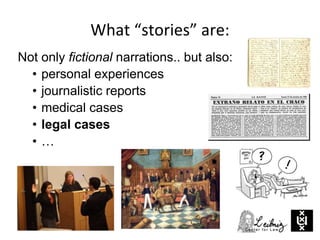
Not only fictional narrations.. but also:
• personal experiences
• journalistic reports
• medical cases
• legal cases
• …
What is a legal case about?
witnesses’, experts’ speeches used to justify a
certain story reconstruction 
• events occurred in a social scenario
lawyers’, judges’ speeches used to justify a
certain legal interpretation of this story 
• legal implications
What is a legal case about?
witnesses’, experts’ speeches used to
justify a certain story reconstruction 
• events occurred in a social scenario
lawyers’, judges’ speeches used to justify a
certain legal interpretation of the story 
• legal implications
What is a legal case about?
witnesses’, experts’ speeches used to
justify a certain story reconstruction 
• events occurred in a social scenario
lawyers’, judges’ speeches used to justify a
certain legal interpretation of the story 
• legal implications
• nested narratives/speech acts
• originated from a failure of norm. expectations
• informative intent within the legal system
• brings part of background to the foreground
A relevant issue
Unfortunately, stories, by their own nature, are
partial (ill-defined) representations.
What is in a story depends on
• default assumptions
• common-sense knowledge
• expertise
• interest
• focus
• ...
A relevant issue
Unfortunately, stories, by their own nature, are
partial (ill-defined) representations.
What is told in a story depends on
• default assumptions
• common-sense knowledge
• expertise
• interest
• focus
• intent...
of the narrator !
A relevant issue
Unfortunately, stories, by their own nature, are
partial (ill-defined) representations.
What is read in a story depends on
• default assumptions
• common-sense knowledge
• expertise
• interest
• focus
• intent...
of the listener !
Three ontological domains
• discourse: the signal
• story: the meaning
• conversation: the context, i.e. the
knowledge and intent of narrator/listener
and those ascribed to the other party
Three ontological domains
• discourse: the signal
• story: the meaning
• conversation: the context, i.e. the
knowledge and intent of narrator/listener
and those ascribed to the other party
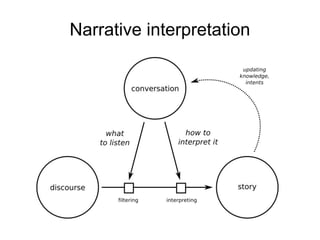
narrative interpretation:
discourse + conversation  story
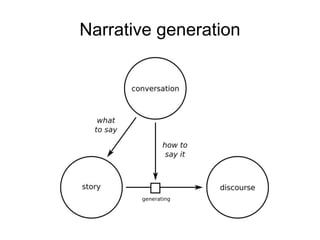
narrative generation:
conversation + story  discourse
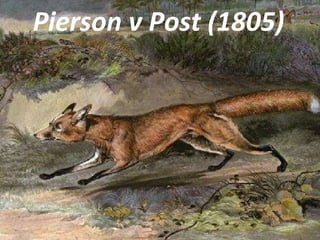
Pierson v PostPierson v Post (1805)
Pierson v Post
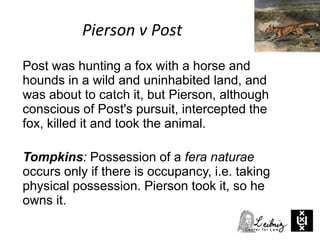
Post was hunting a fox with a horse and
hounds in a wild and uninhabited land, and
was about to catch it, but Pierson, although
conscious of Post's pursuit, intercepted the
fox, killed it and took the animal.
Tompkins: Possession of a fera naturae
occurs only if there is occupancy, i.e. taking
physical possession. Pierson took it, so he
owns it.
Pierson v Post
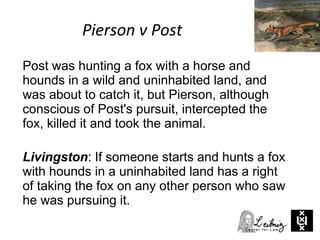
Post was hunting a fox with a horse and
hounds in a wild and uninhabited land, and
was about to catch it, but Pierson, although
conscious of Post's pursuit, intercepted the
fox, killed it and took the animal.
Livingston: If someone starts and hunts a fox
with hounds in a uninhabited land has a right
of taking the fox on any other person who saw
he was pursuing it.
“Shallow” story model
• sequence of events
Post was hunting a fox with a horse and
hounds in a wild and uninhabited land, and
was about to catch it, but Pierson, although
conscious of Post's pursuit, the
fox, it and the animal. [..]
• sequence of events
• occurring at certain circumstances
Post a fox
, and
, but Pierson, although
, the
fox, it and the animal. [..]
“Shallow” story model
Post a fox
, and , but Pierson, although
, the fox, it and the animal.
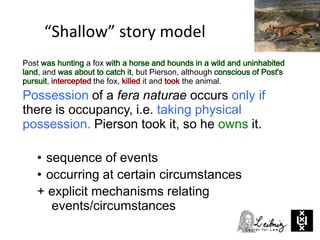
Possession of a fera naturae occurs only if
there is occupancy, i.e. taking physical
possession. Pierson took it, so he owns it.
• sequence of events
• occurring at certain circumstances
+ explicit mechanisms relating
events/circumstances
“Shallow” story model
• a sequence of events
• occurring at certain circumstances
+ explicit mechanisms relating events/
circumstances
• What about the implicit mechanisms?
Our objective
We look for a methodology to
• acquire in a computational form
• the systematic knowledge
• concerning a social scenario,
• presented through a narrative
(e.g. a legal case, a scenario given by an expert, etc.)
• allowing alternative interpretations
Requirements
• bypass natural language issues
• we are not targeting narrative
comprehension, but scenario acquisition
from different interpreters
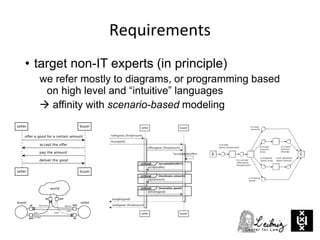
• target non-IT experts (in principle)
we refer mostly to diagrams, or programming based
on high level and “intuitive” languages
 affinity with scenario-based modeling
Requirements
From “Shallow” to “Deep” story model
Issues:
• consecutiveness vs consequence
“the mainspring of the narrative activity is to be traced to that
very confusion between consecutiveness and consequence,
what-comes-after being read in a narrative as what-is-
caused-by”, Barthes [1968]
• story-relative vs discourse-relative timelines
ordering as events occur vs how they are told/observed
Three levels of constraints
• weak: discourse ordering
• medium: relative/absolute time indexing
• strong: dependencies (logic or causal)
From “Shallow” to “Deep” story model
Three levels of constraints
• weak: discourse ordering
• medium: relative/absolute time indexing
• strong: dependencies (logic or causal)
The last is by far the most important to our scope:
problem of Contingency vs Contextuality
From “Shallow” to “Deep” story model
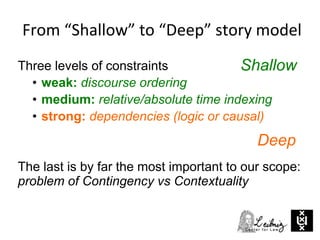
Three levels of constraints
• weak: discourse ordering
• medium: relative/absolute time indexing
• strong: dependencies (logic or causal)
The last is by far the most important to our scope:
problem of Contingency vs Contextuality
Shallow
Deep
From “Shallow” to “Deep” story model
An important step is the recognition of sub-
systems operating concurrently (e.g. agents,
concurrent cognitive modules).
What is necessarily said in a sequential way, may
in fact be simultaneous.
From “Shallow” to “Deep” story model
An important step is the recognition of sub-
systems operating concurrently (e.g. agents,
concurrent cognitive modules).
What is necessarily said in a sequential way, may
in fact be simultaneous.
A specific story provides a synchronization
between concurrent systems (as agents).
From “Shallow” to “Deep” story model
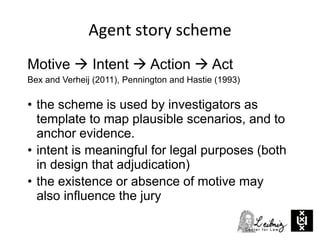
Agent story scheme
Motive  Intent  Action  Act
Bex and Verheij (2011), Pennington and Hastie (1993)
• the scheme is used by investigators as
template to map plausible scenarios, and to
anchor evidence.
• intent is meaningful for legal purposes (both
in design that adjudication)
• the existence or absence of motive may
also influence the jury
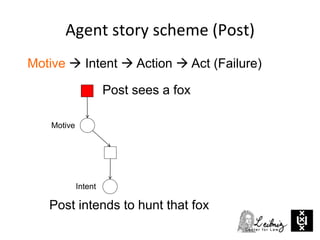
Agent story scheme (Post)
Motive  Intent  Action  Act (Failure)
Motive
Post intends to hunt that fox
Intent
Post sees a fox
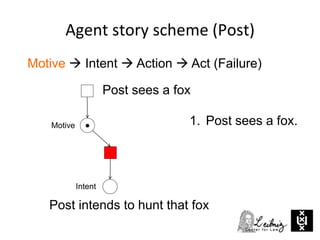
Agent story scheme (Post)
Motive  Intent  Action  Act (Failure)
Motive
Post intends to hunt that fox
Intent
Post sees a fox
1. Post sees a fox.
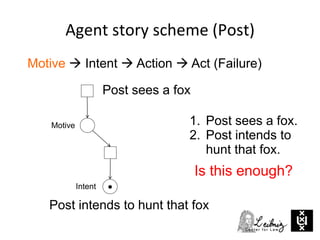
Agent story scheme (Post)
Motive  Intent  Action  Act (Failure)
1. Post sees a fox.
2. Post intends to
hunt that fox.
Is this enough?
Motive
Post intends to hunt that fox
Intent
Post sees a fox
Agent story scheme (Post)
Motive  Intent  Action  Act (Failure)
• Considering only these events the model is
not enough specified.
 We need circumstantial conditions
Motive  Intent  Action  Act (Failure)
Post is hunting foxes
Agent story scheme (Post)
Motivation
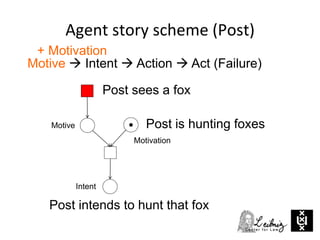
+ Motivation
Motive
Post intends to hunt that fox
Intent
Post sees a fox
Agent story scheme (Post)
Motive  Intent  Action  Act (Failure)
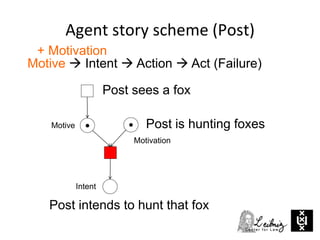
+ Motivation
Post is hunting foxes
Motivation
Motive
Post intends to hunt that fox
Intent
Post sees a fox
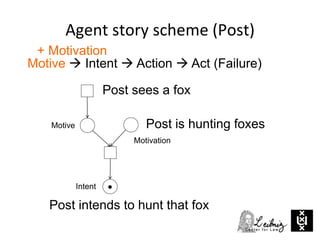
Agent story scheme (Post)
Motive  Intent  Action  Act (Failure)
+ Motivation
Post is hunting foxes
Motivation
Motive
Post intends to hunt that fox
Intent
Post sees a fox
Agent story scheme (Post)
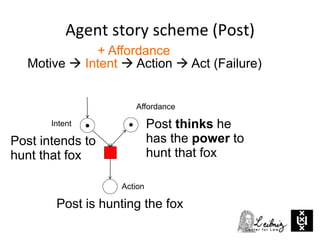
Motive  Intent  Action  Act (Failure)
Intent
Post is hunting the fox
Action
+ Affordance
Post thinks he
has the power to
hunt that fox
Post intends to
hunt that fox
Affordance
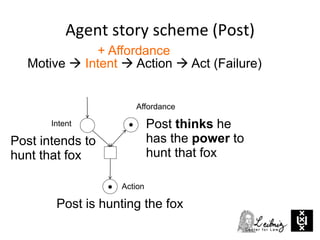
Agent story scheme (Post)
Motive  Intent  Action  Act (Failure)
+ Affordance
Post is hunting the fox
Post thinks he
has the power to
hunt that fox
Post intends to
hunt that fox
Intent
Action
Affordance
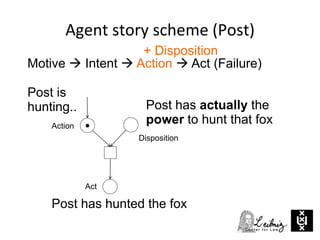
Motive  Intent  Action  Act (Failure)
Action
Post has hunted the fox
Act
+ Disposition
Post has actually the
power to hunt that fox
Agent story scheme (Post)
Disposition
Post is
hunting..
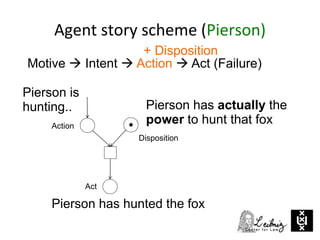
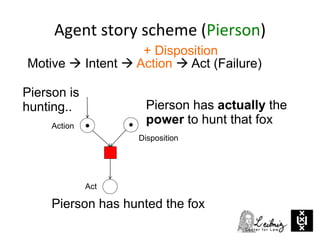
Agent story scheme (Pierson)
Motive  Intent  Action  Act (Failure)
+ Disposition
Pierson has hunted the fox
Pierson has actually the
power to hunt that foxAction
Act
Pierson is
hunting..
Disposition
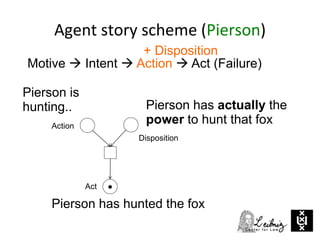
Agent story scheme (Pierson)
Motive  Intent  Action  Act (Failure)
+ Disposition
Pierson has hunted the fox
Pierson has actually the
power to hunt that foxAction
Act
Pierson is
hunting..
Disposition
Agent story scheme (Pierson)
Motive  Intent  Action  Act (Failure)
+ Disposition
Pierson has hunted the fox
Pierson has actually the
power to hunt that foxAction
Act
Pierson is
hunting..
Disposition
Failures and social failures
• The difference between expectations and
actual outcome allows to include in the model
the computation of failures (cf. Plot units)
 useful for validation!
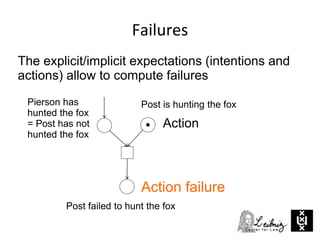
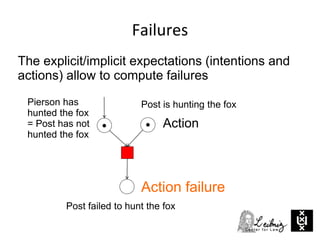
Failures
Action failure
Post is hunting the foxPierson has
hunted the fox
= Post has not
hunted the fox
Post failed to hunt the fox
Action
The explicit/implicit expectations (intentions and
actions) allow to compute failures
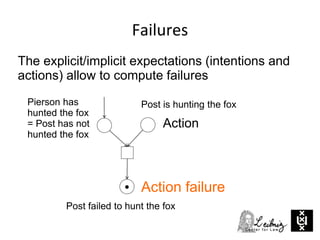
Failures
Pierson has
hunted the fox
= Post has not
hunted the fox
Action failure
Post is hunting the fox
Post failed to hunt the fox
Action
The explicit/implicit expectations (intentions and
actions) allow to compute failures
Failures
Pierson has
hunted the fox
= Post has not
hunted the fox
Action failure
Post is hunting the fox
Post failed to hunt the fox
Action
The explicit/implicit expectations (intentions and
actions) allow to compute failures
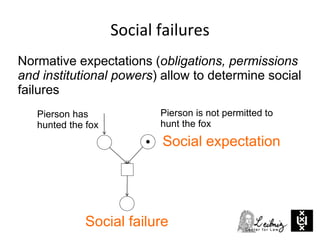
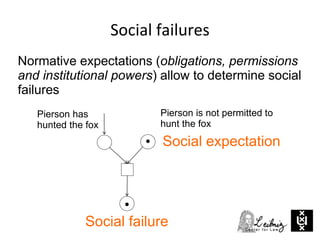
Social failures
Social failure
Social expectation
Pierson is not permitted to
hunt the fox
Pierson has
hunted the fox
Normative expectations (obligations, permissions
and institutional powers) allow to determine social
failures
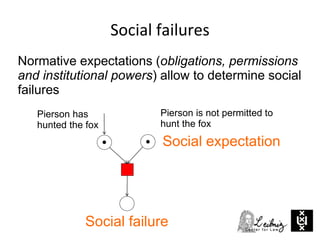
Social failures
Social failure
Social expectation
Pierson is not permitted to
hunt the fox
Pierson has
hunted the fox
Normative expectations (obligations, permissions
and institutional powers) allow to determine social
failures
Social failures
Social failure
Social expectation
Pierson is not permitted to
hunt the fox
Pierson has
hunted the fox
Normative expectations (obligations, permissions
and institutional powers) allow to determine social
failures
Reconstructing the puzzle…
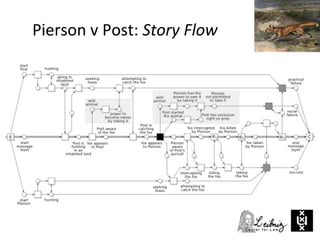
Pierson v Post: Story Flow
Discussion
• This contribution is based on a weak definition
of validity for story models
• As long as the execution of the given
mechanisms with the right synchronization
produces the narrated events, the model is
valid.
 allow for alternative interpretations/fabulae
Discussion
• We do not consider the problem of increased
depth as the most difficult issue in our domain
1. The explicit modeling of the scheme of a
case is useful for clarification purposes
Discussion
• We do not consider the problem of increased
depth as the most difficult issue in our domain
2. Some story components may be easily
reused
Discussion
• We do not consider the problem of increased
depth as the most difficult issue in our domain
2. Some story components may be easily
reused
3. If they cannot be reused but seems
applicable, the system can ask the modeler
to provide circumstantial distinction
 constructivist acquisition model
Discussion
• We do not consider the problem of increased
depth as the most difficult issue in our domain
2. Some story components may be easily
reused
3. If they cannot be reused but seems
applicable, the system can ask the modeler
to provide circumstantial distinction
 constructivist acquisition model
The real issue? the HCI interface!
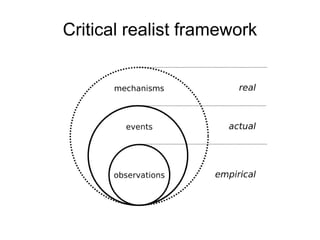
Critical realist framework
Discussion
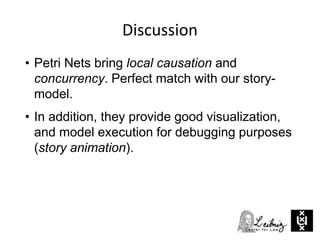
• Petri Nets bring local causation and
concurrency. Perfect match with our story-
model.
• In addition, they provide good visualization,
and model execution for debugging purposes
(story animation).
Narrative generation
Narrative interpretation
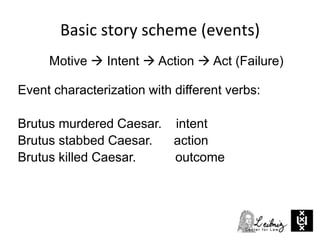
Basic story scheme (events)
Motive  Intent  Action  Act (Failure)
Event characterization with different verbs:
Brutus murdered Caesar. intent
Brutus stabbed Caesar. action
Brutus killed Caesar. outcome

Legal Knowledge Conveyed by Narratives: towards a representational model

  • 1.
    Legal Knowledge Conveyed byNarratives 2 August 2014 - CMN presentation Giovanni Sileno g.sileno@uva.nl Alexander Boer Tom van Engers Leibniz Center for Law – University of Amsterdam Towards a Representational Model
  • 2.
    The social functionof “stories” Stories are “constituents of human memory, knowledge, and social communication” Schank and Abelson [1995], Knowledge and memory: the real story
  • 3.
    The social functionof “stories” “Many different root metaphors have been put forth to represent the essential nature of human beings: homo faber, homo economous, homo politicus, [...], rational man. I now propose homo narrans to be added to the list. Fischer [1984], Narration as a Human Communication Paradigm
  • 4.
    What “stories” are: Notonly fictional narrations.. but also: • personal experiences • journalistic reports • medical cases • legal cases • …
  • 5.
    What is alegal case about? witnesses’, experts’ speeches used to justify a certain story reconstruction  • events occurred in a social scenario lawyers’, judges’ speeches used to justify a certain legal interpretation of this story  • legal implications
  • 6.
    What is alegal case about? witnesses’, experts’ speeches used to justify a certain story reconstruction  • events occurred in a social scenario lawyers’, judges’ speeches used to justify a certain legal interpretation of the story  • legal implications
  • 7.
    What is alegal case about? witnesses’, experts’ speeches used to justify a certain story reconstruction  • events occurred in a social scenario lawyers’, judges’ speeches used to justify a certain legal interpretation of the story  • legal implications • nested narratives/speech acts • originated from a failure of norm. expectations • informative intent within the legal system • brings part of background to the foreground
  • 8.
    A relevant issue Unfortunately,stories, by their own nature, are partial (ill-defined) representations. What is in a story depends on • default assumptions • common-sense knowledge • expertise • interest • focus • ...
  • 9.
    A relevant issue Unfortunately,stories, by their own nature, are partial (ill-defined) representations. What is told in a story depends on • default assumptions • common-sense knowledge • expertise • interest • focus • intent... of the narrator !
  • 10.
    A relevant issue Unfortunately,stories, by their own nature, are partial (ill-defined) representations. What is read in a story depends on • default assumptions • common-sense knowledge • expertise • interest • focus • intent... of the listener !
  • 11.
    Three ontological domains •discourse: the signal • story: the meaning • conversation: the context, i.e. the knowledge and intent of narrator/listener and those ascribed to the other party
  • 12.
    Three ontological domains •discourse: the signal • story: the meaning • conversation: the context, i.e. the knowledge and intent of narrator/listener and those ascribed to the other party narrative interpretation: discourse + conversation  story narrative generation: conversation + story  discourse
  • 13.
    Pierson v PostPiersonv Post (1805)
  • 14.
    Pierson v Post Postwas hunting a fox with a horse and hounds in a wild and uninhabited land, and was about to catch it, but Pierson, although conscious of Post's pursuit, intercepted the fox, killed it and took the animal. Tompkins: Possession of a fera naturae occurs only if there is occupancy, i.e. taking physical possession. Pierson took it, so he owns it.
  • 15.
    Pierson v Post Postwas hunting a fox with a horse and hounds in a wild and uninhabited land, and was about to catch it, but Pierson, although conscious of Post's pursuit, intercepted the fox, killed it and took the animal. Livingston: If someone starts and hunts a fox with hounds in a uninhabited land has a right of taking the fox on any other person who saw he was pursuing it.
  • 16.
    “Shallow” story model •sequence of events Post was hunting a fox with a horse and hounds in a wild and uninhabited land, and was about to catch it, but Pierson, although conscious of Post's pursuit, the fox, it and the animal. [..]
  • 17.
    • sequence ofevents • occurring at certain circumstances Post a fox , and , but Pierson, although , the fox, it and the animal. [..] “Shallow” story model
  • 18.
    Post a fox ,and , but Pierson, although , the fox, it and the animal. Possession of a fera naturae occurs only if there is occupancy, i.e. taking physical possession. Pierson took it, so he owns it. • sequence of events • occurring at certain circumstances + explicit mechanisms relating events/circumstances “Shallow” story model
  • 19.
    “Shallow” story model •a sequence of events • occurring at certain circumstances + explicit mechanisms relating events/ circumstances • What about the implicit mechanisms?
  • 20.
    Our objective We lookfor a methodology to • acquire in a computational form • the systematic knowledge • concerning a social scenario, • presented through a narrative (e.g. a legal case, a scenario given by an expert, etc.) • allowing alternative interpretations
  • 21.
    Requirements • bypass naturallanguage issues • we are not targeting narrative comprehension, but scenario acquisition from different interpreters
  • 22.
    • target non-ITexperts (in principle) we refer mostly to diagrams, or programming based on high level and “intuitive” languages  affinity with scenario-based modeling Requirements
  • 23.
    From “Shallow” to“Deep” story model Issues: • consecutiveness vs consequence “the mainspring of the narrative activity is to be traced to that very confusion between consecutiveness and consequence, what-comes-after being read in a narrative as what-is- caused-by”, Barthes [1968] • story-relative vs discourse-relative timelines ordering as events occur vs how they are told/observed
  • 24.
    Three levels ofconstraints • weak: discourse ordering • medium: relative/absolute time indexing • strong: dependencies (logic or causal) From “Shallow” to “Deep” story model
  • 25.
    Three levels ofconstraints • weak: discourse ordering • medium: relative/absolute time indexing • strong: dependencies (logic or causal) The last is by far the most important to our scope: problem of Contingency vs Contextuality From “Shallow” to “Deep” story model
  • 26.
    Three levels ofconstraints • weak: discourse ordering • medium: relative/absolute time indexing • strong: dependencies (logic or causal) The last is by far the most important to our scope: problem of Contingency vs Contextuality Shallow Deep From “Shallow” to “Deep” story model
  • 27.
    An important stepis the recognition of sub- systems operating concurrently (e.g. agents, concurrent cognitive modules). What is necessarily said in a sequential way, may in fact be simultaneous. From “Shallow” to “Deep” story model
  • 28.
    An important stepis the recognition of sub- systems operating concurrently (e.g. agents, concurrent cognitive modules). What is necessarily said in a sequential way, may in fact be simultaneous. A specific story provides a synchronization between concurrent systems (as agents). From “Shallow” to “Deep” story model
  • 29.
    Agent story scheme Motive Intent  Action  Act Bex and Verheij (2011), Pennington and Hastie (1993) • the scheme is used by investigators as template to map plausible scenarios, and to anchor evidence. • intent is meaningful for legal purposes (both in design that adjudication) • the existence or absence of motive may also influence the jury
  • 30.
    Agent story scheme(Post) Motive  Intent  Action  Act (Failure) Motive Post intends to hunt that fox Intent Post sees a fox
  • 31.
    Agent story scheme(Post) Motive  Intent  Action  Act (Failure) Motive Post intends to hunt that fox Intent Post sees a fox 1. Post sees a fox.
  • 32.
    Agent story scheme(Post) Motive  Intent  Action  Act (Failure) 1. Post sees a fox. 2. Post intends to hunt that fox. Is this enough? Motive Post intends to hunt that fox Intent Post sees a fox
  • 33.
    Agent story scheme(Post) Motive  Intent  Action  Act (Failure) • Considering only these events the model is not enough specified.  We need circumstantial conditions
  • 34.
    Motive  Intent Action  Act (Failure) Post is hunting foxes Agent story scheme (Post) Motivation + Motivation Motive Post intends to hunt that fox Intent Post sees a fox
  • 35.
    Agent story scheme(Post) Motive  Intent  Action  Act (Failure) + Motivation Post is hunting foxes Motivation Motive Post intends to hunt that fox Intent Post sees a fox
  • 36.
    Agent story scheme(Post) Motive  Intent  Action  Act (Failure) + Motivation Post is hunting foxes Motivation Motive Post intends to hunt that fox Intent Post sees a fox
  • 37.
    Agent story scheme(Post) Motive  Intent  Action  Act (Failure) Intent Post is hunting the fox Action + Affordance Post thinks he has the power to hunt that fox Post intends to hunt that fox Affordance
  • 38.
    Agent story scheme(Post) Motive  Intent  Action  Act (Failure) + Affordance Post is hunting the fox Post thinks he has the power to hunt that fox Post intends to hunt that fox Intent Action Affordance
  • 39.
    Motive  Intent Action  Act (Failure) Action Post has hunted the fox Act + Disposition Post has actually the power to hunt that fox Agent story scheme (Post) Disposition Post is hunting..
  • 40.
    Agent story scheme(Pierson) Motive  Intent  Action  Act (Failure) + Disposition Pierson has hunted the fox Pierson has actually the power to hunt that foxAction Act Pierson is hunting.. Disposition
  • 41.
    Agent story scheme(Pierson) Motive  Intent  Action  Act (Failure) + Disposition Pierson has hunted the fox Pierson has actually the power to hunt that foxAction Act Pierson is hunting.. Disposition
  • 42.
    Agent story scheme(Pierson) Motive  Intent  Action  Act (Failure) + Disposition Pierson has hunted the fox Pierson has actually the power to hunt that foxAction Act Pierson is hunting.. Disposition
  • 43.
    Failures and socialfailures • The difference between expectations and actual outcome allows to include in the model the computation of failures (cf. Plot units)  useful for validation!
  • 44.
    Failures Action failure Post ishunting the foxPierson has hunted the fox = Post has not hunted the fox Post failed to hunt the fox Action The explicit/implicit expectations (intentions and actions) allow to compute failures
  • 45.
    Failures Pierson has hunted thefox = Post has not hunted the fox Action failure Post is hunting the fox Post failed to hunt the fox Action The explicit/implicit expectations (intentions and actions) allow to compute failures
  • 46.
    Failures Pierson has hunted thefox = Post has not hunted the fox Action failure Post is hunting the fox Post failed to hunt the fox Action The explicit/implicit expectations (intentions and actions) allow to compute failures
  • 47.
    Social failures Social failure Socialexpectation Pierson is not permitted to hunt the fox Pierson has hunted the fox Normative expectations (obligations, permissions and institutional powers) allow to determine social failures
  • 48.
    Social failures Social failure Socialexpectation Pierson is not permitted to hunt the fox Pierson has hunted the fox Normative expectations (obligations, permissions and institutional powers) allow to determine social failures
  • 49.
    Social failures Social failure Socialexpectation Pierson is not permitted to hunt the fox Pierson has hunted the fox Normative expectations (obligations, permissions and institutional powers) allow to determine social failures
  • 50.
  • 51.
    Pierson v Post:Story Flow
  • 52.
    Discussion • This contributionis based on a weak definition of validity for story models • As long as the execution of the given mechanisms with the right synchronization produces the narrated events, the model is valid.  allow for alternative interpretations/fabulae
  • 53.
    Discussion • We donot consider the problem of increased depth as the most difficult issue in our domain 1. The explicit modeling of the scheme of a case is useful for clarification purposes
  • 54.
    Discussion • We donot consider the problem of increased depth as the most difficult issue in our domain 2. Some story components may be easily reused
  • 55.
    Discussion • We donot consider the problem of increased depth as the most difficult issue in our domain 2. Some story components may be easily reused 3. If they cannot be reused but seems applicable, the system can ask the modeler to provide circumstantial distinction  constructivist acquisition model
  • 56.
    Discussion • We donot consider the problem of increased depth as the most difficult issue in our domain 2. Some story components may be easily reused 3. If they cannot be reused but seems applicable, the system can ask the modeler to provide circumstantial distinction  constructivist acquisition model The real issue? the HCI interface!
  • 58.
  • 59.
    Discussion • Petri Netsbring local causation and concurrency. Perfect match with our story- model. • In addition, they provide good visualization, and model execution for debugging purposes (story animation).
  • 60.
  • 61.
  • 62.
    Basic story scheme(events) Motive  Intent  Action  Act (Failure) Event characterization with different verbs: Brutus murdered Caesar. intent Brutus stabbed Caesar. action Brutus killed Caesar. outcome