6TH GLOBAL BHL MEETING PUBLIC EVENT, FAPESP, SÃO PAULO, BRAZIL, 8 MAY 2015
GBIF – avanços e perspectivas
Tim Hirsch
Deputy Director, GBIF Secretariat
O QUE É O GBIF?
• Colaboração intergovernamental
• Estabelecido 2001, recomendação do painel
científico da OCDE
• Facilita acesso livre e aberto aos dados sobre
biodiversidade atravès do internet
www.gbif.org
O QUE É QUE O GBIF FAZ?
• Promove padrões comuns e ferramentas livres
para o gerenciamento e compartilha de dados
sobre a biodiversidade
• Mantém infraestrututra informática, plataforma
GBIF.org para descoberta e acesso aos dados
• Rede colaborativa nas escalas globais, regionais e
nacionais
www.gbif.org
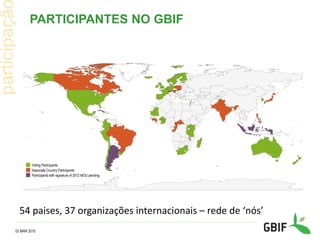
PARTICIPANTES NO GBIF
03 MAR 2015
Voting Participants
Associate Country Participants
Participants with signature of 2012 MOU pending
54 paises, 37 organizações internacionais – rede de ‘nós’
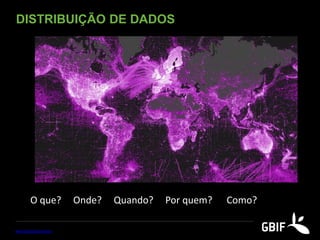
DISTRIBUIÇÃO DE DADOS
www.gbif.org/occurrence
O que? Onde? Quando? Por quem? Como?
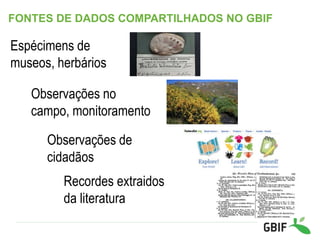
FONTES DE DADOS COMPARTILHADOS NO GBIF
Observações no
campo, monitoramento
Espécimens de
museos, herbários
Observações de
cidadãos
Recordes extraidos
da literatura
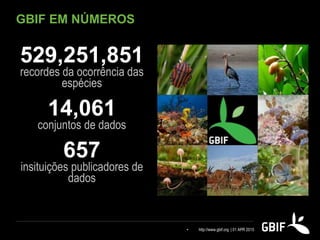
GBIF EM NÚMEROS
529,251,851
recordes da ocorrência das
espécies
14,061
conjuntos de dados
657
insituições publicadores de
dados
• http://www.gbif.org | 01 APR 2015
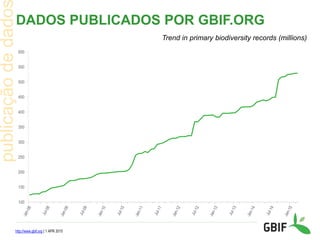
DADOS PUBLICADOS POR GBIF.ORG
http://www.gbif.org | 1 APR 2015
Trend in primary biodiversity records (millions)
100
150
200
250
300
350
400
450
500
550
600
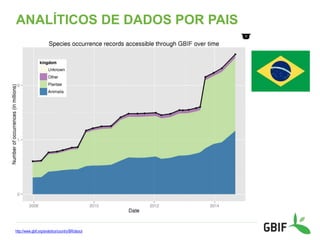
ANALÍTICOS DE DADOS POR PAIS
http://www.gbif.org/analytics/country/BR/about
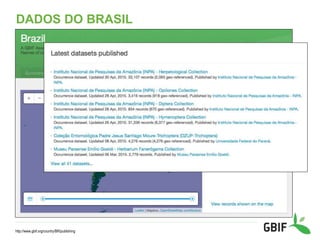
DADOS DO BRASIL
http://www.gbif.org/country/BR/publishing
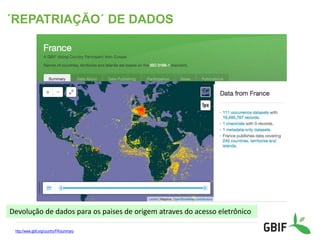
Devolução de dados para os paises de origem atraves do acesso eletrônico
´REPATRIAÇÃO´ DE DADOS
http://www.gbif.org/country/FR/summary
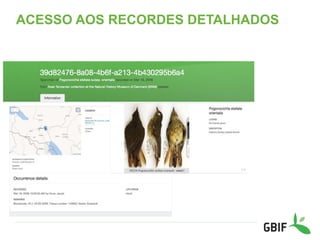
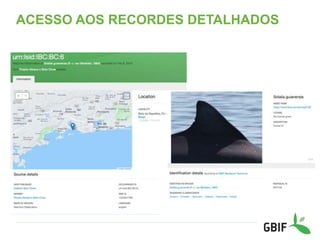
ACESSO AOS RECORDES DETALHADOS
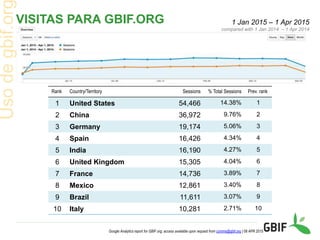
VISITAS PARA GBIF.ORG 1 Jan 2015 – 1 Apr 2015
compared with 1 Jan 2014 – 1 Apr 2014
Rank Country/Territory Sessions % Total Sessions Prev. rank
1 United States 54,466 14.38% 1
2 China 36,972 9.76% 2
3 Germany 19,174 5.06% 3
4 Spain 16,426 4.34% 4
5 India 16,190 4.27% 5
6 United Kingdom 15,305 4.04% 6
7 France 14,736 3.89% 7
8 Mexico 12,861 3.40% 8
9 Brazil 11,611 3.07% 9
10 Italy 10,281 2.71% 10
Google Analytics report for GBIF.org; access available upon request from comms@gbif.org | 08 APR 2015
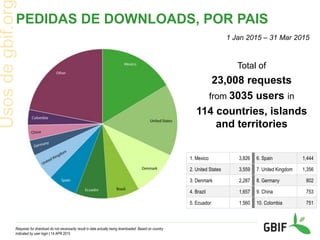
PEDIDAS DE DOWNLOADS, POR PAIS
Requests for download do not necessarily result in data actually being downloaded. Based on country
indicated by user login | 14 APR 2015
1. Mexico 3,826 6. Spain 1,444
2. United States 3,559 7. United Kingdom 1,356
3. Denmark 2,287 8. Germany 802
4. Brazil 1,657 9. China 753
5. Ecuador 1,560 10. Colombia 751
Total of
23,008 requests
from 3035 users in
114 countries, islands
and territories
1 Jan 2015 – 31 Mar 2015
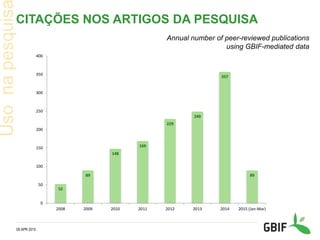
CITAÇÕES NOS ARTIGOS DA PESQUISA
09 APR 2015
Annual number of peer-reviewed publications
using GBIF-mediated data
52
89
148
169
229
249
357
89
0
50
100
150
200
250
300
350
400
2008 2009 2010 2011 2012 2013 2014 2015 (Jan-Mar)
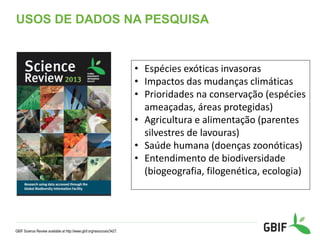
USOS DE DADOS NA PESQUISA
GBIF Science Review available at http://www.gbif.org/resources/3427.
• Espécies exóticas invasoras
• Impactos das mudanças climáticas
• Prioridades na conservação (espécies
ameaçadas, áreas protegidas)
• Agricultura e alimentação (parentes
silvestres de lavouras)
• Saúde humana (doenças zoonóticas)
• Entendimento de biodiversidade
(biogeografia, filogenética, ecologia)
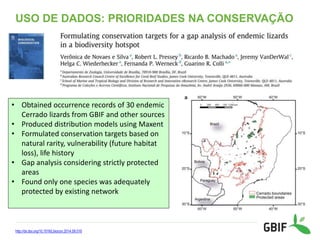
USO DE DADOS: PRIORIDADES NA CONSERVAÇÃO
http://dx.doi.org/10.1016/j.biocon.2014.09.016
• Obtained occurrence records of 30 endemic
Cerrado lizards from GBIF and other sources
• Produced distribution models using Maxent
• Formulated conservation targets based on
natural rarity, vulnerability (future habitat
loss), life history
• Gap analysis considering strictly protected
areas
• Found only one species was adequately
protected by existing network
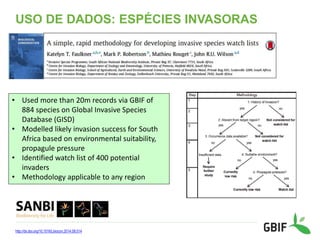
USO DE DADOS: ESPÉCIES INVASORAS
http://dx.doi.org/10.1016/j.biocon.2014.08.014
• Used more than 20m records via GBIF of
884 species on Global Invasive Species
Database (GISD)
• Modelled likely invasion success for South
Africa based on environmental suitability,
propagule pressure
• Identified watch list of 400 potential
invaders
• Methodology applicable to any region
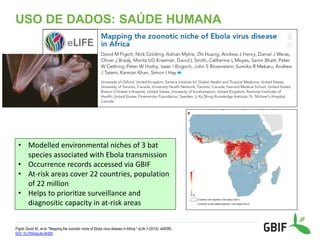
USO DE DADOS: SAÚDE HUMANA
Pigott, David M., et al. "Mapping the zoonotic niche of Ebola virus disease in Africa." eLife 3 (2014): e04395.
DOI: 10.7554/eLife.04395
• Modelled environmental niches of 3 bat
species associated with Ebola transmission
• Occurrence records accessed via GBIF
• At-risk areas cover 22 countries, population
of 22 million
• Helps to prioritize surveillance and
diagnositic capacity in at-risk areas
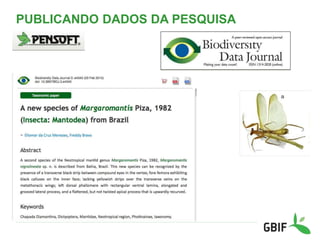
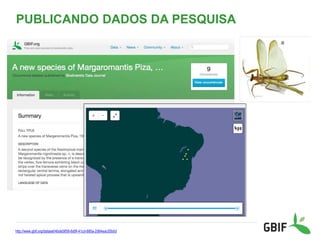
PUBLICANDO DADOS DA PESQUISA
http://www.gbif.org/dataset/4bde5856-6d9f-41cd-880a-2d64eac05b0d
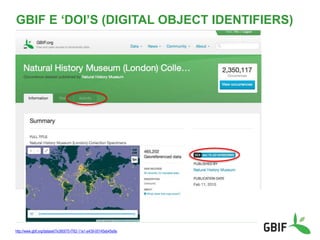
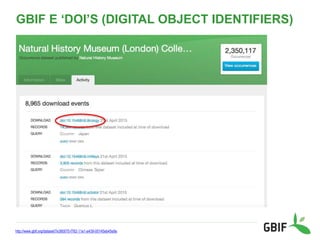
GBIF E ‘DOI’S (DIGITAL OBJECT IDENTIFIERS)
http://www.gbif.org/dataset/7e380070-f762-11e1-a439-00145eb45e9a
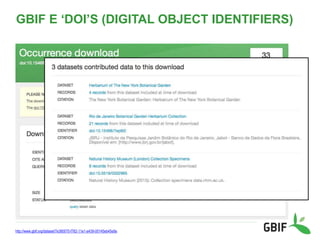
GBIF E ‘DOI’S (DIGITAL OBJECT IDENTIFIERS)
http://www.gbif.org/dataset/7e380070-f762-11e1-a439-00145eb45e9a
GBIF E ‘DOI’S (DIGITAL OBJECT IDENTIFIERS)
http://www.gbif.org/dataset/7e380070-f762-11e1-a439-00145eb45e9a
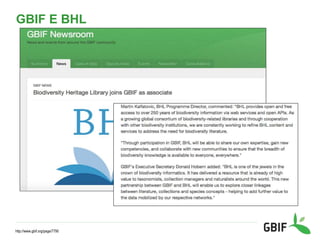
GBIF E BHL
http://www.gbif.org/page/7790
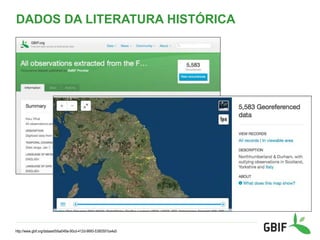
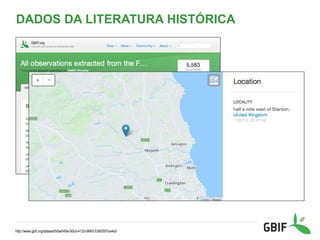
DADOS DA LITERATURA HISTÓRICA
http://www.gbif.org/dataset/bfaa049a-90cd-412d-9660-5380591ba4a5
DADOS DA LITERATURA HISTÓRICA
http://www.gbif.org/dataset/bfaa049a-90cd-412d-9660-5380591ba4a5
OBRIGADO PELA ATENÇÃO!
• thirsch@gbif.org
• www.gbif.org

GBIF – avanços e perspectivas - Tim Hirsch

  • 1.
    6TH GLOBAL BHLMEETING PUBLIC EVENT, FAPESP, SÃO PAULO, BRAZIL, 8 MAY 2015 GBIF – avanços e perspectivas Tim Hirsch Deputy Director, GBIF Secretariat
  • 2.
    O QUE ÉO GBIF? • Colaboração intergovernamental • Estabelecido 2001, recomendação do painel científico da OCDE • Facilita acesso livre e aberto aos dados sobre biodiversidade atravès do internet www.gbif.org
  • 3.
    O QUE ÉQUE O GBIF FAZ? • Promove padrões comuns e ferramentas livres para o gerenciamento e compartilha de dados sobre a biodiversidade • Mantém infraestrututra informática, plataforma GBIF.org para descoberta e acesso aos dados • Rede colaborativa nas escalas globais, regionais e nacionais www.gbif.org
  • 4.
    PARTICIPANTES NO GBIF 03MAR 2015 Voting Participants Associate Country Participants Participants with signature of 2012 MOU pending 54 paises, 37 organizações internacionais – rede de ‘nós’
  • 5.
    DISTRIBUIÇÃO DE DADOS www.gbif.org/occurrence Oque? Onde? Quando? Por quem? Como?
  • 6.
    FONTES DE DADOSCOMPARTILHADOS NO GBIF Observações no campo, monitoramento Espécimens de museos, herbários Observações de cidadãos Recordes extraidos da literatura
  • 7.
    GBIF EM NÚMEROS 529,251,851 recordesda ocorrência das espécies 14,061 conjuntos de dados 657 insituições publicadores de dados • http://www.gbif.org | 01 APR 2015
  • 8.
    DADOS PUBLICADOS PORGBIF.ORG http://www.gbif.org | 1 APR 2015 Trend in primary biodiversity records (millions) 100 150 200 250 300 350 400 450 500 550 600
  • 9.
    ANALÍTICOS DE DADOSPOR PAIS http://www.gbif.org/analytics/country/BR/about
  • 10.
  • 11.
    Devolução de dadospara os paises de origem atraves do acesso eletrônico ´REPATRIAÇÃO´ DE DADOS http://www.gbif.org/country/FR/summary
  • 12.
  • 13.
  • 14.
    VISITAS PARA GBIF.ORG1 Jan 2015 – 1 Apr 2015 compared with 1 Jan 2014 – 1 Apr 2014 Rank Country/Territory Sessions % Total Sessions Prev. rank 1 United States 54,466 14.38% 1 2 China 36,972 9.76% 2 3 Germany 19,174 5.06% 3 4 Spain 16,426 4.34% 4 5 India 16,190 4.27% 5 6 United Kingdom 15,305 4.04% 6 7 France 14,736 3.89% 7 8 Mexico 12,861 3.40% 8 9 Brazil 11,611 3.07% 9 10 Italy 10,281 2.71% 10 Google Analytics report for GBIF.org; access available upon request from comms@gbif.org | 08 APR 2015
  • 15.
    PEDIDAS DE DOWNLOADS,POR PAIS Requests for download do not necessarily result in data actually being downloaded. Based on country indicated by user login | 14 APR 2015 1. Mexico 3,826 6. Spain 1,444 2. United States 3,559 7. United Kingdom 1,356 3. Denmark 2,287 8. Germany 802 4. Brazil 1,657 9. China 753 5. Ecuador 1,560 10. Colombia 751 Total of 23,008 requests from 3035 users in 114 countries, islands and territories 1 Jan 2015 – 31 Mar 2015
  • 16.
    CITAÇÕES NOS ARTIGOSDA PESQUISA 09 APR 2015 Annual number of peer-reviewed publications using GBIF-mediated data 52 89 148 169 229 249 357 89 0 50 100 150 200 250 300 350 400 2008 2009 2010 2011 2012 2013 2014 2015 (Jan-Mar)
  • 17.
    USOS DE DADOSNA PESQUISA GBIF Science Review available at http://www.gbif.org/resources/3427. • Espécies exóticas invasoras • Impactos das mudanças climáticas • Prioridades na conservação (espécies ameaçadas, áreas protegidas) • Agricultura e alimentação (parentes silvestres de lavouras) • Saúde humana (doenças zoonóticas) • Entendimento de biodiversidade (biogeografia, filogenética, ecologia)
  • 18.
    USO DE DADOS:PRIORIDADES NA CONSERVAÇÃO http://dx.doi.org/10.1016/j.biocon.2014.09.016 • Obtained occurrence records of 30 endemic Cerrado lizards from GBIF and other sources • Produced distribution models using Maxent • Formulated conservation targets based on natural rarity, vulnerability (future habitat loss), life history • Gap analysis considering strictly protected areas • Found only one species was adequately protected by existing network
  • 19.
    USO DE DADOS:ESPÉCIES INVASORAS http://dx.doi.org/10.1016/j.biocon.2014.08.014 • Used more than 20m records via GBIF of 884 species on Global Invasive Species Database (GISD) • Modelled likely invasion success for South Africa based on environmental suitability, propagule pressure • Identified watch list of 400 potential invaders • Methodology applicable to any region
  • 20.
    USO DE DADOS:SAÚDE HUMANA Pigott, David M., et al. "Mapping the zoonotic niche of Ebola virus disease in Africa." eLife 3 (2014): e04395. DOI: 10.7554/eLife.04395 • Modelled environmental niches of 3 bat species associated with Ebola transmission • Occurrence records accessed via GBIF • At-risk areas cover 22 countries, population of 22 million • Helps to prioritize surveillance and diagnositic capacity in at-risk areas
  • 21.
  • 22.
    PUBLICANDO DADOS DAPESQUISA http://www.gbif.org/dataset/4bde5856-6d9f-41cd-880a-2d64eac05b0d
  • 23.
    GBIF E ‘DOI’S(DIGITAL OBJECT IDENTIFIERS) http://www.gbif.org/dataset/7e380070-f762-11e1-a439-00145eb45e9a
  • 24.
    GBIF E ‘DOI’S(DIGITAL OBJECT IDENTIFIERS) http://www.gbif.org/dataset/7e380070-f762-11e1-a439-00145eb45e9a
  • 25.
    GBIF E ‘DOI’S(DIGITAL OBJECT IDENTIFIERS) http://www.gbif.org/dataset/7e380070-f762-11e1-a439-00145eb45e9a
  • 26.
  • 27.
    DADOS DA LITERATURAHISTÓRICA http://www.gbif.org/dataset/bfaa049a-90cd-412d-9660-5380591ba4a5
  • 28.
    DADOS DA LITERATURAHISTÓRICA http://www.gbif.org/dataset/bfaa049a-90cd-412d-9660-5380591ba4a5
  • 29.
    OBRIGADO PELA ATENÇÃO! •thirsch@gbif.org • www.gbif.org

Editor's Notes

  • #12 The principle of ‘data repatriation’ is demonstrated in these two slides showing data currently displayed on the ‘country page’ for France in GBIF.org. (http://www.gbif.org/country/fr). The first map shows all data for species observed or collected in France and its coastal waters. This amounts to around 11 million records, from over 900 datasets shared from institutions in 38 countries. (animate) The second map shows all data shared by institutions in France. You’ll see that although these are strongly concentrate in French territory, they actually span the world, sharing data on biodiversity located in 245 countries, territories and islands – thus making this data available to governments and researchers in the countries where these species originate.
  • #13 A recent development in GBIF has been to enable users to access much richer information about each species occurrence record, through harvesting a wider set of fields included in the records submitted by the data publishers. In addition to the core information of species, location and date of collection, this includes details such as field notes and remarks, the life stage of the individual and now (a new feature launched in June 2014) any images, audio or video associated with the record. In this example, a specimen from the Tanzanian bird collection at Denmark’s Natural History Museum is shown complete with the location and date of collection, the name of collector and the image of the actual specimen.
  • #14 A recent development in GBIF has been to enable users to access much richer information about each species occurrence record, through harvesting a wider set of fields included in the records submitted by the data publishers. In addition to the core information of species, location and date of collection, this includes details such as field notes and remarks, the life stage of the individual and now (a new feature launched in June 2014) any images, audio or video associated with the record. In this example, a specimen from the Tanzanian bird collection at Denmark’s Natural History Museum is shown complete with the location and date of collection, the name of collector and the image of the actual specimen.
  • #28 http://www.gbif.org/dataset/bfaa049a-90cd-412d-9660-5380591ba4a5