Background GPA  calls on countries to: “ develop an efficient goal-oriented, economically efficient and sustainable  system  of ex situ conservation” and “ develop and strengthen  cooperation  among national programmes and international institutions to sustain ex situ collections…” ITPGRFA  calls on Parties to: “ cooperate to promote the development of an efficient and sustainable  system  of ex situ conservation” “ cooperate  to enhance international activities to promote conservation, evaluation and documentation of PGRFA”
The vision A rational global system for the efficient and effective ex situ  conservation  and sustainable use of PGRFA
Establishment of the Trust Established under international law in Oct. 2004 Public-private partnership Joint initiative of FAO and Bioversity International on behalf of CGIAR Centres Endowment fund with target $260 million, generating $12 million/year, in perpetuity now stands at approx $100 million Essential element of the funding strategy of ITPGRFA
Making decisions  Regional strategies and global crop strategies identify eligible collections set priorities define most efficient, effective approach for conservation Process stakeholders involved through regional/crop networks facilitated through expert consultations backup from Trust, Bioversity & CG Centres, FAO Where are we? major crops, all regions available on Trust website Where do we go from here? Trust willing to work with networks etc. to raise funds to implement strategies
Long-term grants from endowment Short-term project funds Building a global system
Criteria for long-term support  PGRFA judged   important  in the context of regional or crop conservation strategy Effective links to  users Material in  Multilateral System  of ITPGRFA Facilities, human resources and management systems  adequate to ensure long-term conservation to internationally agreed technical standards Willingness to act in  partnership  to achieve a rational system for conserving PGRFA and make them available
Long-term support to in-trust collections in region Barley Forages Faba bean Grasspea Lentil US$ 300,000/annum from Trust endowment US$ 132,000/annum from ICARDA endowment
The Global System Project Regeneration Safety duplication Information (Collecting)
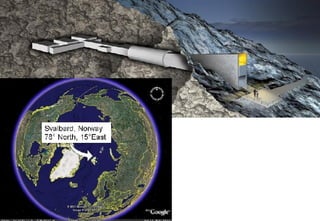
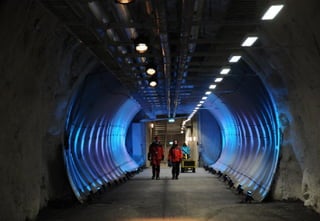
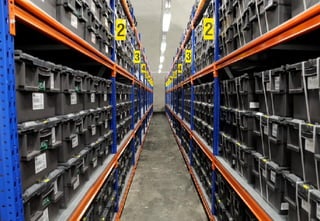
The Global System Project Regeneration of accessions in priority collections and duplication in long-term conservation 21 Annex 1 crops, 60 collections, 70,000 accessions  identified by  crop strategies regional networks multilingual regeneration guidelines strengthening capacity of key genebanks Duplication in Svalbard International Seed Vault  from the regenerations of seed crops  other important collections (e.g., in trust)


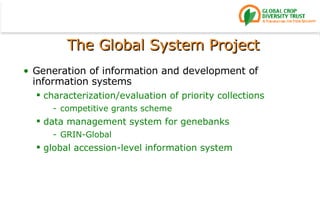
Generation of information and development of information systems  characterization/evaluation of priority collections competitive grants scheme data management system for genebanks GRIN-Global global accession-level information system The Global System Project
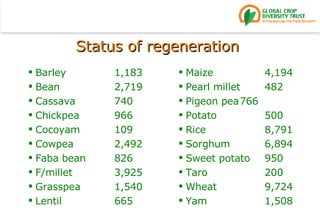
Barley 1,183 Bean 2,719 Cassava 740 Chickpea 966 Cocoyam 109 Cowpea 2,492 Faba bean 826 F/millet 3,925 G rasspea 1,540 Lentil 665 Maize 4,194 Pearl millet 482 Pigeon pea 766 Potato 500 Rice 8,791 S orghum 6,894 Sweet potato 950 Taro 200 Wheat 9,724 Yam 1,508 Status of regeneration
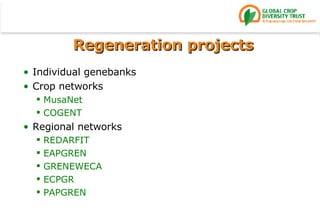
Regeneration projects Individual genebanks Crop networks MusaNet COGENT Regional networks REDARFIT EAPGREN GRENEWECA ECPGR PAPGREN
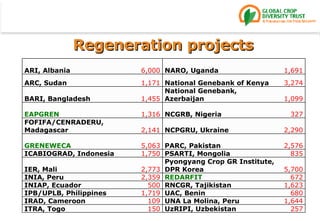
Regeneration projects ARI, Albania 6,000 NARO, Uganda 1,691 ARC, Sudan 1,171 National Genebank of Kenya 3,274 BARI, Bangladesh 1,455 National Genebank, Azerbaijan 1,099 EAPGREN 1,316 NCGRB, Nigeria 327 FOFIFA/CENRADERU, Madagascar 2,141 NCPGRU, Ukraine 2,290 GRENEWECA 5,063 PARC, Pakistan 2,576 ICABIOGRAD, Indonesia 1,750 PSARTI, Mongolia 835 IER, Mali 2,773 Pyongyang Crop GR Institute, DPR Korea  5,700 INIA, Peru 2,359 REDARFIT 672 INIAP, Ecuador 500 RNCGR, Tajikistan  1,623 IPB/UPLB, Philippines 1,719 UAC, Benin 680 IRAD, Cameroon 109 UNA La Molina, Peru 1,644 ITRA, Togo 150 UzRIPI, Uzbekistan 257
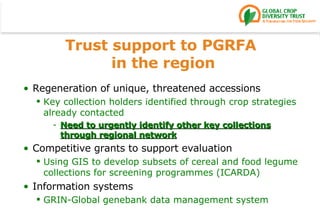
Trust support to PGRFA  in the region Regeneration of unique, threatened accessions Key collection holders identified through crop strategies already contacted Need to urgently identify other key collections through regional network Competitive grants to support evaluation Using GIS to develop subsets of cereal and food legume collections for screening programmes (ICARDA) Information systems GRIN-Global genebank data management system
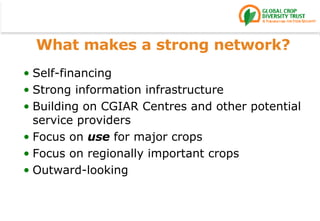
What makes a strong network? Self-financing Strong information infrastructure Building on CGIAR Centres and other potential service providers Focus on  use  for major crops Focus on regionally important crops Outward-looking
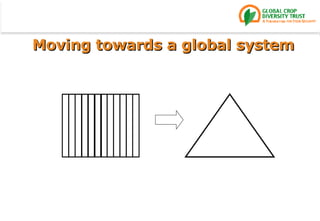
Moving towards a global system
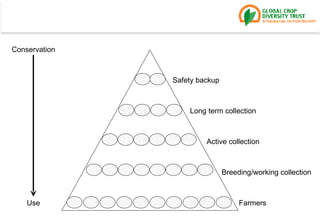
Conservation Use Safety backup Long term collection Active collection Breeding/working collection Farmers
شكراً

Global Crop Diversity Trust collaboration with PGRN, Dr. L.Guarino

  • 1.
  • 2.
    Background GPA calls on countries to: “ develop an efficient goal-oriented, economically efficient and sustainable system of ex situ conservation” and “ develop and strengthen cooperation among national programmes and international institutions to sustain ex situ collections…” ITPGRFA calls on Parties to: “ cooperate to promote the development of an efficient and sustainable system of ex situ conservation” “ cooperate to enhance international activities to promote conservation, evaluation and documentation of PGRFA”
  • 3.
    The vision Arational global system for the efficient and effective ex situ conservation and sustainable use of PGRFA
  • 4.
    Establishment of theTrust Established under international law in Oct. 2004 Public-private partnership Joint initiative of FAO and Bioversity International on behalf of CGIAR Centres Endowment fund with target $260 million, generating $12 million/year, in perpetuity now stands at approx $100 million Essential element of the funding strategy of ITPGRFA
  • 5.
    Making decisions Regional strategies and global crop strategies identify eligible collections set priorities define most efficient, effective approach for conservation Process stakeholders involved through regional/crop networks facilitated through expert consultations backup from Trust, Bioversity & CG Centres, FAO Where are we? major crops, all regions available on Trust website Where do we go from here? Trust willing to work with networks etc. to raise funds to implement strategies
  • 6.
    Long-term grants fromendowment Short-term project funds Building a global system
  • 7.
    Criteria for long-termsupport PGRFA judged important in the context of regional or crop conservation strategy Effective links to users Material in Multilateral System of ITPGRFA Facilities, human resources and management systems adequate to ensure long-term conservation to internationally agreed technical standards Willingness to act in partnership to achieve a rational system for conserving PGRFA and make them available
  • 8.
    Long-term support toin-trust collections in region Barley Forages Faba bean Grasspea Lentil US$ 300,000/annum from Trust endowment US$ 132,000/annum from ICARDA endowment
  • 9.
    The Global SystemProject Regeneration Safety duplication Information (Collecting)
  • 10.
    The Global SystemProject Regeneration of accessions in priority collections and duplication in long-term conservation 21 Annex 1 crops, 60 collections, 70,000 accessions identified by crop strategies regional networks multilingual regeneration guidelines strengthening capacity of key genebanks Duplication in Svalbard International Seed Vault from the regenerations of seed crops other important collections (e.g., in trust)
  • 11.
  • 12.
  • 13.
  • 14.
    Generation of informationand development of information systems characterization/evaluation of priority collections competitive grants scheme data management system for genebanks GRIN-Global global accession-level information system The Global System Project
  • 15.
    Barley 1,183 Bean2,719 Cassava 740 Chickpea 966 Cocoyam 109 Cowpea 2,492 Faba bean 826 F/millet 3,925 G rasspea 1,540 Lentil 665 Maize 4,194 Pearl millet 482 Pigeon pea 766 Potato 500 Rice 8,791 S orghum 6,894 Sweet potato 950 Taro 200 Wheat 9,724 Yam 1,508 Status of regeneration
  • 16.
    Regeneration projects Individualgenebanks Crop networks MusaNet COGENT Regional networks REDARFIT EAPGREN GRENEWECA ECPGR PAPGREN
  • 17.
    Regeneration projects ARI,Albania 6,000 NARO, Uganda 1,691 ARC, Sudan 1,171 National Genebank of Kenya 3,274 BARI, Bangladesh 1,455 National Genebank, Azerbaijan 1,099 EAPGREN 1,316 NCGRB, Nigeria 327 FOFIFA/CENRADERU, Madagascar 2,141 NCPGRU, Ukraine 2,290 GRENEWECA 5,063 PARC, Pakistan 2,576 ICABIOGRAD, Indonesia 1,750 PSARTI, Mongolia 835 IER, Mali 2,773 Pyongyang Crop GR Institute, DPR Korea 5,700 INIA, Peru 2,359 REDARFIT 672 INIAP, Ecuador 500 RNCGR, Tajikistan 1,623 IPB/UPLB, Philippines 1,719 UAC, Benin 680 IRAD, Cameroon 109 UNA La Molina, Peru 1,644 ITRA, Togo 150 UzRIPI, Uzbekistan 257
  • 18.
    Trust support toPGRFA in the region Regeneration of unique, threatened accessions Key collection holders identified through crop strategies already contacted Need to urgently identify other key collections through regional network Competitive grants to support evaluation Using GIS to develop subsets of cereal and food legume collections for screening programmes (ICARDA) Information systems GRIN-Global genebank data management system
  • 19.
    What makes astrong network? Self-financing Strong information infrastructure Building on CGIAR Centres and other potential service providers Focus on use for major crops Focus on regionally important crops Outward-looking
  • 20.
    Moving towards aglobal system
  • 21.
    Conservation Use Safetybackup Long term collection Active collection Breeding/working collection Farmers
  • 22.