GLOBAL BIODIVERSITY INFORMATION FACILITY WWW.GBIF.ORG Building the global biodiversity information commons for climate change adaptation UNFCCC CoP 15 Side Event  8 Dec, 20h00 Dan Turell Room Bella Centre Dr Nick King, Executive Director, GBIF
The Biodiversity Crisis The UN Millenium Assessment found losses in biodiversity in the past 50 years  ’was more rapid than ever before in human history’.  To sustain Earth’s life-support services, from food security, resilience to natural disasters, and access to clean water and raw materials ,  improvements are needed to address biodiversity losses and changes  (extinctions, changes in population sizes, distribution, species composition,  genetic diversity ). Habitat Loss Invasive Species Overexploitation Pollution Climate Change
Changes in forest cover in Borneo (left) and the human impact globally  – estimated <20% of original forests intact and fully functional  (Nature 452, 2008)  Increasing loss and fragmentation of  ecosystems eg. forests Destruction of forests and forest soils accounts for 20% of global GHG emissions;  Yet standing forests absorb ~15% of atmospheric carbon = compound problem!
Fishing Down the Food Web…. 5 4 3 2 Trophic level
Global footprint vs biocapacity Source: Global Footprint Network
TEEB Report 2009 The `Stern report´ equivalent for biodiversity loss,  – trying to understand what we are losing economically.
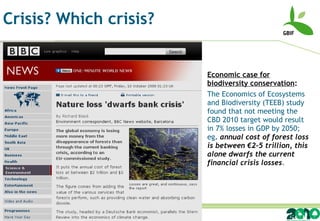
Crisis? Which crisis? Economic case for biodiversity conservation :  The Economics of Ecosystems and Biodiversity (TEEB) study found that not meeting the CBD 2010 target would result in 7% losses in GDP by 2050; eg .  annual cost of forest loss is between €2-5 trillion, this alone dwarfs the current financial crisis losses .
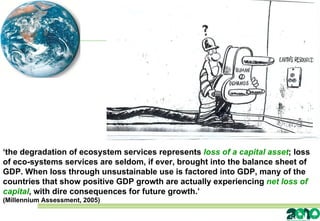
‘ the degradation of ecosystem services represents  loss of a capital asset ;  loss of eco-systems services are seldom, if ever, brought into the balance sheet of GDP. When loss through unsustainable use is factored into GDP, many of the countries that show positive GDP growth are actually experiencing  net loss of capital , with dire consequences for future growth.’ (Millennium Assessment, 2005)
The MDGs 7. Ensure environmental sustainability (Integrate sustainable development into policies/programs & reverse loss of natural resources).   
Millenium Assessment (2005) “ Balance sheet  more   red than black ”
(Wilson et al,  Ecology  2005) 16 mountain butterfly species   Sierra de Guadarrama, Spain Average movement uphill  = 212 m  +  60 m (SE) Temperature increase  = 1.3  ° C    225 m Average range area loss since 1970     ONE THIRD  Change over ~ 35 years:
(based on 1103 spp from region/taxon combinations including:  Mexico, Brazil, South Africa, Europe, Australia & mammals, birds, other vertebrates, butterflies, plants) Thomas  et al, Nature , 2004 Percentages of species expected to lose >90% of  suitable  range by 2050 -  predict….nearly 50% of species will be ‘committed to extinction’  full/ubiquitous dispersal  / without dispersal >90%  a rea loss by 2050   min. no. spp. mid-range max. no. spp. 9%  21% 14%  30% 32%  47%
Decline in biodiversity with increasing intensity of human use; loss of habitat means decreasing ability to adapt or migrate.... Netherlands Env Agency
Solving transboundary issues…. Climate change and biodiversity are both a  transboundary issue ; Solutions are only possible through  multi-lateral cooperation and info-sharing ; GBIF is a  working example  of a multi-lateral agreement to share and provide access to relevant information for improved policy and decision-making….
Key Millennium Assessment Solutions IPCC Side Event Tuesday 8 Dec: update on AR4, road to AR5: move from “it’s real” i.e. climate is changing and AGW is the cause; to what we need to do about it i.e. “here is the information you need to make good decisions”
GBIF’s Mandate ” To  facilitate free and open access to biodiversity data  worldwide, via the Internet, to underpin scientific research, conservation and sustainable development.” GBIF is govt-initiated, and govt. funded,  in response to government agency needs in biodiversity information access and management; GBIF is in service to science, as a global ‘public good’
Not a database or data aggregator GBIF is a global  science/informatics research infrastructure : What is GBIF ? - promoting global participation, linking up a global network of participants; - enabling online publishing and sharing of biodiversity data; - promoting development of data capture & exchange standards; - building an informatics architecture; - building capacity; - catalysing development of analytical tools.
Primary biodiversity data and information  effectively available Data and information that  have been produced  but  are not easy to find, access, and use  (i.e not effectively available!) -  a gigantic task of mobilising billions of data is still needed, as well as integrating new data.  Biological collections Scientific publications Observations Reports Gray literature Data Bases Geography
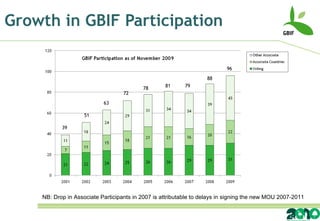
Growth in GBIF Participation NB: Drop in Associate Participants in 2007 is attributable to delays in signing the new MOU 2007-2011 39 51 63 72 78 81 79 88 96
GBIF: an intergovernmental initiative to share biodiversity information Currently 53 countries; 43 International Organisations…
Data shared online via GBIF  (>190m biodiversity records mapped to a 1 X 1 degree grid)
Data geo-referenced to US
US-hosted data shared via GBIF
GBIF Data portal and data access/sharing/ repatriation
Predicting climate-induced changes in tropical forests composition….. Species richness - forest genera of Sterculiaceae, Meliaceae, Dipterocapaceae
Summary of CC impacts on tropical forests … All families and genera suffer  >50% niche loss; species loss ; Some gain in potential, but this would require migration and suitable ecological/climate niche (for forests) at destination; Important implications for REDD, LULUCF and many other CC adaptation/mitigation programmes…..
Agriculture and climate change
IAS – World’s 100 Worst Invaders list GBIF-enabled data mean of 15000 records per species. Need ~20 unique occurrence points for robust model development (83 of 100 Worst Invaders list).  Asian longhorn beetle
Mapping Human Disease Vectors Aedes albopictus  “Asian Tiger Mosquito”  Invader - fastest spreading mosquito in the world  Known to transmit Dengue, La Crosse, St. Louis, Eastern Equine, Ross River, Rift Valley, and West Nile Viruses
Tiger mosquito – native range…… Modeled native range in Asia from specimens & observations
Tiger mosquito : modeled potential continental-US invasion…. Projected Asian ecological niche onto present USA ecological zones to create invasion risk-map.
Tiger mosquito : observed actual  US invasion (by county)
Asian Tiger mosquito : world risk-map (present climate niches)
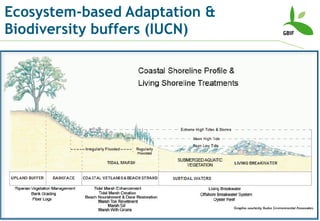
Ecosystem-based Adaptation & Biodiversity buffers (IUCN)
 
Summary  - key pts: Climate Change is changing biodiversity worldwide, impacting ecosystem services, forests, agriculture and food security, disease transmission, etc; Climate change and ecosystem change are transboundary problems ; Transboundary issues can only be solved by international agreement on cooperation and information sharing; GBIF is a working example of a multi-lateral agreement to share and access biodiversity data to underpin improved decision-making for adaptation and mitigation…… Requires global participation!
Join GBIF and benefit from being part of a global solution..... Web site:  www.gbif.org   GBIF Secretariat Universitetsparken 15 DK-2100 Copenhagen Ø Denmark E-mail:  [email_address] GBIF Secretariat building, supported by a grant from the Aage V. Jensens Fonde
 

Cop15

  • 1.
    GLOBAL BIODIVERSITY INFORMATIONFACILITY WWW.GBIF.ORG Building the global biodiversity information commons for climate change adaptation UNFCCC CoP 15 Side Event 8 Dec, 20h00 Dan Turell Room Bella Centre Dr Nick King, Executive Director, GBIF
  • 2.
    The Biodiversity CrisisThe UN Millenium Assessment found losses in biodiversity in the past 50 years ’was more rapid than ever before in human history’. To sustain Earth’s life-support services, from food security, resilience to natural disasters, and access to clean water and raw materials , improvements are needed to address biodiversity losses and changes (extinctions, changes in population sizes, distribution, species composition, genetic diversity ). Habitat Loss Invasive Species Overexploitation Pollution Climate Change
  • 3.
    Changes in forestcover in Borneo (left) and the human impact globally – estimated <20% of original forests intact and fully functional (Nature 452, 2008) Increasing loss and fragmentation of ecosystems eg. forests Destruction of forests and forest soils accounts for 20% of global GHG emissions; Yet standing forests absorb ~15% of atmospheric carbon = compound problem!
  • 4.
    Fishing Down theFood Web…. 5 4 3 2 Trophic level
  • 5.
    Global footprint vsbiocapacity Source: Global Footprint Network
  • 6.
    TEEB Report 2009The `Stern report´ equivalent for biodiversity loss, – trying to understand what we are losing economically.
  • 7.
    Crisis? Which crisis?Economic case for biodiversity conservation : The Economics of Ecosystems and Biodiversity (TEEB) study found that not meeting the CBD 2010 target would result in 7% losses in GDP by 2050; eg . annual cost of forest loss is between €2-5 trillion, this alone dwarfs the current financial crisis losses .
  • 8.
    ‘ the degradationof ecosystem services represents loss of a capital asset ; loss of eco-systems services are seldom, if ever, brought into the balance sheet of GDP. When loss through unsustainable use is factored into GDP, many of the countries that show positive GDP growth are actually experiencing net loss of capital , with dire consequences for future growth.’ (Millennium Assessment, 2005)
  • 9.
    The MDGs 7.Ensure environmental sustainability (Integrate sustainable development into policies/programs & reverse loss of natural resources).  
  • 10.
    Millenium Assessment (2005)“ Balance sheet more red than black ”
  • 11.
    (Wilson et al, Ecology 2005) 16 mountain butterfly species Sierra de Guadarrama, Spain Average movement uphill = 212 m + 60 m (SE) Temperature increase = 1.3 ° C  225 m Average range area loss since 1970  ONE THIRD Change over ~ 35 years:
  • 12.
    (based on 1103spp from region/taxon combinations including: Mexico, Brazil, South Africa, Europe, Australia & mammals, birds, other vertebrates, butterflies, plants) Thomas et al, Nature , 2004 Percentages of species expected to lose >90% of suitable range by 2050 - predict….nearly 50% of species will be ‘committed to extinction’ full/ubiquitous dispersal / without dispersal >90% a rea loss by 2050 min. no. spp. mid-range max. no. spp. 9% 21% 14% 30% 32% 47%
  • 13.
    Decline in biodiversitywith increasing intensity of human use; loss of habitat means decreasing ability to adapt or migrate.... Netherlands Env Agency
  • 14.
    Solving transboundary issues….Climate change and biodiversity are both a transboundary issue ; Solutions are only possible through multi-lateral cooperation and info-sharing ; GBIF is a working example of a multi-lateral agreement to share and provide access to relevant information for improved policy and decision-making….
  • 15.
    Key Millennium AssessmentSolutions IPCC Side Event Tuesday 8 Dec: update on AR4, road to AR5: move from “it’s real” i.e. climate is changing and AGW is the cause; to what we need to do about it i.e. “here is the information you need to make good decisions”
  • 16.
    GBIF’s Mandate ”To facilitate free and open access to biodiversity data worldwide, via the Internet, to underpin scientific research, conservation and sustainable development.” GBIF is govt-initiated, and govt. funded, in response to government agency needs in biodiversity information access and management; GBIF is in service to science, as a global ‘public good’
  • 17.
    Not a databaseor data aggregator GBIF is a global science/informatics research infrastructure : What is GBIF ? - promoting global participation, linking up a global network of participants; - enabling online publishing and sharing of biodiversity data; - promoting development of data capture & exchange standards; - building an informatics architecture; - building capacity; - catalysing development of analytical tools.
  • 18.
    Primary biodiversity dataand information effectively available Data and information that have been produced but are not easy to find, access, and use (i.e not effectively available!) - a gigantic task of mobilising billions of data is still needed, as well as integrating new data. Biological collections Scientific publications Observations Reports Gray literature Data Bases Geography
  • 19.
    Growth in GBIFParticipation NB: Drop in Associate Participants in 2007 is attributable to delays in signing the new MOU 2007-2011 39 51 63 72 78 81 79 88 96
  • 20.
    GBIF: an intergovernmentalinitiative to share biodiversity information Currently 53 countries; 43 International Organisations…
  • 21.
    Data shared onlinevia GBIF (>190m biodiversity records mapped to a 1 X 1 degree grid)
  • 22.
  • 23.
  • 24.
    GBIF Data portaland data access/sharing/ repatriation
  • 25.
    Predicting climate-induced changesin tropical forests composition….. Species richness - forest genera of Sterculiaceae, Meliaceae, Dipterocapaceae
  • 26.
    Summary of CCimpacts on tropical forests … All families and genera suffer >50% niche loss; species loss ; Some gain in potential, but this would require migration and suitable ecological/climate niche (for forests) at destination; Important implications for REDD, LULUCF and many other CC adaptation/mitigation programmes…..
  • 27.
  • 28.
    IAS – World’s100 Worst Invaders list GBIF-enabled data mean of 15000 records per species. Need ~20 unique occurrence points for robust model development (83 of 100 Worst Invaders list). Asian longhorn beetle
  • 29.
    Mapping Human DiseaseVectors Aedes albopictus “Asian Tiger Mosquito” Invader - fastest spreading mosquito in the world Known to transmit Dengue, La Crosse, St. Louis, Eastern Equine, Ross River, Rift Valley, and West Nile Viruses
  • 30.
    Tiger mosquito –native range…… Modeled native range in Asia from specimens & observations
  • 31.
    Tiger mosquito :modeled potential continental-US invasion…. Projected Asian ecological niche onto present USA ecological zones to create invasion risk-map.
  • 32.
    Tiger mosquito :observed actual US invasion (by county)
  • 33.
    Asian Tiger mosquito: world risk-map (present climate niches)
  • 34.
    Ecosystem-based Adaptation &Biodiversity buffers (IUCN)
  • 35.
  • 36.
    Summary -key pts: Climate Change is changing biodiversity worldwide, impacting ecosystem services, forests, agriculture and food security, disease transmission, etc; Climate change and ecosystem change are transboundary problems ; Transboundary issues can only be solved by international agreement on cooperation and information sharing; GBIF is a working example of a multi-lateral agreement to share and access biodiversity data to underpin improved decision-making for adaptation and mitigation…… Requires global participation!
  • 37.
    Join GBIF andbenefit from being part of a global solution..... Web site: www.gbif.org GBIF Secretariat Universitetsparken 15 DK-2100 Copenhagen Ø Denmark E-mail: [email_address] GBIF Secretariat building, supported by a grant from the Aage V. Jensens Fonde
  • 38.

Editor's Notes

  • #10 What are the MDGs? Background and introduction: A set of goals, with specific targets and indicators, agreed to by all countries and all the world’s leading development institutions, to address and reduce poverty in its various dimensions by the year 2015. The first set of shared global development objectives committed to by rich and poor countries alike: Adopted by 189 nations during the United Nations Millennium Summit in September 2000 Targets were set out during the 90’s in various international conferences and summits and were later compiled and known as the International Development Goals The Millennium Declaration integrated these Development Goals as part of the Millennium Declaration  the Millennium Development Goals. Endorsed by the entire international development system MDG framework now defines the global development agenda Reaffirmed by every country five years later in September 2005 The Eight Goals Are: Goal 1: Eradicate extreme poverty and hunger Goal 2: Achieve universal primary education Goal 3: Promote gender equality and empower women Goal 4: Reduce child mortality Goal 5: Improve maternal health Goal 6: Combat HIV/AIDS, malaria and other diseases Goal 7: Ensure environmental sustainability Goal 8: Develop a Global Partnership for Development
  • #31 Native distribution, 100 pts as white squares, purple ramp shows ENM based on those points
  • #32 North American projection of SE Asian ENM for Aedes
  • #33 Actual progress of invasion of this species … red = new counties, blue = keeping the tally Click and you see the comparison … NOTE THAT THE SPECIES invaded in NA ONLY out to the limits of its SE Asian ecological potential