Update on Research Program
– Asia
Research program Director, Asia
Presentation at the
98th Governing Board meeting
Program Committee
20 April 2021
Presentation at the 98th ICRISAT Governing Board Meeting
Program Committee 20 April 2021
Introduction
• The year 2020 was a challenging year because of
COVID-related restrictions.
• Lockdown during the early phase and entry of limited
workforce to the workplace in later phase adversely
affected research progress and delivery in different
projects.
• All possible efforts were made to carryout critical
activities to save the precious breeding material,
pathogenic isolates essential for phenotyping for various
diseases and pests and meet the outputs of ongoing
projects- some staff housed within the campus.
• Nearly 300 virtual meetings were held by different
project teams to keep track of project implementation.
• Online platforms were extensively used for capacity
building and knowledge sharing, planning and execution
of workplans, and reviewing the progress.
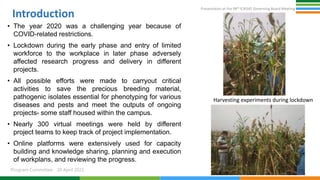
Harvesting experiments during lockdown
Presentation at the 98th ICRISAT Governing Board Meeting
Program Committee 20 April 2021
Crop Breeding- Chickpea
• Six varieties of chickpea released in India during
2020. These include
four varieties (RLBGK 1, RVG 204, JGK 6, NBeG 810)
released by Central Variety Released Committee
(CVRC) and
two varieties (Phule Vishwaraj, NBeG 452) released
by State Variety Release Committees (SVRC).
• Seventy-one advanced breeding lines supplied by
ICRISAT were tested under various All India
Coordinated Research Project (AICRP) trials during
2020-21 crop season.
• New rapid generation protocol that allows 6
generations/year was used for advancing 10
crosses and one RIL population.
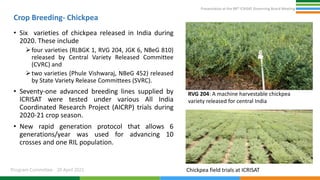
RVG 204: A machine harvestable chickpea
variety released for central India
Chickpea field trials at ICRISAT
Presentation at the 98th ICRISAT Governing Board Meeting
Program Committee 20 April 2021
Crop Breeding-Groundnut
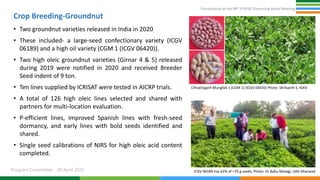
• Two groundnut varieties released in India in 2020
• These included- a large-seed confectionary variety (ICGV
06189) and a high oil variety (CGM 1 (ICGV 06420)).
• Two high oleic groundnut varieties (Girnar 4 & 5) released
during 2019 were notified in 2020 and received Breeder
Seed indent of 9 ton.
• Ten lines supplied by ICRISAT were tested in AICRP trials.
• A total of 126 high oleic lines selected and shared with
partners for multi-location evaluation.
• P-efficient lines, improved Spanish lines with fresh-seed
dormancy, and early lines with bold seeds identified and
shared.
• Single seed calibrations of NIRS for high oleic acid content
completed.
ICGV 06189 has 62% of >70 g seeds; Photo: Dr Babu Motagi, UAS-Dharwad
Chhattisgarh Mungfali-1 (CGM 1) (ICGV 06420) Photo: Shrikanth S, IGKV
Presentation at the 98th ICRISAT Governing Board Meeting
Program Committee 20 April 2021
Crop Breeding - Pigeonpea
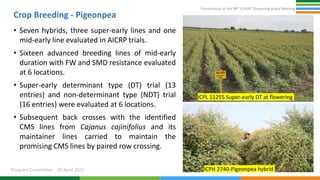
• Seven hybrids, three super-early lines and one
mid-early line evaluated in AICRP trials.
• Sixteen advanced breeding lines of mid-early
duration with FW and SMD resistance evaluated
at 6 locations.
• Super-early determinant type (DT) trial (13
entries) and non-determinant type (NDT) trial
(16 entries) were evaluated at 6 locations.
• Subsequent back crosses with the identified
CMS lines from Cajanus cajinifolius and its
maintainer lines carried to maintain the
promising CMS lines by paired row crossing.
5
ICPH 2740-Pigeonpea hybrid
ICPL 11255 Super-early DT at flowering
Presentation at the 98th ICRISAT Governing Board Meeting
Program Committee 20 April 2021
Crop Breeding- Sorghum
6
• Three multi-cut forage varieties (Pant Chari-12, 13 and
15) released in India.
• Red grain sorghum varieties and hybrids with high yield,
grain mold tolerance, higher protein digestibility, and
polyphenol content were identified.
• A biofortified red grain sorghum variety was tested in
the AICRP trial, and the proposal will be developed for
release.
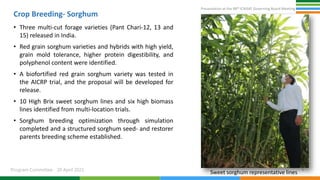
• 10 High Brix sweet sorghum lines and six high biomass
lines identified from multi-location trials.
• Sorghum breeding optimization through simulation
completed and a structured sorghum seed- and restorer
parents breeding scheme established.
Sweet sorghum representative lines
Presentation at the 98th ICRISAT Governing Board Meeting
Program Committee 20 April 2021
Crop Breeding- Pearl millet
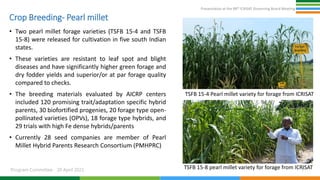
• Two pearl millet forage varieties (TSFB 15-4 and TSFB
15-8) were released for cultivation in five south Indian
states.
• These varieties are resistant to leaf spot and blight
diseases and have significantly higher green forage and
dry fodder yields and superior/or at par forage quality
compared to checks.
• The breeding materials evaluated by AICRP centers
included 120 promising trait/adaptation specific hybrid
parents, 30 biofortified progenies, 20 forage type open-
pollinated varieties (OPVs), 18 forage type hybrids, and
29 trials with high Fe dense hybrids/parents
• Currently 28 seed companies are member of Pearl
Millet Hybrid Parents Research Consortium (PMHPRC)
7
TSFB 15-4 Pearl millet variety for forage from ICRISAT
TSFB 15-8 pearl millet variety for forage from ICRISAT
Presentation at the 98th ICRISAT Governing Board Meeting
Program Committee 20 April 2021
Crop Breeding- Finger millet
• Heat tolerant progenies identified from
the progenies received from Kenya by
screening during two summer seasons.
• Calibration curve was developed for
screening of finger millet genotypes for
iron and zinc.
• 15 advanced breeding lines evaluated at
4 location in MLTs in Telangana, AP and
Uttarakhand.
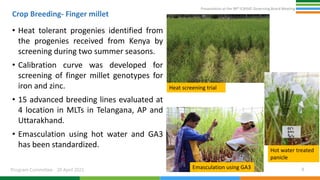
• Emasculation using hot water and GA3
has been standardized.
8
Heat screening trial
Emasculation using GA3
Hot water treated
panicle
Presentation at the 98th ICRISAT Governing Board Meeting
Program Committee 20 April 2021
Breeding Modernization
• Crop Teams consisting of product placement lead, genomics, breeding, disease-
insect, seed, data management developed and continuous interaction in progress
• BPAT recommendation response nearly completed
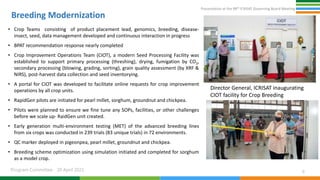
• Crop Improvement Operations Team (CIOT), a modern Seed Processing Facility was
established to support primary processing (threshing), drying, fumigation by CO2,
secondary processing (blowing, grading, sorting), grain quality assessment (by XRF &
NIRS), post-harvest data collection and seed inventorying.
• A portal for CIOT was developed to facilitate online requests for crop improvement
operations by all crop units.
• RapidGen pilots are initiated for pearl millet, sorghum, groundnut and chickpea.
• Pilots were planned to ensure we fine tune any SOPs, facilities, or other challenges
before we scale up- RaidGen unit created.
• Early generation multi-environment testing (MET) of the advanced breeding lines
from six crops was conducted in 239 trials (83 unique trials) in 72 environments.
• QC marker deployed in pigeonpea, pearl millet, groundnut and chickpea.
• Breeding scheme optimization using simulation initiated and completed for sorghum
as a model crop.
9
Director General, ICRISAT inaugurating
CIOT facility for Crop Breeding
Presentation at the 98th ICRISAT Governing Board Meeting
Program Committee 20 April 2021
Integrated Crop Management
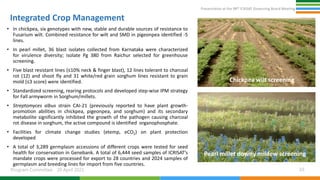
• In chickpea, six genotypes with new, stable and durable sources of resistance to
Fusarium wilt. Combined resistance for wilt and SMD in pigeonpea identified -5
lines.
• In pearl millet, 36 blast isolates collected from Karnataka were characterized
for virulence diversity; isolate Pg 380 from Raichur selected for greenhouse
screening.
• Five blast resistant lines (≤10% neck & finger blast), 12 lines tolerant to charcoal
rot (12) and shoot fly and 31 white/red grain sorghum lines resistant to grain
mold (≤3 score) were identified.
• Standardized screening, rearing protocols and developed step-wise IPM strategy
for Fall armyworm in Sorghum/millets.
• Streptomyces albus strain CAI-21 (previously reported to have plant growth-
promotion abilities in chickpea, pigeonpea, and sorghum) and its secondary
metabolite significantly inhibited the growth of the pathogen causing charcoal
rot disease in sorghum, the active compound is identified organophosphate.
• Facilities for climate change studies (etemp, eCO2) on plant protection
developed
• A total of 3,289 germplasm accessions of different crops were tested for seed
health for conservation in Genebank. A total of 6,444 seed samples of ICRISAT’s
mandate crops were processed for export to 28 countries and 2024 samples of
germplasm and breeding lines for import from five countries.
10
Chickpea wilt screening
Pearl millet downy mildew screening
Presentation at the 98th ICRISAT Governing Board Meeting
Program Committee 20 April 2021
ICRISAT Development Centre
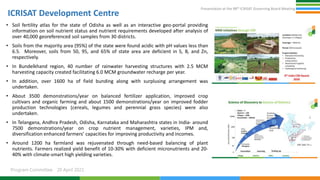
• Soil fertility atlas for the state of Odisha as well as an interactive geo-portal providing
information on soil nutrient status and nutrient requirements developed after analysis of
over 40,000 georeferenced soil samples from 30 districts.
• Soils from the majority area (95%) of the state were found acidic with pH values less than
6.5. Moreover, soils from 50, 95, and 65% of state area are deficient in S, B, and Zn,
respectively.
• In Bundelkhand region, 40 number of rainwater harvesting structures with 2.5 MCM
harvesting capacity created facilitating 6.0 MCM groundwater recharge per year.
• In addition, over 1600 ha of field bunding along with surplusing arrangement was
undertaken.
• About 3500 demonstrations/year on balanced fertilizer application, improved crop
cultivars and organic farming and about 1500 demonstrations/year on improved fodder
production technologies (cereals, legumes and perennial grass species) were also
undertaken.
• In Telangana, Andhra Pradesh, Odisha, Karnataka and Maharashtra states in India- around
7500 demonstrations/year on crop nutrient management, varieties, IPM and,
diversification enhanced farmers’ capacities for improving productivity and incomes.
• Around 1200 ha farmland was rejuvenated through need-based balancing of plant
nutrients. Farmers realized yield benefit of 10-30% with deficient micronutrients and 20-
40% with climate-smart high yielding varieties.
Presentation at the 98th ICRISAT Governing Board Meeting
Program Committee 20 April 2021
Farm & Engineering Services (FES)
• Comprehensive support was provided for 72 ha of experimental
fields and controlled environment research facilities under Covid 19
risk situation.
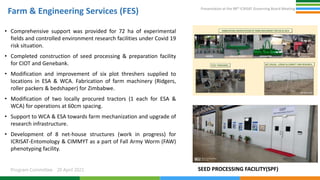
• Completed construction of seed processing & preparation facility
for CIOT and Genebank.
• Modification and improvement of six plot threshers supplied to
locations in ESA & WCA. Fabrication of farm machinery (Ridgers,
roller packers & bedshaper) for Zimbabwe.
• Modification of two locally procured tractors (1 each for ESA &
WCA) for operations at 60cm spacing.
• Support to WCA & ESA towards farm mechanization and upgrade of
research infrastructure.
• Development of 8 net-house structures (work in progress) for
ICRISAT-Entomology & CIMMYT as a part of Fall Army Worm (FAW)
phenotyping facility.
SEED PROCESSING FACILITY(SPF)
Presentation at the 98th ICRISAT Governing Board Meeting
Program Committee 20 April 2021
Thank You
Questions?
13

Asia Governing Board April 2021

  • 1.
    Update on ResearchProgram – Asia Research program Director, Asia Presentation at the 98th Governing Board meeting Program Committee 20 April 2021
  • 2.
    Presentation at the98th ICRISAT Governing Board Meeting Program Committee 20 April 2021 Introduction • The year 2020 was a challenging year because of COVID-related restrictions. • Lockdown during the early phase and entry of limited workforce to the workplace in later phase adversely affected research progress and delivery in different projects. • All possible efforts were made to carryout critical activities to save the precious breeding material, pathogenic isolates essential for phenotyping for various diseases and pests and meet the outputs of ongoing projects- some staff housed within the campus. • Nearly 300 virtual meetings were held by different project teams to keep track of project implementation. • Online platforms were extensively used for capacity building and knowledge sharing, planning and execution of workplans, and reviewing the progress. Harvesting experiments during lockdown
  • 3.
    Presentation at the98th ICRISAT Governing Board Meeting Program Committee 20 April 2021 Crop Breeding- Chickpea • Six varieties of chickpea released in India during 2020. These include four varieties (RLBGK 1, RVG 204, JGK 6, NBeG 810) released by Central Variety Released Committee (CVRC) and two varieties (Phule Vishwaraj, NBeG 452) released by State Variety Release Committees (SVRC). • Seventy-one advanced breeding lines supplied by ICRISAT were tested under various All India Coordinated Research Project (AICRP) trials during 2020-21 crop season. • New rapid generation protocol that allows 6 generations/year was used for advancing 10 crosses and one RIL population. RVG 204: A machine harvestable chickpea variety released for central India Chickpea field trials at ICRISAT
  • 4.
    Presentation at the98th ICRISAT Governing Board Meeting Program Committee 20 April 2021 Crop Breeding-Groundnut • Two groundnut varieties released in India in 2020 • These included- a large-seed confectionary variety (ICGV 06189) and a high oil variety (CGM 1 (ICGV 06420)). • Two high oleic groundnut varieties (Girnar 4 & 5) released during 2019 were notified in 2020 and received Breeder Seed indent of 9 ton. • Ten lines supplied by ICRISAT were tested in AICRP trials. • A total of 126 high oleic lines selected and shared with partners for multi-location evaluation. • P-efficient lines, improved Spanish lines with fresh-seed dormancy, and early lines with bold seeds identified and shared. • Single seed calibrations of NIRS for high oleic acid content completed. ICGV 06189 has 62% of >70 g seeds; Photo: Dr Babu Motagi, UAS-Dharwad Chhattisgarh Mungfali-1 (CGM 1) (ICGV 06420) Photo: Shrikanth S, IGKV
  • 5.
    Presentation at the98th ICRISAT Governing Board Meeting Program Committee 20 April 2021 Crop Breeding - Pigeonpea • Seven hybrids, three super-early lines and one mid-early line evaluated in AICRP trials. • Sixteen advanced breeding lines of mid-early duration with FW and SMD resistance evaluated at 6 locations. • Super-early determinant type (DT) trial (13 entries) and non-determinant type (NDT) trial (16 entries) were evaluated at 6 locations. • Subsequent back crosses with the identified CMS lines from Cajanus cajinifolius and its maintainer lines carried to maintain the promising CMS lines by paired row crossing. 5 ICPH 2740-Pigeonpea hybrid ICPL 11255 Super-early DT at flowering
  • 6.
    Presentation at the98th ICRISAT Governing Board Meeting Program Committee 20 April 2021 Crop Breeding- Sorghum 6 • Three multi-cut forage varieties (Pant Chari-12, 13 and 15) released in India. • Red grain sorghum varieties and hybrids with high yield, grain mold tolerance, higher protein digestibility, and polyphenol content were identified. • A biofortified red grain sorghum variety was tested in the AICRP trial, and the proposal will be developed for release. • 10 High Brix sweet sorghum lines and six high biomass lines identified from multi-location trials. • Sorghum breeding optimization through simulation completed and a structured sorghum seed- and restorer parents breeding scheme established. Sweet sorghum representative lines
  • 7.
    Presentation at the98th ICRISAT Governing Board Meeting Program Committee 20 April 2021 Crop Breeding- Pearl millet • Two pearl millet forage varieties (TSFB 15-4 and TSFB 15-8) were released for cultivation in five south Indian states. • These varieties are resistant to leaf spot and blight diseases and have significantly higher green forage and dry fodder yields and superior/or at par forage quality compared to checks. • The breeding materials evaluated by AICRP centers included 120 promising trait/adaptation specific hybrid parents, 30 biofortified progenies, 20 forage type open- pollinated varieties (OPVs), 18 forage type hybrids, and 29 trials with high Fe dense hybrids/parents • Currently 28 seed companies are member of Pearl Millet Hybrid Parents Research Consortium (PMHPRC) 7 TSFB 15-4 Pearl millet variety for forage from ICRISAT TSFB 15-8 pearl millet variety for forage from ICRISAT
  • 8.
    Presentation at the98th ICRISAT Governing Board Meeting Program Committee 20 April 2021 Crop Breeding- Finger millet • Heat tolerant progenies identified from the progenies received from Kenya by screening during two summer seasons. • Calibration curve was developed for screening of finger millet genotypes for iron and zinc. • 15 advanced breeding lines evaluated at 4 location in MLTs in Telangana, AP and Uttarakhand. • Emasculation using hot water and GA3 has been standardized. 8 Heat screening trial Emasculation using GA3 Hot water treated panicle
  • 9.
    Presentation at the98th ICRISAT Governing Board Meeting Program Committee 20 April 2021 Breeding Modernization • Crop Teams consisting of product placement lead, genomics, breeding, disease- insect, seed, data management developed and continuous interaction in progress • BPAT recommendation response nearly completed • Crop Improvement Operations Team (CIOT), a modern Seed Processing Facility was established to support primary processing (threshing), drying, fumigation by CO2, secondary processing (blowing, grading, sorting), grain quality assessment (by XRF & NIRS), post-harvest data collection and seed inventorying. • A portal for CIOT was developed to facilitate online requests for crop improvement operations by all crop units. • RapidGen pilots are initiated for pearl millet, sorghum, groundnut and chickpea. • Pilots were planned to ensure we fine tune any SOPs, facilities, or other challenges before we scale up- RaidGen unit created. • Early generation multi-environment testing (MET) of the advanced breeding lines from six crops was conducted in 239 trials (83 unique trials) in 72 environments. • QC marker deployed in pigeonpea, pearl millet, groundnut and chickpea. • Breeding scheme optimization using simulation initiated and completed for sorghum as a model crop. 9 Director General, ICRISAT inaugurating CIOT facility for Crop Breeding
  • 10.
    Presentation at the98th ICRISAT Governing Board Meeting Program Committee 20 April 2021 Integrated Crop Management • In chickpea, six genotypes with new, stable and durable sources of resistance to Fusarium wilt. Combined resistance for wilt and SMD in pigeonpea identified -5 lines. • In pearl millet, 36 blast isolates collected from Karnataka were characterized for virulence diversity; isolate Pg 380 from Raichur selected for greenhouse screening. • Five blast resistant lines (≤10% neck & finger blast), 12 lines tolerant to charcoal rot (12) and shoot fly and 31 white/red grain sorghum lines resistant to grain mold (≤3 score) were identified. • Standardized screening, rearing protocols and developed step-wise IPM strategy for Fall armyworm in Sorghum/millets. • Streptomyces albus strain CAI-21 (previously reported to have plant growth- promotion abilities in chickpea, pigeonpea, and sorghum) and its secondary metabolite significantly inhibited the growth of the pathogen causing charcoal rot disease in sorghum, the active compound is identified organophosphate. • Facilities for climate change studies (etemp, eCO2) on plant protection developed • A total of 3,289 germplasm accessions of different crops were tested for seed health for conservation in Genebank. A total of 6,444 seed samples of ICRISAT’s mandate crops were processed for export to 28 countries and 2024 samples of germplasm and breeding lines for import from five countries. 10 Chickpea wilt screening Pearl millet downy mildew screening
  • 11.
    Presentation at the98th ICRISAT Governing Board Meeting Program Committee 20 April 2021 ICRISAT Development Centre • Soil fertility atlas for the state of Odisha as well as an interactive geo-portal providing information on soil nutrient status and nutrient requirements developed after analysis of over 40,000 georeferenced soil samples from 30 districts. • Soils from the majority area (95%) of the state were found acidic with pH values less than 6.5. Moreover, soils from 50, 95, and 65% of state area are deficient in S, B, and Zn, respectively. • In Bundelkhand region, 40 number of rainwater harvesting structures with 2.5 MCM harvesting capacity created facilitating 6.0 MCM groundwater recharge per year. • In addition, over 1600 ha of field bunding along with surplusing arrangement was undertaken. • About 3500 demonstrations/year on balanced fertilizer application, improved crop cultivars and organic farming and about 1500 demonstrations/year on improved fodder production technologies (cereals, legumes and perennial grass species) were also undertaken. • In Telangana, Andhra Pradesh, Odisha, Karnataka and Maharashtra states in India- around 7500 demonstrations/year on crop nutrient management, varieties, IPM and, diversification enhanced farmers’ capacities for improving productivity and incomes. • Around 1200 ha farmland was rejuvenated through need-based balancing of plant nutrients. Farmers realized yield benefit of 10-30% with deficient micronutrients and 20- 40% with climate-smart high yielding varieties.
  • 12.
    Presentation at the98th ICRISAT Governing Board Meeting Program Committee 20 April 2021 Farm & Engineering Services (FES) • Comprehensive support was provided for 72 ha of experimental fields and controlled environment research facilities under Covid 19 risk situation. • Completed construction of seed processing & preparation facility for CIOT and Genebank. • Modification and improvement of six plot threshers supplied to locations in ESA & WCA. Fabrication of farm machinery (Ridgers, roller packers & bedshaper) for Zimbabwe. • Modification of two locally procured tractors (1 each for ESA & WCA) for operations at 60cm spacing. • Support to WCA & ESA towards farm mechanization and upgrade of research infrastructure. • Development of 8 net-house structures (work in progress) for ICRISAT-Entomology & CIMMYT as a part of Fall Army Worm (FAW) phenotyping facility. SEED PROCESSING FACILITY(SPF)
  • 13.
    Presentation at the98th ICRISAT Governing Board Meeting Program Committee 20 April 2021 Thank You Questions? 13