Food security: the
challenges


  Tim Benton
  UK Champion for Global Food
  Security & Professor of Ecology,
  University of Leeds

  tim.benton@foodsecurity.ac.uk
Today, food …

      • Is the world’s biggest industry
      • Is the world’s largest land user
      • Is the world’s largest water user
      • Is the world’s largest polluter and
        undermines essential environmental
        systems
      • Contributes to more ill-health than any
        other factor

      • We need it, daily
      • …but increasingly there isn’t enough of
        it
This is a global matter that
affects us all…
Those of us who are well fed, well garmented and well ordered, ought not to forget that necessity makes frequently the
root of crime. It is well for us to recollect that even in our own law-abiding, not to say virtuous cases, the only barrier
between us and anarchy is the last nine meals we’ve had. It may be taken as axiomatic that a starving man is never a
good citizen. AH Lewis 1896
WWF ecological footprint index
From Living Planet Report 2012
Unequal access to resources


  Germany: The Melander family – 4
  mouths $500.07 per week


                  2005


  Chad: The Aboubakar family - 6
  mouths $1.23 per week
Kit kat

          •   Milk chocolate (66%) (sugar, cocoa butter, cocoa mass, dried
              skimmed milk, whey powder, butterfat, vegetable fat,
              lactose, emulsifier (soya lecithin), flavouring), wheat flour,
              sugar, vegetable fat, cocoa mass, yeast, raising agent
              (sodium bicarbonate), salt, calcium sulphate, flavouring
DEMAND FOR FOOD IS GROWING
FAST
Population growth

                To 2050:
                 Population will
                 increase 35% (7.0-
                 ~9.2 bn),
                1 bn more in next 12
                yrs in Sub Saharan
                Africa and Asia
                    • 1.6m per week
                    • 2000 cities the size
                      of Edinburgh or 1250
                      the size of Leeds or
                      116 New Yorks
Growth in global food demand
Animal protein expensive in
resources to produce (ENA)
                              • 35% more mouths by 2050
                                 – Mainly in Asia, Africa and S. Am
                              • Richer people eat more:
                                 – ~5bn people in middle class by 2030 (cf
                                   1.8bn now), with associated higher
                                   consumption (meat, dairy and total
                                   volumes)
                                 – Mainly in Asia
                              • 70% urbanised
                                 – Understanding of food systems

                              • All add up to increased global food
                                demand (FAO estimate 60% more)
CONSTRAINTS ON SUPPLY GROWTH
Globally, there’s no more land


               Foley et al (2011) , Nature
Other constraints on production
                            growth

                             • Resource and regulatory squeezes:
                               – Nitrogen
Cost–benefit analysis
                               – Fuel
highlights that the
environmental costs of
                               – Phosphate
all N losses in Europe
(estimated at €70–€320
                               – pesticides
billion per year at
current rates) outweighs
the direct economic
benefits of N in
agriculture. (European
Nitrogen Assessment 2010)
Increasing
       competition
       for water


                      Per Capita Water Requirement for Food
By 2050 over half
the world’s
population will not
have enough water
to meet demands
CLIMATE CHANGE:
CHANGING VARIABILITY: THE WEATHER
Increasing extremes

    “…in France and northern Italy, where over 70,000 people
    perished from heat-related causes….. Italy experienced a
    record drop in maize yields of 36% from a year earlier,
    whereas in France maize and fodder production fell by 30%,
    fruit harvests declined by 25%, and wheat harvests (which
    had nearly reached maturity by the time the heat set in)
    declined by 21%”


                                             Battisti 2009 Science
Changing weather


  Historically, what was a 1 in 700 year event is
  now a 1 in 7-10 year event
Extreme weather can have
Expected area
covered under
                global impacts
“normal”
historical
conditions

 0.1%
 2.1%


 2.1%
0.1%


                                  PNAS, online Aug 2012
The same weather phenomenon
       can be very large scale


Need to increase resilience throughout the food chain
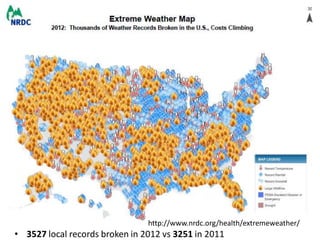
http://www.nrdc.org/health/extremeweather/
• 3527 local records broken in 2012 vs 3251 in 2011
THE NEED FOR SUSTAINABILITY
Agriculture’s environmental
                           footprint is huge
Foley et al Science 2011   • 4.9b ha land used;
                            – 75% of current gains in agricultural land via
                              deforestation (FAOSTAT 2010; Lambin 2011)
                            – Must cease land conversion (Stern report,
                              TEEB)
                           • ~25% of global GHG is from agriculture and
                             associated land use change (Tillman 2011)
                            – 18% in UK from agric and food sector (~60%
                              fertiliser, ~40% livestock, Defra)
                           • 24% soils on agricultural land degraded
                            – 12m ha agricultural land lost p.a. (ISRIC 2009)
                           • >70% water extraction for agriculture (FAO 2004)
                           • Diffuse pollution
                              – ~€300 bn across Europe (Eur. Nitr. Ass. 2011)
                           • Loss of biodiversity and ecosystem services
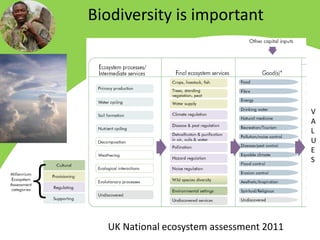
Biodiversity is important


                                          V
                                          A
                                          L
                                          U
                                          E
                                          S


  UK National ecosystem assessment 2011
We are caught between a
rock and a hard place


                Agriculture is
                damaging the
                environment at an
                unsustainable rate:
                but we need more
                production
CAN WE PRODUCE MORE
SUSTAINABLY?
“Sustainable
                           Agriculture” needs…

                           • Management of farming’s
                             impacts within
                             plots/fields
                           • management of land to
                             maintain other services

Sustainable agricultural landscapes require landscape planning:
many services depend on the amount, quality and
configuration of non-cropped habitat
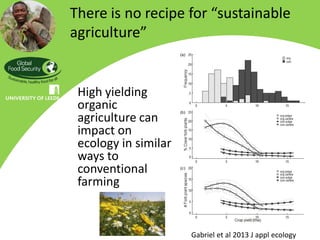
There is no recipe for “sustainable
agriculture”


 High yielding
 organic
 agriculture can
 impact on
 ecology in similar
 ways to
 conventional
 farming


                      Gabriel et al 2013 J appl ecology
The most efficient production of services
and yield may require land sparing…


          • If there is a trade-off between
            farming production and ecology
            then specialising different areas
            to produce (mainly) one product
            may produce more in aggregate
            than trying to produce both on
            the same land


     Gabriel et al. 2009 J app Ecol; 2010 Ecol Letts; Hodgson et al 2010 Ecol. Letts
Zero sum game for demand
ROUTES TO SOLUTIONS FOR
SUSTAINABLE PRODUCTION…?
Supply-side: “Win win” solutions

                                                          • Manage soils better
                                                             – Fertility, reduced erosion, soil
                                                               “health”, soil carbon
                                                          • Reduce waste, utilising new
                                                            knowledge
                                                             – Precision Farming
                                                             – Chemical innovation for reduction of
                                                               leaching loss
                                                             – Recycling etc
                                                          • Value ecosystem services
Robotic weeding:
Weed recognition through machine vision (26 species);
                                                             – Pollination, natural enemies, water
applies Glyphosphate only to the leaf of the weed (~1 g      – Manage landscape configuration
per hectare cf 720 g/ha)                                       better
Simon Blackmore, Harper Adams                             • New crops and varieties
                                                             – Role for GM and other molecular
                                                               biology advances
We need to save land for
ecology

 • Sustainable landscapes
 • Sustainable
   countries
 • Sustainable world
DOES DEMAND REQUIRE SUPPLY?
IT’S NOT JUST ABOUT
PRODUCTION
Global food losses/waste is estimated to be 1.3 billion
tonnes per annum (pa), equating to approximately one
third of edible food intended for human consumption

The total food production of sub-Saharan Africa =
developed world food waste (230mt)
Can we change our attitude to
food?

     • We want abundant, cheap,
       safe, nutritious, high-welfare,
       local and sustainable food –
       but we can’t have it all
Thorny issues for
solutions

    • Reducing waste from field to meal
    • Sustainable and healthy diets and their adoption
    • Incorporating the real cost of food into its price
      and being willing to pay it: who has the power?
    • The role of novel technologies and public
      perceptions
    • Economic growth vs sustainability and valuing
      natural capital
    • Managing competition for resources (land, water,
      energy etc)
    • Weighting local vs international impacts and
      managing them
    • Transport, logistics, sovereignty, aid, equity
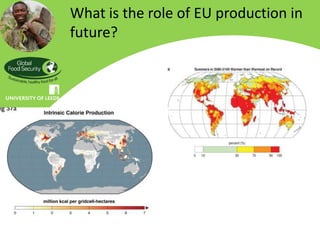
What is the role of EU production in
future?
THE PERSONAL CHALLENGE
The world is being used
unsustainably…
      • Pick questions to work on
        that matter
      • Use your skills wisely
      • Be creative, be bold
      • Be a leader not a follower
      • Make a difference…
The world is being
                   used unsustainably …

                         What are you doing about it?
                         What are you going to do about
                         it?
                         Many small changes add up to big
                         changes


Animal protein is
expensive to produce
(ENA)
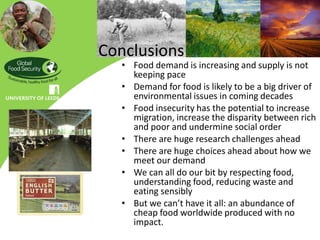
Conclusions
  • Food demand is increasing and supply is not
    keeping pace
  • Demand for food is likely to be a big driver of
    environmental issues in coming decades
  • Food insecurity has the potential to increase
    migration, increase the disparity between rich
    and poor and undermine social order
  • There are huge research challenges ahead
  • There are huge choices ahead about how we
    meet our demand
  • We can all do our bit by respecting food,
    understanding food, reducing waste and
    eating sensibly
  • But we can’t have it all: an abundance of
    cheap food worldwide produced with no
    impact.
Thank you!
tim.benton@foodsecurity.ac.uk
    www.foodsecurity.ac.uk

Tim Benton @FTF2013

  • 1.
    Food security: the challenges Tim Benton UK Champion for Global Food Security & Professor of Ecology, University of Leeds tim.benton@foodsecurity.ac.uk
  • 2.
    Today, food … • Is the world’s biggest industry • Is the world’s largest land user • Is the world’s largest water user • Is the world’s largest polluter and undermines essential environmental systems • Contributes to more ill-health than any other factor • We need it, daily • …but increasingly there isn’t enough of it
  • 5.
    This is aglobal matter that affects us all…
  • 6.
    Those of uswho are well fed, well garmented and well ordered, ought not to forget that necessity makes frequently the root of crime. It is well for us to recollect that even in our own law-abiding, not to say virtuous cases, the only barrier between us and anarchy is the last nine meals we’ve had. It may be taken as axiomatic that a starving man is never a good citizen. AH Lewis 1896
  • 7.
    WWF ecological footprintindex From Living Planet Report 2012
  • 8.
    Unequal access toresources Germany: The Melander family – 4 mouths $500.07 per week 2005 Chad: The Aboubakar family - 6 mouths $1.23 per week
  • 9.
    Kit kat • Milk chocolate (66%) (sugar, cocoa butter, cocoa mass, dried skimmed milk, whey powder, butterfat, vegetable fat, lactose, emulsifier (soya lecithin), flavouring), wheat flour, sugar, vegetable fat, cocoa mass, yeast, raising agent (sodium bicarbonate), salt, calcium sulphate, flavouring
  • 10.
    DEMAND FOR FOODIS GROWING FAST
  • 11.
    Population growth To 2050: Population will increase 35% (7.0- ~9.2 bn), 1 bn more in next 12 yrs in Sub Saharan Africa and Asia • 1.6m per week • 2000 cities the size of Edinburgh or 1250 the size of Leeds or 116 New Yorks
  • 12.
    Growth in globalfood demand Animal protein expensive in resources to produce (ENA) • 35% more mouths by 2050 – Mainly in Asia, Africa and S. Am • Richer people eat more: – ~5bn people in middle class by 2030 (cf 1.8bn now), with associated higher consumption (meat, dairy and total volumes) – Mainly in Asia • 70% urbanised – Understanding of food systems • All add up to increased global food demand (FAO estimate 60% more)
  • 13.
  • 14.
    Globally, there’s nomore land Foley et al (2011) , Nature
  • 15.
    Other constraints onproduction growth • Resource and regulatory squeezes: – Nitrogen Cost–benefit analysis – Fuel highlights that the environmental costs of – Phosphate all N losses in Europe (estimated at €70–€320 – pesticides billion per year at current rates) outweighs the direct economic benefits of N in agriculture. (European Nitrogen Assessment 2010)
  • 16.
    Increasing competition for water Per Capita Water Requirement for Food By 2050 over half the world’s population will not have enough water to meet demands
  • 17.
  • 18.
    Increasing extremes “…in France and northern Italy, where over 70,000 people perished from heat-related causes….. Italy experienced a record drop in maize yields of 36% from a year earlier, whereas in France maize and fodder production fell by 30%, fruit harvests declined by 25%, and wheat harvests (which had nearly reached maturity by the time the heat set in) declined by 21%” Battisti 2009 Science
  • 19.
    Changing weather Historically, what was a 1 in 700 year event is now a 1 in 7-10 year event
  • 20.
    Extreme weather canhave Expected area covered under global impacts “normal” historical conditions 0.1% 2.1% 2.1% 0.1% PNAS, online Aug 2012
  • 21.
    The same weatherphenomenon can be very large scale Need to increase resilience throughout the food chain
  • 22.
    http://www.nrdc.org/health/extremeweather/ • 3527 localrecords broken in 2012 vs 3251 in 2011
  • 23.
    THE NEED FORSUSTAINABILITY
  • 24.
    Agriculture’s environmental footprint is huge Foley et al Science 2011 • 4.9b ha land used; – 75% of current gains in agricultural land via deforestation (FAOSTAT 2010; Lambin 2011) – Must cease land conversion (Stern report, TEEB) • ~25% of global GHG is from agriculture and associated land use change (Tillman 2011) – 18% in UK from agric and food sector (~60% fertiliser, ~40% livestock, Defra) • 24% soils on agricultural land degraded – 12m ha agricultural land lost p.a. (ISRIC 2009) • >70% water extraction for agriculture (FAO 2004) • Diffuse pollution – ~€300 bn across Europe (Eur. Nitr. Ass. 2011) • Loss of biodiversity and ecosystem services
  • 25.
    Biodiversity is important V A L U E S UK National ecosystem assessment 2011
  • 26.
    We are caughtbetween a rock and a hard place Agriculture is damaging the environment at an unsustainable rate: but we need more production
  • 27.
    CAN WE PRODUCEMORE SUSTAINABLY?
  • 28.
    “Sustainable Agriculture” needs… • Management of farming’s impacts within plots/fields • management of land to maintain other services Sustainable agricultural landscapes require landscape planning: many services depend on the amount, quality and configuration of non-cropped habitat
  • 29.
    There is norecipe for “sustainable agriculture” High yielding organic agriculture can impact on ecology in similar ways to conventional farming Gabriel et al 2013 J appl ecology
  • 30.
    The most efficientproduction of services and yield may require land sparing… • If there is a trade-off between farming production and ecology then specialising different areas to produce (mainly) one product may produce more in aggregate than trying to produce both on the same land Gabriel et al. 2009 J app Ecol; 2010 Ecol Letts; Hodgson et al 2010 Ecol. Letts
  • 31.
    Zero sum gamefor demand
  • 32.
    ROUTES TO SOLUTIONSFOR SUSTAINABLE PRODUCTION…?
  • 33.
    Supply-side: “Win win”solutions • Manage soils better – Fertility, reduced erosion, soil “health”, soil carbon • Reduce waste, utilising new knowledge – Precision Farming – Chemical innovation for reduction of leaching loss – Recycling etc • Value ecosystem services Robotic weeding: Weed recognition through machine vision (26 species); – Pollination, natural enemies, water applies Glyphosphate only to the leaf of the weed (~1 g – Manage landscape configuration per hectare cf 720 g/ha) better Simon Blackmore, Harper Adams • New crops and varieties – Role for GM and other molecular biology advances
  • 34.
    We need tosave land for ecology • Sustainable landscapes • Sustainable countries • Sustainable world
  • 35.
  • 36.
    IT’S NOT JUSTABOUT PRODUCTION Global food losses/waste is estimated to be 1.3 billion tonnes per annum (pa), equating to approximately one third of edible food intended for human consumption The total food production of sub-Saharan Africa = developed world food waste (230mt)
  • 37.
    Can we changeour attitude to food? • We want abundant, cheap, safe, nutritious, high-welfare, local and sustainable food – but we can’t have it all
  • 38.
    Thorny issues for solutions • Reducing waste from field to meal • Sustainable and healthy diets and their adoption • Incorporating the real cost of food into its price and being willing to pay it: who has the power? • The role of novel technologies and public perceptions • Economic growth vs sustainability and valuing natural capital • Managing competition for resources (land, water, energy etc) • Weighting local vs international impacts and managing them • Transport, logistics, sovereignty, aid, equity
  • 39.
    What is therole of EU production in future?
  • 40.
  • 41.
    The world isbeing used unsustainably… • Pick questions to work on that matter • Use your skills wisely • Be creative, be bold • Be a leader not a follower • Make a difference…
  • 42.
    The world isbeing used unsustainably … What are you doing about it? What are you going to do about it? Many small changes add up to big changes Animal protein is expensive to produce (ENA)
  • 43.
    Conclusions •Food demand is increasing and supply is not keeping pace • Demand for food is likely to be a big driver of environmental issues in coming decades • Food insecurity has the potential to increase migration, increase the disparity between rich and poor and undermine social order • There are huge research challenges ahead • There are huge choices ahead about how we meet our demand • We can all do our bit by respecting food, understanding food, reducing waste and eating sensibly • But we can’t have it all: an abundance of cheap food worldwide produced with no impact.
  • 44.