P H D C A N D I D A T E
OANA IACOB
Natural flood management as a
climate change adaptation option
11 April, Facing the Future Symposium 2013
Dundee
Outline
 Introduction to ecosystem services
 Climate change threat
 What is natural flood management?
 Tarland study catchment
 Hydrological modelling
 Land use scenarios
 Climate change scenarios
 Hydrological modelling tool
 Conclusions
11 April, Facing the Future Symposium 2013
Introduction to ecosystem services
 Humans have always depended on nature for
environmental assets like clean water, nutrient
cycling and soil formation.
 These have been called by different names through
human history, but are presently gaining global
attention as ‘ecosystem services’.
11 April, Facing the Future Symposium 2013
Ecosystem services
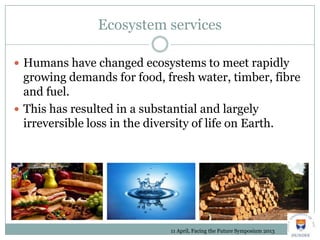
 Humans have changed ecosystems to meet rapidly
growing demands for food, fresh water, timber, fibre
and fuel.
 This has resulted in a substantial and largely
irreversible loss in the diversity of life on Earth.
11 April, Facing the Future Symposium 2013
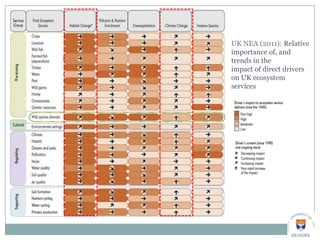
UK NEA (2011): Relative
importance of, and
trends in the
impact of direct drivers
on UK ecosystem
services
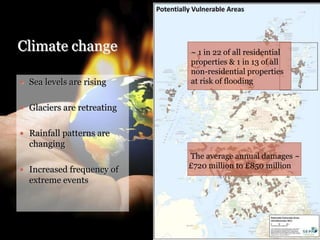
 Sea levels are rising
 Glaciers are retreating
 Rainfall patterns are
changing
 Increased frequency of
extreme events
Climate change ~ 1 in 22 of all residential
properties & 1 in 13 of all
non-residential properties
at risk of flooding
The average annual damages ~
£720 million to £850 million
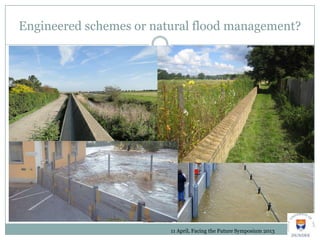
Engineered schemes or natural flood management?
11 April, Facing the Future Symposium 2013
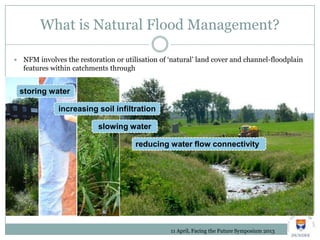
What is Natural Flood Management?
 NFM involves the restoration or utilisation of ‘natural’ land cover and channel-floodplain
features within catchments through
storing water
increasing soil infiltration
slowing water
reducing water flow connectivity
11 April, Facing the Future Symposium 2013
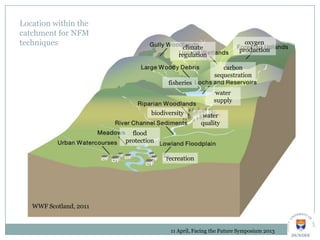
Location within the
catchment for NFM
techniques
WWF Scotland, 2011
11 April, Facing the Future Symposium 2013
fisheries
carbon
sequestration
oxygen
production
biodiversity
recreation
water
quality
flood
protection
water
supply
climate
regulation
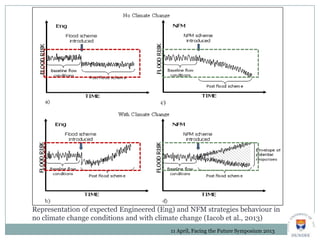
Representation of expected Engineered (Eng) and NFM strategies behaviour in
no climate change conditions and with climate change (Iacob et al., 2013)
c)
11 April, Facing the Future Symposium 2013
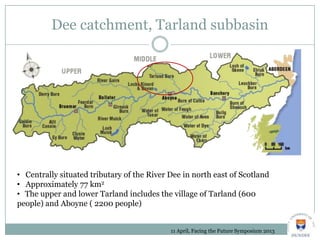
Dee catchment, Tarland subbasin
11 April, Facing the Future Symposium 2013
• Centrally situated tributary of the River Dee in north east of Scotland
• Approximately 77 km2
• The upper and lower Tarland includes the village of Tarland (600
people) and Aboyne ( 2200 people)
Tarland
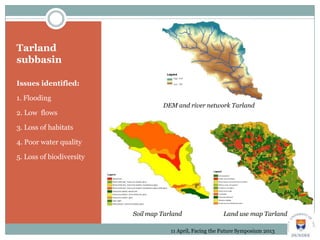
subbasin
Issues identified:
1. Flooding
2. Low flows
3. Loss of habitats
4. Poor water quality
5. Loss of biodiversity
Soil map Tarland Land use map Tarland
11 April, Facing the Future Symposium 2013
DEM and river network Tarland
Modelling land use and climate scenarios
Land use
scenarios
Climate
change
scenarios
11 April, Facing the Future Symposium 2013
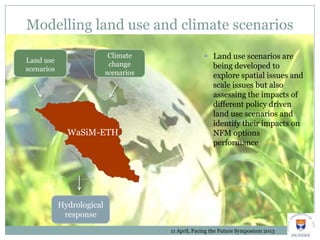
 Land use scenarios are
being developed to
explore spatial issues and
scale issues but also
assessing the impacts of
different policy driven
land use scenarios and
identify their impacts on
NFM options
performance
WaSiM-ETH
Hydrological
response
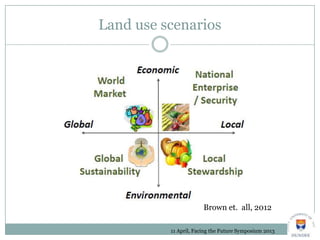
Land use scenarios
Brown et. all, 2012
11 April, Facing the Future Symposium 2013
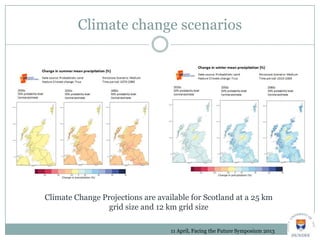
Climate change scenarios
Climate Change Projections are available for Scotland at a 25 km
grid size and 12 km grid size
11 April, Facing the Future Symposium 2013
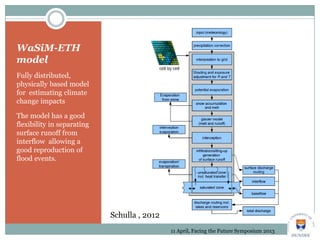
WaSiM-ETH
model
Fully distributed,
physically based model
for estimating climate
change impacts
The model has a good
flexibility in separating
surface runoff from
interflow allowing a
good reproduction of
flood events.
11 April, Facing the Future Symposium 2013
Schulla , 2012
Conclusions
 Climate change poses new challenges that need new
approaches for flood risk management
 Natural flood management has the potential to
deliver ‘low regret’ solutions
 Time lags must be considered in
flood vulnerable communities
11 April, Facing the Future Symposium 2013
QUESTIONS
Thank you!
11 April, Facing the Future Symposium 2013

Oana Iacob @FTF2013

  • 1.
    P H DC A N D I D A T E OANA IACOB Natural flood management as a climate change adaptation option 11 April, Facing the Future Symposium 2013 Dundee
  • 2.
    Outline  Introduction toecosystem services  Climate change threat  What is natural flood management?  Tarland study catchment  Hydrological modelling  Land use scenarios  Climate change scenarios  Hydrological modelling tool  Conclusions 11 April, Facing the Future Symposium 2013
  • 3.
    Introduction to ecosystemservices  Humans have always depended on nature for environmental assets like clean water, nutrient cycling and soil formation.  These have been called by different names through human history, but are presently gaining global attention as ‘ecosystem services’. 11 April, Facing the Future Symposium 2013
  • 4.
    Ecosystem services  Humanshave changed ecosystems to meet rapidly growing demands for food, fresh water, timber, fibre and fuel.  This has resulted in a substantial and largely irreversible loss in the diversity of life on Earth. 11 April, Facing the Future Symposium 2013
  • 5.
    UK NEA (2011):Relative importance of, and trends in the impact of direct drivers on UK ecosystem services
  • 6.
     Sea levelsare rising  Glaciers are retreating  Rainfall patterns are changing  Increased frequency of extreme events Climate change ~ 1 in 22 of all residential properties & 1 in 13 of all non-residential properties at risk of flooding The average annual damages ~ £720 million to £850 million
  • 7.
    Engineered schemes ornatural flood management? 11 April, Facing the Future Symposium 2013
  • 8.
    What is NaturalFlood Management?  NFM involves the restoration or utilisation of ‘natural’ land cover and channel-floodplain features within catchments through storing water increasing soil infiltration slowing water reducing water flow connectivity 11 April, Facing the Future Symposium 2013
  • 9.
    Location within the catchmentfor NFM techniques WWF Scotland, 2011 11 April, Facing the Future Symposium 2013 fisheries carbon sequestration oxygen production biodiversity recreation water quality flood protection water supply climate regulation
  • 10.
    Representation of expectedEngineered (Eng) and NFM strategies behaviour in no climate change conditions and with climate change (Iacob et al., 2013) c) 11 April, Facing the Future Symposium 2013
  • 11.
    Dee catchment, Tarlandsubbasin 11 April, Facing the Future Symposium 2013 • Centrally situated tributary of the River Dee in north east of Scotland • Approximately 77 km2 • The upper and lower Tarland includes the village of Tarland (600 people) and Aboyne ( 2200 people)
  • 12.
    Tarland subbasin Issues identified: 1. Flooding 2.Low flows 3. Loss of habitats 4. Poor water quality 5. Loss of biodiversity Soil map Tarland Land use map Tarland 11 April, Facing the Future Symposium 2013 DEM and river network Tarland
  • 13.
    Modelling land useand climate scenarios Land use scenarios Climate change scenarios 11 April, Facing the Future Symposium 2013  Land use scenarios are being developed to explore spatial issues and scale issues but also assessing the impacts of different policy driven land use scenarios and identify their impacts on NFM options performance WaSiM-ETH Hydrological response
  • 14.
    Land use scenarios Brownet. all, 2012 11 April, Facing the Future Symposium 2013
  • 15.
    Climate change scenarios ClimateChange Projections are available for Scotland at a 25 km grid size and 12 km grid size 11 April, Facing the Future Symposium 2013
  • 16.
    WaSiM-ETH model Fully distributed, physically basedmodel for estimating climate change impacts The model has a good flexibility in separating surface runoff from interflow allowing a good reproduction of flood events. 11 April, Facing the Future Symposium 2013 Schulla , 2012
  • 17.
    Conclusions  Climate changeposes new challenges that need new approaches for flood risk management  Natural flood management has the potential to deliver ‘low regret’ solutions  Time lags must be considered in flood vulnerable communities 11 April, Facing the Future Symposium 2013
  • 18.
    QUESTIONS Thank you! 11 April,Facing the Future Symposium 2013