What role for small-scale energy?
Understanding the value of challenging large-
scale lock-in
Iain Soutar
University of Exeter
April 2013
Outline
 Context: the energy challenge
 the growth of small scale
 Sociotechnical change theory
 WREN: A case study of change
The big three challenges
 Emission reduction targets essentially an energy
challenge
 c. 75% of GHG emissions from energy
 Renewing electricity infrastructure
 c. £110bn by 2020
 Energy security
 Demand as well as supply issue
Scale and immediacy of challenges is unprecedented
Several possible pathways
 Whichever path we take will have implications for meeting
(each part of) energy challenge
 Several common themes
 Decarbonise electricity
 With implications for generation, supply network etc
 Demand must play a role
 People as well as infrastructures
 A system-wide approach is necessary
 Technological, economic, societal and institutional restructuring
 Large, expensive decisions
 Energy as a social issue
 Trade-offs inevitable
The real energy challenge
 Political-economic paradigm drives inertia
 Regulation favours norm
 Technological and institutional lock-in
 Neuhoff‟s uneven playing field
 Current system unable to correct for externalities
 Alternative frameworks may be
more appropriate
 We can do it…
If we want to
The difficulty lies,
not with the new ideas,
but in escaping the old ones
John Maynard Keynes
ELEC OF ENERGY
Is small beautiful?
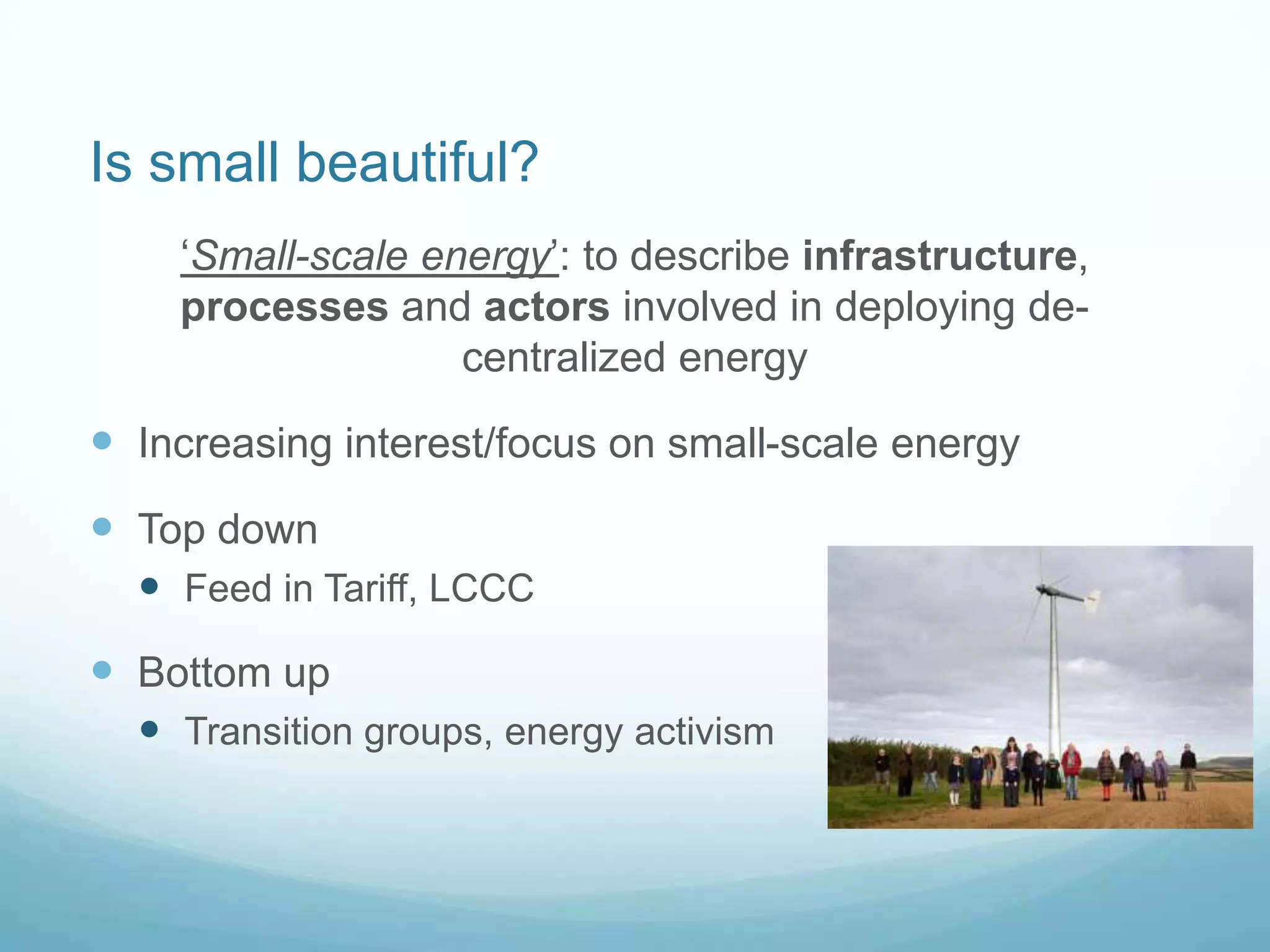
„Small-scale energy‟: to describe infrastructure,
processes and actors involved in deploying de-
centralized energy
 Increasing interest/focus on small-scale energy
 Top down
 Feed in Tariff, LCCC
 Bottom up
 Transition groups, energy activism
Is small beautiful?
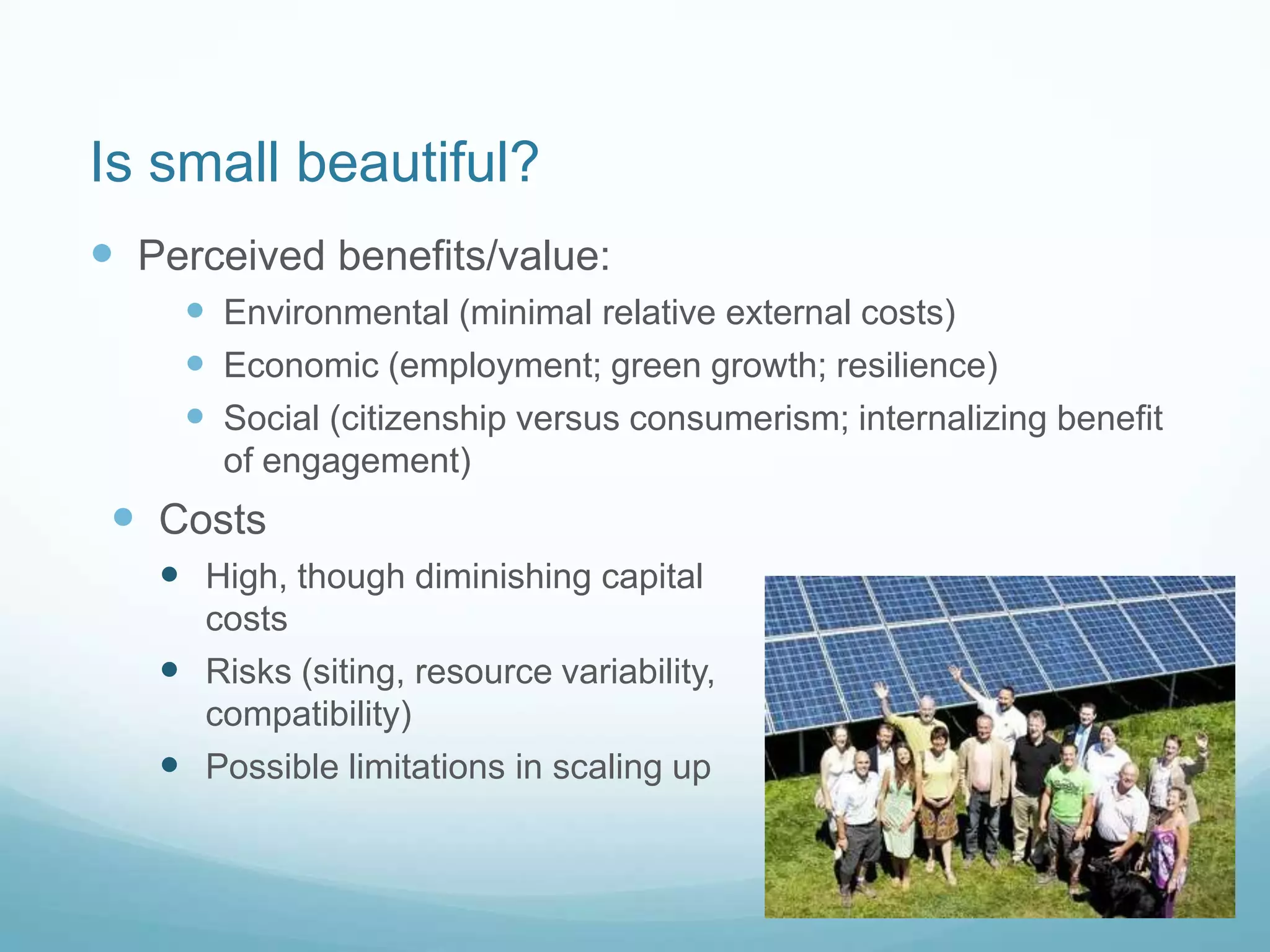
 Perceived benefits/value:
 Environmental (minimal relative external costs)
 Economic (employment; green growth; resilience)
 Social (citizenship versus consumerism; internalizing benefit
of engagement)
 Costs
 High, though diminishing capital
costs
 Risks (siting, resource variability,
compatibility)
 Possible limitations in scaling up
Research objectives
1. How can we start to understand the whole-system
aspects of small scale energy?
(so what is important??)
2. Through what kind of framework can value be
understood?
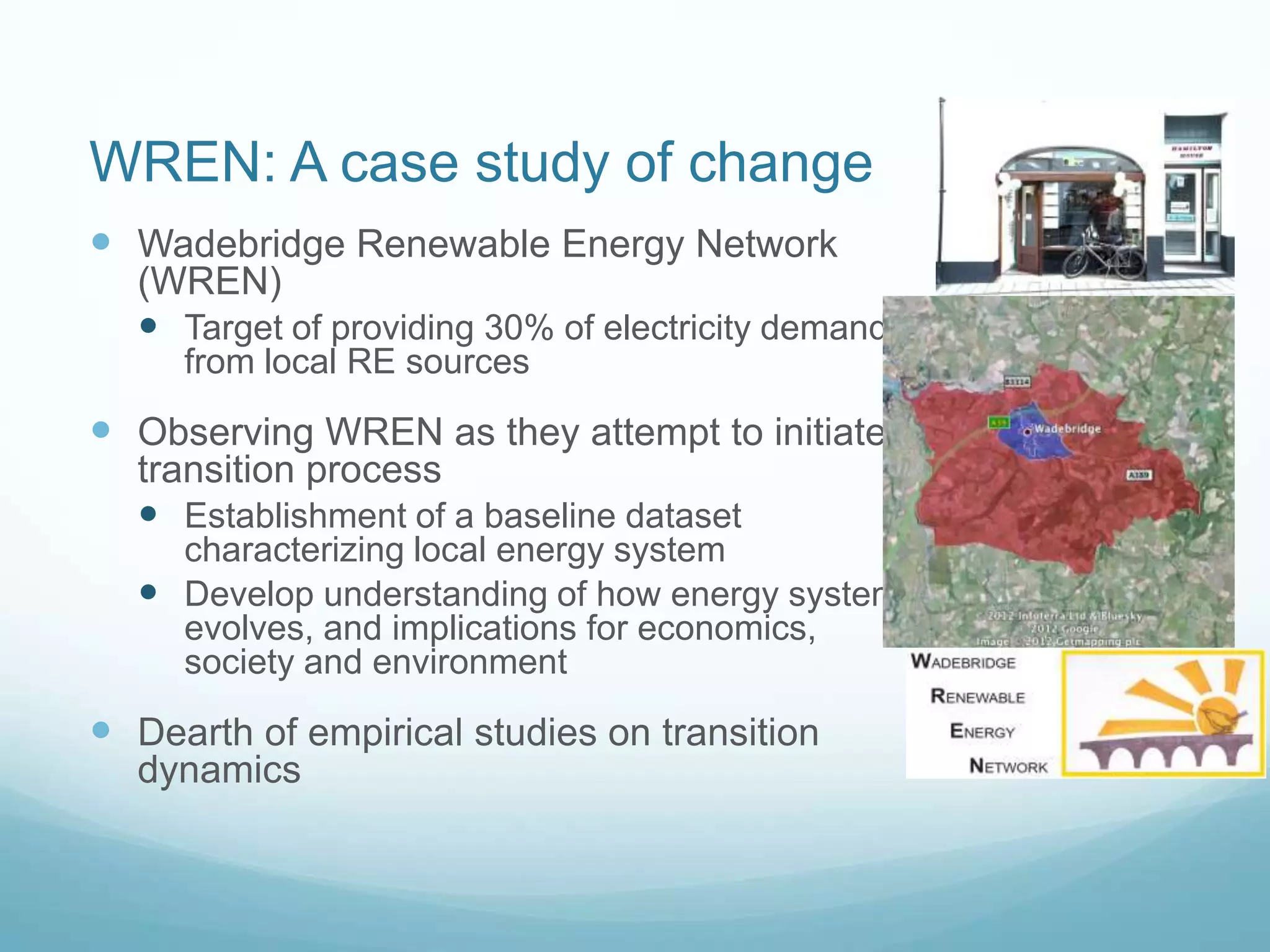
WREN: A case study of change
 Wadebridge Renewable Energy Network
(WREN)
 Target of providing 30% of electricity demand
from local RE sources
 Observing WREN as they attempt to initiate
transition process
 Establishment of a baseline dataset
characterizing local energy system
 Develop understanding of how energy system
evolves, and implications for economics,
society and environment
 Dearth of empirical studies on transition
dynamics
Methods
1. Establish baseline of Wadebridge‟s energy system
 Primary and secondary data
 Quant/qual social survey
 Cross-sectional snapshot
2. Establish sociotechnical „narratives‟ as a way of
understanding and communicating data
 Focused interviews with key stakeholders
 Contextualising data
 Situating data in wider system, and alongside wider
societal objectives
Indicators, as “thriftily selected data assumed to have a causal relationship with
a theoretical concept” (Vos et al, 1984)
• Resource
e.g. Supply types & quantities produced & consumed
• Economic
e.g. Monetary costs and benefits of supply and consumption
• Social
e.g. Engagement; value-added practices
• Environmental
e.g. Emissions avoided; compatibility with other activities
• Contextual
e.g. Geographic, demographic, macroeconomic
Alignment of indicators with objectives
(income – housing stock – fuel poverty -
Establishing a baseline
Indicator
data
Industry
/Technology
e.g. Are
technologies:
Available?
Established?
Effective?
Reliable?
Economics
/markets
e.g. Are RE
investments:
Feasible?
Risky?
Over what
timescales?
Society
/culture
e.g. Is society:
Engaged?
Accepting?
Willing?
Able?
Policy
e.g. Is policy:
Enabling?
Supportive?
Consistent?
Equitable?
Narratives of
domains
Resource/energy; Economic; Social; Environmental
Current energy system
(regime)
Small-scale energy
(niche)
Thank you
i.soutar@exeter.ac.uk
The value of evidence
 Big energy decisions necessarily political
 Profound economic and social consequences
 What type of evidence is most useful, and to whom?
 Value of evidence may be limited
 Energy is complex, difficult to model
 An optimum pathway?
 Disagreement over objectives
 We can do it…if we want to
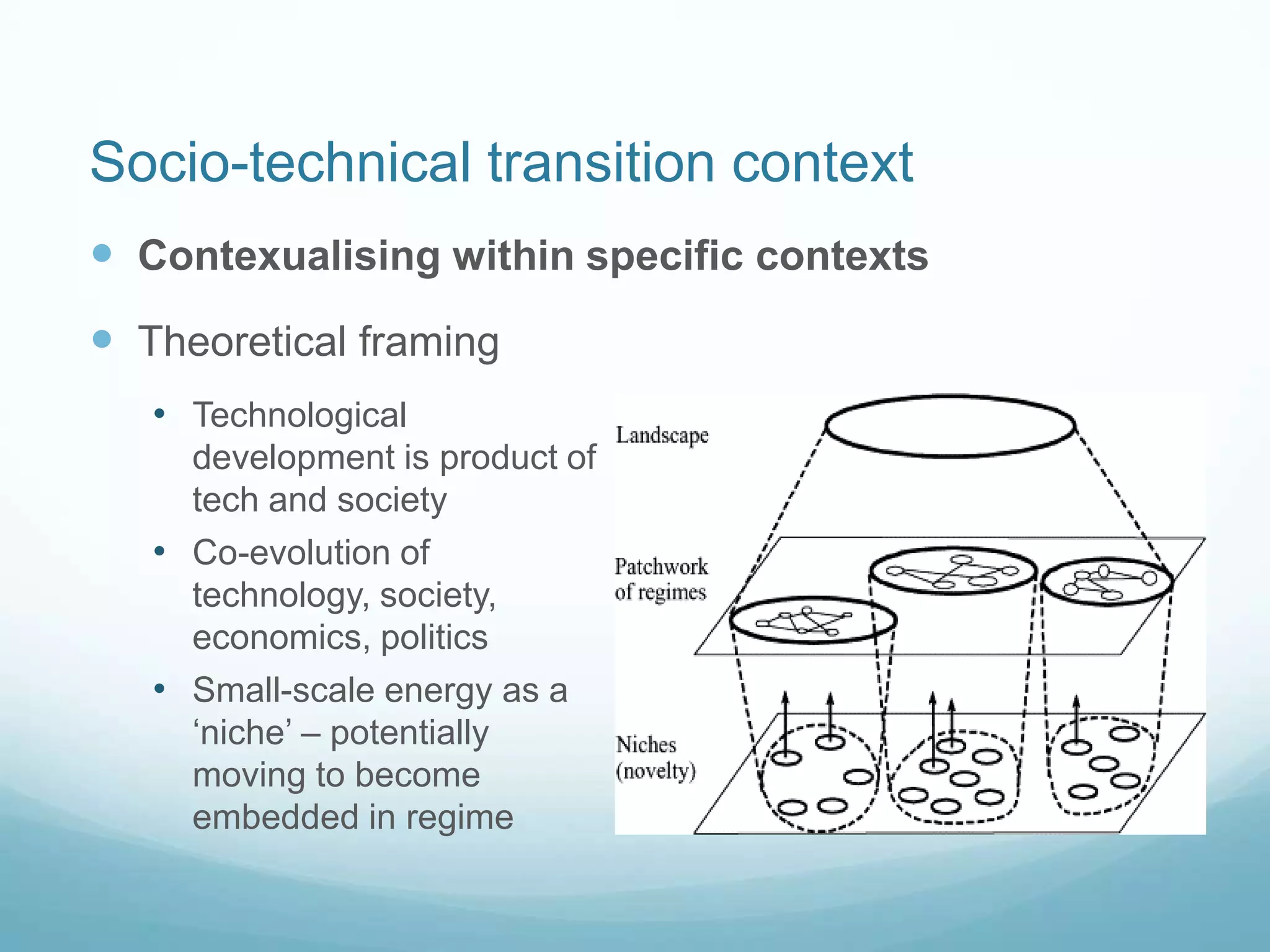
Socio-technical transition context
 Contexualising within specific contexts
 Theoretical framing
• Technological
development is product of
tech and society
• Co-evolution of
technology, society,
economics, politics
• Small-scale energy as a
„niche‟ – potentially
moving to become
embedded in regime

Iain Soutar

  • 1.
    What role forsmall-scale energy? Understanding the value of challenging large- scale lock-in Iain Soutar University of Exeter April 2013
  • 2.
    Outline  Context: theenergy challenge  the growth of small scale  Sociotechnical change theory  WREN: A case study of change
  • 3.
    The big threechallenges  Emission reduction targets essentially an energy challenge  c. 75% of GHG emissions from energy  Renewing electricity infrastructure  c. £110bn by 2020  Energy security  Demand as well as supply issue Scale and immediacy of challenges is unprecedented
  • 4.
    Several possible pathways Whichever path we take will have implications for meeting (each part of) energy challenge  Several common themes  Decarbonise electricity  With implications for generation, supply network etc  Demand must play a role  People as well as infrastructures  A system-wide approach is necessary  Technological, economic, societal and institutional restructuring  Large, expensive decisions  Energy as a social issue  Trade-offs inevitable
  • 5.
    The real energychallenge  Political-economic paradigm drives inertia  Regulation favours norm  Technological and institutional lock-in  Neuhoff‟s uneven playing field  Current system unable to correct for externalities  Alternative frameworks may be more appropriate  We can do it… If we want to The difficulty lies, not with the new ideas, but in escaping the old ones John Maynard Keynes
  • 6.
  • 7.
    Is small beautiful? „Small-scaleenergy‟: to describe infrastructure, processes and actors involved in deploying de- centralized energy  Increasing interest/focus on small-scale energy  Top down  Feed in Tariff, LCCC  Bottom up  Transition groups, energy activism
  • 8.
    Is small beautiful? Perceived benefits/value:  Environmental (minimal relative external costs)  Economic (employment; green growth; resilience)  Social (citizenship versus consumerism; internalizing benefit of engagement)  Costs  High, though diminishing capital costs  Risks (siting, resource variability, compatibility)  Possible limitations in scaling up
  • 9.
    Research objectives 1. Howcan we start to understand the whole-system aspects of small scale energy? (so what is important??) 2. Through what kind of framework can value be understood?
  • 10.
    WREN: A casestudy of change  Wadebridge Renewable Energy Network (WREN)  Target of providing 30% of electricity demand from local RE sources  Observing WREN as they attempt to initiate transition process  Establishment of a baseline dataset characterizing local energy system  Develop understanding of how energy system evolves, and implications for economics, society and environment  Dearth of empirical studies on transition dynamics
  • 11.
    Methods 1. Establish baselineof Wadebridge‟s energy system  Primary and secondary data  Quant/qual social survey  Cross-sectional snapshot 2. Establish sociotechnical „narratives‟ as a way of understanding and communicating data  Focused interviews with key stakeholders  Contextualising data  Situating data in wider system, and alongside wider societal objectives
  • 12.
    Indicators, as “thriftilyselected data assumed to have a causal relationship with a theoretical concept” (Vos et al, 1984) • Resource e.g. Supply types & quantities produced & consumed • Economic e.g. Monetary costs and benefits of supply and consumption • Social e.g. Engagement; value-added practices • Environmental e.g. Emissions avoided; compatibility with other activities • Contextual e.g. Geographic, demographic, macroeconomic Alignment of indicators with objectives (income – housing stock – fuel poverty - Establishing a baseline
  • 14.
    Indicator data Industry /Technology e.g. Are technologies: Available? Established? Effective? Reliable? Economics /markets e.g. AreRE investments: Feasible? Risky? Over what timescales? Society /culture e.g. Is society: Engaged? Accepting? Willing? Able? Policy e.g. Is policy: Enabling? Supportive? Consistent? Equitable? Narratives of domains Resource/energy; Economic; Social; Environmental Current energy system (regime) Small-scale energy (niche)
  • 15.
  • 16.
    The value ofevidence  Big energy decisions necessarily political  Profound economic and social consequences  What type of evidence is most useful, and to whom?  Value of evidence may be limited  Energy is complex, difficult to model  An optimum pathway?  Disagreement over objectives  We can do it…if we want to
  • 18.
    Socio-technical transition context Contexualising within specific contexts  Theoretical framing • Technological development is product of tech and society • Co-evolution of technology, society, economics, politics • Small-scale energy as a „niche‟ – potentially moving to become embedded in regime

Editor's Notes

  • #4 CLIMATE CHANGE and EMISSION REDUCTION is an ENERGY CHALLENGEEmission reduction target of 80% by 205020% by 2020110bn – more than double current rate of investment (75 for generation, 35 for transmission/distribution)In Next decade, we are to lose quarter of current capacity (ageing closures and environmental regulation)Energy system is significant contributorto emissions – problem as well as potential solution2007 White Paper – Meeting the Energy ChallengeSystem wide – decisions about supply and demand will have technological, environmental, economic, social implicationsHuge decisions, and trade offs to be made – decarbonising supply or focusing on demand reduction?Scale: decisions will be costly (infrastructure, restructuring elsewhere, learning process). Which decisions are made will have different costs (economic as well as environmental and social)
  • #5 Themes align towards 2 challenges ageing infrastructure emission reduction energy security
  • #6 Paradigmas dominant political economic framework; political light touch, markets choose regulation favoursinflexible operation of fossil and nuclear rather than intermittent generation Output cannot be predicted (and therefore traded) with same accuracy that conventional fuels can. Sell output on longer-term contracts, trade little intra-dayUneven playing field - makes it difficult for possible solutions to compete with the established norms In liberalised markets, companies should in theory pay full cost of decisionsEmissions have impacts – climate change and healthCompanies should theoretically pay the full cost of their investmentsInstead these costs are borne by society. Lock-inCoevolution of technological networks and social structures that support them.Current suppliers (esp vertically integrated) additionally incentivised to block entry of renewables if takes market share from conventionalTechnological infrastructures, organizations, society and governing organizations = self reinforcing barriers to change 3. Unlikely that traditional focus on short termist cost efficient approaches are suitable for a social issue.Inertia: Current setup makes change difficult. Six companies have between 96 and 99% of the domestic electricity supply marketRecent Bloomberg report: only Scottish Power have built only RE since 2005. SSE spent 2/3 of its investments on RE, mostly wind
  • #7 Bloomberg NEF report 20125 years from 2006
  • #8 SMALL SCALE – KIT AND PEOPLE/INSTITUTIONSPURPOSEFULLY AVOIDING THE USE OF DECENTRALISED ENERGY/COMMUNITY ENERGYFOCUS: TOP DOWN (POLICIES AND INCENTIVES) AND BOTTOM UP (INCOME, DEMOCRACY, ENVIRONMENTAL MOVEMENTS, COMMUNITY DEVELOPMENT)COSTS LEARNING AS WE GOPreliminary accreditation for community solarNo obligation for energy efficiency requirement on non domestic buildings
  • #9 BenefitsEconomic– employment lauded as a driver for renewable industry – dependent on technology and timescales.Social: conventional fossil fuel can be thought of as having external cost of disengagement. Community energy seeks to internalise thisCostsInnovation and learning needed for economies of scale; Centralised energy benefited from long history of technological learningA lot of (particularly positive) aspects are intangible, so difficult to monetise
  • #10 Role of small scale not in economic terms, but in social terms associated with energy policy objectivesWhat indicators are important?Trade off between many comprehensive, and focusFrameworkIf some of the attributes are difficult to monetise, how else can they be considered?
  • #19 Niches provide seeds for change; niche supporters aim to have their innovation selected and embedded in regime.Institutional,organisational, economic and cultural ‘entrenchment’ of incumbent regimeMicro, meso, macro levels