República Bolivariana de Venezuela
Ministerio del Poder Popular para la Educacion Superior
Universidad Yacambú
Facultad de Humanidades
Cabudare – Edo. Lara
Franklin Noguera
The present perfect in English is a tense
used to refer to actions that happen in the
recent past .
Affirmative: S + HAVE/HAS + V (in past
participle) + C
Negative: S + HAVE/HAS + NOT + V (in past
participle) + C
I have bought a new dress.
I have not bought a new dress.
Interrogative:
YES/NO: HAS/HAS + S + Vpp + C? Have I bought a new dress?
WH: WH + HAVE/HAS + S + Vpp+ C? Why have I bought a new dress?
The Past Perfect in English is a tense used
to refer to an action that took place earlier
in another action, although both have
happened in the past by establishing an
order among them.
Affirmative: S + HAD + Vpp +
C
I had bought a new car.
Negative: S + HAD+ NOT + Vpp + C I had not bought a new car
Interrogative:
YES/NO: HAD + S + Vpp+ C? Had I bought a new car?
WH: WH + HAD + S + Vpp+ C? Why had I a new car?
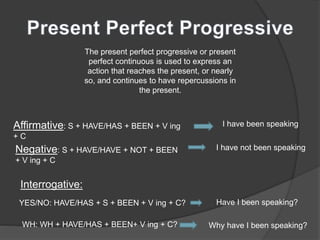
The present perfect progressive or present
perfect continuous is used to express an
action that reaches the present, or nearly
so, and continues to have repercussions in
the present.
Affirmative: S + HAVE/HAS + BEEN + V ing
+ C
I have been speaking
Negative: S + HAVE/HAVE + NOT + BEEN
+ V ing + C
I have not been speaking
Interrogative:
YES/NO: HAVE/HAS + S + BEEN + V ing + C? Have I been speaking?
WH: WH + HAVE/HAS + BEEN+ V ing + C? Why have I been speaking?
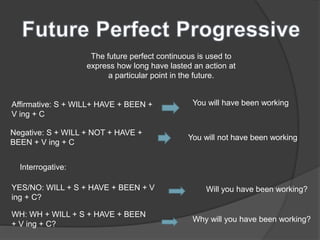
The future perfect continuous is used to
express how long have lasted an action at
a particular point in the future.
Affirmative: S + WILL+ HAVE + BEEN +
V ing + C
You will have been working
Negative: S + WILL + NOT + HAVE +
BEEN + V ing + C
You will not have been working
Interrogative:
YES/NO: WILL + S + HAVE + BEEN + V
ing + C?
Will you have been working?
WH: WH + WILL + S + HAVE + BEEN
+ V ing + C?
Why will you have been working?

Tiempos Perfectos

  • 1.
    República Bolivariana deVenezuela Ministerio del Poder Popular para la Educacion Superior Universidad Yacambú Facultad de Humanidades Cabudare – Edo. Lara Franklin Noguera
  • 2.
    The present perfectin English is a tense used to refer to actions that happen in the recent past . Affirmative: S + HAVE/HAS + V (in past participle) + C Negative: S + HAVE/HAS + NOT + V (in past participle) + C I have bought a new dress. I have not bought a new dress. Interrogative: YES/NO: HAS/HAS + S + Vpp + C? Have I bought a new dress? WH: WH + HAVE/HAS + S + Vpp+ C? Why have I bought a new dress?
  • 3.
    The Past Perfectin English is a tense used to refer to an action that took place earlier in another action, although both have happened in the past by establishing an order among them. Affirmative: S + HAD + Vpp + C I had bought a new car. Negative: S + HAD+ NOT + Vpp + C I had not bought a new car Interrogative: YES/NO: HAD + S + Vpp+ C? Had I bought a new car? WH: WH + HAD + S + Vpp+ C? Why had I a new car?
  • 4.
    The present perfectprogressive or present perfect continuous is used to express an action that reaches the present, or nearly so, and continues to have repercussions in the present. Affirmative: S + HAVE/HAS + BEEN + V ing + C I have been speaking Negative: S + HAVE/HAVE + NOT + BEEN + V ing + C I have not been speaking Interrogative: YES/NO: HAVE/HAS + S + BEEN + V ing + C? Have I been speaking? WH: WH + HAVE/HAS + BEEN+ V ing + C? Why have I been speaking?
  • 5.
    The future perfectcontinuous is used to express how long have lasted an action at a particular point in the future. Affirmative: S + WILL+ HAVE + BEEN + V ing + C You will have been working Negative: S + WILL + NOT + HAVE + BEEN + V ing + C You will not have been working Interrogative: YES/NO: WILL + S + HAVE + BEEN + V ing + C? Will you have been working? WH: WH + WILL + S + HAVE + BEEN + V ing + C? Why will you have been working?