Context Culture Specific Model of
Inclusion
Spreading Awareness on Inclusion in Tibetan community in
Exile
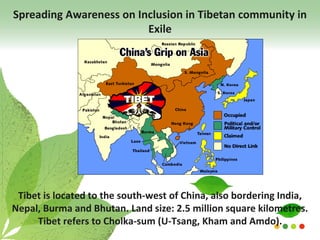
Tibet is located to the south-west of China, also bordering India,
Nepal, Burma and Bhutan. Land size: 2.5 million square kilometres.
Tibet refers to Cholka-sum (U-Tsang, Kham and Amdo).
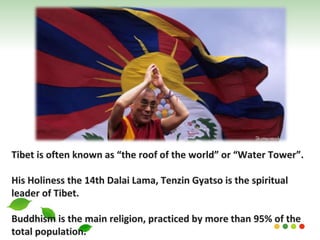
Tibet is often known as “the roof of the world” or “Water Tower”.
His Holiness the 14th Dalai Lama, Tenzin Gyatso is the spiritual
leader of Tibet.
Buddhism is the main religion, practiced by more than 95% of the
total population.
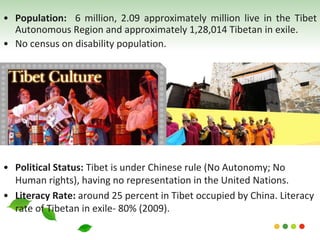
• Political Status: Tibet is under Chinese rule (No Autonomy; No
Human rights), having no representation in the United Nations.
• Literacy Rate: around 25 percent in Tibet occupied by China. Literacy
rate of Tibetan in exile- 80% (2009).
• Population: 6 million, 2.09 approximately million live in the Tibet
Autonomous Region and approximately 1,28,014 Tibetan in exile.
• No census on disability population.
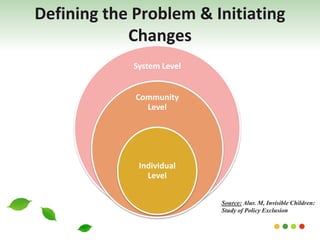
System Level
Community
Level
Individual
Level
Defining the Problem & Initiating
Changes
Source: Alur. M, Invisible Children:
Study of Policy Exclusion
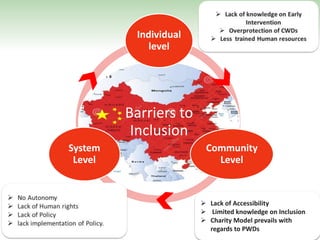
 Lack of Accessibility
 Limited knowledge on Inclusion
 Charity Model prevails with
regards to PWDs
Barriers to
Inclusion
Individual
level
Community
Level
System
Level
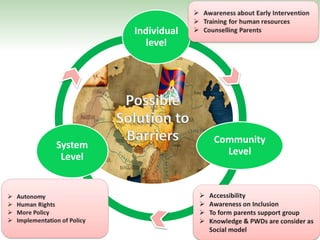
Individual
level
Community
Level
System
Level
 Accessibility
 Awareness on Inclusion
 To form parents support group
 Knowledge & PWDs are consider as
Social model
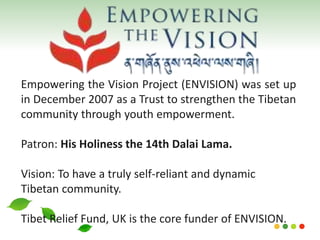
Empowering the Vision Project (ENVISION) was set up
in December 2007 as a Trust to strengthen the Tibetan
community through youth empowerment.
Patron: His Holiness the 14th Dalai Lama.
Vision: To have a truly self-reliant and dynamic
Tibetan community.
Tibet Relief Fund, UK is the core funder of ENVISION.
Communist China has occupied Tibet since 1959. There is NO
AUTONOMY: Basic human rights are violated.
Lack of policy but CTA have a very good policy on education like
the right to education without discrimination of race, caste,
colour, religion, child with disabilities and other minorities group.
Today there are 76 Tibetan schools in exile but lack of
accessibility, lack of trained human resources.
There is limited knowledge on the rights of the disabled and on
inclusion in the community.
GAP ANALYSES
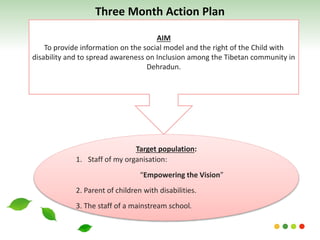
AIM
To provide information on the social model and the right of the Child with
disability and to spread awareness on Inclusion among the Tibetan community in
Dehradun.
Target population:
1. Staff of my organisation:
“Empowering the Vision”
2. Parent of children with disabilities.
3. The staff of a mainstream school.
Three Month Action Plan
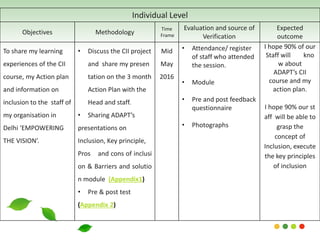
Individual Level
Objectives Methodology
Time
Frame
Evaluation and source of
Verification
Expected
outcome
To share my learning
experiences of the CII
course, my Action plan
and information on
inclusion to the staff of
my organisation in
Delhi ‘EMPOWERING
THE VISION’.
• Discuss the CII project
and share my presen
tation on the 3 month
Action Plan with the
Head and staff.
• Sharing ADAPT’s
presentations on
Inclusion, Key principle,
Pros and cons of inclusi
on & Barriers and solutio
n module (Appendix1)
• Pre & post test
(Appendix 2)
Mid
May
2016
• Attendance/ register
of staff who attended
the session.
• Module
• Pre and post feedback
questionnaire
• Photographs
I hope 90% of our
Staff will kno
w about
ADAPT’s CII
course and my
action plan.
I hope 90% our st
aff will be able to
grasp the
concept of
Inclusion, execute
the key principles
of inclusion
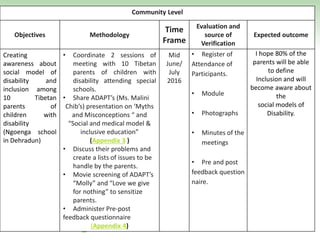
Community Level
Objectives Methodology
Time
Frame
Evaluation and
source of
Verification
Expected outcome
Creating
awareness about
social model of
disability and
inclusion among
10 Tibetan
parents of
children with
disability
(Ngoenga school
in Dehradun)
• Coordinate 2 sessions of
meeting with 10 Tibetan
parents of children with
disability attending special
schools.
• Share ADAPT’s (Ms. Malini
Chib’s) presentation on ‘Myths
and Misconceptions “ and
“Social and medical model &
inclusive education”
(Appendix 3 )
• Discuss their problems and
create a lists of issues to be
handle by the parents.
• Movie screening of ADAPT’s
“Molly” and “Love we give
for nothing” to sensitize
parents.
• Administer Pre-post
feedback questionnaire
(Appendix 4)
Mid
June/
July
2016
• Register of
Attendance of
Participants.
• Module
• Photographs
• Minutes of the
meetings
• Pre and post
feedback question
naire.
I hope 80% of the
parents will be able
to define
Inclusion and will
become aware about
the
social models of
Disability.
Community Level
Objectives Methodology
Time
Frame
Evaluation and
source of
Verification
Expected outcome
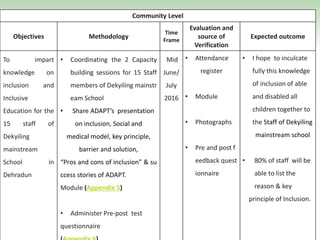
To impart
knowledge on
inclusion and
Inclusive
Education for the
15 staff of
Dekyiling
mainstream
School in
Dehradun
• Coordinating the 2 Capacity
building sessions for 15 Staff
members of Dekyiling mainstr
eam School
• Share ADAPT’s presentation
on inclusion, Social and
medical model, key principle,
barrier and solution,
“Pros and cons of inclusion” & su
ccess stories of ADAPT.
Module (Appendix 5)
• Administer Pre-post test
questionnaire
Mid
June/
July
2016
• Attendance
register
• Module
• Photographs
• Pre and post f
eedback quest
ionnaire
• I hope to inculcate
fully this knowledge
of inclusion of able
and disabled all
children together to
the Staff of Dekyiling
mainstream school
• 80% of staff will be
able to list the
reason & key
principle of Inclusion.
Community Level
Objectives Methodology
Time
Frame
Evaluation and
source of
Verification
Expected outcome
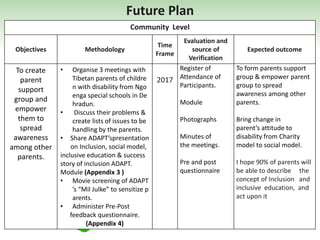
To create
parent
support
group and
empower
them to
spread
awareness
among other
parents.
• Organise 3 meetings with
Tibetan parents of childre
n with disability from Ngo
enga special schools in De
hradun.
• Discuss their problems &
create lists of issues to be
handling by the parents.
• Share ADAPT’spresentation
on Inclusion, social model,
inclusive education & success
story of inclusion ADAPT.
Module (Appendix 3 )
• Movie screening of ADAPT
’s “Mil Julke” to sensitize p
arents.
• Administer Pre-Post
feedback questionnaire.
(Appendix 4)
2017
Register of
Attendance of
Participants.
Module
Photographs
Minutes of
the meetings.
Pre and post
questionnaire
To form parents support
group & empower parent
group to spread
awareness among other
parents.
Bring change in
parent’s attitude to
disability from Charity
model to social model.
I hope 90% of parents will
be able to describe the
concept of Inclusion and
inclusive education, and
act upon it
Future Plan
COMMUNITY LEVEL
Objectives Methodology
Time
Frame
Evaluation and
source of
Verification
Expected outcome
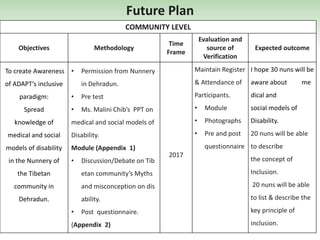
To create Awareness
of ADAPT’s inclusive
paradigm:
Spread
knowledge of
medical and social
models of disability
in the Nunnery of
the Tibetan
community in
Dehradun.
• Permission from Nunnery
in Dehradun.
• Pre test
• Ms. Malini Chib’s PPT on
medical and social models of
Disability.
Module (Appendix 1)
• Discussion/Debate on Tib
etan community’s Myths
and misconception on dis
ability.
• Post questionnaire.
(Appendix 2)
2017
Maintain Register
& Attendance of
Participants.
• Module
• Photographs
• Pre and post
questionnaire
I hope 30 nuns will be
aware about me
dical and
social models of
Disability.
20 nuns will be able
to describe
the concept of
Inclusion.
20 nuns will be able
to list & describe the
key principle of
inclusion.
Future Plan
Tibetp

Tibetp

  • 1.
    Context Culture SpecificModel of Inclusion
  • 2.
    Spreading Awareness onInclusion in Tibetan community in Exile Tibet is located to the south-west of China, also bordering India, Nepal, Burma and Bhutan. Land size: 2.5 million square kilometres. Tibet refers to Cholka-sum (U-Tsang, Kham and Amdo).
  • 3.
    Tibet is oftenknown as “the roof of the world” or “Water Tower”. His Holiness the 14th Dalai Lama, Tenzin Gyatso is the spiritual leader of Tibet. Buddhism is the main religion, practiced by more than 95% of the total population.
  • 4.
    • Political Status:Tibet is under Chinese rule (No Autonomy; No Human rights), having no representation in the United Nations. • Literacy Rate: around 25 percent in Tibet occupied by China. Literacy rate of Tibetan in exile- 80% (2009). • Population: 6 million, 2.09 approximately million live in the Tibet Autonomous Region and approximately 1,28,014 Tibetan in exile. • No census on disability population.
  • 5.
    System Level Community Level Individual Level Defining theProblem & Initiating Changes Source: Alur. M, Invisible Children: Study of Policy Exclusion
  • 6.
     Lack ofAccessibility  Limited knowledge on Inclusion  Charity Model prevails with regards to PWDs Barriers to Inclusion Individual level Community Level System Level
  • 7.
    Individual level Community Level System Level  Accessibility  Awarenesson Inclusion  To form parents support group  Knowledge & PWDs are consider as Social model
  • 8.
    Empowering the VisionProject (ENVISION) was set up in December 2007 as a Trust to strengthen the Tibetan community through youth empowerment. Patron: His Holiness the 14th Dalai Lama. Vision: To have a truly self-reliant and dynamic Tibetan community. Tibet Relief Fund, UK is the core funder of ENVISION.
  • 9.
    Communist China hasoccupied Tibet since 1959. There is NO AUTONOMY: Basic human rights are violated. Lack of policy but CTA have a very good policy on education like the right to education without discrimination of race, caste, colour, religion, child with disabilities and other minorities group. Today there are 76 Tibetan schools in exile but lack of accessibility, lack of trained human resources. There is limited knowledge on the rights of the disabled and on inclusion in the community. GAP ANALYSES
  • 10.
    AIM To provide informationon the social model and the right of the Child with disability and to spread awareness on Inclusion among the Tibetan community in Dehradun. Target population: 1. Staff of my organisation: “Empowering the Vision” 2. Parent of children with disabilities. 3. The staff of a mainstream school. Three Month Action Plan
  • 11.
    Individual Level Objectives Methodology Time Frame Evaluationand source of Verification Expected outcome To share my learning experiences of the CII course, my Action plan and information on inclusion to the staff of my organisation in Delhi ‘EMPOWERING THE VISION’. • Discuss the CII project and share my presen tation on the 3 month Action Plan with the Head and staff. • Sharing ADAPT’s presentations on Inclusion, Key principle, Pros and cons of inclusi on & Barriers and solutio n module (Appendix1) • Pre & post test (Appendix 2) Mid May 2016 • Attendance/ register of staff who attended the session. • Module • Pre and post feedback questionnaire • Photographs I hope 90% of our Staff will kno w about ADAPT’s CII course and my action plan. I hope 90% our st aff will be able to grasp the concept of Inclusion, execute the key principles of inclusion
  • 12.
    Community Level Objectives Methodology Time Frame Evaluationand source of Verification Expected outcome Creating awareness about social model of disability and inclusion among 10 Tibetan parents of children with disability (Ngoenga school in Dehradun) • Coordinate 2 sessions of meeting with 10 Tibetan parents of children with disability attending special schools. • Share ADAPT’s (Ms. Malini Chib’s) presentation on ‘Myths and Misconceptions “ and “Social and medical model & inclusive education” (Appendix 3 ) • Discuss their problems and create a lists of issues to be handle by the parents. • Movie screening of ADAPT’s “Molly” and “Love we give for nothing” to sensitize parents. • Administer Pre-post feedback questionnaire (Appendix 4) Mid June/ July 2016 • Register of Attendance of Participants. • Module • Photographs • Minutes of the meetings • Pre and post feedback question naire. I hope 80% of the parents will be able to define Inclusion and will become aware about the social models of Disability.
  • 13.
    Community Level Objectives Methodology Time Frame Evaluationand source of Verification Expected outcome To impart knowledge on inclusion and Inclusive Education for the 15 staff of Dekyiling mainstream School in Dehradun • Coordinating the 2 Capacity building sessions for 15 Staff members of Dekyiling mainstr eam School • Share ADAPT’s presentation on inclusion, Social and medical model, key principle, barrier and solution, “Pros and cons of inclusion” & su ccess stories of ADAPT. Module (Appendix 5) • Administer Pre-post test questionnaire Mid June/ July 2016 • Attendance register • Module • Photographs • Pre and post f eedback quest ionnaire • I hope to inculcate fully this knowledge of inclusion of able and disabled all children together to the Staff of Dekyiling mainstream school • 80% of staff will be able to list the reason & key principle of Inclusion.
  • 14.
    Community Level Objectives Methodology Time Frame Evaluationand source of Verification Expected outcome To create parent support group and empower them to spread awareness among other parents. • Organise 3 meetings with Tibetan parents of childre n with disability from Ngo enga special schools in De hradun. • Discuss their problems & create lists of issues to be handling by the parents. • Share ADAPT’spresentation on Inclusion, social model, inclusive education & success story of inclusion ADAPT. Module (Appendix 3 ) • Movie screening of ADAPT ’s “Mil Julke” to sensitize p arents. • Administer Pre-Post feedback questionnaire. (Appendix 4) 2017 Register of Attendance of Participants. Module Photographs Minutes of the meetings. Pre and post questionnaire To form parents support group & empower parent group to spread awareness among other parents. Bring change in parent’s attitude to disability from Charity model to social model. I hope 90% of parents will be able to describe the concept of Inclusion and inclusive education, and act upon it Future Plan
  • 15.
    COMMUNITY LEVEL Objectives Methodology Time Frame Evaluationand source of Verification Expected outcome To create Awareness of ADAPT’s inclusive paradigm: Spread knowledge of medical and social models of disability in the Nunnery of the Tibetan community in Dehradun. • Permission from Nunnery in Dehradun. • Pre test • Ms. Malini Chib’s PPT on medical and social models of Disability. Module (Appendix 1) • Discussion/Debate on Tib etan community’s Myths and misconception on dis ability. • Post questionnaire. (Appendix 2) 2017 Maintain Register & Attendance of Participants. • Module • Photographs • Pre and post questionnaire I hope 30 nuns will be aware about me dical and social models of Disability. 20 nuns will be able to describe the concept of Inclusion. 20 nuns will be able to list & describe the key principle of inclusion. Future Plan