Counting the
“Invisible”?
The need for
qualitative
data
Marion Steff, PhD
6th December 2016
Plan Conference,
Nepal
Facts SDG 4
 Inclusion: mentioned 1 time (in the overall goal #4)
 Disabilities: mentioned 4 times (4.5 and 4.a)
 Girls: mentioned 2 times (4.1 and 4.2)
 Women: mentioned 2 times (4.3 and 4.6)
 Vulnerability: mentioned 2 times (4.5)
The world has a very clear message coming from the United Nations: everyone
has an equal right to quality inclusive education no matter their ethnic group,
age, gender, disability, or belief system.
What is missing?
Qualitative data! It is not mentioned at
all in the SDGs
Good news?
 UN is open to creative and innovative
combinations of quantitative and
qualitative information to support
understanding
 Data collection is based at national
level, with a chance for us to
influence review processes to reach
people who are the most left behind
The study in Tanzania
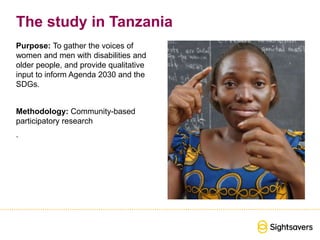
Purpose: To gather the voices of
women and men with disabilities and
older people, and provide qualitative
input to inform Agenda 2030 and the
SDGs.
Methodology: Community-based
participatory research
.
Data collection & analysis
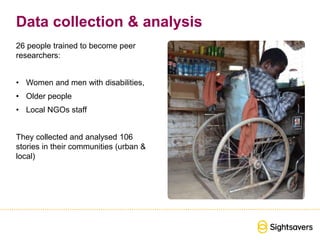
26 people trained to become peer
researchers:
• Women and men with disabilities,
• Older people
• Local NGOs staff
They collected and analysed 106
stories in their communities (urban &
local)
Eight priority themes
Peer researchers identified 8 priorities themes for policy focus & advocacy
efforts:
 Access to education and quality learning
 Access to health services
 Issues fed back from NGOs
 Poverty relating to income & dependence
 Attitudes towards witchcraft & albinism
 Relationships difficulties & marriage breakdowns
 Sexual violence & gender issues
 Poor treatment from family
Findings in education
• Little investment from the government in supporting inclusive education
• Teachers are not adequately trained to teach children with disabilities
• Schools infrastructures are not accessible
• The community does not engage in supporting access to education for
children with disabilities
• Families does not send their children with disabilities to schools because of
different reasons (cost, illness, etc.)
• There is free education policy for children with disabilities in Tanzania but it is
not implemented and parents still have to pay school fees
Passages from stories on education (1/2)
“When I was discharged from the dispensary, I lost my hearing. I continued to
stay with my aunt at home while using drugs prescribed at the hospital and felt
better. When I came back from the hospital, I could not hear properly. I was bright
but I started to drop in the class… I left school because I could not hear what was
being taught so I saw no importance in school”
Person with hearing impairment, 18 years, Nachingwea district
“When I attended school, I was humiliated by teachers and decided to quit. I was
the only person with albinism in the class. For example, the teacher would tell me
that I had to sit at the front because I had a visual problem and could not see
well, but in fact, I was already in the front seat [and could not be closer]”
Person with albinism, 19 years, Nachingwea district
Passages from stories on education (2/2)
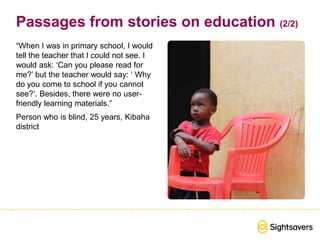
“When I was in primary school, I would
tell the teacher that I could not see. I
would ask: ‘Can you please read for
me?’ but the teacher would say: ‘ Why
do you come to school if you cannot
see?’. Besides, there were no user-
friendly learning materials.”
Person who is blind, 25 years, Kibaha
district
Ways forward
Peer researchers suggested a number of ways forward to share with the
Tanzania government. For instance, they recommended the following:
• More teachers should be trained to provide quality inclusive education for
learners with disabilities
• Curriculums should be flexible and adapt to the needs of learners
• Parents of children with disabilities should be sensitised to the importance of
taking their children to school to receive an education
• Communities should be made aware of the importance of supporting families
with a member having a disability
• Curriculums should teach about the importance of respecting and caring for
each other
• Older people should be listened to as their life experience is invaluable
Recommendations & conclusion
 Qualitative data brings a deeper understanding of the issue
 The data is linked to human experience and this is more compelling and
powerful than data gathered through quantitative research
 Qualitative data reveals issues that could not be exposed with the sole use of
quantitative data
 Statistical analysis should be a complement to, not a substitution for,
qualitative assessments.
 We need to engage in advocating for the use of different data sources in the
SDGs, including qualitative data, perceptions data and citizen-generated data.
For more information
Email: msteff@sightsavers.org
Visit: www.sightsavers.org/voices
Tweet: @sightsavers_pol
Thank you

Marion Steff (December 2016). Counting the "Invisible"? The need for qualitative data.

  • 1.
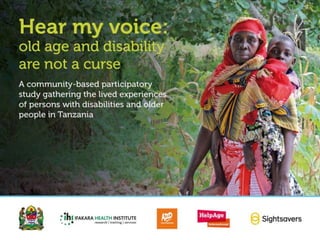
    Counting the “Invisible”? The needfor qualitative data Marion Steff, PhD 6th December 2016 Plan Conference, Nepal
  • 2.
    Facts SDG 4 Inclusion: mentioned 1 time (in the overall goal #4)  Disabilities: mentioned 4 times (4.5 and 4.a)  Girls: mentioned 2 times (4.1 and 4.2)  Women: mentioned 2 times (4.3 and 4.6)  Vulnerability: mentioned 2 times (4.5) The world has a very clear message coming from the United Nations: everyone has an equal right to quality inclusive education no matter their ethnic group, age, gender, disability, or belief system.
  • 3.
    What is missing? Qualitativedata! It is not mentioned at all in the SDGs Good news?  UN is open to creative and innovative combinations of quantitative and qualitative information to support understanding  Data collection is based at national level, with a chance for us to influence review processes to reach people who are the most left behind
  • 5.
    The study inTanzania Purpose: To gather the voices of women and men with disabilities and older people, and provide qualitative input to inform Agenda 2030 and the SDGs. Methodology: Community-based participatory research .
  • 6.
    Data collection &analysis 26 people trained to become peer researchers: • Women and men with disabilities, • Older people • Local NGOs staff They collected and analysed 106 stories in their communities (urban & local)
  • 7.
    Eight priority themes Peerresearchers identified 8 priorities themes for policy focus & advocacy efforts:  Access to education and quality learning  Access to health services  Issues fed back from NGOs  Poverty relating to income & dependence  Attitudes towards witchcraft & albinism  Relationships difficulties & marriage breakdowns  Sexual violence & gender issues  Poor treatment from family
  • 8.
    Findings in education •Little investment from the government in supporting inclusive education • Teachers are not adequately trained to teach children with disabilities • Schools infrastructures are not accessible • The community does not engage in supporting access to education for children with disabilities • Families does not send their children with disabilities to schools because of different reasons (cost, illness, etc.) • There is free education policy for children with disabilities in Tanzania but it is not implemented and parents still have to pay school fees
  • 9.
    Passages from storieson education (1/2) “When I was discharged from the dispensary, I lost my hearing. I continued to stay with my aunt at home while using drugs prescribed at the hospital and felt better. When I came back from the hospital, I could not hear properly. I was bright but I started to drop in the class… I left school because I could not hear what was being taught so I saw no importance in school” Person with hearing impairment, 18 years, Nachingwea district “When I attended school, I was humiliated by teachers and decided to quit. I was the only person with albinism in the class. For example, the teacher would tell me that I had to sit at the front because I had a visual problem and could not see well, but in fact, I was already in the front seat [and could not be closer]” Person with albinism, 19 years, Nachingwea district
  • 10.
    Passages from storieson education (2/2) “When I was in primary school, I would tell the teacher that I could not see. I would ask: ‘Can you please read for me?’ but the teacher would say: ‘ Why do you come to school if you cannot see?’. Besides, there were no user- friendly learning materials.” Person who is blind, 25 years, Kibaha district
  • 11.
    Ways forward Peer researcherssuggested a number of ways forward to share with the Tanzania government. For instance, they recommended the following: • More teachers should be trained to provide quality inclusive education for learners with disabilities • Curriculums should be flexible and adapt to the needs of learners • Parents of children with disabilities should be sensitised to the importance of taking their children to school to receive an education • Communities should be made aware of the importance of supporting families with a member having a disability • Curriculums should teach about the importance of respecting and caring for each other • Older people should be listened to as their life experience is invaluable
  • 12.
    Recommendations & conclusion Qualitative data brings a deeper understanding of the issue  The data is linked to human experience and this is more compelling and powerful than data gathered through quantitative research  Qualitative data reveals issues that could not be exposed with the sole use of quantitative data  Statistical analysis should be a complement to, not a substitution for, qualitative assessments.  We need to engage in advocating for the use of different data sources in the SDGs, including qualitative data, perceptions data and citizen-generated data.
  • 13.
    For more information Email:msteff@sightsavers.org Visit: www.sightsavers.org/voices Tweet: @sightsavers_pol Thank you