CPDP
(PRESENTATION)
TOPIC – BRAC NGO
BY:
VISHAL HASRAJANI - 130410111033
JAYANSHU GUNDANIYA - 130410111029
AKSHAY KURLI - 130410111005
BHAVIN PANDYA - 130410111014
VIVEK CHAUHAN - 130410111019
INTRODUCTION
• BRAC stands for Bangladesh Rural
Advancement Committee.
• BRAC, an international development
organization based in Bangladesh, is the
largest non-governmental development
organization in the world, measured by the
number of employees and the number of
people it has helped
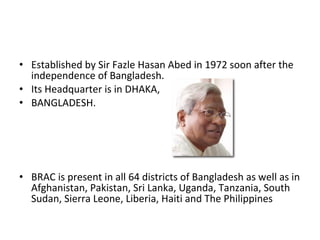
• Established by Sir Fazle Hasan Abed in 1972 soon after the
independence of Bangladesh.
• Its Headquarter is in DHAKA,
• BANGLADESH.
• BRAC is present in all 64 districts of Bangladesh as well as in
Afghanistan, Pakistan, Sri Lanka, Uganda, Tanzania, South
Sudan, Sierra Leone, Liberia, Haiti and The Philippines
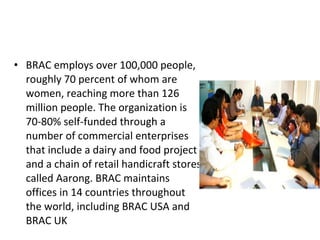
• BRAC employs over 100,000 people,
roughly 70 percent of whom are
women, reaching more than 126
million people. The organization is
70-80% self-funded through a
number of commercial enterprises
that include a dairy and food project
and a chain of retail handicraft stores
called Aarong. BRAC maintains
offices in 14 countries throughout
the world, including BRAC USA and
BRAC UK
What is unique about BRAC?
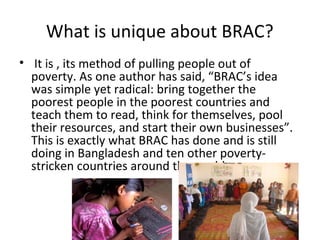
• It is , its method of pulling people out of
poverty. As one author has said, “BRAC’s idea
was simple yet radical: bring together the
poorest people in the poorest countries and
teach them to read, think for themselves, pool
their resources, and start their own businesses”.
This is exactly what BRAC has done and is still
doing in Bangladesh and ten other poverty-
stricken countries around the world
• BRAC has organized the isolated poor and
learned to understand their needs by finding
practical ways to increase their access to
resources, support their entrepreneurship and
empower them to become agents of change.
Women and girls have been the focus of
BRAC’s anti-poverty approach; BRAC
recognizes both their vulnerabilities and thirst
for change
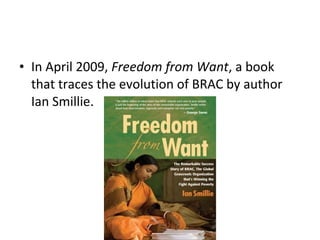
• In April 2009, Freedom from Want, a book
that traces the evolution of BRAC by author
Ian Smillie.
Mission & Vision
→ VISION OF BRAC.
“ A world free from all forms of exploitation and
discrimination where everyone has the opportunity to
realize their potential. ”
→ MISSION OF BRAC.
“Our mission is to empower people and communities in
situations of poverty, illiteracy, disease and social
injustice. Our interventions aim to achieve large scale,
positive changes through economic and social
programmes that enable men and women to realize
their potential.”
Objectives
• Economic development
BRAC’s Economic Development programme includes
microcredit(small loans).
Village Organizations provide loans to poverty groups.
BRAC has reached out to those who, due to extreme
poverty, cannot access microfinance. BRAC defines such
people suffering from extreme poverty as the 'ultra poor',
and has designed a programme customized for this group
that combines subsidy with enterprise development
training, healthcare, social development and asset transfer,
eventually pulling the ultra poor into its mainstream
microfinance programme.
• In addition to microfinance, BRAC provides
enterprise training and support to its member
borrowers.
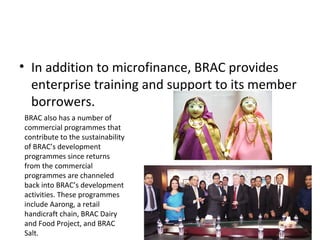
BRAC also has a number of
commercial programmes that
contribute to the sustainability
of BRAC’s development
programmes since returns
from the commercial
programmes are channeled
back into BRAC’s development
activities. These programmes
include Aarong, a retail
handicraft chain, BRAC Dairy
and Food Project, and BRAC
Salt.
• Education
• BRAC’s Non-Formal Primary Education programme
provides five-year primary education course in four
years to poor, rural, disadvantaged children and drop-
outs who cannot access formal schooling.
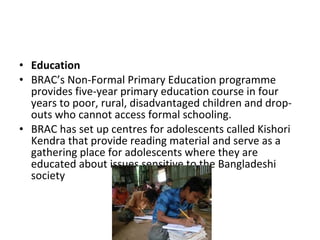
• BRAC has set up centres for adolescents called Kishori
Kendra that provide reading material and serve as a
gathering place for adolescents where they are
educated about issues sensitive to the Bangladeshi
society
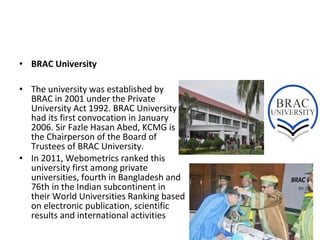
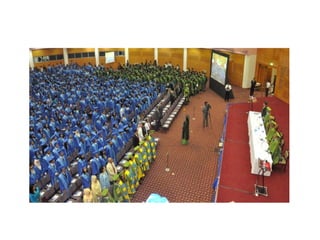
• BRAC University
• The university was established by
BRAC in 2001 under the Private
University Act 1992. BRAC University
had its first convocation in January
2006. Sir Fazle Hasan Abed, KCMG is
the Chairperson of the Board of
Trustees of BRAC University.
• In 2011, Webometrics ranked this
university first among private
universities, fourth in Bangladesh and
76th in the Indian subcontinent in
their World Universities Ranking based
on electronic publication, scientific
results and international activities
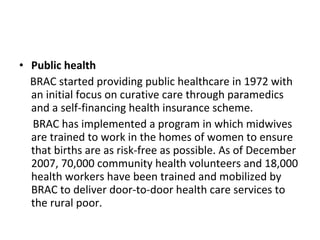
• Public health
BRAC started providing public healthcare in 1972 with
an initial focus on curative care through paramedics
and a self-financing health insurance scheme.
BRAC has implemented a program in which midwives
are trained to work in the homes of women to ensure
that births are as risk-free as possible. As of December
2007, 70,000 community health volunteers and 18,000
health workers have been trained and mobilized by
BRAC to deliver door-to-door health care services to
the rural poor.
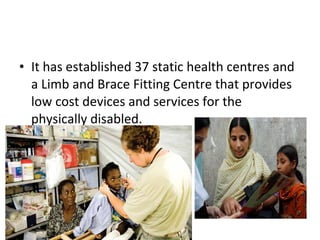
• It has established 37 static health centres and
a Limb and Brace Fitting Centre that provides
low cost devices and services for the
physically disabled.
• Social development
• In 1996, BRAC started a programme in
collaboration with the Ain O Shalish Kendra (ASK)
and Bangladesh National Women Leader’s
Association (BNWLA) to empower women to
protect themselves from social discrimination and
exploitation
• The programme has two components: the Social
Development component and the Human Rights
and Legal Services component.
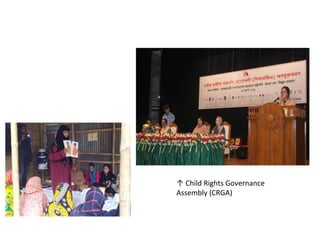
↑ Child Rights Governance
Assembly (CRGA)
• Disaster relief
BRAC conducted one of the largest NGO responses to
Cyclone Sidr which hit vast areas of the south-western
coast in Bangladesh in mid-November 2007. BRAC
distributed emergency relief materials, including food
and clothing, to over 900,000 survivors, provided
medical care to over 60,000 victims and secured safe
supplies of drinking water. BRAC is now focusing on
long-term rehabilitation, which will include agriculture
support, infrastructure reconstruction and livelihood
regeneration
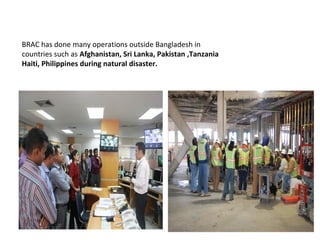
BRAC has done many operations outside Bangladesh in
countries such as Afghanistan, Sri Lanka, Pakistan ,Tanzania
Haiti, Philippines during natural disaster.
• “BRAC has done what few others have – they
have achieved success on a massive scale,
bringing life-saving health programs to
millions of the world's poorest people. They
remind us that even the most intractable
health problems are solvable, and inspire us
to match their success throughout the
developing world.” – Bill Gates
• BRAC Awards
• Gates Award for Global Health (Bill and Melinda
Gates Foundation), 2004
• CGAP Financial Transparency Award, 2005 &
2006
• Independence Award (Shadhinata Puroshkar),
2007
• The Conrad N. Hilton Humanitarian Prize, 2008
• Devex Top 40 Development Innovator, 2011
• #1 Nonprofit in International Microfinance (2012)
• #1 in Top 100 Best NGOs in 2013 (2013)
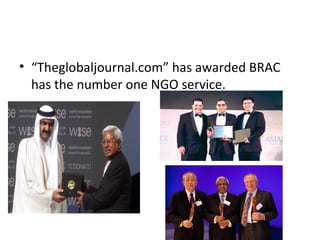
• “Theglobaljournal.com” has awarded BRAC
has the number one NGO service.
THANK YOU

Ngo brac

  • 1.
    CPDP (PRESENTATION) TOPIC – BRACNGO BY: VISHAL HASRAJANI - 130410111033 JAYANSHU GUNDANIYA - 130410111029 AKSHAY KURLI - 130410111005 BHAVIN PANDYA - 130410111014 VIVEK CHAUHAN - 130410111019
  • 2.
    INTRODUCTION • BRAC standsfor Bangladesh Rural Advancement Committee. • BRAC, an international development organization based in Bangladesh, is the largest non-governmental development organization in the world, measured by the number of employees and the number of people it has helped
  • 3.
    • Established bySir Fazle Hasan Abed in 1972 soon after the independence of Bangladesh. • Its Headquarter is in DHAKA, • BANGLADESH. • BRAC is present in all 64 districts of Bangladesh as well as in Afghanistan, Pakistan, Sri Lanka, Uganda, Tanzania, South Sudan, Sierra Leone, Liberia, Haiti and The Philippines
  • 4.
    • BRAC employsover 100,000 people, roughly 70 percent of whom are women, reaching more than 126 million people. The organization is 70-80% self-funded through a number of commercial enterprises that include a dairy and food project and a chain of retail handicraft stores called Aarong. BRAC maintains offices in 14 countries throughout the world, including BRAC USA and BRAC UK
  • 5.
    What is uniqueabout BRAC? • It is , its method of pulling people out of poverty. As one author has said, “BRAC’s idea was simple yet radical: bring together the poorest people in the poorest countries and teach them to read, think for themselves, pool their resources, and start their own businesses”. This is exactly what BRAC has done and is still doing in Bangladesh and ten other poverty- stricken countries around the world
  • 6.
    • BRAC hasorganized the isolated poor and learned to understand their needs by finding practical ways to increase their access to resources, support their entrepreneurship and empower them to become agents of change. Women and girls have been the focus of BRAC’s anti-poverty approach; BRAC recognizes both their vulnerabilities and thirst for change
  • 7.
    • In April2009, Freedom from Want, a book that traces the evolution of BRAC by author Ian Smillie.
  • 8.
    Mission & Vision →VISION OF BRAC. “ A world free from all forms of exploitation and discrimination where everyone has the opportunity to realize their potential. ” → MISSION OF BRAC. “Our mission is to empower people and communities in situations of poverty, illiteracy, disease and social injustice. Our interventions aim to achieve large scale, positive changes through economic and social programmes that enable men and women to realize their potential.”
  • 9.
    Objectives • Economic development BRAC’sEconomic Development programme includes microcredit(small loans). Village Organizations provide loans to poverty groups. BRAC has reached out to those who, due to extreme poverty, cannot access microfinance. BRAC defines such people suffering from extreme poverty as the 'ultra poor', and has designed a programme customized for this group that combines subsidy with enterprise development training, healthcare, social development and asset transfer, eventually pulling the ultra poor into its mainstream microfinance programme.
  • 10.
    • In additionto microfinance, BRAC provides enterprise training and support to its member borrowers. BRAC also has a number of commercial programmes that contribute to the sustainability of BRAC’s development programmes since returns from the commercial programmes are channeled back into BRAC’s development activities. These programmes include Aarong, a retail handicraft chain, BRAC Dairy and Food Project, and BRAC Salt.
  • 11.
    • Education • BRAC’sNon-Formal Primary Education programme provides five-year primary education course in four years to poor, rural, disadvantaged children and drop- outs who cannot access formal schooling. • BRAC has set up centres for adolescents called Kishori Kendra that provide reading material and serve as a gathering place for adolescents where they are educated about issues sensitive to the Bangladeshi society
  • 12.
    • BRAC University •The university was established by BRAC in 2001 under the Private University Act 1992. BRAC University had its first convocation in January 2006. Sir Fazle Hasan Abed, KCMG is the Chairperson of the Board of Trustees of BRAC University. • In 2011, Webometrics ranked this university first among private universities, fourth in Bangladesh and 76th in the Indian subcontinent in their World Universities Ranking based on electronic publication, scientific results and international activities
  • 14.
    • Public health BRACstarted providing public healthcare in 1972 with an initial focus on curative care through paramedics and a self-financing health insurance scheme. BRAC has implemented a program in which midwives are trained to work in the homes of women to ensure that births are as risk-free as possible. As of December 2007, 70,000 community health volunteers and 18,000 health workers have been trained and mobilized by BRAC to deliver door-to-door health care services to the rural poor.
  • 15.
    • It hasestablished 37 static health centres and a Limb and Brace Fitting Centre that provides low cost devices and services for the physically disabled.
  • 16.
    • Social development •In 1996, BRAC started a programme in collaboration with the Ain O Shalish Kendra (ASK) and Bangladesh National Women Leader’s Association (BNWLA) to empower women to protect themselves from social discrimination and exploitation • The programme has two components: the Social Development component and the Human Rights and Legal Services component.
  • 17.
    ↑ Child RightsGovernance Assembly (CRGA)
  • 18.
    • Disaster relief BRACconducted one of the largest NGO responses to Cyclone Sidr which hit vast areas of the south-western coast in Bangladesh in mid-November 2007. BRAC distributed emergency relief materials, including food and clothing, to over 900,000 survivors, provided medical care to over 60,000 victims and secured safe supplies of drinking water. BRAC is now focusing on long-term rehabilitation, which will include agriculture support, infrastructure reconstruction and livelihood regeneration
  • 19.
    BRAC has donemany operations outside Bangladesh in countries such as Afghanistan, Sri Lanka, Pakistan ,Tanzania Haiti, Philippines during natural disaster.
  • 20.
    • “BRAC hasdone what few others have – they have achieved success on a massive scale, bringing life-saving health programs to millions of the world's poorest people. They remind us that even the most intractable health problems are solvable, and inspire us to match their success throughout the developing world.” – Bill Gates
  • 21.
    • BRAC Awards •Gates Award for Global Health (Bill and Melinda Gates Foundation), 2004 • CGAP Financial Transparency Award, 2005 & 2006 • Independence Award (Shadhinata Puroshkar), 2007 • The Conrad N. Hilton Humanitarian Prize, 2008 • Devex Top 40 Development Innovator, 2011 • #1 Nonprofit in International Microfinance (2012) • #1 in Top 100 Best NGOs in 2013 (2013)
  • 22.
    • “Theglobaljournal.com” hasawarded BRAC has the number one NGO service.
  • 23.