www.tibet.net
hzÞÅ-zôh-¤ÛºÛ-
OÛG-º²âGÅü
Central Tibetan Administration (CTA)
www.tibet.net/en/diir/
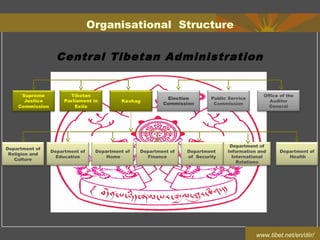
Organisational Structure
Central Tibetan Administration
Public Service
Commission
Office of the
Auditor
General
Department of
Religion and
Culture
Department of
Health
Department of
Home
Department of
Information and
International
Relations
Department
of Security
Department of
Education
Department of
Finance
www.tibet.net
Background
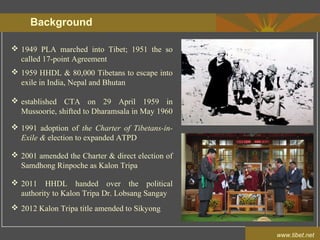
 1949 PLA marched into Tibet; 1951 the so
called 17-point Agreement
 1959 HHDL & 80,000 Tibetans to escape into
exile in India, Nepal and Bhutan
 established CTA on 29 April 1959 in
Mussoorie, shifted to Dharamsala in May 1960
 1991 adoption of the Charter of Tibetans-in-
Exile & election to expanded ATPD
 2001 amended the Charter & direct election of
Samdhong Rinpoche as Kalon Tripa
 2011 HHDL handed over the political
authority to Kalon Tripa Dr. Lobsang Sangay
 2012 Kalon Tripa title amended to Sikyong
Constitution: Charter of the Tibetans in Exile (CTIE)
www.tibet.net
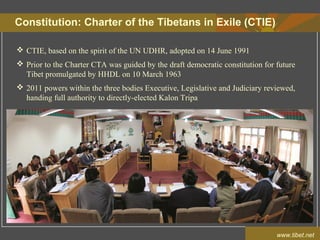
 CTIE, based on the spirit of the UN UDHR, adopted on 14 June 1991
 Prior to the Charter CTA was guided by the draft democratic constitution for future
Tibet promulgated by HHDL on 10 March 1963
 2011 powers within the three bodies Executive, Legislative and Judiciary reviewed,
handing full authority to directly-elected Kalon Tripa
Judiciary: Supreme Justice Commission (SJC)
www.tibet.net
 SJC highest judicial organ, formalised on March 11, 1992, Composed of the Chief
Justice Commissioner and two other Justice Commissioners; Appointed by TPIE by
election out of candidates submitted by the Selection Committee
 Since 29th May 2011, the Chief Justice Commissioner takes the oath of office from the
out-going Chief Justice Commissioner or the officiating Chief Justice Commissioner;
two other Justice Commissioners take the oath of office from the Chief Justice
Commissioner
 Northern Local Justice Commissioner in Dehra Dun, Southern Local Justice
Commissioner in Bylakuppe, Circuit Court and Welfare Officer as Commissioners
Legislature: Tibetan Parliament-in-Exile (TPIE)
www.tibet.net
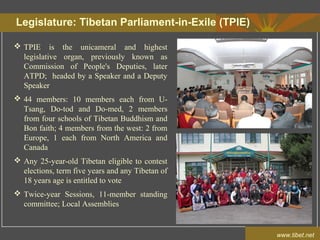
 TPIE is the unicameral and highest
legislative organ, previously known as
Commission of People's Deputies, later
ATPD; headed by a Speaker and a Deputy
Speaker
 44 members: 10 members each from U-
Tsang, Do-tod and Do-med, 2 members
from four schools of Tibetan Buddhism and
Bon faith; 4 members from the west: 2 from
Europe, 1 each from North America and
Canada
 Any 25-year-old Tibetan eligible to contest
elections, term five years and any Tibetan of
18 years age is entitled to vote
 Twice-year Sessions, 11-member standing
committee; Local Assemblies
Executive (The Kashag or Cabinet)
www.tibet.net
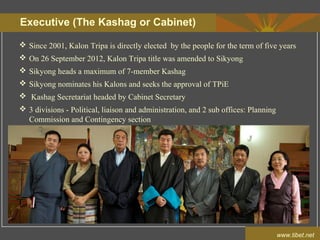
 Since 2001, Kalon Tripa is directly elected by the people for the term of five years
 On 26 September 2012, Kalon Tripa title was amended to Sikyong
 Sikyong heads a maximum of 7-member Kashag
 Sikyong nominates his Kalons and seeks the approval of TPiE
 Kashag Secretariat headed by Cabinet Secretary
 3 divisions - Political, liaison and administration, and 2 sub offices: Planning
Commission and Contingency section
Election Commission (EC)
www.tibet.net
 The 13th Dalai Lama had better
knowledge of the world at large and
he introduced a number of reforms
to modernize Tibet
 At 16 HHDL assumed the political
and spiritual leadership of Tibet and
initiated measures to reform Tibet,
but had to escape Tibet after 1959
Tibetan National Uprising
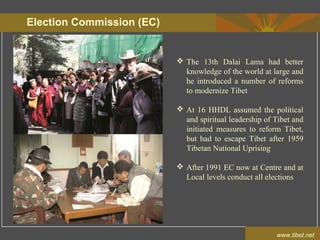
 After 1991 EC now at Centre and at
Local levels conduct all elections
Public Service Commission (PSC)
www.tibet.net
 Till 1972 the
recruitment &
appointment of
Tibetan civil
service staff were
done by the
Service
Management
Office later by
Department of
Personnel
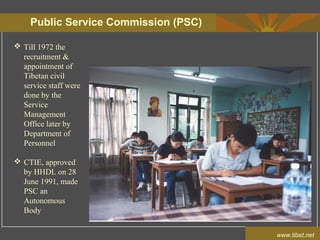
 CTIE, approved
by HHDL on 28
June 1991, made
PSC an
Autonomous
Body
Office of the Auditor General (OAG)
www.tibet.net
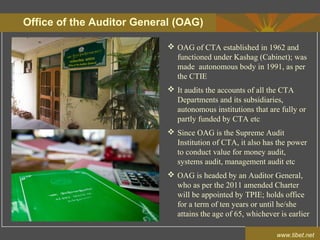
 OAG of CTA established in 1962 and
functioned under Kashag (Cabinet); was
made autonomous body in 1991, as per
the CTIE
 It audits the accounts of all the CTA
Departments and its subsidiaries,
autonomous institutions that are fully or
partly funded by CTA etc
 Since OAG is the Supreme Audit
Institution of CTA, it also has the power
to conduct value for money audit,
systems audit, management audit etc
 OAG is headed by an Auditor General,
who as per the 2011 amended Charter
will be appointed by TPIE; holds office
for a term of ten years or until he/she
attains the age of 65, whichever is earlier
Department of Religion & Culture (DORC)
www.tibet.net
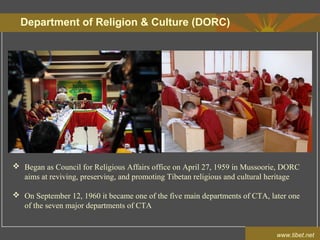
 Began as Council for Religious Affairs office on April 27, 1959 in Mussoorie, DORC
aims at reviving, preserving, and promoting Tibetan religious and cultural heritage
 On September 12, 1960 it became one of the five main departments of CTA, later one
of the seven major departments of CTA
Department of Home (DOH)
www.tibet.net
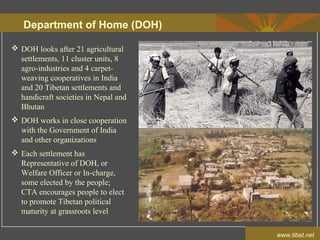
 DOH looks after 21 agricultural
settlements, 11 cluster units, 8
agro-industries and 4 carpet-
weaving cooperatives in India
and 20 Tibetan settlements and
handicraft societies in Nepal and
Bhutan
 DOH works in close cooperation
with the Government of India
and other organizations
 Each settlement has
Representative of DOH, or
Welfare Officer or In-charge,
some elected by the people;
CTA encourages people to elect
to promote Tibetan political
maturity at grassroots level
Department of Finance (DOF)
www.tibet.net
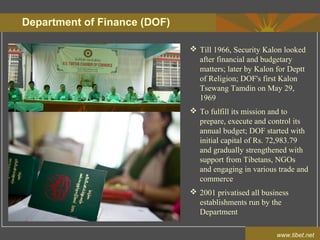
 Till 1966, Security Kalon looked
after financial and budgetary
matters; later by Kalon for Deptt
of Religion; DOF's first Kalon
Tsewang Tamdin on May 29,
1969
 To fulfill its mission and to
prepare, execute and control its
annual budget; DOF started with
initial capital of Rs. 72,983.79
and gradually strengthened with
support from Tibetans, NGOs
and engaging in various trade and
commerce
 2001 privatised all business
establishments run by the
Department
www.tibet.net
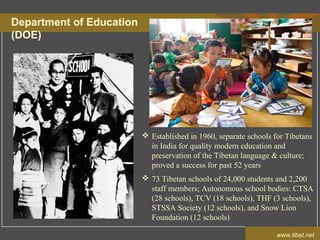
 Established in 1960, separate schools for Tibetans
in India for quality modern education and
preservation of the Tibetan language & culture;
proved a success for past 52 years
 73 Tibetan schools of 24,000 students and 2,200
staff members; Autonomous school bodies: CTSA
(28 schools), TCV (18 schools), THF (3 schools),
STSSA Society (12 schools), and Snow Lion
Foundation (12 schools)
Department of Education
(DOE)
Department of Security (DOS)
www.tibet.net
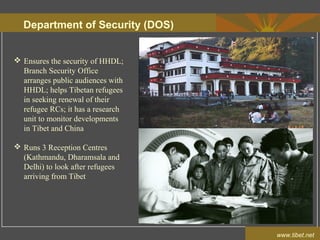
 Ensures the security of HHDL;
Branch Security Office
arranges public audiences with
HHDL; helps Tibetan refugees
in seeking renewal of their
refugee RCs; it has a research
unit to monitor developments
in Tibet and China
 Runs 3 Reception Centres
(Kathmandu, Dharamsala and
Delhi) to look after refugees
arriving from Tibet
Department of Information & International Relations (DIIR)
www.tibet.net
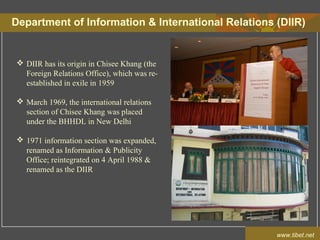
 DIIR has its origin in Chisee Khang (the
Foreign Relations Office), which was re-
established in exile in 1959
 March 1969, the international relations
section of Chisee Khang was placed
under the BHHDL in New Delhi
 1971 information section was expanded,
renamed as Information & Publicity
Office; reintegrated on 4 April 1988 &
renamed as the DIIR
www.tibet.net/en/diir/
Office of Tibet (OT)
OTs are the official agencies of HHDL and CTA
1960 Bureau of His Holiness the Dalai Lama, New Delhi
1960 Tibetan Refugee Welfare Office, Kathmandu
1964 The Office of Tibet, New York
- Liaison Office for Latin America
1964 The Tibet Bureau, Geneva
1975 Liaison Office of H.H. the Dalai Lama, Tokyo
1981 The Office of Tibet, London
1992 Tibet Information Office, Canberra
1992 Bureau du Tibet, Brussels
- Bureau du Tibet, Paris
1993 Tibet Culture & Information Centre, Moscow
1997 The Office of Tibet, Pretoria
1997 Religious Foundation of H.H. the Dalai Lama, Taipei
Department of Health (DOH)
www.tibet.net
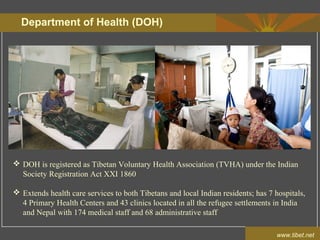
 DOH is registered as Tibetan Voluntary Health Association (TVHA) under the Indian
Society Registration Act XXI 1860
 Extends health care services to both Tibetans and local Indian residents; has 7 hospitals,
4 Primary Health Centers and 43 clinics located in all the refugee settlements in India
and Nepal with 174 medical staff and 68 administrative staff
Thank you!
www.tibet.net

Brief Introduction to CTA

  • 1.
  • 2.
    www.tibet.net/en/diir/ Organisational Structure Central TibetanAdministration Public Service Commission Office of the Auditor General Department of Religion and Culture Department of Health Department of Home Department of Information and International Relations Department of Security Department of Education Department of Finance
  • 3.
    www.tibet.net Background  1949 PLAmarched into Tibet; 1951 the so called 17-point Agreement  1959 HHDL & 80,000 Tibetans to escape into exile in India, Nepal and Bhutan  established CTA on 29 April 1959 in Mussoorie, shifted to Dharamsala in May 1960  1991 adoption of the Charter of Tibetans-in- Exile & election to expanded ATPD  2001 amended the Charter & direct election of Samdhong Rinpoche as Kalon Tripa  2011 HHDL handed over the political authority to Kalon Tripa Dr. Lobsang Sangay  2012 Kalon Tripa title amended to Sikyong
  • 4.
    Constitution: Charter ofthe Tibetans in Exile (CTIE) www.tibet.net  CTIE, based on the spirit of the UN UDHR, adopted on 14 June 1991  Prior to the Charter CTA was guided by the draft democratic constitution for future Tibet promulgated by HHDL on 10 March 1963  2011 powers within the three bodies Executive, Legislative and Judiciary reviewed, handing full authority to directly-elected Kalon Tripa
  • 5.
    Judiciary: Supreme JusticeCommission (SJC) www.tibet.net  SJC highest judicial organ, formalised on March 11, 1992, Composed of the Chief Justice Commissioner and two other Justice Commissioners; Appointed by TPIE by election out of candidates submitted by the Selection Committee  Since 29th May 2011, the Chief Justice Commissioner takes the oath of office from the out-going Chief Justice Commissioner or the officiating Chief Justice Commissioner; two other Justice Commissioners take the oath of office from the Chief Justice Commissioner  Northern Local Justice Commissioner in Dehra Dun, Southern Local Justice Commissioner in Bylakuppe, Circuit Court and Welfare Officer as Commissioners
  • 6.
    Legislature: Tibetan Parliament-in-Exile(TPIE) www.tibet.net  TPIE is the unicameral and highest legislative organ, previously known as Commission of People's Deputies, later ATPD; headed by a Speaker and a Deputy Speaker  44 members: 10 members each from U- Tsang, Do-tod and Do-med, 2 members from four schools of Tibetan Buddhism and Bon faith; 4 members from the west: 2 from Europe, 1 each from North America and Canada  Any 25-year-old Tibetan eligible to contest elections, term five years and any Tibetan of 18 years age is entitled to vote  Twice-year Sessions, 11-member standing committee; Local Assemblies
  • 7.
    Executive (The Kashagor Cabinet) www.tibet.net  Since 2001, Kalon Tripa is directly elected by the people for the term of five years  On 26 September 2012, Kalon Tripa title was amended to Sikyong  Sikyong heads a maximum of 7-member Kashag  Sikyong nominates his Kalons and seeks the approval of TPiE  Kashag Secretariat headed by Cabinet Secretary  3 divisions - Political, liaison and administration, and 2 sub offices: Planning Commission and Contingency section
  • 8.
    Election Commission (EC) www.tibet.net The 13th Dalai Lama had better knowledge of the world at large and he introduced a number of reforms to modernize Tibet  At 16 HHDL assumed the political and spiritual leadership of Tibet and initiated measures to reform Tibet, but had to escape Tibet after 1959 Tibetan National Uprising  After 1991 EC now at Centre and at Local levels conduct all elections
  • 9.
    Public Service Commission(PSC) www.tibet.net  Till 1972 the recruitment & appointment of Tibetan civil service staff were done by the Service Management Office later by Department of Personnel  CTIE, approved by HHDL on 28 June 1991, made PSC an Autonomous Body
  • 10.
    Office of theAuditor General (OAG) www.tibet.net  OAG of CTA established in 1962 and functioned under Kashag (Cabinet); was made autonomous body in 1991, as per the CTIE  It audits the accounts of all the CTA Departments and its subsidiaries, autonomous institutions that are fully or partly funded by CTA etc  Since OAG is the Supreme Audit Institution of CTA, it also has the power to conduct value for money audit, systems audit, management audit etc  OAG is headed by an Auditor General, who as per the 2011 amended Charter will be appointed by TPIE; holds office for a term of ten years or until he/she attains the age of 65, whichever is earlier
  • 11.
    Department of Religion& Culture (DORC) www.tibet.net  Began as Council for Religious Affairs office on April 27, 1959 in Mussoorie, DORC aims at reviving, preserving, and promoting Tibetan religious and cultural heritage  On September 12, 1960 it became one of the five main departments of CTA, later one of the seven major departments of CTA
  • 12.
    Department of Home(DOH) www.tibet.net  DOH looks after 21 agricultural settlements, 11 cluster units, 8 agro-industries and 4 carpet- weaving cooperatives in India and 20 Tibetan settlements and handicraft societies in Nepal and Bhutan  DOH works in close cooperation with the Government of India and other organizations  Each settlement has Representative of DOH, or Welfare Officer or In-charge, some elected by the people; CTA encourages people to elect to promote Tibetan political maturity at grassroots level
  • 13.
    Department of Finance(DOF) www.tibet.net  Till 1966, Security Kalon looked after financial and budgetary matters; later by Kalon for Deptt of Religion; DOF's first Kalon Tsewang Tamdin on May 29, 1969  To fulfill its mission and to prepare, execute and control its annual budget; DOF started with initial capital of Rs. 72,983.79 and gradually strengthened with support from Tibetans, NGOs and engaging in various trade and commerce  2001 privatised all business establishments run by the Department
  • 14.
    www.tibet.net  Established in1960, separate schools for Tibetans in India for quality modern education and preservation of the Tibetan language & culture; proved a success for past 52 years  73 Tibetan schools of 24,000 students and 2,200 staff members; Autonomous school bodies: CTSA (28 schools), TCV (18 schools), THF (3 schools), STSSA Society (12 schools), and Snow Lion Foundation (12 schools) Department of Education (DOE)
  • 15.
    Department of Security(DOS) www.tibet.net  Ensures the security of HHDL; Branch Security Office arranges public audiences with HHDL; helps Tibetan refugees in seeking renewal of their refugee RCs; it has a research unit to monitor developments in Tibet and China  Runs 3 Reception Centres (Kathmandu, Dharamsala and Delhi) to look after refugees arriving from Tibet
  • 16.
    Department of Information& International Relations (DIIR) www.tibet.net  DIIR has its origin in Chisee Khang (the Foreign Relations Office), which was re- established in exile in 1959  March 1969, the international relations section of Chisee Khang was placed under the BHHDL in New Delhi  1971 information section was expanded, renamed as Information & Publicity Office; reintegrated on 4 April 1988 & renamed as the DIIR
  • 17.
    www.tibet.net/en/diir/ Office of Tibet(OT) OTs are the official agencies of HHDL and CTA 1960 Bureau of His Holiness the Dalai Lama, New Delhi 1960 Tibetan Refugee Welfare Office, Kathmandu 1964 The Office of Tibet, New York - Liaison Office for Latin America 1964 The Tibet Bureau, Geneva 1975 Liaison Office of H.H. the Dalai Lama, Tokyo 1981 The Office of Tibet, London 1992 Tibet Information Office, Canberra 1992 Bureau du Tibet, Brussels - Bureau du Tibet, Paris 1993 Tibet Culture & Information Centre, Moscow 1997 The Office of Tibet, Pretoria 1997 Religious Foundation of H.H. the Dalai Lama, Taipei
  • 18.
    Department of Health(DOH) www.tibet.net  DOH is registered as Tibetan Voluntary Health Association (TVHA) under the Indian Society Registration Act XXI 1860  Extends health care services to both Tibetans and local Indian residents; has 7 hospitals, 4 Primary Health Centers and 43 clinics located in all the refugee settlements in India and Nepal with 174 medical staff and 68 administrative staff
  • 19.

Editor's Notes

  • #4 1949 PLA marched into Tibet's, 1951, the so called 17-point Agreement on Measures for the Peaceful Liberation of Tibet. 1959 HHDL & 80,000 Tibetans to escape into exile in India, Nepal and Bhutan; established CTA on 29 April 1959 in Mussoorie, shifted to Dharamsala in May 1960 Rehabilitation Education Democratisation & Restoration of freedom for Tibet In 1991 adoption of the Charter of Tibetans-in-Exile & election to expanded ATPD In 2001 amended the Charter & direct election of Samdhong Rinpoche as Kalon Tripa - In 2011 HHDL handed over the political authority to Kalon Tripa Dr. Lobsang Sangay