Collaboration, Science,
and Technology Merge to
Improve Water Quality
David Gamstetter
Donna Murphy

Cincinnati Park Board
U.S. Forest Service NA SPF
Aging Sewer Infrastructure
 Cincinnati/Hamilton County is one of 772 cities in the US
with a combined sewer system.
 Hamilton County ranks 5th in the nation for urban
combined sewer overflow (CSO) volume.
 Up to 105 overflows/year in some CSOs resulting in 14
billion gallons annually overflowing into waterways.

 Over 300 miles of streams once flowed through the
lower Mill Creek, today only 75 miles remain with over
600 miles of combined sewers.
Combined Sewer Overflows

MSD’s sewer system during wet weather based on the typical year rainfall.
Combined Sewer Overflows

Annually 14 billion
gallons of untreated
stormwater and
sewage overflows
from CSOs
Hamilton County CSOs - 212
Consent Decree
The consent decree with the US EPA, Ohio EPA, and
ORSANCO (the regulators) mandates that Metropolitan
Sewer District (MSD):
 Capture, treat, or remove at least 85% of the 14
billion gallons of annual overflows from CSOs
 Eliminate all overflows from sanitary sewers (about
100 million gallons annually)
Default Solution – Storage Tunnel
The approved solution was a $244M tunnel:
 30 feet in diameter
 1.2 miles long
 1.6 billion gallons of storage
The tunnel would meet mandates for compliance.
Communities and watershed function would remain
unchanged without any new reinvestment.
What if a sewer project…
 Could be more than a sewer project?

 Could improve stormwater quality?
 Could be a strategic investment?
 Could be greener?
What if it could….
 Signify as a catalyst for community transformation?

 Establish a new watershed based model for community
planning?

 Engage the neighborhood and local partners?
 Generate community assets that attracted new
interest and investment?

 Create open space, enhanced streetscapes, and
development opportunities?
Project Groundwork
 One of the largest public works projects in
Cincinnati’s 200+ year history.

 Green solutions for stormwater quality
 Improves quality of life — cleaner streams
and improved public health.
 Community enhancements
Project Groundwork
Provides community and social benefits by:

 promoting environmental, social, and economic
solutions.

 revitalizes the economy by creating local jobs and
opportunities for economic growth.
 reduces sewage overflows into rivers and streams and
eliminates sewage backups.
Lick Run Watershed
The Lick Run watershed is 2,700 acres in
Cincinnati’s west side, and is home to
the largest CSO in Hamilton County.
Annually, 1 billion gallons of raw
sewage, mixed with stormwater,
overflows into Mill Creek.
Of that total, 25% is sewage – the rest
comes from stormwater and reconveyed
stream flow.
Click to add Title
U.S. Forest Service
Northeastern Area State and Private Forestry
Federal Policy Drivers
1. Clean Water Act - To restore and maintain the
chemical, physical, and biological integrity of the
Nation’s waters
2. Safe Drinking Water Act
Forest Service Policy Drivers
USFS National Priorities
 Conserve and Manage Working Forests Landscapes
 Protect Forests from Threats
 Enhance Public Benefits from Trees and Forests

USFS NA S&PF Strategic Plan 2013-2018
 Best available science through the engagement of all
partners across all landscapes.
 X strategies of 27 could address water quality issues
….across all

landscapes

NA S&PF Strategic Plan 2013-2018
Use the best available science and commitment to respond to forest
threats through the engagement of all partners across all landscapes
Science
1. UTC Study (2000 and 2011 Multi-State)
 39% UTC
 UTC decreased 1.2% since 2000.
 28 of Cincinnati’s 52 neighborhoods <25% UTC
2. CityGreen (2000 and 2010)
 Cincinnati’s annual savings - $2,190,420 in
avoided stormwater costs.
3. i-Tree Hydro (2011)
 Role of vegetation in managing stormwater.
Ohio River Basin Grant Purpose
“A collaborative approach demonstrating water
quality improvement practices in forested and urban
landscapes within the Ohio River Basin”

-US Forest Service ~ Northeastern Area State &
Private Forestry, competitive allocation process
Why the Ohio River Basin
Project is Important
This project addresses water quality degradation from runoff
by land use conversions and CSOs, that affect the health and
ecology of the Ohio River and its tributaries.
Key threats to Ohio forests (noted in Ohio’s FRAS):
 Inadequate funding for conservation
 Lack of public awareness
 Lack of comprehensive planning
 Water quality impacts from land management practices
 Urbanization in a high priority landscape
Ohio River Basin Project
Innovative management at the landscape scale to
address water quality, stormwater management, and
watershed health in priority landscapes.
 State Forests
 Municipalities

 Outreach
Ohio River Basin Project
Outputs
 Green infrastructure and stormwater control
measures
Short and medium-term outcomes will focus on
changes in knowledge, attitudes, skills, aspirations,
behavior, policy, and practices.
Ohio River Basin Project

The Ohio Division of Forestry manages over 200,000
acres of state forest lands. Since European settlement,
Ohio has lost 90% of its wetlands.
Goals:

 Protect existing Ohio forested wetlands
 Create new Ohio forested wetlands
Ohio River Basin Project
 Ohio State University

 Metropolitan Sewer District of Greater Cincinnati
 City of Cincinnati
 Ohio River Radio Consortium
 Lower Olentangy River Watershed Urban Forestry
Partnership
Ohio River Basin Project

The ODNR and OSU will locate, classify, and record all
forested wetlands currently within Ohio’s state forests.
This data layer will be added to the Ohio Statewide
Forest Resource Assessment & Strategy (FRAS).
Water Management plans and BMPs can then be
developed to protect forested wetlands.
Driver: Ohio State Action Plan
Ohio State Action Plan








Forests health
Water quality
Forest management
Conservation $
Comprehensive planning
Impacts of urbanization
Public awareness
Connecting to the Landscape
52 Local Partners
 Regional Plans - Agenda 360
 County Plans - MSD Wet
Weather Plan
 City Plans - Plan Cincinnati
2012 Lick Run Master Plan
 Local Plans - Centennial parks
Master Plan
Defining Landscape Scale
Critical Needs Assessment
The 2010 Ohio/Michigan Regional Urban Tree
Canopy Assessment and Implementation Project
is a collaboration of the following organizations:
Urban Tree Canopy Study
The UTC Assessment:

 Serves as a benchmark
from which to measure
success of future programs.
 Leverages support from
partners.
 Educates the public about
the many benefits of trees.
Urban Tree Canopy Study
 Used 5 GIS to map landcover in Hamilton County,
(trees and forests, impervious surfaces, open space,
soil and water).
 Assess Cincinnati’s existing and possible Urban Tree
Canopy (UTC) citywide and within creeksheds, land
use types and census blocks.
 Model environmental services provided by trees.
CITYgreen Studies 2010
GIS-based model used to calculate the ecosystem services and value of
Cincinnati’s existing urban forest. Provides benefit estimates of the value of
tree canopy for air pollution removal, capacity for 5 air pollutants, carbon
storage and sequestration in lbs./yr., stormwater mitigated and water quality.

Impervious surface, tree canopy, and land use layers were developed from aerial photography
Environmental Services of Trees

Cincinnati Parks provide $5,075,000 in
Annual stormwater management benefits
Environmental Services of Trees

Cincinnati’s urban forest provides $42,404,000
In annual pollution removal and stormwater
abatement benefits.
Distribution of Existing
UTC by Creekshed
Environmental Benefits
calculated by CITYgreen (example)
CARBON BENEFITS
Carbon storage: 1,659.57 tons
Carbon sequestration: 2.89 tons/year
POLLUTION REMOVAL BENEFITS
Ozone: $3,930.17 (1280.7 pounds)
SO²: $298.68 (397.7 pounds)
NO²: $2,253.64 (734.3 pounds)
PM¹º: $2,267.52 (1106.6 pounds)
CO: $63.79 (146.7 pounds)

STORMWATER BENEFITS
Runoff reduction: 68.8%
Time of concentration increase: 66.9%
Peak flow reduction: 84.5%
Storage volume (trees removed): 165,919 ft3
Cost Benefit Analysis Environmental
Services
Provided by Cincinnati Street Trees

Stormwater, carbon, air pollution abatement
Energy savings
Total Benefits (1)

$3,240,402.00
$4,760,000.00
$8,000,000.00

Annual Maintenance Costs

$1,800,000.00

Return on $1 Investment
Annual benefit for each tree
Typical assessment on a 50’ wide lot
Net annual benefit

$4.44
$94.12
$ 9.00
$85.12
Chiquita Brands donated and planted 80 Trees
as part of a corporate service project
Ault Park Stormwater Separation Project
“….the

best available science

www.itreetools.org
i-Tree Hydro
Watershed model that calculates the impacts of tree cover and impervious surfaces on
stormwater runoff. Uses slope, soil type, % of impervious surface, and tree cover to
calculate the infrastructure needed to abate stormwater if tree canopy is not present. Cost
savings are based on the avoidance of constructing infrastructure.
Lick Run i-Tree Hydro
 100 % forest, shrub understory = 0 runoff
 Shrub understory restoration = 1.9% reduction in flow if
honeysuckle is replaced by native shrubs.
 Herbaceous understory restoration = 1.4% reduction in
flow if honeysuckle is removed and herbaceous layer
regenerates.
Triple Bottom Line
Weighs the economic, social, and
environmental cost-benefits of a project.

Community

Economic: Jobs, business, and growth

Social: community revitalization, parks
Environmental: stream ecology, health,
UTC

Economy

Environment
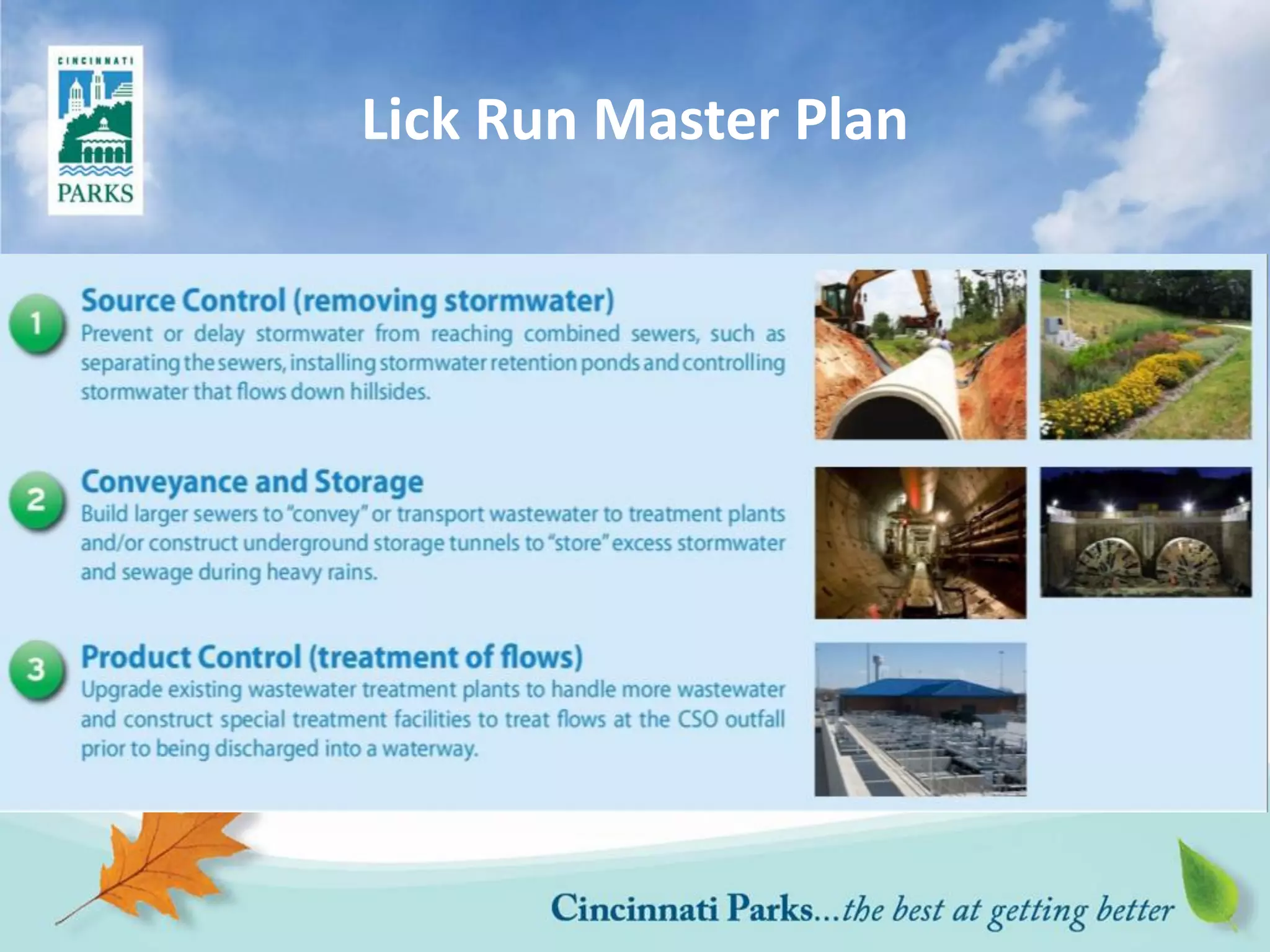
Lick Run Master Plan
Urban Waterway Plan
Urban Waterway Plan
Lick Run Plan
Urban Waterway Plan
St. Francis Court Apartments Bioretention Features
Before & After

2009: Two levels of unused parking lots

2012: Two bioinfiltration basins with walking path
Spring 2011, Ponding after rain event
Summer 2011, One year after installation
Special Thanks

Collaboration, Science, and Technology Merge to Improve Water Quality

  • 1.
    Collaboration, Science, and TechnologyMerge to Improve Water Quality David Gamstetter Donna Murphy Cincinnati Park Board U.S. Forest Service NA SPF
  • 2.
    Aging Sewer Infrastructure Cincinnati/Hamilton County is one of 772 cities in the US with a combined sewer system.  Hamilton County ranks 5th in the nation for urban combined sewer overflow (CSO) volume.  Up to 105 overflows/year in some CSOs resulting in 14 billion gallons annually overflowing into waterways.  Over 300 miles of streams once flowed through the lower Mill Creek, today only 75 miles remain with over 600 miles of combined sewers.
  • 3.
    Combined Sewer Overflows MSD’ssewer system during wet weather based on the typical year rainfall.
  • 4.
    Combined Sewer Overflows Annually14 billion gallons of untreated stormwater and sewage overflows from CSOs Hamilton County CSOs - 212
  • 5.
    Consent Decree The consentdecree with the US EPA, Ohio EPA, and ORSANCO (the regulators) mandates that Metropolitan Sewer District (MSD):  Capture, treat, or remove at least 85% of the 14 billion gallons of annual overflows from CSOs  Eliminate all overflows from sanitary sewers (about 100 million gallons annually)
  • 6.
    Default Solution –Storage Tunnel The approved solution was a $244M tunnel:  30 feet in diameter  1.2 miles long  1.6 billion gallons of storage The tunnel would meet mandates for compliance. Communities and watershed function would remain unchanged without any new reinvestment.
  • 7.
    What if asewer project…  Could be more than a sewer project?  Could improve stormwater quality?  Could be a strategic investment?  Could be greener?
  • 8.
    What if itcould….  Signify as a catalyst for community transformation?  Establish a new watershed based model for community planning?  Engage the neighborhood and local partners?  Generate community assets that attracted new interest and investment?  Create open space, enhanced streetscapes, and development opportunities?
  • 9.
    Project Groundwork  Oneof the largest public works projects in Cincinnati’s 200+ year history.  Green solutions for stormwater quality  Improves quality of life — cleaner streams and improved public health.  Community enhancements
  • 10.
    Project Groundwork Provides communityand social benefits by:  promoting environmental, social, and economic solutions.  revitalizes the economy by creating local jobs and opportunities for economic growth.  reduces sewage overflows into rivers and streams and eliminates sewage backups.
  • 11.
    Lick Run Watershed TheLick Run watershed is 2,700 acres in Cincinnati’s west side, and is home to the largest CSO in Hamilton County. Annually, 1 billion gallons of raw sewage, mixed with stormwater, overflows into Mill Creek. Of that total, 25% is sewage – the rest comes from stormwater and reconveyed stream flow.
  • 15.
  • 16.
    U.S. Forest Service NortheasternArea State and Private Forestry
  • 17.
    Federal Policy Drivers 1.Clean Water Act - To restore and maintain the chemical, physical, and biological integrity of the Nation’s waters 2. Safe Drinking Water Act
  • 18.
    Forest Service PolicyDrivers USFS National Priorities  Conserve and Manage Working Forests Landscapes  Protect Forests from Threats  Enhance Public Benefits from Trees and Forests USFS NA S&PF Strategic Plan 2013-2018  Best available science through the engagement of all partners across all landscapes.  X strategies of 27 could address water quality issues
  • 19.
    ….across all landscapes NA S&PFStrategic Plan 2013-2018 Use the best available science and commitment to respond to forest threats through the engagement of all partners across all landscapes
  • 20.
    Science 1. UTC Study(2000 and 2011 Multi-State)  39% UTC  UTC decreased 1.2% since 2000.  28 of Cincinnati’s 52 neighborhoods <25% UTC 2. CityGreen (2000 and 2010)  Cincinnati’s annual savings - $2,190,420 in avoided stormwater costs. 3. i-Tree Hydro (2011)  Role of vegetation in managing stormwater.
  • 21.
    Ohio River BasinGrant Purpose “A collaborative approach demonstrating water quality improvement practices in forested and urban landscapes within the Ohio River Basin” -US Forest Service ~ Northeastern Area State & Private Forestry, competitive allocation process
  • 22.
    Why the OhioRiver Basin Project is Important This project addresses water quality degradation from runoff by land use conversions and CSOs, that affect the health and ecology of the Ohio River and its tributaries. Key threats to Ohio forests (noted in Ohio’s FRAS):  Inadequate funding for conservation  Lack of public awareness  Lack of comprehensive planning  Water quality impacts from land management practices  Urbanization in a high priority landscape
  • 23.
    Ohio River BasinProject Innovative management at the landscape scale to address water quality, stormwater management, and watershed health in priority landscapes.  State Forests  Municipalities  Outreach
  • 24.
    Ohio River BasinProject Outputs  Green infrastructure and stormwater control measures Short and medium-term outcomes will focus on changes in knowledge, attitudes, skills, aspirations, behavior, policy, and practices.
  • 25.
    Ohio River BasinProject The Ohio Division of Forestry manages over 200,000 acres of state forest lands. Since European settlement, Ohio has lost 90% of its wetlands. Goals:  Protect existing Ohio forested wetlands  Create new Ohio forested wetlands
  • 26.
    Ohio River BasinProject  Ohio State University  Metropolitan Sewer District of Greater Cincinnati  City of Cincinnati  Ohio River Radio Consortium  Lower Olentangy River Watershed Urban Forestry Partnership
  • 27.
    Ohio River BasinProject The ODNR and OSU will locate, classify, and record all forested wetlands currently within Ohio’s state forests. This data layer will be added to the Ohio Statewide Forest Resource Assessment & Strategy (FRAS). Water Management plans and BMPs can then be developed to protect forested wetlands.
  • 28.
    Driver: Ohio StateAction Plan Ohio State Action Plan        Forests health Water quality Forest management Conservation $ Comprehensive planning Impacts of urbanization Public awareness
  • 29.
    Connecting to theLandscape 52 Local Partners  Regional Plans - Agenda 360  County Plans - MSD Wet Weather Plan  City Plans - Plan Cincinnati 2012 Lick Run Master Plan  Local Plans - Centennial parks Master Plan
  • 30.
  • 32.
    Critical Needs Assessment The2010 Ohio/Michigan Regional Urban Tree Canopy Assessment and Implementation Project is a collaboration of the following organizations:
  • 33.
    Urban Tree CanopyStudy The UTC Assessment:  Serves as a benchmark from which to measure success of future programs.  Leverages support from partners.  Educates the public about the many benefits of trees.
  • 34.
    Urban Tree CanopyStudy  Used 5 GIS to map landcover in Hamilton County, (trees and forests, impervious surfaces, open space, soil and water).  Assess Cincinnati’s existing and possible Urban Tree Canopy (UTC) citywide and within creeksheds, land use types and census blocks.  Model environmental services provided by trees.
  • 35.
    CITYgreen Studies 2010 GIS-basedmodel used to calculate the ecosystem services and value of Cincinnati’s existing urban forest. Provides benefit estimates of the value of tree canopy for air pollution removal, capacity for 5 air pollutants, carbon storage and sequestration in lbs./yr., stormwater mitigated and water quality. Impervious surface, tree canopy, and land use layers were developed from aerial photography
  • 36.
    Environmental Services ofTrees Cincinnati Parks provide $5,075,000 in Annual stormwater management benefits
  • 37.
    Environmental Services ofTrees Cincinnati’s urban forest provides $42,404,000 In annual pollution removal and stormwater abatement benefits.
  • 38.
  • 39.
    Environmental Benefits calculated byCITYgreen (example) CARBON BENEFITS Carbon storage: 1,659.57 tons Carbon sequestration: 2.89 tons/year POLLUTION REMOVAL BENEFITS Ozone: $3,930.17 (1280.7 pounds) SO²: $298.68 (397.7 pounds) NO²: $2,253.64 (734.3 pounds) PM¹º: $2,267.52 (1106.6 pounds) CO: $63.79 (146.7 pounds) STORMWATER BENEFITS Runoff reduction: 68.8% Time of concentration increase: 66.9% Peak flow reduction: 84.5% Storage volume (trees removed): 165,919 ft3
  • 40.
    Cost Benefit AnalysisEnvironmental Services Provided by Cincinnati Street Trees Stormwater, carbon, air pollution abatement Energy savings Total Benefits (1) $3,240,402.00 $4,760,000.00 $8,000,000.00 Annual Maintenance Costs $1,800,000.00 Return on $1 Investment Annual benefit for each tree Typical assessment on a 50’ wide lot Net annual benefit $4.44 $94.12 $ 9.00 $85.12
  • 41.
    Chiquita Brands donatedand planted 80 Trees as part of a corporate service project
  • 42.
    Ault Park StormwaterSeparation Project
  • 43.
    Ault Park StormwaterSeparation Project
  • 44.
    Ault Park StormwaterSeparation Project
  • 48.
  • 49.
    i-Tree Hydro Watershed modelthat calculates the impacts of tree cover and impervious surfaces on stormwater runoff. Uses slope, soil type, % of impervious surface, and tree cover to calculate the infrastructure needed to abate stormwater if tree canopy is not present. Cost savings are based on the avoidance of constructing infrastructure.
  • 50.
    Lick Run i-TreeHydro  100 % forest, shrub understory = 0 runoff  Shrub understory restoration = 1.9% reduction in flow if honeysuckle is replaced by native shrubs.  Herbaceous understory restoration = 1.4% reduction in flow if honeysuckle is removed and herbaceous layer regenerates.
  • 52.
    Triple Bottom Line Weighsthe economic, social, and environmental cost-benefits of a project. Community Economic: Jobs, business, and growth Social: community revitalization, parks Environmental: stream ecology, health, UTC Economy Environment
  • 53.
  • 54.
  • 55.
  • 56.
  • 57.
  • 60.
    St. Francis CourtApartments Bioretention Features Before & After 2009: Two levels of unused parking lots 2012: Two bioinfiltration basins with walking path
  • 61.
    Spring 2011, Pondingafter rain event
  • 62.
    Summer 2011, Oneyear after installation
  • 63.