A Century of Progress with Pride 
The City of Berwyn 
Robert J. Lovero 
Mayor 
December 10, 2013 
Amy Walkenbach 
Illinois Environmental Protection Agency 
Watershed Management Section #15 
P.O. Box 19276 
Springfield, Illinois 62794-9276 
Dear Ms. Walkenbach: 
As Mayor of the City of Berwyn, I would like to convey my sincere appreciation for the opportunity to 
submit this application for the Illinois Green Infrastructure Grant Program. As mayor of a densely 
populated, inner ring suburb I see firsthand the effects of an overworked combined sewer system such as 
flooded basements, polluted waterways and damaged infrastructure. 
In order to be part of the solution to these problems, the City of Berwyn seeks funding in the amount of 
$1,445,765.17. This financial assistance will be used to initiate Berwyn’s Green Alley Program thus 
responsibly reconstructing eight alleyways in Berwyn to include pervious concrete pavement. By 
returning stormwater runoff to the ground, we hope to be able to reduce the likelihood of combined 
sewer overflows; an occurrence that has become all too common. 
Enclosed you will find two hard copies and a digital version of our proposal for green infrastructure. 
Through your support of this initiative we hope to collectively address the amount of pollutants entering 
the Des Plaines River watershed. Thank you for your time and consideration of our proposal. If you 
have any questions about the plan, please feel free to contact me. 
Respectfully, 
Robert J. Lovero 
Mayor 
6700 West 26th Street Berwyn, Illinois 60402-0701 Telephone: (708) 788-2660 Fax: (708) 788-2567 www.berwyn-il.gov
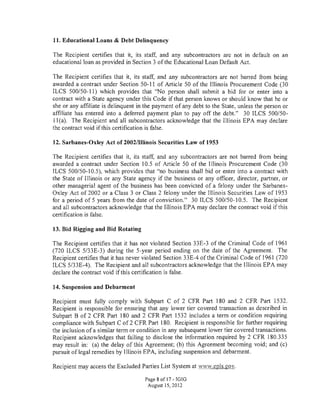
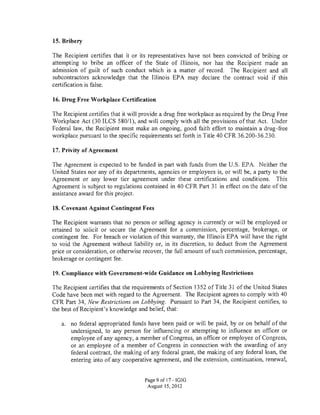
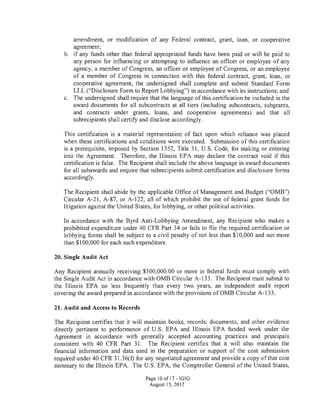
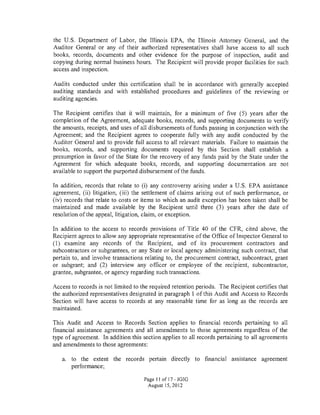
City of Berwyn Green Alleys Program 
1 | P a g e 
City of Berwyn Green Alleys Program 
Hydrologic Unit Code (HUC) 0712000407 
Des Plaines River Watershed 
Category: Combined Sewer Overflow Rehabilitation 
Rivers: IL G‐39 Des Plaines River 
Contact Information: Robert Schiller 
Public Works Director, City of Berwyn 
6700 West 30th Street 
Berwyn, IL 60402 
(708) 788.2660 
rschiller@ci.berwyn.il.us 
City of Berwyn Website: http://www.berwyn‐il.gov/
City of Berwyn Green Alleys Program 
Abstract: 
The City of Berwyn requests $1,445,765.17 in grant funds through the Illinois Green 
Infrastructure Grant Program (IGIG) to implement the Green Alleys Program. The total cost of 
this project is $1,700,900.20. The City will provide the local match supporting 15% of the 
project in the amount of $255,135.03. The proposed project involves reconstructing 8,480 
square yards of alley space to include Pervious Concrete Pavement. These green alleys will 
significantly increase permeability thus enabling 97% of stormwater to infiltrate into the 
ground. Furthermore, the permeable pavement will filter stormwater runoff and reduce 
pollutant concentrations. Through this project the City hopes to demonstrate to the public the 
benefits of green infrastructure and sustainability. 
Berwyn, as an urban infill community, has active Combined Sewer Overflow (CSO) problems 
and recognizes the environmental and health risks that are associated. The proposed Green 
Alleys Program will increase the amount of permeable land and therefore allow stormwater to 
matriculate into the ground naturally instead of taxing the areas combined sewer system. 
1. Project Narrative: 
Characterization of the Area: 
The City of Berwyn is located within ten miles of the Chicago Loop, situated between the 
Stevenson (I‐55) and Eisenhower (I‐290) Expressways and is in close proximity to Midway 
Airport, O’Hare Airport and served by the Metra Rail line. Due to its prime location and 
availability of affordable housing, the City has seen an increase in population, traffic and urban 
density over the past several decades. 
The City’s land area is 3.9 square miles with a growing population of 56,657 in which 72% are 
over the age of 18. This equates to a population density of 14,527 per square mile; 20% higher 
than that of Chicago’s. 
The City’s combined sewer system is nearing 100 years old and incapable, at times, of handling 
the increased capacity especially during a storm. Much of the combined sewer system was 
designed to handle small one story structures when pervious green areas were much larger. 
While the population and density of Berwyn has grown, the combined sewer system has 
remained largely untouched. Currently the City contains only 2.0% of open space. The City’s 
current stormwater management system is a combined sewer system provided by the 
Metropolitan Water Reclamation District of Greater Chicago (MWRDGC), comprised of a 
conveyance system nearly 100 miles in length and storm laterals totaling 19 miles. Stormwater 
runoff and sewage are collected into a single pipe and ultimately discharged into the large 
interceptors of the MWRDGC where it is eventually treated at their Stickney Treatment Plant. 
2 | P a g e
City of Berwyn Green Alleys Program 
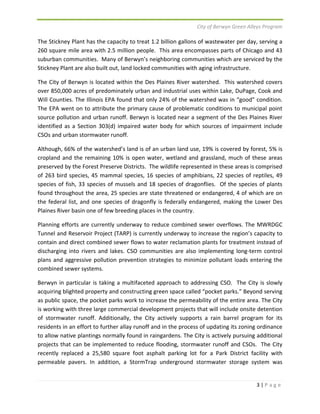
The Stickney Plant has the capacity to treat 1.2 billion gallons of wastewater per day, serving a 
260 square mile area with 2.5 million people. This area encompasses parts of Chicago and 43 
suburban communities. Many of Berwyn’s neighboring communities which are serviced by the 
Stickney Plant are also built out, land locked communities with aging infrastructure. 
The City of Berwyn is located within the Des Plaines River watershed. This watershed covers 
over 850,000 acres of predominately urban and industrial uses within Lake, DuPage, Cook and 
Will Counties. The Illinois EPA found that only 24% of the watershed was in “good” condition. 
The EPA went on to attribute the primary cause of problematic conditions to municipal point 
source pollution and urban runoff. Berwyn is located near a segment of the Des Plaines River 
identified as a Section 303(d) impaired water body for which sources of impairment include 
CSOs and urban stormwater runoff. 
Although, 66% of the watershed’s land is of an urban land use, 19% is covered by forest, 5% is 
cropland and the remaining 10% is open water, wetland and grassland, much of these areas 
preserved by the Forest Preserve Districts. The wildlife represented in these areas is comprised 
of 263 bird species, 45 mammal species, 16 species of amphibians, 22 species of reptiles, 49 
species of fish, 33 species of mussels and 18 species of dragonflies. Of the species of plants 
found throughout the area, 25 species are state threatened or endangered, 4 of which are on 
the federal list, and one species of dragonfly is federally endangered, making the Lower Des 
Plaines River basin one of few breeding places in the country. 
Planning efforts are currently underway to reduce combined sewer overflows. The MWRDGC 
Tunnel and Reservoir Project (TARP) is currently underway to increase the region’s capacity to 
contain and direct combined sewer flows to water reclamation plants for treatment instead of 
discharging into rivers and lakes. CSO communities are also implementing long‐term control 
plans and aggressive pollution prevention strategies to minimize pollutant loads entering the 
combined sewer systems. 
Berwyn in particular is taking a multifaceted approach to addressing CSO. The City is slowly 
acquiring blighted property and constructing green space called “pocket parks.” Beyond serving 
as public space, the pocket parks work to increase the permeability of the entire area. The City 
is working with three large commercial development projects that will include onsite detention 
of stormwater runoff. Additionally, the City actively supports a rain barrel program for its 
residents in an effort to further allay runoff and in the process of updating its zoning ordinance 
to allow native plantings normally found in raingardens. The City is actively pursuing additional 
projects that can be implemented to reduce flooding, stormwater runoff and CSOs. The City 
recently replaced a 25,580 square foot asphalt parking lot for a Park District facility with 
permeable pavers. In addition, a StormTrap underground stormwater storage system was 
3 | P a g e
City of Berwyn Green Alleys Program 
installed in a park in a section of the City that experiences flooding regularly, designed to 
provide 5,507 cubic feet of underground storage. 
Project Need: 
The City has experienced several instances of damaging flooding over the past couple of 
years. The City’s combined sewers are outdated and were not originally designed to sustain the 
demands of a growing urban area. The Green Alley Program is intended to provide storm sewer 
relief to the City’s combined sewer system by providing detention and percolation areas in the 
alleys. The City is looking to redevelop these areas using a green pavement solution as a way to 
mitigate flooding concerns as well as prepare for the future. Over the past couple of years, the 
City has experienced severe flooding events resulting in hundreds of thousands of dollars in 
damage and the displacement of residents from their homes. 
Berwyn’s stormwater and sanitary sewerage is conveyed to the MWRDGC interceptor system. 
Most of these City collection sewers have a very limited capacity to convey stormwater runoff 
due to their small size and long distances to the MWRDGC interceptor. During heavy rainfall 
events, MWRDGC has been forced to close the sluices gates to their system and excess flows 
are diverted into the surrounding waterways untreated. 
Pervious Concrete is a highly effective on‐site stormwater management practice and 
considered amongst the Best Management Practices (BMPs) of the EPA. Berwyn is hopeful that 
the Green Alleys Program will reduce the volume of stormwater entering the combined sewer 
system by 97%. Surface runoff entering the green alleys will infiltrate the ground rather than 
end up in the combined sewer system. This initiative will also reduce pollutant loads entering 
both the City system and the MWRD system and will ultimately reduce the discharging of 
pollutants into the area waterways. Thus, the Green Alleys Program will help improve local 
water quality in the long term. 
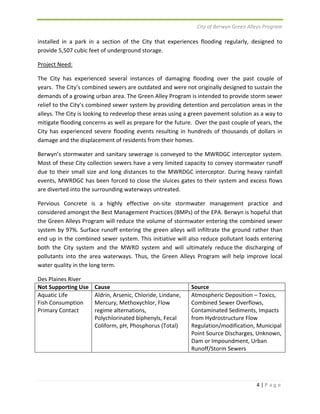
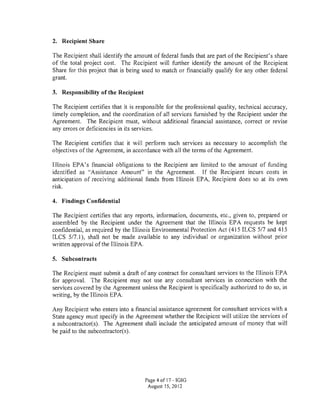
Des Plaines River 
Not Supporting Use Cause Source 
Aquatic Life 
Fish Consumption 
Primary Contact 
4 | P a g e 
Aldrin, Arsenic, Chloride, Lindane, 
Mercury, Methoxychlor, Flow 
regime alternations, 
Polychlorinated biphenyls, Fecal 
Coliform, pH, Phosphorus (Total) 
Atmospheric Deposition – Toxics, 
Combined Sewer Overflows, 
Contaminated Sediments, Impacts 
from Hydrostructure Flow 
Regulation/modification, Municipal 
Point Source Discharges, Unknown, 
Dam or Impoundment, Urban 
Runoff/Storm Sewers
City of Berwyn Green Alleys Program 
5 | P a g e 
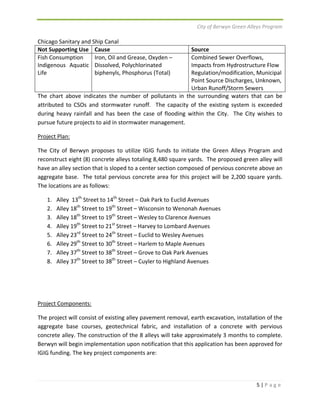
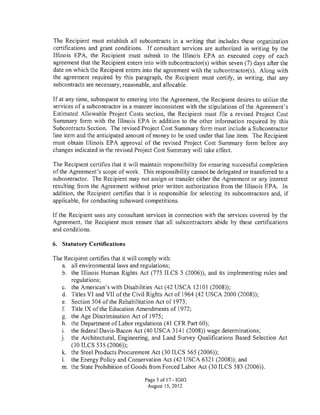
Chicago Sanitary and Ship Canal 
Not Supporting Use Cause Source 
Fish Consumption 
Indigenous Aquatic 
Life 
Iron, Oil and Grease, Oxyden – 
Dissolved, Polychlorinated 
biphenyls, Phosphorus (Total) 
Combined Sewer Overflows, 
Impacts from Hydrostructure Flow 
Regulation/modification, Municipal 
Point Source Discharges, Unknown, 
Urban Runoff/Storm Sewers 
The chart above indicates the number of pollutants in the surrounding waters that can be 
attributed to CSOs and stormwater runoff. The capacity of the existing system is exceeded 
during heavy rainfall and has been the case of flooding within the City. The City wishes to 
pursue future projects to aid in stormwater management. 
Project Plan: 
The City of Berwyn proposes to utilize IGIG funds to initiate the Green Alleys Program and 
reconstruct eight (8) concrete alleys totaling 8,480 square yards. The proposed green alley will 
have an alley section that is sloped to a center section composed of pervious concrete above an 
aggregate base. The total pervious concrete area for this project will be 2,200 square yards. 
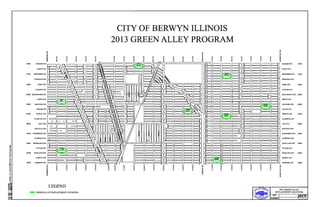
The locations are as follows: 
1. Alley 13th Street to 14th Street – Oak Park to Euclid Avenues 
2. Alley 18th Street to 19th Street – Wisconsin to Wenonah Avenues 
3. Alley 18th Street to 19th Street – Wesley to Clarence Avenues 
4. Alley 19th Street to 21st Street – Harvey to Lombard Avenues 
5. Alley 23rd Street to 24th Street – Euclid to Wesley Avenues 
6. Alley 29th Street to 30th Street – Harlem to Maple Avenues 
7. Alley 37th Street to 38th Street – Grove to Oak Park Avenues 
8. Alley 37th Street to 38th Street – Cuyler to Highland Avenues 
Project Components: 
The project will consist of existing alley pavement removal, earth excavation, installation of the 
aggregate base courses, geotechnical fabric, and installation of a concrete with pervious 
concrete alley. The construction of the 8 alleys will take approximately 3 months to complete. 
Berwyn will begin implementation upon notification that this application has been approved for 
IGIG funding. The key project components are:
City of Berwyn Green Alleys Program 
1. Design/Engineering Phase: The City Engineer will prepare the specifications and plans 
for the construction work of the alleys. The ten (10) year Operations and Maintenance 
Plan will be developed during this phase. 
2. Public Bidding: The construction bid notice will be released. 
3. Bid Opening/Contract Awarded: Proposals will be opened and evaluated, and the 
6 | P a g e 
contract will be awarded to the successful bidder. 
4. Construction Phase: Once the subcontract has been approved by the IEPA, construction 
of both projects will commence. 
5. Project Completion/Operations and Maintenance Plan. 
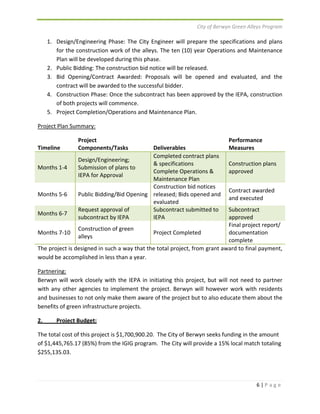
Project Plan Summary: 
Timeline 
Project 
Components/Tasks Deliverables 
Performance 
Measures 
Months 1‐4 
Design/Engineering; 
Submission of plans to 
IEPA for Approval 
Completed contract plans 
& specifications 
Complete Operations & 
Maintenance Plan 
Construction plans 
approved 
Months 5‐6 Public Bidding/Bid Opening 
Construction bid notices 
released; Bids opened and 
evaluated 
Contract awarded 
and executed 
Months 6‐7 Request approval of 
subcontract by IEPA 
Subcontract submitted to 
IEPA 
Subcontract 
approved 
Months 7‐10 Construction of green 
alleys Project Completed 
Final project report/ 
documentation 
complete 
The project is designed in such a way that the total project, from grant award to final payment, 
would be accomplished in less than a year. 
Partnering: 
Berwyn will work closely with the IEPA in initiating this project, but will not need to partner 
with any other agencies to implement the project. Berwyn will however work with residents 
and businesses to not only make them aware of the project but to also educate them about the 
benefits of green infrastructure projects. 
2. Project Budget: 
The total cost of this project is $1,700,900.20. The City of Berwyn seeks funding in the amount 
of $1,445,765.17 (85%) from the IGIG program. The City will provide a 15% local match totaling 
$255,135.03.
City of Berwyn Green Alleys Program 
7 | P a g e 
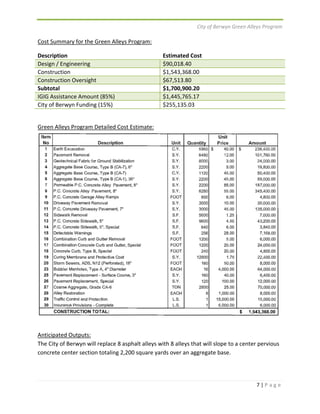
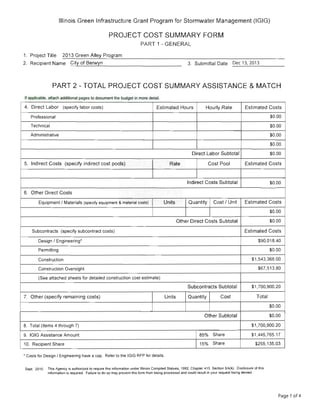
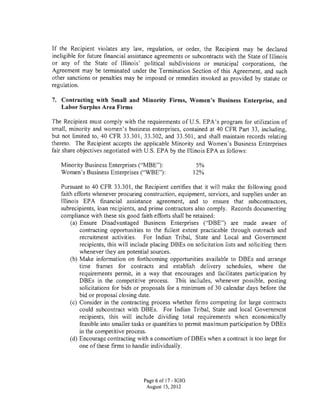
Cost Summary for the Green Alleys Program: 
Description Estimated Cost 
Design / Engineering $90,018.40 
Construction $1,543,368.00 
Construction Oversight $67,513.80 
Subtotal $1,700,900.20 
IGIG Assistance Amount (85%) $1,445,765.17 
City of Berwyn Funding (15%) $255,135.03 
Green Alleys Program Detailed Cost Estimate: 
Anticipated Outputs: 
The City of Berwyn will replace 8 asphalt alleys with 8 alleys that will slope to a center pervious 
concrete center section totaling 2,200 square yards over an aggregate base.
City of Berwyn Green Alleys Program 
8 | P a g e 
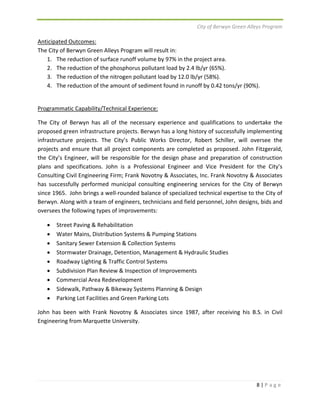
Anticipated Outcomes: 
The City of Berwyn Green Alleys Program will result in: 
1. The reduction of surface runoff volume by 97% in the project area. 
2. The reduction of the phosphorus pollutant load by 2.4 lb/yr (65%). 
3. The reduction of the nitrogen pollutant load by 12.0 lb/yr (58%). 
4. The reduction of the amount of sediment found in runoff by 0.42 tons/yr (90%). 
Programmatic Capability/Technical Experience: 
The City of Berwyn has all of the necessary experience and qualifications to undertake the 
proposed green infrastructure projects. Berwyn has a long history of successfully implementing 
infrastructure projects. The City’s Public Works Director, Robert Schiller, will oversee the 
projects and ensure that all project components are completed as proposed. John Fitzgerald, 
the City’s Engineer, will be responsible for the design phase and preparation of construction 
plans and specifications. John is a Professional Engineer and Vice President for the City’s 
Consulting Civil Engineering Firm; Frank Novotny & Associates, Inc. Frank Novotny & Associates 
has successfully performed municipal consulting engineering services for the City of Berwyn 
since 1965. John brings a well‐rounded balance of specialized technical expertise to the City of 
Berwyn. Along with a team of engineers, technicians and field personnel, John designs, bids and 
oversees the following types of improvements: 
 Street Paving & Rehabilitation 
 Water Mains, Distribution Systems & Pumping Stations 
 Sanitary Sewer Extension & Collection Systems 
 Stormwater Drainage, Detention, Management & Hydraulic Studies 
 Roadway Lighting & Traffic Control Systems 
 Subdivision Plan Review & Inspection of Improvements 
 Commercial Area Redevelopment 
 Sidewalk, Pathway & Bikeway Systems Planning & Design 
 Parking Lot Facilities and Green Parking Lots 
John has been with Frank Novotny & Associates since 1987, after receiving his B.S. in Civil 
Engineering from Marquette University.
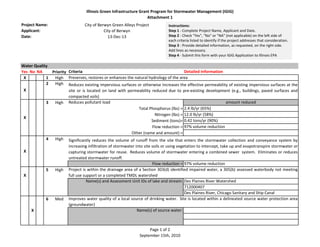
Illinois Green Infrastructure Grant Program for Stormwater Management (IGIG) 
Attachment 1 
High Significantly reduces the volume of runoff from the site that enters the stormwater collection and conveyance system by 
Page 1 of 2 
September 15th, 2010 
Project Name: 
Yes No NA Priority Criteria Detailed Information 
X 1 High 
X 
2 High 
High Reduces pollutant load amount reduced 
2.4 lb/yr (65%) 
12.0 lb/yr (58%) 
0.42 tons/yr (90%) 
97% volume reduction 
Flow reduction = 97% volume reduction 
Name(s) and Assessment Unit IDs of lake and stream: Des Plaines River Watershed 
712000407 
Des Plaines River, Chicago Sanitary and Ship Canal 
Name(s) of source water: 
5 
Med 
City of Berwyn Green Alleys Project 
Applicant: 
Date: 
City of Berwyn 
13-Dec-13 
Preserves, restores or enhances the natural hydrology of the area 
High 
increasing infiltration of stormwater into site soils or using vegetation to intercept, take up and evapotranspire stormwater or 
capturing stormwater for reuse. Reduces volume of stormwater entering a combined sewer system. Eliminates or reduces 
untreated stormwater runoff. 
Project is within the drainage area of a Section 303(d) identified impaired water, a 305(b) assessed waterbody not meeting 
full use support or a completed TMDL watershed 
Improves water quality of a local source of drinking water. Site is located within a delineated source water protection area 
(groundwater) 
Water Quality 
X 
4 
X 
Reduces existing impervious surfaces or otherwise increases the effective permeability of existing impervious surfaces at the 
site or is located on land with permeability reduced due to pre-existing development (e.g., buildings, paved surfaces and 
compacted soils) 
X 
X 
6 
Total Phosphorus (lbs) = 
Nitrogen (lbs) = 
Sediment (tons)= 
Flow reduction = 
Other (name and amount) = 
3 
Instructions: 
Step 1 - Complete Project Name, Applicant and Date. 
Step 2 - Check "Yes", "No" or "NA" (not applicable) on the left side of 
each criteria listed to identify if the project addresses that consideration. 
Step 3 - Provide detailed information, as requested, on the right side. 
Add lines as necessary. 
Step 4 - Submit this form with your IGIG Application to Illinois EPA
Illinois Green Infrastructure Grant Program for Stormwater Management (IGIG) 
Attachment 1 
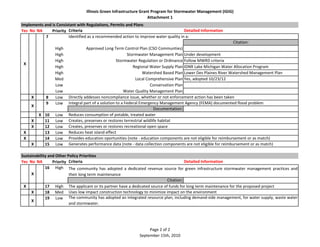
Implements and is Consistant with Regulations, Permits and Plans 
Yes No NA Priority Criteria Detailed Information 
Identified as a recommended action to improve water quality in a: 
Directly addesses noncompliance issue, whether or not enforcement action has been taken 
Integral part of a solution to a Federal Emergency Management Agency (FEMA) documented flood problem 
Creates, preserves or restores terrestrial wildlife habitat 
Creates, preserves or restores recreational open space 
Reduces heat island effect 
Provides education oportunities (note - education components are not eligible for reimbursement or as match) 
Generates performance data (note - data collection components are not eligible for reimbursement or as match) 
The applicant or its partner have a dedicated source of funds for long term maintenance for the proposed project 
Page 2 of 2 
September 15th, 2010 
Citation: 
High Approved Long Term Control Plan (CSO Communties) 
High Stormwater Management Plan Under development 
High Stormwater Regulation or Ordinance Follow MWRD criteria 
High Regional Water Supply Plan IDNR Lake Michigan Water Allocation Program 
High Watershed Based Plan Lower Des Plaines River Watershed Management Plan 
Med Local Comprehensive Plan Yes, adopted 10/23/12 
Low Conservation Plan 
Low Water Quality Management Plan 
X 8 Low 
Documentation: 
X 9 Low 
X 10 Low 
X 11 Low 
X 12 Low 
X 13 Low 
X 14 Low 
X 15 Low 
Yes No NA Priority Criteria Detailed Information 
Citation: 
X 
16 High 
X 17 High 
X 18 Med 
X 19 Low 
The community has adopted a dedicated revenue source for green infrastructure stormwater management practices and 
their long term maintenance 
7 
Reduces consumption of potable, treated water 
Sustainability and Other Policy Priorities 
Uses low impact construction technology to minimize impact on the environment 
The community has adopted an integrated resource plan, including demand-side management, for water supply, waste water 
and stormwater. 
X
2013.dec.1314 318 e-green alleys grant program

2013.dec.1314 318 e-green alleys grant program

  • 1.
    A Century ofProgress with Pride The City of Berwyn Robert J. Lovero Mayor December 10, 2013 Amy Walkenbach Illinois Environmental Protection Agency Watershed Management Section #15 P.O. Box 19276 Springfield, Illinois 62794-9276 Dear Ms. Walkenbach: As Mayor of the City of Berwyn, I would like to convey my sincere appreciation for the opportunity to submit this application for the Illinois Green Infrastructure Grant Program. As mayor of a densely populated, inner ring suburb I see firsthand the effects of an overworked combined sewer system such as flooded basements, polluted waterways and damaged infrastructure. In order to be part of the solution to these problems, the City of Berwyn seeks funding in the amount of $1,445,765.17. This financial assistance will be used to initiate Berwyn’s Green Alley Program thus responsibly reconstructing eight alleyways in Berwyn to include pervious concrete pavement. By returning stormwater runoff to the ground, we hope to be able to reduce the likelihood of combined sewer overflows; an occurrence that has become all too common. Enclosed you will find two hard copies and a digital version of our proposal for green infrastructure. Through your support of this initiative we hope to collectively address the amount of pollutants entering the Des Plaines River watershed. Thank you for your time and consideration of our proposal. If you have any questions about the plan, please feel free to contact me. Respectfully, Robert J. Lovero Mayor 6700 West 26th Street Berwyn, Illinois 60402-0701 Telephone: (708) 788-2660 Fax: (708) 788-2567 www.berwyn-il.gov
  • 2.
    City of BerwynGreen Alleys Program 1 | P a g e City of Berwyn Green Alleys Program Hydrologic Unit Code (HUC) 0712000407 Des Plaines River Watershed Category: Combined Sewer Overflow Rehabilitation Rivers: IL G‐39 Des Plaines River Contact Information: Robert Schiller Public Works Director, City of Berwyn 6700 West 30th Street Berwyn, IL 60402 (708) 788.2660 rschiller@ci.berwyn.il.us City of Berwyn Website: http://www.berwyn‐il.gov/
  • 3.
    City of BerwynGreen Alleys Program Abstract: The City of Berwyn requests $1,445,765.17 in grant funds through the Illinois Green Infrastructure Grant Program (IGIG) to implement the Green Alleys Program. The total cost of this project is $1,700,900.20. The City will provide the local match supporting 15% of the project in the amount of $255,135.03. The proposed project involves reconstructing 8,480 square yards of alley space to include Pervious Concrete Pavement. These green alleys will significantly increase permeability thus enabling 97% of stormwater to infiltrate into the ground. Furthermore, the permeable pavement will filter stormwater runoff and reduce pollutant concentrations. Through this project the City hopes to demonstrate to the public the benefits of green infrastructure and sustainability. Berwyn, as an urban infill community, has active Combined Sewer Overflow (CSO) problems and recognizes the environmental and health risks that are associated. The proposed Green Alleys Program will increase the amount of permeable land and therefore allow stormwater to matriculate into the ground naturally instead of taxing the areas combined sewer system. 1. Project Narrative: Characterization of the Area: The City of Berwyn is located within ten miles of the Chicago Loop, situated between the Stevenson (I‐55) and Eisenhower (I‐290) Expressways and is in close proximity to Midway Airport, O’Hare Airport and served by the Metra Rail line. Due to its prime location and availability of affordable housing, the City has seen an increase in population, traffic and urban density over the past several decades. The City’s land area is 3.9 square miles with a growing population of 56,657 in which 72% are over the age of 18. This equates to a population density of 14,527 per square mile; 20% higher than that of Chicago’s. The City’s combined sewer system is nearing 100 years old and incapable, at times, of handling the increased capacity especially during a storm. Much of the combined sewer system was designed to handle small one story structures when pervious green areas were much larger. While the population and density of Berwyn has grown, the combined sewer system has remained largely untouched. Currently the City contains only 2.0% of open space. The City’s current stormwater management system is a combined sewer system provided by the Metropolitan Water Reclamation District of Greater Chicago (MWRDGC), comprised of a conveyance system nearly 100 miles in length and storm laterals totaling 19 miles. Stormwater runoff and sewage are collected into a single pipe and ultimately discharged into the large interceptors of the MWRDGC where it is eventually treated at their Stickney Treatment Plant. 2 | P a g e
  • 4.
    City of BerwynGreen Alleys Program The Stickney Plant has the capacity to treat 1.2 billion gallons of wastewater per day, serving a 260 square mile area with 2.5 million people. This area encompasses parts of Chicago and 43 suburban communities. Many of Berwyn’s neighboring communities which are serviced by the Stickney Plant are also built out, land locked communities with aging infrastructure. The City of Berwyn is located within the Des Plaines River watershed. This watershed covers over 850,000 acres of predominately urban and industrial uses within Lake, DuPage, Cook and Will Counties. The Illinois EPA found that only 24% of the watershed was in “good” condition. The EPA went on to attribute the primary cause of problematic conditions to municipal point source pollution and urban runoff. Berwyn is located near a segment of the Des Plaines River identified as a Section 303(d) impaired water body for which sources of impairment include CSOs and urban stormwater runoff. Although, 66% of the watershed’s land is of an urban land use, 19% is covered by forest, 5% is cropland and the remaining 10% is open water, wetland and grassland, much of these areas preserved by the Forest Preserve Districts. The wildlife represented in these areas is comprised of 263 bird species, 45 mammal species, 16 species of amphibians, 22 species of reptiles, 49 species of fish, 33 species of mussels and 18 species of dragonflies. Of the species of plants found throughout the area, 25 species are state threatened or endangered, 4 of which are on the federal list, and one species of dragonfly is federally endangered, making the Lower Des Plaines River basin one of few breeding places in the country. Planning efforts are currently underway to reduce combined sewer overflows. The MWRDGC Tunnel and Reservoir Project (TARP) is currently underway to increase the region’s capacity to contain and direct combined sewer flows to water reclamation plants for treatment instead of discharging into rivers and lakes. CSO communities are also implementing long‐term control plans and aggressive pollution prevention strategies to minimize pollutant loads entering the combined sewer systems. Berwyn in particular is taking a multifaceted approach to addressing CSO. The City is slowly acquiring blighted property and constructing green space called “pocket parks.” Beyond serving as public space, the pocket parks work to increase the permeability of the entire area. The City is working with three large commercial development projects that will include onsite detention of stormwater runoff. Additionally, the City actively supports a rain barrel program for its residents in an effort to further allay runoff and in the process of updating its zoning ordinance to allow native plantings normally found in raingardens. The City is actively pursuing additional projects that can be implemented to reduce flooding, stormwater runoff and CSOs. The City recently replaced a 25,580 square foot asphalt parking lot for a Park District facility with permeable pavers. In addition, a StormTrap underground stormwater storage system was 3 | P a g e
  • 5.
    City of BerwynGreen Alleys Program installed in a park in a section of the City that experiences flooding regularly, designed to provide 5,507 cubic feet of underground storage. Project Need: The City has experienced several instances of damaging flooding over the past couple of years. The City’s combined sewers are outdated and were not originally designed to sustain the demands of a growing urban area. The Green Alley Program is intended to provide storm sewer relief to the City’s combined sewer system by providing detention and percolation areas in the alleys. The City is looking to redevelop these areas using a green pavement solution as a way to mitigate flooding concerns as well as prepare for the future. Over the past couple of years, the City has experienced severe flooding events resulting in hundreds of thousands of dollars in damage and the displacement of residents from their homes. Berwyn’s stormwater and sanitary sewerage is conveyed to the MWRDGC interceptor system. Most of these City collection sewers have a very limited capacity to convey stormwater runoff due to their small size and long distances to the MWRDGC interceptor. During heavy rainfall events, MWRDGC has been forced to close the sluices gates to their system and excess flows are diverted into the surrounding waterways untreated. Pervious Concrete is a highly effective on‐site stormwater management practice and considered amongst the Best Management Practices (BMPs) of the EPA. Berwyn is hopeful that the Green Alleys Program will reduce the volume of stormwater entering the combined sewer system by 97%. Surface runoff entering the green alleys will infiltrate the ground rather than end up in the combined sewer system. This initiative will also reduce pollutant loads entering both the City system and the MWRD system and will ultimately reduce the discharging of pollutants into the area waterways. Thus, the Green Alleys Program will help improve local water quality in the long term. Des Plaines River Not Supporting Use Cause Source Aquatic Life Fish Consumption Primary Contact 4 | P a g e Aldrin, Arsenic, Chloride, Lindane, Mercury, Methoxychlor, Flow regime alternations, Polychlorinated biphenyls, Fecal Coliform, pH, Phosphorus (Total) Atmospheric Deposition – Toxics, Combined Sewer Overflows, Contaminated Sediments, Impacts from Hydrostructure Flow Regulation/modification, Municipal Point Source Discharges, Unknown, Dam or Impoundment, Urban Runoff/Storm Sewers
  • 6.
    City of BerwynGreen Alleys Program 5 | P a g e Chicago Sanitary and Ship Canal Not Supporting Use Cause Source Fish Consumption Indigenous Aquatic Life Iron, Oil and Grease, Oxyden – Dissolved, Polychlorinated biphenyls, Phosphorus (Total) Combined Sewer Overflows, Impacts from Hydrostructure Flow Regulation/modification, Municipal Point Source Discharges, Unknown, Urban Runoff/Storm Sewers The chart above indicates the number of pollutants in the surrounding waters that can be attributed to CSOs and stormwater runoff. The capacity of the existing system is exceeded during heavy rainfall and has been the case of flooding within the City. The City wishes to pursue future projects to aid in stormwater management. Project Plan: The City of Berwyn proposes to utilize IGIG funds to initiate the Green Alleys Program and reconstruct eight (8) concrete alleys totaling 8,480 square yards. The proposed green alley will have an alley section that is sloped to a center section composed of pervious concrete above an aggregate base. The total pervious concrete area for this project will be 2,200 square yards. The locations are as follows: 1. Alley 13th Street to 14th Street – Oak Park to Euclid Avenues 2. Alley 18th Street to 19th Street – Wisconsin to Wenonah Avenues 3. Alley 18th Street to 19th Street – Wesley to Clarence Avenues 4. Alley 19th Street to 21st Street – Harvey to Lombard Avenues 5. Alley 23rd Street to 24th Street – Euclid to Wesley Avenues 6. Alley 29th Street to 30th Street – Harlem to Maple Avenues 7. Alley 37th Street to 38th Street – Grove to Oak Park Avenues 8. Alley 37th Street to 38th Street – Cuyler to Highland Avenues Project Components: The project will consist of existing alley pavement removal, earth excavation, installation of the aggregate base courses, geotechnical fabric, and installation of a concrete with pervious concrete alley. The construction of the 8 alleys will take approximately 3 months to complete. Berwyn will begin implementation upon notification that this application has been approved for IGIG funding. The key project components are:
  • 7.
    City of BerwynGreen Alleys Program 1. Design/Engineering Phase: The City Engineer will prepare the specifications and plans for the construction work of the alleys. The ten (10) year Operations and Maintenance Plan will be developed during this phase. 2. Public Bidding: The construction bid notice will be released. 3. Bid Opening/Contract Awarded: Proposals will be opened and evaluated, and the 6 | P a g e contract will be awarded to the successful bidder. 4. Construction Phase: Once the subcontract has been approved by the IEPA, construction of both projects will commence. 5. Project Completion/Operations and Maintenance Plan. Project Plan Summary: Timeline Project Components/Tasks Deliverables Performance Measures Months 1‐4 Design/Engineering; Submission of plans to IEPA for Approval Completed contract plans & specifications Complete Operations & Maintenance Plan Construction plans approved Months 5‐6 Public Bidding/Bid Opening Construction bid notices released; Bids opened and evaluated Contract awarded and executed Months 6‐7 Request approval of subcontract by IEPA Subcontract submitted to IEPA Subcontract approved Months 7‐10 Construction of green alleys Project Completed Final project report/ documentation complete The project is designed in such a way that the total project, from grant award to final payment, would be accomplished in less than a year. Partnering: Berwyn will work closely with the IEPA in initiating this project, but will not need to partner with any other agencies to implement the project. Berwyn will however work with residents and businesses to not only make them aware of the project but to also educate them about the benefits of green infrastructure projects. 2. Project Budget: The total cost of this project is $1,700,900.20. The City of Berwyn seeks funding in the amount of $1,445,765.17 (85%) from the IGIG program. The City will provide a 15% local match totaling $255,135.03.
  • 8.
    City of BerwynGreen Alleys Program 7 | P a g e Cost Summary for the Green Alleys Program: Description Estimated Cost Design / Engineering $90,018.40 Construction $1,543,368.00 Construction Oversight $67,513.80 Subtotal $1,700,900.20 IGIG Assistance Amount (85%) $1,445,765.17 City of Berwyn Funding (15%) $255,135.03 Green Alleys Program Detailed Cost Estimate: Anticipated Outputs: The City of Berwyn will replace 8 asphalt alleys with 8 alleys that will slope to a center pervious concrete center section totaling 2,200 square yards over an aggregate base.
  • 9.
    City of BerwynGreen Alleys Program 8 | P a g e Anticipated Outcomes: The City of Berwyn Green Alleys Program will result in: 1. The reduction of surface runoff volume by 97% in the project area. 2. The reduction of the phosphorus pollutant load by 2.4 lb/yr (65%). 3. The reduction of the nitrogen pollutant load by 12.0 lb/yr (58%). 4. The reduction of the amount of sediment found in runoff by 0.42 tons/yr (90%). Programmatic Capability/Technical Experience: The City of Berwyn has all of the necessary experience and qualifications to undertake the proposed green infrastructure projects. Berwyn has a long history of successfully implementing infrastructure projects. The City’s Public Works Director, Robert Schiller, will oversee the projects and ensure that all project components are completed as proposed. John Fitzgerald, the City’s Engineer, will be responsible for the design phase and preparation of construction plans and specifications. John is a Professional Engineer and Vice President for the City’s Consulting Civil Engineering Firm; Frank Novotny & Associates, Inc. Frank Novotny & Associates has successfully performed municipal consulting engineering services for the City of Berwyn since 1965. John brings a well‐rounded balance of specialized technical expertise to the City of Berwyn. Along with a team of engineers, technicians and field personnel, John designs, bids and oversees the following types of improvements:  Street Paving & Rehabilitation  Water Mains, Distribution Systems & Pumping Stations  Sanitary Sewer Extension & Collection Systems  Stormwater Drainage, Detention, Management & Hydraulic Studies  Roadway Lighting & Traffic Control Systems  Subdivision Plan Review & Inspection of Improvements  Commercial Area Redevelopment  Sidewalk, Pathway & Bikeway Systems Planning & Design  Parking Lot Facilities and Green Parking Lots John has been with Frank Novotny & Associates since 1987, after receiving his B.S. in Civil Engineering from Marquette University.
  • 10.
    Illinois Green InfrastructureGrant Program for Stormwater Management (IGIG) Attachment 1 High Significantly reduces the volume of runoff from the site that enters the stormwater collection and conveyance system by Page 1 of 2 September 15th, 2010 Project Name: Yes No NA Priority Criteria Detailed Information X 1 High X 2 High High Reduces pollutant load amount reduced 2.4 lb/yr (65%) 12.0 lb/yr (58%) 0.42 tons/yr (90%) 97% volume reduction Flow reduction = 97% volume reduction Name(s) and Assessment Unit IDs of lake and stream: Des Plaines River Watershed 712000407 Des Plaines River, Chicago Sanitary and Ship Canal Name(s) of source water: 5 Med City of Berwyn Green Alleys Project Applicant: Date: City of Berwyn 13-Dec-13 Preserves, restores or enhances the natural hydrology of the area High increasing infiltration of stormwater into site soils or using vegetation to intercept, take up and evapotranspire stormwater or capturing stormwater for reuse. Reduces volume of stormwater entering a combined sewer system. Eliminates or reduces untreated stormwater runoff. Project is within the drainage area of a Section 303(d) identified impaired water, a 305(b) assessed waterbody not meeting full use support or a completed TMDL watershed Improves water quality of a local source of drinking water. Site is located within a delineated source water protection area (groundwater) Water Quality X 4 X Reduces existing impervious surfaces or otherwise increases the effective permeability of existing impervious surfaces at the site or is located on land with permeability reduced due to pre-existing development (e.g., buildings, paved surfaces and compacted soils) X X 6 Total Phosphorus (lbs) = Nitrogen (lbs) = Sediment (tons)= Flow reduction = Other (name and amount) = 3 Instructions: Step 1 - Complete Project Name, Applicant and Date. Step 2 - Check "Yes", "No" or "NA" (not applicable) on the left side of each criteria listed to identify if the project addresses that consideration. Step 3 - Provide detailed information, as requested, on the right side. Add lines as necessary. Step 4 - Submit this form with your IGIG Application to Illinois EPA
  • 11.
    Illinois Green InfrastructureGrant Program for Stormwater Management (IGIG) Attachment 1 Implements and is Consistant with Regulations, Permits and Plans Yes No NA Priority Criteria Detailed Information Identified as a recommended action to improve water quality in a: Directly addesses noncompliance issue, whether or not enforcement action has been taken Integral part of a solution to a Federal Emergency Management Agency (FEMA) documented flood problem Creates, preserves or restores terrestrial wildlife habitat Creates, preserves or restores recreational open space Reduces heat island effect Provides education oportunities (note - education components are not eligible for reimbursement or as match) Generates performance data (note - data collection components are not eligible for reimbursement or as match) The applicant or its partner have a dedicated source of funds for long term maintenance for the proposed project Page 2 of 2 September 15th, 2010 Citation: High Approved Long Term Control Plan (CSO Communties) High Stormwater Management Plan Under development High Stormwater Regulation or Ordinance Follow MWRD criteria High Regional Water Supply Plan IDNR Lake Michigan Water Allocation Program High Watershed Based Plan Lower Des Plaines River Watershed Management Plan Med Local Comprehensive Plan Yes, adopted 10/23/12 Low Conservation Plan Low Water Quality Management Plan X 8 Low Documentation: X 9 Low X 10 Low X 11 Low X 12 Low X 13 Low X 14 Low X 15 Low Yes No NA Priority Criteria Detailed Information Citation: X 16 High X 17 High X 18 Med X 19 Low The community has adopted a dedicated revenue source for green infrastructure stormwater management practices and their long term maintenance 7 Reduces consumption of potable, treated water Sustainability and Other Policy Priorities Uses low impact construction technology to minimize impact on the environment The community has adopted an integrated resource plan, including demand-side management, for water supply, waste water and stormwater. X