PHYSICAL EDUCATION:
THROWING & CATCHING UNIT
MR. RAMIREZ
7TH GRADE PHYSICAL EDUCATION CLASS
LECTURE OBJECTIVES & CA CONTENT STANDARDS
• CA Content Standards:
• 1.1 Demonstrate mature techniques for the following patterns: overhand, sidearm, and underhand throwing; catching;
kicking/punting; striking; trapping; dribbling (hand and foot); and volleying.
2.1 Identify and describe key elements in the mature performance of overhand, sidearm, and underhand throwing;
catching; kicking/punting; striking; trapping; dribbling (hand and foot); and volleying.
5.2 Accept responsibility for individual improvement.
• LO:
• Introduce throwing and catching techniques
• Students will be able to understand and apply all critical elements of a universal throwing skill and catching skill
• Students will be able to know when to use these skills in sport games and activities
• Students will be able to perform a throwing and catching skill
• Students will be able to individual assess their own throwing and catching skill and accept self improvement if needed
on skill acquisition
EDUCATIONAL HOOK…
• Are you the strongest student in this physical education class? Are you the fastest? Or maybe the
smartest? You don’t have to be either of these to enjoy and learn a throwing skill and catching skill,
together we can acquire these two skills with practice and then apply them into sports, games, and
daily lives. Physical education is engaging in physical activity to prolong a healthy lifestyle. One doesn’t
necessarily have to perform 100 push ups, run a 6 minute mile, or know all answers to school
curriculum because physical activity can be achieved through performing a throwing and catching skill
individual, in a team setting, or with family and friends for fun.
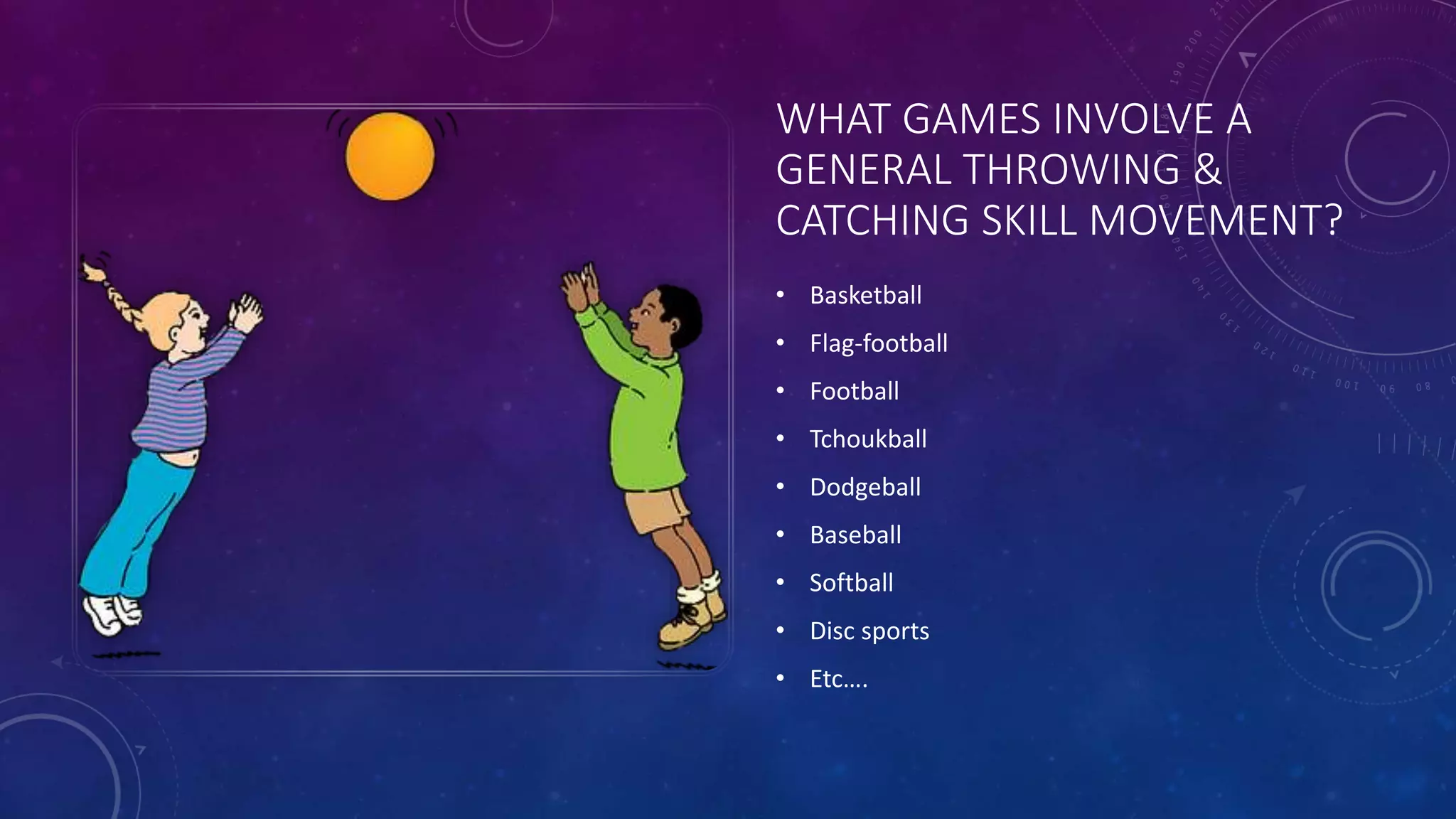
WHAT GAMES INVOLVE A
GENERAL THROWING &
CATCHING SKILL MOVEMENT?
• Basketball
• Flag-football
• Football
• Tchoukball
• Dodgeball
• Baseball
• Softball
• Disc sports
• Etc….
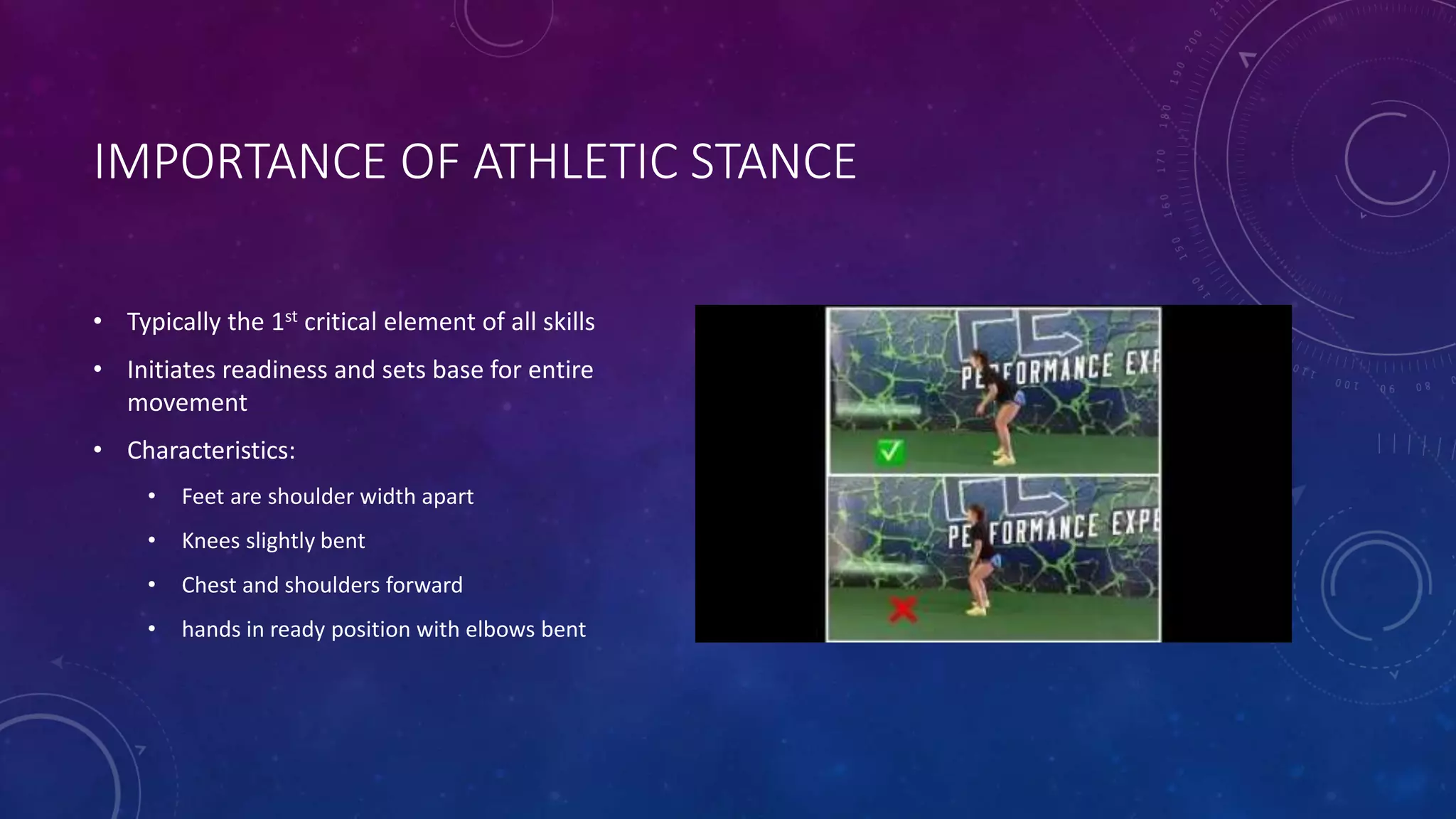
IMPORTANCE OF ATHLETIC STANCE
• Typically the 1st critical element of all skills
• Initiates readiness and sets base for entire
movement
• Characteristics:
• Feet are shoulder width apart
• Knees slightly bent
• Chest and shoulders forward
• hands in ready position with elbows bent
NOW LET’S CREATE AN ATHLETIC STANCE.
• Students lets assume an athletic stance
• Remember – look assertive and ready
GENERAL THROWING SKILL CRITICAL ELEMENTS
1. Athletic stance
2. Point shoulder and hip to target
3. Ball placement – on dominate hand
4. Hand position/grip(varies on ball shape)
5. Arm elevation- ball near ear, shoulder is at 90 degrees
6. Step to target
7. Rotation of torso & hip
8. Extent arm forward
9. Flick wrist downward motion and release
10. Follow through
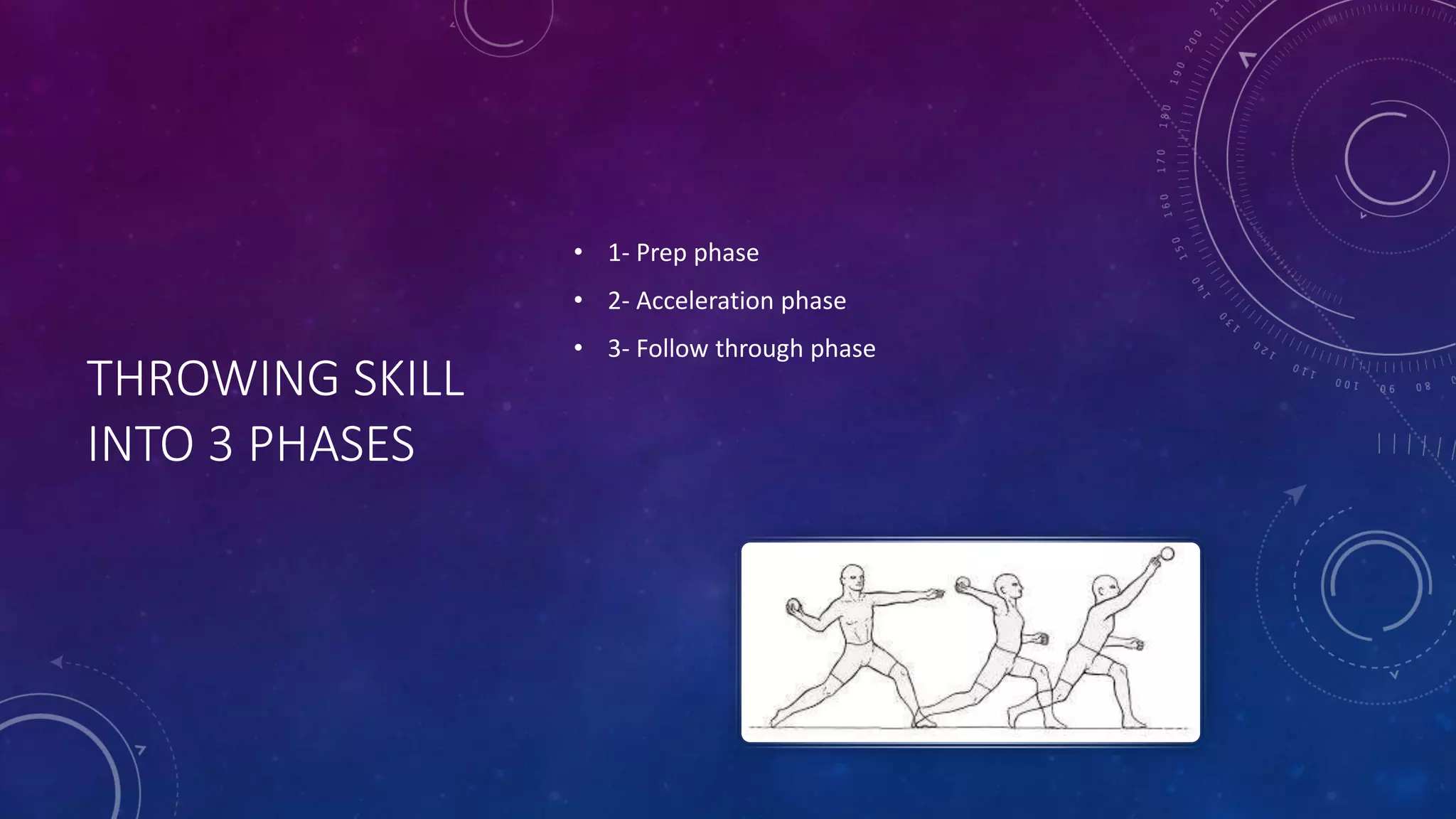
THROWING SKILL
INTO 3 PHASES
• 1- Prep phase
• 2- Acceleration phase
• 3- Follow through phase
PRACTICE TIME! NOW YOU TRY..
• Grab a ball (any ball) and throw it against a wall or to open space
• Can’t go outside or have a ball? No Problem, ROLL a pair of Socks and throw the ball of socks against an
open wall!
• Challenge time: step as far away as possible from the wall or in open space and try to throw the ball(or
pair of socks) forward for more than 10-15 feet in length
TYPES OF RELATED THROWING SKILLS
• Overhand throw – standard, elevated arm by the ear
• Underhand throw – arm is swung below waist with palm facing target
• Sidearm throw – arm is swung to the side of the body parallel to the ground
GENERAL CATCHING SKILL CRITICAL ELEMENTS
1. Athletic stance
2. Monitor the ball- eye on the ball
3. Elbows flexed(arms ready around the chest area)
4. Slightly extend arms out
5. Read the catch- eyes on ball
6. Create a diamond shape with both hands
7. Contact: fully extend arms towards direction of ball(catch with hands NOT body)
8. Cup the ball with both hands, spread fingers around ball
9. Look to tuck the ball into body minimizing the force of impact
10. Secure the ball with both hands
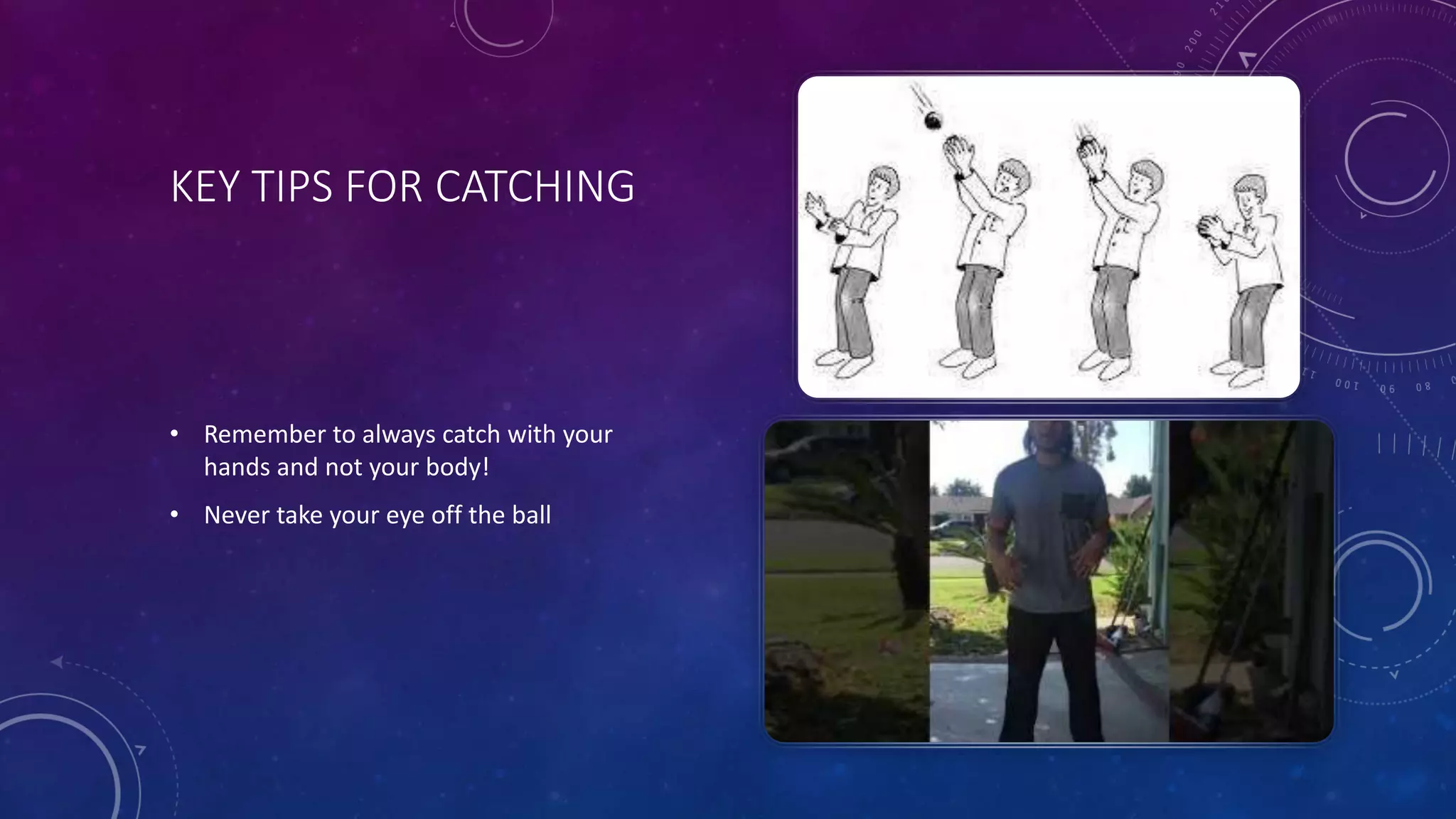
KEY TIPS FOR CATCHING
• Remember to always catch with your
hands and not your body!
• Never take your eye off the ball
PRACTICE TIME! NOW YOU TRY..
• With any ball, toss the ball up in the air and attempt to catch it
• Don’t have a ball? Use a pair of Rolled socks!
• Challenge time: Toss the ball(or pair of socks) in the air as high as you can and catch it 3 times.
TYPES OF RELATED CATCHING SKILLS
• Underhand catch – caught with both hands below the waist, pinkies(small fingers) close together
• Overhead catch – caught with both hands above the head, thumbs are close together
• Chest area catch– caught with both hands around the center of chest area
QUESTIONS
• Q1: If the ball is thrown in my direction and is landing near my knee area what kind of catch should I
attempt?
• Q2: If I elevate my throwing arm around my ear area and I am ready to aim at my target, what kind of
throw am I performing?
END OF LECTURE, TIME FOR ACTIVITIES & GAMES!
• Report to your roll call area in the Gymnasium area
• See you there

Throwing and Catching Lecture

  • 1.
    PHYSICAL EDUCATION: THROWING &CATCHING UNIT MR. RAMIREZ 7TH GRADE PHYSICAL EDUCATION CLASS
  • 2.
    LECTURE OBJECTIVES &CA CONTENT STANDARDS • CA Content Standards: • 1.1 Demonstrate mature techniques for the following patterns: overhand, sidearm, and underhand throwing; catching; kicking/punting; striking; trapping; dribbling (hand and foot); and volleying. 2.1 Identify and describe key elements in the mature performance of overhand, sidearm, and underhand throwing; catching; kicking/punting; striking; trapping; dribbling (hand and foot); and volleying. 5.2 Accept responsibility for individual improvement. • LO: • Introduce throwing and catching techniques • Students will be able to understand and apply all critical elements of a universal throwing skill and catching skill • Students will be able to know when to use these skills in sport games and activities • Students will be able to perform a throwing and catching skill • Students will be able to individual assess their own throwing and catching skill and accept self improvement if needed on skill acquisition
  • 3.
    EDUCATIONAL HOOK… • Areyou the strongest student in this physical education class? Are you the fastest? Or maybe the smartest? You don’t have to be either of these to enjoy and learn a throwing skill and catching skill, together we can acquire these two skills with practice and then apply them into sports, games, and daily lives. Physical education is engaging in physical activity to prolong a healthy lifestyle. One doesn’t necessarily have to perform 100 push ups, run a 6 minute mile, or know all answers to school curriculum because physical activity can be achieved through performing a throwing and catching skill individual, in a team setting, or with family and friends for fun.
  • 4.
    WHAT GAMES INVOLVEA GENERAL THROWING & CATCHING SKILL MOVEMENT? • Basketball • Flag-football • Football • Tchoukball • Dodgeball • Baseball • Softball • Disc sports • Etc….
  • 5.
    IMPORTANCE OF ATHLETICSTANCE • Typically the 1st critical element of all skills • Initiates readiness and sets base for entire movement • Characteristics: • Feet are shoulder width apart • Knees slightly bent • Chest and shoulders forward • hands in ready position with elbows bent
  • 6.
    NOW LET’S CREATEAN ATHLETIC STANCE. • Students lets assume an athletic stance • Remember – look assertive and ready
  • 7.
    GENERAL THROWING SKILLCRITICAL ELEMENTS 1. Athletic stance 2. Point shoulder and hip to target 3. Ball placement – on dominate hand 4. Hand position/grip(varies on ball shape) 5. Arm elevation- ball near ear, shoulder is at 90 degrees 6. Step to target 7. Rotation of torso & hip 8. Extent arm forward 9. Flick wrist downward motion and release 10. Follow through
  • 8.
    THROWING SKILL INTO 3PHASES • 1- Prep phase • 2- Acceleration phase • 3- Follow through phase
  • 9.
    PRACTICE TIME! NOWYOU TRY.. • Grab a ball (any ball) and throw it against a wall or to open space • Can’t go outside or have a ball? No Problem, ROLL a pair of Socks and throw the ball of socks against an open wall! • Challenge time: step as far away as possible from the wall or in open space and try to throw the ball(or pair of socks) forward for more than 10-15 feet in length
  • 10.
    TYPES OF RELATEDTHROWING SKILLS • Overhand throw – standard, elevated arm by the ear • Underhand throw – arm is swung below waist with palm facing target • Sidearm throw – arm is swung to the side of the body parallel to the ground
  • 11.
    GENERAL CATCHING SKILLCRITICAL ELEMENTS 1. Athletic stance 2. Monitor the ball- eye on the ball 3. Elbows flexed(arms ready around the chest area) 4. Slightly extend arms out 5. Read the catch- eyes on ball 6. Create a diamond shape with both hands 7. Contact: fully extend arms towards direction of ball(catch with hands NOT body) 8. Cup the ball with both hands, spread fingers around ball 9. Look to tuck the ball into body minimizing the force of impact 10. Secure the ball with both hands
  • 12.
    KEY TIPS FORCATCHING • Remember to always catch with your hands and not your body! • Never take your eye off the ball
  • 13.
    PRACTICE TIME! NOWYOU TRY.. • With any ball, toss the ball up in the air and attempt to catch it • Don’t have a ball? Use a pair of Rolled socks! • Challenge time: Toss the ball(or pair of socks) in the air as high as you can and catch it 3 times.
  • 14.
    TYPES OF RELATEDCATCHING SKILLS • Underhand catch – caught with both hands below the waist, pinkies(small fingers) close together • Overhead catch – caught with both hands above the head, thumbs are close together • Chest area catch– caught with both hands around the center of chest area
  • 15.
    QUESTIONS • Q1: Ifthe ball is thrown in my direction and is landing near my knee area what kind of catch should I attempt? • Q2: If I elevate my throwing arm around my ear area and I am ready to aim at my target, what kind of throw am I performing?
  • 16.
    END OF LECTURE,TIME FOR ACTIVITIES & GAMES! • Report to your roll call area in the Gymnasium area • See you there