1
Continuous Assessment Component in Physical Education
Contents
Introduction 2
Rationale 2
General Curriculum Objectives 2
Programme Objectives 3
Themes/Topics/Skills 4
Physical Education terms 5
Fundamental Motor Skills 6
Programme of Work 7
Lesson Planning 8
Exemplars 10
Sample Lesson 1 11
Sample Assessment Rubric 11
Sample Lesson 2 13
Sample Lesson 3 15
Assessment Criteria 17
Student Mark Sheet 18
Teaching Notes 19
Integrating Special Needs Children 20
Lifestyle Practices 21
Food Group 22
Fundamental Motor Skills in Physical Education 23
2
Developing Running Techniques 24
Running Activities 25
Supplemental Units and Lessons 27
Units in Educational Gymnastics 28
Sample 1 29
Sample 2 31
Sample 3 32
Sample 4 34
Balancing on different body parts samples 35
Unit of Work: Gymnastics Symmetry and Asymmetry 41
Glossary of Terms 49
Physical Education Continuous Assessment Component
Introduction
 The physical education programme will utilise a movement education approach to the
teaching of Games and Educational Gymnastics.
 The programme will be based on fundamental motor skills that may be taught in a
limited space
 The continuous assessment component will focus on skill performance to ensure a
more standardised process.
 Skill application will be taught during the regular instructional programme.
Rationale
Quality Physical Education has as its basis purposeful movement, which is an essential element
in the process of human growth and development and has implications for the total development
of children. Physical Education is an integral aspect of general education and should be included
at all levels of the curriculum. Physical Education as an aspect of the continuous assessment
component will contribute to the realisation of the value outcomes of the MOE.
3
Value Outcomes
 Will function at their best with a strong sense of commitment to their interests and
activities
 Academically balanced to be productive
 Physically fit, mentally alert, well nourished, and psychologically sound
 Active in exercise, sports, games and recreation
 Competent to interact and communicate with others, within different social settings and
environments
General Curriculum Objectives
 Develop movement concepts through the utilization of skills in problem solving
situations
 Develop and maintain appropriate levels of fitness through purposeful physical activity
 Enhance fundamental manipulative abilities
 Promote positive interaction with others
Programme objectives
 Develop patterns and combinations of movement into repeatable sequences
 Throw and catch using mature motor patterns
 Appreciate the benefits of cooperation and sharing
Themes/Topics/Skills
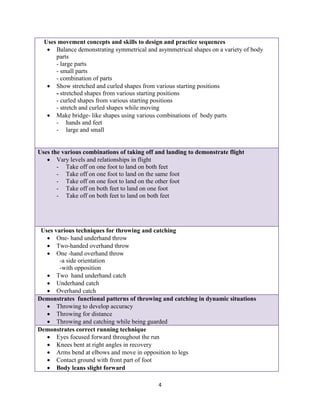
THEMES/ TOPICS/SKILLS
Designs and performs sequences that involve elements of movement
 Movement elements :- concepts and skills
- space awareness – personal & general space, direction, pathways , levels
- body awareness - shape, balance /weight bearing, transference of weight
- quality - speed & force, light &heavy, smooth & jerky
- relationships- people, objects
4
Uses movement concepts and skills to design and practice sequences
 Balance demonstrating symmetrical and asymmetrical shapes on a variety of body
parts
- large parts
- small parts
- combination of parts
 Show stretched and curled shapes from various starting positions
- stretched shapes from various starting positions
- curled shapes from various starting positions
- stretch and curled shapes while moving
 Make bridge- like shapes using various combinations of body parts
- hands and feet
- large and small
Uses the various combinations of taking off and landing to demonstrate flight
 Vary levels and relationships in flight
- Take off on one foot to land on both feet
- Take off on one foot to land on the same foot
- Take off on one foot to land on the other foot
- Take off on both feet to land on one foot
- Take off on both feet to land on both feet
Uses various techniques for throwing and catching
 One- hand underhand throw
 Two-handed overhand throw
 One -hand overhand throw
-a side orientation
-with opposition
 Two hand underhand catch
 Underhand catch
 Overhand catch
Demonstrates functional patterns of throwing and catching in dynamic situations
 Throwing to develop accuracy
 Throwing for distance
 Throwing and catching while being guarded
Demonstrates correct running technique
 Eyes focused forward throughout the run
 Knees bent at right angles in recovery
 Arms bend at elbows and move in opposition to legs
 Contact ground with front part of foot
 Body leans slight forward
5
Physical Education Terms
Movement Elements, Concepts & Skills
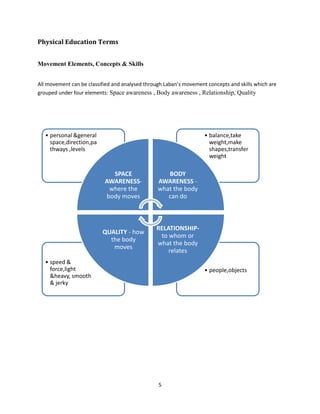
All movement can be classified and analysed through Laban’s movement concepts and skills which are
grouped under four elements: Space awareness , Body awareness , Relationship, Quality
• people,objects
• speed &
force,light
&heavy, smooth
& jerky
• balance,take
weight,make
shapes,transfer
weight
• personal &general
space,direction,pa
thways ,levels
SPACE
AWARENESS-
where the
body moves
BODY
AWARENESS -
what the body
can do
RELATIONSHIP-
to whom or
what the body
relates
QUALITY - how
the body
moves
6
Fundamental motor skills
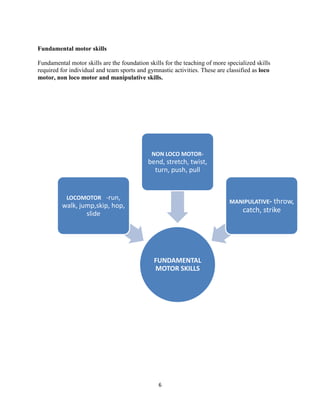
Fundamental motor skills are the foundation skills for the teaching of more specialized skills
required for individual and team sports and gymnastic activities. These are classified as loco
motor, non loco motor and manipulative skills.
FUNDAMENTAL
MOTOR SKILLS
LOCOMOTOR -run,
walk, jump,skip, hop,
slide
NON LOCO MOTOR-
bend, stretch, twist,
turn, push, pull
MANIPULATIVE- throw,
catch, strike
7
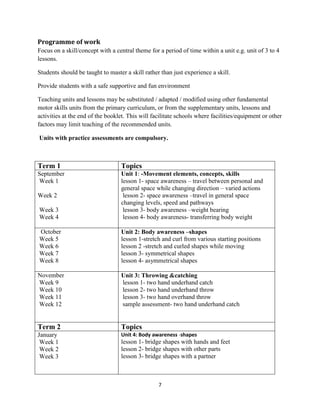
Programme of work
Focus on a skill/concept with a central theme for a period of time within a unit e.g. unit of 3 to 4
lessons.
Students should be taught to master a skill rather than just experience a skill.
Provide students with a safe supportive and fun environment
Teaching units and lessons may be substituted / adapted / modified using other fundamental
motor skills units from the primary curriculum, or from the supplementary units, lessons and
activities at the end of the booklet. This will facilitate schools where facilities/equipment or other
factors may limit teaching of the recommended units.
Units with practice assessments are compulsory.
Term 1 Topics
September
Week 1
Week 2
Week 3
Week 4
Unit 1: -Movement elements, concepts, skills
lesson 1- space awareness – travel between personal and
general space while changing direction – varied actions
lesson 2- space awareness –travel in general space
changing levels, speed and pathways
lesson 3- body awareness –weight bearing
lesson 4- body awareness- transferring body weight
October
Week 5
Week 6
Week 7
Week 8
Unit 2: Body awareness –shapes
lesson 1-stretch and curl from various starting positions
lesson 2 -stretch and curled shapes while moving
lesson 3- symmetrical shapes
lesson 4- asymmetrical shapes
November
Week 9
Week 10
Week 11
Week 12
Unit 3: Throwing &catching
lesson 1- two hand underhand catch
lesson 2- two hand underhand throw
lesson 3- two hand overhand throw
sample assessment- two hand underhand catch
Term 2 Topics
January
Week 1
Week 2
Week 3
Unit 4: Body awareness -shapes
lesson 1- bridge shapes with hands and feet
lesson 2- bridge shapes with other parts
lesson 3- bridge shapes with a partner
8
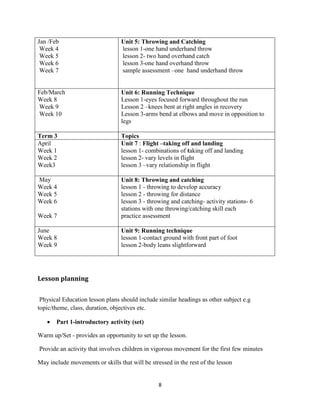
Jan /Feb
Week 4
Week 5
Week 6
Week 7
Unit 5: Throwing and Catching
lesson 1-one hand underhand throw
lesson 2- two hand overhand catch
lesson 3-one hand overhand throw
sample assessment –one hand underhand throw
Feb/March
Week 8
Week 9
Week 10
Unit 6: Running Technique
Lesson 1-eyes focused forward throughout the run
Lesson 2 –knees bent at right angles in recovery
Lesson 3-arms bend at elbows and move in opposition to
legs
Term 3 Topics
April
Week 1
Week 2
Week3
Unit 7 : Flight –taking off and landing
lesson 1- combinations of taking off and landing
lesson 2- vary levels in flight
lesson 3 –vary relationship in flight
May
Week 4
Week 5
Week 6
Week 7
Unit 8: Throwing and catching
lesson 1 - throwing to develop accuracy
lesson 2 - throwing for distance
lesson 3 - throwing and catching- activity stations- 6
stations with one throwing/catching skill each
practice assessment
June
Week 8
Week 9
Unit 9: Running technique
lesson 1-contact ground with front part of foot
lesson 2-body leans slightforward
Lesson planning
Physical Education lesson plans should include similar headings as other subject e.g
topic/theme, class, duration, objectives etc.
 Part 1-introductory activity (set)
Warm up/Set - provides an opportunity to set up the lesson.
Provide an activity that involves children in vigorous movement for the first few minutes
May include movements or skills that will be stressed in the rest of the lesson
9
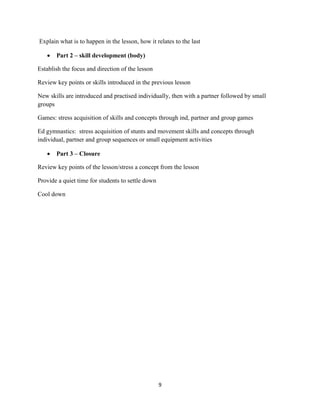
Explain what is to happen in the lesson, how it relates to the last
 Part 2 – skill development (body)
Establish the focus and direction of the lesson
Review key points or skills introduced in the previous lesson
New skills are introduced and practised individually, then with a partner followed by small
groups
Games: stress acquisition of skills and concepts through ind, partner and group games
Ed gymnastics: stress acquisition of stunts and movement skills and concepts through
individual, partner and group sequences or small equipment activities
 Part 3 – Closure
Review key points of the lesson/stress a concept from the lesson
Provide a quiet time for students to settle down
Cool down
10
Lesson Plan Exemplars
11
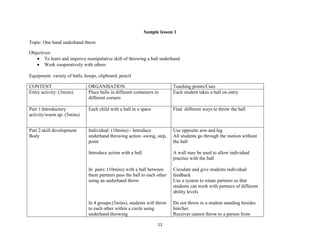
Sample lesson 1
Topic: One hand underhand throw
Objectives:
 To learn and improve manipulative skill of throwing a ball underhand
 Work cooperatively with others
Equipment: variety of balls, hoops, clipboard, pencil
CONTENT ORGANISATION Teaching points/Cues
Entry activity: (3mins) Place balls in different containers in
different corners
Each student takes a ball on entry
Part 1:Introductory
activity/warm up: (5mins)
Each child with a ball in a space Find different ways to throw the ball
Part 2:skill development
Body
Individual: (10mins) - Introduce
underhand throwing action -swing, step,
point
Introduce action with a ball
In pairs: (10mins) with a ball between
them partners pass the ball to each other
using an underhand throw
In 4 groups:(5mins), students will throw
to each other within a circle using
underhand throwing
Use opposite arm and leg
All students go through the motion without
the ball
A wall may be used to allow individual
practice with the ball
Circulate and give students individual
feedback
Use a system to rotate partners so that
students can work with partners of different
ability levels
Do not throw to a student standing besides
him/her.
Receiver cannot throw to a person from
12
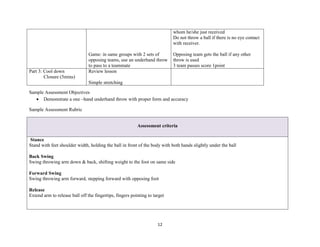
Game: in same groups with 2 sets of
opposing teams, use an underhand throw
to pass to a teammate
whom he/she just received
Do not throw a ball if there is no eye contact
with receiver.
Opposing team gets the ball if any other
throw is used
3 team passes score 1point
Part 3: Cool down
Closure (5mins)
Review lesson
Simple stretching
Sample Assessment Objectives
 Demonstrate a one –hand underhand throw with proper form and accuracy
Sample Assessment Rubric
Assessment criteria
Stance
Stand with feet shoulder width, holding the ball in front of the body with both hands slightly under the ball
Back Swing
Swing throwing arm down & back, shifting weight to the foot on same side
Forward Swing
Swing throwing arm forward, stepping forward with opposing foot
Release
Extend arm to release ball off the fingertips, fingers pointing to target
13
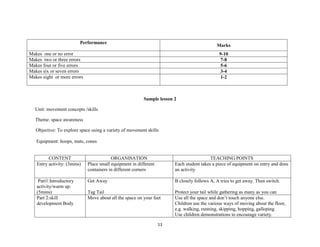
Performance
Marks
Makes one or no error 9-10
Makes two or three errors 7-8
Makes four or five errors 5-6
Makes six or seven errors 3-4
Makes eight or more errors 1-2
Sample lesson 2
Unit: movement concepts /skills
Theme: space awareness
Objective: To explore space using a variety of movement skills
Equipment: hoops, mats, cones
CONTENT ORGANISATION TEACHING POINTS
Entry activity: (3mins) Place small equipment in different
containers in different corners
Each student takes a piece of equipment on entry and does
an activity
Part1:Introductory
activity/warm up:
(5mins)
Get Away
Tag Tail
B closely follows A, A tries to get away. Then switch.
Protect your tail while gathering as many as you can
Part 2:skill
development Body
Move about all the space on your feet Use all the space and don’t touch anyone else.
Children use the various ways of moving about the floor,
e.g. walking, running, skipping, hopping, galloping
Use children demonstrations to encourage variety.
14
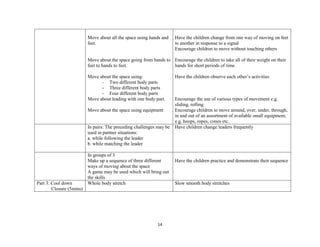
Move about all the space using hands and
feet.
Move about the space going from hands to
feet to hands to feet.
Move about the space using:
- Two different body parts
- Three different body parts
- Four different body parts
Move about leading with one body part.
Move about the space using equipment
Have the children change from one way of moving on feet
to another in response to a signal
Encourage children to move without touching others
Encourage the children to take all of their weight on their
hands for short periods of time.
Have the children observe each other’s activities
Encourage the use of various types of movement e.g.
sliding, rolling
Encourage children to move around, over, under, through,
in and out of an assortment of available small equipment,
e.g. hoops, ropes, cones etc.
In pairs: The preceding challenges may be
used in partner situations:
a. while following the leader
b. while matching the leader
Have children change leaders frequently
In groups of 3
Make up a sequence of three different
ways of moving about the space
A game may be used which will bring out
the skills
Have the children practice and demonstrate their sequence
Part 3: Cool down
Closure (5mins)
Whole body stretch Slow smooth body stretches
15
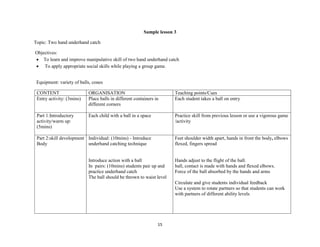
Sample lesson 3
Topic: Two hand underhand catch
Objectives:
 To learn and improve manipulative skill of two hand underhand catch
 To apply appropriate social skills while playing a group game.
Equipment: variety of balls, cones
CONTENT ORGANISATION Teaching points/Cues
Entry activity: (3mins) Place balls in different containers in
different corners
Each student takes a ball on entry
Part 1:Introductory
activity/warm up:
(5mins)
Each child with a ball in a space Practice skill from previous lesson or use a vigorous game
/activity
Part 2:skill development
Body
Individual: (10mins) - Introduce
underhand catching technique
Introduce action with a ball
In pairs: (10mins) students pair up and
practice underhand catch
The ball should be thrown to waist level
Feet shoulder width apart, hands in front the body, elbows
flexed, fingers spread
Hands adjust to the flight of the ball.
ball, contact is made with hands and flexed elbows.
Force of the ball absorbed by the hands and arms
Circulate and give students individual feedback
Use a system to rotate partners so that students can work
with partners of different ability levels
16
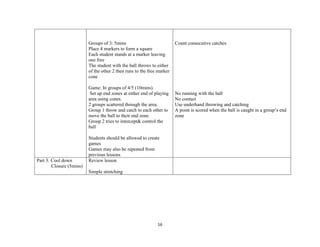
Groups of 3: 5mins
Place 4 markers to form a square
Each student stands at a marker leaving
one free
The student with the ball throws to either
of the other 2 then runs to the free marker
cone
Game: In groups of 4/5 (10mins).
Set up end zones at either end of playing
area using cones.
2 groups scattered through the area.
Group 1 throw and catch to each other to
move the ball to their end zone
Group 2 tries to intercept& control the
ball
Students should be allowed to create
games
Games may also be repeated from
previous lessons
Count consecutive catches
No running with the ball
No contact
Use underhand throwing and catching
A point is scored when the ball is caught in a group’s end
zone
Part 3: Cool down
Closure (5mins)
Review lesson
Simple stretching
17
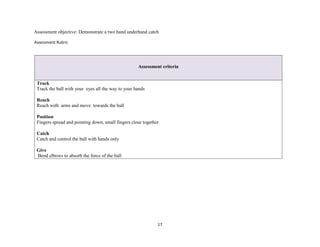
Assessment objective: Demonstrate a two hand underhand catch
Assessment Rubric
Assessment criteria
Track
Track the ball with your eyes all the way to your hands
Reach
Reach with arms and move towards the ball
Position
Fingers spread and pointing down, small fingers close together
Catch
Catch and control the ball with hands only
Give
Bend elbows to absorb the force of the ball
18
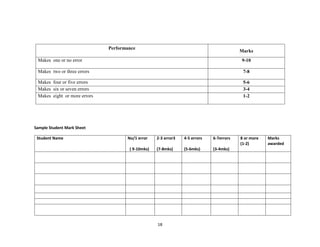
Performance
Marks
Makes one or no error 9-10
Makes two or three errors 7-8
Makes four or five errors 5-6
Makes six or seven errors 3-4
Makes eight or more errors 1-2
Sample Student Mark Sheet
Student Name No/1 error
( 9-10mks)
2-3 error3
(7-8mks)
4-5 errors
(5-6mks)
6-7errors
(3-4mks)
8 or more
(1-2)
Marks
awarded
19
TEACHING NOTES
20
Integrating Special Needs Children
Teachers must ensure developmentally appropriate activities are provided for all children in an
Inclusive Environment.
Strategies
 Station Work – This can help when teaching a variety of activities. Exceptional students
can be included in spite of their limitations and without drastically changing the content
or emphasis of the program.
 Task Cards – These can be pre-designed to accommodate a variety of Exceptional
students in almost every area of the Physical Education Program.
 Peer Tutors – This strategy is especially helpful for students who have difficulty
following directions or when functional mobility and manipulation are very limited.
Mature students may be selected and trained for this purpose using a “rotational” system.
Types of Disabilities
Learning Disabilities - give rise to difficulties in acquiring knowledge and skills to the normal
level of those expected of the same age. Teachers should have a limited but secure range of skills
and movement that students can select from and apply in creative and challenging situations. Use
materials and resources that students can access through sight , sound, touch or smell e.g
different- sized textured, noisy and fluorescent balls
Behaviour Disorders – teachers should strive as much as possible to avoid techniques that may
weaken appropriate behaviour responses. Avoid the use of punishment such as denial, extra
exercise or angry expressions.
Perceptual-Motor Deficiencies –characteristic symptoms of perceptual- motor deficiencies
commonly observed in the primary school:
 Body Image
o Inability to identify and locate body parts, such as the right and left hand,
knee or elbow
o Inability to move parts of the body as directed by the teacher
o Inability to imitate movements performed by the teacher or another performer
 Balance
o Inability to maintain balance - static ,while moving and in flight
21
 Spatial Awareness
o Inability to move parts of the body in specified directions, eg. Crossing the left
arm over the right side of the body.
o Inability to move the body through space, eg. Moving forward, backward, up,
down and around.
o Inability to move into space without bumping into objects or other students in the
general pathway of movement
 Hand-eye and Foot-eye coordination
o Inability to throw a ball into the air and catch it after one bounce
o Inability to perform basic loco-motor skills such as running, hopping, galloping,
or jumping
o Inability to kick a stationary or moving ball
Games can be modified to facilitate students who possess a variety of physical or mental
disabilities.
Some Healthy lifestyles practices for students
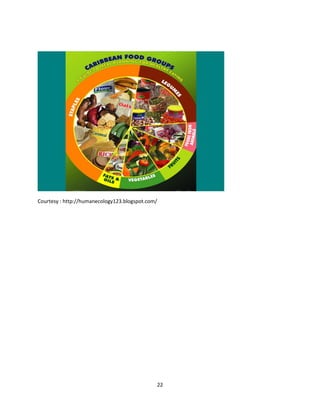
• Drinking plenty of water everyday to be healthy e.g. approximately six glasses
• Eating breakfast everyday - Children who don’t have breakfast get sleepy at school,
have a harder time paying attention, and tend to eat more junk food later in the day. Kids
who do eat breakfast get higher test scores and perform better in sports.( The importance of
eating a good breakfast -http://www.permanente.net)
• Choosing healthy breakfast foods like whole grains, fruits, and dairy products that
ensure children are getting the vitamins and minerals that the body needs.
• Choosing fruits and vegetables as healthy snacks
• Understanding how many servings the body needs
• Setting a goal to move more and sit less
• Setting a goal to exercise and stretch everyday
22
Courtesy : http://humanecology123.blogspot.com/
23
More on fundamental motor skills in Physical Education
Throwing and catching skills
Two-Handed Underhand Throw
 Begin with the back straight, feet about shoulder-width apart, and knees slightly bent.
 Arms are straight and the ball is held with the fingers of both hands
 Keep the back straight, then swing the arms forward and upward, and straighten the
knees
 Release the ball off the fingers and follow through in the direction of the ball
Two-Handed Overhand Throw
 Hold ball in both hands
 Using a sideways stance, shift weight from front to back foot
 Raise arms up over the head
 Transfer weight forward
 Bring arms forward and release the ball off the fingers.
One-Hand Overhand Throw
 Begin with one foot forward and the body weight evenly distributed over both feet.
 Hold the ball with both hands in front of the body
 In the first part of the backswing, raise the upper arm and flex the wrist so the hand
points backward
 At this point the next side faces the direction of the throw
 The arm extends forward; and the weight is on the rear foot
 At the same time the upper arm lifts up and forward and the other arm moves down
and back as the weight shifts to the front foot.
 The ball is released off the fingertips
 The follow-through should be in a downward direction, ending with the palm of the
throwing hand facing the ground.
Two-Handed Overhand Catch
 When the ball approaches above the waist, the elbows are bent and held high, and the
fingers and thumbs are spread
 As the ball approaches, the arms extend forward and up
 The ball should be caught with the tips of the fingers and thumbs; the thumbs are
close together
 As the ball is caught, the hands recoil toward the body to the force of the oncoming
ball.
24
Developing Running Techniques
1. Eyes focused forward throughout the run
 Students run a short distance with eyes closed then open
 Mirror running: groups of three or four run one behind the other 2-3 metres apart.
Students focus on the back of the head of the person in front of them
2. Knees bent at right angles in recovery
 Heels are kicked to the buttocks while running
 Run with arms held straight down behind the body and heels are kicked to touch the
hands. Knees are pointed down throughout the exercise
 Students run on the spot. Partners squat behind with hands outstretched at a height where
the heels of the runner will touch
 Knee slaps: on the spot students hold hands in front at hip level and ‘sprint’ to slap knees
and hands
 Exaggerated action with high knee lift , elbows bent and arms swinging
3. Arms bend at elbows and move in opposition to legs
 Students sit and hold relay batons/rulers/sticks in each hand and swing the arms back and
forth with bent elbows
 Race walking: student use exaggerated arm movements
 Continuous scissors jumping :begin in a forward stride position(right foot and left arms
forward). Jump on the spot and reverse arms and legs. Repeat and increase rhythm
 Students sprint short distances with batons/ rulers in each hand
 March on the spot: legs first then arms join in
4. Contact ground with front part of foot
 Changing pace using letter cards for signals as students move around the area : w-walk, j-
jog, r- run. Students change speed as the cards change . Stress heel toe placement for the
walk/jog and toe placement for the run.
 Students march on their toes with short skips and emphasis on staying tall
5. Body leans slightly forward
 Tow a partner: a runner tows a partner who is facing same direction by holding hands.
The partner applies slight resistance which encourages body lean.
 Students run with a partner over 15metres. Emphasis on students’ body and running up
on toes.
25
Running Activities
Bean bag scramble
 Groups of 4 with one hoop and four bean bags
 Hoops are randomly scattered with 4 bean bags in each hoop. One group stands near each
hoop
 On asignal students collect bean bags from other hoops and place them in their own hoop
one at a time
 Teams must not protect their hoops
 Run the activity for a set time then replace bean bags
Knees up
 Set out cones to create two lines 15-20 metres apart
 Students stand in lines and skip with high knee lift and matching opposite arm
movement, towards the opposite line
 Elbows bend at right angles in front and behind the body
Belly starts
 Set out 4 cones to create two lines 15-20 metres apart.
 Students lie in lines on the floor face down.
 On a signal the students in the first row scramble to their feet and sprint to the line 15
metres away.
 Repeat until each line of students has done a start. Starting positions may be changed.
Circle sprint
 Six students stand in a chalk/rope circle and are numbered 1-6.
 The teacher says on your marks, set and calls a number.
 Students with the designated number sprint clockwise around the circle back to their
places
Ball sprinter
 Students in two groups form a line facing each other 40- 60m apart.
 Place the balls in the middle of the area.
26
 Students are numbered in each group.
 The teacher calls “on your mark, set” and a number.
 Students with that number sprint to their ball and raise it above their heads
Pass and sprint
 Students are placed in two groups.
 The running group forms a straight line with the first student holding a baton.
 The passing group forms a circle around one of their students.
 On signal, the first student in the running group runs around the circle of the passing
group and passes the baton to student # 2.
 Each member of the group completes the circuit.
 At the same time the passing group counts how many passes of their ball can be made to
the group members.
 Groups exchange roles and repeat.
 The group with the greater number of passes is the winner
27
SUPPLEMENTAL UNITS AND LESSONS
DEVELOPED BY COTEFORD JUNIOR SCHOOL, LONDON, ENGLAND
AS PART OF THEIR PHYSICAL EDUCATION PROGRAMME
Used by permission
28
UNITS IN EDUCATIONAL GYMNASTICS
PATHWAYS
BALANCE
SYMMETRY
STRETCHING & CURLING
RECEIVING BODY WEIGHT
29
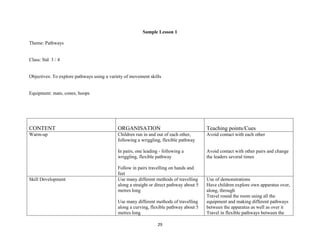
Sample Lesson 1
Theme: Pathways
Class: Std 3 / 4
Objectives: To explore pathways using a variety of movement skills
Equipment: mats, cones, hoops
CONTENT ORGANISATION Teaching points/Cues
Warm-up Children run in and out of each other,
following a wriggling, flexible pathway
In pairs, one leading - following a
wriggling, flexible pathway
Follow in pairs travelling on hands and
feet
Avoid contact with each other
Avoid contact with other pairs and change
the leaders several times
Skill Development Use many different methods of travelling
along a straight or direct pathway about 5
metres long
Use many different methods of travelling
along a curving, flexible pathway about 5
metres long
Use of demonstrations
Have children explore own apparatus over,
along, through
Travel round the room using all the
equipment and making different pathways
between the apparatus as well as over it
Travel in flexible pathways between the
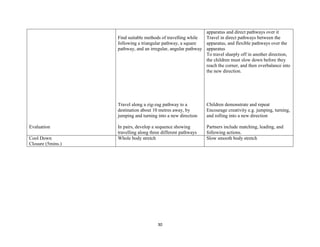
30
Evaluation
Find suitable methods of travelling while
following a triangular pathway, a square
pathway, and an irregular, angular pathway
Travel along a zig-zag pathway to a
destination about 10 metres away, by
jumping and turning into a new direction
In pairs, develop a sequence showing
travelling along three different pathways
apparatus and direct pathways over it
Travel in direct pathways between the
apparatus, and flexible pathways over the
apparatus
To travel sharply off in another direction,
the children must slow down before they
reach the corner, and then overbalance into
the new direction.
Children demonstrate and repeat
Encourage creativity e.g. jumping, turning,
and rolling into a new direction
Partners include matching, leading, and
following actions.
Cool Down
Closure (5mins.)
Whole body stretch Slow smooth body stretch
31
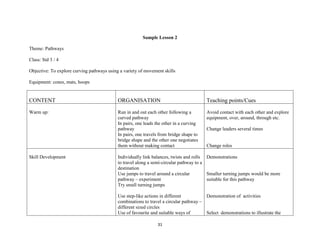
Sample Lesson 2
Theme: Pathways
Class: Std 3 / 4
Objective: To explore curving pathways using a variety of movement skills
Equipment: cones, mats, hoops
CONTENT ORGANISATION Teaching points/Cues
Warm up: Run in and out each other following a
curved pathway
In pairs, one leads the other in a curving
pathway
In pairs, one travels from bridge shape to
bridge shape and the other one negotiates
them without making contact
Avoid contact with each other and explore
equipment, over, around, through etc.
Change leaders several times
Change roles
Skill Development Individually link balances, twists and rolls
to travel along a semi-circular pathway to a
destination
Use jumps to travel around a circular
pathway – experiment
Try small turning jumps
Use step-like actions in different
combinations to travel a circular pathway –
different sized circles
Use of favourite and suitable ways of
Demonstrations
Smaller turning jumps would be more
suitable for this pathway
Demonstration of activities
Select demonstrations to illustrate the
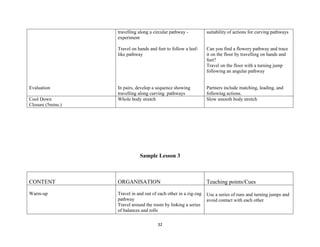
32
Evaluation
travelling along a circular pathway -
experiment
Travel on hands and feet to follow a leaf-
like pathway
In pairs, develop a sequence showing
travelling along curving pathways
suitability of actions for curving pathways
Can you find a flowery pathway and trace
it on the floor by travelling on hands and
feet?
Travel on the floor with a turning jump
following an angular pathway
Partners include matching, leading, and
following actions.
Cool Down
Closure (5mins.)
Whole body stretch Slow smooth body stretch
Sample Lesson 3
CONTENT ORGANISATION Teaching points/Cues
Warm-up Travel in and out of each other in a zig-zag
pathway
Travel around the room by linking a series
of balances and rolls
Use a series of runs and turning jumps and
avoid contact with each other
33
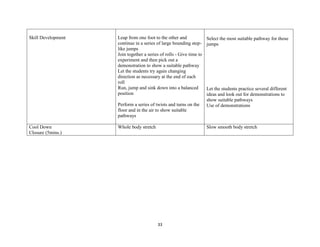
Skill Development Leap from one foot to the other and
continue in a series of large bounding step-
like jumps
Join together a series of rolls - Give time to
experiment and then pick out a
demonstration to show a suitable pathway
Let the students try again changing
direction as necessary at the end of each
roll
Run, jump and sink down into a balanced
position
Perform a series of twists and turns on the
floor and in the air to show suitable
pathways
Select the most suitable pathway for those
jumps
Let the students practice several different
ideas and look out for demonstrations to
show suitable pathways
Use of demonstrations
Cool Down
Closure (5mins.)
Whole body stretch Slow smooth body stretch
34
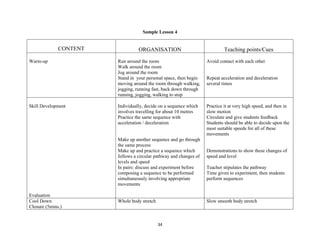
Sample Lesson 4
CONTENT ORGANISATION Teaching points/Cues
Warm-up Run around the room
Walk around the room
Jog around the room
Stand in your personal space, then begin
moving around the room through walking,
jogging, running fast, back down through
running, jogging, walking to stop
Avoid contact with each other
Repeat acceleration and deceleration
several times
Skill Development
Evaluation
Individually, decide on a sequence which
involves travelling for about 10 metres
Practice the same sequence with
acceleration / deceleration
Make up another sequence and go through
the same process
Make up and practice a sequence which
follows a circular pathway and changes of
levels and speed
In pairs: discuss and experiment before
composing a sequence to be performed
simultaneously involving appropriate
movements
Practice it at very high speed, and then in
slow motion
Circulate and give students feedback
Students should be able to decide upon the
most suitable speeds for all of these
movements
Demonstrations to show these changes of
speed and level
Teacher stipulates the pathway
Time given to experiment, then students
perform sequences
Cool Down
Closure (5mins.)
Whole body stretch Slow smooth body stretch
35
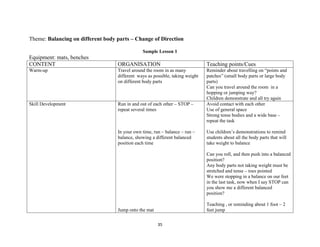
Theme: Balancing on different body parts – Change of Direction
Sample Lesson 1
Equipment: mats, benches
CONTENT ORGANISATION Teaching points/Cues
Warm-up Travel around the room in as many
different ways as possible, taking weight
on different body parts
Reminder about travelling on “points and
patches” (small body parts or large body
parts)
Can you travel around the room in a
hopping or jumping way?
Children demonstrate and all try again
Skill Development Run in and out of each other – STOP –
repeat several times
In your own time, run – balance – run –
balance, showing a different balanced
position each time
Jump onto the mat
Avoid contact with each other
Use of general space
Strong tense bodies and a wide base –
repeat the task
Use children’s demonstrations to remind
students about all the body parts that will
take weight to balance
Can you roll, and then push into a balanced
position?
Any body parts not taking weight must be
stretched and tense – toes pointed
We were stopping in a balance on our feet
in the last task, now when I say STOP can
you show me a different balanced
position?
Teaching , or reminding about 1 foot – 2
feet jump
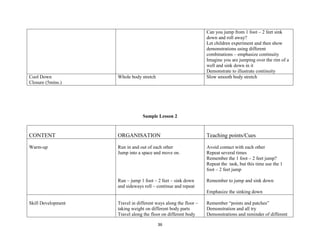
36
Can you jump from 1 foot – 2 feet sink
down and roll away?
Let children experiment and then show
demonstrations using different
combinations – emphasize continuity
Imagine you are jumping over the rim of a
well and sink down in it
Demonstrate to illustrate continuity
Cool Down
Closure (5mins.)
Whole body stretch Slow smooth body stretch
Sample Lesson 2
CONTENT ORGANISATION Teaching points/Cues
Warm-up Run in and out of each other
Jump into a space and move on.
Run – jump 1 foot – 2 feet – sink down
and sideways roll – continue and repeat
Avoid contact with each other
Repeat several times
Remember the 1 foot – 2 feet jump?
Repeat the task, but this time use the 1
foot – 2 feet jump
Remember to jump and sink down
Emphasize the sinking down
Skill Development Travel in different ways along the floor –
taking weight on different body parts
Travel along the floor on different body
Remember “points and patches”
Demonstration and all try
Demonstrations and reminder of different
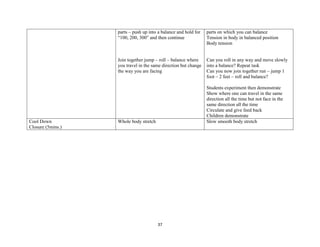
37
parts – push up into a balance and hold for
“100, 200, 300” and then continue
Join together jump – roll – balance where
you travel in the same direction but change
the way you are facing
parts on which you can balance
Tension in body in balanced position
Body tension
Can you roll in any way and move slowly
into a balance? Repeat task
Can you now join together run – jump 1
foot – 2 feet – roll and balance?
Students experiment then demonstrate
Show where one can travel in the same
direction all the time but not face in the
same direction all the time
Circulate and give feed back
Children demonstrate
Cool Down
Closure (5mins.)
Whole body stretch Slow smooth body stretch
38
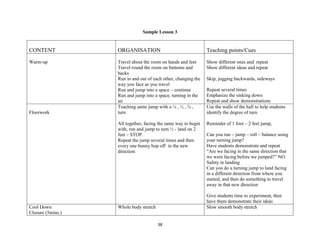
Sample Lesson 3
CONTENT ORGANISATION Teaching points/Cues
Warm-up Travel about the room on hands and feet
Travel round the room on buttoms and
backs
Run in and out of each other, changing the
way you face as you travel
Run and jump into a space – continue
Run and jump into a space, turning in the
air
Show different ones and repeat
Show different ideas and repeat
Skip, jogging backwards, sideways
Repeat several times
Emphasize the sinking down
Repeat and show demonstrations
Floorwork
Teaching same jump with a ¼ , ½ , ¾ ,
turn
All together, facing the same way to begin
with, run and jump to turn ½ - land on 2
feet – STOP.
Repeat the jump several times and then
every one bunny hop off in the new
direction
Use the walls of the hall to help students
identify the degree of turn
Reminder of 1 foot – 2 feet jump,
Can you run – jump – roll – balance using
your turning jump?
Have students demonstrate and repeat
“Are we facing in the same direction that
we were facing before we jumped?” NO
Safety in landing
Can you do a turning jump to land facing
in a different direction from where you
started, and then do something to travel
away in that new direction
Give students time to experiment, then
have them demonstrate their ideas
Cool Down
Closure (5mins.)
Whole body stretch Slow smooth body stretch
39
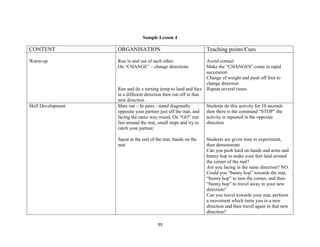
Sample Lesson 4
CONTENT ORGANISATION Teaching points/Cues
Warm-up Run in and out of each other.
On “CHANGE” – change directions
Run and do a turning jump to land and face
in a different direction then run off in that
new direction
Avoid contact
Make the “CHANGES” come in rapid
succession
Change of weight and push off foot to
change direction
Repeat several times
Skill Development Mats out – In pairs - stand diagonally
opposite your partner just off the mat, and
facing the same way round. On “GO” run
fast around the mat, small steps and try to
catch your partner.
Squat at the end of the mat, hands on the
mat.
Students do this activity for 10 seconds
then there is the command “STOP” the
activity is repeated in the opposite
direction
Students are given time to experiment,
then demonstrate
Can you push hard on hands and arms and
bunny hop to make your feet land around
the corner of the mat?
Are you facing in the same direction? NO.
Could you “bunny hop” towards the mat,
“bunny hop” to turn the corner, and then
“bunny hop” to travel away in your new
direction?
Can you travel towards your mat, perform
a movement which turns you in a new
direction and then travel again in that new
direction?
40
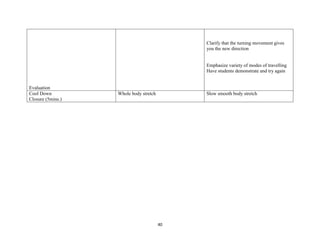
Evaluation
Clarify that the turning movement gives
you the new direction
Emphasize variety of modes of travelling
Have students demonstrate and try again
Cool Down
Closure (5mins.)
Whole body stretch Slow smooth body stretch
41
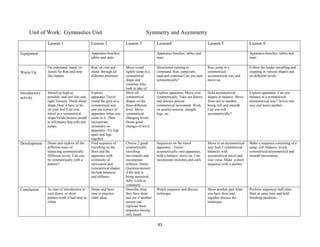
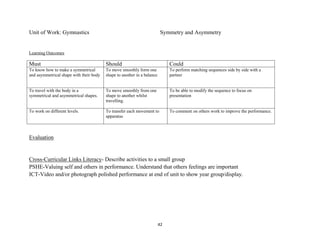
Unit of Work: Gymnastics Unit Symmetry and Asymmetry
Lesson 1 Lesson 2 Lesson 3 Lesson4 Lesson 5 Lesson 6
Equipment Apparatus-benches,
tables and mats
Apparatus-benches, tables and
mats
Apparatus-benches, tables and
mats
Warm Up
On command, stand, sit
,kneel, lie.Run and stop
like statues
Run, sit, run and
stand, through all
different positions.
Move round
lightly jump in a
symmetrical
shape and
continue.Also
look at take of
Directional running to
command. Run, jump,turn,
land,and continue.Can you turn
symmetrically?
Run, jump in a
symmetrical/
asymmetrical way and
move on.
Follow the leader travelling and
stopping in various shapes and
on different levels.
Introductory
activity
Stretch as high as
possible, and curl low and
tight.Tension. Think about
shape.Does it have to be
on your feet?Can you
travel in a symmetrical
shape?(slide,bounce,stradd
le roll,bunny hop,rolls,star
jump)
Explore
apparatus.Travel
round the gym in a
symmetrical way
and use a piece of
apparatus when you
come to it. Then
incorporate
symmetry on
apparatus. Try legs
apart and legs
together.
Show all
symmetrical
shapes on the
floor-different
level. Move
symmetrical
changing levels.
Demo good
changes of level.
Explore apparatus. Move over
symmetrically. Take out demos
and discuss precise
symmetrical movement. Work
on quality-tension, straight
legs, etc.
Hold asymmetrical
shapes in balance. Move
from one to another,
being still and smooth.
Can you roll
asymmetrically?
Explore apparatus. Can you
balance in a symmetrical/
asymmetrical way? Arrive one
way and leave another
Development Demo and explore all the
different ways of
balancing symmetrically.
Different levels. Can you
be symmetrically with a
partner?
Find sequence of
travelling on the
floor and the
apparatus with
continuity of
movement and
symmetrical shapes.
Include balances
and stillness.
Choose 2 good
symmetrically
travelling
movements and
incorporate
stillness. Demo
Question/answer
if the task is
being answered
fully. Look at
continuity
Sequences on the travel
apparatus . Travel
aymmetrically onto apparatus,
hold a balance, move on. Can
incorporate stretches and curls
Move in an asymmetrical
way.Join 2 symmetrical
balances with
asymmetrical travel and
vice versa. Make a short
sequence with a partner
Make a sequence consisting of a
jump, roll, balance, levels,
symmetrical/asymmetrical and
smooth movements.
Conclusion As start of introduction to
cool down, or show
partner work if had time to
refine
Demo and have
time to practice
other ideas.
Describe what
they have done
and see if another
person can
replicate their
sequence having
only heard
Watch sequence and discuss
technique
Show another pair what
you have done and
together discuss the
technique..
Perform sequences half class.
Start at same time and hold
finishing positions.
42
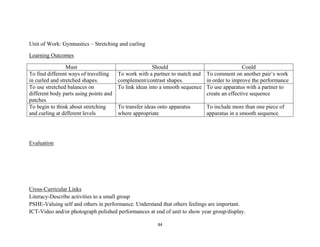
Unit of Work: Gymnastics Symmetry and Asymmetry
Learning Outcomes
Must Should Could
To know how to make a symmetrical
and asymmetrical shape with their body
To move smoothly form one
shape to another in a balance
To perform matching sequences side by side with a
partner
To travel with the body in a
symmetrical and asymmetrical shapes.
To move smoothly from one
shape to another whilst
travelling.
To be able to modify the sequence to focus on
presentation
To work on different levels. To transfer each movement to
apparatus
To comment on others work to improve the performance.
Evaluation
Cross-Curricular Links Literacy- Describe activities to a small group
PSHE-Valuing self and others in performance. Understand that others feelings are important
ICT-Video and/or photograph polished performance at end of unit to show year group/display.
43
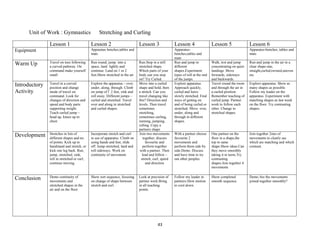
Unit of Work : Gymnastics Stretching and Curling
Lesson 1 Lesson 2 Lesson 3 Lesson 4 Lesson 5 Lesson 6
Equipment Apparatus benches,tables and
mats
Apparatus-
benches,tables and
mats
Apparatus-benches, tables and
mats
Warm Up Travel on toes following
a curved pathway. On
command make yourself
small.
Run round, jump into a
space, land lightly and
continue. Land on 1 or 2
feet.Show stretched in the air
Run.Stop in a still
stretched shape.
Which parts of your
body can you stop
on? Try Curled.
Run and jump in
different
shapes.Experiment
types of roll at the end
of the jumps.
Walk, trot and jump
concentrating on quiet
landings .Move
forwards, sideways
and backwards.
Run and jump in the air in a
clear shape-star,
straight,curled,twisted,uneven
etc.
Introductory
Activity
Travel in a curved
position and change
mode of travel on
command. Look for
changes of direction and
speed and body parts
supporting weight.
Teach curled jump –
head up, knees up to
chest
Explore the apparatus – over,
under, along, through. Climb
on jump of f 2 feet, sink and
roll away. Different jumps –
curled and stretched. Travel
over and along in stretched
and curled shapes.
Move into a curled
shape and hold, then
a stretch. Can you
travel changing like
this? Direction and
levels. Then travel
sometimes
stretching,
sometimes curling,
running, jumping,
rolling. Copy a
partners shape.
Explore apparatus.
Approach quickly,
curled and leave
slowly stretched. Find
ways of getting on
and of being curled or
stretched. Move over,
under, along and
through in different
shapes.
Travel round the room
and through the air in
a curled position.
Remember teaching of
curled jump. Partner
work to follow each
other. Change to
stretched shapes.
Explore apparatus. Show as
many shapes as possible.
Follow my leader on the
apparatus. Experiment with
matching shapes as last week
on the floor. Try contrasting
shapes.
Development Stretches in lots of
different shapes and no.
of points. Kick up to
handstand and stretch, or
kick one leg back. Run,
jump, stretched, sink,
roll in stretched or curl,
continue moving.
Incorporate stretch and curl
in use of apparatus. Climb on
using hands and feet, slide
off. Jump stretched, land and
roll sideways. Work on
continuity of movement.
Join two movements
together, discuss
favourite and
perform together
with a partner. Then
lead and follow –
stretch, curl, speed
and direction
With a partner choose
favourite 2
movements and
perform them side by
side.Demo. Discuss
and have time to try
out other peoples.
One partner on the
floor in a shape,the
top in same
shape.Show ideas.Can
they move smoothly
taking it in turns.Try
contrasting
shapes.Join together 4
movements
Join together 2stes of
movements to clearly see
which are matching and which
contrast.
Conclusion Demo continuity of
movements and
stretched shapes in the
air and on the floor
Show sort sequence, focusing
on change of shape between
stretch and curl.
Look at precision of
partner work.Bring
in all teaching
points.
Follow my leader in
partners.Slow motion
to cool down.
Show completed
smooth sequence.
Demo.Are the movements
joined together smoothly?
44
Unit of Work: Gymnastics – Stretching and curling
Learning Outcomes
Must Should Could
To find different ways of travelling
in curled and stretched shapes.
To work with a partner to match and
complement/contrast shapes.
To comment on another pair’s work
in order to improve the performance
To use stretched balances on
different body parts using points and
patches
To link ideas into a smooth sequence To use apparatus with a partner to
create an effective sequence
To begin to think about stretching
and curling at different levels
To transfer ideas onto apparatus
where appropriate
To include more than one piece of
apparatus in a smooth sequence
Evaluation
Cross-Curricular Links
Literacy-Describe activities to a small group
PSHE-Valuing self and others in performance. Understand that others feelings are important.
ICT-Video and/or photograph polished performances at end of unit to show year group/display.
45
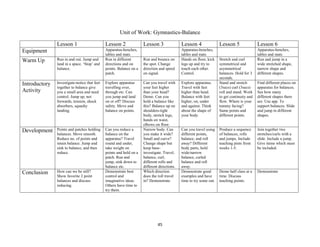
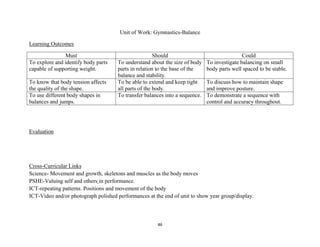
Unit of Work: Gymnastics-Balance
Lesson 1 Lesson 2 Lesson 3 Lesson 4 Lesson 5 Lesson 6
Equipment Apparatus-benches,
tables and mats
Apparatus-benches,
tables and mats
Apparatus-benches,
tables and mats
Warm Up Run in and out. Jump and
land in a space. ‘Stop’ and
balance.
Run in different
directions and on
points. Balance on a
patch.
Run and bounce on
the spot. Change
direction and speed
on signal.
Hands on floor, kick
legs up and try to
touch each other.
Control.
Stretch and curl
symmetrical and
asymmetrical
balances. Hold for 3
seconds.
Run and jump in a
wide stretched shape,
narrow shape and
different shapes.
Introductory
Activity
Investigate-notice that feet
together to balance give
you a small area and need
control. Jump up, not
forwards, tension, shock
absorbers, squashy
landing.
Explore apparatus
travelling over,
through etc. Can
you jump and land
on or off? Discuss
safety. Move and
balance on points.
Can you travel with
your feet higher
than your head?
Demo. Can you
hold a balance like
this? Balance up on
shoulders-tight
body, stretch legs,
hands on waist,
elbows on floor.
Explore apparatus.
Travel with feet
higher than head.
Balance with feet
higher, on, under
and against. Think
about the shape of
your body.
Stand and stretch
(3secs) curl (3secs)
roll and stand. Work
to get continuity and
flow. Where is your
tummy facing?
Same points and
different points.
Find different places on
apparatus for balances.
See how many
different shapes there
are. Use app. To
support balances. Slide
and jump in different
shapes.
Development Points and patches holding
balances. Move smooth.
Reduce no. of points and
retain balance. Jump and
sink to balance, and then
reduce.
Can you reduce a
balance on the
apparatus? Travel
round and under,
take weight on
points and hold on a
patch. Run and
jump, sink down to
balance etc.
Narrow body. Can
you make it wide?
Small and curve?
Change shape but
keep base-
investigate. Travel,
balance, curl,
different rolls and
different directions.
Can you travel using
different points,
balance, and roll
away? Different
body parts, hold
wide/narrow
balance, curled
balance and roll
away.
Produce a sequence
of balances, rolls
and jumps. Include
teaching pints from
weeks 1-5.
Join together two
stretches/curls with a
slide. Include a jump.
Give items which must
be included.
Conclusion How can we be still?
Show favorite 3 point
balances and discuss
reducing.
Demonstrate best
control and
imaginative ideas.
Others have time to
try them.
Which direction
does the roll travel
in? Demonstrate.
Demonstrate good
examples and have
time to try some out.
Demo half class at a
time. Discuss
teaching points.
Demonstrate
46
Unit of Work: Gymnastics-Balance
Learning Outcomes
Must Should Could
To explore and identify body parts
capable of supporting weight.
To understand about the size of body
parts in relation to the base of the
balance and stability.
To investigate balancing on small
body parts well spaced to be stable.
To know that body tension affects
the quality of the shape.
To be able to extend and keep tight
all parts of the body.
To discuss how to maintain shape
and improve posture.
To use different body shapes in
balances and jumps.
To transfer balances into a sequence. To demonstrate a sequence with
control and accuracy throughout.
Evaluation
Cross-Curricular Links
Science- Movement and growth, skeletons and muscles as the body moves
PSHE-Valuing self and others in performance.
ICT-repeating patterns. Positions and movement of the body
ICT-Video and/or photograph polished performances at the end of unit to show year group/display.
47
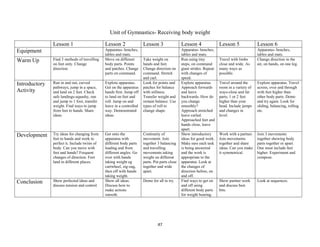
Unit of Gymnastics- Receiving body weight
Lesson 1 Lesson 2 Lesson 3 Lesson 4 Lesson 5 Lesson 6
Equipment Apparatus- benches,
tables and mats.
Apparatus- benches,
tables and mats.
Apparatus- benches,
tables and mats.
Warm Up Find 3 methods of travelling
on feet only. Change
direction.
Move on different
body parts. Points
and patches. Change
parts on command.
Take weight on
hands and feet.
Change direction on
command. Stretch
and curl.
Run using tiny
steps, on command
giant strides. Repeat
with changes of
speed.
Travel with limbs
close and wide. As
many ways as
possible.
Change direction in the
air, on hands, on one leg.
Introductory
Activity
Run in and out, curved
pathways, jump in a space,
and land on 2 feet. Check
safe landings-squashy, run
and jump to 1 foot, transfer
weight. Find ways to jump
from feet to hands. Share
ideas.
Explore apparatus.
Get on the apparatus
hands first. Jump off
to land on feet and
roll. Jump on and
leave in a controlled
way. Demonstrated
ideas.
Look for points and
patches for balance
with stillness.
Transfer weight and
remain balance. Use
types of roll to
change shape.
Explore apparatus.
Approach forwards
and leave
backwards. How do
you change
smoothly?
Approach stretched
leave curled.
Approached feet and
hands close, leave
apart.
Travel around the
room in a variety of
ways-close and far
parts, 1 or 2 feet
higher than your
head. Include jumps
and changes in
level.
Explore apparatus. Travel
across, over and through
with feet higher than
other body parts. Demo
and try again. Look for
sliding, balancing, rolling
etc.
Development Try ideas for changing from
feet to hands and work to
perfect it. Include twists of
body. Can you move with
feet and hands? Frequent
changes of direction. Feet
land in different places.
Get onto the
apparatus with
different body parts
leading and from
different angles. Go
over with hands
taking weight eg
cartwheel, zig-zag,
then off with hands
taking weight.
Continuity of
movement. Join
together 3 balancing
and travelling
movements taking
weight on different
parts. Put parts close
together and wide
apart.
Show introductory
ideas for good work.
Make sure each task
is being answered
and the work is
appropriate to the
apparatus. Look at
the changes of
direction before, on
and off.
Work with a partner.
Join movements
together and share
ideas. Can you make
it symmetrical.
Join 3 movements
together showing body
parts together or apart.
One must include feet
higher. Experiment and
compose.
Conclusion Show perfected ideas and
discuss tension and control.
Show all ideas.
Discuss how to
make actions
smooth.
Demo for all to try. Find ways to get on
and off using
different body parts
for weight bearing.
Show partner work
and discuss best
bits.
Look at sequences.
48
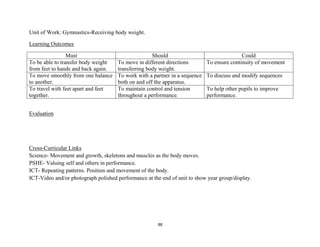
Unit of Work: Gymnastics-Receiving body weight.
Learning Outcomes
Must Should Could
To be able to transfer body weight
from feet to hands and back again.
To move in different directions
transferring body weight.
To ensure continuity of movement
To move smoothly from one balance
to another.
To work with a partner in a sequence
both on and off the apparatus.
To discuss and modify sequences
To travel with feet apart and feet
together.
To maintain control and tension
throughout a performance.
To help other pupils to improve
performance.
Evaluation
Cross-Curricular Links
Science- Movement and growth, skeletons and muscles as the body moves.
PSHE- Valuing self and others in performance.
ICT- Repeating patterns. Position and movement of the body.
ICT-Video and/or photograph polished performance at the end of unit to show year group/display.
49
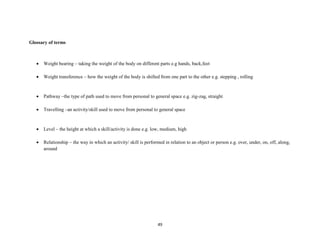
Glossary of terms
 Weight bearing – taking the weight of the body on different parts e.g hands, back,feet
 Weight transference – how the weight of the body is shifted from one part to the other e.g. stepping , rolling
 Pathway –the type of path used to move from personal to general space e.g. zig-zag, straight
 Travelling –an activity/skill used to move from personal to general space
 Level – the height at which a skill/activity is done e.g. low, medium, high
 Relationship – the way in which an activity/ skill is performed in relation to an object or person e.g. over, under, on, off, along,
around

CAC Physical Education manual

  • 1.
    1 Continuous Assessment Componentin Physical Education Contents Introduction 2 Rationale 2 General Curriculum Objectives 2 Programme Objectives 3 Themes/Topics/Skills 4 Physical Education terms 5 Fundamental Motor Skills 6 Programme of Work 7 Lesson Planning 8 Exemplars 10 Sample Lesson 1 11 Sample Assessment Rubric 11 Sample Lesson 2 13 Sample Lesson 3 15 Assessment Criteria 17 Student Mark Sheet 18 Teaching Notes 19 Integrating Special Needs Children 20 Lifestyle Practices 21 Food Group 22 Fundamental Motor Skills in Physical Education 23
  • 2.
    2 Developing Running Techniques24 Running Activities 25 Supplemental Units and Lessons 27 Units in Educational Gymnastics 28 Sample 1 29 Sample 2 31 Sample 3 32 Sample 4 34 Balancing on different body parts samples 35 Unit of Work: Gymnastics Symmetry and Asymmetry 41 Glossary of Terms 49 Physical Education Continuous Assessment Component Introduction  The physical education programme will utilise a movement education approach to the teaching of Games and Educational Gymnastics.  The programme will be based on fundamental motor skills that may be taught in a limited space  The continuous assessment component will focus on skill performance to ensure a more standardised process.  Skill application will be taught during the regular instructional programme. Rationale Quality Physical Education has as its basis purposeful movement, which is an essential element in the process of human growth and development and has implications for the total development of children. Physical Education is an integral aspect of general education and should be included at all levels of the curriculum. Physical Education as an aspect of the continuous assessment component will contribute to the realisation of the value outcomes of the MOE.
  • 3.
    3 Value Outcomes  Willfunction at their best with a strong sense of commitment to their interests and activities  Academically balanced to be productive  Physically fit, mentally alert, well nourished, and psychologically sound  Active in exercise, sports, games and recreation  Competent to interact and communicate with others, within different social settings and environments General Curriculum Objectives  Develop movement concepts through the utilization of skills in problem solving situations  Develop and maintain appropriate levels of fitness through purposeful physical activity  Enhance fundamental manipulative abilities  Promote positive interaction with others Programme objectives  Develop patterns and combinations of movement into repeatable sequences  Throw and catch using mature motor patterns  Appreciate the benefits of cooperation and sharing Themes/Topics/Skills THEMES/ TOPICS/SKILLS Designs and performs sequences that involve elements of movement  Movement elements :- concepts and skills - space awareness – personal & general space, direction, pathways , levels - body awareness - shape, balance /weight bearing, transference of weight - quality - speed & force, light &heavy, smooth & jerky - relationships- people, objects
  • 4.
    4 Uses movement conceptsand skills to design and practice sequences  Balance demonstrating symmetrical and asymmetrical shapes on a variety of body parts - large parts - small parts - combination of parts  Show stretched and curled shapes from various starting positions - stretched shapes from various starting positions - curled shapes from various starting positions - stretch and curled shapes while moving  Make bridge- like shapes using various combinations of body parts - hands and feet - large and small Uses the various combinations of taking off and landing to demonstrate flight  Vary levels and relationships in flight - Take off on one foot to land on both feet - Take off on one foot to land on the same foot - Take off on one foot to land on the other foot - Take off on both feet to land on one foot - Take off on both feet to land on both feet Uses various techniques for throwing and catching  One- hand underhand throw  Two-handed overhand throw  One -hand overhand throw -a side orientation -with opposition  Two hand underhand catch  Underhand catch  Overhand catch Demonstrates functional patterns of throwing and catching in dynamic situations  Throwing to develop accuracy  Throwing for distance  Throwing and catching while being guarded Demonstrates correct running technique  Eyes focused forward throughout the run  Knees bent at right angles in recovery  Arms bend at elbows and move in opposition to legs  Contact ground with front part of foot  Body leans slight forward
  • 5.
    5 Physical Education Terms MovementElements, Concepts & Skills All movement can be classified and analysed through Laban’s movement concepts and skills which are grouped under four elements: Space awareness , Body awareness , Relationship, Quality • people,objects • speed & force,light &heavy, smooth & jerky • balance,take weight,make shapes,transfer weight • personal &general space,direction,pa thways ,levels SPACE AWARENESS- where the body moves BODY AWARENESS - what the body can do RELATIONSHIP- to whom or what the body relates QUALITY - how the body moves
  • 6.
    6 Fundamental motor skills Fundamentalmotor skills are the foundation skills for the teaching of more specialized skills required for individual and team sports and gymnastic activities. These are classified as loco motor, non loco motor and manipulative skills. FUNDAMENTAL MOTOR SKILLS LOCOMOTOR -run, walk, jump,skip, hop, slide NON LOCO MOTOR- bend, stretch, twist, turn, push, pull MANIPULATIVE- throw, catch, strike
  • 7.
    7 Programme of work Focuson a skill/concept with a central theme for a period of time within a unit e.g. unit of 3 to 4 lessons. Students should be taught to master a skill rather than just experience a skill. Provide students with a safe supportive and fun environment Teaching units and lessons may be substituted / adapted / modified using other fundamental motor skills units from the primary curriculum, or from the supplementary units, lessons and activities at the end of the booklet. This will facilitate schools where facilities/equipment or other factors may limit teaching of the recommended units. Units with practice assessments are compulsory. Term 1 Topics September Week 1 Week 2 Week 3 Week 4 Unit 1: -Movement elements, concepts, skills lesson 1- space awareness – travel between personal and general space while changing direction – varied actions lesson 2- space awareness –travel in general space changing levels, speed and pathways lesson 3- body awareness –weight bearing lesson 4- body awareness- transferring body weight October Week 5 Week 6 Week 7 Week 8 Unit 2: Body awareness –shapes lesson 1-stretch and curl from various starting positions lesson 2 -stretch and curled shapes while moving lesson 3- symmetrical shapes lesson 4- asymmetrical shapes November Week 9 Week 10 Week 11 Week 12 Unit 3: Throwing &catching lesson 1- two hand underhand catch lesson 2- two hand underhand throw lesson 3- two hand overhand throw sample assessment- two hand underhand catch Term 2 Topics January Week 1 Week 2 Week 3 Unit 4: Body awareness -shapes lesson 1- bridge shapes with hands and feet lesson 2- bridge shapes with other parts lesson 3- bridge shapes with a partner
  • 8.
    8 Jan /Feb Week 4 Week5 Week 6 Week 7 Unit 5: Throwing and Catching lesson 1-one hand underhand throw lesson 2- two hand overhand catch lesson 3-one hand overhand throw sample assessment –one hand underhand throw Feb/March Week 8 Week 9 Week 10 Unit 6: Running Technique Lesson 1-eyes focused forward throughout the run Lesson 2 –knees bent at right angles in recovery Lesson 3-arms bend at elbows and move in opposition to legs Term 3 Topics April Week 1 Week 2 Week3 Unit 7 : Flight –taking off and landing lesson 1- combinations of taking off and landing lesson 2- vary levels in flight lesson 3 –vary relationship in flight May Week 4 Week 5 Week 6 Week 7 Unit 8: Throwing and catching lesson 1 - throwing to develop accuracy lesson 2 - throwing for distance lesson 3 - throwing and catching- activity stations- 6 stations with one throwing/catching skill each practice assessment June Week 8 Week 9 Unit 9: Running technique lesson 1-contact ground with front part of foot lesson 2-body leans slightforward Lesson planning Physical Education lesson plans should include similar headings as other subject e.g topic/theme, class, duration, objectives etc.  Part 1-introductory activity (set) Warm up/Set - provides an opportunity to set up the lesson. Provide an activity that involves children in vigorous movement for the first few minutes May include movements or skills that will be stressed in the rest of the lesson
  • 9.
    9 Explain what isto happen in the lesson, how it relates to the last  Part 2 – skill development (body) Establish the focus and direction of the lesson Review key points or skills introduced in the previous lesson New skills are introduced and practised individually, then with a partner followed by small groups Games: stress acquisition of skills and concepts through ind, partner and group games Ed gymnastics: stress acquisition of stunts and movement skills and concepts through individual, partner and group sequences or small equipment activities  Part 3 – Closure Review key points of the lesson/stress a concept from the lesson Provide a quiet time for students to settle down Cool down
  • 10.
  • 11.
    11 Sample lesson 1 Topic:One hand underhand throw Objectives:  To learn and improve manipulative skill of throwing a ball underhand  Work cooperatively with others Equipment: variety of balls, hoops, clipboard, pencil CONTENT ORGANISATION Teaching points/Cues Entry activity: (3mins) Place balls in different containers in different corners Each student takes a ball on entry Part 1:Introductory activity/warm up: (5mins) Each child with a ball in a space Find different ways to throw the ball Part 2:skill development Body Individual: (10mins) - Introduce underhand throwing action -swing, step, point Introduce action with a ball In pairs: (10mins) with a ball between them partners pass the ball to each other using an underhand throw In 4 groups:(5mins), students will throw to each other within a circle using underhand throwing Use opposite arm and leg All students go through the motion without the ball A wall may be used to allow individual practice with the ball Circulate and give students individual feedback Use a system to rotate partners so that students can work with partners of different ability levels Do not throw to a student standing besides him/her. Receiver cannot throw to a person from
  • 12.
    12 Game: in samegroups with 2 sets of opposing teams, use an underhand throw to pass to a teammate whom he/she just received Do not throw a ball if there is no eye contact with receiver. Opposing team gets the ball if any other throw is used 3 team passes score 1point Part 3: Cool down Closure (5mins) Review lesson Simple stretching Sample Assessment Objectives  Demonstrate a one –hand underhand throw with proper form and accuracy Sample Assessment Rubric Assessment criteria Stance Stand with feet shoulder width, holding the ball in front of the body with both hands slightly under the ball Back Swing Swing throwing arm down & back, shifting weight to the foot on same side Forward Swing Swing throwing arm forward, stepping forward with opposing foot Release Extend arm to release ball off the fingertips, fingers pointing to target
  • 13.
    13 Performance Marks Makes one orno error 9-10 Makes two or three errors 7-8 Makes four or five errors 5-6 Makes six or seven errors 3-4 Makes eight or more errors 1-2 Sample lesson 2 Unit: movement concepts /skills Theme: space awareness Objective: To explore space using a variety of movement skills Equipment: hoops, mats, cones CONTENT ORGANISATION TEACHING POINTS Entry activity: (3mins) Place small equipment in different containers in different corners Each student takes a piece of equipment on entry and does an activity Part1:Introductory activity/warm up: (5mins) Get Away Tag Tail B closely follows A, A tries to get away. Then switch. Protect your tail while gathering as many as you can Part 2:skill development Body Move about all the space on your feet Use all the space and don’t touch anyone else. Children use the various ways of moving about the floor, e.g. walking, running, skipping, hopping, galloping Use children demonstrations to encourage variety.
  • 14.
    14 Move about allthe space using hands and feet. Move about the space going from hands to feet to hands to feet. Move about the space using: - Two different body parts - Three different body parts - Four different body parts Move about leading with one body part. Move about the space using equipment Have the children change from one way of moving on feet to another in response to a signal Encourage children to move without touching others Encourage the children to take all of their weight on their hands for short periods of time. Have the children observe each other’s activities Encourage the use of various types of movement e.g. sliding, rolling Encourage children to move around, over, under, through, in and out of an assortment of available small equipment, e.g. hoops, ropes, cones etc. In pairs: The preceding challenges may be used in partner situations: a. while following the leader b. while matching the leader Have children change leaders frequently In groups of 3 Make up a sequence of three different ways of moving about the space A game may be used which will bring out the skills Have the children practice and demonstrate their sequence Part 3: Cool down Closure (5mins) Whole body stretch Slow smooth body stretches
  • 15.
    15 Sample lesson 3 Topic:Two hand underhand catch Objectives:  To learn and improve manipulative skill of two hand underhand catch  To apply appropriate social skills while playing a group game. Equipment: variety of balls, cones CONTENT ORGANISATION Teaching points/Cues Entry activity: (3mins) Place balls in different containers in different corners Each student takes a ball on entry Part 1:Introductory activity/warm up: (5mins) Each child with a ball in a space Practice skill from previous lesson or use a vigorous game /activity Part 2:skill development Body Individual: (10mins) - Introduce underhand catching technique Introduce action with a ball In pairs: (10mins) students pair up and practice underhand catch The ball should be thrown to waist level Feet shoulder width apart, hands in front the body, elbows flexed, fingers spread Hands adjust to the flight of the ball. ball, contact is made with hands and flexed elbows. Force of the ball absorbed by the hands and arms Circulate and give students individual feedback Use a system to rotate partners so that students can work with partners of different ability levels
  • 16.
    16 Groups of 3:5mins Place 4 markers to form a square Each student stands at a marker leaving one free The student with the ball throws to either of the other 2 then runs to the free marker cone Game: In groups of 4/5 (10mins). Set up end zones at either end of playing area using cones. 2 groups scattered through the area. Group 1 throw and catch to each other to move the ball to their end zone Group 2 tries to intercept& control the ball Students should be allowed to create games Games may also be repeated from previous lessons Count consecutive catches No running with the ball No contact Use underhand throwing and catching A point is scored when the ball is caught in a group’s end zone Part 3: Cool down Closure (5mins) Review lesson Simple stretching
  • 17.
    17 Assessment objective: Demonstratea two hand underhand catch Assessment Rubric Assessment criteria Track Track the ball with your eyes all the way to your hands Reach Reach with arms and move towards the ball Position Fingers spread and pointing down, small fingers close together Catch Catch and control the ball with hands only Give Bend elbows to absorb the force of the ball
  • 18.
    18 Performance Marks Makes one orno error 9-10 Makes two or three errors 7-8 Makes four or five errors 5-6 Makes six or seven errors 3-4 Makes eight or more errors 1-2 Sample Student Mark Sheet Student Name No/1 error ( 9-10mks) 2-3 error3 (7-8mks) 4-5 errors (5-6mks) 6-7errors (3-4mks) 8 or more (1-2) Marks awarded
  • 19.
  • 20.
    20 Integrating Special NeedsChildren Teachers must ensure developmentally appropriate activities are provided for all children in an Inclusive Environment. Strategies  Station Work – This can help when teaching a variety of activities. Exceptional students can be included in spite of their limitations and without drastically changing the content or emphasis of the program.  Task Cards – These can be pre-designed to accommodate a variety of Exceptional students in almost every area of the Physical Education Program.  Peer Tutors – This strategy is especially helpful for students who have difficulty following directions or when functional mobility and manipulation are very limited. Mature students may be selected and trained for this purpose using a “rotational” system. Types of Disabilities Learning Disabilities - give rise to difficulties in acquiring knowledge and skills to the normal level of those expected of the same age. Teachers should have a limited but secure range of skills and movement that students can select from and apply in creative and challenging situations. Use materials and resources that students can access through sight , sound, touch or smell e.g different- sized textured, noisy and fluorescent balls Behaviour Disorders – teachers should strive as much as possible to avoid techniques that may weaken appropriate behaviour responses. Avoid the use of punishment such as denial, extra exercise or angry expressions. Perceptual-Motor Deficiencies –characteristic symptoms of perceptual- motor deficiencies commonly observed in the primary school:  Body Image o Inability to identify and locate body parts, such as the right and left hand, knee or elbow o Inability to move parts of the body as directed by the teacher o Inability to imitate movements performed by the teacher or another performer  Balance o Inability to maintain balance - static ,while moving and in flight
  • 21.
    21  Spatial Awareness oInability to move parts of the body in specified directions, eg. Crossing the left arm over the right side of the body. o Inability to move the body through space, eg. Moving forward, backward, up, down and around. o Inability to move into space without bumping into objects or other students in the general pathway of movement  Hand-eye and Foot-eye coordination o Inability to throw a ball into the air and catch it after one bounce o Inability to perform basic loco-motor skills such as running, hopping, galloping, or jumping o Inability to kick a stationary or moving ball Games can be modified to facilitate students who possess a variety of physical or mental disabilities. Some Healthy lifestyles practices for students • Drinking plenty of water everyday to be healthy e.g. approximately six glasses • Eating breakfast everyday - Children who don’t have breakfast get sleepy at school, have a harder time paying attention, and tend to eat more junk food later in the day. Kids who do eat breakfast get higher test scores and perform better in sports.( The importance of eating a good breakfast -http://www.permanente.net) • Choosing healthy breakfast foods like whole grains, fruits, and dairy products that ensure children are getting the vitamins and minerals that the body needs. • Choosing fruits and vegetables as healthy snacks • Understanding how many servings the body needs • Setting a goal to move more and sit less • Setting a goal to exercise and stretch everyday
  • 22.
  • 23.
    23 More on fundamentalmotor skills in Physical Education Throwing and catching skills Two-Handed Underhand Throw  Begin with the back straight, feet about shoulder-width apart, and knees slightly bent.  Arms are straight and the ball is held with the fingers of both hands  Keep the back straight, then swing the arms forward and upward, and straighten the knees  Release the ball off the fingers and follow through in the direction of the ball Two-Handed Overhand Throw  Hold ball in both hands  Using a sideways stance, shift weight from front to back foot  Raise arms up over the head  Transfer weight forward  Bring arms forward and release the ball off the fingers. One-Hand Overhand Throw  Begin with one foot forward and the body weight evenly distributed over both feet.  Hold the ball with both hands in front of the body  In the first part of the backswing, raise the upper arm and flex the wrist so the hand points backward  At this point the next side faces the direction of the throw  The arm extends forward; and the weight is on the rear foot  At the same time the upper arm lifts up and forward and the other arm moves down and back as the weight shifts to the front foot.  The ball is released off the fingertips  The follow-through should be in a downward direction, ending with the palm of the throwing hand facing the ground. Two-Handed Overhand Catch  When the ball approaches above the waist, the elbows are bent and held high, and the fingers and thumbs are spread  As the ball approaches, the arms extend forward and up  The ball should be caught with the tips of the fingers and thumbs; the thumbs are close together  As the ball is caught, the hands recoil toward the body to the force of the oncoming ball.
  • 24.
    24 Developing Running Techniques 1.Eyes focused forward throughout the run  Students run a short distance with eyes closed then open  Mirror running: groups of three or four run one behind the other 2-3 metres apart. Students focus on the back of the head of the person in front of them 2. Knees bent at right angles in recovery  Heels are kicked to the buttocks while running  Run with arms held straight down behind the body and heels are kicked to touch the hands. Knees are pointed down throughout the exercise  Students run on the spot. Partners squat behind with hands outstretched at a height where the heels of the runner will touch  Knee slaps: on the spot students hold hands in front at hip level and ‘sprint’ to slap knees and hands  Exaggerated action with high knee lift , elbows bent and arms swinging 3. Arms bend at elbows and move in opposition to legs  Students sit and hold relay batons/rulers/sticks in each hand and swing the arms back and forth with bent elbows  Race walking: student use exaggerated arm movements  Continuous scissors jumping :begin in a forward stride position(right foot and left arms forward). Jump on the spot and reverse arms and legs. Repeat and increase rhythm  Students sprint short distances with batons/ rulers in each hand  March on the spot: legs first then arms join in 4. Contact ground with front part of foot  Changing pace using letter cards for signals as students move around the area : w-walk, j- jog, r- run. Students change speed as the cards change . Stress heel toe placement for the walk/jog and toe placement for the run.  Students march on their toes with short skips and emphasis on staying tall 5. Body leans slightly forward  Tow a partner: a runner tows a partner who is facing same direction by holding hands. The partner applies slight resistance which encourages body lean.  Students run with a partner over 15metres. Emphasis on students’ body and running up on toes.
  • 25.
    25 Running Activities Bean bagscramble  Groups of 4 with one hoop and four bean bags  Hoops are randomly scattered with 4 bean bags in each hoop. One group stands near each hoop  On asignal students collect bean bags from other hoops and place them in their own hoop one at a time  Teams must not protect their hoops  Run the activity for a set time then replace bean bags Knees up  Set out cones to create two lines 15-20 metres apart  Students stand in lines and skip with high knee lift and matching opposite arm movement, towards the opposite line  Elbows bend at right angles in front and behind the body Belly starts  Set out 4 cones to create two lines 15-20 metres apart.  Students lie in lines on the floor face down.  On a signal the students in the first row scramble to their feet and sprint to the line 15 metres away.  Repeat until each line of students has done a start. Starting positions may be changed. Circle sprint  Six students stand in a chalk/rope circle and are numbered 1-6.  The teacher says on your marks, set and calls a number.  Students with the designated number sprint clockwise around the circle back to their places Ball sprinter  Students in two groups form a line facing each other 40- 60m apart.  Place the balls in the middle of the area.
  • 26.
    26  Students arenumbered in each group.  The teacher calls “on your mark, set” and a number.  Students with that number sprint to their ball and raise it above their heads Pass and sprint  Students are placed in two groups.  The running group forms a straight line with the first student holding a baton.  The passing group forms a circle around one of their students.  On signal, the first student in the running group runs around the circle of the passing group and passes the baton to student # 2.  Each member of the group completes the circuit.  At the same time the passing group counts how many passes of their ball can be made to the group members.  Groups exchange roles and repeat.  The group with the greater number of passes is the winner
  • 27.
    27 SUPPLEMENTAL UNITS ANDLESSONS DEVELOPED BY COTEFORD JUNIOR SCHOOL, LONDON, ENGLAND AS PART OF THEIR PHYSICAL EDUCATION PROGRAMME Used by permission
  • 28.
    28 UNITS IN EDUCATIONALGYMNASTICS PATHWAYS BALANCE SYMMETRY STRETCHING & CURLING RECEIVING BODY WEIGHT
  • 29.
    29 Sample Lesson 1 Theme:Pathways Class: Std 3 / 4 Objectives: To explore pathways using a variety of movement skills Equipment: mats, cones, hoops CONTENT ORGANISATION Teaching points/Cues Warm-up Children run in and out of each other, following a wriggling, flexible pathway In pairs, one leading - following a wriggling, flexible pathway Follow in pairs travelling on hands and feet Avoid contact with each other Avoid contact with other pairs and change the leaders several times Skill Development Use many different methods of travelling along a straight or direct pathway about 5 metres long Use many different methods of travelling along a curving, flexible pathway about 5 metres long Use of demonstrations Have children explore own apparatus over, along, through Travel round the room using all the equipment and making different pathways between the apparatus as well as over it Travel in flexible pathways between the
  • 30.
    30 Evaluation Find suitable methodsof travelling while following a triangular pathway, a square pathway, and an irregular, angular pathway Travel along a zig-zag pathway to a destination about 10 metres away, by jumping and turning into a new direction In pairs, develop a sequence showing travelling along three different pathways apparatus and direct pathways over it Travel in direct pathways between the apparatus, and flexible pathways over the apparatus To travel sharply off in another direction, the children must slow down before they reach the corner, and then overbalance into the new direction. Children demonstrate and repeat Encourage creativity e.g. jumping, turning, and rolling into a new direction Partners include matching, leading, and following actions. Cool Down Closure (5mins.) Whole body stretch Slow smooth body stretch
  • 31.
    31 Sample Lesson 2 Theme:Pathways Class: Std 3 / 4 Objective: To explore curving pathways using a variety of movement skills Equipment: cones, mats, hoops CONTENT ORGANISATION Teaching points/Cues Warm up: Run in and out each other following a curved pathway In pairs, one leads the other in a curving pathway In pairs, one travels from bridge shape to bridge shape and the other one negotiates them without making contact Avoid contact with each other and explore equipment, over, around, through etc. Change leaders several times Change roles Skill Development Individually link balances, twists and rolls to travel along a semi-circular pathway to a destination Use jumps to travel around a circular pathway – experiment Try small turning jumps Use step-like actions in different combinations to travel a circular pathway – different sized circles Use of favourite and suitable ways of Demonstrations Smaller turning jumps would be more suitable for this pathway Demonstration of activities Select demonstrations to illustrate the
  • 32.
    32 Evaluation travelling along acircular pathway - experiment Travel on hands and feet to follow a leaf- like pathway In pairs, develop a sequence showing travelling along curving pathways suitability of actions for curving pathways Can you find a flowery pathway and trace it on the floor by travelling on hands and feet? Travel on the floor with a turning jump following an angular pathway Partners include matching, leading, and following actions. Cool Down Closure (5mins.) Whole body stretch Slow smooth body stretch Sample Lesson 3 CONTENT ORGANISATION Teaching points/Cues Warm-up Travel in and out of each other in a zig-zag pathway Travel around the room by linking a series of balances and rolls Use a series of runs and turning jumps and avoid contact with each other
  • 33.
    33 Skill Development Leapfrom one foot to the other and continue in a series of large bounding step- like jumps Join together a series of rolls - Give time to experiment and then pick out a demonstration to show a suitable pathway Let the students try again changing direction as necessary at the end of each roll Run, jump and sink down into a balanced position Perform a series of twists and turns on the floor and in the air to show suitable pathways Select the most suitable pathway for those jumps Let the students practice several different ideas and look out for demonstrations to show suitable pathways Use of demonstrations Cool Down Closure (5mins.) Whole body stretch Slow smooth body stretch
  • 34.
    34 Sample Lesson 4 CONTENTORGANISATION Teaching points/Cues Warm-up Run around the room Walk around the room Jog around the room Stand in your personal space, then begin moving around the room through walking, jogging, running fast, back down through running, jogging, walking to stop Avoid contact with each other Repeat acceleration and deceleration several times Skill Development Evaluation Individually, decide on a sequence which involves travelling for about 10 metres Practice the same sequence with acceleration / deceleration Make up another sequence and go through the same process Make up and practice a sequence which follows a circular pathway and changes of levels and speed In pairs: discuss and experiment before composing a sequence to be performed simultaneously involving appropriate movements Practice it at very high speed, and then in slow motion Circulate and give students feedback Students should be able to decide upon the most suitable speeds for all of these movements Demonstrations to show these changes of speed and level Teacher stipulates the pathway Time given to experiment, then students perform sequences Cool Down Closure (5mins.) Whole body stretch Slow smooth body stretch
  • 35.
    35 Theme: Balancing ondifferent body parts – Change of Direction Sample Lesson 1 Equipment: mats, benches CONTENT ORGANISATION Teaching points/Cues Warm-up Travel around the room in as many different ways as possible, taking weight on different body parts Reminder about travelling on “points and patches” (small body parts or large body parts) Can you travel around the room in a hopping or jumping way? Children demonstrate and all try again Skill Development Run in and out of each other – STOP – repeat several times In your own time, run – balance – run – balance, showing a different balanced position each time Jump onto the mat Avoid contact with each other Use of general space Strong tense bodies and a wide base – repeat the task Use children’s demonstrations to remind students about all the body parts that will take weight to balance Can you roll, and then push into a balanced position? Any body parts not taking weight must be stretched and tense – toes pointed We were stopping in a balance on our feet in the last task, now when I say STOP can you show me a different balanced position? Teaching , or reminding about 1 foot – 2 feet jump
  • 36.
    36 Can you jumpfrom 1 foot – 2 feet sink down and roll away? Let children experiment and then show demonstrations using different combinations – emphasize continuity Imagine you are jumping over the rim of a well and sink down in it Demonstrate to illustrate continuity Cool Down Closure (5mins.) Whole body stretch Slow smooth body stretch Sample Lesson 2 CONTENT ORGANISATION Teaching points/Cues Warm-up Run in and out of each other Jump into a space and move on. Run – jump 1 foot – 2 feet – sink down and sideways roll – continue and repeat Avoid contact with each other Repeat several times Remember the 1 foot – 2 feet jump? Repeat the task, but this time use the 1 foot – 2 feet jump Remember to jump and sink down Emphasize the sinking down Skill Development Travel in different ways along the floor – taking weight on different body parts Travel along the floor on different body Remember “points and patches” Demonstration and all try Demonstrations and reminder of different
  • 37.
    37 parts – pushup into a balance and hold for “100, 200, 300” and then continue Join together jump – roll – balance where you travel in the same direction but change the way you are facing parts on which you can balance Tension in body in balanced position Body tension Can you roll in any way and move slowly into a balance? Repeat task Can you now join together run – jump 1 foot – 2 feet – roll and balance? Students experiment then demonstrate Show where one can travel in the same direction all the time but not face in the same direction all the time Circulate and give feed back Children demonstrate Cool Down Closure (5mins.) Whole body stretch Slow smooth body stretch
  • 38.
    38 Sample Lesson 3 CONTENTORGANISATION Teaching points/Cues Warm-up Travel about the room on hands and feet Travel round the room on buttoms and backs Run in and out of each other, changing the way you face as you travel Run and jump into a space – continue Run and jump into a space, turning in the air Show different ones and repeat Show different ideas and repeat Skip, jogging backwards, sideways Repeat several times Emphasize the sinking down Repeat and show demonstrations Floorwork Teaching same jump with a ¼ , ½ , ¾ , turn All together, facing the same way to begin with, run and jump to turn ½ - land on 2 feet – STOP. Repeat the jump several times and then every one bunny hop off in the new direction Use the walls of the hall to help students identify the degree of turn Reminder of 1 foot – 2 feet jump, Can you run – jump – roll – balance using your turning jump? Have students demonstrate and repeat “Are we facing in the same direction that we were facing before we jumped?” NO Safety in landing Can you do a turning jump to land facing in a different direction from where you started, and then do something to travel away in that new direction Give students time to experiment, then have them demonstrate their ideas Cool Down Closure (5mins.) Whole body stretch Slow smooth body stretch
  • 39.
    39 Sample Lesson 4 CONTENTORGANISATION Teaching points/Cues Warm-up Run in and out of each other. On “CHANGE” – change directions Run and do a turning jump to land and face in a different direction then run off in that new direction Avoid contact Make the “CHANGES” come in rapid succession Change of weight and push off foot to change direction Repeat several times Skill Development Mats out – In pairs - stand diagonally opposite your partner just off the mat, and facing the same way round. On “GO” run fast around the mat, small steps and try to catch your partner. Squat at the end of the mat, hands on the mat. Students do this activity for 10 seconds then there is the command “STOP” the activity is repeated in the opposite direction Students are given time to experiment, then demonstrate Can you push hard on hands and arms and bunny hop to make your feet land around the corner of the mat? Are you facing in the same direction? NO. Could you “bunny hop” towards the mat, “bunny hop” to turn the corner, and then “bunny hop” to travel away in your new direction? Can you travel towards your mat, perform a movement which turns you in a new direction and then travel again in that new direction?
  • 40.
    40 Evaluation Clarify that theturning movement gives you the new direction Emphasize variety of modes of travelling Have students demonstrate and try again Cool Down Closure (5mins.) Whole body stretch Slow smooth body stretch
  • 41.
    41 Unit of Work:Gymnastics Unit Symmetry and Asymmetry Lesson 1 Lesson 2 Lesson 3 Lesson4 Lesson 5 Lesson 6 Equipment Apparatus-benches, tables and mats Apparatus-benches, tables and mats Apparatus-benches, tables and mats Warm Up On command, stand, sit ,kneel, lie.Run and stop like statues Run, sit, run and stand, through all different positions. Move round lightly jump in a symmetrical shape and continue.Also look at take of Directional running to command. Run, jump,turn, land,and continue.Can you turn symmetrically? Run, jump in a symmetrical/ asymmetrical way and move on. Follow the leader travelling and stopping in various shapes and on different levels. Introductory activity Stretch as high as possible, and curl low and tight.Tension. Think about shape.Does it have to be on your feet?Can you travel in a symmetrical shape?(slide,bounce,stradd le roll,bunny hop,rolls,star jump) Explore apparatus.Travel round the gym in a symmetrical way and use a piece of apparatus when you come to it. Then incorporate symmetry on apparatus. Try legs apart and legs together. Show all symmetrical shapes on the floor-different level. Move symmetrical changing levels. Demo good changes of level. Explore apparatus. Move over symmetrically. Take out demos and discuss precise symmetrical movement. Work on quality-tension, straight legs, etc. Hold asymmetrical shapes in balance. Move from one to another, being still and smooth. Can you roll asymmetrically? Explore apparatus. Can you balance in a symmetrical/ asymmetrical way? Arrive one way and leave another Development Demo and explore all the different ways of balancing symmetrically. Different levels. Can you be symmetrically with a partner? Find sequence of travelling on the floor and the apparatus with continuity of movement and symmetrical shapes. Include balances and stillness. Choose 2 good symmetrically travelling movements and incorporate stillness. Demo Question/answer if the task is being answered fully. Look at continuity Sequences on the travel apparatus . Travel aymmetrically onto apparatus, hold a balance, move on. Can incorporate stretches and curls Move in an asymmetrical way.Join 2 symmetrical balances with asymmetrical travel and vice versa. Make a short sequence with a partner Make a sequence consisting of a jump, roll, balance, levels, symmetrical/asymmetrical and smooth movements. Conclusion As start of introduction to cool down, or show partner work if had time to refine Demo and have time to practice other ideas. Describe what they have done and see if another person can replicate their sequence having only heard Watch sequence and discuss technique Show another pair what you have done and together discuss the technique.. Perform sequences half class. Start at same time and hold finishing positions.
  • 42.
    42 Unit of Work:Gymnastics Symmetry and Asymmetry Learning Outcomes Must Should Could To know how to make a symmetrical and asymmetrical shape with their body To move smoothly form one shape to another in a balance To perform matching sequences side by side with a partner To travel with the body in a symmetrical and asymmetrical shapes. To move smoothly from one shape to another whilst travelling. To be able to modify the sequence to focus on presentation To work on different levels. To transfer each movement to apparatus To comment on others work to improve the performance. Evaluation Cross-Curricular Links Literacy- Describe activities to a small group PSHE-Valuing self and others in performance. Understand that others feelings are important ICT-Video and/or photograph polished performance at end of unit to show year group/display.
  • 43.
    43 Unit of Work: Gymnastics Stretching and Curling Lesson 1 Lesson 2 Lesson 3 Lesson 4 Lesson 5 Lesson 6 Equipment Apparatus benches,tables and mats Apparatus- benches,tables and mats Apparatus-benches, tables and mats Warm Up Travel on toes following a curved pathway. On command make yourself small. Run round, jump into a space, land lightly and continue. Land on 1 or 2 feet.Show stretched in the air Run.Stop in a still stretched shape. Which parts of your body can you stop on? Try Curled. Run and jump in different shapes.Experiment types of roll at the end of the jumps. Walk, trot and jump concentrating on quiet landings .Move forwards, sideways and backwards. Run and jump in the air in a clear shape-star, straight,curled,twisted,uneven etc. Introductory Activity Travel in a curved position and change mode of travel on command. Look for changes of direction and speed and body parts supporting weight. Teach curled jump – head up, knees up to chest Explore the apparatus – over, under, along, through. Climb on jump of f 2 feet, sink and roll away. Different jumps – curled and stretched. Travel over and along in stretched and curled shapes. Move into a curled shape and hold, then a stretch. Can you travel changing like this? Direction and levels. Then travel sometimes stretching, sometimes curling, running, jumping, rolling. Copy a partners shape. Explore apparatus. Approach quickly, curled and leave slowly stretched. Find ways of getting on and of being curled or stretched. Move over, under, along and through in different shapes. Travel round the room and through the air in a curled position. Remember teaching of curled jump. Partner work to follow each other. Change to stretched shapes. Explore apparatus. Show as many shapes as possible. Follow my leader on the apparatus. Experiment with matching shapes as last week on the floor. Try contrasting shapes. Development Stretches in lots of different shapes and no. of points. Kick up to handstand and stretch, or kick one leg back. Run, jump, stretched, sink, roll in stretched or curl, continue moving. Incorporate stretch and curl in use of apparatus. Climb on using hands and feet, slide off. Jump stretched, land and roll sideways. Work on continuity of movement. Join two movements together, discuss favourite and perform together with a partner. Then lead and follow – stretch, curl, speed and direction With a partner choose favourite 2 movements and perform them side by side.Demo. Discuss and have time to try out other peoples. One partner on the floor in a shape,the top in same shape.Show ideas.Can they move smoothly taking it in turns.Try contrasting shapes.Join together 4 movements Join together 2stes of movements to clearly see which are matching and which contrast. Conclusion Demo continuity of movements and stretched shapes in the air and on the floor Show sort sequence, focusing on change of shape between stretch and curl. Look at precision of partner work.Bring in all teaching points. Follow my leader in partners.Slow motion to cool down. Show completed smooth sequence. Demo.Are the movements joined together smoothly?
  • 44.
    44 Unit of Work:Gymnastics – Stretching and curling Learning Outcomes Must Should Could To find different ways of travelling in curled and stretched shapes. To work with a partner to match and complement/contrast shapes. To comment on another pair’s work in order to improve the performance To use stretched balances on different body parts using points and patches To link ideas into a smooth sequence To use apparatus with a partner to create an effective sequence To begin to think about stretching and curling at different levels To transfer ideas onto apparatus where appropriate To include more than one piece of apparatus in a smooth sequence Evaluation Cross-Curricular Links Literacy-Describe activities to a small group PSHE-Valuing self and others in performance. Understand that others feelings are important. ICT-Video and/or photograph polished performances at end of unit to show year group/display.
  • 45.
    45 Unit of Work:Gymnastics-Balance Lesson 1 Lesson 2 Lesson 3 Lesson 4 Lesson 5 Lesson 6 Equipment Apparatus-benches, tables and mats Apparatus-benches, tables and mats Apparatus-benches, tables and mats Warm Up Run in and out. Jump and land in a space. ‘Stop’ and balance. Run in different directions and on points. Balance on a patch. Run and bounce on the spot. Change direction and speed on signal. Hands on floor, kick legs up and try to touch each other. Control. Stretch and curl symmetrical and asymmetrical balances. Hold for 3 seconds. Run and jump in a wide stretched shape, narrow shape and different shapes. Introductory Activity Investigate-notice that feet together to balance give you a small area and need control. Jump up, not forwards, tension, shock absorbers, squashy landing. Explore apparatus travelling over, through etc. Can you jump and land on or off? Discuss safety. Move and balance on points. Can you travel with your feet higher than your head? Demo. Can you hold a balance like this? Balance up on shoulders-tight body, stretch legs, hands on waist, elbows on floor. Explore apparatus. Travel with feet higher than head. Balance with feet higher, on, under and against. Think about the shape of your body. Stand and stretch (3secs) curl (3secs) roll and stand. Work to get continuity and flow. Where is your tummy facing? Same points and different points. Find different places on apparatus for balances. See how many different shapes there are. Use app. To support balances. Slide and jump in different shapes. Development Points and patches holding balances. Move smooth. Reduce no. of points and retain balance. Jump and sink to balance, and then reduce. Can you reduce a balance on the apparatus? Travel round and under, take weight on points and hold on a patch. Run and jump, sink down to balance etc. Narrow body. Can you make it wide? Small and curve? Change shape but keep base- investigate. Travel, balance, curl, different rolls and different directions. Can you travel using different points, balance, and roll away? Different body parts, hold wide/narrow balance, curled balance and roll away. Produce a sequence of balances, rolls and jumps. Include teaching pints from weeks 1-5. Join together two stretches/curls with a slide. Include a jump. Give items which must be included. Conclusion How can we be still? Show favorite 3 point balances and discuss reducing. Demonstrate best control and imaginative ideas. Others have time to try them. Which direction does the roll travel in? Demonstrate. Demonstrate good examples and have time to try some out. Demo half class at a time. Discuss teaching points. Demonstrate
  • 46.
    46 Unit of Work:Gymnastics-Balance Learning Outcomes Must Should Could To explore and identify body parts capable of supporting weight. To understand about the size of body parts in relation to the base of the balance and stability. To investigate balancing on small body parts well spaced to be stable. To know that body tension affects the quality of the shape. To be able to extend and keep tight all parts of the body. To discuss how to maintain shape and improve posture. To use different body shapes in balances and jumps. To transfer balances into a sequence. To demonstrate a sequence with control and accuracy throughout. Evaluation Cross-Curricular Links Science- Movement and growth, skeletons and muscles as the body moves PSHE-Valuing self and others in performance. ICT-repeating patterns. Positions and movement of the body ICT-Video and/or photograph polished performances at the end of unit to show year group/display.
  • 47.
    47 Unit of Gymnastics-Receiving body weight Lesson 1 Lesson 2 Lesson 3 Lesson 4 Lesson 5 Lesson 6 Equipment Apparatus- benches, tables and mats. Apparatus- benches, tables and mats. Apparatus- benches, tables and mats. Warm Up Find 3 methods of travelling on feet only. Change direction. Move on different body parts. Points and patches. Change parts on command. Take weight on hands and feet. Change direction on command. Stretch and curl. Run using tiny steps, on command giant strides. Repeat with changes of speed. Travel with limbs close and wide. As many ways as possible. Change direction in the air, on hands, on one leg. Introductory Activity Run in and out, curved pathways, jump in a space, and land on 2 feet. Check safe landings-squashy, run and jump to 1 foot, transfer weight. Find ways to jump from feet to hands. Share ideas. Explore apparatus. Get on the apparatus hands first. Jump off to land on feet and roll. Jump on and leave in a controlled way. Demonstrated ideas. Look for points and patches for balance with stillness. Transfer weight and remain balance. Use types of roll to change shape. Explore apparatus. Approach forwards and leave backwards. How do you change smoothly? Approach stretched leave curled. Approached feet and hands close, leave apart. Travel around the room in a variety of ways-close and far parts, 1 or 2 feet higher than your head. Include jumps and changes in level. Explore apparatus. Travel across, over and through with feet higher than other body parts. Demo and try again. Look for sliding, balancing, rolling etc. Development Try ideas for changing from feet to hands and work to perfect it. Include twists of body. Can you move with feet and hands? Frequent changes of direction. Feet land in different places. Get onto the apparatus with different body parts leading and from different angles. Go over with hands taking weight eg cartwheel, zig-zag, then off with hands taking weight. Continuity of movement. Join together 3 balancing and travelling movements taking weight on different parts. Put parts close together and wide apart. Show introductory ideas for good work. Make sure each task is being answered and the work is appropriate to the apparatus. Look at the changes of direction before, on and off. Work with a partner. Join movements together and share ideas. Can you make it symmetrical. Join 3 movements together showing body parts together or apart. One must include feet higher. Experiment and compose. Conclusion Show perfected ideas and discuss tension and control. Show all ideas. Discuss how to make actions smooth. Demo for all to try. Find ways to get on and off using different body parts for weight bearing. Show partner work and discuss best bits. Look at sequences.
  • 48.
    48 Unit of Work:Gymnastics-Receiving body weight. Learning Outcomes Must Should Could To be able to transfer body weight from feet to hands and back again. To move in different directions transferring body weight. To ensure continuity of movement To move smoothly from one balance to another. To work with a partner in a sequence both on and off the apparatus. To discuss and modify sequences To travel with feet apart and feet together. To maintain control and tension throughout a performance. To help other pupils to improve performance. Evaluation Cross-Curricular Links Science- Movement and growth, skeletons and muscles as the body moves. PSHE- Valuing self and others in performance. ICT- Repeating patterns. Position and movement of the body. ICT-Video and/or photograph polished performance at the end of unit to show year group/display.
  • 49.
    49 Glossary of terms Weight bearing – taking the weight of the body on different parts e.g hands, back,feet  Weight transference – how the weight of the body is shifted from one part to the other e.g. stepping , rolling  Pathway –the type of path used to move from personal to general space e.g. zig-zag, straight  Travelling –an activity/skill used to move from personal to general space  Level – the height at which a skill/activity is done e.g. low, medium, high  Relationship – the way in which an activity/ skill is performed in relation to an object or person e.g. over, under, on, off, along, around