Thrift Savings Plan Review
https://learn.extension.org/events/2361
This material is based upon work supported by the National Institute of Food and Agriculture, U.S. Department of Agriculture, and the Office of Family
Readiness Policy, U.S. Department of Defense under Award Numbers 2010-48869-20685, 2012-48755-20306, and 2014-48770-22587. 1
Research and evidenced-based
professional development
through engaged online communities
www.extension.org/militaryfamilies
Sign up for webinar email notifications at www.extension.org/62831 2
Join the Conversation Online!
MFLN Personal Finance
@MFLNPF
Military Families Learning Network
Military Families Learning Network LinkedIn Group
https://www.linkedin.com/groups/8409844
3
77 K Street NE | Washington, D.C., 20002 | www.tsp.gov 4
Thrift Savings Plan
Review
Presented by
Stewart Kaplan, AFC®, RFC, RPA
Federal Retirement Thrift Investment Board
Agenda
• Overview of the 2016 NDAA –
“Blended” Retirement System for the
Uniformed Services
• Overview of the Thrift Savings Plan
5
TSP Rules under 2016 NDAA
“Blended” Retirement System for
the Uniformed Services
6
TSP Rules Under Blended System*
Effective Jan 1, 2018 2016 National Defense Authorization Act
Automatic Contributions 1%, Begins 60 days after entry (or at election), Ends at 26 YOS
Matching Contributions Up to 4%, Begins 2 YOS + 1 day after entry, Ends at 26 YOS
Enrollment On or after 2 Jan 18: Automatic at entry; auto reenrollment
every Jan if member has opted out
Service member
contribution rate
3% automatic; full match requires 5%, no default to Roth TSP
Vesting of DoD
contributions
2 YOS
Opt-in eligibility Serving on 1/1/2018 and < 12 YOS as of 12/31/2017
Opt-in period 1/1/2018 – 12/31/2018 (+ hardship extensions)
*As of Jan 8, 2016 7
Overview of the Thrift Savings Plan
Make Wise Decisions Today—Retire with Dignity Tomorrow
Saving for Retirement—Your TSP Contributions
Investing for the Long Haul—Managing Your TSP Account
Turning Savings to Income—TSP Income Options
TSP Resources
8
Retire With Dignity
Tomorrow
Make Wise Decisions Today
9
What will your retirement look like?
• In retirement, the Thrift Savings Plan supplements
fixed (formula-based) income sources
‒ Social Security
‒ Defined benefit plans, e.g., CSRS/FERS annuity, military
pension
• TSP account balance at retirement depends on:
‒ How long contributions are made
‒ How much has been contributed or withdrawn
‒ Earnings on contributions
‒ Plan expense ratio/fees
10
Factors that affect TSP balance
Helpful
‒ FERS: contribute enough to get full agency match
 Contribute five percent to get maximum agency match of four
percent
‒ Allocate contributions to investment funds based on
appropriate balance of risk to return
 Periodically:
• Review account performance and long-term strategy
• Rebalance and reallocate based on review
 Or, choose a Lifecycle Fund – rebalancing and reallocations occur
automatically
11
Factors that affect TSP balance
Harmful
‒ Frequent Interfund Transfers
 Short-term, tactical moves using index funds is an
unsuccessful long-term investment strategy
‒ Using TSP to access savings that should have been
put into another type of account
 Loans
• Temporary depletion
 Financial Hardship In-Service Withdrawals
• Permanent depletion
12
Your TSP Contributions
Saving for Retirement
13
14
myPaymyPay
Make
contribution
election:
•Basic Pay
•Special*
•Incentive*
•Bonus*
Make
contribution
election:
•Basic Pay
•Special*
•Incentive*
•Bonus*
Choose tax treatment:Choose tax treatment: Decide how much:
•Percentage of basic pay
•Plus a percentage from
incentive, special and bonus
pay
Decide how much:
•Percentage of basic pay
•Plus a percentage from
incentive, special and bonus
pay
and/or
Enter birthdate and
address:
•Must update address each time
you move
•Note this is not the same as your
DFAS correspondence address
Enter birthdate and
address:
•Must update address each time
you move
•Note this is not the same as your
DFAS correspondence address
Receive correspondence from
the TSP:
•Welcome Letter
•Account number
•Temporary password needed to
access account on TSP.gov
Receive correspondence from
the TSP:
•Welcome Letter
•Account number
•Temporary password needed to
access account on TSP.gov
Establish account access:
•Make a “contribution allocation” to
allocate future contributions
•Make an “interfund transfer” to change
the investment of money already in your
account
Establish account access:
•Make a “contribution allocation” to
allocate future contributions
•Make an “interfund transfer” to change
the investment of money already in your
account
Roth
(after-tax)
•Contributions
deducted from pay
after Federal taxes are
withheld
•Federal taxes no longer
apply to contributions
•Earnings may be
withdrawn tax-free
once they are
“qualified”
Roth
(after-tax)
•Contributions
deducted from pay
after Federal taxes are
withheld
•Federal taxes no longer
apply to contributions
•Earnings may be
withdrawn tax-free
once they are
“qualified”
Traditional
(tax-deferred)
•Contributions
deducted from pay
before Federal taxes
are withheld
•Federal taxes are
“deferred”
•Taxes must be paid
on everything when
withdrawn
Traditional
(tax-deferred)
•Contributions
deducted from pay
before Federal taxes
are withheld
•Federal taxes are
“deferred”
•Taxes must be paid
on everything when
withdrawn
*must also contribute at
least 1% from basic pay
myPaymyPaymyPaymyPay
myPaymyPay TSP.govTSP.govUS MailUS Mail
How Do I Start?
14
Main Menu
15
Contribution Elections
0
16
Address and Date of Birth
17
TSP Website (www.tsp.gov)
18
See “Calculators” under “Planning and Tools” on TSP.gov 19
20
Use this calculator on the TSP.gov website
under “Planning and Tools” to find out!
21
Example: E-3, under 2 years (2015)
22
Your future
contributions:
$14,499.00
Growth of your future
contributions:
$139,808.72
Total estimated TSP
account balance:
$152,307.72
Example: E-3, under 2 years (2015)
22
23
20
Your future
contributions:
$40,464.36
Growth of your future
contributions:
$250,499.35
Total estimated TSP
account balance:
$290,963.71
Example: E-3, under 2 years (2015)
23
24
30
Your future
contributions:
$73,082.88
Growth of your future
contributions:
$294,188.58
Total estimated TSP
account balance:
$367,271.46
5.00%
Example: E-3, under 2 years (2015)
24
25
30
Your future
contributions:
$102,315.96
Growth of your future
contributions:
$411,864.62
Total estimated TSP
account balance:
$514,180.58
5.00%
7%
Example: E-3, under 2 years (2015)
25
Traditional TSP
• Federal income taxes are deferred on “Traditional”
contributions made to the TSP
‒ Contributions are deducted from pay before Federal taxes are
withheld, i.e., contributions are “pre-tax”
‒ Employee pays Federal income taxes only on remaining salary
• Participants pay Federal income tax on distributions from
their TSP account based on the applicable tax rate for the
year they receive them
• Deferral of state or county taxes is determined by each
individual jurisdiction
26
Roth TSP
• Federal income taxes are withheld on “Roth” contributions
made to the TSP
‒ Contributions are deducted from pay after Federal taxes are
withheld, i.e., contributions are “after-tax”
‒ Employee pays Federal income taxes on entire salary
• Participants will not pay Federal income tax on distributions
from their TSP account in the future:
‒ For the portion that consists only of contributions
‒ For the portion that consists of earnings if they meet both criteria to
be “qualified”
 Five years have passed since January 1 of the year participant made their
first Roth contribution
 Are age 59½ or older, permanently disabled, or deceased
27
25%
You make a Traditional
Contribution of
$10,000
You make a Roth
Contribution of
$7,500
(and pay $2,500 in Federal
income taxes for current year)
After tax distribution Tax free distribution
15% $46,133 $40,706
25% $40,706 $40,706
28% $39,078 $40,706
assuming 7% average
annual rate of return)
Traditional or Roth?
In 25 years,
tax rate is:
In 25 years,
tax rate is:
Current tax rate
is:
Current tax rate
is:
Equal impact on net pay
Example:
OR
28
1
Net cost to TSP participants, averaged across all funds
2
All-in, participant-weighted cost of large 401(k) plans. Source: Deloitte, Inside the Structure of Defined
Contribution/401(k) Plan Fees, 2013
3
Asset-weighted average expense ratio for equity mutual funds. Source: Investment Company Institute, 2014
Investment Company Factbook
TSP
401(k) Plans
Retail Mutual Funds
29
(Assuming 7% annual rate of return)
$377,425
TSP @ .029%
$336,477
401k Plans @ .41%
$307,361
Mutual Funds @ .74%
Years
30
30
Questions?
31
Managing Your TSP
Account
Investing for the Long Haul
32
33
(F Fund) (C Fund) (S Fund) (I Fund)
$596.77
$1730.02
$1525.64
$405.03
$410.52
$205.20
Growth of $100
TSP-Related Indices, 1987-2014
34
L Income
L 2020 L 2030
L 2040 L 2050
Lifecycle Funds
Investment Allocation*
*As of Jan 2016
35
Logic of the Lifecycle Funds
G
74%
Investment in the L Funds does not protect from investment losses
Expected Risk HighLow
HighLowExpectedReturn
36
 Choose an asset allocation that corresponds to your time horizon
 Rebalance and reallocate accordingly, or
 Choose a Lifecycle Fund
Use a long-term strategyUse a long-term strategy
 Studies show no evidence of successful outcomes using
“market timing” strategies
 Attempting to time the market increases the risk of not
being invested when the market goes up significantly
 Loans
 Financial Hardship Withdrawals
Don’t attempt to “time the market”
Avoid using the TSP as a solution to meet short-term financial needs
37
Participant-Directed
Account Transactions
Contribution Allocation Interfund Transfer
- Tells the TSP how participant wants
new money going into their account
to be invested among the TSP
investment fund options
- Includes employee contributions,
agency contributions, TSP loan
payments, and any transferred or
rollover funds
- Allows participant to transfer all or
part of their existing TSP fund balances
among the different TSP investment
fund options
- Does not affect the investment of
future deposits into their TSP account
May be done via TSP ThriftLine or TSP.gov
Generally effective as of close of business each day (based on 12 noon ET cutoff)
Participant will receive confirmation via website, email or mail
38
Residential
For purchase or construction
of a primary residence only
(pay back in 1-15 years)
General Purpose
No documentation required
(pay back in 1-5 years)
Types of Loans
39
Costs of a Loan
• $50 processing fee - deducted when loan is
disbursed
• Loan interest
‒ Based on G fund rate at time application is processed
‒ Fixed for life of the loan
• The invisible (and possibly the largest) cost is
foregone investment earnings and reduced
compounding of retirement savings
40
Financial Hardship Withdrawals
• Qualifying circumstances
‒ Negative monthly cash flow
‒ Medical expenses
‒ Personal casualty losses
‒ Legal expenses for separation or divorce
• Restrictions
‒ Minimum withdrawal $1,000
‒ May only withdraw your own contributions and earnings
‒ Six month non-contribution/waiting period
41
Costs of a Financial
Hardship Withdrawal
• Withdrawal can’t be repaid – permanently reduces
retirement savings
• Contributions suspended for 6 months
‒ No contributions means no matching (FERS)
• Withholding rate is 10%, actual tax is likely to be higher
• Additional 10% penalty tax on distributions prior to
age 59½
See tsp.gov/plan participation or the TSP booklet: “In-Service Withdrawals,”
for more information 42
TSP INCOME OPTIONS
Turning Savings to Income
43
Partial Withdrawal
(Must be separated)
• Allows for a one time withdrawal of a
minimum of $1,000 up to the entire balance
of the account
• Withdrawing entire balance will close out account
• Provides an opportunity to transfer a portion of
account to an IRA or another qualified plan
• Participants should discuss and understand all
options with tax or financial professional before
making withdrawal decisions
See the instructions for Form TSP-77, Request for a Partial Withdrawal When Separated,
for more information 44
Full Withdrawal
(Must be separated)
45
TSP Bulletin 14-3
46
• Use for retirement income or use for purposes
other than retirement income?
• Income Options
‒ Flexible income: Monthly payments
‒ Guaranteed income: Life annuities
‒ Custom solutions: Mixed withdrawals
• Participants with both Uniformed Services and civilian
TSP accounts may combine them*
Options
*See the instructions for Form TSP-65, Request to Combine Civilian and Uniformed Services
TSP Accounts, for more information 47
Wait
• If income is not needed until retirement, leave your
savings in the plan and do nothing
• Continue to stay invested in the TSP funds and earn
market returns
• Continue to defer income taxes until distributions
begin
48
Flexible Income
• Monthly payments by fixed dollar amount
‒ Amount specified by participant
‒ Minimum payment $25
‒ Amount may be changed annually
• Monthly payments based on life expectancy
‒ Payments are computed by TSP
‒ Amount automatically adjusts annually
49
Inbound Transfers
and Rollovers
Traditional
IRA
Traditional
IRA
50
Guaranteed Income
• TSP life annuity
‒ Income is guaranteed for the life of the annuitant(s)
‒ Funds are transferred from TSP to the annuity
provider, and benefits are “locked in” when request is
processed
51
Lump Sum Withdrawal
• May request all or any percentage of account
balance as a single payment
‒ Treated as an eligible rollover distribution
52
70
Mixed Withdrawals
Form TSP-70 53
Exceptions to the
IRS Early Withdrawal Penalty
The 10% IRS Early Withdrawal Penalty does not apply to payments that are:
• Received at age 59½ or later
• Received after you separate/retire during or after the year you reach age 55 (or the year
you reach age 50 if you are a public safety employee as defined in section 72(t)(10)(B)(ii) of
the internal revenue code
• Received in a year you have deductible medical expenses that exceed 10% of your
adjusted gross income (7.5% if you or your spouse is 65 or over)
• Received as a result of total and permanent disability*
• Annuity payments
• TSP monthly payments based on life expectancy
• Ordered by a domestic relations court
• Made because of death
• Made from a beneficiary participant account
* Participant must provide the justification to IRS when they file their taxes
See: IRS Publications 575, Pension and Annuity Income and
IRS Publication 721, Tax Guide to U.S. Civil Service Benefits
54
Spouses’ Rights
Retirement Plan Requirement* Exceptions†
FERS or
Uniformed
Services
Notarized spouse signature
required**
Whereabouts unknown or
exceptional circumstances
- TSP-16 or TSP-U-16
required
CSRS
Spouse is entitled to
notification of the
participant’s withdrawal
election
Whereabouts unknown
- TSP-16 required
* If account balance is less than $3,500, spouse’s signature/notice is not required
**If married but no spouse signature: Spouse is entitled to a Joint Life Annuity with 50% Survivor
Benefits, Level Payments, and no cash refund feature
†
Waiver of spouse’s signature/notification valid for 90 days from approval
55
Questions?
56
TSP Resources
57
TSP Publications at
TSP.gov
58
TSP Thriftline
59
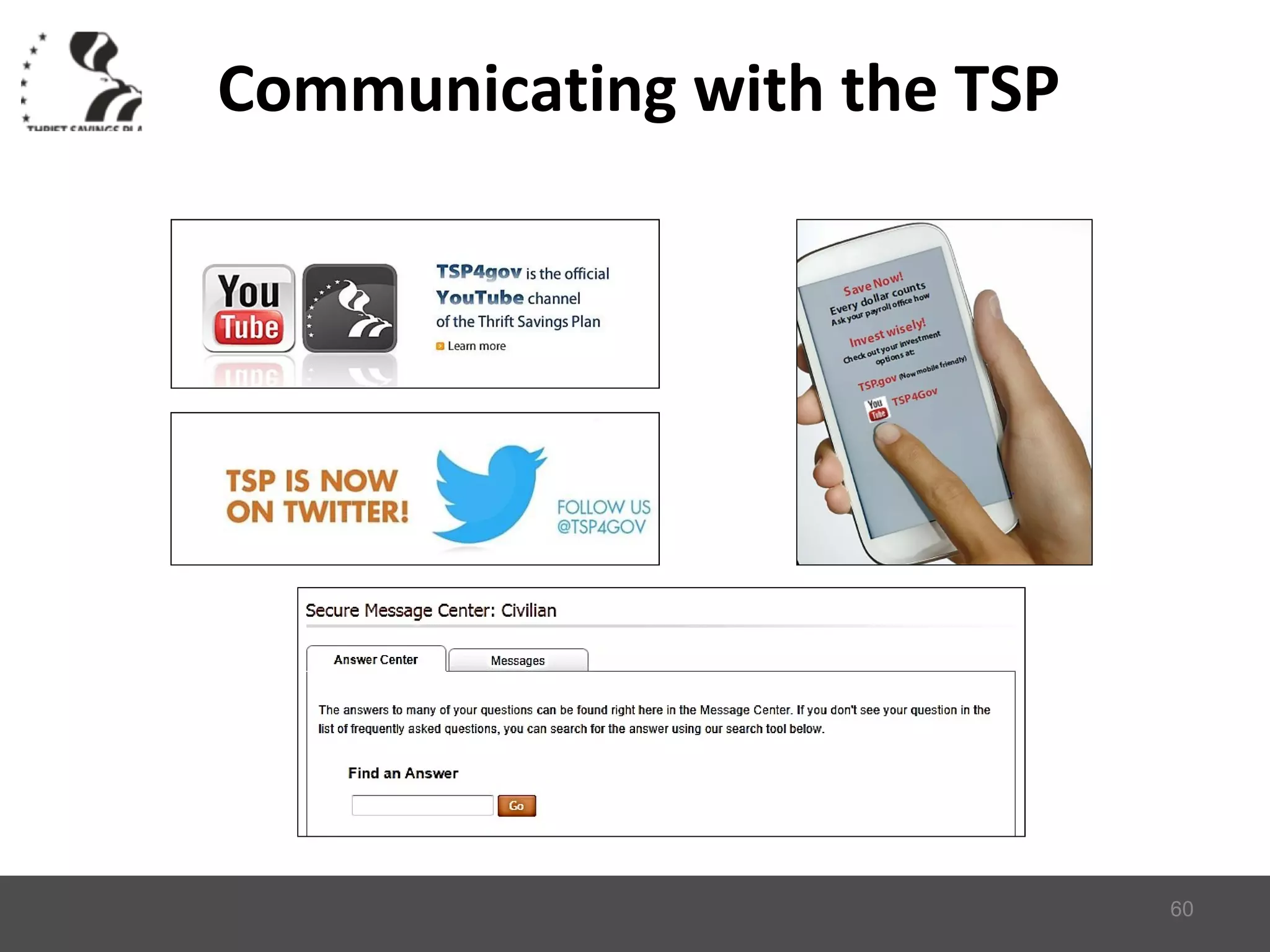
Communicating with the TSP
60
TSP Training Information for CY2016
TSP 101: Overview of the TSP
(2-day class)
TSP 200: Advanced TSP Topics
(1-day class)
TSP for the Uniformed Services
(1-day class)
Introductory course designed primarily for
human resources staff members who
administer all or part of the TSP program.
Covers all facets of the TSP including
automatic enrollment, contribution rules
and limits, traditional vs. Roth contributions,
how information is exchanged between the
TSP and employing agencies, vesting, the TSP
investment menu, court orders, loans,
withdrawals, and death benefits.
Advanced course for agency benefits officers
who are responsible for developing financial
education plans and providing retirement
financial education to their employees.
Explores frequently asked questions about
the and common misconceptions about the
TSP. Knowledge of the basic rules for TSP
eligibility and participation are prerequisites
for this course.
Course designed for individuals providing
personal financial counseling and/or
financial education in military environments.
Provides a fairly comprehensive overview of
the TSP with special emphasis on issues
most relevant to military financial educators.
It also may provide a basis for financial
educators to build their own TSP curriculum.
Covers contribution rules and limits,
traditional and Roth contributions, the TSP
investment funds, loans, withdrawals, and
death benefits.
March 22-23 March 24
April 20-21 April 22 April 14
May10-11 May 12
June 7-8 June 9
July 20-21 July 22
August 9-10 August 11 August 25
October 25-26 October 27
*Classes held at FRTIB in Washington DC 61
Agenda
• The 2016 National Defense Authorization Act includes major changes to the military
retirement system regarding service member participation in the TSP.
• Service members who contribute to the TSP must understand its role in providing
retirement income and how to manage this asset wisely.
• Service members must understand the steps to begin making contributions and
setting up an account on TSP.gov.
• Service members should understand which type of contribution is most advantageous
for them (Roth or Traditional).
• The Lifecycle Funds may be an excellent choice for service members because they
include an investment mix tailored to time horizons and are rebalanced and
readjusted automatically.
• Service members should understand the pros and cons of TSP loans and hardship
withdrawals before taking a loan or hardship withdrawal.
• TSP’s income options provide a great deal of flexibility and careful consideration
should be given before making any decisions.
62
Evaluation and CEUs/Certificate
of Completion
The Personal Finance Concentration Area offers
1.5 credit hours from AFCPE and FinCert
certificates of completion for today’s webinar.
To receive a certificate of completion, please
complete the evaluation and post-test found at:
https://vte.co1.qualtrics.com/jfe/form/SV_d6XVIo
QZtIUd8sB
Must pass post-test with an 80% or higher to
receive certificate. 63
Personal Finance Upcoming
Event
Savings Strategies for Military Families
• Date: Tuesday, February 16, 2016
• Time: 11 Eastern
• Location:
https://learn.extension.org/events/2344
For more information on MFLN- Personal Finance go to:
http://blogs.extension.org/militaryfamilies/personal-
finance/
64
Find all upcoming and recorded webinars covering:
Community Capacity Building
This material is based upon work supported by the National Institute of Food and Agriculture, U.S. Department of Agriculture, and the Office of Family
Readiness Policy, U.S. Department of Defense under Award Numbers 2010-48869-20685, 2012-48755-20306, and 2014-48770-22587.
www.extension.org/62581
65

Thrift Savings Plan Review

  • 1.
    Thrift Savings PlanReview https://learn.extension.org/events/2361 This material is based upon work supported by the National Institute of Food and Agriculture, U.S. Department of Agriculture, and the Office of Family Readiness Policy, U.S. Department of Defense under Award Numbers 2010-48869-20685, 2012-48755-20306, and 2014-48770-22587. 1
  • 2.
    Research and evidenced-based professionaldevelopment through engaged online communities www.extension.org/militaryfamilies Sign up for webinar email notifications at www.extension.org/62831 2
  • 3.
    Join the ConversationOnline! MFLN Personal Finance @MFLNPF Military Families Learning Network Military Families Learning Network LinkedIn Group https://www.linkedin.com/groups/8409844 3
  • 4.
    77 K StreetNE | Washington, D.C., 20002 | www.tsp.gov 4 Thrift Savings Plan Review Presented by Stewart Kaplan, AFC®, RFC, RPA Federal Retirement Thrift Investment Board
  • 5.
    Agenda • Overview ofthe 2016 NDAA – “Blended” Retirement System for the Uniformed Services • Overview of the Thrift Savings Plan 5
  • 6.
    TSP Rules under2016 NDAA “Blended” Retirement System for the Uniformed Services 6
  • 7.
    TSP Rules UnderBlended System* Effective Jan 1, 2018 2016 National Defense Authorization Act Automatic Contributions 1%, Begins 60 days after entry (or at election), Ends at 26 YOS Matching Contributions Up to 4%, Begins 2 YOS + 1 day after entry, Ends at 26 YOS Enrollment On or after 2 Jan 18: Automatic at entry; auto reenrollment every Jan if member has opted out Service member contribution rate 3% automatic; full match requires 5%, no default to Roth TSP Vesting of DoD contributions 2 YOS Opt-in eligibility Serving on 1/1/2018 and < 12 YOS as of 12/31/2017 Opt-in period 1/1/2018 – 12/31/2018 (+ hardship extensions) *As of Jan 8, 2016 7
  • 8.
    Overview of theThrift Savings Plan Make Wise Decisions Today—Retire with Dignity Tomorrow Saving for Retirement—Your TSP Contributions Investing for the Long Haul—Managing Your TSP Account Turning Savings to Income—TSP Income Options TSP Resources 8
  • 9.
    Retire With Dignity Tomorrow MakeWise Decisions Today 9
  • 10.
    What will yourretirement look like? • In retirement, the Thrift Savings Plan supplements fixed (formula-based) income sources ‒ Social Security ‒ Defined benefit plans, e.g., CSRS/FERS annuity, military pension • TSP account balance at retirement depends on: ‒ How long contributions are made ‒ How much has been contributed or withdrawn ‒ Earnings on contributions ‒ Plan expense ratio/fees 10
  • 11.
    Factors that affectTSP balance Helpful ‒ FERS: contribute enough to get full agency match  Contribute five percent to get maximum agency match of four percent ‒ Allocate contributions to investment funds based on appropriate balance of risk to return  Periodically: • Review account performance and long-term strategy • Rebalance and reallocate based on review  Or, choose a Lifecycle Fund – rebalancing and reallocations occur automatically 11
  • 12.
    Factors that affectTSP balance Harmful ‒ Frequent Interfund Transfers  Short-term, tactical moves using index funds is an unsuccessful long-term investment strategy ‒ Using TSP to access savings that should have been put into another type of account  Loans • Temporary depletion  Financial Hardship In-Service Withdrawals • Permanent depletion 12
  • 13.
  • 14.
    14 myPaymyPay Make contribution election: •Basic Pay •Special* •Incentive* •Bonus* Make contribution election: •Basic Pay •Special* •Incentive* •Bonus* Choosetax treatment:Choose tax treatment: Decide how much: •Percentage of basic pay •Plus a percentage from incentive, special and bonus pay Decide how much: •Percentage of basic pay •Plus a percentage from incentive, special and bonus pay and/or Enter birthdate and address: •Must update address each time you move •Note this is not the same as your DFAS correspondence address Enter birthdate and address: •Must update address each time you move •Note this is not the same as your DFAS correspondence address Receive correspondence from the TSP: •Welcome Letter •Account number •Temporary password needed to access account on TSP.gov Receive correspondence from the TSP: •Welcome Letter •Account number •Temporary password needed to access account on TSP.gov Establish account access: •Make a “contribution allocation” to allocate future contributions •Make an “interfund transfer” to change the investment of money already in your account Establish account access: •Make a “contribution allocation” to allocate future contributions •Make an “interfund transfer” to change the investment of money already in your account Roth (after-tax) •Contributions deducted from pay after Federal taxes are withheld •Federal taxes no longer apply to contributions •Earnings may be withdrawn tax-free once they are “qualified” Roth (after-tax) •Contributions deducted from pay after Federal taxes are withheld •Federal taxes no longer apply to contributions •Earnings may be withdrawn tax-free once they are “qualified” Traditional (tax-deferred) •Contributions deducted from pay before Federal taxes are withheld •Federal taxes are “deferred” •Taxes must be paid on everything when withdrawn Traditional (tax-deferred) •Contributions deducted from pay before Federal taxes are withheld •Federal taxes are “deferred” •Taxes must be paid on everything when withdrawn *must also contribute at least 1% from basic pay myPaymyPaymyPaymyPay myPaymyPay TSP.govTSP.govUS MailUS Mail How Do I Start? 14
  • 15.
  • 16.
  • 17.
    Address and Dateof Birth 17
  • 18.
  • 19.
    See “Calculators” under“Planning and Tools” on TSP.gov 19
  • 20.
    20 Use this calculatoron the TSP.gov website under “Planning and Tools” to find out!
  • 21.
    21 Example: E-3, under2 years (2015)
  • 22.
    22 Your future contributions: $14,499.00 Growth ofyour future contributions: $139,808.72 Total estimated TSP account balance: $152,307.72 Example: E-3, under 2 years (2015) 22
  • 23.
    23 20 Your future contributions: $40,464.36 Growth ofyour future contributions: $250,499.35 Total estimated TSP account balance: $290,963.71 Example: E-3, under 2 years (2015) 23
  • 24.
    24 30 Your future contributions: $73,082.88 Growth ofyour future contributions: $294,188.58 Total estimated TSP account balance: $367,271.46 5.00% Example: E-3, under 2 years (2015) 24
  • 25.
    25 30 Your future contributions: $102,315.96 Growth ofyour future contributions: $411,864.62 Total estimated TSP account balance: $514,180.58 5.00% 7% Example: E-3, under 2 years (2015) 25
  • 26.
    Traditional TSP • Federalincome taxes are deferred on “Traditional” contributions made to the TSP ‒ Contributions are deducted from pay before Federal taxes are withheld, i.e., contributions are “pre-tax” ‒ Employee pays Federal income taxes only on remaining salary • Participants pay Federal income tax on distributions from their TSP account based on the applicable tax rate for the year they receive them • Deferral of state or county taxes is determined by each individual jurisdiction 26
  • 27.
    Roth TSP • Federalincome taxes are withheld on “Roth” contributions made to the TSP ‒ Contributions are deducted from pay after Federal taxes are withheld, i.e., contributions are “after-tax” ‒ Employee pays Federal income taxes on entire salary • Participants will not pay Federal income tax on distributions from their TSP account in the future: ‒ For the portion that consists only of contributions ‒ For the portion that consists of earnings if they meet both criteria to be “qualified”  Five years have passed since January 1 of the year participant made their first Roth contribution  Are age 59½ or older, permanently disabled, or deceased 27
  • 28.
    25% You make aTraditional Contribution of $10,000 You make a Roth Contribution of $7,500 (and pay $2,500 in Federal income taxes for current year) After tax distribution Tax free distribution 15% $46,133 $40,706 25% $40,706 $40,706 28% $39,078 $40,706 assuming 7% average annual rate of return) Traditional or Roth? In 25 years, tax rate is: In 25 years, tax rate is: Current tax rate is: Current tax rate is: Equal impact on net pay Example: OR 28
  • 29.
    1 Net cost toTSP participants, averaged across all funds 2 All-in, participant-weighted cost of large 401(k) plans. Source: Deloitte, Inside the Structure of Defined Contribution/401(k) Plan Fees, 2013 3 Asset-weighted average expense ratio for equity mutual funds. Source: Investment Company Institute, 2014 Investment Company Factbook TSP 401(k) Plans Retail Mutual Funds 29
  • 30.
    (Assuming 7% annualrate of return) $377,425 TSP @ .029% $336,477 401k Plans @ .41% $307,361 Mutual Funds @ .74% Years 30 30
  • 31.
  • 32.
  • 33.
  • 34.
    (F Fund) (CFund) (S Fund) (I Fund) $596.77 $1730.02 $1525.64 $405.03 $410.52 $205.20 Growth of $100 TSP-Related Indices, 1987-2014 34
  • 35.
    L Income L 2020L 2030 L 2040 L 2050 Lifecycle Funds Investment Allocation* *As of Jan 2016 35
  • 36.
    Logic of theLifecycle Funds G 74% Investment in the L Funds does not protect from investment losses Expected Risk HighLow HighLowExpectedReturn 36
  • 37.
     Choose anasset allocation that corresponds to your time horizon  Rebalance and reallocate accordingly, or  Choose a Lifecycle Fund Use a long-term strategyUse a long-term strategy  Studies show no evidence of successful outcomes using “market timing” strategies  Attempting to time the market increases the risk of not being invested when the market goes up significantly  Loans  Financial Hardship Withdrawals Don’t attempt to “time the market” Avoid using the TSP as a solution to meet short-term financial needs 37
  • 38.
    Participant-Directed Account Transactions Contribution AllocationInterfund Transfer - Tells the TSP how participant wants new money going into their account to be invested among the TSP investment fund options - Includes employee contributions, agency contributions, TSP loan payments, and any transferred or rollover funds - Allows participant to transfer all or part of their existing TSP fund balances among the different TSP investment fund options - Does not affect the investment of future deposits into their TSP account May be done via TSP ThriftLine or TSP.gov Generally effective as of close of business each day (based on 12 noon ET cutoff) Participant will receive confirmation via website, email or mail 38
  • 39.
    Residential For purchase orconstruction of a primary residence only (pay back in 1-15 years) General Purpose No documentation required (pay back in 1-5 years) Types of Loans 39
  • 40.
    Costs of aLoan • $50 processing fee - deducted when loan is disbursed • Loan interest ‒ Based on G fund rate at time application is processed ‒ Fixed for life of the loan • The invisible (and possibly the largest) cost is foregone investment earnings and reduced compounding of retirement savings 40
  • 41.
    Financial Hardship Withdrawals •Qualifying circumstances ‒ Negative monthly cash flow ‒ Medical expenses ‒ Personal casualty losses ‒ Legal expenses for separation or divorce • Restrictions ‒ Minimum withdrawal $1,000 ‒ May only withdraw your own contributions and earnings ‒ Six month non-contribution/waiting period 41
  • 42.
    Costs of aFinancial Hardship Withdrawal • Withdrawal can’t be repaid – permanently reduces retirement savings • Contributions suspended for 6 months ‒ No contributions means no matching (FERS) • Withholding rate is 10%, actual tax is likely to be higher • Additional 10% penalty tax on distributions prior to age 59½ See tsp.gov/plan participation or the TSP booklet: “In-Service Withdrawals,” for more information 42
  • 43.
    TSP INCOME OPTIONS TurningSavings to Income 43
  • 44.
    Partial Withdrawal (Must beseparated) • Allows for a one time withdrawal of a minimum of $1,000 up to the entire balance of the account • Withdrawing entire balance will close out account • Provides an opportunity to transfer a portion of account to an IRA or another qualified plan • Participants should discuss and understand all options with tax or financial professional before making withdrawal decisions See the instructions for Form TSP-77, Request for a Partial Withdrawal When Separated, for more information 44
  • 45.
  • 46.
  • 47.
    • Use forretirement income or use for purposes other than retirement income? • Income Options ‒ Flexible income: Monthly payments ‒ Guaranteed income: Life annuities ‒ Custom solutions: Mixed withdrawals • Participants with both Uniformed Services and civilian TSP accounts may combine them* Options *See the instructions for Form TSP-65, Request to Combine Civilian and Uniformed Services TSP Accounts, for more information 47
  • 48.
    Wait • If incomeis not needed until retirement, leave your savings in the plan and do nothing • Continue to stay invested in the TSP funds and earn market returns • Continue to defer income taxes until distributions begin 48
  • 49.
    Flexible Income • Monthlypayments by fixed dollar amount ‒ Amount specified by participant ‒ Minimum payment $25 ‒ Amount may be changed annually • Monthly payments based on life expectancy ‒ Payments are computed by TSP ‒ Amount automatically adjusts annually 49
  • 50.
  • 51.
    Guaranteed Income • TSPlife annuity ‒ Income is guaranteed for the life of the annuitant(s) ‒ Funds are transferred from TSP to the annuity provider, and benefits are “locked in” when request is processed 51
  • 52.
    Lump Sum Withdrawal •May request all or any percentage of account balance as a single payment ‒ Treated as an eligible rollover distribution 52
  • 53.
  • 54.
    Exceptions to the IRSEarly Withdrawal Penalty The 10% IRS Early Withdrawal Penalty does not apply to payments that are: • Received at age 59½ or later • Received after you separate/retire during or after the year you reach age 55 (or the year you reach age 50 if you are a public safety employee as defined in section 72(t)(10)(B)(ii) of the internal revenue code • Received in a year you have deductible medical expenses that exceed 10% of your adjusted gross income (7.5% if you or your spouse is 65 or over) • Received as a result of total and permanent disability* • Annuity payments • TSP monthly payments based on life expectancy • Ordered by a domestic relations court • Made because of death • Made from a beneficiary participant account * Participant must provide the justification to IRS when they file their taxes See: IRS Publications 575, Pension and Annuity Income and IRS Publication 721, Tax Guide to U.S. Civil Service Benefits 54
  • 55.
    Spouses’ Rights Retirement PlanRequirement* Exceptions† FERS or Uniformed Services Notarized spouse signature required** Whereabouts unknown or exceptional circumstances - TSP-16 or TSP-U-16 required CSRS Spouse is entitled to notification of the participant’s withdrawal election Whereabouts unknown - TSP-16 required * If account balance is less than $3,500, spouse’s signature/notice is not required **If married but no spouse signature: Spouse is entitled to a Joint Life Annuity with 50% Survivor Benefits, Level Payments, and no cash refund feature † Waiver of spouse’s signature/notification valid for 90 days from approval 55
  • 56.
  • 57.
  • 58.
  • 59.
  • 60.
  • 61.
    TSP Training Informationfor CY2016 TSP 101: Overview of the TSP (2-day class) TSP 200: Advanced TSP Topics (1-day class) TSP for the Uniformed Services (1-day class) Introductory course designed primarily for human resources staff members who administer all or part of the TSP program. Covers all facets of the TSP including automatic enrollment, contribution rules and limits, traditional vs. Roth contributions, how information is exchanged between the TSP and employing agencies, vesting, the TSP investment menu, court orders, loans, withdrawals, and death benefits. Advanced course for agency benefits officers who are responsible for developing financial education plans and providing retirement financial education to their employees. Explores frequently asked questions about the and common misconceptions about the TSP. Knowledge of the basic rules for TSP eligibility and participation are prerequisites for this course. Course designed for individuals providing personal financial counseling and/or financial education in military environments. Provides a fairly comprehensive overview of the TSP with special emphasis on issues most relevant to military financial educators. It also may provide a basis for financial educators to build their own TSP curriculum. Covers contribution rules and limits, traditional and Roth contributions, the TSP investment funds, loans, withdrawals, and death benefits. March 22-23 March 24 April 20-21 April 22 April 14 May10-11 May 12 June 7-8 June 9 July 20-21 July 22 August 9-10 August 11 August 25 October 25-26 October 27 *Classes held at FRTIB in Washington DC 61
  • 62.
    Agenda • The 2016National Defense Authorization Act includes major changes to the military retirement system regarding service member participation in the TSP. • Service members who contribute to the TSP must understand its role in providing retirement income and how to manage this asset wisely. • Service members must understand the steps to begin making contributions and setting up an account on TSP.gov. • Service members should understand which type of contribution is most advantageous for them (Roth or Traditional). • The Lifecycle Funds may be an excellent choice for service members because they include an investment mix tailored to time horizons and are rebalanced and readjusted automatically. • Service members should understand the pros and cons of TSP loans and hardship withdrawals before taking a loan or hardship withdrawal. • TSP’s income options provide a great deal of flexibility and careful consideration should be given before making any decisions. 62
  • 63.
    Evaluation and CEUs/Certificate ofCompletion The Personal Finance Concentration Area offers 1.5 credit hours from AFCPE and FinCert certificates of completion for today’s webinar. To receive a certificate of completion, please complete the evaluation and post-test found at: https://vte.co1.qualtrics.com/jfe/form/SV_d6XVIo QZtIUd8sB Must pass post-test with an 80% or higher to receive certificate. 63
  • 64.
    Personal Finance Upcoming Event SavingsStrategies for Military Families • Date: Tuesday, February 16, 2016 • Time: 11 Eastern • Location: https://learn.extension.org/events/2344 For more information on MFLN- Personal Finance go to: http://blogs.extension.org/militaryfamilies/personal- finance/ 64
  • 65.
    Find all upcomingand recorded webinars covering: Community Capacity Building This material is based upon work supported by the National Institute of Food and Agriculture, U.S. Department of Agriculture, and the Office of Family Readiness Policy, U.S. Department of Defense under Award Numbers 2010-48869-20685, 2012-48755-20306, and 2014-48770-22587. www.extension.org/62581 65

Editor's Notes

  • #46 Alt = “TSP withdrawal form”
  • #47 Alt = “Zoom in on bulletin text”
  • #50 Alt = “Monthly payment election on Form TSP-70”
  • #51 Alt = “Transfers and rollovers funneling into TSP”
  • #52 Alt = “Life annuity election on Form TSP-70”
  • #53 Alt = “Mixed withdrawal election on Form TSP-70”
  • #54 Alt = Mixed withdrawal election on Form TSP-70”