










Top10 SMSF Strategies for 2011/12Aaron DunnManaging Director, The SMSF Academy
This presentation provided general advice only.  No direct or implicit recommendations are given in this document. This means that the general advice provided has not been prepared taking into account an individual’s financial circumstances (i.e. investment objectives, financial situation and particular investment needs).  You should assess whether the advice is appropriate to your individual financial circumstances before making an investment decision. You can either assess the advice yourself or seek the help of an authorised representative through an Australian Financial Services License (AFSL) holder.The SMSF Academy Pty Ltd believes that the information in this presentation is correct at the time of compilation but does not warrant the accuracy of that information. Save for statutory liability which cannot be excluded, The SMSF Academy disclaims all responsibility for any loss or damage which any person may suffer from reliance on this information or any opinion, conclusion or recommendation in this presentation whether the loss or damage is caused by any fault or negligence on the part of presenter or otherwise. General AdviceDisclaimer
Strategy 1:Contribution Splitting is back in vouge!
A reincarnation of RBLs?Government proposal to extend contribution cap for over 50’s with balance of less than $500,000Consultation paper dealing with parameters including:How to calculate member balances?Assessment model?What financial year to use for assessment?SMSF specific issues
ExampleJohn (52) – member account balance of $489,000 SMSF audited financials at 30 June 2011For the 2011/12 financial year:$50,000 concession contributionNet earnings of $10,000Closing Balance of $541,500What level of contributions will John be able to make from 1 July 2012?Answer: $50,000Why? Government likely to utilise balance ‘two years’ prior (i.e. 30 June 2011)Contribution Splitting benefit?Remember: $50,000 cannot be split until 1 July each year30 June 2011 member balances become very important!!Think about whether the 2010 contributions should be split when doing the 2011 financials.
Strategy 2:Contributions Reserve – strategy & saviour
Using a Contributions ReserveAbility to “park” contributions for up to 28 days after the end of month in which contribution madeJune contributions can be held-over until following financial year (allocated before 28 July)Deduction for taxpayer when paidAssessed against cap when allocated to the memberNTLG Super Technical Sub Group Committee minutes 16 June 2009Applicable to both concessional and non-concessional contributions
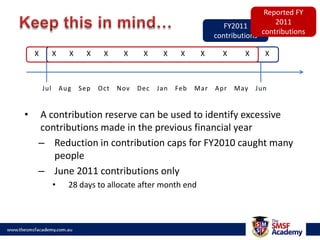
Reported FY 2011 contributionsKeep this in mind…FY2011 contributions  X     XX     X     XXXXXXXXXJul   Aug   Sep   Oct   Nov   Dec   Jan   Feb   Mar   Apr   May   JunA contribution reserve can be used to identify excessive contributions made in the previous financial yearReduction in contribution caps for FY2010 caught many peopleJune 2011 contributions only 28 days to allocate after month end
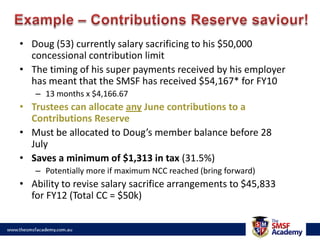
Example – Contributions Reserve saviour!Doug (53) currently salary sacrificing to his $50,000 concessional contribution limitThe timing of his super payments received by his employer has meant that the SMSF has received $54,167* for FY1013 months x $4,166.67Trustees can allocate any June contributions to a Contributions ReserveMust be allocated to Doug’s member balance before 28 JulySaves a minimum of $1,313 in tax (31.5%)Potentially more if maximum NCC reached (bring forward)Ability to revise salary sacrifice arrangements to $45,833 for FY12 (Total CC = $50k)
Strategy 3:Contributions Deferral
Contributions DeferralWhat if your client is on the top MTR (46.5%)?Can potentially salary sacrifice or make a personal deductible contribution up to CC cap plus up to NCC capEmployer / individual receives full deduction on contributionExcess tax payable, but on receipt of a Notice of Assessment (NoA)Provided no further NCCs or excess CCs made in subsequent years there is no double taxation but get the benefit of the assessment deferral
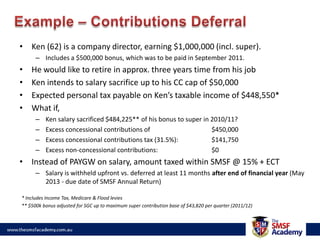
Example – Contributions DeferralKen (62) is a company director, earning $1,000,000 (incl. super). Includes a $500,000 bonus, which was to be paid in September 2011.He would like to retire in approx. three years time from his jobKen intends to salary sacrifice up to his CC cap of $50,000Expected personal tax payable on Ken’s taxable income of $448,550*What if,Ken salary sacrificed $484,225** of his bonus to super in 2010/11?Excess concessional contributions of 		$450,000Excess concessional contributions tax (31.5%):		$141,750Excess non-concessional contributions:		$0Instead of PAYGW on salary, amount taxed within SMSF @ 15% + ECTSalary is withheld upfront vs. deferred at least 11 months after end of financial year (May 2013 - due date of SMSF Annual Return)* Includes Income Tax, Medicare & Flood levies** $500k bonus adjusted for SGC up to maximum super contribution base of $43,820 per quarter (2011/12)
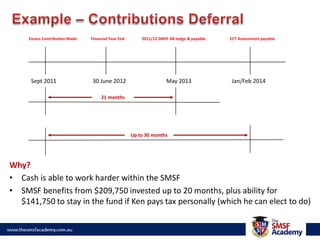
Example – Contributions DeferralExcess Contribution Made              Financial Year End	                 2011/12 SMSF AR lodge & payable 	         ECT Assessment payableSept 2011	    30 June 2012	           May 2013Jan/Feb 201421 monthsUp to 30 monthsWhy?Cash is able to work harder within the SMSFSMSF benefits from $209,750 invested up to 20 months, plus ability for $141,750 to stay in the fund if Ken pays tax personally (which he can elect to do)
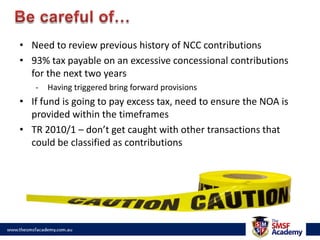
Be careful of…Need to review previous history of NCC contributions
93% tax payable on an excessive concessional contributions for the next two years
Having triggered bring forward provisions
If fund is going to pay excess tax, need to ensure the NOA is provided within the timeframes
TR 2010/1 – don’t get caught with other transactions that could be classified as contributionsStrategy 4:SMSF Limited Recourse Borrowing
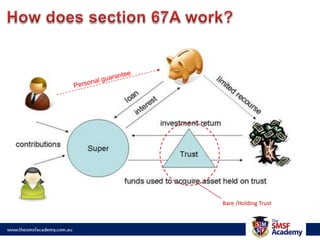
How does section 67A work?Personal guaranteeBare /Holding Trust
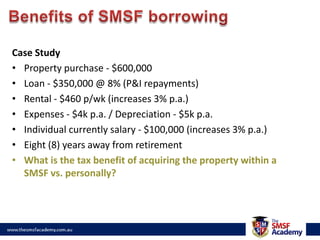
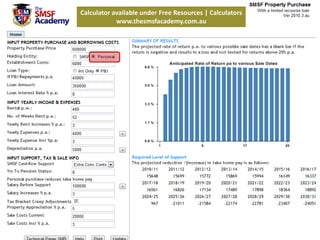
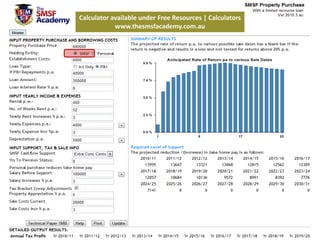
Benefits of SMSF borrowingCase StudyProperty purchase - $600,000Loan - $350,000 @ 8% (P&I repayments)Rental - $460 p/wk (increases 3% p.a.)Expenses - $4k p.a. / Depreciation - $5k p.a.Individual currently salary - $100,000 (increases 3% p.a.)Eight (8) years away from retirementWhat is the tax benefit of acquiring the property within a SMSF vs. personally?
Calculator available under Free Resources | Calculators www.thesmsfacademy.com.au
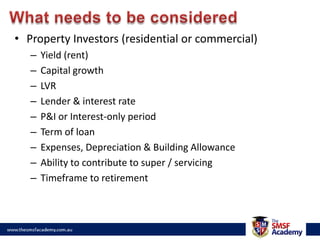
What needs to be consideredProperty Investors (residential or commercial)Yield (rent)Capital growthLVRLender & interest rateP&I or Interest-only periodTerm of loanExpenses, Depreciation & Building AllowanceAbility to contribute to super / servicingTimeframe to retirement
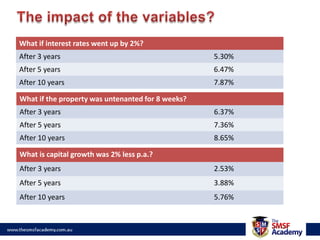
The impact of the variables?
Strategy 5:Borrowing for Property Development
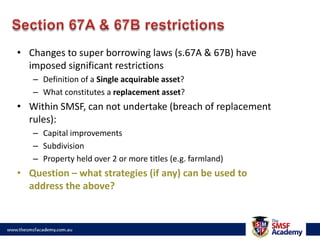
Section 67A & 67B restrictionsChanges to super borrowing laws (s.67A & 67B) have imposed significant restrictionsDefinition of a Single acquirable asset? What constitutes a replacement asset?Within SMSF, can not undertake (breach of replacement rules):Capital improvementsSubdivision Property held over 2 or more titles (e.g. farmland)Question – what strategies (if any) can be used to address the above?
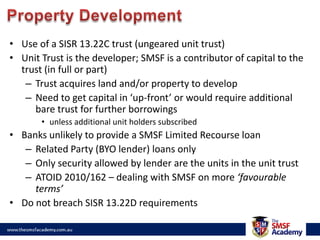
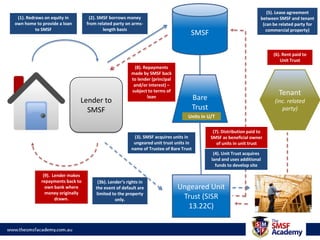
Property DevelopmentUse of a SISR 13.22C trust (ungeared unit trust)Unit Trust is the developer; SMSF is a contributor of capital to the trust (in full or part)Trust acquires land and/or property to developNeed to get capital in ‘up-front’ or would require additional bare trust for further borrowingsunless additional unit holders subscribedBanks unlikely to provide a SMSF Limited Recourse loanRelated Party (BYO lender) loans onlyOnly security allowed by lender are the units in the unit trustATOID 2010/162 – dealing with SMSF on more ‘favourable terms’Do not breach SISR 13.22D requirements
SMSF(5). Lease agreement between SMSF and tenant (can be related party for commercial property)(1). Redraws on equity in own home to provide a loan to SMSF(2). SMSF borrows money from related party on arms-length basis(6). Rent paid to Unit Trust(8). Repayments made by SMSF back to lender (principal and/or interest) – subject to terms of loanTenant(inc. related party)Bare Trust Lender to SMSFUnits in U/T(7). Distribution paid to SMSF as beneficial owner of units in unit trust(3). SMSF acquires units in ungeared unit trust units in name of Trustee of Bare Trust(4). Unit Trust acquires land and uses additional funds to develop site(9).  Lender makes repayments back to own bank where money originally drawn.Ungeared Unit Trust (SISR 13.22C)(3b). Lender’s rights in the event of default are limited to the property only.
Strategy 6:Taking the minimum Pension as Lump Sum
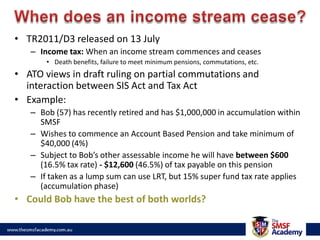
When does an income stream cease?TR2011/D3 released on 13 JulyIncome tax: When an income stream commences and ceasesDeath benefits, failure to meet minimum pensions, commutations, etc.ATO views in draft ruling on partial commutations and interaction between SIS Act and Tax ActExample:Bob (57) has recently retired and has $1,000,000 in accumulation within SMSFWishes to commence an Account Based Pension and take minimum of $40,000 (4%)Subject to Bob’s other assessable income he will have between$600 (16.5% tax rate) -$12,600 (46.5%) of tax payable on this pensionIf taken as a lump sum can use LRT, but 15% super fund tax rate applies (accumulation phase)Could Bob have the best of both worlds?
Yes, he canWhere pension is partially commuted and payment is elected to be received as a lump sum, this amount will count towards the member’s minimum pension for the financial year. This benefit payment can be made in cash or in-speciePartial Commutation Example
Strategy 7:Locking in tax-free proportion for pensions
Proportioning RuleSimpler Super introduce many changes including the proportioning rule when commencing an income streamProportioning rule locks in the tax-free and taxable componentWhy is this important?Greater tax efficiency for pensions under 60 years of ageEstate planning benefits
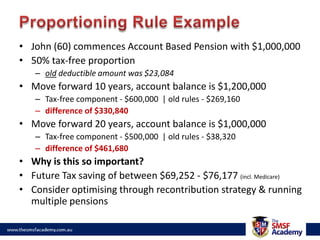
Proportioning Rule ExampleJohn (60) commences Account Based Pension with $1,000,00050% tax-free proportionolddeductible amount was $23,084Move forward 10 years, account balance is $1,200,000Tax-free component - $600,000  | old rules - $269,160   difference of $330,840Move forward 20 years, account balance is $1,000,000Tax-free component - $500,000  | old rules - $38,320   difference of $461,680Why is this so important?Future Tax saving of between $69,252 - $76,177 (incl. Medicare)Consider optimising through recontribution strategy & running multiple pensions
Strategy 8:Using segregation effectively
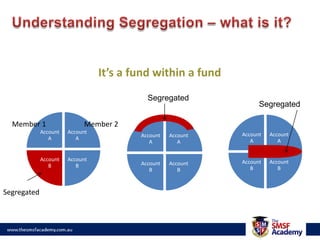
SegregatedUnderstanding Segregation – what is it?It’s a fund within a fundSegregatedSegregatedMember 1Member 2Segregated
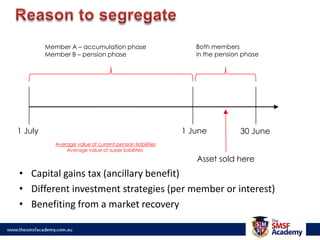
Reason to segregateBoth members in the pension phaseMember A – accumulation phaseMember B – pension phase 1 July 1 June30 June Average value of current pension liabilitiesAverage value of super liabilities Asset sold hereCapital gains tax (ancillary benefit)Different investment strategies (per member or interest)Benefiting from a market recovery
Strategy 9:Understanding the benefits of Anti-detriment
Anti-detriment tax deductionSection 295-485 ITAA 1997Additional amount paid in the event of the death of a member (tax saving amount) to compensate for tax paid on contributions received.Use Audit Method or Calculation Method (ATOID 2010/5) to determine amountHow to ‘fund’ the tax saving amount?Tax deduction claimed only on amount paid as lump sumConfirmed in ATO NLTG Super Technical Meeting Minutes – March 2011
Anti-detriment ExampleFrank (58) recently passed away and is survived by his wife MariaDeath benefit of $550,000 to be paidMaria wishes to take $150,000 as a lump sum with balance as an Account Based Pension (ABP)Can we claim a deduction for the tax saving amount and how much can we claim?
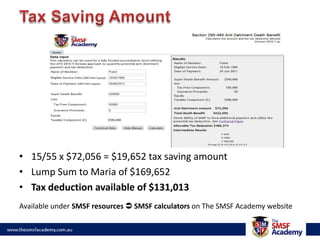
Tax Saving Amount15/55 x $72,056 = $19,652 tax saving amountLump Sum to Maria of $169,652Tax deduction available of $131,013Available under SMSF resources  SMSF calculators on The SMSF Academy website
Strategy 10:Maximising the death benefit with a Future Liability benefit deduction
Future Liability Benefit DeductionSection 295-470 ITAA 1997Lesser known estate planning tool particularly beneficial for SMSFsElection to claim tax deduction on future liability benefit replaces claim of deduction for insurance premium where:Member dies*, Disability superannuation benefit is paid*,Income stream is paid as a result of temporary incapacity	* Must be in connected with employmentNote: SMSF becomes ineligible claim future insurance premium deductions for membersNo need for the fund to have insurance to claim the deduction
Future Liability Benefit ExampleJohn dies suddenly at age 50 and is survived by wife, Jane (48) and two (2) sons, Robert (23) & Chris (19)Member balance of $600,000 in SMSF ($120k TFC)Life Insurance policy of $650,000 in which fund is ordinarily entitled to a tax deductionJohn’s service period (work) was 24 yearsWhat tax deduction can the fund claim for the Future Liability to pay benefits?$1,250,000 x (15 years / 39 years) = $480,769Remember that no tax deduction can be claimed for the insurance in the elected year of the tax deduction Regardless of previous years where tax deduction was claimedLook to magnify the tax deduction using both anti-detriment and future liability to pay benefits.
                            Top10 SMSF StrategiesContribution splitting back in vogue!!Contribution ReservesContribution DeferralSMSF Limited Recourse BorrowingBorrowing for Property DevelopmentMinimum Pension as Lump SumLocking in Tax-Free proportion income streamsUsing segregation effectivelyAnti-detrimentFuture Liability Benefit

Top10 SMSF strategies for 2011/12

  • 1.
    Top10 SMSF Strategiesfor 2011/12Aaron DunnManaging Director, The SMSF Academy
  • 2.
    This presentation providedgeneral advice only. No direct or implicit recommendations are given in this document. This means that the general advice provided has not been prepared taking into account an individual’s financial circumstances (i.e. investment objectives, financial situation and particular investment needs). You should assess whether the advice is appropriate to your individual financial circumstances before making an investment decision. You can either assess the advice yourself or seek the help of an authorised representative through an Australian Financial Services License (AFSL) holder.The SMSF Academy Pty Ltd believes that the information in this presentation is correct at the time of compilation but does not warrant the accuracy of that information. Save for statutory liability which cannot be excluded, The SMSF Academy disclaims all responsibility for any loss or damage which any person may suffer from reliance on this information or any opinion, conclusion or recommendation in this presentation whether the loss or damage is caused by any fault or negligence on the part of presenter or otherwise. General AdviceDisclaimer
  • 3.
  • 4.
    A reincarnation ofRBLs?Government proposal to extend contribution cap for over 50’s with balance of less than $500,000Consultation paper dealing with parameters including:How to calculate member balances?Assessment model?What financial year to use for assessment?SMSF specific issues
  • 5.
    ExampleJohn (52) –member account balance of $489,000 SMSF audited financials at 30 June 2011For the 2011/12 financial year:$50,000 concession contributionNet earnings of $10,000Closing Balance of $541,500What level of contributions will John be able to make from 1 July 2012?Answer: $50,000Why? Government likely to utilise balance ‘two years’ prior (i.e. 30 June 2011)Contribution Splitting benefit?Remember: $50,000 cannot be split until 1 July each year30 June 2011 member balances become very important!!Think about whether the 2010 contributions should be split when doing the 2011 financials.
  • 6.
    Strategy 2:Contributions Reserve– strategy & saviour
  • 7.
    Using a ContributionsReserveAbility to “park” contributions for up to 28 days after the end of month in which contribution madeJune contributions can be held-over until following financial year (allocated before 28 July)Deduction for taxpayer when paidAssessed against cap when allocated to the memberNTLG Super Technical Sub Group Committee minutes 16 June 2009Applicable to both concessional and non-concessional contributions
  • 8.
    Reported FY 2011contributionsKeep this in mind…FY2011 contributions X XX X XXXXXXXXXJul Aug Sep Oct Nov Dec Jan Feb Mar Apr May JunA contribution reserve can be used to identify excessive contributions made in the previous financial yearReduction in contribution caps for FY2010 caught many peopleJune 2011 contributions only 28 days to allocate after month end
  • 9.
    Example – ContributionsReserve saviour!Doug (53) currently salary sacrificing to his $50,000 concessional contribution limitThe timing of his super payments received by his employer has meant that the SMSF has received $54,167* for FY1013 months x $4,166.67Trustees can allocate any June contributions to a Contributions ReserveMust be allocated to Doug’s member balance before 28 JulySaves a minimum of $1,313 in tax (31.5%)Potentially more if maximum NCC reached (bring forward)Ability to revise salary sacrifice arrangements to $45,833 for FY12 (Total CC = $50k)
  • 10.
  • 11.
    Contributions DeferralWhat ifyour client is on the top MTR (46.5%)?Can potentially salary sacrifice or make a personal deductible contribution up to CC cap plus up to NCC capEmployer / individual receives full deduction on contributionExcess tax payable, but on receipt of a Notice of Assessment (NoA)Provided no further NCCs or excess CCs made in subsequent years there is no double taxation but get the benefit of the assessment deferral
  • 12.
    Example – ContributionsDeferralKen (62) is a company director, earning $1,000,000 (incl. super). Includes a $500,000 bonus, which was to be paid in September 2011.He would like to retire in approx. three years time from his jobKen intends to salary sacrifice up to his CC cap of $50,000Expected personal tax payable on Ken’s taxable income of $448,550*What if,Ken salary sacrificed $484,225** of his bonus to super in 2010/11?Excess concessional contributions of $450,000Excess concessional contributions tax (31.5%): $141,750Excess non-concessional contributions: $0Instead of PAYGW on salary, amount taxed within SMSF @ 15% + ECTSalary is withheld upfront vs. deferred at least 11 months after end of financial year (May 2013 - due date of SMSF Annual Return)* Includes Income Tax, Medicare & Flood levies** $500k bonus adjusted for SGC up to maximum super contribution base of $43,820 per quarter (2011/12)
  • 13.
    Example – ContributionsDeferralExcess Contribution Made Financial Year End 2011/12 SMSF AR lodge & payable ECT Assessment payableSept 2011 30 June 2012 May 2013Jan/Feb 201421 monthsUp to 30 monthsWhy?Cash is able to work harder within the SMSFSMSF benefits from $209,750 invested up to 20 months, plus ability for $141,750 to stay in the fund if Ken pays tax personally (which he can elect to do)
  • 14.
    Be careful of…Needto review previous history of NCC contributions
  • 15.
    93% tax payableon an excessive concessional contributions for the next two years
  • 16.
    Having triggered bringforward provisions
  • 17.
    If fund isgoing to pay excess tax, need to ensure the NOA is provided within the timeframes
  • 18.
    TR 2010/1 –don’t get caught with other transactions that could be classified as contributionsStrategy 4:SMSF Limited Recourse Borrowing
  • 19.
    How does section67A work?Personal guaranteeBare /Holding Trust
  • 20.
    Benefits of SMSFborrowingCase StudyProperty purchase - $600,000Loan - $350,000 @ 8% (P&I repayments)Rental - $460 p/wk (increases 3% p.a.)Expenses - $4k p.a. / Depreciation - $5k p.a.Individual currently salary - $100,000 (increases 3% p.a.)Eight (8) years away from retirementWhat is the tax benefit of acquiring the property within a SMSF vs. personally?
  • 21.
    Calculator available underFree Resources | Calculators www.thesmsfacademy.com.au
  • 22.
    Calculator available underFree Resources | Calculators www.thesmsfacademy.com.au
  • 23.
    What needs tobe consideredProperty Investors (residential or commercial)Yield (rent)Capital growthLVRLender & interest rateP&I or Interest-only periodTerm of loanExpenses, Depreciation & Building AllowanceAbility to contribute to super / servicingTimeframe to retirement
  • 24.
    The impact ofthe variables?
  • 25.
    Strategy 5:Borrowing forProperty Development
  • 26.
    Section 67A &67B restrictionsChanges to super borrowing laws (s.67A & 67B) have imposed significant restrictionsDefinition of a Single acquirable asset? What constitutes a replacement asset?Within SMSF, can not undertake (breach of replacement rules):Capital improvementsSubdivision Property held over 2 or more titles (e.g. farmland)Question – what strategies (if any) can be used to address the above?
  • 27.
    Property DevelopmentUse ofa SISR 13.22C trust (ungeared unit trust)Unit Trust is the developer; SMSF is a contributor of capital to the trust (in full or part)Trust acquires land and/or property to developNeed to get capital in ‘up-front’ or would require additional bare trust for further borrowingsunless additional unit holders subscribedBanks unlikely to provide a SMSF Limited Recourse loanRelated Party (BYO lender) loans onlyOnly security allowed by lender are the units in the unit trustATOID 2010/162 – dealing with SMSF on more ‘favourable terms’Do not breach SISR 13.22D requirements
  • 28.
    SMSF(5). Lease agreementbetween SMSF and tenant (can be related party for commercial property)(1). Redraws on equity in own home to provide a loan to SMSF(2). SMSF borrows money from related party on arms-length basis(6). Rent paid to Unit Trust(8). Repayments made by SMSF back to lender (principal and/or interest) – subject to terms of loanTenant(inc. related party)Bare Trust Lender to SMSFUnits in U/T(7). Distribution paid to SMSF as beneficial owner of units in unit trust(3). SMSF acquires units in ungeared unit trust units in name of Trustee of Bare Trust(4). Unit Trust acquires land and uses additional funds to develop site(9). Lender makes repayments back to own bank where money originally drawn.Ungeared Unit Trust (SISR 13.22C)(3b). Lender’s rights in the event of default are limited to the property only.
  • 29.
    Strategy 6:Taking theminimum Pension as Lump Sum
  • 30.
    When does anincome stream cease?TR2011/D3 released on 13 JulyIncome tax: When an income stream commences and ceasesDeath benefits, failure to meet minimum pensions, commutations, etc.ATO views in draft ruling on partial commutations and interaction between SIS Act and Tax ActExample:Bob (57) has recently retired and has $1,000,000 in accumulation within SMSFWishes to commence an Account Based Pension and take minimum of $40,000 (4%)Subject to Bob’s other assessable income he will have between$600 (16.5% tax rate) -$12,600 (46.5%) of tax payable on this pensionIf taken as a lump sum can use LRT, but 15% super fund tax rate applies (accumulation phase)Could Bob have the best of both worlds?
  • 31.
    Yes, he canWherepension is partially commuted and payment is elected to be received as a lump sum, this amount will count towards the member’s minimum pension for the financial year. This benefit payment can be made in cash or in-speciePartial Commutation Example
  • 32.
    Strategy 7:Locking intax-free proportion for pensions
  • 33.
    Proportioning RuleSimpler Superintroduce many changes including the proportioning rule when commencing an income streamProportioning rule locks in the tax-free and taxable componentWhy is this important?Greater tax efficiency for pensions under 60 years of ageEstate planning benefits
  • 34.
    Proportioning Rule ExampleJohn(60) commences Account Based Pension with $1,000,00050% tax-free proportionolddeductible amount was $23,084Move forward 10 years, account balance is $1,200,000Tax-free component - $600,000 | old rules - $269,160 difference of $330,840Move forward 20 years, account balance is $1,000,000Tax-free component - $500,000 | old rules - $38,320 difference of $461,680Why is this so important?Future Tax saving of between $69,252 - $76,177 (incl. Medicare)Consider optimising through recontribution strategy & running multiple pensions
  • 35.
  • 36.
    SegregatedUnderstanding Segregation –what is it?It’s a fund within a fundSegregatedSegregatedMember 1Member 2Segregated
  • 37.
    Reason to segregateBothmembers in the pension phaseMember A – accumulation phaseMember B – pension phase 1 July 1 June30 June Average value of current pension liabilitiesAverage value of super liabilities Asset sold hereCapital gains tax (ancillary benefit)Different investment strategies (per member or interest)Benefiting from a market recovery
  • 38.
    Strategy 9:Understanding thebenefits of Anti-detriment
  • 39.
    Anti-detriment tax deductionSection295-485 ITAA 1997Additional amount paid in the event of the death of a member (tax saving amount) to compensate for tax paid on contributions received.Use Audit Method or Calculation Method (ATOID 2010/5) to determine amountHow to ‘fund’ the tax saving amount?Tax deduction claimed only on amount paid as lump sumConfirmed in ATO NLTG Super Technical Meeting Minutes – March 2011
  • 40.
    Anti-detriment ExampleFrank (58)recently passed away and is survived by his wife MariaDeath benefit of $550,000 to be paidMaria wishes to take $150,000 as a lump sum with balance as an Account Based Pension (ABP)Can we claim a deduction for the tax saving amount and how much can we claim?
  • 41.
    Tax Saving Amount15/55x $72,056 = $19,652 tax saving amountLump Sum to Maria of $169,652Tax deduction available of $131,013Available under SMSF resources  SMSF calculators on The SMSF Academy website
  • 42.
    Strategy 10:Maximising thedeath benefit with a Future Liability benefit deduction
  • 43.
    Future Liability BenefitDeductionSection 295-470 ITAA 1997Lesser known estate planning tool particularly beneficial for SMSFsElection to claim tax deduction on future liability benefit replaces claim of deduction for insurance premium where:Member dies*, Disability superannuation benefit is paid*,Income stream is paid as a result of temporary incapacity * Must be in connected with employmentNote: SMSF becomes ineligible claim future insurance premium deductions for membersNo need for the fund to have insurance to claim the deduction
  • 44.
    Future Liability BenefitExampleJohn dies suddenly at age 50 and is survived by wife, Jane (48) and two (2) sons, Robert (23) & Chris (19)Member balance of $600,000 in SMSF ($120k TFC)Life Insurance policy of $650,000 in which fund is ordinarily entitled to a tax deductionJohn’s service period (work) was 24 yearsWhat tax deduction can the fund claim for the Future Liability to pay benefits?$1,250,000 x (15 years / 39 years) = $480,769Remember that no tax deduction can be claimed for the insurance in the elected year of the tax deduction Regardless of previous years where tax deduction was claimedLook to magnify the tax deduction using both anti-detriment and future liability to pay benefits.
  • 45.
    Top10 SMSF StrategiesContribution splitting back in vogue!!Contribution ReservesContribution DeferralSMSF Limited Recourse BorrowingBorrowing for Property DevelopmentMinimum Pension as Lump SumLocking in Tax-Free proportion income streamsUsing segregation effectivelyAnti-detrimentFuture Liability Benefit

Editor's Notes

  • #34 .. Aaron may lead into this one ...When thinking about segregation, I think it’s very useful just to keep this simple concept in mind:If you segregate part of a fund, you are just setting up a fund within a fund. Remember that concept: it’s a fund within a fund.It’s not a completely separate trust vehicle, with a deed, ATO reporting, trustees, etc. It’s simpler than that, it’s just a notional fund, defined only by the Trustees’ decisions and records.All it requires is for the Trustees to maintain records of what asset or assets are segregated, and what accounts are supported by those assets.Also, remember that essentially anything can be in or out of that fund within a fund:You can segregate all of a members’ accounts, or just some of that members accounts;You can segregate all pension accounts from all accumulation accounts, or segregate only some of them;You can segregate particular assets or groups of assets;Segregation can start or stop whenever the Trustees decide;If you need to, you can even have multiple segregated pools within your fund!So remember this idea, it’s key to understanding segregation: segregation is about setting up a sub-fund within your SMSF. That fund can include as much or as little as you choose and can start or stop whenever you choose.