3 KEY LEARNINGS
Anet Redmer
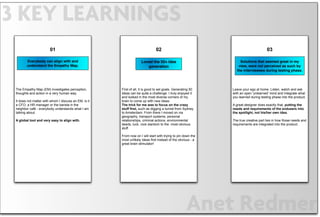
01
The Empathy Map (EM) investigates perception,
thoughts and action in a very human way.
It does not matter with whom I discuss an EM, is it
a CFO, a HR manager or the barista in the
neighbor café - everybody understands what I am
talking about.
A global tool and very easy to align with.
Everybody can align with and
understand the Empathy Map.
02
First of all, it is good to set goals. Generating 50
ideas can be quite a challenge. I truly enjoyed it
and looked in the most diverse corners of my
brain to come up with new ideas.
The trick for me was to focus on the crazy
stuff first, such as digging a tunnel from Sydney
to Amsterdam. From there I moved on via
geography, transport systems, personal
relationships, criminal actions, environmental
deeds, luck, rock stardom to the most obvious
stuff.
From now on I will start with trying to pin down the
most unlikely ideas first instead of the obvious - a
great brain stimulator!
Loved the 50+ idea
generation
03
Leave your ego at home. Listen, watch and ask
with an open 'unlearned' mind and integrate what
you learned during testing phase into the product.
A great designer does exactly that, putting the
needs and requirements of the endusers into
the spotlight, not his/her own idea.
The true creative part lies in how those needs and
requirements are integrated into the product.
Solutions that seemed great in my
view, were not perceived as such by
the interviewees during testing phase.
Ask
different
users
PROCESS MAP
PROBLEM SOLUTION
Observe &
Ask
How to do
things
differently
Watch
different
users
Document
Ask and
interview
Prototype
Test
Improve
Iterate until
solution
Anet Redmer
Define,
choose,
focus on
few ideas
only
Needs
Require
ments
Road
map
Different
environme
nts
Reserve
engineering
Ask people
to help
brainstorm
Empathy
Map
Optimize
my own
environme
nt
Different
circumstan
ces
Generate
MANY
Ideas
Surprised
about
different
perception of
user
Wanna
haves/
wishes
Focus on
solving only
part of the
problem
Add
magic
White
board
Do the
impossible
Light
Co-
working
space
REFLECTION
Anet Redmer
Design thinking skills and mindsets to be applied.
A problem I really care about in
my own environment is my
daily practice of Bikram yoga.
For your information, Bikram
Yoga is synthesized from
traditional 1000+-year-old Hatha
Yoga techniques. All Bikram Yoga
classes run for 90 minutes and
consist of 26 postures and 2
breathing exercises. Bikram Yoga
is practiced in a hot room heated
to 105°F / 40.6°C. We are
practicing in a mild sauna-like
environment and the effect on my
mind and body is amazing.
Having that said though, what's
the effect on the environment?
As you might imagine, I have
started to feel bad about my
carbon footprint. Next to
cranking up the heat in the room,
we obviously sweat a lot, using
lots of towels, gear etc. Every
week my sweaty towel and gear
use adds up to about two
machine washes. I refuse to use
a dryer, but many just throw their
gear in to the dryer and let it run,
run, run - no care for reduced
energy consumption, carbon
footprint or sustainability. I love
my yoga, I do it everyday. I am as
fit as a lion, yoga has become
part of my life, it is like brushing
my teeth everyday. I would never
give it up, so my quest is: How
can I make Bikram yoga more
sustainable?
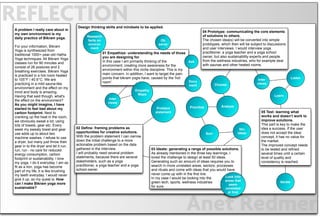
01 Empathize: understanding the needs of those
you are designing for.
In this case I am primarily thinking of the
environment, creating more awareness for the
environment within this niche discipline. This is my
main concern. In addition, I want to target the pain
points that bikram yogis have, caused by the 'hot
room'.
Empathy
Maps
Inter
views
Research
facts on
environ
ment
Ob
serve
Ask
Docu
ment
02 Define: framing problems as
opportunities for creative solutions.
With the problem statement I can narrow
down the initial challenge to a more
actionable problem based on the data
gathered in the interview.
I will probably need several problem
statements, because there are several
stakeholders, such as a yoga
practitioner, a yoga teacher and a yoga
school owner.
Problem
statement
03 Ideate: generating a range of possible solutions.
As already mentioned in the three key learnings, I
loved the challenge to design at least 50 ideas.
Generating such an amount of ideas requires you to
search in more unrelated areas, sectors, processes
and rituals and come with ideas that you would have
never come up with in the first line.
In my case I would be looking into the
green tech, sports, wellness industries
for sure.
04 Prototype: communicating the core elements
of solutions to others.
The chosen idea(s) will be converted into simple
prototypes, which then will be subject to discussions
and user interviews. I would interview yoga
practitioner, a yoga teacher and a yoga school
owner, but also sustainability experts and people
from the wellness industries, who for example deal
with saunas and other heated rooms.
50+
ideas
Look into
areas that
seem
unrelated
at first
Choose
Sort
Prioritize Analyze
05 Test: learning what
works and doesn’t work to
improve solutions.
This part is key to make the
idea a success. If the user
does not accept the idea/
concept, it has no value for
the market.
The improved concept needs
to be tested and refined
several times until a certain
level of quality and
consistency is reached.
Inter
views
Listen
Learn
Iterate

Three take-aways, process map and reflection (3 pages)

  • 1.
    3 KEY LEARNINGS AnetRedmer 01 The Empathy Map (EM) investigates perception, thoughts and action in a very human way. It does not matter with whom I discuss an EM, is it a CFO, a HR manager or the barista in the neighbor café - everybody understands what I am talking about. A global tool and very easy to align with. Everybody can align with and understand the Empathy Map. 02 First of all, it is good to set goals. Generating 50 ideas can be quite a challenge. I truly enjoyed it and looked in the most diverse corners of my brain to come up with new ideas. The trick for me was to focus on the crazy stuff first, such as digging a tunnel from Sydney to Amsterdam. From there I moved on via geography, transport systems, personal relationships, criminal actions, environmental deeds, luck, rock stardom to the most obvious stuff. From now on I will start with trying to pin down the most unlikely ideas first instead of the obvious - a great brain stimulator! Loved the 50+ idea generation 03 Leave your ego at home. Listen, watch and ask with an open 'unlearned' mind and integrate what you learned during testing phase into the product. A great designer does exactly that, putting the needs and requirements of the endusers into the spotlight, not his/her own idea. The true creative part lies in how those needs and requirements are integrated into the product. Solutions that seemed great in my view, were not perceived as such by the interviewees during testing phase.
  • 2.
    Ask different users PROCESS MAP PROBLEM SOLUTION Observe& Ask How to do things differently Watch different users Document Ask and interview Prototype Test Improve Iterate until solution Anet Redmer Define, choose, focus on few ideas only Needs Require ments Road map Different environme nts Reserve engineering Ask people to help brainstorm Empathy Map Optimize my own environme nt Different circumstan ces Generate MANY Ideas Surprised about different perception of user Wanna haves/ wishes Focus on solving only part of the problem Add magic White board Do the impossible Light Co- working space
  • 3.
    REFLECTION Anet Redmer Design thinkingskills and mindsets to be applied. A problem I really care about in my own environment is my daily practice of Bikram yoga. For your information, Bikram Yoga is synthesized from traditional 1000+-year-old Hatha Yoga techniques. All Bikram Yoga classes run for 90 minutes and consist of 26 postures and 2 breathing exercises. Bikram Yoga is practiced in a hot room heated to 105°F / 40.6°C. We are practicing in a mild sauna-like environment and the effect on my mind and body is amazing. Having that said though, what's the effect on the environment? As you might imagine, I have started to feel bad about my carbon footprint. Next to cranking up the heat in the room, we obviously sweat a lot, using lots of towels, gear etc. Every week my sweaty towel and gear use adds up to about two machine washes. I refuse to use a dryer, but many just throw their gear in to the dryer and let it run, run, run - no care for reduced energy consumption, carbon footprint or sustainability. I love my yoga, I do it everyday. I am as fit as a lion, yoga has become part of my life, it is like brushing my teeth everyday. I would never give it up, so my quest is: How can I make Bikram yoga more sustainable? 01 Empathize: understanding the needs of those you are designing for. In this case I am primarily thinking of the environment, creating more awareness for the environment within this niche discipline. This is my main concern. In addition, I want to target the pain points that bikram yogis have, caused by the 'hot room'. Empathy Maps Inter views Research facts on environ ment Ob serve Ask Docu ment 02 Define: framing problems as opportunities for creative solutions. With the problem statement I can narrow down the initial challenge to a more actionable problem based on the data gathered in the interview. I will probably need several problem statements, because there are several stakeholders, such as a yoga practitioner, a yoga teacher and a yoga school owner. Problem statement 03 Ideate: generating a range of possible solutions. As already mentioned in the three key learnings, I loved the challenge to design at least 50 ideas. Generating such an amount of ideas requires you to search in more unrelated areas, sectors, processes and rituals and come with ideas that you would have never come up with in the first line. In my case I would be looking into the green tech, sports, wellness industries for sure. 04 Prototype: communicating the core elements of solutions to others. The chosen idea(s) will be converted into simple prototypes, which then will be subject to discussions and user interviews. I would interview yoga practitioner, a yoga teacher and a yoga school owner, but also sustainability experts and people from the wellness industries, who for example deal with saunas and other heated rooms. 50+ ideas Look into areas that seem unrelated at first Choose Sort Prioritize Analyze 05 Test: learning what works and doesn’t work to improve solutions. This part is key to make the idea a success. If the user does not accept the idea/ concept, it has no value for the market. The improved concept needs to be tested and refined several times until a certain level of quality and consistency is reached. Inter views Listen Learn Iterate