Elsevier's program to support research data
Presented by: Dr. Hylke Koers, Content Innovation Manager, Journal & Data Solutions
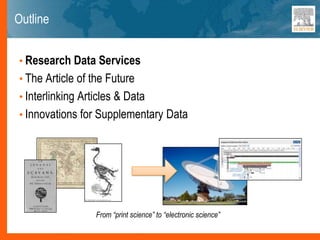
Outline
• Research Data Services
• The Article of the Future
• Interlinking Articles & Data
• Innovations for Supplementary Data
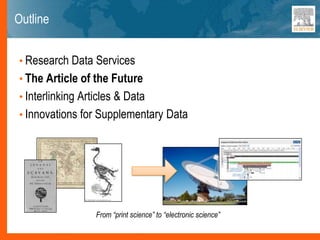
From “print science” to “electronic science”
Principles of Research Data Services
• A new department to explore collaborations on research data mgmn’t with
data repositories, libraries/IT departments and researchers.
• Main goal: make research data optimally available, discoverable and
reusable.
• Collaboration is tailored to partner’s unique needs:
• Working with a few domain-specific and institutional repositories and institutions
• Aspects where collaboration is needed are discussed
• Collaboration plan is drawn up using SLA: agree on time, conditions, etc.
• 2013: series of pilots, studies and reports to enable feasibility study:
• What are key needs?
• Can Elsevier play a role: skillsets, partnerships?
• Is there a (transparent) business model for this?
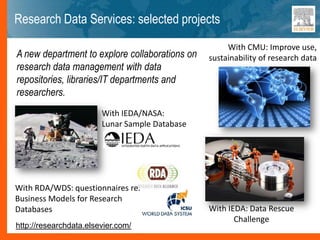
Research Data Services: selected projects
A new department to explore collaborations on
research data management with data
repositories, libraries/IT departments and
researchers.
With IEDA/NASA:
Lunar Sample Database
With CMU: Improve use,
sustainability of research data
With IEDA: Data Rescue
Challenge
http://researchdata.elsevier.com/
With RDA/WDS: questionnaires re.
Business Models for Research
Databases
Outline
• Research Data Services
• The Article of the Future
• Interlinking Articles & Data
• Innovations for Supplementary Data
From “print science” to “electronic science”
Elsevier’s Article of the Future
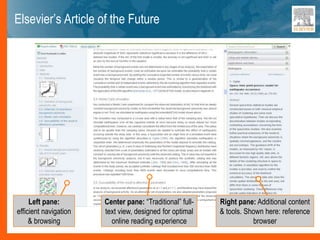
Center pane: “Traditional” full-
text view, designed for optimal
online reading experience
Right pane: Additional content
& tools. Shown here: reference
browser
Left pane:
efficient navigation
& browsing
Elsevier’s Article of the Future
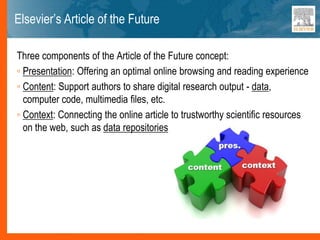
Three components of the Article of the Future concept:
◦ Presentation: Offering an optimal online browsing and reading experience
◦ Content: Support authors to share digital research output - data,
computer code, multimedia files, etc.
◦ Context: Connecting the online article to trustworthy scientific resources
on the web, such as data repositories
Interlinking Articles and Data adds value both ways
85% of researchers believe it is useful to link underlying digital
research data to the formal literature (PARSE.Insight)
• Increase visibility, discoverability, and usage
• Provide context, avoid misinterpretation and incorrect usage
• Ensure long-term availability of useful content and context
• Coordinate submission process / deposit mechanism
Remember him?
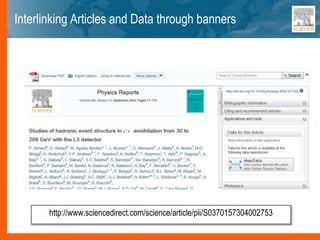
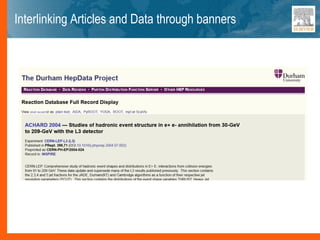
Interlinking Articles and Data through banners
http://www.sciencedirect.com/science/article/pii/S0370157304002753
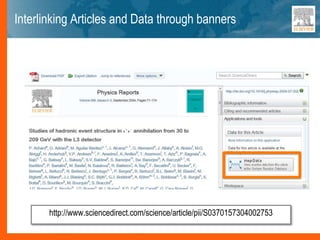
Interlinking Articles and Data through banners
http://www.sciencedirect.com/science/article/pii/S0370157304002753
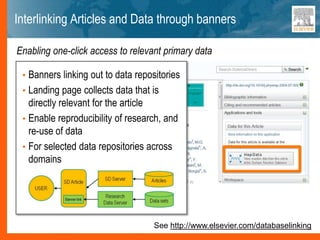
Interlinking Articles and Data through banners
See http://www.elsevier.com/databaselinking
Enabling one-click access to relevant primary data
• Banners linking out to data repositories
• Landing page collects data that is
directly relevant for the article
• Enable reproducibility of research, and
re-use of data
• For selected data repositories across
domains
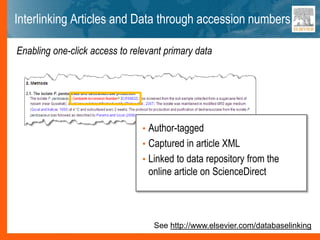
Interlinking Articles and Data through accession numbers
See http://www.elsevier.com/databaselinking
Enabling one-click access to relevant primary data
• Author-tagged
• Captured in article XML
• Linked to data repository from the
online article on ScienceDirect
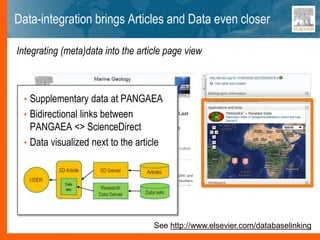
Data-integration brings Articles and Data even closer
See http://www.elsevier.com/databaselinking
Integrating (meta)data into the article page view
• Supplementary data at PANGAEA
• Bidirectional links between
PANGAEA <> ScienceDirect
• Data visualized next to the article
Data-integration brings Articles and Data even closer
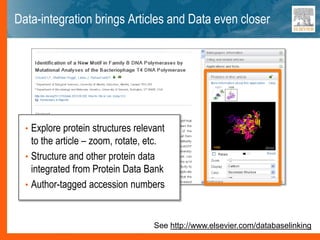
• Explore protein structures relevant
to the article – zoom, rotate, etc.
• Structure and other protein data
integrated from Protein Data Bank
• Author-tagged accession numbers
See http://www.elsevier.com/databaselinking
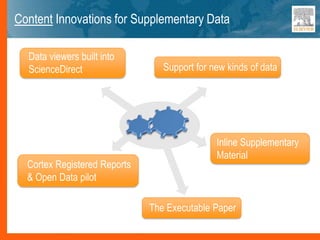
Content Innovations for Supplementary Data
Cortex Registered Reports
& Open Data pilot
Support for new kinds of data
Data viewers built into
ScienceDirect
The Executable Paper
Inline Supplementary
Material
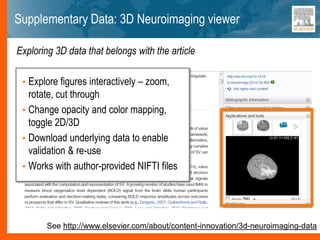
Supplementary Data: 3D Neuroimaging viewer
See http://www.elsevier.com/about/content-innovation/3d-neuroimaging-data
Exploring 3D data that belongs with the article
• Explore figures interactively – zoom,
rotate, cut through
• Change opacity and color mapping,
toggle 2D/3D
• Download underlying data to enable
validation & re-use
• Works with author-provided NIFTI files
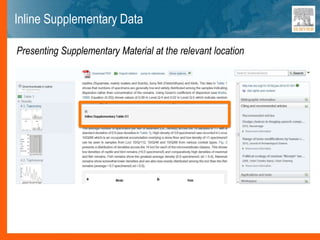
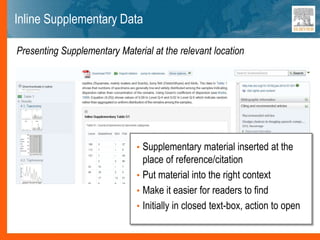
Inline Supplementary Data
Presenting Supplementary Material at the relevant location
Inline Supplementary Data
• Supplementary material inserted at the
place of reference/citation
• Put material into the right context
• Make it easier for readers to find
• Initially in closed text-box, action to open
Presenting Supplementary Material at the relevant location
Cortex Registered Report pilot
Featured in The Guardian “Confronting the 'sloppiness' that
pervades science”, http://bit.ly/1aUAy7f
• Two-step submission process:
• Method and proposed analysis are submitted for pre-registration
• Paper is conditionally accepted
• Research is executed
• Full paper submitted, accepted provided that protocol is followed
• All experimental data made available Open Access
Executable Papers marry Articles, Data, and Code
See http://www.elsevier.com/executablepapers
Improving the reproducibility of research
Thanks!
Further reading:
• Research Data Services:
http://researchdata.elsevier.com
• Database linking:
http://www.elsevier.com/databaselinking
• Article of the Future and Content Innovation:
http://www.elsevier.com/about/content-innovation
• The Executable Paper:
http://www.elsevier.com/executablepaper
The 2007 “Brussels Declaration”
Raw research data should be made freely available to all
researchers. Publishers encourage the public posting of the raw data
outputs of research. Sets or sub-sets of data that are submitted with a
paper to a journal should wherever possible be made freely accessible
to other scholars
http://www.stm-assoc.org/brussels-declaration/

2013 DataCite Summer Meeting - Elsevier's program to support research data (Hylke Koers, Elsevier)

  • 1.
    Elsevier's program tosupport research data Presented by: Dr. Hylke Koers, Content Innovation Manager, Journal & Data Solutions
  • 2.
    Outline • Research DataServices • The Article of the Future • Interlinking Articles & Data • Innovations for Supplementary Data From “print science” to “electronic science”
  • 3.
    Principles of ResearchData Services • A new department to explore collaborations on research data mgmn’t with data repositories, libraries/IT departments and researchers. • Main goal: make research data optimally available, discoverable and reusable. • Collaboration is tailored to partner’s unique needs: • Working with a few domain-specific and institutional repositories and institutions • Aspects where collaboration is needed are discussed • Collaboration plan is drawn up using SLA: agree on time, conditions, etc. • 2013: series of pilots, studies and reports to enable feasibility study: • What are key needs? • Can Elsevier play a role: skillsets, partnerships? • Is there a (transparent) business model for this?
  • 4.
    Research Data Services:selected projects A new department to explore collaborations on research data management with data repositories, libraries/IT departments and researchers. With IEDA/NASA: Lunar Sample Database With CMU: Improve use, sustainability of research data With IEDA: Data Rescue Challenge http://researchdata.elsevier.com/ With RDA/WDS: questionnaires re. Business Models for Research Databases
  • 5.
    Outline • Research DataServices • The Article of the Future • Interlinking Articles & Data • Innovations for Supplementary Data From “print science” to “electronic science”
  • 6.
    Elsevier’s Article ofthe Future Center pane: “Traditional” full- text view, designed for optimal online reading experience Right pane: Additional content & tools. Shown here: reference browser Left pane: efficient navigation & browsing
  • 7.
    Elsevier’s Article ofthe Future Three components of the Article of the Future concept: ◦ Presentation: Offering an optimal online browsing and reading experience ◦ Content: Support authors to share digital research output - data, computer code, multimedia files, etc. ◦ Context: Connecting the online article to trustworthy scientific resources on the web, such as data repositories
  • 8.
    Interlinking Articles andData adds value both ways 85% of researchers believe it is useful to link underlying digital research data to the formal literature (PARSE.Insight) • Increase visibility, discoverability, and usage • Provide context, avoid misinterpretation and incorrect usage • Ensure long-term availability of useful content and context • Coordinate submission process / deposit mechanism
  • 9.
  • 10.
    Interlinking Articles andData through banners http://www.sciencedirect.com/science/article/pii/S0370157304002753
  • 11.
    Interlinking Articles andData through banners http://www.sciencedirect.com/science/article/pii/S0370157304002753
  • 12.
    Interlinking Articles andData through banners
  • 13.
    Interlinking Articles andData through banners See http://www.elsevier.com/databaselinking Enabling one-click access to relevant primary data • Banners linking out to data repositories • Landing page collects data that is directly relevant for the article • Enable reproducibility of research, and re-use of data • For selected data repositories across domains
  • 14.
    Interlinking Articles andData through accession numbers See http://www.elsevier.com/databaselinking Enabling one-click access to relevant primary data • Author-tagged • Captured in article XML • Linked to data repository from the online article on ScienceDirect
  • 15.
    Data-integration brings Articlesand Data even closer See http://www.elsevier.com/databaselinking Integrating (meta)data into the article page view • Supplementary data at PANGAEA • Bidirectional links between PANGAEA <> ScienceDirect • Data visualized next to the article
  • 16.
    Data-integration brings Articlesand Data even closer • Explore protein structures relevant to the article – zoom, rotate, etc. • Structure and other protein data integrated from Protein Data Bank • Author-tagged accession numbers See http://www.elsevier.com/databaselinking
  • 17.
    Content Innovations forSupplementary Data Cortex Registered Reports & Open Data pilot Support for new kinds of data Data viewers built into ScienceDirect The Executable Paper Inline Supplementary Material
  • 18.
    Supplementary Data: 3DNeuroimaging viewer See http://www.elsevier.com/about/content-innovation/3d-neuroimaging-data Exploring 3D data that belongs with the article • Explore figures interactively – zoom, rotate, cut through • Change opacity and color mapping, toggle 2D/3D • Download underlying data to enable validation & re-use • Works with author-provided NIFTI files
  • 19.
    Inline Supplementary Data PresentingSupplementary Material at the relevant location
  • 20.
    Inline Supplementary Data •Supplementary material inserted at the place of reference/citation • Put material into the right context • Make it easier for readers to find • Initially in closed text-box, action to open Presenting Supplementary Material at the relevant location
  • 21.
    Cortex Registered Reportpilot Featured in The Guardian “Confronting the 'sloppiness' that pervades science”, http://bit.ly/1aUAy7f • Two-step submission process: • Method and proposed analysis are submitted for pre-registration • Paper is conditionally accepted • Research is executed • Full paper submitted, accepted provided that protocol is followed • All experimental data made available Open Access
  • 22.
    Executable Papers marryArticles, Data, and Code See http://www.elsevier.com/executablepapers Improving the reproducibility of research
  • 23.
    Thanks! Further reading: • ResearchData Services: http://researchdata.elsevier.com • Database linking: http://www.elsevier.com/databaselinking • Article of the Future and Content Innovation: http://www.elsevier.com/about/content-innovation • The Executable Paper: http://www.elsevier.com/executablepaper
  • 24.
    The 2007 “BrusselsDeclaration” Raw research data should be made freely available to all researchers. Publishers encourage the public posting of the raw data outputs of research. Sets or sub-sets of data that are submitted with a paper to a journal should wherever possible be made freely accessible to other scholars http://www.stm-assoc.org/brussels-declaration/