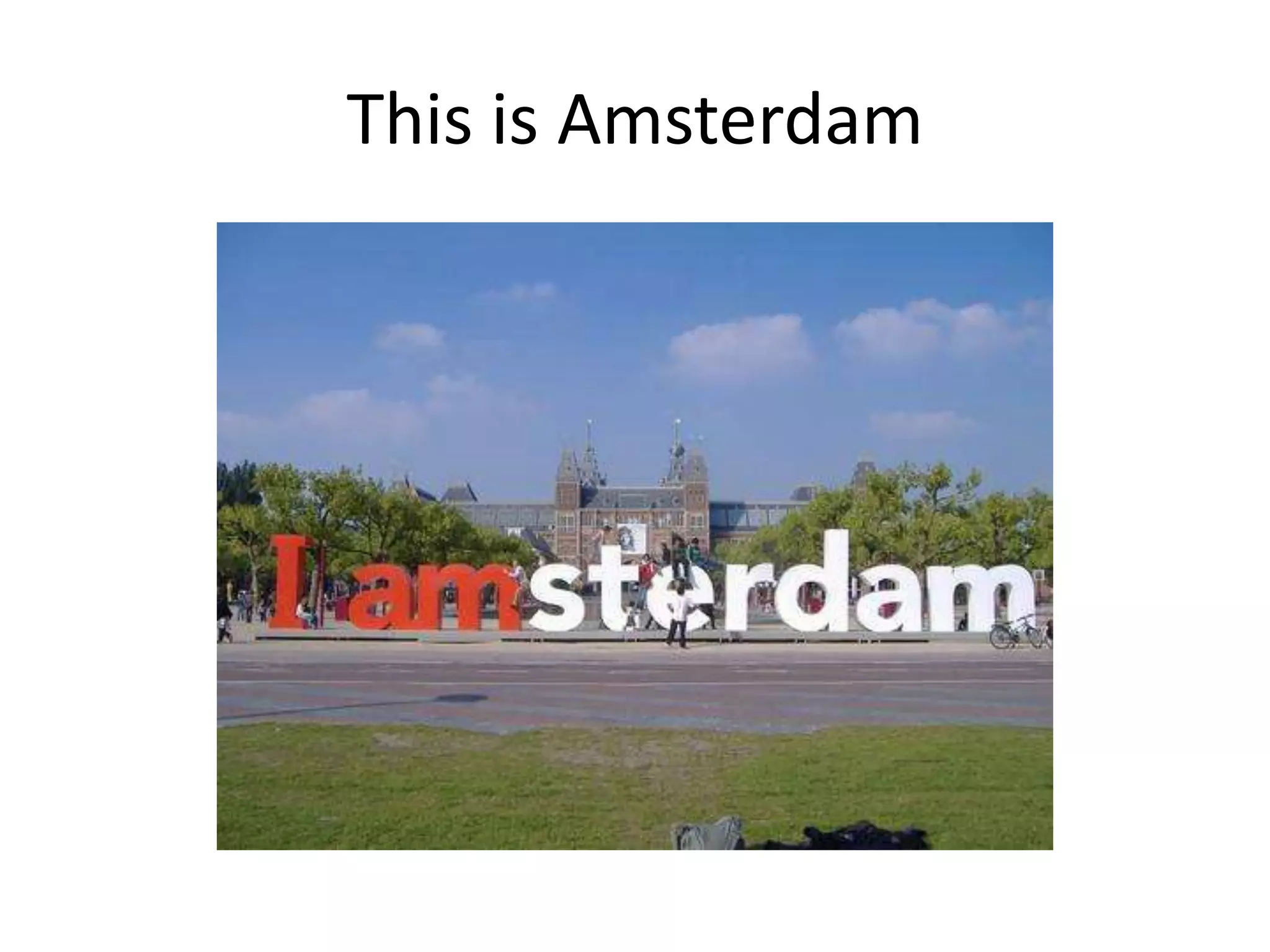
This is Amsterdam
Introduction
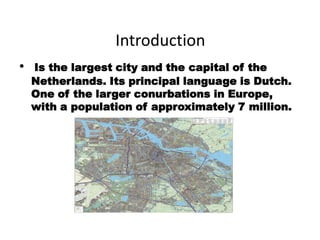
•   Is the largest city and the capital of the
    Netherlands. Its principal language is Dutch.
    One of the larger conurbations in Europe,
    with a population of approximately 7 million.
History of Amsterdam
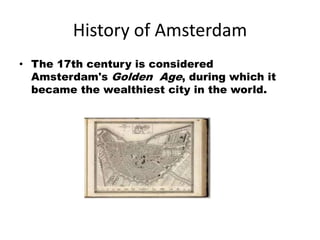
• The 17th century is considered
  Amsterdam's Golden Age, during which it
  became the wealthiest city in the world.
Geography of Amsterdam
• Amsterdam is intensely urbanized, as is
  the Amsterdam metropolitan area
  surrounding the city. Comprising 219.4 square
  kilometres of land, the city proper has 4,457
  inhabitants per km2 and 2,275 houses per
  km2.Parks and nature reserves make up 12%
  of Amsterdam's land area.
• The oldest area of the town is known
  as de Wallen (the quays). It lies to the
  east of Damrak and contains the city's
  famous red light district.
Geography of Amsterdam
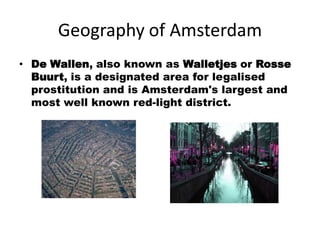
• De Wallen, also known as Walletjes or Rosse
  Buurt, is a designated area for legalised
  prostitution and is Amsterdam's largest and
  most well known red-light district.
The economy amsterdam
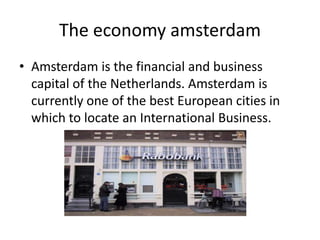
• Amsterdam is the financial and business
  capital of the Netherlands. Amsterdam is
  currently one of the best European cities in
  which to locate an International Business.
Info of tourists
• Amsterdam is one of the most popular tourist
  destinations in Europe, receiving more than
  4.63 million international visitors annually,
  this is excluding the 16 million day trippers
  visiting the city every year.
Move in Amsterdam
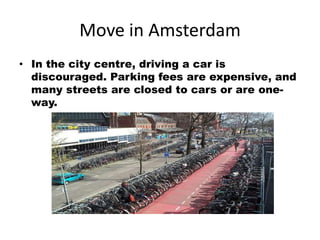
• In the city centre, driving a car is
  discouraged. Parking fees are expensive, and
  many streets are closed to cars or are one-
  way.

This is Amsterdam (by Víctor Fuster)

  • 1.
  • 2.
    Introduction • Is the largest city and the capital of the Netherlands. Its principal language is Dutch. One of the larger conurbations in Europe, with a population of approximately 7 million.
  • 3.
    History of Amsterdam •The 17th century is considered Amsterdam's Golden Age, during which it became the wealthiest city in the world.
  • 4.
    Geography of Amsterdam •Amsterdam is intensely urbanized, as is the Amsterdam metropolitan area surrounding the city. Comprising 219.4 square kilometres of land, the city proper has 4,457 inhabitants per km2 and 2,275 houses per km2.Parks and nature reserves make up 12% of Amsterdam's land area. • The oldest area of the town is known as de Wallen (the quays). It lies to the east of Damrak and contains the city's famous red light district.
  • 5.
    Geography of Amsterdam •De Wallen, also known as Walletjes or Rosse Buurt, is a designated area for legalised prostitution and is Amsterdam's largest and most well known red-light district.
  • 6.
    The economy amsterdam •Amsterdam is the financial and business capital of the Netherlands. Amsterdam is currently one of the best European cities in which to locate an International Business.
  • 7.
    Info of tourists •Amsterdam is one of the most popular tourist destinations in Europe, receiving more than 4.63 million international visitors annually, this is excluding the 16 million day trippers visiting the city every year.
  • 8.
    Move in Amsterdam •In the city centre, driving a car is discouraged. Parking fees are expensive, and many streets are closed to cars or are one- way.