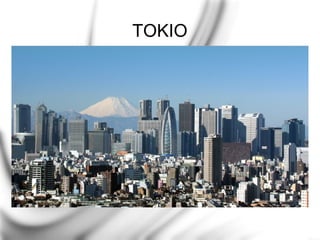
TOKIO
INDEX
●

Introduction

●

Places of interest
●

Districts

●

Metropolitan Government Building

●

Tsukiji Market

●

Parks

●

Museums
INTRODUCTION
●

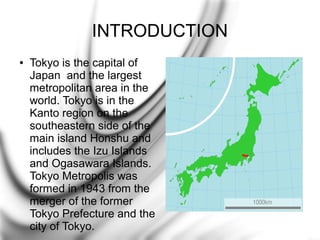
Tokyo is the capital of
Japan and the largest
metropolitan area in the
world. Tokyo is in the
Kanto region on the
southeastern side of the
main island Honshu and
includes the Izu Islands
and Ogasawara Islands.
Tokyo Metropolis was
formed in 1943 from the
merger of the former
Tokyo Prefecture and the
city of Tokyo.
INTRODUCTION
●

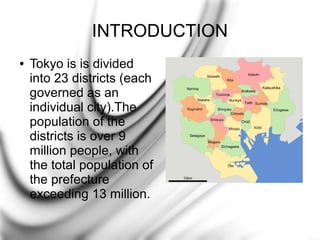
Tokyo is is divided
into 23 districts (each
governed as an
individual city).The
population of the
districts is over 9
million people, with
the total population of
the prefecture
exceeding 13 million.
DISTRICTS
●

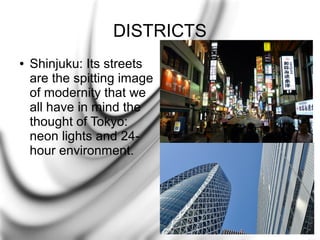
Shinjuku: Its streets
are the spitting image
of modernity that we
all have in mind the
thought of Tokyo:
neon lights and 24hour environment.
DISTRICTS
●

●

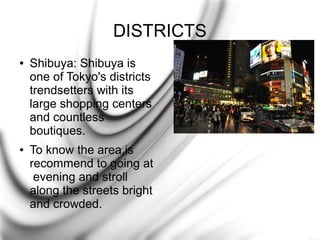
Shibuya: Shibuya is
one of Tokyo's districts
trendsetters with its
large shopping centers
and countless
boutiques.
To know the area,is
recommend to going at
evening and stroll
along the streets bright
and crowded.
DISTRICTS
●

●

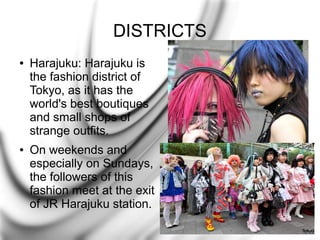
Harajuku: Harajuku is
the fashion district of
Tokyo, as it has the
world's best boutiques
and small shops of
strange outfits.
On weekends and
especially on Sundays,
the followers of this
fashion meet at the exit
of JR Harajuku station.
DISTRICTS
●

●

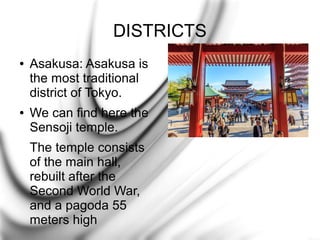
Asakusa: Asakusa is
the most traditional
district of Tokyo.
We can find here the
Sensoji temple.
The temple consists
of the main hall,
rebuilt after the
Second World War,
and a pagoda 55
meters high
DISTRICTS
●

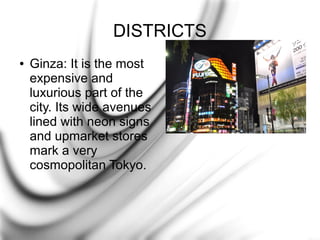
Ginza: It is the most
expensive and
luxurious part of the
city. Its wide avenues
lined with neon signs
and upmarket stores
mark a very
cosmopolitan Tokyo.
DISTRICTS
●

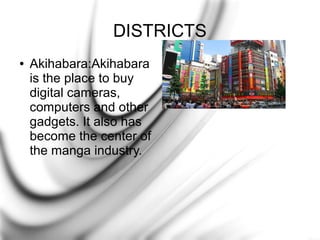
Akihabara:Akihabara
is the place to buy
digital cameras,
computers and other
gadgets. It also has
become the center of
the manga industry.
DISTRICTS
●

●

●

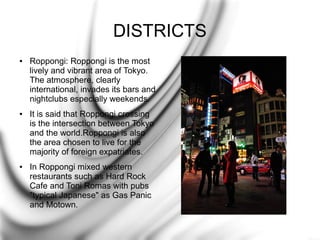
Roppongi: Roppongi is the most
lively and vibrant area of Tokyo.
The atmosphere, clearly
international, invades its bars and
nightclubs especially weekends.
It is said that Roppongi crossing
is the intersection between Tokyo
and the world.Roppongi is also
the area chosen to live for the
majority of foreign expatriates.
In Roppongi mixed western
restaurants such as Hard Rock
Cafe and Toni Romas with pubs
"typical Japanese" as Gas Panic
and Motown.
DISTRICTS
●

●

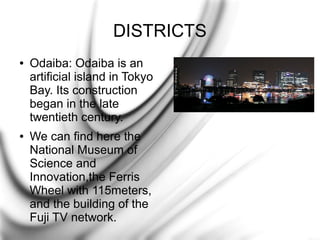
Odaiba: Odaiba is an
artificial island in Tokyo
Bay. Its construction
began in the late
twentieth century.
We can find here the
National Museum of
Science and
Innovation,the Ferris
Wheel with 115meters,
and the building of the
Fuji TV network.
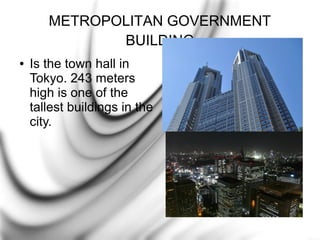
METROPOLITAN GOVERNMENT
BUILDING
●

Is the town hall in
Tokyo. 243 meters
high is one of the
tallest buildings in the
city.
Tsukiji Market
●

●

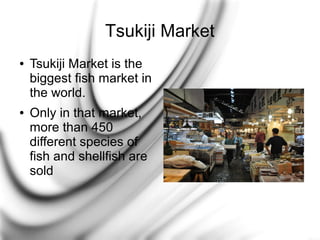
Tsukiji Market is the
biggest fish market in
the world.
Only in that market,
more than 450
different species of
fish and shellfish are
sold
UENO PARK
●

●

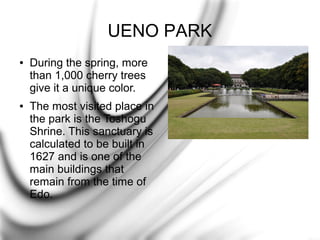
During the spring, more
than 1,000 cherry trees
give it a unique color.
The most visited place in
the park is the Toshogu
Shrine. This sanctuary is
calculated to be built in
1627 and is one of the
main buildings that
remain from the time of
Edo.
MUSEUMS
●

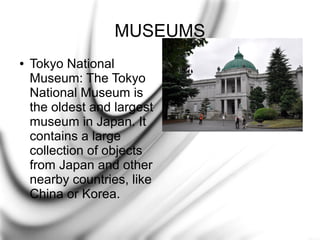
Tokyo National
Museum: The Tokyo
National Museum is
the oldest and largest
museum in Japan. It
contains a large
collection of objects
from Japan and other
nearby countries, like
China or Korea.
MUSEUMS
●

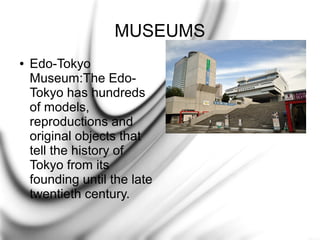
Edo-Tokyo
Museum:The EdoTokyo has hundreds
of models,
reproductions and
original objects that
tell the history of
Tokyo from its
founding until the late
twentieth century.
MUSEUMS
●

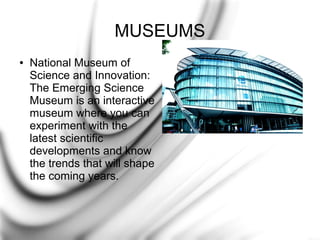
National Museum of
Science and Innovation:
The Emerging Science
Museum is an interactive
museum where you can
experiment with the
latest scientific
developments and know
the trends that will shape
the coming years.

Tokio Sergio 1 E

  • 1.
  • 2.
    INDEX ● Introduction ● Places of interest ● Districts ● MetropolitanGovernment Building ● Tsukiji Market ● Parks ● Museums
  • 3.
    INTRODUCTION ● Tokyo is thecapital of Japan and the largest metropolitan area in the world. Tokyo is in the Kanto region on the southeastern side of the main island Honshu and includes the Izu Islands and Ogasawara Islands. Tokyo Metropolis was formed in 1943 from the merger of the former Tokyo Prefecture and the city of Tokyo.
  • 4.
    INTRODUCTION ● Tokyo is isdivided into 23 districts (each governed as an individual city).The population of the districts is over 9 million people, with the total population of the prefecture exceeding 13 million.
  • 5.
    DISTRICTS ● Shinjuku: Its streets arethe spitting image of modernity that we all have in mind the thought of Tokyo: neon lights and 24hour environment.
  • 6.
    DISTRICTS ● ● Shibuya: Shibuya is oneof Tokyo's districts trendsetters with its large shopping centers and countless boutiques. To know the area,is recommend to going at evening and stroll along the streets bright and crowded.
  • 7.
    DISTRICTS ● ● Harajuku: Harajuku is thefashion district of Tokyo, as it has the world's best boutiques and small shops of strange outfits. On weekends and especially on Sundays, the followers of this fashion meet at the exit of JR Harajuku station.
  • 8.
    DISTRICTS ● ● Asakusa: Asakusa is themost traditional district of Tokyo. We can find here the Sensoji temple. The temple consists of the main hall, rebuilt after the Second World War, and a pagoda 55 meters high
  • 9.
    DISTRICTS ● Ginza: It isthe most expensive and luxurious part of the city. Its wide avenues lined with neon signs and upmarket stores mark a very cosmopolitan Tokyo.
  • 10.
    DISTRICTS ● Akihabara:Akihabara is the placeto buy digital cameras, computers and other gadgets. It also has become the center of the manga industry.
  • 11.
    DISTRICTS ● ● ● Roppongi: Roppongi isthe most lively and vibrant area of Tokyo. The atmosphere, clearly international, invades its bars and nightclubs especially weekends. It is said that Roppongi crossing is the intersection between Tokyo and the world.Roppongi is also the area chosen to live for the majority of foreign expatriates. In Roppongi mixed western restaurants such as Hard Rock Cafe and Toni Romas with pubs "typical Japanese" as Gas Panic and Motown.
  • 12.
    DISTRICTS ● ● Odaiba: Odaiba isan artificial island in Tokyo Bay. Its construction began in the late twentieth century. We can find here the National Museum of Science and Innovation,the Ferris Wheel with 115meters, and the building of the Fuji TV network.
  • 13.
    METROPOLITAN GOVERNMENT BUILDING ● Is thetown hall in Tokyo. 243 meters high is one of the tallest buildings in the city.
  • 14.
    Tsukiji Market ● ● Tsukiji Marketis the biggest fish market in the world. Only in that market, more than 450 different species of fish and shellfish are sold
  • 15.
    UENO PARK ● ● During thespring, more than 1,000 cherry trees give it a unique color. The most visited place in the park is the Toshogu Shrine. This sanctuary is calculated to be built in 1627 and is one of the main buildings that remain from the time of Edo.
  • 16.
    MUSEUMS ● Tokyo National Museum: TheTokyo National Museum is the oldest and largest museum in Japan. It contains a large collection of objects from Japan and other nearby countries, like China or Korea.
  • 17.
    MUSEUMS ● Edo-Tokyo Museum:The EdoTokyo hashundreds of models, reproductions and original objects that tell the history of Tokyo from its founding until the late twentieth century.
  • 18.
    MUSEUMS ● National Museum of Scienceand Innovation: The Emerging Science Museum is an interactive museum where you can experiment with the latest scientific developments and know the trends that will shape the coming years.