Think Like an
Entrepreneur”
By
Dr. Deborah Ferber
Is business ownership right for you?
An “entrepreneur” A person who takes
calculated risks……
Self-assessment questions:
Are you a self-starter?
How well do you plan and organize?
Can you work long hours?
How will the business affect your family?
A startup:
Follow your own dream
Buying an existing business:
You will have current customers and
a known track record of performance
Franchising:
Brand recognition reduces marketing
costs
Does the idea suit your personality and interests?
Will you use your own name to brand the business?
Will it be financially viable?
Do you have startup money to invest?
What will your monthly expenses be?
Is there a current need in the marketplace?
Who are you competing with?
Different legal structures protect you in
different ways and offer varying tax
advantages:
Sole Proprietorships
General Partnerships and Joint Ventures
Corporations
Limited Liability Company (LLCs)
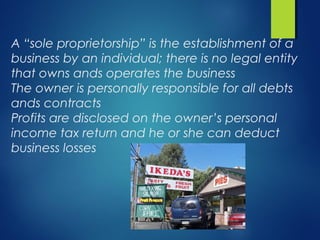
A “sole proprietorship” is the establishment of a
business by an individual; there is no legal entity
that owns ands operates the business
The owner is personally responsible for all debts
ands contracts
Profits are disclosed on the owner’s personal
income tax return and he or she can deduct
business losses
A “corporation” is created by filing articles of
incorporation with the appropriate agency in
the State
The corporation is separate and distinct from
the owners of the corporation
Owners of an interest in the corporation are
called shareholders or stockholders
They are protected from liability from the
corporation’s debts and obligations
A “limited liability company” (LLC) combines
liability protection with the tax status of a general
partnership
Owners of an interest in the LLC are called
members
Members have no personal liability for the debts
and obligations of the LLC
Members disclose profits and deduct losses on
their individual tax returns
Business Plan 101
A “business plan” is a roadmap that describes where
you’re going and how you’re going to get there
A guide to achieving your goals
A tool to spark investor interest
A document that helps employees understand the
company mission
Thinking About Tax Obligations as an Entrepreneur
Federal taxes are paid at intervals with IRS coupons,
usually through the Electronic Federal Tax Payment
System (EFTPS)
States tax structures vary; most require some form of
tax on small businesses
Local authorities may tax business property or all
businesses operating in the area
Research the laws that apply to you; accountants or tax
lawyers may be needed
Taxes and More Taxes
Federal income tax withholding
Businesses must withhold Federal income tax
from employees’ wages based on W-4
information
Federal unemployment tax
Pays unemployment compensation to workers
who lose their jobs
Social Security and Medicare
Required under the Federal Insurance
Contributions Act (FICA), also called self-
employment tax
“Don’t Forget Insurance”
Business property insurance
Liability and excess liability coverage
Worker’s Compensation
Health insurance
Life insurance
An insurance agent should be included in the business
startup process
Licenses and Permits
Licenses or permits are required to operate certain types of
businesses
One or more licenses may be required from the city, State,
county, and/or Federal Government
You may need multiple licenses if you work in more than one
jurisdiction
Failure to obtain the proper licenses can result in fines or the
loss of your business
The application process varies according to jurisdiction;
research the requirements in your area
Bonding
Bonding” guarantees that a business will perform its
assigned tasks. A bond is issued by a bonding
company after the business is thoroughly investigated
Surety bonds: The surety company agrees to
compensate the customer if the business fails to pay a
debt or meet an obligation
Fidelity bonds: Protect against the actions of
employees (such as embezzlement)
You must have an agent or broker to g
“Copyrights, Trademarks and Patents”
Copyrights, trademarks, and patents all deal with
intellectual property and how to protect it
“Intellectual property” is a product based on an
idea and it has some type of commercial value
Intellectual property includes a wide range of
products, such as books, musical compositions, and
works of art.
“The Five C’s For Credit”
How banks determine whether to loan you money:
Character: Credit history is very important!
Capacity: What is your track record of debt repayment?
Capital: How long will personal resources support both
you and the business?
Conditions: Current economic conditions
Collateral: Assets the company pledges as a source of
repayment for the loan
Secured and Unsecured Lines of Credit
If you have trouble getting financing, a “secured
line of credit” can be used to purchase equipment
Property or equipment is used as collateral, which
guarantees repayment
An “unsecured line of credit” does not require
collateral
This is given as a personal loan to the company’s
officers, based on the individuals’ credit histories
Accounting Methods
Sound accounting and bookkeeping practices are
essential to any business
Many businesses rely on an accountant to handle
financial recordkeeping
Computer programs such as Quicken, Peachtree,
or Quickbooks can simplify some bookkeeping
tasks
Cash and Accrual Methods of
Accounting
 The “cash basis” method of accounting requires
only that you record financial transactions when
money is paid or received
Not adequate for businesses that give credit to
their customers or maintain a large inventory
 The “accrual basis” method reports income
when earned and expenses when incurred, not
when money actually changes hands
Patents
Human Resource Management
 The Human Resources function deals with hiring
and managing employees
 Be specific when interviewing candidates
Avoid inappropriate and illegal questions
during the interview
 Provide competitive compensation and benefits
 Maintain detailed employee records
 Consider an Employee Stock Ownership Plan
(ESOP)
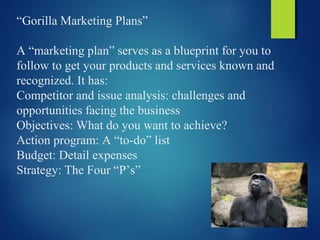
“Gorilla Marketing Plans”
A “marketing plan” serves as a blueprint for you to
follow to get your products and services known and
recognized. It has:
Competitor and issue analysis: challenges and
opportunities facing the business
Objectives: What do you want to achieve?
Action program: A “to-do” list
Budget: Detail expenses
Strategy: The Four “P’s”
The Four P’s of Marketing
Product: Describes features and benefits
Price: Lists prices and pricing strategy
Promotion: Tools or tactics to achieve
marketing objectives
Placement: Sales philosophies and
methods
Guerilla Tips to help you win the war
Public Relations and Publicity
1. The oldest guerrilla trick is old fashion PR so keep at it. Pick up
the phone and give local journalists what they need most; great
news content – its all about spinning your activity to make it a
human interest story. The Guerrilla marketing tactics below are
your means to this end.
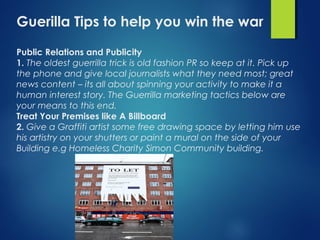
Treat Your Premises like A Billboard
2. Give a Graffiti artist some free drawing space by letting him use
his artistry on your shutters or paint a mural on the side of your
Building e.g Homeless Charity Simon Community building.
Guerilla Tips to help you win the war
1. Do a Fake Protest A fake protest is a great way to get attention
for your business because it not only makes people aware of you,
it also shows them that you have the confidence in your products
that other companies don’t. Make sure you and your employees
are loud and proud and you will definitely get the attention of
anyone within earshot of you.
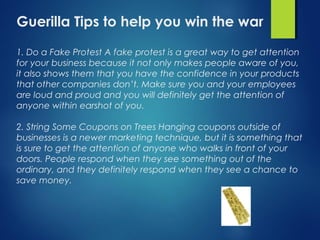
2. String Some Coupons on Trees Hanging coupons outside of
businesses is a newer marketing technique, but it is something that
is sure to get the attention of anyone who walks in front of your
doors. People respond when they see something out of the
ordinary, and they definitely respond when they see a chance to
save money.
Guerilla Tips to help you win the war
3. Start a Friendly Fight With the creation of social networks,
businesses are realizing that they have to use these mediums in
every way that they can to help spread the word about their
companies. A friendly fight is when you and another company
battle it out through the use of social networking and other
mediums by having the public vote on who has the better
products. This won’t harm your business; however, it would help
people to cast their vote judiciously
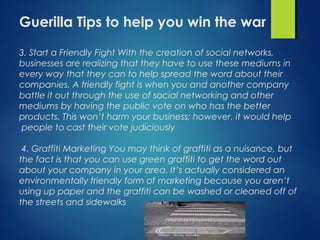
4. Graffiti Marketing You may think of graffiti as a nuisance, but
the fact is that you can use green graffiti to get the word out
about your company in your area. It’s actually considered an
environmentally friendly form of marketing because you aren’t
using up paper and the graffiti can be washed or cleaned off of
the streets and sidewalks
Guerilla Tips to help you win the war
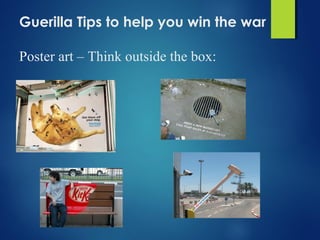
Poster art – Think outside the box:
Entrepreneurial Advice from
Billionaires

Thank Like an Entrepreneur

  • 1.
  • 2.
    Is business ownershipright for you? An “entrepreneur” A person who takes calculated risks…… Self-assessment questions: Are you a self-starter? How well do you plan and organize? Can you work long hours? How will the business affect your family?
  • 3.
    A startup: Follow yourown dream Buying an existing business: You will have current customers and a known track record of performance Franchising: Brand recognition reduces marketing costs
  • 4.
    Does the ideasuit your personality and interests? Will you use your own name to brand the business? Will it be financially viable? Do you have startup money to invest? What will your monthly expenses be? Is there a current need in the marketplace? Who are you competing with?
  • 5.
    Different legal structuresprotect you in different ways and offer varying tax advantages: Sole Proprietorships General Partnerships and Joint Ventures Corporations Limited Liability Company (LLCs)
  • 6.
    A “sole proprietorship”is the establishment of a business by an individual; there is no legal entity that owns ands operates the business The owner is personally responsible for all debts ands contracts Profits are disclosed on the owner’s personal income tax return and he or she can deduct business losses
  • 7.
    A “corporation” iscreated by filing articles of incorporation with the appropriate agency in the State The corporation is separate and distinct from the owners of the corporation Owners of an interest in the corporation are called shareholders or stockholders They are protected from liability from the corporation’s debts and obligations
  • 8.
    A “limited liabilitycompany” (LLC) combines liability protection with the tax status of a general partnership Owners of an interest in the LLC are called members Members have no personal liability for the debts and obligations of the LLC Members disclose profits and deduct losses on their individual tax returns
  • 9.
    Business Plan 101 A“business plan” is a roadmap that describes where you’re going and how you’re going to get there A guide to achieving your goals A tool to spark investor interest A document that helps employees understand the company mission
  • 10.
    Thinking About TaxObligations as an Entrepreneur Federal taxes are paid at intervals with IRS coupons, usually through the Electronic Federal Tax Payment System (EFTPS) States tax structures vary; most require some form of tax on small businesses Local authorities may tax business property or all businesses operating in the area Research the laws that apply to you; accountants or tax lawyers may be needed
  • 11.
    Taxes and MoreTaxes Federal income tax withholding Businesses must withhold Federal income tax from employees’ wages based on W-4 information Federal unemployment tax Pays unemployment compensation to workers who lose their jobs Social Security and Medicare Required under the Federal Insurance Contributions Act (FICA), also called self- employment tax
  • 12.
    “Don’t Forget Insurance” Businessproperty insurance Liability and excess liability coverage Worker’s Compensation Health insurance Life insurance An insurance agent should be included in the business startup process
  • 13.
    Licenses and Permits Licensesor permits are required to operate certain types of businesses One or more licenses may be required from the city, State, county, and/or Federal Government You may need multiple licenses if you work in more than one jurisdiction Failure to obtain the proper licenses can result in fines or the loss of your business The application process varies according to jurisdiction; research the requirements in your area
  • 14.
    Bonding Bonding” guarantees thata business will perform its assigned tasks. A bond is issued by a bonding company after the business is thoroughly investigated Surety bonds: The surety company agrees to compensate the customer if the business fails to pay a debt or meet an obligation Fidelity bonds: Protect against the actions of employees (such as embezzlement) You must have an agent or broker to g
  • 15.
    “Copyrights, Trademarks andPatents” Copyrights, trademarks, and patents all deal with intellectual property and how to protect it “Intellectual property” is a product based on an idea and it has some type of commercial value Intellectual property includes a wide range of products, such as books, musical compositions, and works of art.
  • 16.
    “The Five C’sFor Credit” How banks determine whether to loan you money: Character: Credit history is very important! Capacity: What is your track record of debt repayment? Capital: How long will personal resources support both you and the business? Conditions: Current economic conditions Collateral: Assets the company pledges as a source of repayment for the loan
  • 17.
    Secured and UnsecuredLines of Credit If you have trouble getting financing, a “secured line of credit” can be used to purchase equipment Property or equipment is used as collateral, which guarantees repayment An “unsecured line of credit” does not require collateral This is given as a personal loan to the company’s officers, based on the individuals’ credit histories
  • 18.
    Accounting Methods Sound accountingand bookkeeping practices are essential to any business Many businesses rely on an accountant to handle financial recordkeeping Computer programs such as Quicken, Peachtree, or Quickbooks can simplify some bookkeeping tasks
  • 19.
    Cash and AccrualMethods of Accounting  The “cash basis” method of accounting requires only that you record financial transactions when money is paid or received Not adequate for businesses that give credit to their customers or maintain a large inventory  The “accrual basis” method reports income when earned and expenses when incurred, not when money actually changes hands Patents
  • 20.
    Human Resource Management The Human Resources function deals with hiring and managing employees  Be specific when interviewing candidates Avoid inappropriate and illegal questions during the interview  Provide competitive compensation and benefits  Maintain detailed employee records  Consider an Employee Stock Ownership Plan (ESOP)
  • 21.
    “Gorilla Marketing Plans” A“marketing plan” serves as a blueprint for you to follow to get your products and services known and recognized. It has: Competitor and issue analysis: challenges and opportunities facing the business Objectives: What do you want to achieve? Action program: A “to-do” list Budget: Detail expenses Strategy: The Four “P’s”
  • 22.
    The Four P’sof Marketing Product: Describes features and benefits Price: Lists prices and pricing strategy Promotion: Tools or tactics to achieve marketing objectives Placement: Sales philosophies and methods
  • 23.
    Guerilla Tips tohelp you win the war Public Relations and Publicity 1. The oldest guerrilla trick is old fashion PR so keep at it. Pick up the phone and give local journalists what they need most; great news content – its all about spinning your activity to make it a human interest story. The Guerrilla marketing tactics below are your means to this end. Treat Your Premises like A Billboard 2. Give a Graffiti artist some free drawing space by letting him use his artistry on your shutters or paint a mural on the side of your Building e.g Homeless Charity Simon Community building.
  • 24.
    Guerilla Tips tohelp you win the war 1. Do a Fake Protest A fake protest is a great way to get attention for your business because it not only makes people aware of you, it also shows them that you have the confidence in your products that other companies don’t. Make sure you and your employees are loud and proud and you will definitely get the attention of anyone within earshot of you. 2. String Some Coupons on Trees Hanging coupons outside of businesses is a newer marketing technique, but it is something that is sure to get the attention of anyone who walks in front of your doors. People respond when they see something out of the ordinary, and they definitely respond when they see a chance to save money.
  • 25.
    Guerilla Tips tohelp you win the war 3. Start a Friendly Fight With the creation of social networks, businesses are realizing that they have to use these mediums in every way that they can to help spread the word about their companies. A friendly fight is when you and another company battle it out through the use of social networking and other mediums by having the public vote on who has the better products. This won’t harm your business; however, it would help people to cast their vote judiciously 4. Graffiti Marketing You may think of graffiti as a nuisance, but the fact is that you can use green graffiti to get the word out about your company in your area. It’s actually considered an environmentally friendly form of marketing because you aren’t using up paper and the graffiti can be washed or cleaned off of the streets and sidewalks
  • 26.
    Guerilla Tips tohelp you win the war Poster art – Think outside the box:
  • 27.

Editor's Notes

  • #28 http://www.youtube.com/watch?v=bhUT74Yh9OA