CREATING POSITIVE
SPACES
USING BIOPHILIC DESIGN
Anaccessiblepractitioner’sguidetohelpinspirearchitectsand
designerstounderstandtheprinciplesofBiophilicDesignandhowto
implementitatarangeofscalesandcosts.
2 | Creating positive spaces using biophilic design Creating positive spaces using biophilic design | 3
Biophilic Design is a human centred approach
aimed at improving our connection to nature and
natural processes in the buildings that we live
and work. This improved connection can benefit
our wellbeing by reducing stress and improving
recuperation – helping to cut costs and improve
outcomes in the built environment.
More than just a new design trend, Biophilic Design
should be seen as a universal design ethos – after
all, at some point in our lives we’ve all had positive
experiences of nature. So, implementing it isn’t
necessarily about spending money, but recognising
the many ways that we can connect to nature
through the culture and design of the spaces
that are so important to us. Through this design
guide we hope to inspire creativity, productivity
and wellbeing at a range of scales to enhance our
connection to nature, for the benefit of all.”
– OLIVER HEATH, Director of Oliver Heath Design, author of this Design Guide
2 | Creating positive spaces using biophilic design
4 | Creating positive spaces using biophilic design
A GUIDE TO IMPLEMENTING BIOPHILIC DESIGN –
WHAT’S IN IT FOR YOU?
In this inspirational guide we share our insights and
research on Biophilic Design (designing nature back
into the built environment) and show you that, due to
the profound effect it can have on people’s wellbeing,
it is more that just an aesthetic consideration. We aim
to provide you with an understanding of both its human
and economic benefits, to arm you with a convincing
business case, and to propose a range of practical
methods for implementing Biophilic Design no matter
what your budget.
We hope that by the time you put this guide down you will
understand:
· What Biophilic Design is
· Why we should focus on this human-centred approach to 		
design
· How to implement it at a variety of scales
· Who is already doing it
· Where and when it can be used
Whether this is all new to you, or you’re already using a
biophilic approach, this guide will help you communicate the
benefits of designing in a human-centred way to your clients,
decision makers or those who inhabit your spaces.
WHY IS INTERFACE SUPPORTING THIS SUBJECT?
Creating positive spaces where we work, rest and play
involves design that incorporates visual appeal, purpose,
sustainable elements, and an understanding of human
behaviour. Bold thinking is required to strike the balance
between reflecting each person’s needs whilst adhering to
regulatory standards, without compromising on the design
aesthetic.
The building industry is increasingly recognising companies
who prioritise supporting the wellbeing of their people.
Certification systems like the WELL Building Standard™
are gaining traction and the increasing interest in them
demonstrates that the creation of positive spaces requires
further investigation.
To capture insights from industry and thought leaders,
Interface have co-authored a series of papers to explore the
value of human-centred design, understand how nature can
inspire the creation of positive spaces and examine the future
of sustainable buildings.
Creating positive spaces using biophilic design | 5
Creating positive spaces using biophilic design | 7
CONTENTS
CONTENTS
CHAPTER 1 pg. 08
WHAT IS BIOPHILIC DESIGN?
CHAPTER 2 pg. 14
BIOPHILIC DESIGN -
THE SCIENCE BEHIND IT
CHAPTER 4 pg. 22
BIOPHILIC DESIGN PATTERNS AT
DIFFERENT SCALES – LET’S GET GOING!
CHAPTER 5 pg. 28
BIOPHILIC DESIGN IN PRACTICE:
INSPIRATIONAL CASE STUDIES
· Office Design Medium Cost/Scale - 		
ByggVesta – Stockholm
· Office Design High Cost/Scale -
WWF Living Planet Centre – UK
· Hospitality Design Medium Cost/Scale -
Restaurant Vakst – Denmark
· Hospitality Design High Cost/Scale - 		
Naman Retreat – Vietnam
CHAPTER 6 pg. 50
SO, WHAT’S THE FUTURE OF HUMAN
CENTRED DESIGN?
CHAPTER 3 pg. 18
HOW TO GET YOUR CLIENTS ON BOARD:
THE SALES PITCH
6 | Creating positive spaces using biophilic design
Creating positive spaces using biophilic design | 9
8 | Creating positive spaces using biophilic design
CHAPTER 1:
WHAT IS
BIOPHILIC
DESIGN?
Biophilic Design offers guidelines for how to create built
environments that support our innate human attraction to
nature and natural processes (biophilia).
“Throughout our evolution, we’ve spent 99.9 per cent of our
time in nature. Our physiology is still adapted to it. During
everyday life, a feeling of comfort can be achieved if our
rhythms are synchronized with those of the environment.”3
–
Yoshifumi Miyazaki
Our response to natural environments stems from our
evolutionary development and survival. It makes sense that
our ancestors felt calmer in places that had an abundance of
greenery and living elements, as they indicated the availability
of food and water and this meant they could focus on other
things. Similarly, spaces that offered both the security of being
contained, or sheltered, and that had a good vista over the
landscape would have been essential for our ancestors to
keep an eye out for predators or animals to hunt. The theory
behind these ideas are summarised in the next chapter - see
the Savannah hypothesis section.
We still experience a psychological inheritance of this survival
instinct (even though we don’t have to worry about foraging
for sustenance or predators in the same way) in our urban
environments. This means that a space designed to have a
sense of refuge and prospect with plenty of living elements
in (or references to them) can make us feel less stressed and
more productive.
With this in mind, Biophilic Design offers an approach
to creating buildings and spaces that respond to our
human needs. Biophilic Design principles can be applied to
existing and new buildings, interior and exterior spaces alike.
They can be implemented at a range of scales and budgets
and have greatest impact within the urban environment where
we have strayed the furthest from nature.
It is essential that, as we spend more time indoors and in
urban environments, we find ways to increase our contact
with nature and natural elements to take advantage of its
benefits. And here’s why…
BIOPHILIA IS:
CHAPTER 1: WHAT IS BIOPHILIC DESIGN?
The passionate love of life and
of all that is alive; it is the wish
to further growth, whether in
a person, a plant, an idea or a
social group.”
1
– Erich Fromm
The innately emotional affiliation
of human beings to other
living organisms. Innate means
hereditary and hence part of
ultimate human nature.”
2
– E.O. Wilson
8 | Creating positive spaces using biophilic design
WHY IS IT RELEVANT NOW? A CHANGE FOR
THE BETTER
Creating spaces that enhance wellbeing is an important
design aim to achieve. Why? Because as urbanisation has
increased, stress rates have also rocketed. Coincidence?
We don’t think so. Here’s some astonishing facts that
demonstrate why:
· By 2050, 66% of the developed world will be urbanised4
, 		
and thus we are becoming increasingly distanced 			
from nature.
· North Americans spend 93% of their time indoors5
whilst 		
Europeans spend 85-90% of their time indoors.6
· Stress has been called the “health epidemic of the 21st 		
century” by the World Health Organization,7
causing 		
significant costs for employers and increasing the 		
need for individuals to focus on their physical and mental 		
health.
· We recover significantly faster from stress when exposed to
a natural environment, in comparison to an urban setting.8
· In the UK in 2015/16, 1
1.7 million working days were lost 		
due to stress.9
This doesn’t take into account the indirect 		
stress related costs, such as decreased concentration and 		
productivity.
· In 2002, the European Commission calculated the costs of
work-related stress in the EU at €20 billion a year.10
With a vast body of research to support the ethos, it’s
important that we find ways to creatively develop the
implementation of the principles of Biophilic Design and make
it financially accessible, to increase the uptake.
We hope to explore and promote the discussion around
creating positive human-centred spaces, whilst helping the
architecture and design community expand the services
they offer. In Chapter 2, we’ll show you how a Biophilic
approach to design can improve the Triple Bottom Line:
wellbeing for building occupants, employee productivity for
businesses, and return rates for clients. Considering that
our health and wellbeing are intrinsically linked to that of
the natural environment around us, surely we should want to
protect it and enable it to flourish.
CHAPTER 1: WHAT IS BIOPHILIC DESIGN?
By 2050, 66% of the developed
world will be urbanised, and thus we
are becoming increasingly distanced
from nature.
66%
In 2002, the European Commission
calculated the costs of work-
related stress in the EU at
€20 billion a year.
20
billion
In the UK in 2015/16, 1
1.7 million
working days were lost due to
stress.
11.7
million
10 | Creating positive spaces using biophilic design Creating positive spaces using biophilic design | 1
1
12 | Creating positive spaces using biophilic design Creating positive spaces using biophilic design | 13
CHAPTER 1: WHAT IS BIOPHILIC DESIGN?
BIOPHILIC DESIGN - THE OVERVIEW
Human centred design has risen-up the agenda for the
design industry in the last couple of years and Biophilic
Design is still a relatively new field of practice. In this design
guide we will introduce you to Terrapin Bright Green’s
neuroscientific & psychological take on Biophilic Design. This
approach is concerned with what goes on in our heads when
we connect with nature, as well as our perception of it, and
considers how to enhance spaces with:
· Nature in the Space: designing in direct contact with 		
nature or natural systems.
· Natural Analogues: design strategies that use references
to, or representations of, nature.
· Nature of the Space: mimicking the spatial qualities of 		
natural environments to evoke/enhance human responses.1
1
Terrapin Bright Green offer an accessible framework for
interpreting, adapting and applying Biophilic Design principles
into design practice. In Chapter 3, we’ll go into more detail on
their “14 Patterns of Biophilic Design”, where we will expand
on these approaches by giving you some ‘how to’ examples to
fit any budget. But first…
Creating positive spaces using biophilic design | 15
14 | Creating positive spaces using biophilic design
CHAPTER 2:
BIOPHILIC
DESIGN -
THE SCIENCE
BEHIND IT
CHAPTER 2: BIOPHILIC DESIGN - THE SCIENCE BEHIND IT
There has been a great deal of scientific research around why the desire for a nature connection is so deeply embedded in
our physical and mental states. This has led to the development of theories about how Biophilic Design can help fulfil that
need and improve wellbeing. These theories explain our physical and psychological reactions to elements within our built and
natural environments, and offer us opportunities to be creative and utilise these responses to create positive spaces.
We have selected some of the best bits to get you thinking about how to bring Biophilic Design theory into your practice:
Circadian Rhythms are the
‘physical, mental and behavioral
changes that follow a roughly 24-
hour cycle, responding primarily to
light and darkness in an organism’s
environment.’
13
*In 2017, the Nobel Prize in Physiology or Medicine was
awarded to the scientists who discovered the molecular
mechanisms that control Circadian Rhythms.
Natural daylight triggers cells in the eye that signal the
secretion or suppression of melatonin - the sleep inducing
hormone that regulates our Circadian Rhythms.14
However, artificial light can throw our Circadian Rhythms out
of kilter and have physiological, cognitive and overall health
consequences.
We can reset our Circadian Rhythms through increased
exposure to sunlight.
Designing spaces that offer occupants more opportunities for
exposure to natural light will help them reset their Circadian
Rhythms and improve wellbeing and performance.
The Prospect-Refuge Theory
17
argues that we have an ‘inborn desire’
for prospect so that we can observe
things without being seen by others.
Savanna Hypothesis
18
suggests
that human preference is to be in lush
healthy Savannah-like environments
where we can see potential threats or
prey across open grasslands from a
place of safe refuge.
Why do we feel more comfortable and safe in some
environments and not others? Biophilia recognises the need
for inhabitants to have the structure of a natural environment.
For example, Savannah-like open spaces contrasting with
more sheltered “safe” spaces. These create spaces that
enable both excitement and exploration with quiet areas
that allow us to restore mental and physical focus.
14 | Creating positive spaces using biophilic design
Attention Restoration Theory
19
Nature can replenish our mental
and attentional capacity after we’ve
tired our brains out from too much
“directed attention”. That is, nature
can reactivate the tired parts, and so
we can enjoy “effortless attention”
for a short while at least.
20
People have a strong tendency to prefer natural views over
urban landscapes, inducing more positive emotional and
physiological states. Liking for urban scenes increases
when trees and other vegetation are incorporated.21
We also
view natural movement more positively than mechanical
movement, and occasionally shifting our attention to
something natural is beneficial for attention restoration.22
Mindfulness
28
Mindfulness
29
techniques
purposefully increase awareness
of the present moment through
connection with one’s senses,
reducing stress
30
, anxiety, and physical
disorders.
When working with distraction we experience higher
levels of stress31
which can lead to depression32
and
behaviours that increase the risk of heart disease.33
Should
we have no quiet place to escape to, Biophilic Design can
encourage the sensory awareness required for mindful
states through:
Sight – Natural light and views out to nature create
awareness of the present moment. Planted partitions in open
plan offices can block visual distraction and dampen sound.34
Smell – Introducing plants can improve air quality35
and
introduce pleasant, natural aromas. Vaporised stem oil
from Hinoki Cypress trees creates a 20% increase in NK
cells (cells that protect us from disease agents) and lowers
fatigue.36
Hearing – Recorded sounds, such as flowing water, mask
disruptive noises.
Touch – Tactile sensory contrasts create a sense of
momentary awareness. We can also zone spaces with
changes in floor surfaces, acoustic and visual landscapes.
‘Blue Space’ Theory
26
We prefer environments (built or
natural) containing water. They
can have a positive effect on us
and we perceive them to be more
restorative than those without.
Incorporating water into environments has been found
to reduce stress, lower heart rate and blood pressure, and
enhance relaxation, positive emotions, concentration, and
memory restoration.27
Ecological Valence Theory
23
This theory explains our colour
preferences and responses to
them. We seek colours that are
reminiscent of nature when it is
thriving
24
, for example:
Incorporating references to nature (natural analogues),
such as natural materials, patterns, textures or colours that
mimic nature can make us feel better and have a positive
physiological effect. For example, using wood in interiors
can reduce blood pressure and increase the feeling of
comfort.25
CHAPTER 2: BIOPHILIC DESIGN - THE SCIENCE BEHIND IT
It’s what we crave because we know instinctively that we must have
it to survive. We must breathe Nature, smell Nature, feel it, hear it,
touch it, live it, eat it to be whole. We must be immersed in it.”
37
– Helena van Vliet, AIA – Principal at Helena van Vliet Architect, LLC
Blue: clear sky or clean water –
calming and relaxing
Green: healthy vegetation –
calming and restorative
Yellow: warmth and sunshine –
happy and welcoming
Red: healthy ripe fruits –
energising and exciting
Creating positive spaces using biophilic design | 17
16 | Creating positive spaces using biophilic design
Creating positive spaces using biophilic design | 19
18 | Creating positive spaces using biophilic design
CHAPTER 3:
HOW TO GET
YOUR CLIENTS
ON BOARD:
THE SALES
PITCH Biophilic Design can have tangible benefits within the
workplace, educational, hospitality, retail and domestic
sectors – creating savings and improving profits. Using
Biophilic Design can create a greater sense of health and
well-being for inhabitants, staff and visitors alike. But it can
also have hugely beneficial financial implications that
stem from improving the health and well being of the building
occupants. This research on a few of the sectors should help
you convince your clients that the economic benefits add up:
CHAPTER 3: HOW TO GET YOUR CLIENTS ON BOARD: THE SALES PITCH
Despite so many office workers living in city-dominated lives, with
increasingly limited access to natural elements, they all share an
affinity with the natural world. No matter where they are, people
yearn for more natural light, peace and quiet, and most importantly,
the chance to be closer to nature.
It follows, then, that businesses that boast offices with design
elements inspired by nature, such as more natural light and
greenery, will have employees that are happier and more productive
at work, and perhaps healthier too.”
38
– Sir Cary Cooper (CBE FAcSS), Psychologist
18 | Creating positive spaces using biophilic design
Creating positive spaces using biophilic design | 21
20 | Creating positive spaces using biophilic design
CHAPTER 3: HOW TO GET YOUR CLIENTS ON BOARD: THE SALES PITCH
EVIDENCE
SECTOR
Offices: Offices can be more
productive and create lower levels of
stress, fostering greater happiness and
creativity, whilst helping to retain staff
and reduce absenteeism.
Education: Schools can increase focus
and concentration in students and staff
whilst reducing the impacts of cognitive
fatigue, stress and ADHD. This can
improve the schools performance and
staff and student retention.
Hospitality: Hotels and restaurants
can decompress the stress of everyday
life for their guests and staff, whilst
commanding higher rates of return on
rooms with nature connections.
· Energy costs make up just under 1% of business operating costs, whilst staff costs in salaries
and benefits are over 90%.39
· In 2013, the cost to Europe of work-related depression was estimated to be €617 billion 		
annually.40
· Studies have shown that 10% of employee absence can be attributed to working in 		
environments with no connection to nature.41
· The inclusion of living elements or views onto nature in an office environment can:
		 - Prevent fatigue when completing tasks that demand high levels of attention.42
		 - Speed up call processing by 6-12%43
		 - Increase performance by 10% to 25% on tests of mental function and memory recall44
		 - Increase wellbeing by 15%, productivity by 6% and creativity by 15%45
		 - Reduce absenteeism by 15%46
· Optimising exposure to daylight alone can:
		 - Increase the speed of learning by 20-26%
		 - Improve attendance by an average of 3.5days/year
		 - Improve test scores by 5-14%47
· Creating naturalised learning spaces for children can:
		 - Enhance their cognitive abilities and increase ability to focus48
		 - Reduce symptoms of Attention Deficit Disorder (ADD)49
		 - Increase physical activity, nutrition and creativity50
		
- Reduce stress51
· The Opryland Hotel in Nashville, which is abundant in Biophilic features, enjoys 85% occupancy/
year. This is well above the national average of 68%.52
· Hotels charge more for rooms with views to natural landscapes, as guests show a preference for
views and request them.53
· Hotel rooms with a view to water have room rates 11%-18% higher than those without a view.54
· Hotel guests spend 36% more time in Biophilic hotel lobbies than conventional lobbies, thus
spending more money inside the hotel.55
If pharmaceutical companies could put this effect in a pill, they
would do so and they would make billions. But they can’t. Nature
can’t be packaged or marketed.”
56
– Tristan Gooley
Creating positive spaces using biophilic design | 23
CHAPTER 4: BIOPHILIC DESIGN PATTERNS AT DIFFERENT SCALES – LET’S GET GOING!
Biophilic Design shouldn’t be seen as an expensive option,
but as a creative exercise to improve wellbeing. The
key to this is recognising the opportunities and creating
strategies that make it accessible at a variety of scales. With
that in mind, we‘d like to inspire you with examples of how to
implement Biophilic Design at different scales according to
time, levels of disruption, and economic considerations:
· No Cost – educational shift in culture and awareness.
· Low Cost – petty cash, money in pocket, one-off costs,
such as decoration.
· Medium Cost – interior design and refurbishment, medium
budget and ongoing maintenance, such as furniture and 		
furnishings.
· High Cost – large scale interior refurbishment, new build 		
projects and ongoing maintenance, from structural features
to architectural considerations.
If you are going for WELL Building Standard™ certification,
this section could help you think of practical ways to achieve
the mind concept. If that means nothing to you, check out our
previous design guide: Creating Positive Spaces using the
WELL Building Standard™ (www.interface.com/well-guide).
This section may also offer you some design approaches to
achieve other human-centred building standards.
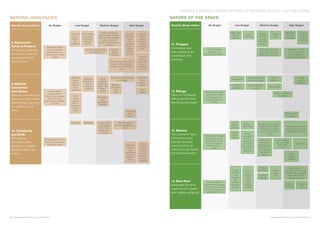
We’ve used the “14 Patterns of Biophilic Design” as a
framework to offer practical ways to implement Biophilic
Design to interior and exterior environments. We’ve broken
the patterns down into a handy table that you can reference
quickly and there are examples at a range of scales for
you to pick and choose from when you need to. Each of
the examples in the table can be introduced into the built
environment in exciting and creative ways, no matter what
your budget. Think of them as a starting point for your creative
interpretation. There’s no need to opt for just one strategy
either – blend them all to create a unique approach for each
design project and space.
If you think this is all way too much to take on just yet,
you may be surprised by some of our easy to implement
solutions. We have come up with some nifty approaches to
implementing Biophilic Design that can have a big impact
without too much disruption. However, if you are ready, your
clients are on board and you have the resources available,
think big and be bold!
CHAPTER 4:
BIOPHILIC
DESIGN
PATTERNS AT
DIFFERENT
SCALES – LET’S
GET GOING!
22 | Creating positive spaces using biophilic design
Creating positive spaces using biophilic design | 25
24 | Creating positive spaces using biophilic design
CHAPTER 4: BIOPHILIC DESIGN PATTERNS AT DIFFERENT SCALES – LET’S GET GOING!
Biophilic Design Pattern No Budget Low Budget Medium Budget High Budget
1. Visual
Connection
with Nature
View to elements of
nature, living systems
and natural processes
2. Non-Visual
Connection
with Nature
Sounds, touch,
smells, or tastes that
engender a positive
reference to nature
3. Non-Rhythmic
Sensory Stimuli
Objects or materials
in consistent yet
unpredictable motion
as found in nature (e.g:
grass swaying/ripples
on water/leaves in a
breeze)
4. Thermal &
Airflow Variability
Changes in air
temperature, humidity,
airflow across the
skin and surface
temperatures that
mimic natural
environments
Biophilic Design Pattern No Budget Low Budget Medium Budget High Budget
5. Presence
of Water
Seeing, hearing or
touching of water
6. Dynamic and
Diffuse Light
Varying intensities of
light and shadow that
change over time to
mimic natural patterns
and cycles
7. Connection with
Natural Systems
Awareness of natural
processes such as
seasons and temporal
changes
Plants in view
outdoors: Changing
layout of furniture
to take advantage
of views outside if
building situated in
natural landscape/
next to park/body of
water
Positioning of furniture
to face water features
Position desks close to
windows/skylights
Position furniture to
enable views of sky/
weather outside
Opening windows to
allow breezes to create
gentle movement in
plant leaves, blinds or
curtains
Enable opening and
closing of windows
throughout the day
according to comfort
levels
Natural soundtracks
to create acoustic
backdrop
Cut flowers
on tables &
desks
Scent
atomisers
and
diffusers
Rain
catchers,
wind
chimes,
rainbow
maker
(prism)
Fairylights
Colour
changing
LED lights or
lampshades
projecting
colour &
pattern
Sheltered
space
outside
Planting to
create shadows
(deciduous
windows)
Adjustable
blinds to
control light
Inside/outside:
cloud maps, tide
charts, temperature/
humidity/ air pressure
measurements, moon
cycles
Materials: light reflecting
floors, tables, walls and
surfaces, mirrors, light
reflective paint, tile
glazes, white surfaces,
sequin/mirrored
surfaces
Blinds:
cut outs
to project
shadows
and light
Green
walls:
absorb
heat,
humidity &
moisture
imbalances
Fountains,
flowing
water
(sound
masking)
and zoning
of spaces
Glass
roof –
skylight
Glass
doors/
walls
Clay paints
and surfaces:
absorb heat/
moisture
imbalances
Covered
outdoor spaces:
eating areas,
canopy in
winter, covered
outdoor
exercise
spaces,
weather proof
Kinetic water features:
cools the air and increases
humidity, zones areas by
making them feel different,
trickling water/ fountains
Sight: Imagery with water in
the composition, instances
of the colour blue, LED
screens, projection of water
flowing/ waterfall, ripples,
bouncing light
Seating by
non-fixed
water
features
Pools of
water in or
outdoors
Contrast/ use of tonal
variation of blues – depth
for different feels (ecological
valence theory): fabric,
carpet tiles, curtains, wall
paint, lighting (use for
changing times of day –
circadian rhythms)
Kinetic
artwork:
mobiles
Hanging plants:
kokodema,
macramé, baskets
Cleaning products:
low VOC, good quality
and nice smelling hand
soaps/ moisturisers
Sound masking: natural
sounds/ water lapping
Lighting
that
projects
dappled
light
(gobo/
moving
lights)
Installing
windows
that can
open
individually
& skylights
Offices/
hotels:
showers,
pools,
steam
rooms,
waterfalls,
bath in the
bedroom
External
fins (archi-
tectural)
Circadian
lighting
HVAC (heating,
ventilation and
air conditioning)
delivery
combined with
natural plant
strategy
Handmade/
glazed reflective
tiles
Exterior: water
features/ ponds
(ripples from
raindrops, freeze
in winter)
Plant deciduous
trees outside
Kinetic
sculptures
Planters –
Boston ivy
facades
Patio/
rooftops
with
seasonal
plants
Indoor willow
tree
Digital:
moving
screens,
projections
of patterns
Lights in trees
Bird
boxes and
squirrel
houses in
sight
Furniture
materials: chairs,
tables, stair
cases, use soft/
contrasting
materials for
relaxation vs.
focus spaces
Include kitchen
with healthy food
options
Citrus or coffee smells
(stimulate taste buds)
Visible
mechanical
ventilation
Seasonal winter
considerations:
fire pits,
blankets, hot
water bottles
Window
planters
Green roof
Green walls
that release
scent and are
touch resilient
Full height glass
walls/ windows
to see water
flow down – rain
or water feature
Position building
surrounded by
nature
Fans blowing
onto green
walls to create
movement
Light reflecting
off water
features/
fish tanks to
create rippling
movements
Zoning: floor
textures
– carpet/
timber/
stone/
biometric
Living green
walls
Cut Flowers
subscriptions
Landscaped
gardens with
seating areas
Refurbished
operable
windows
Internal
courtyards
Lightwell
Atrium
Trellis wall plant
screens
Plant services –hire of plants with monthly
subscription for maintenance
Interior and exterior
planting scheme
Potted plants
on desks &
shelves
NATURE IN THE SPACE
Creating positive spaces using biophilic design | 27
26 | Creating positive spaces using biophilic design
Biophilic Design Pattern No Budget Low Budget Medium Budget High Budget
8. Biomorphic
Forms & Patterns
Contoured, patterned,
textured or numerical
arrangements that
mimic nature
9. Material
Connection
with Nature
Materials and elements
from nature that reflect
local ecology/ geology
to create sense of
place
10. Complexity
and Order
Rich sensory
information that
adheres to a spatial
hierarchy similar to
nature
NATURAL ANALOGUES NATURE OF THE SPACE
Biophilic Design Pattern No Budget Low Budget Medium Budget High Budget
11. Prospect
Unimpeded view
over a distance for
surveillance and
planning
12. Refuge
Place for withdrawal
with protection from
behind and overhead
13. Mystery
The promise of more
information using
partially obscured
views to entice an
individual to go further
into the environment
14. Risk/Peril
Identifiable threat to
create tension paired
with reliable safeguard
CHAPTER 4: BIOPHILIC DESIGN PATTERNS AT DIFFERENT SCALES – LET’S GET GOING!
Display occupants’
pictures of natural
forms/patterns on
screensavers or social
media
Consider seating
orientation and
positioning by windows
Move existing furniture
and plants to create
private spaces for
retreating & restoring
energy
Move existing furniture
and plants to create
partial views through
the interior space to
enhance sense of
intrigue
Create a supportive
culture that encourages
everyone to step outside
their comfort zone e.g.
learning new skills
Artwork
(mimic
shapes
and
patterns)
Wayfinding
through
signpost
Leafy/
planted
screens
Images:
view down
from
mountain
top,
murals
(Trompe
D’oeuil)
Seating
over drops
Uneven
flooring
Ham-
mocks,
hanging
chairs/
swing
seats,
hanging
shelves
Water:
digital
LED
Trompe
D’oueil
Mural
Headphones
Raised
platforms
Pavilion
arcades &
walkways
Indoor winter
garden
Set up quiet corners
(seat, lamp, carpet)
Outdoor seating -
benches
Outdoor mezzanine
or gazebo
Curtains/
partitioning
Refuge pods
Obscured
views: plants
hanging, glass,
partitions (or
semi obscured
with frosted
glass)
A pull towards a
space: sounds,
smells, light,
wonder
Seating
(low back),
tiered
communal
seating
Wayfinding
through
structure
Hanging
walkways
Transparent materials:
glass/ polycarbonate
walls/ doors/ partitions
Balconies – sense
of space, mezzanine,
elevated platforms
(interior and exterior)
Materials:
natural
colours,
textures
and
patterns
Layer light
Use of
nature
inspired
colour –
ecological
valence
theory
Columns
like trees,
spirals
(stairs,
corridors,
Gaudi-
esque),
cell like
facades
Exposed
structure
and
mechanical
systems
(exoskel-
etal)
Structural
timber
beams
Light fittings
e.g: petals,
mushrooms,
pineapple
shapes
Low
partitions
Mirrors –
disorientate
Screen/ curtain/ frosted
glass creates shadow
movement and implied
activity that you want
to see
Winding paths through
spaces, gentle curving
(slightly disorientating)
Glass elevator/
escalator/ floor/ railing:
height (walkway, double
height atriums, tree
houses, gazebos)
Labyrinths
Digital
mapping
projection
Slowly
revealed
view or
artwork (so
you have to
keep walking
to reveal
more of it)
Window
seats
Choice
of site for
building
(in nature)
Bouldering
walls
Wallpaper
that mimics
natural
material
surface
Wallpaper
Wood:
handles/
hand rails,
timber wall
panels,
veneer
Zoning spaces
using pattern,
texture, light,
sound, colour
and touch
Biomimetic
tiles,
wallpapers,
flooring
Bark tiles,
cork, leather,
wood,
stone
Layout of
interior/
exterior
spaces:
curved
paths and
zones
Mimic
natural
hierarchy
in struc-
ture and
key archi-
tectural
elements
Freedom
to be ex-
perimental,
pavilions
installations,
structures
Materials:
colour,
texture,
pattern
Timber
cladding
Organic
shaped
furniture
Mathematical: fractals (3’s),
patterns within patterns,
repeated forms at different
scales
Clay/ ceramics furnishings
and fittings
Partitions (glass
textures, etched film on
glass)
Patterns: undulating
glass (underwater feel),
tiles, floor tiles, wallpaper
(colour/ texture),
screens of etched glass/
partitions
Fibonacci series, photos
of natural forms
Move existing furniture
and plants to organise
spaces into zones
Display objects
occupants have
found in local natural
environments e.g.
stones, shells, seedpods,
branches
28 | Creating positive spaces using biophilic design
CHAPTER 5: BIOPHILIC DESIGN IN PRACTICE: INSPIRATIONAL CASE STUDIES
CHAPTER 5:
BIOPHILIC
DESIGN IN
PRACTICE:
INSPIRATIONAL
CASE STUDIES
We have picked out four inspiring projects from around the
world to illustrate how Biophilic Design can be implemented
at different scales. We’ve gathered a range of insights into the
projects from the Biophilic elements they used, the costs, the
design intent and the impact it has had. We hope these case
studies inspire you to think about incorporating some biophilic
elements into your own spaces. Let’s have a look…
Fresh air. Daylight. Minimal noise. A steady temperature.
These four factors are the secret ingredients of healthy, productive
work environments. And yet, many people spend their working
week sitting in sealed up, stuffy offices that are dim and dingy, or lit
up like operating theatres. They sit shivering in winter or sweating
in summer, are distracted by incessant disruptive noise, and never
see the sun or the sky during the day. This isn’t good – for the
health of people, or for the health of the planet.”
58
– Jane Henley, Operations Manager, Green Building at IFC/ World Bank Group
28 | Creating positive spaces using biophilic design Creating positive spaces using biophilic design | 29
Creating positive spaces using biophilic design | 31
30 | Creating positive spaces using biophilic design
OFFICE DESIGN
MEDIUM COST/SCALE
BYGGVESTA – STOCKHOLM
A&D: Studio Stockholm
Cost: Overall, the cost of the refurbishment was 5,250 000
SEK. 35-40% of that cost is attributed to biophilic elements
such as wooden materials, wooden structures and plants
Area: 1000m2
Year: 2017
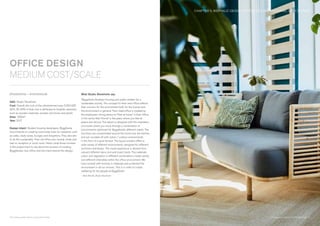
Design intent: Student housing developers, ByggVesta,
focus heavily on creating community hubs for residents, such
as cafes, study areas, lounges and receptions. They also aim
to do this sustainably. Their old office was neutral, small, and
had no reception or lunch room. Here’s what those involved
in the project have to say about the process of creating
ByggVesta’s new office and the intent behind the design:
What Studio Stockholm say:
”ByggVesta develops housing and public welfare for a
sustainable society. The concept for their new office reflects
their concern for the environment both for the human and
the environment in general. Their head office is created by
the employees’ strong desire to “Feel at home” in their office,
in the sense that “Home” is the place where you feel at
peace and secure. The layout is designed with the inspiration
of a home where you move through a combination of
environments optimised for ByggVesta’s different needs. The
functions are concentrated around the home hub, the kitchen,
and are rounded off with indoor / outdoor environments
in the form of a quiet terrace. The layout solution offers a
wide variety of different environments, designed for different
functions and tempo. The visual experience is derived from
nature’s different dens, bird and insect nests. The materials,
colour and vegetation in different combinations create variety
and different intensities within the office environment. We
have worked with honesty in materials and protected the
environment in all our choices. This is in order to create
wellbeing for the people at ByggVesta.”
– Boel Allende, Studio Stockholm
Creating positive spaces using biophilic design | 31
CHAPTER 5: BIOPHILIC DESIGN IN PRACTICE: INSPIRATIONAL CASE STUDIES
Creating positive spaces using biophilic design | 33
32 | Creating positive spaces using biophilic design
What ByggVesta say:
“Together with Studio Stockholm, we did a brief for important
qualities in the office. Places to unwind, places for activity,
places for social encounter. Natural material, soft feeling,
lots of greenery and a soothing atmosphere… Our client
group defined the vision that our future office should feel as
comfortable as a HOME. That became the base of the future
design concept. The zone with the best view is the zone for
calm reading, quiet work.’
– Cecilia Wallin, ByggVesta
What occupants say:
· The new offices positively impact their day-to-day life very
much
· They feel proud to work at ByggVesta
· They feel better in the new offices in comparison to their 		
previous workspace
· Visitors feel happy with their experience of the office
· There is more space for focused work
· The atmosphere is more sociable, with more frequent
interactions between people and groups, such as the
introduction of ‘swap meetings’, where people sell and
swap things with each other, and yoga sessions
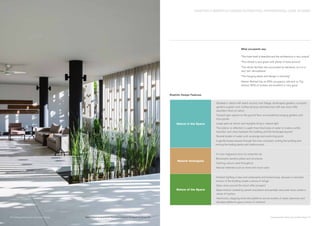
Nature in the Space
· Natural light through plenty of large windows
· Plants on the floor, shelves, in planters and trellises
· Window seats to observe the outdoors
· Outdoor terrace
Natural Analogues
· Economically and environmentally friendly materials used throughout
such as wood and leather
· Nature-inspired wallpaper
· Timber patterning on floors
· Wooden floors in the kitchen area
Nature of the Space
· Different spaces inspired by nature: dens, bird and insect nests
· Choice of private spaces for staff to retreat to: aquatic feeling
kitchenette, informal lounge spaces
· Choice of larger gathering places: patio, social dining areas
· Zoned areas with changes in carpet
· High back chairs for prospect & refuge benefits
Biophilic Design Features:
32 | Creating positive spaces using biophilic design
CHAPTER 5: BIOPHILIC DESIGN IN PRACTICE: INSPIRATIONAL CASE STUDIES
Creating positive spaces using biophilic design | 35
34 | Creating positive spaces using biophilic design
Image © Janie Airey
www.janie-airey.com
OFFICE DESIGN
HIGH COST/SCALE
WWF LIVING PLANET CENTRE – WOKING, UK
A&D: Hopkins Architects
Cost: £20.2 million (€22.8)
Area: 3,600 m²
Year: 2013
Design intent: WWF’s new UK base, the Living Planet
Centre, reflects the ethos and environmental credentials
of the company, as well as providing the public with an
interactive place to visit and learn about the work WWF
does. They aimed for this new building to be an ‘exemplar’
green building for the rest of the world, making it sustainable,
environmentally friendly and inspirational.
Impact: In their old offices, staff satisfaction was at a mere
27% for their 300 employees. Now, 95% of employees report
feeling proud to work in the Living Planet Centre. As well as
benefiting people, the project also benefitted the planet: The
Living Planet Centre has achieved a BREEAM ‘Outstanding’
rating, and 99% of construction waste was diverted from
landfill. Bike sheds with a green roof also encourage cycling
to work.
Creating positive spaces using biophilic design | 35
CHAPTER 5: BIOPHILIC DESIGN IN PRACTICE: INSPIRATIONAL CASE STUDIES
Creating positive spaces using biophilic design | 37
36 | Creating positive spaces using biophilic design
Image © Morley Vonsternberg
www.vonsternberg.com
What occupants say:
“The trees and the ceiling - I feel like I’m ‘in touch’ with the
environment. The building embraces the equity of the WWF
brand, it’s nice to hear the birds tweeting.”
“I find the environment makes me feel part of a professional
organisation while at the same time allowing me to exit the
‘buzz’ and get real quiet time for tasks that need it.”
Nature in the Space
· Natural soundtracks, background noises and scents
· Planted indoor trees
· Large panes of glass allowing for natural light and views onto nearby canal and
common
· Tranquil gardens with: wetlands area, wildlife pond, native plants, growing fruit and
vegetables using harvested rain water, bat, bird and bug boxes, outdoor spaces for
work
Natural Analogues
· Use of wood in structural elements, desks etc
· Biomorphic formed pods in entrance
· Reclaimed timber used
· Images of arctic and tropical seas and different animal species
Nature of the Space
· Four immersive timber ‘zones’ to reflect WWF’s key work (wildlife, forests, rivers
and oceans)
· Spaces for private working: ‘quiet booths’, ‘concentration zones’, sofas and break
out spaces
· High ceiling, open atrium layout with a curvaceous roofline made of arched
wooden pillars encourages prospect through the interior
· Glimpses into each contrasting experience zone through wooden ‘fins’, creating a
sense of mystery and a small clue to what is behind
Biophilic Design Features:
36 | Creating positive spaces using biophilic design
CHAPTER 5: BIOPHILIC DESIGN IN PRACTICE: INSPIRATIONAL CASE STUDIES
Creating positive spaces using biophilic design | 39
38 | Creating positive spaces using biophilic design
What other people say:
WWF is all about respect for nature and biodiversity and we wanted
to reflect this in the landscape design of its new Living Planet
Centre and Headquarters. The end result is a rich and stimulating,
yet simple and functional landscape setting that will be enjoyed by
the employees of WWF-UK, the residents of Woking and by public
visitors.”59
– Andrew Grant, director, Grant Associates.
It’s a fantastic eco-building that shows how it’s possible to use our
planet’s resources wisely, but also helps us all to connect with the
natural world.”60
– Sir David Attenborough.
Affordability is often cited as a key barrier to investment in
sustainable buildings. By developing a truly exemplar building on
a budget, WWF will inspire and influence the construction industry
and policy makers alike.”61
– Paul King, chief executive, UK Green Building Council.
38 | Creating positive spaces using biophilic design
Image © Janie Airey
www.janie-airey.com
CHAPTER 5: BIOPHILIC DESIGN IN PRACTICE: INSPIRATIONAL CASE STUDIES
Creating positive spaces using biophilic design | 41
40 | Creating positive spaces using biophilic design
HOSPITALITY DESIGN
MEDIUM COST/SCALE
RESTAURANT VAKST – DENMARK
A&D: Genbyg
Cost: £237,000 (€268.000)
Area: Ground floor 80 m2
, basement 120 m2
Year: 2016
Design intent: Vakst, meaning growth in Danish, is a
restaurant that resembles an indoor greenhouse. The aim was
to create a vivid, lush, organic garden-like atmosphere within
a city, much like a garden party. This restaurant has two levels,
one of which is underground. The lower floor represents the
soil where plant roots flourish and the floor above is the light
area in which the foliage grows. Environmental sustainability
through the re-use of materials was a priority in the creation
of this restaurant.
What Genbyg say:
We talked to Rasmus Fex, Designer at Genbyg, about the
intent, impact and features of the design. Let’s take a look at
what he had to say…
“The overall vision was to create a space with a design that
reflects the Nordic kitchen and the dual atmosphere of
a city and a garden. Cofoco, the owner of the restaurant,
wanted to incorporate green elements at the same time as
using recycled materials. They said to us – ‘Can you make a
greenhouse inside?’ That was the only brief, so it was really
free for us to come up with the concept. The brief was also
to create an organic space like a garden party, so on the first
floor we have garden lights across the ceiling. Downstairs, we
made a tent. We found some recycled, old tablecloths and put
them together for a big tent in the ceiling.”
– Rasmus Fex, Genbyg.
“You get a feeling of being on an old farm or barn. Before, the
restaurant was called ‘Work in Progress,’ but people hardly
went there because it didn’t have any concept or DNA… Now
it is fully booked all the time. There is a lot of green and I think
people just love that, like sitting in a greenhouse. There is a
really nice atmosphere in there. And all the materials have
soul because they have been used before.”
– Rasmus Fex, Genbyg.
This design was nominated for the international Restaurant
and Bar Design Awards in 2016.
Creating positive spaces using biophilic design | 41
Photos © Chris Tonnesen
CHAPTER 5: BIOPHILIC DESIGN IN PRACTICE: INSPIRATIONAL CASE STUDIES
Creating positive spaces using biophilic design | 43
42 | Creating positive spaces using biophilic design
CHAPTER 5: Who’s doing it?
What occupants say:
Trip Advisor Reviews:
91% excellent or very good
“The interior is modern but warm, as the whole place is
outfitted with plants and feels like the inside of a greenhouse.
There is seating on two levels -- one at street level and
another floor on the sub-level with skylights to the street
above. A unique design and one that we enjoyed.”
“The interior is most inviting with soft lighting and dozens of
potted plants.”
“The design of the restaurant - which features a central green
house, wood and concrete - is superb.”
“A really beautiful atmosphere… an indoor “greenhouse”
added to the experience.”
Nature in the Space
· Greenery: floor plants, hanging plants, potted plants on shelving, planters
· Large windows and glass walls to allow plenty of natural light
Natural Analogues
· Exposed wooden greenhouse structure
· Wooden floors and furniture
· Stone walls
· Leather seat coverings
· Recycled materials used throughout, such as old scaffolding planks to form the
bar and teakwood chairs from an old High School
Nature of the Space
· Swing seats offer a sense of risk
· Views across restaurant through the greenhouse windows allow for prospect
· Tent-like feel and darker nooks in the basement create a sense of refuge
· Light pools from skylights in the basement create a sense of mystery
· Views partially obscured by plants also creates mystery and encourages exploration
Biophilic Design Features:
42 | Creating positive spaces using biophilic design Photos © Chris Tonnesen
CHAPTER 5: BIOPHILIC DESIGN IN PRACTICE: INSPIRATIONAL CASE STUDIES
Creating positive spaces using biophilic design | 45
44 | Creating positive spaces using biophilic design
HOSPITALITY DESIGN
HIGH COST/SCALE
NAMAN RETREAT – DA NANG, VIETNAM
A&D: MIA Design Studio
Cost: Undisclosed
Area: 1600 m2
Year: 2015
Design intent: The five-star Naman retreat includes the
‘Pure Spa’, a free flowing, no-wall sanctuary with 15 luxury
treatment rooms to create a ‘healing and tranquil cocoon,’
and a health club for exercise, meditation and yoga. This spa
touches on all the senses to create peace and tranquillity, with
the aim to create a state of natural relaxation.
As well as the Spa, the resort has a series of villas,
restaurants and bars that incorporate features to evoke a
feeling of being at one with nature.
Guided activities are also on offer for mindfulness and getting
in touch with nature, such as tai chi, yoga, hiking, biking, beach
meditation, fishing and gardening.
What MIA Design Studio say:
· With use of local plants, each retreat becomes a healing
environment where the guest can enjoy a luxurious 		
wellness in privacy.
· Water and vegetation are indeed strong elements in this 		
luxurious setting.
· The façade is composed by latticed patterns alternated 		
with vertical landscapes that filter the strong tropical 		
sunlight into a pleasant play of light and shadow on 		
the textured walls. Various plants are carefully allocated and
become a part of the architectural screens.
· Different areas flow smoothly into each other and the 		
beautiful landscape creates an amazing journey into 		
a dream-like experience.
Creating positive spaces using biophilic design | 45
CHAPTER 5: BIOPHILIC DESIGN IN PRACTICE: INSPIRATIONAL CASE STUDIES
Naman Retreat designed by Vo Trong Nghia Architects, Photograph by Hiroyuki Oki
46 | Creating positive spaces using biophilic design Creating positive spaces using biophilic design | 47
CHAPTER 5: Who’s doing it?
What occupants say:
“The hotel itself is beautiful and the architecture is very unique.”
“The retreat is very green with plenty of trees around.”
“The whole facilities are surrounded by bamboos, so it is a
very ‘zen’ atmosphere.”
“The hanging plants and design is stunning.”
Naman Retreat has an 80% occupancy rate and on Trip
Advisor, 95% of reviews are excellent or very good.
Nature in the Space
· Situated in nature with beach access, lush foliage, landscaped gardens, courtyard
gardens a green roof, rooftop terraces and balconies with sea views offer
abundant views to nature
· Tranquil open spaces on the ground floor surrounded by hanging gardens and
lotus ponds
· Large open-air atrium and skylights bring in natural light
· The exterior is reflected in a palm-tree-lined body of water to create a softer
transition and views between the building and the landscape beyond
· Several bodies of water such as plunge and swimming pools
· A gentle breeze passes through the inner courtyard, cooling the building and
moving the trailing plants and shallow pools.
Natural Analogues
· In-room fragrance menu for essential oils
· Biomorphic bamboo pillars and structures
· Calming colours used throughout
· Natural materials such as stone and wood used
Nature of the Space
· Ambient lighting in bars and restaurants and tucked away Jacuzzis in secluded
corners of the building create a sense of refuge
· Open views around the resort offer prospect
· Glass exterior shaded by panels and plants and partially obscured views create a
sense of mystery
· Hammocks, stepping stone like platforms across bodies of water, balconies and
elevated platforms give a sense of risk/peril.
Biophilic Design Features:
46 | Creating positive spaces using biophilic design
CHAPTER 5: BIOPHILIC DESIGN IN PRACTICE: INSPIRATIONAL CASE STUDIES
Naman Retreat designed by Vo Trong Nghia Architects, Photograph by Hiroyuki Oki
Creating positive spaces using biophilic design | 49
48 | Creating positive spaces using biophilic design
FURTHER INSPIRATION
These case studies are just a tiny sample of the exciting and
innovative Biophilic Design in practice in a couple of sectors.
For more inspiration, take a look at the Living Future Institute’s
Living Building Challenge (https://living-future.org/lbc/) and
some of the certified WELL Building Standard™ projects
(https://wellonline.wellcertified.com/community/projects).
Human Space’s Biophilic Design Hub (http://humanspaces.com)
also has a wealth of articles and Case Studies to further your
knowledge in this area.
CHAPTER 5: BIOPHILIC DESIGN IN PRACTICE: INSPIRATIONAL CASE STUDIES
Creating positive spaces using biophilic design | 51
50 | Creating positive spaces using biophilic design
Not every Biophilic Design feature has evidence to support
its positive effects. But that’s just the nature of such an
innovative and emergent approach to design. Many aspects
are being tested in ongoing projects such as the BRE
Biophilic Office project, where pre- and post-occupancy data
will be gathered over the next two years.
In 2017 BRE launched The Biophilic Office Project, in which
they are refurbishing one floor of an office building on their
Watford campus in the UK. During this process, research will
be gathered on how Biophilic Design can be implemented at a
low, medium and high level and the subsequent benefits to the
health, wellbeing and productivity of the office occupants.62
The project will spend its first year measuring quantitative and
qualitative aspects of the existing building and occupants. A
four-month refurbishment process will then take place based
on this information. This will see the floorplan redesigned
to reflect three zones with low, medium and high scale of
Biophilic implementations. Following this, a year-long study of
the benefits of each zone, and the return on investment (ROI)
of each Biophilic aspect will take place.
One of our future design guides will be on how to
conduct pre-and post-occupancy studies, so perhaps
you’ll pick that up and contribute to this growing body of
evidence to support Biophilic design.
The BRE project has the potential to change and aid the
development of design standards, and building codes.
As we are all becoming more aware of issues around things
like air quality, so too are governments - policies to combat
negative impacts on human health are emerging globally.
Biophilic Design has a big part to play in counteracting some
of the negative impacts of human activity by re-introducing
nature and its benefits into the urban environment. Everyone
has role to play, from interior designers and architects,
to urban designers.
Biophilic Design is already a feature within the likes of
human-centred building standards such as the WELL Building
Standard™, so its benefits are being recognised as having
a positive effect on psychological wellbeing and are being
adopted by the architecture and design community. There are
some exciting developments in materials and technologies
that mimic nature – be that real or virtual – and these are
becoming increasingly sophisticated with time. So much is
happening as Biophilic Design is gaining momentum, so it
really is a case of watch this space…
CHAPTER 6:
SO, WHAT’S THE
FUTURE OF
HUMAN
CENTRED
DESIGN?
CHAPTER 6: SO, WHAT’S THE FUTURE OF HUMAN CENTRED DESIGN?
50 | Creating positive spaces using biophilic design
Creating positive spaces using biophilic design | 53
52 | Creating positive spaces using biophilic design
1
Fromm, E. (1973). The Anatomy of Human Destructiveness, New
York (Holt, Rinehart and Winston) 1973.
2
Kellert, S. R., & Wilson, E. O. (Eds.). (1995). The biophilia hypothesis.
Island Press.
3
http://www.florencewilliams.com/the-nature-fix
4
http://www.un.org/en/development/desa/news/population/world-
urbanization-prospects-2014.html
5
Klepeis, N E. et al. (2001) The National Human Activity Pattern Sur-
vey (NHAPS): A Resource for Assessing Exposure to Environmental
Pollutants Lawrence Berkeley National Laboratory for U.S. Environ-
mental Protection Agency (EPA)
6
The European Commission Report (200)3 http://europa.eu/rapid/
press-release_IP-03-1278_en.htm
7
https://www.mequilibrium.com/wp-content/uploads/2013/03/3-1-
13-FINAL.pdf
8
Ulrich, R. S., Simons, R., Losito, B. D., Fiorito, E., Miles, M. A., & Zel-
son, M. (1991). Stress recovery during exposure to natural and urban
environments. Journal of Environmental Psychology, 1
1, 201–230.
9
http://www.hse.gov.uk/statistics/causdis/stress/stress.pdf
10
https://osha.europa.eu/en/tools-and-publications/publications/
literature_reviews/calculating-the-cost-of-work-related-stress-and-
psychosocial-risks
1
1
https://www.terrapinbrightgreen.com/report/economics-of-biophil-
ia/
12
https://www.terrapinbrightgreen.com/report/economics-of-biophil-
ia/
13
https://www.nigms.nih.gov/Education/Pages/Factsheet_Circadi-
anRhythms.aspx
14
http://www.thephotonspace.com/how/
15
http://www.cell.com/current-biology/abstract/S0960-
9822(13)00764-1
16
http://www.cell.com/current-biology/abstract/S0960-
9822(13)00764-1
17
Appleton, J. (1975) The Experience of Landscape
18
Orians, G.H. & J.H. Heerwagen (1992). Evolved Responses to
Landscapes. In J.H. Barkow, L. Cosmides, & J. Tooby (Eds.), The
Adapted Mind: Evolutionary Psychology and the Generation of Cul-
ture (555-579). New York, NY: Oxford University Press.
35
Nasa Report (1989) Interior Landscape Plants for Air Pollution
Abatement
36
http://www.florencewilliams.com/books-1
37
http://humanspaces.com/2016/05/1
1/the-garden-of-urban/
38
http://humanspaces.com/2014/10/08/this-is-the-headline-for-
an-article-which-could-go-onto-two-lines/
39
World Green Business Council (2014) Health, Wellbeing &
Productivity in Offices: The next chapter for green building - Key
findings P2
40
https://osha.europa.eu/en/tools-and-publications/publications/
literature_reviews/calculating-the-cost-of-work-related-stress-and-
psychosocial-risks
41
Elzeyadi, I. “Daylighting-Bias and Biophilia: Quantifying the Impacts
of Daylight on Occupants Health.” In: Thought and leadership
in Green Buildings Research. Greenbuild 201
1 Proceedings.
Washington, Dc: USGBc Press. 201
1.
42
Raanaas, R. K., Horgen-Evensen, K., Rich, D., Sjostrom, G. & Patil,
G. (201
1). Benefits of indoor plants on attention capacity in an office
setting. Journal of Environmental Psychology, 31, 99-105.
43
Heschong, lisa. Heschong Mahone Group. (2003) “Windows and
Offices: A Study of Office Worker Performance and the Indoor
Environment.” California Energy commission: Pacific Gas and Electric
company, California.
44
Heschong, Lisa. Heshong Mahone Group (2003) “Windows and
Offices: A Study of Office Worker Performance and the Indoor
Environment” – California Energy Commission
45
Human Spaces Report (2015) The Global Impact of Biophilic
Design in the Workplace P19-30
46
Romm, Joseph J. and William D. Browning (1994) “Greening the
building and the bottom line.” Rocky Mountain Institute, Colorado
47
Analysis of the performance of students in day lit schools –Nicklas
Bailey, 1996
48
Wells, N. M. (2000). At home with nature: Effects of “greenness”
on children’s cognitive functioning. Environment and behavior, 32(6),
775-795.
49
Kuo, F. E., & Faber Taylor, A. (2004). A potential natural treatment
for attention-deficit/hyperactivity disorder: evidence from a national
study. American journal of public health, 94(9), 1580-1586.
50
Bell, A., & Dyment, J. E. (2006). Grounds for action: Promoting
physical activity through school ground greening in Canada.
Evergreen.
19
http://humanspaces.com/2016/01/21/the-attention-restoration-
theory/
20
Grinde, B., & Patil, G. G. (2009). Biophilia: Does visual contact with
nature impact on health and wellbeing?. International Journal of
Environmental Research and Public Health, 6(9), Page 2334-2335
21
Ulrich, R. S. (1986). Human responses to vegetation and land-
scapes. Landscape and urban planning, 13, 29-44.
22
Beauchamp, M.S., K.E. Lee, J.V. Haxby, & A. Martin (2003). FMRI
Responses To Video and Point-Light Displays of Moving Humans
and Manipulable Objects. Journal of Cognitive Neuroscience, 15 (7),
991-1001.
23
http://humanspaces.com/2015/12/23/ecological-valence-theory/
24
Orians, G.H. & J.H. Heerwagen (1992). Evolved Responses to
Landscapes. In J.H. Barkow, L. Cosmides, & J. Tooby (Eds.), The
Adapted Mind: Evolutionary Psychology and the Generation of
Culture (555-579). New York, NY: Oxford University Press.
25
Tsunetsugu, Y., Y. miyazaki, & H. Sato (2007). Physiological effects
in Humans Induced by the visual Stimulation of Room Interiors with
Different Wood Quantities. Journal of Wood Science, 53 (1), 1
1-16.
26
MathewWhiteaAmandaSmithaKellyHumphryesaSabinePahlaDebo-
rahSnellingbMichaelDepledgec Blue space: The importance of water
for preference, affect, and restorativeness ratings of natural and built
scenes Journal of Environmental Psychology, Volume 30, Issue 4,
December 2010, Pages 482-493
27
https://humanspaces.com/2016/03/09/water-for-wellbeing/
28
http://humanspaces.com/2015/09/30/mindful-offices/
29
http://www.mindfulnet.org/page2.htm
30
Grossman, P., Niemann, L., Schmidt, S., & Walach, H. (2004).
Mindfulness-based stress reduction and health benefits: A meta-
analysis. Journal of psychosomatic research, 57(1), 35-43.
31
Mark, G., Gudith, D., & Klocke, U. (2008, April). The cost of
interrupted work: more speed and stress. In Proceedings of the
SIGCHI conference on Human Factors in Computing Systems (pp.
107-1
10). ACM.
32
http://www.mayoclinic.org/healthy-lifestyle/stress-management/
expert-answers/stress/faq-20058233
33
http://www.heart.org/HEARTORG/HealthyLiving/
StressManagement/HowDoesStressAffectYou/Stress-and-Heart-
Health_UCM_437370_Article.jsp#.WYBihLpFyUk
34
Biophilia: Does Visual Contact with Nature Impact on Health and
Well-Being
51
Wells, N. M., & Evans, G. W. (2003). Nearby nature: A buffer of life
stress among rural children. Environment and behavior, 35(3), 31
1-
330.
52
Symposium: the Role of Horticulture in Human Well-being and
Social Development. Timber Press, Portland, OR 1992. The article
entitled “People and Plants: A Case Study in the Hotel Industry”
53
Lange, E., & Schaeffer, P.V., (2001) A comment on the market value
of a room with a view
54
http://humanspaces.com/2017/08/30/biophilic-design-
hospitality/
55
http://humanspaces.com/2017/08/30/biophilic-design-
hospitality/
56
https://www.naturalnavigator.com/books-and-library/how-to-
connect-with-nature
57
https://www.terrapinbrightgreen.com/report/economics-of-
biophilia/
58
http://humanspaces.com/2014/12/01/secret-to-healthy-
productive-workplaces/
59
https://worldlandscapearchitect.com/wwf-uk-living-planet-centre-
and-headquarters-opens/#.Wg2msEx2uUl
60
https://www.wwf.org.uk/updates/sir-david-attenborough-opens-
living-planet-centre
61
http://assets.wwf.org.uk/custom/stories/
lpc/?_ga=2.19221304.180071018.1510228340-
1693922368.1510061
180&_gac=1.238290612.1510228340.
EAIaIQobChMI7cOYkbax1wIVz73tCh3iCgUmEAAYASAAEgJnpvD_
BwE
62
http://bregroup.com/services/research/the-biophilic-office/
REFERENCES
Creating positive spaces using biophilic design | 55
54 | Creating positive spaces using biophilic design
This design guide has been produced as part of Interface’s
DesignLab. DesignLab is a community of forward thinking
architects and designers who want to create positive spaces
for people and planet.
Interface want to share their innovative approach to human
centred design and help architects, designers and decision
makers pave the way towards innovative ways of creating
sustainable buildings with wellbeing at their heart.
Other Design Guides available as date of publishing:
· Creating Positive Spaces - WELL Building Standard™ 		
Published January 2018
Authors:
Oliver Heath – Founder and Director of Oliver Heath Design
Victoria Jackson – Lead Researcher at Oliver Heath Design
Eden Goode – Researcher at Oliver Heath Design
We would like to thank ByggVesta, WWF, Restaurant Vakst
and Naman Retreat for giving consent for their case study
material to be included in this publication. We are especially
grateful to those who gave their time to providing information
and quotes to include throughout this Design Guide.
Publishing date: June 2018
www.interface.com
Southeast Asia Headquarters +65 9819 9128 80 Marine Parade Road, #22-03/07
Parkway Parade
Singapore 449269
India Headquarters +91 80 4613 1313 7th Floor, #9/1, SKAV 909 Building,
Lavelle Road, Richmond Circle,
Bengaluru – 560025
Karnataka
Australia & New Zealand
Headquarters
+61 2 8332 2400 101 Chalmers Street
Surry Hills, NSW 2010
China Headquarters +86 512 5373 9832 1
1
1 North Dongting Road
Economic Development
Area of Taicang,
Taicang City
Jiangsu Province, 215400

wc_ap-Biophilic-Design-Guide-APAC.pdf

  • 1.
    CREATING POSITIVE SPACES USING BIOPHILICDESIGN Anaccessiblepractitioner’sguidetohelpinspirearchitectsand designerstounderstandtheprinciplesofBiophilicDesignandhowto implementitatarangeofscalesandcosts.
  • 2.
    2 | Creatingpositive spaces using biophilic design Creating positive spaces using biophilic design | 3 Biophilic Design is a human centred approach aimed at improving our connection to nature and natural processes in the buildings that we live and work. This improved connection can benefit our wellbeing by reducing stress and improving recuperation – helping to cut costs and improve outcomes in the built environment. More than just a new design trend, Biophilic Design should be seen as a universal design ethos – after all, at some point in our lives we’ve all had positive experiences of nature. So, implementing it isn’t necessarily about spending money, but recognising the many ways that we can connect to nature through the culture and design of the spaces that are so important to us. Through this design guide we hope to inspire creativity, productivity and wellbeing at a range of scales to enhance our connection to nature, for the benefit of all.” – OLIVER HEATH, Director of Oliver Heath Design, author of this Design Guide 2 | Creating positive spaces using biophilic design
  • 3.
    4 | Creatingpositive spaces using biophilic design A GUIDE TO IMPLEMENTING BIOPHILIC DESIGN – WHAT’S IN IT FOR YOU? In this inspirational guide we share our insights and research on Biophilic Design (designing nature back into the built environment) and show you that, due to the profound effect it can have on people’s wellbeing, it is more that just an aesthetic consideration. We aim to provide you with an understanding of both its human and economic benefits, to arm you with a convincing business case, and to propose a range of practical methods for implementing Biophilic Design no matter what your budget. We hope that by the time you put this guide down you will understand: · What Biophilic Design is · Why we should focus on this human-centred approach to design · How to implement it at a variety of scales · Who is already doing it · Where and when it can be used Whether this is all new to you, or you’re already using a biophilic approach, this guide will help you communicate the benefits of designing in a human-centred way to your clients, decision makers or those who inhabit your spaces. WHY IS INTERFACE SUPPORTING THIS SUBJECT? Creating positive spaces where we work, rest and play involves design that incorporates visual appeal, purpose, sustainable elements, and an understanding of human behaviour. Bold thinking is required to strike the balance between reflecting each person’s needs whilst adhering to regulatory standards, without compromising on the design aesthetic. The building industry is increasingly recognising companies who prioritise supporting the wellbeing of their people. Certification systems like the WELL Building Standard™ are gaining traction and the increasing interest in them demonstrates that the creation of positive spaces requires further investigation. To capture insights from industry and thought leaders, Interface have co-authored a series of papers to explore the value of human-centred design, understand how nature can inspire the creation of positive spaces and examine the future of sustainable buildings. Creating positive spaces using biophilic design | 5
  • 4.
    Creating positive spacesusing biophilic design | 7 CONTENTS CONTENTS CHAPTER 1 pg. 08 WHAT IS BIOPHILIC DESIGN? CHAPTER 2 pg. 14 BIOPHILIC DESIGN - THE SCIENCE BEHIND IT CHAPTER 4 pg. 22 BIOPHILIC DESIGN PATTERNS AT DIFFERENT SCALES – LET’S GET GOING! CHAPTER 5 pg. 28 BIOPHILIC DESIGN IN PRACTICE: INSPIRATIONAL CASE STUDIES · Office Design Medium Cost/Scale - ByggVesta – Stockholm · Office Design High Cost/Scale - WWF Living Planet Centre – UK · Hospitality Design Medium Cost/Scale - Restaurant Vakst – Denmark · Hospitality Design High Cost/Scale - Naman Retreat – Vietnam CHAPTER 6 pg. 50 SO, WHAT’S THE FUTURE OF HUMAN CENTRED DESIGN? CHAPTER 3 pg. 18 HOW TO GET YOUR CLIENTS ON BOARD: THE SALES PITCH 6 | Creating positive spaces using biophilic design
  • 5.
    Creating positive spacesusing biophilic design | 9 8 | Creating positive spaces using biophilic design CHAPTER 1: WHAT IS BIOPHILIC DESIGN? Biophilic Design offers guidelines for how to create built environments that support our innate human attraction to nature and natural processes (biophilia). “Throughout our evolution, we’ve spent 99.9 per cent of our time in nature. Our physiology is still adapted to it. During everyday life, a feeling of comfort can be achieved if our rhythms are synchronized with those of the environment.”3 – Yoshifumi Miyazaki Our response to natural environments stems from our evolutionary development and survival. It makes sense that our ancestors felt calmer in places that had an abundance of greenery and living elements, as they indicated the availability of food and water and this meant they could focus on other things. Similarly, spaces that offered both the security of being contained, or sheltered, and that had a good vista over the landscape would have been essential for our ancestors to keep an eye out for predators or animals to hunt. The theory behind these ideas are summarised in the next chapter - see the Savannah hypothesis section. We still experience a psychological inheritance of this survival instinct (even though we don’t have to worry about foraging for sustenance or predators in the same way) in our urban environments. This means that a space designed to have a sense of refuge and prospect with plenty of living elements in (or references to them) can make us feel less stressed and more productive. With this in mind, Biophilic Design offers an approach to creating buildings and spaces that respond to our human needs. Biophilic Design principles can be applied to existing and new buildings, interior and exterior spaces alike. They can be implemented at a range of scales and budgets and have greatest impact within the urban environment where we have strayed the furthest from nature. It is essential that, as we spend more time indoors and in urban environments, we find ways to increase our contact with nature and natural elements to take advantage of its benefits. And here’s why… BIOPHILIA IS: CHAPTER 1: WHAT IS BIOPHILIC DESIGN? The passionate love of life and of all that is alive; it is the wish to further growth, whether in a person, a plant, an idea or a social group.” 1 – Erich Fromm The innately emotional affiliation of human beings to other living organisms. Innate means hereditary and hence part of ultimate human nature.” 2 – E.O. Wilson 8 | Creating positive spaces using biophilic design
  • 6.
    WHY IS ITRELEVANT NOW? A CHANGE FOR THE BETTER Creating spaces that enhance wellbeing is an important design aim to achieve. Why? Because as urbanisation has increased, stress rates have also rocketed. Coincidence? We don’t think so. Here’s some astonishing facts that demonstrate why: · By 2050, 66% of the developed world will be urbanised4 , and thus we are becoming increasingly distanced from nature. · North Americans spend 93% of their time indoors5 whilst Europeans spend 85-90% of their time indoors.6 · Stress has been called the “health epidemic of the 21st century” by the World Health Organization,7 causing significant costs for employers and increasing the need for individuals to focus on their physical and mental health. · We recover significantly faster from stress when exposed to a natural environment, in comparison to an urban setting.8 · In the UK in 2015/16, 1 1.7 million working days were lost due to stress.9 This doesn’t take into account the indirect stress related costs, such as decreased concentration and productivity. · In 2002, the European Commission calculated the costs of work-related stress in the EU at €20 billion a year.10 With a vast body of research to support the ethos, it’s important that we find ways to creatively develop the implementation of the principles of Biophilic Design and make it financially accessible, to increase the uptake. We hope to explore and promote the discussion around creating positive human-centred spaces, whilst helping the architecture and design community expand the services they offer. In Chapter 2, we’ll show you how a Biophilic approach to design can improve the Triple Bottom Line: wellbeing for building occupants, employee productivity for businesses, and return rates for clients. Considering that our health and wellbeing are intrinsically linked to that of the natural environment around us, surely we should want to protect it and enable it to flourish. CHAPTER 1: WHAT IS BIOPHILIC DESIGN? By 2050, 66% of the developed world will be urbanised, and thus we are becoming increasingly distanced from nature. 66% In 2002, the European Commission calculated the costs of work- related stress in the EU at €20 billion a year. 20 billion In the UK in 2015/16, 1 1.7 million working days were lost due to stress. 11.7 million 10 | Creating positive spaces using biophilic design Creating positive spaces using biophilic design | 1 1
  • 7.
    12 | Creatingpositive spaces using biophilic design Creating positive spaces using biophilic design | 13 CHAPTER 1: WHAT IS BIOPHILIC DESIGN? BIOPHILIC DESIGN - THE OVERVIEW Human centred design has risen-up the agenda for the design industry in the last couple of years and Biophilic Design is still a relatively new field of practice. In this design guide we will introduce you to Terrapin Bright Green’s neuroscientific & psychological take on Biophilic Design. This approach is concerned with what goes on in our heads when we connect with nature, as well as our perception of it, and considers how to enhance spaces with: · Nature in the Space: designing in direct contact with nature or natural systems. · Natural Analogues: design strategies that use references to, or representations of, nature. · Nature of the Space: mimicking the spatial qualities of natural environments to evoke/enhance human responses.1 1 Terrapin Bright Green offer an accessible framework for interpreting, adapting and applying Biophilic Design principles into design practice. In Chapter 3, we’ll go into more detail on their “14 Patterns of Biophilic Design”, where we will expand on these approaches by giving you some ‘how to’ examples to fit any budget. But first…
  • 8.
    Creating positive spacesusing biophilic design | 15 14 | Creating positive spaces using biophilic design CHAPTER 2: BIOPHILIC DESIGN - THE SCIENCE BEHIND IT CHAPTER 2: BIOPHILIC DESIGN - THE SCIENCE BEHIND IT There has been a great deal of scientific research around why the desire for a nature connection is so deeply embedded in our physical and mental states. This has led to the development of theories about how Biophilic Design can help fulfil that need and improve wellbeing. These theories explain our physical and psychological reactions to elements within our built and natural environments, and offer us opportunities to be creative and utilise these responses to create positive spaces. We have selected some of the best bits to get you thinking about how to bring Biophilic Design theory into your practice: Circadian Rhythms are the ‘physical, mental and behavioral changes that follow a roughly 24- hour cycle, responding primarily to light and darkness in an organism’s environment.’ 13 *In 2017, the Nobel Prize in Physiology or Medicine was awarded to the scientists who discovered the molecular mechanisms that control Circadian Rhythms. Natural daylight triggers cells in the eye that signal the secretion or suppression of melatonin - the sleep inducing hormone that regulates our Circadian Rhythms.14 However, artificial light can throw our Circadian Rhythms out of kilter and have physiological, cognitive and overall health consequences. We can reset our Circadian Rhythms through increased exposure to sunlight. Designing spaces that offer occupants more opportunities for exposure to natural light will help them reset their Circadian Rhythms and improve wellbeing and performance. The Prospect-Refuge Theory 17 argues that we have an ‘inborn desire’ for prospect so that we can observe things without being seen by others. Savanna Hypothesis 18 suggests that human preference is to be in lush healthy Savannah-like environments where we can see potential threats or prey across open grasslands from a place of safe refuge. Why do we feel more comfortable and safe in some environments and not others? Biophilia recognises the need for inhabitants to have the structure of a natural environment. For example, Savannah-like open spaces contrasting with more sheltered “safe” spaces. These create spaces that enable both excitement and exploration with quiet areas that allow us to restore mental and physical focus. 14 | Creating positive spaces using biophilic design
  • 9.
    Attention Restoration Theory 19 Naturecan replenish our mental and attentional capacity after we’ve tired our brains out from too much “directed attention”. That is, nature can reactivate the tired parts, and so we can enjoy “effortless attention” for a short while at least. 20 People have a strong tendency to prefer natural views over urban landscapes, inducing more positive emotional and physiological states. Liking for urban scenes increases when trees and other vegetation are incorporated.21 We also view natural movement more positively than mechanical movement, and occasionally shifting our attention to something natural is beneficial for attention restoration.22 Mindfulness 28 Mindfulness 29 techniques purposefully increase awareness of the present moment through connection with one’s senses, reducing stress 30 , anxiety, and physical disorders. When working with distraction we experience higher levels of stress31 which can lead to depression32 and behaviours that increase the risk of heart disease.33 Should we have no quiet place to escape to, Biophilic Design can encourage the sensory awareness required for mindful states through: Sight – Natural light and views out to nature create awareness of the present moment. Planted partitions in open plan offices can block visual distraction and dampen sound.34 Smell – Introducing plants can improve air quality35 and introduce pleasant, natural aromas. Vaporised stem oil from Hinoki Cypress trees creates a 20% increase in NK cells (cells that protect us from disease agents) and lowers fatigue.36 Hearing – Recorded sounds, such as flowing water, mask disruptive noises. Touch – Tactile sensory contrasts create a sense of momentary awareness. We can also zone spaces with changes in floor surfaces, acoustic and visual landscapes. ‘Blue Space’ Theory 26 We prefer environments (built or natural) containing water. They can have a positive effect on us and we perceive them to be more restorative than those without. Incorporating water into environments has been found to reduce stress, lower heart rate and blood pressure, and enhance relaxation, positive emotions, concentration, and memory restoration.27 Ecological Valence Theory 23 This theory explains our colour preferences and responses to them. We seek colours that are reminiscent of nature when it is thriving 24 , for example: Incorporating references to nature (natural analogues), such as natural materials, patterns, textures or colours that mimic nature can make us feel better and have a positive physiological effect. For example, using wood in interiors can reduce blood pressure and increase the feeling of comfort.25 CHAPTER 2: BIOPHILIC DESIGN - THE SCIENCE BEHIND IT It’s what we crave because we know instinctively that we must have it to survive. We must breathe Nature, smell Nature, feel it, hear it, touch it, live it, eat it to be whole. We must be immersed in it.” 37 – Helena van Vliet, AIA – Principal at Helena van Vliet Architect, LLC Blue: clear sky or clean water – calming and relaxing Green: healthy vegetation – calming and restorative Yellow: warmth and sunshine – happy and welcoming Red: healthy ripe fruits – energising and exciting Creating positive spaces using biophilic design | 17 16 | Creating positive spaces using biophilic design
  • 10.
    Creating positive spacesusing biophilic design | 19 18 | Creating positive spaces using biophilic design CHAPTER 3: HOW TO GET YOUR CLIENTS ON BOARD: THE SALES PITCH Biophilic Design can have tangible benefits within the workplace, educational, hospitality, retail and domestic sectors – creating savings and improving profits. Using Biophilic Design can create a greater sense of health and well-being for inhabitants, staff and visitors alike. But it can also have hugely beneficial financial implications that stem from improving the health and well being of the building occupants. This research on a few of the sectors should help you convince your clients that the economic benefits add up: CHAPTER 3: HOW TO GET YOUR CLIENTS ON BOARD: THE SALES PITCH Despite so many office workers living in city-dominated lives, with increasingly limited access to natural elements, they all share an affinity with the natural world. No matter where they are, people yearn for more natural light, peace and quiet, and most importantly, the chance to be closer to nature. It follows, then, that businesses that boast offices with design elements inspired by nature, such as more natural light and greenery, will have employees that are happier and more productive at work, and perhaps healthier too.” 38 – Sir Cary Cooper (CBE FAcSS), Psychologist 18 | Creating positive spaces using biophilic design
  • 11.
    Creating positive spacesusing biophilic design | 21 20 | Creating positive spaces using biophilic design CHAPTER 3: HOW TO GET YOUR CLIENTS ON BOARD: THE SALES PITCH EVIDENCE SECTOR Offices: Offices can be more productive and create lower levels of stress, fostering greater happiness and creativity, whilst helping to retain staff and reduce absenteeism. Education: Schools can increase focus and concentration in students and staff whilst reducing the impacts of cognitive fatigue, stress and ADHD. This can improve the schools performance and staff and student retention. Hospitality: Hotels and restaurants can decompress the stress of everyday life for their guests and staff, whilst commanding higher rates of return on rooms with nature connections. · Energy costs make up just under 1% of business operating costs, whilst staff costs in salaries and benefits are over 90%.39 · In 2013, the cost to Europe of work-related depression was estimated to be €617 billion annually.40 · Studies have shown that 10% of employee absence can be attributed to working in environments with no connection to nature.41 · The inclusion of living elements or views onto nature in an office environment can: - Prevent fatigue when completing tasks that demand high levels of attention.42 - Speed up call processing by 6-12%43 - Increase performance by 10% to 25% on tests of mental function and memory recall44 - Increase wellbeing by 15%, productivity by 6% and creativity by 15%45 - Reduce absenteeism by 15%46 · Optimising exposure to daylight alone can: - Increase the speed of learning by 20-26% - Improve attendance by an average of 3.5days/year - Improve test scores by 5-14%47 · Creating naturalised learning spaces for children can: - Enhance their cognitive abilities and increase ability to focus48 - Reduce symptoms of Attention Deficit Disorder (ADD)49 - Increase physical activity, nutrition and creativity50 - Reduce stress51 · The Opryland Hotel in Nashville, which is abundant in Biophilic features, enjoys 85% occupancy/ year. This is well above the national average of 68%.52 · Hotels charge more for rooms with views to natural landscapes, as guests show a preference for views and request them.53 · Hotel rooms with a view to water have room rates 11%-18% higher than those without a view.54 · Hotel guests spend 36% more time in Biophilic hotel lobbies than conventional lobbies, thus spending more money inside the hotel.55 If pharmaceutical companies could put this effect in a pill, they would do so and they would make billions. But they can’t. Nature can’t be packaged or marketed.” 56 – Tristan Gooley
  • 12.
    Creating positive spacesusing biophilic design | 23 CHAPTER 4: BIOPHILIC DESIGN PATTERNS AT DIFFERENT SCALES – LET’S GET GOING! Biophilic Design shouldn’t be seen as an expensive option, but as a creative exercise to improve wellbeing. The key to this is recognising the opportunities and creating strategies that make it accessible at a variety of scales. With that in mind, we‘d like to inspire you with examples of how to implement Biophilic Design at different scales according to time, levels of disruption, and economic considerations: · No Cost – educational shift in culture and awareness. · Low Cost – petty cash, money in pocket, one-off costs, such as decoration. · Medium Cost – interior design and refurbishment, medium budget and ongoing maintenance, such as furniture and furnishings. · High Cost – large scale interior refurbishment, new build projects and ongoing maintenance, from structural features to architectural considerations. If you are going for WELL Building Standard™ certification, this section could help you think of practical ways to achieve the mind concept. If that means nothing to you, check out our previous design guide: Creating Positive Spaces using the WELL Building Standard™ (www.interface.com/well-guide). This section may also offer you some design approaches to achieve other human-centred building standards. We’ve used the “14 Patterns of Biophilic Design” as a framework to offer practical ways to implement Biophilic Design to interior and exterior environments. We’ve broken the patterns down into a handy table that you can reference quickly and there are examples at a range of scales for you to pick and choose from when you need to. Each of the examples in the table can be introduced into the built environment in exciting and creative ways, no matter what your budget. Think of them as a starting point for your creative interpretation. There’s no need to opt for just one strategy either – blend them all to create a unique approach for each design project and space. If you think this is all way too much to take on just yet, you may be surprised by some of our easy to implement solutions. We have come up with some nifty approaches to implementing Biophilic Design that can have a big impact without too much disruption. However, if you are ready, your clients are on board and you have the resources available, think big and be bold! CHAPTER 4: BIOPHILIC DESIGN PATTERNS AT DIFFERENT SCALES – LET’S GET GOING! 22 | Creating positive spaces using biophilic design
  • 13.
    Creating positive spacesusing biophilic design | 25 24 | Creating positive spaces using biophilic design CHAPTER 4: BIOPHILIC DESIGN PATTERNS AT DIFFERENT SCALES – LET’S GET GOING! Biophilic Design Pattern No Budget Low Budget Medium Budget High Budget 1. Visual Connection with Nature View to elements of nature, living systems and natural processes 2. Non-Visual Connection with Nature Sounds, touch, smells, or tastes that engender a positive reference to nature 3. Non-Rhythmic Sensory Stimuli Objects or materials in consistent yet unpredictable motion as found in nature (e.g: grass swaying/ripples on water/leaves in a breeze) 4. Thermal & Airflow Variability Changes in air temperature, humidity, airflow across the skin and surface temperatures that mimic natural environments Biophilic Design Pattern No Budget Low Budget Medium Budget High Budget 5. Presence of Water Seeing, hearing or touching of water 6. Dynamic and Diffuse Light Varying intensities of light and shadow that change over time to mimic natural patterns and cycles 7. Connection with Natural Systems Awareness of natural processes such as seasons and temporal changes Plants in view outdoors: Changing layout of furniture to take advantage of views outside if building situated in natural landscape/ next to park/body of water Positioning of furniture to face water features Position desks close to windows/skylights Position furniture to enable views of sky/ weather outside Opening windows to allow breezes to create gentle movement in plant leaves, blinds or curtains Enable opening and closing of windows throughout the day according to comfort levels Natural soundtracks to create acoustic backdrop Cut flowers on tables & desks Scent atomisers and diffusers Rain catchers, wind chimes, rainbow maker (prism) Fairylights Colour changing LED lights or lampshades projecting colour & pattern Sheltered space outside Planting to create shadows (deciduous windows) Adjustable blinds to control light Inside/outside: cloud maps, tide charts, temperature/ humidity/ air pressure measurements, moon cycles Materials: light reflecting floors, tables, walls and surfaces, mirrors, light reflective paint, tile glazes, white surfaces, sequin/mirrored surfaces Blinds: cut outs to project shadows and light Green walls: absorb heat, humidity & moisture imbalances Fountains, flowing water (sound masking) and zoning of spaces Glass roof – skylight Glass doors/ walls Clay paints and surfaces: absorb heat/ moisture imbalances Covered outdoor spaces: eating areas, canopy in winter, covered outdoor exercise spaces, weather proof Kinetic water features: cools the air and increases humidity, zones areas by making them feel different, trickling water/ fountains Sight: Imagery with water in the composition, instances of the colour blue, LED screens, projection of water flowing/ waterfall, ripples, bouncing light Seating by non-fixed water features Pools of water in or outdoors Contrast/ use of tonal variation of blues – depth for different feels (ecological valence theory): fabric, carpet tiles, curtains, wall paint, lighting (use for changing times of day – circadian rhythms) Kinetic artwork: mobiles Hanging plants: kokodema, macramé, baskets Cleaning products: low VOC, good quality and nice smelling hand soaps/ moisturisers Sound masking: natural sounds/ water lapping Lighting that projects dappled light (gobo/ moving lights) Installing windows that can open individually & skylights Offices/ hotels: showers, pools, steam rooms, waterfalls, bath in the bedroom External fins (archi- tectural) Circadian lighting HVAC (heating, ventilation and air conditioning) delivery combined with natural plant strategy Handmade/ glazed reflective tiles Exterior: water features/ ponds (ripples from raindrops, freeze in winter) Plant deciduous trees outside Kinetic sculptures Planters – Boston ivy facades Patio/ rooftops with seasonal plants Indoor willow tree Digital: moving screens, projections of patterns Lights in trees Bird boxes and squirrel houses in sight Furniture materials: chairs, tables, stair cases, use soft/ contrasting materials for relaxation vs. focus spaces Include kitchen with healthy food options Citrus or coffee smells (stimulate taste buds) Visible mechanical ventilation Seasonal winter considerations: fire pits, blankets, hot water bottles Window planters Green roof Green walls that release scent and are touch resilient Full height glass walls/ windows to see water flow down – rain or water feature Position building surrounded by nature Fans blowing onto green walls to create movement Light reflecting off water features/ fish tanks to create rippling movements Zoning: floor textures – carpet/ timber/ stone/ biometric Living green walls Cut Flowers subscriptions Landscaped gardens with seating areas Refurbished operable windows Internal courtyards Lightwell Atrium Trellis wall plant screens Plant services –hire of plants with monthly subscription for maintenance Interior and exterior planting scheme Potted plants on desks & shelves NATURE IN THE SPACE
  • 14.
    Creating positive spacesusing biophilic design | 27 26 | Creating positive spaces using biophilic design Biophilic Design Pattern No Budget Low Budget Medium Budget High Budget 8. Biomorphic Forms & Patterns Contoured, patterned, textured or numerical arrangements that mimic nature 9. Material Connection with Nature Materials and elements from nature that reflect local ecology/ geology to create sense of place 10. Complexity and Order Rich sensory information that adheres to a spatial hierarchy similar to nature NATURAL ANALOGUES NATURE OF THE SPACE Biophilic Design Pattern No Budget Low Budget Medium Budget High Budget 11. Prospect Unimpeded view over a distance for surveillance and planning 12. Refuge Place for withdrawal with protection from behind and overhead 13. Mystery The promise of more information using partially obscured views to entice an individual to go further into the environment 14. Risk/Peril Identifiable threat to create tension paired with reliable safeguard CHAPTER 4: BIOPHILIC DESIGN PATTERNS AT DIFFERENT SCALES – LET’S GET GOING! Display occupants’ pictures of natural forms/patterns on screensavers or social media Consider seating orientation and positioning by windows Move existing furniture and plants to create private spaces for retreating & restoring energy Move existing furniture and plants to create partial views through the interior space to enhance sense of intrigue Create a supportive culture that encourages everyone to step outside their comfort zone e.g. learning new skills Artwork (mimic shapes and patterns) Wayfinding through signpost Leafy/ planted screens Images: view down from mountain top, murals (Trompe D’oeuil) Seating over drops Uneven flooring Ham- mocks, hanging chairs/ swing seats, hanging shelves Water: digital LED Trompe D’oueil Mural Headphones Raised platforms Pavilion arcades & walkways Indoor winter garden Set up quiet corners (seat, lamp, carpet) Outdoor seating - benches Outdoor mezzanine or gazebo Curtains/ partitioning Refuge pods Obscured views: plants hanging, glass, partitions (or semi obscured with frosted glass) A pull towards a space: sounds, smells, light, wonder Seating (low back), tiered communal seating Wayfinding through structure Hanging walkways Transparent materials: glass/ polycarbonate walls/ doors/ partitions Balconies – sense of space, mezzanine, elevated platforms (interior and exterior) Materials: natural colours, textures and patterns Layer light Use of nature inspired colour – ecological valence theory Columns like trees, spirals (stairs, corridors, Gaudi- esque), cell like facades Exposed structure and mechanical systems (exoskel- etal) Structural timber beams Light fittings e.g: petals, mushrooms, pineapple shapes Low partitions Mirrors – disorientate Screen/ curtain/ frosted glass creates shadow movement and implied activity that you want to see Winding paths through spaces, gentle curving (slightly disorientating) Glass elevator/ escalator/ floor/ railing: height (walkway, double height atriums, tree houses, gazebos) Labyrinths Digital mapping projection Slowly revealed view or artwork (so you have to keep walking to reveal more of it) Window seats Choice of site for building (in nature) Bouldering walls Wallpaper that mimics natural material surface Wallpaper Wood: handles/ hand rails, timber wall panels, veneer Zoning spaces using pattern, texture, light, sound, colour and touch Biomimetic tiles, wallpapers, flooring Bark tiles, cork, leather, wood, stone Layout of interior/ exterior spaces: curved paths and zones Mimic natural hierarchy in struc- ture and key archi- tectural elements Freedom to be ex- perimental, pavilions installations, structures Materials: colour, texture, pattern Timber cladding Organic shaped furniture Mathematical: fractals (3’s), patterns within patterns, repeated forms at different scales Clay/ ceramics furnishings and fittings Partitions (glass textures, etched film on glass) Patterns: undulating glass (underwater feel), tiles, floor tiles, wallpaper (colour/ texture), screens of etched glass/ partitions Fibonacci series, photos of natural forms Move existing furniture and plants to organise spaces into zones Display objects occupants have found in local natural environments e.g. stones, shells, seedpods, branches
  • 15.
    28 | Creatingpositive spaces using biophilic design CHAPTER 5: BIOPHILIC DESIGN IN PRACTICE: INSPIRATIONAL CASE STUDIES CHAPTER 5: BIOPHILIC DESIGN IN PRACTICE: INSPIRATIONAL CASE STUDIES We have picked out four inspiring projects from around the world to illustrate how Biophilic Design can be implemented at different scales. We’ve gathered a range of insights into the projects from the Biophilic elements they used, the costs, the design intent and the impact it has had. We hope these case studies inspire you to think about incorporating some biophilic elements into your own spaces. Let’s have a look… Fresh air. Daylight. Minimal noise. A steady temperature. These four factors are the secret ingredients of healthy, productive work environments. And yet, many people spend their working week sitting in sealed up, stuffy offices that are dim and dingy, or lit up like operating theatres. They sit shivering in winter or sweating in summer, are distracted by incessant disruptive noise, and never see the sun or the sky during the day. This isn’t good – for the health of people, or for the health of the planet.” 58 – Jane Henley, Operations Manager, Green Building at IFC/ World Bank Group 28 | Creating positive spaces using biophilic design Creating positive spaces using biophilic design | 29
  • 16.
    Creating positive spacesusing biophilic design | 31 30 | Creating positive spaces using biophilic design OFFICE DESIGN MEDIUM COST/SCALE BYGGVESTA – STOCKHOLM A&D: Studio Stockholm Cost: Overall, the cost of the refurbishment was 5,250 000 SEK. 35-40% of that cost is attributed to biophilic elements such as wooden materials, wooden structures and plants Area: 1000m2 Year: 2017 Design intent: Student housing developers, ByggVesta, focus heavily on creating community hubs for residents, such as cafes, study areas, lounges and receptions. They also aim to do this sustainably. Their old office was neutral, small, and had no reception or lunch room. Here’s what those involved in the project have to say about the process of creating ByggVesta’s new office and the intent behind the design: What Studio Stockholm say: ”ByggVesta develops housing and public welfare for a sustainable society. The concept for their new office reflects their concern for the environment both for the human and the environment in general. Their head office is created by the employees’ strong desire to “Feel at home” in their office, in the sense that “Home” is the place where you feel at peace and secure. The layout is designed with the inspiration of a home where you move through a combination of environments optimised for ByggVesta’s different needs. The functions are concentrated around the home hub, the kitchen, and are rounded off with indoor / outdoor environments in the form of a quiet terrace. The layout solution offers a wide variety of different environments, designed for different functions and tempo. The visual experience is derived from nature’s different dens, bird and insect nests. The materials, colour and vegetation in different combinations create variety and different intensities within the office environment. We have worked with honesty in materials and protected the environment in all our choices. This is in order to create wellbeing for the people at ByggVesta.” – Boel Allende, Studio Stockholm Creating positive spaces using biophilic design | 31 CHAPTER 5: BIOPHILIC DESIGN IN PRACTICE: INSPIRATIONAL CASE STUDIES
  • 17.
    Creating positive spacesusing biophilic design | 33 32 | Creating positive spaces using biophilic design What ByggVesta say: “Together with Studio Stockholm, we did a brief for important qualities in the office. Places to unwind, places for activity, places for social encounter. Natural material, soft feeling, lots of greenery and a soothing atmosphere… Our client group defined the vision that our future office should feel as comfortable as a HOME. That became the base of the future design concept. The zone with the best view is the zone for calm reading, quiet work.’ – Cecilia Wallin, ByggVesta What occupants say: · The new offices positively impact their day-to-day life very much · They feel proud to work at ByggVesta · They feel better in the new offices in comparison to their previous workspace · Visitors feel happy with their experience of the office · There is more space for focused work · The atmosphere is more sociable, with more frequent interactions between people and groups, such as the introduction of ‘swap meetings’, where people sell and swap things with each other, and yoga sessions Nature in the Space · Natural light through plenty of large windows · Plants on the floor, shelves, in planters and trellises · Window seats to observe the outdoors · Outdoor terrace Natural Analogues · Economically and environmentally friendly materials used throughout such as wood and leather · Nature-inspired wallpaper · Timber patterning on floors · Wooden floors in the kitchen area Nature of the Space · Different spaces inspired by nature: dens, bird and insect nests · Choice of private spaces for staff to retreat to: aquatic feeling kitchenette, informal lounge spaces · Choice of larger gathering places: patio, social dining areas · Zoned areas with changes in carpet · High back chairs for prospect & refuge benefits Biophilic Design Features: 32 | Creating positive spaces using biophilic design CHAPTER 5: BIOPHILIC DESIGN IN PRACTICE: INSPIRATIONAL CASE STUDIES
  • 18.
    Creating positive spacesusing biophilic design | 35 34 | Creating positive spaces using biophilic design Image © Janie Airey www.janie-airey.com OFFICE DESIGN HIGH COST/SCALE WWF LIVING PLANET CENTRE – WOKING, UK A&D: Hopkins Architects Cost: £20.2 million (€22.8) Area: 3,600 m² Year: 2013 Design intent: WWF’s new UK base, the Living Planet Centre, reflects the ethos and environmental credentials of the company, as well as providing the public with an interactive place to visit and learn about the work WWF does. They aimed for this new building to be an ‘exemplar’ green building for the rest of the world, making it sustainable, environmentally friendly and inspirational. Impact: In their old offices, staff satisfaction was at a mere 27% for their 300 employees. Now, 95% of employees report feeling proud to work in the Living Planet Centre. As well as benefiting people, the project also benefitted the planet: The Living Planet Centre has achieved a BREEAM ‘Outstanding’ rating, and 99% of construction waste was diverted from landfill. Bike sheds with a green roof also encourage cycling to work. Creating positive spaces using biophilic design | 35 CHAPTER 5: BIOPHILIC DESIGN IN PRACTICE: INSPIRATIONAL CASE STUDIES
  • 19.
    Creating positive spacesusing biophilic design | 37 36 | Creating positive spaces using biophilic design Image © Morley Vonsternberg www.vonsternberg.com What occupants say: “The trees and the ceiling - I feel like I’m ‘in touch’ with the environment. The building embraces the equity of the WWF brand, it’s nice to hear the birds tweeting.” “I find the environment makes me feel part of a professional organisation while at the same time allowing me to exit the ‘buzz’ and get real quiet time for tasks that need it.” Nature in the Space · Natural soundtracks, background noises and scents · Planted indoor trees · Large panes of glass allowing for natural light and views onto nearby canal and common · Tranquil gardens with: wetlands area, wildlife pond, native plants, growing fruit and vegetables using harvested rain water, bat, bird and bug boxes, outdoor spaces for work Natural Analogues · Use of wood in structural elements, desks etc · Biomorphic formed pods in entrance · Reclaimed timber used · Images of arctic and tropical seas and different animal species Nature of the Space · Four immersive timber ‘zones’ to reflect WWF’s key work (wildlife, forests, rivers and oceans) · Spaces for private working: ‘quiet booths’, ‘concentration zones’, sofas and break out spaces · High ceiling, open atrium layout with a curvaceous roofline made of arched wooden pillars encourages prospect through the interior · Glimpses into each contrasting experience zone through wooden ‘fins’, creating a sense of mystery and a small clue to what is behind Biophilic Design Features: 36 | Creating positive spaces using biophilic design CHAPTER 5: BIOPHILIC DESIGN IN PRACTICE: INSPIRATIONAL CASE STUDIES
  • 20.
    Creating positive spacesusing biophilic design | 39 38 | Creating positive spaces using biophilic design What other people say: WWF is all about respect for nature and biodiversity and we wanted to reflect this in the landscape design of its new Living Planet Centre and Headquarters. The end result is a rich and stimulating, yet simple and functional landscape setting that will be enjoyed by the employees of WWF-UK, the residents of Woking and by public visitors.”59 – Andrew Grant, director, Grant Associates. It’s a fantastic eco-building that shows how it’s possible to use our planet’s resources wisely, but also helps us all to connect with the natural world.”60 – Sir David Attenborough. Affordability is often cited as a key barrier to investment in sustainable buildings. By developing a truly exemplar building on a budget, WWF will inspire and influence the construction industry and policy makers alike.”61 – Paul King, chief executive, UK Green Building Council. 38 | Creating positive spaces using biophilic design Image © Janie Airey www.janie-airey.com CHAPTER 5: BIOPHILIC DESIGN IN PRACTICE: INSPIRATIONAL CASE STUDIES
  • 21.
    Creating positive spacesusing biophilic design | 41 40 | Creating positive spaces using biophilic design HOSPITALITY DESIGN MEDIUM COST/SCALE RESTAURANT VAKST – DENMARK A&D: Genbyg Cost: £237,000 (€268.000) Area: Ground floor 80 m2 , basement 120 m2 Year: 2016 Design intent: Vakst, meaning growth in Danish, is a restaurant that resembles an indoor greenhouse. The aim was to create a vivid, lush, organic garden-like atmosphere within a city, much like a garden party. This restaurant has two levels, one of which is underground. The lower floor represents the soil where plant roots flourish and the floor above is the light area in which the foliage grows. Environmental sustainability through the re-use of materials was a priority in the creation of this restaurant. What Genbyg say: We talked to Rasmus Fex, Designer at Genbyg, about the intent, impact and features of the design. Let’s take a look at what he had to say… “The overall vision was to create a space with a design that reflects the Nordic kitchen and the dual atmosphere of a city and a garden. Cofoco, the owner of the restaurant, wanted to incorporate green elements at the same time as using recycled materials. They said to us – ‘Can you make a greenhouse inside?’ That was the only brief, so it was really free for us to come up with the concept. The brief was also to create an organic space like a garden party, so on the first floor we have garden lights across the ceiling. Downstairs, we made a tent. We found some recycled, old tablecloths and put them together for a big tent in the ceiling.” – Rasmus Fex, Genbyg. “You get a feeling of being on an old farm or barn. Before, the restaurant was called ‘Work in Progress,’ but people hardly went there because it didn’t have any concept or DNA… Now it is fully booked all the time. There is a lot of green and I think people just love that, like sitting in a greenhouse. There is a really nice atmosphere in there. And all the materials have soul because they have been used before.” – Rasmus Fex, Genbyg. This design was nominated for the international Restaurant and Bar Design Awards in 2016. Creating positive spaces using biophilic design | 41 Photos © Chris Tonnesen CHAPTER 5: BIOPHILIC DESIGN IN PRACTICE: INSPIRATIONAL CASE STUDIES
  • 22.
    Creating positive spacesusing biophilic design | 43 42 | Creating positive spaces using biophilic design CHAPTER 5: Who’s doing it? What occupants say: Trip Advisor Reviews: 91% excellent or very good “The interior is modern but warm, as the whole place is outfitted with plants and feels like the inside of a greenhouse. There is seating on two levels -- one at street level and another floor on the sub-level with skylights to the street above. A unique design and one that we enjoyed.” “The interior is most inviting with soft lighting and dozens of potted plants.” “The design of the restaurant - which features a central green house, wood and concrete - is superb.” “A really beautiful atmosphere… an indoor “greenhouse” added to the experience.” Nature in the Space · Greenery: floor plants, hanging plants, potted plants on shelving, planters · Large windows and glass walls to allow plenty of natural light Natural Analogues · Exposed wooden greenhouse structure · Wooden floors and furniture · Stone walls · Leather seat coverings · Recycled materials used throughout, such as old scaffolding planks to form the bar and teakwood chairs from an old High School Nature of the Space · Swing seats offer a sense of risk · Views across restaurant through the greenhouse windows allow for prospect · Tent-like feel and darker nooks in the basement create a sense of refuge · Light pools from skylights in the basement create a sense of mystery · Views partially obscured by plants also creates mystery and encourages exploration Biophilic Design Features: 42 | Creating positive spaces using biophilic design Photos © Chris Tonnesen CHAPTER 5: BIOPHILIC DESIGN IN PRACTICE: INSPIRATIONAL CASE STUDIES
  • 23.
    Creating positive spacesusing biophilic design | 45 44 | Creating positive spaces using biophilic design HOSPITALITY DESIGN HIGH COST/SCALE NAMAN RETREAT – DA NANG, VIETNAM A&D: MIA Design Studio Cost: Undisclosed Area: 1600 m2 Year: 2015 Design intent: The five-star Naman retreat includes the ‘Pure Spa’, a free flowing, no-wall sanctuary with 15 luxury treatment rooms to create a ‘healing and tranquil cocoon,’ and a health club for exercise, meditation and yoga. This spa touches on all the senses to create peace and tranquillity, with the aim to create a state of natural relaxation. As well as the Spa, the resort has a series of villas, restaurants and bars that incorporate features to evoke a feeling of being at one with nature. Guided activities are also on offer for mindfulness and getting in touch with nature, such as tai chi, yoga, hiking, biking, beach meditation, fishing and gardening. What MIA Design Studio say: · With use of local plants, each retreat becomes a healing environment where the guest can enjoy a luxurious wellness in privacy. · Water and vegetation are indeed strong elements in this luxurious setting. · The façade is composed by latticed patterns alternated with vertical landscapes that filter the strong tropical sunlight into a pleasant play of light and shadow on the textured walls. Various plants are carefully allocated and become a part of the architectural screens. · Different areas flow smoothly into each other and the beautiful landscape creates an amazing journey into a dream-like experience. Creating positive spaces using biophilic design | 45 CHAPTER 5: BIOPHILIC DESIGN IN PRACTICE: INSPIRATIONAL CASE STUDIES Naman Retreat designed by Vo Trong Nghia Architects, Photograph by Hiroyuki Oki
  • 24.
    46 | Creatingpositive spaces using biophilic design Creating positive spaces using biophilic design | 47 CHAPTER 5: Who’s doing it? What occupants say: “The hotel itself is beautiful and the architecture is very unique.” “The retreat is very green with plenty of trees around.” “The whole facilities are surrounded by bamboos, so it is a very ‘zen’ atmosphere.” “The hanging plants and design is stunning.” Naman Retreat has an 80% occupancy rate and on Trip Advisor, 95% of reviews are excellent or very good. Nature in the Space · Situated in nature with beach access, lush foliage, landscaped gardens, courtyard gardens a green roof, rooftop terraces and balconies with sea views offer abundant views to nature · Tranquil open spaces on the ground floor surrounded by hanging gardens and lotus ponds · Large open-air atrium and skylights bring in natural light · The exterior is reflected in a palm-tree-lined body of water to create a softer transition and views between the building and the landscape beyond · Several bodies of water such as plunge and swimming pools · A gentle breeze passes through the inner courtyard, cooling the building and moving the trailing plants and shallow pools. Natural Analogues · In-room fragrance menu for essential oils · Biomorphic bamboo pillars and structures · Calming colours used throughout · Natural materials such as stone and wood used Nature of the Space · Ambient lighting in bars and restaurants and tucked away Jacuzzis in secluded corners of the building create a sense of refuge · Open views around the resort offer prospect · Glass exterior shaded by panels and plants and partially obscured views create a sense of mystery · Hammocks, stepping stone like platforms across bodies of water, balconies and elevated platforms give a sense of risk/peril. Biophilic Design Features: 46 | Creating positive spaces using biophilic design CHAPTER 5: BIOPHILIC DESIGN IN PRACTICE: INSPIRATIONAL CASE STUDIES Naman Retreat designed by Vo Trong Nghia Architects, Photograph by Hiroyuki Oki
  • 25.
    Creating positive spacesusing biophilic design | 49 48 | Creating positive spaces using biophilic design FURTHER INSPIRATION These case studies are just a tiny sample of the exciting and innovative Biophilic Design in practice in a couple of sectors. For more inspiration, take a look at the Living Future Institute’s Living Building Challenge (https://living-future.org/lbc/) and some of the certified WELL Building Standard™ projects (https://wellonline.wellcertified.com/community/projects). Human Space’s Biophilic Design Hub (http://humanspaces.com) also has a wealth of articles and Case Studies to further your knowledge in this area. CHAPTER 5: BIOPHILIC DESIGN IN PRACTICE: INSPIRATIONAL CASE STUDIES
  • 26.
    Creating positive spacesusing biophilic design | 51 50 | Creating positive spaces using biophilic design Not every Biophilic Design feature has evidence to support its positive effects. But that’s just the nature of such an innovative and emergent approach to design. Many aspects are being tested in ongoing projects such as the BRE Biophilic Office project, where pre- and post-occupancy data will be gathered over the next two years. In 2017 BRE launched The Biophilic Office Project, in which they are refurbishing one floor of an office building on their Watford campus in the UK. During this process, research will be gathered on how Biophilic Design can be implemented at a low, medium and high level and the subsequent benefits to the health, wellbeing and productivity of the office occupants.62 The project will spend its first year measuring quantitative and qualitative aspects of the existing building and occupants. A four-month refurbishment process will then take place based on this information. This will see the floorplan redesigned to reflect three zones with low, medium and high scale of Biophilic implementations. Following this, a year-long study of the benefits of each zone, and the return on investment (ROI) of each Biophilic aspect will take place. One of our future design guides will be on how to conduct pre-and post-occupancy studies, so perhaps you’ll pick that up and contribute to this growing body of evidence to support Biophilic design. The BRE project has the potential to change and aid the development of design standards, and building codes. As we are all becoming more aware of issues around things like air quality, so too are governments - policies to combat negative impacts on human health are emerging globally. Biophilic Design has a big part to play in counteracting some of the negative impacts of human activity by re-introducing nature and its benefits into the urban environment. Everyone has role to play, from interior designers and architects, to urban designers. Biophilic Design is already a feature within the likes of human-centred building standards such as the WELL Building Standard™, so its benefits are being recognised as having a positive effect on psychological wellbeing and are being adopted by the architecture and design community. There are some exciting developments in materials and technologies that mimic nature – be that real or virtual – and these are becoming increasingly sophisticated with time. So much is happening as Biophilic Design is gaining momentum, so it really is a case of watch this space… CHAPTER 6: SO, WHAT’S THE FUTURE OF HUMAN CENTRED DESIGN? CHAPTER 6: SO, WHAT’S THE FUTURE OF HUMAN CENTRED DESIGN? 50 | Creating positive spaces using biophilic design
  • 27.
    Creating positive spacesusing biophilic design | 53 52 | Creating positive spaces using biophilic design 1 Fromm, E. (1973). The Anatomy of Human Destructiveness, New York (Holt, Rinehart and Winston) 1973. 2 Kellert, S. R., & Wilson, E. O. (Eds.). (1995). The biophilia hypothesis. Island Press. 3 http://www.florencewilliams.com/the-nature-fix 4 http://www.un.org/en/development/desa/news/population/world- urbanization-prospects-2014.html 5 Klepeis, N E. et al. (2001) The National Human Activity Pattern Sur- vey (NHAPS): A Resource for Assessing Exposure to Environmental Pollutants Lawrence Berkeley National Laboratory for U.S. Environ- mental Protection Agency (EPA) 6 The European Commission Report (200)3 http://europa.eu/rapid/ press-release_IP-03-1278_en.htm 7 https://www.mequilibrium.com/wp-content/uploads/2013/03/3-1- 13-FINAL.pdf 8 Ulrich, R. S., Simons, R., Losito, B. D., Fiorito, E., Miles, M. A., & Zel- son, M. (1991). Stress recovery during exposure to natural and urban environments. Journal of Environmental Psychology, 1 1, 201–230. 9 http://www.hse.gov.uk/statistics/causdis/stress/stress.pdf 10 https://osha.europa.eu/en/tools-and-publications/publications/ literature_reviews/calculating-the-cost-of-work-related-stress-and- psychosocial-risks 1 1 https://www.terrapinbrightgreen.com/report/economics-of-biophil- ia/ 12 https://www.terrapinbrightgreen.com/report/economics-of-biophil- ia/ 13 https://www.nigms.nih.gov/Education/Pages/Factsheet_Circadi- anRhythms.aspx 14 http://www.thephotonspace.com/how/ 15 http://www.cell.com/current-biology/abstract/S0960- 9822(13)00764-1 16 http://www.cell.com/current-biology/abstract/S0960- 9822(13)00764-1 17 Appleton, J. (1975) The Experience of Landscape 18 Orians, G.H. & J.H. Heerwagen (1992). Evolved Responses to Landscapes. In J.H. Barkow, L. Cosmides, & J. Tooby (Eds.), The Adapted Mind: Evolutionary Psychology and the Generation of Cul- ture (555-579). New York, NY: Oxford University Press. 35 Nasa Report (1989) Interior Landscape Plants for Air Pollution Abatement 36 http://www.florencewilliams.com/books-1 37 http://humanspaces.com/2016/05/1 1/the-garden-of-urban/ 38 http://humanspaces.com/2014/10/08/this-is-the-headline-for- an-article-which-could-go-onto-two-lines/ 39 World Green Business Council (2014) Health, Wellbeing & Productivity in Offices: The next chapter for green building - Key findings P2 40 https://osha.europa.eu/en/tools-and-publications/publications/ literature_reviews/calculating-the-cost-of-work-related-stress-and- psychosocial-risks 41 Elzeyadi, I. “Daylighting-Bias and Biophilia: Quantifying the Impacts of Daylight on Occupants Health.” In: Thought and leadership in Green Buildings Research. Greenbuild 201 1 Proceedings. Washington, Dc: USGBc Press. 201 1. 42 Raanaas, R. K., Horgen-Evensen, K., Rich, D., Sjostrom, G. & Patil, G. (201 1). Benefits of indoor plants on attention capacity in an office setting. Journal of Environmental Psychology, 31, 99-105. 43 Heschong, lisa. Heschong Mahone Group. (2003) “Windows and Offices: A Study of Office Worker Performance and the Indoor Environment.” California Energy commission: Pacific Gas and Electric company, California. 44 Heschong, Lisa. Heshong Mahone Group (2003) “Windows and Offices: A Study of Office Worker Performance and the Indoor Environment” – California Energy Commission 45 Human Spaces Report (2015) The Global Impact of Biophilic Design in the Workplace P19-30 46 Romm, Joseph J. and William D. Browning (1994) “Greening the building and the bottom line.” Rocky Mountain Institute, Colorado 47 Analysis of the performance of students in day lit schools –Nicklas Bailey, 1996 48 Wells, N. M. (2000). At home with nature: Effects of “greenness” on children’s cognitive functioning. Environment and behavior, 32(6), 775-795. 49 Kuo, F. E., & Faber Taylor, A. (2004). A potential natural treatment for attention-deficit/hyperactivity disorder: evidence from a national study. American journal of public health, 94(9), 1580-1586. 50 Bell, A., & Dyment, J. E. (2006). Grounds for action: Promoting physical activity through school ground greening in Canada. Evergreen. 19 http://humanspaces.com/2016/01/21/the-attention-restoration- theory/ 20 Grinde, B., & Patil, G. G. (2009). Biophilia: Does visual contact with nature impact on health and wellbeing?. International Journal of Environmental Research and Public Health, 6(9), Page 2334-2335 21 Ulrich, R. S. (1986). Human responses to vegetation and land- scapes. Landscape and urban planning, 13, 29-44. 22 Beauchamp, M.S., K.E. Lee, J.V. Haxby, & A. Martin (2003). FMRI Responses To Video and Point-Light Displays of Moving Humans and Manipulable Objects. Journal of Cognitive Neuroscience, 15 (7), 991-1001. 23 http://humanspaces.com/2015/12/23/ecological-valence-theory/ 24 Orians, G.H. & J.H. Heerwagen (1992). Evolved Responses to Landscapes. In J.H. Barkow, L. Cosmides, & J. Tooby (Eds.), The Adapted Mind: Evolutionary Psychology and the Generation of Culture (555-579). New York, NY: Oxford University Press. 25 Tsunetsugu, Y., Y. miyazaki, & H. Sato (2007). Physiological effects in Humans Induced by the visual Stimulation of Room Interiors with Different Wood Quantities. Journal of Wood Science, 53 (1), 1 1-16. 26 MathewWhiteaAmandaSmithaKellyHumphryesaSabinePahlaDebo- rahSnellingbMichaelDepledgec Blue space: The importance of water for preference, affect, and restorativeness ratings of natural and built scenes Journal of Environmental Psychology, Volume 30, Issue 4, December 2010, Pages 482-493 27 https://humanspaces.com/2016/03/09/water-for-wellbeing/ 28 http://humanspaces.com/2015/09/30/mindful-offices/ 29 http://www.mindfulnet.org/page2.htm 30 Grossman, P., Niemann, L., Schmidt, S., & Walach, H. (2004). Mindfulness-based stress reduction and health benefits: A meta- analysis. Journal of psychosomatic research, 57(1), 35-43. 31 Mark, G., Gudith, D., & Klocke, U. (2008, April). The cost of interrupted work: more speed and stress. In Proceedings of the SIGCHI conference on Human Factors in Computing Systems (pp. 107-1 10). ACM. 32 http://www.mayoclinic.org/healthy-lifestyle/stress-management/ expert-answers/stress/faq-20058233 33 http://www.heart.org/HEARTORG/HealthyLiving/ StressManagement/HowDoesStressAffectYou/Stress-and-Heart- Health_UCM_437370_Article.jsp#.WYBihLpFyUk 34 Biophilia: Does Visual Contact with Nature Impact on Health and Well-Being 51 Wells, N. M., & Evans, G. W. (2003). Nearby nature: A buffer of life stress among rural children. Environment and behavior, 35(3), 31 1- 330. 52 Symposium: the Role of Horticulture in Human Well-being and Social Development. Timber Press, Portland, OR 1992. The article entitled “People and Plants: A Case Study in the Hotel Industry” 53 Lange, E., & Schaeffer, P.V., (2001) A comment on the market value of a room with a view 54 http://humanspaces.com/2017/08/30/biophilic-design- hospitality/ 55 http://humanspaces.com/2017/08/30/biophilic-design- hospitality/ 56 https://www.naturalnavigator.com/books-and-library/how-to- connect-with-nature 57 https://www.terrapinbrightgreen.com/report/economics-of- biophilia/ 58 http://humanspaces.com/2014/12/01/secret-to-healthy- productive-workplaces/ 59 https://worldlandscapearchitect.com/wwf-uk-living-planet-centre- and-headquarters-opens/#.Wg2msEx2uUl 60 https://www.wwf.org.uk/updates/sir-david-attenborough-opens- living-planet-centre 61 http://assets.wwf.org.uk/custom/stories/ lpc/?_ga=2.19221304.180071018.1510228340- 1693922368.1510061 180&_gac=1.238290612.1510228340. EAIaIQobChMI7cOYkbax1wIVz73tCh3iCgUmEAAYASAAEgJnpvD_ BwE 62 http://bregroup.com/services/research/the-biophilic-office/ REFERENCES
  • 28.
    Creating positive spacesusing biophilic design | 55 54 | Creating positive spaces using biophilic design 54 | Creating positive spaces using biophilic design This design guide has been produced as part of Interface’s DesignLab. DesignLab is a community of forward thinking architects and designers who want to create positive spaces for people and planet. Interface want to share their innovative approach to human centred design and help architects, designers and decision makers pave the way towards innovative ways of creating sustainable buildings with wellbeing at their heart. Other Design Guides available as date of publishing: · Creating Positive Spaces - WELL Building Standard™ Published January 2018 Authors: Oliver Heath – Founder and Director of Oliver Heath Design Victoria Jackson – Lead Researcher at Oliver Heath Design Eden Goode – Researcher at Oliver Heath Design We would like to thank ByggVesta, WWF, Restaurant Vakst and Naman Retreat for giving consent for their case study material to be included in this publication. We are especially grateful to those who gave their time to providing information and quotes to include throughout this Design Guide. Publishing date: June 2018
  • 29.
    www.interface.com Southeast Asia Headquarters+65 9819 9128 80 Marine Parade Road, #22-03/07 Parkway Parade Singapore 449269 India Headquarters +91 80 4613 1313 7th Floor, #9/1, SKAV 909 Building, Lavelle Road, Richmond Circle, Bengaluru – 560025 Karnataka Australia & New Zealand Headquarters +61 2 8332 2400 101 Chalmers Street Surry Hills, NSW 2010 China Headquarters +86 512 5373 9832 1 1 1 North Dongting Road Economic Development Area of Taicang, Taicang City Jiangsu Province, 215400