The use of Thermoelectric generators
to recover exhaust heat waste
Are exhaust heat recovery systems practical enough
to be able to be used on everyday road cars?
Thermoelectric generator (TEG) interest came from F1, where
they use two types of TEG’s. The one that is mainly used on
hybrid road cars is the kinetic energy recovery system.
How TEG’s work
- Heat is transferred through an N and a P type
thermoelement
- Current is used, or transferred to a battery to be
stored
3
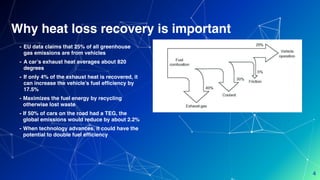
Why heat loss recovery is important
- EU data claims that 25% of all greenhouse
gas emissions are from vehicles
- A car’s exhaust heat averages about 820
degrees
- If only 4% of the exhaust heat is recovered, it
can increase the vehicle’s fuel efficiency by
17.5%
- Maximizes the fuel energy by recycling
otherwise lost waste
- If 50% of cars on the road had a TEG, the
global emissions would reduce by about 2.2%
- When technology advances, it could have the
potential to double fuel efficiency
4
Positives of TEG’s
- Minimal system maintenance
- Silent operation
- High reliability
- No moving and complex mechanical parts are involved
- Zero emissions
- Can be built in a range of sizes
- Many applications
- Can operate in zero or high-G conditions
- Direct energy conversion
- Recycles waste
5
- Very expensive
- 30% cost increase for hybrid vehicles equipped with a TEG
(5-10 years to break even)
- Less efficient than other energy conversion technology
- Design and engineering expertise to effectively apply the
technology to a certain application is very rare
- This limits wider usage
- To work on roads cars, the car must be a hybrid
Downsides of TEG’s
6
Conclusion
Are exhaust heat recovery systems practical enough
to be able to be used on everyday road cars?
- Yes and No
- The technology is already being used
- Difficult to implement
- Depends on your budget
- Needs future development to become large scale
7
Works cited
Fagnan, Rene. “Technique - The MGU-K and MGU-H Explained.”
Motorsport.com, Motorsport.com USA, 24 June 2016,
us.motorsport.com/f1/news/technique-the-mgu-k-and-mgu-h-explained-791187/2986353/.
Keilloh , Graham. “McLaren Reveals MCL34 2019 Formula 1 Car”
Motor Sport Magazine, 14 Feb. 2019,
www.motorsportmagazine.com/news/f1/mclaren-reveals-mcl34-2019-formula-1-car.
Petric, Darjan. “Red Bull – 2019 Honda F1 Engine Has Proper 'Party Mode”
MAXF1net, 8 Jan. 2019,
maxf1.net/en/red-bull-2019-honda-f1-engine-has-proper-party-mode/.
8
Works Cited
9
Avaritsioti, Eleni. “Environmental and Economic Benefits of Car Exhaust Heat Recovery.” Transportation Research Procedia, Science Direct, 27 June 2016,
www.sciencedirect.com/science/article/pii/S2352146516300801.
Barrieu, Edouard. “EHRS Impact on Engine Warm up and Fuel Economy.”Energy.gov, US Department of Energy, 2011, EHRS Impact on Engine
Warm up and Fuel Economy.
Beirnes, Barbara, et al. “How Thermoelectric Generators Work.” Applied Thermoelectric Solutions LLC, 20 Nov. 2019, thermoelectricsolutions.com
how-thermoelectric-generators-work/.
Orr, B., et al. “A Review of Car Waste Heat Recovery Systems Utilising Thermoelectric Generators and Heat Pipes.” Applied Thermal Engineering,
Pergamon, 10 Nov. 2015
www.sciencedirect.com/science/article/pii/S135943111501128X.
Sault, Brooke. “Scientific Guide to Understanding and Using TEG Power!” Knowledge Base for Understanding TEGs - TEG Talk, 21 Apr. 2018,
www.tegmart.com/info/guide-to-understanding-and-using-teg-power-and-products/.

Thermoelectric generators presentation - Travis Grafitti

  • 1.
    The use ofThermoelectric generators to recover exhaust heat waste Are exhaust heat recovery systems practical enough to be able to be used on everyday road cars?
  • 2.
    Thermoelectric generator (TEG)interest came from F1, where they use two types of TEG’s. The one that is mainly used on hybrid road cars is the kinetic energy recovery system.
  • 3.
    How TEG’s work -Heat is transferred through an N and a P type thermoelement - Current is used, or transferred to a battery to be stored 3
  • 4.
    Why heat lossrecovery is important - EU data claims that 25% of all greenhouse gas emissions are from vehicles - A car’s exhaust heat averages about 820 degrees - If only 4% of the exhaust heat is recovered, it can increase the vehicle’s fuel efficiency by 17.5% - Maximizes the fuel energy by recycling otherwise lost waste - If 50% of cars on the road had a TEG, the global emissions would reduce by about 2.2% - When technology advances, it could have the potential to double fuel efficiency 4
  • 5.
    Positives of TEG’s -Minimal system maintenance - Silent operation - High reliability - No moving and complex mechanical parts are involved - Zero emissions - Can be built in a range of sizes - Many applications - Can operate in zero or high-G conditions - Direct energy conversion - Recycles waste 5
  • 6.
    - Very expensive -30% cost increase for hybrid vehicles equipped with a TEG (5-10 years to break even) - Less efficient than other energy conversion technology - Design and engineering expertise to effectively apply the technology to a certain application is very rare - This limits wider usage - To work on roads cars, the car must be a hybrid Downsides of TEG’s 6
  • 7.
    Conclusion Are exhaust heatrecovery systems practical enough to be able to be used on everyday road cars? - Yes and No - The technology is already being used - Difficult to implement - Depends on your budget - Needs future development to become large scale 7
  • 8.
    Works cited Fagnan, Rene.“Technique - The MGU-K and MGU-H Explained.” Motorsport.com, Motorsport.com USA, 24 June 2016, us.motorsport.com/f1/news/technique-the-mgu-k-and-mgu-h-explained-791187/2986353/. Keilloh , Graham. “McLaren Reveals MCL34 2019 Formula 1 Car” Motor Sport Magazine, 14 Feb. 2019, www.motorsportmagazine.com/news/f1/mclaren-reveals-mcl34-2019-formula-1-car. Petric, Darjan. “Red Bull – 2019 Honda F1 Engine Has Proper 'Party Mode” MAXF1net, 8 Jan. 2019, maxf1.net/en/red-bull-2019-honda-f1-engine-has-proper-party-mode/. 8
  • 9.
    Works Cited 9 Avaritsioti, Eleni.“Environmental and Economic Benefits of Car Exhaust Heat Recovery.” Transportation Research Procedia, Science Direct, 27 June 2016, www.sciencedirect.com/science/article/pii/S2352146516300801. Barrieu, Edouard. “EHRS Impact on Engine Warm up and Fuel Economy.”Energy.gov, US Department of Energy, 2011, EHRS Impact on Engine Warm up and Fuel Economy. Beirnes, Barbara, et al. “How Thermoelectric Generators Work.” Applied Thermoelectric Solutions LLC, 20 Nov. 2019, thermoelectricsolutions.com how-thermoelectric-generators-work/. Orr, B., et al. “A Review of Car Waste Heat Recovery Systems Utilising Thermoelectric Generators and Heat Pipes.” Applied Thermal Engineering, Pergamon, 10 Nov. 2015 www.sciencedirect.com/science/article/pii/S135943111501128X. Sault, Brooke. “Scientific Guide to Understanding and Using TEG Power!” Knowledge Base for Understanding TEGs - TEG Talk, 21 Apr. 2018, www.tegmart.com/info/guide-to-understanding-and-using-teg-power-and-products/.