1 ICCPGE 234
______________________________________________________________________________
ICCPGE 234
SIMULATION STUDY OF MISCIBLE CO2 FLOODING IN
STRATIFIED RESERVOIRS
Ahmed I. Omar, Abdulmoain M. Elhenshiri, Abdullah A. Elsherif
This paper was prepared for 1st
International Conference on Chemical, Petroleum, and Gas Engineering
(ICCPGE 2016) Alkhoms, Libya 20 to 22 December 2016
This paper was conducted by GEM simulator, which is a compositional three dimensions reservoir
simulator. Firstly, the study aimed to choose the best tertiary recovery method suited for X field then
followed by simulation studies were designed to investigate the impact of the degree of the vertical
heterogeneity, layers permeability, injection rates and effects of gravity force.
Abstract
The production from underground petroleum reservoirs in early stage is totally
accomplished by the reservoir natural energy. Ultimately, the production will decline, the
secondary phase of oil started then followed by tertiary techniques when it becomes
uneconomical feasible.
The essential aim of this study is to examine the effects of vertical heterogeneity, by
studying the layers permeability order, degree of heterogeneity, injection rate and degree
of communication effects on the performance of miscible gases flooding in reservoir
experiencing vertical stratifications. The second scope of this research is optimizing WAG
techniques in such reservoirs which implemented to control the negative effects of gravity
forces that arise from the huge density and mobility’s difference between the driving and
in-situ reservoir fluid. The sensitivity analysis was designed to account the governing
parameters for predicting efficient scenario of displacement such as slug size, WAG ratio,
and WAG length and gas injection rate.
Based on the result reported in this study, the performance of miscible Co2 process was
the preferable. The Co2 flooding enhanced as the injection rate increased while the fining
upward is the best permeability- depth configuration for such EOR process. Virtually the
communication between the layers lead this process of recovering more oil to limited value
where the gravity force start to act negatively. WAG CO2 EOR performance was assessed
based on the oil recovery factor and the amount of injected CO2, for stratified reservoir
with limited Co2 sources the performance is getting better as the WAG ratio increased until
critical ratio where the effect of miscibility is fully masked.
Introduction
Traditionally, Enhanced oil recovery (EOR) refers to a process implemented to modify the
existing interaction properties either between the reservoir fluids or rock/fluids in order to
optimize ultimate recovery factor, and this interaction might reduce the interfacial tension,
2 ICCPGE 234
______________________________________________________________________________
oil swelling, reduce oil viscosity; also wetability modification. The gas flooding can be
classified into miscible and immiscible, the miscible flood means no more interface
between gas and in-situ hydrocarbon, interfacial tension (IFT) = 0, either at the front or
back of the floo [ ]
.
Generally the miscible displacement process maintains reservoir pressure and improves oil
displacement because the interfacial tension lowering. The fluid most commonly used for
miscible displacement is carbon dioxide because it reduces the oil viscosity and is less
expensive than liquefied petroleum gas. Oil displacement by carbon dioxide injection relies
on the phase behavior of the mixtures of that gas and the crude, these behaviors are strongly
dependent on reservoir temperature, pressure and crude oil composition. To get the
miscibility should keep the pressure above minimum miscible pressure (MMP) and it’s the
lowest pressure at which the interfacial tension between a pair of fluids vanishe [ ]
.
WAG water alternative miscible gas injection has proven its applicability to improve oil
recovery compared to pure water injection or pure gas injection. WAG injection can
improves oil recovery by better sweep efficiency on both macroscopic and microscopic
levels compared to gas injection or water flooding alone. In general the water alternative
gas injection process it can be divided into miscible and immiscible displacement
proces [ ]
.
The efficiency is due to the advantages offered by this technique, including:
• Controls mobility (reduces Gas processing)
• Improves operation (less gas cycling)
• Improve residual oil recovery
Methodology:
Basically the research start with constructing a compositional reservoir simulation model
based on EOS derived from PVT report of well (A-78) given by Melletah oil Company,
the PVT laboratory data contain differential liberation (DL), constant composition
expansion (CCE) and pressure saturation tests. Those results were used to tune the EOS to
be capable of characterizing the CO2-hydrocarbon system above the MMP. The reservoir
oil is undersaturated light oil, see table 1, with stock tank gravity of 38.2 API, the CO2
minimum miscibility pressure (MMP) was determined to approximately be 6040psia.
Table 1. Semi-detailed composition of monophasic fluid
Component CO2 N2 C1 C2 C3 I-C4 N-C4 I-C5
Composition 4.83 0.19 60.21 10.83 3.21 0.69 0.99 0.47
Component N-C5 I-C6 C7 C8 C9 C10 C11 C12+
Composition 0.55 1.18 1.54 1.74 1.17 1.01 0.89 10.5
3 ICCPGE 234
______________________________________________________________________________
The two-parameter Peng-Robinson EOS (Peng and Robinson, 1978) was selected to
regenerate the fluid properties because it has proven to be suitable for low-temperature
CO2-oil mixtures). The Modified Pedersen 1987 selected as the best viscosity correlation
match the oil viscosity test.
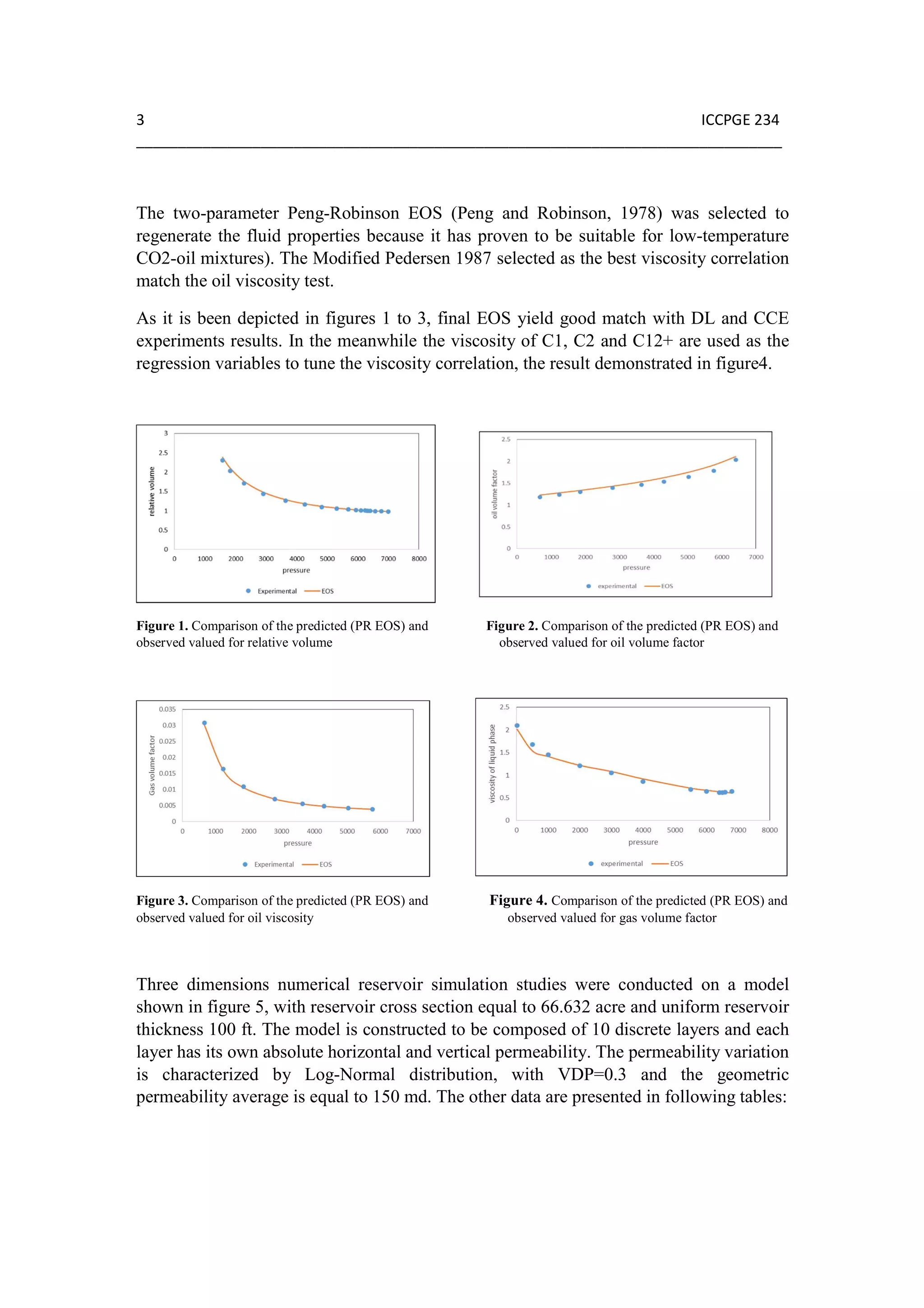
As it is been depicted in figures 1 to 3, final EOS yield good match with DL and CCE
experiments results. In the meanwhile the viscosity of C1, C2 and C12+ are used as the
regression variables to tune the viscosity correlation, the result demonstrated in figure4.
Figure 1. Comparison of the predicted (PR EOS) and Figure 2. Comparison of the predicted (PR EOS) and
observed valued for relative volume observed valued for oil volume factor
Figure 3. Comparison of the predicted (PR EOS) and Figure 4. Comparison of the predicted (PR EOS) and
observed valued for oil viscosity observed valued for gas volume factor
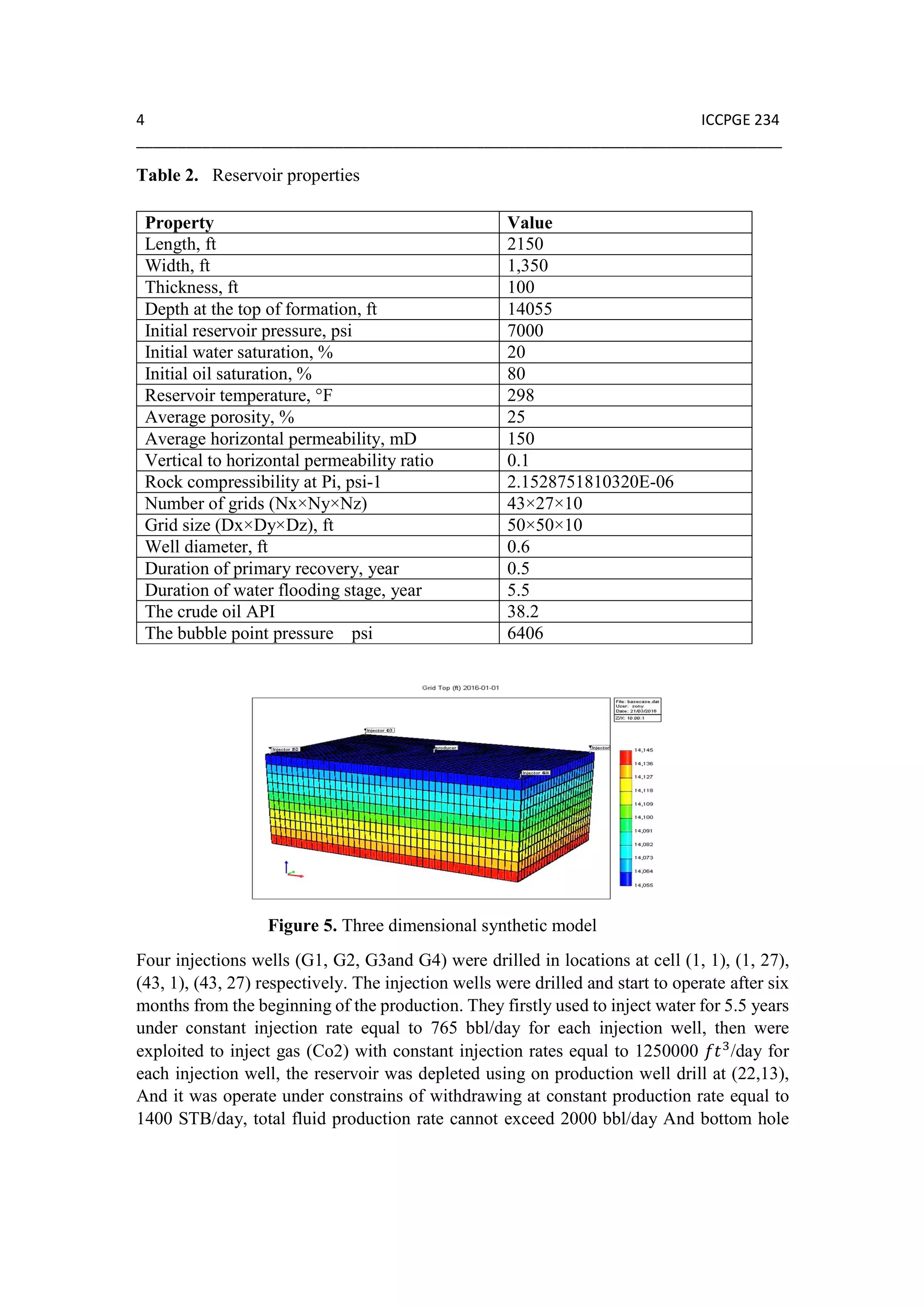
Three dimensions numerical reservoir simulation studies were conducted on a model
shown in figure 5, with reservoir cross section equal to 66.632 acre and uniform reservoir
thickness 100 ft. The model is constructed to be composed of 10 discrete layers and each
layer has its own absolute horizontal and vertical permeability. The permeability variation
is characterized by Log-Normal distribution, with VDP=0.3 and the geometric
permeability average is equal to 150 md. The other data are presented in following tables:
4 ICCPGE 234
______________________________________________________________________________
Table 2. Reservoir properties
Figure 5. Three dimensional synthetic model
Four injections wells (G1, G2, G3and G4) were drilled in locations at cell (1, 1), (1, 27),
(43, 1), (43, 27) respectively. The injection wells were drilled and start to operate after six
months from the beginning of the production. They firstly used to inject water for 5.5 years
under constant injection rate equal to 765 bbl/day for each injection well, then were
exploited to inject gas (Co2) with constant injection rates equal to 1250000 /day for
each injection well, the reservoir was depleted using on production well drill at (22,13),
And it was operate under constrains of withdrawing at constant production rate equal to
1400 STB/day, total fluid production rate cannot exceed 2000 bbl/day And bottom hole
Property Value
Length, ft 2150
Width, ft 1,350
Thickness, ft 100
Depth at the top of formation, ft 14055
Initial reservoir pressure, psi 7000
Initial water saturation, % 20
Initial oil saturation, % 80
Reservoir temperature, °F 298
Average porosity, % 25
Average horizontal permeability, mD 150
Vertical to horizontal permeability ratio 0.1
Rock compressibility at Pi, psi-1 2.1528751810320E-06
Number of grids (Nx×Ny×Nz) 43×27×10
Grid size (Dx×Dy×Dz), ft 50×50×10
Well diameter, ft 0.6
Duration of primary recovery, year 0.5
Duration of water flooding stage, year 5.5
The crude oil API 38.2
The bubble point pressure psi 6406
5 ICCPGE 234
______________________________________________________________________________
pressure in well limited to 2000 psi. The perforation thickness for the all wells were equal
to the reservoir thickness. The production was started at 1 JAN 2016. These operation
constrains were applied to keep depleting the reservoir above its saturation pressure and
sustaining miscibility as long as possible. The model was running for 15 years.
Firstly the model was used to find the optimum EOR process to continues the study with
which was miscible CO2 flood. Simulation studies were deigned to examine the effects of
vertical heterogeneity on such process, the parameters control the gravity dimensionless
number, cross flow between the adjacent layers, the layers permeability order were
sensitized.
• Degree of heterogeneity
The horizontal permeability variation in the vertical direction has significant effect on the
performance of the Co2 flooding. To investigate this effect and since the permeability is
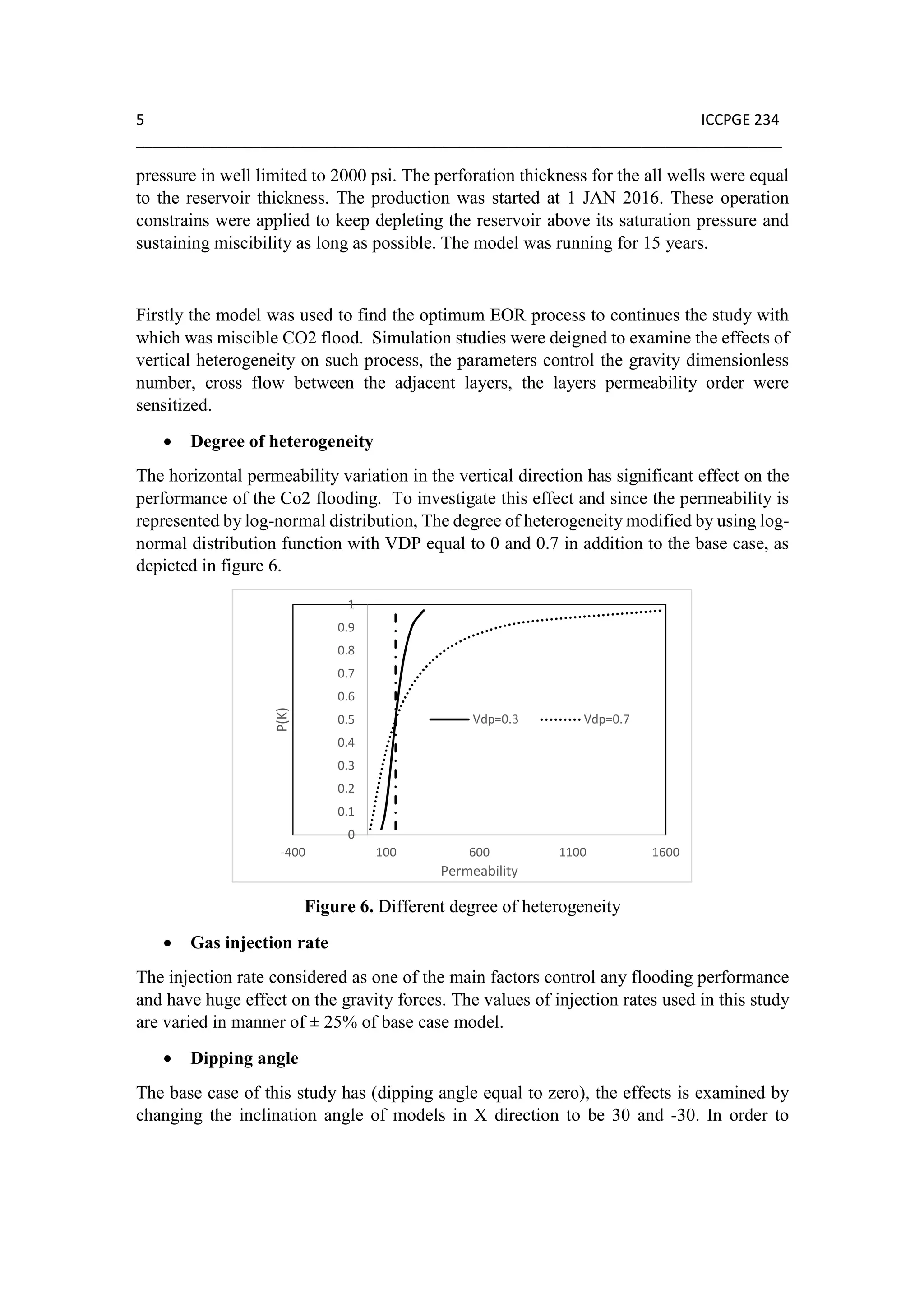
represented by log-normal distribution, The degree of heterogeneity modified by using log-
normal distribution function with VDP equal to 0 and 0.7 in addition to the base case, as
depicted in figure 6.
Figure 6. Different degree of heterogeneity
• Gas injection rate
The injection rate considered as one of the main factors control any flooding performance
and have huge effect on the gravity forces. The values of injection rates used in this study
are varied in manner of ± 25% of base case model.
• Dipping angle
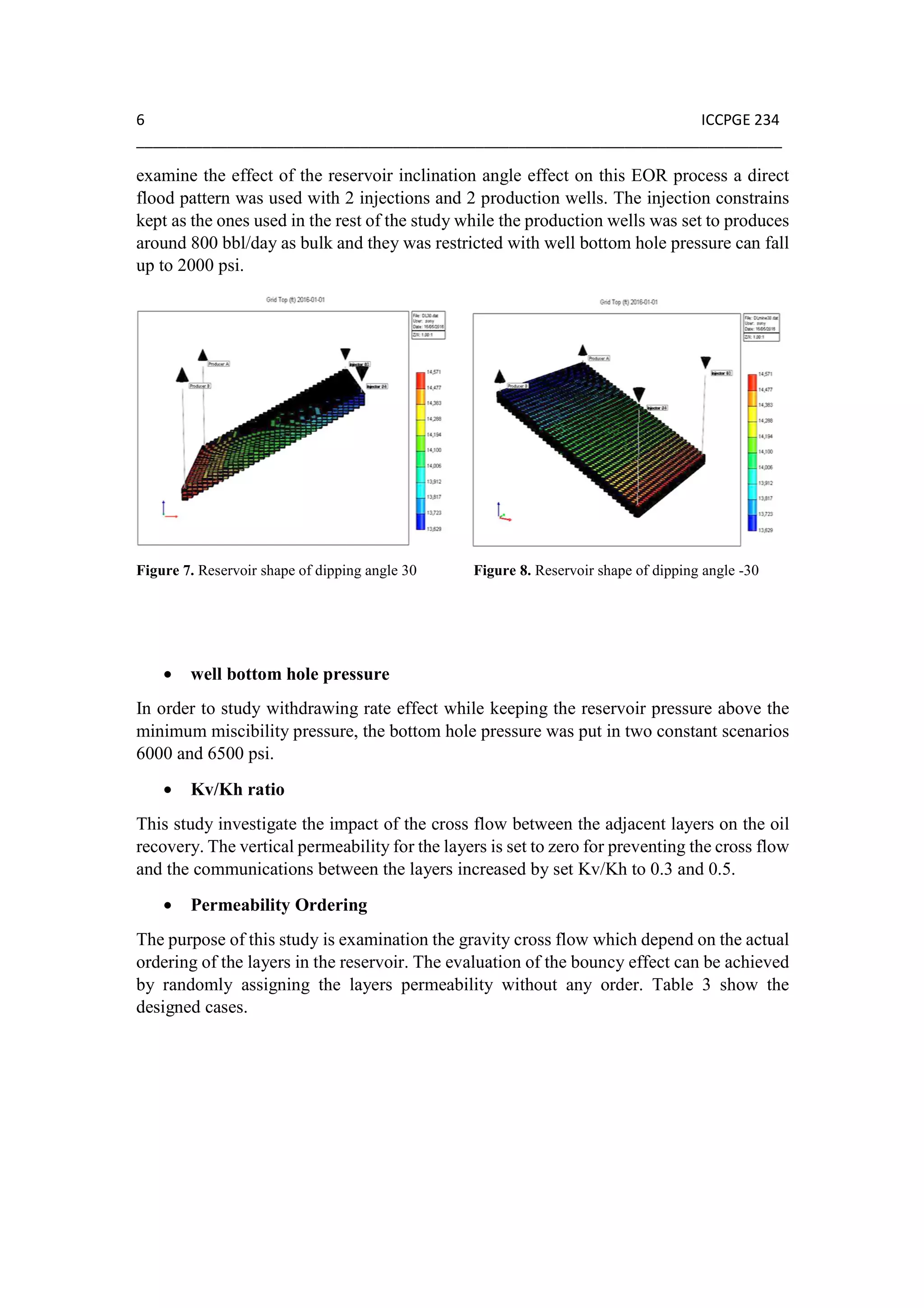
The base case of this study has (dipping angle equal to zero), the effects is examined by
changing the inclination angle of models in X direction to be 30 and -30. In order to
0
0.1
0.2
0.3
0.4
0.5
0.6
0.7
0.8
0.9
1
-400 100 600 1100 1600
P(K)
Permeability
Vdp=0.3 Vdp=0.7
6 ICCPGE 234
______________________________________________________________________________
examine the effect of the reservoir inclination angle effect on this EOR process a direct
flood pattern was used with 2 injections and 2 production wells. The injection constrains
kept as the ones used in the rest of the study while the production wells was set to produces
around 800 bbl/day as bulk and they was restricted with well bottom hole pressure can fall
up to 2000 psi.
Figure 7. Reservoir shape of dipping angle 30 Figure 8. Reservoir shape of dipping angle -30
• well bottom hole pressure
In order to study withdrawing rate effect while keeping the reservoir pressure above the
minimum miscibility pressure, the bottom hole pressure was put in two constant scenarios
6000 and 6500 psi.
• Kv/Kh ratio
This study investigate the impact of the cross flow between the adjacent layers on the oil
recovery. The vertical permeability for the layers is set to zero for preventing the cross flow
and the communications between the layers increased by set Kv/Kh to 0.3 and 0.5.
• Permeability Ordering
The purpose of this study is examination the gravity cross flow which depend on the actual
ordering of the layers in the reservoir. The evaluation of the bouncy effect can be achieved
by randomly assigning the layers permeability without any order. Table 3 show the
designed cases.
7 ICCPGE 234
______________________________________________________________________________
Table 3. Distribution of permeability on reservoir layers
Permeability
md
Fining
downward
Fining
upward
Random
1
Random
2
Random
3
Random
4
Random
5
301.782 1 10 3 6 5 9 8
226.091 2 9 7 5 10 1 3
196.384 3 8 5 7 9 10 4
176.352 4 7 2 10 6 5 9
160.467 5 6 9 8 2 7 1
146.682 6 5 10 4 1 3 2
133.885 7 4 1 9 8 6 10
121.198 8 3 4 1 7 2 6
107.478 9 2 6 3 4 8 7
89.7646 10 1 8 2 3 4 5
• Continuous Co2 injection and miscible Co2 WAG optimizing:
The above mentioned studies are followed by optimizing WAG technique. The sensitivity
analysis was designed to include wide range of parameters to predict the best scenario of
displacement such as slug size, WAG ratio, WAG length and gas injection rate
In typical gas injection processes, the mobility ratio between injected gas and the displaced
oil bank is very unfavorable because of low viscosity of the injected fluids. This lead to
viscous fingering (abridged breakthrough) and reduced sweep efficiency. To overcome
these problems, alternating injection of gas and water with specified volume, known as the
WAG process, has been develope [ ]
.
In WAG process, injection of water as a slightly incompressible fluid can maintain the
reservoir pressure level, which is necessary for developing the miscibility between gas and
oil with acceleration of gas solubility in oil (and therefore oil viscosity reduction). Because
of the density contrast, the injected gas and water usually tend to sweep different portions
of the reservoir. The upper portion of the pore space will tend to be swept by gas while
water will push the oil in the lower parts. In order to optimize the WAG process, there are
several parameters that should be designed carefully such as WAG Ratio, cycle length and
slug size. To study the effect of WAG ratio on recovery for this specific reservoir model,
four cases with WAG ratio of 0.5, 1.0, 2.0 and 0 (continuous CO2 injection) were
considered. Each injection scenario will be continued until the HCPV of injected CO2
reaches 1.0. To consider the effect of cycle length, an additional two cases for the WAG
8 ICCPGE 234
______________________________________________________________________________
ratio of 0.5 will be provided. Table 4 provides a summary of the injection scheme in each
case. The injection rate of fluids is however fixed at 1400 rbbl/day except for all scenarios.
Table 4. Summary of WAG injection scheme in each case
Inj. scenario WAG ratio WAG cycle
length
CO2 inj. length Water inj.
length
[fraction] [months] [months] [months]
1 0 NA NA NA
2 0.5 18 12 6
3 1.0 18 9 9
4 2.0 18 6 12
5 0.5 12 8 4
6 0.5 9 6 3
Simulation results and discussions
Compositional simulation model was used to simulate some enhanced oil recovery
methods, examining their mechanisms of improving the ultimate oil recovery and studying
the effects of the degree of heterogeneity on these techniques performance. The results are
classified based on purpose of study to:
o Result of degree of heterogeneity
The effect of the degree of heterogeneity is obvious on recovery factor, depicted in figure
9, the less recovery factor that we get it when the VDP is equal to 0 and the highest recovery
factor when the VDP is equal to 0.7, this mean the performance of reservoir is getting better
as the heterogeneity increase. The strange response is established due to the reservoir is
layered with coarsen upward permeability- depth configurations with vertical permeability
being set as 10% of the perm J values.
Figure 9. Sensitivity for degree of heterogeneity Figure 10. Sensitivity for degree of heterogeneity
on the recovery factor on the reservoir pressure
9 ICCPGE 234
______________________________________________________________________________
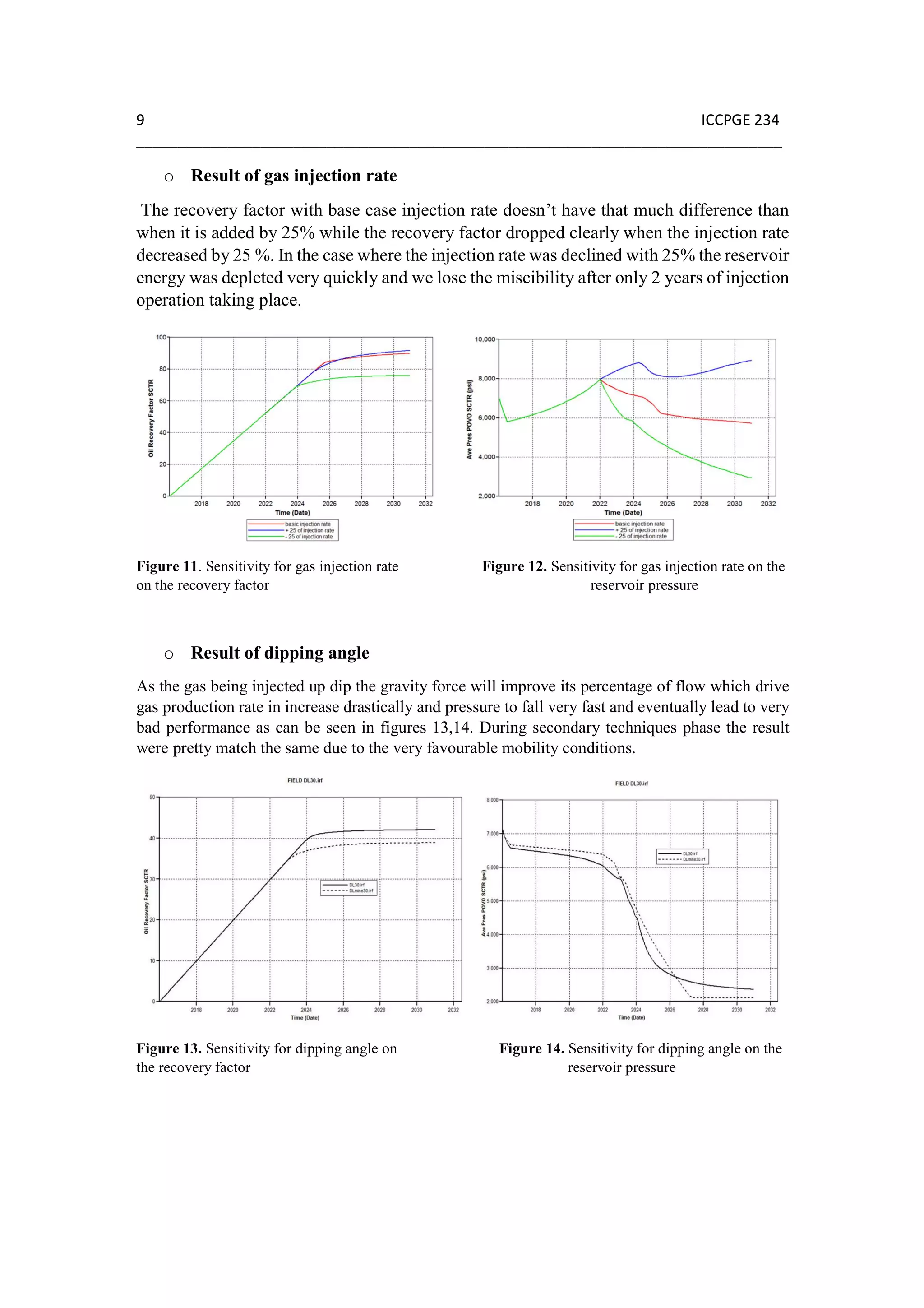
o Result of gas injection rate
The recovery factor with base case injection rate doesn’t have that much difference than
when it is added by 25% while the recovery factor dropped clearly when the injection rate
decreased by 25 %. In the case where the injection rate was declined with 25% the reservoir
energy was depleted very quickly and we lose the miscibility after only 2 years of injection
operation taking place.
Figure 11. Sensitivity for gas injection rate Figure 12. Sensitivity for gas injection rate on the
on the recovery factor reservoir pressure
o Result of dipping angle
As the gas being injected up dip the gravity force will improve its percentage of flow which drive
gas production rate in increase drastically and pressure to fall very fast and eventually lead to very
bad performance as can be seen in figures 13,14. During secondary techniques phase the result
were pretty match the same due to the very favourable mobility conditions.
Figure 13. Sensitivity for dipping angle on Figure 14. Sensitivity for dipping angle on the
the recovery factor reservoir pressure
10 ICCPGE 234
______________________________________________________________________________
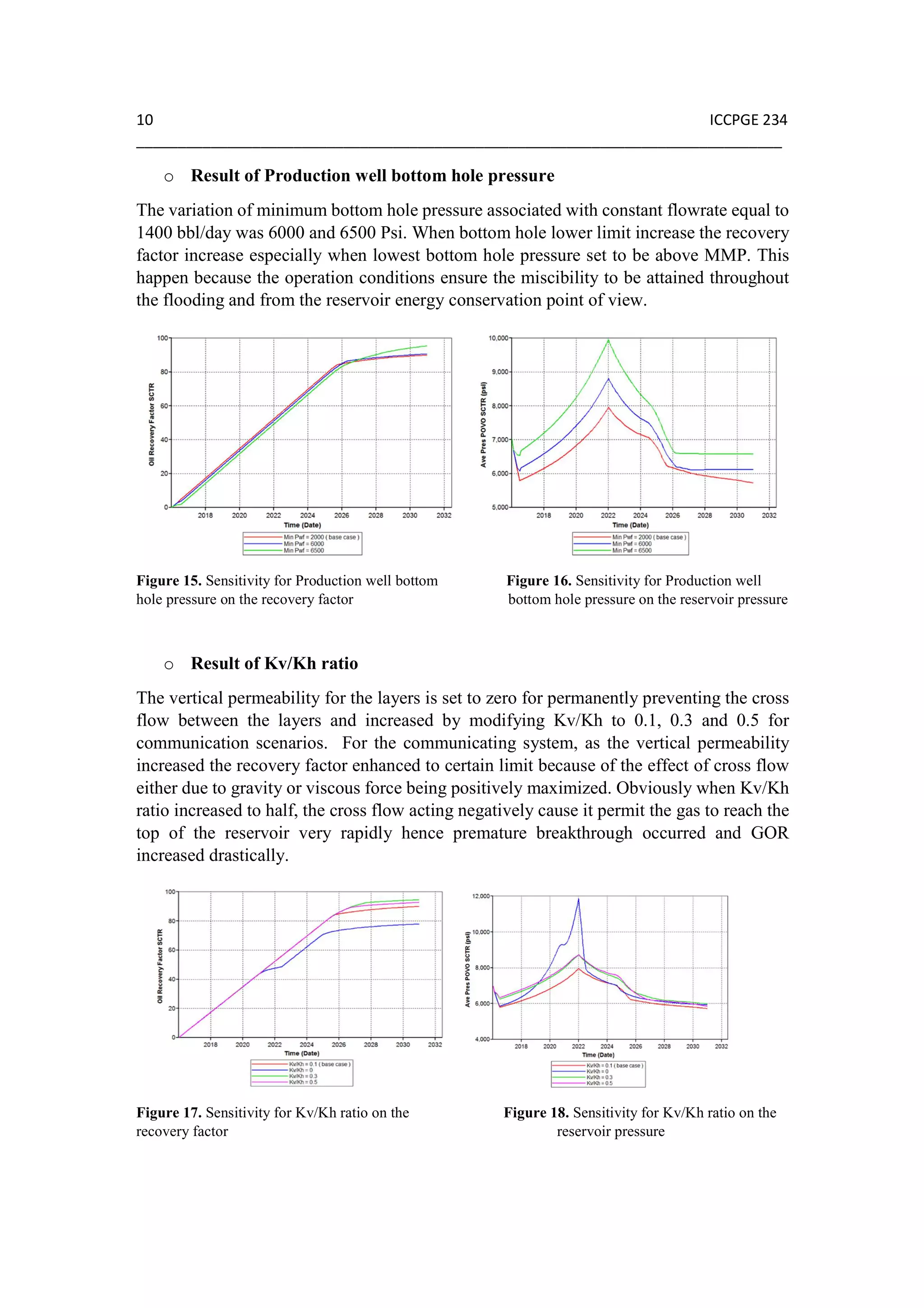
o Result of Production well bottom hole pressure
The variation of minimum bottom hole pressure associated with constant flowrate equal to
1400 bbl/day was 6000 and 6500 Psi. When bottom hole lower limit increase the recovery
factor increase especially when lowest bottom hole pressure set to be above MMP. This
happen because the operation conditions ensure the miscibility to be attained throughout
the flooding and from the reservoir energy conservation point of view.
Figure 15. Sensitivity for Production well bottom Figure 16. Sensitivity for Production well
hole pressure on the recovery factor bottom hole pressure on the reservoir pressure
o Result of Kv/Kh ratio
The vertical permeability for the layers is set to zero for permanently preventing the cross
flow between the layers and increased by modifying Kv/Kh to 0.1, 0.3 and 0.5 for
communication scenarios. For the communicating system, as the vertical permeability
increased the recovery factor enhanced to certain limit because of the effect of cross flow
either due to gravity or viscous force being positively maximized. Obviously when Kv/Kh
ratio increased to half, the cross flow acting negatively cause it permit the gas to reach the
top of the reservoir very rapidly hence premature breakthrough occurred and GOR
increased drastically.
Figure 17. Sensitivity for Kv/Kh ratio on the Figure 18. Sensitivity for Kv/Kh ratio on the
recovery factor reservoir pressure
11 ICCPGE 234
______________________________________________________________________________
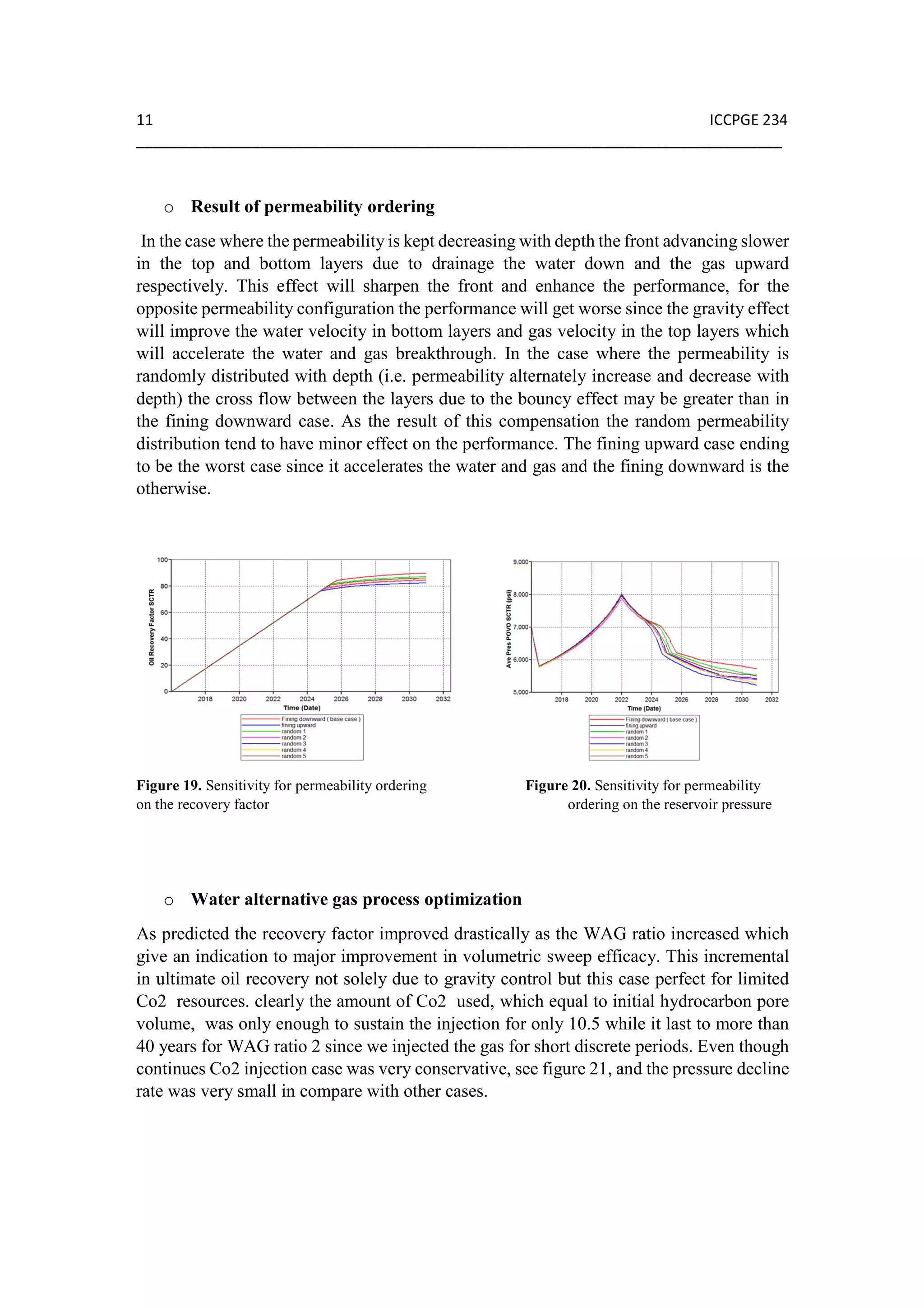
o Result of permeability ordering
In the case where the permeability is kept decreasing with depth the front advancing slower
in the top and bottom layers due to drainage the water down and the gas upward
respectively. This effect will sharpen the front and enhance the performance, for the
opposite permeability configuration the performance will get worse since the gravity effect
will improve the water velocity in bottom layers and gas velocity in the top layers which
will accelerate the water and gas breakthrough. In the case where the permeability is
randomly distributed with depth (i.e. permeability alternately increase and decrease with
depth) the cross flow between the layers due to the bouncy effect may be greater than in
the fining downward case. As the result of this compensation the random permeability
distribution tend to have minor effect on the performance. The fining upward case ending
to be the worst case since it accelerates the water and gas and the fining downward is the
otherwise.
Figure 19. Sensitivity for permeability ordering Figure 20. Sensitivity for permeability
on the recovery factor ordering on the reservoir pressure
o Water alternative gas process optimization
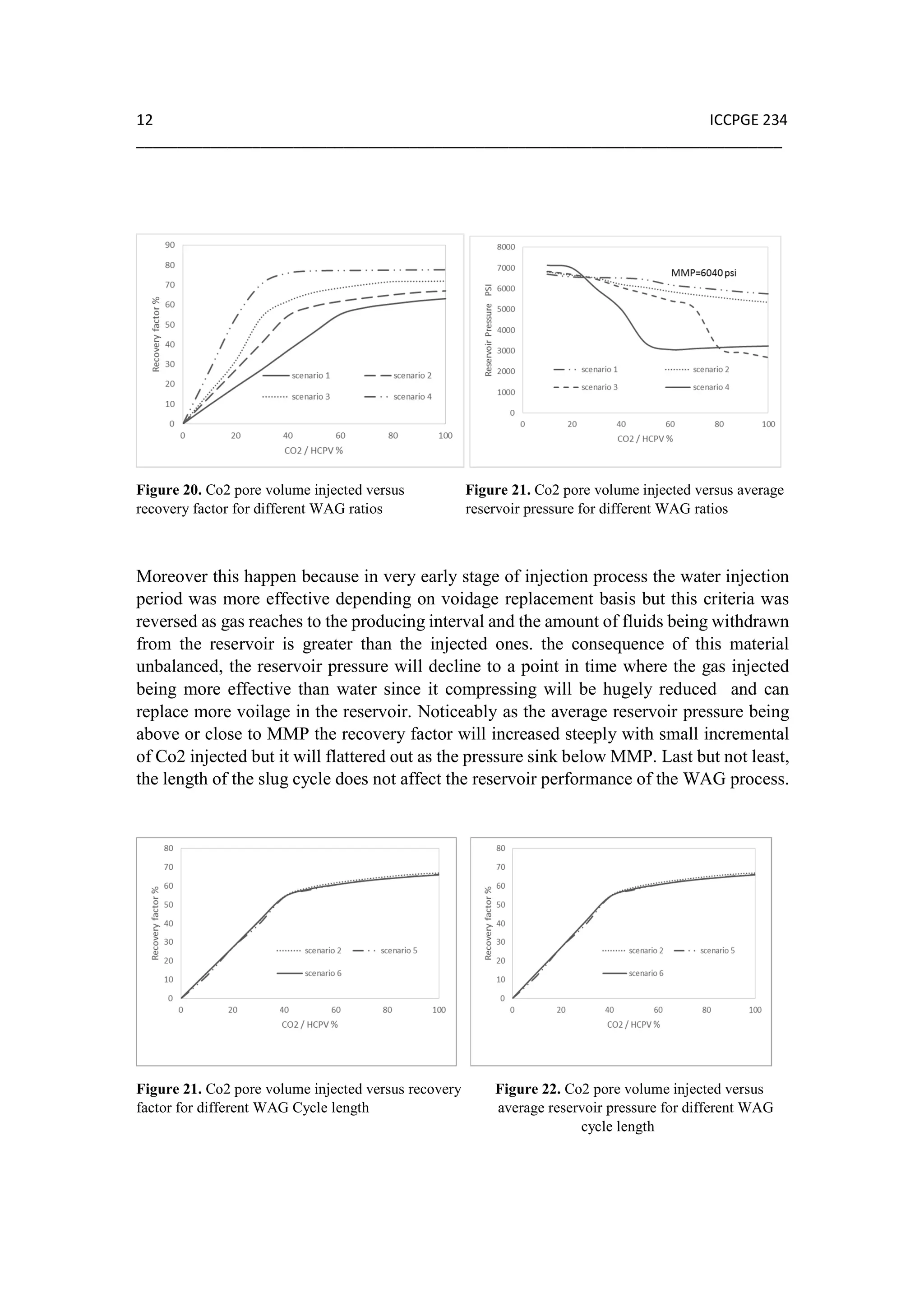
As predicted the recovery factor improved drastically as the WAG ratio increased which
give an indication to major improvement in volumetric sweep efficacy. This incremental
in ultimate oil recovery not solely due to gravity control but this case perfect for limited
Co2 resources. clearly the amount of Co2 used, which equal to initial hydrocarbon pore
volume, was only enough to sustain the injection for only 10.5 while it last to more than
40 years for WAG ratio 2 since we injected the gas for short discrete periods. Even though
continues Co2 injection case was very conservative, see figure 21, and the pressure decline
rate was very small in compare with other cases.
12 ICCPGE 234
______________________________________________________________________________
Figure 20. Co2 pore volume injected versus Figure 21. Co2 pore volume injected versus average
recovery factor for different WAG ratios reservoir pressure for different WAG ratios
Moreover this happen because in very early stage of injection process the water injection
period was more effective depending on voidage replacement basis but this criteria was
reversed as gas reaches to the producing interval and the amount of fluids being withdrawn
from the reservoir is greater than the injected ones. the consequence of this material
unbalanced, the reservoir pressure will decline to a point in time where the gas injected
being more effective than water since it compressing will be hugely reduced and can
replace more voilage in the reservoir. Noticeably as the average reservoir pressure being
above or close to MMP the recovery factor will increased steeply with small incremental
of Co2 injected but it will flattered out as the pressure sink below MMP. Last but not least,
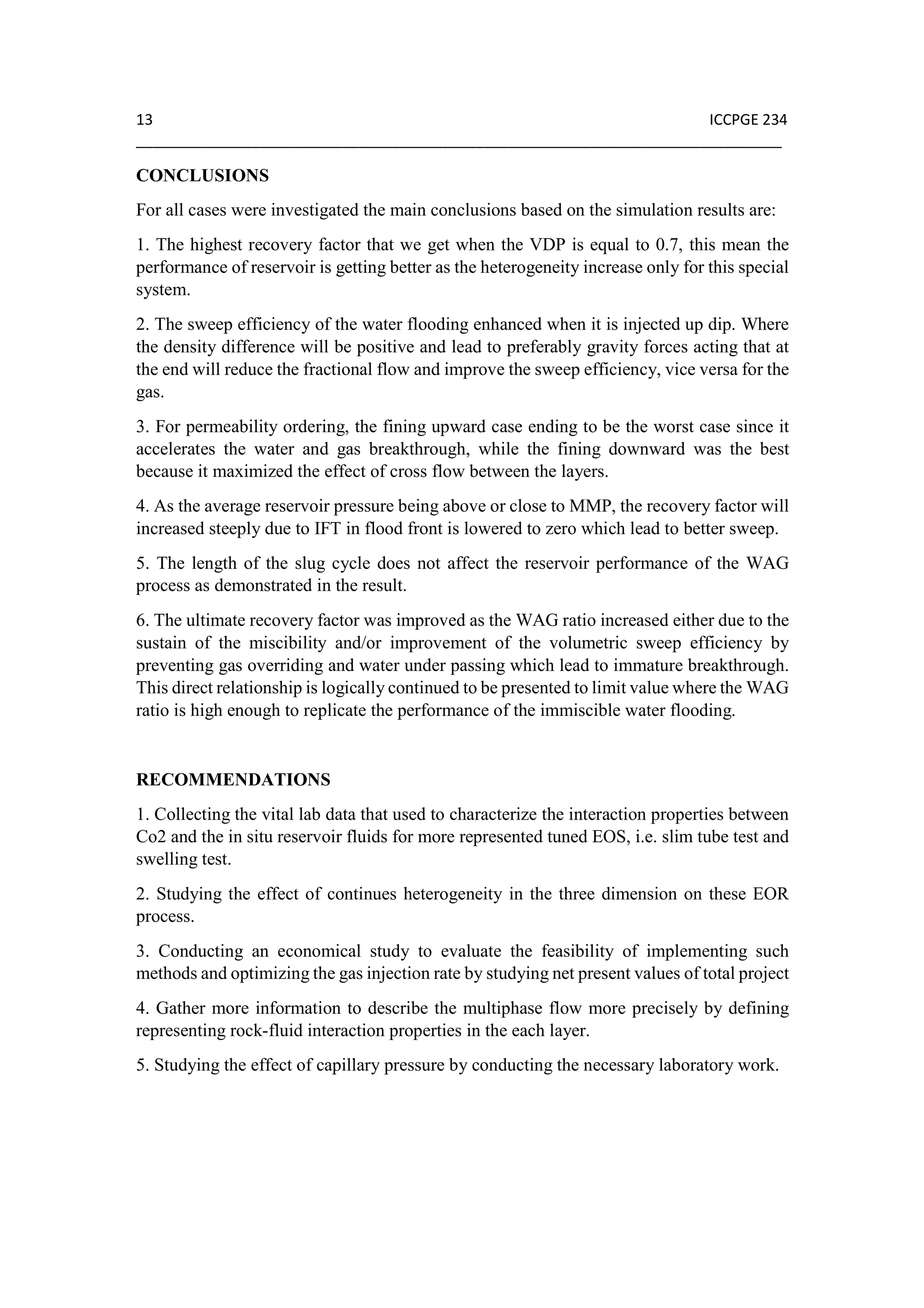
the length of the slug cycle does not affect the reservoir performance of the WAG process.
Figure 21. Co2 pore volume injected versus recovery Figure 22. Co2 pore volume injected versus
factor for different WAG Cycle length average reservoir pressure for different WAG
C cycle length
13 ICCPGE 234
______________________________________________________________________________
CONCLUSIONS
For all cases were investigated the main conclusions based on the simulation results are:
1. The highest recovery factor that we get when the VDP is equal to 0.7, this mean the
performance of reservoir is getting better as the heterogeneity increase only for this special
system.
2. The sweep efficiency of the water flooding enhanced when it is injected up dip. Where
the density difference will be positive and lead to preferably gravity forces acting that at
the end will reduce the fractional flow and improve the sweep efficiency, vice versa for the
gas.
3. For permeability ordering, the fining upward case ending to be the worst case since it
accelerates the water and gas breakthrough, while the fining downward was the best
because it maximized the effect of cross flow between the layers.
4. As the average reservoir pressure being above or close to MMP, the recovery factor will
increased steeply due to IFT in flood front is lowered to zero which lead to better sweep.
5. The length of the slug cycle does not affect the reservoir performance of the WAG
process as demonstrated in the result.
6. The ultimate recovery factor was improved as the WAG ratio increased either due to the
sustain of the miscibility and/or improvement of the volumetric sweep efficiency by
preventing gas overriding and water under passing which lead to immature breakthrough.
This direct relationship is logically continued to be presented to limit value where the WAG
ratio is high enough to replicate the performance of the immiscible water flooding.
RECOMMENDATIONS
1. Collecting the vital lab data that used to characterize the interaction properties between
Co2 and the in situ reservoir fluids for more represented tuned EOS, i.e. slim tube test and
swelling test.
2. Studying the effect of continues heterogeneity in the three dimension on these EOR
process.
3. Conducting an economical study to evaluate the feasibility of implementing such
methods and optimizing the gas injection rate by studying net present values of total project
4. Gather more information to describe the multiphase flow more precisely by defining
representing rock-fluid interaction properties in the each layer.
5. Studying the effect of capillary pressure by conducting the necessary laboratory work.
14 ICCPGE 234
______________________________________________________________________________
References:
[1] - Christensen, J R, Stenby, E H, Skauge , A, “Review of the WAG field experience”,
SPE 71203, revised paper 39883, presented at the 1998 SPE International petroleum
Conference and exhibition of Mexico, Villhermosa, March 3-5, 1998. Paper peer approved
22 January 2001
[2] - M. K. Zahoor, M. N. Derahman, and M. H. Yunan, “Wag Process Design – an Updated
Review,” Brazilian J. Pet. Gas, vol. 5, no. 2, pp. 109–121, 2011.
[3]- Don W. Green, G. Paul Willhite, Enhanced Oil Recovery Henry L. Doherty Memorial
Fund of AIME, Society of Petroleum Engineers, 1998.

ICCPGE

  • 1.
    1 ICCPGE 234 ______________________________________________________________________________ ICCPGE234 SIMULATION STUDY OF MISCIBLE CO2 FLOODING IN STRATIFIED RESERVOIRS Ahmed I. Omar, Abdulmoain M. Elhenshiri, Abdullah A. Elsherif This paper was prepared for 1st International Conference on Chemical, Petroleum, and Gas Engineering (ICCPGE 2016) Alkhoms, Libya 20 to 22 December 2016 This paper was conducted by GEM simulator, which is a compositional three dimensions reservoir simulator. Firstly, the study aimed to choose the best tertiary recovery method suited for X field then followed by simulation studies were designed to investigate the impact of the degree of the vertical heterogeneity, layers permeability, injection rates and effects of gravity force. Abstract The production from underground petroleum reservoirs in early stage is totally accomplished by the reservoir natural energy. Ultimately, the production will decline, the secondary phase of oil started then followed by tertiary techniques when it becomes uneconomical feasible. The essential aim of this study is to examine the effects of vertical heterogeneity, by studying the layers permeability order, degree of heterogeneity, injection rate and degree of communication effects on the performance of miscible gases flooding in reservoir experiencing vertical stratifications. The second scope of this research is optimizing WAG techniques in such reservoirs which implemented to control the negative effects of gravity forces that arise from the huge density and mobility’s difference between the driving and in-situ reservoir fluid. The sensitivity analysis was designed to account the governing parameters for predicting efficient scenario of displacement such as slug size, WAG ratio, and WAG length and gas injection rate. Based on the result reported in this study, the performance of miscible Co2 process was the preferable. The Co2 flooding enhanced as the injection rate increased while the fining upward is the best permeability- depth configuration for such EOR process. Virtually the communication between the layers lead this process of recovering more oil to limited value where the gravity force start to act negatively. WAG CO2 EOR performance was assessed based on the oil recovery factor and the amount of injected CO2, for stratified reservoir with limited Co2 sources the performance is getting better as the WAG ratio increased until critical ratio where the effect of miscibility is fully masked. Introduction Traditionally, Enhanced oil recovery (EOR) refers to a process implemented to modify the existing interaction properties either between the reservoir fluids or rock/fluids in order to optimize ultimate recovery factor, and this interaction might reduce the interfacial tension,
  • 2.
    2 ICCPGE 234 ______________________________________________________________________________ oilswelling, reduce oil viscosity; also wetability modification. The gas flooding can be classified into miscible and immiscible, the miscible flood means no more interface between gas and in-situ hydrocarbon, interfacial tension (IFT) = 0, either at the front or back of the floo [ ] . Generally the miscible displacement process maintains reservoir pressure and improves oil displacement because the interfacial tension lowering. The fluid most commonly used for miscible displacement is carbon dioxide because it reduces the oil viscosity and is less expensive than liquefied petroleum gas. Oil displacement by carbon dioxide injection relies on the phase behavior of the mixtures of that gas and the crude, these behaviors are strongly dependent on reservoir temperature, pressure and crude oil composition. To get the miscibility should keep the pressure above minimum miscible pressure (MMP) and it’s the lowest pressure at which the interfacial tension between a pair of fluids vanishe [ ] . WAG water alternative miscible gas injection has proven its applicability to improve oil recovery compared to pure water injection or pure gas injection. WAG injection can improves oil recovery by better sweep efficiency on both macroscopic and microscopic levels compared to gas injection or water flooding alone. In general the water alternative gas injection process it can be divided into miscible and immiscible displacement proces [ ] . The efficiency is due to the advantages offered by this technique, including: • Controls mobility (reduces Gas processing) • Improves operation (less gas cycling) • Improve residual oil recovery Methodology: Basically the research start with constructing a compositional reservoir simulation model based on EOS derived from PVT report of well (A-78) given by Melletah oil Company, the PVT laboratory data contain differential liberation (DL), constant composition expansion (CCE) and pressure saturation tests. Those results were used to tune the EOS to be capable of characterizing the CO2-hydrocarbon system above the MMP. The reservoir oil is undersaturated light oil, see table 1, with stock tank gravity of 38.2 API, the CO2 minimum miscibility pressure (MMP) was determined to approximately be 6040psia. Table 1. Semi-detailed composition of monophasic fluid Component CO2 N2 C1 C2 C3 I-C4 N-C4 I-C5 Composition 4.83 0.19 60.21 10.83 3.21 0.69 0.99 0.47 Component N-C5 I-C6 C7 C8 C9 C10 C11 C12+ Composition 0.55 1.18 1.54 1.74 1.17 1.01 0.89 10.5
  • 3.
    3 ICCPGE 234 ______________________________________________________________________________ Thetwo-parameter Peng-Robinson EOS (Peng and Robinson, 1978) was selected to regenerate the fluid properties because it has proven to be suitable for low-temperature CO2-oil mixtures). The Modified Pedersen 1987 selected as the best viscosity correlation match the oil viscosity test. As it is been depicted in figures 1 to 3, final EOS yield good match with DL and CCE experiments results. In the meanwhile the viscosity of C1, C2 and C12+ are used as the regression variables to tune the viscosity correlation, the result demonstrated in figure4. Figure 1. Comparison of the predicted (PR EOS) and Figure 2. Comparison of the predicted (PR EOS) and observed valued for relative volume observed valued for oil volume factor Figure 3. Comparison of the predicted (PR EOS) and Figure 4. Comparison of the predicted (PR EOS) and observed valued for oil viscosity observed valued for gas volume factor Three dimensions numerical reservoir simulation studies were conducted on a model shown in figure 5, with reservoir cross section equal to 66.632 acre and uniform reservoir thickness 100 ft. The model is constructed to be composed of 10 discrete layers and each layer has its own absolute horizontal and vertical permeability. The permeability variation is characterized by Log-Normal distribution, with VDP=0.3 and the geometric permeability average is equal to 150 md. The other data are presented in following tables:
  • 4.
    4 ICCPGE 234 ______________________________________________________________________________ Table2. Reservoir properties Figure 5. Three dimensional synthetic model Four injections wells (G1, G2, G3and G4) were drilled in locations at cell (1, 1), (1, 27), (43, 1), (43, 27) respectively. The injection wells were drilled and start to operate after six months from the beginning of the production. They firstly used to inject water for 5.5 years under constant injection rate equal to 765 bbl/day for each injection well, then were exploited to inject gas (Co2) with constant injection rates equal to 1250000 /day for each injection well, the reservoir was depleted using on production well drill at (22,13), And it was operate under constrains of withdrawing at constant production rate equal to 1400 STB/day, total fluid production rate cannot exceed 2000 bbl/day And bottom hole Property Value Length, ft 2150 Width, ft 1,350 Thickness, ft 100 Depth at the top of formation, ft 14055 Initial reservoir pressure, psi 7000 Initial water saturation, % 20 Initial oil saturation, % 80 Reservoir temperature, °F 298 Average porosity, % 25 Average horizontal permeability, mD 150 Vertical to horizontal permeability ratio 0.1 Rock compressibility at Pi, psi-1 2.1528751810320E-06 Number of grids (Nx×Ny×Nz) 43×27×10 Grid size (Dx×Dy×Dz), ft 50×50×10 Well diameter, ft 0.6 Duration of primary recovery, year 0.5 Duration of water flooding stage, year 5.5 The crude oil API 38.2 The bubble point pressure psi 6406
  • 5.
    5 ICCPGE 234 ______________________________________________________________________________ pressurein well limited to 2000 psi. The perforation thickness for the all wells were equal to the reservoir thickness. The production was started at 1 JAN 2016. These operation constrains were applied to keep depleting the reservoir above its saturation pressure and sustaining miscibility as long as possible. The model was running for 15 years. Firstly the model was used to find the optimum EOR process to continues the study with which was miscible CO2 flood. Simulation studies were deigned to examine the effects of vertical heterogeneity on such process, the parameters control the gravity dimensionless number, cross flow between the adjacent layers, the layers permeability order were sensitized. • Degree of heterogeneity The horizontal permeability variation in the vertical direction has significant effect on the performance of the Co2 flooding. To investigate this effect and since the permeability is represented by log-normal distribution, The degree of heterogeneity modified by using log- normal distribution function with VDP equal to 0 and 0.7 in addition to the base case, as depicted in figure 6. Figure 6. Different degree of heterogeneity • Gas injection rate The injection rate considered as one of the main factors control any flooding performance and have huge effect on the gravity forces. The values of injection rates used in this study are varied in manner of ± 25% of base case model. • Dipping angle The base case of this study has (dipping angle equal to zero), the effects is examined by changing the inclination angle of models in X direction to be 30 and -30. In order to 0 0.1 0.2 0.3 0.4 0.5 0.6 0.7 0.8 0.9 1 -400 100 600 1100 1600 P(K) Permeability Vdp=0.3 Vdp=0.7
  • 6.
    6 ICCPGE 234 ______________________________________________________________________________ examinethe effect of the reservoir inclination angle effect on this EOR process a direct flood pattern was used with 2 injections and 2 production wells. The injection constrains kept as the ones used in the rest of the study while the production wells was set to produces around 800 bbl/day as bulk and they was restricted with well bottom hole pressure can fall up to 2000 psi. Figure 7. Reservoir shape of dipping angle 30 Figure 8. Reservoir shape of dipping angle -30 • well bottom hole pressure In order to study withdrawing rate effect while keeping the reservoir pressure above the minimum miscibility pressure, the bottom hole pressure was put in two constant scenarios 6000 and 6500 psi. • Kv/Kh ratio This study investigate the impact of the cross flow between the adjacent layers on the oil recovery. The vertical permeability for the layers is set to zero for preventing the cross flow and the communications between the layers increased by set Kv/Kh to 0.3 and 0.5. • Permeability Ordering The purpose of this study is examination the gravity cross flow which depend on the actual ordering of the layers in the reservoir. The evaluation of the bouncy effect can be achieved by randomly assigning the layers permeability without any order. Table 3 show the designed cases.
  • 7.
    7 ICCPGE 234 ______________________________________________________________________________ Table3. Distribution of permeability on reservoir layers Permeability md Fining downward Fining upward Random 1 Random 2 Random 3 Random 4 Random 5 301.782 1 10 3 6 5 9 8 226.091 2 9 7 5 10 1 3 196.384 3 8 5 7 9 10 4 176.352 4 7 2 10 6 5 9 160.467 5 6 9 8 2 7 1 146.682 6 5 10 4 1 3 2 133.885 7 4 1 9 8 6 10 121.198 8 3 4 1 7 2 6 107.478 9 2 6 3 4 8 7 89.7646 10 1 8 2 3 4 5 • Continuous Co2 injection and miscible Co2 WAG optimizing: The above mentioned studies are followed by optimizing WAG technique. The sensitivity analysis was designed to include wide range of parameters to predict the best scenario of displacement such as slug size, WAG ratio, WAG length and gas injection rate In typical gas injection processes, the mobility ratio between injected gas and the displaced oil bank is very unfavorable because of low viscosity of the injected fluids. This lead to viscous fingering (abridged breakthrough) and reduced sweep efficiency. To overcome these problems, alternating injection of gas and water with specified volume, known as the WAG process, has been develope [ ] . In WAG process, injection of water as a slightly incompressible fluid can maintain the reservoir pressure level, which is necessary for developing the miscibility between gas and oil with acceleration of gas solubility in oil (and therefore oil viscosity reduction). Because of the density contrast, the injected gas and water usually tend to sweep different portions of the reservoir. The upper portion of the pore space will tend to be swept by gas while water will push the oil in the lower parts. In order to optimize the WAG process, there are several parameters that should be designed carefully such as WAG Ratio, cycle length and slug size. To study the effect of WAG ratio on recovery for this specific reservoir model, four cases with WAG ratio of 0.5, 1.0, 2.0 and 0 (continuous CO2 injection) were considered. Each injection scenario will be continued until the HCPV of injected CO2 reaches 1.0. To consider the effect of cycle length, an additional two cases for the WAG
  • 8.
    8 ICCPGE 234 ______________________________________________________________________________ ratioof 0.5 will be provided. Table 4 provides a summary of the injection scheme in each case. The injection rate of fluids is however fixed at 1400 rbbl/day except for all scenarios. Table 4. Summary of WAG injection scheme in each case Inj. scenario WAG ratio WAG cycle length CO2 inj. length Water inj. length [fraction] [months] [months] [months] 1 0 NA NA NA 2 0.5 18 12 6 3 1.0 18 9 9 4 2.0 18 6 12 5 0.5 12 8 4 6 0.5 9 6 3 Simulation results and discussions Compositional simulation model was used to simulate some enhanced oil recovery methods, examining their mechanisms of improving the ultimate oil recovery and studying the effects of the degree of heterogeneity on these techniques performance. The results are classified based on purpose of study to: o Result of degree of heterogeneity The effect of the degree of heterogeneity is obvious on recovery factor, depicted in figure 9, the less recovery factor that we get it when the VDP is equal to 0 and the highest recovery factor when the VDP is equal to 0.7, this mean the performance of reservoir is getting better as the heterogeneity increase. The strange response is established due to the reservoir is layered with coarsen upward permeability- depth configurations with vertical permeability being set as 10% of the perm J values. Figure 9. Sensitivity for degree of heterogeneity Figure 10. Sensitivity for degree of heterogeneity on the recovery factor on the reservoir pressure
  • 9.
    9 ICCPGE 234 ______________________________________________________________________________ oResult of gas injection rate The recovery factor with base case injection rate doesn’t have that much difference than when it is added by 25% while the recovery factor dropped clearly when the injection rate decreased by 25 %. In the case where the injection rate was declined with 25% the reservoir energy was depleted very quickly and we lose the miscibility after only 2 years of injection operation taking place. Figure 11. Sensitivity for gas injection rate Figure 12. Sensitivity for gas injection rate on the on the recovery factor reservoir pressure o Result of dipping angle As the gas being injected up dip the gravity force will improve its percentage of flow which drive gas production rate in increase drastically and pressure to fall very fast and eventually lead to very bad performance as can be seen in figures 13,14. During secondary techniques phase the result were pretty match the same due to the very favourable mobility conditions. Figure 13. Sensitivity for dipping angle on Figure 14. Sensitivity for dipping angle on the the recovery factor reservoir pressure
  • 10.
    10 ICCPGE 234 ______________________________________________________________________________ oResult of Production well bottom hole pressure The variation of minimum bottom hole pressure associated with constant flowrate equal to 1400 bbl/day was 6000 and 6500 Psi. When bottom hole lower limit increase the recovery factor increase especially when lowest bottom hole pressure set to be above MMP. This happen because the operation conditions ensure the miscibility to be attained throughout the flooding and from the reservoir energy conservation point of view. Figure 15. Sensitivity for Production well bottom Figure 16. Sensitivity for Production well hole pressure on the recovery factor bottom hole pressure on the reservoir pressure o Result of Kv/Kh ratio The vertical permeability for the layers is set to zero for permanently preventing the cross flow between the layers and increased by modifying Kv/Kh to 0.1, 0.3 and 0.5 for communication scenarios. For the communicating system, as the vertical permeability increased the recovery factor enhanced to certain limit because of the effect of cross flow either due to gravity or viscous force being positively maximized. Obviously when Kv/Kh ratio increased to half, the cross flow acting negatively cause it permit the gas to reach the top of the reservoir very rapidly hence premature breakthrough occurred and GOR increased drastically. Figure 17. Sensitivity for Kv/Kh ratio on the Figure 18. Sensitivity for Kv/Kh ratio on the recovery factor reservoir pressure
  • 11.
    11 ICCPGE 234 ______________________________________________________________________________ oResult of permeability ordering In the case where the permeability is kept decreasing with depth the front advancing slower in the top and bottom layers due to drainage the water down and the gas upward respectively. This effect will sharpen the front and enhance the performance, for the opposite permeability configuration the performance will get worse since the gravity effect will improve the water velocity in bottom layers and gas velocity in the top layers which will accelerate the water and gas breakthrough. In the case where the permeability is randomly distributed with depth (i.e. permeability alternately increase and decrease with depth) the cross flow between the layers due to the bouncy effect may be greater than in the fining downward case. As the result of this compensation the random permeability distribution tend to have minor effect on the performance. The fining upward case ending to be the worst case since it accelerates the water and gas and the fining downward is the otherwise. Figure 19. Sensitivity for permeability ordering Figure 20. Sensitivity for permeability on the recovery factor ordering on the reservoir pressure o Water alternative gas process optimization As predicted the recovery factor improved drastically as the WAG ratio increased which give an indication to major improvement in volumetric sweep efficacy. This incremental in ultimate oil recovery not solely due to gravity control but this case perfect for limited Co2 resources. clearly the amount of Co2 used, which equal to initial hydrocarbon pore volume, was only enough to sustain the injection for only 10.5 while it last to more than 40 years for WAG ratio 2 since we injected the gas for short discrete periods. Even though continues Co2 injection case was very conservative, see figure 21, and the pressure decline rate was very small in compare with other cases.
  • 12.
    12 ICCPGE 234 ______________________________________________________________________________ Figure20. Co2 pore volume injected versus Figure 21. Co2 pore volume injected versus average recovery factor for different WAG ratios reservoir pressure for different WAG ratios Moreover this happen because in very early stage of injection process the water injection period was more effective depending on voidage replacement basis but this criteria was reversed as gas reaches to the producing interval and the amount of fluids being withdrawn from the reservoir is greater than the injected ones. the consequence of this material unbalanced, the reservoir pressure will decline to a point in time where the gas injected being more effective than water since it compressing will be hugely reduced and can replace more voilage in the reservoir. Noticeably as the average reservoir pressure being above or close to MMP the recovery factor will increased steeply with small incremental of Co2 injected but it will flattered out as the pressure sink below MMP. Last but not least, the length of the slug cycle does not affect the reservoir performance of the WAG process. Figure 21. Co2 pore volume injected versus recovery Figure 22. Co2 pore volume injected versus factor for different WAG Cycle length average reservoir pressure for different WAG C cycle length
  • 13.
    13 ICCPGE 234 ______________________________________________________________________________ CONCLUSIONS Forall cases were investigated the main conclusions based on the simulation results are: 1. The highest recovery factor that we get when the VDP is equal to 0.7, this mean the performance of reservoir is getting better as the heterogeneity increase only for this special system. 2. The sweep efficiency of the water flooding enhanced when it is injected up dip. Where the density difference will be positive and lead to preferably gravity forces acting that at the end will reduce the fractional flow and improve the sweep efficiency, vice versa for the gas. 3. For permeability ordering, the fining upward case ending to be the worst case since it accelerates the water and gas breakthrough, while the fining downward was the best because it maximized the effect of cross flow between the layers. 4. As the average reservoir pressure being above or close to MMP, the recovery factor will increased steeply due to IFT in flood front is lowered to zero which lead to better sweep. 5. The length of the slug cycle does not affect the reservoir performance of the WAG process as demonstrated in the result. 6. The ultimate recovery factor was improved as the WAG ratio increased either due to the sustain of the miscibility and/or improvement of the volumetric sweep efficiency by preventing gas overriding and water under passing which lead to immature breakthrough. This direct relationship is logically continued to be presented to limit value where the WAG ratio is high enough to replicate the performance of the immiscible water flooding. RECOMMENDATIONS 1. Collecting the vital lab data that used to characterize the interaction properties between Co2 and the in situ reservoir fluids for more represented tuned EOS, i.e. slim tube test and swelling test. 2. Studying the effect of continues heterogeneity in the three dimension on these EOR process. 3. Conducting an economical study to evaluate the feasibility of implementing such methods and optimizing the gas injection rate by studying net present values of total project 4. Gather more information to describe the multiphase flow more precisely by defining representing rock-fluid interaction properties in the each layer. 5. Studying the effect of capillary pressure by conducting the necessary laboratory work.
  • 14.
    14 ICCPGE 234 ______________________________________________________________________________ References: [1]- Christensen, J R, Stenby, E H, Skauge , A, “Review of the WAG field experience”, SPE 71203, revised paper 39883, presented at the 1998 SPE International petroleum Conference and exhibition of Mexico, Villhermosa, March 3-5, 1998. Paper peer approved 22 January 2001 [2] - M. K. Zahoor, M. N. Derahman, and M. H. Yunan, “Wag Process Design – an Updated Review,” Brazilian J. Pet. Gas, vol. 5, no. 2, pp. 109–121, 2011. [3]- Don W. Green, G. Paul Willhite, Enhanced Oil Recovery Henry L. Doherty Memorial Fund of AIME, Society of Petroleum Engineers, 1998.